Christian use of digital devices redefines ‘going to church’

McKINNEY (RNS)—No matter where people live, they can go to church—virtually, at least—with Christ Fellowship in McKinney, which is on board with almost every high-tech gadget under heaven.

Christ Fellowship in McKinney offers worshippers a Facebook page, online sermons, live chats and QR codes.

Find the church by going online—the 21st-century version of sighting a steeple on the horizon. Beyond its website, Christ Fellowship also has a Facebook page.

The curious can download the worship program by scanning their customized-with-a-cross QR code. Worship services are streamed online from the church's Internet campus—with live chat running so participants can share spiritual insights in real time.

Afterward, Senior Pastor Bruce Miller said: ''Someone will ask you, 'How did it go? Did God help you today? How can we help you?' Just like we do when people come to our building in McKinney. We are here to help people find and follow Christ, wherever they are starting out from.''

And wherever they are in the digital world.

Christ Fellowship exemplifies most of the latest ways churches dramatically extend their reach beyond any one time or local address. Such congregations signal ''a willingness to meet new challenges,'' said Scott Thumma, of the Hartford Institute for Religion Research, author of a study by Faith Communities Today of how churches, synagogues and mosques use the Internet and other technology.

Sermons by Bruce Miller, senior pastor of Christ Fellowship Church in McKinney, Texas, are part of the streaming worship service offered by the church's Internet campus.

The organization's national survey of 11,077 of the nation's 335,000 congregations found seven in 10 U.S. congregations had websites, and four in 10 had Facebook pages by 2010.

The use of QR codes—which allow users to scan a bar code with their cell phone and go directly to a related website—is too new to be measured yet, Thumma said. He recently began tracking churches that stream worship—about 1 percent of congregations, he estimates.

Future surveys may measure the explosion of digital applications. Christ Fellowship has one app for donating online and another for swapping goods and services to help others in the community—2,100 people at the North Texas church campus and God knows how many online.

Believers have been early adopters of every new form of communication since the first printed book—the Gutenberg Bible. Centuries later, examples abound beyond individual congregations:

• Pope Benedict XVI's annual World Communications address emphasized the importance of a Christian presence in the digital world. The Vatican has a Web TV channel and had a Twitter campaign during Lent.

• Confession: A Roman Catholic App—released for the iPhone a year ago by www.littleiapps.com, a U.S. company—has been downloaded more than 100,000 times. Sacraments can't be done virtually so ''you are not YouTube-ing or emailing your confession,'' said Patrick Leinen, a cofounder of the company.
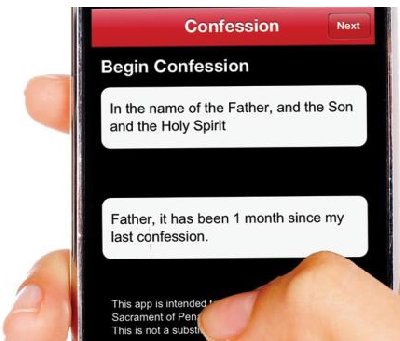
Confession: A Roman Catholic App has been downloaded more than 100,000 times since the aide to Roman Catholic confessions was released a year ago, according to co-founder Patrick Leinen.

The app is a ''personalized examination of conscience,'' an aid that prompts Catholics through the required preconfession soul-searching. Then they can bring notes right in to meet the priest, Leinen said.

The Billy Graham Evangelistic Association, a pioneer in print, radio, television and satellite-broadcast outreach for decades, now employs search-engine algorithms to steer people toward salvation.

Its Internet evangelism project, launched last fall, scours search engines for people who enter phrases such as, ''Does God love me?'' or ''Does God answer prayers?'' The results page includes a paid listing that highlights a website introducing Christ, www.PeaceWithGod.jesus.net.

People who sign on to the sinner's prayer on that page turn up in a real-time scroll of the latest ''decisions'' at www.SearchforJesus.net, a page that explains the Internet ministry.

• Believers can sing along with a new tablet hymnal from Church Publishing. In March, the Episcopal Church's publishing house released eHymnals for the iPad and other digital readers.

With the infinite reach of technology, ''people are able to confront God in unique ways even if they are hundreds of miles apart,'' said John Mark Reynolds, director of the honors institute at Biola University, a private evangelical school in La Mirada, Calif. Biola held a conference on blogging two years ago. It updated to a Web-focused conference last year, and this June, the conference zeroed in on digital technology.

No matter the technology, the overall focus remains the same, Reynolds said: ''How can the Christian church utilize the tools media has given us without being subsumed by them? You don't want delivery to become everything.''

Technology ultimately should be an enhancement, not a re-placement, for gathering in person for worship, discussion, debate and service to others, said Drew Goodmanson, CEO of Monk Development, which helps churches use the Internet to fulfill their missions.

Goodmanson appreciates that ''you can have a digital Bible in the palm of your hand or connect with others in prayer any time, anywhere.'' Even so, he cautioned: ''Jesus would not have a Facebook page. He wouldn't be stopping in an Internet cafe to update his status.''


Steven Curtis Chapman encourages audiences to show hope

NASHVILLE, Tenn.—For more than 25 years, Steven Curtis Chapman has been sharing songs and stories about God's redemption, grace, love and faithfulness with audiences around the world. Along the way, Chapman has garnered 56 Dove Awards from the Gospel Music Association, five Grammy Awards and 46 No. 1 radio hits.

Through it all, he has remained dedicated to shining the spotlight on Christ.

Steven Curtis Chapman

"Realizing that God has entrusted me with a calling to lead people before his throne gives a greater meaning and purpose to performing concerts and writing songs," Chapman said. 

"I love hearing stories about people accepting Christ during a concert or how a song on the radio inspired someone to follow the Lord. It is the greatest honor and privilege knowing that these songs are leading people to Christ.  

"With all the songs that I've written through the years, my prayer has been: 'Lord, I want to know you more. As you make yourself known, I want to make you known to others through what I write, sing and the stories I tell.'"

In addition to his music, Chapman desires to create platforms to reach out and help those in need.

As strong advocates for adoption and orphan care, he and his wife, Mary Beth, have adopted three daughters from China. They also established a ministry, Show Hope , that has given more than 2,600 financial grants to adoptive families and has affected the lives of children from 45 countries. 

In addition to financial aid, Show Hope empowers families, communities and churches with adoption and orphan care resources to assist them in advocating and caring for the millions of orphans around the world. Show Hope also provides for orphans with special needs through special care centers in China.

The Christian Alliance for Orphans presented the Chapmans with the Defender of the Fatherless Award at Saddleback Church in Lake Forest, Calif.

In 2008, the Chapman family was devastated by the death of their adopted daughter, Maria Sue. However, they found comfort and strength through God's faithfulness and unfailing love.

Now, with an even greater passion and purpose for sharing the gospel through songs, Chapman hopes his music will help provide comfort for people dealing with the loss of a loved one.

"After Maria went to heaven, I was crying out to God in the midst of grief, darkness and despair," Chapman said.

"I kept saying, 'God, I trust you … even though I don't understand.' When I started doing concerts again, I found there was a new meaning, purpose and passion in the song lyrics. 

"Just as my family had walked through more valleys than we ever had before, I was singing about trusting God, his sovereignty and faithfulness. I found myself singing many of the lyrics with a new understanding and new desperation for the truth of the gospel.

"Even to this day, God is still leading us out of those dark places. We still wake up and face a heavy reality. In the midst of our sadness, we are reminded that Jesus is leading us on this journey, and we are going to make it through. God will never leave or forsake his children.

"I certainly don't have all the answers, but I know that as my family has walked through the deepest, darkest places in our lives that God has been right there with us every step of the way—sustaining us and giving us strength.

"After all these years and after everything that my family has been through, we can still declare that God is good and that he is faithful. 

"I want to encourage others not to lose heart or grow weary, because for those who have a relationship with Christ, this journey will take us home. That is the greatest promise and where we find our hope."


Faith Digest

Views on voting for a Mormon unchanged. Nearly one American in five says he or she would not vote for a Mormon president, a percentage that hardly has budged since 1967, according to a new Gallup poll. It is unclear how the anti-Mormon inclination will affect Mitt Romney, the presumed GOP presidential nominee, Gallup said, since just 57 percent of Americans know he is a member of the Church of Jesus Christ of Latter-day Saints. Anti-Mormon attitudes are tied closely to education levels and partisanship, with nearly a quarter of Americans with a high school education or less saying they would not vote for a Mormon. That number decreases to just 7 percent among those with postgraduate degrees. Nine in 10 Republicans and 79 percent of independents said they would vote for a Mormon; just 72 percent of Democrats agreed. Gallup began asking the Mormon question in 1967, when 19 percent said they would not vote for a Mormon presidential candidate. This year, 18 percent said they would not vote for a qualified Mormon candidate, down from 22 percent in 2011. The anti-Mormon bias remains remarkably consistent, according to Gallup, considering that resistance to candidates who are black, Jewish or female has declined markedly since 1967. The Gallup poll is based on telephone interviews conducted June 7-10 with a random sample of 1,004 adults. The poll has a margin of error of plus or minus 4 percentage points.

Faith DigestReligious donations decline again. Post-recession America is beginning to open its wallet to charities again but is not giving as generously to religious institutions. While charitable donations from individuals rose nearly 4 percent overall in 2011, according to the annual Giving USA report, donations to houses of worship and other religious bodies dropped by 1.7 percent—a decrease for the second year in a row. The report, compiled by the Indiana University Center on Philanthropy, shows individual Americans gave nearly $218 billion last year, $96 billion of which went to religious organizations. The proportion of the charitable donations going to religious groups has been falling steadily for decades, said Robert Evans, of Giving USA's editorial review board. Evans offered several reasons for the decline, including increased competition from a proliferating number of nonreligious organizations, a decrease in church attendance and a general lack of sophistication within religious institutions regarding fund-raising.
Evangelicals propose code of ethics. The National Association of Evangelicals is urging pastors to seek a common moral ground by uniting under a consistent code of ethics. NAE leaders said the new code provides uniform guidance to church leaders across the 40 denominations that comprise the nation's largest evangelical group. The code puts into writing ethical guidelines that often go unspoken. Specifics include, among other things, sexual purity, regular financial auditing, not recruiting members from a pastor's former congregation and counseling ethics. A team of ethicists, pastors and denominational leaders working over an 18-month span compiled the code.

Compiled from Religion News Service


Millennials losing their religion, walk away from church

NASHVILLE, Tenn. (ABP)—Young adults are leaving the church in record numbers, and experts wonder how many of them are ever coming back.

LifeWay Research found seven in 10 Protestants ages 18 to 30 who went to church regularly in high school quit attending by age 23. A third of those had not returned by age 30. That means about one-fourth of young Protestants have left the church.

The Barna Group says six in 10 young people will leave the church permanently or for an extended period starting at age 15.

The 2012 Millennial Values Survey, conducted jointly by the Public Religion Research Institute and Georgetown University's Berkley Center for Religion, Peace and World Affairs, found college-age millennials are 30 percent more likely than the general population to be religiously unaffiliated.

Millennials report lower levels of religious engagement across the board. Just one in four says he or she attends religious services at least once a week, while 43 percent say they seldom or never attend.

Nearly half of younger millennials still live with their parents, but those who live at home are no more likely to attend church than those who do not.

Experts say the trend away from organized religion dates back to the early 1990s. While there's nothing new about young adults drifting from the faith after they leave home until they marry and have children of their own, pollsters fear current trends signal more than sowing wild oats.

Millennials are leaving the faith at higher rates than ever before, and with many postponing life-changing events like career and marriage to later ages, more and more young adults are making choices with sometimes lifelong consequences largely devoid of religious influence.

Experts point to various reasons for the exodus. Conventional wisdom attributes the trend to moral compromise. Free from parental control, young adults adopt lifestyles they were taught were sinful. Unwilling to change and desiring to avoid feelings of guilt, they drop their faith commitment.

While that certainly is a factor, researchers suggest the picture is more complicated.

According to a 2010 Christianity Today article by Drew Dyck, many young people influenced by college professors and writings of the rash of New Atheist authors consider religion intellectually inferior to academic study.

Others have postmodern misgivings about hyper-logical apologetics such as C.S. Lewis' Mere Christianity that were persuasive to earlier generations of young skeptics.

Some have been hurt by Christians, such as victims of sexual abuse by clergy, and then doubly victimized when other church members ostracize and judge them unforgiving. Christa Brown, a victims' advocate and author of This Little Light: Beyond a Baptist Preacher Predator and His Gang, calls clergy sex abuse a "soul-murdering" offense, because it robs many formerly devout victims of the desire to have anything to do with the church.

For most, however, research suggests the main reason for disengaging from religion is far less dramatic. Their faith simply does not seem relevant or important to their daily lives.

Studies find younger millennials have mixed feelings about Christianity. Most believe present-day Christianity has good values and principles and that it consistently shows love toward other people. At the same time, majorities view Christians as hypocritical, judgmental and anti-gay.

Thom Rainer, president of LifeWay Christian Resources, who has done extensive research about church dropouts, says contrary to what most people think, the unchurched aren't bothered all that much by some hypocrisy among Christians, because they recognize nobody is perfect. They are turned off, however, by Christians who treat other Christians poorly, talk but don't listen and harbor holier-than-thou attitudes.

Rainer found a common theme running through the excuses why young adults stop attending church. "Stated simply, they just did not see that church was essential to their lives," he concluded.

Some observers say churches wringing their hands over young people leaving the fold have only themselves to blame.

Dyck, author of Generation Ex-Christian: Why Young Adults Are Leaving the Faith and How to Bring Them Back, says over the last couple of decades the focus in youth ministry has shifted from spiritual growth to attracting large numbers of kids and keeping them entertained. That, he says, has produced unintended consequences. Many youth ministries have become largely devoid of spiritual engagement.

"Too many youth groups are holding tanks with pizza," LifeWay Research director Ed Stetzer said in a 2007 interview with USA Today. "There's no life transformation taking place. People are looking for a faith that can change them and to be a part of changing the world."

Kara Powell, executive director of the Fuller Youth Institute and co-author of Sticky Faith: Everyday Ideas to Build Lasting Faith in Your Kids, says as youth ministry became more professionalized in the last 50 years, kids wound up being segregated from the rest of the church. While there is a place for age groups to be together with their own kind, she said in a Relevant Magazine interview, having intergenerational relationships is vitally important in high school and college students' development of a mature faith.

"The original churches in the first century were multigenerational, were multi-ethnic," she said. "We need to provide space for folks in similar life spaces to chat and share community, but balance is something we swing through on our way to the other extreme."

Experts say even with today's sobering numbers, the news isn't all bad.

Many formerly churched millennials say they harbor no ill will toward Christianity and see an open door for their possible return to the fold.

In Essential Church, Thom and Sam Rainer said the "dechurched" often need nothing more than a gentle nudge from family or friends to reconnect. Four in 10 "rechurched" individuals in their study said parents or other family members were instrumental in their return to church.

Another two out of 10 said they returned to church with encouragement from friends or acquaintances.


Young snake handlers grasp the dangerous power of faith

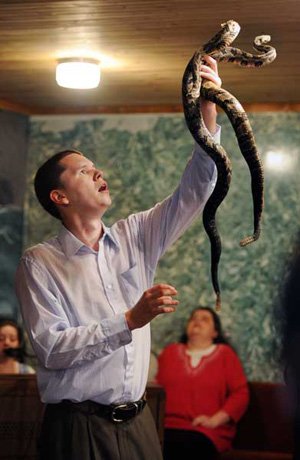
NASHVILLE, Tenn. (RNS)—Andrew Hamblin's Facebook page is filled with snippets of his life—making a late-night run for tacos, watching SpongeBob on the couch with his kids, and handling rattlesnakes in church.

Hamblin, 21, pastor of Tabernacle Church of God in LaFollette, Tenn., is part of a new generation of serpent-handling Christians who are revitalizing a century-old faith tradition in Tennessee.

Gregory Coots (left) of Middleboro, Ky., and Andrew Hamblin, 21, pastor of Tabernacle Church of God in LaFollette, Tenn., embrace each other while Hamlin holds several copperheads during a church service. (RNS PHOTO/Shelley Mays/Courtesy USA Today Grace Hill Media)

While older serpent handlers were wary of outsiders, these younger believers welcome visitors and use social media to promote their often misunderstood—and illegal—version of Christianity. They want to show the power of their extreme form of spirituality. And they hope to reverse a state ban on handling snakes in church.

Since the early 1900s, a handful of true believers in Eastern Tennessee and other parts of Appalachia have practiced the so-called signs of the gospel, found in the King James Version of the Gospel of Mark: "And these signs shall follow them that believe; In my name shall they cast out devils; they shall speak with new tongues; They shall take up serpents; and if they drink any deadly thing, it shall not hurt them; they shall lay hands on the sick, and they shall recover."

While other churches ignore this passage due to its questionable status in early Bible manuscripts or treat it metaphorically, serpent handlers follow it literally. Their intense faith demands holy living and rewards them with spiritual ecstasy—the chance to hold life and death in their hands.

"There's still an anointing from heaven. Glory to God!" Micah Golden shouted. "He'll still let you do the signs of God."

Then he flipped the lid of a small wooden box by his feet and pulled out three Southern copperheads, all entwined. Golden lifted them about his head, then swung them back and forth in front of him before handing them to Hamblin, who took the snakes in one hand and lifted the other in prayer.

Hamblin began to preach about Jesus: "The same man that walked upon the water, he said, 'They shall take up serpents.' There's a realness in the signs of God."

That led to a cascade of prayers as the whole crowd began to speak in tongues. Then the shouts died down, and Hamblin and other worshippers started a procession toward the door.

"Come on, people, let's go have church," he said.

Hamblin and other handlers say the Bible tells people to obey the law. So, he wears a seat belt while driving, obeys the speed limit and files his taxes on time.

But Hamblin won't give up serpent handling, which he says is a command from God—even though Tennessee outlawed it in 1947 after five people died of serpent bites at churches in two years.

Andrew Hamblin, 21, pastor of Tabernacle Church of God in La Follette, Tenn., holds up two rattlesnakes during church service. (RNS photo by Shelley Mays/courtesy USA Today)

Breaking the law can lead to a fine of $50 to $150 or up to six months in jail. The ban rarely is enforced, unless someone dies in a church.

Hamblin knows people think he and other handlers are crazy. But if more people experienced what he does when in church, they wouldn't mock it, he said.

"It is the closest thing to heaven on earth that you could get," he said. "You can feel God's power in the flesh."

For more than a century, serpent handlers have had a turbulent relationship with outsiders. Churches popped up around charismatic preachers, then faded after controversy or bad publicity. When the practice became illegal, true believers went underground.

Until last year, serpent-handling churches were in decline, said Paul Williamson, professor of psychology at Henderson State University in Arkadelphia, Ark., who studies serpent handlers.

That's changed as the children of older leaders have grown up and started handling serpents. Converts, like Hamblin and Golden, have joined them.

By inviting outsiders to his church, Hamblin hopes to show serpent handlers practice their faith in a responsible manner. He begins each service with a warning—"There's death in that box"—pointing to a pile of serpent boxes.

Despite precautions, serpent handlers get bitten. Hamblin almost died at 19 when a bite from a yellow timber left him hospitalized with internal bleeding.

Over Memorial Day weekend, Randy "Mack" Wolford of Bluefield, W. Va., one of Hamblin's mentors and friends, was bitten by a timber rattler during an outdoor Sunday service held at Panther State Park in West Virginia, the only state where serpent handling is legal. He was pronounced dead the next day.

Hamblin and his wife, Elizabeth, drove to West Virginia so he could preach at Wolford's funeral. He still was reeling from the shock that the friend he called Brother Mack was gone.

Hamblin planned to tell grieving mourners not to lose faith.

"The only thing I know to do is to encourage the people of God to keep on," he said. "Keep doing the signs of God."


Singer discovers redemption, restoration in Christ

NASHVILLE, Tenn.—As singer/songwriter Heather Williams shares about the redemption and restoration she found in a relationship with Christ, she displays character and strength far beyond her years.

During her childhood, Williams dealt with extreme poverty and intense abuse from her mother and stepfather. One time, she even was chained to a tree as a punishment.

Singer/songwriter Heather Williams

At age 11, Williams' mother sent her away, and she began living with her grandfather. While dealing with the traumatic effects of abuse, neglect and rejection, Williams turned to drugs and alcohol to numb the pain during her teenage years. At times, she contemplated suicide.

Just before her life was about to spin completely out of control, Williams found redemption, unconditional love and a Savior while reconnecting with her birth father and accepting an invitation to attend a worship service.

Realizing she reached rock bottom, Williams surrendered her life to Christ.

"When I was 18, I was going through a whole series of events where I was really rejecting God and blaming him for everything that had taken place in my childhood," Williams said. "But I finally came to a point where I decided that I was going to give my life to God, because I was running out of options to survive."

While undergoing a radical life change, she began pursuing music as an outlet to share her experiences. As she was getting her life back on track, Williams fell in love and got married. Tragically, the young couple encountered heartache and grief when their 6-month-old firstborn son suddenly died.

In the midst of their pain, she wrote the words to the hit song, "Hallelujah."

"I believe that God took a moment where I was desperately crying out to him and translated it into this powerful song that people can relate to," Williams said.

"Everyone has that moment where they have nowhere else to turn, except desperately seeking God's comfort and guidance. This song offers people hope in dark situations by reminding them that God is very near to them."

Reflecting on her journey through the years, Williams is grateful for how far God's grace has brought her.

"Everything that I've lived through, I have tried to translate into music—to somehow be able to tell the story of hope and redemption that Jesus Christ has brought me and how he can bring the same to anyone else," she said.


Catholic, mainline churches losing great proportion of childhood adherents

WASHINGTON (RNS)—A growing tide of young Americans is ebbing away from the religions of their childhood, and most are ending up in no religion at all.

One in four young adults choose "unaffiliated" when asked about their religion, according to a new report from the Public Religion Research Institute and Georgetown University's Berkley Center for Religion, Peace & World Affairs.

But most within this unaffiliated group—55 percent—identified with a religious group when they were younger.

"These younger unaffiliated adults are very nonreligious," said Daniel Cox, the institute's research director. "They demonstrate much lower levels of religiosity than we see in the general population," including participation in religious rituals or worship services.

Some will return to their faiths as they age, "but there's not a lot of evidence that most will come back," added Cox, who said the trend away from organized religion dates back to the early 1990s.

The study of 2,013 Americans ages 18-24 focused on the younger end of the cohort commonly known as the "millennials" or "Generation Y," which generally includes young adults as old as 29. Interviews were conducted between March 7 and 20.

Across denominations, the net losses were uneven, with Catholics losing the highest proportion of childhood adherents—nearly 8 percent—followed by white mainline Protestant traditions, which lost 5 percent.

Among Catholics, whites were twice as likely as Hispanics to say they are no longer affiliated with the church.

White evangelical and black denominations fared better, with a net loss of about 1 percent. Non-Christian groups posted a modest 1 percent net increase in followers.

But the only group that saw significant growth between childhood and young adulthood was the unaffiliated—a jump from 11 percent to 25 percent.

The study also posed a wide range of questions to the group, from their views on the Tea Party to labor unions to same-sex marriage.

It also delved into more philosophical territory, questioning whether younger millennials' moral views are more universal (there is always a right and wrong) or contextual (it depends on the situation).

The researchers found a morally divided generation, with 50 percent of respondents placing themselves in the contextual category and 45 percent believing in universal rights and wrongs.

Answers to questions on the nature of morality varied widely depending on political party affiliation, education and religion, with the most dramatic differences correlating with religion.

An overwhelming majority of white evangelical Protestants (68 percent) said they believe some things always are wrong, compared to 49 percent of black Protestants, 45 percent of Catholics and 35 percent of the unaffiliated.

More specifically, on social issues such as abortion and same-sex marriage, younger millennials hardly think as a group.

"We see some really stark divides," said Cox, which he said belies the conventional wisdom that bills this as the "Kumbaya" generation, in which everyone understands each other and gets along.

"It's something to watch as these folks start moving through society and start to vote regularly," he said.

Specifically:

• A sweeping majority of the religiously unaffiliated (82 percent) said abortion should be legal in all or most cases. More than two-thirds of religiously affiliated non-Christians agreed.

• White evangelical Protestants were most opposed to abortion, with nearly 9 in 10 (88 percent) saying it should be illegal in all or most cases. Among Latino Protestants, 71 percent shared this belief. Catholics were more divided, with 48 percent saying abortion should mostly be legal and 51 percent disagreeing.

• On same-sex marriage, nearly six in 10 younger millennials (59 percent) approved, with distinctions among religious groups generally mirroring those on abortion.


Faith Digest

Catholic groups file suit. Dozens of Catholic universities, dioceses and other institutions filed lawsuits in courts around the country recently in a coordinated effort, spearheaded by the U.S. hierarchy and Catholic conservatives, to overturn the Obama administration's contraception mandate plan. The 43 plaintiffs, including 13 dioceses and the University of Notre Dame, say the mandate forces religious employers to provide contraceptive and sterilization services to employees that violate their beliefs. They say that infringes on First Amendment religious freedom protections and charge the federal government's exemption for religious organizations is too narrow. The Obama administration and its allies reject those assertions and say a proposed compromise to the mandate effectively bypasses any entanglement in birth control coverage by faith-based groups.

Crystal Cathedral to move into smaller church. In a building swap, the Crystal Cathedral has announced it will move its congregation to a smaller Roman Catholic church after the iconic Protestant megachurch was sold to the Catholic Diocese of Orange, Calif. Last fall, a bankruptcy judge approved the diocese's $57.5 million purchase of the glass-walled building in Garden Grove. The cathedral's congregation is exercising an option in the sales agreement that permits it to move to St. Callistus Catholic Church in June 2013. The Catholic congregation at St. Callistus, and later the administrative offices of the diocese, will move to the Crystal Cathedral site. The Cathedral congregation will pay $25,000 in monthly rent for two years starting January 2014, with the cost escalating in a predetermined formula after that. The cathedral said the length of the lease agreement has not been determined.

Sikh TSA agent wins lawsuit. A Sikh security officer at New York's largest airport won a $30,000 settlement against the Department of Homeland Security, which had forbidden him from displaying his kara—a wristband Sikhs wear to remind them of the divine. Kulwinder Singh called it a violation of his religious rights and took his case to the U.S. Equal Employment Opportunity Commission. The EEOC decided the case in March and required the TSA to allow employees to wear the kara freely, and to post a notice of the violation by mid-June.

Photographer to appeal decision. Attorneys for a Christian wedding photographer say they will appeal a New Mexico court decision that ruled she violated anti-discrimination laws by refusing to photograph a lesbian commitment ceremony. The controversy began in 2006 when Elaine Huguenin, co-owner of Elane Photography, refused to photograph a "commitment ceremony" for Vanessa Willock and her partner. Huguenin claims her refusal was rooted in her Christian faith that views marriage as a sacred union between one man and one woman. The decision by the New Mexico Court of Appeals upholds a 2008 ruling by the New Mexico Civil Rights Commission in favor of the same-sex couple that subsequently was upheld in district court.

Compiled from Religion News Service


Loss of faith: From Pentecostal pastor, to universalist, to atheist

BETHESDA, Md. (RNS)—In the span of just a few months, Jerry DeWitt went from a respected pastor with a vibrant congregation to an atheist without a job.

DeWitt, 42, is the first "graduate" of The Clergy Project, a program supported by several atheist organizations that assists pastors who have lost their faith to "come out" as atheists to family, friends, congregations and communities.

Jerry DeWitt, a former Pentecostal preacher, came to be an atheist while still preaching in the pulpit.

DeWitt, who lives in southern Louisiana, went public last October when he posted a picture of himself with the prominent and polarizing atheist Richard Dawkins, snapped at a meeting of atheists and other "freethinkers" in Houston.

Speaking in March before a cheering crowd of several hundred unbelievers at the American Atheists conference, he described posting the picture as "committing identity suicide."

The response was swift. His congregation put him out, friends cut him off and some family members will not speak to him, he said.

"It is not just finances, and it is not just career," he said in the fire-and-brimstone cadences of his Pentecostal background. "It is everything that you hold dear."

But there are gains, too, he insisted. "With a little help from my friends, I have learned how to do more than survive," he said.

DeWitt's transition from true believer to total skeptic took 25 years. It began, he said, with the idea of hell. How could it be, as he had been taught and preached, that a loving God would damn most people to eternal fire? "This thing called hell, it began to rock my world," he said.

From there he read about universalism—the idea that salvation is universal, and all people will be restored in their relationship with God without any action on their own part. After universalism, he discovered the idea, supported by some neuroscientists, that God is actually our inner dialogue.

"I went from God loves everybody to God saves everybody to God is in everybody," he said. "When you come from where I come from, … it's not too long before you are" at the American Atheists convention.

His new beliefs—or lack of them—were kept secret from friends, family and his congregation. And they were put to the test when a friend in crisis asked him to pray with her.

"I could not do it," he said. "At that moment, my conscience outweighed everything else in my life. … No matter how much I loved her, I knew the best hope for her situation was a good medical staff, and I wasn't going to pretend there was anything better for her than science and reason."

His heart, he said, was "absolutely, totally broken." He described gazing at himself in a mirror and realizing "that if I could not pray for her that I would never pray for anyone or anything ever again."

It was then that he found The Clergy Project, plugging into its anonymous online support groups and forums. That was in May 2011.

"I was amazed that there were people out there wrestling with the same issues I was," he said. "And I began to work my way out with a little help from my friends."

Today, DeWitt is the executive director of Recovering From Religion, a group that professes to help people find their way after a loss of faith.

"Not only can you survive, but you can thrive through this process," he insisted.


For ministers, lost faith can lead to lost family, jobs

BETHESDA, Md. (RNS)—As coming out parties go, this was a big one. As the American Atheists convention wound down, a woman with short dark hair and a dark suit took the stage.

Standing under the projection of a large capital "A," she told the crowd of several hundred that she was a pastor who, for the last several months, had been questioning her beliefs online under the pseudonym "Lynn."

Teresa MacBain of Tallahassee, Fla., who served as a Methodist pastor 10 years, she spoke at the American Atheist convention and announced she no longer believed in God. (RNS PHOTO)

Then she took a deep breath and said: "My name is Teresa. And I am an atheist." As the room exploded with cheers, Teresa MacBain wiped away tears.

MacBain, 44, is the latest "graduate" of The Clergy Project, an online support network for pastors who, like her, have lost their faith and embraced atheism.

The goal of the project is not to pull pastors from the pulpit, but to provide those who already have lost their faith a safe place to discuss—anonymously—what comes next.

The network's hope is they will, like MacBain, eventually feel strong enough to put their families, friends and careers on the line and announce their atheism.

"When you leave the ministry, you can lose all of that," said Dan Barker, a former minister, co-president of the Freedom From Religion Foundation and a founder of The Clergy Project. "You have to ask yourself, 'Who am I now?' … The Clergy Project is a place where their self-respect is restored."

Barker traces the origin of the project to conversations with struggling pastors and a meeting with Richard Dawkins, the evolutionary biologist and prominent atheist.

All felt the need for a place where active clergy could make the transition from Sunday mornings in the pulpit to Sunday mornings in bed.

That need was given new urgency in 2010 when Daniel Dennett, a Tufts University professor and another prominent atheist, and Linda LaScola, a qualitative researcher, published an article outlining their work with five active clergy—all Protestant males—whose faith had crumbled.

These men, they found, had much in common—all went into ministry to help people, all began questioning their seminary training, and all let go of their faith gradually. And all expressed confusion and frustration about how to live and work as atheists.

"They have early doubts that they do not act on," LaScola said after the convention. "Then they keep quiet. They don't tell their colleagues. It is a slow process from belief to lack of belief."

The 2010 study garnered a lot of attention among atheists, and The Clergy Project was launched in March 2011 with the help and support of FFRF and Dawkins' foundation.

Today, Barker says, the project has about 200 online members, including active and former clergy from Protestant, Catholic, evangelical and Pentecostal backgrounds. There are also a couple of rabbis and a lone imam. All choose pseudonyms and share only as much as they feel comfortable with each other.

Mike Aus, 48, pastor of a Houston Lutheran congregation of 150 people, found The Clergy Project last year after years of solitary doubt. The day before MacBain's appearance at the convention, he announced his atheism on MSNBC's Up With Chris Hayes.

After addressing the convention—which also greeted him enthusiastically—he said he felt like a burden had been lifted upon connecting with The Clergy Project.

"The most important thing to me was knowing I wasn't alone," he said. "It was that fundamental sense of community with people who were experiencing the same things I was. It let me know it was not the end of the road, that there was life after this calling."

MacBain, too, said her doubts started years ago. When she came to the Maryland convention, she was pastor of a 200-member Methodist church in Tallahassee, Fla. She decided to go public, she said, because she could not go on.

"When I stepped up there, I knew I was finished," she said later. "I could only live so long doing a double life. I think any person who has any integrity, it eats away at your soul—or lack of soul."

The cost was high—something MacBain realized fully only after returning home. Some friends cut her off, and some family members said she is unwelcome in their homes. She received hate mail and became afraid to leave the house alone.

But emotions run high in both directions. MacBain's congregation apparently felt so blindsided, they locked her out of the church, she said.

Her husband, a police officer, had to go in and pick up her things, which already were packed, she said.

Aus' congregation, unaware of his change of heart until learning about it on television—on Palm Sunday, no less—decided to disband. Their final service was Easter Sunday.

"There was anger, yes," said Joe Vingle, a member of Aus' Texas church. "Some people had been with Mike for 20 years or longer. Those were the ones that were really hurt. They are feeling that everything they were taught by him is a lie."

But Vingle said there also was understanding. "He is still a friend, and I am interested in seeing where this takes him," he said.

In a way, the convention also was a coming out for The Clergy Project. A day later, project leaders met to explore new services they might provide pastors—short-term loans, employment assistance and scholarships.

And they appointed a new executive director—MacBain.

"As these clergy come out, they are not just thrown to the wolves," she said. "They can find resources that will help them take the next step."


Taking the Matthew 25 test

When it comes to judging livestock, some Baptists have a beef with sheep and goats. In Matthew 25:31-46, Jesus describes Judgment Day, with all the nations gathered around God's throne and people separated into two groups—sheep on one side, goats on the other. The sheep are invited to enter into the kingdom prepared for them, while the goats are consigned to hellfire prepared for the devil and his helpers.

To distinguish sheep from goats, Jesus talks about feeding the hungry, welcoming the stranger, caring for the sick, visiting people in prison and other kind acts. Christ equates ministry to "the least of these my brothers" as service to him.

To some, that sounds too much like salvation by works, rather than salvation by grace through faith. But others see no contradiction—just a challenge to make sure grace produces a transformed life characterized by care for the vulnerable.

Grace or works

"There is no dichotomy between faith and works," said Van Christian, pastor of First Baptist Church in Comanche. "Good works are not an option in order to be saved; salvation is by grace alone. Good works are not an option once we are saved; whoever claims to be in Christ must walk as he walked."

Christian notes the Apostle Paul wrote about salvation by grace through faith—not as a result of works—in Ephesians 2:8-9. But in the very next verse, Paul says Christ's followers are created for good works. Works do not earn salvation, but they demonstrate it, he insisted.

"Faith in Jesus Christ is demonstrable, visible and easily recognizable," said Christian, chairman of the Baptist General Convention of Texas Executive Board.

Robert Prince, pastor of First Baptist Church in Waynesville, N.C., agrees. God saves people by his grace, received through faith, but that same salvation produces tangible evidence—good fruit.

"When we know Christ relationally, we bear the fruit of good works," said Prince, former pastor of First Baptist Church in Vernon.

The unrighteous in Matthew 25—the goats in the parable—demonstrate by their lack of concern for vulnerable people no vital relationship with Christ, he explained.

"If they had been in a relationship with Christ, they would have borne the fruit of love and compassion for those in need. The problem is that many who call themselves believers don't understand that a relationship with Christ leads to care for the poor and hurting."

Keith Herron, pastor of Holmeswood Baptist Church in Kansas City, Mo., believes Jesus in Matthew 25 describes accountability for stewards of faith and influence.

"We don't believe there's much wiggle room in our stewardship of the faith along the lines of Matthew 25. To be an authentic follower of Jesus, we will follow him in these ways. This is not a matter of salvation; this is a matter of being Christ's followers in our realms of influence," said Herron, moderator-elect of the Cooperative Baptist Fellowship and former pastor of Manor Baptist Church in San Antonio.

"Our realms of influence are centered and grounded in our physical location, but the world we serve is understood to be wherever we go between Sundays."

Too often, an overemphasis on piety can separate Baptist churches from the nitty-gritty needs of their communities, he asserted.

"We hide behind our piety, mislabeling and condemning our involvement as 'local politics' and implying such involvement would be crass or messy," he said. "Our stewardship of faith pulls us toward our community's needs and draws us to action."

Charity or justice

Charles Carroll from First Baptist Church in Comanche served as crew chief for volunteer builders. The team constructed a home for a couple near Bastrop whose house had been destroyed by wildfire last year. (PHOTO/Ken Camp)

Proper understanding of the kind of compassionate response Jesus describes in Matthew 25 moves Christians from acts of charity to a hunger for justice, Prince insisted.

"To help 'the least of these,' we must not only engage in individual acts of charity, but also confront systems that deprive people of the ability to care for their own needs," he said.

"Individual aid is important, but oftentimes it provides only temporary relief. The systems that hurt the poor are cultural, social and governmental. Individual aid is insufficient, as are government reform and social change. To help the poor, we need to be engaged at all these levels."

At First Baptist in Comanche, Christian said, he tries though his preaching to emphasize God's expectation that genuine conversion results in changed lives that reflect God's character.

"Just as the Pharisees followed the law without knowing God, simply doing acts of charity is not sufficient. When these acts of charity are a reflection of the changed life in Christ, however, they reflect a righteousness that demonstrates a right relationship with God. This right relationship is not limited to a few specific deeds. It is a complete change in lifestyle that reflects the nature of God," he said.

Demonstrate God's love

Members of First Baptist Church in Comanche have learned to take that teaching seriously, Christian said.

"They do not see ministry as simply benevolent work. They do not merely help people for the sake of doing something good. They work as a testament to their faith in Christ and see the ministry as a gift to him, as much as a gift to the people involved," he said. "I believe this enables them to see people and projects through the eyes of Christ."

For example, when wildfires destroyed homes in Bastrop last year, members of First Baptist in Comanche helped people there recover and rebuild.

"The folks that we have focused on were elderly, poor, uninsured and unable to recover on their own. In terms of the world, there was nothing about them that demonstrated a reason for them to be helped. Yet our church recognized this is a means of following the command of Jesus and reflecting the grace by which we are saved," Christian said.

"We shared the gospel—not just in words, but in sacrificial deeds that demonstrated the love of God we have and want to share."


Partnership offers mental health benefits for homeless people in Waco

WACO—Collaboration between a Baptist university’s psychology department and a faith-based ministry improves the lives of homeless people in Waco.

Matthew Stanford, professor of psychology, neuroscience and biomedical studies at Baylor University, developed a partnership with Mission Waco in which doctoral students provide free psychological assessments for the homeless.

During the first year of the collaborative arrangement, the graduate students—under faculty supervision—provided psychological assessments and feedback for 70 homeless people, providing a service to Mission Waco valued at $35,000.

They also provided brief reports that helped the faith-based agency offer an additional $22,500 of service in one year. Nearly two-thirds (64 percent) of the individuals assessed used the report in a Supplemental Security Income application or appeal for benefits.

“Of those who have received a benefits decision, 22 individuals are now receiving benefits, while only six applicants who used our reports have been denied thus far—a 79 percent approval rate,” the Baylor team reported.

After evaluating the partnership and its results, researchers published their findings in the April issue of Professional Psychology: Research and Practice.

The journal article cites one case study involving a homeless woman who sought emergency shelter from Mission Waco to escape domestic violence. The woman had been denied government benefits, lacked job skills and suffered from Tourette’s syndrome.

A psychological assessment showed borderline cognitive ability and revealed substance abuse issues, which led to her placement in a treatment facility prior to job training.

“The report was given to the treatment staff when she began the program. While she was there, the staff used the assessment report as part of an appeal of her benefit denial, and she subsequently was awarded benefits,” the article said.

“She has since completed a job corps training program, and her SSI benefits have helped pay for the apartment in which she currently resides. “Having a professional psychological evaluation made a difference not only in selecting appropriate treatment, but also in her application for benefits, with the result that this woman is no longer homeless today.”