Taize movement brings throwback appeal to U.S.

CHICAGO (RNS)—Every year, about 100,000 pilgrims trek to the Taize ecumenical community in France, where the biggest attraction is the music, a throwback—way, way back, about 1,500 years or so—to repetitive plainchant.

Recently, the Taize brothers brought their conference to the United States for the first time, where several thousand people—particularly young adults—met for prayer and song at DePaul University in Chicago.

Several thousand people—particularly young adults—met for prayer and song at the Taize conference at DePaul University in Chicago.

Brother Emile, a Catholic and a spokesman for the group, said pilgrims seek out Taize for answers to questions about life in general and faith in particular. 

"Young people, I think, feel respected at Taize," said Brother Emile. "They're welcome to come with their questions and their doubts. And they're very relieved sometimes to feel that there's a place for them as they are."

Taize (pronounced tie-zay) long has generated attention for its ability to attract followers from both Catholic and Protestant traditions, but now people are asking how the group is so successful in attracting young Christians who, according to surveys, are leaving the church in droves.

Some mainline Protestant leaders who've been exposed to Taize say the movement could help reverse decades of falling membership and attrition. United Methodist Pastor Mark Ulrickson from Southern California likes the way the monks integrate spirituality with action, and he says this would keep young people rooted to church.

"(Taize) doesn't start with, 'Here's what you have to believe,'" Ulrickson said. "It starts with, 'We're brothers and sisters in this person of Christ, and we come together to be in prayer together to discover each other and what gifts we have.'"

Chris Soukup was on the verge of leaving the Episcopal Church as a 19-year-old freshman at South Dakota State University. He had grown tired of years of going to church just because his parents said so. When he was asked to take a job as a counselor at a church camp, he had his reservations but decided to give it a try.

Soukup was moved by the Taize-style camp that was led by a visiting brother from France. Three weeks of singing simple phrases over and over, extolling God as the light out of darkness, and quiet time to pray and meditate on passages that exemplify living the life of the gospel captivated Soukup's soul. 

"It's a really relaxing style of worship that you don't get with a lot of the denominations … where they're focused on more of a sermon style or a praise-and-worship kind of thing," Soukup said. "The silence is really the biggest thing for me, where you just have time to reflect."

By the end of the three weeks, Soukup realized how much he longed for church. He now goes twice weekly for spiritual nourishment and a strong sense of community, both at home and at school.

Rita Powell of St. Paul's Episcopal Church in Vermillion, S.D., who tapped Soukup to become camp counselor, has been to Taize several times and said the local Taize service attracts more young people than Sunday mornings do.

"Ideally, what sticks ultimately is that sense that you already knew something," she said. "Inside each one of us, (we) already know the truth of the gospel, the truth of love … so it's not so much the style of prayer. If you can create the space for people of any age to really feel that source of faith, then the style of prayer is really secondary."

The part about nudging participants to go to church is what really appeals to Elizabeth Nickerson, a leader of Taize prayer at Chicago's Fourth Presbyterian Church. Taize's international visits are designed to place young adults with host families. The idea is for them to form relationships, and for the host families to take them to church.

"We need for young adults to know there's a place for them in the church," she said. "They're welcome, and they're needed, and their viewpoints are needed to strengthen the church."


Soccer chaplain to manage faith presence in Olympic Village

MANCHESTER, England—John Boyers' gig at the Summer Olympics—managing chaplains in the athletes' Olympic Village—might seem sensational until a visitor sees his normal digs.

Chaplain John Boyers has spent 20 years giving pastoral care to the players and staff of the Manchester United soccer team in England. This month, he'll also provide it for the athletes at the Summer Olympics in London. (IMB PHOTO)

His workplace—the home of the Manchester United soccer club—is nicknamed the "Theatre of Dreams." For 20 years, he's rubbed shoulders with the thousands who pay $25 a head to tour Old Trafford, one of the world's most visited stadiums. And that's not counting game days, when 76,000 fans show up.

Boyers is a constant in a place of never-ending turn-over, and he insists that's just the way he likes it.

"Being sensitively present in people's lives and being found trustworthy over time are so important," said Boyers, chaplain for the 647 full-time staff members and players of Manchester United. "I come alongside people to be a supportive friend, providing spiritual and pastoral care when they need it."

He doesn't proselytize. He has his reasons.

"It's different from being a chaplain in the United States," Boyers said. "In English sports, a secular culture, people are suspicious of keen Christians."

Opportunities for overt evangelism are very restricted, and a "hard sell" just doesn't work well in England, he said.

"So chaplains are accepted by clubs as those who serve, offering pastoral and spiritual care sensitively to all people employed by a club," Boyers said. "That's the deal. If you don't like the deal, don't sign up."

That means no organized prayer times before games or chapel services for players, but near Easter and Christmas, he does lead Bible studies for Christian staff. As for his regular weekly work, Boyers said, "I pray that the Lord will go before me, be with me and direct me, causing people to ask the questions which produce significant conversations."

And, he said, many days they do. A number of players and staff dealing with problems, crises and life questions seek him out to talk. Those who don't still think of him as a "good guy," shake his hand in the hallway and know he's there if they ever did decide to chat.

"At the heart of UK sports chaplaincy is one concept—trusting relationships. When people get to know you and trust you, they open up to you, often when they need help," Boyers said.

Boyers is invading their space on purpose—and the staff and players value that, he said.

"Chaplaincy is incarnational ministry—what Jesus did to identify with us," he said. "The church can't hide behind its lovely windows and doors. It's got to get out there into the wider world."

"It's messy work," he said, "but if the incarnation of Jesus means anything to us, we have to identify with people as he did and meet them where they are."

That truth got Boyers out of the church and into chaplaincy in the first place. It's the reason he agreed to pilot the nation's chaplaincy program on behalf of the Baptist Union of Great Britain. The program now has 230 chaplains of different Christian denominations placed in professional sports from soccer to horse racing.

"I have known John Boyers for 25 years and honor him as the doyen of sports chaplains in the United Kingdom. He has a winsome way of opening doors that were previously closed," said David Coffey, global ambassador for BMS World Mission and past president of Baptist World Alliance.

"The fruitfulness of his ministry over the past 21 years is a testimony to God's faithfulness and John's persevering spirit. His considerable experience will be a great asset to the chaplaincy at the London Olympic Games."

During the Olympics and Paralympics, Boyers will manage the deployment of 160 chaplains from the five major world religions—Christianity, Islam, Buddhism, Judaism and Hinduism—into the athletes' village.

Boyers and other Christian chaplains will hold optional services and lead Bible studies for athletes and others working in the village, as well as be available to talk or pray with anyone who requests it.

It's the same deal as it is at Old Trafford—proselytizing is prohibited in Olympic areas. "But when people ask questions, we have every right to respond," Boyers said.

So, he keeps praying the same prayer—that God will prompt questions that allow him to tell how Jesus Christ changes lives. And whether those opportunities come or not, he said, he'll serve with love and compassion.

For more information about chaplaincy work in the UK, visit sportschaplaincy.org.uk.

For more information about ministry efforts surrounding the Olympics, visit morethangold.org.uk.


Heavy metal rock star seeks to share the light of Christ

MIDLAND—When Brian "Head" Welch left the heavy metal band Korn in 2005, the announcement triggered significant speculation as people wondered what led the rock star out of the darkness and into the light.

Brian "Head" Welch, formerly of Korn, promotes is book Washed By Blood.

During his tenure as Korn's guitarist, the group earned Grammy awards and sold more than 30 million albums internationally, but Welch paid a high price for success. Wild parties, drugs and alcohol made his life spin out of control and left him feeling completely empty inside. 

No matter what he did, nothing could fill the void in his life—until he found Jesus.

Welch had an eye-opening experience of what his life was becoming after his wife no longer could care for their young daughter because of the effects of drugs.

Desperate to find help, Welch visited a church service.

"I remember crying out to God that night saying: 'Jesus, if you are real like that pastor said, then you've got to take these drugs from me.  Come into my life. Come into my heart. Search me right now. Search my heart. You know that I want to quit these drugs. You know that I want to be a good dad to this kid. She is going to lose me if I don't quit. I need your help.'"

During the weeks that followed, Welch continued performing with Korn and struggled with his decision to give his life to Christ. However, Welch knew he needed to change his lifestyle and come clean. One day while praying about his decision, he felt compelled to throw out all his drugs and quit the band.

Realizing he had been given a second chance at life, Welch wanted to spend it living for Christ.

"When Christ came into my life, I gained a new understanding of life," Welch said. "We were created to live for him and to be with him. It is the most incredible feeling, being exactly where you belong when you find Jesus. Contentment comes from a relationship with Christ. You do not have to look anywhere else."

When Welch performs concerts and speaks at events, he is committed to sharing a message of hope and redemption. He will perform Aug. 2 at Rock the Desert in Midland.

"I want people to know that there is more than this world," Welch said. "Everyone lives for here and now, but these years are flying by so fast. If people would take their eyes off of this world and onto eternity, how different things would be. It's crazy how everyone is so focused on this place that is quickly fading away. Obviously, you can still enjoy life, but you need that foundation of eternity and focusing on the things to come." 

Welch has written several books about his transformation through Christ, including Save Me From Myself and Washed By Blood. He also has written a devotional book, Stronger: 40 Days of Metal and Spirituality. His music also is featured in the faith-based film, Hardflip, and he recently shared his testimony on a commercial for I Am Second

"My favorite thing to do is talk about the Lord," Welch said. "But if I go to a rock concert or hang out with friends who aren't Christians, I know when to stop talking, just be a friend and let them see a change in me. I'm blessed to be alive today and to be able to tell others about how Jesus has changed my life. If he can do that for me, then he can do that for anyone.

"I'm not perfect by any means, and I still have struggles, but I'm so much happier than I've ever been in my whole life—even on my bad days. My life has changed in every single way, definitely for the better. I went through some tough times to get to where I'm at today, but looking back, I think that I had to go through the pain to get to the peace.  

"Now, I want to be able to walk through any circumstance in life and be strong in the Lord. In order to get to that place, you have to go through many trials. It says in Psalm 56:3, 'When I am afraid, I will trust in the Lord.' I think that's the mark of true maturity."


Faith Digest: Bible museum planned for capital

A large-scale Bible museum will open in Washington, D.C., within four years, according to planners who have been touring the world with portions of their collection.

Bible museum planned for capital. A large-scale Bible museum will open in Washington, D.C., within four years, according to planners who have been touring the world with portions of their collection. Cary Summers, chief operating officer of the Museum of the Bible, a nonprofit umbrella group for the collection of the billionaire Green family of Oklahoma, said they considered Washington, Dallas and New York but decided the nation's capital was the best location. Planners hope to confirm the museum's exact location later this summer.

Discount for churchgoers challenged. For more than a year, Prudhomme's Lost Cajun Kitchen in Lancaster County, Pa., has offered a Sunday special: Diners who bring in a current church bulletin receive 10 percent off the purchase of their dinners. But John Wolff of Lancaster, an atheist and member of the Freedom From Religion Foundation, filed a complaint with the Pennsylvania Human Relations Commission claiming the restaurant should not give discounts based on religion. The restaurant's co-owner, Sharon Prudhomme, questions how the promotion for churchgoers differs from senior citizen discounts or free meals for kids under age 12. "A senior discount isn't so bad. We'll all get there eventually. But we won't all become churchgoers," said Wolff, who is 80.

Faith DigestMormons high on Romney, wary of media. Most Mormons in Utah believe Mitt Romney's rise to become the apparent GOP presidential nominee is a good thing for the Church of Jesus Christ of Latter-day Saints. But many do not trust the media to cover the church fairly, according to a new poll. The study, conducted by Key Research and Brigham Young University's Center for the Study of Elections and Democracy, revealed more than eight in 10 Utah Mormons said they are "very excited" or "somewhat excited" about Romney's accomplishment. Nearly as many (77 percent) said his nomination is a good thing for the LDS church; just 2 percent told pollsters it was a negative development. However, more than two-thirds of Utah Mormons said Romney's nomination will bring bad and good publicity for the LDS church. An identical percentage (68 percent) said they do not trust the media to cover the church fairly.

Ministers put health at risk. Most members of the clergy are taught to put the physical and spiritual needs of others first, but that self-denial may be harmful to their own health, according to a new Duke University study. Studies of United Methodist pastors in North Carolina found high rates of chronic disease and depression, and researchers worry it can be difficult to convince clergy to seek help. Duke Global Health Institute research found the 40 percent obesity rate among North Carolina United Methodist clergy eclipsed the state average of 29 percent. Pastors also suffered high rates of chronic diseases such as diabetes, asthma, arthritis and hypertension. More than 10 percent showed symptoms of depression, about double the national rate. Despite these health issues, clergy also were more likely to say their health did not negatively affect their work.

Compiled from Religion News Service


Vocational stewardship

Many Americans have a clearer idea what they will do on summer vacation than how they will fulfill any God-given sense of vocation. Some Christians see vocation as limited to a select few—mostly ministers and missionaries.

"A job is what we do to make a living. A vocation is what we do to make a life," says Jim Denison, theologian-in-residence with the Baptist General Convention of Texas.

Even those who see a larger calling for all Christ's followers sometimes wonder if talk about vocation represents an elusive reality in an economy where a lot of people just would be glad to find a job—any job.

So, is vocational stewardship an ivory-tower concept divorced from real life? Or is it an imperative calling for all citizens of God's kingdom?`

Understanding vocation

Christians first must begin by understanding the difference between a job and vocation, according to Jim Denison, founder of the Denison Forum on Truth and Culture.

"A job is what we do to make a living. A vocation is what we do to make a life," said Denison, theologian-in-residence with the Baptist General Convention of Texas.

By definition, Denison noted, vocation implies a sense of calling to some larger purpose that provides significance and direction.

"Here's a practical way to tell the difference," he said. "Would you do your job whether you were paid or not? If money were no object, and you knew you couldn't fail, what would you do with your life?"

Even beyond Christian circles, people ask those kinds of questions. Speaking at spring commencement at Tufts University, Eric Greitens—a Rhodes Scholar, Navy SEAL and humanitarian relief worker—told the graduates, "The best definition I have ever heard of a vocation is that it's the place where your great joy meets the world's great need."

Greitens' statement reflects a variation on Christian author Frederick Buechner's reflection: "The place God calls you to is the place where your deep gladness and the world's deep hunger meet."

That point of intersection reflects the "sweet spot" where a Christian's passions and gifts are used to accomplish God's priorities in a needy world, according to Amy Sherman, author of Kingdom Calling: Vocational Stewardship for the Common Good.

Making choices

Realistically, she recognizes some Christians may see that as a luxury they cannot afford.

"Tough economic times can make it difficult to live in the sweet spot, as can other factors such as family responsibilities that limit one's geographic mobility or mean that the job must come with great health benefits—and the sweet spot job may not," said Sherman, director of the Sagamore Institute's Center on Faith in Communities.

"Nonetheless, compared to most of the world, American believers do have a significant degree of vocational choice, and so we need to be very intentional about how to steward that freedom."

The "decision-making grid" for Christians should be larger than for nonbelievers, said Sherman, a senior fellow both at the Sagamore Institute and at Baylor University's Institute for Study of Religion.

"It should focus our attention not simply on the personal benefits the job opportunity affords—perks, salary, prestige, etc.—but also on the opportunities it affords to serve others, the way in which it might direct our talents toward underserved populations, the scope it might afford for managing others—and thus having great opportunities to live out winsome, diligent, loving servant leadership as a supervisor—and so forth."

Maximizing in-between times

It may take years of preparation and planning before a Christian can be equipped and ready to serve in the ideal place where the worker's joy and the world's needs meet, Sherman acknowledged.

In the meantime, she recommended, a follower of Christ should view each season of life as a learning opportunity—even if that involves coping with tedium, boredom, irritating coworkers or unreasonable bosses.

"Every job affords the opportunity for personal growth in Christ-like character," she said.

In any job, a Christian should look for opportunities to show servant leadership, as well as increase skill-levels and knowledge, Sherman noted. Even junior-level employees have the potential to become change agents in the workplace, she added.

"Perhaps there is an opportunity to volunteer on the firm's community charitable committee that makes decisions about where to invest charitable dollars," she suggested. "Perhaps the firm has an internship program. Who does that benefit? Could the junior employee suggest changes to the program that would extend its benefits to minority or low-income students?"

Even if a paying job does not offer opportunities for a Christian to develop skills for service in God's kingdom, the believer could gain that experience through volunteer service, she added.

Recognizing a kingdom assignment

When Christians acknowledge God's sovereignty over every aspect of life, it puts vocational choices in a different perspective, Denison noted.

"In the Bible, God is a king. In our culture, he's a hobby. If God is your king, you're wearing his clothes, breathing his air, walking on his planet. He's your king on Monday, not just Sunday," he said.

"If he's your king, your assignment in his kingdom is your highest priority. Everything you do should be viewed as fulfilling this assignment."

God reveals his assignment to kingdom citizens through circumstances, people, Bible study and personal worship, Denison explained. "His assignment is best for you, whatever the economic circumstances of the day," he said. "If you want to know his assignment for your life, you may ask him."


New book tells story of loss, redemption

(ABP)–A new book self-described as "one part worst-case scenario and three parts God's creative redemption," about a church-bus tragedy that turned into a grassroots movement for doing good, cracked the Amazon Top 50 Christian Living Hot New Releases during its first week of publication.

"Maggie Lee for Good" is a testimony that God is at work even in life's worst-case scenarios.

Three years ago this July 12, John and Jinny Henson of Shreveport, La., sent their 12-year-old daughter, Maggie Lee, to church camp. When a tire failed and the bus flipped on a Mississippi interstate, she and another student were ejected and pinned underneath.

Summoned to a hospital in Jackson, Miss., the Hensons were told not to expect their daughter to live through the night. Miraculously, her condition stabilized, and she lingered three weeks before being declared brain dead on Aug. 2, 2009.

Taking turns at Maggie Lee's bedside, the couple shared their roller-coaster experience through a website for posting medical updates about critical patients called CaringBridge.org. For reasons they did not fully understand, surmising that perhaps with so many parents sending kids off to summer camp that their story struck a particular nerve, the site logged more than 250,000 visits during the three-week period. The response was significant enough for Snopes.com to include an entry about whether or not Maggie Lee is an urban legend.

At her memorial service, Maggie Lee's voice teacher sang a song from the girl's favorite Broadway musical, "Wicked." Struck by the line "because I knew you I have changed for the better, I have been changed for good," a family friend had rubber wrist bracelets made with the message "Maggie Lee … for Good."

Not wanting to let grief get the last word, a woman in Texas who did not know the Hensons, but had followed the online prayer requests following the accident, suggested turning what would have been Maggie Lee's upcoming birthday into a public-service project in her honor.

Not really expecting anything good to come out of her loss but lacking a better idea for how to cope with the difficulty of getting through Maggie Lee's first birthday after her death, Jinny Henson went along. She set up a Facebook page asking what seemed at the time like an ambitious goal of 1,300 people to pledge to do one good deed on Oct. 29, the day Maggie Lee would have turned 13.

The 1,300 number was surpassed the first day, and they decided to set their sights on 13,000 people taking part in Maggie Lee for Good on Oct. 29, 2009. Before it was over more than 18,000 people had joined the effort labeled "One Day, One Deed, One Difference."

Realizing that people have short memories, Jinny Henson expected Maggie Lee for Good to be a one-shot experience. Participants wanted to do it again, however, so a second annual event was held Oct. 29, 2010. The third year it got a special boost, when Shreveport's mayor proclaimed Oct. 29, 2011, "Maggie Lee for Good Day," turning it into a citywide project.

Now the Hensons tell their story in a book, Maggie Lee for Good, released June 7 by Smyth & Helwys Publishing. A press release describes it as a "heartbreaking story of a parent's loss and the unbelievable good which has come from thousands of friends and strangers alike wanting good to have the final say."

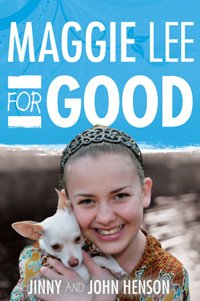
The cover of "Maggie Lee for Good" features Eric Sorenson's photo of Maggie Lee and her beloved Chihuahua Ellie.

"The theme of the book is that God can bring something beautiful even out of our most tragic circumstances," says John Henson. "It has been incredible to watch and we are so thankful to have the chance to continue Maggie Lee's work of sharing God's goodness with the world."

Interspersed with their experience, the Hensons include a section about the theological challenges presented by suffering and loss, including the inadequacy of explanations like "it must be God's will" offered by well-meaning people intending to give comfort, and about how much help they received from books by others with similar experiences like John Claypool and Carlyle Marney.

The end of the book includes discussion questions for group study and John's Aug. 23, 2009, sermon at First Baptist Church in Shreveport titled "Jairus Revisited."

"The life and death of Maggie Lee Henson began a movement of kindness that is still reverberating," says an afterword. "More than just a feel-good story, her story is proof that the human spirit will triumph even when the body fails, that people do want good to win, and that God is very much at work redeeming the world and even our worst-case scenarios."

Readers wanting to join Maggie Lee for Good are invited to go to the Facebook page facebook.com/MaggieLeeforGood. Click the "Like" button and you will be in the group. Those wanting to present Maggie Lee for Good to their school or service organization can find free resources, graphics and printables at http://maggieleeforgood.org/.


Kingdom calling not about a church’s institutional survival

Stewardship sermons often focus on finances. Even when preachers include stewardship of time and talents, emphasis on their use at church typically trumps application to the workplace or community. Amy Sherman wants church leaders to grasp a wider vision.

Amy Sherman

"I think most pastors do desire to see their people apply their faith to all areas of life and not compartmentalize it. The problem is that there is much in the life of the church—our language, our music, etc.—that inadvertently can entrench the sacred/secular dichotomy," said Sherman, author of Kingdom Calling: Vocational Stewardship for the Common Good.

Churches commission missionaries and honor Sunday school teachers, but they may never recognize members who view their marketplace professions as places of ministry, she noted.

In the process, churches communicate the message, "The real work that matters in the kingdom is the spiritual stuff," she said. "We say, 'John left his job as an engineer to go into full-time ministry'—as though being an engineer wasn't ministry."

Many seminaries fail to give attention to issues of vocation and the integration of faith and work, said Sherman, a senior fellow both at the Sagamore Institute and at Baylor University's Institute for Study of Religion. And some preachers don't preach on the workplace because they lack significant work experience apart from church settings.

"Some pastors have little marketplace experience and so have few reference points for illustrations. They may feel intimidated to talk about the workplace or the world of business due to their unfamiliarity," she said.

When churches and their leaders gain a clear understanding about God's kingdom that transcends the local congregation, members expand their concept of vocation and stewardship mean, theologian Jim Denison noted.

Churches commission missionaries and honor Sunday school teachers, but they may never recognize members who view their marketplace professions as places of ministry.

"If a church embraces and communicates a kingdom vision rather than an institutional mission, her members will see their lives and work as part of God's larger purpose," the founder of the Denison Forum on Truth and Culture said.

Part of the problem rests in how churches and their members measure success, he continued.

"Our culture measures us by our performance, possessions and popularity. As a result, churches often measure themselves by their programs, property and people," said Denison, the Baptist General Convention of Texas theologian-in-residence. "By contrast, God measures us by our obedience to his kingdom assignment."

When a congregation understands the mission of God's kingdom reaches beyond the ministries inside the church's four walls, it may result in a reordering of priorities in terms of what leaders expect from members, Sherman noted.

"There has to be a conviction that the purpose of the church is to be on mission with King Jesus in his work of renewal," she said. "That work occurs outside as well as inside the church.

"So, if you embrace this conviction, you will care about external or community ministry. Therefore, you will scale back the responsibilities required of church members for the work of sustaining the institutional church—because you recognize that sustaining the institutional church is not what the purpose of the church is. So, with fewer such commitments, members are freed up for service in the world.

"If we really believe Jesus is calling us to join him in his kingdom work, then we will not be afraid. If we make our priorities what his priorities are, he will supply our needs."


For this Baptist, ‘business as mission’ is calling

JACKSONVILLE, Fla.—Some Christians live out their faith by ministering in churches, visiting prisoners or serving as missionaries. Jordan England does it by designing and selling furniture.

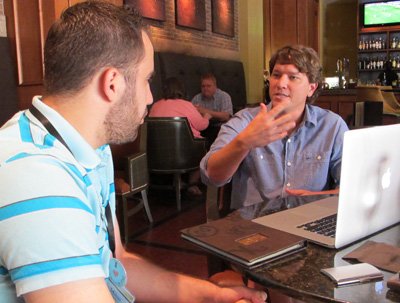
Jordan England (right), founder and CEO of Industry West, explains his company to Mihai Ciopasiu, executive director of the Ruth Project, a nonprofit that serves Gypsy children in Romania. England's Jacksonville-based online company designs and sells furniture. Meeting in a hotel restaurant in Fort Worth during Cooperative Baptist Fellowship general assembly, the two discussed an arrangement for Industry West to furnish a Romanian school with modern classroom desks—just the kind of project the company was created for, England said. (ABP PHOTO)

"This is my calling," said England, the 31-year-old owner and CEO of Industry West, an e-commerce company based in Jacksonville, Fla., that produces designer furniture.

But the core purpose of the firm he founded in 2010 is to support charitable causes.

"I found this is the best way to live out my faith," said England, a member at Hendricks Avenue Baptist Church in Jacksonville.

Others are finding that the best way, too—and in growing numbers, according to experts who follow trends in social entrepreneurism and the burgeoning field of 'business as mission.'

"The movement is called 'BAM' and there are several books out there on it," said Tom Phillips, founder of Memphis-based Diversified Conveyors, Inc., and a regular speaker at workshops and conventions devoted to the subject.

Phillips' company manufactures larger conveyor systems used by airports and companies like FedEx. He founded it in 2000 as a way to generate money for local, national and international charities and ministries. It currently generates more than $1 million annually for 54 causes.

As the movement grows and more people hear about it, they suddenly see their business acumen as a spiritual blessing, he said.

"I think it's a way of taking our faith and the gifts God gives us—in my case entrepreneurship—and apply it to the kingdom," he said.

Phillips has been invited to more BAM workshops every year, including some hosted by the Cooperative Baptist Fellowship, and he's seeing the number of such companies noticeably increasing.

"I think there's a pretty good paradigm shift going on," he said.

Part of the timing for that shift is connected to the recession and resulting bailouts and other fallout, said Linda Brennan, professor of management at Mercer University.

The economic downturn fostered distaste for greed and motivated some firms to increase transparency and social responsibility, she said. Some individuals simultaneously were inspired to seek new models for doing business, Brennan said.

England's represent a hybrid between the more overtly Christian business-as-mission model and the largely secular social entrepreneurism approach, she said.

England agreed, noting that his company's newly redesigned website has no references to Christianity or his being a Baptist.

Instead, it tells customers the company's purpose is about giving back and lists agencies the company helps to the tune of more than 10 percent of revenues.

Those include Project Ruth, which serves Gypsy children in Romania, and Hope Haven of the Low Country, a children's advocacy and rape crisis center in South Carolina.

By contrast, Phillips' website includes a verse from Scripture (Acts 1:8) and a mission statement declaring adherence to Christian principles.

England said his "under the radar" faith-based approach is intentional because it can turn off some customers and detract from the product.

The product isn't just furniture but how it's used, he said. England is headed to Romania in September to equip a school with newly designed classroom desks as part of a deal worked out with Project Ruth during the recent 2012 CBF general assembly in Fort Worth.

Making those kinds of deals, he added, is the company's reason for existence and his way of living out the gospel.

"I don't want to be Chick-fil-A where everyone knows we're a Christian business," he said. "But that is what drives me to make it successful."


Band challenges audiences to live like Christ

NASHVILLE, Tenn.—For the Dove Award-winning group Sidewalk Prophets, Live Like That is more than just the title of their latest album. It's a reminder for believers to be aware of their words and actions while striving to be examples of Christ to the world around them.

Members of Sidewalk Prophets hope the songs on their new album, Live Like That, will remind teenagers and young adults to be aware of their words and actions while striving to be examples of Christ to the world around them.

The songs on the band's new album are designed to encourage Christians and are based on Hebrews 12:1, "Therefore, since we are surrounded by such a great cloud of witnesses, let us throw off everything that hinders and the sin that so easily entangles, and let us run with perseverance the race marked out for us."

"Our prayer is that every song on this album is dedicated to a glimpse of what it means to live like Christ," lead singer Dave Frey said. "We want teenagers to know that if they spend time in prayer and in the word, and serve as an example of Christ to their friends, then they are going to be blown away by what God has prepared for them. The journey is long and not always easy, but thankfully, it's also full of blessings and grace.

"My parents divorced during my junior year of high school. It was a tough time, but I realized that I could either run from God or run to him. Thankfully, I chose the latter. In both good times and bad times, God is always there. It might not always be an easy situation to endure, but God is always faithful to his children."

In addition to Frey, the group is made up of Ben McDonald, Cal Joslin, Justin Nace and Shaun Tomczak. The band members continue to receive messages about the impact of their debut album, These Simple Truths, released in 2009, that featured the hit songs, "The Words I Would Say" and "You Love Me Anyway."

{youtube}GfosSggwQS0{/youtube}

"A teenager recently came up to us after a concert and, with tears in his eyes, told us about a time when he was on the brink of despair," Frey said. "This young boy said that just as he was about to end his life, a friend drove up beside him and the song playing in the car was 'You Love Me Anyway.' I get goose bumps just thinking about it. That's why we do what we do. It's God moving through songs."

While performing concerts around the country, the group hopes to offer more than a concert. They hope to provide a life-changing encounter with God.

"We often get so comfortable with our faith, but Christ calls us to have a faith that is powerful and moving," Frey said. "Whether it's taking a mission trip to Africa or visiting with your neighbors, we need to step out of our comfort zone so we can shine the light and love of Christ."


Christian use of digital devices redefines ‘going to church’

McKINNEY (RNS)—No matter where people live, they can go to church—virtually, at least—with Christ Fellowship in McKinney, which is on board with almost every high-tech gadget under heaven.

Christ Fellowship in McKinney offers worshippers a Facebook page, online sermons, live chats and QR codes.

Find the church by going online—the 21st-century version of sighting a steeple on the horizon. Beyond its website, Christ Fellowship also has a Facebook page.

The curious can download the worship program by scanning their customized-with-a-cross QR code. Worship services are streamed online from the church's Internet campus—with live chat running so participants can share spiritual insights in real time.

Afterward, Senior Pastor Bruce Miller said: ''Someone will ask you, 'How did it go? Did God help you today? How can we help you?' Just like we do when people come to our building in McKinney. We are here to help people find and follow Christ, wherever they are starting out from.''

And wherever they are in the digital world.

Christ Fellowship exemplifies most of the latest ways churches dramatically extend their reach beyond any one time or local address. Such congregations signal ''a willingness to meet new challenges,'' said Scott Thumma, of the Hartford Institute for Religion Research, author of a study by Faith Communities Today of how churches, synagogues and mosques use the Internet and other technology.

Sermons by Bruce Miller, senior pastor of Christ Fellowship Church in McKinney, Texas, are part of the streaming worship service offered by the church's Internet campus.

The organization's national survey of 11,077 of the nation's 335,000 congregations found seven in 10 U.S. congregations had websites, and four in 10 had Facebook pages by 2010.

The use of QR codes—which allow users to scan a bar code with their cell phone and go directly to a related website—is too new to be measured yet, Thumma said. He recently began tracking churches that stream worship—about 1 percent of congregations, he estimates.

Future surveys may measure the explosion of digital applications. Christ Fellowship has one app for donating online and another for swapping goods and services to help others in the community—2,100 people at the North Texas church campus and God knows how many online.

Believers have been early adopters of every new form of communication since the first printed book—the Gutenberg Bible. Centuries later, examples abound beyond individual congregations:

• Pope Benedict XVI's annual World Communications address emphasized the importance of a Christian presence in the digital world. The Vatican has a Web TV channel and had a Twitter campaign during Lent.

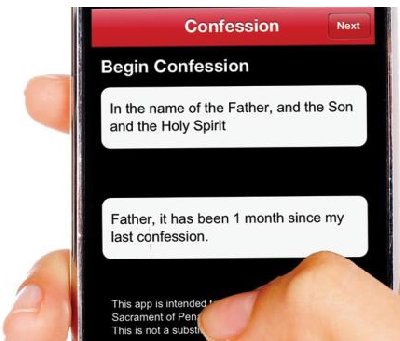
• Confession: A Roman Catholic App—released for the iPhone a year ago by www.littleiapps.com, a U.S. company—has been downloaded more than 100,000 times. Sacraments can't be done virtually so ''you are not YouTube-ing or emailing your confession,'' said Patrick Leinen, a cofounder of the company.

Confession: A Roman Catholic App has been downloaded more than 100,000 times since the aide to Roman Catholic confessions was released a year ago, according to co-founder Patrick Leinen.

The app is a ''personalized examination of conscience,'' an aid that prompts Catholics through the required preconfession soul-searching. Then they can bring notes right in to meet the priest, Leinen said.

The Billy Graham Evangelistic Association, a pioneer in print, radio, television and satellite-broadcast outreach for decades, now employs search-engine algorithms to steer people toward salvation.

Its Internet evangelism project, launched last fall, scours search engines for people who enter phrases such as, ''Does God love me?'' or ''Does God answer prayers?'' The results page includes a paid listing that highlights a website introducing Christ, www.PeaceWithGod.jesus.net.

People who sign on to the sinner's prayer on that page turn up in a real-time scroll of the latest ''decisions'' at www.SearchforJesus.net, a page that explains the Internet ministry.

• Believers can sing along with a new tablet hymnal from Church Publishing. In March, the Episcopal Church's publishing house released eHymnals for the iPad and other digital readers.

With the infinite reach of technology, ''people are able to confront God in unique ways even if they are hundreds of miles apart,'' said John Mark Reynolds, director of the honors institute at Biola University, a private evangelical school in La Mirada, Calif. Biola held a conference on blogging two years ago. It updated to a Web-focused conference last year, and this June, the conference zeroed in on digital technology.

No matter the technology, the overall focus remains the same, Reynolds said: ''How can the Christian church utilize the tools media has given us without being subsumed by them? You don't want delivery to become everything.''

Technology ultimately should be an enhancement, not a re-placement, for gathering in person for worship, discussion, debate and service to others, said Drew Goodmanson, CEO of Monk Development, which helps churches use the Internet to fulfill their missions.

Goodmanson appreciates that ''you can have a digital Bible in the palm of your hand or connect with others in prayer any time, anywhere.'' Even so, he cautioned: ''Jesus would not have a Facebook page. He wouldn't be stopping in an Internet cafe to update his status.''


Steven Curtis Chapman encourages audiences to show hope

NASHVILLE, Tenn.—For more than 25 years, Steven Curtis Chapman has been sharing songs and stories about God's redemption, grace, love and faithfulness with audiences around the world. Along the way, Chapman has garnered 56 Dove Awards from the Gospel Music Association, five Grammy Awards and 46 No. 1 radio hits.

Through it all, he has remained dedicated to shining the spotlight on Christ.

Steven Curtis Chapman

"Realizing that God has entrusted me with a calling to lead people before his throne gives a greater meaning and purpose to performing concerts and writing songs," Chapman said. 

"I love hearing stories about people accepting Christ during a concert or how a song on the radio inspired someone to follow the Lord. It is the greatest honor and privilege knowing that these songs are leading people to Christ.  

"With all the songs that I've written through the years, my prayer has been: 'Lord, I want to know you more. As you make yourself known, I want to make you known to others through what I write, sing and the stories I tell.'"

In addition to his music, Chapman desires to create platforms to reach out and help those in need.

As strong advocates for adoption and orphan care, he and his wife, Mary Beth, have adopted three daughters from China. They also established a ministry, Show Hope , that has given more than 2,600 financial grants to adoptive families and has affected the lives of children from 45 countries. 

In addition to financial aid, Show Hope empowers families, communities and churches with adoption and orphan care resources to assist them in advocating and caring for the millions of orphans around the world. Show Hope also provides for orphans with special needs through special care centers in China.

The Christian Alliance for Orphans presented the Chapmans with the Defender of the Fatherless Award at Saddleback Church in Lake Forest, Calif.

In 2008, the Chapman family was devastated by the death of their adopted daughter, Maria Sue. However, they found comfort and strength through God's faithfulness and unfailing love.

Now, with an even greater passion and purpose for sharing the gospel through songs, Chapman hopes his music will help provide comfort for people dealing with the loss of a loved one.

"After Maria went to heaven, I was crying out to God in the midst of grief, darkness and despair," Chapman said.

"I kept saying, 'God, I trust you … even though I don't understand.' When I started doing concerts again, I found there was a new meaning, purpose and passion in the song lyrics. 

"Just as my family had walked through more valleys than we ever had before, I was singing about trusting God, his sovereignty and faithfulness. I found myself singing many of the lyrics with a new understanding and new desperation for the truth of the gospel.

"Even to this day, God is still leading us out of those dark places. We still wake up and face a heavy reality. In the midst of our sadness, we are reminded that Jesus is leading us on this journey, and we are going to make it through. God will never leave or forsake his children.

"I certainly don't have all the answers, but I know that as my family has walked through the deepest, darkest places in our lives that God has been right there with us every step of the way—sustaining us and giving us strength.

"After all these years and after everything that my family has been through, we can still declare that God is good and that he is faithful. 

"I want to encourage others not to lose heart or grow weary, because for those who have a relationship with Christ, this journey will take us home. That is the greatest promise and where we find our hope."


Faith Digest

Views on voting for a Mormon unchanged. Nearly one American in five says he or she would not vote for a Mormon president, a percentage that hardly has budged since 1967, according to a new Gallup poll. It is unclear how the anti-Mormon inclination will affect Mitt Romney, the presumed GOP presidential nominee, Gallup said, since just 57 percent of Americans know he is a member of the Church of Jesus Christ of Latter-day Saints. Anti-Mormon attitudes are tied closely to education levels and partisanship, with nearly a quarter of Americans with a high school education or less saying they would not vote for a Mormon. That number decreases to just 7 percent among those with postgraduate degrees. Nine in 10 Republicans and 79 percent of independents said they would vote for a Mormon; just 72 percent of Democrats agreed. Gallup began asking the Mormon question in 1967, when 19 percent said they would not vote for a Mormon presidential candidate. This year, 18 percent said they would not vote for a qualified Mormon candidate, down from 22 percent in 2011. The anti-Mormon bias remains remarkably consistent, according to Gallup, considering that resistance to candidates who are black, Jewish or female has declined markedly since 1967. The Gallup poll is based on telephone interviews conducted June 7-10 with a random sample of 1,004 adults. The poll has a margin of error of plus or minus 4 percentage points.

Faith DigestReligious donations decline again. Post-recession America is beginning to open its wallet to charities again but is not giving as generously to religious institutions. While charitable donations from individuals rose nearly 4 percent overall in 2011, according to the annual Giving USA report, donations to houses of worship and other religious bodies dropped by 1.7 percent—a decrease for the second year in a row. The report, compiled by the Indiana University Center on Philanthropy, shows individual Americans gave nearly $218 billion last year, $96 billion of which went to religious organizations. The proportion of the charitable donations going to religious groups has been falling steadily for decades, said Robert Evans, of Giving USA's editorial review board. Evans offered several reasons for the decline, including increased competition from a proliferating number of nonreligious organizations, a decrease in church attendance and a general lack of sophistication within religious institutions regarding fund-raising.

Evangelicals propose code of ethics. The National Association of Evangelicals is urging pastors to seek a common moral ground by uniting under a consistent code of ethics. NAE leaders said the new code provides uniform guidance to church leaders across the 40 denominations that comprise the nation's largest evangelical group. The code puts into writing ethical guidelines that often go unspoken. Specifics include, among other things, sexual purity, regular financial auditing, not recruiting members from a pastor's former congregation and counseling ethics. A team of ethicists, pastors and denominational leaders working over an 18-month span compiled the code.

Compiled from Religion News Service