New hymnal helps engage Scripture word for word

NASHVILLE (BP)—Twelve years ago, Randall Goodgame’s family was in the thick of homeschooling. His wife Amy struggled to help the kids memorize their weekly Scripture verses. Goodgame decided to help in a way that came naturally to him—writing songs.

It worked.

“It worked so well that … within a few weeks I realized, well, this seems important,” Goodgame said in a recent interview with Baptist Press.
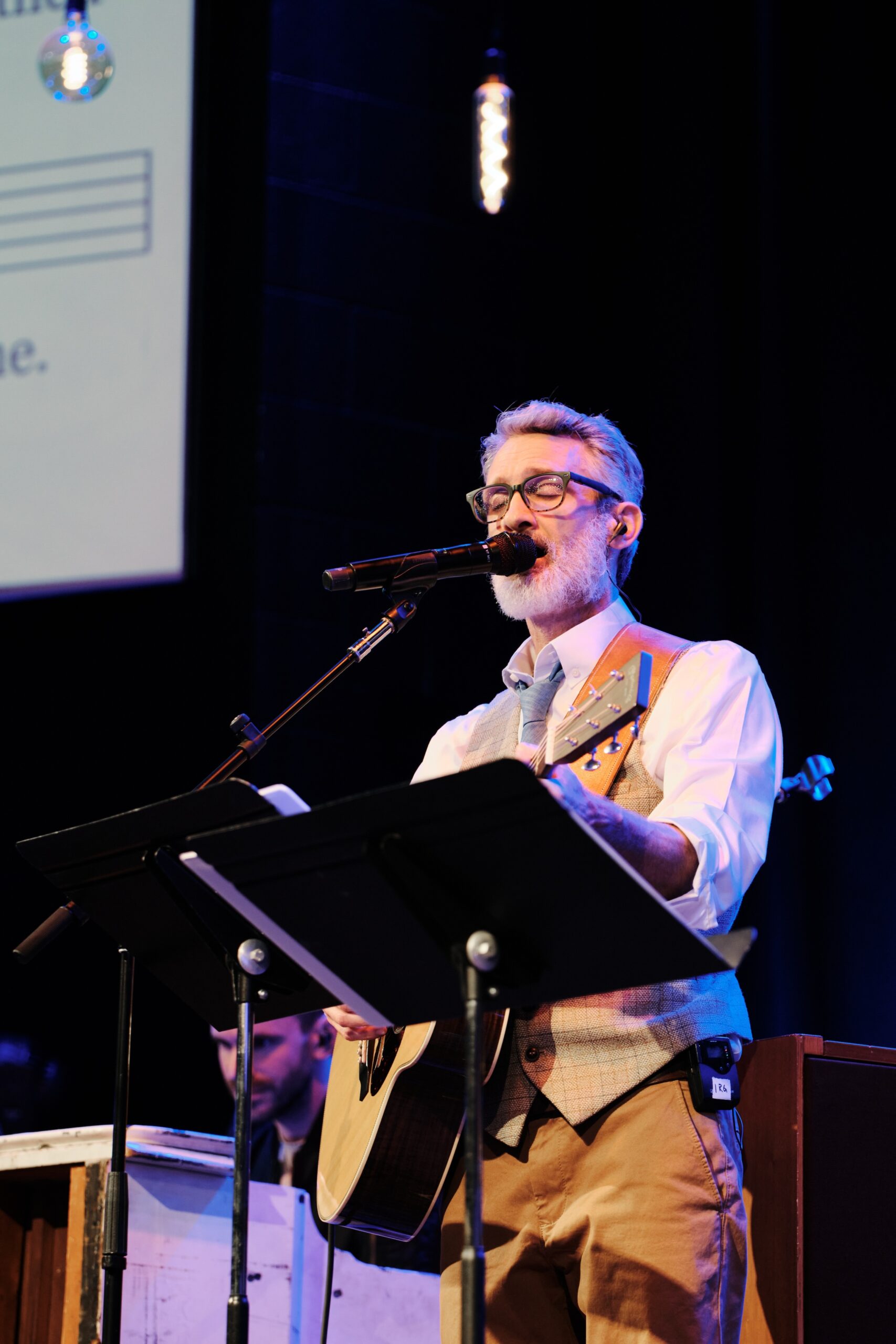
Songwriter Randall Goodgame introduced his ‘Scripture Hymnal’ in front of a live audience in October. (Photo courtesy Turning Point Media via BP)

Songwriter Randall Goodgame introduced his Scripture Hymnal in front of a live audience in October. “There’s something about music that allows us to experience something more than just the information,” he said.

What started as a project to help his kids soon turned into a new phase of his ministry as a music artist. Now, Goodgame’s Scripture songs fill a new hymnal—aptly titled Scripture Hymnal—which Goodgame hopes will help churchgoers internalize God’s word.

“Music helps people remember things,” Goodgame writes in the hymnal’s introduction. “And music memories conjure much more than just information. … In the time it takes to hear a melody, a whole world can flood our consciousness.”

Music involves more than just the intellect, he told BP, which makes it an effective teacher.

“God gave us these emotions, and we are spiritual people,” he said. “We are these eternal creatures trapped in these glorious gifts that we call bodies that were made in the image of the creator. And there’s something about music that allows us to experience something more than just the information.”

And even more than that, we are called to sing together.

“First and foremost, [singing is] an act of obedience,” Goodgame said. “The Lord only requires us to do things that are good for us. He sanctioned it. We know that means it’s good for us. … There’s something so powerful about proclaiming the truth of what’s real and what we depend on about this God that we serve and trust—proclaiming it together through song.”

A labor of love

The hymnal opens with “In the Beginning,” based on Genesis 1:1. Hymn No. 55, “Unless You Change,” is based on Matthew 18:3-5. “Quick to Listen, Slow to Speak”—hymn No. 95—is based on James 1:19.

There are 106 songs, all taken directly from Scripture, plus accompanying Scripture readings and indexes listing the songs by topic, musical style, Scripture passage and more.
The ‘Scripture Hymnal’ contains 106 songs, which all have corresponding studio recordings online.

Scripture Hymnal contains 106 songs, which all have corresponding studio recordings online.

The team of 12 writers who collaborated on the songs committed not to change the Scripture text in any way. They used mostly the NIV, ESV and CSB translations, choosing what they considered the most lyrical translation for a given passage.

Word-for-word rendering made the songwriting more challenging, but Goodgame had strategies for making the songs easy to learn and sing.

First, he simply immersed himself in the verses, reading them very slowly, praying and letting the passage’s theme and text dictate the feel and form of the song.

He took a cue from traditional hymns for the structure of the songs.

“Old hymns were built for unmusical people to sing together,” he said, adding that usually means one syllable per beat.

“I really made an effort to try to be aware of the syllables and where they fell on the beat,” he said. “And then once you’ve constrained yourself to that, then you have to find melodies that sound appealing within that restriction. Then it’s just kind of problem solving and listening and praying.”

Much of his inspiration for which passages to use for songs came from his own Bible study, but Goodgame also asked friends, including several pastors, “If there were one verse that your congregation would be able to sing to each other and to the Lord, what would that one verse be?”

Goodgame premiered the hymnal in a live concert Oct. 11 in Franklin, Tenn., where the capacity crowd was able to sing along with the songs pretty much right away. The lines from the hymnal appearing on the screens helped those who could read music, but even those who couldn’t were able to follow along quickly.

“The goal is you want people to feel like this is how a melody was supposed to be written for these words,” Goodgame said.

What he’s called to do

For more than a decade, Randall Goodgame has been writing songs using the Bible for lyrics.

Goodgame is no stranger to using music to instill important truths. Over the last 20 years, he’s built a kids’ and family music brand called Slugs & Bugs, releasing the first album along with singer-songwriter Andrew Peterson in 2006.

The albums are equal parts silly and serious, with songs like “God Made You” and “May the Lord Bless You and Keep You” appearing alongside ones like “Tractor Tractor” and “Chicken Wiggle.”

But the one thing they all have in common is quality music and production. It’s the kind of kids’ music that parents keep listening to on their way to work after they drop the kids off at school.

After Goodgame’s success in writing songs to help his kids memorize Scripture, he began focusing on using Scripture alone for his lyrics, and the Slugs & Bugs Sing the Bible series was born. Sing the Bible Volume 1 came out in 2014. There have been four others since then.

“It’s what the Lord called me to for well over a decade,” he said. “And I think if I hadn’t had all those five Sing the Bible albums under my belt, I wouldn’t have been prepared to have done what I just did with the Scripture Hymnal. … I’ve done it for long enough that I’ve just gotten better at it. Like you do when you do the same thing over and over.”

A priceless opportunity

The Scripture Hymnal is not for kids, though the songs are singable enough that kids can easily learn them. And for those who don’t read music or who prefer to learn them aurally, there is a studio recording of each song online.

A QR code in the front of the hymnal takes the user to the recordings. The recordings also are being compiled into albums, the second of which released Nov. 29. There will be nine albums in all.

“Even though it was written for congregational singing, I really do hope people also see the value of just personal devotion with it,” Goodgame said. “They don’t have to read music; they can just go to the song through the QR code and flip to the page of the song they want to sing and sing along with the music.”

Goodgame said a main inspiration for the hymnal project was learning how his Sing the Bible CDs helped people internalize the word of God.

“I always have heard for years and years from people, ‘The Lord will bring the song that I need to my mind right when I need it.’ I just hear it over and over again,” he said. “To carry around God’s word with you is just priceless.”

Ultimately, he hopes the Scripture Hymnal will help the church be the church.

Singing together is proclaiming God’s faithfulness “right next to people that you know are going through hard things,” he said. “You are going through something hard, and you’re affirming it, proclaiming it, choosing to believe or at least try to believe by singing what you know is true with a whole room of other people that are doing the same thing.”

And how much more so when the words believers are singing are taken straight from Scripture.

“Every time we engage with the word, we have an opportunity to meet Jesus,” Goodgame said. “And it’s in Jesus that we are redeemed, and we are sanctified, and that dim little spark brightens, and we become lights in the world, caring less about ourselves and more about other people.

“And his kingdom grows because of the outpouring of his love through us to other people. And his word is the beginning of all of that.”
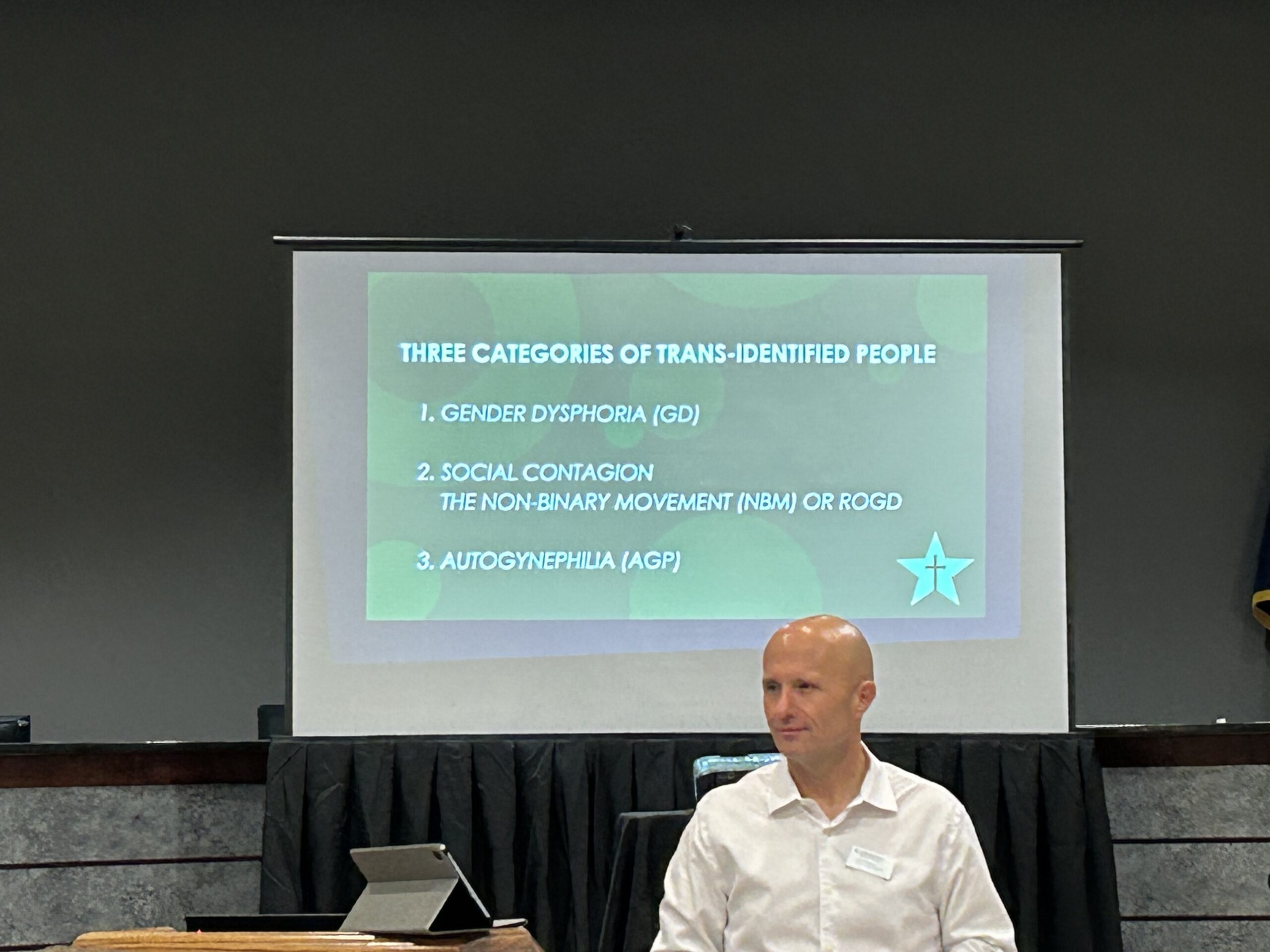


Sexuality and Gen Z an important conversation

WACO—“How can we disciple our young people well on matters of biblical sexuality?” Gary Stidham, director of training for Texas Baptists’ Center for Collegiate Ministry, asked a Texas Baptist group.

Stidham raised the question during a breakout session held in conjunction with the Baptist General Convention of Texas annual meeting last month.

Stidham credited Sean McDowell, a professor at Talbot School of Theology, with observing that prior generations wanted to know about Christianity, “Is it true?” But Generation Z is asking, “Is it good?”

Gary Stidham offers a breakout session on Gen Z and sexuality at the BGCT annual meeting. (Photo / Calli Keener)

The shift from intellectual questions to moral questions among young people means churches must be sensitive in how they discuss matters of sexual identity, if they want to reach Gen Z.

Today’s critique of the church by those outside the faith isn’t so much that Christianity is illogical or unreasonable, but that it is unloving and uncaring toward people on the margins—particularly women, immigrants, people of color and those in the LGBTQ community, Stidham noted.

But if church leaders want to help students and young families love the gospel, the church and the word of God, “we have to tackle issues around sexual morality, because that’s where the culture has gotten so far off the rails in the last few decades,” Stidham said.

Stidham suggested to address this conversation, Christian leaders should talk about the subject of sexuality holistically, starting with Genesis; make affirming marriage a priority; celebrate chastity, singleness and celibacy; teach wise dating; and fight pornography aggressively.

Stidham served as a campus missionary with Baptist Student Ministries at the University of Texas in Arlington for 21 years. He now oversees 60 campus missionary interns for their first couple of years out of college serving with BSM. His doctoral work focused on LGBTQ issues.

He noted 12 years ago, after a time when the BSM at UT Arlington had “gotten really good at gathering large groups” but was not seeing very many college students come to Christ, “God led us to shepherd a really powerful evangelistic movement.”

As a result, the BSM began to see at least one student a week come to Christ, a trend, Stidham noted, “that continues to this day.”

One thing his team at UT Arlington began to realize was these new Christians’ “lives were messy,” and they came with “a lot of baggage to unpack, and a lot of that baggage had to do with gender and sexuality issues.”

While Stidham acknowledged issues about sexuality “have always been around,” the increased cultural focus on sexuality and gender identity means issues around sexuality are even more present and complex. In fact, sexual confusion and brokenness permeate Gen Z.

Increasing numbers

Gallup reported this year 19 percent of Gen Z (ages 12-27) identify as LGBTQ, compared to about 10 percent of Millennials, 5 percent of Gen X and 2 percent of Baby Boomers.

A recent Barna poll reflects an even higher percentage, with 39 percent identifying as LGBTQ and half of that number identifying as bisexual.

But more Gen Z identify as same-sex-attracted than who act upon that attraction, Stidham pointed out. Most of this generation who claim a bisexual identity only date the opposite sex. They “want that identity, so they say they’re bisexual, even though they don’t act upon it.”

What has led to the burgeoning numbers who identify as LGBTQ? First, Stidham noted, is the “straight-up reality that there are people who are same-sex attracted.”

From ancient times all the way up until now, in a “complicated mix of nature and nurture,” he said, there are people “who didn’t ask for it” or “wake up and decide one morning, ‘I’m going to like people like me (same sex).’”

Another factor is the epidemic of loneliness affecting this generation. Sexual identity has coalesced into a “movement of belonging for disaffected youth,” where they can find connections that eluded them outside of the LGBTQ community.

Another contributor is social pressure, especially for people who in years past would have been described as “tomboys” or “sensitive boys.” Now, there is pressure for such natural personality differences to be understood as signifiers of homosexuality or gender nonconformity, he explained.

Mental health and LGBTQ are related, Stidham noted, pointing out there is a “tremendous correlation” between anxiety and depression and LGBTQ identity. And neurodivergence—autism spectrum disorder, obsessive-compulsive disorder, post-traumatic stress disorder—has an even higher correlation to LGBTQ identity than anxiety.

“Almost every one of the reasons means what these young adults don’t need is our scorn and a wagging finger. What they typically need is our arms welcoming them in.

“They need patience. They need help meeting Jesus, so that with discipleship they can unpack all the confusion,” he noted.

Trying to “own the liberals” isn’t the way to love LGBTQ people. Instead, loving the teenagers who struggle with confusing messages about sexuality is how to reach LGBTQ people, he said.

Powerful forces, talked about in Colossians 2:8, are working to indoctrinate Gen Z. In every generation, Satan wants to capture the minds of the people and move people away from God. Stidham sees the increase in LGBTQ identities as evidence of an ongoing spiritual battle with “elemental forces.”

Stidham pointed to “radical individual autonomy” that came out of the sexual revolution of the 1960s as being at the heart of why LGBTQ has become such a heated issue. So, he cautioned pastors against playing into a “nobody can tell me what to do mindset.”

Core identity realignment

For a good many people, sexuality has become the ultimate identity, seen as being at the very core of who they are.

“I’m not a man who happens to be same-sex attracted. I’m a gay man,” Stidham gave as an example to clarify this idea.

Because sexuality has assumed such a preeminent place in identities, in order to disciple young people, church leaders must learn how to speak thoughtfully and with nuance about these issues.

Christian students want to talk about these issues, Stidham noted. They want to know the truth concerning sexuality. In fact, “they’re more eager to hear than we are to share.”

These conversations should be approached by church leaders with genuine questions, seeking to understand what students are hearing and feeling about matters of sexuality and identity.

“We are ministers and missionaries, not political pundits,” Stidham noted. There is a culture war happening, “but don’t be a culture warrior,” Stidham urged. “The reason we talk about these issues is to help people come to Jesus.”

1 Corinthian 6:18-20 demonstrates sexual morality is profoundly important to our spirituality, he said.

When Christian leaders are discipling students on matters of sexuality, they should stress the flourishing that can come when identities are found not in sexuality, but in Christ.


Hartford: Most congregations avoid discussing politics

(RNS)—Despite the incessant tracking of evangelical Christian, Latino Catholic, Muslim and other religious groups through the recently ended election season, a study released on Election Day by the Hartford Institute for Religion Research showed that most congregations are politically inactive, with nearly half actively avoiding discussing politics at their gatherings.

The Hartford report, “Politics in the Pews? Analyzing Congregational Political Engagement,” focused on how congregations as a whole deal with politics, not religious individuals or their clergy alone.

“Congregations often get left out of conversations about religion and politics but are inferred to be influential,” the report states.

Even if members are politically active and many leaders are often outspoken about issues and candidates they support, most congregations make great efforts to keep politics out of the church.

“When they come together as a spiritual community, they don’t want politics directly involved. There’s a lot of pushback from the people in the pews,” said Scott Thumma, director of the Hartford Institute for Religion Research, who co-wrote the report with Charissa Mikoski, an assistant research professor.

The study’s data was drawn from a larger project developed by the institute to track congregational change, Faith Communities Today. It relies on surveys of 15,278 congregations conducted in early 2020. Responses were given by congregation leaders on behalf of their assemblies.

According to the report, 23 percent of congregation leaders identified their congregation as politically active, but only 40 percent engaged in what the report calls “overtly political activities” over 12 months, mostly infrequently.

The report measured congregations’ level of political engagement by looking at seven categories of political activities, including distributing voter guides, organizing protests in support or opposition of a policy, and inviting a candidate to address the congregation.

A minority of congregations engage in any of the above; 22 percent handed out voter guides; 7 percent asked a candidate to speak to the congregations; and 10 percent lobbied for elected officials.

Pastors see political discussion as tricky business

In nearly half of congregations—45 percent—their leaders thought most participants didn’t share the same political views, making politics a sometimes treacherous topic. Discussing politics is also tricky for pastors, the report found, as they risk offending members whose views don’t align.

Not surprisingly, “purple congregations,” in which both political parties are represented in the pews, were more likely to avoid political discussion than politically homogenous ones, per the report. Congregations where politics previously spurred conflicts—the case in 10 percent of the congregations surveyed—were less likely to engage in any of these activities again.

The results clash with the general narrative about Christians’ political engagement, especially stories of evangelicals’ avid political engagement. According to Hartford’s report, however, Catholic and Orthodox parishes are more engaged than Protestant churches.

“Further, the congregations who are engaged in these kinds of political activities do not fit the broader narrative of Evangelical Protestants being more politically active,” the report said. “While these connections are present at the individual level, it does not appear to be happening at the organizational (congregational) level.”

Instead of directly addressing political issues, the closest most congregations get to political discussion tends to be sermons that uphold specific values associated with particular political issues, such as immigration or abortion.

Congregations whose membership is more than 50 percent Black or African-American are more likely to be politically active, reflecting Black churches’ historical political involvement, especially in the fight for racial justice.

“It’s almost built into the DNA of an African American congregation to have that kind of activism approach,” Thumma said.

Since these congregations are more homogenous, members may also feel more comfortable addressing politics, assuming other congregants have the same politics.

The survey sample included 2,000 multi-ethnic congregations and churches, where 20 percent of participants were not of the dominant race. Their results were similar to those of non-multiracial churches, with 60 percent reporting having no involvement in politics.


Less than half of Americans attend church at Christmas

BRENTWOOD, Tenn.—As Americans make their Christmas plans, slightly less than half say they usually attend a church service during the holiday season.

A Lifeway Research study finds U.S. adults are split on whether they’ll be at church sometime this Christmas—47 percent say they typically attend church at Christmastime, while 48 percent say they do not, and 5 percent aren’t sure.

“The very name ‘Christmas’ originates in the church’s celebration of Jesus Christ’s birth. In the mid-14th century, the words ‘Christ’s Mass’ were first merged as a single term for this celebration,” said Scott McConnell, executive director of Lifeway Research.

“While 9 in 10 Americans do something to celebrate Christmas, less than half typically attend church at Christmastime today.”

Pastors plan for larger crowds during the Christmas season. In 2023, Lifeway Research found U.S. Protestant pastors say they usually plan four events or activities at their churches to celebrate Christmas.

About 4 in 5 pastors (81 percent) say Christmas is one of their three highest attendance worship services, according to a 2024 Lifeway Research study. Specifically, 28 percent say Christmas draws the most people to their church.

During the season, churches see more people at their Christmas Eve service than other worship services, a 2022 Lifeway Research study revealed.

Who is most likely to attend?

This Christmas season, 47 percent of Americans say attending church is part of their usual holiday traditions, but some are more likely to show up than others.

Not surprisingly, those who attend church most often—more than once a week—are the most likely (95 percent) to be there for Christmas.

Protestants (57 percent), Catholics (56 percent) and those from other religions (53 percent) are more likely than the religiously unaffiliated (21 percent) to report usually attending a church service. The religiously unaffiliated are the most likely to say no (71 percent).

Americans with evangelical beliefs are far more likely than those without such beliefs to show up to church during Christmas (72 percent v. 40 percent).

What prompts Christmas church attendance?

Most of those attending church at Christmastime say they do so primarily because of their faith. Three in 5 (60 percent) of those who typically attend church during this season say they do so to honor Jesus.

Fewer say their church attendance comes from a desire to observe tradition (16 percent), to be with family and friends (15 percent) or to get in the Christmas spirit (8 percent). Few (1 percent) aren’t sure what motivates their attendance.

“While church services draw more people in the Christmas season, their prime motivation isn’t unified. The majority are drawn to celebrate the birth of Jesus, honoring him as the Christ or promised Messiah. But others mostly join in because of the importance of family, their embrace of Christmas church tradition or to jumpstart Christmas vibes,” McConnell said.

Christians who attend church less often are more likely to say their Christmas attendance comes from tradition. Those who rarely or never attend (22 percent) and those who attend once or twice a month or only on religious holidays (27 percent) are more likely than those who attend about once a week (10 percent) and those who attend more than once a week (6 percent) to say they show up to observe tradition.

Americans with evangelical beliefs are more likely than other Americans to say they attend services to honor Jesus (74 percent v. 53 percent). The religiously unaffiliated are the most likely to say they attend to be with family and friends (42 percent) and to get in the Christmas spirit (21 percent).

Some are just waiting to be invited

Those who don’t typically show up at Christmas may simply be waiting on an invitation. Most (56 percent) say they likely would attend church if someone they know invited them to attend with them at Christmas time, including 17 percent who are very likely.

Around a third (36 percent) say they’re unlikely, including 24 percent who are very unlikely. Another 8 percent say they’re not sure.

“More than 1 in 8 Americans are convinced they would not attend a Christmas service if an acquaintance invited them. However, the majority of Americans who do not typically attend church at Christmastime say they probably would if they were invited by someone they know,” McConnell said.

“But anticipating a positive response may not be the best motivation for a churchgoer to invite people to a Christmas service. A different motivation in the chorus of an African American spiritual appeals to everybody: ‘Go tell it on the mountain that Jesus Christ is born.’ This chorus suggests that the Hallelujah-inspiring good news of Jesus being born is reason enough to tell it on the mountain or on the city wall.”

Catholics (71 percent), Protestants (65 percent) and Americans of other religions (58 percent) who don’t typically attend during Christmas are more likely than the religiously unaffiliated (40 percent) to say they’re likely to attend a service if invited. The religiously unaffiliated are the most likely to say they are unlikely to attend if invited (55 percent).

Christians who already attend church at least occasionally are more likely to show up this time of year if invited. Christians who attend a worship service about once a week (76 percent) and those who attend once or twice a month or only on religious holidays (69 percent) are more likely than those who rarely or never attend (52 percent) to say they’re likely to show up if invited.

Christmas invitations also may be effective for women (61 percent say they’re likely to attend), Hispanics (72 percent), those in Midwest (65 percent) and Northeast (60 percent) and those with evangelical beliefs (69 percent).

Older Americans who don’t typically attend aren’t looking for an opportunity to start. Those 65 and older (48 percent) are the most likely to say they are unlikely to go to a church service with a friend if invited during Christmas.

The online survey was conducted Aug. 14-30, 2024, using a national pre-recruited panel.  Researchers used quotas and slight weights to balance gender, age, region, ethnicity, education, religion and evangelical beliefs to reflect the population more accurately. The completed sample is 1,200 surveys, providing 95 percent confidence the sampling error from the panel does not exceed plus or minus 3.3 percent. Margins of error are higher in sub-groups.


Signing church services for the Deaf is a work of love

WASHINGTON (RNS)—At the First Baptist Church of Suitland, just across the District of Columbia border in Maryland, a typical Sunday service includes coffee and pastries, warm greetings and a sermon delivered by Pastor Quintin Few Sr., in an auditorium with a full band and speaker system.

Pastor Quintin Few Sr. preaches at First Baptist Church of Suitland, Md., Oct. 6, 2024, while being interpreted by Holy Hands ministry members with American Sign Language, inset. (Video screen grab)

At the side of the stage as the service proceeds are two people translating Few’s words into American Sign Language to help Deaf and hard of hearing parishioners. They are part of a program at the church known as the Holy Hands ministry.

With their hands flowing from one sign to the next, the interpreters bring the pastor’s words to life, which can be no easy task.

“One missed sign or one missed concept can prevent others from working out their salvation on that day,” said Bronte Stewart, who founded the program with the church’s leadership and music director in 2014.

Because Stewart sees every service as an opportunity to strengthen one’s faith, the ministry, she believes, offers more than access. It is inspired by a shared conviction among members that including anyone who might walk through the church’s doors is a fundamental part of living their Christian values.

“We were intentional in making sure that the Deaf community was integrated into the life of the church and to see them as part of us, irrespective of their disability,” said Few. “I think that is so important when you are ministering to any community.”

Interpreted services rare

Churches that offer interpreted services are still relatively rare in the United States. The Deaf Bible Society, a nonprofit that works to make the Bible accessible to Deaf people, lists nearly 30 houses of worship in the state that are “Deaf Churches” (led by Deaf people) or “Interpreted Churches.”

That’s likely an undercount—First Baptist doesn’t appear on its list—but with more than 5,000 churches in the state, it’s most likely only a tiny minority provide ASL services. Meanwhile, estimates put the share of Americans who are Deaf or hard of hearing at 11 million, or about 3.6 percent.

Responding to the call

Michael and Sharone Ligon. (Courtesy photo)

At First Baptist Suitland, the Holy Hands ministry was born out of a conversation that took place in January 2014, when a Deaf woman named Sharone Ligon walked into First Baptist Suitland, interested in joining the church.

“There was a woman there explaining how the Sunday school works,” said Ligon, who was in a group with other prospective members but could not hear what was being said. A church member noticed Ligon had not been speaking much and approached her.

“He said, ‘Are you deaf?’ And I said, ‘Yes, I am.’ And so that’s when he called Bronte to come over,” Ligon recalled.

Stewart, a long-time church member, said: “I knew basic sign language. I wouldn’t even say at a ‘101’ level. It was probably like a level 99,” explained Stewart.

Others in the church encouraged Stewart to learn more sign language in hopes she could become an ASL interpreter, but she was hesitant.

“You know, when the Lord taps you on your shoulder, sometimes you miss it,” she said. “I thought to myself: ‘Oh no, not me, Lord. You couldn’t possibly be calling on me to do this task.’ I didn’t hear that.”

But not long afterward, one of First Baptist’s ministry directors approached her to say the church would send her to school to learn ASL if she would interpret at services.

“I said, ‘Oh, OK, if the Lord’s going to equip me, yeah, I’m going,’” said Stewart, who then enrolled in ASL classes at a local community college.

Standards for ASL interpreters

Becoming a certified ASL interpreter can take years of rigorous examinations, and interpreters are required to meet standards set by the Registry of Interpreters for the Deaf, a body that provides guidance for those interpreting in various settings, including religious ones.

RID’s Standard Practice Paper, a document that “provides a framework for basic and respectable standards,” outlines the specialized skills needed for interpretation in religious settings.

“Knowledge of a source language of an original text found in scripture such as Arabic, Hebrew, Latin or others would enhance the overall interpretation,” it points out. “It is ideal for the interpreter to have familiarity with the sacred text; however, the interpreter may need to work with an English translation.”

Due to the intimate nature of religious services, the Standard Practice Paper encourages interpreters to “enhance their skills by working with a religious mentor who is a seasoned and/or certified interpreter before working independently.”

Starting the ministry

Bronte Stewart signs in a video. (Courtesy image)

Stewart would go on to receive a bachelor’s degree in interpretation studies and gain certification, but in the early days of the Holy Hands ministry, Stewart and Ligon worked to understand the Bible better.

“If she wanted to know about certain signs, she would find words, and then we would talk about how they were meant to be communicated. She would ask me, ‘What’s the sign for this?’And I would show her, and then we would keep going from there,” said Ligon.

Eventually the two collaborated to teach a course at the church for members interested in learning ASL.

Stewart remains steadfast in her goal to interpret in church because of three core values: “community, culture, language, that’s what’s playing out in my head, those three things,” she said. “Before understanding the culture, you need to know that this language is communication access for that community. Without those three things, your message is not going to come across clearly in a religious setting.”

New leadership

There are now seven church members working in the Holy Hands ministry, carrying on Stewart’s legacy of service, though Stewart has turned leadership over to a member of the congregation named Sharon Ford. A hearing woman who joined Holy Hands early on, Ford witnessed the moment when Ligon and her husband were baptized in the church, as Holy Hands members interpretated.

“They came to know the Lord and have a relationship with him. They joined the church and were baptized here,” she said. “So, the congregation got to see that we were doing God’s work by spreading the gospel and making sure that everyone could understand it regardless of any differences.”

In reflecting on her journey, Stewart often punctuates her sentences with the phrase: “Look at God.”

“God has laid out a plan for his people, and every time something happens in my life or the lives of others, I hearken back to his promises. He will never leave us nor forsake us. He always lights our pathways, and so anytime God shows up, I give him the glory, and I say, ‘Look at God.’”


Bible study offers antidote to loneliness, study shows

PHILADELPHIA (BP)—The Bible protects against what the U.S. surgeon general has termed an “epidemic of loneliness” as harmful to health as smoking 15 cigarettes a day, the American Bible Society said in releasing its latest chapter of the 2024 State of the Bible.

Bible engagement, forgiveness and church attendance all offer individual antidotes to loneliness, decreasing the malady by more than 50 percent, the American Bible Society said.

Scripture engagement offers interaction with a God who loves “with an everlasting love” (Jeremiah 31:3) and a God whom the Psalmist in Psalm 139:3 said was familiar with all of his ways, the American Bible Society stated, and encourages church attendance that provides avenues for meaningful relationships.

Statistically, nearly 75 percent of all Americans report moderate to high levels of loneliness that lead to poor health outcomes. It also costs employers an estimated $154 billion annually in absences attributed to stress created by loneliness, the surgeon general said in 2023, and it costs $6.7 billion annually in excess Medicare spending among socially isolated older adults.

(2024 State of the Bible, American Bible Society)

But when the Bible enters the equation, only 11 percent of Scripture-engaged respondents reported high levels of loneliness, compared to 22 percent of those considered Bible-disengaged, with Scripture engagement defined as those who score 100 or higher on a scale judging the frequency of Bible readership and its impact on and centrality to a reader’s daily life.

Among churchgoers, only 12 percent of those who attend church weekly report high levels of loneliness, compared to 25 percent of those who never attend.

Regarding forgiveness, 16 percent of those strongly able and somewhat able to forgive reported high levels of loneliness, compared to 36 percent of those strongly unable to forgive, and 22 percent of those somewhat unable to forgive.

Otherwise, loneliness varied by generation and gender. In American Bible Society research, 37 percent of Gen Z females reported high levels of loneliness, compared to 18 percent of Gen Z males; with 49 percent of Gen Z females reporting moderate levels of loneliness, compared to 59 percent of males of that generation. Only 14 percent of Gen Z females reported low levels of loneliness, compared to 23 percent of Gen Z males.

Lowest levels of loneliness were found among older Americans, whom the American Bible Society grouped in the Boomer-plus category.

Here, males and females equally reported high levels of loneliness at 11 percent, followed by 53 percent of female and 49 percent of males reporting moderate levels of loneliness, and 36 percent of females and 40 percent of males reporting low levels of loneliness.

And while wealth widely is considered limited in achieving mental well-being, annual income levels above $100,000 correlated with lower levels of loneliness, researchers found, with 13 percent of those in that income bracket reporting high levels of loneliness, compared to 33 percent of those earning less than $20,000.

Researchers also graded respondents with a loneliness score based on the University of California at Los Angeles Loneliness Scale, resulting in an overall score of 5 to 20, with the average for all respondents settling at 11.9.

State of the Bible is based on a nationally representative survey conducted for the American Bible Society by NORC at the University of Chicago, using the AmeriSpeak panel. Findings are based on 2,506 online interviews conducted in January 2024 with adults in all 50 states and the District of Columbia.


How churches can provide respite for special needs families

Did you know the stress level of mothers who have a child with special needs has been compared to that of combat soldiers? Often, families of those with disabilities feel hidden within faith communities because they’re simply not there or not included in the activities. What can we, the church, do differently to provide times of respite for these families? How can we build relationships, offer support and provide rest?

What is respite?

Respite is a short period of relief or rest from something difficult or unpleasant. Family relationships are often strained as a result of the parents’ time being monopolized by the special care necessary for a child with a disability. Siblings of children with special needs may have little time with their parents.

Offering times of respite can be an opportunity for parents to reconnect with their other children and for spouses to spend time together. Churches can play a crucial role in providing this support and rest.

What does respite look like?

There are three approaches to respite care: group-centered, family-centered and church-centered respite. These approaches will focus on drop-off/child care, relief for the family and caregivers, and support while the child with special needs is at church.

Group-centered respite

Many families who have children with special needs struggle to find acceptance, often feeling their child does not “belong.” The church can provide that “belonging” and share God’s love with them through nights of respite.

A night of respite can be a once-a-month experience for children with special needs that gives parents a much-needed evening out. This parents’ night out provides fun activities for the kids and some free time for the adults.

What does a church need to make a “Night of Respite” a success?

  • Volunteer team

This team will consist of directors and coordinators who ensure the night runs smoothly, from registration to clean up. This team will need an overall director, a volunteer coordinator, a medical coordinator and an activities coordinator.

The volunteer coordinator will manage the number of attendees and the number of volunteers needed to care for the children attending the respite night.

The activities coordinator will let their creative juices flow as they plan theme activities, from bingo and scavenger hunts to crafts and photo backdrops.

The medical coordinator will know the medical needs of the children attending and lead a group of medical volunteers to meet those needs.

Insider tip: Churches typically have success finding volunteers through special education teachers, the medical field, student ministry, college partnerships and homeschool groups.

  • Medical plan

It’s wise to recruit, train and organize a group of professional medical personnel to volunteer their services for the respite event. Establish clear guidelines for what services the volunteer respite medical team will be responsible for based on the comfort level and expertise of those recruited—such as tube feeds, medicine administration, suctioning of airways and other services.

  • Intake forms

Having records of important information on each child at the respite event is essential. This record includes all pertinent information for the guest, including emergency contact information, a list of medications and any other information the parents offer. This record should stay with the child at all times.

  • Themes/Bible story

As a church, we seek to advance the gospel through our events and activities. A respite night should be a place where the gospel, Scripture and Bible stories are shared. Theme nights can bring a fun spin to a Bible story—such as weather night/Jesus calms the storm, Valentine’s/Jesus loves you.

Family-centered respite

The family-centered respite approach allows church members to rally around a special needs family to provide care and support. One way this has been successful is by developing a team of volunteers who play a specific role in that family’s rest and care.

What does this team look like?

  • Family support team member

This person assists a specific family through one of the following: monthly meal delivery, home projects, child care/respite care, transportation, child mentorship, etc. This is an ongoing volunteer role.

  •  Respite care/child care

Parents may need an occasional break from the stresses associated with providing for a child with special needs. This break may be a simple two-hour slot for a mom to go grocery shopping or an overnight stay while a couple gets away for the weekend. This can be a consistent or sporadic volunteer role.

  • Prayer and encouragement 

The role of prayer can mean a world of difference for a family. Acts of encouragement, such as notes, are also essential to the family’s well-being. This is an ongoing volunteer role.

Church-centered respite

A church-centered approach refers to the regular support and care provided to a child with special needs during weekly worship and small group time. This support allows families to leave their child in a children’s ministry equipped and ready to care for that child.

What can a church do on Sundays and Wednesdays during weekly services?

  • Sensory rooms

A sensory room is a space that provides a child with personalized sensory input that helps children calm and focus themselves to be better prepared for learning and interacting with others. Sometimes, children need a calm place to regulate. Other times, it provides a location for learning in a room with the least restricted environment.

Tip: Multiple websites help a church set up its sensory room. Fun and Function is a great resource.

  • Worship rooms

Some churches can attach a parent/child room to the back of the worship center to allow a parent and child to slip away during worship. This side room enables the parent to engage in worship while allowing the child the space to move and play freely.

  • Buddies

Not every child with special needs requires a buddy, but a buddy is an excellent way to provide kids with the extra support they need to feel safe, understood, and accepted. Those who fill the role of a buddy understand the child’s circumstances and provide appropriate support and care for that child.

What is the first step?

The first step is to simply start the conversation. What would a time of respite look like at your church? Half the battle is the church body realizing the need. Some studies show nearly half of special needs parents refrain from participating in a religious activity because their child was not included or welcomed.

These families often worry about their child making a scene, disrupting or being a burden to others. Many of these families have daily struggles and challenges. If going to church is one of those struggles, why go?

So, start the conversation today. You can do this. Be a difference maker in the lives of these families by building relationships, offering support and providing rest through times of respite.

Lauren Brown is the children and family minister at Brookwood Baptist Church in Shreveport, La. This article originally appeared on LifewayResearch.com and was republished with permission.


Porn use grows among Christians, study says

VENTURA, Calif. (BP)—Christian men and women use pornography more today than in 2016 when Barna spotlighted the sin among pastors and congregants, an updated study found.

This time around, Barna teamed with Pure Desire Ministries and its partners in presenting “Beyond the Porn Phenomenon: Equipping the Church for a New Conversation About Pornography, Betrayal Trauma and Healing.”

The report tracks and defines the problem, calls on the church to offer a healing balm and offers practical guidance to that end.

“The average Christian is not experiencing freedom in this area; 75 percent of Christian men and 40 percent of Christian women report that they are viewing pornography at least occasionally,” wrote Pure Desire Ministries Executive Director Nick Stumbo, a former pastor who overcame porn use more than a decade ago. “The numbers for today’s youngest adults are even worse.

“But what may be more troubling is that well over half of Christians who use porn say they are comfortable with their porn use.”

In the general population, porn use has increased 6 percentage points among U.S. adults in the past eight years, rising to 61 percent, Barna reported, with use increasing to 44 percent among women from a 2016 mark of 39 percent.

For Christians, 54 percent reported viewing porn in the latest study, compared to 68 percent of non-Christians, a disparity of 14 percentage points that narrows when considering frequency, Barna reported.

Nearly a quarter of practicing Christians, 22 percent, view porn at least weekly, compared to 31 percent of non-Christians.

Churches not addressing the issue

But most churches are not addressing the problem, respondents said. Only 10 percent of Christians and churched adults said their churches offer programs to help those struggling with porn use and addiction, but 58 percent of Christian or churched adults want their church to do so.

Despite the low percentage of churches addressing the problem, 75 percent of pastors said they individually are ministering to those struggling with porn, and 51 percent of those seeking help are married men, pastors said.

Among pastors themselves, 18 percent cite porn use as a current personal struggle, and 67 percent have a history of porn use. Most of them, 86 percent, believe porn use is common among Christian pastors, study authors wrote.

When churches do address the issue of pornography, they often overlook the full problem, said Sam Black, an expert in pornography recovery with Covenant Eyes. Churches often don’t see past the spiritual harm, he said in a roundtable discussion included in the report.

“Churches often miss the physical healing that is necessary. They miss that spouses need healing from their partner’s betrayal. And they often completely miss that women watch porn,” Black said. “Leaders often fail at providing people with an understanding of how pornography can be damaging.

“Most churches fail to recognize that pornography undermines every ministry of the local church.”

While churches offer children’s ministry, host marriage seminars, date nights and weekend retreats, inappropriate content is available to children as never before, Black said, and porn is cited as a contributing factor in many divorces.

But Christian respondents disagree on whether porn use is problematic, researchers found. Most Christians, 62 percent, said a person can regularly view pornography and live a sexually healthy life.

While research shows a correlation between porn use and poor mental health and well-being outcomes, researchers were slow to confirm a causal relationship.

“This data doesn’t tell us if porn use leads to lower well-being scores, or if people with lower well-being scores are more likely to use porn,” researchers wrote.

“Further research is needed to explore potential cause-and-effect relationships. If porn consumption contributes to diminished well-being, it’s concerning; conversely, if lower well-being prompts individuals to turn to porn, that’s also undesirable.”

Prevalent among younger generations

Porn use is more common among younger generations including Christians, researchers found. Among practicing Christians ages 18-38, more than half—53 percent—have sent a nude image of themselves via text, email, social media or app. Usually, they send nude images to their boyfriend or girlfriend (87 percent) or a friend (24 percent), and 89 percent of the time it was a nude image of themselves.

Most youth leaders, 89 percent, say they wish parents would teach teenagers about sexual health and behaviors, but most youth leaders (69 percent) believe teens are learning such things from friends or social media.

How can the church make a difference?

Black hopes the church will provide a safe place for honesty, vulnerability and grace in community.

“The Church is God’s plan A. It is within the Church where God seeks to restore those who have become ensnared. God isn’t embarrassed, fearful or ignorant of our sin,” Black said in the report. “Today, the local church has choices. It can largely ignore the problems of pornography because they are too unseemly. It can chastise, rebuke and cast out, which will send more people into hiding.”

Key tips for pastors and Christian leaders:

  • Insights from the study call on pastors and Christian leaders to intentionally cultivate vibrant faith communities that empower individuals to live with sexual integrity, confront the challenges of the digital age and experience the fullness of God’s design for sexuality.
  • Prioritize equipping congregations with a comprehensive understanding of the complexities surrounding porn. With the data in mind, this could look like biblical teaching and support groups, but also partnering with counselors and other medical professionals for a combined approach to reconciling (or preventing) the damages of porn use.

The findings are based on an online survey of 2,976 U.S. adults, with an oversample of Christians, conducted Oct. 20-30, 2023; a survey of 462 U.S. senior Protestant pastors conducted Sept. 27-Oct. 9, 2023, and a survey of 205 U.S. Christian youth leaders conducted Nov. 16, 2023-Jan. 16, 2024.


Churchgoers want to hear pastors address current issues

BRENTWOOD, Tenn.—American churchgoers are looking for more than biblical explanation from their pastor each week. Many say they expect the sermons to help them understand and address modern cultural issues.

Four in 5 U.S. Protestant churchgoers (80 percent) say they believe a pastor must address current issues to be doing their job, according to a Lifeway Research study. Few (16 percent) disagree, and 4 percent aren’t sure.

Churchgoers seem to distinguish between addressing cultural issues and endorsing political candidates. A previously released Lifeway Research study of Americans found only 29 percent believe it is appropriate for pastors to endorse candidates for public office during a church service.

Christians who attend a worship service at least once a month are more likely than other Americans to believe endorsements during church services are acceptable, but still, only around a third (35 percent) agree.

If Protestant churchgoers are looking for direct endorsements at church, they’re going to be disappointed. Just 2 percent of pastors say they have endorsed a political candidate during a church service this year, according to an additional Lifeway Research study of U.S. Protestant pastors.

But for churchgoers wanting pastors to address issues, most feel like their church meets those expectations. Around 3 in 5 say their pastor addresses current issues within a sermon weekly, including 27 percent who say that happens every week and 35 percent almost every week. Another 23 percent say it happens at least once a month.

Only a handful of churchgoers say broaching modern topics happens less frequently. Around 1 in 14 (7 percent) say they hear a sermon addressing current issues several times a year, while 6 percent say that rarely happens. Just 1 percent say their pastor never addresses those topics in a sermon, and 2 percent aren’t sure.

“Churchgoers notice that most pastors are not just preaching from the Bible as an historical document,” said Scott McConnell, executive director of Lifeway Research.

“Pastors seek to explain the original meaning and context, but then apply those principles to issues and situations today. Such application of the biblical text helps churchgoers recognize its relevance.”

Churchgoers under the age of 50 are more likely to hear their pastors broach modern topics each week. Those aged 18-34 (34 percent) and 35-49 (41 percent) are more likely than those 50-64 (25 percent) and 65 and older (17 percent) to say their pastor’s sermons address current issues every week.

African American churchgoers (40 percent) are also among the most likely to say they hear culturally relevant issues in sermons every week.

Those at the largest churches, with 500 or more in worship attendance, are among the most likely to say their pastors rarely address current issues (13 percent).

While 80 percent of churchgoers believe pastors must touch on these topics as part of their role, some are more likely to see this as necessary.

Methodists (96 percent) and those who attend Restorationist Movement churches (89 percent) are among the most likely to believe pastors must address current issues to be doing their job.

White churchgoers (82 percent) and those of other ethnicities who are not African American or Hispanic (87 percent) are also among the most likely to see this as a requirement.

Older churchgoers, those 65 and older, are among the most likely to disagree that pastors must address current issues as part of their job (22 percent).

High level of trust in pastors

Congregants may want to hear from their pastors on the concerns of the day because they broadly trust those leading their churches.

More than 9 in 10 U.S. Protestant churchgoers (91 percent) say they completely trust the pastor of their church. Only 5 percent disagree, 2 percent aren’t sure and 2 percent say they currently do not have a pastor. Of those who have a pastor at their church, 92 percent of churchgoers trust them.

“It can be assumed from these numbers that most of those who have lacked trust in their pastor have either found a new church or no longer attend their church once a month or more,” McConnell said.

“Yet, almost half of churchgoers with a pastor (47 percent) indicate their trust in their pastor could improve since they did not strongly agree that they completely trust the pastor of their church.”

Some churchgoers are more trusting of their pastor than others. Men are more likely than women to completely trust their pastor (93 percent v. 89 percent). Churchgoers with evangelical beliefs are also more likely than those without such beliefs to be trusting (95 percent v. 87 percent).

White churchgoers (93 percent) and those aged 50-64 (95 percent) are among the most likely to completely trust the pastor of their church.

Additional education can raise distrust among churchgoers. Those with a graduate degree (9 percent) are more likely than those who have a high school diploma or less (4 percent) to say they don’t trust their pastor.

The online survey of American Protestant churchgoers was conducted Sept. 19-29, 2023, using a national pre-recruited panel. Analysts used quotas and slight weights to balance gender, age, region, ethnicity, education and religion to reflect the population more accurately.

The completed sample is 1,008 surveys, providing 95 percent confidence that the sampling error from the panel does not exceed plus or minus 3.2 percent. This margin of error accounts for the effect of weighting. Margins of error are higher in sub-groups.


Percentage of ‘Nones’ flatlines for third consecutive year

PHILADELPHIA (BP)—The percentage of U.S. adults not affiliated with a religion has flatlined at 26 percent since 2022 after decades of growth, the American Bible Society said in its latest release from the 2024 State of the Bible.

But the diverse group of 70 million Americans designated as “Nones,” 10 percent of whom say they’ve made a personal commitment to Jesus, are reachable by the church, said John Plake, American Bible Society chief innovation officer and State of the Bible editor in chief.

“One of the things that we think is really useful in ministering to people with no religious affiliation is just to recognize that they’re not against you,” Plake told Baptist Press. “And they’re not against the church, or God or the Bible. They’re in this place in between.

“It’s this liminal place in between for a lot of Americans, and that gives us hope that we can reach out to those people, and we can communicate the gospel clearly and biblically.”

Researchers aren’t sure why the Nones category grew steadily in the last quarter of the 20th century, spiked three percentage points from 2021 to 2022, and now appears to be stabilizing, Plake said. But he cited a trend of Americans becoming less religiously brand affiliated, which the American Bible Society has documented since the late 1990s.

“Denominations in America are sort of less brand-aligned than they used to be,” he said. “When I was growing up … the denominational brand was on the marker of the church. Today, that’s less popular, even if those churches are still affiliated with the Southern Baptist Convention, or the Assemblies of God, or the ELCA (Evangelical Lutheran Church in America), they may not actually say that on the sign or make a very big deal about it.

“So, often people are attending churches,” Plake said. “But they actually don’t know what kind of church they’re attending.”

Not all Nones are the same

The American Bible Society explored Nones in the 7th chapter of its latest State of the Bible, released Oct. 10th. The Bible society links to an audio interview with Ryan P. Burge, whose groundbreaking 2021 book “The Nones” traces public data from the General Social Survey back to 1972, when only 5 percent of U.S. adults said they were religiously unaffiliated.

“Dr. Ryan Burge has helped us understand that just because someone says they have no religious affiliation, that kind of doesn’t tell us enough about them,” Plake said. “They’re not all the same group of people.”

Along with the 10 percent of Nones who’ve accepted Jesus are 25 percent who are open or curious about Jesus or the Bible. Conversely, 64 percent of Nones are not curious about the Bible or Jesus, and 40 percent are hostile to the Bible.

“We’ve been concerned that this movement towards no religious affiliation would then become a further movement towards becoming atheist or people who are really opposed to the gospel,” Plake said. “And we’re not really seeing that.”

Rather, many Nones are still exploring their faith, and others will come to a place of exploration, researchers believe.

Churches can reach out to Nones by recognizing they’re receptive to the gospel at key areas in their lives, including during periods of disruption or when they’re struggling with anxiety or emotional needs.

“As a former pastor, I’m thinking, ‘OK, how can we do church in a way that reaches out to our community,’” Plake said, “and welcomes people who might be struggling with these issues.”

Among other characteristics of Nones:

  • 7 percent read the Bible three to four times a year.
  • 3 percent agree “the Bible is totally accurate in all of the principles it presents,” compared to 38 percent of the general public.
  • 8 percent say their religious faith is very important in their life today, compared to half of the general public.
  • 40 percent believe the Bible was written to control or manipulate people.

State of the Bible is based on a nationally representative survey conducted for the American Bible Society by NORC at the University of Chicago, using the AmeriSpeak panel. Findings are based on 2,506 online interviews conducted in January 2024 with adults in all 50 states and the District of Columbia.

Additional chapters scheduled for release this year focus on loneliness and philanthropy.


Scholars and family: Stop taking Bonhoeffer’s name in vain

(RNS)—In recent years, author and radio host Eric Metaxas and other conservative Christian supporters of Donald Trump have compared themselves to the famed German theologian Dietrich Bonhoeffer, who was put to death for taking part in a plan to assassinate Adolph Hitler.

Eric Metaxas speaks at Judson University’s annual Constitution Day chapel service on Sept. 26, 2018, in Elgin, Il., near Chicago. (RNS File Photo / Emily McFarlan Miller)

In a recent interview on Flashpoint, a Christian television talk show on the Victory network, both Metaxas—author of a bestselling biography of Bonhoeffer—and the show’s host called the current election a “Bonhoeffer moment” and urged Christians to rise up and oppose evil.

That evil, in Metaxas’ eyes, is the Democrats, who, he has argued, stole the 2020 election and whom he often compares to Nazis. For him, if Democrats win the next election, it could mean the end of America as we know it.

Metaxas has argued and has claimed in the past Trump is God’s chosen candidate and those who oppose him oppose God.

His newest book, Religionless Christianity—a phrase used by Bonhoeffer—describes America’s current politics as a spiritual war and sign of the end times.

‘Dangerous misuse of Bonhoeffer’s life and lessons”

A group of Bonhoeffer scholars and the theologian’s descendants have had enough.

In a statement issued Oct. 18, members of the International Bonhoeffer Society called on Metaxas and others to stop comparing the current election to the rise of the Nazis. The statement, in particular, called out Metaxas for social media posts featuring a gun and a Bible and his support of Jan. 6 rioters.

“This portrayal glorifies violence and draws inappropriate analogies between our political system and that of Nazi Germany,” the scholars said in a statement, which has been signed by more than 800 Bonhoeffer scholars and other Christian leaders. “It is a dangerous misuse of Bonhoeffer’s life and lessons, particularly in this election season in the United States.”

The scholars and relatives of Bonhoeffer also objected to the mention of Bonhoeffer’s work in Project 2025, a controversial plan from the Heritage Foundation and other Trump supporters, which has been criticized for promoting Christian nationalism.

“From Project 2025 to violent political rhetoric, the legacy of German pastor Dietrich Bonhoeffer is being invoked this election season on behalf of Christian Nationalism,” the scholars said in their statement. “It is a dangerous and grievous misuse of his theology and life.”

New Bonhoeffer biopic released in November

The statement was prompted in part by the upcoming release of a new Bonhoeffer biopic, which will be out in theaters in late November. One of the posters for the film shows Bonhoeffer with a gun, and a trailer for the film shows his involvement in the plot to kill Hitler.

Movie poster for a new Bonhoeffer biopic. (Angel Studios)

Some of the early social media tweets about the film included messages about the “battle against tyranny” and a line from the trailer, “My country was invaded from within.”

During Metaxas’ Victory Channel interview, the trailer for the movie—which is being distributed by Angel Studios, the studio behind the hit film Sound of Freedom, was shown. After the trailer, Metaxas and other guests urged Christians to wake up to the evil of their political enemies.

In an interview for a German news publication, relatives of Bonhoeffer criticized that depiction of the theologian. Relatives also released a statement rejecting the idea that Bonhoeffer would have embraced Christian nationalism.

“He would never have seen himself anywhere near the right-wing extremist, violent movements that are trying to appropriate him today,” family members said in a statement passed on by Bonhoeffer scholars. “On the contrary, he would have criticized these very attitudes.”

Metaxas’ press contact did not immediately respond to a request for comment.

Lori Brandt Hale, professor of religion at Augsburg University and president of the English language section of the International Bonhoeffer Society, said scholars understand filmmakers need to take artistic license, and they do not believe the filmmakers intend to send Christian nationalist messages.

‘Strongly oppose’ any call for political violence

Lori Brandt Hale (International Bonhoeffer Society Photo)

Hale, who has seen the film, said the movie—and, even more so, the marketing material—exaggerates the theologian’s role in the conspiracy against Hitler and plays up the idea of him being an “assassin.”

She and other scholars worry that may give viewers the wrong message—especially if they already hold Christian nationalist views or are sympathetic to Metaxas’ claims—and they may use Bonhoeffer’s opposition to Hitler to justify political violence.

Hale said Bonhoeffer’s theological and ethical reflections in the face of the evils of the Nazis are distorted by American Christian nationalists. In America’s current politics, she fears Christian nationalists miss the real comparisons with Nazi Germany, including “threats to political enemies, the free press, and the Constitution, and calls to dehumanize certain groups of people, especially immigrants and refugees.”

“The people who make comparisons with Nazi Germany and contemporary realities, they are just not doing the work,” she said.

The statement from the Bonhoeffer Society makes a similar point.

“Any attempt to invoke Dietrich Bonhoeffer and his resistance against Hitler as a reason to engage in political violence in our contemporary context must be strongly opposed,” it says. “Moreover, while Bonhoeffer supported the coup, he refused to offer a Christian or theological justification for it. He understood the dangers of such a rationale.”

The promotional site for the film includes a call to reject racism and antisemitism and calls on supporters to practice civil discourse and peacemaking. A “Bonhoeffer Declaration” linked to the site also calls for fans to “stand with Israel” and is endorsed by a number of Christian pastors, including some with Christian nationalist ties.

‘A singular voice of love, grace, justice and courage’

Makers of the new Bonhoeffer biography reject the idea that the film has a Christian nationalist message.

Jared Geesey, chief distribution officer of Angel, said the film is being released at a time when antisemitism is on the rise and that the film calls audiences “to stand up against evil and love our neighbor—no matter who that neighbor is.” He also downplayed any connection to Metaxas and defended the poster promoting the film.

“The film is not based on the Eric Metaxas book, even though the titles may look similar,” he said. “The movie poster is simply a representation of the film. This is a spy thriller, and we believe the artwork captures the tension inherent in the story.”

Todd Komarnicki, writer and director of the Bonhoeffer movie, said he “could not be further from being a Christian nationalist.”

“The fact is, Bonhoeffer doesn’t belong to any group,” he said. “He is a singular voice of love, grace, justice and courage, and his voice is just as clarion now as it was during WWII.

“We should be listening to him (which our movie does) and not to all the voices trying to steal him for their own cultural grievances.”


Follow God’s call at any age, refugee advocate urges

WAXAHACHIE—Carla Cochrane said she first felt a call to learn more about asylum seekers in May 2019.

She said it was a time when the news was paying quite a bit of attention to the increase of asylum seekers at the southern border.

“And for some reason, I remember that caught my mind,” she said, and she began to study and learn about it.

Her church, The Avenue Church in Waxahachie, was doing a Bible study on Gideon, Cochrane explained.

“I remember thinking, ‘What do I have in common with Gideon?’” she recalled.

When they finished the study, Cochrane said, “It was like, I felt God saying: ‘This is what I want you to do. You are to advocate on their behalf.’”

God opens doors

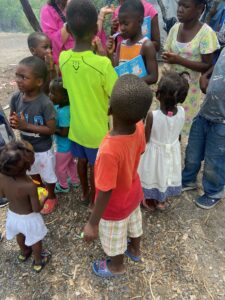
The children of Haitian asylum seekers gather for small toys and coloring materials in Reynosa. (Courtesy Photo)

Though she was in her late 50s with grown children and grandchildren, once she said “yes” to God, and began to research and learn about refugee ministry, God began opening doors, Cochrane said.

“That’s why I say, ‘Just say yes [to God],’” she explained, noting no matter how old someone is when God calls, he will use and bless those who say “yes” and are faithful.

Cochrane visited the border for the first time in November 2019.  She visited refugee camps in Reynosa and Matamoros filled with asylum seekers. Her mission friend Sheri Short, who she credits for helping her turn the calling to action, accompanied Cochrane on this trip.

The women met migrants who were waiting for an opportunity to present themselves for asylum at ports of entry in McAllen and Brownsville. They went into Mexico with missionaries from Texas Baptists River Ministry, who took them to the migrant camps in Reynosa and Matamoros.

God continued to open doors, Cochrane said. And, she was able to return to those same camps in November 2020.

When Cochrane grew up in a Fundamental Baptist church in “small town Texas,” she explained, caring for immigrants wasn’t a focus of the church in that community.

She has stayed in “small town Texas” as an adult, so her environment has not shifted much in its lack of commitment to refugee ministry. She explained this has been one of the hardest things she’s faced in following this calling.

Cochrane thought when God gave her the heart for this ministry, the people she loves would be excited for her to have found her place in God’s mission, but that is not what she experienced.

Finding a team

While her family and friends support her involvement, their understanding of why it matters so much to her has a limit. So, she was glad to find a community, Women of Welcome, of like-minded women devoted to understanding God’s heart for immigrants.

It was in this community on Facebook where in 2021 she met a sister who would play an important role in the ways that God was leading her, Alma Ruth, founder and director of Practice Mercy Foundation.

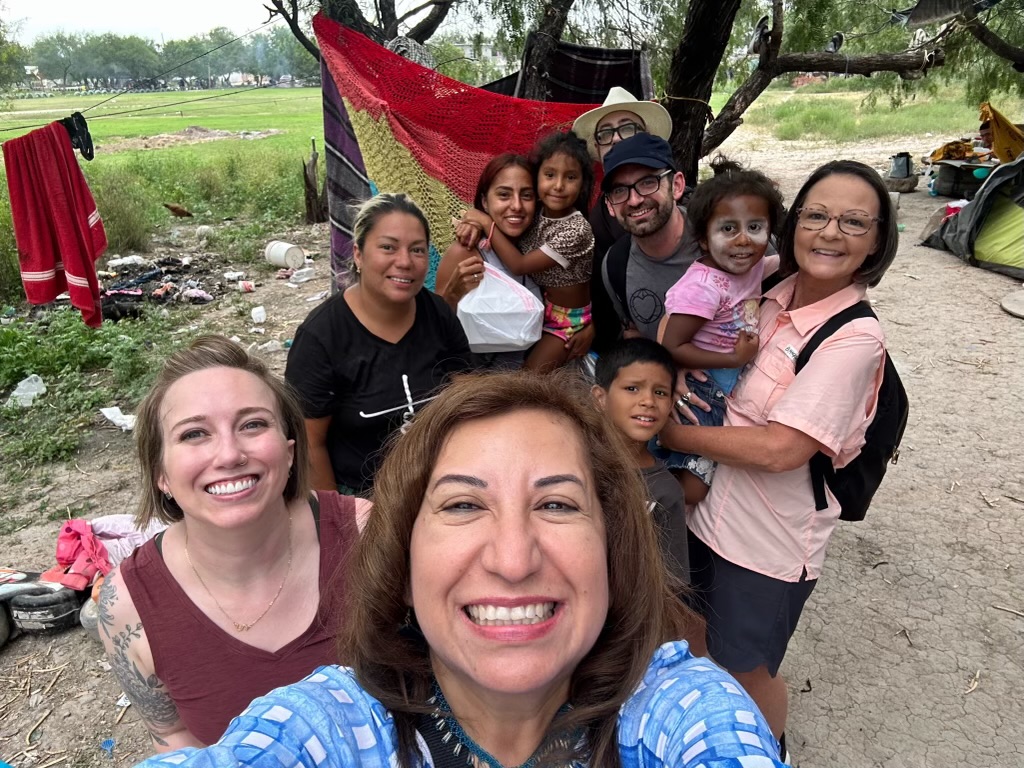
Alma Ruth (front), Carla Cochrane (right holding the child) and friends visit asylum seekers at Reynosa, Mexico in May 2023. (Courtesy Photo)

Cochrane began to learn about Ruth’s mission work at the border through her nonprofit. And in May 2022, she joined Practice Mercy for an immersion trip to visit Senda De Vida refugee shelter in Reynosa.

Then in July 2022 she returned to the border with a mission group from her church. The group met Ruth on one of the days. Ruth took them on a boat tour of the Rio Grande River, where they saw a portion of the border wall that separates the United States and Mexico.

She and Ruth stayed in close touch, and in October 2022, Cochrane became a board member for Practice Mercy Foundation, serving as treasurer until January 2024.

During that time, an in-person board meeting in McAllen provided an opportunity to help with an eyeglass clinic at a Haitian camp in Reynosa in December 2023.

On that same visit, Cochrane met a young Russian pastor and his family staying in Reynosa, who had contacted Ruth for help when they fled Russia because their advocacy against the war in Ukraine made them targets.

God appointments

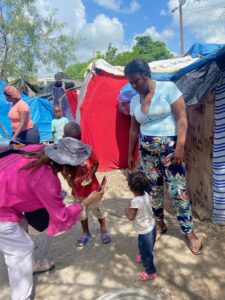
Alma Ruth (left) intersects with a Haitian family that a refugee camp in Reynosa. (Courtesy Photo)

One evening, the group tagged along with a local reporter. Spending time with him allowed the group to interact with asylum seekers who crossed over “and turned themselves in to Border Patrol for a chance to claim asylum.”

Cochrane said about 50 individuals crossed the border that evening.

“There were teenagers, families, mothers and their children, unaccompanied siblings and several older men and women,” she said.

“They were processed to be taken to a detention center by bus. Border Patrol allowed us to speak with them, give them water and snacks, blankets and to pray over them.”

The group felt “this was a moment only God could have orchestrated, for us to have this amazing experience,” Cochrane recalled.

Cochrane went on two additional immersion trips with Practice Mercy in 2023. In May, they visited a Haitian camp in Reynosa, where they spent most of their time with the children. Then in September, they went to a refugee camp in Matamoros, where they conducted an eyeglass clinic, spent time with the children and provided personal hygiene items for the women.

“This trip was life changing for me,” Cochrane recalled, “because God had it planned out to the smallest detail.”

She explained her job was to put lenses into eyeglass frames, and she was struggling a little to get them to go in.

The world’s best hug

Juan, a 15-year-old from Venezuela, came and stood beside her to help with the glasses.

“He didn’t speak English, and I don’t speak Spanish. But when God is in the middle of it, all that really doesn’t matter,” Cochrane observed.

Juan stuck around helping for about three hours, Cochrane wondering all the while, “Why would this teen boy want to spend so much time with a 61-year-old woman?”

After the eyeglass clinic concluded an interpreter came over, so she learned more about Juan.

Cochrane learned he and his 18-year-old brother were both in the camp “awaiting an appointment, through the CBP app, to present themselves for asylum at the port of entry.”

They were hoping to make it to their father, who was in New York. Their mother remained in Columbia.

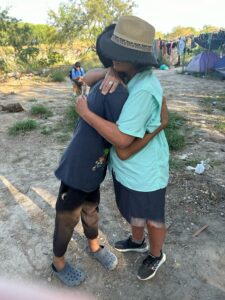
Carla Cochrane hugs Juan. (Courtesy Photo)

Jaun told her he missed his mom. But the saddest thing for him was leaving his grandparents in Venezuela, because he likely would never get to see them again.

“It was at that moment that I knew exactly why God had brought me to this camp at this day and time” Cochrane said. Juan needed a grandmother.

“I asked if I could hug him, and that embrace will be a wonderful memory for me the rest of my life. I attempted to release our hug three times before he finally let go of me. Only God!”

Cochrane said she will continue to visit the border to serve, walk alongside and hear stories from asylum seekers to advocate on their behalf, for as long as God makes it possible.

“I always tell others that the greatest take-away for me is that God has allowed me to see others through the eyes of Jesus, and therefore my heart is forever changed.

“He has filled it with so much love, compassion and joy.”

 And, she said she heard from Juan’s dad. Juan was in New York City. Both boys made it to asylum and to family.