Evangelicals hold nuanced views on immigration

BRENTWOOD, Tenn.—Evangelicals in the United States want both secure borders and laws that provide avenues for certain illegal immigrants to obtain legal status, according to a recent Lifeway Research study.

They want to deport dangerous illegal immigrants but aren’t as concerned about those who arrived as children and have lived peacefully in the United States.

Additionally, evangelicals overwhelmingly recognize personal and national responsibilities to care for refugees and others fleeing their nation of origin.

The Lifeway Research study finds evangelical voters are predominantly Trump voters and politically conservative. They also see their faith as a primary influence on their views of immigration and related political issues.

Studies over the past four years show stability among the perspectives and priorities of evangelicals concerning immigration. The 2025 study was sponsored by the Evangelical Immigration Table, World Relief, the National Latino Evangelical Coalition and the National Association of Evangelicals and was conducted by Lifeway Research.

 “Over the past several years, through all the rhetoric of a tumultuous political season, evangelicals’ views on immigration issues have actually been remarkably stable,” said Matthew Soerens, vice president of advocacy and policy for World Relief.

“The big news here is how little has changed despite the prominence of immigration-related rhetoric in the presidential campaign. Most evangelicals—whether the majority who voted for President Trump or the minority who voted for Vice President Harris— still want the same common-sense things from immigration policy they wanted in past surveys.”

Soon after taking office, Trump indefinitely suspended the U.S. Refugee Admissions Program saying the nation “lacks the ability to absorb large numbers of migrants, and in particular, refugees, into its communities in a manner that does not compromise the availability of resources for Americans, that protects their safety and security, and that ensures the appropriate assimilation of refugees.”

Additionally, the U.S. State Department suspended funding to groups that assist refugees.

Evangelicals have been a consistent voting bloc supporting Trump during his three presidential campaigns.

Strong support for refugees remains consistent

Most evangelicals voice support for refugees. Seven in 10 (70 percent) say the United States has a moral responsibility to accept refugees, including 34 percent who strongly agree. Around a quarter (23 percent) disagree. That number is statistically unchanged from a January 2024 Lifeway Research study.

Around 3 in 4 evangelicals (74 percent) say they would support a bipartisan Senate bill that would allow Afghan allies evacuated by the U.S. military to apply for permanent legal status after undergoing additional vetting.

“Evangelicals’ care for refugees and immigrants is as steady as their political preference, but some leaders may not be listening,” said Scott McConnell, executive director of Lifeway Research.

Evangelicals are more split over reintroducing a “zero tolerance” policy along the U.S.-Mexico border that led to the separation of children from parents. The policy was terminated by the first Trump administration in June 2018. Currently, 45 percent of evangelicals would support reintroducing the policy, while 43 percent oppose such a move and 12 percent are not sure.
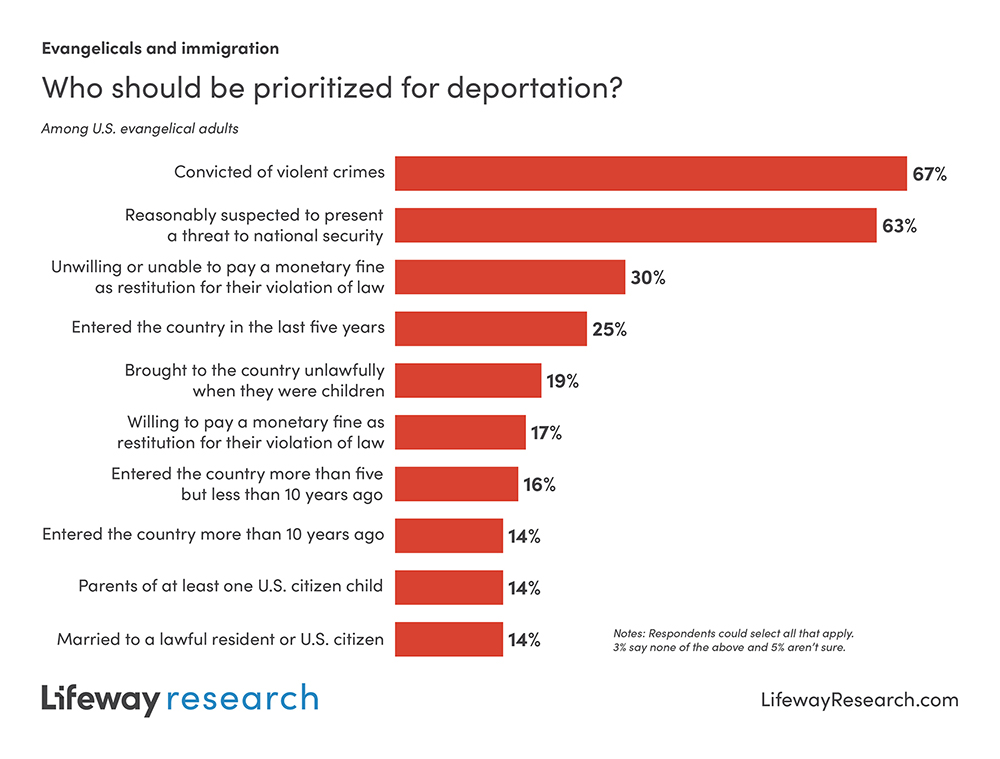
As Trump moves on his campaign promise of deporting illegal immigrants, evangelicals say those efforts should prioritize criminals and security threats.

Most want deportations to focus on individuals who have been convicted of violent crimes (67 percent) or those reasonably suspected of presenting a threat to national security (63 percent).

Fewer believe enforcement should prioritize those who are unwilling or unable to pay a monetary fine as restitution for violating the law (30 percent) or those who entered the country in the last five years (25 percent).

Fewer than 1 in 5 evangelicals believe deportation should focus on those who were brought to the country unlawfully as children (19 percent), would be willing to pay a monetary fine as restitution (17 percent), entered the country more than five years ago but less than 10 (16 percent), entered the country more than 10 years ago (14 percent), are the parents of at least one U.S. citizen child (14 percent) or those who are married to a lawful resident or U.S. citizen (14 percent).
 “A large majority of evangelicals do not want immigrants unlawfully in the country to be prioritized for deportation except if they have been convicted of violent crimes or pose a threat to national security,” McConnell said.

“Less than 1 in 6 evangelicals value deporting undocumented immigrants whose immediate family has legal status or who have been in the country for more than five years. These are their neighbors and families they don’t want to see divided.”

Future legislation

Evangelicals in the United States believe legislative steps should be taken to address the immigration issue.

Four in 5 (80 percent) say it’s important that Congress passes significant new immigration legislation this year. Most want to make it harder for new immigrants to enter the country illegally but easier for some of those already here to earn citizenship.

Around 3 in 4 (76 percent) say they would support changes to the U.S. immigration laws that would both increase border security measures and establish a process so immigrants unlawfully in the nation could earn permanent legal status and eventually apply for citizenship if they pay a fine, complete a criminal background check and complete other requirements during a probationary period.

If a political candidate supported those dual changes, evangelicals say they would be more likely to vote for them in future elections. Around 2 in 3 (64 percent) say supporting reform with both of those aspects makes them more likely to vote for a candidate. Far fewer (12 percent) say they would be less likely to back a candidate who supported such reforms.

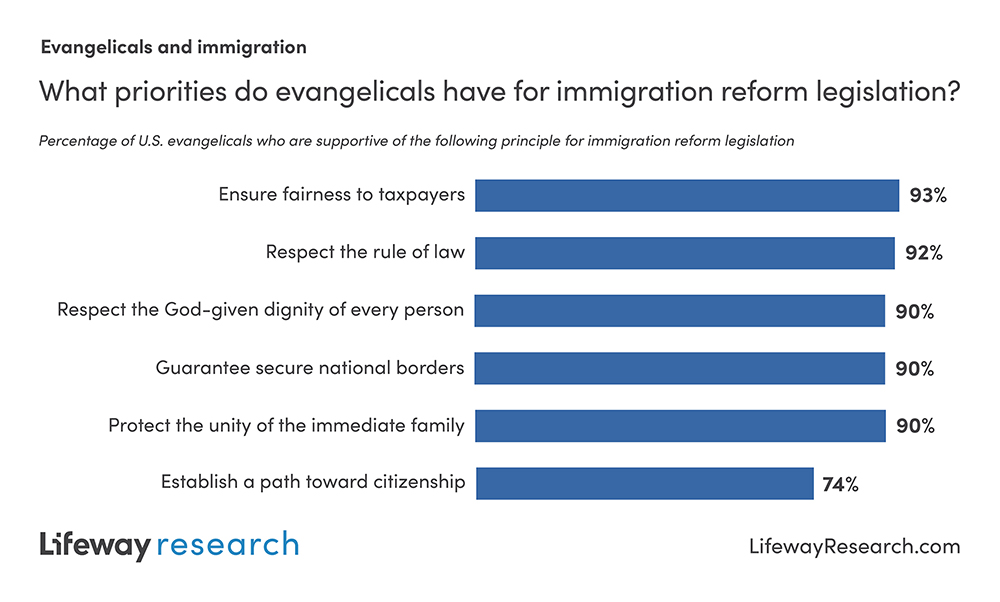
Considering immigration reform legislation, evangelicals want lawmakers to keep several priorities in mind.

Around 9 in 10 believe reform should ensure fairness to taxpayers (93 percent), respect the rule of law (92 percent), respect the God-given dignity of every person (90 percent), guarantee secure national borders (90 percent) and protect the unity of the immediate family (90 percent).

Three in 4 support potential legislation that establishes a path to citizenship for those who are here illegally, are interested in becoming legal citizens and meet certain qualifications (74 percent).

Support for each of those priorities has increased among self-identified evangelicals since a 2015 Lifeway Research study but has remained stable since a 2022 study.

Four in 5 evangelicals (81 percent) would support Republicans and Democrats working together on a combination of immigration reforms that strengthen border security, create a pathway to citizenship for undocumented immigrants who came to the United States as children, known as “Dreamers,” and provide a reliable number of screened, legal farmworkers.
“A large majority of evangelicals want increased border security, Dreamers to be able to apply for citizenship and farming needs to be met with enough screened immigrant farmworkers each year,” McConnell said. “Evangelicals want a system that is both fair and alleviates potential threats to national security.”

Personal views on immigration

Overall, evangelicals in the United States see legal immigration as helpful to the country. A quarter (26 percent) say legal immigration is helpful and the nation should increase the number approved in a year. Around 2 in 5 (40 percent) believe it is helpful and we should maintain the current number of legal immigrants approved.

One in 5 (20 percent) agree it’s helpful but want to decrease the number approved. Fewer say legal immigration is harmful and we should decrease those who are approved (8 percent) or that we should completely stop approving legal immigrants (6 percent).

Many evangelicals worry specifically about the recent number of immigrants that have come to the United States. More than 2 in 5 say that amount is a drain on economic resources (44 percent) and a threat to the safety of citizens (43 percent).

Additionally, 37 percent say the number is a threat to law and order, and 29 percent believe it’s a threat to traditional American customs and culture.

Positively, many evangelicals say the number of recent immigrants presents an opportunity to introduce them to Jesus Christ (42 percent), an opportunity to show them love (37 percent), an improvement to America’s cultural diversity (25 percent) and a boost to entrepreneurial activity (16 percent).

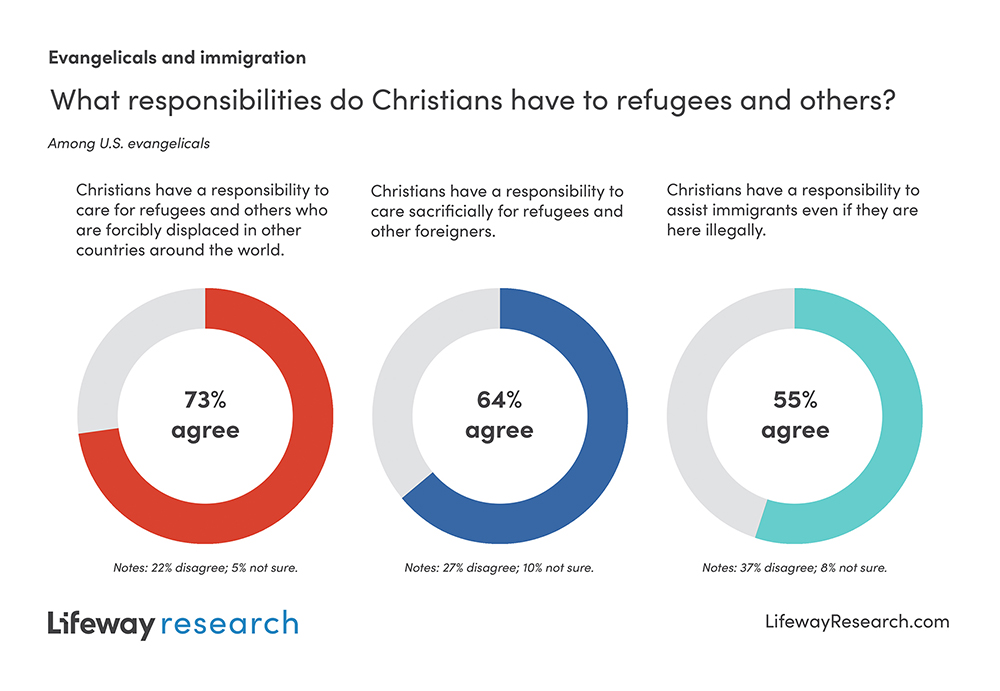
Thinking about moral responsibilities, about 2 in 3 evangelicals (64 percent) believe Christians have a responsibility to sacrificially care for refugees and other foreigners.

Asked specifically about refugees and others who are forcibly displaced in other countries, beyond the United States, 73 percent said Christians have a responsibility to care.

Most (55 percent) also say Christians have a responsibility to assist immigrants even if they are here illegally.
“It’s easy to presume the loudest evangelical voices on television or social media—who tend to advocate the extreme positions of either mass deportation and shutting out refugees on one hand or open borders and amnesty on the other—are the majority opinion, but this polling confirms my anecdotal experience in local evangelical churches across the United States,” said Soerens, who also serves as the national coordinator for the Evangelical Immigration Table.

“There’s a clear consensus for secure borders and for sustained or increased levels of legal immigration, particularly for refugees fleeing persecution. Evangelicals advocate for deporting violent criminals but also for establishing an earned path to citizenship for undocumented immigrants able to pass a background check and meet other appropriate requirements.”

When asked what has most influenced their thinking on immigration, evangelicals primarily say the Bible (23 percent). Other significant influences include immigrants they have observed (16 percent), the media (14 percent), immigrants they have interacted with (11 percent) and friends and family (10 percent).

Fewer say they have been most influenced by the positions of elected officials (8 percent), their local church (5 percent), national Christian leaders (4 percent) or teachers or professors (2 percent).

Influences included most often among evangelicals’ top three most influential sources on the topic of immigration are immigrants they’ve observed (42 percent), friends and family (40 percent), the Bible (38 percent), the media (37 percent) and immigrants they’ve interacted with (35 percent).

 “The care for immigrants and refugees expressed by the responses of the majority of evangelicals in this survey correlates with actions the Bible commands. Yet not all evangelicals are familiar with these numerous biblical statements, nor do all have compassion for such people today,” McConnell said.

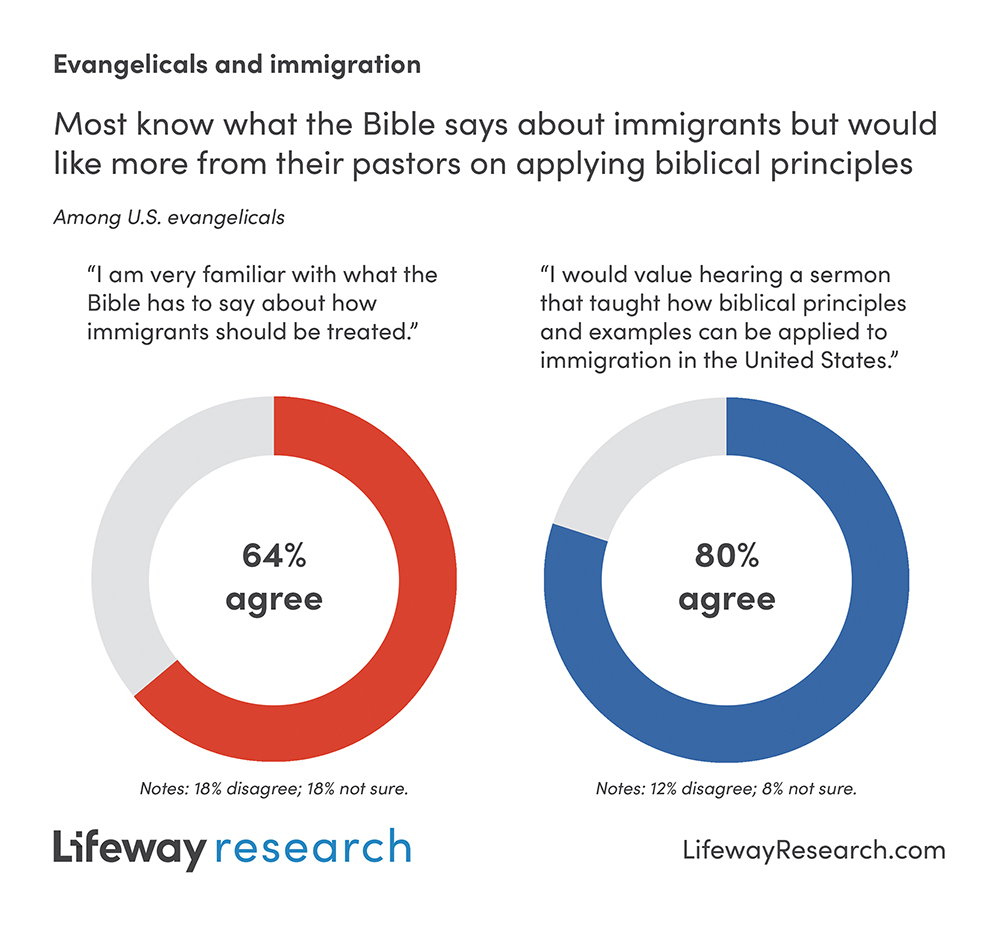
Most evangelicals (64 percent) say they are very familiar with what the Bible has to say about how immigrants should be treated. Still, 4 in 5 (80 percent) say they would value hearing a sermon that teaches how biblical principles and examples can be applied to immigration in the U.S.

Around 1 in 4 evangelicals (28 percent) say they have heard immigration discussed in their local church in a way that encouraged them to reach out to immigrants in their community, while 64 percent disagree.

Almost 7 in 10 evangelicals (69 percent) say they have never been involved in a ministry that served refugees or other immigrants. Around 3 in 10 say they have, including 13 percent currently and 18 percent in the past.

 “I hope this research will give courage to pastors,” Soerens said. “Not only do their people crave biblical teaching on this topic, but the likelihood that the immigration policy ramifications of biblical principles will upset their congregants is slim, since super-majorities of evangelicals already support commonsense, compassionate principles on immigration rooted in Scripture.”

Still, evangelicals believe caring for these individuals is a responsibility of the church. Almost half (46 percent) say churches in the United States should be at the forefront of responding to the increase of people forced to flee their homes due to persecution or conflict.

Another 28 percent say the church should be concerned with the increase but it is not a top priority. Fewer say the church should leave it to governments to address the issue (12 percent) or that they are unsure (13 percent).

U.S. evangelicals rate many of the issues related to displacement as one of the three most urgent global issues that need the attention of churches in the U.S., while the issue itself ranks closer to the bottom.

Almost half say one of the top issues the church should give attention to is war and violent conflict (45 percent) and human trafficking (45 percent). More than a third point to orphans and vulnerable children (36 percent) and religious persecution (35 percent).

“At a time when 120 million people around our world have been forced from their homes, we believe the refugee and displacement crisis should be a priority of the American church,” said Soerens.

“While American evangelicals seem to be less focused on displacement than on some of the underlying causes of displacement, such as war, conflict and religious persecution, we hope the church will increasingly take the lead in responding to this global crisis.”

The study was sponsored by the Evangelical Immigration Table, World Relief, National Latino Evangelical Coalition, and the National Association of Evangelicals. The online survey was conducted Jan. 13-21, 2025, using a national pre-recruited panel.

Analysts used quotas and slight weights to balance gender, age, region, ethnicity and education to reflect the population more accurately.

The completed sample is 1,004 surveys, including 525 surveys completed by those with evangelical beliefs and 920 completed by self-identified evangelicals. The sample provides 95 percent confidence that the sampling error does not exceed plus or minus 3.1 percent. Margins of error are higher in sub-groups.


Chaves: Views of the past shape future outlook

BROWNWOOD—João Chaves, a historian of religion, told Howard Payne University students and guests, “We must contend with our past to consider our future.”

Chaves, assistant professor of history of religion in the Américas at Baylor University, delivered the Currie-Strickland Lectures in Christian Ethics on “Faith Crossing Borders: How Immigrant Churches are Shaping the Future of Christianity.”

On the second day of the lecture series, Chaves emphasized the subtitle to his lecture was misleading if it set the expectation that he would try to “reflexively predict what will happen,” “offer an overly romanticized picture of immigrant Christianity,” or intentionally enter into debates that can be inflammatory or heavily politicized—however important those debates may be.

As a historian with training in the sociology of religion, Chaves said he was trained “to look at patterns behind us.”

But Chaves said he had learned “that our outlook on the past shapes—sometimes hides—what we’re able to see on the horizon. How one imagines the future has much to do with how one understands the past.”

In order to consider how migration might shape the future of Christianity, people first must contend with how they understand the past, he said.

To highlight the “entanglement” at the heart of his lecture, Chaves told a story about an old-time evangelist home missionary. The evangelist was set to preach at a church where he needed a translator to interpret his message for the congregation.

The translator was very good, Chaves said. When the preacher went one way, the interpreter went that way. When the preacher emphasized something, the interpreter emphasized something too.

When the sermon concluded, an altar call was given with many people coming forward to respond, Chaves said.

But when the preacher found the translator to thank her for translating his sermon for him, she looked at him, confused, and said: “Translating? You preached your sermon. I preached mine.”

Chaves said the story illustrates how “often Western missionaries were given and even took credit for what was accomplished by immigrants and locals.”

When Christians think about migration, they only rarely think about missions, he explained.

Baptists, in particular, “have long seen themselves as a missionary,” he asserted, beginning with William Carey, who is considered the father of modern missions.

The Triennial Convention, the first national body of Baptists in the United States, formed in 1814, was triggered by the influence of Adoniram and Ann Judson, some of the first missionaries to be sent out from the United States.

During the 1800s, Baptists from Sweden, Germany and other European countries also were immigrating to the United States and impacting the development of Baptist cooperation and work here.

In 1845, missions was at the core of the formation of the Southern Baptist Convention, when tensions over whether slave-owners would be appointed as missionaries led to a split from the Triennial Convention.

Since then, “Northern and Southern Baptists in the U.S. have invested heavily in foreign missions, mostly by separate mission boards,” Chaves explained.

He noted the legacies of Northern and Southern Baptist missionaries continue to be explored and preserved by denominations who have their own history intertwined with mission work that can be translated into offerings.

But the way Baptist missionary endeavors are told isn’t static, he said. “Approaches to the history of missions continue to develop.”

The legacies of Baptist missionaries from the Global North, United States and Europe increasingly are found in conjunction with other actors in Christianity’s expansion—migrants and locals.

“A shift in how the history of Baptist missions is traditionally told is ongoing,” Chaves explained, including a new focus on the ways often neglected actors and sources contributed to Christianity’s expansion. This can be applied to other denominations, as well, he noted.

Missions scholars continue to learn how central migration has been to the expansion of Christianity.

Outsized importance has been given to traditional Western missionaries sent from missionary boards as the de facto driving force of missions.

But these assumptions continue to be challenged, Chaves noted. And migration and local agency’s centrality to the Christian story can be acknowledged, without harming the legacy of Baptist missionaries.

Understanding who is a missionary and who is a migrant helps in understanding the shift, Chaves said.

Who counts as a missionary?

Christian missionaries often are seen as people sent by organizations to save the souls of the lost worldwide, but there is more to consider, Chaves asserted.

“On the one hand, traditional missionaries sent by Christian agencies to foreign countries are technically migrants,” he said.

Their visas might be classified as religious, business, tourism or something else, “and missionary agencies have been very creative regarding how to circumvent immigration laws.”

“On the other hand, Christianity advances by immigrants who move from one place to another without necessarily being sent by missionary agencies or even seeing themselves as missionaries.”

These immigrants inspire Christian locals or missionary agencies in host countries to broaden their horizons and often serve as antecedents of organized missionary work.

“Christianity developed as a religion in which missionaries are immigrants, and immigrants are missionaries” Chaves noted.

There is an overlap between migration and Christian mission, Chavez noted, “especially when the latter is understood as an endeavor that entails crossing national, linguistic, cultural and existential borders.”

Who counts as a migrant?

Understanding how migration factors into the development and expansion of Christianity requires “unlearning” traditional ways of thinking about missions—as missionaries being primarily white and male. It demands learning how local agencies and migration “were and are vital to the growth and vibrancy of Christianity worldwide,” he said.

Chaves noted histories of the modern missionary movement have obscured the role of migration as “a common driver” of Baptist missionary efforts or subordinated the roles of migrants and locals in Christianity’s expansion.

Chaves cited a quote from Baptist historian David Bebbington’s Baptists Through the Centuries and the whole of Kenneth Scott Latourette’s seven-volume series A History of the Expansion of Christianity as examples where the impact of migrants and locals in the story of missions is either downplayed or largely overlooked.

Many scholars now focus on non-Western actors in Christianity’s expansion and growth, but Chaves acknowledged the difficulty in locating primary sources or accounts of what local, non-Western Christians said about themselves that are not heavily redacted.

Chaves explained large waves of immigration to the United States, the top migration destination, have consistently been met with anti-immigrant sentiment. That includes when immigrant groups were European (Irish in the 1800s)—when “xenophobia became an American tradition”—and the current rise in anti-immigrant sentiment and policy.

However, Christian migrants to the United States are revitalizing northern denominations and contributing to reevangelizing the country.

Migration has spread Christianity since the start of the Jesus movement, Chaves noted.

Christian exiles and refugees shared their faith wherever they went, and migrants continue to take their God with them wherever they go.

Immigrant churches will continue to shape the future of Christianity by continuing to be a space for religion to thrive in new places, offering solace for those in need and functioning as mediating structures that help migrants adapt to their new countries.

“For good or ill, migrants are essential to the mission,” he said.

Migrant joys, struggle and laughter will continue to be the seeds of Christianity’s growth, he said.


Find Black history, family devotions and recipes in one book

NASHVILLE (BP)—When the 18th century church planter, evangelist and foreign missionary George Liele was imprisoned in Jamaica, he spread the gospel in prison, reminiscent of the apostle Paul.

Liele is among historical African American Christians author Trillia Newbell invites families to center dinner table devotions around in her book, Celebrating Around the Table: Learning the Stories of Black Christians Through Readings, Fellowship, Food, and Faith.

“It’s my family tradition in book form,” said Newbell, a former director of community outreach with the Southern Baptist Ethics & Religious Liberty Commission. “Yes, it’s for Black History Month, but you can use it any time.”
She began the tradition perhaps a decade ago with her family, discussing famous and not-so-famous African American trailblazers around the kitchen table with her family over traditional dishes, with prayer and devotions.

“You can use the book anytime,” she said. “We don’t want to just study history in a certain month. We want to study it all the time. And so, any time you can gather around the table and start a discussion, and look at the Bible verses together, and talk about people and learn about what God says in his word, you want to do it.”

Learning Black history

Liele rose from slavery, was granted freedom and began preaching in Georgia during the American Revolutionary War. He borrowed $700 on an indentured servitude agreement to travel to Jamaica, arrived there in 1782, and—after earning his freedom from bondage—planted a house church with three other Americans.

George Liele, a former slave, not only was the first ordained African American Baptist preacher in America, but also was the world’s first Baptist missionary. His ministry in Jamaica predated the missionary work of William Carey in India.

Liele is remembered as the first foreign Baptist missionary. While preaching in Kingston in 1797, he was charged falsely with inciting a rebellion through his sermons and ended up in jail. Acquitted, he still served time in jail for a debt he owed on a church he pastored. He remained in jail until the debt was paid, preaching while imprisoned, Newbell pointed out in her narrative.

Newbell tells Liele’s story alongside 11 trailblazing African American Christians including Frederick Douglass, Betsey Stockton, Charlotte L. Forten Grimké, Lemuel Haynes, Ruby Bridges, Mahalia Jackson and others, offering original Bible-based devotions for each.

“In the book, I feature … godly characteristics that each of them displays,” Newbell said. “The devotionals kind of feature those characteristics. So, whether someone was brave, humble, forgiving, loving, … all sorts of biblical characteristics that I found as I learned about the people, I pulled out. And then, I wrote a devotional based on what I learned about the people.”

Dinner table conversations build family unity

The dinner table is important to Newbell’s family, she said, and she advocates for the dinner table as a prominent place to build unity in all family units.

And while the book is built around family, including photos of cherished moments of Newbell with her husband Thern and their son and daughter, she presents the book as a useful tool for singles and includes “children’s corner” resources for those 6 and older.

She encourages families and individuals to try the practice to learn about a variety of cultures, continuing beyond Black History Month.

Unique to the book are recipes for Southern favorites learned in her mother’s kitchen, family traditions and personal contemporary tweaks.

Cornbread, homemade butter, baked ribs, black-eyed peas, greens, salmon croquettes, shrimp and grits, sweet potato pie, apple pie and banana pudding are among recipes presented as approachable by most cooks in modestly appointed kitchens.

“The recipes are meant to give you a taste of common southern African American cuisine. But remember, I am not a chef,” Newbell writes in the book, “and none of the meals will be gourmet.

“These recipes are for the everyday cook. And although the recipes have modern ingredients, I intentionally didn’t add complicated ingredients or require special equipment. So, you won’t need an air fryer.”

Only, no microwaves, she’s quick to add.

“I said easy, but not that easy!”


‘God does not show favoritism,’ João Chaves asserts

BROWNWOOD—“God does not show favoritism,” João Chaves, assistant professor of history of religion in the Américas at Baylor University, reminded Howard Payne University students in chapel on Jan. 29.

Taking as his text the story of Peter and Cornelius in Acts 10:34-35, Chaves read: “Then Peter began to speak, “I now realize how true it is that God does not show favoritism, but accepts from every nation, the one who fears him and does what is right.”

In his first presentation on “Faith Crossing Borders: How Immigrant Churches are Shaping the Future of Christianity” for the Currie-Strickland Lectures in Christian Ethics at HPU, Chaves challenged students to consider the interplay of faith and culture.

Attempting to “mix both lecture and sermon” for the chapel crowd, he said, Chaves provided historical, theological and personal background for his discussion before unpacking the text.

One of the more radical elements of Christianity, Chavez noted, is that “Christians are called to live as people on the move, people whose identity is grounded in a reality that transcends our world.

“Christians are challenged to live as strangers on earth, even though they are tempted to live as if they are legacies,” he said.

Philippians 3:20 says “Our citizenship is in heaven,” Chaves emphasized.

Yet the tendency of Christians to see themselves as “legacies” on Earth instead of “strangers” leads to entitlement, contributing to conflict among Christians.

These specific conflicts among Christians—differences or prejudices relating to how they view ethnicity, class, gender or otherwise—aren’t primarily about “who gets into heaven,” but about “how we live our lives together here,” Chaves pointed out.

Major theological conflicts have centered around these issues relating to diverse ways of understanding how to live out Christianity here and now, Chaves continued.

But, “God often surprises God’s followers by welcoming people they could not,” he said.

Diversity of Christianity worldwide

Christianity worldwide is radically diverse, dynamic and growing, he said. Chaves noted the shifting of Christianity’s center from Europe and the United Sates to the Global South in African, Asian and Latin American countries where more than 78 percent of the world’s Christians now reside.

While the United States still maintains the largest number of Christians, that’s partly from the many Christians who have immigrated to the nation and revitalize the faith here, diversifying U.S. Christianity, too, Chaves said.

The diverse groups are informed by ancestral traditions and the exchange of religious ideas among differing Christian traditions and other religions, “opening up spaces for cross-pollination and introducing innovations that shape Christian forms and meaning.”

Despite the explosive growth of Christianity in other areas, some groups of Christians reject other self-described Christians because they practice Christianity in forms that are different from their own.

However, creativity and diversity in Christian belief and practice is not new. In fact, it’s very old, Chaves said.

Multiracial, multinational exchanges between religious imaginations have been part of Christianity’s growth and development since ancient times.

Diversification of Christianity in the United States is fueled by immigrants and informed by believers’ diverse cultural heritages and ancestral traditions, he noted.

And in the first century, the church was comprised of Christians from many ethnicities, races, classes and cultural backgrounds, yet they coexisted in a complex arrangement.

Transnational theologians, including Augustine, the “mestizo son of a Roman father and Berber mother, who was often torn between his Roman and African roots and traditions,” developed theologies Christians look to still today in multicultural environments.

The Christian Diaspora saw the gospel message sometimes disputed, yet it spread in this setting. As Christianity spread and indigenized, many did not recognize God in “the other,” even when they claimed to worship the same God, he said.

“The gospel, nevertheless, grew amid disagreement.”

The indigenizing principle means the gospel should be “at home anywhere”—for the gospel message to grow, it must be adaptable and accessible to local people of any background—yet it “is never really entirely at home. It challenges individuals to look beyond our culture because it points to a kingdom that is not of this world,” Chaves said.

God calls his people to look beyond their own cultures to relate to people of other cultures for the mission of spreading the gospel. Scripture is replete with examples of God’s people “being called to leave their places of comfort in order to fulfill God’s call for their lives.”

In the Old Testament, “stranger” is a common element in several passages Chaves cited: Genesis 12:1 and 39:1-6; Exodus 2:22; and Joshua 6:25.

God’s command to “love the foreigner among you” weren’t just theoretical. It was given after the Hebrew exile in Egypt, pointing God’s people back to the experience of being strangers in exile for 400 years.

Scripture repeatedly indicates “God’s welcome is more extensive and complex than even God’s followers might like,” Chaves said.

He acknowledged as an immigrant to the United States from Brazil, where he grew up in a Baptist church after coming to Christ through the witness of a charismatic street preacher, his reading of the Peter and Cornelius story is not objective.

Being a Baptist in predominantly Roman Catholic Brazil, at that time, was countercultural, he said.

Immigrating to the southern United States to study and teach often has meant continuing to feel like a stranger.

He has seen the phenomena of “strangers like [him]” being either sincerely celebrated or subjected to extreme pressure by the majority culture to adjust to its preferences, so Peter’s interaction with Cornelius is personal for him, Chaves explained.

Seeing God in diversity

In Acts 10, God challenges Peter, telling him: “do not call anything impure that God has made clean.” God proves Peter wrong by compelling him to encounter a person from another culture and see God in him, Chaves said.

Though Peter continued to struggle with this tension at times, he does seem to realize in the key passage what God has been doing all along. “God is much bigger” than Peter’s ethnic or religious identity had allowed, Chaves noted.

“God will not allow Peter to confuse ethnocentricity for divine truth,” he said. “God is a God whose work in nature pours forth diversity, and complexity in unity.”

The mystery of God’s triune nature—three persons in one essence—is itself a challenge for Christians to strive to find unity with other believers in their diverse ways of viewing and being in the world.

Peter’s interaction with Cornelius also points to the danger that even leaders in the Christian community can fail to realize “our cultural expectations of the people whom God should accept can keep us from seeing who God actually is.”

The story of Peter teaches “we have much to learn about God by understanding that relationship with people from other places and cultures.”

Before Peter arrived at the home of Cornelius, “he was completely sure that people like Cornelius—uncircumcised Gentiles—were beyond God’s reach unless they changed into who Peter wanted them to be.”

But Cornelius taught Peter “he had too little a God,” Chaves explained.

He encouraged chapel students to be open to encountering and learning from each other.

“God calls us to be a beautiful celebration of diversity … in the hope that we can endure. It is a strange hope. Praise the Lord. God have mercy. Amen.”


Anabaptists commemorate 500 years with study Bible

(RNS)—Anabaptists around the world are commemorating 500 years since their founders performed the first adult baptisms outside Zürich and kicked off the Radical Reformation.

The Anabaptist tradition included Mennonites, Amish, Church of the Brethren, Hutterites and other small Christian groups—and significantly influenced Baptists.

The Anabaptist movement has long been defined by its belief in the separation of the church from the state, that it should be a voluntary decision to join the church and, for many, a commitment to nonviolence.

In North America, the top event is the Jan. 21 release of a new study Bible that incorporates the insight of almost 600 lay groups, but throughout the coming months, Anabaptists around the world will commemorate the anniversary with worship services, music, lectures and more.

Those events will culminate on May 29 with a daylong event hosted by the Mennonite World Conference in Zürich, which will feature workshops, concerts, a panel discussion, historical walking tours and an ecumenical worship service.

That event reflects the movement’s history in the area. In January 1525, a group of young people, some of whom later became the movement’s first martyrs, met in the home of Anna Manz to baptize each other in defiance of the local government.

Originally a negative label applied by outsiders, Anabaptist meant “rebaptizer,” as the group rejected the infant baptisms of other traditions.

Confessional and ecumenical commemoration

John Roth

John Roth, a professor emeritus of history at Goshen College who is also coordinating global and North American 500th anniversary events, told RNS the 450th anniversary was “ a little bit simplistic” in its focus on a few key individuals and Zürich.

In contrast, Roth said, this commemoration would be “ much more nuanced, much more, I would say, humble, less nostalgic, more confessional and more ecumenical in its approach.”

In Costa Rica, members of all 25 churches will be celebrating a special worship service the weekend after the anniversary, with cultural performances and a presentation of Mennonite history in Costa Rica, as well as global Anabaptist history.

Cindy Alpízar Alpízar, pastor of Jesucristo es el Señor (“Jesus Christ is the Lord”) Church in Heredia, Costa Rica, who recently taught a course on Anabaptist history for pastors, said, “We are pointing out that radical following of Jesus, no matter what it costs.”

“To be pacifists is not only nonviolence and abstaining from violence, but instead to work for peace and above all the centrality of Jesus,” Alpízar said.

Churches throughout the United States will be marking the anniversary with their own events over the next months, including sermon series, hymn sings and historical presentations.

Bluffton University in Ohio will hold an extensive calendar of events through the spring including a film festival, various guest lectures, a Bible school, a theater performance, an exhibit of historic Anabaptist Bibles and two concerts.

Roth explained that, in a moment when “there are so many reasons not to hope for the future,” the Anabaptist tradition is “ready to let go of effectiveness,” believing in doing the right thing as “ God’s world is moving toward a meaningful conclusion.”

Study Bible designed to be read in community

Many North American Anabaptists began remembering the 500th anniversary in late 2022 and early 2023 by participating in one of the 597 Bible study groups for the Anabaptist Community Bible.

In 18 different Anabaptist faith groups, six to 10 people met to discuss a passage from the Old Testament, the New Testament and part of a Psalm, using a study guide that was available in English, German, Spanish, French, Amharic and Bahasa Indonesian.

The new study Bible features those reflections, in addition to insights from Bible scholars, as well as historians highlighting 16th-century Anabaptist writing.

“ Central to our understanding of how the Bible should be read is that it’s read in community,” said Roth, project director of MennoMedia’s Anabaptism at 500 project. The project also will be releasing two devotionals, a photo storybook and three children’s books over the coming months, all products of a process that began in 2020.

MennoMedia is the publishing company of Mennonite Church Canada and Mennonite Church USA, but the company’s new Bible also incorporates study groups from more conservative Anabaptist communities, including Old Order Amish, LMC, Evana and the Mennonite Brethren, Roth told the Christian Century.

In order to be accessible to a wide variety of communities, including immigrant Anabaptist congregations, the Anabaptist Community Bible uses the Common English Bible translation. The study Bible also features 40 art pieces in linocut or woodcut styles.

The Anabaptist Community Bible was scheduled to be released at College Mennonite Church in Goshen, Ind., a hub for Mennonite life in the Midwest, with a worship service and fellowship time including the opportunity to take photos with a cutout of Menno Simons, a key 16th-century Anabaptist leader, holding the Anabaptist Community Bible.

Over the weekend, Alpízar kicked off a 90-hour livestream Bible read-a-thon featuring readers from 42 countries and many different languages. She also contributed a chapter to a devotional on the woman at the well.

“The word (of God) has a fundamental role in our congregations,” Alpízar, who takes a variety of national and regional leadership roles in the Costa Rican church, said of the importance of celebrating the anniversary with the read-a-thon. She emphasized that reading in many languages “speaks to the gospel, that it is without borders.”

Study process encourages questions

Multiple leaders praised the Bible study process that was used in the groups, which asked readers to reflect on what the passage taught them about God, about human beings, what Jesus might have to say about the passage, how they might live differently based on the passage and what questions the passage inspired.

Gerald Mast

Gerald Mast, a professor of communication at Bluffton University, said the students in his religious communication class were very enthusiastic about their experiences participating in the study group.

“ Those are interesting questions,” Mast said. “And they are questions that are not about closing down the conversation the way that I think the Bible is often used in some Christian circles.”

Mast said the space to grapple with the text “ got a lot of people interested in my congregation in Bible study who maybe wouldn’t have otherwise been interested in Bible study,” adding that a fellow member who’d said he wasn’t “a Bible-reading kind of guy” said he was “having a hard time putting (the Anabaptist Community Bible) down.”

“ This process is something that we can keep using,” said Deron Bergstresser, part of the pastoral team at Waterford Mennonite Church in Goshen, where four groups met. “I think it’s a really clear and open-ended and really accessible way for people to read the Bible together in a group.”

Michelle Burkholder, associate pastor at Hyattsville Mennonite Church in Maryland, read the passages assigned to the congregation’s adults with youth in grades six through 12.

“One of the gifts of an Anabaptist approach to encountering Scripture is that everyone is invited into that experience, including kids and youth,” they said, explaining that the youth “asked some really hard questions of the text and of the nature of God represented in the text.”

The text is “a giant puzzle that we are all invited to join in, to grapple with, to listen deeply, to test and try on different angles and perspectives and to boldly challenge or affirm what we encounter,” Burkholder said.

Bergstresser said he was using the anniversary to reflect on the history of Anabaptist resistance to and independence from the state and to continue to encourage his congregation “to take Jesus seriously” as compassionate and as a healer.

Mast, who led the process for creating the early Anabaptist marginal notes for the Anabaptist Community Bible, said he wanted to make sure the Bible represented some of the “rich body of testimony that is now available in English after about a century of translation work and archive work.”

For Mast, the early Anabaptists’ emphasis on love has been an important theme to reflect on with this anniversary.

But he emphasized the importance of commemorating the entire 500 years of Anabaptist history, including the more recent globalization of the movement, where the largest groups are now in Africa.

“ Much of the energy and newness and creativity of thinking is coming from the (Global) South,” he said.

One lesson Roth learned from the way Lutherans had celebrated their 500th anniversary was their decision after the anniversary events had begun to switch the language from “celebration” to “commemoration” after Catholics said, “ We’ve had 50 years of ecumenical conversation trying to put the pieces back together, and you’re celebrating this division.”

“ I’m aware that the birth of every group, which is worthy to be celebrated, is also a church division,” Roth said. “ We should acknowledge that in some way, even as we identify the distinctive gifts that this tradition has brought forward.”


Laws guarding kids from online porn at risk in appeal

WASHINGTON (BP)—Laws in 20 states aimed at shielding minors from online pornography are under fire as the U.S. Supreme Court hears a legal challenge Jan. 15, with the Texas Baptists’ Christian Life Commission joining the Southern Baptist Ethics & Religious Liberty Commission among many interceding for the Texas law at the center of the case.

At issue in the case, Free Speech Coalition, Inc. v. Paxton, is Texas House Bill 1181, one of a string of 20 such laws passed since Louisiana began the charge in 2022 to require websites containing at least 33 percent pornographic materials to verify that a user is at least 18 years old.

The Free Speech Coalition, an adult entertainment industry trade association, is challenging the laws and has a hearing before the High Court, arguing the regulations endanger free speech and privacy rights of site users. The Texas case is appealed from the U.S. Fifth Circuit, which upheld for Texas.

The public policy organizations’ brief said the U.S. Constitution does not prohibit states from regulating materials that are obscene to minors and presented historical evidence dating to the 17th century.

“The Fifth Circuit’s decision aligns with the history of State regulation of obscenity and this Court’s tradition of respecting the broad police powers enjoyed by the States to protect minors from obscene entertainment,” the brief stated.

“While Texas might have done more, it legislated only as much as was necessary to protect children from exposure to harmful, obscene sexual materials. H.B. 1181 accords with the history of State regulation of material that is obscene for minors, and so it is plainly constitutional.”

Tennessee’s law, originally scheduled to take effect Jan. 1, was allowed to take effect late in the day on Jan. 13 when the U.S. Court of Appeals for the Sixth Circuit stayed an injunction the Free Speech Coalition had secured in December to block the law’s implementation. In Georgia, a law passed in 2024 is set to take effect in July.

In response, the most-visited adult website Pornhub has blocked access to its site in most of the states where age verification laws have been passed, leaving access available in Georgia, Louisiana and Tennessee, CNN reported.

Much support for Texas law

Nearly 60 lawmakers from 15 of the states where laws are in effect jointly filed an amici brief in support of the Texas law—and by extension their own.

“In sum, speech regulations are scrutinized more leniently, and First Amendment protections are at their weakest when children are at risk; where no criminal prosecution or total ban or prior restraint or viewpoint discrimination is present; where the law regulates conduct; and where the content is sexually graphic and is broadly disseminated in a manner that may expose children,” reads the brief submitted by lawmakers. “H.B. 1181 is just such a law. Its sole purpose is to restrict children’s access to sexually graphic material.”

Legislators signing the brief, filed Nov. 15, 2024, represented Alabama, Arkansas, Florida, Idaho, Indiana, Kansas, Kentucky, Louisiana, Mississippi, Montana, Nebraska, North and South Carolina, Tennessee and Utah. In addition to the aforenamed states and Texas, similar laws are in effect in Virginia, South Dakota and Oklahoma.

“As articulated in their statement of faith, Southern Baptists believe that God gave all of humanity free choice when it comes to questions of morality,” the ERLC wrote. “But minors often lack the developmental capacity or moral maturity to know how to exercise that free choice responsibly.

“Thus, Southern Baptists believe it is important to structure society and society’s rules to maximize the ability to educate and train minors on their social and moral responsibilities.

“And while it is primarily the role of families to provide this education and training, the States certainly have an important role to play in this process—most significantly by protecting the ability of families to perform their role.”

Scholars from the Wheatley Institute at Brigham Young University and the Institute for Family Studies—affiliated with the Church of Jesus Christ of Latter-Day Saints—recently analyzed research studies of pornography use conducted over the last 20 years, documenting “trends in pornography use among children and teens and to identify how its use may be harmful to their development in significant ways,” a press release explained.

The researchers used their findings to submit an additional amicus brief to the U.S. Supreme Court in Free Speech Coalition, Inc. v. Paxton.

The report, released Jan. 14, concludes that “not only is pornography linked to development risk for minors, but it is actually more dangerous for young people than acknowledged in some research studies,” the press release reads.

Laura Schlegel, a Republican Louisiana representative who authored the first successful online age verification law in the nation, is also a licensed professional counselor and certified sex addiction therapist. Exposure to porn harms children and adolescents, she said in her brief.

Girls who view pornography are more likely to see themselves as objects of male pleasure, struggle with self-esteem issues, have higher rates of self-harm and suffer more vulnerability to sexual exploitation. Boys develop unrealistic and harmful attitudes toward sex and relationships that lead to increased aggression and difficulties in forming genuine intimate connections, Schlegel said.

Anxiety, depression and engagement in risky sexual behavior are pronounced.

“Protecting minors from obscene content isn’t just a compelling interest legally,” Schlegel noted. “It is a compelling, bipartisan issue at every kitchen table in this country.”

With additional reporting by Calli Keener.


Promise Keepers founder Bill McCartney dead at 84

(RNS)—Bill McCartney, a former college football coach who became one of the most influential religious figures in American life during the 1990s after founding the Promise Keepers movement, died Jan. 10. He was 84.

“It is with heavy hearts that we announce the passing of Bill McCartney, beloved husband, father, grandfather, and friend, who left this world peacefully at the age of 84 after a courageous journey with dementia,” his family said in a statement.

In March of 1990, not long after his University of Colorado Buffaloes missed a chance at the national championship by losing to Notre Dame in the Orange Bowl, McCartney hopped in a car with a friend, Dave Wardell. They drove from the university’s campus in Boulder to Pueblo, Colo., where he was scheduled to give a speech at a Fellowship of Christian Athletes banquet.

While on the road, McCartney talked about his concerns that American men were losing their faith in God, and as a result, the nation’s families were suffering. During that drive, the idea of Promise Keepers was born.

Within a year, McCartney had grown Promise Keepers from a relatively small group of followers to a gathering of 4,000 men at the University of Colorado’s basketball arena. Along the way, he also led the Buffaloes to a national championship after beating Notre Dame in a rematch.

Promise Keepers drew tens of thousands to events

A few years later, Promise Keepers was drawing tens of thousands of worshippers to arenas and stadiums around the country—and eventually more than half a million men to the National Mall in Washington in 1997.

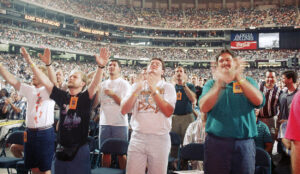
More than 65,000 men attended the Promise Keepers meeting at the Georgia Dome in Atlanta, June 30, 1995. The message is one of Christian faith, family and fatherhood. (AP Photo/Leita Cowart)

The group’s prominence sparked a national debate about the role of faith in public life and the evolving relationship between men and women, especially in religious communities.

During Promise Keepers gatherings, McCartney preached a mix of traditional Christian gender roles, known as complementarianism—with men as the spiritual leaders of their homes and societies—and a softer, kinder approach to masculinity, where men did the dishes, listened to their wives and were known for kindness rather than toughness.

“A real man, a man’s man, is a godly man,” McCartney said in a 1995 press conference before a packed-out event in Washington, D.C., The Washington Post reported. “A real man is a man of substance, a man that’s vulnerable, a man who loves his wife, a man that has a passion for God, and is willing to lay down his life for him.”

Butler said McCartney’s message resonated with both evangelical men and women—as it portrayed what the movement hoped to be at its best—but often clashed with the broader culture, especially with those who saw the group’s message as an attack on women’s rights.

“The Promise Keepers speak about taking back America for Christ, but they also mean to take back the rights of women,” Patricia Ireland, then president of the National Organization for Women, told The Washington Post in 1997, when Promise Keepers was at the height of its popularity.

“Their call for submission of women is one that doesn’t have a place in either the pulpit or the public sphere in the 1990s.”

Promise Keepers also was known for opposing LGBTQ rights, which also made McCartney controversial.

Strong emphasis on racial reconciliation

But the movement also stirred dissension in Christian circles for focusing on racial reconciliation, often in blunt terms.

“Racism is an insidious monster,” McCartney said in a 1996 rally for clergy in Atlanta, in announcing Promise Keepers’ move to focus on issues of race. “You can’t say you love God and not love your brother.”

He preached a similar message the following year before the rally in Washington, linking religious revival in the country with racial reconciliation.

“The church has been divided, and a house divided cannot stand,” he said, according to Religion News Service reporting at the time.

The movement faltered in the late 1990s, in part due to a move away from stadium events to smaller rallies in more places, which led to financial woes, as the income from the stadium events had paid the organization’s bills for years.

Less than a year after the “Stand in the Gap” event at the National Mall, the group laid off most of its staff. A move to focus on racial reconciliation proved less popular with evangelicals than the focus on how to be a good dad or husband, with some Christian leaders labeling it as “divisive.”

The group went through several attempts to reinvent itself—including a partisan turn during the Trump era—but has long failed to regain its former influence.

‘A shift in the American religious landscape’

Paul Emory Putz, assistant director of Truett Seminary’s Faith & Sports Institute at Baylor University, and author of The Spirit of the Game, said that there had long been a connection between Christianity and football.

 But until McCartney, few sports figures from the charismatic movement in evangelicalism had much of a public presence. But McCartney, who had been part of a charismatic Catholic parish and called himself a “born-again Catholic” and was later part of a Vineyard church, brought that community into the sports world.

“He marked a shift in the American religious landscape where that form of faith became more mainstream,” Putz said.

Putz also said McCartney lived out his beliefs, leaving the University of Colorado in order to pay more attention to his family

Born Aug. 22, 1940, McCartney grew up in Riverview, Mich., where he played football, basketball and baseball in high school, before getting a scholarship to play football at the University of Missouri.

After graduating from Missouri in 1962, McCartney coached high school in Joplin, Mo., before becoming coach of the basketball team at Holy Redeemer High School in Detroit and then football coach at Divine Child High School in Dearborn, Mich.

His success at the high school level led to an assistant coach job at the University of Michigan. In 1982, McCartney, known as “Coach Mac,” was named the football coach at the University of Colorado, where he led the team to 10 winning seasons in a row and made the Buffaloes a national powerhouse.

He resigned as coach in 1994, in part due to his wife’s ill health. He would step down as leader of Promise Keepers in 2003 but returned for a while in 2008.

His last season with the Buffaloes was 1994, when the team went 11-1 behind a roster that included Kordell Stewart, Michael Westbrook and the late Rashaan Salaam.

That season featured the “Miracle in Michigan,” with Westbrook hauling in a 64-yard touchdown catch from Stewart on a Hail Mary as time expired in a road win over the Wolverines, according to The Associated Press. Salaam also rushed for 2,055 yards and won the Heisman Trophy.

Praised as coach and role model

A conversion experience in his 30s changed the course of McCartney’s life, his family said in announcing the former coach’s death, and led him to devote the remainder of his life to living out his Christian faith.

Former colleagues and players testified to McCartney’s impact on their lives as both a coach and a role model.

“Coach Mac was an incredible man who taught me about the importance of faith, family and being a good husband, father and grandfather,” Rich George, University of Colorado athletic director, said on the university’s website.

Alfred Williams, a star player for the Buffaloes who later went on to win Super Bowls in the NFL as a member of the Denver Broncos, also paid tribute to McCartney.

“His unwavering faith and deep love for his family were the foundation of his life—values that always mattered more to him than the game itself,” Williams posted on X. “Coach Mac will be forever missed and deeply loved by all who had the privilege of knowing him.”

McCartney has been mostly out of public view in recent years. His family announced in 2016 that he had been diagnosed with dementia and Alzheimer’s.

“Coach Mac touched countless lives with his unwavering faith, boundless compassion and enduring legacy as a leader, mentor and advocate for family, community and faith,” the family said.

“As a trailblazer and visionary, his impact was felt both on and off the field, and his spirit will forever remain in the hearts of those he inspired.”

McCartney remains the winningest coach in Colorado history, with a record of 93-55-5. He was inducted into the College Football Hall of Fame in 2013.

He was preceded in death by Lynne, his wife of 50 years, who died in 2013. Survivors include four children, 10 grandchildren and three great-grandchildren.


Richard Hays, scholar know for changing his views, has died

(RNS)—Richard Hays, a renowned New Testament scholar and former dean of Duke Divinity School known for his influential books on Christian ethics and his change of mind about same-sex marriage, died Jan. 3, at his home in Nashville, Tenn., from pancreatic cancer. Hays was 76.

A former English teacher and pastor, Hays was a graduate of Yale University and Yale Divinity School and earned his doctorate from Emory University in 1981. He then returned to teach New Testament at Yale from 1981 to 1991 and then at Duke Divinity School until his retirement in 2018.

For much of his career, he was perhaps best known for his 1996 book, The Moral Vision of the New Testament, in which he argued same-sex relationships were “one among many tragic signs that we are a broken people, alienated from God’s loving purpose.”

His well-respected scholarly work was cited by Christian leaders who viewed same-sex relationships as sinful and who opposed LGBTQ affirmation in churches.

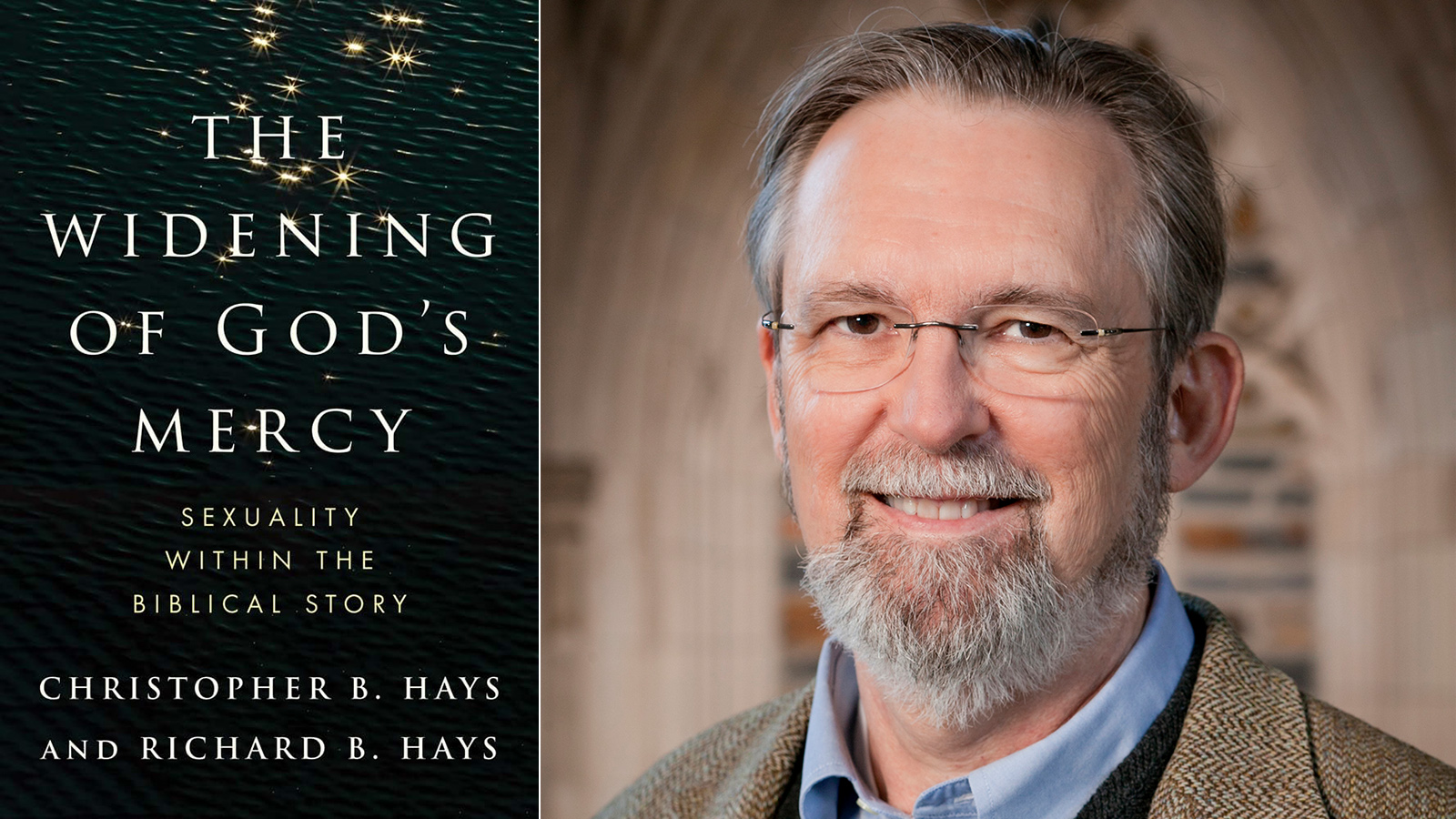
Last year, Hays publicly changed his mind—in what he described as an act of repentance for the way his work had been used to harm LGBTQ people and to divide Christians—in a new book, The Widening of God’s Mercy: Sexuality Within the Biblical Story, co-authored with his son, Christopher Hays, an Old Testament scholar.

‘The Widening of God’s Mercy: Sexuality Within the Biblical Story’ cover art and co-author Richard Hays. (Photo courtesy of Duke via RNS)

In the book’s introduction, Richard Hays recounts how his brother initially balked at attending their mother’s funeral, because her church, where the service would be held, affirmed same-sex relationships. That prompted him to reflect on the place of LGBTQ Christians in the church.

Since 1996, Hays had been rethinking his interpretation of the biblical texts barring same-sex relations because of his experience of teaching gay students in seminary and seeing the faithful service of gay Christians in local churches, he told Pete Wehner in a New York Times interview last year, including Hays’ own congregation.

 “The present book is, for me, an effort to offer contrition and to set the record straight on where I now stand. … I am deeply sorry,” he told RNS in 2024. “The present book can’t undo past damage, but I pray that it may be of some help.”

The new book was seen as a betrayal by conservatives who agreed with his former book. But Hays told National Public Radio he was at peace with his change of mind, though he knew it would cause controversy.

“So, there’s a sense in which I’m eating some of my own words, and I’m concerned that it will perhaps burn some bridges and break some relationships that I’ve cherished,” he told NPR. “But as I age, I wanted my final word on the subject to be out there. And so there it is.”

Hays initially was diagnosed with pancreatic cancer in July 2015 and at the time had been given a dire prognosis. But surgery and chemotherapy put his cancer into remission until 2022, when it returned. Despite more treatment, the cancer had spread by the summer of 2023, and eventually he went into hospice care.

This past fall, he wrote a health update asking for prayer, knowing the cancer would likely soon take his life.

“Over these past nine years, Judy and I have become practiced in looking death in the face,” he wrote. “We continue to trust that we are in the hands of a merciful God who loves us. And we continue to anticipate the power of the resurrection.

“It’s a hard thing to know with some certainty that I will not be here to watch my grandchildren grow up. But as in years before, we remain grateful for each new day in which we can join the Psalmist in proclaiming: ‘This is the day that the Lord has made; let us rejoice and be glad in it.’”

Hays is survived by his wife, Judy, and children Christopher and Sarah.

For the Baptist Standard’s response to Hayes’ book, The Widening of God’s Mercy see: Voices: Response to The Widening of God’s Mercy, Part I; Voices: Response to The Widening of God’s Mercy, Part II; and Voices: Three responses to The Widening of God’s Mercy.


Religious traditions can help with holiday blues, experts say

(RNS)—In a May 2023 advisory, U.S. Surgeon General Vivek Murthy called attention to the “public health crisis of loneliness, isolation and lack of connection in the U.S. today.”

In his plan to address this crisis, he listed faith groups as key players in the solution: “Religious or faith-based groups can be a source for regular social contact, serve as a community of support, provide meaning and purpose, create a sense of belonging around shared values and beliefs, and are associated with reduced risk-taking behaviors.”

While the directive was meant more generally, faith leaders and mental health experts say religious traditions and faith communities can play a key role in helping people get through the winter holidays, when rates of depression and anxiety are proven to increase.

From food drives to special services, like “lessons and carols,” to extra events and gatherings that often include a shared meal, many houses of worship are bustling with activity and opportunities to engage with community in December.

Showing up

“During the holidays, we are practicing relational spirituality and engaging in our awakened brain,” said Lisa Miller, a professor of psychology and education at Columbia University’s Teachers College. “We are actually showing up for one another to be loving, to be holding, to be guiding and never leave anyone alone.”

For many, the winter holidays are a time of grief, loss or perhaps heightened levels of depression and anxiety. A poll by the American Psychological Association found 41 percent of adults in the United States say their stress increases during the holidays.

Additionally, the National Alliance on Mental Illness found 64 percent of people living with a mental illness reported their conditions worsen around the holidays.

Miller, who founded the Spirituality Mind Body Institute, described the winter holiday season as the “Sabbath of the year” and said spirituality is a “clear antidote” to the unprecedented rise in so-called diseases of despair—alcoholism, drug use and suicide—in the United States.

This is the time when all those activities houses of worship engage in can really shine, Miller says: creating space for people to come share their feelings, singing together, participating in a prayer and inviting people to give back to their community through charity.

According to the National Alliance on Mental Illness, both religion and spirituality can have a positive impact on mental health, though often in different ways.

In general, religion gives people something to believe in, provides a sense of structure and typically connects people with similar beliefs. Meanwhile, the group describes spirituality as a sense of connection to something bigger, aiding in self-reflection and exploration of how one fits into the rest of the world.

While the research has been mixed on the connection between religiosity and overall health, a 2019 Pew Research Study found more than one-third of “actively religious” adults say they are “very happy” compared to a quarter of religiously inactive and unaffiliated Americans.

Sarah Lund, the minister for Disabilities and Mental Health Justice at the United Church of Christ, agreed faith communities are considered some of the key places to improve the mental health of Americans.

Gift of connection

“We don’t realize what a gift it is to be connected to each other and to have weekly gatherings where we share space, share community, break bread together, have friendships and build relationships through prayer, through Bible study and through worship,” Lund said.

And for people struggling with grief, disability or mental health during the holidays, Lund said support from a community, like a congregation, can help. She noted that some churches offer “Blue Christmas” services—opportunities to honor people who have lost loved ones and are experiencing grief—and expressed hope that congregations might consider ways to incorporate such acknowledgements all year.

Meadowbrook Baptist Church in Robinson held its first “Blue Christmas” service this year, called “A Service of Peace: Reflecting on Loss in a Season of Hopeful Anticipation.”

Meadowbrook Executive Pastor David Cozart explained the pastoral team wrestled for some time with knowing there was a need to offer such a service, but not knowing exactly “how to do it in a way that created an intentional pause, without forcing people to relive some of their most painful moments.”

They determined last year they were going to make sure it was accomplished this year, he said. Those who came to the intimate service expressed gratitude, noting while they didn’t know what to expect, they also didn’t know how much they needed it.

Cozart said he hopes it’s a service the church continues to offer every Christmas.

First Baptist Church in Allen has held similar services in past years, but because they are in an interim season, only offered the annual GriefShare: Surviving the Holidays event this year. The event offered video presentations from grief experts and discussion—as a typical grief group session would—but was open to anyone in the church or community dealing with loss, Jimmy Smith, generations pastor at the church, explained.

For some in attendance, it would be their first holiday without the person whose loss brought them to the event. Others were more seasoned in grief, but they all were able to share their struggles and personal grief journey through the holidays.

Smith described it as “a beautiful and sacred time, as we get to hear from one another, encourage one another and support one another.

“Every participant was given a workbook that had devotionals and helps for the holidays and a cross ornament they could put on their tree as a way to remember and honor their loved one,” Smith explained.

Continuing the work

“After the holidays is when people feel that kind of letdown,” Lund said. “As people of faith, there’s an opportunity to continue the intentional work about inclusion and supporting people’s mental health and accommodating the needs of people who have disabilities.”

“A strong spiritual life is more protective against addiction, more protective against depression, more protective even against suicide than anything else known to the social or medical sciences,” Miller said.

“When we look at hundreds of peer-reviewed articles, we see that the magnitude of the protective benefits of spiritual life are pointing to a way forward for our country.”

With additional reporting by Calli Keener.


Report links Bible engagement, generosity and happiness

PHILADELPHIA (BP)—Bible-engaged Christians are the most charitable people in the United States, and giving increases happiness among the generous, the American Bible Society said in releasing the last chapter of the 2024 State of the Bible.

“People who consistently read the Bible and live by its teachings are more likely to give to charity,” American Bible Society Chief Innovation Officer John Plake said in releasing the results.

“Our data shows that they also give far more—not only to their churches, but also to religious and non-religious charities. At a national level, we could say that scripture-engaged people form a massive engine of generosity and philanthropy.”

Evangelical households top the chart in the average amount donated, the percentage of people donating and the percentage given to their church or any religious charity, researchers said. Only 20 percent of evangelicals don’t give at all, and 40 percent give all of their contributions to their church.

But while evangelicals give more as a dollar amount, only the lowest income earners give at least 10 percent of their income to charity, researchers said.

“Nonprofits naturally look first to the top-line dollars donated, but God looks at the heart. And giving proportions may be a better window there,” researchers wrote. “Those blessed with great wealth often give from their surplus. It takes a deeper commitment to give sacrificially.

“Our survey shows that donors at the lowest income levels give the greatest percentage of their income to church or charity.”

Families earning under $20,000 a year give as much as 11 percent of their income to charity. But percentage giving largely decreases as income increases, dropping to 5.4 percent for families that earn just under $50,000, researchers said.

Giving rises as high as 8.5 percent of income for families earning between $50,000 and just under $100,000, but drops to the lowest proportion of 2.9 percent for those who earn between $100,000 and $150,000.

It is more blessed to give

In each income bracket, those who give are happier than those who don’t, based on the Life and Happiness Domain of the Human Flourishing Scale the American Bible Society introduced in this year’s State of the Bible.

On the 0-to-10 scale, with 10 indicating the highest level of happiness, givers scored nearly 7.2, while nongivers scored a full point less at 6.1.

“The lowest satisfaction score (5.2) comes among non-givers in the poorest households, those making less than $30,000 a year. But givers at that same income level have a satisfaction score of 6.5, rivaling non-givers making up to $100,000,” researchers wrote. “You might say the joy of giving is better than getting a $50,000 raise.”

The chapter was the final release of the 2024 State of the Bible, a comprehensive report which tracked such topics as faith in technology, human flourishing, love, Americans’ perceptions of church, Gen Z, nones and nominals, and loneliness.

State of the Bible is based on a nationally representative survey conducted for the American Bible Society by NORC at the University of Chicago, using the AmeriSpeak panel. Findings are based on 2,506 online interviews conducted in January 2024 with adults in all 50 states and the District of Columbia.


Faith leaders worried about immigration raids at churches

WASHINGTON (RNS)—Faith leaders are reacting with concern to a report President-elect Donald Trump plans to rescind a long-standing policy that discourages immigration officials from conducting raids at churches, schools and hospitals.

According to a report from NBC News Dec. 11, the incoming Trump administration plans to do away with a policy outlined in an internal 2011 U.S. Immigrations and Customs Enforcement memo by then-ICE director John Morton. The policy discourages government agents from making arrests at or near “sensitive locations,” such as houses of worship.

The news comes amid Trump’s campaign pledge to enact the “largest deportation” in U.S. history, which he has said could begin soon after he assumes office. He suggested in an interview over the weekend U.S. citizens could be deported with undocumented family members.

Gabriel Salguero. (Photo courtesy of The Gathering via RNS)

The Trump transition team did not respond to a request to confirm the president-elect’s intent to change the policy, but Gabriel Salguero, president of the National Latino Evangelical Coalition, said news of the policy change was “sending a deep chill down the spine of the Latino evangelical church.”

In a separate interview, Salguero noted he recently completed a “know your rights” training with 82 Hispanic evangelical bishops, many of whom have immigrants—undocumented and otherwise—in their congregations. He called the proposed change “a fear-based policy” and voiced concern about whether it will respect religious liberty.

“How are they going to execute these raids in ways that respect religious liberty and in ways that do not strike fear into children who are worshipping in Sunday school? I have 30 kids in a Sunday school class—I don’t know who is documented and undocumented,” Salguero said.

Samuel Rodriguez, head of the National Hispanic Christian Leadership Conference and one of Trump’s evangelical advisers, maintained in an email the policy change is narrower in intent, and he is “convinced the incoming Trump administration will focus on criminal illegal immigrants.”

He insisted the policy “serves as a warning” to undocumented immigrants who engage in criminal activity, such as “sex, human and drug traffickers” or “rapist gang members.”

“I do not foresee in any way, the administration targeting or going into schools or churches, pursuing God-fearing law-abiding immigrants who have been here for 15 years or more, and whose children were born or raised here,” Rodriguez said.

Different situation now

But other faith leaders are not as sure, such as those who participate in the New Sanctuary Movement, a faith-based effort that began under President Barack Obama’s administration and expanded greatly during Trump’s first term.

Participants in the movement—which includes members of many faiths—allow undocumented immigrants at risk of deportation to take up residence in houses of worship, hoping to pressure immigration officials into dropping their deportation orders.

Some immigrants have lived in churches for years, until eventually leaving after deportation orders were rescinded or changed.

Umstead Park United Church of Christ in Raleigh was one of a half dozen North Carolina churches that sheltered undocumented immigrants during the first Trump administration. Doug Long—former pastor of Umstead, now retired—suggested he wasn’t entirely surprised by the proposed change, which activists feared would occur during Trump’s first term.

“If they are making that announcement, I think it brings some clarity because we assumed it was already going to happen,” Long said.

When former North Carolina-based sanctuary leaders met last month, he added, the activists concluded churches wanting to help undocumented immigrants would need to pursue new avenues.

“It’s a very different situation than it was five, six years ago,” Long said.

Commitment to ‘love the stranger’ remains

Still, church leaders said they did not expect to retreat from their commitment to protecting undocumented people, a position they said is grounded in the scriptural call to love the stranger.

“When Jesus told us to love our neighbors, he didn’t also tell us to make sure that they were documented,” said Isaac Villegas, a Mennonite—whose church, the Chapel Hill Mennonite Fellowship, gave sanctuary to an undocumented immigrant during the first Trump administration.

 “He just said love and care for your neighbors. Full stop. Not, oh, check their documentation status while you’re at it.”

Longtime immigrant rights advocate Noel Andersen, a United Church of Christ minister and national field director at Church World Service, a group that helps resettle refugees, expressed outrage over reports of the policy change.

“The right for all people to find safety, refuge and rest in houses of worship is fundamental to our nation’s history of religious freedom and our longstanding values,” he said.

“No one should face fear of deportation when going to houses of worship, seeking medical care, social services, at public demonstrations or taking their kids to school.

“Regardless of what policy the Trump administration rescinds or puts forth, faith communities will continue to look to our sacred texts and centuries of tradition to live out our faith by welcoming immigrants and protecting the most vulnerable among us.”

Andersen added: “We must lead with compassion and love instead of cruelty or fear to keep families together and to ensure that all people are treated with their God given dignity.”

Other religious groups appear to be taking a wait-and-see approach to the news.

Chieko Noguchi, spokesperson for the U.S. Conference of Catholic Bishops, said in a statement the group of prelates is “aware of the various proposals being discussed with regards to immigration, and are preparing to deal with a range of policies, and will engage appropriately when public policies are put forth by the office holders.”

Representatives for the Evangelical Lutheran Church in America, a denomination that declared itself a “sanctuary church body” at its 2019 Churchwide Assembly and whose members taped “9.5 theses” expressing their concern for immigrants to the door of an ICE building in Milwaukee, declined to comment.

The New Sanctuary Movement is an extension of an earlier effort that occurred in the 1980s, when churches along the U.S.-Mexico border opened their doors to an uptick in migrants, especially those fleeing El Salvador and Guatemala, whom the government largely denied requests for asylum.

In 1986, the FBI infiltrated the movement and indicted 16 activists before ultimately convicting nine. The movement is credited with pressuring President Ronald Reagan’s administration to do more to help Guatemalans and Salvadorans.

Religious activists associated with the movement also pushed San Francisco to pass a “city of refuge” ordinance in 1989 that ended local cooperation with federal immigration officials. The law change was the first example of a “sanctuary city,” a movement that expanded during Trump’s first term—and that he has repeatedly condemned.

As for reports of Trump ending the “sensitive locations” policy, Salguero said he especially was troubled the news came amid the Christian season of Advent. Jesus Christ, he said, was a “refugee fleeing violence.”

“During the highest of our holy days, now we have to talk to our families about this,” Salguero said.

Even so, he remained steadfast in his desire to aid immigrants.

“For us, this is not a political thing,” he said. “This is not a partisan thing. We have to do what Christ has called us to do.”


New hymnal helps engage Scripture word for word

NASHVILLE (BP)—Twelve years ago, Randall Goodgame’s family was in the thick of homeschooling. His wife Amy struggled to help the kids memorize their weekly Scripture verses. Goodgame decided to help in a way that came naturally to him—writing songs.

It worked.

“It worked so well that … within a few weeks I realized, well, this seems important,” Goodgame said in a recent interview with Baptist Press.

Songwriter Randall Goodgame introduced his ‘Scripture Hymnal’ in front of a live audience in October. (Photo courtesy Turning Point Media via BP)

Songwriter Randall Goodgame introduced his Scripture Hymnal in front of a live audience in October. “There’s something about music that allows us to experience something more than just the information,” he said.

What started as a project to help his kids soon turned into a new phase of his ministry as a music artist. Now, Goodgame’s Scripture songs fill a new hymnal—aptly titled Scripture Hymnal—which Goodgame hopes will help churchgoers internalize God’s word.

“Music helps people remember things,” Goodgame writes in the hymnal’s introduction. “And music memories conjure much more than just information. … In the time it takes to hear a melody, a whole world can flood our consciousness.”

Music involves more than just the intellect, he told BP, which makes it an effective teacher.

“God gave us these emotions, and we are spiritual people,” he said. “We are these eternal creatures trapped in these glorious gifts that we call bodies that were made in the image of the creator. And there’s something about music that allows us to experience something more than just the information.”

And even more than that, we are called to sing together.

“First and foremost, [singing is] an act of obedience,” Goodgame said. “The Lord only requires us to do things that are good for us. He sanctioned it. We know that means it’s good for us. … There’s something so powerful about proclaiming the truth of what’s real and what we depend on about this God that we serve and trust—proclaiming it together through song.”

A labor of love

The hymnal opens with “In the Beginning,” based on Genesis 1:1. Hymn No. 55, “Unless You Change,” is based on Matthew 18:3-5. “Quick to Listen, Slow to Speak”—hymn No. 95—is based on James 1:19.

There are 106 songs, all taken directly from Scripture, plus accompanying Scripture readings and indexes listing the songs by topic, musical style, Scripture passage and more.

The ‘Scripture Hymnal’ contains 106 songs, which all have corresponding studio recordings online.

Scripture Hymnal contains 106 songs, which all have corresponding studio recordings online.

The team of 12 writers who collaborated on the songs committed not to change the Scripture text in any way. They used mostly the NIV, ESV and CSB translations, choosing what they considered the most lyrical translation for a given passage.

Word-for-word rendering made the songwriting more challenging, but Goodgame had strategies for making the songs easy to learn and sing.

First, he simply immersed himself in the verses, reading them very slowly, praying and letting the passage’s theme and text dictate the feel and form of the song.

He took a cue from traditional hymns for the structure of the songs.

“Old hymns were built for unmusical people to sing together,” he said, adding that usually means one syllable per beat.

“I really made an effort to try to be aware of the syllables and where they fell on the beat,” he said. “And then once you’ve constrained yourself to that, then you have to find melodies that sound appealing within that restriction. Then it’s just kind of problem solving and listening and praying.”

Much of his inspiration for which passages to use for songs came from his own Bible study, but Goodgame also asked friends, including several pastors, “If there were one verse that your congregation would be able to sing to each other and to the Lord, what would that one verse be?”

Goodgame premiered the hymnal in a live concert Oct. 11 in Franklin, Tenn., where the capacity crowd was able to sing along with the songs pretty much right away. The lines from the hymnal appearing on the screens helped those who could read music, but even those who couldn’t were able to follow along quickly.

“The goal is you want people to feel like this is how a melody was supposed to be written for these words,” Goodgame said.

What he’s called to do

For more than a decade, Randall Goodgame has been writing songs using the Bible for lyrics.

Goodgame is no stranger to using music to instill important truths. Over the last 20 years, he’s built a kids’ and family music brand called Slugs & Bugs, releasing the first album along with singer-songwriter Andrew Peterson in 2006.

The albums are equal parts silly and serious, with songs like “God Made You” and “May the Lord Bless You and Keep You” appearing alongside ones like “Tractor Tractor” and “Chicken Wiggle.”

But the one thing they all have in common is quality music and production. It’s the kind of kids’ music that parents keep listening to on their way to work after they drop the kids off at school.

After Goodgame’s success in writing songs to help his kids memorize Scripture, he began focusing on using Scripture alone for his lyrics, and the Slugs & Bugs Sing the Bible series was born. Sing the Bible Volume 1 came out in 2014. There have been four others since then.

“It’s what the Lord called me to for well over a decade,” he said. “And I think if I hadn’t had all those five Sing the Bible albums under my belt, I wouldn’t have been prepared to have done what I just did with the Scripture Hymnal. … I’ve done it for long enough that I’ve just gotten better at it. Like you do when you do the same thing over and over.”

A priceless opportunity

The Scripture Hymnal is not for kids, though the songs are singable enough that kids can easily learn them. And for those who don’t read music or who prefer to learn them aurally, there is a studio recording of each song online.

A QR code in the front of the hymnal takes the user to the recordings. The recordings also are being compiled into albums, the second of which released Nov. 29. There will be nine albums in all.

“Even though it was written for congregational singing, I really do hope people also see the value of just personal devotion with it,” Goodgame said. “They don’t have to read music; they can just go to the song through the QR code and flip to the page of the song they want to sing and sing along with the music.”

Goodgame said a main inspiration for the hymnal project was learning how his Sing the Bible CDs helped people internalize the word of God.

“I always have heard for years and years from people, ‘The Lord will bring the song that I need to my mind right when I need it.’ I just hear it over and over again,” he said. “To carry around God’s word with you is just priceless.”

Ultimately, he hopes the Scripture Hymnal will help the church be the church.

Singing together is proclaiming God’s faithfulness “right next to people that you know are going through hard things,” he said. “You are going through something hard, and you’re affirming it, proclaiming it, choosing to believe or at least try to believe by singing what you know is true with a whole room of other people that are doing the same thing.”

And how much more so when the words believers are singing are taken straight from Scripture.

“Every time we engage with the word, we have an opportunity to meet Jesus,” Goodgame said. “And it’s in Jesus that we are redeemed, and we are sanctified, and that dim little spark brightens, and we become lights in the world, caring less about ourselves and more about other people.

“And his kingdom grows because of the outpouring of his love through us to other people. And his word is the beginning of all of that.”