Weighing the spiritual cost when saints turn out to be scoundrels

WASHINGTON (RNS)—When Sarah Joy Hays learned two years ago her pastor in Baton Rouge, La., had an extramarital affair with a woman in their church—a woman who had been her spiritual mentor many years—she was angry and confused.

“I got pregnant out of wedlock, and she was one of the first people I told,” Hays recalled. “She kind of pastored and mentored me through it.

“To find out she was actively involved in this affair throughout that—that’s where I had the hardest time, figuring out how to react to that. I was going through something that was very obvious, an ‘external sin.’ And she was in the same situation, essentially, but nobody knew.”

Both the pastor and the woman with whom he had an affair were disciplined by their denomination, and he was removed from the pastorate, Hays said.

Two years later, the small congregation has a new pastor, and many members have taken advantage of periodic one-on-one and group counseling provided by their denomination, achieving some measure of healing. But Hays said she still is guarded spiritually.

“It causes you to question any amount of wisdom and discernment from then on,” Hays said. “It helps determine trust and how you give away trust.”

Sense of self affected by betrayed trust

What do people of faith do when they learn the person they trusted to teach them about God actually is a predator? What if the faith leader they admired all their lives turns out to be more scoundrel than saint?

“Part of what happens to us, on a much deeper level than the initial shock, disbelief, disappointment or outrage, is that our sense of ourselves is affected negatively,” said Lallene Rector, president of Garrett-Evangelical Theological Seminary in Illinois, where she has been an associate professor of psychology of religion and pastoral psychotherapy since 1986.

“To the extent that we have felt enhanced in our own self-esteem by our affiliation with these leaders, part of what we may experience (often unawares) is a deflation of our own self-worth,” Rector said.

“The failure of these idealized figures can strike at the very heart of our own longing for a kind of perfection,” left over from childhood disappointments in parents and other adults, said Rector.

“Add God to that mix—the clergy as a role representative of God—and it’s psychologically intoxicating.”

Consider biblical examples

The Bible can be instructive when it comes to spiritual leaders falling from grace—but perhaps not in the way some people might think.

For example, take King David—a morally complicated man, at best. Nevertheless, Scripture describes him as “the apple of God’s eye.” It’s a paradox often invoked to defend faith leaders—and others—who behave badly.

“David is like these pastors in that he is lionized for the things that he did, like expanding boundaries and whatnot, and a tradition of overlooking” the bad things he did, said Wil Gafney, associate professor of Hebrew Bible at Brite Divinity School in Fort Worth.

But Gafney said the biblical king’s story is not meant to be a prescription for how anyone should behave. “Just because God did something wonderful with (David) doesn’t mean we should do all the things he did.”

From her reading of the biblical account, Gafney believes David raped Bathsheba.

“The text says he sent men to get her. That evaporates consent,” Gafney said.

“I think we need to be able to not hang a thing around someone’s neck forever, but be honest and not sweep it under the rug. That means allowing brokenness to be broken.”

True repentance involves accountability

Because David’s story is about “how we deal with a beloved leader,” Gafney said, some adopt the attitude, “Well, it was all worth it.” Others want to leave the past behind.

“But others choose to say, ‘Let’s be real about this person and this is part of that legacy that doesn’t go away.’ And it doesn’t go away, because when we don’t hold him accountable for it in our telling, we then give other people permission,” Gafney said.

“Christians have evolved into this understanding of repentance that is not biblical—that it’s about saying, ‘I’m sorry,’ and hopefully not doing the thing again.”

But that’s only the first layer of repentance, Gafney insisted. “From the Hebrew Bible forward, reparation is at the heart of repentance. … Yes, your profound sorrow, your turning your life around—that’s part of it—but you’ve still never made it right,” she said.

If the ramifications of one person’s failure can seem endless, the failure of an institution means restitution on another scale. A moral catastrophe like the systemic cover-up by bishops and other Catholic leaders cataloged in the 1,300-page Pennsylvania grand jury report released in August “demands public and sincere lamentation from every segment of the Body of Christ,” said Richard Rohr, the Franciscan priest and founder of the Center for Action and Contemplation in Albuquerque, N.M., in a recent statement. “Only then can deep healing begin.”

But the Catholic Church has more than just sinful behavior to account for, Rohr noted. “It also demands public ownership, repentance, and reform of our very immature teaching in regard to sexuality in general, male power issues in particular, and our ‘enforced’ understanding of celibacy, which will predictably produce this kind of result,” he said.

“This shadowy material will keep emerging unless we own it and hold it fully accountable.”


Will Graham hopes ‘Unbroken’ sequel changes lives

NASHVILLE (BP)—Will Graham can do a convincing impersonation of his late grandfather Billy Graham. But for his role in Unbroken: Path to Redemption, Graham received strict orders: Don’t do an impression.

“The director said: Don’t imitate your grandfather,” Graham said. “My grandfather back then preached extremely fast. But the director said: ‘Don’t preach fast. Preach slow and be yourself.’”

Sequel tells the rest of the story

The movie, scheduled to hit theaters Sept. 14, follows the story of Olympian and World War II prisoner Louis Zamperini, who returned home a hero but nearly saw his life and marriage ruined due to PTSD, thoughts of revenge against his captors, and dependency on alcohol.

A visit to the 1949 Billy Graham Crusade in Los Angeles changed Zamperini’s life forever. He accepted Christ, later became an evangelist and founded Victory Boys Camp, an outreach for at-risk youth.

The PG-13 movie is a follow-up to the 2014 release Unbroken, which focused on Zamperini’s war heroics. The new movie stars Samuel Hunt of Chicago Fire and Chicago P.D. as Zamperini and Merritt Patterson of The Royals as his wife Cynthia. Will Graham plays Billy Graham.

Matthew Baer, who produced both movies, said he was “blown away” by the similar cadence of Billy Graham’s voice and Will Graham’s voice. The younger Graham, though, said any similarities were not intentional.

“He and I, we sound alike, but he says a few words different than I would,” said Graham, a vice president and associate evangelist for the Billy Graham Evangelistic Association who earned his master of divinity from Southeastern Baptist Theological Seminary. “What you’re seeing there is actually not a Billy Graham impersonation. That’s just me.”

Story of redemption and forgiveness

Will Graham grew up hearing about Zamperini’s conversion at the 1949 evangelistic crusade, but it wasn’t until he read the bestselling book by Laura Hillenbrand about Zamperini’s life that he fully appreciated the story’s depth.

“It’s one of the greatest stories of forgiveness outside of the Bible,” Graham said. “Louis received forgiveness, his life was restored, his marriage was restored, his nightmares went away, his drinking went away.”

Just as significantly, Graham added, Zamperini then extended forgiveness to others.

“Louis said he didn’t know if what God did in his life was just a fad or if it really changed him,” Graham said. “And he said he wouldn’t know that until he went back to Tokyo to meet his former captors.”

(Universal Studios / The WTA Group)

Unbroken: Path to Redemption recreates that key moment in Zamperini’s life when he came face to face with the Japanese men who had tortured him—the men who had hit and whipped Zamperini and the other prisoners regularly.

Hillenbrand’s book says Zamperini and the other prisoners were beaten for folding their arms, for cleaning their teeth, for talking in their sleep and for not understanding orders. One “favorite punishment” according to the book, was to force prisoners to do the “Ofuna crouch,” which involved standing for hours with knees “bent halfway and arms overhead.” Prisoners who stopped or who fell were clubbed and kicked. The beatings are recreated in the 2014 film Unbroken.

Mutsuhiro Watanabe—the Japanese corporal nicknamed “the Bird”—singled out Zamperini for his Olympic fame and took a personal satisfaction in torturing him. The Bird beat the prisoners daily, “fracturing their windpipes, rupturing their eardrums, shattering their teeth, tearing one man’s ear half off and leaving men unconscious,” according to Hillenbrand’s book.

Zamperini was a prisoner of war two years.

“Zamperini hated these men—he hated them,” Graham said, referencing Zamperini’s time without Christ. “But when he stood before them after the war, he said his heart melted in love for them. He said he no longer hated them. And he said, right then he knew what God had done in his life was real. And because of that, he was able to forgive them. … He formerly wanted to kill these people, and now he wanted to love on them and tell them about Christ and how Christ can change your life.”

The Bird never agreed to meet him, so Zamperini mailed him a letter.

L.A. Crusade changed Billy Graham’s ministry

The 1949 crusade also was a life-changing event for Billy Graham. Prior to the Los Angeles event, few people in the United States had heard of the evangelist, who was only 30 and was serving as president of Northwestern Bible College in Minneapolis. Newspaper publisher William Randolph Hearst made a decision that would change history by sending a note to editors to “puff” Graham.

“In other words, go write nice things about Billy Graham,” Will Graham said, explaining Hearst’s note. “And so the next day, my granddaddy showed up and there was like 100 reporters. He’s like, ‘I couldn’t get one,’ and now he’s got like 100 of them. He says: What happened? Why are you guys all here? And one of the guys replied to my granddaddy and said: You’ve been kissed by William Randolph Hearst.”

Hearst died two years later and never met Billy Graham. The evangelist never knew why Hearst liked him so much. Nevertheless, it was a “watershed moment,” Billy Graham would say.

“The 1949 crusade is what made Billy Graham famous,” Will Graham said.

Unbroken: Path to Redemption shows the famous tent that housed the crusade, which originally was scheduled for three weeks and was extended to eight weeks. More than 350,000 people attended. One of those was Zamperini, who was invited by his wife.

Will Graham said he hopes the movie makes an impact on moviegoers in a similar way the crusade affected Zamperini.

“My first and primary reason for doing this is that people would give their life over to Jesus Christ,” Graham said. “There’s going to be a lot more Louis Zamperinis out there. They’re struggling in their marriage. Their marriage is broken, their life’s falling apart. They’re addicted, trying to drown their sorrows away with drugs or alcohol, and they don’t know what to do. I want them to be like Louis.”

It’s also “a great love story,” he added.

“It’s a great story of survival and turning one’s life around, but ultimately it’s about Jesus Christ changing a couple, a husband and a wife,” Graham said. “I hope people see the real story behind it where they’re the Louis, and they can give their life to Christ, too.”

Unbroken: Path to Redemption is rated PG-13 for thematic content and related disturbing images. It contains no coarse language or sexuality.


When faith competes with materialism, charitable giving suffers

WACO—Religious people tend to be more charitable than their nonreligious counterparts, but they’ll think twice about opening their wallets if it prolongs their next big purchase, according to new research from Baylor University’s Hankamer School of Business.

Baylor researchers James A. Roberts and Meredith David partnered on a study that examined the relationship between religiosity and charitable giving, and what drives the latter.

They found religiosity—the way people live out their lives based on their faith—can drive donors to give. But when materialism—that self-serving want for more money or material possessions—enters the equation, giving decreases.

“At once, we want to help others, but at the same time, we desire the money and possessions that we all cherish to a greater or lesser degree,” the researchers wrote. “It is the result of such give-and-take between opposing values that drives our behavior as donors to charitable causes.”

A total of 180 adults participated in the study, published in International Journal of Nonprofit and Voluntary Sector Marketing.

Attitudes toward giving to help others examined

Roberts and David looked specifically at religiosity’s effect on peoples’ attitudes toward helping others and attitudes toward charitable organizations.

Religiosity, they explained, is different from religious affiliation. It is “something that individuals experience outside of their place of worship and constitutes a way of viewing and experiencing the world that is different from their less religious (or nonreligious) counterparts,” they wrote.

Roberts and David said they approached the study with the idea that helping others is a common rule among major religions.

In general, research showed those expressing higher levels of religiosity were found to possess more favorable attitudes toward helping others and to charitable organizations. And those with stronger attitudes toward helping others also expressed a greater breadth in their giving.

More religion does not equal more charity

But higher levels of religiosity do not guarantee open wallets, David said.

“We can’t always assume that religiosity ensures charitable giving,” she said.

Study results suggest increasing materialism lessened the positive effect of one’s attitude toward helping others in terms of “the breadth of giving,” she said.

Roberts, a nationally recognized expert on consumerism, said he and David, a nationally recognized expert on consumer behavior and well-being, weren’t too surprised by the study’s findings, given a basic understanding of human nature and the self-centeredness that accompanies materialism.

However, they believe understanding these dynamics can benefit charitable organizations as they identify potential donors and prepare for “the ask.”

“Although materialism was found to reduce the breadth and likelihood of charitable giving in the present study, it could spur charitable giving if it is driven by self-serving motivations,” they wrote in the “managerial implications” section of the study.

In other words, appeal to the donors’ inclination to give and their desire for public acknowledgment.

“Large donations that come with naming rights, spur news coverage or exceed the donations of other prominent individuals are all examples of how materialism can be used to drive charitable donations,” they wrote.


Churchgoers tend to congregate along political lines, survey says

NASHVILLE, Tenn.—America has become increasingly divided by politics in recent years. So have its Protestant churches.

More than half—57 percent—of Protestant churchgoers under 50 say they prefer to go to church with people who share their political views. And few adult Protestant churchgoers say they attend services with people of a different political persuasion.

Churches divided by politics

Those are among the findings in a new report on churchgoing and politics from Nashville-based LifeWay Research.

“Like many places in America, churches are divided by politics,” said Scott McConnell, executive director of LifeWay Research. “And churchgoers under 50 seem to want it that way.”

For the study, LifeWay Research surveyed 1,010 Americans who attend services at least once a month at a Protestant or nondenominational church.

Forty-six percent agree with the statement, “I prefer to attend a church where people share my political views.” Forty-two percent disagree. Twelve percent are not sure.
More than half (57 percent) of churchgoers ages 18 to 49 agree. Fewer churchgoers ages 50 to 64 (39 percent) or ages 65 and over (33 percent) agree. Men (51 percent) are more likely to agree than women (43 percent).

Methodist (57 percent), nondenominational (51 percent) and Baptist (49 percent) churchgoers are more likely to agree than churchgoers from other denominations. Lutherans (33 percent) are less likely to agree.

“Only a third of churchgoers in the study had strong feelings on this subject,” McConnell said. Twelve percent strongly agree, while 22 percent strongly disagree.

“Politics doesn’t seem to be a high priority for most Protestants when choosing a church to attend,” he said. “But for a small group of churchgoers, it’s really crucial.”

Birds of a feather …

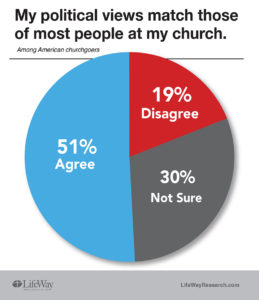
LifeWay Research also asked Protestant churchgoers if their political views match those of people in their church. Half agree (51 percent), while 19 percent disagree and 30 percent are uncertain.

Churchgoers ages 35 to 49 (61 percent) are more likely to agree than those ages 50 to 64 (47 percent) or those 65 and older (44 percent). Men (58 percent) are more likely to agree than women (46 percent). Those who attend services at least once a week (52 percent) are more likely to agree than those who attend once or twice a month (43 percent).

American churchgoers who hold evangelical beliefs (57 percent) are more likely to agree their political views match others in their church, compared to those who don’t hold evangelical beliefs (44 percent). Baptist (58 percent), nondenominational (54 percent) and Assemblies of God/Pentecostal (53 percent) churchgoers are more likely to agree. Lutherans (31 percent) are less likely.

Protestant churchgoers and other Americans who attend worship services at least once a month made up about half of voters (52 percent) in the 2016 presidential election, according to data from Pew Research.

Churchgoers might stick around even if they disagree over politics.

A previous LifeWay Research study of Protestant and nondenominational churchgoers found only 9 percent would consider leaving their church over political views.

“More than a few churchgoers in the most recent study (30 percent) don’t know the political views of people besides them in the pews,” said McConnell.

“Politics isn’t the only thing that churchgoers care about,” he said. “In some churches, politics isn’t mentioned at all—at least in the pews.”

LifeWay Research conducted the study Aug. 22–30, 2017. For this survey, a nationally representative sample of U.S. Protestant and nondenominational adults (18 and older) who attend religious services once a month or more often was selected from the Web-enabled KnowledgePanel.

Analysts used sample stratification and base weights for gender, age, race/ethnicity, region, metro/non-metro, home ownership, education and income to reflect the most recent U.S. Census data. Study-specific weights included for gender by age, race/ethnicity, region and education. The completed sample is 1,010 surveys. The sample provides 95 percent confidence that the sampling error does not exceed plus or minus 3.1 percentage points. Margins of error are higher in sub-groups.


‘Queen of Soul,’ who started with gospel, dies at age 76

WASHINGTON (RNS)—Aretha Franklin, who began her singing career with gospel music and later was crowned the “Queen of Soul,” died Aug. 16 after battling a range of health issues. She was 76.

Franklin got her start in the Detroit church of her pastor father, C.L. Franklin. She was first recorded at his New Bethel Baptist Church on the album Spirituals at age 14.

“Aretha, like Al Green, is one of the few artists who is universally accepted in the black church,” said Bil Carpenter, author of Uncloudy Days: The Gospel Music Encyclopedia. “The church often shuns artists who sing R&B as backsliders and reject them when they come back and sing gospel. However, Aretha’s always been given a pass.”

When Franklin, a Memphis, Tenn., native, who was raised in Detroit, was awarded the 2005 Presidential Medal of Freedom by then-President George W. Bush, the citation noted: “Her instantly recognizable voice has captivated listeners ever since she toured with her father’s gospel revue in the 1950s.”

‘She took you to church’

Gospel and soul singer Candi Staton, who traveled on the gospel circuit with Franklin during that decade when they were teens, recalled her friend was a “gifted singer even as a young girl,” even though no one knew then all the hits that would follow with her unique voice.

“What I love about it is that she never lost her connection to the church, and that church training was always channeled through her music regardless of what she was singing,” Staton said. “She took you to church even if she was singing about a no-good man.”

Carpenter said Franklin, a lifelong Baptist whose mother and sisters were gospel singers, continued to represent her church roots on stage and on some of her secular albums for decades after that, and influenced artists in genres stretching from R&B to country. But Franklin also inspired a range of gospel artists, from Richard Smallwood and The Hawkins Family to artists who came after them, such as Karen Clark Sheard, Donald Lawrence and Anita Wilson.

“It’s the sheer power of her voice and the unique phrasing that distinguish her from her peers. In her prime, Aretha’s voice took listeners to a place that few other artists’ voices could take them,” Carpenter said. “Whether she was singing a Broadway tune, a jazz standard or an R&B song, she always brought that authentic black gospel flavor to it.”

The singer who is known for “(You Make Me Feel Like) A Natural Woman” and “Respect” gave a nod to faith in the toe-tapping love song “I Say a Little Prayer.” She begins her solo with “The moment I wake up/Before I put on my makeup/I say a little” before backup singers chime in with “prayer for you.”

Amazing Grace

Her best-selling album, Amazing Grace, a 1972 release, is among five Franklin recordings featured in the Grammy Hall of Fame.

“Critics always talked about the gospel feeling in Aretha’s voice so it was a very big deal when she finally made a proper gospel album like Amazing Grace,” Carpenter said. “For years, it was the best-selling gospel album by a woman ever … until Whitney Houston’s The Preacher’s Wife stole that top position at 3 million units.”

Franklin’s two-record set includes the classic hymn by John Newton, as well as “What a Friend We Have in Jesus” and “God Will Take Care of You.”

A Rolling Stone reviewer said Franklin “sings like never before on record” on that live album.

Amazing Grace is more a great Aretha Franklin album than a great gospel album,” Jon Landau wrote at the time. “The liberation and abandon she has always implied in her greatest moments are now fully and consistently achieved.”

Clara Ward, of the Ward Singers, and Mahalia Jackson were among Franklin’s mentors. She sang “Precious Lord, Take My Hand,” at Jackson’s funeral and also performed the song, one of the favorites of Martin Luther King Jr., at the 2011 dedication of the Washington memorial in his honor.

Speaking of her faith

Sometimes Franklin spoke, rather than sang, about her beliefs.

When asked in 2017 by the Chicago Sun-Times about the importance of her faith, Franklin said: “It is very important. It certainly has sustained me to this day.”

Earlier, in 2013, she told The Associated Press that her healing from an undisclosed condition was considered “absolutely miraculous” after she had been ill for several months.

“I was talking to Smokey Robinson, my oldest best friend Smokey, talking about the fact that some doctors are not very well acquainted with faith healing,” she told the AP. “And Smokey said, ‘Well, they just don’t know who your healer is.’”

Franklin, who received a Kennedy Center honor in 1994, was the first woman to be inducted into the Rock & Roll Hall of Fame in Cleveland, in 1987.

“In Aretha Franklin’s sprawling career, she has taken on many roles—the devout gospel singer, the sensual R&B siren, the pop crossover phenom, Lady Soul—and dominated them all,” the hall’s website says.

The same year the hall of fame honored her, Franklin again recorded sacred music at New Bethel for the album One Lord, One Faith, One Baptism, which won a Grammy for best soul performance.

One of her most recent Grammy wins was in 2007 for “Never Gonna Break My Faith” with Mary J. Blige. The song was featured on the soundtrack of “Bobby,” a movie about the 1968 assassination of U.S. Sen. Robert Kennedy. In 2010, she won a Grammy for “You’ve Got a Friend,” recorded with Ronald Isley.

As news broke of her failing health, celebrities including Ciara, Missy Elliott and Mariah Carey tweeted that they were praying for her.

Franklin, who had announced retirement plans in 2017, had hoped to continue touring in 2018. After receiving a doctor’s recommendation, she had been forced to cancel concerts in several North American cities.


Analysis: Why Zika, and other viruses, don’t disprove God’s goodness

It’s been two years since Christian missionaries and aid workers in Zika-infested areas wrestled with whether to stay or go after the virus triggered an international public health emergency. Last week, the CDC released a new report indicating for the first time what happens as babies exposed to the Zika virus grow older—they may face problems when none presented at birth.

Seeing the most vulnerable in our society suffering so cruelly can raise questions about God’s goodness. Anjeanette “AJ” Roberts, a microbiologist and scholar at Reasons to Believe, began thinking about these issues in graduate school.

Read this article on Christianity Today.


Analysis—A kind of homelessness: Evangelicals of color in the Trump era

Before the 2016 election, Nikki Toyama-Szeto had thought of the term “evangelical” as neutral. “It was about theology,” she told me recently. She had a long history working with evangelical organizations like International Justice Mission and Intervarsity, and as the executive director of Evangelicals for Social Action, she was a well-known speaker and activist in evangelical circles. Her faith had been central to affirming her own racial identity and gender. “For myself, as a person of color, as an evangelical, I would say that I actually discovered my identity as an Asian American woman in the context of my faith,” she told me. “General, secular American society was saying you are invisible, or you can be either a newscaster or you can be the ‘dragon lady.’ It was in the context of my faith that I found out, ‘Oh, God created my gender and my ethnicity to be a gift for me.’”

Then, with the election of Donald Trump and her awareness that white evangelicals had voted for him overwhelmingly, she said, “I became suspicious that we don’t have each other’s back. I thought we did.” She kept thinking of white believers: “If you voted for Trump, then his racism was just not a deal-breaker for you. When push comes to shove, I feel like you threw me under the bus.”

President Trump’s support among white evangelicals remains strikingly strong (with 75 percent voicing their approval in April), but as commentators and the press continue to unpack their dedication to Trump, another set of statistics is getting far less attention: According to Pew Research, almost 25 percent of American evangelicals are not white, and they voted quite differently. (Another poll from PRRI puts the percentages of people of color far higher, saying that 46 percent of U.S. evangelicals are black, Asian, Latino, or otherwise non-white. The poll’s method was to count as evangelical any person who identifies as Protestant and who answers “yes” when asked if they are evangelical or born again.)

Not surprisingly, but importantly, Trump’s support among evangelicals of color is dramatically lower than among white evangelicals.

Continue reading this article at Religion & Politics.


Support for Christians refusing to serve same-sex weddings goes … up

In the wake of Masterpiece Cakeshop’s victory at the US Supreme Court, a new survey finds that public support is increasing both for conservative wedding vendors like Colorado baker Jack Phillips and for same-sex weddings like the one he refused to serve.

A survey conducted by PRRI after the high court’s controversial ruling in June found that public support for same-sex marriage has never been higher, with 64% of Americans now approving of its legality. Yet PRRI also found that Americans are increasingly sympathetic to service refusals by bakers, caterers, florists and other small business owners with conservative religious beliefs.

PRRI found that 46 percent of Americans believe owners of wedding-related businesses should be allowed to refuse their services to same-sex couples based on their religious convictions, while 48 percent of Americans believe business owners should be compelled to provide their services to such couples with no conscience exemption from antidiscrimination laws.

This is a shift from 2017, when only 41 percent of Americans favored the rights of religious business owners in this scenario, while 53 percent favored the rights of same-sex couples. PRRI found that most demographic groups have moved more in favor of religious liberty protections on this issue.

Whose views have changed most: people of color.

Continue reading this article at Christianity Today.


Teens’ screen time linked to ADHD and spiritual problems

NASHVILLE (BP)—Teens who report high-frequency digital media use are twice as likely to develop attention-deficit/hyperactivity disorder, a study in the Journal of the American Medical Association reports. Christian mental health practitioners say excessive screen time can damage the soul, as well.

“Screens today are the modern-day Baal—the socially acceptable thing that keeps us from a deepening relationship with Jesus,” said Joshua Straub, a marriage and family strategist for LifeWay Christian Resources.

The study “supports ongoing research that too much screen time is detrimental to our hearts, minds and souls,” said Straub, a child psychologist. “Yet for some reason, we—as a society—seem to be ignoring the data.”

Study connects screen time and ADHD symptoms

Researchers at three universities—the University of Southern California, the University of California at San Diego and the University of California at Los Angeles—examined a pool of 4,100 15- and 16-year-olds in the Los Angeles area for the study.

They pared the pool down to 2,587 teens with no preexisting ADHD symptoms, then asked how frequently those teens used 14 digital media platforms. Participants subsequently were monitored for digital media use and ADHD symptoms over a two-year period.

Among the digital platforms studied were social media, texting, Internet browsing, streaming or downloading music, chatting online and streaming television or movies.

Youth in the study who said they used at least half the platforms “many” times per day were more than twice as likely as low- or medium-frequency users to develop ADHD symptoms.

The National Institute of Mental Health defines ADHD as “a brain disorder marked by an ongoing pattern of inattention and/or hyperactivity-impulsivity that interferes with functioning or development.”

While 4.6 percent of teens who reported no use or moderate use of the digital platforms developed ADHD symptoms, 10.5 percent who used all 14 platforms many times per day exhibited symptoms, as did 9.5 percent who used half the platforms many times per day.

‘Statistically significant association’

Adam Leventhal, a USC professor and coauthor of the study, said it “raises concern whether the proliferation of high-performance digital media technologies may be putting a new generation of youth at risk for ADHD,” according to a USC news release. He noted the study “can’t confirm causation” but shows “a statistically significant association.”

“What’s new is that previous studies on this topic were done many years ago, when social media, mobile phones, tablets and mobile apps didn’t exist,” Leventhal added. “New mobile technologies can provide fast, high-intensity stimulation accessible all day, which has increased digital media exposure far beyond what’s been studied before.”

Chuck Hannaford, a clinical psychologist who served on the Southern Baptist Convention Executive Committee’s Mental Health Advisory Group, said the study “confirms much of what we already know.”

“There is a link between social media, smartphone use, gaming and mental health in teens. It is not a positive connection,” Hannaford said.

“Smartphones, social media and online gaming do have an impact on a developing youth. Studies have linked excessive screen time to mental health issues among youth. There are indications that those prone to depression and anxiety, in addition to deficits in cognitive functioning, can develop mental health issues.”

‘Pursue real relationships, not simply virtual ones’

“Young people need to pursue real relationships, not simply virtual ones,” said Hannaford, president of Heart Life Professional Soul Care in Germantown, Tenn. “We may be allowing our children to bypass certain strengths that come from personal interactions, healthy competition and the resiliency that comes from group interaction by allowing them to withdraw and distract themselves from the tension of life.”

Though ADHD is over-diagnosed in youth, Hannaford said, “parents should take note and research what they can do if their teen is spending too much time bypassing the development of the constructs necessary for the pursuit of goals and relationships.”

A person touches, swipes or taps their phone hundreds of times a day, Straub said, adding, “It’s hard to help our kids and teens when we ourselves as adults can’t put them down.”

Proverbs 3:3 and 7:2-3 are two Scriptures that apply to screen time, Straub said.

In them, the Old Testament writer “tells us to write the steadfast love and commands of God on the ‘tablet’ of our heart. He describes our hearts as a tablet. What we’re writing on them matters,” Straub said. “The coveting of products through advertisements or the coveting of other people’s lives through social media does nothing fruitful for our hearts.

“When we train our brains for screens, they become wired for screens. When we train them for relationships, they become wired for relationships. Our tablets of our hearts need people—real face-to-face time. In fact, there’s nothing that can give your child more of an advantage in life, education or for their spiritual journey than you the parent in face-to-face eye contact.”


Most churchgoers say God wants them to prosper financially

NASHVILLE, Tenn.—For some Americans, dropping a check into the offering plate at church is a bit like having a Discover Card. They expect a cash-back bonus.

About a third of Protestant churchgoers say their congregation teaches God will bless them if they donate money. Two-thirds say God wants them to prosper. One in four says Christians have to do something for God to receive material blessings in return.

Those are among the key findings of a new study on so-called “prosperity gospel” beliefs from Nashville-based LifeWay Research. For the study, LifeWay Research surveyed 1,010 Americans who attend a Protestant or non-denominational church at least once a month.

Many link giving to financial rewards

Researchers found more than a few churchgoers believe giving to God leads to financial rewards, said Scott McConnell, executive director of LifeWay Research.

“A significant group of churches seem to teach that donations trigger a financial response from God,” said McConnell.

The controversial and commonplace belief that God gives financial rewards in exchange for offerings is a central part of the so-called prosperity gospel, which offers a “direct path to the good life,” as Duke professor Kate Bowler puts it.

LifeWay Research found 38 percent of Protestant churchgoers agree with the statement, “My church teaches that if I give more money to my church and charities, God will bless me in return.” Fifty-seven percent disagree, including 40 percent who strongly disagree. Five percent are not sure.

Pentecostal and Assemblies of God churchgoers (53 percent) are most likely to agree. Churchgoers with evangelical beliefs (41 percent) are more likely to agree than those without evangelical beliefs (35 percent).

African-American (51 percent) and Hispanic churchgoers (43 percent) are more likely to agree than white churchgoers (32 percent).

Expectations of financial prosperity

Even if they don’t see a direct link between offerings and blessings, many churchgoers say God wants them to do well.

Sixty-nine percent agree with the statement, “God wants me to prosper financially.” Twenty percent disagree, and 10 percent are not sure.

The more people go to church, the more likely they are to think God wants them to do well. Among those who attend at least once a week, 71 percent say God wants them to prosper financially. That drops to 56 percent for those who go to church once or twice a month.

Churchgoers who have evangelical beliefs (75 percent) are more likely to agree God wants them to prosper than those without evangelical beliefs (63 percent). Pentecostal and Assemblies of God (80 percent), Baptist (74 percent), non-denominational (67 percent) and Methodist churchgoers (65 percent) are among the most likely to agree.

Lutherans, however, are more skeptical. Just under half (49 percent) say God wants them to prosper financially.

Payoff for doing good

Some churchgoers draw a direct tie from their actions to God’s blessings.

One in four (26 percent) agrees with the statement: “To receive material blessings from God, I have to do something for God.” Seventy percent disagree, and 5 percent are not sure.

Southerners (30 percent) are more likely to agree than those who live in the Midwest (20 percent) or West (19 percent). African-American (44 percent) and Hispanic (34 percent) churchgoers are more likely to agree than white churchgoers (17 percent) or those from other ethnic groups (16 percent).

Pentecostal/Assemblies of God churchgoers (34 percent), Methodists (29 percent) and Baptists (28 percent) are more likely than other denominations to say they have to do something for God to get a material reward. Lutherans (12 percent) are less likely.

A previous LifeWay Research study on American theological views found similar results. In that study, one in four Americans said they believe God always will reward true faith with material blessings. Americans who hold evangelical beliefs were most likely to agree with that statement.

Evangelicals appear to be to the most eager to embrace a link between God’s financial blessings and their actions, McConnell said.

“A number of high-profile evangelical leaders have condemned the prosperity gospel,” he said. “But more than a few people in the pews have embraced it.”

LifeWay Research conducted the study Aug. 22–30, 2017. For this survey, a nationally representative sample of U.S. Protestant and nondenominational adults (18 and older) who attend religious services once a month or more often was selected from the KnowledgePanel, a probability-based panel designed to be representative of the U.S. population.

Analysts used sample stratification and base weights for gender, age, race/ethnicity, region, metro/non-metro, home ownership, education and income to reflect the most recent U.S. Census data.

The completed sample is 1,010 surveys, providing 95 percent confidence that the sampling error does not exceed plus or minus 3.1 percentage points. Margins of error are higher in sub-groups.


Fewer Americans attend religious services; research tells why

WASHINGTON (RNS)—Fewer adults are attending religious services in the United States, but not necessarily because they don’t believe.

Many cite practical or personal reasons for skipping weekly services, according to new Pew Research Center data released Aug. 1.

Most notably, nearly four in 10 say they simply practice their faith in other ways and remain “fairly religious by a number of measures,” according to Pew Associate Director of Research Gregory A. Smith.

For nearly three in 10 Americans, the reason they don’t attend religious services is because they do not share religious beliefs.

Found another outlet for faith

But more people say it’s because they find another outlet for their faith (37 percent) or dislike certain things about services (37 percent)—namely, they haven’t found a place of worship that they like, they don’t like the sermons at their place of worship, or they don’t feel welcome.

Of those believers who rarely or never attend services, six in 10 identify as Christian, and 44 percent say they pray every day.

It’s unclear from the survey results how those respondents practice their faith instead. Those who rarely or never attend services don’t seem to be joining community organizations instead, Smith said. In fact, regular attendees still are more likely to join groups like a club or charity.

The new data follows previous surveys suggesting the number of Americans attending religious services at least once a week is dropping. According to Pew’s 2014 Religious Landscape Survey, those who say they go to church or another house of worship at least once a week fell from 39 percent in 2007 to 35 percent in 2014.

In that same period, the number who say they “seldom or never” go to church, mosque, synagogue or another service inched up, from 27 percent to 30 percent.

‘Moderately religious’

The recent survey shows nonetheless that many of those who don’t regularly attend services remain “at least moderately religious,” Smith noted. Nearly all (94 percent) of those who attend services at least once a month and well over half (61 percent) who rarely or never attend for reasons other than nonbelief say religion is at least somewhat important in their lives.

Of those who attend services at least once a month, most (81 percent) say they do so to grow closer to God, but they also cite giving children a moral foundation (69 percent), becoming a better person (68 percent) and receiving comfort in times of trouble or sorrow (66 percent). Ninety-one percent are Christian, and 71 percent pray every day.

Pew surveyed more than 4,700 people on its American Trends Panel, recruited from telephone surveys. Panelists participated in a self-administered web survey between Dec. 4 and 18, 2017. The margin of error for all respondents is plus or minus 2.3 percentage points, according to Pew.


Discuss religion when treating young adults with mental illness

WACO—A majority of young adults with severe mental illness—bipolar disorder, schizophrenia or major depression—consider religion and spirituality relevant to their mental health, according to a new study from Baylor University.

Holly Oxhandler, associate dean for research and faculty development in Baylor’s Diana R. Garland School of Social Work, served as lead author on the study, published in the journal Spirituality in Clinical Practice.

Researchers examined data from 55 young adults, ages 18-25, with serious mental illness who had used crisis emergency services. Of the 55 young adults interviewed, 34 “mentioned religion or spirituality in the context of talking about their mental health symptoms and service use with little-to-no prompting,” researchers wrote.

The sample for the study was racially diverse and gender-balanced. Not all of those interviewed considered themselves religious, as 41 percent answered “other,” “I don’t know” or “none” when asked their religious preference.

God viewed as source of comfort and support

However, researchers found religion and spirituality emerged as a unique way in which this sample was able to make sense of their difficult life situations and mental health struggles.

“Not only did these young adults struggle with serious mental illness, but they had also experienced extreme adversity—including abuse, poverty, homelessness, addiction, near-death experiences, loss and an overwhelming lack of access to medical and mental health services,” researchers wrote.

“Yet, many attempted to explain, make sense of or organize their circumstances through their religious/spiritual perspective and talked about God as a source of comfort and support.”

The young adults expressed both positive and negative views of God, prayer and support from religious and spiritual communities. Regardless of their views, Oxhandler explained, the important thing to note is that they’re talking about these topics—something social workers and counselors traditionally often are not equipped or trained to assess or discuss.

Mental health providers need to understand role of religion

“It’s the elephant in the room,” Oxhandler said of discussions of religion and spirituality. “If we continue to ignore it, we’re ignoring a huge component of peoples’ lives that may be tied to the clinical issue.”

Such discussions can help drive subsequent treatment options, Oxhandler said.

“As mental health care providers discern what mental health services to provide or coping strategies to recommend, it’s especially important they understand the role of religion/spirituality in the lives of the vulnerable young adults they serve,” she said.

Researchers also found those surveyed described using positive religious coping, negative religious coping or experiences, discussed their relationship with God or a higher power and unpacked the role of their support systems and faith.

Positive religious coping included prayer, reading religious texts, support from their religious and spiritual communities and identifying religious and spiritual meaning in difficult situations.

Some cited negative religious experiences

Negative religious coping or experiences included having a negative experience with a religious organization not being supportive or receiving hurtful messages from the religious community.

“Those who discussed their relationship with God or a higher power discussed God providing a sense of comfort or protection, accepting them for who they are or positively intervening in their lives,” Oxhandler said.

“Among those who unpacked the role of their support systems and faith, they often described family and friends referencing religion or God for support, and some even offered recommendations for others struggling with mental illness that involve religion and spirituality.”

Some of those interviewed said they found the mention of God or religion by family and friends less than helpful. For example, a 22-year-old white female with no religious identification mentioned in her interview that a family member “tries to tell me that going to church will be better for me because it will help me find peace, and it really does quite the opposite.”

Researchers noted nearly all participants who reported negative experiences with religion and spirituality also reported utilizing positive religious and spiritual coping or having a positive relationship with God.

Such complexity highlights the importance of including religion and spirituality during the initial assessment with a client, Oxhandler said.

“It’s critical that mental health care providers be well equipped and trained to assess for the complex role of religion and spirituality in the lives of young adults with serious mental illness, recognizing that it could appear to be a tremendous source of support and resilience and/or a source of pain and discomfort, if even a part of their lives at all,” she said.