New report urges congregations to aid family caregivers
June 18, 2019
WASHINGTON (RNS)—A new report on family caregivers details how congregations can play a role in supporting the increasing number of members caring for elders.
“Whether their care journey feels like a roller coaster, the deep end, or a long marathon, family caregivers are at risk of emotional, financial, and spiritual exhaustion as they balance both work and care and are tempted, often by necessity, to journey alone,” writes the report’s author, Lutheran pastor Amy Ziettlow.
“Called to Care: Honoring Elders & the Family Care Journey,” released June 11 by the Center for Public Justice, a nonpartisan Christian organization focused on civic education and policy research, proposes ways houses of worship, employers and the government can assist caregivers.
“We need congregations, workplaces, and public policies that honor and support these superhero caregivers,” Ziettlow writes.
Ziettlow, a former hospice chaplain, says that the overall number of unpaid caregivers to the elderly—about 41.3 million—is expected to increase significantly as baby boomers age. Citing the Bureau of Labor Statistics and AARP, she said the average caregiver spends three hours a day aiding an elder and $7,000 a year on out-of-pocket related costs.
Congregations encouraged to support caregivers
The report, which quotes the biblical commandment to “honor your father and your mother,” offers examples of how congregations can stand by those whose loved ones suddenly or gradually can no longer live by themselves or handle day-to-day responsibilities.
It suggests that congregations can provide paid family leave to clergy and employees, noting such action is “honoring paid work and family work as equally dignified and holy.”
The report recommends that houses of worship provide volunteers to help care recipients navigate their health decisions or give respite to caregivers. And it urges congregations to offer a warm welcome back to elders who may return to a congregation after being away for a period of time.
“Congregational ministry creates an environment where the potential for companionship and mutual support thrives,” writes Ziettlow, who now leads an Evangelical Lutheran Church in America congregation in Decatur, Ill. “And it is a space to raise and grapple with existential questions regarding death and end-of-life wishes.”
Christian service not automatic for Christians, study shows
June 18, 2019
NASHVILLE, Tenn.—In spite of biblical admonitions for Christians to be servants, many Protestant churchgoers find it difficult to serve others, a recent study reveals.
The 2019 Discipleship Pathway Assessment study from LifeWay Research found few Protestant churchgoers say they strongly agree they are personally taking actions that indicate a life of service to God and others.
The study identifies serving God and others as one of eight signposts that consistently show up in the lives of growing Christians.
“Many churchgoers profess faith in Jesus Christ, but are not putting that faith into action,” said Scott McConnell, executive director of LifeWay Research. “Jesus set an example for his followers through both the beliefs he taught and the way he served others.”
Intentional generosity?
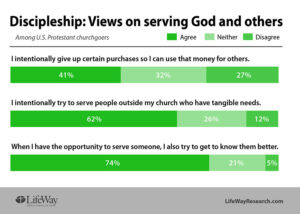
Fifteen percent of Protestant churchgoers strongly agree they intentionally give up certain purchases so they can use that money for others. Including those who somewhat agree, 41 percent say they practice that type of intentional generosity.
Younger churchgoers are more likely to take this step of service than older ones. Among 18- to 34-year-olds attending a Protestant church once a month or more, 22 percent strongly agree they give up purchases to use that money for others. The same is true for 18 percent of those age 35 to 49, 12 percent of 50- to 64-year-olds, and 8 percent of those 65 and older.
Hispanic churchgoers (25 percent) are more likely to strongly agree than African American (17 percent) or white (12 percent) churchgoers.
Those who attend a worship service at least weekly are more likely to strongly agree than those who attend less frequently (16 percent to 11 percent).
Protestant churchgoers are slightly more likely to say they intentionally try to serve people outside of their church who have tangible needs. More than six in 10 agree (62 percent), with 25 percent strongly agreeing.
Those 65 and older are the age demographic least likely to strongly agree (19 percent).
Hispanic (38 percent) and African American (29 percent) churchgoers are more likely to strongly agree than white churchgoers (21 percent).
Again, those who attend church services more frequently are more likely to say they serve others in this way, with 26 percent of those who attend at least weekly strongly agreeing compared to 21 percent of those who attend less than four times a month.
“Contrary to a common use of the word among Christians, serving is not confined to having a job to do at church,” McConnell said. “Serving includes showing the love of Christ in tangible ways to our neighbors in need.”
‘Getting to know you’
Three-quarters of regular Protestant churchgoers (74 percent) see their acts of service as a way to also get to know others. A full third (33 percent) strongly agree that when they have the opportunity to serve someone, they also try to get to know the person better.
Women (35 percent) are more likely to strongly agree than men (30 percent), while Hispanic churchgoers (45 percent) are the ethnic group most likely to strongly agree.
Regular churchgoers with less than a college degree (36 percent) are more likely to strongly agree than those who have a bachelor’s degree or higher (29 percent).
Black Protestants (39 percent) and evangelical Protestants (34 percent) are more likely to strongly agree than mainline Protestants (26 percent).
Those who attend worship services four times a month or more (35 percent) are more likely to strongly agree than those who attend less frequently (28 percent).
“It is easy to get a ‘fix-it’ mentality when serving,” said McConnell. “While there is most definitely a practical aspect to service, there is also a personal element. Without caring to know the person you are helping, a church’s service lacks the love that is at the heart of all Christian service.”
The online survey of 2,500 Protestant churchgoers was conducted Jan. 14–29. Respondents were screened to include those who identified as Protestant or non-denominational and attend religious services at least once a month. Analysts used quotas and slight weights to balance gender, age, region, ethnicity, income and denominational affiliation. The completed sample is 2,500 surveys, providing 95 percent confidence that the sampling error does not exceed plus or minus 2 percent. Margins of error are higher in sub-groups.
New Maverick still follows King
June 18, 2019
Justin Jackson, who was traded to the Dallas Mavericks from the Sacramento Kings, has learned that God has a sense of humor, as well as a sense of direction.
“Our plans are not always aligned with his plans. He has funny and different ways to show that,” Jackson said.
Churchgoers good at relationships but not making disciples
June 18, 2019
NASHVILLE, Tenn.—Building relationships with other believers seems to come naturally to Protestant churchgoers, but those relationships often are built apart from Bible study and spiritual growth, a LifeWay Research study concludes.
The 2019 Discipleship Pathway Assessment study from LifeWay Research found 78 percent of Protestant churchgoers say they have developed significant relationships with people at their church, including 43 percent who strongly agree.
Fewer than one in 10 disagree (8 percent), while 14 percent neither agree nor disagree.
The survey of Protestant churchgoers identifies building relationships as one of eight signposts that consistently show up in the lives of growing Christians. The survey is part of the 2019 Discipleship Pathway Assessment, a larger study identifying traits of Christian discipleship.
“In an American culture in which significant relationships are hard to form, most churchgoers have had at least some success at making friends at church,” said Scott McConnell, executive director of LifeWay Research. “But the majority aren’t as confident as they could be about the significance of those relationships.”
Few leverage relationships to make disciples
While there is no evidence of a gender divide on developing significant relationships at church, age plays a role in the likelihood someone has strong friendships at church. More than four in 10 churchgoers 65 and older (46 percent) strongly agree they have significant relationships within the congregation compared to 38 percent of 18-year-olds to 34-year-olds.
Not surprisingly, those who attend worship services more frequently—four times a month or more—are more likely to confirm strongly they have developed such relationships than those who attend less frequently (47 percent to 33 percent).
Fewer churchgoers, however, are intentionally leveraging their relationships with other believers to help them grow in their faith. Fewer than half of churchgoers (48 percent) agree with the statement, “I intentionally spend time with other believers to help them grow in their faith.” This includes 19 percent who strongly agree. The same number (19 percent) disagree.
“There is a different element to relationships at church that the majority of churchgoers haven’t prioritized,” McConnell said, noting that “investing in other believers” is one way Christians demonstrate love for God. “The relationship isn’t just about mutual interests; it is about proactively being interested in the faith of others.”
While older churchgoers (65 and older) are more likely to say they have significant relationships, they are less likely to strongly agree they intentionally spend time with other believers to help them grow (13 percent). Young adults (ages 18 to 34) are the most likely to strongly agree they are intentional about investing time in the spiritual growth of others (26 percent).
Hispanics (32 percent) are more likely to strongly agree than African Americans (22 percent), whites (17 percent) or churchgoers of other ethnicities (17 percent).
Black Protestants (24 percent) and evangelicals (21 percent) are significantly more likely than mainline Protestants (12 percent) to agree strongly they are intentional about spending time to help others grow spiritually.
Lack of involvement in small groups
While many churchgoers aren’t seeking to spend time with others to help them grow, they aren’t spending time with a small group that could benefit their own personal discipleship either.
According to the survey, 35 percent of churchgoers attend a class or small group four or more times in a typical month. Fourteen percent attend two to three times a month. About four in 10 (38 percent) Protestant churchgoers do not attend a class or small group in a typical month, while 13 percent attend once a month.
“For much of church history, small groups or classes have been one of the most effective ways churches offer for attendees to connect with others, study the Bible and serve together,” McConnell said. “This avenue of seeking God together is both relational and devotional.”
White churchgoers (41 percent) are more likely to say they never attend a small group of some kind than African-Americans (35 percent) and Hispanics (26 percent).
Mainline Protestants (48 percent) are more likely to never attend a small group than black Protestants (36 percent) and evangelicals (35 percent).
Blessed are the peacemakers
Half of churchgoers (49 percent) say they intentionally try to make peace at church, including 24 percent who strongly agree.
Almost four in 10 are noncommittal (38 percent), while 13 percent say they aren’t trying to be peacemakers.
“As Jesus prayed about his future followers, his priority was their unity,” McConnell said. “It takes work to keep the peace among a group of people. Stepping in to make that happen benefits everyone in the church.”
Younger churchgoers (28 percent) are most likely to strongly agree they intentionally try to be a peacemaker.
Hispanic (34 percent) and African-American churchgoers (32 percent) are more likely than white churchgoers (19 percent) to strongly agree they try to bring peace at church.
Black Protestants (32 percent) are most likely to strongly agree they try to be peacemakers followed by evangelicals (24 percent) and mainline Protestants (16 percent).
Researchers conducted the online survey of 2,500 Protestant churchgoers Jan. 14–29, 2019. They screened respondents to include those who identified as Protestant/non-denominational and attend religious services at least once a month. Analysts used quotas and slight weights to balance gender, age, region, ethnicity, income and denominational affiliation. The completed sample is 2,500 surveys, providing 95 percent confidence that the sampling error does not exceed plus or minus 2.0 percent. Margins of error are higher in sub-groups.
Christian writer Rachel Held Evans dies at age 37
June 18, 2019
WASHINGTON (RNS)—Rachel Held Evans, a popular progressive Christian writer and speaker, died May 4 at age 37 after a brief illness.
Evans had been in a medically induced coma for several weeks and never returned to an alert state.
Her husband, Dan, informed followers and supporters of his wife’s death on her website.
“This entire experience is surreal. I keep hoping it’s a nightmare from which I’ll awake. I feel like I’m telling someone else’s story,” her husband Dan Evans wrote in an update on Evan’s blog.
“I cannot express how much the support means to me and our kids. To everyone who has prayed, called, texted, driven, flown, given of themselves physically and financially to help ease this burden: Thank you. We are privileged. Rachel’s presence in this world was a gift to us all and her work will long survive her.”
Later, in an update on her website, Dan Evans, said that she began having “unexpected symptoms” while receiving treatment for an infection and that doctors found her brain was experiencing constant seizures. Doctors had placed her in a medically induced coma while working to determine the cause and treatment, he said.
Influential writer
(Courtesy photo by Maki Evans)
Evans is best known for her popular blog and best-selling books, including New York Times best-seller A Year of Biblical Womanhood, Searching for Sunday and, most recently, Inspired. She also served on President Obama’s Advisory Council on Faith-based and Neighborhood Partnerships.
In her books and blog posts, she wrote openly about her faith journey, which led her from Bryan College—a conservative evangelical school known for promoting belief in a literal, six-day creation—to the mainline Episcopal Church. Along the way, she chronicled her faith, doubt, honest questions and evolving beliefs with a sense of humor.
That didn’t come without controversy, including pushback from more conservative Christians over A Year of Biblical Womanhood, which celebrated an egalitarian view of women’s roles in both marriage and the church.
But in her writing, she rarely lapsed into us-versus-them arguments, instead presenting a vision of the church as a place with room for everyone.
Influential encourager
A number of women said during an online prayer vigil they would not have pursued ministry if not for Evans, and others said the only reason they had hung onto faith amid doubt was because of Evans.
Fellow writers praised Evans for sharing the considerable platform she has built, both on her blog and at “Why Christian?” and “Evolving Faith,” the conferences she co-founded for evolving or progressive Christians who aren’t sure where they belong on the spiritual landscape.
The news of Evans’ hospitalization had been met with an outpouring of support from readers, writers and Christian leaders, both conservative and progressive.
Upbringing in evangelicalism
Evans was raised in a nondenominational, evangelical Christian family in Dayton, Tenn.—the home, she liked to point out, of the 1925 Scopes Monkey Trial, the watershed case about teaching evolution in schools that caused many conservative Christians to feel alienated from the American mainstream.
She joked about the prizes she won as a kid for having all the answers when it came to Christianity, such as the time she won the “Best Christian Attitude Award.”
But as a student at Bryan, Evans began asking tough questions about her faith, like why God would send people to hell, which she wrote about in her first book. Evolving in Monkey Town was published in 2010 and later re-released as Faith Unraveled.
Evans brought her sense of humor to those questions in 2012’s A Year of Biblical Womanhood, in which she took the Bible’s instructions for women to hilarious extremes and shared what she learned from women of diverse faiths, including Amish and Jewish women.
Move away from evangelicalism
When she was growing up, the word “evangelical” had seemed synonymous to her with “real” or “authentic,” she told Religion News Service several years ago. She finally abandoned the label in 2014, after a number of evangelical Christians canceled sponsorships for children in need after the charity World Vision announced it would employ people in same-sex marriages. (World Vision later reversed that decision.)
That incident “confirmed what I’d been suspecting for a while—that my values were simply out of line with the evangelical culture’s values,” she said. “And by then, I’d just grown weary of fighting for a label that no longer fit.”
She wrote about her subsequent journey away from church and what kept leading her back in 2015’s Searching for Sunday, and about rediscovering a love for Scripture in 2018’s Inspired.
She worshipped with her family at St. Luke’s Episcopal Church in Cleveland, Tenn.
“Death is a part of life,” Evans wrote this year in a Facebook post at the beginning of Lent, the solemn time of penance and fasting many Christians observe leading up to Easter.
“My prayer for you this season is that you make time to celebrate that reality, and to grieve that reality, and that you will know you are not alone. Ashes to ashes, dust to dust.”
Aretha Franklin recalls roots in ‘Amazing Grace’ documentary
June 18, 2019
WASHINGTON (RNS)—Standing at the pulpit of a Los Angeles Baptist church in 1972, Aretha Franklin—known more for hits like “Respect” and “Chain of Fools”—started singing her own rendition of “Amazing Grace.”
As she sang the ode to divine deliverance, Franklin prompted members of the congregation at the recording of the gospel album to shake their heads and raise their arms.
The rhythm and blues star took on the role of a minister of music as she rendered one gospel song after another.
“You’ve got a mighty good friend in Jesus,” she sings at one point.
“Sing, Aretha!” someone in the church seats shouts.
Documentary shows R&B artist’s roots in church music
“Amazing Grace,” the documentary about the making of what would become the best-selling live gospel album, spends 87 minutes giving viewers a chance to see the woman known just as Aretha go back to her roots. The singer, who died at age 76 last year, first was recorded singing gospel music at her father’s church at age 14.
The title track features Franklin’s unique arrangement—almost 11 minutes long—with multiple notes attached to the words “amazing,” “grace” and other words in that time-honored hymn.
“That track was completely free in terms of meter, in terms of rhythm,” said Aaron Cohen, author of Amazing Grace, a 2011 book about the recording of the album. “She wasn’t being confined to a two- or three-minute pop song where she has to hit these notes to fill it out. Granted, every song she did she did her way, but more so with ‘Amazing Grace.’”
The long-awaited documentary was delayed almost five decades in part because of technical issues: The film and its accompanying sound were not synchronized when the recording was made. Decades later, digital technicians were able to link them, enabling the documentary directed by Oscar-winning Sydney Pollack to be released.
Now the musical mastery of Franklin’s voice is combined with a bird’s-eye view of the church setting where she recorded gospel favorites while playing a Steinway or standing at a pulpit with a large mural of the baptism of Jesus behind her.
Not just to perform, but to serve
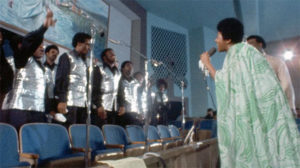
Aretha Franklin interacts with James Cleveland’s Southern California Community Choir while recording her “Amazing Grace” album at a Los Angeles Baptist church in 1972. (Photo courtesy of NEON via RNS)
The film captures not only the freedom with which she expresses herself musically, but the call and response between the artist and James Cleveland’s Southern California Community Choir, outfitted in bright silver vests.
“As a singer, she was the star. But in that environment, she was also there to serve as well,” said Cohen, former associate editor of DownBeat magazine, who has seen the documentary six times and previously viewed raw footage.
Delores Klyvert, a fan of Franklin’s, said “Respect” is one of her favorites but she got a fuller view of the artist as a woman of faith when she stopped by a movie theater in Washington, D.C., on Good Friday.
“I knew about her father, her church, her religious background,” said Klyvert, a member of a multicultural nondenominational church in Richmond, Va. “It was just that it brought it to the forefront and let me actually connect with it a little better. I knew it, but it’s nothing like actually seeing and hearing.”
Shared experience
Near the start of the film Cleveland introduces Franklin by saying “she can sing anything—anything.” But the focus for the two nights of recording and the two LPs of the original album was the genre of gospel.
She sings the first selection, “Wholy Holy,” a cover of a Marvin Gaye song, at the Steinway grand piano, dressed in a long white dress with sequins, eyes often closed.
The film shows a predominantly black congregation, some men dressed in plaid jackets with wide lapels and some women dancing in the aisles, seeming to respond to both the method and the message of Franklin’s music.
“It does capture that emotional immediacy that there is in this kind of church,” said Cohen. “This whole character that is a community just comes so alive in a very vivid way in the film. And it’s about sharing. It’s about sharing an experience.”
As a camera pans the congregation, viewers can spot director Pollack, Franklin’s mentor and gospel singer Clara Ward and the Rolling Stones’ Mick Jagger (who toured with gospel singer Dorothy Norwood in the same year the “Amazing Grace” album was released).
‘Hasn’t ever left the church’
When Cleveland takes his turn at the piano to accompany Franklin, he adds more about her background.
“You know being a daughter of a Baptist minister, you had to know these hymns before you could do anything,” he said.
In the middle of the slow-moving “Precious Memories,” Franklin sings, “We ought to sing that one more time.”
Her father, C.L. Franklin, was in the audience for the recording. In one poignant moment, he stands over his daughter seated at the piano and mops the sweat from her brow.
At another point, her father recounts a story of his trip to the dry cleaners where the proprietor speaks of missing Aretha’s involvement in church music.
“If you want to know the truth, she hasn’t ever left the church,” he said.
More than seven months after her death, Franklin is getting renewed attention on the big screen and beyond. On April 15, she was awarded a posthumous Pulitzer Prize for “her indelible contribution to American music and culture for more than five decades.”
A week later, on Easter Sunday, BET aired the Stellar Gospel Music Awards at which singers Regina Belle, Erica Campbell and Kelly Price sang in tribute to Franklin and her family was presented with the inaugural ICON Award in her honor.
The “Amazing Grace” documentary was shown at about two dozen locations across the country on Easter Sunday, followed by a live-streamed address of William J. Barber II, who has co-led a revival of Martin Luther King Jr.’s Poor People’s Campaign, from Barber’s North Carolina church. A representative of the film said theaters in Austin and Brooklyn sold out.
“When we relaunched the Poor People’s Campaign in 2018, Aretha called me to pledge her support,” said Barber in a promotional video about the film. “You are about to hear and see the queen of a gospel tradition that was forged in the fires of America’s worst injustice.
“This music has sustained millions through many dangers, toils and snares. It not only kept them. It moved them, like it did Aretha, to stand for justice.”
More churchgoers pray about evangelism than practice it
June 18, 2019
NASHVILLE, Tenn.—Most Protestant churchgoers say they are eager to talk to others about Jesus and pray for opportunities to share their faith. But most say they have not had any evangelistic conversations in the past six months.
The 2019 Discipleship Pathway Assessment study from Nashville-based LifeWay Research found excitement and eagerness about the idea of evangelism, but few Protestant churchgoers actually engaged in the practice on a regular basis.
More than half (55 percent) of those who attend church at least once a month say they have not shared with someone how to become a Christian in the past six months.
“Sharing the good news that Jesus paid for our sins through his death on the cross and rose again to bring us new life is the mission of the church,” said Scott McConnell, executive director of LifeWay Research. “But it does not appear to be the priority of churchgoers.”
Praying for opportunities
A majority of churchgoers (56 percent) say they pray for opportunities to tell others about Jesus at least once a week, with 23 percent praying for such moments every day.
More than a quarter (27 percent) say they rarely or never pray for those opportunities.
Those with a high school diploma or less are most likely to say they pray for those opportunities every day (31 percent).
Hispanics (36 percent) and African-Americans (29 percent) are more likely to offer those prayers every day compared to whites (20 percent) or other ethnicities (17 percent).
Increased church attendance makes it more likely someone has offered evangelistic prayers.
Those who attend a worship service on average once a week (75 percent) are more likely than churchgoers who attend less frequently (69 percent) to pray at least once a month.
Eager to talk about Jesus?
Most churchgoers (56 percent) also say they are eager to talk about Jesus with people who are not like them in terms of ethnicity, income or interests. About one in six disagrees (16 percent).
Churchgoers 65 and older are the age group least likely to strongly agree they are eager to share the gospel with those different from themselves (20 percent).
Hispanics (40 percent) and African-Americans (32 percent) are more likely to strongly agree than whites (23 percent).
“The task of making disciples of all nations has not been fully embraced in the American church—especially by the majority culture,” McConnell said. “This is in spite of the convenience of having other ethnicities and immigrants from other countries often living in the same neighborhood.”
Less than half of churchgoers say they have shared with someone in the past six months how to become a Christian (45 percent).
Of those who have spoken to someone about becoming a Christian, most had done so with one or two people (24 percent). One churchgoer in 10 averages at least one evangelistic conversation a month.
Young more likely to share their faith
Those 65 and older are the age demographic most likely to say they had no evangelistic conversations in the past six months (62 percent).
“Recently, there has been much discussion about young adults participating less in evangelism. That’s not the case, however,” McConnell said. “In fact, young adult and middle-aged churchgoers are more likely to have shared with someone how to become a Christian in the past six months than older churchgoing adults.”
Hispanics are the ethnic group least likely to say they have not spoken with anyone about becoming a Christian in the last six months (32 percent).
Those who attend a worship service four times a month or more (53 percent) are less likely to say they have had no evangelistic conversations than those who attend less than four times a month (60 percent).
Inviting people to church
Most churchgoers (55 percent) say they have, however, invited an unchurched person to a church service or program in the past six months.
While 45 percent say they haven’t made any invitation, 31 percent say they invited one or two individuals.
Hispanics are the most likely to have invited someone. Around seven in 10 (71 percent) Hispanic churchgoers say they invited at least one person to church.
Increased church attendance also is linked to an increased practice of inviting others to church.
Those who attend at least four times a month (58 percent) are more likely to say they have invited an unchurched person to a church service in the past six months than those who attend less than four times a month (47 percent).
“Jesus never promised the Great Commission would be completed quickly,” McConnell said. “But he set the expectation that the efforts to reach all nations with his gospel should be continuous. Many in church today appear to be distracted from Jesus’ final command.”
The online survey of 2,500 Protestant churchgoers was conducted Jan. 14–29, 2019. Respondents were screened to include those who identified as Protestant/non-denominational and attend religious services at least once a month. Analysts used quotas and slight weights to balance gender, age, region, ethnicity, income and denominational affiliation. The completed sample is 2,500 surveys, providing 95 percent confidence that the sampling error does not exceed plus or minus 2 percent. Margins of error are higher in sub-groups.
Discipleship OK but most pastors see room for growth
June 18, 2019
NASHVILLE, Tenn.—Most Protestant pastors feel confident about the discipleship taking place in their churches. However, there’s still plenty of room for growth, according to a new study from Nashville-based LifeWay Research.
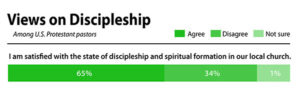
About two-thirds (65 percent) say they are satisfied with the state of discipleship and spiritual formation in their local church, while 78 percent indicate there’s room for improvement.
While two-thirds agree they are satisfied with discipleship, 44 percent are not regularly evaluating discipleship progress to inform that opinion. About eight out of 10 (83 percent) have an intentional plan for discipleship.
“Following Christ involves movement,” said Scott McConnell, executive director of LifeWay Research. “And that movement can either be walking with Christ or straying from that path. Churches must be vigilant and proactive in encouraging the progress of believers.”
More pastors today say they are satisfied with the state of discipleship in their church than seven years ago. In a similar survey by LifeWay Research in 2011, less than half (47 percent) were satisfied.
In the 2019 study, 55 percent of Protestant pastors say they regularly evaluate discipleship progress of their congregations. That’s up from 43 percent of pastors who answered “yes” to the same question in 2011.
“As pastors increasingly value measurement of discipleship, it is important to note that growth in Christlikeness is more than having new people to fill places of service at church,” McConnell said. “Our journey with Christ involves our beliefs, attitudes and behaviors, so we need evaluation in all of these areas.”
Varied approaches
Churches use many approaches to disciple and encourage spiritual development in adults, the study found. On average, churches chose more than six of the nine approaches listed in the survey. Sunday School and ongoing small group Bible studies are the most common discipleship approaches followed by sermons, women’s groups and short-term Bible studies.
“In a broad sense, discipleship is really an intentional and consistent effort, driven by faith, to follow Jesus,” said Michael Kelley, director of Discipleship and Groups Ministry at LifeWay Christian Resources. “But the specific dynamics of how discipleship happens in an individual church vary based on the context of that local church.”
When it comes to the question of on-campus or off-campus small group Bible studies, almost all Protestant pastors (96 percent) say they have ongoing adult Sunday School or small group Bible studies at the church building. Slightly more than half (53 percent) say they have small group Bible studies that meet in homes or outside the church building.
Pastors of small to mid-size churches tend to choose on-campus Bible studies exclusively. Most pastors of churches with an attendance of 49 or fewer (89 percent), 50-99 (97 percent), 100-249 (97 percent), and 250-plus (96 percent) say they have on-campus Sunday School or small group studies for adults.
At the same time, pastors of churches with attendance of 250-plus are most likely to use off-campus small groups (77 percent).
Differences by age, region and ethnicity
The pastor survey also reveals demographic differences by age, region and ethnicity, as well as church size and denomination:
Pastors of churches with attendance of 100-249 (70 percent) are more likely to say they are satisfied with the state of discipleship in their church than those with attendance of 50-99 (61 percent). Pentecostals (75 percent) are more likely to agree than Baptists (63 percent) and Methodists (54 percent)
Pastors age 45-54 (88 percent) are more likely to say their church has an intentional plan for discipleship of individuals and encouraging their spiritual growth when compared to those 55-64 (80 percent). Non-white pastors (91 percent) are more likely to say they have an intentional plan than white pastors (82 percent).
Pastors in the South (59 percent) are more likely to say they evaluate discipleship progress in their church than those in the Midwest (51 percent). Pastors age 18-44 (60 percent) are more likely to evaluate their church’s progress than those 65 and older (49 percent).
Signposts of spiritual health
“The majority of older pastors grew up in churches where discipleship was assumed to be taking place,” McConnell said. “More younger pastors realize it’s something that must be tracked.”
LifeWay Research has been studying discipleship and spiritual growth for 30 years, McConnell noted.
Since 2007, LifeWay Research has surveyed more than 7,000 churchgoers as part of national samples of Protestants in the U.S. to discover and improve measures of spiritual formation.
Eight years ago, LifeWay Research embarked on a comprehensive study of spiritual growth among churchgoers and the degree to which churches actually were producing biblical disciples and not merely churchgoers. That study identified eight common attributes of the Christian life that lead to spiritual health in a believer.
The eight signposts include Bible engagement, obeying God and denying self, serving God and others, sharing Christ, exercising faith, seeking God, building relationships and living a life unashamed of Jesus Christ.
Researchers conducted the phone survey of 1,000 Protestant pastors Aug. 29 to Sept. 11, 2018. The calling list was a stratified random sample, drawn from a list of all Protestant churches and using quotas for church size. Each interview was conducted with the senior pastor, minister or priest of the church called. Analysts weighted responses by region to reflect the population more accurately. The completed sample is 1,000 surveys, providing 95 percent confidence that the sampling error does not exceed plus or minus 3.2 percent. Margins of error are higher in sub-groups.
Number of Americans who belong to a church plummets
June 18, 2019
WASHINGTON (RNS)—Most Americans still say they believe in God, but their involvement in organized religion continues to wane.
A new Gallup report found that only half of Americans say they belong to a church or other religious body, down from 69 percent two decades earlier.
Most of the decline is tied to the rise of the so-called “nones”—those who claim no religious affiliation. Gallup found that the share of Americans who claim a religious identity declined from 90 percent to 77 percent in recent decades.
But even those who claim a faith tradition may not belong to a religious congregation or community, according to the report, which compared data from 1998-2000 to data from 2016-18.
At the turn of the century, Gallup said, 73 percent of religious Americans belonged to a house of worship. That’s dropped to 64 percent today.
“The still-sizable proportion of religious Americans also contribute to declining church membership, as fewer in this group belong to a church than did so two decades ago,” the report states.
‘Americans’ orientation to religion is changing’
Being part of a house of worship no longer is seen as essential for a growing number of religious Americans, Gallup found.
“It is clear then, that the nature of Americans’ orientation to religion is changing, with fewer religious Americans finding membership in a church or other faith institution to be a necessary part of their religious experience,” the report stated.
Age and generational differences appear to play a role in whether Americans join a house of worship.
“Just 42 percent of millennials are members of churches, on average,” according to the report. “By comparison, 20 years ago, 62 percent of members of Generation X belonged to a church, when they were about the same age as millennials are today.”
The poll found that 68 percent of “traditionalists”—which Gallup identifies as those born before 1945—are part of a church or other religious body. That percentage has declined from 78 percent two decades ago.
Gallup’s study also found that 89 percent of traditionalists have a religious identity, compared with 68 percent of millennials, which it defines as those born between 1980 and 2000.
“Not only are millennials less likely than older Americans to identify with a religion, but millennials who are religious are significantly less likely to belong to a church,” according to the report. “Fifty-seven percent of religious millennials belong to a church, compared with 65 percent or more in older generations.”
Among other findings:
Catholics (63 percent) are less likely to belong to a church than Protestants (67 percent).
Nondenominational Christians (57 percent) are less likely to belong to a church than those tied to a specific denomination (70 percent).
Mormons have among the highest affiliation with a church at about 90 percent.
Jewish membership in synagogues has remained steady at about 50 percent.
Gallup’s findings echo recent data from the General Social Survey. That data found that nones, Catholics and evangelicals claim about the same number of Americans.
The Gallup study predicts that membership in churches may continue to decline.
“These trends are not just numbers, but play out in the reality that thousands of U.S. churches are closing each year,” according to Gallup. “Religious Americans in the future will likely be faced with fewer options for places of worship, and likely less convenient ones, which could accelerate the decline in membership even more.”
The Gallup study was based on telephone interviews of American adults from all 50 states and the District of Columbia. Trend data on membership came from surveys of 2,000 adults. The margin of error is plus or minus 3 percentage points.
Results for 2016-18 are based on interviews with 7,688 Americans. Results from 1998-2000 are based on interviews with 7,184 Americans. Both have a margin of error of plus or minus 1 percentage point.
Evangelicals raise spiritual questions about artificial intelligence
June 18, 2019
WASHINGTON (RNS)—Artificial intelligence may allow technology to help people make wise decisions and work more efficiently. But it is not morally neutral, argues a group of Southern Baptist and other evangelical leaders in a new declaration about technology and ethics.
“We affirm the use of AI to inform and aid human reasoning and moral decision-making because it is a tool that excels at processing data and making determinations, which often mimics or exceeds human ability,” according to the statement titled “Artificial Intelligence: An Evangelical Statement of Principles.”
“While AI excels in data-based computation, technology is incapable of possessing the capacity for moral agency or responsibility.”
Dozens of people gathered April 11 at an event hosted by the Southern Baptist Convention’s Ethics and Religious Liberty Commission for a discussion about the implications of artificial intelligence on topics ranging from faith to foreign policy.
Potential benefits, spiritual concerns
ERLC President Russell Moore said the technological innovation could lead to new ways of sharing translations of the Bible with people across the globe who have yet to hear the gospel, and it already allows blind believers to listen to a smart speaker recite portions of the Bible.
But he said it is crucial to raise spiritual questions about the use of AI.
“For many years, I have grappled with the issue that many of our people in my community seem to think that the most pressing cultural issues are those items being debated on Facebook right now, when in many cases the most pressing cultural issue is Facebook itself and how we relate to all of these emerging technologies,” he said.
Jason Thacker, ERLC’s creative director, developed the five-page statement with the assistance of experts in theology, technology, law and medicine.
The statement aims to help evangelicals proactively navigate their use of technology like smartphones and virtual assistants such as Siri or Alexa from a scriptural perspective that focuses on the ethics of human dignity.
Opportunity for flourishing; threat to human dignity
“I believe that AI presents one of the greatest opportunities for human flourishing in our lifetime, but it also presents one of the greatest threats to human dignity that we’ll ever face,” said Thacker, author of a forthcoming book titled Technology & the Future.
Thacker compared modern technology to the story in the biblical book of Exodus where Egyptians created and worshipped a golden calf.
“If we don’t think about what we’re creating with artificial intelligence, we’re going to fall prey to the same temptation to worship the creation rather than the creator,” he said.
Taylor Barkley, program officer for technology and innovation at the libertarian Charles Koch Institute, said he “couldn’t agree more” with the statement’s declaration that “human beings should develop and harness technology in ways that lead to greater flourishing and the alleviation of human suffering.”
Barkley, an advocate of “permissionless innovation,” said he appreciated the statement’s aim of diminishing fears about the future of technology and said“concerns should be addressed as we arrive at them rather than throwing darts at whatever may come.”
AI cannot erase responsibility for human agency
The statement urged that AI should be used to “identify and eliminate bias inherent in human decision-making.” But data should not be used to benefit the powerful or harm the weak.
“We deny that human agency or moral culpability in war can be delegated to AI,” it says. “No nation or group has the right to use AI to carry out genocide, terrorism, torture, or other war crimes.”
The signatories also condemned using AI for what they consider inappropriate sexual purposes, including objectifying of human beings.
“AI should not intrude upon or substitute for the biblical expression of sexuality between a husband and wife according to God’s design for human marriage,” they said.
The statement also affirmed the value of work as “part of God’s plan for human beings” and said technology should be used to enhance it rather than replace it.
“Humanity should not use AI and other technological innovations as a reason to move toward lives of pure leisure even if greater social wealth creates such possibilities,” the statement says.
In an interview after the event, Moore said ERLC plans to develop curricula and other resources for churches as parents, clergy and Sunday school teachers grapple with whether or how to use smartphones and tablets in worship.
“The number one question that I get right now in terms of personal ethics is about technology,” he said.
Geneticist Francis Collins helps bridge faith and science
June 18, 2019
WASHINGTON (RNS)—On top of his duties as the director of the National Institutes of Health, Francis Collins takes time to answer letters from Christians seeking to reconcile their faith with science.
At a recent conference of BioLogos, the nonprofit he founded more than 10 years ago, Collins told an audience of 360 scientists, pastors and educators about an email he received from a man in Nigeria named Emanuel.
Emanuel was raised in a conservative Christian home but was studying to be a nurse and wrestling with whether he could hold onto his faith. Collins told him he didn’t need to abandon his faith in order to understand what he was learning.
Francis Collins
“I was so grateful for the opportunity to reassure this young man and his friends that there is a wonderful answer to the dilemma they face and to walk them through what that might be,” Collins told the audience assembled in Baltimore for the BioLogos conference.
A renowned geneticist, Collins is recognized in faith circles not only for his scientific accomplishments—among them piloting the Human Genome Project—but for his faith in God.
That dedication to Christianity has earned him star power among a segment of evangelicals who are eager to accept the findings of science while also regarding the Bible as a source of ultimate authority.
In an interview at the BioLogos conference—edited for length and clarity—Collins responded to questions about the challenges that lie ahead in reconciling faith and science.
When it comes to genetics, CRISPR, the new tool for gene editing, is getting a lot of attention. What are the most important issues here that Christians need to wrestle with?
There’s one area that has moved to the top of the list in terms of its ethical consequences, that is gene editing in terms of modifying the germline, the part of the DNA that gets passed on from parent to child. Gene editing is applied in other settings, too, in a lab or to treat a patient (in a way) that doesn’t involve a part of DNA that doesn’t get passed on, as we did for sickle cell anemia. Those are not particularly controversial from an ethical perspective.
But if you’re talking about the DNA of an embryo, with the intention to produce a child that has a different spelling of their own instruction book than otherwise would have happened, that’s crossing a profoundly significant line. It has all kinds of issues of a practical sort: Can you do it, can you do it efficiently and is it safe? But it also has deeply significant, ethical, philosophical, theological issues. If we are made in God’s image, if we are fearfully and wonderfully made, as Psalm 139 says, are we really ready to take on the role of changing that?
If this were to happen in a broad way, not just to treat diseases but to enhance performance and ultimately reinvent humanity in a way that might make us a very different species, as a scientist, as a Christian, I’m deeply concerned about not crossing that line without profoundly significant debates.
But of course, this has already happened. Dr. He Jiankui in China violated every one of the principles we all thought we’d agreed to—it would have to be for a medical need and done with consent, without coercion, it would have to be safe. He did in fact modify the DNA of two twins who are now born and whose status is unknown, and I hope they’re OK. That just shocked the world.
I joined in a call three weeks ago for at least a five-year moratorium on any further experiments of this sort, and it should be international. Every country should take charge of figuring out if they have the appropriate legal barriers to this kind of thing, because I do not think the public has had a chance to hear about this or engage in this.
For Christians, this is a pretty serious issue, in terms of our relationship with God. It’s hard to identify instances in which you need to do this for medical purposes. Those who say, ‘Well, are you going to prevent a terrible disease in the name of your philosophical objections?’ I would say, ‘Well, show me your example of where you need to do this to prevent a terrible disease.’ It’s very hard to find those.
Several people cited a finding from the Barna Group that 49 percent of teenagers in the church agree that the church seems to reject much of what science tells us. Why is that worrisome?
If we accept the fact that the church and science are going down different pathways, we have to ask: Does one have to win and the other have to lose and is that the future we want? I don’t. I don’t want a future where science is taking over everything and our entire focus is on technology and secularism, and concepts of morality get damaged and concepts of love and beauty and spirituality take a backseat to the latest gadgets. That’s a dark kind of image.
At the same time, I don’t want a future where the fundamentalist views threatened by science decide that science isn’t to be trusted. Who of our young people would want to take part? We will lose the young people, lose the amazing opportunities, particularly in medicine, to keep going forward and slip back instead into a kind of denial of what we’re able to learn about creation through science. Either one of those options is really grim.
The alternative has to be figuring out a way for the scientific and spiritual worldview to enhance each other. That’s what BioLogos is all about.
Do Christians bring added value to science?
Absolutely. If you go back in history, you’ll see that an awful lot of scientific revelation of the past many centuries has been conducted by Christians because Christians have this sense of awe of God the creator, the fact that God created an ordered universe that could be understood. That’s why Christianity has been the cradle of so many scientists in the past, because of this opportunity through science to worship a God of order.
I think that’s the case for me as a scientist: I get a special privilege in the moment of discovery to say, ‘Oh, wow! Look what I figured out, and I can tell everyone else I know it,’ but also, ‘Look at this glimpse I just got of God’s mind, and what a gift that is!’ So, I think Christians bring that sense of curiosity and vision and awe.
Whether it’s adding to the body of knowledge of how life works or how the universe is put together, or whether it’s more applied and prevents a child from suffering, that feels like a calling that every Christian deep down experiences, and here is a chance to play that out in this wonderful team spirit of scientific investigations of nature.
Gospel choirs try to build racial harmony through song
June 18, 2019
ST. LOUIS (RNS)—Emi Belciak teaches third grade in a tough part of suburban St. Louis, where she says her students are exposed to more violence than any child should be.
The school where Belciak teaches is just three miles from the site in Ferguson, Mo., where Michael Brown was killed. Five years have passed, but this part of north St. Louis County hasn’t completely healed.
Belciak wanted to do something to help—so she joined a choir.
Building bridges, breaking down barriers
The Community Gospel Choir of St. Louis is dedicated to bridging the black and white communities in a metropolitan area rarely associated with racial harmony. The diverse group aims to break down racial, cultural and economic barriers among its members and the community.
The 75-member choir opens its Monday night rehearsals with group prayer. Next, the choir preps for an upcoming performance or refines a new song. The idea is to get the lyrics and music memorized so the choir can improvise in front of an audience, just like a jazz or blues musician would.
At the core of the repertoire are message songs, about gathering inner strength in the face of adversity. Typical are the rousing “Call on the Lord” and “Now I’m on My Way.”
The choir is 40 percent black and 60 percent white, unlike many choirs that are either all white or all black. Community Gospel Choir members often socialize outside of official choir activities, say group members. They go out to eat and sometimes belt out a rock anthem together at a karaoke bar.
Most are Christian. For them, singing gospel music is a religious experience.
“What really attracted me was the choir’s endeavor to bring races together through African-American spirituals and gospel,” said Suzanne Palmer, the group’s musical director. “I thought, this is great, to try and bring the races together through the good news of Jesus. I thought, wow, that’s probably for me.”
As part of its mission, the group also tries to collaborate with other choral groups of different backgrounds. An early March concert matched the Community Gospel Choir with the New Sunny Mount Baptist Chancel Choir, which drew a primarily black audience, and the Ambassadors of Harmony, a barbershop-quartet-style group with a mostly white fan base.
The Community Gospel Choir is open to all comers, said Tom Ptacek, the choir’s president. It had a Reform Jewish rabbi member at one time in its 12-year history and currently has at least two LGBTQ members.
“We’d accept a Muslim member. We don’t have any—yet,” said Ptacek. “We need to get some Hispanic members in the choir, too. We are diverse by race, economics and geography. We made a conscious decision to include people from different economic backgrounds to be part of the choir.”
Twin Cities choir values diversity
Up the Mississippi River a bit from St. Louis, the Twin Cities Community Gospel Choir in Minnesota has a similar mission. It seeks to bridge communities across racial, cultural and economic divides through its soulful interpretation of African-American gospel music.
The Twin Cities Community Gospel Choir, led by artistic director Ed Newman, center, is in its 26th year. (Photo courtesy of Twin Cities Community Gospel Choir via RNS)
The Twin Cities choir is now in its 26th year.
Founder Robert Robinson started the choir at Metropolitan State University to create a diverse community on campus, said Laura Tueting Nelson, Twin Cities Community Gospel Choir president.
“Minnesota has a large chorale tradition, and interestingly enough, Scandinavians initially showed up to sing in the choir, so it started out being a lot of white people,” Tueting Nelson said. “Then Robert brought in more people of color and he started this group singing. Most of the Scandinavian white folks did not have any experience singing gospel music, so he started from the beginning.”
That meant they didn’t sing from scores, but rather followed the oral tradition of listening to how to sing the music properly and repeating it.
“From the beginning, it was teaching people about the tradition and the impact of gospel music,” Tueting Nelson said. “They sang throughout the community and were quite successful.”
The Twin Cities choir focuses on the cultural and artistic aspects of gospel music, rather than seeing it as a religious experience.
“People from any background can participate and learn something about what this music meant historically as well as where it’s going today since there’s a lot of new music being written,” Tueting Nelson said. “We include an oral talking history of gospel music and a whole capsule about this American music that led into blues and jazz and uniquely American forms of music.”
The Twin Cities Community Gospel Choir is 20 percent black, representative of its community’s diversity. The group rehearses weekly, like its St. Louis counterpart.
“It’s impressive to me that people are willing to give every Thursday of their lives, as well as performance dates, to sing with this choir,” said Tueting Nelson. “Anyone can join; you don’t have to go through a tryout. We assume they’ll be able to carry a tune.”
Back in St. Louis, Belciak says being part of the gospel choir has been “therapeutic.” She’s always loved singing and said that getting to know choir members has allowed her to meet people from different walks of life and to hear their stories.
It’s a small step toward building a stronger community.
“I’m definitely supportive of the mission of the choir,” Belciak said. “Seeing the kind of violence that my kids are exposed to and how it affects their self-esteem, I like to think I’m making a difference and playing a part in the solution.”
 Those who attend a worship service at least weekly are more likely to strongly agree than those who attend less frequently (16 percent to 11 percent).
 While there is no evidence of a gender divide on developing significant relationships at church, age plays a role in the likelihood someone has strong friendships at church. More than four in 10 churchgoers 65 and older (46 percent) strongly agree they have significant relationships within the congregation compared to 38 percent of 18-year-olds to 34-year-olds.
 According to the survey, 35 percent of churchgoers attend a class or small group four or more times in a typical month. Fourteen percent attend two to three times a month. About four in 10 (38 percent) Protestant churchgoers do not attend a class or small group in a typical month, while 13 percent attend once a month.
 The
The 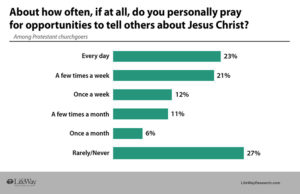 A majority of churchgoers (56 percent) say they pray for opportunities to tell others about Jesus at least once a week, with 23 percent praying for such moments every day.
 About two-thirds (65 percent) say they are satisfied with the state of discipleship and spiritual formation in their local church, while 78 percent indicate there’s room for improvement.
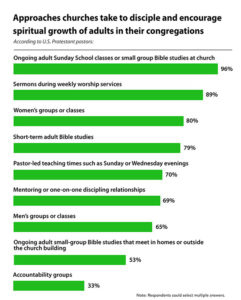 Churches use many approaches to disciple and encourage spiritual development in adults, the study found. On average, churches chose more than six of the nine approaches listed in the survey. Sunday School and ongoing small group Bible studies are the most common discipleship approaches followed by sermons, women’s groups and short-term Bible studies.
