PORTRUSH, United Kingdom (BP)—Success and Scottie Scheffler have become practically synonymous lately. Yet, it’s the world’s top-ranked golfer’s comments on what constitutes true meaning—and, more to the point, what doesn’t—that keeps grabbing attention.
Sheffler, a graduate of Highland Park High School and the University of Texas, cruised to a four-stroke win in The Open Championship with a 17-under performance.
The 29-year-old joins Tiger Woods, Jack Nicklaus and Gary Player as the only golfers to win The Masters, PGA Championship and The Open before turning 30.
He played with little pressure as the world’s No. 1. Perhaps because, as he told reporters on July 15, it’s just another tournament.
“If I win, it’s going to be awesome for about two minutes, and then we’re going to get to the next week and it’s going to be like: ‘Hey, you won two majors this year. How important is for you to win the FedEx Cup playoffs?” he said on July 15 of next month’s tournament in Memphis. “And just like that, we’re back here again.”
‘The highs are ephemeral’
Scheffler was clear in that pre-tournament press conference as well as the one July 20 that featured the Claret Jug to his side: He gets a tremendous amount of joy and satisfaction out of the sport. He has played literally since he was a toddler. However, it’s not where he gets his fulfillment.
George Schroeder—now pastor of First Baptist Church in Fairfield, spent nearly 30 years in sports media. That included stints as senior writer at USA Today and nine Associated Press Editor awards covering national college sports.
In his experience, it’s rare for athletes to have such moments, he said. Those admissions on the fleeting happiness with a win usually come in private conversations.
“The highs are ephemeral. And they’re not nearly as important as they—and we—so often make them out to be,” Schroeder said.
The overwhelming majority of the July 15 press conference addressed the course at Royal Portrush Golf Club in Northern Ireland and the upcoming tournament. The last questioner, however, asked Scheffler to comment on the longest he has celebrated something or to describe his most crushing loss.
Known for his Christian testimony, Scheffler’s thoughts came with a heavy tone out of Ecclesiastes and covered the final five minutes of the press conference.
“I love putting in the work. I love being able to practice. … I love the challenge. I love being able to play this game for a living. It’s one of the greatest joys of my life,” he said. “But does it fill the deepest wants and desires of my heart? Absolutely not.”
‘Family is my priority’
That comment brought an off-mic question: “What do you find fulfilling?”
Scheffler reaffirmed his love for playing golf and competing, but also the love of being a father and taking care of his wife and son, of being able to provide for them.
“Family is my priority,” he said. “If golf ever started affecting my home life … that’s going to be the last day I play out here for a living.”
A priority on faith has always been part of Scheffler’s career. Earlier in last week’s press conference he was asked about the books, particularly those on golf, he was currently reading. There’s a devotional he reads on his iPad, he said, alongside another “spiritual” book that’s “definitely not” about golf. Then there is his Bible.
On Sunday, he said again how his “greatest priorities” are faith and family.
“Golf is third. I’ve said it for a long time. Golf is not how I identify myself,” he said.
Scheffler’s message on the importance of family caught Nike’s eye, as shown in an ad that offered another definition of winning.
“It’s so refreshing that he values his family and specifically spoke of his desire to be a good father more than any and every success in golf,” Schroeder said.
“He clearly loves golf and winning. But having been to the top of the mountain, he’s recognized how unfulfilling that actually is, and how it pales in comparison to the joys of life with Christ, and as he talked about, life with his family.”
A way to bring glory to God
Schroeder went on to describe Scheffler’s self-evaluation in real time in front of reporters “a good, clean fight to have with oneself,” and one we should never back down from.
“Do I prize something else more than the treasure of Jesus? It’s like the parable Jesus told in Matthew 13. He has found a treasure in a field and he’d be willing to sell everything he’s achieved—the Claret Jug, green jacket, the No. 1 ranking—to have that treasure.”
Scheffler’s comments on enjoying the work he puts in every day also leaves something for believers to examine.
“It’s not drudgery for him, but a joy,” said Schroeder, who referenced Tim Keller’s book Every Good Endeavor, which connected practice, or work, to worship.
“It’s not compartmentalized away from his faith. It’s a way to bring glory to God,” he said. “I’m not talking about thanking and praising God when he wins a tournament, though he does, but more about seeing every day as a way to bring glory to God by striving for excellence in his work. We can and should do the same.”
As someone who has written about or commented on college sports most of his life, Schroeder has an eye on the high stakes leveled at athletes as young as 17 in the era of Name, Image and Likeness. The pressure has never been higher. Statements like Scheffler’s on what really matters are important for athletes, and fans, to remember.
“We so often see athletes as two-dimensional. Even those who don’t have Scheffler’s foundation of faith in Christ, or who haven’t achieved his level of success, struggle with recognition that even the highest level of achievement does not provide ultimate fulfillment,” he said. “Sadly, many know nothing beyond sports, or winning – and so they keep chasing those highs.
“As fans we need to recognize that our heroes are human. We’re so often so invested in our teams that we lose sight of that—or never see it to begin with. Win or lose, they’re quite often going through the same struggles as we are.
“If we see them through that lens—as people—we probably won’t direct so much adulation toward them when they win big, or vitriol when they don’t meet our expectations.”
Duo desires to help shape lives with Scripture songs
July 22, 2025
CEDAR HILL—While leading worship for children’s camps such as Mt. Lebanon Baptist Encampment in Cedar Hill, the husband-and-wife worship duo Dave and Jess Ray—otherwise known as “Doorpost Songs”—seek to influence the rising generation by developing Scripture-based songs and resources to help children easily remember key passages.
Their name is based on Deuteronomy 6, and their primary desire is to help families become rooted in Scripture through the songs they sing and teach their children. As the parents of three children, this is especially close to their hearts.
“Hearing the words of Scripture in the voices of children will never get old,” Dave Ray said. “What an incredible blessing to help create those moments.
“Doorpost Songs began almost by accident. At the first church we served, our children’s minister asked me to write a song for their fall memory verse. I wrote the song and actually liked it, and then I realized that we could do more.”
Ray wrote enough Scripture-based songs for an album, and then he gathered a group of instrumentalists to record the tracks and a children’s choir to sing them.
Fulfilling a sacred command
“Once the album was complete, we needed something to call it,” he said. “Because the focus was Scripture and family, we were immediately drawn to Deuteronomy 6: ‘And these words that I command you today shall be on your heart. You shall teach them diligently to your children. … You shall write them on the doorposts of your house and on your gates.’
“Ultimately, the purpose of these songs is to help God’s word become a part of our family life. It’s a way of fulfilling this sacred command.”
Dave and Jess Ray both have fond memories of growing up in church and crafting their musical skills at an early age.
Jess Ray played bluegrass and gospel music with her family, while also singing while playing the piano, mandolin and cello.
Dave Ray began learning to play the piano as a child, along with singing, and then he started playing the guitar at age 13.
Today, the duo leads worship for a variety of conferences, camps and family worship events around the country.
“We love getting to partner with churches to create fun worship nights that bring the whole family together,” Dave Ray said. “So often, each age group is separated on Sundays, and when we come together, not only can it be incredibly fun but also incredibly meaningful both for parents and kids.
“We also want kids and families to have a deeper love for God’s word. For many of us, God’s word is an afterthought when it should be our lifeblood.”
Encouraging parents to be spiritual leaders
The Rays want to encourage parents to fulfill their role as spiritual leaders.
“It’s not an easy role, but it’s such an important calling,” Dave Ray said. “We can trust that as we seek to faithfully live out God’s calling, he’ll be with us every step of the way.”
The inspiration for their songwriting process comes directly from reading Scripture passages and putting them to music. However, they admit it can sometimes be a challenging task.
“Most of the Bible was not written to be a song,” Dave Ray said. “It doesn’t have rhyme or meter or symmetry. Even the poetry in Scripture is different from the kind of poetry we use.
“So, a big part of the process is just sitting with a bunch of different verses and testing them musically: ‘Can we find a melody that fits the syllables? Are there rhyming words that we can figure out how to pair? And most importantly, will a kid love singing this?’”
Their ultimate goal is to create songs filled with rich, biblical truths that will help shape young hearts and minds with the gospel.
“Teaching our kids to be worshippers is one of our most important tasks,” Dave Ray said. “We spend so much time trying to get our kids to obey God and much less time teaching them to love God. But love for God is where true obedience comes from. If our kids are going to love God deeply, they must learn to be worshippers.”
Christian broadcasters ask listeners to support AM radio
July 22, 2025
(RNS)—Faith Radio President Scott Beigle’s quest for Christian radio started with 1070AM, a former CNN news station in Tallahassee, Fla.
After moving from northern Alabama to the Florida Panhandle with his wife and three kids, Beigle, who is Baptist, noted the lack of Christian radio stations in the area and felt compelled to change that.
Months later, on Oct. 6, 1997, that calling became a reality as the Faith Radio Network’s blend of evangelical Christian music and teachings hit the airwaves on 1070AM.
Nearly three decades later, the nonprofit network has grown to include 12 other Christian radio stations. Their flagship station, 1070AM, has been converted to a Spanish-language Christian station to meet the needs of Latino Christians in the region.
“There was no one doing that in our area,” Beigle told RNS.
But in recent years, the future of 1070AM has become uncertain, even as Beigle said its message has become more vital.
“A lot of them, especially now with the immigration and all, they’re scared,” Beigle said of 1070AM’s Spanish-speaking listeners. “
And we understand they’re scared to go out, but they’re not scared to listen—to turn that AM radio on to hear their language, and to hear how God can change their life.”
AM radio being phased out by automakers
In recent decades, AM radio, known especially for talk radio, has faded in popularity with the arrival of the clearer but more limited reach of FM signals, in addition to streaming and satellite radio.
A 2025 survey from Barna Group and the National Religious Broadcasters found listeners access Christian radio from multiple sources, with 68 percent saying they listen to FM stations, 57 percent a website or app, 38 percent satellite radio and 37 percent AM stations.
AM radio stations remain a smaller but consequential part of America’s radio landscape. The National Association of Broadcasters reports 80 million Americans still listen to AM radio each month on over 4,000 AM stations
However, AM radio now faces an existential threat: removal from cars. Citing dwindling audiences and technological clashes with electric vehicle equipment, automakers such as Ford, Volkswagen, Tesla and BMW have begun phasing out AM radio in some newer vehicles.
Advocating for AM radio
A diverse coalition of stakeholders linked with conservative talk shows, foreign language stations and religious broadcasters is teaming up in the halls of Congress, advocating to salvage AM radio’s spot on the nation’s dashboards, at least temporarily.
For many Christian stations, the legislative effort has spiritual stakes.
“We’re in the hope business—to see their lives changed,” Beigle said.
The AM Radio for Every Vehicle Act is the latest iteration of a bill that would require United States automakers to include AM receivers in new vehicles for the next 10 years.
Though the bill has already gained broad bipartisan support—with at least 218 co-sponsors of the House version and 61 of the Senate—the House version is still in committee, while the vote on the Senate version has yet to be scheduled.
“We have more than enough votes to pass it in the House right now, but to make it a priority in a moment where there’s just a whole lot of four- and five-alarm fires you have to put out, it’s hard to do something that’s more of a long-term concern,” said Mike Farris, legal counsel for the National Religious Broadcasters.
The NRB, a multimedia association founded by evangelical Christian broadcasters in the 1940s, has more than 120 AM stations among its members and has been one of several groups advocating for the legislation.
A public safety issue
Proponents of AM radio say the medium has long been a key source of emergency communication. The Federal Emergency Management Agency’s warning system relies on AM stations for emergency alerts, and local AM stations are known for distributing critical updates in a crisis—particularly in more rural areas, where AM is sometimes the only signal available.
Carolyn Cassidy, a regional general manager for Christian media conglomerate Salem Media Group, said her stations give AM listeners in Tampa, Fla., information on how to prepare for, ride out and recover from severe storms during hurricane season.
“It’s a First Amendment issue, it’s a religious issue, but it’s also a public safety issue, because AM radio is the backbone of the Emergency Alert System,” said Nic Anderson, vice president of government affairs for Salem.
Anderson fears excluding AM radio from cars is a move toward giving automakers control over what drivers can listen to.
Known for promoting Christian and conservative values, Salem Media Group owns and operates roughly 80 stations, 84 percent of which fall on AM, Anderson said. The group also has about 3,000 affiliate stations that are owned locally but carry Salem programs—and of those, 900 are AM stations.
PSAs tout value of AM radio
In addition to advocating on Capitol Hill, Salem has been raising awareness among listeners by distributing prerecorded, pro-AM radio public service announcements from evangelical Christian leaders and influencers such as Focus on the Family President Jim Daly and Turning Point USA founder Charlie Kirk.
“For generations, AM radio has brought the hope of the gospel, biblical teaching and encouragement right into our homes and cars, especially in times of crisis,” Kirk said in one of the announcements.
“But now, some automakers want to eliminate AM radio from new vehicles. Let’s stand together and protect this ministry lifeline.”
Broadcasters say one reason Christian stations are especially available in the AM format is because it’s a more affordable option than FM, making it more accessible to smaller, niche stations of all stripes, including farming and foreign language stations.
“AM allows for certain formats that can’t command the bigger dollars from agencies. They have more of a local appeal,” said Orlando Boyd, general manager of The Gospel Nashville, which offers a mix of music and talk shows that cater to Christian audiences.
“It’s really to get that foot in the door … for people trying to break into the radio business.”
Boyd said The Gospel Nashville began as an AM station and later added an FM translator, which “piggybacks” on the AM station to play the same content on an FM frequency.
But the AM station is still a key part of the branding and reach. It’s vital, he said, for listeners in remote settings and is often the first choice for those over age 40.
Sheila Brown, who owns two AM radio stations—WUFO (1080AM) in Buffalo, N.Y., and WIGO (1570 AM) in Atlanta—said listeners on the east side of Buffalo and the south side of Atlanta especially depend on these stations’ unique blend of R&B, gospel and talk shows to reflect their interests and experiences.
“We’re running our own narrative when it comes to our talk shows, our music, our format. No one else in either city has the formats that we have,” Brown said.
Brown started her career in an entry-level position at WUFO in 1986 and worked her way up to become owner and CEO in 2013. She went on to purchase WIGO in 2022.
While WUFO in Buffalo has since added a translator to air its content on an FM signal, WIGO in Atlanta is a standalone AM station.
Brown’s stations feature daily gospel music and sermon segments, and on Sundays, they play religious content all day. That’s why for the lifelong member of Pilgrim Missionary Baptist Church in Buffalo, the fight for AM radio is a matter of faith.
“You have so many people that are sick and shut in, who can’t get out to their churches like they used to,” Brown said. “But when they turn to us, they’ll get the same singing, ministry, preaching that they would if they would be at their church.”
Program reduces barriers to theological education
July 22, 2025
A network of Ascent-related seminaries, including Baylor University’s Truett Theological Seminary, will launch a pilot program this fall hoping to open the door to theological education to a cohort of students for whom “taking the first step” has been an obstacle.
Ascent is a newer cooperative missions movement comprised of theologically centrist congregations of varying denominational backgrounds, several of which are BGCT-cooperating churches.
The group’s First Seminary Initiative will utilize a graduate theological education exchange model, offering up to 18 credits—six courses—of graduate-level courses over the course of a year.
“It’s a pilot program to try and mobilize more people toward theological education,” Ascent senior director Chris Backert explained.
“One of our statements or axioms about this is that the church in North America needs more theological education, not less,” he said. “It just needs to be delivered differently.”
The classes, digitally distributed, are the same courses generally offered during the first year of theological studies in traditional campus-based seminaries, Truett Dean Todd Still explained.
A sampling of seminaries
He said teaching responsibilities will be shared among professors from Truett Seminary; Winebrenner Theological Seminary in Ohio, associated with the Churches of God denomination; Northern Seminary in Illinois, historically American Baptist; and Missio Seminary in Pennsylvania, which in addition to its Philadelphia campus cooperates to offer theological education digitally through Kairos Seminary. Kairos opened an extension campus through San Antonio Baptist Association last year.
All of the participating institutions are Association of Theological Schools accredited, and all will accept coursework completed through the program toward a degree at their respective seminaries, offering students a chance to sample a variety of seminaries to determine which is best suited to complete their studies, Backert explained.
A student is not obligated to continue studies at any of the institutions, but these courses taught by these professors will give a good sense of what each school offers, he noted.
Still said Truett’s contribution will be Introduction to Christian Mission and Witness, taught by Truett’s longest-tenured professor, Mike Stroope.
Prospective students will apply to the pilot program and take as few or as many of the courses, offered in mini terms, as they are interested in taking at the affordable cost of $300 per month. That cost is intended to get people “off of a zero, and into a ‘yes’” to pursuing theological education, Backert said.
Then, at the Ascent summit next March 10-12, “there will be a convening of everyone” who participated.
Still noted, of the participating institutions, only Truett Seminary offers primarily an in-residence university-based seminary. The other three schools offer degrees that could be completed virtually. Truett offers one digitally distributed degree, the Master of Arts in Theology and Sports Studies.
The seminary is trending in a positive direction, he said, with more Baptists in-residence pursuing a Master of Divinity degree. Enrollment is trending toward a record number of students this fall, he added.
The challenge, Still noted, for theological schools is “to innovate, without forgetting the thing that you’ve done best since the beginning,” which for Truett has been and continues to be the Mastery of Divinity degree, he said.
While Ascent hopes to see the seminary network grow to include other schools, Still said, “it’s the start that stops most from beginning seminary.”
The Ascent related seminaries don’t want “the ideal, or the perfect, be the enemy of the good.”
So they asked themselves, “How can you create something that is accessible, something that is affordable, something that is flexible, so that students” through the one-year pilot program can take a step into theological education.
They decided to offer two classes in the fall, two classes in the winter and two in the late spring, early summer.
“We’re playing a small part in something that is larger than we,” Still said. “The idea is that as you take these courses, we will be an option among other options.”
He noted Dennis Wiles, pastor of First Baptist Church in Arlington and several other Texas Baptists pastors and congregations have strong buy-in to the Ascent movement.
“We feel like we’re serving in concert with our primary constituency, Texas Baptists,” Still said, but Truett also has much in common with Virginia Baptists, who helped launch Ascent.
So, participating in the program to offer to students “a taste” of several schools, seemed a good opportunity to try, he said.
“That’s why we’re calling it a pilot,” he said, noting none of the participating schools has “any grand ideas” about where the program will lead.
The classes do not constitute a micro-degree of any sort. They are a “suite of standalone courses” that can go toward a degree.
Stepping into theological education
“We’re trying to get people interested in theological education,” he said.
Many churches have said seminary is optional or that it isn’t needed anymore, Still observed.
“What we’re saying is a call to ministry is a call to prepare for ministry, and this is the next faithful step,” he said.
Still acknowledged this program is one pathway to theological training among many and emphasized they “are piloting it to see if it really is viable.”
The initiative represents “a good faith attempt to do something together” with the great hope it will “introduce people who sense both interest and call to theological education, so that they can begin the journey.”
Backert added: “Our main heart is we’re trying to propel people to say: ‘OK, I can take a jump into seminary education. It’s affordable. It’s accessible, and still quality.’”
So, the students can feel good about deciding where they’re going at the end of the year.
“The journey begins with a single step,” Still noted. “We’re eager to see if there are some students out there who might think this is a suitable and doable way to start.”
‘Lift Every Voice and Sing’ celebrates 125 years
July 22, 2025
WASHINGTON (RNS)—“Lift Every Voice and Sing” is a hymn many African Americans of older generations just know.
They’d sung it in church, learned it in school and stood for what is dubbed the unofficial Black national anthem just like they might for “The Star-Spangled Banner.”
“Lift every voice and sing/’Til earth and heaven ring/Ring with the harmonies of Liberty,” it begins.
“Let our rejoicing rise/High as the list’ning skies/Let it resound loud as the rolling sea.”
Courtney-Savali Andrews, an assistant professor at Oberlin College’s Conservatory of Music in Northeast Ohio, was born in the mid-1970s in Seattle, where the song—which turns 125 years old this year—was a staple at her Baptist church and in the wider Black community.
Pastor Ovella Davis of Always in Jesus’ Presence Ministries in Detroit presented a workshop on the Hammond organ during a symposium on “Lift Every Voice and Sing” at the Museum of the Bible on June 12. (RNS Photo / Adelle M. Banks)
“It was impressed upon me, particularly from the ministers of music and the pastor, that not only did I have to sing the song with a full-heartedness, I also had to memorize all of the words,” she recalled in mid-June at the Museum of the Bible in Washington, D.C.
“And so, it was one of those items that you did not want to be caught, specifically by your peers, looking into the hymnal.”
Andrews, who studies African American and African diasporic music, was one of a dozen speakers at a daylong symposium on “Lift Every Voice and Sing,” on June 12 at the museum.
Background of the song
The song first was publicly by a group of 500 Black schoolchildren in 1900 in Jacksonville, Fla., to commemorate the birthday of President Abraham Lincoln.
Its words were written by educator and civil rights activist James Weldon Johnson for the occasion, and his brother, J. Rosamond Johnson, set them to music.
“They both saw artistic and cultural excellence as a major key to Black advancement in America,” said Theodore Thorpe III, a Virginia church musician and high school choral director, and the symposium’s keynote speaker.
“The hymn continued to resonate and reverberate, even beyond the expectations of the Johnson brothers.”
In its early years, it was pasted on the back of hymnals, Bibles and schoolbooks and was sung regularly at NAACP and other organizational gatherings.
Words from its second stanza were recited in the benediction of President Barack Obama’s first inauguration in 2009, and in the sermon at the inaugural prayer service the next day: “God of our weary years/God of our silent tears,/Thou who has brought us thus far on the way.”
During his remarks, Thorpe ticked off a range of artists who have recorded versions—some known for gospel music and some not—Ray Charles, Aretha Franklin, Alicia Keys and Mary Mary.
“‘Lift Every Voice and Sing’ remains one of the most powerful symbols of the Civil Rights Movement,” he said. “It is featured in over 40 different Christian hymnals and sung in churches all across America, not just during Black History Month or Juneteenth.”
The Howard University Gospel Choir performs during the Lift Every Voice and Sing event. (RNS Photo / Adelle M. Banks)
Anthem presentations
Over the course of the day and evening, some 200 audience members heard the song performed by a wind ensemble, sung in an array of arrangements by choirs, played on the Hammond B-3 organ and featured in a spoken-word performance.
“It resonates not only in different genres, but it resonates in even different generations,” said Bobby Duke, the museum’s chief curatorial officer, in an interview.
“We have seen people that are very much senior citizens, when they heard the Duke Ellington (School of the Arts) choir start singing, they stood. We see college students and then even students that are still in secondary school singing this.”
Duke collaborated with Bishop David D. Daniels III, a scholar of historical African and Black Pentecostal contributions to Christianity, who envisioned the symposium before his death on Oct. 10, 2024.
The event—dedicated in memory of Daniels—received funding from the Phos Foundation, which is co-directed by Virginia Gov. Glenn Youngkin and his wife, Suzanne.
The Washington Performing Arts Children of the Gospel Choir was one of several choirs to perform as part of the event. (RNS Photo / Adelle M. Banks)
The symposium featured discussions of the three-stanza text—often all three are sung in churches and performances—and the music that accompanies it.
Words of ‘hope and lament’
Religious leaders and scholars, including Joy Moore, president of Northern Seminary outside of Chicago, discussed its words of hope and of lament.
“The text of this song doesn’t just say, as African Americans, we are in pain,” she said. “But it says, from this experience of pain, we hold this hope passed down to us, and we pass it on so that we are faithful to who we are and to the God who has created us and called us and not given up on us.”
One audience member, E. Daryl Duff, a retired Navy musician, described an instance where the song was not accepted by a white member of a chorus he directed at Fort Belvoir in Virginia.
“She was a solid choir member until February, when I would program this song, ‘Lift Every Voice and Sing,’ and she saw it as a divisive song,” Duff, who is Black, told the panelists.
“How do we as a people—Black, white, Jewish, Chinese, Japanese—make this song ubiquitous, which I believe that’s what God wants?”
Chelle Stearns, a white professor at Seattle School of Theology & Psychology and a symposium panelist, said in response: “Two words come to mind: curiosity and friendship. And I think we need a lot more of that.”
Journalist Kevin Sack, author of a new book about Mother Emanuel African Methodist Episcopal Church in Charleston, S.C.—where nine church members, including their pastor, were murdered by a white supremacist in 2015—wrote about being moved by two particular lines of the song.
Back in 2019, he stood next to a septuagenarian church member, whose eyes filled with tears as congregants sang: “We have come over a way that with tears has been watered/We have come, treading our path through the blood of the slaughtered.”
“It just blew me away at how directly relevant it was to what had happened, literally one floor below where we’re standing,” Sack recalled in an interview with Religion News Service the day after the symposium.
Kevin Sack. (Photo courtesy of Sack)
Sack, who is Jewish and has spent many Sundays at Mother Emanuel, said he considers the song the nation’s best anthem.
“I give the Johnsons credit, because obviously I don’t know that it was their intent, but I do think that it is a piece of music that communicates powerfully to white listeners as well as to Black listeners,” Sack said.
Symposium organizers and participants noted their desire for the anthem to continue to bridge ages as well as races.
“It’s transferable to not only many genres, but it’s transferable to the generations,” said Stephen Michael Newby, a music professor at Baylor University in Waco, pointing to the popular concert version of the anthem arranged by musician Roland Carter and performed across Europe and America, including by the Duke Ellington high schoolers at the symposium.
Prince Francis, 13, sang with the Washington Performing Arts Children of the Gospel Choir during the event. (RNS Photo / Adelle M. Banks)
Prince Francis, 13, a member of the Washington Performing Arts Children of the Gospel Choir, which sang a gospel-style version, agreed.
After the event, he said he liked the “powerful meaning” of the song.
“To me, when it says, “Lift every voice and sing ’til earth and heaven ring,’” he said, “you want people to sing with you and come together.”
Many churchgoers participate in more than one
July 22, 2025
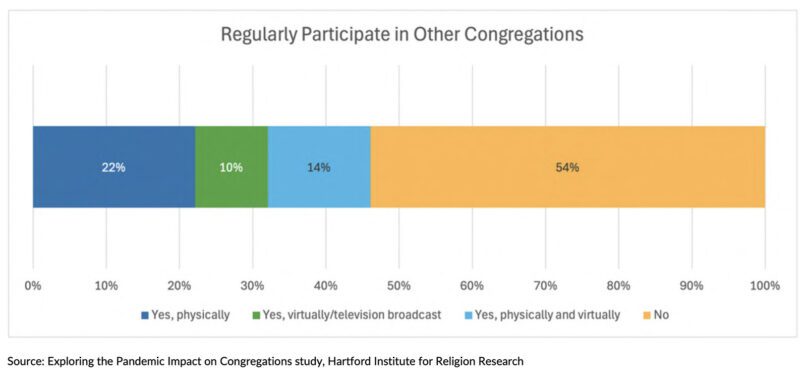
(RNS)—Five years after the start of the COVID-19 pandemic, almost half of churchgoers are regular participants in congregations other than their primary one, either attending in person, watching online or on TV, or taking part in both physical and virtual offerings.
Researchers for the multiyear Hartford Institute for Religion Research study found 46 percent of about 24,000 churchgoers responding to their survey reported active engagement with more than one church.
Engaging in other congregations did not prevent these churchgoers from giving and volunteering at the primary church in their lives, said Scott Thumma, principal investigator of the Exploring the Pandemic Impact on Congregations study.
“(P)articipating in multiple services regularly did not detract from one’s commitment to one’s home church,” he said. “Rather, it was as if these highly committed religious persons wanted/needed more spiritual sustenance than their one church provided and sought out this nourishment elsewhere while remaining as involved in their home church.”
Of the tens of thousands surveyed, half were evangelical Protestant (50 percent), one-third were Catholic or Orthodox (32 percent), and 18 percent were mainline Protestant. About 7 in 10 worship at churches with 250 or more attendees (71 percent), the majority attend churches that offer online services (85 percent), and one-fifth are part of multiracial congregations (19 percent).
“Regularly Particpate in Other Congregations” (Graphic courtesy HIRR via RNS)
Project researchers, who have previously surveyed congregational leaders, said the most recent research, released June 16, looks at the behaviors and attitudes of those most likely to be attending church.
“From the perspective of the 24,000 church attenders we surveyed, the picture that emerges is largely positive,” reads the introduction to the 36-page report, “This Place Means Everything to Me: Key Findings from a National Survey of Church Attenders in Post-Pandemic United States.”
“Many more respondents said their religious faith and spirituality had strengthened since the pandemic. Likewise, financial giving has increased, as has involvement and volunteering,” according to the report.
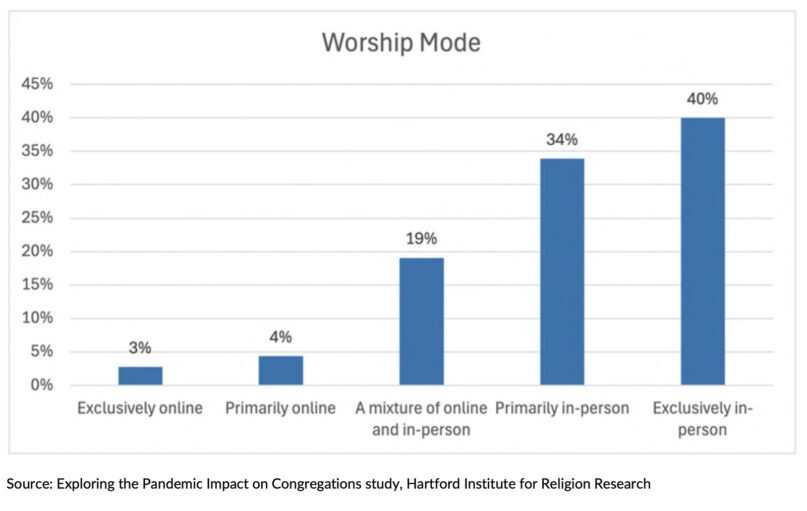
Researchers found 3 out of 4 churchgoers say they take part in worship services primarily or exclusively in person. About one-fifth (19 percent) say they attend a mixture of online and in-person services, and 7 percent say they exclusively or primarily attend online.
“Worship Mode” (Graphic courtesy HIRR via RNS)
“When comparing the respondents who attend in person with those who tune in virtually, the former are more likely to volunteer with the congregation, attend more frequently, and have more close friends in the congregation,” the report reads.
While evangelical church attenders were more likely than people in other faith groups to be virtual participants, Black church participants were less likely than those of other races to attend in person.
Catholic and Orthodox churchgoers were much more likely to opt for in-person attendance, with the centrality of the weekly Eucharistic ritual a likely factor.
About two-thirds (64 percent) of online worshippers acknowledged they multitask while watching or listening to services, but almost all (95 percent) say they pray or meditate during the service and most read or sing along (79 percent and 71 percent, respectively) with in-person congregants.
“What Online Worshippers Do During the Service” (Graphic courtesy HIRR via RNS)
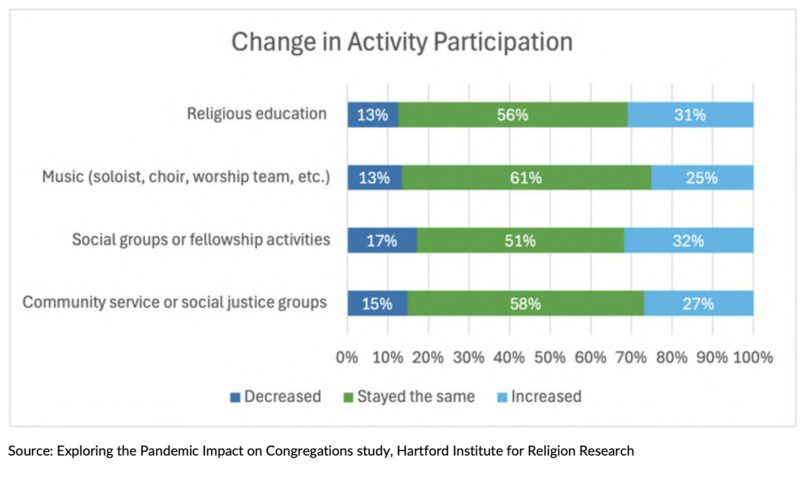
Overall, besides worship services, participation in other religious activities and programs—such as religious education, music, social groups or fellowship activities—has increased or remained the same in the last five years.
A majority maintained their engagement level in the wake of the pandemic, while 25 percent to 32 percent of respondents increased their participation and 13 percent to 17 percent have decreased.
Evangelical church attenders reported high attendance in most of the programs except community service, an activity in which mainline church congregants were more likely to note increased participation.
Black church attenders reported higher levels of participation in all the activities than congregants at other churches.
Although Black church attenders are less likely to worship in person, this subgroup of congregants is nevertheless among those who have considerable small group participation.
A sizable percentage—38 percent—of respondents said they had started attending their current church within the last five years.
“Interestingly, among the new attenders in the survey, 22 percent report not having attended a congregation for years and 8 percent indicate they never participated in a congregation before the one they currently attend,” the report notes.
“This combined 31 percent of new attendees represent former religious ‘nones’ or congregational converts who are embracing organized religion for the very first time in their lives or returners who have been ‘re-churched’ after a lapse in participation.”
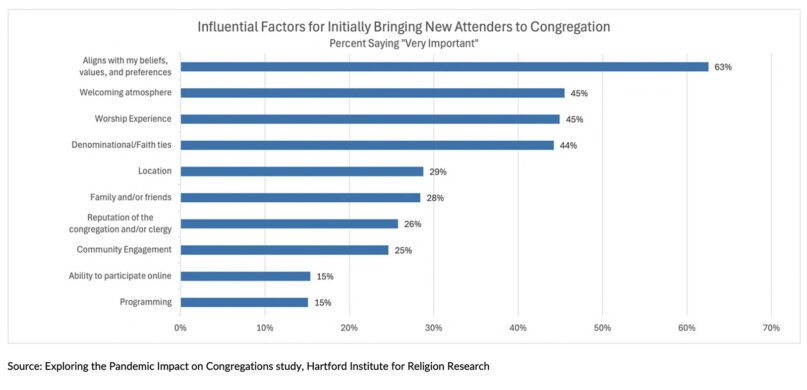
“Influential Factors for Initially Bringing New Attenders to Congregation” (Graphic courtesy HIRR via RNS)
By far, the most influential factor that drew new congregants to a church was an alignment with their values, beliefs and preferences (63 percent). More than 4 in 10 cited a welcoming atmosphere (45 percent), the worship experience (45 percent) and the denominational/faith ties (44 percent).
Almost two-thirds (61 percent) of those surveyed were women, 73 percent were white and 10 percent were immigrants (and 27 percent were children of immigrants).
Thumma cautioned that the survey results likely paint a rosier picture because they are based on the views of active participants.
A survey of church leaders, he said, may offer a broader sense of the state of a congregation, including the very committed members and people who are less so. He also noted five years past the start of the pandemic, churchgoing patterns—from attendance to giving to religious education—continue to shift.
“So far, no two surveys we have done record a static ‘back to normal’ reality has been established,” he said in an email to Religion News Service.
“Things are still in flux. The impact of the pandemic on congregational life has a long tail of influence.”
The findings are from a survey of a total of 24,165 adults representing more than 80 denominations, with an overall margin of error of plus or minus 0.6 percentage points.
They were based on responses from congregations requested by the Faith Communities Today partnership (12,658) and supplemented by responses to two other panels, Survey Monkey Audience (2,784) and Prolific (8,723).
“Change in Activity Participation” (Graphic courtesy HIRR via RNS)
Respondents from the latter two sources were selected and screened based on church attendance of at least a few times a year, not counting funerals or weddings.
Christian musician Michael Tait admits to ‘double life’
July 22, 2025
(RNS)—Days after an investigation revealed allegations of sexual assault against Christian musician Michael Tait, the former Newsboys frontman publicly admitted to abusing cocaine and alcohol and touching men “in an unwanted sensual way.”
“I am ashamed of my life choices and actions, and make no excuses for them,” Tait wrote in an Instagram post June 10. “I will simply call it what God calls it—sin. … While I might dispute certain details in the accusations against me, I do not dispute the substance of them.”
Last week, The Roys Report reported three men Tait met in the Christian music industry between 2004 and 2014 accused him of substance abuse and sexual assault. RNS was unable to reach the alleged victims, who were given anonymity in the Roys article.
Known for performing on Christian music hits such as DC Talk’s “Jesus Freak” (1996) and Newsboys’ “God’s Not Dead” (2011), Tait has been a mainstay of the contemporary Christian music world since the 1990s.
He was a founding member of the Grammy Award-winning Christian rock trio DC Talk and later became the lead singer of Christian rock band Newsboys in 2009, before abruptly leaving in January.
Tait admitted in his Instagram post that he was largely “living two distinctly different lives” and said he left Newsboys because he was “tired of leading a double life.”
“I am truly sorry,” Tait wrote. “It is my hope and prayer that all those I have hurt will receive healing, mercy and hope from the Merciful Healer and Hope-Giver.”
He said he is now sober after spending six weeks at a treatment center in Utah.
“I accept the consequences of my sin and am committed to continuing the hard work of repentance and healing-work I will do quietly and privately, away from the stage and spotlight,” he wrote.
After the allegations against Tait, current Newsboys members Jody Davis, Duncan Phillips, Jeff Frankenstein and Adam Agee said in a statement to RNS they were “devastated” by the implications.
“We are horrified, heartbroken and angry at this report and in many ways, we feel as if we and our families have been deceived for the last 15 years,” they wrote in their June 5 statement. “When he left the band in January, Michael confessed to us and our management that he ‘had been living a double-life’ but we never imagined that it could be this bad.”
America’s largest Christian radio network, K-LOVE, has since pulled DC Talk and Newsboys from its music rotation for the time being, according to a statement to The Roys Report.
“As the investigation proceeds, our prayers are with all those involved,” a spokesperson wrote. “In the meantime, our programming team is resting Newsboys and DC Talk music on our stream.”
Walter Brueggemann, influential biblical scholar, dies at 92
July 22, 2025
(RNS)—Walter Brueggemann, one of the most widely respected Bible scholars of the past century, died June 5 at his home in Michigan. He was 92.
The author of more than 100 books of theology and biblical criticism, Brueggemann was professor emeritus of Old Testament studies at Columbia Theological Seminary in Decatur, Ga., until his retirement in 2003.
His specialty was the Hebrew Bible and especially the Hebrew prophets, and his books were aimed primarily at clergy and church leaders. But through sermons, Brueggemann’s concepts have become familiar to many churchgoers.
Though ordained, Brueggemann never served as a pastor of his own church. He was, however, a much sought after and eloquent preacher and lecturer.
“He had an incredible way to discern what was happening in the world and the church and to speak into that with a much-needed word,” said Conrad L. Kanagy, professor emeritus at Elizabethtown College in Pennsylvania, who wrote a biography of Brueggemann and edited some of his books.
‘Keep alive the ministry of imagination’
Brueggemann’s books were broadly influential, especially in mainline Protestant circles. His 1978 The Prophetic Imagination sold more than a million copies and remains a classic that is still frequently assigned in mainline seminaries.
In the book, he showed how the biblical prophets, called to imagine a different world, disrupted politics and the dominant culture and its assumptions.
Brueggemann himself was critical of American consumerism, militarism and nationalism.
“It is the vocation of the prophet to keep alive the ministry of imagination, to keep on conjuring and proposing future alternatives to the single one the king wants to urge as the only thinkable one,” he wrote.
Brueggemann was text-focused but resisted the dominant modes of biblical interpretation because they put distance between the reader and the text. He sought to help pastors hear God’s voice within the biblical text.
Brueggemann was born in Tilden, Neb., in 1933. His father, a pastor in the German Evangelical Synod of North America, ordained him. He and his brother, Ed, grew up in Blackburn, Mo.
As a teenager, Brueggemann and his brother visited a Black church on the edge of town. It later influenced his commitment to social justice.
His academic journey began at Elmhurst College (now University), in Elmhurst, Ill. He went on to study at Eden Theological Seminary and Union Theological Seminary. He received a Ph.D. in education from St. Louis University, while teaching at Eden Theological Seminary in St. Louis. He left Eden for Columbia Theological Seminary, a Presbyterian school, in 1986.
Brueggemann, however, remained an active minister in the United Church of Christ. He was a frequent speaker at its conferences as well as a mentor to countless church leaders.
He is survived by his wife, Tia, and by his sons James and John and their families.
Seminaries innovate and adapt to changing landscape
July 22, 2025
PRINCETON, N.J. (RNS)—An audience sat enraptured in Princeton Theological Seminary’s dining hall as, one by one, adults in their 20s walked up to a platform, took the microphone and shared a story.
“I realized that if God made our bodies this intricate, shouldn’t the care we give others be just as intricate?” Jewel Koshy asked.
“I allowed Jesus to look at me, and I looked at him, and my life was completely transformed,” Betty Freymann said.
“How can we stay inquisitive in a world where excellence is expected and assimilation is often rewarded?” Ray’Chel Wilson asked. “For me, I take my questions to God.”
Despite the setting, the young adults speaking weren’t seminarians. They were entrepreneurs, nonprofit leaders, health care workers and other professionals.
The summit they attended was part of the Polaris Young Adult Leadership Network, a new initiative from Princeton Theological Seminary that aims to equip young Christian leaders to find their calling beyond parish ministry.
“If you lead in the public sector, if you are an artist or a business leader or an educator, and you’re deeply motivated by your Christian faith, we think theological education has something to offer there as well,” said Shari Oosting, project director of the Polaris Network.
In recent years, many U.S. seminaries have faced existential threats fueled by the COVID-19 pandemic and a changing religious landscape. As organized religion continues to fade in popularity among many Gen Z, some seminaries are downsizing, combining and embracing online and hybrid models.
B.H. Carroll Theological Seminary, now part of East Texas Baptist University, was an early adopter of an online model of theological instruction.
“We exist to serve Christ and his church through the worldwide provision of affordable, high-quality, accessible and accredited theological education,” the seminary’s purpose statement says.
“Wherever there is Internet access, there is a classroom. Whether global or local, we equip students through the teaching of dedicated professors who are academically well-qualified, experienced in the diverse ministries of the church and missions-minded.”
Serving ‘alongside’ the church
Seminaries also are evolving, offering different certificate programs or degrees tailored for nonclergy students. Some seminaries target retired or second-career students. Others refuse to give up on young adults, instead designing programs to help them live out their spirituality beyond seminary walls.
Todd Still (Baylor Photo)
Todd Still, dean of Baylor University’s Truett Theological Seminary, points to his institution’s mission statement: “To equip God-called men and women for gospel ministry in and alongside Christ’s church by the power of the Holy Spirit.”
“The ‘alongside’ language communicates our school’s concern and commitment to prepare people who will serve with the church and not only in the church,” Still said.
For students “who have the time, space and finances to do a dual degree,” Truett Seminary offers a Master of Divinity degree in conjunction with a Master of Social Work, Master of Business Administration, Master of Education, Master of Music or Juris Doctor degree from Baylor.
At the other end of the spectrum in terms of a commitment of time and money, Truett Seminary offers an online certificate program as an alternative “when Sunday school isn’t quite enough, but a Master of Divinity isn’t the right fit,” the school’s website explains.
Seeking to shape Christian leaders
Freymann, 28, a Dallas-based tech consulting manager and a participant at the Polaris summit, said meeting other Christians doing “the Lord’s work” in the secular world has made her feel less alone.
“I love that we’re pushing to form Christian leaders. Not Catholic, not Presbyterian, not Episcopal leaders, but Christian leaders,” said Freymann, who is Catholic and hosts a Spanish-language podcast for Latino Catholics.
Freymann gathered in the seminary’s library with roughly 30 other young adults. The room was abuzz as participants responded to discussion prompts, wove strands of yarn for an interactive art project and heard a lecture about the church in the modern world.
Throughout the summit, each shared eight-minute personal stories about Christian leadership in groups or at the final storytelling festival.
Kennedy Maye at the Polaris Leadership Summit in early April 2025, in Princeton, N.J. (RNS photo/Kathryn Post)
“Something that really stood out to me is the fact that everyone is a young adult,” said participant Kennedy Maye, a 22-year-old psychology major at the University of Kentucky.
Raised as a nondenominational Christian, she often discusses God with other young adults in her life but said she often finds herself “defending God.” Here, it was different.
Launched in 2023 with a $4 million grant from the Lilly Endowment, the Polaris Young Adult Leadership Network convenes these cohorts while also offering sub-grants to fund their local ministry efforts and provide workshops on topics like mental health, vocational discernment and sustainability.
The aim is to combat isolation among young Christian leaders and counteract the narrative that all young people are losing their faith.
“In a lot of ways, these young people are teaching us how to be a seminary for the next generation,” said Kenda Creasy Dean, the Mary D. Synnott professor of youth, church and culture at Princeton Theological Seminary and one of the architects of Polaris.
Built to train pastors, many seminaries like Princeton are increasingly welcoming students looking to discern their calling rather than intending to work at a congregation. Dean said she has observed pastoral credentials don’t have the draw they used to for students, which is mirrored in trends at the seminary.
Offering a variety of Master of Arts degrees
Enrollment in its Master of Divinity program—a prerequisite for many seeking ordination—has declined in recent years, down to 155 students in the 2024-2025 school year, from 245 students in 2020-2021.
However, Princeton’s master’s programs for leaders interested in theology/sustainability and in justice/public life have grown steadily since being launched in 2023. The seminary also has seen growth in part-time, hybrid and online offerings. And this year, it saw the largest incoming class of degree-pursuing students in the last five years.
According to data from the Association of Theological Schools, an umbrella group of more than 270 schools, Princeton isn’t alone.
Enrollment in Master of Divinity programs continues to decline among ATS member schools, down roughly 14 percent since 2020.
Baylor University’s Truett Theological Seminary (Baylor University Photo)
However, that dip has been offset by boosts in two-year, often customizable Master of Arts programs and nondegree enrollment, leading to an overall 1.8 percent increase in enrollment at ATS schools since 2020.
Still noted Master of Divinity degree enrollment at Truett Seminary has declined somewhat, but enrollment in the seminary’s Master of Arts in Christian Ministry and Master of Theological Studies programs is increasing.
“These are shorter degrees,” he explained. “While the MTS is a general theological/biblical degree, the MACM remains decidedly focused on churchly ministry.”
Truett Seminary offers several other Master of Arts degrees designed for students who plan to serve “alongside” the church. Degrees focus on the intersections of theology with health care, sports studies, contextual witness and innovation, ecology and food justice.
Emphasis on affordability and accessibility
Truett Seminary has seen its overall enrollment increase in recent years due in large part to its emphasis on affordability and accessibility, Still said.
“We work intentionally and painstakingly to raise as much scholarship funding as we possibly can in order to drive down the tuition price-point. We are seeking to find the golden mean of students to train and scholarships to offer,” he said.
“Some schools have students but little financial support. Other schools have strong finances but few students to educate. We are striving to have both.”
To make theological education more accessible, in addition to its home campus in Waco, Truett Seminary opened additional instructional sites in Houston and San Antonio.
Its Doctor of Ministry degree program not only meets in those three locations, but also in Amarillo and in Falls Church, Va., at the Baptist World Alliance headquarters.
Some seminaries are facing significant challenges. Trinity Evangelical Divinity School, an influential Evangelical Free Church school near Chicago, announced last month it will be acquired by a Canadian university and move to British Columbia.
Making a transformative impact
Despite financial setbacks, the school has had a transformative impact on the nearby city of Waukegan, Ill., thanks to a young adult-centered program called Mosaic Ministries.
Young adults participate in a Bible study at the Mosaic Hub on July 26, 2023, in North Chicago. (Photo courtesy Mosaic Ministries)
Mosaic Ministries began praying with and building relationships with Waukegan churches in 2010. With the help of the Lilly Endowment, it became a formal collaboration of 12 churches in 2017, with the purpose of developing ministries with young adults.
By listening to what young people asked for—space to ask hard questions and do life together, not just host another barbecue, for example—churches adapted.
“As the years went by, our churches grew healthier, they grew more intergenerational, they grew more missional, and this collaboration of churches shifted from individual churches to a network,” said Daniel Hartman, co-director of Mosaic Ministries at Trinity Evangelical Divinity School.
In 2022, that network came together to form Refined, a program for young adults from each of the 12 churches. Across 18 months, the young adults received mentoring, attended retreats and became involved in Waukegan-based community projects.
Though Adi Camacho grew up attending a Baptist church in Waukegan, she joined Refined after several years away from the church.
“It was my first time getting to meet brothers and sisters who were not from my congregation that could hear my heart and be there for me and love and support me in such a godly way,” Camacho said. “We were able to break barriers between our churches.”
Camacho hosts a podcast about Mosaic Ministries’ impact and pitches the program at citywide events like cleanup days, toy drives or prayer services. The city routinely looks to Mosaic to meet local needs, and Mosaic’s hub, a revamped former library, is a gathering place designed to welcome young people who might be hesitant to meet at church, said Hartman.
It’s not yet clear how Mosaic Ministries will be impacted by the seminary’s move. However, Mosaic and similar innovative seminary initiatives take a unique approach to empowering young people in their own contexts, without trying to convince them to enroll as students.
Experimenting and innovating
For example, Austin Presbyterian Theological Seminary has created programming for both Christian and “Christ curious” young adults.
“There are all kinds of places where young adults gather at the edges of Christian conversation,” said Melissa Wiginton, vice president for strategic engagement and partnerships at the Austin seminary.
“We know that there is a longing out there for people to be connected to something that’s sturdy enough to hold them, but not so rigid that it encages them.”
Since 2017, the seminary, also with the help of the Lilly Endowment, has created such spaces via its 787 Initiative, which offers faith and community engagement for young people in Austin.
Mercedes Collins, who runs a recreational club, We Outside ATX, for Austin’s Black community, provides input for 787’s advisory council. She said young people in her network are craving spaces where their voices are heard.
“Community is a spiritual thing, right?” said Collins, who identifies as more spiritual than religious. “We’re not meant to be here alone.”
787 was a precursor to the seminary’s Austin Story Project, which launched in January and will offer an in-person storytelling cohort and spiritual pilgrimages for young adults. The first pilgrimage will focus on nonviolence, where participants will visit sites connected with nuclear weapon production in the Pacific Northwest. A survivor of the bombing of Hiroshima will accompany them.
“Everybody’s in a massive period of experimentation,” said Dean, of Princeton Theological Seminary. “Desperation is a spiritual gift, and so it gives you a chance to experiment with things that, you know, 10 years ago were off the table. That’s happening everywhere, and we are no different in that.”
Still likewise emphasized the importance of continuing to try new approaches.
“The bottom line is this: those who are willing and able to collaborate and innovate in theological education will likely be able to weather the storm longer and to navigate the headwinds better than those who are not,” he said.
With additional reporting by Managing Editor Ken Camp.
MLK comic book still serves as nonviolence teaching tool
July 22, 2025
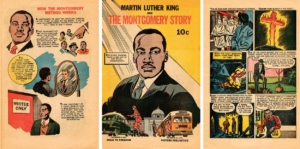
(RNS)—At cross-cultural gatherings in Bethlehem, West Bank, groups of children and adults turn to a 67-year-old, colorful comic book with Martin Luther King Jr.’s image on its cover, his tie and shirt collar visible beneath his clerical robe.
As they read from “Martin Luther King and the Montgomery Story,” the group leader is prepared to discuss questions about achieving peace through nonviolent behavior.
“What are the teachings we have from Martin Luther King?” asks Zoughbi Zoughbi, a Palestinian Christian who is the international president of the Fellowship of Reconciliation and founder of Wi’am: The Palestinian Conflict Transformation Center.
“How can we benefit from it, and how do we deal with issues like that in the Palestinian area under the Israeli occupation? How to send a message of love, agape with assertiveness, not aggressive?”
Available in six languages
“Martin Luther King and the Montgomery Story” is available in several languages. (Image courtesy of the Fellowship of Reconciliation)
In a phone interview with RNS, Zoughbi said the comic book, published in 1958, remains a staple in his work. It is available in six languages, including Arabic.
Over the decades, it was used in Arabic in the anti-government Arab Spring uprisings, in English in anti-apartheid activism in South Africa and in Spanish in Latin American ecclesial base communities, or small Catholic groups that meet for social justice activities and Bible study.
It continues to be a teaching tool and an influential historical account in the United States as well. The book was distributed in January at New York City’s Riverside Church and has been listed as a curriculum resource for Muslim schools.
It remains a popular item, available online and in print for $2, at the bookstore at Atlanta’s Martin Luther King Jr. Center for Nonviolent Social Change. Store director Patricia Sampson called it “one of our best sellers.”
The 16-page book was created by the Fellowship of Reconciliation, a Christian-turned-interfaith anti-war organization. It was written by Alfred Hassler, then FOR-USA’s executive secretary, in collaboration with the comic industry’s Benton Resnik.
A gift of $5,000 from the Ford Foundation’s Fund for the Republic, a nonprofit advocating for free speech and religious liberty, helped support it.
“We are a pacifist organization, and we believe deeply in the transformative power of nonviolence,” said Ariel Gold, executive director of FOR-USA, based in Stony Point, N.Y.
“And where this comic really fits into that is that we know that nonviolence is more than a catchphrase, and it’s really something that comes out of a deep philosophy of love and an intensive strategy for political change.”
‘The Comic Book That Changed the World’
(Image courtesy of the Fellowship of Reconciliation)
The comic book bears out that philosophy, in part by telling the story of King’s time in Montgomery, Ala. King was chosen to lead the Montgomery Improvement Association as Black riders of the city’s buses strove to no longer have to move to let white people sit down.
Their nonviolent actions, catalyzed by Rosa Parks’ refusing to give up her seat in 1955, eventually led to a Supreme Court decision that segregated public busing was unconstitutional.
The comic book ends with a breakdown of “how the Montgomery method works,” with tips for how to foster nonviolence that include “decide what special thing you are going to work on” and “see your enemy as a human being … a child of God.”
Ahead of publishing, Hassler received “adulation and a few corrections” from King, to whom he sent a draft, said Andrew Aydin, who wrote his master’s thesis on the comic book and titled it “The Comic Book that Changed the World.”
The name of the comic book’s artist, long unknown, was revealed in 2018 to be Sy Barry, known for his artwork in “The Phantom” comic strip, by the blog comicsbeat.com.
In an edition of FOR’s Fellowship magazine, King wrote in a letter about his appreciation for the comic book: “You have done a marvelous job of grasping the underlying truth and philosophy of the movement.”
The book quickly gained traction. The Jan. 1, 1958, edition of Fellowship noted the organization had received advance orders for 75,000 copies from local FOR groups, the National Council of Churches and the NAACP. An ad on its back page noted single copies cost 10 cents, and 5,000 could be ordered for $250.
By 2018, the magazine said some 250,000 copies had been distributed, “especially throughout the Deep South.”
Graphic novels highlight civil rights struggles
The comic book has led to other series in the same genre that also seek to highlight civil rights efforts, using vivid images that synopsize historical accounts of the 1960s.
March, a popular graphic novel trilogy (2013-2016), was created by U.S. Rep. John Lewis, along with Aydin, his then-congressional staffer, and artist Nate Powell, about Lewis’ work in the Civil Rights Movement. A follow-up volume, Run, was published in 2021.
Congressman John Lewis (right) teamed up with Andrew Aydin to produce the graphic novel “Run,” a sequel to their award-wining trilogy, “March.” (RNS Image)
“It was part of learning the way of peace, the way of love, of nonviolence. Reading the Martin Luther King story, that little comic book, set me on the path that I’m on today,” said Lewis, quoted in the online curriculum guide on FOR’s website.
More recently, a new grant-funded webcomic series, “Bad Catholics, Good Trouble,” was inspired by both the King comic book and March, said creator Matthew Cressler.
Described as a “series about antiracism and struggles for justice across American Catholic history,” it chronicles the stories of Sister Angelica Schultz, a white Catholic nun who sought to improve housing access for African American residents in Chicago, and retired judge Arthur McFarland.
As a teenager, McFarland worked to desegregate his Catholic high school in Charleston, S.C., and later encouraged the hiring of Black staff at the University of Notre Dame in Indiana.
Continued use in diverse educational settings
Cressler said the King comic book’s continued distribution and use in diverse educational settings “make it one of the most significant comics in the history of comics—which is something that might seem wild to say, given how when most people think about comic books, they think of superheroes like Superman or Batman.”
Though different in topic and artistic style, Cressler said, the MLK comic book can be compared to Maus by Art Spiegelman and On Tyranny by Timothy Snyder—more recent graphic novels about a Jewish Holocaust survivor and threats to democracy, respectively—“as a medium through which to teach, to educate and specifically to politically mobilize.”
Anthony Nicotera, director of advancement for FOR-USA and an assistant professor at Seton Hall University, a Catholic school in South Orange, N.J., uses the King comic book in his peace and justice studies classes.
“People are using it in small ways or local ways or maybe even in larger ways,” he said, “and we don’t find out until after it’s happened.”
Gold, a progressive Jew who is the first non-Christian to lead FOR-USA, said future versions are planned beyond the six current languages to further share the message of King, the boycott and nonviolence.
This year, she said, her organization is aiming to translate it into French and Hebrew, for use in joint Israeli-Palestinian studies and trainings on nonviolence, as well as for Jewish religious schools.
“Especially in this political moment, I think we really need sources of hope, and we need reminders of the work and the strategy and the sacrifice that is required to successfully meet such an intense moment as this,” she said.
Fuller LGBTQ policy unchanged but disagreement noted
July 22, 2025
(RNS)—The board of a leading evangelical seminary voted during its May meeting to affirm its long-standing belief that LBGTQ relationships are unbiblical.
But in a May email to supporters, Fuller Theological Seminary’s president also acknowledged that some “faithful” Christian denominations approve of same-sex relationships, an unusual stance for an evangelical seminary.
The acknowledgment that denominations can disagree on the issue and remain faithful has led to confusion about whether married gay students who belong to affirming denominations might be allowed at the school. Or what will happen to faculty who affirm same-sex marriage.
When asked how the comments about affirming Christians might affect the seminary’s ban on LBGTQ relationships for students, a spokesperson confirmed there was no official change to policy.
“The board has made no changes to Fuller’s Community Standards, which all students commit to adhere to upon enrollment, and which states Fuller’s belief that ‘sexual union must be reserved for marriage, which is the covenant union between one man and one woman,” the school’s media contact wrote in an email to RNS.
The school’s current community standards—which apply to students, faculty and staff—also state “sexual abstinence is required for the unmarried.”
“The seminary believes premarital, extramarital, and homosexual forms of explicit sexual conduct to be inconsistent with the teaching of Scripture,” according to the community standards.
Community Standards have been tested
Those standards have been tested in recent years.
In 2019, a former student sued the seminary for discrimination after she was dismissed for having violated the policy. School officials discovered she was married to another woman during a review of the student’s tax return for the financial aid process. A second expelled student joined that suit, which eventually was dismissed.
In 2024, the seminary fired Ruth Schmidt, a senior director at Fuller and graduate of the seminary, after she refused to commit to supporting the school’s views of sexuality.
David Goatley
Fuller President David Goatley appointed a task force to review the school’s position on sexuality and look at possible changes. A draft policy that became public last year proposed keeping Fuller official beliefs the same but allowing students from traditions that affirm LGBTQ relationships “to live with integrity consistent to the Christian communities to which they belong.”
Last week, Goatley sent out an email with an update from the May board meeting, saying the school had affirmed its current position on sexuality.
“At the same time, we acknowledge that faithful Christians—through prayerful study, spiritual discernment, and lived experience—have come to affirm other covenantal forms of relationship,” Goatley wrote in the email update.
“Some evangelicals will disagree with this acknowledgment; others will resonate deeply,” the Fuller president wrote in an op-ed published at Churchleaders.com last week about the board update.
“Recognizing such differences does not weaken our commitment to historic Christian teaching. Instead, it reflects our effort to engage complex realities with theological integrity and pastoral sensitivity.”
No new policy adopted
Neither the board update email nor Goatley’s op-ed detailed how the school’s policies on sexuality will apply in the future. He did point out the school affirms both women and men as pastors, contrasting that with the views of some evangelical seminaries that teach only men can be pastors.
In the email update, Goatley wrote he would be “working with the Board of Trustees, the administration, and the faculty to develop guidelines to continue living out our commitments.”
The school’s president told RNS the official policy would continue to apply to faculty as well as students.
“The board introduced no new policies,” he said in an emailed statement. “They confirmed the institution’s existing commitments concerning marriage and human sexuality. We anticipate that faculty will continue to serve in alignment with the mission of the seminary.”
The current community standards barring same-sex relationships remain on the school’s website, which also states that students and employees must commit to following “all of the seminary’s published policies and ethical standards.”
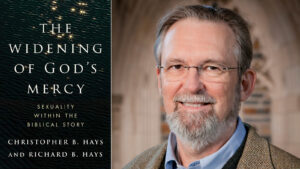
‘The Widening of God’s Mercy: Sexuality Within the Biblical Story’ and co-author Richard Hays. (Photo courtesy of Duke via RNS)
Some faculty at Fuller have expressed support for LGBTQ affirmation, including one high-profile Fuller professor.
Christopher Hays, who teaches Old Testament at Fuller, recently wrote The Widening of God’s Mercy, which argues for affirming LGBTQ relationships, with his father, Richard Hays, a prominent New Testament scholar who died earlier this year.
Fuller is one of the largest evangelical seminaries in the country, with 1,620 students overall enrolled this past fall—the equivalent of 714 full-time students—according to data from the Association of Theological Schools.
Of those students, 370 were enrolled in the Master of Divinity degree program, while 507 were in a Doctor of Ministry program, both designed for pastors.
The school was founded in 1947 by radio evangelist Charles Fuller, host of “The Old Fashioned Revival Hour.”
U.S. the outlier in biblical reverence in ‘secular west’
July 22, 2025
PHILADELPHIA (BP)—From a global vantage point unique to its study of the Bible’s impact on U.S. adults, the American Bible Society said Americans revere Scripture, faith and church more than others in a geographical cluster described as the “Secular West.”
The United States, Canada, Western Europe, Australia and New Zealand are included in the secular west cluster.
The American Bible Society said only 37 percent of secular west residents say the Bible is personally relevant. The United States is the outlier, with 51 percent of adults affirming Scripture’s relevance to them personally.
This mirrors a Lifeway Research study released May 13 showing 51 percent of American adults have read at least half of the Bible.
The American Bible Society includes the findings in the second chapter of its 15th annual State of the Bible, relying on data from the 2025 Patmos World Bible Attitudes Survey, with permission, with Gallup as the source research agency.
“These insights, made possible by invaluable contributions and expertise among our partner organizations, give us an unprecedented view of worldwide attitudes toward and engagement with the Bible,” said John Plake, chief innovation officer at the American Bible Society and State of the Bible series editor.
“This study helps us see where God’s word is spreading and his church is growing. We also see vast opportunities to share his word with the world.”
The American Bible Society draws on its membership in United Bible Societies, a fellowship active in more than 240 nations, in releasing the data.
In partnership with the British and Foreign Bible Society, the United Bible Societies and Gallup, the Patmos World Bible Attitudes Survey polled 91,000 people in 85 countries on Bible attitudes and practices.
The initiative draws from John’s letters to the seven churches in Asia Minor as recorded in Revelation, identifying seven geographical clusters and putting the United States in the fifth cluster described as the secular west.
Americans view Bible more favorably
In the secular west, the vast majority of adults do not find the Bible personally relevant, researchers said. Only 40 percent of residents in the cluster said religion is an important part of their daily life, compared to 69 percent of the global population.
But also in the secular west, Americans outpace other nations in key areas of biblical engagement, and judge the Bible more favorably.
While an average of 18 percent of adults in the cluster use the Bible “a few times a week or more,” 28 percent of Americans do so, compared to 18 percent of the Irish, the nearest ranking country in the cluster, and 8 percent of the French, the lowest use found.
While an average of 19 percent in the secular west attend church at least weekly, 28 percent in the United States do so, followed by 26 percent of Irish and 21 percent of Italians, with the lowest weekly attendance, 10 percent, found in France.
More than half of Americans, 53 percent, said religion is an important part of their daily lives, outpacing the average of 40 percent in the cluster who said so. Comparatively, 50 percent of Italians also said so, with Norwegians least often saying so at 17 percent.
When asked whether “It’s difficult to trust the Bible because it clashes with the scientific worldview,” the United States was the only nation with more respondents who said, “It’s not difficult to trust the Bible,” the American Bible Society noted.
“The U.S. is the only nation in this group with more disagreement (41 percent) than agreement (31 percent)—more who say it’s not difficult to trust the Bible,” researchers wrote. “The level of ‘strong’ disagreement in the U.S. (23 percent) more than doubles that of nearly every other nation in the cluster.”
Still, some U.S. responses varied.
When an average of 48 percent of respondents in the cluster disagreed or strongly disagreed that the Bible is a source of harm in the world, 55 percent of Americans said the same, outpaced by 65 percent of Italians.
And while 23 percent of Americans said the Bible is indeed a source of harm in the world—outpacing the secular west average of 22 percent—only 12 percent of Italians said so.
Other clusters in the Patmos Initiative are:
The “Majority Muslim” cluster 1, West Africa, Chad, Sudan, Pakistan and Afghanistan.
The “Majority Christian” cluster 2, Russia, Eastern Europe and Portugal, citing a historical connection to Orthodox Christianity.
The “Majority Muslim” cluster 3, North Africa, Middle East, Turkey and Central Asia.
The “Majority Christian” cluster 4, Latin America, Caribbean, Philippines.
The “Religiously Diverse” cluster 6, India, China, Indonesia, Japan.
The “Majority Christian” cluster 7, Sub-Saharan Africa.
Fieldwork details for all countries can be found in the methodology chapter of The Patmos Survey report, available here.
The American Bible Society will release additional chapters of the State of the Bible monthly through December, focusing on trust, flourishing, identity and church and Bible engagement.







 The United States, Canada, Western Europe, Australia and New Zealand are included in the secular west cluster.
 But also in the secular west, Americans outpace other nations in key areas of biblical engagement, and judge the Bible more favorably.