Umpire-minister Ted Barrett returns to World Series

HOUSTON (BP)—Ted Barrett—a Baptist minister and umpire—is back in the World Series.

A full-time umpire for Major League Baseball since 1999, Barrett is co-founder of Calling for Christ.

On Oct. 15, the day after his crew wrapped up the divisional round between the Giants and Dodgers, Barrett received word that for the fifth time he would be among those making the calls on baseball’s biggest stage.

The 56-year-old ordained Southern Baptist minister has a seasoned perspective from when he first began calling some MLB games in 1994.

“It’s truly a gift,” he told Baptist Press “All good things come from God, and this was a surprise for me.”

Typically, four to five years may pass between an umpire’s opportunities to be in the World Series.

Barrett’s work off the baseball field overshadows his work on it. Through Calling for Christ, he encourages peers to stay strong in their faith through—when possible—in-person gatherings but also by virtual meet-ups from whatever various cities have a game that day.

In his career, he’s witnessed the gospel’s impact on umpires working a high-stress job that has no shortage of people telling you you’re doing it wrong.

“It’s been really cool coming up with guys in the minor leagues who, at first, had no interest in church or Scripture,” he said. “I get to see their participation grow at things like a retreat or spring training Bible study. They get involved and go deep. It’s great to watch.”

‘Give it all to God and let things play out’

Umpires Ted Barrett, Angel Hernandez, Lance Barksdale and Alex Tosi huddle before the New York Yankees take on the New York Mets in a baseball game on Friday, Sept. 10, 2021, in New York. (AP Photo/Adam Hunger)

Two of those involved in Calling for Christ, Alfonso Marquez and Mike Muchlinske, were on the field with Barrett during Game 1 of the World Series. All three carried a small, metal cross Barrett’s 81-year-old dad, Jim, a retired welder from Buffalo, N.Y., made in his backyard in Arizona.

“Since he makes them, they’re all a little different,” said Barrett. “Mine is attached to my stopwatch, and so when I walk around, it hangs from my pocket. Fans will see it and say something. They also see us pray at home plate before a game.”

That witness extends to the game itself.

“On the field, I want to be an example of a Christ-follower with integrity. I say Jesus would have been the ultimate umpire, with his ability to make the tough calls. I call people out, but grace and forgiveness can be there when confrontation happens. When I walk out there, I feel I have favor from God with the interaction I have with players, managers and coaches.”

Baseball in 2021 is different than last year, he noted. Although there was a champion crowned in 2020, the absence of crowds made the game different. It was very strange and surreal, he said.

“I’m really looking forward to tonight and having the fans back,” Barrett said prior to the first game of the 2021 World Series.

And yet, he’s even more eager for what comes after the season. That includes spending time with his grandkids, ministry through Calling for Christ and filling pulpits.

“A lot of guys, as we get older, realize more and more how much we rely on God,” he said. “The reality is God has been carrying me all along. Whatever God has next, I’m going to enjoy it. We’re to give it all to God and let things play out.”


Pandemic increased stress but few pastors left the ministry

NASHVILLE, Tenn.—Pastors have faced increased stress during the COVID-19 pandemic, as churches were forced to adapt overnight. More felt their role was overwhelming at times, but few pastors actually decided to leave the ministry.
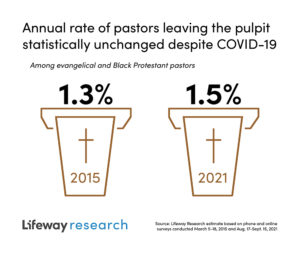
A new Lifeway Research study found close to 1 percent of evangelical and historically Black Protestant senior pastors step away from the pulpit each year—a rate statistically unchanged from a 2015 Lifeway Research study.

“COVID-19 was neither a small nor short-lived stressor for pastors,” said Scott McConnell, executive director of Lifeway Research. “Many have speculated that pastors have been opting out of the pastorate as a result. That is not the case. They are remaining faithful to the calling at levels similar to those seen before the pandemic.”

The August-September 2021 study surveyed more than 1,500 pastors serving in both evangelical and historically Black Protestant churches.

Around 1 in 6 pastors (17 percent) started at their current church during the pandemic years of 2020-2021. Half of the senior pastors facing the ministry upheaval brought on by COVID-19 were new to their role, and 51 percent are serving in their first church as senior pastor.

More than 1 in 3 pastors (37 percent) say they were the senior leader of their church 10 years ago. Among those congregations that had a different pastor in 2011, most of the previous pastors are now either retired (30 percent) or pastoring another church (28 percent).

In that time frame, some stepped away from the pulpit for a different ministry role (13 percent) or are working in a non-ministry position (8 percent), according to the current pastor. Combined, those two groups who leave the pastorate before retirement reveal an annual pastor attrition rate of around 1.5 percent.

“COVID-19 is not the only pressure pastors face, nor is it the most likely reason pastors from a decade ago are no longer pastoring,” McConnell said. “Baby Boomer pastors are reaching retirement age, and while many continue pastoring for years afterward, retirement is still the most common reason a pastor from 2011 is not pastoring a decade later.”

Thinking of their predecessor in cases where that person is working outside the pastorate, current senior pastors are most likely to say the previous pastor left due to a change in calling (32 percent), church conflict (18 percent), burnout (13 percent), being a poor fit with the church (12 percent), or family issues (10 percent).

Fewer point to a moral or ethical issue (8 percent), an illness (5 percent), personal finances (5 percent), or a lack of preparation (3 percent).

Conflict and change

Regardless of how the previous pastor left, the vast majority of pastors feel confident in their position. Nine in 10 pastors (90 percent) say they are sure they can stay at their current church as long as they want, including 60 percent who strongly agree.

While only 15 percent of pastors a decade ago have left the pastorate and fewer than 1 in 6 pastors say conflict drove that pastor from the pastorate, many pastors have experienced conflict in their church.

Among the pastors surveyed who pastored a different church previously, almost half (47 percent) say they left their last church because they took it as far as they could. Another third (33 percent) say their family needed a change. A quarter say there was conflict in the church (25 percent). More than 1 in 5 points to the church not embracing their approach to pastoral ministry (22 percent) or having unrealistic expectations of them (21 percent). Another 18 percent admit they were not a good fit for the church. Few say they were reassigned (14 percent) or asked to leave the church (10 percent).

Even if conflict didn’t cause them to leave their last church, most pastors (69 percent) say they dealt with some type of conflict there.

More than 1 in 3 say they experienced a significant personal attack (39 percent), had conflict over proposed changes (39 percent), or were in conflict with lay leaders (38 percent). More than a quarter ran into disagreements over expectations about the pastor’s role (28 percent) or their leadership style (27 percent). Fewer experienced conflict over doctrinal differences (12 percent) or politics (8 percent).

“Churches are groups of people, and even like-minded people do not always get along,” McConnell said. “It would be naïve to think a church would not experience disagreements. The important thing is whether that church maintains unity and love for each other as they navigate those differences or stoops to personal attacks as many pastors have experienced.”

Their previous experience with conflict leads 4 in 5 pastors (80 percent) to expect they will have to confront it in their current church in the future. As part of this preparation, 9 in 10 say they consistently listen for signs of conflict in their church (90 percent) and invest in processes and behaviors to prevent it (89 percent).

Overworked and overloaded

Direct conflict with churchgoers is not the only type of issue pastors face in their ministry. They often feel overworked and overloaded as individuals and worry about the toll their work may take on their family.

Most pastors say they are on-call 24 hours a day (71 percent) and their role is frequently overwhelming (63 percent). Half of pastors (50 percent) say the demands of their job are often greater than they can handle. Many say they feel isolated (38 percent) and face unrealistic expectations from their church (23 percent). One in 5 pastors (21 percent) admit they frequently feel irritated at their church members.

“The impact of the pandemic may be most noticeable in pastors’ increased agreement that the role of being a pastor is frequently overwhelming, which jumped from 54 percent in 2015 to 63 percent today,” McConnell said.

“But there has also been a shift in how some pastors think about their work. Fewer pastors agree they must be ‘on-call’ 24 hours a day, declining from 84 percent to 71 percent. Perhaps even more telling, the majority of pastors (51 percent) strongly agreed with this expectation in 2015, while only a third (34 percent) strongly feel this obligation today.”

Almost all evangelical and Black Protestant pastors are married (95 percent), and their role as spouse, and often parent, has the potential to conflict with their role as church leader. Most, however, feel serving in vocational ministry has been good for their family.

More than 9 in 10 pastors say their spouse is very satisfied with their marriage (96 percent) and enthusiastic about life in ministry together (91 percent). A similar percentage (94 percent) consistently protect time with their family. Most pastors were able to take a week’s vacation with their family last year (83 percent) and plan monthly date nights with their spouse (66 percent).

As a result, few say their work keeps them from spending time with their family (31 percent), and even fewer feel their family resents the demands of pastoral ministry (19 percent).

Still, 2 in 5 pastors say they are often concerned about their family’s financial security.

“Fewer pastors are concerned about their family’s financial security—41 percent today compared to 53 percent in 2015,” McConnell said. “This decrease in the number of pastors stressed over their personal finances may be due to increased generosity in their church or financial stimulus checks from the government. It is still more common for a pastor to be worried about their own finances than to report declines in giving at their church.”

Encouragement and support

While families may provide some added stress and responsibilities for pastors, they are also one of the sources of encouragement and support. They also are a channel through which a congregation can care for their pastor. Nine in 10 pastors (90 percent) say their family receives genuine encouragement from their church.

Close to 9 in 10 (86 percent) feel their church gives them the freedom to say no when faced with unrealistic expectations. While few say their church has a plan for the pastor to periodically receive a sabbatical (32 percent), almost 9 in 10 say they have a day to unplug from ministerial work and have a day of rest at least once a week (86 percent).

Pastors are also leaning on others for support and encouragement. Most say at least once a month they openly share their struggles with their spouse (82 percent), a close friend (68 percent), or another pastor (66 percent). Others say they are able to speak with lay leaders in the church (42 percent), a mentor (40 percent), another staff member (35 percent), a Bible study group in their church (23 percent), or a counselor (9 percent).

“The difficult moments and seasons pastors face require ongoing investment in their spiritual, physical and mental well-being,” McConnell said. “Most pastors and churches have practices that help the pastor in these ways, but there are often missed opportunities to encourage, build up and avoid misunderstandings.”

The study was sponsored by Houston’s First Baptist Church and Richard Dockins, M.D. The mixed mode survey of 1,576 evangelical and Black Protestant pastors was conducted Aug. 17–Sept. 15, 2021, using both phone and online interviews.

The completed sample is 1,000 phone interviews and 576 online surveys. Responses were weighted by region, church size and denominational group to reflect the population more accurately. The sample provides 95 percent confidence the sampling error does not exceed plus or minus 2.7 percent. Margins of error are higher in sub-groups.

Comparisons are made to a phone survey of 1,500 evangelical and Black Protestant pastors conducted by Lifeway Research March 5-18, 2015.



Influential musician Ralph Carmichael dead at 94

NASHVILLE (BP)—Often called the “father of contemporary Christian music,” Ralph Carmichael left his mark on the music industry in seven decades and at least as many genres. Carmichael died Oct. 20 at the age of 94.

Planning to become a pastor, Carmichael attended Southern California Bible College. But he pursued music instead and became head of the school’s music department. The innovative, contemporary arrangements he did with the school’s various music groups and ensembles won him acclaim, but churches often found them too worldly.

In the 1950s and ‘60s, Carmichael crossed easily between working with Gospel greats like George Beverly Shea and arranging for jazz legends like Ella Fitzgerald and Nat King Cole. And all the while, he was composing music for TV shows, including I Love Lucy and Bonanza, films like the 1958 hit The Blob and many others.

In 1966, he founded Light Records to give voice to the growing Jesus Movement. Artists he signed, like Andrae Crouch and the Winans, soon became major players in a whole new kind of music.

“The rise of the Christian music industry is not that long of a story,” said Mike Harland, associate pastor of worship at First Baptist Church of Jackson, Miss. “Just 40 years ago, there really was no such thing as a genre of Christian music. It grew out of the Jesus Movement.

“Ralph Carmichael was one of those legitimate music industry executives that built the bridge between what was happening in the Jesus Music movement … to the church itself.”

Harland, who served several years as the director of Lifeway Worship before returning to local church ministry, first encountered Carmichael’s work singing in youth choir.

“He was the father of the youth musical,” Harland said of Carmichael, whose work in musicals like Tell It Like It Isand Young Messiah was performed in churches far and wide. “When it came to the Baptist tradition, his name was on it.”

Many more Christians were exposed to Carmichael’s work in film scores he wrote for the Billy Graham Evangelistic Association—20 in all, including 1970’s The Cross and the Switchblade.

Others remember singing his songs—like “The Savior Is Waiting” (which Harland called “a staple of Baptist hymnody”), “He’s Everything to Me,” “Reach Out to Jesus” (recorded by Elvis Presley) and “Love is Surrender” (recorded by the Carpenters).

Perhaps his best known, most enduring work was 1960’s “The Magic of Christmas,” an album of mostly sacred Christmas songs by Nat King Cole. Carmichael’s tender, lush arrangements can still be heard just about anywhere each Christmastime, and his and Cole’s version of “The Christmas Song” is considered a classic.

Harland said Carmichael was a well-respected musician who just happened to be a Christian, which lent legitimacy to a struggling new industry.

“His faith found its expression in his life,” he said. “And his life was a musician. … It would be very difficult to measure the impact Ralph Carmichael had on American music in general but particularly Christian music.”

Harlan likened it to the “coaching tree” concept in football, when people make connections based on coaches they’ve worked with or for.

“If there were a musician tree, it goes back to Ralph Carmichael,” he said.


Baptist watchdog issues annual ethical fashion report

WASHINGTON (RNS)—The fashion industry continues to struggle with wage gaps and sustainability, according to a report from an Australian Baptist watchdog group, despite marked improvement in how the industry treats workers and sources its goods over the past few years.

Baptist World Aid Australia’s 2021 Ethical Fashion Report scorecard rated roughly 100 fashion companies, which averaged a score of 33.6 out of 100 compared with all industries the group tracks.

“We’ve seen considerable progress in the fashion industry and engaged with many brands that are committed to becoming more ethical and sustainable,” said Peter Keegan, Baptist World Aid’s director of advocacy. “But these grades and scores show us we’re not there yet.”

Baptist World Aid Australia has published the annual Ethical Fashion Report since 2013, as part of its efforts to alleviate global poverty and challenge injustice. According to the report, the global fashion industry, which employs some 50 million people, is one of the top five industries most at risk for complicity in modern slavery.

Group assigns ethical ratings to brands

Brands are rated in five categories, which include environmental sustainability, human rights monitoring and worker empowerment.

Using the organization’s Brand Finder, shoppers can compare the ethical ratings of their favorite brands, which receive grades from A+ through F based on a numerical score.

This year, 40 percent of companies improved their score compared with 2019, and the industry saw an overall increase in companies using sustainable fibers and tracing raw materials. Twenty companies earned an A+ and A, 55 received B or C and 23 received D or F.

Popular brands including H&M, Converse and Patagonia earned an A rating, while Roxy and Forever 21 earned an F.

The average company scored a D for work on wage improvement and worker unions. The report also found that only 15 percent of companies are paying workers in their supply chain a living wage, a drop from 20 percent in 2019.

The report attributed the decline to pandemic-related losses, noting garment workers have collectively lost more than $16 billion in wages since COVID-19 began.

“Our research identified a vast gap between the ethical sourcing measures companies put in place, and real, tangible outcomes for garment workers,” said Chantelle Mayo, advocacy project manager for Baptist World Aid Australia. “That’s a big hurdle for any consumer trying to shop ethically, and an area we need to keep pressuring the fashion industry to address.”


Attendance shrinking at small and midsize congregations

WASHINGTON (RNS)—A new survey of 15,278 religious congregations across the United States confirms trends sociologists have documented for several decades: Congregational life across the country is shrinking.

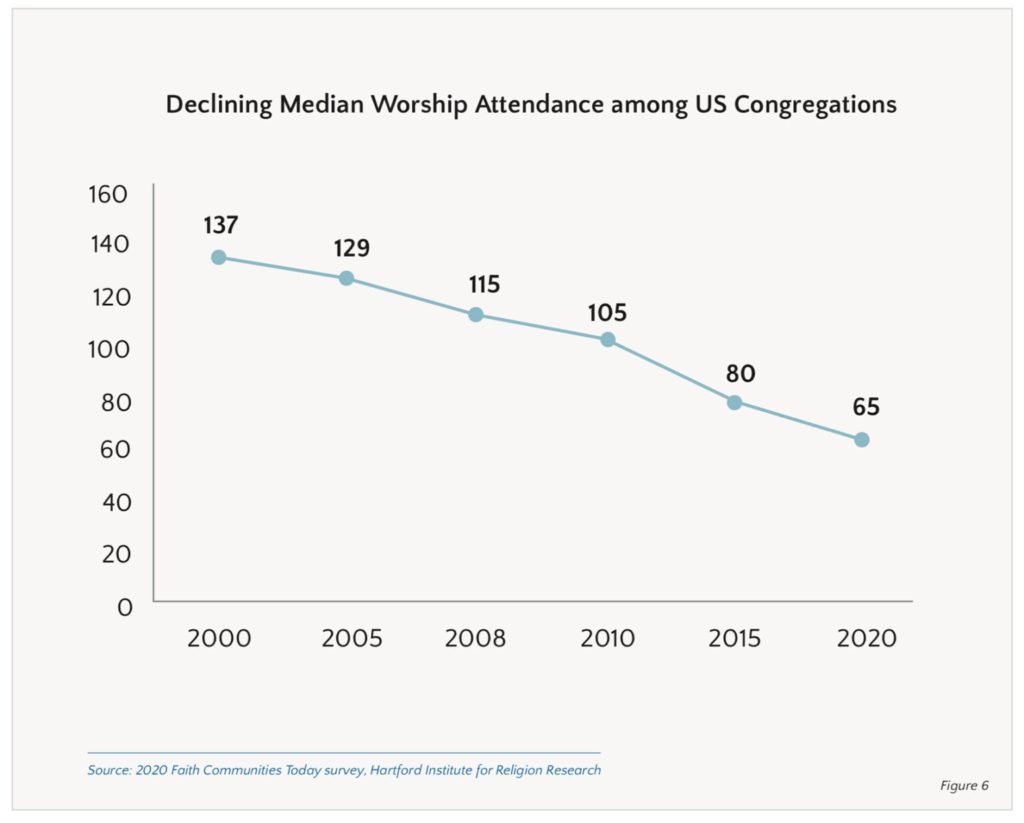
The most recent round of the Faith Communities Today survey found a median decline in attendance of 7 percent between 2015 and 2020.

The survey, fielded just before the coronavirus lockdown, finds that half of the country’s estimated 350,000 religious congregations had 65 or fewer people in attendance on any given weekend. That’s a drop of more than half from a median attendance level of 137 people in 2000, the first year the survey gathered data.

As Scott Thumma, director of the Hartford Institute for Religion Research and the survey’s author, put it: “The dramatically increasing number of congregations below 65 attendees with a continued rate of decline should be cause for concern among religious communities.”

The Faith Communities Today survey consists of self-reported questionnaires sent out to congregational leaders every five years since 2000—mostly through 20 collaborating denominations and faith traditions.

It found mainline Protestants suffered the greatest decline over the past five years (12.5 percent), with a median of 50 people attending worship in 2020. Evangelical congregations declined at a slower rate (5.4 percent) over the same five-year period and had a median attendance of 65 people at worship. Catholic and Orthodox Christian churches declined by 9 percent.

The only groups to boost attendance over the past five years were non-Christian congregations—Muslim, Baha’i and Jewish.

Not just mainline churches declining

“One of the meta-narratives of the last several decades is mainline decline and evangelical health,” said Mark Chaves, professor of sociology, religious studies and divinity at Duke University, who conducted a similar analysis known as the National Congregations Study. “It’s clear in recent years there’s been a decline in evangelical churches, as well. Mainline decline is not unique.”

The survey found half of the nation’s congregations were in the South, even though only 38 percent of the U.S. population lives there. It also suggested small congregations in rural areas and small towns may be unsustainable. Nearly half of the country’s congregations are in rural areas (25 percent) or small towns (22 percent), while the 2020 census found only 6 percent of Americans live in rural areas and 8 percent in small towns.

The country’s changing demographics may be key to rural and small-town decline. Young people have been moving to urban areas; businesses and industries have also left these communities bereft of resources and talent.

That doesn’t mean all small churches are going to close. Allen Stanton, director of the Turner Center for Rural Vitality at the University of Tennessee Southern, said smaller congregations need to be judged on their own metrics.

“We’re asking rural churches to be more like large and suburban churches, and they’re not designed to be,” said Stanton, author of Reclaiming Rural: Building Thriving Rural Congregations.

Measures taken by larger churches, such as increasing the number of small groups or attracting more youth, may not be feasible in these communities, Stanton said. But these congregations can still hold their own, with part-time leaders or volunteers.

Decline most drastic in midsized churches

However, the Faith Communities Today survey finds it’s midsize churches with an attendance of 100 to 250 that have declined the most precipitously—the median decline was 12 percent.

“These congregations were built in the post-World War II era,” said Thumma. “They’re struggling to have enough staff to satisfy everybody. And they don’t have all the programs of larger churches.”

Congregations with 1,500 people in attendance were best able to avoid decline; 71 percent of those large churches grew over the past five years. That may suggest many people are abandoning midsized congregations for megachurches that have full-time clergy, greater financial and physical resources and a diversity of ages and races among members.

One bright spot in the study: Congregations are becoming more racially diverse. In 2000, only 12 percent of congregations were multiracial. In the latest survey, the figure climbed to 25 percent.

The survey defined multiracial congregations as those where 20 percent or more of participants are not part of the dominant racial group.

Many researchers now are investigating if racial diversity also equals integration in relationships—or if people simply are attending church together. Previous research also found increased diversity is one-directional.

“It’s still in the direction of predominantly white churches becoming less predominantly white, Chaves said. “It’s very little in the other direction. There’s not a big increase in diversity in predominantly Black churches.”


Nearly half in U.S. watched church online during pandemic

NASHVILLE, Tenn.—Prior to the COVID-19 pandemic, online worship services were a novel concept for many churches. In the almost two years since, however, churches have adapted and reached new people with the adoption of digital streaming.

According to a new Lifeway Research study, 45 percent of Americans say they have watched a Christian church service online during the COVID-19 pandemic, including some who say they don’t normally physically attend.

Slightly more than half (52 percent) say they have not watched a church service during the pandemic, most of whom say they don’t normally attend church in person either.

“The distance to one’s nearest church has changed almost overnight,” said Scott McConnell, executive director of Lifeway Research. “A form of communication that was not even used by most churches before the pandemic has now reached almost half of Americans.”

Churches pivoted to online options early in pandemic

In a previous Lifeway Research study of Protestant pastors conducted prior to the spread of COVID-19, 41 percent said they didn’t regularly livestream any portion of their church service or post the sermon online later. At the time of the survey, only around 1 in 4 (27 percent) said they livestreamed either the entire service or just the sermon.

As the coronavirus began to spread and social distancing guidelines emerged, the vast majority of churches quickly provided digital options. By March 2020, Lifeway Research found 92 percent of Protestant pastors said they provided some type of video sermons or worship services online. That climbed to 97 percent in April 2020.

In a Lifeway Research study from early 2021, 85 percent of Protestant churchgoers said their congregation offered livestreamed worship services, and 76 percent said their church posted a video of the worship service to watch later.

Additionally, 53 percent of churchgoers said they watched online worship services at their church more in 2020 than in 2019, while 21 percent said they watched more online services at a different church in 2020.

Those who had not attended connected to church online

Throughout the pandemic, Lifeway Research found pastors reporting new people who had previously not attended their church in the past attended or connected online. The latest study seems to bear that out.

When asked, “Have you watched a Christian church service online during the COVID pandemic?” 45 percent say they have, including 30 percent who normally attend church in person and 15 percent who normally do not attend in person.

“It’s not surprising to see churchgoers using online options to view a church service, but there are also those who have not been church attendees who have at least checked out a church service during the pandemic,” McConnell said.

Americans with evangelical beliefs are three times as likely as other Americans to say they watched church services online during the pandemic and normally attend church in person (64 percent to 20 percent).

Some of those most likely to say they watched church services online during the pandemic but don’t normally attend church in person include young adults ages 18-34 (18 percent) and African Americans (22 percent).

Churches were still not able to reach most Americans with the expansion of digital offerings during the pandemic, however, as 52 percent say they have not watched services online during the pandemic.

Most of those (42 percent) say they haven’t watched online and normally do not attend church in person. Another 1 in 10 Americans (10 percent) say they do normally attend church in person but have not watched a church service online during the pandemic.

“Church participation is in flux,” McConnell said. “Some who were regular, in-person churchgoers before COVID-19 only view online services today, others have never tuned in online despite the pandemic, and still others use both at different times. This shift has created both challenges and opportunities for pastors and church leaders.”

The online survey of 1,005 Americans was conducted Sept. 3-14, using a national pre-recruited panel. Analysts used quotas and slight weights to balance gender, age, region, ethnicity, education and religion to reflect the population more accurately. The completed sample of 1,005 surveys provides 95 percent confidence that the sampling error from the panel does not exceed plus or minus 3.3 percent. Margins of error are higher in sub-groups.


Documentary recounts the glory and mess of Christian music

NASHVILLE (RNS)—The contemporary Christian music industry survived scandals, pushback from televangelists and the wholesale disruption of the record industry over the past 50 years and kept rolling along.

Then last spring, COVID-19 brought it all to a halt.

Artists who’d spent decades on the road were suddenly stuck at home, their tour buses unpacked, with no clear indication when they’d be able to get back to playing music in public. For Christian filmmakers Andrew and Jon Erwin, who began their careers making music videos, the pandemic seemed a once-in-a-lifetime chance to get their musical heroes on camera.

“For the first time in history, all of these artists are off the road,” Andrew Erwin told Religion News Service.

So the Erwins, a pair of brothers who’ve made faith-based movies such as I Can Only Imagine and October Baby, called up Christian music legends Amy Grant and Michael W. Smith and pitched the idea of a documentary about the history of Christian music. The two said “yes” and signed on as producers. Before long, the project was underway.

‘The Jesus Music”  traces CCM history

The result of their efforts is The Jesus Music, a documentary that traces contemporary Christian music from its beginnings among hippies at Calvary Chapel in Costa Mesa, Calif., in the late 1960s to the global worship music empire of Australia’s Hillsong Church.

The documentary debuted in early October, earning just over a half-million dollars at the box office in limited release, according to Deadline Hollywood, which covers the entertainment industry.

Andrew Erwin said he and his brother interviewed about 100 artists, including some of the biggest names in Christian music, including Kirk Franklin, TobyMac and other members of DC Talk, Chris Tomlin, Bill Gaither, Lecrae and current chart-topper Lauren Daigle.

Distributed by Lionsgate, the film is anchored around the experiences of Grant and Smith, who became some of the biggest names in the business beginning in the 1980s. Early on, Grant gives an interview in what was once the Koinonia Christian Bookstore and Coffeehouse on Nashville’s music row.

At the time of the interview, Grant—who has sold tens of millions of records—was a few weeks away from having open-heart surgery. She recalls visiting the coffeehouse and hearing people singing with guitars about Jesus. The experience, she said in the film, changed her life.

“It was unlike anything this Southern religious town had seen,” she said during the interview.

“A lot of hymns are, close your eyes singing to God,” Grant said, in describing the music she dreamed of making. “I wanted to sing songs with my eyes wide open, singing to each other.”

Rooted in early 1970s Jesus Movement

The strongest part of the film comes in the first hour. The Erwins use vintage footage and interviews with California pastor Greg Laurie and Tommy Coomes of the early Christian rock band Love Song to recount the movement’s early days, when former hippies, disenchanted by sex and drugs, formed what was known as the “Jesus movement” of the early 1970s.

That moment had its own soundtrack with guitar and drums—epitomized by the long-haired songwriter star Larry Norman, whose songs about the end of the world, racism and the emptiness of drugs and sex made him the movement’s first rock star.

At one point, interviewees recite lyrics of “Why Don’t You Look Into Jesus,” one of Norman’s early hits, which begins with the line “Sipping whiskey from a paper cup, you drown your sorrows till you can’t stand up,” then goes on to talk about shooting up drugs and getting a sexually transmitted disease on Valentine’s Day.

John Styll, the former president of the Gospel Music Association and founder of Contemporary Christian Music magazine, said such lyrics would be banned on today’s Christian radio.

“No way would they play it,” he said in the film.

The movie also highlights Explo ’72, a massive Christian music event that featured Christian music stars alongside performers such as Johnny Cash, Rita Coolidge and Kris Kristofferson. During that event, which brought more than 200,000 young people to Dallas, evangelist Billy Graham gave his stamp of approval to the Jesus movement and Jesus music.

“True faith ought to be applied to the social problems of our day,” Graham said in a speech at the event that’s featured in the film. “Today, Christian young people ought to be involved in the problems of poverty, ecology, war, racial tension and all other problems of our generation.”

‘We wanted to understand the struggle’

Lonnie Frisbee, an influential preacher in the movement’s early days, also is featured in the documentary. Frisbee played an important role in the Jesus movement but was long overlooked after his death from AIDS in the early 1990s. The film also mentions some of the scandals that engulfed Christian music stars such as Grant and Sandi Patty.

“We did not have any intention of chasing scandal, but we wanted to understand the struggle,” said Jon Erwin in a video interview. “There were a lot of complicated people within the timeline of Christian music.”

Kirk Franklin in “The Jesus Music.” (Photo courtesy of Lionsgate)

The film also denounces the racism that separated white Christian stars from Black gospel musicians. It includes an interview with Kirk Franklin, whose comments about seeking racial healing were cut from a broadcast of a Christian music industry awards show.

“When we don’t say something, we’re saying something,” Franklin said during the speech, which addressed the killing of Black men.

One of the film’s most touching moments comes in footage of the funeral for Truett Foster McKeehan, the 21-year-old son of TobyMac, one of the founders of DC Talk. McKeehan died of an accidental overdose in 2019, and his father recounts his son’s passing in an emotional interview.

Among the film’s surprises is a section on the Christian metal band Stryper, whose members became Christians after watching sermons of televangelist Jimmy Swaggart. After their conversions, band members became stars known for playing metal music that praised Jesus and for throwing Bibles at their fans during concerts, only to see Swaggart turn on them.

Most of the musicians in the film said if they had the chance, they’d do it all over again. But their fame came with a cost, warns Michael Tait, one of the founders of DC Talk. Tait would go on to be the lead singer of the Newsboys, another influential Christian band.

“I would not wish fame, or fortune, or notoriety on anybody,” he said. “Anonymity is not a bad thing. Trust me.”


Southern Gospel museum seeks new home

PIGEON FORGE, Tenn. (BP)—The Blackwood Brothers Quartet promoted its 37-passenger, refurbished 1939 Aerocoach bus, air-conditioned with bunk beds and recliners, as providing the “utmost riding comfort.”

Typically at that time in the 1950s, Southern gospel music groups traveled the sometimes hundreds of miles by car to perform in rural towns, with singers in the seats and musical instruments in the trunks, said Arthur Rice, lead singer for the Kingdom Heirs and president of the Southern Gospel Music Association’s Southern Gospel Music Hall of Fame and Museum.

“And so J.D. Sumner decided that, you know, it would be a whole lot more comfortable to travel in something that was a little bit bigger,” Rice said. “J.D. Sumner was the very first one to actually come across” using tour buses for singing groups.

A replica of the bus is among the thousands of Southern gospel music artifacts displayed by the Southern Gospel Hall of Fame and Museum.

The Southern Gospel Music Association is looking for a new home for its collections after more than 20 years at Dollywood, Dolly Parton’s amusement park and entertainment complex in Pigeon Forge, Tenn. The association’s lease for its 15,000-square-feet facility at Dollywood was not renewed in 2021 because of constraints of the COVID-19 pandemic and a Dollywood expansion plan, Rice said.

Between performances of the Kingdom Heirs Oct. 8 at Dollywood, where the group is in its 36th year as resident gospel artists, Rice talked about the search for a new museum home. He said the Southern Gospel Music Association plans to remain in the Pigeon Forge area and is currently blessed to store its hall of fame and museum artifacts in space donated by an area businessman. Several possibilities are being considered for new sites.

Arthur Rice (2nd row 3rd from left) is lead singer of the Kingdom Heirs and president of the Southern Gospel Music Association’s Southern Gospel Music Hall of Fame and Museum. (Kingdom Heirs photo)

“When we opened at Dollywood that was just a godsend, to have a public platform to present our music and the message,” Rice said. “That was right for the time. When we closed, I was sad because it was an end of an era, but I believe that God has … got his hand on what’s next. He’s given us this time, while the museum is closed, to prepare for that time. I don’t know exactly what it is.

“My vision really is to have a place where we could not only have the plaques and the artifacts, but also have a theater-type venue to where we could have groups come in (and) do a performance.” Attendees could then view the history.

“I think we can educate more people in a year’s time than we could in a lifetime,” Rice said.

The plaques Rice references depict inductees into the SGMA Hall of Fame spanning 25 years. 2021 inductees, announced Sept. 28 at the National Quartet Convention in Pigeon Forge, are prolific musician and songwriter Jack Clark of Cleveland, Tenn.; award-winning singer and songwriter Karen Peck Gooch of Karen Peck and New River; gospel music broadcaster Marlin Raymond Taylor; and the late Aaron Wilburn, a noted gospel songwriter, musician and comedian who died in 2020.

They join such noted honorees as Fanny Crosby, inducted posthumously in 2014; Thomas A. Dorsey, inducted posthumously in 2013; Carl Stuart Hamblen, inducted posthumously in 2012; Bill and Gloria Gaither (inducted in 1997 and 2005, respectively); and several members of The Happy Goodman family group.

In addition to the plaques, among the many museum artifacts awaiting display are historical songbooks, clothing worn by singers, and priceless musical instruments on loan from owners. Many of the priceless pieces are in safe-keeping with the owners until a new site is found.

Rice sees preserving the history of Southern gospel as important.

“It’s a very interesting story, and we want to share that with people,” Rice said. “For me, it is a map of how God has used our music through the years to encourage, to draw people to Christ, to lift them up.

“There’s nothing more encouraging than a gospel song when you’re in a low place. I want people to see how God’s hand has been on this music and on our people. We’re all flawed and we all are going through things, but God still chooses to use us as vessels. Yes, there’s been some characters through the years, but you know what, God still uses them.”


Biography reveals faith of civil rights activist Fannie Lou Hamer

WASHINGTON (RNS)—Fannie Lou Hamer was an advocate for African Americans, women and poor people—and for many who were all three.

She lost her sharecropping job and her home when she registered to vote. She suffered physical and sexual assaults when she was taken to jail for her activism.

The stories of her struggles reached the floor of the 1964 Democratic Convention—and the nation when her emotional speech aired on television.

Kate Clifford Larson (Courtesy photo)

Historian Kate Clifford Larson has written a new book, Walk With Me: A Biography of Fannie Lou Hamer, that reveals details of the faith and life of Hamer, who was born 104 years ago and died in 1977.

Inspired by young Student Nonviolent Coordinating Committee workers who preached Bible passages about liberation at her church in Ruleville, Miss., in 1962, Hamer became a singer and speaker for equal rights and human rights.

“She crawled her way through extraordinarily difficult circumstances to bring her voice to the nation to be heard,” Larson said. “And she knew that she was representing so many people that were not heard.”

Larson spoke to Religion News Service about Hamer’s faith, her favorite spirituals and how music helped the activist and advocate survive.

The interview has been edited for length and clarity.

Why did you decide to write a biography of Fannie Lou Hamer, and how would you describe her as a woman of faith?

I published a book about (Harriet) Tubman, and Hamer is so similar to Harriet Tubman, only 100 years later. I decided to start looking into her life and thinking I should do a biography of Hamer.

I just became hooked. There were so many similarities, and things I could see in Hamer that I just thought, we need to have a refresher about Fannie Lou Hamer and the strength of her character and how she survived such incredible adversity and found the same kind of solace that Harriet Tubman did—in her faith, in her family and the community—to keep going and fighting and to try to make the world a better place.

It seems she is relatively unknown in many circles despite the credit she’s given by civil rights veterans for her work.

It is curious that she is not well known broadly. And I hope that changes, because I think we need to look back sometimes to see how far we’ve come. And with Hamer, the things that happened to her—she faced the world by confronting that trauma, and that violence, without hate.

And the only way she could do that was through her faith, and talking to God and saying: Where are you, what is happening here, give me the strength to carry this weight and to move forward. And she did. She knew hate could really destroy her—that feeling of hating the people that were trying to kill her and subjugate her. She managed to rise above it because she had a greater mission in front of her.

Why did you title the book “Walk With Me”?

The title is from the song Walk With Me, Lord. She was brutally beaten, nearly killed, in the Winona, Miss., jail in June of 1963. As she lay in her jail cell, bleeding and bruised and coming in and out of consciousness, she struggled to hang on and her cellmate, Euvester Simpson, a teenage civil rights worker, was there with her.

She asked Euvester to please sing with her because she needed to find strength and she needed God to be with her. So she sang that song, Walk With Me, Lord. She needed to feel there was something bigger that would help her survive those moments where it wasn’t so clear she would survive. And I found it so powerful that she would do that. She survived that night and was able to get up and walk the next morning.

What other spirituals and gospel songs were particularly important to Hamer as she fought for voting rights and other social justice causes?

One of her favorites is This Little Light of Mine. She sang that everywhere, all the time. It’s kind of her anthem. There were some other spirituals, but really, most of the ones she sang a lot during the movement were those crossover folk songs, rooted in Christian spirituals, like Go Tell It on the Mountain. She grew up not only in a very strong church environment, the Baptist church, but she grew up in the fields of Mississippi where there were work songs in the fields, call and response songs. Where she grew up was actually the birthplace of the Delta blues music.

She also quoted the Bible to the people she differed with. Were there particular biblical lessons Hamer applied to her fight to help her fellow Black Mississippians?

She used the Bible in many different ways. She used it to shame her white oppressors who claimed also to be Christians, following the path of Christ. She would use the Bible and say: Are you following this path by what you’re doing to me, to my fellow community members and family members? And she used the Bible passages to remind Christian ministers: This is your job, and what are you doing up on that pulpit? You’re telling people to be patient. Well, in the Bible it says stand up and lead people out of Egypt.

You wrote about William Chapel Missionary Baptist Church, Hamer’s congregation, throughout the book. What happened there, over the years as the Student Nonviolent Coordinating Committee and other groups used it as a place for meetings, classes and rallies?

The church, the ministers participated in the movement and had meetings in that church at great risk to themselves and to the church, and in fact, the church was bombed a couple of times even though the fires were put out, fortunately, very quickly. There were residents in the community that took their lives and put them on the line. They were at great risk, to go to those meetings, to conduct those meetings, to go out and do voter registration drives. It was all centered on the church community because that was really the only community buildings in many of these places where people could meet together to have these discussions.

You said Hamer was at a crossroads as she first listened to those SNCC activists seeking more people to join their cause.

She experienced trauma, and she had been sterilized against her will—she didn’t give permission—and she had gone through this very deep depression, and it tested her faith. It tested her understanding of the world, and she came out of that and went to this meeting in Ruleville in 1962, and when she heard those young people and their passion and their willingness to put their lives on the line for her, she viewed them as the “New Kingdom.”

So, it was more than a crossroads for her. It was a moment where she could see the future in these young people, and she called them the “New Kingdom (right here) on earth.” If they were willing to stand up and risk their lives then she could, at 45, 46 years old, stand up herself. That was a crossroads. She made that choice to stand up, publicly, and move forward.


Fernando Ortega: Siglos de familia, arte e iglesia

Fernando Ortega ha grabado 21 álbumes, hasta ahora. Mantiene una agenda regular de conciertos por todo Estados Unidos, ha dirigido el culto de ocho iglesias y ha sido músico de gira con Anne Graham Lotz. Recientemente ha publicado una colección de sus fotografías y relatos en Fernando’s Birds.

Antes de todo eso, estuvo en el ministerio universitario de la Iglesia Bautista Hoffmantown en Albuquerque, N.M., donde tocaba el piano en los servicios de adoración y en el coro de jóvenes. Y antes de eso, fue moldeado por la larga e histórica historia de su familia en el norte de Nuevo México. La siguiente entrevista es para conmemorar el Mes de la Herencia Hispana.

Háblenos del lugar donde creció y de su familia.

Crecí en Albuquerque, N.M. Tengo tres hermanos: una hermana menor, un hermano menor y una hermana mayor. Éramos muy unidos mientras crecíamos y seguimos siéndolo de adultos, especialmente desde la muerte de nuestros padres en los últimos años. Los tres tenemos inclinaciones musicales, aunque mi hermano y yo somos los únicos músicos profesionales de la familia.

¿Cuánto tiempo lleva su familia en Nuevo México?

Esta es una gran pregunta en este momento, porque mi hija Ruby y yo hemos estado construyendo el árbol genealógico de los Ortega desde principios de 2021.

He buscado a través de muchos tipos de registros en línea, especialmente los documentos del censo, y he sido capaz de rastrear varias generaciones para encontrar el primer Ortega en Nuevo México de quien somos descendientes. Se llamaba Francisco de Ortega y nació en los alrededores de Albuquerque en 1614. Su esposa fue Isabel de Zamora. Tuvieron cuatro hijos: Simón, María, Tiburcio y Clementa. Francisco de Ortega es el noveno bisabuelo de mi hija Ruby.

¿Cómo influye su familia en su visión del cristianismo?

Definitivamente siento el peso y la importancia de una línea tan larga de cristianismo católico generacional en mi familia, aunque yo haya sido protestante toda mi vida.

Mis abuelos Juan Melquiades y Apoloñita Ortega fueron los primeros de mi ascendencia que se convirtieron al presbiterianismo en algún momento a principios del siglo XX. Esa conversión no estuvo exenta de consecuencias en la familia y también en el pueblo de Chimayo, N.M., donde vivían, pero con el tiempo, esos rencores disminuyeron, y mis dos abuelos murieron como cristianos muy respetados y devotos en su comunidad.

Así que, sí, el presbiterianismo es lo que me impregnó desde mi nacimiento. La liturgia y el calendario litúrgico relativamente flojos -en relación con el catolicismo- de esa denominación es lo que nos formó a mí y a mis hermanos y definió la forma en que vivíamos nuestra fe y nuestra vida eclesiástica.

Sin embargo, si lo pienso bien, mi conocimiento del calendario eclesiástico fue leve mientras crecía. No recuerdo haber estado nunca especialmente atento a las estaciones de la iglesia -en particular el Adviento o la Cuaresma-, aunque la liturgia presbiteriana durante ambas estaciones es muy específica.

Cuando era adolescente, abandoné el presbiterianismo y pasé varios años en una iglesia pentecostal vibrante, aunque bastante extraña. Nuestros servicios de los viernes por la noche en esa iglesia eran, por decirlo suavemente, salvajes.

Esas reuniones duraban horas. Comenzaban con música y bailes, marchas con cadenas de baile, hablar y cantar en lenguas, seguidas de una larga enseñanza o predicación, seguida de “la unción” que caía sobre quien la dirigía, y culminaba con un servicio de “imposición de manos” en el que se producían curaciones y liberaciones de demonios.

Y luego, estaba el “después”.

Recuerdo que nuestro servicio de Nochebuena siempre incluía una tarta de cumpleaños para el Niño Jesús, iluminada con bengalas del 4 de julio. Bailábamos como locos alrededor de ese pastel. Años más tarde, como bautista del sur -una larga historia-, el servicio de Nochebuena también era bastante ruidoso y grandioso, e incluía un coro y una orquesta gigantescos.

Menciono la Nochebuena simplemente porque en ambas iglesias, una vez terminadas nuestras ruidosas celebraciones, siempre me encontraba conduciendo por Albuquerque en busca de la iglesia católica más cercana donde pudiera participar en una Misa de Gallo mucho más tranquila y reverente, una ceremonia caracterizada por la solemnidad y el asombro. Supongo que era la sensibilidad religiosa de mis antepasados la que me llevaba a ese lugar en Nochebuena.

Su familia aparece en su música, ya sea por su nombre o de forma menos evidente. ¿Cómo influye su familia en su música?

Mi familia era muy musical cuando crecía. Mi padre y mi madre tenían una interesante y ecléctica colección de vinilos que incluía canciones folclóricas italianas y francesas, piezas clásicas como “Water Music” de Händel, canciones populares mexicanas, Doris Day y Andy Williams. Tengo vívidos recuerdos de estar tumbado en el suelo escuchando todos esos discos y absorbiendo el ambiente.

Mis padres eran muy fieles a pasar mucho tiempo con ambos lados de la familia. Así que estábamos mucho en el coche, conduciendo a Chimayo, Mora, Santa Fe, Los Álamos, y luego estaban los frecuentes viajes de pesca durante el verano. Todo eso para decir que cantábamos en el coche todo el tiempo, y armonizábamos entre nosotros.

Y, por supuesto, en la iglesia cantábamos con el himnario delante de la cara. Aprendí pronto a seguir las cuatro voces de la página: bajo, tenor, alto y soprano.

Usted pasó una parte importante de su carrera musical en California y luego regresó a Nuevo México. De todos los lugares a los que podía ir después de California, ¿por qué Nuevo México?

He pensado mucho en esto en los últimos años. Me encantaba California. Mi ex esposa y yo teníamos una dulce y diminuta casa de campo en Laguna Beach, en una zona de ensueño y hippie de la ciudad. Era encantador y tranquilo en ese cañón, y a un breve paseo de 10 minutos del océano Pacífico, por el amor de Dios. Pero siempre sentía el tirón de mi hogar en Nuevo México.

Durante los 22 años que viví en California, anhelaba volver a Nuevo México, con mi familia, por supuesto, pero también echaba de menos el paisaje del alto desierto y de las Montañas Rocosas del Sur. Y después de volver a mudarme a Albuquerque, supe que estaba donde tenía que estar. Pero ahora que he podido investigar y contemplar la larga historia de los Ortegas en este lugar, todo tiene aún más sentido. Las últimas piezas del rompecabezas están ahora en su sitio.

Más recientemente, te has convertido en un ávido fotógrafo. Su tema favorito parecen ser los pájaros. ¿Cómo empezó eso?

Tenía un montón de puntos de recompensa en mi cuenta de American Express. Entre algunas de las cosas increíbles que pude conseguir gratis, conseguí una cámara Canon básica y un par de objetivos.

Un día, mi hermana Cristina me invitó a ir a fotografiar pájaros con ella, algo que ya hacía desde hacía años. Recorrimos los bosques a lo largo del río Grande y vimos todo tipo de aves que no sabía que existían.

En un momento dado, estaba tumbada de espaldas sobre un enorme tronco de árbol caído, mirando al cielo, cuando un majestuoso y grueso halcón blanco pasó por encima. Imprudentemente apunté mi cámara al pájaro y tomé algunas imágenes extraordinariamente nítidas. Se trataba de un halcón ferruginoso, y al instante se convirtió en mi rapaz favorita. La experiencia me cautivó de inmediato.

Volviendo a su familia: Usted tiene una hija. ¿Qué parte de la herencia de los Ortega cree que ella va a sacar adelante?

Lamentablemente, he caído en el error con Ruby y el idioma español. Tuvo algunos profesores decentes cuando estaba en la escuela primaria, pero ahora que está en la secundaria, no tiene ninguna clase de español. Eso es algo que realmente me gustaría remediar.

No mencioné antes que una gran parte de la historia de la familia Ortega es el tejido de textiles. Mi abuelo Juan Melquiades fue un tejedor de gran renombre aquí en Nuevo México, al igual que su padre y tres de sus hermanos. Cuando el abuelo murió en 1991, la Institución Smithsoniana adquirió un par de sus tejidos y partes de su telar, que fueron expuestos en el Museo Nacional de Historia Americana. Ahora esos objetos forman parte de la colección permanente de la institución.

Mi hermano Armando y yo aprendimos a tejer con mi abuelo. Estaría loco si no le transmitiera el arte a Ruby, que tiene muchas inclinaciones artísticas.

Publicado originalmente en inglés aquí


Lucado finds peace in quiet providence amid personal struggles

SAN ANTONIO (RNS)—Pastor and bestselling author Max Lucado believes the story of Esther can help guide Christians through challenging times.

Lucado should know.

The biblical book bearing Esther’s name has helped him through his own bout with a breakthrough case of COVID-19 and his recent diagnosis with a serious health condition, called an ascending aortic aneurysm.

Not to mention the national upheaval of a pandemic, a reckoning over racial justice, a rancorous presidential election and a siege of the U.S. Capitol, all in the past year.

During that time, Lucado, teaching pastor at Oak Hills Church in San Antonio, created daily Coronavirus Check-In videos online and saw a bump in sales of his books, with titles like Anxious for Nothing and Unshakeable Hope.

He also unpacked the story of Esther, the Jewish queen who saves her people from genocide in the biblical account, for his latest book, You Were Made for this Moment: Courage for Today and Hope for Tomorrow.

“The theme of the book of Esther, indeed, the theme of the Bible, is that all injustices of the world will be turned on their head,” he writes in You Were Made for this Moment.

“When we feel like everything is falling apart, God is working in our midst, causing everything to fall into place. He is the king of quiet providence … and he invites you and me to partner in his work.”

Lucado spoke with Religion News Service about You Were Made for this Moment, the book of Esther and his recent diagnosis. This interview has been edited for length and clarity.

What made you decide to write about Esther?

As 2020 kicked off, I was just like everybody else—just really pushed back on my heels with all the struggles of the spring of 2020. I was actually scheduled to teach a series at our church on stewardship, but that seemed really tone deaf. Everybody was just reeling from the pandemic and the stress and insecurity and fear.

So I recalibrated and began thinking, “Is there a series in the Bible that deals with a global calamity?” Of course, they’re all over the place. I’d already preached through Joseph, already preached about Exodus, but I’d never taught on the life and the story of Esther. I’ve always wanted to. I’ve loved that story for all my life. So I said, “OK, we’re going to study through this as a church,” and it really resonated because it is a story of a global calamity, at least in terms of the Hebrews. They had no out. It was just overwhelming. It seemed like there was no solution, and then God turned it around in the story and provided deliverance.

How did writing You Were Made for this Moment during the COVID-19 pandemic and other upheavals this past year and a half impact how you read and thought about the book of Esther?

I don’t think I was aware how the two main Hebrew characters, Mordecai and Esther, were really clandestine in their faith initially. They blended into the culture, and they were happy to be thought of as Persian. They were so Persian, he could work for the king and she could sleep with the king, and nobody knew they were Jewish.

In the day in which we live, it seems more difficult to know how to live a Christian life and not be a jerk, on one extreme, or not be invisible, on the other extreme. How can I lead a Christian life in which I have a deeply rooted faith and yet still be a great neighbor, still be good for society, still not be that person that people roll their eyes at—that we really are the constructive force for good in the world?

The other is just the fear the Jewish people must have felt. The king of Persia was a misogynist, partying, oblivious, clueless—more of a drinker than a thinker kind of guy—and then his righthand man (Haman) just decided to annihilate all the Jews. Remember these are exiles. These are marginalized people. So if you’re a Hebrew in those days, you really feel outmaneuvered by fate, outnumbered by your foes.

I think the pandemic left people feeling weary, worried and wounded by the uphill battle, and I think it’s still going on. I remember when I presented this book to the publisher, I said, “Unfortunately, this would have been great to release it in the beginning of the pandemic,” because when I presented it, I thought the pandemic was ending. We all did. And now it’s still going on.

Why do you believe Esther’s story can guide readers through challenging times—not just pandemics and politics, but the personal struggles that have continued during this time, too?

I think we are so mesmerized by stories in Scripture that are dramatic, like the splitting of the Red Sea or the raising of the dead. Those stories are extraordinary and inspirational.

But the story of Esther is interesting because there’s no visible miracle. The reality of their world is kind of like the reality of ours; that is, most of us don’t experience those dramatic miracles. The theology behind Esther is quiet providence. It’s kind of behind the scenes. Esther’s famous for being one of two books in the Bible, along with Song of Solomon, in which the name of God does not appear.

I think the relevancy of the story to our day is most of us don’t have these dramatic miracles, but we can—by virtue of this story and others—trust the behind-the-scenes work of God in the middle of our challenge.

You’ve faced your own personal struggles. You recently announced you’d been diagnosed with an ascending aortic aneurysm. Any update on your health?

We were really caught off guard by this because I’m in good health. It’s asymptomatic. But I was actually having a calcium test done, and in the process of the calcium test, it became clear to the doctor that I have this aneurysm. It’s pretty sizable. Since I announced it, I have come to learn it’s just shy of being large enough where surgery is mandatory. It’s an option right now, so we’re still doing tests.

Initially, I had about three or four days in which I felt like I couldn’t get my emotions under control. I kept thinking: “Oh man, I’ve got this ticking time bomb in my chest. It’s going to rupture at any moment.” But I’ve really felt peaceful.

You had a breakthrough case of COVID-19 two months ago, too.

Boy, I did, and it knocked me off my feet. I thought I had dodged the bullet because I was vaccinated, but it knocked me down for about three days. I really was sick. But then, I got over it. I’m thankful I was vaccinated. I think that helped it from ever getting into my lungs. I was sick—so sick I could hardly get off the couch, and my wife would only see me wearing a hazmat suit. But we made it.

How has what you took from studying the book of Esther helped you through your own challenging times?

There were times, especially with the surfacing of the aneurysm story, I was so thankful I had just spent the last month looking at a great story of God’s providence because it gave me some tools in my tool chest to go to.

Number One, I had this great story of Esther that was really fresh in my mind.

Number Two, I was really reacquainted with some of the promises in Scripture that mean so much to us. Romans 8:28—“Everything works together for the good of those who love him and are called according to his purpose”—gave me a Scripture upon which to meditate. Also, Philippians 4—that there is a “peace that passes understanding.” I came to experience that peace. In fact, I think I have that peace even to this day.

I probably should be more worried than I am, but I just really feel peaceful about it.

What do you hope readers will take away from the book?

In the story of Esther, Mordecai eventually discloses he is a Jew … and then he sends a message to Esther that relief and rescue will come, and who knows but you have been placed in this position for such a time as this? I think that’s a message all of us can receive.

If God truly is sovereign, if we’re truly under his provision, if there is a good God overseeing all the affairs of mankind, then he has placed you and me on the planet at this time for some reason. Being faithful to him during a time like this is really our highest call. None of us would have chosen to have to live through a pandemic. Nobody wants to live through the World War. Nobody wants to live through the holocaust of Haman. But we don’t get that choice.

We are called to live out our faith during tough times. In these days of politics and pandemic, in which people can be so angry at each other and so easily triggered, we really need a quorum of people who will do their best just to live out their faith and make each neighborhood a better place.


Fernando Ortega: Centuries of family, art and the church

Fernando Ortega has recorded 21 albums—so far. He keeps a regular concert schedule throughout the United States, led worship for eight churches, and has been a touring musician with Anne Graham Lotz. He recently published a collection of his photography and stories in Fernando’s Birds.

Before all of that, he was in the college ministry at Hoffmantown Baptist Church in Albuquerque, N.M., where he played piano for worship services and the youth choir. And before that, he was shaped by his family’s long and storied history in northern New Mexico. The following interview is in commemoration of Hispanic Heritage Month.

UPDATED: The last question and response were inadvertently left off the original post of this interview.

Tell us about where you grew up and your family.

I grew up in Albuquerque, N.M. I have three siblings: a younger sister, younger brother and an older sister. We were close growing up and remain close as adults, and especially so since the deaths of our parents in recent years. All of us are musically inclined, though my brother and I are the only professional musicians in the family.

How long has your family been in New Mexico?

This is such a great question right now, because my daughter Ruby and I have been constructing the Ortega Family Tree since the beginning of 2021.

I have searched through many kinds of records online, especially census documents, and I’ve been able to trace back several generations to find the first Ortega in New Mexico from whom we are descended. His name was Francisco de Ortega, and he was born in the Albuquerque vicinity in 1614. His wife was Isabel de Zamora. They had four children: Simon, Maria, Tiburcio and Clementa. Francisco de Ortega is my daughter Ruby’s ninth great-grandfather.

How does your family influence your view of Christianity?

I definitely feel the weightiness and importance of such a long line of generational Catholic Christianity in my family, even though I have been a Protestant all my life.

My grandparents Juan Melquiades and Apoloñita Ortega were the first in my ancestry who converted to Presbyterianism sometime in the early 1900s. That conversion was not without its consequences in the family and also the village of Chimayo, N.M., where they lived, but over time, those hard feelings subsided, and both my grandparents died as highly respected and devout Christians in their community.

So, yes, Presbyterianism is what I was steeped in since my birth. The relatively loose—in relation to Catholicism—liturgy and liturgical calendar of that denomination is what shaped me and my siblings and defined the way we lived out our faith and our church life.

If I think about it, though, my awareness of the church calendar was only mild growing up. I don’t recall ever being particularly mindful of the church seasons—particularly Advent or Lent—though the Presbyterian liturgy during both seasons is very specific.

As a teenager, I jumped ship from Presbyterianism and spent several years in a vibrant, though fairly bizarre, Pentecostal church. Our Friday night services at that church were, to put it mildly, wild.

Those gatherings lasted hours. They began with music and dancing, marching around in dance chains, speaking and singing in tongues, followed by a lengthy teach-or-preach, followed by “the anointing” falling on whomever was leading, and culminating in a “laying on of hands” service where healings and demon deliverance took place.

And then, there was the “afterglow.”

I remember our Christmas Eve service always included a birthday cake for Baby Jesus, lit up with Fourth of July sparklers. We danced around that cake like mad. Years later, as a Southern Baptist—long story—the Christmas Eve service was also quite loud and grand, including a gargantuan choir and orchestra.

I mention Christmas Eve simply because in both churches, after our loud celebrations were done, I always found myself driving around Albuquerque in search of the nearest Catholic church where I could participate in a much more quiet and reverent Midnight Mass—a ceremony characterized by solemnity and awe. I suppose it was the religious sensibilities of my ancestors that drove me to such a place on Christmas Eve.

Your family shows up in your music—whether by name or less obviously. How does your family shape and inform your music?

My family was very musical growing up. My dad and mom had an interesting and eclectic collection of vinyl that included Italian and French folk songs, classical pieces like Handel’s Water Music, Mexican folk songs, Doris Day, Andy Williams. I have vivid memories of lying on the floor and listening to all those discs and absorbing the vibe.

My parents were very faithful at spending lots of time with both sides of the family. So, we were in the car a lot, driving to Chimayo, Mora, Santa Fe, Los Alamos, and then there were the frequent fishing trips during summer. All that to say, we sang in the car all the time, and harmonized with each other.

And of course, in church we sang with the hymnal in front of our faces. I learned early on how to follow the four voices on the page—bass, tenor, alto and soprano.

You spent a significant part of your musical career in California and then returned to New Mexico. Of all the places you could go after California, why New Mexico?

I’ve thought about this a lot the last several years. I loved California. My former wife and I had a sweet, tiny cottage-esque house in Laguna Beach in a dreamy, hippy-ish party of town. It was charming and peaceful in that canyon, and a brief 10-minute walk to the Pacific Ocean, for crying out loud. But I always was feeling the tug of my home in New Mexico.

All during those 22 years of living in California, I longed to be back in New Mexico, with my family, of course, but I also missed the landscape of the high desert and the Southern Rockies. And after moving back to Albuquerque, I knew I was where I needed to be. But now that I’ve been able to research and contemplate the long history of the Ortegas in this place, it all makes even more sense. The last few pieces of the puzzle are now in place.

More recently, you’ve become an avid photographer. Your favorite subject seems to be birds. How did that start?

I had a bazillion rewards points with my American Express account. Among some of the amazing stuff I was able to get for free, I scored an entry-level Canon camera and a couple of lenses.

One day my sister Cristina invited me to go photograph birds with her, something she’d already been doing for years. We traipsed through the woods along the Rio Grande and spotted all kinds of birds I never knew existed.

At one point, I was lying on my back on a huge fallen tree trunk, staring up at the sky when a majestic, chunky white hawk flew directly over. I recklessly aimed my camera at the bird and took some remarkably sharp images. It was a ferruginous hawk, and it instantly became my favorite raptor. I was immediately taken by the experience.

Coming back to your family: You have a daughter. What part of the Ortega heritage do you see her taking forward?

Sadly, I’ve really let the ball drop with Ruby and the Spanish language. She had a few decent teachers when she was in elementary school, but now that she’s in secondary, she doesn’t have any Spanish classes. That’s something I’d really like to remedy.

I failed to mention earlier that a huge part of the Ortega family’s history is the weaving of textiles. My grandfather Juan Melquiades was a weaver of great renown here in New Mexico, as were his father and three of his brothers. When Grandpa died in 1991, the Smithsonian Institution acquired a couple his weavings and parts of his loom, which were all displayed in the National Museum of American History. Those artifacts now are part the Institution’s permanent collection.

My brother Armando and I learned to weave from my grandfather. I would be crazy not to pass the art down to Ruby, who is very artistically inclined.