Most churches provide hybrid worship as result of pandemic

WASHINGTON (RNS)—Eight in 10 U.S. churches now provide hybrid services, offering options for congregants to worship either in person or online during the COVID-19 pandemic, according to a new study from the Hartford Institute for Religion Research.

Almost a quarter of churches, the report said, have moderate to severe conflicts about pandemic restrictions.

Amid technological adjustments, decisions about government and their own denominations’ COVID-19 restrictions on gathering, and greater requests for food and financial assistance, 67 percent of clergy said 2020 was the hardest year of their ministry.

The new study, which surveyed 2,074 churches from 38 denominations online this summer, is the first look from the institute’s project on the state of churches in the wake of the ongoing pandemic.

Scott Thumma

“These findings from the summer clearly show that the pandemic has had a profound impact across the religious spectrum, and that some churches are faring better than others,” Scott Thumma, principal investigator, said in announcing the study.

“The fact that 83 percent of churches had at least one member test positive shows that almost no congregation was spared, but over two-thirds feel they will emerge stronger than before implies these faith communities are a resilient bunch.”

Thumma, in an interview, said he was surprised that a third of the clergy did not say the last year was their most difficult in ministry.

“You have to wonder, OK, so what year of your ministry was harder than the past year?” he said. “Overall, it really shows that, I think, there are a good many congregations that have survived in pretty decent form but then there’s also a large chunk of them that are in kind of still a very bad way.”

Most churches have resumed in-person worship

The vast majority of churches—88 percent—suspended in-person worship for some period of time. Most of those churches—93 percent—have now resumed gathering in person.

A recent Lifeway Research study showed an even more overwhelming 98 percent of U.S. Protestant churches were meeting in person in August. The Hartford Institute study includes Catholic and Orthodox congregations.

Despite the switch for so many congregations to a hybrid model, more than half of the churches in the survey (54 percent) reported that at the pandemic’s height they completely halted fellowship events, such as church suppers and picnics.

But more than 30 percent of congregations saw growth in requests for food assistance, counseling and spiritual guidance and a quarter received more requests for financial help.

Decline in volunteers noted

The rise in demand for these community services came as the churches saw an overall decline in the volunteers who might help meet those needs.

Churches reported just 15 percent of regular adult participants were volunteering, a significant drop from pre-pandemic times, when the Faith Communities Today survey reported 40 percent of participants volunteering.

“In the same way that supply chains have been drastically upended by the pandemic, so too have many congregational ministry systems been disrupted,” the study noted.

The majority of clergy (62 percent) encouraged church members to get vaccinated, but that stance varied significantly depending on their denominational affiliation.

“Among clergy from historically African American denominations 100 percent encouraged vaccinations, while 77 percent of Mainline Protestant clergy, 49 percent of Catholic/Orthodox clergy and 41 percent of Evangelical Protestant clergy publicly encouraged their attendees to get vaccinated,” the study stated. “Within majority Latino churches from various denominations, 65 percent of their clergy encouraged the vaccine.”

Eight percent of congregations have served as vaccine or test sites, and most of those were larger churches.

Researchers found the pandemic is not affecting churches’ attendance equally. Since 2019, 35 percent of churches saw a decline of 25 percent or more. But 28 percent of congregations said they grew in the past two years, with 18 percent reporting growth of 25 percent or more.

The mode of delivery of worship services was a major factor in whether median attendance increased or fell. For example, the 15 percent of churches that met solely in person saw the steepest decline in attendance—15.7 percent. The 5 percent of congregations that offered only online worship had a decline of 7.3 percent.

Hybrid worship promotes overall growth

But the 80 percent of congregations offering hybrid worship experienced an overall growth of 4.5 percent.

“These congregations tended to be larger with younger clergy, reporting moderate willingness to change, and expressing some struggles to adapt,” the study stated. “They also reported the most infections of COVID-19 of staff and members, as well as the most congregational deaths. These congregations represent 60 percent of Catholic/Orthodox congregations, 62 percent of Mainline, and 90 percent of all Evangelical congregations.”

Overall, the study found 17 percent of churches had one or more members die of COVID-19 and 37 percent had at least one staff member test positive for the virus.

The study also found widely varying giving patterns. While 4 in 10 churches saw an increase in giving, another 3 in 10 reported a decline in donations from members.

The study, titled “Navigating the Pandemic: A First Look at Congregational Responses,” is the first of a new five-year project led by the institute at Hartford International University for Religion and Peace, formerly known as Hartford Seminary.

It is based on a collaboration among 13 denominations from the Faith Communities Today cooperative partnership and institute staffers.

The study has an estimated overall margin of error of plus or minus 4 percentage points.

The multiyear “Exploring the Pandemic Impact on Congregations” project is funded by the Lilly Endowment.


Almost all churches meeting in person but attendance lags

NASHVILLE, Tenn.—The percentage of U.S. Protestant churches meeting in person is comparable to the time before COVID-19, but overall attendance has not yet reached pre-pandemic levels.

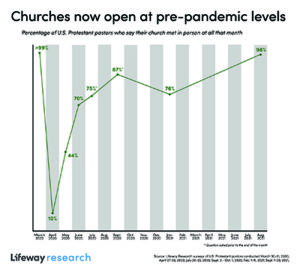
Almost all U.S. Protestant pastors (98 percent) say their church met in person in August, according to a new Lifeway Research study. This marks the highest percentage of churches holding in-person services since March 2020, when COVID-19 became a national health issue.

During the first week of March last year, 99 percent of Protestant churches met in person. By the end of the month, only 7 percent did so, according to a previous Lifeway Research study.

A majority of churches didn’t start holding in-person services again until June 2020. By September 2020, 87 percent met physically, but that dropped to 76 percent in January 2021, according to Lifeway Research studies conducted at the time. In August 2021, however, only 2 percent of churches did not meet in person at all.

“Every church’s path has been different during the pandemic, and each stage of resuming specific aspects of ministry is significant,” said Scott McConnell, executive director of Lifeway Research.

“Worshiping together as a physical assembly of believers in Jesus Christ is an important element of the Christian faith. For almost all Protestant churches, this stage of ministry is now active again, though other aspects of ministry may not be.”

Worshippers return but attendance gap persists

Earlier this year, even as fewer churches held in-person services, 91 percent of churchgoers told Lifeway Research they planned on attending church services as much as they did prior to the pandemic or even more once COVID-19 was no longer an active threat to people’s health.

By September 2020, U.S. Protestant pastors reported most churchgoers had returned. The average church drew 63 percent of their pre-pandemic attendance levels. That dipped slightly in January 2021 to 60 percent. By August, the average pastor saw 73 percent of their church members in person on Sunday morning.

“Many pastors and church leaders are anxious for the whole congregation to gather physically together,” McConnell said. “Worship attendance is improving, but there is still a large gap between today’s in-person attendance and pre-COVID levels.”

While some churches are still below 50 percent of their January 2020 attendance levels, others report growing during the pandemic. Almost 1 in 8 (13 percent) say they had less than half of their pre-COVID-19 crowd in August. That percentage is down substantially from earlier in the pandemic. In both September 2020 and January 2021, more than 1 in 4 churches had less than half their normal Sunday morning crowds.

A plurality of pastors (35 percent) report attendance between 50 percent and 70 percent in August 2021. For 30 percent of pastors, late summer congregations were 70 percent to less than 90 percent.

Another 1 in 8 (13 percent) were 90 percent to 100 percent of their previous levels, while 9 percent say they had more people in attendance in August than they did prior to COVID-19. Only 2 percent of pastors reported growth in January this year.

African American church attendance slow to rebuild

Some pastors are finding it harder to bring back their pre-pandemic churchgoers. While African American Protestant pastors were only slightly less likely than their white counterparts to say they met in person in August (95 percent to 98 percent), African American pastors were 12.5 times as likely as white pastors to say their attendance was less than 30 percent what it was before COVID-19 (25 percent to 2 percent).

Almost 3 in 4 pastors (73 percent) say their worship service attendance in August was fewer than 100 people, with 40 percent drawing fewer than 50 on an average weekend. More than 1 in 5 pastors (22 percent) report crowds of 100 to 249, while 6 percent say they reached 250 or more.

The small church, however, has had an advantage in the pandemic recovery period. Pastors of churches with pre-COVID-19 attendance levels of fewer than 50 people are more likely to report August 2021 attendance back to or exceeding their previous levels.

About 1 in 4 small church pastors (23 percent) say they had 90 percent to 100 percent of their pre-pandemic attendance in August, while 1 in 5 (19 percent) report higher attendance compared to January 2020.

“Most small churches are still not back to pre-pandemic attendance, but far more of them are reaching this point than larger churches,” McConnell said.

“It’s possible small churches are aided by perceived safety of a naturally smaller gathering, differences in technology options for gathering online, or the strength of relational connections. But regardless of the reasons why, in-person worship attendance trends currently look promising for small churches.”

The phone survey of 1,000 Protestant pastors was conducted Sept. 1-29, 2021. The calling list was a stratified random sample, drawn from a list of all Protestant churches. Quotas were used for church size.

Each interview was completed by the senior or sole pastor or a minister at the church. Responses were weighted by region and church size to reflect the population more accurately. The completed sample is 1,000 surveys, providing 95 percent confidence that the sampling error does not exceed plus or minus 3.2 percent. Margins of error are higher in sub-groups.


Samford pulls Meacham over Planned Parenthood ties

BIRMINGHAM, Ala. (RNS)—Noted historian and presidential biographer Jon Meacham has been uninvited from Samford University’s inaugural celebrations for their 19th president, Beck Taylor, over concerns about his ties to Planned Parenthood.

Meacham was scheduled to speak Nov. 3 as part of a series of lectures in the lead-up to the Nov. 4 inauguration of Taylor. However, the private Christian university in Homewood, Ala., pulled Meacham’s lecture after a student created an online petition and a resolution was passed by the Student Government Association, both calling for his removal.

The Change.org petition, started by Samford student Emily Kirby, has garnered more than 1,000 signatures and states their request for Meacham’s removal does not have to do with the content of his lecture but, rather, his “beliefs and previous engagements.”

The petition says Meacham’s involvement with Planned Parenthood does not align with the stance of the university, which historically was affiliated with the Alabama State Baptist Convention. The resolution passed by Samford’s Student Government Association called for the event to be postponed for the same reasons.

On Oct. 6, Meacham headlined the Planned Parenthood South Texas annual luncheon. His speech reflected on the 2020 presidential election and its aftermath. He also spoke at the organization’s 2019 luncheon. Neither of these speeches addressed abortion specifically but were about divisions within the country.

In the press release announcing Meacham’s talk at Samford, which has since been deleted from the school’s website, he is described as “a skilled orator with a depth of knowledge about politics, religion and current affairs.”

Meacham has written numerous books about American history and presidents, including biographies of George H.W. Bush and Thomas Jefferson. His book American Lion, about the life and presidency of Andrew Jackson, won the 2009 Pulitzer Prize in biography. In his recent book, His Truth Is Marching On, Meacham examines how civil rights activist and longtime Congressman John Lewis’ faith in God was integral to his fight for racial equality.

The cancellation of Meacham’s lecture at Samford comes at a time when students and faculty at other Christian schools across the country are calling for more diversity and equity within their institutions.

At Cornerstone University in Grand Rapids, Mich., faculty recently voted no confidence in their incoming president because of his opposition to inclusion efforts. Similarly, faculty at Seattle Pacific University in Washington voted no confidence in its board of trustees after members declined to change a policy preventing the hiring of LGBTQ people.

In a letter sent to students on Oct. 27, Taylor wrote that he is “disappointed by the narrative that has combined important conversations about pro-life issues and Mr. Meacham’s planned appearance at Samford.” While Taylor recognized the potential distraction this event would cause, he also highlighted the “importance of free expression and the exchange of ideas.”

“Our mission as a Christ-centered institution of higher learning is to stand boldly at the intersection of society and the church and to convene important conversations about how to live faithfully in the world,” wrote Taylor in his letter.

A statement provided by Holly Gainer, director of university communications at Samford, said Meacham’s lecture has been postponed and will be rescheduled.


Research shows Bible study helps reform prisoners

WASHINGTON (BP)—Incarcerated individuals became more forgiving, accountable, grateful and capable of self-control after taking an eight-week Bible study on the Gospel of Mark, a newly released study from Prison Fellowship International and Baylor University found.

The course, “The Prisoner’s Journey,” also helped decrease depression, anxiety and anger among those enrolled, thereby reducing drug abuse and fighting, according to initial findings of the first phase of the study conducted in prisons in South Africa and Colombia.

byron johnson300
Byron Johnson

Byron Johnson, founding director of Baylor’s Institute for Studies of Religion, said the research shows the importance of faith-based prison reform.

“Programs like (The Prisoner’s Journey) yield empirical validation of the reality that much of the truly innovative work being done in the name of prison reform is coming from faith-based programs operated by organizations like Prison Fellowship International,” Johnson said.

“These remarkable programs—led by faith-motivated volunteers—are doing a lot to transform individuals and prisons across the world. I hate to think where we would be without these ministries that are dedicated to serving the least of these.”

Baptist Briefs: Prison church joins Baptist association
Inmates at Louisiana State Penitentiary at Angola were the first to have the opportunity to pursue seminary training through a New Orleans Baptist Theological Seminary extension at the nation’s largest maximum security prison. Inmate Paul Will, pastor of Grace Baptist Church of the Main Camp, is a 2007 graduate of seminary’s extension program at Angola. (Baptist Press file image from “A New Hope,” a documentary about the ministry)

Southern Baptist seminaries have offered Bible-based degrees to prison populations, beginning 20 years ago with the New Orleans Baptist Theological Seminary’s flagship program at Louisiana State Penitentiary at Angola. Graduates become ministers among their fellow inmates.

Jody Dean, senior regional associate dean for New Orleans Seminary extension centers, said such programs are part of the seminary’s mission.

“As you unpack our mission statement, the prison programs fit clearly in line with our mission of those that are called to walk with Christ to help them be prepared to proclaim his truth and fulfill his mission,” Dean has said. “And we see them doing that by beginning to teach the word (of God), share the truth and share Christ with those around them.”

Baylor University and Prison Fellowship International released initial findings Oct. 20 after conducting the 40-month study that ended in April, revealing varying degrees of change among prison populations based on such variables as their relationship with God before they enrolled in the Bible study, and whether they were motivated by a sincere desire to change or a selfish desire to possibly earn early release from prison.

Warden calls for churches to help break cycle of criminal activity
Prisoners gather in the yard at the Texas Department of Criminal Justice Darrington Unit in Brazoria County. Southwestern Baptist Theological Seminary and the Heart of Texas Foundation launched Bible college courses there modeled after a program at Louisiana’s Angola prison. (Heart of Texas Foundation Photo)

In Colombia, researchers compared 217 prisoners engaged in the Bible study with the outcomes of 217 prisoners not enrolled in the Bible study.

“In Colombia, we found inmates who completed the Bible study increased their religious involvement,” researchers said, with participants ranking near a negative 0.10 before the Bible study, and rising to a positive 0.60 after the Bible study on the researchers’ religiosity scale, but researchers did not cite specific numerical results. “On the other hand, there was no significant change among those who did not participate in the program (control group).”

Among the 437 inmates who took the Bible study in South Africa, compared to a control group of 125, researchers said their findings “confirmed the importance of religious involvement in relation to inmate transformation through the development of prosocial changes in self-identity and moral character.

Specifically, increased religiosity contributed to an inmate’s cognitive and emotional identity transformations as well as the virtues of forgiveness, empathy, and self-control, which in turn reduced inmate’s negative emotional states.
In addition, involvement in The Prisoner’s Journey course decreased the risk of prison misconduct both directly and indirectly by fostering gratitude among participating inmates.”

Researchers did not reveal numerical findings among the South African participants, but researchers hope to expand the study to include additional prison populations.

More than 460,000 incarcerated people have taken the course Prison Fellowship International conducts in prisons in 39 countries including Latin America, the Asia Pacific region, the Caribbean, Europe and the Middle East.

Prison Fellowship International promotes itself as having worked since 1979 to transform prison populations with the power of the gospel, hoping to engage 20 percent of the global prison population with The Prisoner’s Journey Bible study. Annually, 15 million people worldwide are imprisoned, the group noted.


Umpire-minister Ted Barrett returns to World Series

HOUSTON (BP)—Ted Barrett—a Baptist minister and umpire—is back in the World Series.

A full-time umpire for Major League Baseball since 1999, Barrett is co-founder of Calling for Christ.

On Oct. 15, the day after his crew wrapped up the divisional round between the Giants and Dodgers, Barrett received word that for the fifth time he would be among those making the calls on baseball’s biggest stage.

The 56-year-old ordained Southern Baptist minister has a seasoned perspective from when he first began calling some MLB games in 1994.

“It’s truly a gift,” he told Baptist Press “All good things come from God, and this was a surprise for me.”

Typically, four to five years may pass between an umpire’s opportunities to be in the World Series.

Barrett’s work off the baseball field overshadows his work on it. Through Calling for Christ, he encourages peers to stay strong in their faith through—when possible—in-person gatherings but also by virtual meet-ups from whatever various cities have a game that day.

In his career, he’s witnessed the gospel’s impact on umpires working a high-stress job that has no shortage of people telling you you’re doing it wrong.

“It’s been really cool coming up with guys in the minor leagues who, at first, had no interest in church or Scripture,” he said. “I get to see their participation grow at things like a retreat or spring training Bible study. They get involved and go deep. It’s great to watch.”

‘Give it all to God and let things play out’

Umpires Ted Barrett, Angel Hernandez, Lance Barksdale and Alex Tosi huddle before the New York Yankees take on the New York Mets in a baseball game on Friday, Sept. 10, 2021, in New York. (AP Photo/Adam Hunger)

Two of those involved in Calling for Christ, Alfonso Marquez and Mike Muchlinske, were on the field with Barrett during Game 1 of the World Series. All three carried a small, metal cross Barrett’s 81-year-old dad, Jim, a retired welder from Buffalo, N.Y., made in his backyard in Arizona.

“Since he makes them, they’re all a little different,” said Barrett. “Mine is attached to my stopwatch, and so when I walk around, it hangs from my pocket. Fans will see it and say something. They also see us pray at home plate before a game.”

That witness extends to the game itself.

“On the field, I want to be an example of a Christ-follower with integrity. I say Jesus would have been the ultimate umpire, with his ability to make the tough calls. I call people out, but grace and forgiveness can be there when confrontation happens. When I walk out there, I feel I have favor from God with the interaction I have with players, managers and coaches.”

Baseball in 2021 is different than last year, he noted. Although there was a champion crowned in 2020, the absence of crowds made the game different. It was very strange and surreal, he said.

“I’m really looking forward to tonight and having the fans back,” Barrett said prior to the first game of the 2021 World Series.

And yet, he’s even more eager for what comes after the season. That includes spending time with his grandkids, ministry through Calling for Christ and filling pulpits.

“A lot of guys, as we get older, realize more and more how much we rely on God,” he said. “The reality is God has been carrying me all along. Whatever God has next, I’m going to enjoy it. We’re to give it all to God and let things play out.”


Pandemic increased stress but few pastors left the ministry

NASHVILLE, Tenn.—Pastors have faced increased stress during the COVID-19 pandemic, as churches were forced to adapt overnight. More felt their role was overwhelming at times, but few pastors actually decided to leave the ministry.

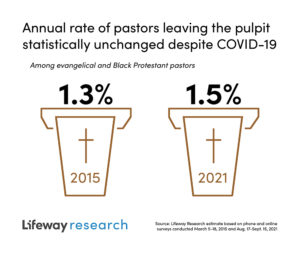
A new Lifeway Research study found close to 1 percent of evangelical and historically Black Protestant senior pastors step away from the pulpit each year—a rate statistically unchanged from a 2015 Lifeway Research study.
“COVID-19 was neither a small nor short-lived stressor for pastors,” said Scott McConnell, executive director of Lifeway Research. “Many have speculated that pastors have been opting out of the pastorate as a result. That is not the case. They are remaining faithful to the calling at levels similar to those seen before the pandemic.”

The August-September 2021 study surveyed more than 1,500 pastors serving in both evangelical and historically Black Protestant churches.

Around 1 in 6 pastors (17 percent) started at their current church during the pandemic years of 2020-2021. Half of the senior pastors facing the ministry upheaval brought on by COVID-19 were new to their role, and 51 percent are serving in their first church as senior pastor.

More than 1 in 3 pastors (37 percent) say they were the senior leader of their church 10 years ago. Among those congregations that had a different pastor in 2011, most of the previous pastors are now either retired (30 percent) or pastoring another church (28 percent).

In that time frame, some stepped away from the pulpit for a different ministry role (13 percent) or are working in a non-ministry position (8 percent), according to the current pastor. Combined, those two groups who leave the pastorate before retirement reveal an annual pastor attrition rate of around 1.5 percent.

“COVID-19 is not the only pressure pastors face, nor is it the most likely reason pastors from a decade ago are no longer pastoring,” McConnell said. “Baby Boomer pastors are reaching retirement age, and while many continue pastoring for years afterward, retirement is still the most common reason a pastor from 2011 is not pastoring a decade later.”

Thinking of their predecessor in cases where that person is working outside the pastorate, current senior pastors are most likely to say the previous pastor left due to a change in calling (32 percent), church conflict (18 percent), burnout (13 percent), being a poor fit with the church (12 percent), or family issues (10 percent).

Fewer point to a moral or ethical issue (8 percent), an illness (5 percent), personal finances (5 percent), or a lack of preparation (3 percent).

Conflict and change

Regardless of how the previous pastor left, the vast majority of pastors feel confident in their position. Nine in 10 pastors (90 percent) say they are sure they can stay at their current church as long as they want, including 60 percent who strongly agree.

While only 15 percent of pastors a decade ago have left the pastorate and fewer than 1 in 6 pastors say conflict drove that pastor from the pastorate, many pastors have experienced conflict in their church.

Among the pastors surveyed who pastored a different church previously, almost half (47 percent) say they left their last church because they took it as far as they could. Another third (33 percent) say their family needed a change. A quarter say there was conflict in the church (25 percent). More than 1 in 5 points to the church not embracing their approach to pastoral ministry (22 percent) or having unrealistic expectations of them (21 percent). Another 18 percent admit they were not a good fit for the church. Few say they were reassigned (14 percent) or asked to leave the church (10 percent).

Even if conflict didn’t cause them to leave their last church, most pastors (69 percent) say they dealt with some type of conflict there.

More than 1 in 3 say they experienced a significant personal attack (39 percent), had conflict over proposed changes (39 percent), or were in conflict with lay leaders (38 percent). More than a quarter ran into disagreements over expectations about the pastor’s role (28 percent) or their leadership style (27 percent). Fewer experienced conflict over doctrinal differences (12 percent) or politics (8 percent).

“Churches are groups of people, and even like-minded people do not always get along,” McConnell said. “It would be naïve to think a church would not experience disagreements. The important thing is whether that church maintains unity and love for each other as they navigate those differences or stoops to personal attacks as many pastors have experienced.”

Their previous experience with conflict leads 4 in 5 pastors (80 percent) to expect they will have to confront it in their current church in the future. As part of this preparation, 9 in 10 say they consistently listen for signs of conflict in their church (90 percent) and invest in processes and behaviors to prevent it (89 percent).

Overworked and overloaded

Direct conflict with churchgoers is not the only type of issue pastors face in their ministry. They often feel overworked and overloaded as individuals and worry about the toll their work may take on their family.

Most pastors say they are on-call 24 hours a day (71 percent) and their role is frequently overwhelming (63 percent). Half of pastors (50 percent) say the demands of their job are often greater than they can handle. Many say they feel isolated (38 percent) and face unrealistic expectations from their church (23 percent). One in 5 pastors (21 percent) admit they frequently feel irritated at their church members.

“The impact of the pandemic may be most noticeable in pastors’ increased agreement that the role of being a pastor is frequently overwhelming, which jumped from 54 percent in 2015 to 63 percent today,” McConnell said.

“But there has also been a shift in how some pastors think about their work. Fewer pastors agree they must be ‘on-call’ 24 hours a day, declining from 84 percent to 71 percent. Perhaps even more telling, the majority of pastors (51 percent) strongly agreed with this expectation in 2015, while only a third (34 percent) strongly feel this obligation today.”

Almost all evangelical and Black Protestant pastors are married (95 percent), and their role as spouse, and often parent, has the potential to conflict with their role as church leader. Most, however, feel serving in vocational ministry has been good for their family.

More than 9 in 10 pastors say their spouse is very satisfied with their marriage (96 percent) and enthusiastic about life in ministry together (91 percent). A similar percentage (94 percent) consistently protect time with their family. Most pastors were able to take a week’s vacation with their family last year (83 percent) and plan monthly date nights with their spouse (66 percent).

As a result, few say their work keeps them from spending time with their family (31 percent), and even fewer feel their family resents the demands of pastoral ministry (19 percent).

Still, 2 in 5 pastors say they are often concerned about their family’s financial security.

“Fewer pastors are concerned about their family’s financial security—41 percent today compared to 53 percent in 2015,” McConnell said. “This decrease in the number of pastors stressed over their personal finances may be due to increased generosity in their church or financial stimulus checks from the government. It is still more common for a pastor to be worried about their own finances than to report declines in giving at their church.”

Encouragement and support

While families may provide some added stress and responsibilities for pastors, they are also one of the sources of encouragement and support. They also are a channel through which a congregation can care for their pastor. Nine in 10 pastors (90 percent) say their family receives genuine encouragement from their church.

Close to 9 in 10 (86 percent) feel their church gives them the freedom to say no when faced with unrealistic expectations. While few say their church has a plan for the pastor to periodically receive a sabbatical (32 percent), almost 9 in 10 say they have a day to unplug from ministerial work and have a day of rest at least once a week (86 percent).

Pastors are also leaning on others for support and encouragement. Most say at least once a month they openly share their struggles with their spouse (82 percent), a close friend (68 percent), or another pastor (66 percent). Others say they are able to speak with lay leaders in the church (42 percent), a mentor (40 percent), another staff member (35 percent), a Bible study group in their church (23 percent), or a counselor (9 percent).

“The difficult moments and seasons pastors face require ongoing investment in their spiritual, physical and mental well-being,” McConnell said. “Most pastors and churches have practices that help the pastor in these ways, but there are often missed opportunities to encourage, build up and avoid misunderstandings.”

The study was sponsored by Houston’s First Baptist Church and Richard Dockins, M.D. The mixed mode survey of 1,576 evangelical and Black Protestant pastors was conducted Aug. 17–Sept. 15, 2021, using both phone and online interviews.

The completed sample is 1,000 phone interviews and 576 online surveys. Responses were weighted by region, church size and denominational group to reflect the population more accurately. The sample provides 95 percent confidence the sampling error does not exceed plus or minus 2.7 percent. Margins of error are higher in sub-groups.

Comparisons are made to a phone survey of 1,500 evangelical and Black Protestant pastors conducted by Lifeway Research March 5-18, 2015.


Influential musician Ralph Carmichael dead at 94

NASHVILLE (BP)—Often called the “father of contemporary Christian music,” Ralph Carmichael left his mark on the music industry in seven decades and at least as many genres. Carmichael died Oct. 20 at the age of 94.

Planning to become a pastor, Carmichael attended Southern California Bible College. But he pursued music instead and became head of the school’s music department. The innovative, contemporary arrangements he did with the school’s various music groups and ensembles won him acclaim, but churches often found them too worldly.

In the 1950s and ‘60s, Carmichael crossed easily between working with Gospel greats like George Beverly Shea and arranging for jazz legends like Ella Fitzgerald and Nat King Cole. And all the while, he was composing music for TV shows, including I Love Lucy and Bonanza, films like the 1958 hit The Blob and many others.

In 1966, he founded Light Records to give voice to the growing Jesus Movement. Artists he signed, like Andrae Crouch and the Winans, soon became major players in a whole new kind of music.

“The rise of the Christian music industry is not that long of a story,” said Mike Harland, associate pastor of worship at First Baptist Church of Jackson, Miss. “Just 40 years ago, there really was no such thing as a genre of Christian music. It grew out of the Jesus Movement.

“Ralph Carmichael was one of those legitimate music industry executives that built the bridge between what was happening in the Jesus Music movement … to the church itself.”

Harland, who served several years as the director of Lifeway Worship before returning to local church ministry, first encountered Carmichael’s work singing in youth choir.

“He was the father of the youth musical,” Harland said of Carmichael, whose work in musicals like Tell It Like It Isand Young Messiah was performed in churches far and wide. “When it came to the Baptist tradition, his name was on it.”

Many more Christians were exposed to Carmichael’s work in film scores he wrote for the Billy Graham Evangelistic Association—20 in all, including 1970’s The Cross and the Switchblade.

Others remember singing his songs—like “The Savior Is Waiting” (which Harland called “a staple of Baptist hymnody”), “He’s Everything to Me,” “Reach Out to Jesus” (recorded by Elvis Presley) and “Love is Surrender” (recorded by the Carpenters).

Perhaps his best known, most enduring work was 1960’s “The Magic of Christmas,” an album of mostly sacred Christmas songs by Nat King Cole. Carmichael’s tender, lush arrangements can still be heard just about anywhere each Christmastime, and his and Cole’s version of “The Christmas Song” is considered a classic.

Harland said Carmichael was a well-respected musician who just happened to be a Christian, which lent legitimacy to a struggling new industry.

“His faith found its expression in his life,” he said. “And his life was a musician. … It would be very difficult to measure the impact Ralph Carmichael had on American music in general but particularly Christian music.”

Harlan likened it to the “coaching tree” concept in football, when people make connections based on coaches they’ve worked with or for.

“If there were a musician tree, it goes back to Ralph Carmichael,” he said.


Baptist watchdog issues annual ethical fashion report

WASHINGTON (RNS)—The fashion industry continues to struggle with wage gaps and sustainability, according to a report from an Australian Baptist watchdog group, despite marked improvement in how the industry treats workers and sources its goods over the past few years.

Baptist World Aid Australia’s 2021 Ethical Fashion Report scorecard rated roughly 100 fashion companies, which averaged a score of 33.6 out of 100 compared with all industries the group tracks.

“We’ve seen considerable progress in the fashion industry and engaged with many brands that are committed to becoming more ethical and sustainable,” said Peter Keegan, Baptist World Aid’s director of advocacy. “But these grades and scores show us we’re not there yet.”

Baptist World Aid Australia has published the annual Ethical Fashion Report since 2013, as part of its efforts to alleviate global poverty and challenge injustice. According to the report, the global fashion industry, which employs some 50 million people, is one of the top five industries most at risk for complicity in modern slavery.

Group assigns ethical ratings to brands

Brands are rated in five categories, which include environmental sustainability, human rights monitoring and worker empowerment.

Using the organization’s Brand Finder, shoppers can compare the ethical ratings of their favorite brands, which receive grades from A+ through F based on a numerical score.

This year, 40 percent of companies improved their score compared with 2019, and the industry saw an overall increase in companies using sustainable fibers and tracing raw materials. Twenty companies earned an A+ and A, 55 received B or C and 23 received D or F.

Popular brands including H&M, Converse and Patagonia earned an A rating, while Roxy and Forever 21 earned an F.

The average company scored a D for work on wage improvement and worker unions. The report also found that only 15 percent of companies are paying workers in their supply chain a living wage, a drop from 20 percent in 2019.

The report attributed the decline to pandemic-related losses, noting garment workers have collectively lost more than $16 billion in wages since COVID-19 began.

“Our research identified a vast gap between the ethical sourcing measures companies put in place, and real, tangible outcomes for garment workers,” said Chantelle Mayo, advocacy project manager for Baptist World Aid Australia. “That’s a big hurdle for any consumer trying to shop ethically, and an area we need to keep pressuring the fashion industry to address.”


Attendance shrinking at small and midsize congregations

WASHINGTON (RNS)—A new survey of 15,278 religious congregations across the United States confirms trends sociologists have documented for several decades: Congregational life across the country is shrinking.

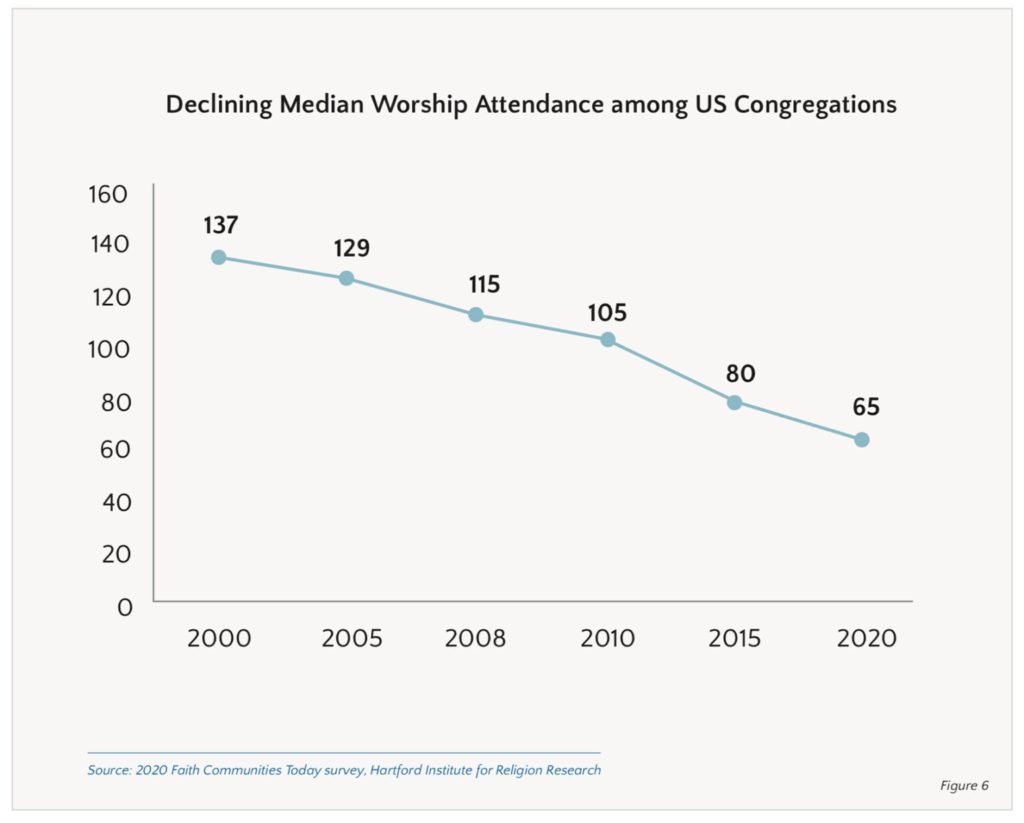
The most recent round of the Faith Communities Today survey found a median decline in attendance of 7 percent between 2015 and 2020.

The survey, fielded just before the coronavirus lockdown, finds that half of the country’s estimated 350,000 religious congregations had 65 or fewer people in attendance on any given weekend. That’s a drop of more than half from a median attendance level of 137 people in 2000, the first year the survey gathered data.

As Scott Thumma, director of the Hartford Institute for Religion Research and the survey’s author, put it: “The dramatically increasing number of congregations below 65 attendees with a continued rate of decline should be cause for concern among religious communities.”

The Faith Communities Today survey consists of self-reported questionnaires sent out to congregational leaders every five years since 2000—mostly through 20 collaborating denominations and faith traditions.

It found mainline Protestants suffered the greatest decline over the past five years (12.5 percent), with a median of 50 people attending worship in 2020. Evangelical congregations declined at a slower rate (5.4 percent) over the same five-year period and had a median attendance of 65 people at worship. Catholic and Orthodox Christian churches declined by 9 percent.

The only groups to boost attendance over the past five years were non-Christian congregations—Muslim, Baha’i and Jewish.

Not just mainline churches declining

“One of the meta-narratives of the last several decades is mainline decline and evangelical health,” said Mark Chaves, professor of sociology, religious studies and divinity at Duke University, who conducted a similar analysis known as the National Congregations Study. “It’s clear in recent years there’s been a decline in evangelical churches, as well. Mainline decline is not unique.”

The survey found half of the nation’s congregations were in the South, even though only 38 percent of the U.S. population lives there. It also suggested small congregations in rural areas and small towns may be unsustainable. Nearly half of the country’s congregations are in rural areas (25 percent) or small towns (22 percent), while the 2020 census found only 6 percent of Americans live in rural areas and 8 percent in small towns.

The country’s changing demographics may be key to rural and small-town decline. Young people have been moving to urban areas; businesses and industries have also left these communities bereft of resources and talent.

That doesn’t mean all small churches are going to close. Allen Stanton, director of the Turner Center for Rural Vitality at the University of Tennessee Southern, said smaller congregations need to be judged on their own metrics.

“We’re asking rural churches to be more like large and suburban churches, and they’re not designed to be,” said Stanton, author of Reclaiming Rural: Building Thriving Rural Congregations.

Measures taken by larger churches, such as increasing the number of small groups or attracting more youth, may not be feasible in these communities, Stanton said. But these congregations can still hold their own, with part-time leaders or volunteers.

Decline most drastic in midsized churches

However, the Faith Communities Today survey finds it’s midsize churches with an attendance of 100 to 250 that have declined the most precipitously—the median decline was 12 percent.

“These congregations were built in the post-World War II era,” said Thumma. “They’re struggling to have enough staff to satisfy everybody. And they don’t have all the programs of larger churches.”

Congregations with 1,500 people in attendance were best able to avoid decline; 71 percent of those large churches grew over the past five years. That may suggest many people are abandoning midsized congregations for megachurches that have full-time clergy, greater financial and physical resources and a diversity of ages and races among members.

One bright spot in the study: Congregations are becoming more racially diverse. In 2000, only 12 percent of congregations were multiracial. In the latest survey, the figure climbed to 25 percent.

The survey defined multiracial congregations as those where 20 percent or more of participants are not part of the dominant racial group.

Many researchers now are investigating if racial diversity also equals integration in relationships—or if people simply are attending church together. Previous research also found increased diversity is one-directional.

“It’s still in the direction of predominantly white churches becoming less predominantly white, Chaves said. “It’s very little in the other direction. There’s not a big increase in diversity in predominantly Black churches.”


Nearly half in U.S. watched church online during pandemic

NASHVILLE, Tenn.—Prior to the COVID-19 pandemic, online worship services were a novel concept for many churches. In the almost two years since, however, churches have adapted and reached new people with the adoption of digital streaming.

According to a new Lifeway Research study, 45 percent of Americans say they have watched a Christian church service online during the COVID-19 pandemic, including some who say they don’t normally physically attend.

Slightly more than half (52 percent) say they have not watched a church service during the pandemic, most of whom say they don’t normally attend church in person either.

“The distance to one’s nearest church has changed almost overnight,” said Scott McConnell, executive director of Lifeway Research. “A form of communication that was not even used by most churches before the pandemic has now reached almost half of Americans.”

Churches pivoted to online options early in pandemic

In a previous Lifeway Research study of Protestant pastors conducted prior to the spread of COVID-19, 41 percent said they didn’t regularly livestream any portion of their church service or post the sermon online later. At the time of the survey, only around 1 in 4 (27 percent) said they livestreamed either the entire service or just the sermon.

As the coronavirus began to spread and social distancing guidelines emerged, the vast majority of churches quickly provided digital options. By March 2020, Lifeway Research found 92 percent of Protestant pastors said they provided some type of video sermons or worship services online. That climbed to 97 percent in April 2020.

In a Lifeway Research study from early 2021, 85 percent of Protestant churchgoers said their congregation offered livestreamed worship services, and 76 percent said their church posted a video of the worship service to watch later.

Additionally, 53 percent of churchgoers said they watched online worship services at their church more in 2020 than in 2019, while 21 percent said they watched more online services at a different church in 2020.

Those who had not attended connected to church online

Throughout the pandemic, Lifeway Research found pastors reporting new people who had previously not attended their church in the past attended or connected online. The latest study seems to bear that out.

When asked, “Have you watched a Christian church service online during the COVID pandemic?” 45 percent say they have, including 30 percent who normally attend church in person and 15 percent who normally do not attend in person.

“It’s not surprising to see churchgoers using online options to view a church service, but there are also those who have not been church attendees who have at least checked out a church service during the pandemic,” McConnell said.

Americans with evangelical beliefs are three times as likely as other Americans to say they watched church services online during the pandemic and normally attend church in person (64 percent to 20 percent).

Some of those most likely to say they watched church services online during the pandemic but don’t normally attend church in person include young adults ages 18-34 (18 percent) and African Americans (22 percent).

Churches were still not able to reach most Americans with the expansion of digital offerings during the pandemic, however, as 52 percent say they have not watched services online during the pandemic.

Most of those (42 percent) say they haven’t watched online and normally do not attend church in person. Another 1 in 10 Americans (10 percent) say they do normally attend church in person but have not watched a church service online during the pandemic.

“Church participation is in flux,” McConnell said. “Some who were regular, in-person churchgoers before COVID-19 only view online services today, others have never tuned in online despite the pandemic, and still others use both at different times. This shift has created both challenges and opportunities for pastors and church leaders.”

The online survey of 1,005 Americans was conducted Sept. 3-14, using a national pre-recruited panel. Analysts used quotas and slight weights to balance gender, age, region, ethnicity, education and religion to reflect the population more accurately. The completed sample of 1,005 surveys provides 95 percent confidence that the sampling error from the panel does not exceed plus or minus 3.3 percent. Margins of error are higher in sub-groups.


Documentary recounts the glory and mess of Christian music

NASHVILLE (RNS)—The contemporary Christian music industry survived scandals, pushback from televangelists and the wholesale disruption of the record industry over the past 50 years and kept rolling along.

Then last spring, COVID-19 brought it all to a halt.

Artists who’d spent decades on the road were suddenly stuck at home, their tour buses unpacked, with no clear indication when they’d be able to get back to playing music in public. For Christian filmmakers Andrew and Jon Erwin, who began their careers making music videos, the pandemic seemed a once-in-a-lifetime chance to get their musical heroes on camera.

“For the first time in history, all of these artists are off the road,” Andrew Erwin told Religion News Service.

So the Erwins, a pair of brothers who’ve made faith-based movies such as I Can Only Imagine and October Baby, called up Christian music legends Amy Grant and Michael W. Smith and pitched the idea of a documentary about the history of Christian music. The two said “yes” and signed on as producers. Before long, the project was underway.

‘The Jesus Music”  traces CCM history

The result of their efforts is The Jesus Music, a documentary that traces contemporary Christian music from its beginnings among hippies at Calvary Chapel in Costa Mesa, Calif., in the late 1960s to the global worship music empire of Australia’s Hillsong Church.

The documentary debuted in early October, earning just over a half-million dollars at the box office in limited release, according to Deadline Hollywood, which covers the entertainment industry.

Andrew Erwin said he and his brother interviewed about 100 artists, including some of the biggest names in Christian music, including Kirk Franklin, TobyMac and other members of DC Talk, Chris Tomlin, Bill Gaither, Lecrae and current chart-topper Lauren Daigle.

Distributed by Lionsgate, the film is anchored around the experiences of Grant and Smith, who became some of the biggest names in the business beginning in the 1980s. Early on, Grant gives an interview in what was once the Koinonia Christian Bookstore and Coffeehouse on Nashville’s music row.

At the time of the interview, Grant—who has sold tens of millions of records—was a few weeks away from having open-heart surgery. She recalls visiting the coffeehouse and hearing people singing with guitars about Jesus. The experience, she said in the film, changed her life.

“It was unlike anything this Southern religious town had seen,” she said during the interview.

“A lot of hymns are, close your eyes singing to God,” Grant said, in describing the music she dreamed of making. “I wanted to sing songs with my eyes wide open, singing to each other.”

Rooted in early 1970s Jesus Movement

The strongest part of the film comes in the first hour. The Erwins use vintage footage and interviews with California pastor Greg Laurie and Tommy Coomes of the early Christian rock band Love Song to recount the movement’s early days, when former hippies, disenchanted by sex and drugs, formed what was known as the “Jesus movement” of the early 1970s.

That moment had its own soundtrack with guitar and drums—epitomized by the long-haired songwriter star Larry Norman, whose songs about the end of the world, racism and the emptiness of drugs and sex made him the movement’s first rock star.

At one point, interviewees recite lyrics of “Why Don’t You Look Into Jesus,” one of Norman’s early hits, which begins with the line “Sipping whiskey from a paper cup, you drown your sorrows till you can’t stand up,” then goes on to talk about shooting up drugs and getting a sexually transmitted disease on Valentine’s Day.

John Styll, the former president of the Gospel Music Association and founder of Contemporary Christian Music magazine, said such lyrics would be banned on today’s Christian radio.

“No way would they play it,” he said in the film.

The movie also highlights Explo ’72, a massive Christian music event that featured Christian music stars alongside performers such as Johnny Cash, Rita Coolidge and Kris Kristofferson. During that event, which brought more than 200,000 young people to Dallas, evangelist Billy Graham gave his stamp of approval to the Jesus movement and Jesus music.

“True faith ought to be applied to the social problems of our day,” Graham said in a speech at the event that’s featured in the film. “Today, Christian young people ought to be involved in the problems of poverty, ecology, war, racial tension and all other problems of our generation.”

‘We wanted to understand the struggle’

Lonnie Frisbee, an influential preacher in the movement’s early days, also is featured in the documentary. Frisbee played an important role in the Jesus movement but was long overlooked after his death from AIDS in the early 1990s. The film also mentions some of the scandals that engulfed Christian music stars such as Grant and Sandi Patty.

“We did not have any intention of chasing scandal, but we wanted to understand the struggle,” said Jon Erwin in a video interview. “There were a lot of complicated people within the timeline of Christian music.”

Kirk Franklin in “The Jesus Music.” (Photo courtesy of Lionsgate)

The film also denounces the racism that separated white Christian stars from Black gospel musicians. It includes an interview with Kirk Franklin, whose comments about seeking racial healing were cut from a broadcast of a Christian music industry awards show.

“When we don’t say something, we’re saying something,” Franklin said during the speech, which addressed the killing of Black men.

One of the film’s most touching moments comes in footage of the funeral for Truett Foster McKeehan, the 21-year-old son of TobyMac, one of the founders of DC Talk. McKeehan died of an accidental overdose in 2019, and his father recounts his son’s passing in an emotional interview.

Among the film’s surprises is a section on the Christian metal band Stryper, whose members became Christians after watching sermons of televangelist Jimmy Swaggart. After their conversions, band members became stars known for playing metal music that praised Jesus and for throwing Bibles at their fans during concerts, only to see Swaggart turn on them.

Most of the musicians in the film said if they had the chance, they’d do it all over again. But their fame came with a cost, warns Michael Tait, one of the founders of DC Talk. Tait would go on to be the lead singer of the Newsboys, another influential Christian band.

“I would not wish fame, or fortune, or notoriety on anybody,” he said. “Anonymity is not a bad thing. Trust me.”


Southern Gospel museum seeks new home

PIGEON FORGE, Tenn. (BP)—The Blackwood Brothers Quartet promoted its 37-passenger, refurbished 1939 Aerocoach bus, air-conditioned with bunk beds and recliners, as providing the “utmost riding comfort.”

Typically at that time in the 1950s, Southern gospel music groups traveled the sometimes hundreds of miles by car to perform in rural towns, with singers in the seats and musical instruments in the trunks, said Arthur Rice, lead singer for the Kingdom Heirs and president of the Southern Gospel Music Association’s Southern Gospel Music Hall of Fame and Museum.

“And so J.D. Sumner decided that, you know, it would be a whole lot more comfortable to travel in something that was a little bit bigger,” Rice said. “J.D. Sumner was the very first one to actually come across” using tour buses for singing groups.

A replica of the bus is among the thousands of Southern gospel music artifacts displayed by the Southern Gospel Hall of Fame and Museum.

The Southern Gospel Music Association is looking for a new home for its collections after more than 20 years at Dollywood, Dolly Parton’s amusement park and entertainment complex in Pigeon Forge, Tenn. The association’s lease for its 15,000-square-feet facility at Dollywood was not renewed in 2021 because of constraints of the COVID-19 pandemic and a Dollywood expansion plan, Rice said.

Between performances of the Kingdom Heirs Oct. 8 at Dollywood, where the group is in its 36th year as resident gospel artists, Rice talked about the search for a new museum home. He said the Southern Gospel Music Association plans to remain in the Pigeon Forge area and is currently blessed to store its hall of fame and museum artifacts in space donated by an area businessman. Several possibilities are being considered for new sites.

Arthur Rice (2nd row 3rd from left) is lead singer of the Kingdom Heirs and president of the Southern Gospel Music Association’s Southern Gospel Music Hall of Fame and Museum. (Kingdom Heirs photo)

“When we opened at Dollywood that was just a godsend, to have a public platform to present our music and the message,” Rice said. “That was right for the time. When we closed, I was sad because it was an end of an era, but I believe that God has … got his hand on what’s next. He’s given us this time, while the museum is closed, to prepare for that time. I don’t know exactly what it is.

“My vision really is to have a place where we could not only have the plaques and the artifacts, but also have a theater-type venue to where we could have groups come in (and) do a performance.” Attendees could then view the history.

“I think we can educate more people in a year’s time than we could in a lifetime,” Rice said.

The plaques Rice references depict inductees into the SGMA Hall of Fame spanning 25 years. 2021 inductees, announced Sept. 28 at the National Quartet Convention in Pigeon Forge, are prolific musician and songwriter Jack Clark of Cleveland, Tenn.; award-winning singer and songwriter Karen Peck Gooch of Karen Peck and New River; gospel music broadcaster Marlin Raymond Taylor; and the late Aaron Wilburn, a noted gospel songwriter, musician and comedian who died in 2020.

They join such noted honorees as Fanny Crosby, inducted posthumously in 2014; Thomas A. Dorsey, inducted posthumously in 2013; Carl Stuart Hamblen, inducted posthumously in 2012; Bill and Gloria Gaither (inducted in 1997 and 2005, respectively); and several members of The Happy Goodman family group.

In addition to the plaques, among the many museum artifacts awaiting display are historical songbooks, clothing worn by singers, and priceless musical instruments on loan from owners. Many of the priceless pieces are in safe-keeping with the owners until a new site is found.

Rice sees preserving the history of Southern gospel as important.

“It’s a very interesting story, and we want to share that with people,” Rice said. “For me, it is a map of how God has used our music through the years to encourage, to draw people to Christ, to lift them up.

“There’s nothing more encouraging than a gospel song when you’re in a low place. I want people to see how God’s hand has been on this music and on our people. We’re all flawed and we all are going through things, but God still chooses to use us as vessels. Yes, there’s been some characters through the years, but you know what, God still uses them.”