Only two-thirds of U.S. Christians believe all have sinned

GLENDALE, Ariz. (BP)—Only 66 percent of American Christians accept the biblical teaching that all have sinned, George Barna said in the latest release from the 2025 American Worldview Survey he oversees at Arizona Christian University.

Most Christians, 72 percent, also believe people are “basically good at heart” and “should not be pejoratively characterized as sinners,” Barna said, revealing confusion among Christians regarding the biblical concept of sin.

“Only 14 percent of self-described Christians hold a biblically consistent theology of sin,” Barna, director of research at ACU’s Cultural Research Center, said of the findings released in two parts Sept. 4 and Sept. 16.

“While most adults acknowledge that sin exists, many reject the truth that all have sinned and fall short before God. This misunderstanding strikes at the very heart of the gospel message.”

‘Blur the seriousness of sin’

Among the larger population, 52 percent believe everyone has sinned, Barna said, with more than 70 percent saying people should not be characterized as sinners because they are basically good at heart.

“And by believing people are ‘basically good at heart,’ the overwhelming majority of Americans (75 percent) blur the seriousness of sin,” Barna wrote of the findings. “In fact, the perspectives that most Americans have on sin are riddled with both logical and theological inconsistencies.”

The findings come from the second of those two waves of research in the 2025 American Worldview Survey conducted by the CRC among a national, demographically representative sample of 2,000 adults at least 18 years old.

Researchers examined trends in beliefs about God, truth, sin and salvation in hopes of understanding key aspects of American faith and providing insights to strengthen Americans’ biblical worldview. The second wave of research was conducted in May.

Among key findings:

  • 95 percent of self-identified Christians believe sin exists, 60 percent believe they are sinners, 66 percent believe everyone has sinned, and 72 percent believe people are basically good at heart.
  • 73 percent of Protestant churchgoers believe everyone is a sinner, compared to 57 percent of Catholics.
  • Among Protestants, 70 percent of mainline church attendees said they personally sin, followed by 69 percent of those attending independent or non-denominational Christian congregations, 61 percent of attendees of Evangelical churches, and 55 percent of adults attending charismatic or Pentecostal churches.
  • In the larger population, adult members of Gen Z (18- to 24-year-olds) are least likely to believe everyone sins, polling at 41 percent; followed by Millennials, 49 percent; Gen X, 53 percent; and Baby Boomers, 57 percent. In the larger population, 62 percent of Blacks believe everyone has sinned, followed by 51 percent of whites, 50 percent of Hispanics and 28 percent of Asians.

‘Harmful strategies’

“Taking refuge in the idea that other people have a sin problem, but they personally do not, or that sin is an outdated concept, are harmful strategies,” Barna said.

“Parents, pastors, and religious influencers have a vital responsibility to keep basic biblical truths before the Christian body, including the reality of sin and its repercussions.”

The church loses its power and authority when its understanding of and response to sin are not distinct from the culture, Barna said.

“As our nation is reeling from the tensions and sadness heightened by recent episodes of political violence, suicides, rampant crime, and other threats to our way of life and existence, the opportunity for the Church to restore sanity and security by unashamedly proclaiming the truths conveyed in the Bible is undeniable,” Barna said.

“The only question is who will be bold enough to steadfastly share God’s truths with a people who so desperately need his forgiveness and loving guidance.”


White church dedicates memorial to the enslaved

WASHINGTON (RNS)—A predominantly white church that sought to learn about its racial history has dedicated a memorial to the enslaved people who once worked on the building’s land in downtown Washington, D.C.

First Congregational United Church of Christ, which dates to 1865, dedicated six recently installed stained-glass panels, titled “Forever in the Path,” on Sept. 14.

A decade ago, the congregation began carefully studying its roots. Some members knew the church’s founders were abolitionists and helped support the creation of Howard University, a historically Black institution in Washington.

Accepted the challenge to look deeper

Renee K. Harrison (Courtesy photo)

But when congregants marked the church’s 150th anniversary in 2015, Howard University School of Divinity professor Renee K. Harrison, the preacher for that occasion, challenged them to look deeper into its history, including into the former slave owners from whom the land was purchased.

Now, Harrison, who wrote Black Hands, White House: Slave Labor and the Making of America, said the church’s years-long initiative to investigate and share that history is “highly unusual”—especially as a predominantly white congregation.

“I think the most important thing is that a Christian institution, a white Christian institution, decided to celebrate the people that work the land—both the celebration of those that were there and those that are there,” Harrison said in an interview days before the dedication ceremony.

Kelly Brown Douglas, canon theologian of the Washington National Cathedral, said the use of stained glass can serve multiple purposes now, as it did in medieval times when windows were not merely decorative but told biblical stories to illiterate people who could not read the Bible for themselves.

“It’s important that these people are finding ways to bring the Black story into a sacred space,” she said upon learning of the project at First Congregational UCC. “What it’s saying is that this story is God’s story, and God’s story is found in this story. And these people, like any other people, are sacred.”

Churches remove windows honoring Confederacy

Many predominantly Black churches have stained-glass windows that incorporate Black history. Other churches with predominantly white congregations in recent years have chosen to use new stained-glass artwork to depict modern aspects of Black history, while removing windows that highlighted the history of the Confederacy.

In 2021, the Cathedral of the Rockies, a predominantly white United Methodist church in Boise, Idaho, replaced a stained-glass window honoring Confederate Gen. Robert E. Lee with an image of Bishop Leontine T.C. Kelly, the first African American woman bishop elected in its denomination.

In 2023, the National Cathedral unveiled new stained-glass windows depicting racial justice protests that replaced panes honoring Lee and Confederate Gen. Stonewall Jackson.

Church discovered history of enslaved people

According to First Congregational United Church of Christ, which describes itself as one of the first racially integrated congregations in Washington, D.C., more than 40 people were enslaved by two families on its property, then a tobacco plantation, between 1750 and 1856.

In 2022, W. Antonio Austin, then a Howard doctoral student, researched the church’s history and in a report identified almost two dozen enslaved men, women and children who worked on the property owned by the Burnes family.

“Some of these individuals were enslaved by several generations of this family,” Austin wrote in his report, citing a document from the Maryland State Archives.

On All Souls Sunday in 2023, the church acknowledged the enslaved people, stating their names in a ceremony that featured candles, artifacts and blessings.

‘Sharing light and needing light’

In August, the stained-glass artwork, whose title evokes a portion of the last stanza of the Black national anthem “Lift Every Voice and Sing,” was installed. Jessica Valoris, a Washington-based artist who describes herself as being of “Black, Jewish and mixed ancestry,” has described the artwork as a means “to use commemoration as an invitation towards reparations, education, and communal reckoning.”

Harrison said the artist’s choice of stained-glass panels, which hang from a ceiling in front of clear windows, is fitting.

“In order for people to receive it, it has to be told with light,” Harrison said. “I think that there’s something about the sacredness of a story sharing light and needing light.”

Valoris’ written description reads: “Glass, both strong and fragile, represents the fragmentation created by systems of slavery, and also the repair that happens through our work of tending to the broken places.”

One of the panels is dedicated to Sal, an enslaved girl.

“Sal, a 9-year-old girl, was the first documented person enslaved by the Burnes family in 1750,” writes Valoris in an explanation of her artwork. “She is noted for her potential ‘increase.’ The panel depicts a mother and child, imagining Sal, reconnected to her loved ones.”

Another panel portrays Betty, an enslaved person documented in Austin’s report for being persistent in advocating for her needs and those of others who had been forced to work on the land.

Renewed covenant to ‘seek justice’

Senior Minister Amanda Hendler-Voss. (Photo courtesy of First Congregational United Church of Christ)

Amanda Hendler-Voss, senior minister of First Congregational UCC, viewed her church’s stained-glass dedication as a timely action.

“We speak this truth in a time when our nation’s president weaponizes political power to whitewash our history of slavery and Jim Crow by distorting the stories of triumph over adversity, silencing the songs of resistance, and punishing institutions that foster diversity, equity and inclusion,” she said.

“‘Forever in the Path’ calls us to renew our covenant to seek justice, love mercy and walk humbly with our God.”

The stained-glass artwork, which hangs near the entrance of the church, also helps declare the contemporary building is, in fact, a house of worship.

“Because our building is modern, people often fail to recognize that a church lives within our space, and we have been trying to be more intentional in announcing to the public our presence as a church; the stained glass is visible from the outside and helps signify that we are a church, albeit a modern one,” Hendler-Voss told Religion News Service in an email.

Douglas, who is also a visiting theology professor at Harvard Divinity School, helped guide the National Cathedral’s process that led to its new stained-glass windows. She said the story First Congregational UCC is telling represents a process of reparations similar to that occurring in the Episcopal Diocese of Washington and among white churches in particular in that diocese, as well as in other regional Christian organizations and denominations.

“Anytime you say reparations, people think of money, but it’s about more than that,” she said. “It’s about planting the seed for a future so that we don’t find ourselves back in a predicament of having to talk about reparations. And one of the ways in which you do that is you change the narrative, and you expand the narrative.”


Slim majority backs physician-assisted suicide

BRENTWOOD, Tenn.—Half of Americans believe a terminally ill person should be able to ask a doctor for help in ending their life. Legal approval has outpaced the growth in public support.

 A Lifeway Research study of U.S. adults finds 51 percent think it is morally acceptable for a person facing a painful terminal disease to ask for a physician’s aid in taking his or her life.

 “Half of Americans seek their own comfort and their own way even in their death, but that doesn’t mean they don’t think twice about the morality of physician-assisted suicide,” said Scott McConnell, executive director of Lifeway Research.

“Only 1 in 5 Americans strongly agree such a decision is morally acceptable. Others are less sure.”

Oregon passed the first “Death with Dignity” law allowing physician-assisted suicide in 1997. Currently, the practice is legal in 12 U.S. jurisdictions: California, Colorado, Delaware, the District of Columbia, Hawaii, Montana, Maine, New Jersey, New Mexico, Oregon, Vermont and Washington.

 While 51 percent of Americans agree with the morality of physician-assisted suicide, just 21 percent strongly agree. Another third (32 percent) disagree, and 17 percent aren’t sure, according to Lifeway Research.

 In a 2016 Lifeway Research study, 67 percent said the practice was morally acceptable, while 33 percent disagreed. In that previous survey, however, respondents were not given the option of saying they weren’t sure.

 Additionally, 77 percent of Americans said they believed suicide was an epidemic in a 2021 Lifeway Research study.

Few, however, felt comfortable making moral or eternal judgments about those who took their own lives. Just 38 percent said those who die by suicide are selfish, and 23 percent said they believe those who do so automatically go to hell.

“Americans base their criteria for morality on different things. Those who see the Bible’s teaching as having authority in their lives are the least likely to say physician-assisted suicide is morally acceptable,” McConnell said. “They take seriously that God breathes life and holds the keys to death.”

The latest Gallup study finds a similar 53 percent of Americans believe doctor-assisted suicide is morally acceptable, while 40 percent believe it is morally wrong. Support for the practice in Gallup’s annual study has remained near 50 percent since it began asking about the practice in 2001.

Demographic and generational differences

 In the most recent Lifeway Research study, the youngest and oldest Americans are among the most likely to support physician-assisted suicide. Those 18-34 (56 percent) and 65 or older (54 percent) are more likely than those 50-64 (45 percent) to see the practice as morally acceptable. Men are also more likely to agree than women (54 percent v. 49 percent).

 U.S. adults in the West are more likely than those in the South to support it (57 percent v. 49 percent). This reflects the legal realities of the two regions. Half of the states where physician-assisted suicide is legal are in the West, while none are in the South.

Religious beliefs and practices also contribute to the likelihood that a person backs the practice. The religiously unaffiliated (63 percent) and Catholics (59 percent) are more likely to be supportive than Protestants (42 percent) or those from non-Christian religions (42 percent).

Additionally, Americans who strongly agree evangelical theological beliefs are less likely than those without such beliefs to back physician-assisted suicide (40 percent v. 55 percent).

Impact of church attendance

Church attendance impacts the likelihood that someone will support the practice, but not in a predictable way.

Those on the two extremes—adults who attend more than once a week (58 percent) and adults who rarely or never attend (58 percent)—are more likely than those who attend about once a week (40 percent) and those who attend once or twice a month or only on religious holidays (44 percent) to say they believe physician-assisted suicide is morally acceptable.

Most Americans (55 percent) believe physicians should be able to assist terminally ill patients in ending their lives, including a quarter (25 percent) who strongly agree. Around 3 in 10 (31 percent) disagree, and 14 percent aren’t sure.

“Physician-assisted suicide has at least two parties facing a moral question—the one taking their own life and the physician who helps. Barely a majority of Americans say it is morally acceptable to take your own life, with slightly more saying a doctor can help,” McConnell said.

 Again, men are more likely than women to agree (58 percent v. 52 percent), and those in the West are more likely than residents of the South (58 percent v. 51 percent).

 The religiously unaffiliated (65 percent) and Catholics (61 percent) are also more likely than Protestants (49 percent) and those from non-Christian religions (43 percent) to think physicians should be able to assist with the suicide of terminally ill patients.

Americans with evangelical beliefs are less likely than those without those beliefs to back physicians assisting with suicides (39 percent v. 60 percent).

Less time at religious services often means more support for physicians’ ability to participate. Those who rarely or never attend religious services (60 percent) and those who attend once or twice a month or only on religious holidays (55 percent) are more likely than those who attend about once a week (45 percent) to agree. Additionally, those who rarely or never attend are the least likely to disagree (22 percent).

 The online survey was conducted Aug. 14-30, 2024, using a national pre-recruited panel. Analysts used quotas and slight weights to balance gender, age, region, ethnicity, education, religion and evangelical beliefs to reflect the population more accurately. The completed sample is 1,200 surveys. The sample provides 95 percent confidence that the sampling error from the panel does not exceed plus or minus 3.3 percent. This margin of error accounts for the effect of weighting. Margins of error are higher in sub-groups.


Gen Z and Millennials top in church attendance

BOULDER, Colo. (BP)—For the first time in decades, Gen Z and Millennials are attending church more frequently than older adults, Barna and Gloo reported Sept. 3 from its latest State of the Church research.

However, despite the rise, the average Christian still only attends church 1.6 time per month, or twice every five weeks, researchers said.

“We were able to analyze our data in a fresh way to show what many pastors feel—that even really regular churchgoers do not attend that often. Among all churched adults, we found that they attend, on average, 1.6 times per month, or roughly two out of every five weekends,” Barna Vice President of Research Daniel Copeland said.

“This new analysis of the tracking data helps us better understand the frustrations pastors feel when they are trying to build momentum for their congregations, such as series-based preaching and mobilizing volunteers.”

Younger generations are attending church nearly twice as often as they did five years ago, researchers said, with Gen Z and Millennials averaging 1.9 and 1.8 weekends a month, respectively, in the first half of 2025.

Elders and Boomers both averaged 1.4 times a month in attendance January through July, researchers said, noting Elders’ drop from 2.3 times monthly in 2000, and Boomers’ decline from twice monthly. Gen X has remained steady, averaging1.6 times monthly.

Attendance for younger Christians is the highest it has been since they reached adulthood and became old enough to be included in Barna’s tracking, researchers noted.

“The fact that young people are showing up more frequently than before is not a typical trend,” Copeland said. “It’s typically older adults who are the most loyal churchgoers.

“This data represents good news for church leaders and adds to the picture that spiritual renewal is shaping Gen Z and Millennials today.”

Congregational life ‘more frayed and less gray’

The increase in attendance has not signaled an increase in devoted disciples, Barna Group CEO David Kinnaman said, but it gives pastors opportunities to create paths for spiritual mentoring that can help deepen the faith of younger generations.

“The significant drop-off among older generations shows that the fabric of congregational life is changing. It’s more frayed and less gray than it was a decade ago,” Kinnaman said.

“The influx of new generations represents a massive opportunity for congregational leaders, but this renewed interest must be stewarded well.”

Kinnaman noted the challenge of “shaping hearts and minds to live out their faith beyond church participation.”

Researchers advised churches to develop discipleship strategies that acknowledge and account for attendance that is less than half of all Sundays, recommending digital tools, church apps for texting, small groups and online resources for spiritual growth.

In uncovering these findings, researchers said they focused on adult Christians who attended church the past six months, highlighting the behavior of people already engaged in church life.

The 2025 State of the Church is based on online and telephone interviews within nationwide random samples of 132,030 adults conducted over 25 years through July. These studies are conducted utilizing quota sampling to represent all U.S. adults by age, gender, race, ethnicity, region, education and income, researchers said. The data also includes 5,580 online interviews collected January through July with quota sampling.

Regarding Gen Z, researchers only began tracking their churchgoing in 2017 and 2018, when the group born as early as 1990 reached adulthood. Data collected likely mirrored the attendance of the youths’ parents, researchers said.


Study: Women ministers resist misogyny with mentors

(RNS)—With a total of six decades of ministry between them, Liz Ríos and Liz Mosbo VerHage were not surprised to learn that the vast majority of women ministers have faced misogyny.

But their new report, “Empowering Resilient Women Ministers: Unveiling the Fuel to Serve Amidst Misogyny,” revealed what helped keep their colleagues in the ministry.

Across ages, races and denominations, women cited pursuing the call they believe they’ve received from God, supportive networks and perseverance as top contributors to their success.

The research by Ríos and VerHage, both ministers and scholars, revealed 87 percent of the 610 women they surveyed said they experienced misogyny, defined as “discrimination, prejudice, objectification, or violence based on your gender,” in their ministry context. Forty-seven percent said they experience such discrimination regularly.

Liz Ríos

“Some of the women that have made space for them, that took their hand and said: ‘Hey, I’m going to invest in you. I’m going to show you the ropes, so that you don’t have to go through some things’ … has also helped them in their resiliency,” said Ríos, a former Assemblies of God minister now affiliated with the Christian Church (Disciples of Christ) who is the founder of The Passion Center, an online faith community and training center.

The report, funded by Louisville Institute, indicated the kinds of discrimination women face in ministry include gender bias, limited opportunities for leadership and adverse expectations related to work/family balance.

Some respondents said that, as a result, they formed their own ministries when they didn’t feel accepted in their own denominations and communities.

“I had to create a new table and plant my own church, because no existing system would allow me to lead at the highest level,” one said, according to the report.

Women find support from other women

VerHage, who is ordained in the Evangelical Covenant Church and serves as senior pastor of the nondenominational LaSalle Street Church in Chicago, said women depend on themselves and other women for encouragement to stick with their commitments to ministry.

Liz Mosbo VerHage

“The ways that they most strongly persevered included finding other supportive women, either in mentorships or cohorts or community groups, and then also developing their own sense of passion and call,” VerHage said. “One thing that really surprised me was only 2 percent of women named that a male colleague had been helpful to them.’’

Their report’s executive summary noted women of color faced both gender and racial inequities and “often also had a harder time leading in churches than they did in secular settings.”

The researchers said their personal experiences also reflect a pattern of women ministers independently pursuing their own paths when traditional ones were not available, or creating new spaces such as building conferences and small groups where women can learn from each other as they seek ministry leadership roles.

Ríos, who is Afro-Puerto Rican, founded Passion2Plant, an egalitarian organization that supports people of color starting new churches. VerHage, who is white, started a women’s leadership conference in the Evangelical Covenant Church to discuss advocacy, justice and the intersection of gender and race.

When Ríos and VerHage delved into their findings in focus groups and one-on-one interviews with a few dozen of the respondents, they learned more about the dynamics of support and barriers.

Some women spoke of being left out of male-dominated spaces where ministry plans were discussed. Others spoke of competitive tensions among women ministers in the same age group as they sought limited roles, even as senior women were more helpful in supporting them in their careers than men.

Role models matter

The study noted role models can counterbalance isolation and lack of information women deal with in ministerial leadership, including helping determine how much they should get paid for an honorarium or how many hours they should be expected to work in a full-time job.

“We need direct and honest information and mentors who tell us exactly how to have the conversations—what to charge, what is the pay scale, how to rest and how to lead without burning out,” one respondent said, according to the report.

The most helpful mentors have certain traits—often being women of an older generation who have healed from some of the wounds of discrimination they’ve suffered—to help younger women advance, the research found.

In contrast, though, Ríos said a regional minister recalled in a one-on-one interview “that it was another woman who told her that women should just be seen and not heard.”

The researchers noted that the study comes at a time when leadership roles for women are being questioned in U.S. politics and in religious circles, including by the Southern Baptist Convention.

At SBC annual meetings the last two years, a constitutional amendment barring any church with a female pastor from the convention narrowly failed to reach the required two-thirds majority threshold of approval.

Three years ago, Southern Baptists—the nation’s largest Protestant denomination and one that 4 percent of study respondents indicated they identified with—affirmed the expulsion of two churches that employed women pastors.

Importance of self-care

While mentoring and training were among the factors that helped build resilience among the women who were studied, many also cited self-care, like visiting a spa or attending a retreat, and spiritual disciplines, such as prayer and journaling, as means of addressing burnout and forging resistance.

Eighty percent of the women studied were between the ages of 25 and 44, and more than 70 percent were from the East or West coasts.

The denominations they represented include the Evangelical Covenant Church, Assemblies of God, Christian Church (Disciples of Christ), Presbyterian Church (USA) and National Baptist Convention (USA).

The majority were midcareer, with 57 percent serving five to 15 years, 25 percent serving fewer than five years, 16 percent in ministry 25 to 30 years and 2 percent serving more than 30 years.

Their racial/ethnic breakdown was 47 percent white, 44 percent Black/African American, 6 percent Hispanic/Latina and 3 percent Asian, Pacific Islander, Indigenous or multiracial. They also represented a range of ministerial credentials—39 percent ordained, 38 percent certified and 23 percent licensed.

Recommendations for change

Ríos and VerHage said they hope their findings will lead to intentional efforts toward improving how church leaders relate to women ministers, and how they structure their churches and organizations.

VerHage said examples of improvement could include men helping ensure women are in the room where decisions are made, and women having more gathering places to “affirm we’re walking a harder road.”

Ríos recalled another respondent whose words stuck with her: “She actually said that ‘If we don’t formalize structures, they will become patriarchal by default.’ You have to be intentional. If not, it’s just going to— by default —just be what it always has been.”

Among their recommendations, the scholars suggested churches and other religious organizations increase transparency about salaries and benefits, hire women to preach and teach, train men and white women about biases and encourage teaching about the voices of women in the Bible.

“The data and voices we heard from are clear — women are no longer waiting for permission but are already preaching, planting, leading, and shaping the future,” they wrote in the conclusion of the executive summary.

“The real question is whether our institutions will recognize and honor that leadership, or continue to reinforce systems that silence it.”


Bible Society funds grants to boost Gen Z Bible use

(RNS)—Could artificial intelligence or short TV episodes help young adults engage more with the Bible?

The American Bible Society has issued first-time grants to four Christian higher education institutions to encourage innovation in getting young adults more interested in Scripture.

At Los Angeles Pacific University, the recipient of a $15,000 grant, scholars will research the effects of a “Bible Engagement Assistant” that builds on “Spark,” an AI course assistant the online university already uses in its classes. The new technological tool will be used by students in the Bible courses of the university.

“It’s to just increase that frequency interacting with biblical text, prompting them with really good questions to reflect on Scripture and how it influences their life,” said Belén McDaniel, grant manager at the nondenominational university with about 2,800 students.

All four of the winners, chosen from a pool of 16 applicants, are affiliated with the Council for Christian Colleges and Universities, a consortium of evangelical schools.

Introducing biblical concepts

Three faculty members at MidAmerica Nazarene University in Olathe, Kan., won a $10,000 grant for their proposed TV show, “Beyond the Bible.”

“Overall readership of the Bible has gone down, but at the same time, knowledge about biblical concepts has actually gone up through shows like ‘The Chosen’ being one of the most popular shows on the planet,” said Aaron Bohn, a filmmaker and associate professor of digital communication at the Church of the Nazarene-affiliated school with about 1,500 students.

He said the grant covers the first three episodes of the short-form show, which will be available on YouTube. Aiming to be both educational and entertaining, the show will feature students introducing biblical concepts and acting them out in sketches with puppets and other characters.

“I can see how these scripts could easily help this age group, the ‘Movable Middle,’ to kind of contextualize the Bible within their lives,” said Addison Lucchi, a MidAmerica Nazarene English professor.

Engaging the ‘Movable Middle’

The Movable Middle is a term the American Bible Society uses to describe those who fit neither their “scripture engaged” category nor their “Bible disengaged” category.

Student Missions BlogThe society’s “State of the Bible USA” 2025 report showed Generation Z ranked lowest among today’s generations in terms of Bible usage. Just 36 percent of Gen Z adults were Bible users this year, compared with 41 percent of the total population.

But its findings also showed a slight increase in Scripture engagement among this youngest group of adults—from 11 percent in 2024 to 15 percent in 2025.

The research, completed in collaboration with the National Opinion Research Center at the University of Chicago, defined Bible users as “individuals who interact with the Bible on their own at least three times a year.”

The American Bible Society considers engagement to be “far more robust,” including frequency of reading the Bible, as well as other measures of the Bible’s influence on the lives of individuals.

Interacting with Scripture

The other two schools that received grants are Dallas Theological Seminary, which plans to study best practices for young adults in different church networks, and Houghton University, which intends to use Lectio Divina, a Scripture-focused prayer practice, to help foster deeper interactions with the Bible.

A team of faculty at Houghton, in western New York, received a grant of $7,335 after they proposed focusing on Lectio Divina. The ancient practice involves reading, meditation and contemplation of the application of Scripture and will be used primarily by volunteers among first-year students taking a required biblical literature course.

Lectio Divina will provide a structured form of scriptural study for students who may have been churchgoers but are unfamiliar with Bible stories and Scripture passages, said Amanda Zambrano, grant writer and director of advancement communications at Houghton, which also includes students of no faith.

“For many of our students, this is going to be their first experience in interacting with Scripture on their own, in their own context,” she said of the school that is affiliated with the Wesleyan Church and has about 900 residential undergraduates.

The American Bible Society and the grantees hope the grant-funded work will serve as models for other schools and ministries.

“We believe this investment will uncover innovative and replicable ways to connect a generation searching for hope and meaning with the answers waiting for them in the life-changing word of God,” said Jennifer Holloran, president and CEO of American Bible Society.

Final reports are expected to be presented at a symposium next May or June, “where completed innovation project teams will report their results and will consult with teams working on new projects,” said John Plake, chief innovation officer at American Bible Society.


Gallup poll reveals Americans’ views on moral issues

NASHVILLE (BP)—Americans don’t see much wrong with using birth control or getting a divorce, but few support extramarital affairs or human cloning.

The latest poll results from Gallup spell out what activities U.S. adults view as morally acceptable and which ones are seen as immoral.

Most Americans believe birth control (90 percent), divorce (75 percent), sex between an unmarried man and woman (68 percent), having a baby outside of marriage (67 percent), gay or lesbian relations (64 percent), gambling (63 percent), human embryonic stem cell research (63 percent), buying or wearing animal fur clothing (61 percent), the death penalty (56 percent), and doctor-assisted suicide (53 percent) are morally acceptable.

U.S. adults are more divided on abortion (49 percent morally acceptable versus 40 percent morally wrong) and medical testing on animals (47 percent morally acceptable versus 47 percent morally wrong).

Fewer Americans say sex between teenagers (41 percent), changing one’s gender (40 percent), pornography (35 percent), cloning animals (34 percent), polygamy (21 percent), suicide (21 percent), cloning humans (8 percent), and married men and women having an affair (8 percent) are morally acceptable choices.

Generally more permissive

The moral views of Americans are not static, however. Many have shifted over the more than 20 years Gallup has conducted this poll. Mostly, Americans have grown more permissive.

Only medical testing on animals has seen a sustained, significant decline in the percentage of adults who view it as morally acceptable. In 2001, 65 percent of Americans said it was morally acceptable. Now, just 47 percent support it.

The percentage of those who view the death penalty as morally acceptable also has dropped, but the dip has been smaller and less sustained over the past three decades—63 percent in 2001 to 56 percent in 2025.

Support for changing one’s gender also fell this year, but it only has been asked in the past four years. In 2021, 46 percent believed it was morally acceptable. In 2025, 40 percent still agree. A 2016 Lifeway Research study of Americans found only 35 percent believed it was morally wrong for an individual to identify with a gender different than the sex they were born.

A 2021 Lifeway Research study of U.S. Protestant pastors found 72 percent say it’s morally wrong to identify with a gender different from your birth sex, and 77 percent say it’s morally wrong to change the gender you were born with through surgery or taking hormones.

On the other hand, Gallup found numerous activities have become more socially acceptable in America since 2001, including divorce (59 percent to 75 percent), sex between an unmarried man and woman (53 percent to 68 percent), gay or lesbian relations (40 percent to 64 percent), and suicide (13 percent to 21 percent).

Other activities were first asked about more recently, but they have also seen growth. Since 2002, support for both having a baby outside of marriage (45 percent in 2002 to 67 percent in 2025) and medical research using stem cells obtained from human embryos (52 percent in 2002 to 63 percent in 2005) has increased.

The percentage of Americans who believe polygamy is morally acceptable has tripled since 2003—from 7 percent to 21 percent. More people are also accepting of sex between teenagers (32 percent in 2013 to 41 percent in 2025).

Some approval ratings remain stable

Other activities have had more stable levels of approval since Gallup first asked. Since 2012, birth control has only wavered plus or minus two points from 90 percent.

Buying and wearing clothing made from animal fur has stayed near 60 percent. Gambling has stayed mostly in the 60s. Support for the death penalty has been around 60 percent.

Approval of doctor-assisted suicide has stayed around 50 percent. Those who approve of pornography have hovered somewhere around 30 percent to 40 percent.

The percentage who support cloning animals has stayed mostly in the 30s, while cloning humans and married men and women having an affair have hovered around 10 percent.

Abortion has been more volatile than the other issues. Those who find it morally acceptable have stayed mostly in the 40s, but it has fluctuated from anywhere between 36 percent and 54 percent over the past two decades.

Generational differences noted

Younger adults, ages 18-34, are often more permissive than their elders. Around 3 in 10 (31 percent) say polygamy is acceptable, compared to 10 percent of those 55 and older.

Most (55 percent) are OK with changing one’s gender, while just 35 percent of older Americans support the practice.

Americans under 35 also are more supportive of gay or lesbian relations, abortion, sex between an unmarried man and woman, sex between teenagers, pornography, buying or wearing animal fur clothing, cloning animals, cloning humans, having a baby outside of marriage, divorce, suicide, gambling, doctor-assisted suicide and the death penalty.

Meanwhile, they are less in favor than those 55 and older of human embryonic stem cell research, birth control, married men and women having an affair, and medical testing on animals.


Discipleship a priority without a plan for many churches

BRENTWOOD, Tenn.—Pastors have a lot of thoughts about discipleship, but they aren’t sure it’s happening in their churches.

In the first part of the State of Discipleship study from Lifeway Research, U.S. Protestant pastors shared their understanding of what discipleship means and how it best occurs.

“Making disciples was the Great Commission Jesus gave his followers before he returned to heaven,” said Scott McConnell, executive director of Lifeway Research.

“This biblical priority warrants that church leaders regularly take a careful look in a mirror to see the state of discipleship in their congregations. This study provides a view of the state of discipleship across all Protestant churches in the U.S.”

In general, pastors have a vague satisfaction with the discipleship happening at their churches but no real way of determining if that is valid. Half (52 percent) are satisfied with discipleship and spiritual formation in their churches, but only 8 percent strongly agree.

Similarly, 52 percent have an intentional plan for discipling individuals in their congregations and encouraging their spiritual growth.

Additionally, 7 in 10 (71 percent) believe there are ways to measure discipleship in a congregation. Despite their current satisfaction and belief in measurements, however, just 30 percent say their churches have specific methods for measuring discipleship, including only 5 percent who strongly agree.

Pastors identify key concepts

When asked about discipleship, pastors volunteered varying key concepts. They’re most likely to say spiritual growth or discipline (12 percent) and Bible study and reading or Scripture memorization (10 percent) are components of discipleship.

Some point to mentoring or meeting one on one (7 percent), teaching/training (6 percent), prayer (6 percent), making disciples (5 percent) and groups (5 percent).

One in 25 pastors mention relationships (4 percent), accountability (4 percent), obedience or following Jesus (4 percent), equipping believers (4 percent), sanctification or becoming more Christlike (4 percent) and community (4 percent). Slightly fewer say discipleship involves time (3 percent) and serving (3 percent).

Other aspects of discipleship specified by pastors include Bible knowledge or literacy (2 percent), evangelism or outreach (2 percent), application (2 percent), maturity (2 percent), leadership (2 percent) and commitment (2 percent).

Fewer say doctrine (1 percent), Great Commission (1 percent), intentionality (1 percent), multiplication (1 percent), the gospel (1 percent), strengthening or iron sharpening iron (less than 1 percent) or fellowship (less than 1 percent). Additionally, 1 percent of U.S. Protestant pastors say they don’t know.

“In one sense, discipleship simply brings intentionality to following Jesus Christ, but it quickly becomes complex when we consider the many ways we need to walk in obedience and how to encourage these in a local church,” McConnell said.

“The variety of ways that pastors describe key elements of discipleship illustrates there are multiple paths but also highlights the need for a framework for thinking through how a church is approaching discipleship.”

Different priorities

With pastors having many of those components of discipleship in their minds, it’s no wonder they often have different priorities and plans for spiritual growth among the people in their congregations.

Pastors are split on what best describes the first priority of activities included in their church’s plan for discipling people. Almost half (46 percent) say they are more focused on biblical knowledge, while 38 percent focus on relationship and encouragement. Fewer say their plan prioritizes equipping and “how-to” (9 percent) or experience and service (5 percent).

Around 9 in 10 Protestant pastors (89 percent) say they use sermons during the weekly worship service as at least one approach to discipleship and encourage the spiritual development of adults in their congregations.

Most churches also use adult Sunday School classes (69 percent), adult small group Bible studies (62 percent), women’s groups or classes (57 percent) and pastor-led teaching times like Sunday or Wednesday evenings (54 percent).

Fewer point to men’s groups or classes (45 percent), study groups or classes for all adults (42 percent) or mentoring or coaching relationships (31 percent). Around 1 in 7 (14 percent) specifically use accountability groups.

A third of pastors (33 percent) say the weekly sermon is the most important for their adult discipleship ministry. Almost 1 in 6 say adult small group Bible study (18 percent) or adult Sunday School (18 percent) is top priority for their congregations.

One in 10 (10 percent) highlights the pastor-led teaching times outside of Sunday morning. Fewer mention mentoring (7 percent), study groups for all adults (6 percent), accountability groups (2 percent), men’s groups (2 percent) or women’s groups (1 percent).

“Ninety-nine percent of churches have at least one approach they use to disciple adults in their congregation, and on average, churches use more than four methods,” McConnell said.

“Discipleship is clearly important to churches. Pastors are not saying they’re trusting a program, but they recognize they must have systems to encourage spiritual development.”

Decentralized approach

Among churches that have a discipleship plan, it might not be unified throughout their ministries to men, women, students, children and other groups.

Pastors with a plan are split between having each ministry develop its own plan for discipling individuals (50 percent) and having a single discipleship plan that all ministries take part in (45 percent). Another 5 percent aren’t sure.

Not every church has targeted discipleship programs for various groups within the congregation. Two in 3 pastors (66 percent) say their churches have a specific program for the spiritual growth of women. Slightly fewer (61 percent) say the same about men.

Most churches have targeted discipleship programs for middle and high school students (57 percent) and elementary age children (57 percent). Around a third target young adults (36 percent) and preschoolers (34 percent) with discipleship programs.

One in 5 (21 percent) do so for college-age adults. Almost 1 in 7 (14 percent) say they don’t have targeted spiritual growth programs for any of these groups.

“Among all Protestant churches, more than a quarter have decentralized discipleship plans for ministries, less than a quarter have a single discipleship plan for their whole church, and around half do not have an intentional discipleship plan,” McConnell said.

“Healthy churches have a plan for discipleship. Clearly, the first step for encouraging spiritual development is developing an intentional plan to do so. And the elements and scope of those plans can vary greatly.”

Importance of relationships

However churches seek to help their people grow spiritually, pastors believe that growth will happen best with other people involved. Almost all (95 percent) say discipleship is not completed in a program but in a relationship.

Most believe that disciple-making relationships must include physical presence. Only 22 percent believe discipleship can be as effective virtually as in-person, while 3 in 4 (75 percent) disagree.

With that, 7 in 10 U.S. Protestant pastors believe discipleship is best accomplished one-on-one or in groups among no more than five people. Specifically, 2 in 5 (40 percent) say it’s best in small groups of two to five believers, while 29 percent place the emphasis on one believer discipling another one-on-one. Another 17 percent say discipleship is best accomplished in small groups of six to 25 believers.

 Few say the right number for discipleship is an individual believer on their own (2 percent) or in a large group of more than 25 (1 percent). One in 10 (11 percent) aren’t sure.

“There is a clear discrepancy in the discipleship thinking of many pastors,” McConnell said. “Seven in 10 say discipleship is most effective with close relationships, but a third say their large group sermons are the top discipling ministry of their church.

“While preaching is definitely a biblical activity required of pastors that can encourage sound doctrine and unity, good discipleship requires just as much intentionality in relational approaches to discipleship.”

The survey of 2,620 Protestant pastors was conducted Sept. 10-30, 2024. Analysts weighted the results by region, church size, and denominational category to reflect the population more accurately. The completed sample is 2,620 surveys, providing 95 percent confidence the sampling error does not exceed plus or minus 2.05 percent. Margins of error are higher in sub-groups.


Focus on the Family founder James Dobson dies at 89

(RNS)—James C. Dobson, a psychologist who advocated a “family values” brand of conservative Christian morality on his popular radio shows and in his bestselling books, died Aug. 21. He was 89.

“Dr. Dobson was a pioneer—a man of deep conviction whose voice shaped the way generations view faith, family and culture,” said Gary Bauer, senior vice president of public policy at the Dr. James Dobson Family Institute.

“His bold leadership, integrity and compassion helped equip countless families to thrive in a world of shifting values. He was a mentor, a counselor and a steady voice of truth in turbulent times.”

A child psychologist by training, Dobson founded Focus on the Family in 1977 to promote conservative views on parenting, defending thespanking of children as a means of discipline.

The nonprofit, based in Colorado Springs, Colo., became hugely influential, first among evangelical Christians and then among a broader public thanks to his internationally syndicated radio programs.

Dobson was heard on more than 4,000 North American radio stations and his show was translated into 27 languages in more than 160 countries, according to the website of the institute.

His parenting precepts were further outlined in Dare to Discipline, a book first published in 1970, and its many sequels. Dobson ultimately wrote more than 70 books.

Gained political influence

As Dobson’s popularity with cultural conservatives grew, political leaders sought him out. In the 1980s Dobson regularly was invited to the White House to consult with President Ronald Reagan and his staff. In 1985, Dobson was appointed to Attorney General Edwin Meese’s Commission on Pornography.

In 1983, Dobson and Bauer started the Family Research Council in Washington to advocate for pro-family policies.

Franklin Graham of Samaritan’s Purse, who said Dobson died after a brief illness, hailed Dobson’s almost five decades of ministry.

“Dr. Dobson was a staunch defender of the family and stood for morality and Biblical values as much as any person in our country’s history,” Graham, a son of evangelist Billy Graham, wrote in a Facebook post. “His legacy and impact for Jesus Christ will continue on for generations.”

Dobson’s unflinching conservatism rankled some Republican leaders at the height of his influence. During the 1996 presidential campaign, for instance, Dobson warned that any attempt to water down the anti-abortion plank in the GOP platform would result in widespread defection from Republican ranks by evangelical voters. He also objected to suggestions that the party’s presidential nominee, Bob Dole, choose a running mate who backed abortion rights.

But Dobson’s mark on conservative thought and evangelical Christian politics continues to this day. In 1994, he was one of the co-founders—along with evangelical figures such as Bill Bright and D. James Kennedy—of the Alliance Defense Fund, a legal organization now known as Alliance Defending Freedom.

The ADF at one point employed Mike Johnson, who has since become U.S. House speaker, and it was a key proponent of the Dobbs v. Jackson Women’s Health Organization case, which resulted in the overturning of Roe v. Wadein 2022.

“The world has lost a mighty voice for truth and an incredibly influential servant of Christ today,” said Kristen Waggoner, ADF CEO, president and chief counsel. “Dobson’s bold leadership and commitment to the gospel shaped the lives of so many and will continue to do so many years after his passing.”

Child rearing and political themes

A Shreveport, La., native, Dobson grew up in Texas and Oklahoma, the son of an evangelist and pastor in the Church of the Nazarene. After graduating from a Nazarene college in California, Dobson earned a doctorate in child development from the University of Southern California. He then joined the pediatric faculty of USC’s medical school, where he taught for 14 years.

Dobson left academia in 1976, and the next year he launched Focus on the Family, beginning from a two-room suite in Arcadia, Calif. As Dobson’s radio show and the organization swelled in popularity, he increasingly became a force among conservative opinion-makers.

Dobson eventually moved the organization to Colorado Springs, a conservative, largely Republican, city, where he built an international organization with a staff of more than 1,300 employees.

In addition to the radio show, the center attracted 200,000 visitors a year and opened an $8.5 million welcome center where films, videotapes and books espousing Dobson’s worldview could be purchased.

In addition to discussions of child rearing, conservative political themes quickly became a staple of the radio show.

Discussing the state of higher education, for instance, Dobson said on one episode, “State universities are breeding grounds, quite literally, for sexually transmitted diseases, including HIV, homosexual behavior, unwanted pregnancies, abortions, alcoholism and drug abuse.”

Yet, unlike prominent televangelists such as Pat Robertson, who ran unsuccessfully for president, and Jerry Falwell, a longtime conservative activist, Dobson initially focused on the power of persuasion and his listening audience, which at one time swelled to an estimated 200 million in 95 countries.

Unlike religious conservative activists such as Bauer, who would run for president as a Republican, and onetime Christian Coalition leader Ralph Reed, Dobson spoke less often to the secular media, an institution he blamed in part for what he deemed society’s moral decay.

“What is tragic and yet curious about the period between 1965 and 1975 is that the radical left had virtually no organized opposition. The media was entirely sympathetic towards its point of view,” said an authorized biography, Turning Hearts Toward Home, written by Focus on the Family official Rolf Zettersten.

Controversial view on spanking

But on his radio shows, Dobson easily switched from political topics to cultural and religious-based ones, always centering his concern on how Americans were raising their children.

“There is nothing more important to most Christian parents than the salvation of their children,” he once said. “Every other goal and achievement in life is anemic and insignificant compared to this transmission of faith to their offspring.”

Many of Dobson’s teachings about child rearing, on spanking in particular, were questioned at the time, and even younger evangelicals have pushed back on his thinking in recent decades.

“Dobson taught people, spank your kid, but sit them down and put them on your lap and hug them,” therapist Krispin Mayfield said in 2024 about Dobson. This combination of pain and affection, Mayfield told Religion News Service, can shape how children view parents and authority figures and can impact their view of God.

The Freedom From Religion Foundation, which countered Dobson’s statements and actions for decades, criticized his stance on spanking when he was appointed in the 1990s to a federal child welfare commission: “James Dobson deserves a ‘Time Out,’ not political favors.”

In reaction to his death, the foundation said in a posting on X: “James Dobson’s legacy isn’t ‘family values’—it’s intolerance. He blamed mass shootings on LGBTQ rights & abortion and reduced marriage to a sexist bargain. FFRF will keep fighting the Christian nationalism he championed.”

Left Focus on the Family in 2009

Dobson left Focus on the Family in 2009—some reports at the time said he was pushed out—and launched the Dr. James Dobson Family Institute and “Family Talk,” a new nationally syndicated radio broadcast.

“One of the common errors of founder-presidents is to hold to the reins of leadership too long, thereby preventing the next generation from being prepared for executive authority,” Dobson said in a statement when his resignation was announced.

Dobson last recorded a broadcast in March and it aired in April, according to the public relations agency representing his family and the institute.

Dobson also turned his energy toward the imaginary, supporting an “Adventures in Odyssey” radio drama series with Focus on the Family and co-authoring the 2013 dystopian novel Fatherless, in which parents of more than two children are pejoratively dubbed “breeders,” reflecting the anti-family sentiments he sought to counter.

“In 1977 I founded what became a worldwide ministry dedicated to the preservation of the home,” he told RNS shortly after the novel was published.

“That effort placed me in one cultural skirmish after another, unwittingly confronting forces much darker than I knew. I don’t pretend to comprehend what occurs in the unseen realm. But I know that we all live in what C.S. Lewis called ‘enemy-occupied territory.’”

He is survived by his wife of 64 years, Shirley Dobson.

EDITOR’S NOTE: The 7th paragraph was edited after the article first was posted to correct a date.


Nearly half of professing Christians don’t attend church

PHILADELPHIA (BP)—Nearly half of American Christians, 45 percent, have not attended church in the past six months, the American Bible Society said in its latest release from the 2025 State of the Bible report.

About two-thirds of American adults—64 percent—say they are Christian, but of those, only 55 percent attend church, the society reported.

The American Bible Society polled church attendees to determine levels of church engagement, viewed as involvement in the life, mission and community of a local church.

Church engagement linked to human flourishing

But for Christians who attend church, accounting for 35 percent of Americans, higher church engagement led to higher human flourishing.

Researchers gauged levels of engagement by asking if attendees had opportunities to learn and grow in their faith, had a best friend at church, whether someone at church encouraged their spiritual development, whether the pastor or another church leader seemed to care about them as a person, and if they had opportunities to use their spiritual gifts at church.

“People’s lives improve when they engage with their church—not just attending, but using their gifts, developing relationships, and taking advantage of opportunities to grow spiritually,” said John Plake, chief innovation officer at the American Bible Society and editor-in-chief of the State of the Bible series.

“Our survey shows that church-engaged Christians have significantly less stress, less anxiety, less loneliness and more hope. For years now, we’ve seen these same effects with Scripture engagement, but the church provides a living environment where these factors can play out. The pairing of church and the Bible is a powerful force.”

Among attendees, 62 percent of those who ranked high in church engagement also ranked high in human flourishing, 40 percent of those with average church engagement scores ranked high in human flourishing, and only 23 percent of those who ranked low in church engagement scored high in human flourishing, researchers said.

Those who attended church frequently experienced greater engagement, but researchers made no conclusions on whether the opportunities to be engaged drove attendance, or whether engagement was a result of attendance.

“We expect those who attend weekly to be the most engaged at church, but the striking detail here is the relatively small difference between monthly attenders and those who attend maybe twice a year,” researchers wrote.

“Some churches consider people ‘regular’ attenders if they show up once a month, but here we see data to dispute that. Whether we’re talking about pastoral care, the use of gifts or growth opportunities, weekly attenders are more than twice as likely to respond enthusiastically.”

Among weekly attendees, 59 percent expressed opportunities to learn and grow in their faith in the past year, compared to 22 percent of monthly attendees.

More than one-third—35 percent—had a best friend at church, compared to 15 percent of monthly attendees. More than half—55 percent—said someone at church encouraged their spiritual development, compared to 24 percent of monthly attendees.

Six out of 10—61 percent—said a pastor or another leader seemed to care about them as a person, and 44 percent had opportunities to use their giftings, compared to 17 percent of monthly attendees.

Demographic differences noted

Demographically, Generation Z—ages 18-28—scored consistently lowest in church engagement in all questions asked, researchers said, with scores varying in other demographic groups including Millennials (ages 29-44), Gen X (ages 45-60) and Baby Boomers (ages 61-79).

Only 1 in 5 among Gen Z felt strongly they can use their gifts at church, compared to 1 in 3 across all other generations, and only 1 in 4 of Gen Z felt strongly their church encourages their spiritual development.

Evangelical Protestant church members expressed higher levels of church engagement, researchers said, but acknowledged that various denominations have different rules determining appropriate engagement.

Specifically, 39 percent of Evangelical Protestants expressed high engagement, followed by 30 percent of Mainline Protestants, 19 percent of Historically Black Protestants and 12 percent of Roman Catholics.

“We recognize that our selection of the church engagement items may reflect an evangelical bias and that other groups may have different beliefs about what a church should be or do, so we’re careful in evaluating these numbers,” the researchers wrote.

Among other findings regarding church attendees:

  • 46 percent felt strongly that their pastor, or another church leader, cared for them as a person; 48 percent agreed with the sentiment but not as strongly, and 6 percent disagreed.
  • 92 percent of attendees agreed to some extent at least that church gave them opportunities to learn and grow in their faith, while 8 percent said they did not.
  • 33 percent agreed strongly they have opportunities to use their gifting at church, 55 percent agreed or somewhat agreed, and 12 percent disagreed.
  • 27 percent felt strongly or somewhat strongly they have a best friend at church, 38 percent agreed or somewhat agreed with the statement, and 35 percent disagreed.

Research findings are gleaned from a nationally representative survey performed for the American Bible Society by NORC at the University of Chicago, using their AmeriSpeak panel. The data came from 2,656 online interviews conducted Jan. 2-21 with American adults in all 50 states and the District of Columbia.


Former pastors cite reasons for early exit from pastorate

Few pastors leave the pulpit each year, but most of those who do say it was a personal decision.

A Lifeway Research study of former senior pastors in four Protestant denominations who stepped down before retirement age revealed 4 in 5 (81 percent) felt sure during most of their ministry at their last church that they could stay there as long as they wanted.

About 1 percent of U.S. Protestant pastors leave the ministry each year, according to the most recent Lifeway Research study. Among pastors from four denominations who step down, 2 in 5 (40 percent) say it was related to a change in their calling.

Other leading causes they cite are conflict in a church (18 percent), burnout (16 percent), family issues (10 percent) and personal finances (10 percent).

Some point to an illness (6 percent), being a poor fit with a church (6 percent), not being able to find a church that was a good fit (4 percent), denominational issues (4 percent), or the church closing or issues related to the pandemic (3 percent). Only 1 percent blame a lack of preparation for the job.

While pastors stepping down for a moral or ethical issue garners the most headlines, only 3 percent are connected to that. Some say another reason (6 percent) and none of these (3 percent).

“Because social media tends to spread current stories that are far from normative, we run the risk of becoming convinced of falsehoods about pastors today,” said Scott McConnell, executive director of Lifeway Research.

“This research study provides uncommon access to a reliable sample from four denominations of those who left the pastorate early, and the most frequent reason for stepping away from the senior pastor role is God’s leadership to do so.”

Who are former pastors?

While some pastors left the pulpit only a few years short of retirement, others had just begun life in the ministry when they quit. A third (33 percent) left when they were between 55 and 66, but similar percentages left when they were 45 to 54 (35 percent) and 44 or younger (32 percent).

More than 2 in 5 (43 percent) never made it to a second church, leaving pastoral ministry entirely after their first. The same percentage (43 percent) served as a senior pastor for 10 years or less, including 21 percent who served five years or less.

Around a third (32 percent) were a senior pastor between 11 and 20 years, while a quarter (25 percent) stood behind the pulpit for more than 20 years.

For 3 in 4 former pastors, their last stop, whether it was their first or not, didn’t last long. Almost three-quarters (73 percent) served as a pastor at their last church for 10 years or less, including 45 percent who were there for five years or less.

One in 5 (20 percent) were at their last church between 11 and 20 years before leaving the ministry. Just 7 percent say their last tenure lasted 20 or more years.
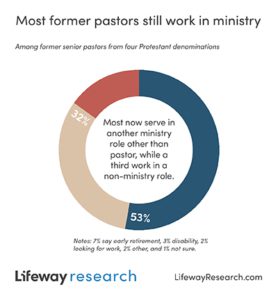
Despite stepping away from the pulpit, half (53 percent) of former pastors are still working in the ministry in a role other than pastor. A third (32 percent) work in a non-ministry role.

Few took early retirement (7 percent), disability (3 percent), are currently looking for work (2 percent) or have some other employment situation (2 percent).

“It’s not surprising to see the majority of former pastors still working in ministry,” McConnell said.

“In addition to many feeling called to their new role, the majority of current Protestant pastors say they have limited non-ministry work experience, with 6 in 10 having worked outside of ministry for 10 years or less before becoming a pastor.”

Half experienced significant conflict

Conflict, the second-leading reason pastors become former pastors, is a reality in many congregations, but for some leaders, it becomes too much.

Almost half (45 percent) of former pastors say they experienced significant conflict in their church during the last year they served as pastor.

Additionally, 9 in 10 (87 percent) faced conflict at some point in their last congregation, most commonly over changes they had proposed (56 percent).

Half of former pastors had conflict with lay leaders (50 percent) or said they experienced a significant personal attack (49 percent).

Around 2 in 5 saw conflict over expectations about the pastor’s role (40 percent) or their leadership style (38 percent).

Close to a quarter experienced conflict related to national or local politics (27 percent) or doctrinal differences (22 percent). One in 8 (12 percent) say none of these.

“The experiences of those who left the pastorate early include more conflict than the typical current pastor has,” McConnell said.

“Among evangelical and Black Protestant current pastors, only 19 percent experienced significant conflict this last year, while 45 percent of former pastors from these four denominations had significant conflict their last year as pastor.”

It’s not as though former pastors were blindsided by the existence of conflict. Nine in 10 (92 percent) say they expected there would be a need to confront conflict in their church.

Almost as many (86 percent) say they consistently listened to people in their church for signs of conflict.

Similarly, 84 percent invested in processes and behaviors to prevent conflict. Additionally, most (55 percent) say their training prepared them to handle the people side of ministry.

Family issues a factor for some

One in 10 former pastors (10 percent) say family issues contributed to their leaving the pulpit, but most tried to prioritize family life.

More than 2 in 3 (68 percent) say they consistently put their family first when time conflicts arose.

Still, 50 percent believe the demands of ministry kept them from spending time with their families, and 41 percent believe their families resented the demands of pastoral ministry. Additionally, 3 in 4 (73 percent) were often concerned about the financial security of their families.

Ministry wasn’t all negative for the pastor’s family. Two in 3 (65 percent) former pastors say their last congregation regularly provided their families with genuine encouragement.

Four in 5 (80 percent) were able to take a vacation with their families for at least a week away from their church work.

Former pastors believe their spouses were on board with church life. More than 4 in 5 (83 percent) say their spouses were very satisfied with their marriages.

Almost 3 in 4 (72 percent) say their spouses were enthusiastic about their life in ministry together. Also, 59 percent planned a date night alone with their spouse at least once a month.

“While it can be true in any occupation that your personal wellbeing and family can impact your job, the roll of pastor amplifies the importance of balance among these. Desiring to do more ministry is a noble compulsion, but not at the expense of health and family,” McConnell said.

Ministry problems identified

As former pastors reflected on their time in the ministry, they highlighted many areas of concern. Many felt pressure from the congregation. Most (53 percent) felt the church had unrealistic expectations of them. And around a third (35 percent) didn’t feel free to say no when expectations of them were unrealistic.

Four in 5 (80 percent) felt they had to be “on-call” 24 hours a day. Most (53 percent) often felt the demands of ministry were greater than they could handle, while almost 2 in 3 (64 percent) frequently felt overwhelmed with the role of pastor.

More than 2 in 5 (42 percent) don’t feel the search team or leaders accurately described their last church before they arrived.

As this pressure built on former pastors, more than 1 in 3 (37 percent) frequently became irritated with people at their church. More than 2 in 3 (68 percent) felt isolated as pastors.

“A church functions a lot like a team, and on a team, each player has a role to play. When the pastor’s role and responsibilities are not clear, it creates unfair strain,” McConnell said.

Still, most pastors were able to find time for themselves and with God during the week. More than 2 in 3 (68 percent) were able to unplug from ministry work at least once a week.

Three in 4 (73 percent) had personal time with the Lord, outside of sermon or lesson preparation, five or more times a week.

Advice for current pastors and churches

Looking back on their time in the pulpit, former pastors have some suggestions for current pastors and their congregations.

When asked what advice they have for current pastors to help them thrive in ministry, former pastors are most likely to tell those still leading churches to prioritize marriage and family (20 percent), spend time with God and read the Bible (16 percent), and remember their calling and trust God (14 percent).

Around 1 in 10 former pastors advise current pastors to pray (9 percent), take time away (8 percent), surround themselves with trustworthy people and friends (8 percent), love God and love others (8 percent), put God first (8 percent), care for themselves (7 percent), and meet with a mentor (7 percent).

Close to 1 in 20 say those still in the ministry should connect and meet with other pastors (6 percent), not go it alone (4 percent) and meet with a counselor (4 percent).

Fewer former pastors say to set boundaries (3 percent), have caution with the denomination (3 percent), learn how to deal with conflict (3 percent), have patience (3 percent), develop leaders (3 percent), listen to and communicate with the congregation (3 percent), be honest (2 percent), don’t give up and remain strong (2 percent), and work on financial planning (2 percent).

One percent or less advise current pastors to preach biblical sermons (1 percent), serve bivocationally (1 percent), display humility (1 percent), be sure the search committee represents a church accurately (1 percent), focus on obedience (1 percent), serve in elder-led congregations (1 percent), avoid politics (less than 1 percent), and be authentic or genuine (less than 1 percent). Only 1 percent didn’t offer any advice.

Even among former pastors, just 2 percent tell current pastors to leave the ministry (2 percent).

 “It is important to notice what former pastors do not give as advice: They do not encourage pastors to do more themselves,” McConnell said. “Trusting in God and taking time to care for their family and themselves make up most of the advice.”

When offering advice to churches on how they can best help their pastor thrive in ministry, former pastors give fewer options.

At least 1 in 10 say congregations should love and respect their pastor’s family (14 percent), pray for their pastor (14 percent), give them time off and protect it (12 percent), encourage and care for them (11 percent), be supportive (10 percent), and have clear and realistic expectations (10 percent).

Slightly fewer advise churches to respect and honor their pastor (9 percent), provide for them (8 percent), remember pastors are human (7 percent), serve or volunteer (7 percent) and love them (7 percent).

Few say to invest in their pastor (4 percent), cooperate with them (3 percent) or move to be elder-led (less than 1 percent). Only 2 percent offered no advice to churches.

“Former pastors’ requests for how churches should treat their pastors are not lengthy. Most listed only one piece of advice, with many focusing on the personal elements of love, care, prayer, respect and encouragement,” McConnell said.

“On the practical side, former pastors encourage churches to have realistic expectations of their pastors, with more mentioning appropriate time off than financial provision.”

The study—sponsored by Houston’s First Baptist Church and Richard Dockins, M.D.—was conducted May 6 to July 6, 2025. The sample lists were created and invitations sent by four Protestant denominations: Assemblies of God, Church of the Nazarene, The Wesleyan Church and Southern Baptist Convention.

Each survey was completed by an individual who has served as a senior (or sole) pastor but stopped serving as senior pastor prior to age 67. The completed sample is 730 former pastors.




Americans’ trust in the church rebounds slightly

While most Americans remain distrustful of the church, a growing number say they have confidence in the institution. Currently, 36 percent say they trust the church, according to Gallup’s annual tracking poll.

For the past three years, the percentage of U.S. adults who said they had a great deal or quite a lot of confidence in the church or organized religion has hovered near record lows. In 2022, trust fell to 31 percent of Americans and has been at 32 percent the last two years.

For the first time since 2020, however, the church has experienced a significant jump in trust. In 2025, 36 percent say they have a great deal or quite a lot of confidence in the church as an institution. The church was last that high in 2021 (37 percent).

Gallup began tracking U.S. adults’ confidence in the church as an institution in 1973. In 1975, 68 percent expressed a great deal or quite a lot of confidence in the church.

After a downward trend, the church experienced a boost of confidence in 2001, as did most other national institutions after the Sept. 11 terrorist attacks. The church rebounded to 60 percent for the first time since 1987. That year marked the last time at least 3 in 5 Americans had confidence in the church.

More than half of U.S. adults (52 percent) said they had a great deal or quite a lot of confidence in the church as an institution in 2019, the last year a majority held that belief. In 2018, confidence levels fell below 40 percent for the first time.

They edged above that mark in 2020, only to drop back below in 2021 and even further in 2022. Despite the 1-point increase in 2023 and the steady percentage in 2024, those years still marked the second-lowest percentages ever.

Political differences

The increase since last year was driven primarily by a jump among Republicans. Compared to 2024, Republicans’ trust in the church increased by 15 points, from 49 percent to 64 percent this year.

With the election of President Donald Trump, Republicans grew in their trust of every institution measured in 2024 and 2025, except for the Supreme Court, which remained statistically flat by falling 1 percentage point.

Trust of the church among political independents grew by 2 percentage points—28 percent to 30 percent. Democrats’ confidence in the church hovered around 1 in 5, falling 1 point to 21 percent.

As churchgoers increasingly say they prefer to be part of a congregation that shares their politics and non-Republicans are most likely to never attend church, congregations may grow politically segregated and struggle to reach those who aren’t GOP voters.

Demographic distinctions

In addition to Democrats and independents, other demographics also report lower levels of confidence in the church.

Black (31 percent) and Hispanic Americans (33 percent) are less likely than white Americans (37 percent) to express a great deal or quite a lot of trust in the church or organized religion. Last year, however, just 30 percent of all non-white Americans said they trusted the church. Many groups that have previously had low levels of trust in the church grew in their confidence in 2025.

While Americans 55 and older are the most likely to express high trust in the church, all age demographics increased in their confidence. Older Americans grew from 39 percent to 42 percent, those 38 to 54 increased from 28 percent to 31 percent, and young adults had the highest jump, moving from 26 percent to 32 percent.

Other segments that saw increases since last year are those who attended some college but didn’t graduate (25 percent to 36 percent), those with annual household income of $50,000 or less (31 percent to 39 percent), and those with household incomes more than $100,000 (29 percent to 36 percent).

Also, men stayed statistically the same (36 percent in 2024 and 37 percent in 2025), but women jumped from 28 percent to 36 percent.

Church in second tier of trusted institutions

In the most recent findings, only three institutions—small businesses (70 percent), the military (62 percent) and science (61 percent)—have the trust of a majority of Americans. The church is among the next tier, including the police (45 percent), higher education (42 percent), the medical system (32 percent), the presidency (30 percent) and banks (30 percent).

Fewer Americans say they trust the public schools (29 percent), the Supreme Court (27 percent), large tech companies (24 percent), newspapers (17 percent), the criminal justice system (17 percent) or big business (15 percent). The least trusted institutions are television news (11 percent) and Congress (10 percent).

In general, Americans have grown less trusting of institutions. The increases in confidence among Republicans have been largely offset by declines among Democrats.

“The significant party shifts in confidence this year largely cancel each other out in the aggregate, and thus, Americans’ confidence in most institutions is unchanged or statistically similar to last year,” according to Gallup.

For example, while confidence in the presidency grew 73 points among Republicans since last year, trust in the institution fell 58 points among Democrats. Overall, trust in the presidency grew slightly from 26 percent in 2024 to 30 percent in 2025.

“While the loss of faith in key U.S. institutions may be hard to ever recover among political independents, partisans’ confidence is easily restored when their political party controls the institution. The flip side, of course, is that the confidence of the other party’s supporters declines when their party loses power,” wrote Megan Brenan in Gallup’s report.

“This suggests that confidence in U.S. institutions may be less about how well the institution performs its societal functions and more about who has the power to influence what the institution can do.”

The public’s average confidence level in the 14 institutions rated each year by Gallup since 1993 remains near historic lows. On average, 28 percent of U.S. adults currently have high levels of trust in those institutions, the same as 2024.