More Americans stay away from church since pandemic

WASHINGTON (RNS)—At the beginning of the COVID-19 pandemic, nearly every congregation in the United States shut down, at least for a while. For some Americans, that was the push they needed to never come back to church.

A new report, which looked at in-person worship attendance patterns before the beginning of the pandemic and in 2022, found a third of those surveyed never attend worship services. That’s up from 25 percent before the start of the pandemic.

The pandemic likely led people who already had loose ties to congregations to leave, said Dan Cox, one of the authors of the new study and a senior fellow in polling and public opinion at the American Enterprise Institute.

These were the folks that were more on the fringes to begin with,” said Cox. “They didn’t need much of a push or a nudge, to just be done completely.”

As part of the 2022 American Religious Benchmark Survey, researchers from the American Enterprise Institute and NORC at the University of Chicago asked 9,425 Americans about their religious identity and worship attendance. Those surveyed had answered the same questions between 2018 and early 2020.

Researchers then compared answers from between 2018 and 2020 to answers from 2022 to understand how attendance patterns changed during the COVID-19 pandemic.

“We are looking at the attendance patterns and religious identity of the exact same people at two different time periods,” said Cox.

The new study focused on attendance at in-person services versus online services. While some people—including the immunocompromised and their families—may still be attending digital services, measuring online engagement is “messier,” said Cox, and very different from in-person involvement. For example, he said, tuning in to a service for a few minutes is much different than going to a service in person.

Young adults particularly likely to skip church

The report also noted the decline in attendance most affected groups that had already started to show a decline before the pandemic—particularly among younger adults, who were already lagging before the pandemic and showed the steepest drop-off since.

Liberal Americans (46 percent), those who have never married (44 percent) and those under 30 (43 percent) are most likely to skip worship service altogether and saw the largest declines in attendance rates.

By contrast, conservatives (20 percent), those over 65 (23 percent) or those who are married (28 percent) are less likely to say they never attend services and saw less drop-off.

One in 4 Americans (24 percent ) said in 2022 that they attend regularly—which includes those who attend nearly every week or more often. Another 8 percent attend at least once a month—for a total of 32 percent who attend regularly or occasionally. That was down slightly from a total of 36 percent in 2020.

In 2022, just over a third (36 percent) said they attend at least once a year. Another third (33 percent) said they never attend—up from 25 percent in 2020.

Cox said generational shifts and the broader polarization in society likely played a role in the attendance decline.

Younger Americans are less likely in general to identify as religious or attend services—the 2021 General Social Survey found that 41.5 percent of Americans between 18 and 29 said they never attend services, with 20.6 percent saying they attend more than once a month.

Political differences come to light

New political battlefronts also opened up during the pandemic, with vaccines and masks becoming points of contention and markers of political identity rather than public health interventions.

Conservative churches were likely to reopen sooner than more liberal congregations—making it easier for people to attend those churches in person.

The change in attendance patterns did not affect every group equally.

More than half of Latter-day Saints (72 percent) and white evangelicals (53 percent) said they attended service regularly in 2022, about the same rate as before the pandemic.

Other groups saw little drop-off in regular attenders as well, including Black Protestants (36 percent), white Catholics (30 percent), Hispanic Catholics (23 percent), white mainliners (17 percent) and Jews (10 percent), all reporting similar regular attendance rates in 2022 as before the pandemic.

The survey did show, however, that in most faith groups, the infrequent attenders were the largest group. That includes about half of white Catholics (46 percent), Hispanic Catholics (47 percent), white mainliners (51 percent) and Jews (54 percent).

Black Protestant regular attenders (36 percent) and infrequent attenders (35 percent) were about the same size.

Some hope in a dismal report

Cox found some hopeful news in the report, in that people have not given up their religious identity for the most part, even if they don’t attend. That gives religious leaders a chance to reconnect with larger numbers of people who still identify with religious traditions but don’t participate.

“These are the people who haven’t completely separated,” he said, so there is still a chance to reengage with them.

The folks who rarely attend services are also most at risk of disappearing completely. If that happens, churches and denominations would be in big trouble, said Cox.

“There are millions of people in that category,” he said. “If they go, I think it’s going to cripple a lot of a lot of denominations, and a lot of congregations are going to have to fold.”

Cox also worried about an increase in what he called “religious polarization,” between people who are active in religious congregations and those who have no involvement at all.

“We’re going to quickly come to a place where a good chunk of the country is not only going to have different views about religion, and different religious experiences, they’re not going to be able to relate to each other in any real way,” he said.

Reconnecting won’t be easy

Reengaging with people who have loose ties to churches will not be easy, said author and scholar Diana Butler Bass, who studies the changing religious landscape. Some people may prefer to attend services or engage spiritual practices online. Others have family challenges and aren’t able to attend.

And disputes over theology and liturgy can make it difficult to be part of a church.

Then there’s the human element.

Even before the pandemic, Americans were experiencing a loneliness crisis, with fewer spending time with friends or participating in social and civic activities. Many have lost the habits and skills of making friends and creating community, said Bass.

“Churches haven’t really figured that out,” she said. “They often say they are friendly but aren’t really—and lack ways of speaking about friendship theologically and developing friendship as a genuine practice of community.”

Many churches are struggling

The decline in attendance overall comes at a time when many congregations are struggling. The median congregation size in the United States dropped from 137 people in 2000 to 65 as of 2020, according to the Faith Communities Today study. Those Americans who do attend services often go to large congregations, leaving many smaller local churches and houses of worship in difficult straits.

Most congregations have seen attendance decline by about a quarter during the pandemic, said Scott Thumma, director of the Hartford Institute for Religion Research at Hartford International University.

That decline has hit smaller churches particularly hard. Most churches, he said, have fewer than 100 people. If 25 people are missing from those churches, that has a huge impact.

During the early days of the pandemic, Thumma said, churches innovated because they had to in order to survive. Now that the crisis of the pandemic has ebbed, they need to make long-term adaptations.

“What happened in the pandemic is that all of us were huddling in the basement, while a tornado was going over our heads,” he said. “Now everyone has come out of the basement and everything is completely different. Now we have to be intentionally creative.”

Churches also need to remind people of the importance of gathering together and to invite people to get involved in community outreach and other acts of service, said Thumma, such as volunteering for a food pantry or other ministry.

“Everything has to be hyper-intentional now,” he said.

While things are difficult, focusing on the future works better than just looking at things that are going wrong, said Thumma, who often consults with congregations and is the principal investigator in the long-term study Exploring the Pandemic Impact on Congregations.

“The focus should be, how can we become a better church—rather than, how do we re-create what we used to have?”

Ahead of the Trend is a collaborative effort between Religion News Service and the Association of Religion Data Archives made possible through the support of the John Templeton Foundation.


Churchgoers value time with God but practices vary

NASHVILLE, Tenn.—Most Protestant churchgoers say they spend time alone with God at least daily, but there’s a range in what they do in that time and what resources they use.

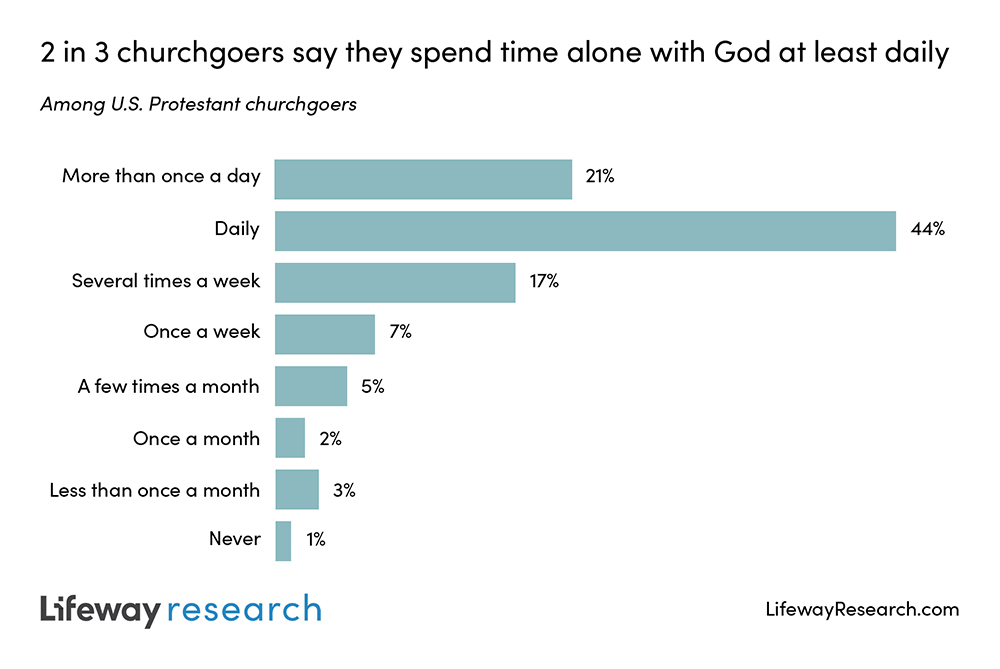
A Lifeway Research study reveals nearly 2 in 3 Protestant churchgoers (65 percent) report they intentionally spend time alone with God at least daily, with 44 percent saying daily and 21 percent saying more than once a day.

Meanwhile, 17 percent of churchgoers say they are alone with God several times a week, and 7 percent say once a week. Others say they are alone with God a few times a month (5 percent), once a month (2 percent), less than once a month (3 percent) or never (1 percent).

This time looks different for different churchgoers, but they are more likely to talk to God through prayer than to listen to him through Scripture. Churchgoers say they most often pray in their own words (83 percent), thank God (80 percent), praise God (62 percent) or confess sins (49 percent).

Fewer than 2 in 5 read from the Bible or a devotional (39 percent). Fewer repeat a set prayer (20 percent), consider God’s characteristics (18 percent) or something else (1 percent).

But if churchgoers were to read something during their time alone with God, most would read from a physical Bible (63 percent). Others would read the Bible in a different format such as a Bible that includes additional commentary or devotional thoughts (25 percent) or Scripture from an app (20 percent).

Fewer than 1 in 3 say they would read from a devotional book that prints some Scripture (32 percent), and even fewer say they would read from a devotional book that doesn’t print Scripture (8 percent). Still, others say they would read a devotional from an app (7 percent) or read something else (3 percent).

When it comes to spending time alone with God, females (48 percent) are more likely than males (38 percent) to say this is a daily habit for them. Those in the South (49 percent) are also among the most likely to say they spend time alone with God on a daily basis.

One in 4 Baptists (25 percent) say they have alone time with God more than once a day. And those with evangelical beliefs (30 percent) are more likely than those without evangelical beliefs (15 percent) to say the same.

Church attendance is also an indicator of quiet time frequency. Those attending worship services at least four times a month (26 percent) are more likely than those who attend one to three times a month (13 percent) to say they spend time alone with God more than once a day.

“We see a pattern in Scripture of followers of God withdrawing to spend time alone with him. Jesus Christ himself also did this,” said Scott McConnell, executive director of Lifeway Research. “Most Protestant churchgoers continue this relational interaction with God and use a variety of resources as they do.”

Prayer practices differ

When spending time alone with God, some prefer to pray in their own words, while others would rather repeat a set prayer.

Younger churchgoers—ages 18-34 (31 percent) and 35-49 (26 percent)—are more likely than those 50-64 (16 percent) and over 65 (11 percent) to say they repeat a set prayer during their alone time with God.

And those ages 50-64 (85 percent) and over 65 (89 percent) are more likely than those 18-34 (77 percent) and 35-49 (77 percent) to say they pray in their own words.

“There are many reasons to pray a set prayer. Whether someone is praying the model prayer Jesus gave or repeating the same request to God each day, these can be meaningful,” McConnell said. “At the same time, Scripture also records Psalms and prayers within its narrative accounts that show how personal and forthright we can be when talking to God in our own words.”

Females (86 percent) are more likely than males (79 percent) to pray in their own words. And those in the South (86 percent) are more likely to pray in their own words than those in the Northeast (77 percent).

Evangelical beliefs and the frequency of church attendance also are factors in how a person prefers to pray. Those who attend worship services at least four times a month are more likely than those who attend less frequently to pray in their own words (85 percent vs. 79 percent). But those who attend a worship service one to three times a month are more likely than those who attend more frequently to repeat a set prayer (24 percent vs.16 percent).

Those with evangelical beliefs are more likely than those without such beliefs to pray in their own words (92 percent vs.76 percent), while those without evangelical beliefs are more likely than those who hold those beliefs to repeat a set prayer (22 percent vs.16 percent).

What does ‘time alone with God’ mean?

What it means to spend time alone with God varies from person to person. But there are some indicators of which practices are most important to different demographics.

While females are more likely than males to say they praise God (66 percent vs.57 percent) or read from the Bible or a devotional (42 percent vs.36 percent), men are more likely than women to say they consider God’s characteristics (21 percent vs.16 percent) when spending time alone with him.

Older churchgoers—those 50-64 (45 percent) and older than 65 (42 percent)—are more likely than those 18-34 (32 percent) and 35-49 (34 percent) to say they read from the Bible or a devotional when spending time alone with God. And those over the age of 65 are the least likely to say they consider God’s characteristics (10 percent).

Evangelical beliefs and church attendance frequencies are also indicators of a person’s preferences in spending time alone with God.

Those who attend worship services the most (four or more times a month) are more likely than those who attend one to three times a month to praise God (67 percent vs.53 percent), confess sins (55 percent vs.38 percent) or read from a Bible or devotional (46 percent vs.28 percent).

And those who hold evangelical beliefs are more likely than those who do not hold evangelical beliefs to thank God (87 percent vs.74 percent), praise God (76 percent vs.51 percent), confess sin (64 percent vs.38 percent) or read from the Bible or a devotional (52 percent vs.29 percent).

But those without evangelical beliefs are more likely than those with evangelical beliefs to consider God’s characteristics (20 percent vs.15 percent).

“An earlier discipleship study from Lifeway Research showed that praising and thanking God is one of the top five predictors of high spiritual maturity,” McConnell said. “This is a widespread practice among churchgoers when they are alone with God.”

What do churchgoers read in quiet times?

Several factors play into what a churchgoer wants to read when spending time alone with God. The youngest adult churchgoers (ages 18-34) are the most likely to read Scripture from an app (40 percent) and the least likely to read from a devotional book that prints some Scripture (21 percent). And females are more likely than males to say they would prefer to read a devotional from an app (9 percent vs.4 percent).

 Those with evangelical beliefs are more likely than those without evangelical beliefs to say they would read from a Bible (78 percent vs.52 percent) if they were reading something in their time alone with God. And those without evangelical beliefs are more likely than those with evangelical beliefs to say they would read from a devotional book that doesn’t print Scripture (11 percent vs.3 percent) or Scripture from an app (22 percent vs.17 percent).

While those who attend a worship service at least four times a month are more likely than those who attend one to three times a month to say they would read the Bible in their quiet time (70 percent vs.52 percent), those who attend one to three times a month are more likely than those who attend more often to say they would read a devotional from an app (9 percent vs.5 percent).

Lifeway Research conducted the online survey Sept. 19-29, 2022, using a national pre-recruited panel. Researchers used quotas and slight weights to balance gender, age, region, ethnicity, education and religion to reflect the population more accurately. The completed sample is 1,002 surveys, providing 95 percent confidence that the sampling error does not exceed plus or minus 3.3 percent. Margins of error are higher in sub-groups.


Ten most significant religion stories of 2022 named

WASHINGTON (RNS)—News of the past 12 months tells a story of deepening division in American and global society, as issues from abortion to same-sex marriage to antisemitism seemed not only to inflame debate between individuals but to destabilize institutions.

Faith communities and organizations, often at the center of some of the year’s most indelible moments, were no less vulnerable to these roiling shifts.

Religion News Service editors selected what they considered the 10 most significant faith-related stories in 2022.

  1. The U.S. Supreme Court overturns Roe v. Wade

When Justice Samuel Alito’s draft opinion in Dobbs v. Jackson Women’s Health Organization leaked, it gave the country, and activists on both sides, time to prepare for the Court’s 6-3 decision to return abortion law to the states.

Anti-abortion protesters gather outside the Supreme Court in Washington, Friday, June 24, 2022. The Supreme Court ended constitutional protections for abortion that had been in place nearly 50 years, a decision by its conservative majority to overturn the court’s landmark abortion cases. (AP Photo/Jose Luis Magana)

Christian-run pregnancy centers vowed to expand, while pro-choice advocates mounted protests and prepared lawsuits, including a synagogue in Palm Beach County, Fla., that sued Gov. Ron DeSantis over the state’s imminent ban on abortions after 15-weeks of pregnancy.

The victory at the court for religious conservatives, 50 years in the making, proved to be a mixed blessing. Voters in Kansas and Michigan rejected ballot measures favoring strong abortion restrictions and pro-choice sentiment seemed to fuel the Democrats’ hold in the 2022 midterm elections. Muslim, Jewish and Christian faith leaders put out statements affirming abortion rights.

Even Pope Francis, receiving U.S. House Speaker Nancy Pelosi in the days following the Dobbs ruling, tacitly rejected ongoing efforts by U.S. Catholic bishops to deny Communion to Pelosi and other pro-choice Catholic politicians.

  1. Russia invades Ukraine

Whatever prompted Russian President Vladimir Putin to order an invasion of Ukraine in February, his ally in Moscow, Patriarch Kirill of the Russian Orthodox Church, made clear Russia’s “special military operation” was motivated at least in part by moral considerations. He cited the West’s spiritual and cultural imperialism, marked by the proliferation of “gay parades,” an apparent reference to LGBTQ Pride Day celebrations common in Western countries.

Russian Orthodox Patriarch Kirill in the Christ the Saviour Cathedral in Moscow, on Jan. 7, 2021. (AP Photo/Alexander Zemlianichenko)

The war for Ukraine’s soul is playing out more concretely in the conflict between Kirill’s Russian Orthodox Patriarchate and the Orthodox Church of Ukraine, which declared its independence under its own patriarch in 2018.

For Kirill and the Russian leaders, political and religious, said one U.S. Orthodox Christian leader, “The idea that the Ukrainians could have an independent church not under the jurisdiction of Moscow is just unfathomable.”

Kirill’s support for the war created cleavages within his own church and brought opprobrium from faith leaders around the world. The World Council of Churches considered expelling the Russian Orthodox delegation, while Pope Francis excoriated the war, even as he tempered his direct criticism of Kirill and Russia in hopes of keeping lines of dialogue open.

  1. Antisemitic attacks and rhetoric continue to mount

An interfaith group of clergy gathered at Good Shepherd Roman Catholic Community in Colleyville to support law enforcement and the families of those taken hostage in the 11-hour standoff Jan. 15at Congregation Beth Israel. Pastor Bob Roberts of Northwood Church in Keller stands far left next to Azhar Azeez; Rabbi Andrew Paley is at center front and Imam Omar Suleiman is behind him, wearing a Muslim head covering. (Via Twitter January 16 / Distributed by RNS)

Two weeks into the new year, an armed British Muslim entered Congregation Beth Israel, a synagogue in Colleyville and held its rabbi and three others hostage for 11 hours.

The incident was the latest to rock American Jews, who have watched as anti-Jewish conspiracies, stemming back to the Charlottesville and the 2018 massacre at Pittsburgh’s Tree of Life synagogue, have gained footholds across the country. The Colleyville incident, which spurred new security measures, was followed by reports of physical abuses and taunts of Jews on the streets of U.S. cities.

The violence has been matched by rhetoric from white Christian nationalists and the rapper Ye, formerly known as Kanye West, who in October began a series of antisemitic statements, mainly on Twitter, mischaracterizing or threatening Jews, while claiming that Black people themselves are Jews.

The rising antisemitism prompted the White House to hold a roundtable on how to combat it, led by Second Gentleman Douglas Emhoff, who said: “We cannot make this normal. We cannot.”

  1. Christian nationalism pushes into the political mainstream

As the anniversary of the Jan. 6 insurrection approached, experts were concerned the attack on the Capitol had encouraged Christian nationalist ideas, not only among extremist groups but also members of Congress and moderate politicians.

Gov. Ron DeSantis appears in a controversial ad titled “God Made a Fighter.” (Video Screen Grab)

Those fears seemed to be realized as Gen. Michael Flynn and pastor Greg Locke held rallies that were part political event, part religious revival and as candidates in the midterm elections, most notably state senator Doug Mastriano in his bid for Pennsylvania governor, fused Christianity and patriotism in increasingly blatant fashion.

By September, a survey showed 3-of-4 Republican evangelical Christians would like to see the United States declared a Christian nation.

Mastriano lost his election, but more potent candidates have signaled that they will tap Christian nationalist themes. Weeks after announcing his re-election campaign, Donald Trump dined with the rapper Ye and Nick Fuentes, a conservative commentator and passionate white Catholic nationalist, while Florida Gov. Ron DeSantis, Trump’s biggest rival for the Republican nomination, ran commercials late in his gubernatorial run titled “God made a fighter.”

  1. United Methodist churches move to begin schism

With the UMC’s General Conference meeting originally scheduled for 2020 postponed for a third time to 2024, many conservative Methodists gave up waiting for a vote to approve an orderly dissolution of the 54-year-old denomination over LGBTQ issues and began disaffiliating from their regional bodies, known as annual conferences.

Some joined the newly launched Global Methodist Church, while other large churches are going their own way, or planning to form smaller networks. Still others have chosen to sue the UMC to free themselves of the financial obligations that are part of the existing disaffiliation process.

Leaders of the UMC largely have supported churches who have applied to leave, while cautioning that they won’t abide churches that foment schism or spread misinformation about the reasons for their departure.

  1. Hindu nationalism makes inroads in United States

The Hindu nationalist movement that has gripped India since Prime Minister Narendra Modi’s Bharatiya Janata Party came to power in 2014 found echoes in the Indian American community, including disturbing signs of growing anti-Muslim sentiment.

Much of the fallout has occurred on American campuses, where life on campus has been politicized for many Hindu students, while some Hindu groups have protested a heightened awareness of caste discrimination as a form of Hinduphobia in itself.

  1. Pope Francis travels to Canada to apologize for mistreatment of indigenous people

After meeting with Indigenous people at the Vatican in March to hear accounts of historic abuse in church-run residential schools in Canada, Pope Francis announced he would go on a “journey of reconciliation” to Iqaluit, the tiny capital of Canada’s northernmost province, Nunavut, to apologize for the mistreatment and cultural assimilationindigenous communities suffered at the hands of Catholic clergy.

On his three-day trip, Francis also held up indigenous people as models of caring for the environment and respect for elders, and urged young people, “supported by the example of your elders,” to “care for the earth, care for your people, care for your history.”

The apologies were met with relief from many indigenous leaders, but also brought criticism from survivors and families of other indigenous communities who did not see the apology as enough.

  1. LGBTQ faculty and students stake a claim on religious campuses

The slow fracturing of religious colleges over the affirmation of LGBTQ students and faculty broke into public view this year as students and faculty pressured school administrators to confront their policies and the theology behind them.

Calvin College, a flagship school of Reformed Christianity, trustees allowed faculty members to dissent from a confession of faith that regards sex outside of heterosexual marriage as sinful.

At Seattle Pacific University, associated with the Free Methodist Church, faculty and students sued the board to end a policy barring people in same-sex relationships from being hired.

While conservative Christian schools were cited as “unsafe” for LGBTQ students, Yeshiva University in New York was ordered by a court to recognize an LGBTQ club the school claimed would violate its Orthodox Jewish values.

  1. Southern Baptist Convention confronts its history on sexual abuse

In Anaheim, Calif., messengers to the Southern Baptist Convention’s annual meeting in June approved a series of reforms to address sexual abuse in the nation’s largest Protestant denomination—including the creation of a website that will track abusive pastors and church workers.

Anderson Cooper of 60 Minutes interviewed SBC President Bart Barber. (Video Screen Grab)

They were spurred in part by a report released a month earlier that found SBC leaders had downplayed the issue of abuse in local churches for years while demonizing abuse survivors as enemies of the church.

At the same gathering, the delegates elected as SBC president Bart Barber, pastor of First Baptist Church in Farmersville, who in personal statements and in an appearance on 60 Minutes, has sought to hold individual pastors and the convention at large accountable for its attitudes toward sexual misconduct.

  1. Big and small U.S. religious groups welcome a tide of refugees

Pavlo Romaniuk said members of First Baptist Church in Hallsville opened their hearts to his family when they relocated as refugees from Ukraine. (Photo / Ken Camp)

In what one aid official called a “return to moral leadership,” the Biden administration proposed in September accepting up to 125,000 refugees to the United States for the second year in a row. In the previous months, thousands fled Russia’s invasion of Ukraine, while nearly 60,000 Venezuelans made contact with U.S. border authorities.

Many of these people will be resettled by nine faith-based organizations designated by the federal government as official partners. One of those nine is the Lutheran Immigration and Refugee Service, which in November received a $15 million donation from philanthropist MacKenzie Scott.

In June, Islamic Relief Worldwide, the Lutheran World Federation and HIAS (formerly the Hebrew Immigrant Aid Society), announced they are strengthening their cooperation to provide a more effective response.

Their effort in many places will be buttressed by the work of individual churches whose volunteers mobilized to provide homes and support.


Sunday school looks different since COVID

WASHINGTON (RNS)—At Mattie Richland Baptist Church in Pineview, Ga., the adults have been back in Sunday school and the kids led a Black history presentation, but the bus that picks up children for their education program remained idle until this month.

Youth give presentations on Black history at Mattie Richland Baptist Church in Pineview, Ga. (Photo by Ja’Qwan Davenport)

At St. Ann’s Episcopal Church in the Chicago suburb of Woodstock, Ill., the once weekly Christian education program is now monthly and is known as “Second Sunday Sunday School.”

At Crossroads Community Cathedral, an Assemblies of God church in East Hartford, Conn., children’s church continues to thrive each weekend, but church leaders describe Christian education for young people as “one of our greatest weaknesses.”

Sunday school, adult forums and other Christian formation classes, already threatened by declines in worship attendance, have been further challenged since COVID-19 shuttered churches and sent their services online.


Scott Thumma speaks during the annual meeting of the Society for the Scientific Study of Religion on Nov. 12, 2022, in Baltimore. (RNS photo by Adelle M. Banks)

A study by the Hartford Institute for Religion Research said more than half were disrupted in some way. Other research shows religious education for adults has bounced back more than for younger church members.

“For some, it continued without any real major disruptions, and for others, it basically collapsed,” said Scott Thumma, the institute’s director, summing up its 2022 pandemic-related research during an October event at Yale Divinity School.

“And the easiest way to make it collapse was to keep religious education for children and youth online. If you kept it online, you probably don’t have a religious education program now.”

Decreasing frequency of Bible study gatherings

Pastor Scott Zaucha of St. Ann’s in Woodstock, a mostly white congregation with about 50 attending on Sundays, said its Sunday school ceased to exist before the pandemic because of its aging congregation. He wondered how to begin it again and learned online Christian education was not the answer, because it seemed like “another thing to try to keep up with” when regular schooling was online.

Zaucha found meeting one Sunday a month in person was the best route, realizing even if families choose St. Ann’s as their congregational home, they may not be weekly attenders.

“When you have only a few families with kids at your church, and you have two kids on this Sunday and six kids on that Sunday, they’re all sort of spread out,” he said. “But if you say, ‘Hey, families, we’re going to have Sunday school once a month.’ Then it lets them know when is the best Sunday for them to come if they’re only going to choose one.”

In Orthodox churches, research shows the parishes that never ceased holding in-person religious education classes for their children and teenagers fared better than those that halted the Sunday school lessons, with some even increasing the number of attendees. The combination of attending worship as well as Sunday school and seeing other youth on a regular basis became crucial for their participation.

“For them, it has become even more valuable through the pandemic for those parishes, which kept young people together,” said Alexei Krindatch, national coordinator of the National Census of Orthodox Christian Churches, in an interview conducted at the Religious Research Association conference in November. “It was an excuse to get together.”

Making adjustments

Youth participate in a combination Vacation Bible School and summer camp at Crossroads Community Cathedral in East Hartford, Conn., in July 2021. (Photo courtesy of Crossroads Community Cathedral)

At Crossroads, a multicultural congregation with about 1,500 gathering each weekend, online campus pastor Luke Monahan has tried numerous options to keep adults and kids engaged since the start of the pandemic. In 2020 there were daily adult devotional videos and two a week for kids. Online options appealed more to the adults than to the kids—his own youngster, at age 6, “shut the little laptop and ran away,” he said. An online kids’ church video he had developed gained little traction.

“One month, I didn’t put it out and didn’t notify anyone on purpose,” said Monahan, who also directs IT and education at the Connecticut church. “Nobody said, ‘Where did that video go?’”

In his presentation at Yale, Thumma said adults have had a much more positive reaction to religious education that is not in person.

“Adults seem to love religious education online,” he said. “And we’re hearing stories about all kinds of Bible studies, all kinds of prayer meetings, all kinds of education events that are happening online for adults, but not for children and youth.”

Publishers seek to respond

Urban Ministries Inc. has found adults, even those who aren’t tech-savvy, are interested in its digital platform, Precepts Digital, which launched this year. The video-enhanced Bible study is meant for individuals or small groups.

“We have been encouraged by the oldest members of our audience embracing digital,” said CEO Jeffrey Wright, whose Christian education publishing company primarily serves African American congregations. “You expect pushback from nondigital natives. And in one focus group, a person commented, ‘Well, you know, it’s harder but it’s worth it.’”

After the pandemic caused a significant drop—Wright estimates a 60 percent to 80 percent decrease—in requests for materials for children and youth in the African American community, the company is working on a children’s version of its digital Bible lessons.

“We have a crisis of catechism going on in America right now,” Wright said, expressing concern for the religious upbringing of the youngest generation.

“If you think about it, a 4- or 5-year-old kid, say, born in 2017 or 2018, has never been in an Easter program or a Christmas program and given that little speech you gave when you were a little kid up in the front of the church. Hasn’t happened. Children aren’t being served.”

Illustrated Ministry, a 7-year-old publishing company that aimed at progressive Christian congregations, also has sought to provide materials to churches as they shifted from in-person to online and, sometimes, back and forth again, depending on the stage of the pandemic.

Adam Walker Cleaveland, who founded the company in Racine, Wisc., said he is seeing a greater demand for resources that provide stand-alone lessons for those who may not be attending Sunday school week after week.

“Since COVID, we have seen increasing need for curriculum and resources that are extremely flexible, extremely adaptable,” he said.

Though many of Illustrated Ministry’s products, including children’s bulletins, children’s ministry curricula and pages to color, are designed for children, they also can be used in intergenerational activities around a table at home.

Walker Cleaveland said his organization is also keeping in mind the volunteer teachers—also in shorter supply since the start of the pandemic—who are preparing for Bible lessons, making sure the work is not too time-consuming.

“In terms of our materials, we try to make it so that there isn’t that in-depth prep required, there’s not a huge supply list,” he said. “So you don’t have to make a trip to Michael’s every week before Sunday school.”

Some return to weekly Sunday Bible study

Pastor Florine Newberry, who leads Mattie Richland Baptist, said its membership rolls have grown from 50 to 96 as the congregation shifted from predominantly Black to a more diverse group after welcoming people who stopped to listen to her outdoor sermons during the pandemic.

After preaching at her church’s front door to people who remained seated socially distant near their cars, the congregation is back inside and adult Sunday school started early in 2022. But formal Christian education for teens and children has been limited due to the pandemic and concerns about respiratory syncytial virus, commonly called RSV.

Instead, Newberry has picked up the phone and suggested particular Scriptures to encourage them when they told her of bullying that’s occurred at school.

But Newberry has been looking forward to January. She plans to use her church’s bus to pick up children for Sunday school after deciding it is safe to transport them again.

“If you can get ’em while they’re at that age, you can really make a difference,” she said of the children who’ve been inquiring about when she’s going to pick them up.

“Once I get them back in Sunday school, I’ll be happy.”


Live animals bring spectacle, humor to Nativity scenes

WASHINGTON (RNS)—David Baum has a warning for any church doing a live Nativity: Watch out for the sheep.

“They’re like little tanks, said Baum, recounting the time some sheep bolted, dragged a bale of hay behind them and “ran down some little old ladies singing Christmas carols.”

For the past few decades, Baum, owner of the Texas Camel Corps, has spent the Christmas season traipsing all over Texas, supplying camels—as well as donkeys, ox and sheep—for live Nativity sets at churches around the state.

“We have got it all,” he said. “I tell people we bring everything but the baby Jesus.”

A live Nativity at the Seaside Chapel in Carolina Beach, N.C., made headlines recently when a pair of cows staged a jailbreak from the manger and dove into a river—leading to an overnight search and a viral video rescue by local police.

The cows were sent home, Dana Vess, the wife of Seaside pastor Jerry Vess, told the Port City Daily newspaper. But the live Nativity—interrupted two years ago after a storm destroyed the church’s set—went on as planned.

“We don’t let anything stop us from sharing the meaning of Christmas,” Vess told the Port City Daily.

Long tradition of animals in Nativity scenes

While the Bible doesn’t specifically mention animals being present at the birth of Jesus, the non-canonical Infancy Gospel of Matthew, which dates to the 7th century, added them to the story, according to medieval historian Vanessa Corcoran.

“And on the third day after the birth of our Lord Jesus Christ, the most blessed Mary went forth out of the cave, and entering a stable, placed the child in the stall, and the ox and the ass adored him,” the Infancy Gospel recounts.

Corcoran said the tradition of staging reenactments of the birth of Jesus, with live animals as part of the cast, dates back to 1223 A.D., when St. Francis of Assisi set up a live Nativity in the town of Greccio, Italy, with a doll in the manger and live animals, according to a biography of Francis written by St. Bonaventure.

Then in 1291, Pope Nicholas VI, the first Franciscan pope, had a Nativity set up in Santa Maria Maggiore in Rome.

“Within a century, virtually every church in Italy started to take up the practice, first with statues but then getting live Nativities as well,” said Corcoran.

More recent retellings of the birth of Jesus include the 2017 film The Star, which depicts the animals, including some camels brought by the wise men, as humorous sidekicks who save the Baby Jesus from Herod.

A 2014 short story by science fiction author John Scalzi, “Script Notes on the Birth of Jesus,” also features the animals as sidekicks, as well as reimagining the wise men as time-traveling “ninjas for Christ.”

Animals not always well-behaved

A camel used for a Nativity scene in Bonner Springs, Kansas, spent several days on the run before being captured. (Photo courtesy of Bonner Springs Police Dept.)

While the animals might have been on their best behavior for St. Francis, they don’t always cooperate with modern-day live Nativity scenes.

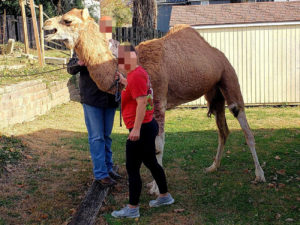
Last Christmas, a camel featured in a drive-thru Nativity scene at the National Agricultural Center and Hall of Fame in Bonner Springs, Kan., made a break for it and spent a day eluding capture by police, who chased the camel in golf carts. In 2010, a video of a reluctant camel toppling into the crowd at a church pageant went viral.

Live animals also played an unexpected role in the downfall of Southern California’s Crystal Cathedral. For decades, Robert Schuller’s now-shuttered megachurch staged a “Glory of Christmas” pageant featuring camels, horses and sheep, along with flying angels. The pageant ended when the church no longer could pay vendors for the pageant, a sign of a larger fiscal crisis at the church.

For years, Damascus Road Community Church in Mount Airy, Md., held a “Walk Through Bethlehem” event, complete with sheep, llamas and donkeys, on a set built on the church’s property. The animals behaved well when they were outside, said Michelle Rader, the church’s lead elder, but there was an adventure when one of the boys in the church tried to ride a donkey and got bucked off.

Things got tricky when a church leader brought a llama inside the church during the announcements to promote the event—and it promptly left an unexpected offering on the stage, Rader said.

“You never know with llamas,” she said.

The church, which put its Christmas reenactment on hold in 2020 due to the pandemic, has also used live animals during reenactments for Palm Sunday and Easter, which could be tricky. While the Bible recounts Jesus riding a donkey into Jerusalem on Palm Sunday, bringing that to life is a challenge, said Rader.

“You have to find a very small man to be Jesus,” she said.

The church also has had wild animals take part in its event, though that was unplanned. One year, said Rader, a group of wild turkeys invaded the church’s property over the Easter weekend and would not go away. The group’s male leader decided to preen for the crowd while Jesus was dying on the cross—and would not leave, despite the best efforts of church members.

“They had absolutely no fear of the crowd,” said Rader.

Live animals ‘a great draw’

Despite some of the challenges, Rader said having animals at reenactments helps bring the Bible’s stories to life.

“They are a great draw,” she said.

The animals at the first live Nativity run by Kenosha Bible Church were mostly well-behaved, though the cow was too big to fit in the stable and had to remain in a trailer. The sheep and other animals provided a great soundtrack for the event run by the Wisconsin church, said worship pastor Mike Middleton, who helped organize the event.

A video from the event, held Dec. 11, catches the sheep baaing in the middle of a pastor’s welcome.

“Yep, thank you. I’ll take that as an ‘Amen,’” the pastor responded.

Middleton said the church had built an outdoor structure during the pandemic for worship services that resembles a stable. That inspired them to launch a live Nativity to retell the Christmas story. Church leaders also wanted to fill the gap left when another popular Nativity in Kenosha, a city about 40 miles south of Milwaukee, shut down.

The event featured live actors and a recorded narration taken from the New Testament accounts and drew more than 1,000 people.

“A lot of times, Bible stories feel like fairy tales,” Middleton said. “When you see the real people, there is more of an impact.”

Bringing the ‘wow’ factor

Having animals—especially larger ones—also brings a “wow” factor to Christmas events, said Baum, whose camels will take part in 36 performances over 28 days during the holiday season.

At some events, he said, the camels are part of the scenery, while at others, Baum and his animals serve as “chauffeurs for the Magi,” with the wise men from the biblical story riding through the crowd.

Along with helping tell the story, the camels add “a bit of spectacle,” Baum said.

“That’s the case whether we are at a small church where Joseph is a kid with a painted-on beard—or we are at a megachurch with lights and smoke machines,” he said.

Despite their reputation for being stubborn, Baum said his camels are “boringly gentle” and love being around people. They are the predictable part of a live Nativity, he said.

The public, however, is another story.

“A hundred years ago,” he said, “most people would have known not to do something goofy behind a horse or other large animal.”

Now that’s not the case. These days he spends much of his time trying to anticipate how people might react around the animals—and take steps to prevent any mishaps.

“The camels are the least of my concerns,” he said.


Most churches plan to worship together on Christmas

NASHVILLE, Tenn.—On Christmas Day, most churches plan to welcome “all ye faithful” and anyone else who wants to celebrate the birth of Jesus.

Most churches open for business on Christmas and New Year’s DayChristmas falls on a Sunday this year, and for most pastors, that gives them all the more reason to gather. More than 5 in 6 U.S. Protestant pastors (84 percent) say their church plans to have services on Christmas Day, a Lifeway Research study reveals.

Slightly fewer (71 percent) say the same about Christmas Eve. While 85 percent plan on hosting New Year’s Day services on Sunday, 21 percent will have a Saturday New Year’s Eve gathering. Few pastors (2 percent) are not planning services on any of those days.

“Families have many traditions on Christmas morning, and most pastors acknowledge not as many of their members will be present compared to Christmas Eve and services earlier in the month,” said Scott McConnell, executive director of Lifeway Research. “However, churches not holding services on Christmas Day are still the exception.”

As pastors recognize Christmas Eve specifically and the holiday season in general as a high attendance time at their churches, most plan to capitalize on the potential crowds by hosting services.

Overall, churches have similar plans as they did six years ago, according to a 2016 Lifeway Research study.

In 2016, the last time Christmas fell on a Sunday, 71 percent of U.S. Protestant pastors planned to hold a Christmas Eve service, the same percentage as this year. On Christmas Day, slightly fewer pastors plan to be open this year compared to six years ago (89 percent in 2016 v. 84 percent in 2022).

This year, 60 percent plan to have church services on both Christmas Eve and Christmas Day, and 25 percent will only have a Christmas Day service. Around 1 in 10 pastors (11 percent) plan to only have a Christmas Eve service, higher than the 8 percent in 2016.

“Only 6 percent of Protestant churches will skip both Christmas Day and New Year’s Day services, likely including traditions that don’t meet on Sundays,” McConnell said.

“Churches that do not meet when these holidays land on Sunday often say it’s for staff and members to spend time with their families. But few want to disrupt the churchgoing rhythm by missing two weeks in a row.”

Several demographic groups of pastors are more likely to be making plans for Christmas Eve services. Younger pastors, those 18 to 44, are more likely than the oldest pastors, those 65 and older, to say they’ll have a Christmas Eve service (76 percent v. 65 percent).

White pastors (74 percent) are more likely than Hispanic (62 percent) and African American pastors (38 percent). Pastors in the South (64 percent) are the least likely to say their churches will be gathering on Christmas Eve.

Denominationally, Lutherans (95 percent), Methodists (91 percent) and Presbyterian/Reformed (84 percent) are more likely than nondenominational pastors (64 percent), Baptists (60 percent), Restorationist movement pastors (52 percent) or Pentecostals (45 percent) to be making plans for Christmas Eve services.

For those wanting to worship on Christmas Day, larger congregations and churches with an African American pastor are more likely to be open than nondenominational churches or those in the West. African American pastors (93 percent) are more likely than Hispanic pastors (80 percent) to make plans for Christmas Day services.

Pastors in the West (74 percent) and those in nondenominational churches (61 percent) are among the least likely. Those at churches with 250 or more in attendance (90 percent) are more likely than those with fewer than 50 (80 percent) to plan for a Sunday service on Christmas Day.

Making plans for the New Year

Similar to Christmas services, few pastors are making changes to their New Year’s plans compared to 2016. Today, 85 percent of U.S. Protestant pastors plan to hold services on New Year’s Day, unchanged from six years ago. Slightly fewer pastors plan to hold New Year’s Eve services this year (25 percent in 2016 v. 21 percent in 2022).

In 2022, 16 percent of pastors plan to have both New Year’s Eve and New Year’s Day services, lower than the 20 percent who said the same in 2016. Most pastors (69 percent) plan to have only a New Year’s Day service on Sunday, while 5 percent plan to have only a New Year’s Eve Saturday service. Fewer than 1 in 10 (8 percent) aren’t planning to hold a service on either day.

Lincoln, faith and emancipation“Some churches meet on New Year’s Eve for a service followed by fun and fellowship,” McConnell said. “Others have a late-night or watchnight service reflecting on the past year with spiritually significant times of prayer and observing communion.

“For African American churches holding services, there is also observance of Emancipation as it was first anticipated on the eve of January 1, 1863. Even among groups where New Year’s Eve services are most common, it’s still a minority who gather that day.”

While New Year’s Eve is the day during this season when the fewest U.S. Protestant pastors say they plan to hold services, there are some churches that are more likely to gather on the last day of the year.

The oldest pastors, those 65 and older, are more likely than the youngest pastors, 18 to 44 (24 percent v. 17 percent). African American (45 percent) and Hispanic pastors (45 percent) are more than twice as likely as white pastors (17 percent) to make plans for New Year’s Eve. Pentecostal pastors (34 percent) are more likely than Baptists (23 percent), Methodists (20 percent), Restorationist movement pastors (14 percent) and Presbyterian/Reformed (5 percent).

On New Year’s Day several groups of pastors are more likely to treat it as a normal Sunday and have services.

Pastors under the age of 55 (88 percent) are more likely than those 65 and older (81 percent). White pastors (87 percent) are more likely than African American (77 percent) and Hispanic pastors (77 percent). Those in the Midwest (87 percent) and South (86 percent) are more likely than those in the West (79 percent) to plan for a New Year’s Day gathering.

Restorationist movement (94 percent) and Baptist pastors (92 percent) are more likely than Methodist (82 percent), nondenominational (76 percent) and Pentecostal pastors (71 percent) to plan services for New Year’s Day. Those at churches with more than 100 in attendance (90 percent) are more likely than those with fewer than 50 on a normal Sunday (80 percent).

The phone survey of Protestant pastors was conducted by Lifeway Research Sept. 6-30. Each interview was conducted with the senior pastor, minister or priest at the church. Responses were weighted by region and church size to reflect the population more accurately. The completed sample is 1,000 surveys, providing 95 percent confidence the sampling error does not exceed plus or minus 3.2 percent. Margins of error are higher in sub-groups.


Study says politics may determine which pew fits

WASHINGTON (RNS)—When Andre Audette first arrived at Notre Dame for grad school, he got a brochure about living in South Bend, Ind.

That brochure included a section on churches and advice on which Catholic parish to attend if you were conservative and which to attend if you were liberal.

Andre Audette

While Audette ignored the brochure’s advice—choosing a different parish altogether—the link between church shopping and politics stuck with him.

“I found that kind of fascinating,” said Audette, now an assistant professor of political science at Monmouth College in Central Illinois.

Audette is co-author of a new study on the role politics plays in finding a church, published in Religion and Politics, a journal of the American Political Science Association.

The study—based on a survey of 2,000 Americans—found about half of those surveyed said they had gone shopping for a new church. The survey also found about 1 in 10 Americans (11.1 percent) said they’d left a church for political reasons, with another 7 percent saying they’d “seriously considered” leaving their church over politics.

Evangelical Christians (81 percent) were most likely to have shopped for a new church.

Mainline Protestants (30 percent) and atheists (32 percent) were most likely to say they’d left a church or thought about leaving over politics. Atheists (16 percent) were least likely to have shopped for a new church, while Black Protestants (13 percent) were least likely to have left a church due to politics.

When it comes to politics, Mainline Protestant churches are in a difficult spot, because they are more politically diverse than either evangelical churches or Black Protestant churches. In the 2020 election, 91 percent of Black Protestant voters supported Democratic candidate Joe Biden, while 84 percent of white evangelical voters voted for Republican candidate Donald Trump, according to analysis by Pew Research.

Mainline Protestants, which Pew described as “white, non-evangelical” Christians, were split—with 43 percent voting for Biden, 57 percent for Trump.

When they are shopping for a new church, evangelicals go looking for another conservative evangelical church like the one they left, where most people vote Republican, Audette said.

“Democrats are mostly just leaving the more liberal denominations,” he said. “It’s a hard time to be a mainline Protestant right now.”

The study in Religion and Politics was based on survey data collected in 2017. Audette suspects political polarization has gotten worse since then, especially due to the COVID-19 pandemic, which likely intensified the role politics plays in congregations.

Churches forming identity around political ideals

Audette, who is Catholic, said he’s seen polarization affect both Catholic parishes and Protestant churches, turning congregations into the same kind of echo chambers that can be found in other parts of American culture.

“We are starting to see churches that are really formulating their identity around these political ideals,” he said.

political divide“That’s really harmful, because it used to be the case that when you’d go to church, you’d sit next to someone who’s a Republican, someone who’s Democrat, and you’d get a little bit of cross-cutting discussion going,” he said. “That’s not happening anymore.”

Scholars such as Ruth Braunstein at the University of Connecticut have argued the rise of partisan politics, especially by the Religious Right, helped fuel the decline of organized religion and the rise of the nones—Americans who claim no religious identity. About 3 in 10 Americans now would be considered nones, according to Pew Research.

In the book Secular Surge, which looks at the nation’s growing secular population, authors David E. Campbell, Geoffrey C. Layman and John C. Green assert conservative politics has made some Americans “allergic to religion.”

A recent survey from Lifeway Research, an evangelical research group, found that half of Protestant churchgoers agreed with the statement, “I prefer to attend a church where people share my political beliefs.”

That same survey found 55 percent of Protestant churchgoers said people in their congregation shared their political beliefs, while only 23 percent said people in their church held different beliefs.

Pew Research found in 2016 about half (49 percent) of Americans have looked for a new congregation at some point in their life. The most common reason was that they moved (34 percent), got married or divorced (11 percent) or disagreed with clergy (11 percent).

That study found that the quality of sermons (83 percent), a warm welcome (79 percent), the style of worship (74 percent) and location (70 percent) had the most impact when choosing a new house of worship.

Bad for religion

Audette, who co-authored the study with Shay R. Hafner, one of his students at Monmouth, has argued in the past that politics may be good for some churches, driving up attendance, but can be bad for religion. In a 2016 article, based on a previous study, he and co-author Christopher Weaver compared the mix of religion and politics to American fast food, which tastes good but is not good for you.

“Although the overall number of fast food consumers continues to shrink, the most successful chains can gain more of the remaining consumers by doubling down on the very practices that are shrinking the market,” they wrote.

“Similarly, a church’s political activities may do little to change the public image of religion in the U.S., but they do make the church more appealing to those who still attend church.”

The appeal of politics to churchgoers puts pastors in a difficult spot, he said, something he hopes to study in the future. The very things that may help their church grow could turn away those outside the church.

“Do you double down on the people that are interested in conservative religion and politics and just try to appeal to them?” he said. “Or do you try to open it up, engage some topics that might be uncomfortable for people? That’s a really hard decision to make.”

Ahead of the Trend is a collaborative effort between Religion News Service and the Association of Religion Data Archives made possible through the support of the John Templeton Foundation.


Theological schools adapt to meet changing demands

WASHINGTON (RNS)—Professional degrees are gaining traction at theological schools across the United States and Canada, while the traditional ministerial degree—the Master of Divinity—is faltering, according to new data.

But Chris Meinzer, senior director and chief operation officer of The Association of Theological Schools, noted overall enrollment at ATS schools has remained stable and the Master of Divinity degree isn’t dying.

Instead, he said, the Master of Arts degree is appealing to more students—an observation echoed by Todd Still, dean of Baylor University’s Truett Theological Seminary.

The Association of Theological Schools, an umbrella organization with more than 270 member schools, reported an uptick in Doctor of Ministry and other professional doctoral programs designed to enhance a minister’s practical skills.

Based on enrollment numbers reported by nearly 90 percent of schools, projected enrollment for doctoral and similar programs in 2022 was 12,300 students, a 4 percent increase from fall 2021 and a notable 24 percent increase from fall 2018, according to the ATS.

The Master of Arts degree, a two-year program that trains students for a wide range of professions, including doctoral studies, nonprofit work and lay ministry, has also seen a subtle increase of 1 percent since fall 2021, and 5 percent since fall 2018, according to fall 2022 projections.

The ATS reports enrollment in Master of Arts degree programs is now on par with enrollment in Master of Divinity programs for the first time in ATS history, according to fall 2022 projections.

The Master of Divinity degree—a three-year program typically chosen by students pursuing ordination—continues to decline. The projected enrollment for fall 2022 is 28,000 Master of Divinity students, a 4 percent decrease from fall 2021 and 9 percent decline since fall 2018.

Master of Divinity programs still constitute 35 percent of enrollment at theological schools overall, per fall 2022 projections. That’s a significant decline from the 43 percent of total enrollment for Master of Divinity degrees a decade ago.

Todd Still

“What is true for ATS-accredited schools in general is also true for … Truett Theological Seminary in particular,” Still said. “Enrollment in our Master of Divinity program is down, while enrollment in our Master of Arts programs and our Doctor of Ministry program is up. Meanwhile, over the past decade, we have experienced overall enrollment growth.”

In fall 2012, Truett Seminary enrolled 344 students, 289 of whom were pursuing a Master of Divinity degree, Still reported. In fall 2022, Truett enrolled 366 students, 214 of whom are pursuing an M.Div. degree.

“Truth be told, the overall percentage of students enrolled at Truett who are pursuing an M.Div. remains strong at 58.5 percent,” he noted. “That being said, we are grateful to have seen an increase in both our M.A., from 21 in the fall of 2012 to 47 in the fall of 2022, and D.Min., from 34 in the fall of 2012 to 72 in the fall of 2022 enrollment.”

Meinzer said several factors steer students toward Master of Arts programs. In some Christian contexts, he said, the Master of Divinity degree no longer is required for ordination. The two-year degree may also entice students over the typically three-year Master of Divinity degree because it requires less time and less of a financial investment. Others might be attracted to specific master’s degree programs.

“There is lots of creativity happening within our schools,” Meinzer pointed out. Fuller Theological Seminary in Pasadena, Calif., for instance, added a fully online Master of Arts in Justice and Advocacy program in fall 2021.

‘Open to experimentation and innovation’

Similarly, Truett Seminary has expanded its degree programs.

“In keeping with our seminary’s mission and vision and to address sagging M.Div. enrollment, we have begun in recent years new academic programs,” Still said.

He pointed to a Ph.D. in preaching program, along with Master of Arts degree offerings in contextual witness and innovation; theology, ecology and food justice; and theology and sports studies.

Truett has added teaching sites in Houston and San Antonio, in addition to its home campus in Waco.

The seminary also has launched initiatives such as the Black Church Studies Program, the Faith and Sports Institute, the Program for the Future Church, the Truett Church Network and the Wesley House of Studies.

“While Truett Seminary highly values and remains deeply committed to residential theological education leading to the M.Div., we also recognize that any number of students for any number of reasons are either unwilling or unable to pursue this degree with us in Waco,” Still said.

“Therefore, we have been and must remain open to experimentation and innovation in order to be faithful to our mission of equipping God-called people for gospel ministry in and alongside Christ’s church by the power of the Holy Spirit.

“Our aim is to offer an excellent theological education that is as affordable and as accessible as possible, and we are grateful for the strong support that we have received and continue to experience from an ever-growing circle of churches, alumni and friends.”

Overall enrollment at theological schools remains steady, an impressive feat, Meinzer noted, amid changing religious trends and demographic challenges in higher education.

Still, 57 percent of ATS schools reported declining enrollment, a sharp rise from 2020, when 46 percent of ATS schools showed enrollment decreases.

Meinzer pointed to schools’ pivot to online classes as one reason. He said roughly 95 percent of ATS schools went completely online in 2020. The return to in-person study could be negatively impacting enrollment.

As theological institutions look to the future, Meinzer urged schools to continue to innovate to meet the needs of today’s evolving religious scene.

“The world is changing, and we need leaders who can serve that changing world,” he said.

With additional reporting by Managing Editor Ken Camp.


Documentary tells faith journey of Man in Black

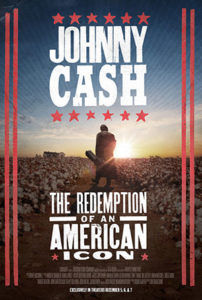
NASHVILLE (BP)—“Johnny Cash: The Redemption of an American Icon,” is a new documentary telling the story of how the legendary musician known as “The Man in Black” found the light of Jesus Christ.

The film releases as a special Fathom Event showing in theaters Dec. 5-7. It is directed by Ben Smallbone, brother of award-winning musical duo For King & Country and contemporary Christian music artist Rebecca St. James.
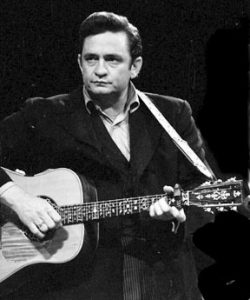
The project uses a combination of archive footage and recordings of Cash, along with interviews with his friends, family members, fellow country musicians and evangelical leaders.

Those featured in the movie include Tim McGraw, Sheryl Crow, Marty Stuart, Franklin Graham, Greg Laurie, Cash’s sister Joanne Cash and Cash’s son John Carter Cash.

John Carter Cash told Baptist Press that even though it was often overlooked, his father’s Christian faith was always a priority for him.

“His faith was essential to him all throughout his life,” Cash said in an interview.

“The defining factor of his life was his faith. His faith and connection to God was there no matter what he struggled with or endured. His faith survived out of grace. He was not perfect, but his ability to continue on is what really stands out.”

The movie tells the story of Cash’s early faith roots growing up in Arkansas, and singing gospel songs while helping work in the family fields. The younger Cash even described gospel music as the music his dad enjoyed the most.

Yet, as Cash began his music career as a young adult, he began to shift to the country music style he became known for. Despite achieving immense music success over several years, Cash dealt with a host of struggles, including a crippling drug addiction and a troubled first marriage to his wife Vivian, whom he divorced in 1966.

These were in addition to Cash’s difficult relationship with his father and the accidental death of his teenage brother Jack, who had desired to become a preacher.

Saw the Light

Johnny Cash (File Photo)

All of these struggles drove Cash to a place of desperation and hopelessness. Things reached a breaking point when his addiction was at its worst in the late 1960s.

The movie tells the story of Cash walking through a dark cave in Tennessee with a flashlight, considering ending his life. At one point Cash walked as deep as he could into the cave, and dropped his flashlight and went to the ground.

Though he was in complete darkness, the story goes that the light from outside of the cave slowly started to peek through, showing him the way out.

The story represents Cash coming back to the light of Christ and the foundation of his Christian faith.

Soon, he began finding ways to bring his faith more prominently into the national spotlight. He filmed a documentary with his second wife June Carter Cash in Israel (“Gospel Road: A Story of Jesus”). He wrote a novel about the apostle Paul (“Man in White”). And he appeared at 30 crusades held by world-renowned evangelist Billy Graham.

Graham and Cash were good friends, said John Carter Cash, who described their relationship as being “like brothers.”

Find connection with God

In addition to Cash’s public displays of faith, the younger Cash was able to see the personal side of his dad’s faith in a tangible way.

“I think one of the greatest spiritual disciplines he had was studying the Scriptures to better understand what the ways of the Spirit were,” John Carter Cash told BP. “My dad was forever a life student. He was always reading, studying and trying to understand more about life and faith.”

Toward the end of his life, Johnny and June Cash attended First Baptist of Hendersonville, Tenn.

John Carter said many people helped his dad break his drug addiction and prioritize God, but he believes he would have found his way back to God no matter the circumstance.

“His faith was his salvation and why he was alive,” the younger Cash said.

“That’s how he made it. My dad was always grateful to be here. He always took in God’s grace because by his own means, he probably wouldn’t have been here. He stayed true to what he believed in. His faith was the central focus, no matter what he went through in life.”

John Carter Cash hopes the movie will paint a picture of his father’s vulnerability in a way that audiences resonate with.

“My father had a way of showing his humanity and showing his weaknesses,” he said. “He was there to support people who were also going through struggles like he went through. My dad was not afraid to say, ‘I have fallen and gotten back up. Please help me and I will help you.’ That’s the person that he was.

“There are things within this movie that I believe will lend the viewer a better understanding of my father as a human. I hope they learn what was really important to him and who he was on the inside, particularly about the beauty of his character and strength of his love.”

In a world full of technology and division, his father’s message would be to focus on what’s really important, John Carter said.

“If he were alive today my dad would say, ‘Don’t forget what really matters,’” he said. ‘“Family, connection and togetherness matter. Don’t forget what is true. Don’t let all of the information that is out there confuse what matters in the end.’

“I hope through this film, people who are struggling or feeling like they’re not connected with God can find that connection just as my father did.”


Charitable giving up but gifts to larger churches dropped

WASHINGTON (RNS)—An annual report on giving to evangelical Christian nonprofits, including churches and other ministries, found that giving to the United States’ largest churches fell by more than 6.6 percent in 2021, despite a rise of 4 percent last year in charitable giving nationwide.

New donors and large donations were especially hard to come by, according to the report.

The findings appeared in the 2022 State of Giving report, released by the Evangelical Council for Financial Accountability, an accreditation organization that sets standards for ministries’ financial management and reporting.

The report’s authors examined cash-giving patterns to more than 1,800 ECFA members, drawn from financial statements from those nonprofits. All told, ECFA members received more than $19 billion in cash donations in 2021. They also received $11.3 billion in revenue from fees and investments and $4.7 billion worth of in-kind donations.

Many Christian groups other than churches saw increases in keeping with the overall rise in philanthropic giving, and some did far better. Donations to Christian foundations (65.8 percent), anti-human trafficking groups (28.9 percent), K-12 schools (18.3 percent), church planting (12.2 percent) and pregnancy resource centers (14.5 percent) saw some of the largest increases.

Giving to Christian charities overall was up 3 percent, adjusted for inflation, according to the report. That tops overall charitable giving in the United States, which dropped by just under 1 percent, according to Giving USA data cited by ECFA.

The report also finds that giving went up by 1.8 percent from 2016 to 2021.

Those numbers made the decline in giving to churches (-6.6 percent) and youth ministry (-2.9 percent) all the more stark. Churches with budgets under $2 million saw giving go down by 8 percent, while those with budgets of more than $20 million saw giving go down by 2.5 percent.

Many charities and churches alike struggled to find staff and volunteers.

The churches in the ECFA are larger than the average church in the United States. According to the 2020 Faith Communities Today study, which looks at congregations from a wide range of faith groups, the median congregation has a budget of $120,000, down 20 percent from 2010.

Most congregations in the United States have budgets of less than $100,000, but because larger churches draw so many, about half of Americans (51 percent) attend a church where the budget is $1 million or more.

The ECFA study found that 45 percent of nonprofits had trouble finding enough volunteers, 53 percent had problems finding enough staff, 29 percent struggled to keep existing donors, and 63 percent had issues finding major donors who gave $10,000 a year or more.

More than a third (37 percent) tapped their reserves in 2021, while 43 percent left reserves untouched. Just under 1 in 5 (17 percent) were able to grow their reserves.


Pastors say Christmas Eve most-attended holiday service

NASHVILLE, Tenn.—The closer it gets to Christmas, the more likely church pews will be filled, pastors say.

Half of U.S. Protestant pastors (48 percent) say a Christmas Eve service is their churches’ largest event during the holiday season, according to a Lifeway Research study. The frequency of the highest attendance events builds up to Christmas Eve and then tapers off into January.

“Christians have many different Christmas traditions, and so do their churches,” said Scott McConnell, executive director of Lifeway Research. “Family and church traditions are most likely to coincide for Christmas Eve services, but many evangelical churches see the highest holiday attendance earlier in December.”

Few pastors point to an event the first week of December or earlier (6 percent) or a service during the second week (10 percent) as their most well-attended. Around a quarter (26 percent) say an event during the third week of the month is top.

While it may not be true for most congregations, early December is the high-water mark for Christmas season attendance at Harrisburg Baptist Church in Tupelo, Miss. Senior pastor Rob Armstrong said attendance starts off strong in December, with their Sunday services the first two weeks of the month being their most attended events.

“Excitement about the Christmas season feeds into the higher attendance in the first few weeks of the month,” he said.

The church’s Christmas Eve service also is well attended, but he said the Sunday closest to Christmas and the Sunday closest to New Year’s Day have the fewest people show up.

In that regard, the Tupelo congregation is in line with most other churches. Few U.S. Protestant pastors see the largest crowds on Christmas Day (7 percent) or an event during the first week of January (5 percent).

The Christmas season is a prime season for church attendance. Traditionally, Christmas is the second-highest attendance time of the year behind only Easter, according to a 2012 Lifeway Research study.

In 2014, more than 3 in 5 Americans (63 percent) said Christmas activities should include a visit to a church service, according to Lifeway Research. In 2015, Lifeway Research found a similar percentage (61 percent) said they typically attend church during Christmastime.

Even among those who don’t attend church this time of the year, 57 percent said they would be likely to attend if someone they knew asked them.

Seasonal differences

High-attendance events during the Christmas season vary from church to church. Pastors in the South (39 percent) are least likely to say Christmas Eve. Pastors at congregations of fewer than 50 (19 percent) are the least likely to say they have the most people attend an event during the third week of December.

Mainline pastors are more likely than their evangelical counterparts to say their most attended service is on Christmas Eve (60 percent v. 44 percent), while evangelical pastors are more likely than mainline ministers to say their highest attendance event is during the third week of December (30 percent v. 17 percent).

Denominationally, some churches fare better earlier in the month, while others see their crowds grow as the season wears on.

Pentecostal (18 percent) and Baptist (15 percent) pastors are more likely than Methodist (3 percent), Restorationist Movement (2 percent) and Lutheran (1 percent) pastors to have their highest attendance during the second week of December.

For the third week, Pentecostals (45 percent), Restorationist Movement pastors (37 percent) and Baptists (35 percent) are more likely than Presbyterian/Reformed (20 percent), non-denominational (17 percent), Methodist (13 percent) and Lutheran (7 percent) pastors to have the largest crowd of the season.

Lutherans (84 percent) are the most likely to say their high-attendance event this season happens on Christmas Eve.

Restorationist Movement churches are unique in that 21 percent say their most popular service is an event the first week of January.

Some traditions have aversion to holiday

John Dobbs, pastor of Forsythe Church of Christ in Monroe, La., said there is a resistance to celebrating Christmas among the autonomous Christian and Church of Christ congregations. “That is based on the truth that we are never actually told in Scripture to celebrate the birth of Christ,” he said.

Dobbs also noted pastors and members at Church of Christ congregations have diverse opinions on how to approach the Christmas holiday.

While many Orthodox Christians celebrate Christmas in January, the first part of the year also provides a natural time of reflection and focus.

“Given the aversion to holidays among many traditional and conservative churches, a day of renewal and beginning again becomes a day of emphasis and engagement,” Dobbs said.

At Harrisburg Baptist, attendance on the Sundays closest to Christmas and New Year’s Day are some of the lowest attended of the season, according to Armstrong, as many are out of town visiting family. Despite what may be smaller crowds, he still believes churches should gather on those days.

“Churches should have worship on Christmas Day or any Sunday close to it,” he said. “It’s OK to have low attendance on those days because people travel.”

Religious traditions specific to varied Christian denominations make a difference in when attendance peaks, McConnell observed.

“Pastors are always eager to see people attending church services, and the Christmas season is one time of year they get to see most of their congregation as well as visitors,” he said. “But the nature of those traditions varies by church with some seeing attendance culminating in a special Christmas Eve service, others a Sunday morning service and others a special musical experience.”

Lifeway Research conducted the phone survey of Protestant pastors Sept. 6-30, 2022. The calling list was a stratified random sample, and researchers used quotas for church size. Analysts weighted responses by region and church size to reflect the population more accurately. The completed sample is 1,000 surveys, providing 95 percent confidence the sampling error does not exceed plus or minus 3.2 percent. Margins of error are higher in sub-groups.


Native American removal is more than physical

Listening to Native people’s stories is one of the most important things a person can do, because it’s one of the things that happens least for Native Americans, Mariah Humphries told webinar participants.

Humphries is director of parachurch partnerships and alumni relations for Baylor University’s Truett Theological Seminary and a member of the Mvskoke Nation. In speaking to Native American experience, she made clear she is only one voice among many Mvskoke and the even broader Native American peoples.

Don’t assume one voice speaks for all, she counseled.

In her Nov. 18 webinar, “The Impact of Untold Stories in History: Exploring Native American Experience,” hosted by Texas Baptist Women in Ministry, Humphries explained the Brackeen v. Haaland case argued before the U.S. Supreme Court Nov. 9. This current event has a long history, she said.

Brackeen v. Haaland

Jennifer and Chad Brackeen are white and members of a Church of Christ congregation in Texas. They are seeking to adopt the 4-year-old Navajo sister of the Navajo boy they previously adopted. ICWA stands in the way, however.

The U.S. Congress approved the Indian Child Welfare Act in 1958. The purpose of ICWA is to prioritize Native American families for the placement of Native American children in foster care.

If a family member cannot adopt, preference is then given to the child’s tribal nation, followed by other tribal nations. Only when those options are exhausted is the adoption opened to non-Native families, who usually are white, Humphries noted.

Child welfare advocates long have deemed ICWA the “gold standard” for child welfare, she said.

Along with the Brackeens, a great-aunt of the girl also wants to adopt her. Here enters ICWA. In response to ICWA’s limitations on adoption, a series of lawsuits has culminated in Texas, Louisiana and Indiana attorneys general and others challenging ICWA’s constitutionality.

Deb Haaland, the named defendant, is U.S. Secretary of the Interior—the first Native American to serve in the cabinet and a member of the Pueblo of Laguna about 46 miles west of Albuquerque, N.M.

To understand why Brackeen v. Haaland is so significant requires going back to the late 1800s, Humphries explained.

Indian removal—physical and cultural

Along with the removal of Native Americans from their ancestral lands in the 1880s and 1890s, and relocation westward to designated areas called “reservations,” the federal government established euphemistically termed “residential schools” to assimilate Native American children.

Kill the Indian in him, and save the man,” is how Lt. Col. Richard Henry Pratt described the program of assimilation.

Native Americans were deemed primitive and savage from at least the founding of the United States, Humphries said. To eliminate such qualities, the U.S. federal government, with the assistance of Christian denominations—including Baptists—ran “Indian schools”—408 of them in 37 states and territories, she added.

Native American children were removed from their families to be placed in these schools. Upon arriving, boys’ hair was cut short—a cultural sleight against Native identity, Humphries said. Native children also were forced to wear Western clothing and to speak English.

In this way, hundreds of thousands of Native American children not only were removed physically from their families, communities and land, but also were removed from every aspect of their tribal nation and culture, Humphries said. At one time, there were 574 federally recognized nations in the United States and hundreds of languages, she added.

Many of these children never went home, and many of their families still don’t know what happened to them, Humphries continued.

Most Americans knew nothing about these schools until mass and unmarked graves were discovered recently. With these discoveries, Americans are learning about the physical, sexual, emotional, mental and spiritual abuse that took place in these schools, as well as the forced labor, poor health care and neglect, Humphries explained.

Continuing removal

Overlapping the federal Indian school program was the Indian Adoption Project, another federal program running from the 1940s to 1967.

Once again, Native American children were removed, this time from the 16 Western U.S. states, to be placed with adoptive families along the East Coast. During this project, one-third of Native American children were separated from their families, Humphries said.

By contrast, ICWA “prioritizes the nativeness” of Native American children, placing them among their family, community and land if at all possible.

Should ICWA be reversed, however, more is at stake than child placements. Reversing ICWA is an attack on tribal sovereignty, Humphries warned. It would open the door to further attacks on tribal sovereignty, as well as open Native American land and resources to American corporate interests.

Quoting Harvard law professor Joseph Singer’s assessment of a possible outcome of Brackeen v. Haaland, Humphries said a reversal “could have ‘revolutionary, catastrophic consequences’ for the relationship between Indian nations and the United States” by affecting “hundreds of treaties with Indian nations … still in effect.”

ICWA’s reversal would be “a continuation of removal,” Humphries said.

Native American children may not be placed with non-Native families, thanks to ICWA, but Native American women still are being removed, Humphries noted, referring to MMIW—Missing and Murdered Indigenous Women.

According to Native Hope, a justice organization for Native Americans, “The murder rate [is] ten times higher than the national average for women living on reservations.” At least one study has found spikes in violence against Native women correspond to the presence of “man camps”—temporary housing for extraction industry employees.

Not only do Native Americans oppose pipelines as invasions and potential contaminants of their tribal lands, but they also do not want the “man camps” that accompany them. A reversal of ICWA could make their presence on tribal land more likely.

Listening for trauma’s echo

Most Americans do not know much of the preceding history, Humphries said. Their conception of Native Americans is frozen in the 1880s or 1890s, she added.

“But we are still here. I am here,” she said.

Native Americans carry generational pain and trauma in their bodies, she continued, noting higher rates of suicide and physical illness among indigenous people than in the general population.

Today, many Native Americans are trying to reconnect with their families, their identities, their heritage and their culture.

Native Americans often want to be heard, because they’re dismissed so often, Humphries said. They are considered as “other,” different and unknown, and often are hidden from view and underreported in statistics.

Referring to how Western Christians often regard Native American perspectives and the assumptions often made about Native American political positions, Humphries said, “If we don’t agree with it on the ballot, we’ll probably reject it in our faith spaces.”

Rather than rejecting Native American stories out of hand, she advocates listening to the suffering and trying to understand the reasons for it.

Listening to Native people’s stories is one of the most important things a person can do, because it’s one of the things that happens least for Native Americans, Humphries said.

Disclosure: Mariah Humphries is vice chair of the Baptist Standard board of directors.