Young organists pull out all the stops to inspire interest

WASHINGTON (RNS)—Storeé Denson settled onto the organ bench at Nineteenth Street Baptist Church, a historic Black church a few miles from the White House, placing his hands on the electronic instrument’s manuals, his feet on its pedals, ears attuned to the choir he accompanies on Sunday mornings.

Like any other organist, Denson has been playing and preparing for numerous services in the weeks before Christmas. He warmed up for the season in November when he got the chance to play the august instrument at the Naval Academy Chapel in Annapolis, Md., at a “Pedals, Pipes and Pizza” event sponsored by the local chapter of the American Guild of Organists.

Storeé Denson plays the organ at Nineteenth Street Baptist Church in Washington, D.C. (RNS Photo / Adelle M. Banks).

“I always wanted to play it,” he said of the organ in the monumental chapel at the academy. “That was one on my checklist.”

As he’s done with many other of his accomplishments at the keyboard, Denson, age 14, checked off that item early. He is one of a small corps of young musicians who took to the organ at a young age, providing promise at a time when the number of instruments and the professionals who play them are in decline. They’ve become modern-day evangelists for the instrument that is more than 2,000 years old.

“I believe if more people start to realize that the organ can be used in contemporary worship, I think we will have an increase of organists,” said Denson, a ninth grader who also sings tenor in the chamber choir and plays piano in the jazz band at his Catholic high school across the Maryland state line.

On the second Sunday in Advent, he accompanied the Nineteenth Street choir as it sang Richard Smallwood’s setting of “Psalm 8” (“Oh, Lord, how excellent is thy name”), as well as “Jesus, the Light of the World.”

Denson, whose parents are both ministers, has been studying organ since he was 9 and credits organists at various Baptist churches for introducing him to the instrument and teaching him to play.

Some organists who start at an early age are veterans of the American Guild of Organists’ “Pipe Organ Encounters” programs, which bring young people to hear and play organs at nearby houses of worship and universities over the course of a few days to learn about the instrument. The program includes their first year of membership in the organists’ guild.

Overall decline in organ use

Scott Thumma, director of the Hartford Institute for Religion Research, said data from the Faith Communities Today studies shows a decline in organ use, with fewer respondent congregations reporting that their organ is played “often and always” and more saying “never” over time.

The American Guild of Organists’ current total membership is 11,516, including professional organists, people who play the instrument as an avocation and those who just like the organ. A decade ago, there were about 17,000 members, and the group reached its apex of about 20,000 in the 1990s.

Eric Birk, the AGO’s staff liaison to the Pipe Organ Encounters program, said the AGO attributes the drop to the deaths of organists who were baby boomers or members of older generations and to the downward demographic shifts in worship attendance.

Nevertheless, Emily Amos, who runs the AGO’s committee for young organists, said she thinks organs are bound to interest some young people.

“I mean, it’s loud, it’s massive, it’s got cool gadgets,” said Amos, 21, who is pursuing a master’s degree in organ performance at Rice University’s Shepherd School of Music. “It’s got everything that you would want to try out.”

Inspire by example

Potential organists may not always find their way to the instrument via churches, said Amos, who has played the famous Wanamaker organ at Macy’s Philadelphia.

“If young people aren’t as interested in going to church or fewer young people are going to church, we need to think, where are they going and how can we get the organ to them there?” said Amos, who is also an organ scholar, or apprentice organist, at St. Paul’s United Methodist Church in Houston. “Because even if, say, they find the organ somewhere else, they may end up in a church.”

Amos, who favors Duruflé’s “Prelude and Fugue on the Name Alain,” hosts a holiday party via Zoom for organists under 30, where they play games, build camaraderie and share “horror stories” from the Christmas season—Advent wreaths catching fire during a service and ciphers (stuck pipes that sound at unwanted times)—and commiserate about the grueling seasonal schedules.

“There was one Christmas Eve where I played three different services at two different churches. So, I had to race from one to the other, then go eat, take a nap and then come back for the midnight,” said Amos, a Roman Catholic who plans to play at St. Paul at some of this year’s five services and sing in the choir at the others.

Birk said the number of young organist members—defined as younger than 30—in the AGO totaled 863 in November.

Beyond the organist guild’s efforts, others are hoping to inspire young artists by example. The Diapason magazine, dedicated to church music, has a biennial “20 under 30” list of young people known for performing on the organ and harpsichord or building the instruments.

Build-your-own miniature pipe organ kits

Peter Scheessele, a 10th grader in Corvallis, Ore., helps his mother, Erin, run Orgelkids USA, a nonprofit that seeks to literally build interest in the instrument by distributing miniature pipe organ kits that allow children and adults to build and then play their own organs.

Designed by a Dutch company, the U.S. kits are created by craftspeople in Oregon. More than two dozen organizations, mostly churches and AGO chapters, have commissioned them at $7,000 apiece.

“I like to show them how the whole thing goes together,” Peter Scheessele said of the children and teens who attend Orgelkids demonstrations at churches and conventions. The kits contain 133 interlocking wood pieces that fit together without glue or screws. “And then they love the moment when it starts to play and they’re able to play it.”

Jim Roman, the organist and artist-in-residence at St. Luke’s United Methodist Church in Houston, says his church has the sole Orgelkids kit in Texas. He builds it with the church’s day school students at least once a year and holds camplike sessions with older children in the summer.

“Organists today need to be proactive about getting the instrument in front of people, especially since fewer people attend church now and get exposed to it as a result,” he said in an email.

“We can’t just hope that people will pay attention on Sunday mornings or randomly decide to show up to a concert and suddenly develop an interest,” said Roman, 32.

Scheessele, 15, plays a full-size organ at his own congregation, First Congregational United Church of Christ in Corvallis. He also recently performed a prelude and fugue by Vincent Lübeck at a local Presbyterian church whose organ has often sat silent.

On Christmas Eve, Scheessele hoped to play variations on a German Christmas carol about Joseph and Mary, part of a grander range of organ music he and other young organists say they prefer to play.

“I think the organ is a very interesting instrument—very complex—and I feel like it’s not represented as well as it should be in society,” he said. “Often, the only time you would hear it in a movie would be dark, foreboding music when that’s not all that the organ can provide,” he said.

“There’s a huge range of repertoire across the country that’s written for organ,” he added. “And I do like to play it all.”



Calling the police is not enough when abuse is alleged

WASHINGTON (RNS)—When leaders of Immanuel Baptist Church in Little Rock, Ark., learned in 2016 a former church staff member had been accused of sexually abusing a child, they called the police and reported the information immediately.

Then, they went silent for seven years.

An assistant director of children’s ministry, Patrick Stephen Miller was arrested, charged with second-degree sexual assault and later convicted of a lesser offense. Immanuel Baptist Pastor Steven Smith and other leaders never informed the congregation.

In early December, Smith finally explained the episode to Immanuel Baptist’s members, but only after the Arkansas Democrat-Gazette reported on Miller’s attempts to have his court records sealed. Smith apologized for withholding information about the abuse and Miller’s conviction.

“I wish we had told you about these crimes sooner,” Smith, the son of former Southern Baptist Convention President Bailey Smith, said at a church service on Dec. 10, according to a recording posted online by the Democrat-Gazette.

Earlier this year, Smith informed the congregation of another incident, in which a former volunteer had been allowed to remain in ministry after sexting with a teen at the church, according to the Democrat-Gazette. In that case, church officials reportedly did not inform law enforcement for years.

The delay in telling the congregation at Immanuel Baptist echoes a similar case in northern Illinois, where Bishop Stewart Ruch of the Upper Midwest Diocese of the Anglican Church in North America delayed for nearly two years telling members of his diocese a volunteer at a church in the diocese had been arrested on sexual abuse charges.

That volunteer, former lay pastor Mark Rivera, was sentenced to 15 years in prison this past March after being convicted of felony child sexual abuse and assault. He later was given six additional years.

Ruch told members of the diocese church leaders were waiting for the legal process to be completed, and that caused the delay. Ruch eventually took a leave of absence and now is facing a church trial on allegations of mishandling cases of abuse.

Fear prompts silence

While churches have made progress in recent years toward addressing abuse, including contacting law enforcement when learning about allegations of sexual abuse, they still can be reluctant to inform people in the pews about abuse that may have happened in their midst, said Jimmy Hinton, a longtime advocate for survivors of abuse.

Church leaders often fear creating a scandal or accusing someone who may be innocent, said Hinton, who frequently advises churches on how to respond to abuse. Leaders often feel they have done the right thing by reporting to police, but he said their work is not complete at that point.

Hinton said his counsel to church leaders is straightforward: If they know about allegations of abuse, they need to tell the congregation. He said that if a congregation is not told, it will lead people to assume the worst.

“They will wonder, what else are you covering up,” he said.

Frank Sommerville, a Texas attorney who specializes in church and nonprofit law, said churches do need to take care when communicating about allegations of abuse to the congregation.

Sommerville said churches can expect a delay between reporting allegations to police and any action, such as filing of charges or making an arrest. They can use that delay to tell church leaders, such as board members or deacons, about what may be coming.

The person accused of abuse should be removed from ministry while the investigation proceeds. Then, when the congregation is informed, after an initial report is made, it should be during a confidential, members-only meeting, he said.

That’s in part to allow law enforcement to do its work, Sommerville said. If charges are filed or an arrest has been made, the congregation should be informed immediately.

“Once an arrest has been made, you need to have a congregational meeting, and tell everyone what you know and what actions you have taken.”

Lou Ann Sabatier, a longtime communications professional and principal of Sabatier Consulting in Falls Church, Va., said church leaders also need to be thoughtful and intentional about how they tell the congregation about a crisis such as allegations of abuse.

That includes being clear about the presumption of innocence even as they send a message that the church takes allegations of abuse seriously, she said.

When a congregation is told about allegations, Sabatier added, it should happen in a controlled setting where people have time and space to respond and ask questions.

“This isn’t something that you would bring up at the end of announcements during the sermon,” she said.

Church leaders have a moral imperative to tell the truth to their congregations, Sabatier said, even when the news is difficult.

“If you are not telling them, you are not being truthful,” she said.


Americans searched for hope on Bible app in 2023

WASHINGTON (RNS)—Bobby Gruenewald might know more about how Americans read the Bible than anyone else in the country.

For the past 15 years, Gruenewald, an online entrepreneur turned pastor, has run the popular YouVersion Bible app—a free application that has been downloaded more than 700 million times in the United States and around the world.

When people log on to the app, they don’t generally want to know what the Bible thinks about politics or hot-button social issues, Gruenewald said. Instead, they are usually looking for some reassurance that things are going to be all right.

Bobby Gruenewald, CEO of YouVersion. (Photo courtesy of Life. Church)

“People are turning to Scripture and using it and looking at it in a way that reminds them of God’s faithfulness or hope,” Gruenewald said.

That search for hope is reflected in a list of the top 10 verses users searched for in 2023. The No. 1 verse for the third year running was Isaiah 41:10, which begins, “So do not fear, for I am with you; do not be dismayed, for I am your God,” in the New International Version.

Other popular searches included familiar verses like John 3:16, Jeremiah 29:11—which speaks of God having plans to prosper his people—and Philippians 4:6, which reads, “Do not be anxious about anything.”

YouVersion is also one place where Americans aren’t arguing about God and politics. Gruenewald said the app—which includes hundreds of Bible translations in multiple languages, Bible reading plans, devotionals and a place to share prayer requests—tried to steer clear of politics or culture war feuds.

That’s in part because the app has an international audience and in part because the app’s developers want to draw people into engaging with the Bible, not drive them away.

“We didn’t want the Bible app to be a battleground for those issues,” said Gruenewald.

The YouVersion app has evolved dramatically over its lifespan. Gruenewald, a pastor on staff at Life.Church based in Oklahoma City, first came up with the idea for YouVersion while waiting in a security line in Chicago O’Hare International Airport in 2006.

YouVersion launched first as a website, where people could look up Bible verses online, and then morphed into an app with the proliferation of smart phones.

Focus on engaging with Scripture

In the early days, the app was focused on giving access to information about the Bible, Gruenewald said. Now the focus is also on engagement with the Bible.

In recent years, the popular Verse of the Day function has expanded to include devotionals and more of a daily experience with the Bible, Gruenewald said. The app also now includes guides on how to pray and ways to let people share prayer requests and get reminders to pray.

“You can ask your friends to pray for those requests, and you can be notified every time someone indicates that they pray for you,” said Gruenewald.

Much of the app’s more recent growth has come in places like India, Latin America and Africa. Of the more than 100 million downloads in 2023, according to YouVersion, more than 80 percent were outside the United States, where a lite version of the app for less-robust smart phones has become popular.

The success of the YouVersion app comes with a great deal of responsibility, Gruenewald said. YouVersion has collected data on tens of millions of users, which requires them to have powerful data security. That data would have great value to advertisers and other outside groups.

But it’s not for sale, Gruenewald said.

“We have been approached by everybody on the planet that wants to buy data,” he said. “We don’t even entertain the conversation. We don’t monetize the data.”

Instead, the app is funded by donors both inside and outside the church. The app is owned by Life.Church, which runs YouVersion as a distinct operation. The church also started a second nonprofit, YouVersionINC, in 2023 to support the app, according to IRS documents.

Given the troubles of other popular social media websites—most notably X, formerly known as Twitter, and TikTok—Gruenewald said the YouVersion team feels a responsibility to keep the app true to its mission and to honor the trust users have put in them.

“There are millions of people that are depending on the app to work,” he said. “And that’s not a trivial matter.”


Latino majority churches see growth, financial struggles

WASHINGTON (RNS)—Majority Latino congregations report growth and stability in attendance and, on average, have younger participants—a sharp contrast to the declining attendance and aging congregations in most churches in the United States.

But more than other congregations across the country, Latino faith communities also face significant financial challenges.

The findings from a new Hartford Institute for Religion Research report, released Dec. 12, provide a rare look at the state of Christian churches with a majority population of Latinos.

“Latino congregations, by and large, constitute a more vibrant aspect of congregational life in the United States, particularly Christian congregational life,” said Kristina Lizardy-Hajbi, author of Latino Congregations: Trends from the Faith Communities Today (FACT) and Exploring the Pandemic Impact on Congregations (EPIC) Studies.

“They tend to be larger congregations and tend to have younger members, and this is, I think, similar to the Latino population as a whole in the United States.”

The report notes Latinos, who comprise 18.7 percent of the U.S. population, increased by 23 percent from 2010 to 2020, according to the latest U.S. Census.

Lizardy-Hajbi, a sociologist of religion at Iliff School of Theology, said the report is unique in its look at this topic, which previously has been the subject of case studies and ethnographies.

It breaks down the share of majority Latino congregations, where Latinos are 50 percent or more of the attendees. The findings indicate 7 in 10 (71.8 percent) were evangelical Protestant, while 15.1 percent were mainline Protestant and 12.8 percent were Catholic and Orthodox.

However, 6 in 10 Latino congregational worshippers attend evangelical Protestant churches (61.7 percent), while about one-third are in Catholic churches (33.8 percent) and only 4.4 percent in mainline Protestant churches.

Overall, Latino congregations have a median of 80 weekly worship attendees, compared with non-Latino congregations, with a median of 65.

Latino churches face financial challenges

Even as Latino congregations fare better in attendance, they and their leaders struggle more with financial matters.

Overall, giving per capita in Latino faith communities based on average attendance is $1,250, compared with $2,000 for all congregations, the report stated.

Before COVID-19-related lockdowns, 62.7 percent of these faith communities said their financial health was “excellent” or “good.” Afterward, a much smaller percentage—26.1 percent—used that description. Those citing “some” or “serious” difficulty shifted in the same time frame from 2.4 percent to 41 percent.

“This trend is mirrored across all U.S. congregations, but it is reflected more drastically within Latino faith communities,” Lizardy-Hajbi wrote in the 29-page report.

“How denominations and other religious bodies are addressing the financial challenges facing Latino congregations most impacted by COVID-19 should be a conversation of priority.”

The clergy leading these congregations—41.7 percent of whom are Latinos and 40 percent non-Latino white—often earn their living outside the faith communities they lead. Whether part-time or full-time congregational leaders, more than a third have paid employment beyond their congregation. Two in 10, overall, are not paid for their congregational work.

Majority Latino congregations are half as likely (34.7 percent) to own the facilities where they meet than are non-Latino congregations (64.8 percent).

Owning, rather than renting, a facility may allow a congregation to better serve as a hub for the community, Lizardy-Hajbi said.

The report noted half (50.2 percent) of majority Latino congregations put “a lot” of emphasis on community service, while 33 percent of other congregations do.

It also described a mix of success in congregational growth. About 4 in 10 (43.6 percent) saw attendance grow more than 5 percent in the last five years, while 18.2 percent remained fairly stable, and 38.2 percent saw a decline of more than 5 percent.

“Still, the overarching picture for majority Latino congregations looks more promising than for other congregations; but time will tell whether dynamics of increasing non-affiliation and secularism will ultimately impact these faith communities,” Lizardy-Hajbi stated in the report.

The findings are based on a segment of research from the FACT survey of 15,278 congregations in 2020 and 2,074 responses to the EPIC survey conducted in 2021. The majority Latino congregations totaled 276 (1.8 percent) and 30 (1.4 percent), respectively.


Las congregaciones de mayoría latina experimentan crecimiento y desafíos financieros

WASHINGTON (RNS)—Las congregaciones mayoritariamente latinas informan de crecimiento y estabilidad en asistencia y, en promedio, cuentan con participantes más jóvenes—un marcado contraste con la disminución de asistencia y el envejecimiento de las congregaciones en la mayoría de las iglesias en Estados Unidos.

Sin embargo, estas comunidades de fe latinas enfrentan desafíos financieros significativos más que otras congregaciones en el país.

Los hallazgos de un nuevo informe del Instituto Hartford para la Investigación Religiosa, publicado el 12 de diciembre, ofrecen una mirada poco común al estado de las iglesias cristianas con una población mayoritaria de latinos.

“Las congregaciones latinas constituyen en gran medida un aspecto más vibrante de la vida congregacional en Estados Unidos, particularmente la vida congregacional cristiana”, dijo Kristina Lizardy-Hajbi, autora de Congregaciones Latinas: Tendencias de los Estudios de Comunidades de Fe Hoy (FACT) y Explorando el Impacto de la Pandemia en Congregaciones (EPIC).

“Tienen a ser congregaciones más grandes y con miembros más jóvenes, y esto, creo, es similar a la población latina en general en Estados Unidos”. El informe señala que los latinos, que representan el 18.7 por ciento de la población de EE. UU., aumentaron un 23 por ciento desde 2010 hasta 2020, según el último censo estadounidense.

Lizardy-Hajbi, socióloga de la religión en la Escuela de Teología Iliff, dijo que el informe es único en su enfoque en este tema, que anteriormente ha sido objeto de estudios de caso y etnografías. Se desglosa la participación de las congregaciones mayoritariamente latinas, donde los latinos son el 50 por ciento o más de los asistentes. Los hallazgos indican que 7 de cada 10 (71.8 por ciento) eran protestantes evangélicos, mientras que el 15.1 por ciento eran protestantes principales y el 12.8 por ciento eran católicos y ortodoxos.

Sin embargo, 6 de cada 10 adoradores latinos asisten a iglesias protestantes evangélicas (61.7 por ciento), mientras que aproximadamente un tercio está en iglesias católicas (33.8 por ciento) y solo el 4.4 por ciento en iglesias protestantes tradicionales.

En general, las congregaciones latinas tienen un promedio de 80 asistentes semanales a los servicios de adoración, en comparación con un promedio de 65 en las congregaciones no latinas.

Aunque las congregaciones latinas tienen mejor asistencia, ellas y sus líderes luchan más con asuntos financieros. El promedio de donaciones per cápita en comunidades de fe latinas, basado en la asistencia promedio, es de $1250 en comparación con $2000 para todas las congregaciones, según el informe.

Antes de los cierres relacionados con COVID-19, el 62.7 por ciento de estas comunidades de fe afirmaban que su salud financiera era “excelente” o “buena”. Después, un porcentaje mucho menor—26.1 por ciento—usó esa descripción. Aquellos que citaban “algunas” o “serias” dificultades cambiaron en el mismo período de tiempo del 2.4 por ciento al 41 por ciento.

 “Esta tendencia se refleja en todas las congregaciones de Estado Unidos, pero se ve de forma más drástica dentro de las comunidades de fe latinas”, escribió Lizardy-Hajbi en el informe de 29 páginas. “La forma en que las denominaciones y otros cuerpos religiosos están abordando los desafíos financieros que enfrentan las congregaciones latinas más afectadas por COVID-19 debería ser una conversación prioritaria”.

Los clérigos que lideran estas congregaciones—41.7 por ciento de los cuales son latinos y el 40 por ciento blancos no latinos—suelen ganarse la vida fuera de las comunidades de fe que lideran. Ya sea a tiempo parcial o completo, más de un tercio de los líderes congregacionales tienen empleo remunerado fuera de su congregación. Dos de cada 10 en general no son remunerados por su trabajo congregacional.

Las congregaciones mayoritariamente latinas tienen la mitad de probabilidad (34.7 por ciento) de ser propietarias de las instalaciones donde se reúnen en comparación con las congregaciones no latinas (64.8 por ciento).

Ser propietario en lugar de alquilar una instalación puede permitir que una congregación sirva mejor como un centro para la comunidad, dijo Lizardy-Hajbi.

El informe señaló que la mitad (50.2 por ciento) de las congregaciones mayoritariamente latinas pone “mucho” énfasis en el servicio comunitario, mientras que el 33 por ciento de otras congregaciones lo hace. También describió una mezcla de éxito en el crecimiento congregacional. Alrededor de 4 de cada 10 (43.6 por ciento) vieron crecer la asistencia más del 5 por ciento en los últimos cinco años, mientras que el 18.2 por ciento se mantuvo bastante estable y el 38.2 por ciento vio una disminución de más del 5 por ciento.

“Aun así, el panorama general para las congregaciones mayoritariamente latinas parece más prometedor que para otras congregaciones; pero el tiempo dirá si la dinámica de aumento de la no afiliación y el secularismo finalmente afectará a estas comunidades de fe”, declaró Lizardy-Hajbi en el informe.

Los hallazgos se basan en un segmento de investigación de la encuesta FACT de 15278 congregaciones en 2020 y 2074 respuestas a la encuesta EPIC realizada en 2021. Las congregaciones mayoritariamente latinas sumaron 276 (1.8 por ciento) y 30 (1.4 por ciento) respectivamente.


Challenge preaching to polarized congregations

WASHINGTON (RNS)—American Baptist pastor Susan Sparks, who is both a minister and a professional comedian, uses humor in her sermons to help her New York City congregation consider ways to approach those with whom they disagree.

Pastor Joel Rainey, who leads a West Virginia evangelical church, hosts a “special edition” of his preaching podcast to answer questions he’s received from his politically diverse congregation about hot-button issues.

Rabbi Rachel Schmelkin recently preached about anger, realizing it was an emotion felt by congregants of her Reform synagogue in Washington, no matter their stance on the Israel-Hamas war.

Fueled by their work in comedy, psychology and theology, some clergy say reducing polarization is both a spiritual necessity for them and an ever-increasing part of their job description.

Susan Sparks regularly uses comedy both in the preaching and signage at Madison Avenue Baptist Church in New York City. (Courtesy photos)

Sparks, who has been on the Laugh in Peace comedy tour with a rabbi and a Muslim comic, said she can see shoulders relax and smiles appear on faces when she starts a sermon in a joking matter—such as the battle over what topping is appropriate on a sweet potato casserole. Then she can move into tougher subjects as she addresses her multiethnic congregation.

“I did a piece on how cancer does not discriminate between Republicans and Democrats,” said Sparks, a cancer survivor, referencing another sermon. “There’s things that we all experience, and we can start there and find that place, enjoy a little moment where we can share something and take tiny baby steps off that to move into harder territory.”

Preaching is one means, she and others say, that clergy can attempt to help congregants get along better with each other and, by extension, their families and friends.


Andrew Hanauer, president and CEO of One America Movement (Courtesy photo)

“We used to have congregations where people would be shaped by Scripture and by their faith leader and then they would listen to the news and say, well, that does or doesn’t fit in with my faith,” said Andrew Hanauer, president and CEO of One America Movement, a Maryland-based organization founded in 2017 that supports leaders of congregations, from Southern Baptists to mainline Protestants to Muslims.

Now, as people often align first with a viewpoint they’ve heard on cable news or read in social media, he said clergy have to answer new questions: “How do you preach in a way that moves people out of complacency about the world in general, but also lets them know this is not a Democratic church or a Republican church—it’s a church for all God’s people?”

In recent years—especially since 2020—as clashes over race, politics and health have escalated into what Hanauer calls “toxic polarization,” clergy can feel like they are walking a knife’s edge in their sermons, as they preach to divided—and sometimes hostile—congregations.

Pastors seek ideas on how to heal division

One America Movement, along with the Colossian Forum and other clergy resource groups, has found pastors are seeking ideas for how to preach in ways that heal, rather than further widen, the social and political divides within their congregations.

In the last year and a half, Hanauer’s organization has worked with more than 100 clergy as they consider sermons or other messaging related to polarization.

Hanauer, a lay member of a nondenominational evangelical church, said his organization offers training to congregations or their leaders on how to manage difficult conversations, as well as listening sessions with clergy who are suffering from burnout and exhaustion. Its work has ranged from training rabbinical students—who went on to preach sermons against polarization—to a multi-faith initiative to address the opioid crisis in West Virginia.

“It’s not about going from red to blue to purple,” he said. “It’s about going above the partisan divisions and having a compelling vision for the world that is more hopeful and more positive.”

Schmelkin, a former staffer at One America Movement, has used what she learned from the organization’s listening sessions and trainings to find nuanced ways to address polarization in her sermons as an associate rabbi at Washington Hebrew Congregation.

She chose to preach on anger on the first Friday night in December, knowing the congregants, representing diverse views, likely were all feeling some level of rage amid the Israel-Hamas war.

Schmelkin talked to them about how God is described in the Torah as “slow to anger,” or “erech apayim.” She recommended drawing “a deep, intentional breath before reacting” as “the first step we can take to better manage our anger, to be a little more like God.”

In an interview, Schmelkin said she has had one-on-one discussions with people in her community who are grappling with divisions over the war—from parents whose college-age children hold different views from theirs to Jewish millennials who have discovered via Facebook some of their close friends do not share their perspectives on the conflict.

In November, she led a “healthy conversations” workshop for young adults coping with those differences and provided a script they could use that had been developed by the One America Movement and Over Zero, a group that uses communication to reduce division and violence.

One participant told Schmelkin afterward she used the script with a friend with whom she had major disagreements about the war, “and she felt like it saved her friendship.”

How people believe others perceive them

Pastor Joel Rainey (Courtesy Photo)

Rainey said he has learned terminology like “metaperception”—how people believe others perceive them—from One America Movement, which he first connected with when he joined other faith leaders in responding to the opioid crisis. He brought the concept into the pulpit by encouraging congregants to have “one conversation” with an individual instead of talking to others about that person.

“You don’t have to wonder what they think about you. You’re going to know,” said the pastor of Covenant Church, a predominantly white congregation in Shepherdstown, W.Va., where about 600 attend Sunday services. “Having one conversation is my way of saying, Don’t ever say anything about somebody that you wouldn’t say directly to them.’”

Rainey, who has been involved in interfaith activities, including a musical concert with Jews and Muslims at his church, said he has used his special-edition podcasts to address issues like Christian nationalism and Israel, issues on which his congregants have conflicting opinions.

“When Psalm 122 says, ‘Pray for the peace of Jerusalem,’ it’s not just the Jews,” he told listeners. “It’s everybody living in that space.”

Develop a ‘vision for conflict transformation’

The Colossian Forum, a Michigan-based organization founded in 2011, originally held issue-specific workshops on topics such as human sexuality and politics but since 2022 has broadened its focus through two-day “WayFinder” trainings.

More than 600 leaders from Christian organizations have gone through the training, seeking help with divisions over anything from “leadership changes to sanctuary carpet color,” according to the group’s website.

People attend the One America Movement summit in May 2023. (Courtesy photo)

During the in-person training, Jess Shults and other staffers encourage participants to develop “a vision for conflict transformation,” she said. Using spiritual and leadership practices, they try to help participants see that divisions are not always a negative. They can be an opportunity to “reflect Christ in the midst of conflict.”

Shults said preaching alone is not sufficient to address polarization in a congregation.

“In an ideal setup, one would be pairing a sermon with, then, some kind of post-sermon conversation during an adult-ed hour,” said the former Reformed Church in America pastor, “so that one is recognizing the place of power they have when delivering a sermon and the community could be brought in.”

Shults also suggests clergy bounce their ideas off other church leaders as they prepare their sermons, to ensure the message reflects “the voice of the Spirit” and Scripture rather than their burnout or exhaustion.

Raymond Kemp, who teaches theology at Georgetown University and preaches regularly at a Catholic church in Potomac, Md., said a lengthy tenure in a pulpit can earn you the trust to address hot-button issues like race or immigration. Ordained in 1967, he has been preaching for over 30 years at Our Lady of Mercy Catholic Church.

“You can’t rent a preacher and have somebody come in and talk about polarization, I don’t think, without creating polarization,” he said. “They got to know the preacher, and they got to know that the preacher enjoys his craft or her craft and has built up enough trust in a community.”

In their book Preaching to a Divided Nation, Matthew D. Kim and Paul A. Hoffman argue it is imperative for clergy to address polarization and seek unity—not just for the sake of the congregation but as a peaceful example for the world beyond it.

“It’s not good enough for members of the family of God to make it through a worship service without engaging in physical or verbal warfare with a neighbor in the pew,” they write in the 2022 book. “There is a greater purpose for the church.”

Though it is hard to measure the level of impact preachers might be having on polarization within their congregations, many remain interested in getting tips and training for their sermons.

The Colossian Forum, whose name is based on the verse in the New Testament book of Colossians that says, “all things hold together in Christ,” reports an average increase of 20 percent in a leader’s confidence in helping a community dealing with conflict after taking its WayFinder training.

It also has seen an increase in calls from churches, seminaries and other Christian nonprofits as the 2024 election season approaches.

“We barely survived 2020, and nobody wants to repeat that,” Shults said their leaders have said. “And so, we need to be doing work now to help us be equipped to live into the next presidential election differently.”

This story was supported by the Solutions Journalism Network, a nonprofit organization dedicated to rigorous and compelling reporting about responses to social problems.


Podcaster sees Jewish conspiracy in red-nosed reindeer

WASHINGTON (RNS)—Christian nationalist commentator Andrew Torba turned on the radio a few weeks ago and discovered a secret war on Christmas.

Not the one fought on the sides of Starbucks cups or in city buses’ destination displays reading “Happy Holidays,” but by Rudolph, Frosty and a few mostly deceased Jewish songwriters.

In a Nov. 21 episode of his “Parallel Christian Society Podcast,” Torba, founder of the alt-right social media platform Gab and co-author of Christian Nationalism: A Biblical Guide For Taking Dominion and Discipling Nations, expressed his dismay at learning many popular Christmas songs were written by American Jews.

Drawing mainly from a review of A Kosher Christmas in the Israeli newspaper Haaretz dating to 2012, Torba recounted how many of the season’s most popular songs—“White Christmas,” “Rudolph the Red-Nosed Reindeer,” “Let it Snow” and “A Holly Jolly Christmas,” to name a few—were written by Jews.

Those songs, Torba claimed, were part of a conspiracy to kick Christ out of Christmas that turned a celebration of the birth of Jesus into a winter holiday with room for Jews.

“Knowing this, how could you allow your household to be filled with this music?” Torba asked his listeners.

Obama signs bipartisan International Religious Freedom Act
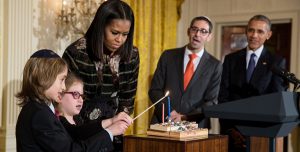
President Barack Obama, First Lady Michelle Obama and Rabbi Steven Exler watch Elijah and Shira Wiesel light the menorah during a Hanukkah reception in the East Room of the White House, Dec. 14. Two days later, the president signed into law the Frank Wolf International Religious Freedom Act of 2016. (Official White House Photo by Chuck Kennedy)

Torba’s suspicions were also raised when he found Jews in America, along with ruining Christmas, celebrate Hanukkah and that American presidents have acknowledged that Jewish holiday.

“Wow, incredible, incredible, how this happened,” he said. “In a Christian nation, it takes this relatively minor Jewish holiday and turns it into this prominent holiday that is celebrated in our White House. Isn’t that something?”

Asked about his podcast, Torba cited the Haaretz article, which quoted the late American novelist Philip Roth describing “White Christmas” as a song that took Christ out of Christmas.

“People who hate and reject Jesus Christ, and whose faith and identity centers around that rejection, wrote subversive songs to ‘de-Christ’ Christmas,” he said in an email.

“This is a problem, and Christians deserve to know about it so they can adjust their listening habits during the Christmas season accordingly.”

Puritans opposed Christmas

Jonathan Sarna, professor of American Jewish history at Brandeis University, suggested Christian nationalists such as Torba might want to do a little reading about American history. First, he pointed out, Christmas was not really a part of America’s founding.

“The Puritans were opposed to Christmas,” Sarna said.

In 1659, leaders of the Massachusetts Bay Colony approved the “Penalty for Keeping Christmas,” which imposed fines on those who feasted or refused to work on the holiday. It wasn’t until German immigrants brought Santa Claus, Christmas trees and songs like “Silent Night” with them that Americans took up Christmas with gusto. Christmas Day did not become a federal holiday until 1870.

Sarna said the songs written by Jewish songwriters fit into the American tradition of celebrating Christmas as a seasonal celebration, rather than a religious one.

“They are more in the tradition of Dickens’ ‘A Christmas Carol’ than in the tradition of ‘Silent Night,’” he said.

Jonathan Karp, who teaches history and Jewish studies at Binghamton University, said there’s no conspiracy involved with the success of Jewish writers of Christmas carols. Jewish songsmiths such as Irving Berlin wrote Christmas songs thinking Americans’ popular performers wanted them.

Karp said many Jews worked in Tin Pan Alley, the collection of songwriters and publishers that flourished in midtown Manhattan from the late 1800s to the mid-1990s, as well as in the theaters and venues where live music was performed.

Before records came into fashion, those songwriters made their money from sales of sheet music, Karp said. One way to sell sheet music was to get popular entertainers to sing them. When the holidays rolled around, those entertainers needed Christmas songs to sing. So, Jewish Tin Pan Alley songwriters wrote them.

Karp also suggested that songs like “White Christmas” were a way for Jewish songwriters to participate in Christmas—even though the religious holiday is not their own.

“I would even go as far as saying it’s about feeling the spirit of Christmas,” he said.

Finding a way to belong in America

Writing Christmas carols isn’t the only way Jewish Americans played a role in holiday tradition. Albert Sadacca, whose Jewish family emigrated from Turkey, helped develop electric Christmas lights and helped found one of the largest Christmas light manufacturers in America.

Devin Naar, associate professor of Jewish studies at the University of Washington in Seattle, who has studied Sadacca’s part in popularizing Christmas lights, said Christmas has become an icon of America almost as much as Uncle Sam or the Stars and Stripes. Even if they don’t celebrate Christmas, Jews have helped write this chapter of the American story.

Naar pointed to a Sephardic proverb found in the Ladino dialect spoken by Jewish immigrants from the Muslim world (like Sadacca), which translates, “Let me enter, and I’ll make a place for myself.”

Whether writing Christmas songs or creating Christmas tree lights, Jews found a way to show that they belonged in America, at a time when their fellow Americans viewed them with suspicion.

In a 2022 essay for The Washington Post, Naar pointed out Calvin Coolidge—the president who presided over the first lighting of the national Christmas tree—favored harsh immigration reforms.

“America must be kept American,” Coolidge said in his first address to the nation, a few weeks before that tree lighting. By American, Coolidge meant “white Christian people, preferably Protestants,” Naar said.

The following year, Coolidge signed legislation that barred Jews and non-Europeans from immigrating to the United States.

In the following decades, Americans became more open to those who had once been outsiders, Naar said. The Christmas carols written by Jews helped make that happen.

Even so, American Jews remain ambivalent about holiday traditions such as Christmas trees.

After all, there’s no way to take Christianity out of the holiday.

“At the end of the day, the name of the holiday is still Christmas,” Naar said.

Antisemitism and Christian nationalism linked

If Torba’s defense of Christmas is neither particularly American nor particularly religious, his antisemitism is in keeping with the ideology he espouses: Christian nationalism, research shows.

Data from a 2020 national survey found a relationship between Christian nationalism—the idea America belongs to Christians and Christians should run the country—and antisemitism.

The more that Americans believed in Christian nationalism, the more they supported antisemitic claims that Jews have too much power in America and around the world.

“It’s a function of what psychologists call a social dominance orientation,” said Paul Djupe, associate professor of political science at Denison University. “They think that there’s a rightful order of things and that Christians should be on top.”

Despite the anger of Christian nationalism, Sarna doubted many people know the religion of Christmas carol writers—or care what they believe. Most people who sing Christmas carols, he said, just want to sing their favorites.

“‘White Christmas’ remains one of the most popular Christmas carols,” he said. “People think it comes from the time of Jesus—not from Irving Berlin.”


Growing number of Americans ‘spiritual but not religious’

WASHINGTON (RNS)—Americans have been abandoning organized religion in droves, and while some have walked away from religion altogether, a distinct group of Americans now call themselves “spiritual but not religious.”

A new Pew Research study puts their numbers at 22 percent of Americans and attempts to describe them in greater detail.

The study places people in the group according to their responses to this definition: “They think of themselves as spiritual or they consider spirituality very important in their lives, but they neither think of themselves as religious nor say religion is very important in their lives.”

The study of 11,201 U.S. adults found Americans broadly consider themselves spiritual—70 percent say they are spiritual in some way. And while the spiritual but not religious share many of the same spiritual beliefs as religious Americans, there are some key distinctions.

Like most Americans, the spiritual but not religious believe people have a soul or spirit in addition to a physical body. They say there is something spiritual beyond the natural world. And they believe there are some things science cannot explain.

But only 20 percent of the spiritual but not religious believe in God as described in the Bible. They are much less likely than religious Americans to say they believe in heaven (54 percent vs. 93 percent) or hell (40 percent vs. 83 percent).

And perhaps critically, only 11 percent of the spiritual but not religious are involved in a religious community (compared with 62 percent of religious adults).

Negative views toward organized religion

They may still affiliate with religion—45 percent of the spiritual but not religious say they are religiously affiliated, with one-fifth identifying as Protestant and 12 percent identifying as Catholic. But they have negative views of organized religion.

Among the spiritual but not religious, 38 percent say religion does more harm than good, while just 7 percent of religious Americans share this view.

“That label ‘spiritual but not religious’ really describes a kind of negative identity more than it describes a particular positive identity,” said Nancy Ammerman, a retired professor of sociology at Boston University who served as an adviser for the Pew study.

“It describes people who are turned off by organized religion. The ‘not religious’ part of the identity is the real key to the identity.”

These Americans feel they don’t fit in a religious setting, Ammerman said.

But as the study also found, the group has largely not replaced congregational belonging with some other form of spiritual gathering.

While 18 percent of religious Americans belong to a nonreligious “spiritual community” that helps them find a connection with something bigger than themselves, only 13 percent of the spiritual but not religious belong to a spiritual community.

Demographically, the spiritual but not religious are more likely to be women; 57 percent are women, 42 percent are male.

Ryan Cragun, a professor of sociology at The University of Tampa who studies the nonreligious, said the higher female ratio among the spiritual but not religious makes sense. Historically, men have more societal permission to say they’re atheist or agnostic.

“Women suffer a lot of discrimination generally, and so they’re less likely to be willing to stake out a position that could subject them to more discrimination. So, they say, ‘I may not be religious but I’m spiritual,’” Cragun said. “And that softens the blow very quickly.”

Politically, the spiritual but not religious identify as Democrats rather than Republicans by a ratio of 2-to-1. Sixty percent say they identify or lean Democratic; 34 percent identify or lean Republican. (Among religious Americans only 39 percent identify or lean Democratic.)

The study, the first of its kind, was fielded in early August. Pew has not previously asked specific questions about spiritual beliefs and practices, so the study cannot address decline or growth in spiritual attitudes.

The margin of error for the full sample of 11,201 respondents was plus or minus 1.4 percentage points.


Churches planning multiple events for Christmas

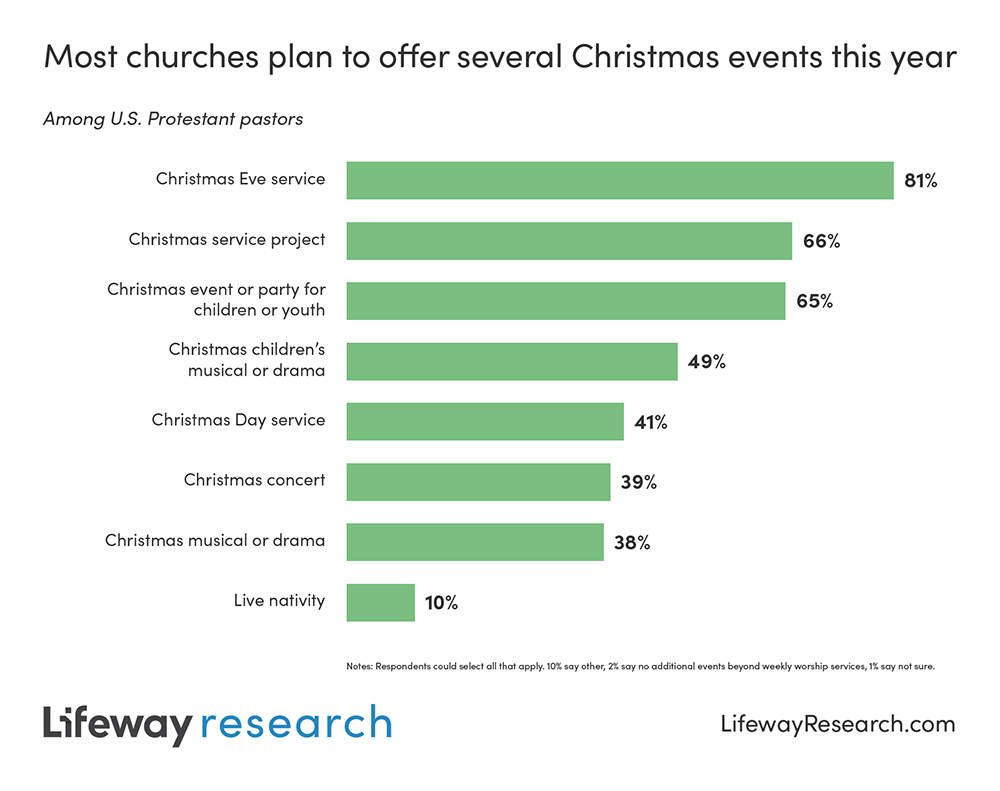
BRENTWOOD, Tenn.—Churches this year are planning an average of four extra events or activities to help members and guests celebrate Christmas this year, Lifeway Research discovered.

A Christmas Eve service tops the list, with 4 in 5 pastors (81 percent) saying their churches plan to offer such a service this year in addition to weekly worship services.

Most churches also are planning to offer a Christmas service project (66 percent) and a Christmas event or party for children or youth (65 percent).

Half of pastors said their congregation plans to have a Christmas children’s musical or drama (49 percent). Around 2 in 5 plan on having a Christmas Day service (41 percent), Christmas concert (39 percent) or Christmas musical or drama (38 percent).

Another 1 in 10 say they are planning to offer a live nativity (10 percent) or planning something else (10 percent).

Few say they do not plan to have any additional events beyond weekly worship services (2 percent) or aren’t sure (1 percent).

“In recent years many churches have trimmed the number of programs they have during the week. But Christmas celebrations still fill the calendar for the typical church,” said Scott McConnell, executive director of Lifeway Research.

“Most churches plan Christmas events for all ages and create experiences that go beyond worship services.”

What do churchgoers want for Christmas?

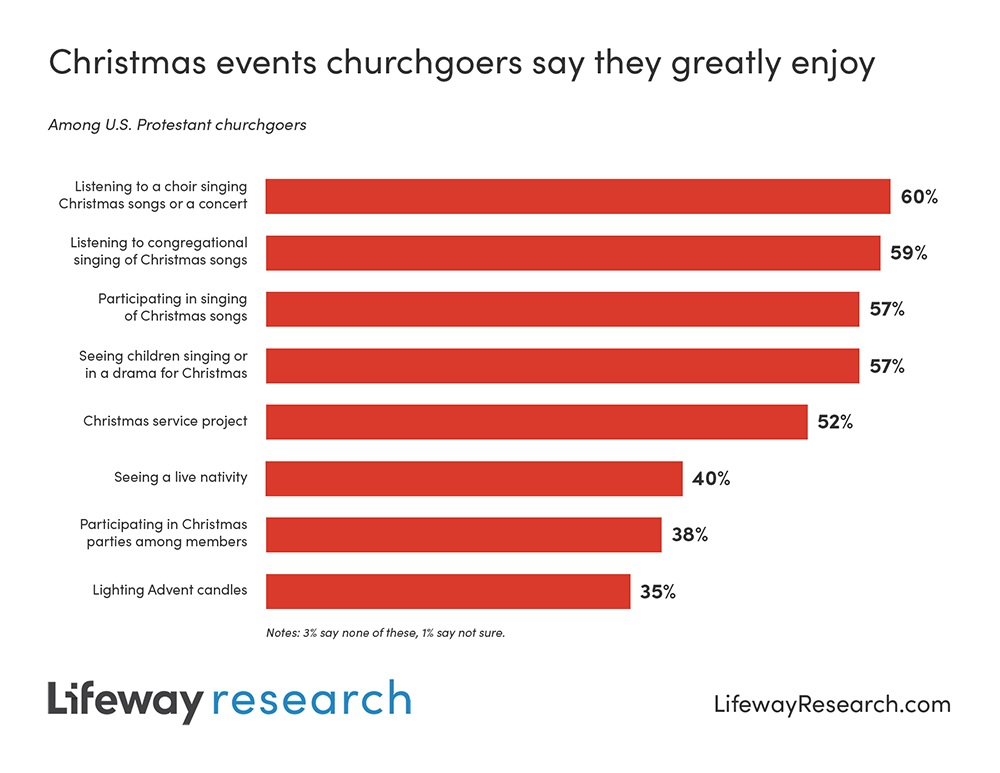
Churchgoers say they enjoy going to an average of four church-led Christmas events from a list of potential events. Most say they greatly enjoy listening to a choir singing Christmas songs or a concert (60 percent), listening to congregational singing of Christmas songs (59 percent), participating in singing Christmas songs (57 percent), seeing children singing or in a drama for Christmas (57 percent) or participating in a Christmas service project (52 percent).

Two in 5 churchgoers say they greatly enjoy seeing a live nativity (40 percent) and participating in Christmas parties among members (38 percent).

Another 35 percent say they enjoy lighting Advent candles, while 3 percent don’t greatly enjoy any of these things, and 1 percent aren’t sure.

“Some churchgoers may attend a church that doesn’t offer Christmas events they have enjoyed a lot in the past,” McConnell said. “So, they may participate in activities at neighboring churches as they celebrate Christmas.”

Demographic differences noted

The smallest churches, those with fewer than 50 in attendance, are least likely to say they are offering a Christmas concert (27 percent), a musical or drama (28 percent), a children’s musical or drama (31 percent), a Christmas event or party for youth or children (46 percent) or a Christmas service project (56 percent).

Churches established prior to 1900 are more likely than the newest churches, those started between 2000 and 2023, to have a Christmas concert (42 percent v. 29 percent). Churches started before 1900 (74 percent) and between 1900 and 1949 (68 percent) are more likely than those at the newest churches (53 percent) to offer a Christmas service project. Churches birthed prior to 1990 also are most likely to plan a Christmas Eve service (89 percent).

The oldest pastors, those 65 and older, are the least likely to say their church is planning a Christmas event or party for children or youth (55 percent) or a Christmas Eve service (74 percent).

“The smallest churches are much less likely to offer Christmas activities that require a lot of people to produce because they just don’t have those people,” McConnell said. “But small churches are just as likely as larger ones to offer a Christmas Eve or Christmas Day service.”

Denominationally, Methodist pastors are the most likely to say they are planning a Christmas concert (53 percent). Lutheran pastors are the most likely to say they will offer a children’s musical or drama (70 percent) and a Christmas Day service (71 percent). Restorationist movement churches are the least likely to offer a Christmas Eve service (52 percent).

While Hispanic pastors are among the most likely to say their church will offer a live nativity (21 percent), African American pastors are the least likely to say they will be having a Christmas Eve service (46 percent). And mainline pastors are more likely than evangelical pastors to say they are having a Christmas Day service (48 percent v. 41 percent).

Females are more likely than male churchgoers to say they enjoy singing Christmas songs (61 percent vs. 52 percent), listening to a choir singing Christmas songs or a concert (64 percent vs. 55 percent), seeing children singing or in a drama for Christmas (62 percent vs. 51 percent), lighting Advent candles (37 percent vs. 31 percent), participating in a Christmas service project (59 percent vs. 43 percent) and seeing a live nativity (46 percent vs. 32 percent).

Age matters

Churchgoers aged 50 to 64 (62 percent) and 65 and older (66 percent) are more likely than those 18 to 34 (45 percent) and 35 to 49 (43 percent) to say they greatly enjoy singing Christmas songs.

Similarly, the oldest churchgoers are the most likely and the youngest churchgoers are the least likely to say they enjoy listening to congregational Christmas singing (71 percent and 38 percent).

Churchgoers aged 50 to 64 (63 percent) and 65 and older (67 percent) are more likely than those 18 to 34 (50 percent) and 35 to 49 (50 percent) to say they greatly enjoy listening to a choir or concert.

And churchgoers aged 50 to 64 (63 percent) and 65 and older (61 percent) are more likely than those 18 to 34 (50 percent) and 35 to 49 (47 percent) to say they greatly enjoy seeing children singing or in a drama for Christmas.

However, the youngest adult churchgoers, those ages 18 to 34, are more likely than the oldest, those 65 and older, to enjoy participating in Christmas parties among members (45 percent vs. 33 percent).

“Much like some radio stations, many churches spend several weeks each year singing Christmas songs. But the enjoyment of these songs in churches is not uniform, with far fewer young adults enjoying this custom,” McConnell said.

Churchgoers who attend worship services at least four times a month are more likely than those who attend one to three times a month to say they greatly enjoy singing Christmas songs (62 percent vs. 50 percent) and listening to congregational singing of Christmas songs (63 percent vs. 54 percent).

Additionally, churchgoers with evangelical beliefs are more likely than those without to enjoy singing Christmas songs (62 percent vs. 51 percent), listening to congregational singing (65 percent vs. 53 percent), seeing children sing or perform a Christmas drama (63 percent vs. 51 percent), participating in service projects (56 percent vs. 47 percent) and seeing a live nativity (44 percent vs. 35 percent).

Meanwhile, those in the largest churches, 250 to 499 (59 percent) and 500 or more (59 percent) are more likely than those in the smallest churches, fewer than 50 (46 percent) and 50 to 99 (48 percent), to say they greatly enjoy participating in Christmas service projects.

Similarly, those attending churches with worship attendance of 250 to 499 (49 percent) are more likely than those with fewer than 50 (38 percent), 50 to 99 (37 percent) or 100 to 249 (39 percent) to say they enjoy live nativities.

The online survey of American Protestant churchgoers was conducted Sept. 19-29. Analysts used quotas and slight weights to balance gender, age, region, ethnicity, education and religion to reflect the population more accurately. The completed sample is 1,008 surveys, providing 95 percent confidence the sampling error from the panel does not exceed plus or minus 3.2 percent.

The phone survey of American Protestant pastors was conducted Aug. 29-Sept. 20. Responses were weighted by region and church size to reflect the population more accurately. The completed sample is 1,004 surveys, providing 95 percent confidence the sampling error from the panel does not exceed plus or minus 3.2 percent.


‘Jesus’ film producers plan release of animated version

WASHINGTON (RNS)—The Jesus Film Project is producing an animated Jesus film that is set to release in theaters around Christmas 2025.

“Do you realize that there are more people in the world today who have little to no knowledge of Jesus than ever before in history?” asked Pastor David Platt, former president of the Southern Baptist Convention’s International Mission Board.

Platt spoke at the announcement of the new project at the Museum of the Bible in Washington on Nov. 30, where Jesus Film Project staffers joined animators and supporters.

“What an opportunity we have to use a medium that God has ordained to reach not just people, but the next generation with the gospel,” Platt said.

Similar events announcing the film were held in South Korea and Uganda.

The original Jesus film, released in 1979, has been translated into more languages than any other movie, according to the Guinness World Book of Records. The 2,100th translation recently was completed.

‘Relevant for kids. and for families’

Josh Newell, executive director of Jesus Film Project, said he views animation as a fitting means to speak to younger generations about the life of Jesus.

“Animation is a compelling way to tell stories,” he said in an interview ahead of the event. “There’s a moral resonance that people have with the story of Jesus, that what he teaches is good and is true, and is relevant for kids and for families.”

The new film’s director, Dominic Carola, has worked on films such as The Lion King, Mulan and Lilo & Stitch. He said the animators are working closely with historical experts to depict the faces and clothing of characters living in the time of Jesus, including Jesus himself.

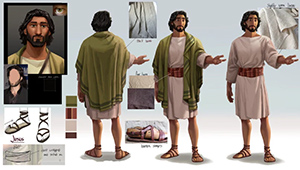
A “concept image” of the Jesus character from the forthcoming animated version of the “Jesus” film. (Image courtesy Jesus Film Project)

“He’s from the Middle East, he’s Jewish, so we knew there’s certain skin tones, textures, things that we can lean into, because this is the part of the world he came from,” Carola said in an interview ahead of the launch, noting the importance of getting confidential feedback from global focus groups.

“We don’t want him to be a surfer from Malibu or looking like somebody from a GQ magazine. He walked among us, and he lived in the flesh. So we went through a very strict process of trying to stay in these bumper rails.”

Carola said he and the animation team will have to approach certain parts of the story of Jesus, such as the crucifixion, “definitely delicately.”

“We don’t want to minimize what he did for us, obviously, but we certainly can’t show it to the level of The Passion of the Christ,” he said. “We’re not doing that. So it’s a fine line.”

The clip that aired Thursday at the Museum of the Bible, depicting the Gospel story of Jesus’ raising the synagogue leader Jairus’ daughter from the dead, was shown to focus groups in different cultures and countries. Newell said even those who might never have heard of Jesus reacted positively to the story.

Grow from 100 to 2,100 languages

While the original film, produced in a docudrama style, was two hours long, the new version is expected to run about 90 minutes. Both are based on the Gospel of Luke, but the storytelling will differ in pace through the animation.

“We will linger in those moments of where there aren’t words in the Bible, and we’ll see Jesus interact in some new ways that we didn’t see in the previous version,” said Newell. “There’s going to be some surprising scenes that are added to it that we really think are fun and meaningful from the Gospel of Luke that we’re going to share.”

As of mid-November, Newell said, about a third of the estimated project cost of $150 million had been raised. Some donors made contributions in honor of Paul Eshleman, Newell’s predecessor, whose family created a memorial fund after his death on May 24 at the age of 80.

Josh Newell speaks about the Jesus Film Project at the Museum of the Bible on Nov. 30 in Washington, D.C. (RNS Photo / Adelle M. Banks)

Newell said he hopes the animated version will launch in 100 languages and that three to five years later, it, like the live action version, will have expanded to 2,100.

The latest translation is in the language of the Waorani tribe. Jim Elliot, a U.S. missionary, was killed when he sought to spread the Christian gospel among the Waorani people in Ecuador in 1956. Newell said in a statement that the version in this language follows a request for it and features voice actors from different Waorani communities.

Gabe Handy, executive program director for the film, said he expects the quality of animation will match other biblical animated films, such as The Prince of Egypt, but the new Jesus film will feature three-dimensional animation, also used in films such as Pixar’s Toy Story.

“They are using some virtual reality in the pre-production process, in some of the design and modeling that they’re doing,” he said of the animators in an interview at the museum before the start of the event. “Because they’re doing it in that way, that’s producing some assets for us that we can apply beyond just making a movie.”

The producers are hoping to create ancillary footage for use in immersive digital experiences. Users of virtual reality goggles, for instance, might follow Jesus along the Via Dolorosa as he approaches Calvary or travel the rocky trip on the Sea of Galilee where the Bible says Jesus calmed the waters.

Bill Bright, the late founder of Cru, previously known as Campus Crusade for Christ, asked Eshleman after the original film debuted in U.S. theaters in 1979 to translate and dub it into dozens of languages. Eventually the ministry, first known for its work on college campuses, crossed the 2,000 mark in 2022.

Asked what Bright, who died in 2003, might think of the new version of the film he debuted 44 years ago, Newell said he believes the founder would approve.

“He would love it because he was so creative,” said Newell, who joined Cru’s staff 25 years ago when Bright was nearing the end of his leadership.

“Anything that we can do to kind of continue that trajectory of reaching younger people and giving them the opportunity to share about Jesus themselves and make an impact and an influence, he’s all over that.”

Editor’s Note: The first paragraph was edited after it originally was posted. RNS ran a correction, clarifying the Jesus Film Project — not Cru — was producing the animated film.


Evangelicals see Israel-Hamas war in light of End Times

DALLAS (RNS)—The End Times are not a topic Robert Jeffress needs much prompting to talk about.

When war broke out between Israel and Hamas on Oct. 7, the senior pastor at First Baptist Church in Dallas, quickly prepared a sermon series on the Apocalypse, which would be accompanied by a forthcoming book on the subject.

On Nov. 5, as the last notes of “Redemption Draweth Nigh,” a hymn about Jesus’ return, resonated in First Baptist’s 3,000-seat sanctuary, Jeffress asked his audience, “Are we actually living in what the Bible calls the End Times?”
The war in Gaza is not the only sign Jeffress submitted as evidence that the period presaging Jesus’ Second Coming, detailed in the Bible’s Book of Revelation and other Scriptures, is coming closer.

He noted, too, rising crime rates, the proliferation of nuclear weapons and natural disasters before announcing, “We are on the verge of the beginning of the End Times.”

“Things are falling into place for this great world battle, fought by the super powers of the world, as the Bible said. They will be armed with nuclear weapons,” Jeffress said.

Looking at current events as fulfillment of prophecy

Other prominent evangelicals have taken up the theme in their sermons. The day following Hamas’ attack, in which Israeli cities were barraged and some 1,200 people were massacred, Greg Laurie, senior pastor at the Harvest Riverside Fellowship in California, framed the violence in terms of End Times prophecy.

“The Bible tells us in the End Times that Israel will be scattered and regathered,” Laurie said. “The Bible predicted hundreds of thousands of years ago that a large force from the North of Israel will attack her after she (Israel) was regathered and one of the allies with modern Russia, or Magog, will be Iran or Persia.”

Before calling the church to pray for peace in Jerusalem, Laurie added, “If you get up in the morning and read this headline “Russia Attacks Israel,” fasten your seatbelt, because you’re seeing Bible prophecy fulfilled in your lifetime.”

While apocalyptic theology is threaded throughout the Bible and came to America with the Puritans, End Time prophecy has gone through cycles of popular acceptance among Christians. It has different strands, but in its most widely known version, known as dispensationalism, Israel is a linchpin to the events of the last days, when, after the Rapture, a coterie of 144,000 Jews are to be converted to Christ before eternity begins.

Israel’s supporters ‘on the right side of God’

Evangelical Christian pastors such as Jeffress have long prompted the United States to be an actor in these events. In his second sermon in the End Times series, on Nov. 12, Jeffress quoted the speech he gave at the ceremony dedicating the new U.S. embassy in Jerusalem in 2018: “For America to be on the right side of Israel is the same as being on the right side of history, and the right side of God.”

The embassy’s move from Tel Aviv to Jerusalem was the fulfillment of a promise Donald Trump made in 2016 as he ran for president for the first time, one applauded by pro-Israel evangelicals. In August 2020, as he ran for reelection, then-President Trump told a campaign rally in Wisconsin: “We moved the capital of Israel to Jerusalem. That’s for the evangelicals.”

Also present the day Jeffress spoke in Jerusalem was the televangelist John Hagee, who in 2006 founded Christians United for Israel, now the largest pro-Israel organization in the United States. On Oct. 22, Christians United hosted a “Night to Honor Israel” rally at Hagee’s Cornerstone Church in San Antonio, with Israeli public figures on hand, as well as U.S. Senators Ted Cruz and Tom Cotton.

Pastor John Hagee, Christians United For Israel founder and chairman, speaks during a CUFI Night to Honor Israel event, during the CUFI Summit 2023, Monday, July 17, 2023, in Arlington, Va., at the Crystal Gateway Marriott. (AP Photo/Jacquelyn Martin)

Hagee was also a speaker at the giant pro-Israel rally held Nov. 14 in Washington, where he reaffirmed his commitment to Israel.

“There is only one nation whose flag will fly over the ancient walls of the sacred city of Jerusalem. That nation is Israel, now and forever,” he said, greeted by cheers.

Claiming some 10 million members, Hagee’s organization has become powerful politically, according to Daniel Hummel, author of Covenant Brothers: Evangelicals, Jews and U.S.-Israeli Relations.

“It is quite a large group, but it’s even more significant that they are organized and have demonstrated over the years that they can actually focus their energy on a local level and a national level to advocate their position,” Hummel said.

The group’s gatherings have become an obligatory stop for GOP presidential hopefuls wishing to articulate their support for Israel in front of Christian Zionists.

“Most of them don’t get into the prophecy stuff,” said Hummel. “They’ll talk more about the national interests that the U.S. has in supporting Israel and about the cultural values that Israel and the U.S. share.”

But Hagee often speaks about the prophecies that drive his support for Israel. A week after Hamas’ attacks, Hagee’s Sunday sermon detailed the unfolding of the End Times, while a timeline illustrating every step from Jesus’ resurrection to the renovation of Earth by fire was displayed in the background.

The recent Hamas attacks draw us closer to the church’s Rapture, he claimed.

“The Bible blessed the Jewish people directly and through the Jewish people blesses us, the Gentile people,” he said.

Hagee added: “Israel is God’s prophetic clock; when the Jewish people are in Israel, the clock is running. When the Jewish people are out of Israel, the clock stops.”

Some view Christian Zionism as insensitive

This logic scandalizes some scholars as well as Jews, who see evangelical support for Israel as compromised by its cosmic hope for their conversion.

“They (Christian Zionists) believe a tiny minority of living Jews will, in the End Times, convert to Christianity, and the rest will be damned to hell for their disbelief,” wrote Steven Gardiner, research director at the Political Research Associates, in a 2020 essay titled, End Times Antisemitism.

In a 2005 sermon, Hagee himself claimed God sent Adolf Hitler to perpetrate the Holocaust to push European Jews toward Israel. He later made clear he didn’t view either Hitler or the Holocaust as positive.

But End Times theology need not be raw to come across as insensitive to the violence suffered by both sides in the long-running Israeli-Palestinian conflict.

On Nov. 12, Jeffress began his sermon by asking the congregation if they knew what could explain the numerous attacks against Israel.

“Spiritual reasons,” he said.


Research: Practicing Christians more generous than others

NASHVILLE (BP)—Practicing Christians outpaced non-practicing Christians and nonbelievers in giving to charities including churches in 2022, the American Bible Society said in the latest release from its 2023 State of the Bible report.

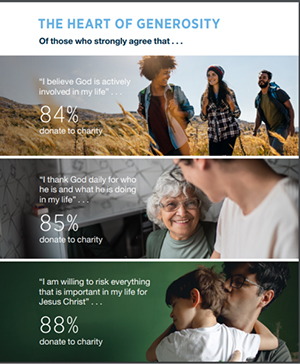
The vast majority of practicing Christians (95 percent) gave to charities in 2022, compared to 68 percent of non-practicing Christians and 51 percent of nonbelievers. The American Bible Society defines practicing Christians as those who identify as such, attend church at least monthly and consider their faith very important in their lives.

“When people practice a meaningful Christian faith, they give, and they give more,” the American Bible Society said in the report’s eighth chapter, focused on generosity. “Again and again we see people transformed by God’s Word, with hearts pried open by God’s love, people of faith moved to share what they have with others—even if they don’t have much to spare.”

Churches, ministries and other houses of worship were the top recipients of charitable gifts for the year, with religion one of the few sectors realizing an increase in receipts, the report stated. But when accounting for inflation, the estimated $143.57 billion in religious contributions—a 5.2 percent increase over 2021—represented a 2.6 percent decline.

“Religious organizations—including local churches, parishes, or temples as well as local and international ministries—receive the greatest portion of charitable giving,” the report stated. “Our data confirm what other researchers have found.”

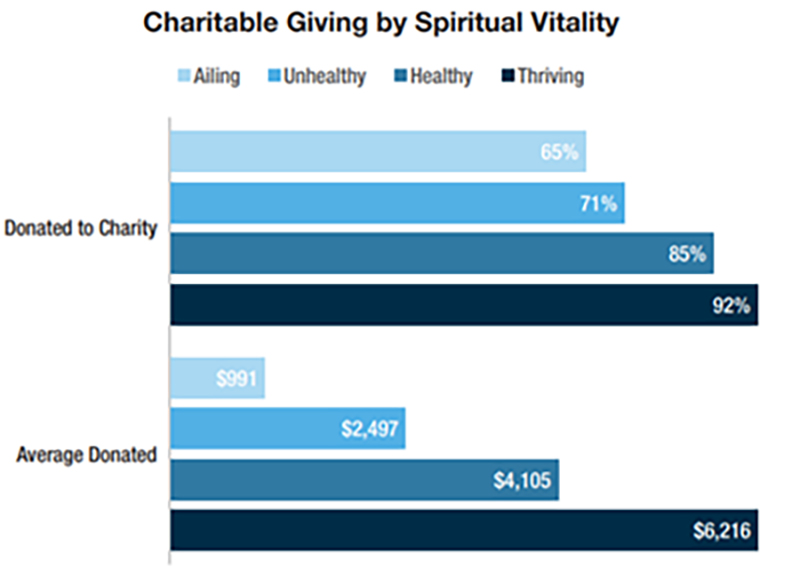
The American Bible Society also gauged giving by spiritual vitality, with 92 percent of those thriving spiritually giving to charities, compared to 85 percent of those with healthy spiritual vitalities, 71 percent of those with unhealthy spiritual vitalities, and 65 percent of those ailing spiritually.

Those thriving averaged $6,216 in annual giving, compared to the $991 in giving by those ailing spiritually. The American Bible Society spiritual vitality gauge, used for the first time in the 2023 study and asked only of professing Christians, rates spiritual health based on answers to nine concise questions focusing on belief, spiritual practices and faith in action.

Other findings on generosity include:

  • Regardless of faith, 68 percent of American households donated to charity in 2022, a rebound from the 62 percent who gave in 2021.
  • Elders, those age 78 and above, are by far the most generous age group, with 83 percent giving to charity and nearly half of those giving at least $1,800 a year.
  • People give to causes they consider important, regardless of their income or expenses.
  • People who volunteer, whether in the church or the community, are also more generous financially.
  • Percentage wise, families earning $30,000 or less a year give more money than those earning $100,000 or more, although larger income earners give larger numerical amounts.

 “While people who make more money give more money, the percentage of income donated by those who give runs much higher among lower income groups. When someone is earning an annual income of $30,000 or less, a contribution of $1,800 or more is a substantial portion (at minimum, 6 percent),” the American Bible Society said, comparing the giving to the story of the widow’s mite recorded in Mark 12 and Luke 21.

“The one-fifth of low earners who contribute at that level are digging deep, giving sacrificially.”

The State of the Bible annually looks at the Bible, faith and the church in America. The American Bible Society collaborated with the University of Chicago’s National Opinion Research Center in designing the study conducted online and via telephone. The survey, conducted Jan. 5-30, produced 2,761 responses from a representative sample of adults 18 and older within the 50 states and the District of Columbia.