Why faith-based groups are prone to sexual abuse

WASHINGTON (RNS)—Hollywood, the USA Gymnastics team, Penn State, the Boy Scouts: Sexual abuse has proved pervasive across institutions. And when it comes to faith groups, no creed, structure, value system or size has seemed immune.

“We’ve got to stop saying that could never happen in my church, or my pastor would never do that,” said David Pooler, a professor of social work at Baylor University who researches clergy-perpetrated sexual abuse of adults.

North Carolina pastor Joshua Wester, chair of the SBC’s Abuse Reform Implementation Task Force, with fellow members of the task force, speaking at the SBC Executive Committee’s meeting in Nashville, Monday, Feb. 19, 2024, announces a new nonprofit that will be tasked with building a database of abusive church pastors and staffers. (RNS photo/Bob Smietana)

With more victims coming forward and more research done on abuse within religious contexts, the evidence has shown that when sexual abuse happens in a place designated not only safe, but holy, it’s a unique form of betrayal. And when the perpetrator is a clergy member or spiritual leader, the abuse can be seen as God-endorsed.

As the scope of this crisis has been revealed, houses of worship and religious institutions—from Southern Baptists to Orthodox Jews to American atheists—have looked to shore up their safeguarding protocols and protect their constituents against abuse.

But rather than scrambling to respond in the wake of a crisis, faith groups need to adopt policies tailored to their setting and connected to their mission, says Kathleen McChesney, who was the first executive director of the Office of Child Protection for the U.S. Conference of Catholic Bishops.

“When you do that, people will have a greater understanding of what you’re doing, why you’re doing it, and how you’re doing it,” said McChesney, one of a growing group of abuse experts and survivor advocates consulting with religious institutions.

Experts suggest a few steps every faith group can take to improve safeguarding protocols.

Accept it can happen anywhere

One of the most dangerous—and common—assumptions religious groups make is to think of sexual abuse as a “them” problem.

As the founder of international nonprofit Freely in Hope, Nikole Lim has worked for years to combat sexual violence in Kenya and Zambia, and more recently has been helping U.S.-based groups prevent sexual abuse locally. For Lim, the reality that 1 in 3 women and 1 in 6 men worldwide are survivors of sexual abuse is evidence this is a problem that permeates every level of society.

“That’s a global statistic that doesn’t only exist in poor communities,” said Lim. “That also exists within your family, within your congregations.”

Experts agree faith groups often embrace the myth that good intentions, theology and ethics can stop sexual abuse from landing on their doorstep. Amy Langenberg, a professor of religious studies at Eckerd College, along with her research partner Ann Gleig, a religious and cultural studies scholar at the University of Central Florida, have shown Buddhist ethics about doing no harm and showing compassion are insufficient to prevent abuse in Buddhist contexts.

“You really do need these other ways of thinking about ethics, which are coming from outside of Buddhism, and which are coming usually from feminism, from advocacy, from the law,” said Langenberg.

Because faith communities often think of themselves as the “good guys,” they’re vulnerable to blind spots. That’s why conducting a risk assessment, much like you’d do for fire insurance, can help pinpoint what protocols are most needed, according to McChesney, who now leads a firm that consults on employee misconduct investigations and policy development.

Once concrete anti-abuse measures are in place, ongoing education can remind people at all levels of the organization to remain vigilant.

Define abuse

Faith groups often struggle to respond effectively to sexual misconduct because they lack consensus on what “counts” as abusive.

Gleig, who is teaming up with Langenberg on a book-length study called “AbuseSex, and the Sangha,” told Religion News Service that in Buddhist contexts, the category of abuse often is contested. In some cases, Gleig said, “abuse can be framed as a Buddhist teaching—for example, that this wasn’t abuse, it was actually some kind of skillful form of pedagogy.”

In churches, Lim has found loose definitions of abuse can lead to a form of “spiritual bypassing,” where abuse is framed as a mistake to be prayed about, rather than an act of harm that requires tangible accountability.

Conversations about sexual abuse in religious settings are often framed around clergy abuse of children. But faith groups must also account for peer-on-peer violence among children and teens, as well as abuse of adults.

Key to preventing such abuse, Pooler said, is having a robust definition of sexual abuse that goes beyond mere legal metrics and includes things such as sexual conversations, nonconsensual touch and sexual jokes and language.

Recognize power dynamics

The unequal power dynamics inherent to religious settings are an enormous barrier to equitably addressing sexual abuse. But the law is beginning to account for this imbalance.

In at least 13 states and the District of Columbia, it’s illegal for clergy to engage in sexual behavior with someone in their spiritual care—and many experts believe this standard, widely embraced when it comes to doctors and therapists, should be universal in religious settings, too.

According to Pooler, religious groups should work to share power among multiple leaders and ensure that the broader community has decision-making authority.

When sexual abuse allegations involve a religious leader, “the person should be placed on some type of leave where they are no longer influencing or speaking,” said Pooler, “because what I have seen is abusive people will try and grab ahold of the microphone and shape a narrative immediately.”

Center survivors

Experts commonly observe a default reaction in religious settings to protect the reputation of the faith group or clergyperson over investigating an abuse allegation. But defensive postures often overlook the person who, at great risk, reported the abuse in the first place.
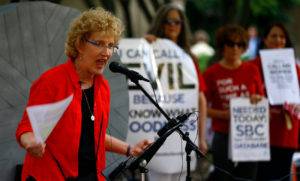
Christa Brown talks about her abuse at a rally outside the annual meeting of the Southern Baptist Convention at the Birmingham-Jefferson Convention Complex, June 11, 2019, in Birmingham, Ala. (RNS photo by Butch Dill)

When a survivor shares abuse allegations, faith groups often fear what will happen if they take the report seriously.

For example, Navila Rashid, director of training and survivor advocacy for Heart, a group that equips Muslims to nurture sexual health and confront sexual violence, said Muslim communities can be hesitant to address sexual violence because they don’t want to add to existing Islamophobic narratives about the violence of Islam. But Rashid told RNS it’s vital to believe survivors.

“If we can’t start off from that premise, then doing and creating preventative tools and methods is not going to actually work,” she said.

Pooler advises groups to make sure survivors “sit at the steering wheel” of how the response is handled—if and when personal details about the survivor are shared, for example, should be entirely up to them.

Caring for abuse survivors requires taking their needs seriously at every juncture, even before abuse is reported, according to Pooler and other experts. That’s why background checks are vital.

“You don’t want to put somebody that has abused a minor ever in a role of supervising minors,” McChesney told RNS.

Get outside help

Faith communities are known for being close-knit, which makes avoiding conflicts of interest difficult, if not impossible, when it comes to holding offenders accountable. That’s why many experts recommend hiring outside groups to hold trainings, develop protocols and steer abuse investigations.

“They don’t have any investment in the church looking good or their leaders looking good,” Pooler said about hiring groups such as GRACE (Godly Response to Abuse in the Christian Environment) or other third-party organizations that investigate abuse allegations. These organizations, he said, are committed to laying out the facts so faith groups can make informed decisions.

Groups that are trauma-informed can also ensure that gathering testimony from survivors doesn’t cause additional harm.

Rashid recommended faith communities create a budget line for hiring outside groups who focus on addressing sexual abuse. Rather than offering quick fixes, she said, such groups are designed to help faith communities unlearn biases, recognize power dynamics and adopt long-term solutions at individual, communal and institutional levels that prioritize the safety of all community members.

“What we want to see with policies is pushing for a culture shift,” she said, “not a Band-Aid fix.”



Christian nationalists lead pro-Israel rally at Columbia

NEW YORK (RNS)—Christian nationalist activist and musician Sean Feucht, pastor Russell Johnson and conservative author Eric Metaxas headed a pro-Israel rally at Columbia University in response to the “Gaza solidarity encampment” established by students a week ago.

The “United for Israel” rally on April 25 was promoted on social media and intended to show support for Israel, Jewish students and faculties.

It drew a crowd of a few hundred, who circled the Columbia campus singing hymns and praying without entering its gate. Instead, they traded shouted slogans and threats through the Upper Manhattan school’s iron fences.

The rally was a sign of political evangelicalism’s increasing interest in campus politics writ large and in the pro-Palestinian campus protests in particular. Earlier in the week, House Speaker Mike Johnson, an evangelical Christian, made an appearance at Columbia to decry antisemitism on the campus and meet with school officials to demand the resignation of Columbia President Minouche Shafik.

The rally was billed as an attempt to “redeem Columbia University,” in the words of Feucht, who gained notoriety during the COVID-19 pandemic for holding worship concerts to protest restrictions on gathering.

He organized the rally with Russell Johnson, the conservative lead pastor of Pursuit NW Church, and Metaxas, a 2020 election denier and supporter of former President Donald Trump. Metaxas—who wrote a 2010 biography of the German theologian Dietrich Bonhoeffer, who was executed for opposing Hitler in World War II—toted a poster of Bonhoeffer’s image during Thursday’s event.

Feucht kickstarted the event by intoning the Christian anthem “How Great Is Our God” before blessing the crowd and praying for Israel.

‘These are the end days’

“Today, we say enough is enough. This anti-Christ, antisemitic agenda that has risen up in New York City, that has risen up in universities,” he said.

The day before, in a livestream, Feucht said there had been a rise in antisemitism on campuses due to the pro-Palestinian student protests and that it was a sign the end times were near.

“We’re seeing this rise and this flood of antisemitism across the world. These are the end days. I know people say this all the time, and everyone’s saying this is the end of the day. … Well, these are the end days, and we’re one day closer to the return of Jesus,” he said.

Adding that the Israel-Hamas war is “one of these end times issues,” Feucht said that Christians need to “get right’’ by siding with Israel.

Reading aloud a verse from the 12th chapter of the Bible’s Book of Genesis referring to God’s covenant with Abraham, Feucht said it was a Christian duty to support Israel.

Feucht then led the protesters in a procession around Columbia’s Morningside Heights campus. Their march, he claimed, mirrored that of Joshua’s army circling the walls of Jericho, as told in the Book of Joshua.

Some protesters blew shofars, musical horns used in Jewish religious ceremonies, emulating the biblical story.

Noreen Ciano, a 63-year-old Christian from New Jersey, closed her eyes and prayed in tongues as she marched.

“I was praying for peace. I was praying for the Lord’s presence in this place,” she told Religion News Service.

A nondenominational Christian, Ciano is a member of the International House of Prayer Eastern Gate Church, for which she hosts a radio show. As a Christian, she said, supporting Israel should be an easy decision, as “the whole Bible is Israel-centric.”

Contrasting perspectives

Some in the crowd waved Israeli and American flags and yelled, “Bring them home,” in reference to the estimated 130 hostages still thought to be held by Hamas since the Oct. 7 attacks.

Along their path, the marchers encountered members of the anti-Zionist Hasidic group Neturei Karta, who held signs reading “Judaism rejects Zionism and the State of Israel.”

Pro-Palestinian Christian activists also clashed with the crowd, some of them bearing signs reading “Jesus lies under the rubble in Palestine.”

At the end of the rally, the march faced off with pro-Palestinian student protesters at the campus gates on Amsterdam Avenue and 116th Street in a tense confrontation. The two groups yelled at each other through the gates, and the pro-Israel crowd sang the Israeli anthem and “God Bless America.”

Members of Passages, a pro-Israel Christian organization that plans “Christian birthright trips” to the Holy Land, came bearing signs reading “Christians stand with Israel.”

Ariel Kohane, a Modern Orthodox Jew who wore a yarmulke printed with the name of a Jewish activist group, Young Jewish Conservatives, under a red “Trump was right” cap, said the marchers’ support of Christian Zionists was much appreciated at this juncture in the war in Gaza.

He also praised the efforts of other evangelical groups, such as Christian United for Israel and its leader, John Hagee, who headlined a rally for Israel late last year in Washington.

“We share conservative political views and religious values. We are allies, and we work together, hand in hand. It’s so wonderful that they are standing side-by-side with us, shoulder-to-shoulder,” Kohane said.

Kohane, who lives near the Columbia campus, denounced the “Gaza solidarity encampment” and said the situation should prompt donors to withdraw funding from the institution. He said Shafik should resign due to her poor handling of the situation.

Anya Andreeva, a Christian living in Brooklyn, came to pray and support Israel. She said she heard about the rally on Facebook but made sure it would be a peaceful demonstration focused on prayer before she decided to attend. She vetted the organizers before coming.

“I saw enough to trust it. I’m keen not to side with anything that uses Christianity as a promotion for any kind of agenda,” she said.

The rally ended in a prayer session. The crowd prayed for the “salvation and safety” of the hostages and blessed Jewish participants who attended.

“Lord, we pray even tonight that a miracle would take place, a miracle across the Middle East,” Feucht said.


Baylor’s Disability & Church conversation emphasizes belonging

Example of a visual schedule, helpful for accessibility. (Photo/Calli Keener)

WACO— Erik Carter challenged participants at a Baylor University conference to be catalysts for change—so all really do belong in faith communities.

Carter is executive director of the Baylor Center for Developmental Disabilities, host of “Disability and Church: A Conversation” on April 17. 

“How might we be communities of all the peoples—where members with and without disabilities live, learn, work and worship?” Carter asked. “And serve and support one another. … Where all families can flourish together in faith and life.”

Carted began with his personal testimony. Growing up in a time when disabled people generally were segregated in schools or clubs, he had limited opportunity to know and befriend people with disabilities. 

“It was as if our schools, workplaces, and even our churches were perfectly designed in ways that kept us apart,” Carter explained.

In this environment, Carter had come to believe his value lay in accomplishments and abilities—until he went to a summer camp his freshman year in college where he “stumbled into new friendships with several young men and women with intellectual disability at a mountain camping program.”

‘Glad abandon’ speaks

Wayne, Margaret and John Ray loved him without any concern for his accomplishments, and he felt belonging, Carter said. Beyond belonging, Carter observed the “glad abandon” with which they worshiped and their deep love for Jesus. 

“John Ray could not speak, and Wayne often struggled with words,” Carter said. “They trusted wholeheartedly. They knew for sure they belonged to God. And how much I longed to have that same assurance! … And so, I followed their lead and gave my life to Christ.” 

Carter said this story should not be surprising. 

“Indeed, it is an ordinary story of how God’s grace flows through God’s people to transform lives. All of God’s people. No asterisks. No exceptions,” he continued.

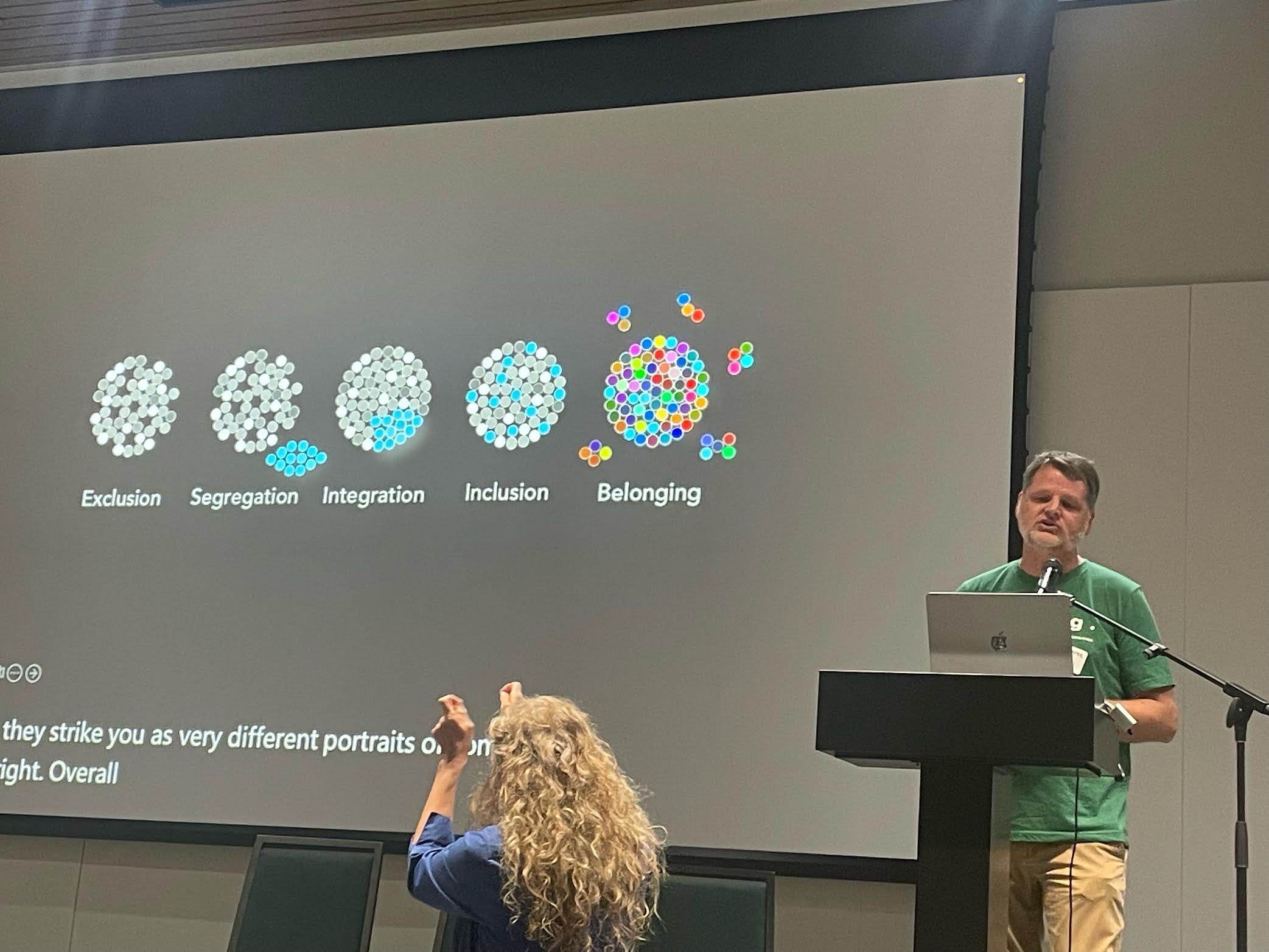
Offering insights from two decades of research focused on “what it means to create communities in which believing and belonging abound together,” Carter described five prevailing portraits for community, which have generally progressed through history “from exclusion toward embrace.”

Erik Carter describes prevailing portraits of community. (Photo/Calli Keener)

Portraits of community

Providing a visual model of each, Carter explained exclusion was the prevailing model of the 1970s, where individuals with disabilities still were excluded from much of community life—especially those with intellectual or developmental disabilities. There were holes in this model. 

“Communities were incomplete,” Carter said.

In the 1970s and ’80s, separation was the prevailing model—where programs were created for children and adults with developmental disabilities, but “usually, apart from anyone else without the same label. In most communities, everyday life was still lived away from people with disabilities,” Carter said.

In the 1990s and 2000s there was a shift toward integration, “but many of the opportunities that emerged still involved a certain separation,” he said. People with disabilities were placed “near, but not really among, their peers without disabilities. There is a huge difference between near and among,” Carter said.

The present-day model is one of inclusion, Carter said—“where a growing national focus is on the full inclusion of people with disabilities in the same classrooms, clubs, colleges, church activities and community groups as anyone else. Inclusion. From being apart to among and with one another.” 

Josh Baker reads Psalm 67:1-5. (Courtesy Photo/Gena Baker)

But, Carter said, there is still one more model churches should be striving toward—beyond integration or inclusion—belonging. In this model, Christians learn to see each other in fundamentally different ways, “as a diverse community in which each person has equal and immeasurable value … knitted together—woven into relationship.”

None of these models is actually just historical—it is “living history; our present landscape….you will find each of these varied portraits—[exclusion, segregation, integration, inclusion and belonging]—across the more than 26,000 churches and scores of Christian schools throughout Texas,” Carter said.

But the research has identified elements of belonging, Carter said, “from the lived experiences of hundreds of young people with intellectual and developmental disabilities and their families who have been part of our various studies over the years. 

 “It is a question we have posed directly to them. How do you know you belong in your faith community?”

Elements of belonging

“Belonging is experienced when they are present, invited, welcomed, known, accepted, supported, cared for, befriended, needed and loved,” Carter said their responses showed.

Carter recalled his own testimony of being welcomed, befriended and loved by Wayne, Margaret and John Ray as a teen and how they shared their faith with others—people with disabilities doing ministry.

 “Three people who might have been overlooked by society—and by the church—as a promising avenue through which Jesus might call others to him. And yet the opposite is certainly true,” Carter said, explaining that their gifts were real, attractive and a conduit for God’s life-changing grace.

Carter opened table talks, observed by Baylor Center for Developmental Disabilities representatives for the purpose of study. Participants reflected on and discussed ways the churches represented were doing well or could do better or differently in each of the ten areas identified as necessary for experiencing belonging.

Panel discussion moderated by Grace Casper, program coordinator for the BCDD (center). Madi Snow-Gould (left) and Aaron Jones (right) share experiences with disability in church. (Photo/Calli Keener)

Table discussions allowed families of disabled people and disabled attendees, themselves, to discuss their experiences with church and disability.  

One participant, whose adult son is autistic, shared a positive story of inclusion at their church where they have been members for years.

She said everyone at church knows her son by name and that “she’s really only known as his mom.” They both feel known and loved there, she said. 

But she said she would like to worship in a space where she feels less concerned about how an unexpected behavior from her son might impact other worshippers. 

She has a vision for beginning a disability-inclusive service, much like other churches might have non-English speaking language services. And one of her pastors and two other church members who want to help support and participate in this ministry vision becoming reality joined her for the talk.

Others at the table shared how their experiences at church had not always been welcoming. Kirk and Gena Baker shared of times they’d been asked to remove autistic children from worship, who were not being excessively disruptive.

They’ve forgiven these offenses, they said. But they expressed how crushing it was to be treated this way by brothers and sisters in Christ. 

Yet they rejoiced in God’s answer to 27 years of prayer, when they moved to Waco less than two years ago and learned about the Baylor Collaborative for Developmental Disabilities beginning.

Thriving congregations initiative

This talk was part of an interdisciplinary project funded by a grant from the Lilly Endowment’s Thriving Congregations Initiative. The project is led by Baylor’s Truett Theological Seminary, Baylor Center for Developmental Disabilities and the Center for Church and Community Impact in the Diana R. Garland School of Social Work. 

 “The project focuses on helping congregations embrace young people with disabilities, mental health challenges and chronic illnesses,” said Angela Reed, Truett Seminary’s associate dean for academic affairs and principal investigator of this project, in an earlier interview.

“We’re going to need congregations that are very interested in young people and supporting young people,” she continued.

“Early this summer, we will be announcing how interested churches can apply to join our first learning cohort,” Carter said.

Jason La Shana, director of the Baylor Collaborative on Faith & Disability, explained the selected cohort of churches will enter into a “multi-year mutual learning process around disability and mental health in the church,” in a follow-up email.


Mainstream media giants accused of sexual exploitation

WASHINGTON (BP)—Many turn to LinkedIn for updates on industry insiders, but among the billion professionals featured alongside respected companies are sexual exploitation leaders such as Pornhub and OnlyFans.

CashApp is popular for electronic payments, but a 17-year-old boy committed suicide after he became a victim of sexual extortion or “sextortion” by criminals who threatened to ruin his life unless he paid them, and only through CashApp.

Nude photos of your daughter are all over the internet, but she pleads innocence. Turns out, her classmates snapped her photo and generated “deepfake” nude images, likely using software shared on Microsoft’s GitHub, where more than 100 million software code writers worldwide collaborate in developing programs.

GitHub’s open-source design allows “anyone to access, use, change, and share software” developed by such giants as Google, Amazon, Twitter, Meta, and Microsoft, the National Center on Sexual Exploitation said, making GitHub the “most prolific space” for AI development and “a major facilitator of the growing crimes of image-based sexual abuse.”

LinkedIn, CashApp and GitHub are among those making the center’s 2024 Dirty Dozen List for “facilitating, enabling, and even profiting from sexual abuse and exploitation.”

“No corporation should be hosting any type of sexual abuse and exploitation but we certainly don’t expect places like LinkedIn to be hosting and perpetuating sexual abuse and exploitation,” said Lina Nealon, vice president and director of corporate advocacy for the center.

“So, we found that LinkedIn is providing a platform for many exploitative companies, most particular PornHub. LinkedIn is normalizing them as a job like any other, as a company like any other.”

The National Center on Sexual Exploitation accused industry leaders of various forms of exploitation including child sexual abuse, rape, sexual extortion, prostitution, sex trafficking, image-based abuse and other evils, documented by the center’s staff including researchers and legal experts.

“These (12) entities exert enormous influence and power politically, economically, socially and culturally, with several corporations on this list enjoying more resources in global recognition than entire nations,” Nealon said.

“Most of the companies we’re calling out have lofty corporate responsibility statements and have launched ethical AI task forces,” Nealon said. “We’re challenging them to actually live up to those statements and fulfill their social obligations to do something.”

The National Center on Sexual Exploitation calls out:

  • Apple, accusing the tech giant of facilitating abuse by refusing to scan for child sex abuse material, hosting dangerous apps with “deceptive” age ratings and descriptions, and neglecting to set default safety features for teens.
  • Cloudflare, a “a platform for sex buyers and traffickers” that claims a desire to “build a better internet,” but provides services “to some of the most prolific prostitution forums and deepfake sites.”
  • Discord as a “hotspot for dangerous interactions and deepfakes.” Exploiters and pedophiles easily contact and groom children on the site, luring children away from home, enticing children into sending sexually explicit images, and sharing sexually explicit images and deepfakes with each other.
  • Meta, with its launch of end-to-end encryption, open-sourced AI, and virtual reality “unleashing new worlds of exploitation.” Meta platforms Facebook, Messenger, Instagram, and WhatsApp “have consistently been ranked for years as the top hotspots for a host of crimes and harms,” the national center said, noting pedophile networks where members share child sex abuse material, contact children and promote children to abusers. The sites enable sex trafficking, sextortion, and image-based sexual abuse, the center said.  In an April 11 blog post, Instagram announced it was implementing new tools to protect users—particularly young people—from sexual exploitation, including a feature that automatically blurs nude images in direct messages.
  • Reddit is a hotspot for sexploitation, the center said, citing child sex abuse material, sex trafficking, and image-based sexual abuse and pornography. The content will be further monetized if Reddit succeeds in going public, the national center said.
  • Roblox, where users with such names as “RaipedLittleGirl” regularly target children among Roblox’s 54 million daily users, bombarding them with sexually explicit content generated through artificial intelligence, grooming them for sexual abuse and luring them from their homes. The center calls out the $2.8 billion platform, popular with preteens, for not embracing “common sense child protection measures.”
  • Spotify, a music streaming app the center said also hosts sexually explicit images, sadistic content and networks trading child sex abuse material. The national center accused Spotify of pervasive hardcore pornography and sexual exploitation.
  • Telegram, promoted as a dark web alternative, has instead unleashed a new era of exploitation, the center said, describing the app as a safe haven for criminal communities globally including sexual torture rings, sextortion gangs, deepfake bots and ot


Locke says Easter Bible burning a sign of attack

MT. JULIET, Tenn. (RNS)—A Tennessee pastor known for burning books, casting out demons and creating outrage says someone burned 200 Bibles outside his church on Easter Sunday.s

Greg Locke, pastor of Global Vision Bible Church in Mt. Juliet, Tenn., said the church’s security cameras recorded a “polite crook” stopping their vehicle in the middle of an intersection by the entrance to the church, turning on hazard lights, then dousing a trailer full of Bibles with gas and setting it on fire.

“You got to be kidding me,” Locke said during the Easter revival service, according to a video posted on the Global Vision website. “How many churches in America have a trailer full of Bibles getting burned to block the parking lot?”

The fire is currently under investigation by the Wilson County Sheriff’s Department.

According to a press release from the sheriff’s office, the Mt. Juliet Fire Department responded to the fire at about 6 a.m. on Sunday morning and quickly extinguished the fire.

“The trailer, containing Bibles, had been dropped off in the middle of the intersection and then intentionally set on fire,” according to the sheriff’s department. “To uphold the integrity of the ongoing investigation, other specific details cannot be provided at this time. However, we assure the community that further updates will be shared at the appropriate juncture.”

At first, Locke joked about the fire, saying he had asked law enforcement to give the charred pages of the Bibles to the church—so the church could hand them out as a reminder of the need for prayer.

Then he called the fire another sign that Christianity was being threatened in America and that the return of Jesus and the End Times were imminent.

“If you think that Christianity is not (under) attack more than ever before in the United States of America, you have not been paying attention,” he told his church. “Quit being lukewarm. Quit being so passive aggressive and namby-pamby and spiritually sissified. OK? I’m telling you, they’re attacking churches in America.”

Locke then told his congregation he had just returned from a trip to Israel, which he said was the safest place in the world, and he insisted news reports about the war in Gaza were media lies.

Linking to End Times prophecy

He then went into a long monologue about the so-called Red Heifer prophecy—the belief a red cow has to be sacrificed on the Temple Mount in Jerusalem to usher in the return of Jesus and the end of the world.

The Temple Mount is currently the site of the Dome of the Rock, one of the holiest places in Islam. Locke told his congregation the mosque on the Temple Mount would soon be “brought to rubble” and a red heifer would soon be sacrificed, which would allow first the Antichrist and then Jesus Christ to arrive.

“We are watching the word of God be fulfilled before our very eyes,” he said.

Locke was once a relatively obscure Tennessee preacher, known mostly for publicity stunts like backpacking hundreds of miles to raise money for missions and staying up all night on a cherry picker to raise awareness about homelessness.

He became a social media influencer after a 2016 video of him condemning the inclusive bathroom policies at Target went viral. Locke has since used his online influence to promote Donald Trump and Christian nationalism—as well as to declare himself an exorcist, capable of casting out demons.

Locke has also claimed witches infiltrated his church in an attempt to bring his ministry down and has clashed with his neighbors and local officials after erecting an enormous tent on the grounds of his church during the COVID-19 pandemic.

That tent, Locke has claimed, is needed to accommodate the crowds of new people attracted by his support for Trump and his newfound career casting out demons.


Survey links religious practice to life satisfaction

(RNS)—Announcing the results of a new Global Flourishing Study, a consortium of scholars and pollsters led by Gallup said they found links between religiosity and people’s satisfaction with their lives.

The study, a joint project of Harvard and Baylor universities, Gallup and the Center for Open Science, aims to uncover what influences “human flourishing,” which is defined by measures of happiness, character and virtue and social relationships, among other values.

According to the group’s research, attending a religious service regularly positively affects flourishing.

“We’re not shocked at that because there’s a lot of other research that indicates that faith is important to human flourishing, but it may come as a surprise to people that religion would be an important thing,” said Byron R. Johnson, director of Baylor University’s Institute for Studies of Religion.

Earlier studies have shown religion could help young people struggling with mental health issues and being involved in a congregation could influence the level of happiness.

For this study, Gallup interviewed 200,000 individuals in more than 20 countries, including Mexico, Japan, Nigeria, Indonesia and Israel. 

Participants were asked questions about the six domains the Center for Open Science has identified as the core indicators of human flourishing. Physical and mental health, purpose and financial stability were among the topics discussed.

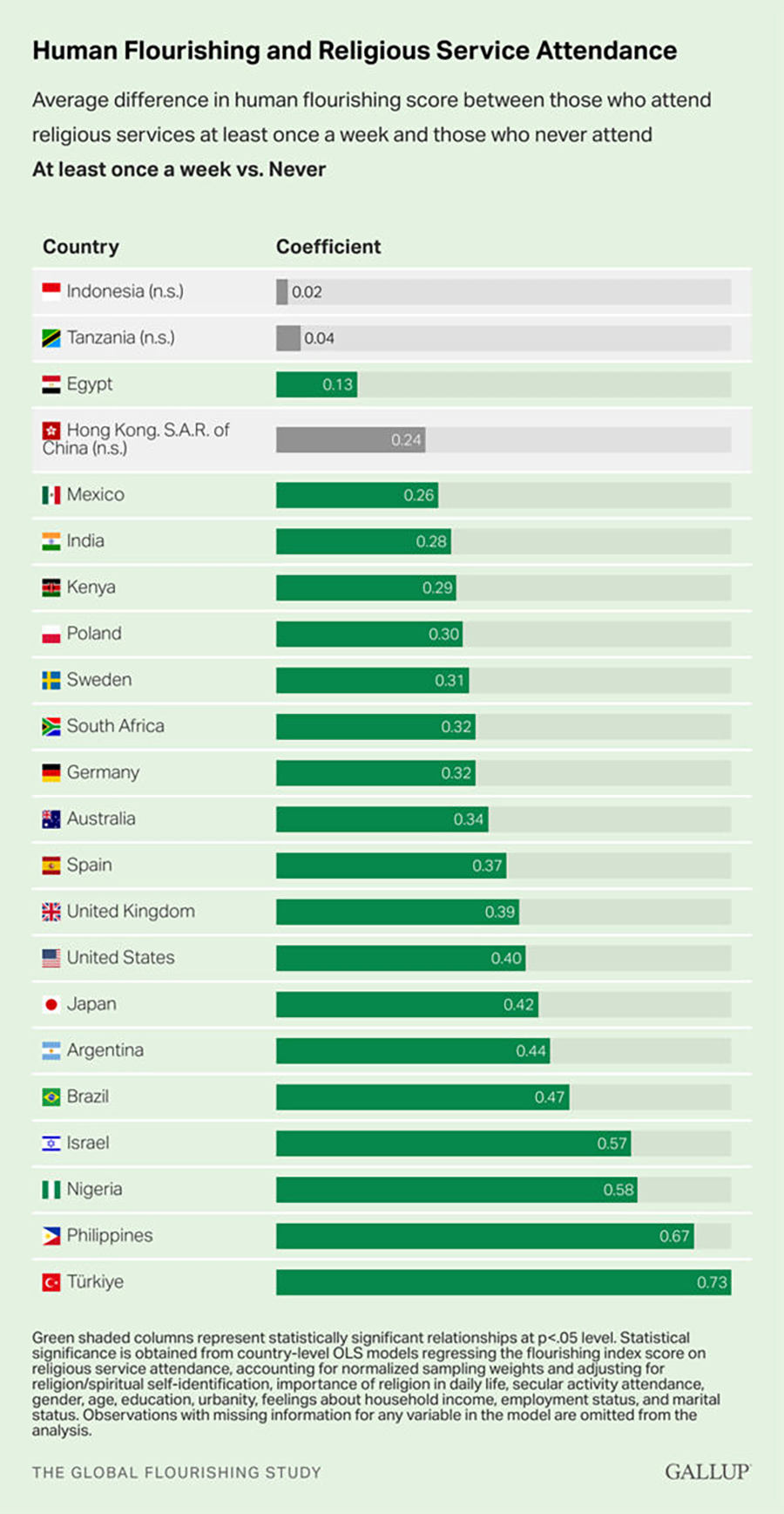
(Graphic courtesy of Gallup)

Their responses were collected during short in-person interviews and used to create a “human flourishing index” ranging from 0 to 10, with 10 being the highest level of satisfaction.

Results lead to further research

Respondents who said “religion is an important part of daily life” score 0.23 points higher on average than those who didn’t. 

Those who attend a religious service at least once a week scored 0.41 points higher than those who never do. 

Attendance one to three times a month correlated with a 0.22 point higher score, while those who go a few times a year scored 0.18 points higher on average.

The study also revealed that gaps in human flourishing scores are largest among people in Turkey, with 0.73 points of difference between Turks who attend religious services weekly and those who never do—in the Philippines (0.67 points of difference), and in Nigeria (0.58 points of difference).

In an article commenting on these results, Gallup noted context is important to understand the data, as other factors related to financial stability, such as being employed and living comfortably, also play a role.

Now that the first results have been published, the team of 50 researchers deployed by the four institutions to work on the study is conducting separate analyses to study the level of flourishing within each religious group and compare religions together. 

These further analyses might give them clues on which religious groups tend to have higher flourishing scores.

“Some people will just be looking at Jewish samples, for example, and some will just be looking at samples of those that follow Islam, and some will be doing all of it,” said Johnson.

The main focus for the next four years is to keep the same sample population so researchers can track the participants’ level of flourishing and understand what influences potential changes.

Johnson said the idea of creating a longitudinal study—one that follows people over time—came after a conference on human flourishing at Harvard in November 2018.

Johnson said the study could also help make headway in understanding the global religious landscape, as the study collected data about religious groups in every country.

The next round of interviews already has started, with results likely available by mid-February 2025. In the meantime, all data collected in the first edition of the survey are available in open access for researchers.


Study: Unaffiliated the only growing religious group in U.S.

WASHINGTON (RNS)—Religious churn has been a key fixture of U.S. religion for a long time, but a new surveyof changes in American religion finds that motion is not so much a swirling but a one-way stream heading out.

A new PRRI survey shows religiously unaffiliated Americans are the only group that has seen steady growth over the past decade—from 21 percent of all Americans in 2013 to 26 percent in 2023.

These unaffiliated Americans—many of whom abandoned their childhood faith—are not looking for a spiritual home. Only 9 percent of people in this group said they were “looking for a religion that’s right for me.”

Most may be unaffiliated for life. Only 3 percent of Americans who grew up without a religious identity said they joined a religion.

Even those who remain religious—the vast majority of Americans, about 67 percent of whom are Christian—say religion is less important in their lives.

Only 53 percent of Americans say religion is the most important or one among many important things in their lives in 2023, compared to 72 percent in 2013.

“The level of religiosity among Americans, even among people that identify with the religious tradition, has really dropped pretty precipitously in the past decade,” said Melissa Deckman, PRRI’s CEO.

“A quarter of Americans say religion isn’t important at all in their lives. Another 19 percent say it’s not really that important, maybe has a little bit of importance.”

Researchers surveyed 5,600 adults across the United States in November and December last year. Those results were compared with studies PRRI did in 2016 and 2013.

The Catholic Church saw the largest decline in religious affiliation of any religious group in 2023. Some 30 percent of Americans said they grew up as Catholics—18 percent white Catholics and 12 percent Hispanic Catholics.

But only 20 percent continue to identify that way today—12 percent white Catholics and 8 percent Hispanic Catholics. A 2016 survey showed similar losses for Catholics.

Study’s groupings challenged

Tom Gaunt, executive director of the Center for Applied Research in the Apostolate at Georgetown University, took issue with the study’s groupings of religions.

He said it was unfair to compare general categories for white evangelicals—for example, a mashup that might include high-church Anglicans alongside Southern Baptists—and compare those to Catholics.

Each one of the denominations in the big general category may have lower retention rates than Catholics. Plus it doesn’t capture switching from one denomination to the next.

He also said the survey doesn’t reflect “reverts”—those who left the church as teens but returned later in life when they had children. In the Catholic Church no one would require those returning Catholics to recommit to the faith.

“The presentation of the data is unclear,” Gaunt said.

According to the data, white mainline Protestants also lost more members than they replaced, about 4 percent. Black Protestants and white evangelical Protestants had the best retention rates—76 percent of those reared as white evangelical Protestants in childhood remained so and 82 percent of Black Protestants.

Among those who left the religious identity they grew up with, 67 percent said they stopped believing their faith’s teachings, up 7 percentage points over 2016.

LGBTQ treatment drives faith departures

But the biggest change came among those who said they quit their religious upbringing because of its treatment or teachings of LGBTQ people.

In 2016, 29 percent cited negative teachings about LGBTQ Christians as a reason they quit their religious affiliation. In 2023, 47 percent said that was a reason they quit.

The younger the unaffiliated were, the more they cited LGBTQ teachings as a reason for leaving. Sixty percent of unaffiliated adults aged 30 or under cited LGBTQ teachings as a reason for quitting.

Compared with 51 percent of unaffiliated in the 30-49 age group and 37 percent of unaffiliated in the 50-64 age group cited LGBTQ teachings as a reason for quitting.

Nearly half of LGBTQ unaffiliated respondents (48 percent) said they no longer identify with their childhood faith because it was bad for their mental health.

“I think treatment of LGBTQ Americans, clearly for younger people, is an issue that is driving them to leave religion altogether,” Deckman said.

Unaffiliated respondents also cited the clergy sexual abuse crisis as a reason for leaving church. Overall, 31 percent of Americans cited clergy sexual abuse. But among former Catholics who no longer identify with their childhood religion, 45 percent cited the clergy sexual abuse crisis.

About 65 percent of unaffiliated Americans are white. They are more likely to identify as Democrats and independents.

Unaffiliated Americans are twice as likely to identify as LGBTQ, 19 percent vs. 9 percent.

The findings confirm a 2020 study in the Journal for the Scientific Study of Religion that found same-sex attraction, behavior and queer identity strongly associated with a decision to step away from organized religion, attend church less frequently or stop going altogether.

The PRRI study had a plus or minus margin of error of 1.7 percentage points.


Author Leah Payne details the rise and fall of CCM

(RNS)—God gave rock ’n’ roll to everyone, as the British rock band Argent once sang.

And everyone includes the religious-right powerhouse James Dobson, as well as the legendary rock band Kiss, both of whom tried to reach the souls of teenagers through the power of rock ’n’ roll.

Both Kiss and Dobson get a mention in God Gave Rock & Roll to You, a new history of the cultural power of contemporary Christian music from religious historian Leah Payne. 

The book traces the rise of CCM. Payne describes its rise as “part business, part devotional activity, part religious instruction,” from its humble beginnings to its 1990s heyday—when Amy Grant’s “Baby Baby” was a monster hit—and then to the current dominance of a handful of megachurches.

The power of “Becky”

She also looks at how Christian leaders like Dobson, Billy Graham and concerned evangelical moms known as “Beckys” sought to harness the power of rock music to keep their kids Christian and to shape the broader culture.

“The story of CCM is the story of how white evangelicals looked to the marketplace for signs of God’s work in the world,” she writes.

Payne draws on interviews with artists, fans and record executives as well as her own training as a religious historian to trace the rise and fall of CCM. 

The book is filled with sharp insights and small details about the role Pentecostalism and Nazarene holiness codes played in shaping Christian music for decades. Rather than being built on generic evangelical beliefs, she argues, Christian music was influenced by both the ecstasy and the strict boundaries of those traditions.

Early on, Payne details how Pentecostalism inspired “Great Balls of Fire,” an early rock ’n’ roll hit by Jerry Lee Lewis, cousin to televangelist Jimmy Swaggart. 

That term was used by Southern Pentecostals to talk about the Holy Spirit—a reference to the book of Acts, where the Spirit descends on early Christians in the form of fire.

For Pentecostals, being filled with the spirit often comes with a sense of euphoria, often displayed through singing. Rockers like Lewis took advantage of that connection, said Payne.

“You can imagine how scandalizing it would be for Pentecostals when Jerry Lee Lewis uses that expression as a very thinly veiled reference to sex,” Payne said in a recent interview. “They felt that it was desecrating their holy practices.”

Payne said the purity codes of groups like the Nazarenes also played a role in Christian music, which was seen as a more wholesome version of rock music. Leaders like James Dobson, who grew up in the Church of the Nazarene—a holiness tradition—used music to spread ideas about chastity and modesty for women.

“Women who were holiness preachers were super modest, but that made them spiritual bosses,” Payne said. “They were out there exorcising demons and telling men what to do from the pulpit.”

Folks like Dobson, Payne argues, kept the modesty part of holiness codes, but they domesticated it—spreading the idea women should be submissive at home rather than powerful.

But women also played a major role in shaping Christian music. The genre’s biggest stars were women—like Grant—and women were its biggest customers. Especially a woman known as “Becky”—an industry term for the suburban evangelical moms who bought the majority of Christian music.

The name “Becky,” said Payne, was used by marketing executives and record producers to determine what songs got recorded and often determined which artists became stars. 

Payne points to the example of Carmelo Domenic Licciardello—better known as Carman—who became a star in the 1990s. She said record company executives were not big fans of Carman, whom she described as a Christian version of Liberace.

But the Beckys loved him and made him a star, Payne said.

“Beckys were really powerful,” Payne said. “They were the ultimate gatekeepers. There was great respect—and, in many cases, fear—of Becky because these suburban, conservative white women were very powerful if they were upset.”

Those women—as well as religious leaders like Dobson and Billy Graham—were hoping to use the power of mass media to shape the spiritual lives of their kids, Payne said. 

At the time, Payne said in the interview, Christian parents were being told their children were in serious danger of being corrupted by the outside world. Buying the right kind of music could help keep them safe.

 That kind of concern sometimes crossed political lines as Christian rock began its rise. 

In the 1980s, Tipper Gore, wife of then-Democratic Senator Al Gore, led a campaign to get warning labels placed on music with offensive lyrics. That same kind of concern from moms helped drive the success of CCM.

But Beckys became older and fewer in number. And as the country became more diverse and more polarized, their buying power shrank. The dependence on that audience made it harder for Christian music to reach a changing nation.

“A lot of the collapse of the industry is explained by the fact that they doubled down on this person who did not replace themselves, demographically speaking,” Payne said.

Several factors contributed to decline

The fracturing of the music business in general also hurt Christian music. Much of the genre’s success, said Payne, depended on creating a Christian alternative to mainstream pop stars like Madonna or George Michael. 

As the larger music scene splintered and top 40 music no longer was a “coherent category,” that became harder to do. How do you create an alternative to the mainstream when there is no musical mainstream?

Payne said Christian music had an impossible task in trying to harness music and “coolness” for religious purposes. Coolness, she said, depends on authenticity and a sense of rebellion against social norms—both of which were problems for religious leaders.

“Christian rock was an uneasy effort to solve those problems,” she said. “And it didn’t work long term.”

The decline of churchgoing in America—and the consolidation of many Christians into megachurches—also hurt the Christian music industry. 

Many Christian bands got their start by playing concerts in medium-sized churches, said Payne, which have largely disappeared. And megachurches have their own bands and sometimes even music labels. So, they don’t need the music industry in the same way anymore.

“CCM depended on those groups to provide gatherings and revenue—and they just don’t exist anymore,” she said.

The CCM market was also affected by larger changes in the American religious landscape—such as the rise of charismatic megachurches like Hillsong and Bethel, whose songs dominate the worship music sung in churches. 

Other groups, like Southern Baptists or Christian music companies, tried to use music in service of their mission, said Payne. But those charismatic churches have made music their mission, said Payne, and no longer need the institutions that supported CCM.

“Among evangelicals, the group that had the most institutional heft was the Southern Baptist Convention,” she said. “And they have faded. 

“CCM has faded. And what has arisen are the nondenominational charismatics. The music showed us that that was coming.”


Easter remains a high attendance day for most churches

BRENTWOOD, Tenn.—Most pastors expect one of their largest crowds of the year at church on Easter, but those expectations have tempered some in the past decade.

The three highest-attendance Sundays for pastors—Easter, Christmas and Mother’s Day—have remained the same since 2011, but each is now less likely to be among the top days, according to a Lifeway Research study of U.S. Protestant pastors.

“While many churches consider high attendance as something from their pre-pandemic past, seasonal changes have resumed,” said Scott McConnell, executive director of Lifeway Research. “Church attendance is predictable again with periods of consistency in the fall and early spring, as well as holiday crowds at Christmas and Easter.”

Today, 90 percent of pastors identify Easter as the day their church has its highest, second-highest or third-highest attendance for worship service. Four in 5 (81 percent) say the same for Christmas, and 51 percent identify Mother’s Day.

But fewer pastors point to high attendance on those three days compared to 2011. Easter, down from 93 percent to 90 percent, and Christmas, down from 84 percent to 81 percent, dropped three percentage points, while Mother’s Day fell eight points from 59 percent to 51 percent.

A day the church designates to invite friends is the only day to have a statistically significant increase in the past decade, climbing from 14 percent in 2011 to 20 percent in 2024.


An additional study finds several of the top days for church attendance are among U.S. Protestant churchgoers’ favorite holidays to celebrate.

More than half of U.S. Protestant pastors (52 percent) identify Easter as the day their church typically has its highest attendance for worship services, statistically unchanged from the 55 percent who said the same in 2011.

Another 30 percent say Easter is the second most attended day at their congregation, while 8 percent identify it as the third-highest-attendance worship service.

 “On any given Sunday, a large minority of a congregation may not be present for worship,” McConnell said. “Easter is the day when the most church members get to church—and for a good reason: No other theme is as profound to a Christian than celebrating that they died with Christ and as Jesus was raised to life, so too Christians are now alive to God in Christ Jesus.”

Pastors of churches that top 100 attendees are more likely than small church pastors to say Easter is one of the highest attended services, if not the highest, at their churches.

Those at churches with 250 or more for an average weekend worship service (67 percent) and those with 100 to 249 (60 percent) are more likely than pastors at churches with 50 to 99 on average (51 percent) and those with fewer than 50 (44 percent) to say Easter is their highest-attendance service of the year.

Additionally, those at churches that average 100-249 for worship services (93 percent) and those at churches with 250 or more (98 percent) are more likely than pastors of churches with attendance of less than 50 (87 percent) to rank Easter in their top three high-attendance days.

Nondenominational pastors are more likely than Presbyterian/Reformed pastors to have their largest crowds on Easter (64 percent v. 45 percent). Also, Lutherans (98 percent) and Methodists (95 percent) are more likely to have Easter near the top than Presbyterian/Reformed (87 percent), Pentecostal (84) or Restorationist Movement pastors (78 percent).

Churchgoers identify favorite holidays

Among churchgoers, Easter ranks third among their favorite holidays to celebrate (10 percent). Those who attend worship services at least four times a month are more likely than those who attend one to three times a month to pick Easter (14 percent v. 5 percent). Also, churchgoers with evangelical beliefs are more likely than those without to choose the celebration of Jesus’ resurrection (13 percent v. 6 percent).

Perhaps unsurprisingly, U.S. Protestant pastors say Christmas is also one of their most well-attended services.

More than a quarter (28 percent) say they typically have their highest attendance for worship services as they celebrate the birth of Jesus, statistically unchanged from 29 percent in 2011. Around 2 in 5 (39 percent) point to Christmas as the second in their attendance rankings, while 14 percent place it third.

“Pastors may have been thinking of different types of worship services for Christmas since the question did not specify a Sunday morning or weekend worship service,” McConnell said. “Different churches have different traditional Christmas celebrations that may not land on December 25. The largest attendance may be on Christmas Eve, the nearest Sunday or the day of a concert.”

Mainline pastors are more likely than their evangelical counterparts to identify Christmas as their best-attended service (35 percent v. 26 percent). Protestant pastors in the Northeast also are more likely than those in the South to have Christmas at the top of their attendance rankings (33 percent v. 24 percent).

Additionally, pastors in the Midwest are more likely than those in the South to have Christmas in their top three (84 percent vs. 78 percent). The largest churches, those 250 or more, are more likely than the smallest churches, fewer than 50 in attendance, to say Christmas is one of their three most well-attended services (89 percent v. 79 percent).

Christmas is by far the favorite holiday of Protestant churchgoers (63 percent), but those at the smallest churches are least likely to agree. Those attending churches with weekly worship services that average 500 or more (69 percent), 100 to 249 (69 percent) and 50 to 99 (63 percent) are more likely than those at churches with fewer than 50 (53 percent) to say Christmas is their favorite holiday to celebrate.

Mother’s Day still a big day, just not as big

While pastors identify Christmas and Easter as far and away their highest-attendance seasons, Mother’s Day remains the clear third, despite dropping in popularity in the past decade.

Few Protestant pastors say Mother’s Day is their highest (6 percent) or second-highest attendance day (14 percent), but a plurality (31 percent) point to the holiday as their third highest.

African American pastors are more likely than white pastors to say they have their highest attendance for a Mother’s Day service (12 percent v. 5 percent). They are also more likely than white pastors to rank the holiday in their top three (66 percent v. 49 percent).

Additionally, pastors 65 and older (55 percent) are among the most likely to say Mother’s Day is one of their three highest attendance services.

Nondenominational pastors (64 percent), Baptists (59 percent), Restorationist Movement pastors (59 percent) and Pentecostals (54 percent) are more likely than Presbyterian/Reformed (39 percent) and Lutheran pastors (30 percent) to place Mother’s Day in their top three.

U.S. Protestant pastors say the other days that make their three highest-attendance services include a day the church designates to invite friends (20 percent), homecoming or anniversary of the church’s founding (18 percent), Fourth of July (3 percent) and Father’s Day (3 percent). Around 1 in 8 say part of their top three includes no particular Sunday (12 percent).

Around a quarter of pastors (22 percent) said another specific day. The top choices offered among those included Thanksgiving, Palm Sunday, a baptism service, Reformation Day, Confirmation Sunday, Christmas Eve and All Saints Day. Each of those had fewer than 3 percent mention them.

Personal invitations matter

The special day to invite friends is the only day that saw significant growth since 2011, with 20 percent of pastors now including it in their top three, compared to 14 percent in 2011. The special friend day is more popular in the Northeast (29 percent) than the Midwest (18 percent) and South (17 percent).

Pentecostals (32 percent) are among the most likely to include this as part of their three highest-attended services. Pastors at churches with an average attendance of 250 or more are among the least likely (11 percent).

“Only the most visible church in the community is likely to get visitors who simply appear at church on Christian holidays,” McConnell said. “People who don’t think of themselves as Christians or who do not have a church typically need a personal invitation before they will show up at a church. Many are open to these invitations, as evidenced by higher attendance when they are emphasized.”

Large churches are also among the least likely to say homecoming or the anniversary of the church’s founding is one of their most popular services (8 percent). For African American (33 percent) and Baptist pastors (28 percent), however, this is more likely to be among their top three attended services.

U.S. Protestant churchgoers also have clear favorite holidays to celebrate, whether that includes a visit to church or not. Christmas (63 percent) and Easter (10 percent), along with Thanksgiving (14 percent) are the most popular holidays among churchgoers, followed by Halloween (4 percent), New Year’s Eve and Day (3 percent) and Independence Day (3 percent).

Fewer choose Memorial Day (1 percent), Labor Day (1 percent), Juneteenth (1 percent), Columbus Day (less than 1 percent) and Martin Luther King, Jr. Day (less than 1 percent), while 2 percent say they’re not sure.

The phone survey of Protestant pastors regarding high attendance days was conducted Aug. 29, 2023, to Sept. 20, 2023. Analysts weighted responses by region and church size to reflect the population more accurately. The completed sample is 1,004 surveys, providing 95 percent confidence that the sampling error does not exceed plus or minus 3.2 percent.

The online survey of American Protestant churchgoers regarding favorite holidays was conducted Sept. 19 to 29, 2023, using a national pre-recruited panel. Quotas and slight weights were used to balance gender, age, region, ethnicity, education and religion to reflect the population more accurately. The completed sample is 1,008 surveys, providing 95 percent confidence that the sampling error from the panel does not exceed plus or minus 3.2 percent.


More than half of Americans rarely go to church

WASHINGTON (RNS)—The most popular church in America might be St. Mattress, followed by Bedside Baptist.

Those two—euphemisms for sleeping in on Sundays—increasingly describe the attitude of many Americans toward attending churches or other houses of worship.

More than half of Americans (56 percent) say they seldom or never attend religious services, according to new data from Gallup. Less than a third (30 percent) say they attend on a weekly or almost weekly basis.

Gallup found almost all of the so-called Nones (95 percent) say they seldom or never attend services. More than half of Jews, Buddhists, Hindus and Orthodox Christians say they rarely attend as well.

Among religious Americans, Latter-Day Saints (67 percent) are most likely to say they attend weekly or almost weekly, followed by Protestants (44 percent), Muslims (38 percent) and Catholics (33 percent).

Percentage of nonattenders doubled in 30 years

Overall, the percentage of Americans who never attend services has more than doubled since the early 1990s, while the share of those who say they rarely attend has stayed stable, according to Gallup data.

An earlier report from Gallup found that in 1992, those who attended weekly (34 percent) outnumbered those who never attended (14 percent) by 2 to 1. Since 2018, the number of Americans who never attend services has outnumbered the number who attend weekly.

Gallup Senior Editor Jeffrey Jones said the decline in attendance is driven mostly by generational shifts. Not only are younger Americans less likely to identify with any religion, they also are less likely to have been raised with a religion.

“If you were raised in a religion and you have fallen away, you can come back to it,” he said. “Younger people, a lot of times, weren’t brought up in any religion. So, they don’t have anything to come back down.”

Americans today are also less religious overall and less likely to identify as Christian, meaning the nation’s largest religious tradition—whose adherents are most likely to attend weekly services—has declined, leading to lower attendance.

Jones said an overall loss of faith in the nation’s institutions likely plays a role in the declining attendance. A Gallup poll last year found only a third of Americans had a great deal or quite a lot of confidence in the church or organized religion.

But the growth of the “nones”—those who do not identify with any religion—likely played a larger role in the attendance decline, Jones said.

Gallup’s findings echo the data from other major organizations, such as Pew Research Center, that track religion and other cultural trends and have found both religious identity and participation are declining.

A recent Pew study found most Americans believe religion’s influence is waning. Half think that is a bad thing. The other half think the decline is good or don’t care.


Threats to staff at faith-based nonprofit increase

WASHINGTON (RNS)—The man who left a recording on Appaswamy “Vino” Pajanor’s voicemail earlier this month spoke with an even keel, but his message was anything but calm.

Over the course of about 40 seconds, the caller accused Pajanor, the head of Catholic Charities San Diego, of “facilitating illegal immigration,” “breaking the law” and being “not really Christian.”

The man saved his most volatile remarks for last, calling Pajanor, an immigrant and U.S. citizen, “scum” and much worse before ending with “Go back to India, you piece of garbage,” according to a recording provided to Religion News Service.

Over the past few months, Pajanor and staffers at Catholic Charities across the country—a decentralized, 113-year-old faith-based nonprofit—have become the targets of some media personalities, conspiracy theorists and even members of Congress.

Critics of Catholic Charities oppose offering aid to immigrants, which they frame as incentivizing illegal immigration. Some even accuse faith groups of breaking the law or working with drug cartels.

Rapidly growing safety threat

The result has been a series of unsettling incidents that have transpired near or even inside Catholic Charities facilities in what officials say is a rapidly growing threat to their safety.

“We have never seen this level,” Pajanor said, referring to the avalanche of vitriol he and his staff have received. “Some of our team members have been here for 20, 30 years, and they have said they have never seen such a thing happen.”

Some local agencies of Catholic Charities assist migrants after they’ve been processed by Customs and Border Protection, providing resources such as food, clothing and short-term housing before asylum-seekers depart for other parts of the country ahead of a scheduled court date with immigration officials.

The Catholic group is one of several faith-based organizations—including Lutheran and Jewish groups, among others—that have partnered with the federal government a long time to offer such services.

Kerry Alys Robinson

“Catholic Charities agencies staff and volunteers all around the country choose to spend their time serving those most in need, like families whose homes were destroyed by a natural disaster, seniors who can’t afford their medicine, and hungry children in need of a nutritious meal,” said Kerry Alys Robinson, president and CEO of Catholic Charities USA. “Their work should earn respect and admiration, not demonization.”

For Pajanor, whose group operates homeless shelters and 14 food pantries in San Diego, the recent avalanche of hate followed a visit by provocateur James O’Keefe.

O’Keefe appeared earlier this month with a film crew outside a hotel being used by Catholic Charities San Diego to house migrants who had been processed by Customs and Border Protection.

Videos posted on social media

In videos posted to social media, O’Keefe and his team can be seen questioning security guards outside the hotel. O’Keefe even posed as an exterminator to try to gain entry. On multiple occasions, O’Keefe suggests migrants in the hotel came into the country illegally and speculates, without offering evidence, that some were being trafficked.

Pajanor reacted to the allegations with exasperation.

“We are helping those individuals who are here legally,” he said. “Every one of them has a notice to appear in a court of law.”

In his video report, O’Keefe included an image of a whiteboard containing the names and contact information of Catholic Charities and their staff.

“Immediately after that post went viral online people started calling team members with threats,” Pajanor said, adding that his team has now increased security at facilities throughout the city—including ones that have nothing to do with migrants.

‘Christ weeps’

San Diego Cardinal Robert McElroy condemned O’Keefe’s actions in a statement to RNS. Describing the incident as an “assault” on Catholic Charities, McElroy accused O’Keefe and his team of “illegal entry,” of victimizing legal immigrants and of criticizing the church for providing food and shelter, “as the Lord commands.”

McElroy also condemned the publicizing of staff’s personal identities and data, “subjecting them to death threats and the destruction of their private lives.”

“Christ weeps at the invocation of his name to justify such outrages,” McElroy stated.

Efforts to reach O’Keefe for comment were unsuccessful.

Catholic Charities officials say the incident is just the latest in a string of attacks on their work.

Similar videos were made at Catholic Charities facilities in Laredo and in Southwestern Ohio, prompting a slew of threatening phone calls and leading the organizations to increase security, the directors of both facilities told RNS.

On Oct. 28, 2023, Stew Peters, a far-right influencer who has expressed pro-Nazi views, said in a speech broadcast to his more than 500,000 followers on both Rumble and X that Catholic Charities helps “coach illegals on how to get admitted here.” He then called for shooting Catholic Charities workers, in addition to migrants.

Involvement by members of Congress

Peters’ speech came after over a year of accusations by a handful of Republican House Representatives that Catholic Charities was complicit in “a secretive, taxpayer-funded, and likely illegal operation to move unknown migrants into the United States.”

Often led by Rep. Lance Gooden of Texas and Rep. Tom Tiffany of Wisconsin, a small group of GOP lawmakers have penned letters to Biden administration officials echoing those accusations.

Lawmakers also formally called on Catholic Charities, Jewish Family Services and other faith groups to preserve documents “related to any expenditures submitted for reimbursement from the federal government related to migrants encountered at the Southern border.”

House Republicans also passed a border bill that included a provision stripping funds from a program that reimburses those offering certain aid to migrants.

Jared Holt, an expert on political extremism and senior research analyst at the Institute for Strategic Dialogue, noted upticks in anti-immigrant rhetoric are common among conservatives during an election year. But when media outlets and personalities home in on specific groups, he said, the situation can escalate quickly.

“To the degree that this might intensify or escalate any more than it has, I think a lot of that depends on how political leaders in this country conduct themselves,” Holt said.

Both Gooden and Tiffany conducted extensive interviews with Michael Voris, the ousted head of now-defunct far-right Catholic media outlet Church Militant who has also been critical of Catholic Charities and their work with migrants.

In addition, Rep. Andy Biggs, who signed the letter asking Catholic Charities and others to preserve documents, hosted activist Ben Bergquam on his podcast last May, where Bergquam accused Catholic Charities of operating as a “middle-man” between drug cartels and the CBP.

Synergism between lawmakers and far right

The synergism between lawmakers and far-right figures was evident during recent incidents surrounding Casa Alitas, a shelter for asylum-seeking migrants run by Catholic Community Services of Southern Arizona, an agency of Catholic Charities.

As in San Diego, O’Keefe posted a video on X Feb. 7 outside Casa Alitas, this time disguised, in his words, as a “homeless vagrant drunk.” Bergquam also previously highlighted Casa Alitas in one of his January videos.

Citing O’Keefe’s video at Casa Alitas, Tiffany and California Rep. Doug LaMalfa visited a Casa Alitas facility two days later and posted their own video, asking employees to allow them to make an unannounced visit, and when turned away, claiming the facility was operating in secrecy and denying them access to information.

Joe Leisz

Joe Leisz, the director of development for Catholic Community Services of Southern Arizona, said lawmakers visiting Arizona at that time had all been invited to tour the organization’s regular shelter operations. He said Tiffany “chose to show up, unannounced” at a temporary overflow site.

Representatives for Tiffany, Biggs, Gooden and LaMalfa did not respond to interview requests for this story.

Similarly, Rachel Campos-Duffy, co-host of FOX & Friends Weekend and wife of former Wisconsin Congressman Sean Duffy, filmed segments inside and outside Casa Alitas on Feb. 25 and 26, where, after being asked to leave the facility, she approached clients and walked around filming. At one point, she claimed rocks were thrown at her car.

Campos-Duffy showed up outside business hours, and according to Leisz, was asked to come back during regular working hours, something FOX denies.

According to a statement sent to RNS by a FOX News spokesperson, “Rachel Campos-Duffy said she was never told to come back during business hours and was only told to leave the property.”

The videos from O’Keefe, Tiffany and Campos-Duffy each had millions of views on X.

Flurry of obscene and threatening calls

Leisz said after the incidents, his colleagues received about 75 “obscene and/or threatening calls” over the course of about a month.

When he shared with callers that his organization’s work comes from Matthew 25’s call to care for people in need, including strangers, Leisz said, “they tell me the Gospel is wrong.”

Rebecca Solloa, the executive director of Catholic Charities in Laredo, said that, while the threatening calls her facility had received were not local, she still instructed her staff to take precautions like avoiding wearing Catholic Charities’ apparel in public.

“Having seen and learned about what happened in El Paso, anybody can come from the outside to hurt the community,” said Solloa, referencing a 2019 mass shooting that killed 23 and which the shooter said was a response “to the Hispanic invasion of Texas.”

Despite the vitriolic rhetoric and conspiracy theories, Tony Stieritz, the CEO of Catholic Charities Southwestern Ohio, which was the target of a Feb. 9 Bergquam video linking the organization to migrants on the border who said they were going to Cincinnati, said that the over 800 volunteers at his facility fall “in love with the work that we do.”

“We will stand resolute in serving the poor and vulnerable regardless of where they come from,” Stieritz said.

To the members of Congress spreading accusations about Catholic Charities, Stieritz said, “It is Congress’ and the (Biden) administration’s job to fix the broken immigration system. We continue to pick up the pieces for the federal government’s lack of a policy that promotes order and human dignity for migrants.

“Let’s not stoop so low as to pick on the people who are trying to do the Christian work of the gospel. Please work together in a bipartisan way to figure out the challenges that we all share,” he said.


Charlie Dates counters John MacArthur about MLK

(RNS)—Charlie Dates, the pastor of two historically Black churches in Chicago, is defending Martin Luther King Jr. after California pastor John MacArthur declared in February the civil rights leader “was not a Christian at all.”

“We, the undersigned, regret that we have to write you this way, but we sense that this is the only way to address the egregious wrong that you—and those like you—have yet again inflicted on Black Christians in America,” Dates wrote in an open letter that appears on the website of his Progressive Baptist Church in Chicago.

“Undoubtedly, you, Mr. MacArthur, have made significant and helpful contributions to the reading and understanding of scripture for our present age. How ironic it now feels to write to you, a teacher, a word of correction. We hope that you will find within this missive a patient and reasonable rebuttal for your unwise and ill-timed slander of the Rev. Dr. Martin L. King, Jr.”

The controversy reflects the lines drawn in disputes among Reformed Christians and other Christian groups over issues related to race or social justice.

MacArthur’s view of King

MacArthur’s comments were made during a question-and-answer session at Grace Community Church in Sun Valley, Calif., where he is the longtime pastor. He was asked what he thought of two influential evangelical groups, Together for the Gospel and The Gospel Coalition, which have been popular with Reformed Christians like those in MacArthur’s congregation.

After noting Together for the Gospel had held a tribute to Reformed theologian R.C. Sproul shortly after his death in 2017, MacArthur added—in a video posted on X, formerly Twitter, in February: “And the strange irony was a year later they did the same thing for Martin Luther King, who was not a Christian at all, whose life was immoral.”

“I’m not saying he didn’t do some social good. And I’ve always been glad that he was a pacifist, or he could have started a real revolution.”

The Gospel Coalition was once a good organization but is now “useless” and “woke,” said MacArthur. “It’s Christianity astray,” he said—referring to a satirical nickname for Christianity Today, an evangelical magazine MacArthur has disapproved of in the past.

A spokesman for The Gospel Coalition did not respond to a request for comment.

MacArthur has been at odds with The Gospel Coalition since 2018, when that group helped sponsor a major conference in Memphis, Tenn., commemorating the 50th anniversary of the death of Martin Luther King Jr. and condemning racism and its negative effects on the life of the church.

At the event were prominent leaders, including Dates, Reformed preacher and author John Piper, Texas megachurch pastor Matt Chandler, then-SBC ethicist Russell Moore and community organizer John Perkins. Both Perkins and Piper are longtime friends of MacArthur.

The 2018 conference led MacArthur and others to draft a statement on social justice—which warned against what he called dangerous ideas about race and justice. That statement helped launch the so-called “war on wokeness” that has polarized both churches and the broader culture.

Reactions to MacArthur

Reacting to MacArthur’s recent statements, Justin Giboney, president of the nonprofit AND Campaign, who also spoke at the 2018 MLK50 Conference, wrote an essay in Christianity Today critiquing MacArthur’s stance on King.

In an interview, Giboney said his organization, a nonpartisan think tank that promotes Christian civic engagement, supports Dates’ open letter. He added that MacArthur’s comments about King reflect a wider “culture-war dynamic” in which some try to “take down all the heroes” of social justice.

After learning of MacArthur’s recent comments, Dates, who also is pastor of Salem Baptist Church of Chicago, said in a sermon, part of which was posted on Instagram on Feb. 26: “I’m so angry I could cry.”

He noted in his open letter MacArthur had chosen to make his remarks during Black History Month. And in a later post on Instagram, Dates said: “Pastor MacArthur, You won’t do this to Dr. King … and you won’t disrespect millions of Christians without account.”

In an interview on Monday, March 18, Dates said: “He cannot get away with this. He has to know that Black and Black-adjacent clergy around the country wholeheartedly disagree with him on theological grounds. He’s not the keeper of who’s Christian and who’s not.”

MacArthur’s further critique

In the past, MacArthur sought to align himself with the ideals of the Civil Rights Movement.

Phil Johnson, the executive editor of Grace to You, MacArthur’s media ministry, said the pastor is not giving interviews or taking any additional questions about King. But Johnson drew a distinction between King’s work on civil rights and his doctrinal beliefs or conduct.

“As John MacArthur mentioned in his recent comments, he believes much of Dr. King’s work in the realm of Civil Rights, voting rights, and equal treatment for all ethnicities was good and beneficial,” Johnson wrote in an email.

Johnson added that MacArthur has long been critical of King on a doctrinal level. King’s “doctrine and morals do not make him a model Bible-believing [person] Christians should seek to emulate,” Johnson said. “That should not really be controversial to anyone familiar with the record of his private life and beliefs.”

MacArthur’s comments echo similar comments by other conservative leaders dating back to the 1960s. During the Civil Rights era, Christianity Today ran a series of essays from then FBI director J. Edgar Hoover, who dismissed the work of King and other Black leaders as communist rather than Christian.

Call for boycott

In the open letter, Dates invokes both Hoover and the segregationist Alabama Gov. George Wallace, calling MacArthur “them in postmodern dress.”

The letter closes with a statement of plans to boycott MacArthur’s work: “Perhaps we should tell you that we are calling on Christian Clergy of all colors to stop reading your commentaries, to dislodge themselves from your conferences, and to give your voice no amplification in their teaching until you fight for justice to roll down like a river in America and righteousness like a mighty stream for those who are marginalized.”