PHILADELPHIA (BP)—Most surveyed Americans don’t see a moral or spiritual benefit to artificial intelligence, new research from the American Bible Society revealed.
More than two-thirds (68 percent) don’t believe AI could be used to enhance their spiritual practices and thus promote spiritual health, the American Bible Society stated May 9 in the latest release from its 2024 State of the Biblereport.
About 6 out of 10 (58 percent) don’t believe the technology could aid in their moral reasoning, and 57 percent don’t believe AI can produce a sermon as well-written as a pastor’s original work.
Thirty-seven percent of responders even would view unfavorably a pastor who uses AI to prepare sermons, researchers found.
Scripture-engaged Christians—as categorized by the American Bible Society—expressed even more pessimism over the technology, including the digitally savvy Gen Z.
‘More fearful than hopeful’
More than half of respondents, 51 percent, believe the use of AI will increase unemployment, with Gen Z and Boomer generations expressing the belief in equal measure.
“Americans are more fearful than hopeful about Artificial Intelligence, but our survey also shows a great deal of uncertainty,” John Farquhar Plake, ABS chief program officer and State of the Bible editor-in-chief, said of the findings.
“People just don’t know how AI will change the culture, but they’re mildly uneasy about it. And how do people of faith feel? The same way—uncertain, uneasy—but more so.”
AI’s possible connection to Christian faith should be more thoroughly explored, researchers said, referencing the critique given by Carey Nieuwhof and Kenny Jahng in their December 2023 book, The Ultimate Guide to AI, Pastors, and the Church.
“The question for church leaders becomes not whether the church will embrace AI, but how the church will embrace AI,” Nieuwhof and Jahng write. “History would tell us that ignoring technological revolutions probably isn’t the wisest choice and AI is no exception. Leaders who ignore the future have a hard time doing ministry in the future.
“But embracing AI fully without thinking through the theological, ethical and existential questions of AI poses difficulties too.”
The findings are included in the 2024 State of the Bible’s second chapter, titled “Faith and Technology.”
Examining online worship
In addition to AI, the chapter focuses on how online church worship is embraced and how it impacts Christians.
The chapter references Lifeway Research from 2020, that showed 97 percent of U.S. churches were putting their services online. At that time, 67 percent were livestreaming and others were providing access to videos for later viewing.
Past the pandemic, in-person worship is rebounding, ABS said, with 75 percent of respondents primarily attending worship in person in 2023, 14 percent worshiping primarily online, and 12 percent using both formats equally.
The findings contrast to 2020, when 38 percent primarily worshiped in person, 45 percent primarily online, and 17 percent used both formats equally.
Gen X and Gen Z are more likely to attend in person, with Millennials and the Boomers-plus generations choosing online worship more often.
Still, a majority of all age groups primarily attend worship in person, including 82 percent of Gen X, 78 percent of Gen Z, 71 percent of Millennials and 70 percent of Boomers-plus.
In-person worship is also more popular among those who attend service weekly and among white Americans, researchers found.
Echoing findings from 2023, researchers said online worshipers are more Scripture-engaged than those who attend in person. Most (81 percent) of online worshipers are more likely to read the Bible on their own, researchers said, compared to about two-thirds of those who primarily worship in person.
State of the Bible is based on a nationally representative survey conducted for the American Bible Society by NORC—previously the National Opinion Research Center—at the University of Chicago, using the AmeriSpeak panel. Findings are based on 2,506 online interviews conducted in January 2024 with adults in all 50 states and the District of Columbia.
Keeping multi-faith lines of communication open
May 10, 2024
People of faith must move beyond tribalism and identify with human suffering experienced by those on “the other side,” a Baptist minister involved in promoting multi-faith relationships said.
As part of the Baptist World Congress, Bob Roberts, global pastor of Northwood Church in Keller and co-founder of Multi-faith Neighbors Network, leads an online seminar about offering a public witness in a pluralistic world. (Screengrab Image)
“Too often, when people look at those on the other side, there’s no respect for their pain, for their suffering and for what has happened in their history,” said Bob Roberts, co-founder of the Multi-Faith Neighbors Network and global pastor at Northwood Church in Keller. “No one wants to acknowledge the other’s point of view.”
Since its beginning, the Multi-Faith Neighbors Network has sought to build trust and respect among people of different faiths by bringing them together to develop authentic relationships based on honest dialogue.
Then Hamas attacked Israel on Oct. 7, 2023, killing more than 1,100 civilians. In response, Israel launched a military assault on Gaza that has claimed more than 34,000 lives.
“The challenge now is that people are seeing the situation through their own tribe’s eyes,” Roberts said.
Jews and Muslims—supporters of Israel and supporters of Palestinians in Gaza—each are hurting, he said.
‘Keep people at the table’
“Our focus has been to keep people at the table. For the most part, it’s worked, but it’s slow, hard work,” Roberts said.
Individuals are more open and honest in small private conversations than in any big public forum, he observed. Individuals don’t want to risk being perceived as disloyal to their own “tribe,” he noted.
“I’ve talked to many Muslims who privately condemn Hamas, the Oct. 7 attacks and other acts of terrorism. But publicly, it’s hard for them to say anything for fear their own tribe will castigate them,” Roberts said.
“I know plenty of rabbis who are horrified by the civilian deaths that have taken place in Gaza. But they don’t speak up for fear of being ostracized by their own tribe.”
The key, he said, to keep talking to each other, even about uncomfortable subjects, such as the relationship between Israel and the Palestinians.
“The issue needs to be addressed. It can’t be put on the back burner,” Roberts said. “The only good thing about the conflict is that it’s making it clear to everyone that something has to be done.”
Look for peacemaking opportunities
Pro Palistinian Protestors gather outside Columbia University. Columbia Students inside the locked gate lead the Palistinian Protestors in chants. (Photo by Catherine Nance / SOPA Images/Sipa USA)(Sipa via AP Images)
The Multi-Faith Neighbors Network has remained focused on “strengthening what remains”—fostering the relationships already developed between ministers, rabbis and imams in communities around the country, as well as overseas.
To date, the network has not launched groups on college campuses, which have become a hotbed of protests and counter-protests.
However, Roberts noted he has been invited to speak at several universities this year, including participating in a panel discussion at an “Othering and Belonging Conference” sponsored by the University of California at Berkeley.
People of faith need to keep the conversation going with people outside their faith and beyond their “tribe,” looking for opportunities to promote peace and understanding, he said.
“And when a hand is extended to us, we need to reach out and grab it,” Roberts said.
Webinar urges compassion in dementia care and ministry
May 10, 2024
A May 2 webinar urged sensitivity and compassion in ministering to people with dementia and their caregivers.
Hosted by B.H. Carroll Theological Seminary’s Marsh Center, “Ministering to Those with Dementia” featured an international panel of dementia care experts.
While aimed at supporting best practices for chaplains and nursing care providers for individuals with dementia in hospital, care home and community settings, much of the information applied to anyone who provides care or support to people with dementia.
Panelists were Kristiina Juudin, a Finnish nurse and researcher with University of Turku’s Faculty of Medicine, who has studied supporting the spirituality of older people with dementia in the nursing setting; Ben Boland, chaplain and lecturer in the Centre for Aging and Pastoral studies at Charles Sturt University, Queensland, Australia; Julia Burton-Jones, chaplaincy trainer with Anna Chaplaincy of BRF Ministries, London, U.K.; and United States-based Richard Behers, hospice chaplain, clinical pastoral educator and author of Living with Dementia using Multisensory Interventions.
What is dementia?
Dementia is not a single disease, Juudin explained, but a term referring to several memory diseases having in common “a decline in cognition that affects coping with daily activities. Dementia causes dependence on other people” due to progressive cognitive decline.
Dementia is experienced in several diseases, including Lewy Body disease, vascular disease, and, most commonly, Alzheimer’s disease, among others. It has no cure.
Estimates predict up to 151 million people will be living with dementia worldwide by 2050, Juudin said.
Early signs of dementia might include pronounced short-term memory loss, inability to complete daily tasks which were not previously a struggle, confusion, or changes in mood or personality, Juudin explained.
These early symptoms progressively decline into more severe loss of cognitive function at variable rates specific to each individual living with dementia. In more than 20 years as a nurse, Juudin said she has observed improvement in the medications used to treat dementia.
Though these medications may slow dementia’s progression, they do not stop it, Juudin said.
Juudin’s research highlighted barriers in supporting spirituality in dementia care for nurses. These barriers included lack of time to spend with each patient, low competence in conducting spiritual support, doubts about whether spirituality benefits their patients, and the growing dependence on other people making it difficult for people with dementia to express spiritual needs.
“But,” she said, “people with dementia, like others, are looking for answers to existential questions.” So, it is important to provide an environment that supports spirituality.
“Spirituality reminds older people with dementia who they really are,” Juudin said.
It’s important to express to older individuals with dementia they are loved and valuable. Nurses can start with this baseline affirmation and look for ways to connect their patients with religious, artistic, natural and other means of finding purpose and meaning utilized in their lives before dementia, Juudin said.
What is spirituality?
Ben Boland defined spirituality as interest in meaning, hope and purpose. He said research around the world and across generations shows most older people have a high interest in spirituality.
So, “spiritual growth is not simply possible in later life, it’s likely,” Boland quoted Elizabeth MacKinlay as saying.
If older people are interested in spirituality, then the question becomes, “Are Christians interested in older people?” Boland said.
“What proportion of resources … are focused on people under 20 versus resources directed toward people over 80?” Boland asked, pointing out that Scripture commands and calls Christians to love older people, including those living with dementia.
Addressing the theological side of ministry to older people with dementia, Boland said he has been asked, “‘Does dementia prevent spiritual awakening and spiritual growth?’ No! is the short answer. … Because Christianity is all about God.
“God who is crucified and raised from the dead 2,000 years ago. Now unless you have a TARDIS, or time machine … we cannot go back and change what happened last week—let alone what happened 2,000 years ago. So, how can we start to think that our cognition effects our spirituality?
“Spirituality is bigger than cognition,” Boland said. “All Christians regularly forget God. But God never forgets us.” So, dementia is not a reason to neglect supporting spirituality in older adults.
Boland suggested a “Triple P Model” of dementia care: prayer, presence—simply showing up to be present with those affected by this isolating disease—and pastoral care, or loving people.
Julia Burton-Jones spoke about Anna Chaplaincy, a ministry in the United Kingdom providing “community-based chaplaincy rooted in local churches, offering spiritual care to older people of strong, little or no faith.”
While there is no U.S. equivalent of Anna Chaplains, Burton-Jones made a case for churches to provide community-based chaplains—either lay or professional, but well-trained—“who will enable growing numbers diagnosed with dementia to be nurtured spiritually.”
Prioritizing ministry to this population “allows churches to ‘join the dots’ in ministry among seniors and tells the wider world we care about people with dementia,” Burton-Jones said.
Go find them
Rich Behers closed out the panel discussing the fundamentals of professional documentation for dementia chaplaincy providers. But he also pointed to his work in developing a multisensory approach to spiritual care for dementia patients, particularly in the later stages of their disease.
He recommended chaplains utilize a Patient Interest Survey, completed by the primary caregiver of the person with dementia.
This survey will help the chaplain gain insight into ways to “reach” the person with dementia and should include:
What does the primary caregiver believe is their loved one’s spiritual concern or problem?
What faith community does the person attend?
How did their person’s faith influence his/her life?
What does the caregiver believe the chaplain could do to best serve their person and the caregiver?
What was your loved one’s career?
What hobbies did your loved one enjoy?
What genre of music was your loved one’s favorite?
The chaplain then can take these answers and set about producing the right sounds, scents, scenery and setting to make a connection that will draw out the person with dementia.
He described how using a certain sound—the sounds of a jet engine preparing for take-off—had “awakened” a man who had been a pilot.
“That’s my plane. I have to get to the tarmac. I’ve got a flight to catch,” the man said, opening his eyes and speaking for the first time in months.
Behers said he has all kinds of sounds. The sounds of a hair salon for a hair stylist or the sounds of reeling in a bass for someone who loved to fish might trigger a response, even when people have not spoken for some time.
“Yes, they can be reached,” he said, even in the end stages, with the right protocol.
They need to know they are safe. They need affirmations of personal worth, three to four-word statements such as: “You are loved by God. You are safe.”
They’re still here, Behers said.
And “if they’re still here, then, by God, it’s up to me to go find them. And use the skills and tools that I have to do that and to find them and love them and let them know of the great love that God still has for them.”
How a praise song became a Christian nationalist theme
May 10, 2024
WASHINGTON (RNS)—When “How Great Is Our God” first hit the worship charts in the fall of 2004, George W. Bush was in the White House, Barack Obama was a little-known Illinois lawmaker just elected to the U.S. Senate, Donald Trump was a would-be reality TV star and scholars were just starting to pay attention to an uptick in the people known as “nones.”
Chris Tomlin
Twenty years later, the song, co-written by Chris Tomlin, Jesse Reeves and Ed Cash, remains a hit—currently No. 4 on the CCLI worship chart, popular in small groups and stadium worship concerts.
It’s also become the theme song for Christian nationalists.
Protesters sang “How Great Is Our God” during the Jericho marches that preceded the Jan. 6 attack on the U.S. Capitol, and it has been a staple at Christian nationalism conferences in recent years.
Last week, when MAGA activist and worship leader Sean Feucht stood at the gates of Columbia University to oppose pro-Palestinian protesters and to demand that the school’s president resign, “How Great Is Our God” was on his lips.
“Our hearts will sing how great is our God,” he sang into a bullhorn, with a drummer in the background and a flag bearing the Stars and Stripes alongside a blue and white Star of David waving overhead.
Powerful and popular song
At first listen, “How Great Is Our God” seems an unlikely candidate for a Christian nationalism protest song. There is nothing overtly political or partisan about the lyrics, and the song is sung in churches of all shapes and sizes.
And it remains extraordinarily popular. The song first appeared on the Top 100 list compiled by Christian Copyright Licensing International, which licenses music for use in churches, in October 2004 and has remained there ever since, often among the top 10 songs.
Leah Payne, a religious historian and author of God Gave Rock & Roll to You, said “How Great Is Our God” showcases the skill of Tomlin and his co-writers—who fused the power of stadium rock anthems with Christian lyrics, creating songs with infectious hooks that draw a crowd into singing along.
“I don’t think they get enough credit for being skilled at what they do,” she said.
“How Great Is Our God” also harks back to an earlier era of worship music, she said, before megachurches such as Hillsong, Bethel and Elevation dominated the industry. The hit songs churned out by those churches often rely on vocal acrobatics and sophisticated arrangements—filled with white space and instrumentals, which makes them harder to pick up spontaneously.
By contrast, “How Great Is Our God,” at its heart, is a guy with a guitar. The song is so simple and catchy that Tomlin admitted he was a bit embarrassed when he first wrote it. But the chorus had magic to it, giving it the kind of power of a song like “We Shall Overcome,” sung at protests for generations.
“A guy with a guitar—or a woman with a guitar—could just pick it up,” Payne said. “It’s just a well-written pop song.”
Payne said worship songs like “How Great Is Our God” work well at protests, regardless of what the protest is about. For example, she said, “Waymaker,” another hit song, was sung both at Black Lives Matters protests and at anti-vax rallies in 2020.
Open to interpretation and application
The lyrics of a song like “How Great Is Our God” can be vague enough that verses describing the God of the Bible could easily be adapted to mean the God of America or the God of a particular group of people.
“When I think of ‘How Great Is Our God,’ I wonder: Who is the ‘our’?” Payne said.
Matthew D. Taylor, a senior scholar at the Institute for Islamic, Christian and Jewish Studies and author of a forthcoming book about the New Apostolic Reformation, says there’s a reason why activists like Feucht pick popular worship songs to play at their rallies.
If Feucht, a musician and worship leader, sang his own songs, which can be more overtly political, no one would sing along, since they are relatively obscure.
Taylor said in recent years, evangelical worship has become increasingly political, especially as congregations became more polarized in the wake of Trump’s 2016 election. Folks who sing songs like “How Great Is Our God” are more likely to share the same political views than they did when the song was first released in the early 2000s.
The COVID-19 pandemic amped up that polarization, Taylor said, with Feucht and other activists turning worship into a partisan act during pandemic-era lockdowns. Feucht began holding outdoor impromptu worship rallies in places such as Portland and Seattle, near the sites of protests that followed the death of George Floyd.
“We are here as citizens of America and citizens of the kingdom of God,” he said during a 2020 worship protest in Seattle. “And we will not be silenced.”
Worship as a weapon
For Feucht, worship is a weapon that empowers Christians for political action as an act of spiritual warfare, as the one-time congressional candidate put it in a sermon posted on his YouTube channel. Singing a worship song can show your political allegiance and fill the act of singing with political meaning.
Musician Sean Feucht, center right with arm raised, and pastor Russell Johnson, center left, participate in the “United for Israel” march around Columbia University, April 25, in Manhattan, New York. (RNS photo/Fiona André)
“It’s the idea that Christian worship is itself a political act, a partisan act,” said Taylor. “And one that baptizes the agenda of one party or one presidential candidate, and demonizes the agenda of the other party.”
Feucht did not respond to an emailed request for comment.
Ironically, Taylor noted, the same folks who love “How Great Is Our God” would be aghast if protesters began shouting out “Allahu Akbar”—an Arabic phrase that means the same thing for Muslims.
Adam Perez, a musician and assistant professor of worship studies at Belmont University in Nashville, Tenn., said “How Great Is Our God” differs from other popular worship songs because it focuses on praising God, rather than testifying to the worshipper’s faith.
“‘How Great Is Our God’ is more straightforward praise and worship,” he said.
The song also draws clear lines between good and evil, darkness and light, which lends itself to partisan politics. Perez said the songwriters didn’t intend the song to be political, and for many people, it is not. But it still has language that works for partisan goals.
“How Great Is Our God” also has a triumphant tone to it, in that God will overcome any obstacle, and that could include political enemies, Perez said. And that can make it a fit for protests.
“God is going to overcome whatever blocks your way,” he said. “That triumphant proclamation of God is the clear connection in these places.”
Perez, who has studied the theology behind Feucht’s worship protests, said the context also matters. A song like “How Great Is Our God” has a different meaning during a Stop the Steal protest or a God and Country rally than it does at a Sunday morning worship service.
But the simplest explanation may be that lots of Christians love “How Great Is Our God.” So it makes sense that Christian nationalists would love it.
“It’s a really popular song,” Perez said.
Why faith-based groups are prone to sexual abuse
May 10, 2024
WASHINGTON (RNS)—Hollywood, the USA Gymnastics team, Penn State, the Boy Scouts: Sexual abuse has proved pervasive across institutions. And when it comes to faith groups, no creed, structure, value system or size has seemed immune.
“We’ve got to stop saying that could never happen in my church, or my pastor would never do that,” said David Pooler, a professor of social work at Baylor University who researches clergy-perpetrated sexual abuse of adults.
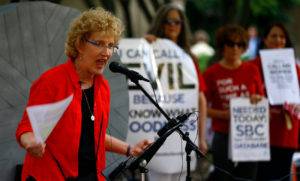
North Carolina pastor Joshua Wester, chair of the SBC’s Abuse Reform Implementation Task Force, with fellow members of the task force, speaking at the SBC Executive Committee’s meeting in Nashville, Monday, Feb. 19, 2024, announces a new nonprofit that will be tasked with building a database of abusive church pastors and staffers. (RNS photo/Bob Smietana)
With more victims coming forward and more research done on abuse within religious contexts, the evidence has shown that when sexual abuse happens in a place designated not only safe, but holy, it’s a unique form of betrayal. And when the perpetrator is a clergy member or spiritual leader, the abuse can be seen as God-endorsed.
As the scope of this crisis has been revealed, houses of worship and religious institutions—from Southern Baptists to Orthodox Jews to American atheists—have looked to shore up their safeguarding protocols and protect their constituents against abuse.
But rather than scrambling to respond in the wake of a crisis, faith groups need to adopt policies tailored to their setting and connected to their mission, says Kathleen McChesney, who was the first executive director of the Office of Child Protection for the U.S. Conference of Catholic Bishops.
“When you do that, people will have a greater understanding of what you’re doing, why you’re doing it, and how you’re doing it,” said McChesney, one of a growing group of abuse experts and survivor advocates consulting with religious institutions.
Experts suggest a few steps every faith group can take to improve safeguarding protocols.
Accept it can happen anywhere
One of the most dangerous—and common—assumptions religious groups make is to think of sexual abuse as a “them” problem.
As the founder of international nonprofit Freely in Hope, Nikole Lim has worked for years to combat sexual violence in Kenya and Zambia, and more recently has been helping U.S.-based groups prevent sexual abuse locally. For Lim, the reality that 1 in 3 women and 1 in 6 men worldwide are survivors of sexual abuse is evidence this is a problem that permeates every level of society.
“That’s a global statistic that doesn’t only exist in poor communities,” said Lim. “That also exists within your family, within your congregations.”
Experts agree faith groups often embrace the myth that good intentions, theology and ethics can stop sexual abuse from landing on their doorstep. Amy Langenberg, a professor of religious studies at Eckerd College, along with her research partner Ann Gleig, a religious and cultural studies scholar at the University of Central Florida, have shown Buddhist ethics about doing no harm and showing compassion are insufficient to prevent abuse in Buddhist contexts.
“You really do need these other ways of thinking about ethics, which are coming from outside of Buddhism, and which are coming usually from feminism, from advocacy, from the law,” said Langenberg.
Because faith communities often think of themselves as the “good guys,” they’re vulnerable to blind spots. That’s why conducting a risk assessment, much like you’d do for fire insurance, can help pinpoint what protocols are most needed, according to McChesney, who now leads a firm that consults on employee misconduct investigations and policy development.
Once concrete anti-abuse measures are in place, ongoing education can remind people at all levels of the organization to remain vigilant.
Define abuse
Faith groups often struggle to respond effectively to sexual misconduct because they lack consensus on what “counts” as abusive.
Gleig, who is teaming up with Langenberg on a book-length study called “Abuse, Sex, and the Sangha,” told Religion News Service that in Buddhist contexts, the category of abuse often is contested. In some cases, Gleig said, “abuse can be framed as a Buddhist teaching—for example, that this wasn’t abuse, it was actually some kind of skillful form of pedagogy.”
In churches, Lim has found loose definitions of abuse can lead to a form of “spiritual bypassing,” where abuse is framed as a mistake to be prayed about, rather than an act of harm that requires tangible accountability.
Conversations about sexual abuse in religious settings are often framed around clergy abuse of children. But faith groups must also account for peer-on-peer violence among children and teens, as well as abuse of adults.
Key to preventing such abuse, Pooler said, is having a robust definition of sexual abuse that goes beyond mere legal metrics and includes things such as sexual conversations, nonconsensual touch and sexual jokes and language.
Recognize power dynamics
The unequal power dynamics inherent to religious settings are an enormous barrier to equitably addressing sexual abuse. But the law is beginning to account for this imbalance.
In at least 13 states and the District of Columbia, it’s illegal for clergy to engage in sexual behavior with someone in their spiritual care—and many experts believe this standard, widely embraced when it comes to doctors and therapists, should be universal in religious settings, too.
According to Pooler, religious groups should work to share power among multiple leaders and ensure that the broader community has decision-making authority.
When sexual abuse allegations involve a religious leader, “the person should be placed on some type of leave where they are no longer influencing or speaking,” said Pooler, “because what I have seen is abusive people will try and grab ahold of the microphone and shape a narrative immediately.”
Center survivors
Experts commonly observe a default reaction in religious settings to protect the reputation of the faith group or clergyperson over investigating an abuse allegation. But defensive postures often overlook the person who, at great risk, reported the abuse in the first place.
Christa Brown talks about her abuse at a rally outside the annual meeting of the Southern Baptist Convention at the Birmingham-Jefferson Convention Complex, June 11, 2019, in Birmingham, Ala. (RNS photo by Butch Dill)
When a survivor shares abuse allegations, faith groups often fear what will happen if they take the report seriously.
For example, Navila Rashid, director of training and survivor advocacy for Heart, a group that equips Muslims to nurture sexual health and confront sexual violence, said Muslim communities can be hesitant to address sexual violence because they don’t want to add to existing Islamophobic narratives about the violence of Islam. But Rashid told RNS it’s vital to believe survivors.
“If we can’t start off from that premise, then doing and creating preventative tools and methods is not going to actually work,” she said.
Pooler advises groups to make sure survivors “sit at the steering wheel” of how the response is handled—if and when personal details about the survivor are shared, for example, should be entirely up to them.
Caring for abuse survivors requires taking their needs seriously at every juncture, even before abuse is reported, according to Pooler and other experts. That’s why background checks are vital.
“You don’t want to put somebody that has abused a minor ever in a role of supervising minors,” McChesney told RNS.
Get outside help
Faith communities are known for being close-knit, which makes avoiding conflicts of interest difficult, if not impossible, when it comes to holding offenders accountable. That’s why many experts recommend hiring outside groups to hold trainings, develop protocols and steer abuse investigations.
“They don’t have any investment in the church looking good or their leaders looking good,” Pooler said about hiring groups such as GRACE (Godly Response to Abuse in the Christian Environment) or other third-party organizations that investigate abuse allegations. These organizations, he said, are committed to laying out the facts so faith groups can make informed decisions.
Groups that are trauma-informed can also ensure that gathering testimony from survivors doesn’t cause additional harm.
Rashid recommended faith communities create a budget line for hiring outside groups who focus on addressing sexual abuse. Rather than offering quick fixes, she said, such groups are designed to help faith communities unlearn biases, recognize power dynamics and adopt long-term solutions at individual, communal and institutional levels that prioritize the safety of all community members.
“What we want to see with policies is pushing for a culture shift,” she said, “not a Band-Aid fix.”
Christian nationalists lead pro-Israel rally at Columbia
May 10, 2024
NEW YORK (RNS)—Christian nationalist activist and musician Sean Feucht, pastor Russell Johnson and conservative author Eric Metaxas headed a pro-Israel rally at Columbia University in response to the “Gaza solidarity encampment” established by students a week ago.
The “United for Israel” rally on April 25 was promoted on social media and intended to show support for Israel, Jewish students and faculties.
It drew a crowd of a few hundred, who circled the Columbia campus singing hymns and praying without entering its gate. Instead, they traded shouted slogans and threats through the Upper Manhattan school’s iron fences.
The rally was a sign of political evangelicalism’s increasing interest in campus politics writ large and in the pro-Palestinian campus protests in particular. Earlier in the week, House Speaker Mike Johnson, an evangelical Christian, made an appearance at Columbia to decry antisemitism on the campus and meet with school officials to demand the resignation of Columbia President Minouche Shafik.
He organized the rally with Russell Johnson, the conservative lead pastor of Pursuit NW Church, and Metaxas, a 2020 election denier and supporter of former President Donald Trump. Metaxas—who wrote a 2010 biography of the German theologian Dietrich Bonhoeffer, who was executed for opposing Hitler in World War II—toted a poster of Bonhoeffer’s image during Thursday’s event.
Feucht kickstarted the event by intoning the Christian anthem “How Great Is Our God” before blessing the crowd and praying for Israel.
‘These are the end days’
“Today, we say enough is enough. This anti-Christ, antisemitic agenda that has risen up in New York City, that has risen up in universities,” he said.
The day before, in a livestream, Feucht said there had been a rise in antisemitism on campuses due to the pro-Palestinian student protests and that it was a sign the end times were near.
“We’re seeing this rise and this flood of antisemitism across the world. These are the end days. I know people say this all the time, and everyone’s saying this is the end of the day. … Well, these are the end days, and we’re one day closer to the return of Jesus,” he said.
Adding that the Israel-Hamas war is “one of these end times issues,” Feucht said that Christians need to “get right’’ by siding with Israel.
Reading aloud a verse from the 12th chapter of the Bible’s Book of Genesis referring to God’s covenant with Abraham, Feucht said it was a Christian duty to support Israel.
Feucht then led the protesters in a procession around Columbia’s Morningside Heights campus. Their march, he claimed, mirrored that of Joshua’s army circling the walls of Jericho, as told in the Book of Joshua.
Some protesters blew shofars, musical horns used in Jewish religious ceremonies, emulating the biblical story.
Noreen Ciano, a 63-year-old Christian from New Jersey, closed her eyes and prayed in tongues as she marched.
“I was praying for peace. I was praying for the Lord’s presence in this place,” she told Religion News Service.
A nondenominational Christian, Ciano is a member of the International House of Prayer Eastern Gate Church, for which she hosts a radio show. As a Christian, she said, supporting Israel should be an easy decision, as “the whole Bible is Israel-centric.”
Contrasting perspectives
Some in the crowd waved Israeli and American flags and yelled, “Bring them home,” in reference to the estimated 130 hostages still thought to be held by Hamas since the Oct. 7 attacks.
Along their path, the marchers encountered members of the anti-Zionist Hasidic group Neturei Karta, who held signs reading “Judaism rejects Zionism and the State of Israel.”
Pro-Palestinian Christian activists also clashed with the crowd, some of them bearing signs reading “Jesus lies under the rubble in Palestine.”
At the end of the rally, the march faced off with pro-Palestinian student protesters at the campus gates on Amsterdam Avenue and 116th Street in a tense confrontation. The two groups yelled at each other through the gates, and the pro-Israel crowd sang the Israeli anthem and “God Bless America.”
Members of Passages, a pro-Israel Christian organization that plans “Christian birthright trips” to the Holy Land, came bearing signs reading “Christians stand with Israel.”
Ariel Kohane, a Modern Orthodox Jew who wore a yarmulke printed with the name of a Jewish activist group, Young Jewish Conservatives, under a red “Trump was right” cap, said the marchers’ support of Christian Zionists was much appreciated at this juncture in the war in Gaza.
He also praised the efforts of other evangelical groups, such as Christian United for Israel and its leader, John Hagee, who headlined a rally for Israel late last year in Washington.
“We share conservative political views and religious values. We are allies, and we work together, hand in hand. It’s so wonderful that they are standing side-by-side with us, shoulder-to-shoulder,” Kohane said.
Kohane, who lives near the Columbia campus, denounced the “Gaza solidarity encampment” and said the situation should prompt donors to withdraw funding from the institution. He said Shafik should resign due to her poor handling of the situation.
Anya Andreeva, a Christian living in Brooklyn, came to pray and support Israel. She said she heard about the rally on Facebook but made sure it would be a peaceful demonstration focused on prayer before she decided to attend. She vetted the organizers before coming.
“I saw enough to trust it. I’m keen not to side with anything that uses Christianity as a promotion for any kind of agenda,” she said.
The rally ended in a prayer session. The crowd prayed for the “salvation and safety” of the hostages and blessed Jewish participants who attended.
“Lord, we pray even tonight that a miracle would take place, a miracle across the Middle East,” Feucht said.
Baylor’s Disability & Church conversation emphasizes belonging
May 10, 2024
Example of a visual schedule, helpful for accessibility. (Photo/Calli Keener)
WACO— Erik Carter challenged participants at a Baylor University conference to be catalysts for change—so all really do belong in faith communities.
Carter is executive director of the Baylor Center for Developmental Disabilities, host of “Disability and Church: A Conversation” on April 17.
“How might we be communities of all the peoples—where members with and without disabilities live, learn, work and worship?” Carter asked. “And serve and support one another. … Where all families can flourish together in faith and life.”
Carted began with his personal testimony. Growing up in a time when disabled people generally were segregated in schools or clubs, he had limited opportunity to know and befriend people with disabilities.
“It was as if our schools, workplaces, and even our churches were perfectly designed in ways that kept us apart,” Carter explained.
In this environment, Carter had come to believe his value lay in accomplishments and abilities—until he went to a summer camp his freshman year in college where he “stumbled into new friendships with several young men and women with intellectual disability at a mountain camping program.”
‘Glad abandon’ speaks
Wayne, Margaret and John Ray loved him without any concern for his accomplishments, and he felt belonging, Carter said. Beyond belonging, Carter observed the “glad abandon” with which they worshiped and their deep love for Jesus.
“John Ray could not speak, and Wayne often struggled with words,” Carter said. “They trusted wholeheartedly. They knew for sure they belonged to God. And how much I longed to have that same assurance! … And so, I followed their lead and gave my life to Christ.”
Carter said this story should not be surprising.
“Indeed, it is an ordinary story of how God’s grace flows through God’s people to transform lives. All of God’s people. No asterisks. No exceptions,” he continued.
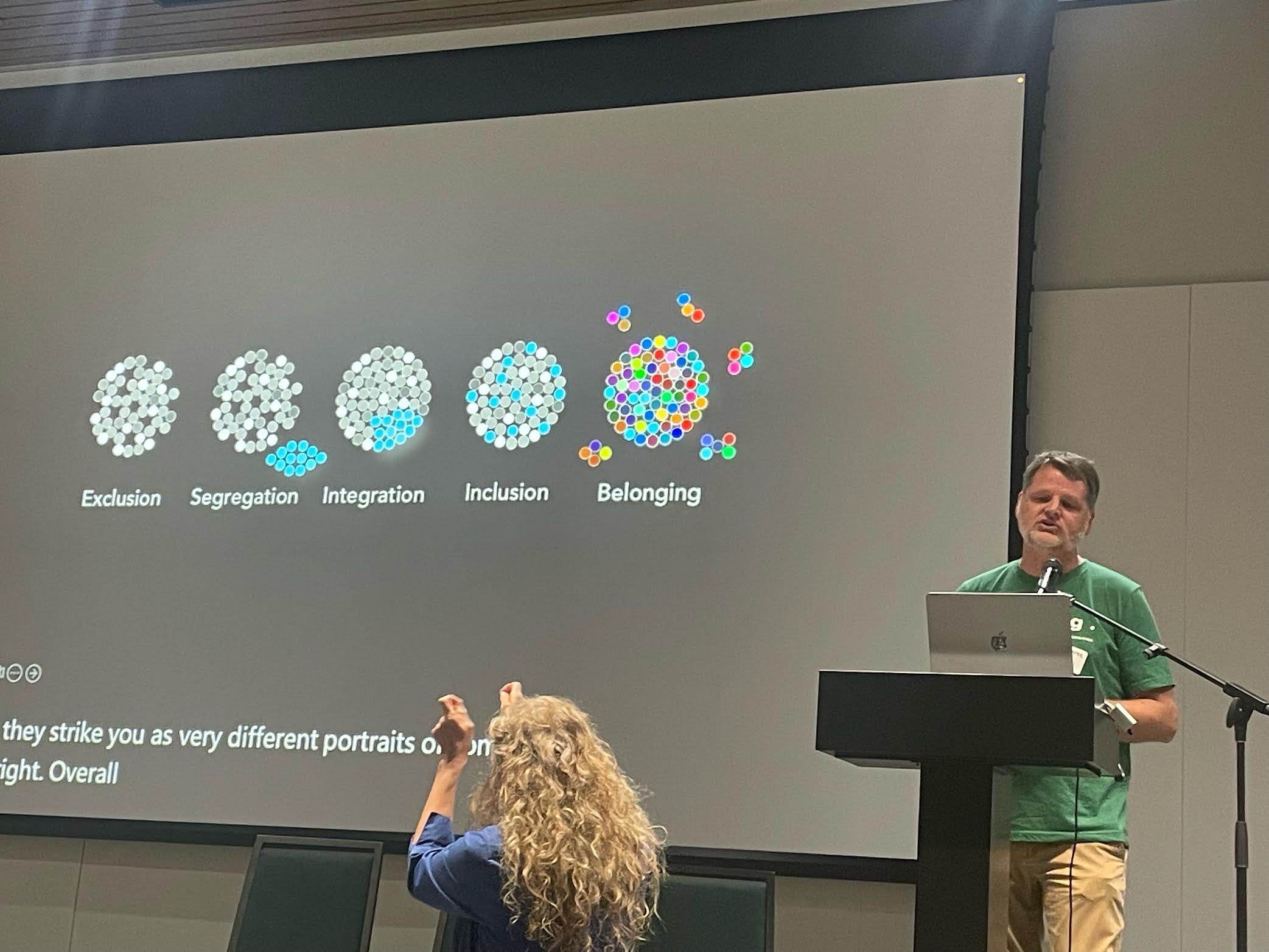
Offering insights from two decades of research focused on “what it means to create communities in which believing and belonging abound together,” Carter described five prevailing portraits for community, which have generally progressed through history “from exclusion toward embrace.”
Erik Carter describes prevailing portraits of community. (Photo/Calli Keener)
Portraits of community
Providing a visual model of each, Carter explained exclusion was the prevailing model of the 1970s, where individuals with disabilities still were excluded from much of community life—especially those with intellectual or developmental disabilities. There were holes in this model.
“Communities were incomplete,” Carter said.
In the 1970s and ’80s, separation was the prevailing model—where programs were created for children and adults with developmental disabilities, but “usually, apart from anyone else without the same label. In most communities, everyday life was still lived away from people with disabilities,” Carter said.
In the 1990s and 2000s there was a shift toward integration, “but many of the opportunities that emerged still involved a certain separation,” he said. People with disabilities were placed “near, but not really among, their peers without disabilities. There is a huge difference between near and among,” Carter said.
The present-day model is one of inclusion, Carter said—“where a growing national focus is on the full inclusion of people with disabilities in the same classrooms, clubs, colleges, church activities and community groups as anyone else. Inclusion. From being apart to among and with one another.”
But, Carter said, there is still one more model churches should be striving toward—beyond integration or inclusion—belonging. In this model, Christians learn to see each other in fundamentally different ways, “as a diverse community in which each person has equal and immeasurable value … knitted together—woven into relationship.”
None of these models is actually just historical—it is “living history; our present landscape….you will find each of these varied portraits—[exclusion, segregation, integration, inclusion and belonging]—across the more than 26,000 churches and scores of Christian schools throughout Texas,” Carter said.
But the research has identified elements of belonging, Carter said, “from the lived experiences of hundreds of young people with intellectual and developmental disabilities and their families who have been part of our various studies over the years.
“It is a question we have posed directly to them. How do you know you belong in your faith community?”
Elements of belonging
“Belonging is experienced when they are present, invited, welcomed, known, accepted, supported, cared for, befriended, needed and loved,” Carter said their responses showed.
Carter recalled his own testimony of being welcomed, befriended and loved by Wayne, Margaret and John Ray as a teen and how they shared their faith with others—people with disabilities doing ministry.
“Three people who might have been overlooked by society—and by the church—as a promising avenue through which Jesus might call others to him. And yet the opposite is certainly true,” Carter said, explaining that their gifts were real, attractive and a conduit for God’s life-changing grace.
Carter opened table talks, observed by Baylor Center for Developmental Disabilities representatives for the purpose of study. Participants reflected on and discussed ways the churches represented were doing well or could do better or differently in each of the ten areas identified as necessary for experiencing belonging.
Panel discussion moderated by Grace Casper, program coordinator for the BCDD (center). Madi Snow-Gould (left) and Aaron Jones (right) share experiences with disability in church. (Photo/Calli Keener)
Table discussions allowed families of disabled people and disabled attendees, themselves, to discuss their experiences with church and disability.
One participant, whose adult son is autistic, shared a positive story of inclusion at their church where they have been members for years.
She said everyone at church knows her son by name and that “she’s really only known as his mom.” They both feel known and loved there, she said.
But she said she would like to worship in a space where she feels less concerned about how an unexpected behavior from her son might impact other worshippers.
She has a vision for beginning a disability-inclusive service, much like other churches might have non-English speaking language services. And one of her pastors and two other church members who want to help support and participate in this ministry vision becoming reality joined her for the talk.
Others at the table shared how their experiences at church had not always been welcoming. Kirk and Gena Baker shared of times they’d been asked to remove autistic children from worship, who were not being excessively disruptive.
They’ve forgiven these offenses, they said. But they expressed how crushing it was to be treated this way by brothers and sisters in Christ.
Yet they rejoiced in God’s answer to 27 years of prayer, when they moved to Waco less than two years ago and learned about the Baylor Collaborative for Developmental Disabilities beginning.
Thriving congregations initiative
This talk was part of an interdisciplinary project funded by a grant from the Lilly Endowment’s Thriving Congregations Initiative. The project is led by Baylor’s Truett Theological Seminary, Baylor Center for Developmental Disabilities and the Center for Church and Community Impact in the Diana R. Garland School of Social Work.
“The project focuses on helping congregations embrace young people with disabilities, mental health challenges and chronic illnesses,” said Angela Reed, Truett Seminary’s associate dean for academic affairs and principal investigator of this project, in an earlier interview.
“We’re going to need congregations that are very interested in young people and supporting young people,” she continued.
“Early this summer, we will be announcing how interested churches can apply to join our first learning cohort,” Carter said.
Jason La Shana, director of the Baylor Collaborative on Faith & Disability, explained the selected cohort of churches will enter into a “multi-year mutual learning process around disability and mental health in the church,” in a follow-up email.
Mainstream media giants accused of sexual exploitation
May 10, 2024
WASHINGTON (BP)—Many turn to LinkedIn for updates on industry insiders, but among the billion professionals featured alongside respected companies are sexual exploitation leaders such as Pornhub and OnlyFans.
CashApp is popular for electronic payments, but a 17-year-old boy committed suicide after he became a victim of sexual extortion or “sextortion” by criminals who threatened to ruin his life unless he paid them, and only through CashApp.
Nude photos of your daughter are all over the internet, but she pleads innocence. Turns out, her classmates snapped her photo and generated “deepfake” nude images, likely using software shared on Microsoft’s GitHub, where more than 100 million software code writers worldwide collaborate in developing programs.
GitHub’s open-source design allows “anyone to access, use, change, and share software” developed by such giants as Google, Amazon, Twitter, Meta, and Microsoft, the National Center on Sexual Exploitation said, making GitHub the “most prolific space” for AI development and “a major facilitator of the growing crimes of image-based sexual abuse.”
LinkedIn, CashApp and GitHub are among those making the center’s 2024 Dirty Dozen List for “facilitating, enabling, and even profiting from sexual abuse and exploitation.”
“No corporation should be hosting any type of sexual abuse and exploitation but we certainly don’t expect places like LinkedIn to be hosting and perpetuating sexual abuse and exploitation,” said Lina Nealon, vice president and director of corporate advocacy for the center.
“So, we found that LinkedIn is providing a platform for many exploitative companies, most particular PornHub. LinkedIn is normalizing them as a job like any other, as a company like any other.”
The National Center on Sexual Exploitation accused industry leaders of various forms of exploitation including child sexual abuse, rape, sexual extortion, prostitution, sex trafficking, image-based abuse and other evils, documented by the center’s staff including researchers and legal experts.
“These (12) entities exert enormous influence and power politically, economically, socially and culturally, with several corporations on this list enjoying more resources in global recognition than entire nations,” Nealon said.
“Most of the companies we’re calling out have lofty corporate responsibility statements and have launched ethical AI task forces,” Nealon said. “We’re challenging them to actually live up to those statements and fulfill their social obligations to do something.”
The National Center on Sexual Exploitation calls out:
Apple, accusing the tech giant of facilitating abuse by refusing to scan for child sex abuse material, hosting dangerous apps with “deceptive” age ratings and descriptions, and neglecting to set default safety features for teens.
Cloudflare, a “a platform for sex buyers and traffickers” that claims a desire to “build a better internet,” but provides services “to some of the most prolific prostitution forums and deepfake sites.”
Discord as a “hotspot for dangerous interactions and deepfakes.” Exploiters and pedophiles easily contact and groom children on the site, luring children away from home, enticing children into sending sexually explicit images, and sharing sexually explicit images and deepfakes with each other.
Meta, with its launch of end-to-end encryption, open-sourced AI, and virtual reality “unleashing new worlds of exploitation.” Meta platforms Facebook, Messenger, Instagram, and WhatsApp “have consistently been ranked for years as the top hotspots for a host of crimes and harms,” the national center said, noting pedophile networks where members share child sex abuse material, contact children and promote children to abusers. The sites enable sex trafficking, sextortion, and image-based sexual abuse, the center said. In an April 11 blog post, Instagram announced it was implementing new tools to protect users—particularly young people—from sexual exploitation, including a feature that automatically blurs nude images in direct messages.
Reddit is a hotspot for sexploitation, the center said, citing child sex abuse material, sex trafficking, and image-based sexual abuse and pornography. The content will be further monetized if Reddit succeeds in going public, the national center said.
Roblox, where users with such names as “RaipedLittleGirl” regularly target children among Roblox’s 54 million daily users, bombarding them with sexually explicit content generated through artificial intelligence, grooming them for sexual abuse and luring them from their homes. The center calls out the $2.8 billion platform, popular with preteens, for not embracing “common sense child protection measures.”
Spotify, a music streaming app the center said also hosts sexually explicit images, sadistic content and networks trading child sex abuse material. The national center accused Spotify of pervasive hardcore pornography and sexual exploitation.
Telegram, promoted as a dark web alternative, has instead unleashed a new era of exploitation, the center said, describing the app as a safe haven for criminal communities globally including sexual torture rings, sextortion gangs, deepfake bots and ot
Locke says Easter Bible burning a sign of attack
May 10, 2024
MT. JULIET, Tenn. (RNS)—A Tennessee pastor known for burning books, casting out demons and creating outrage says someone burned 200 Bibles outside his church on Easter Sunday.s
Greg Locke, pastor of Global Vision Bible Church in Mt. Juliet, Tenn., said the church’s security cameras recorded a “polite crook” stopping their vehicle in the middle of an intersection by the entrance to the church, turning on hazard lights, then dousing a trailer full of Bibles with gas and setting it on fire.
“You got to be kidding me,” Locke said during the Easter revival service, according to a video posted on the Global Vision website. “How many churches in America have a trailer full of Bibles getting burned to block the parking lot?”
The fire is currently under investigation by the Wilson County Sheriff’s Department.
According to a press release from the sheriff’s office, the Mt. Juliet Fire Department responded to the fire at about 6 a.m. on Sunday morning and quickly extinguished the fire.
“The trailer, containing Bibles, had been dropped off in the middle of the intersection and then intentionally set on fire,” according to the sheriff’s department. “To uphold the integrity of the ongoing investigation, other specific details cannot be provided at this time. However, we assure the community that further updates will be shared at the appropriate juncture.”
At first, Locke joked about the fire, saying he had asked law enforcement to give the charred pages of the Bibles to the church—so the church could hand them out as a reminder of the need for prayer.
Then he called the fire another sign that Christianity was being threatened in America and that the return of Jesus and the End Times were imminent.
“If you think that Christianity is not (under) attack more than ever before in the United States of America, you have not been paying attention,” he told his church. “Quit being lukewarm. Quit being so passive aggressive and namby-pamby and spiritually sissified. OK? I’m telling you, they’re attacking churches in America.”
Locke then told his congregation he had just returned from a trip to Israel, which he said was the safest place in the world, and he insisted news reports about the war in Gaza were media lies.
Linking to End Times prophecy
He then went into a long monologue about the so-called Red Heifer prophecy—the belief a red cow has to be sacrificed on the Temple Mount in Jerusalem to usher in the return of Jesus and the end of the world.
The Temple Mount is currently the site of the Dome of the Rock, one of the holiest places in Islam. Locke told his congregation the mosque on the Temple Mount would soon be “brought to rubble” and a red heifer would soon be sacrificed, which would allow first the Antichrist and then Jesus Christ to arrive.
“We are watching the word of God be fulfilled before our very eyes,” he said.
Locke was once a relatively obscure Tennessee preacher, known mostly for publicity stunts like backpacking hundreds of miles to raise money for missions and staying up all night on a cherry picker to raise awareness about homelessness.
He became a social media influencer after a 2016 video of him condemning the inclusive bathroom policies at Target went viral. Locke has since used his online influence to promote Donald Trump and Christian nationalism—as well as to declare himself an exorcist, capable of casting out demons.
Locke has also claimed witches infiltrated his church in an attempt to bring his ministry down and has clashed with his neighbors and local officials after erecting an enormous tent on the grounds of his church during the COVID-19 pandemic.
That tent, Locke has claimed, is needed to accommodate the crowds of new people attracted by his support for Trump and his newfound career casting out demons.
Survey links religious practice to life satisfaction
May 10, 2024
(RNS)—Announcing the results of a new Global Flourishing Study, a consortium of scholars and pollsters led by Gallup said they found links between religiosity and people’s satisfaction with their lives.
The study, a joint project of Harvard and Baylor universities, Gallup and the Center for Open Science, aims to uncover what influences “human flourishing,” which is defined by measures of happiness, character and virtue and social relationships, among other values.
According to the group’s research, attending a religious service regularly positively affects flourishing.
“We’re not shocked at that because there’s a lot of other research that indicates that faith is important to human flourishing, but it may come as a surprise to people that religion would be an important thing,” said Byron R. Johnson, director of Baylor University’s Institute for Studies of Religion.
For this study, Gallup interviewed 200,000 individuals in more than 20 countries, including Mexico, Japan, Nigeria, Indonesia and Israel.
Participants were asked questions about the six domains the Center for Open Science has identified as the core indicators of human flourishing. Physical and mental health, purpose and financial stability were among the topics discussed.
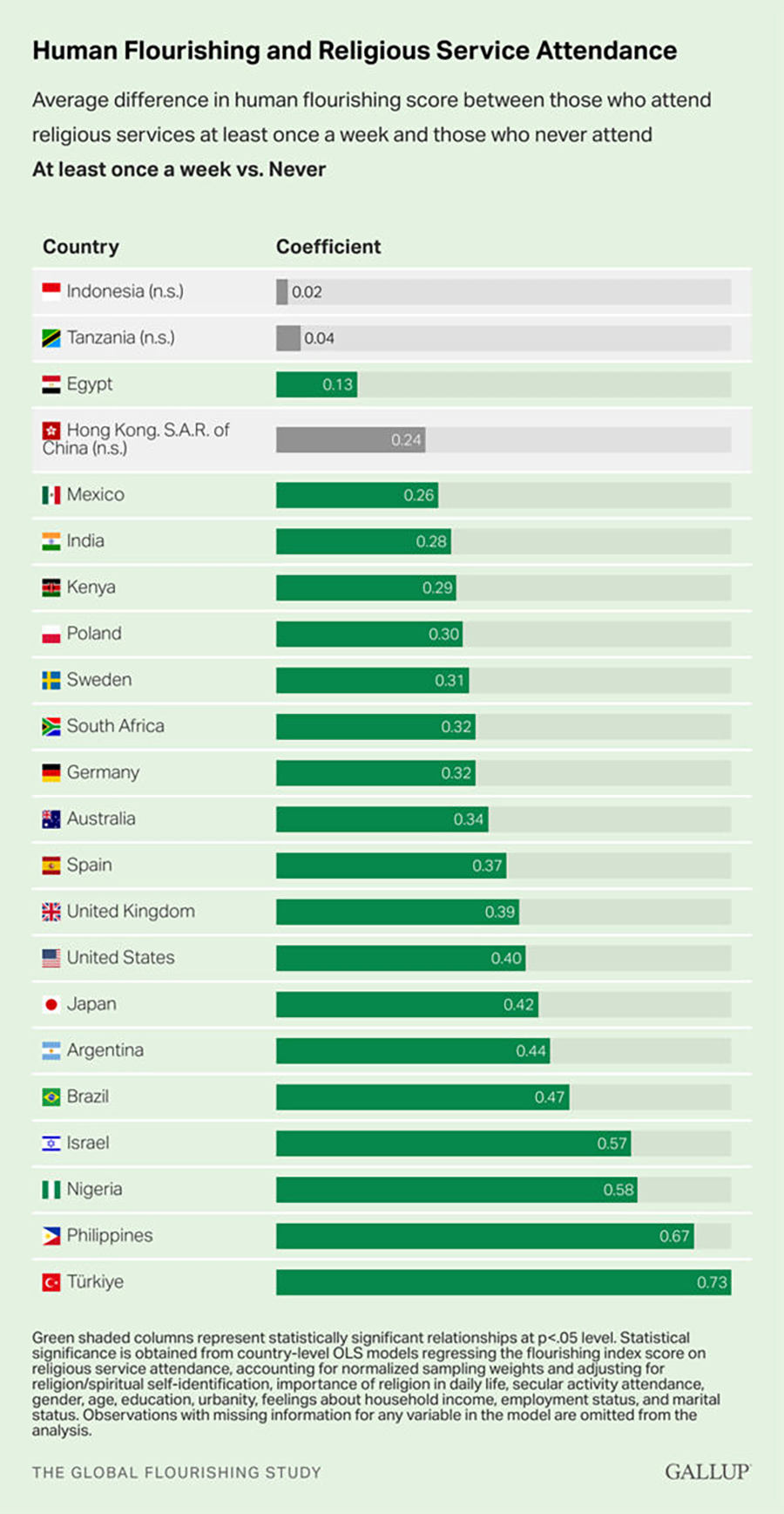
(Graphic courtesy of Gallup)
Their responses were collected during short in-person interviews and used to create a “human flourishing index” ranging from 0 to 10, with 10 being the highest level of satisfaction.
Results lead to further research
Respondents who said “religion is an important part of daily life” score 0.23 points higher on average than those who didn’t.
Those who attend a religious service at least once a week scored 0.41 points higher than those who never do.
Attendance one to three times a month correlated with a 0.22 point higher score, while those who go a few times a year scored 0.18 points higher on average.
The study also revealed that gaps in human flourishing scores are largest among people in Turkey, with 0.73 points of difference between Turks who attend religious services weekly and those who never do—in the Philippines (0.67 points of difference), and in Nigeria (0.58 points of difference).
In an article commenting on these results, Gallup noted context is important to understand the data, as other factors related to financial stability, such as being employed and living comfortably, also play a role.
Now that the first results have been published, the team of 50 researchers deployed by the four institutions to work on the study is conducting separate analyses to study the level of flourishing within each religious group and compare religions together.
These further analyses might give them clues on which religious groups tend to have higher flourishing scores.
“Some people will just be looking at Jewish samples, for example, and some will just be looking at samples of those that follow Islam, and some will be doing all of it,” said Johnson.
The main focus for the next four years is to keep the same sample population so researchers can track the participants’ level of flourishing and understand what influences potential changes.
Johnson said the idea of creating a longitudinal study—one that follows people over time—came after a conference on human flourishing at Harvard in November 2018.
Johnson said the study could also help make headway in understanding the global religious landscape, as the study collected data about religious groups in every country.
The next round of interviews already has started, with results likely available by mid-February 2025. In the meantime, all data collected in the first edition of the survey are available in open access for researchers.
Study: Unaffiliated the only growing religious group in U.S.
May 10, 2024
WASHINGTON (RNS)—Religious churn has been a key fixture of U.S. religion for a long time, but a new surveyof changes in American religion finds that motion is not so much a swirling but a one-way stream heading out.
A new PRRI survey shows religiously unaffiliated Americans are the only group that has seen steady growth over the past decade—from 21 percent of all Americans in 2013 to 26 percent in 2023.
These unaffiliated Americans—many of whom abandoned their childhood faith—are not looking for a spiritual home. Only 9 percent of people in this group said they were “looking for a religion that’s right for me.”
Most may be unaffiliated for life. Only 3 percent of Americans who grew up without a religious identity said they joined a religion.
Even those who remain religious—the vast majority of Americans, about 67 percent of whom are Christian—say religion is less important in their lives.
Only 53 percent of Americans say religion is the most important or one among many important things in their lives in 2023, compared to 72 percent in 2013.
“The level of religiosity among Americans, even among people that identify with the religious tradition, has really dropped pretty precipitously in the past decade,” said Melissa Deckman, PRRI’s CEO.
“A quarter of Americans say religion isn’t important at all in their lives. Another 19 percent say it’s not really that important, maybe has a little bit of importance.”
Researchers surveyed 5,600 adults across the United States in November and December last year. Those results were compared with studies PRRI did in 2016 and 2013.
The Catholic Church saw the largest decline in religious affiliation of any religious group in 2023. Some 30 percent of Americans said they grew up as Catholics—18 percent white Catholics and 12 percent Hispanic Catholics.
But only 20 percent continue to identify that way today—12 percent white Catholics and 8 percent Hispanic Catholics. A 2016 survey showed similar losses for Catholics.
Study’s groupings challenged
Tom Gaunt, executive director of the Center for Applied Research in the Apostolate at Georgetown University, took issue with the study’s groupings of religions.
He said it was unfair to compare general categories for white evangelicals—for example, a mashup that might include high-church Anglicans alongside Southern Baptists—and compare those to Catholics.
Each one of the denominations in the big general category may have lower retention rates than Catholics. Plus it doesn’t capture switching from one denomination to the next.
He also said the survey doesn’t reflect “reverts”—those who left the church as teens but returned later in life when they had children. In the Catholic Church no one would require those returning Catholics to recommit to the faith.
“The presentation of the data is unclear,” Gaunt said.
According to the data, white mainline Protestants also lost more members than they replaced, about 4 percent. Black Protestants and white evangelical Protestants had the best retention rates—76 percent of those reared as white evangelical Protestants in childhood remained so and 82 percent of Black Protestants.
Among those who left the religious identity they grew up with, 67 percent said they stopped believing their faith’s teachings, up 7 percentage points over 2016.
LGBTQ treatment drives faith departures
But the biggest change came among those who said they quit their religious upbringing because of its treatment or teachings of LGBTQ people.
In 2016, 29 percent cited negative teachings about LGBTQ Christians as a reason they quit their religious affiliation. In 2023, 47 percent said that was a reason they quit.
The younger the unaffiliated were, the more they cited LGBTQ teachings as a reason for leaving. Sixty percent of unaffiliated adults aged 30 or under cited LGBTQ teachings as a reason for quitting.
Compared with 51 percent of unaffiliated in the 30-49 age group and 37 percent of unaffiliated in the 50-64 age group cited LGBTQ teachings as a reason for quitting.
Nearly half of LGBTQ unaffiliated respondents (48 percent) said they no longer identify with their childhood faith because it was bad for their mental health.
“I think treatment of LGBTQ Americans, clearly for younger people, is an issue that is driving them to leave religion altogether,” Deckman said.
Unaffiliated respondents also cited the clergy sexual abuse crisis as a reason for leaving church. Overall, 31 percent of Americans cited clergy sexual abuse. But among former Catholics who no longer identify with their childhood religion, 45 percent cited the clergy sexual abuse crisis.
About 65 percent of unaffiliated Americans are white. They are more likely to identify as Democrats and independents.
Unaffiliated Americans are twice as likely to identify as LGBTQ, 19 percent vs. 9 percent.
The findings confirm a 2020 study in the Journal for the Scientific Study of Religion that found same-sex attraction, behavior and queer identity strongly associated with a decision to step away from organized religion, attend church less frequently or stop going altogether.
The PRRI study had a plus or minus margin of error of 1.7 percentage points.
Author Leah Payne details the rise and fall of CCM
May 10, 2024
(RNS)—God gave rock ’n’ roll to everyone, as the British rock band Argent once sang.
And everyone includes the religious-right powerhouse James Dobson, as well as the legendary rock band Kiss, both of whom tried to reach the souls of teenagers through the power of rock ’n’ roll.
Both Kiss and Dobson get a mention in God Gave Rock & Roll to You, a new history of the cultural power of contemporary Christian music from religious historian Leah Payne.
The book traces the rise of CCM. Payne describes its rise as “part business, part devotional activity, part religious instruction,” from its humble beginnings to its 1990s heyday—when Amy Grant’s “Baby Baby” was a monster hit—and then to the current dominance of a handful of megachurches.
The power of “Becky”
She also looks at how Christian leaders like Dobson, Billy Graham and concerned evangelical moms known as “Beckys” sought to harness the power of rock music to keep their kids Christian and to shape the broader culture.
“The story of CCM is the story of how white evangelicals looked to the marketplace for signs of God’s work in the world,” she writes.
Payne draws on interviews with artists, fans and record executives as well as her own training as a religious historian to trace the rise and fall of CCM.
The book is filled with sharp insights and small details about the role Pentecostalism and Nazarene holiness codes played in shaping Christian music for decades. Rather than being built on generic evangelical beliefs, she argues, Christian music was influenced by both the ecstasy and the strict boundaries of those traditions.
Early on, Payne details how Pentecostalism inspired “Great Balls of Fire,” an early rock ’n’ roll hit by Jerry Lee Lewis, cousin to televangelist Jimmy Swaggart.
That term was used by Southern Pentecostals to talk about the Holy Spirit—a reference to the book of Acts, where the Spirit descends on early Christians in the form of fire.
For Pentecostals, being filled with the spirit often comes with a sense of euphoria, often displayed through singing. Rockers like Lewis took advantage of that connection, said Payne.
“You can imagine how scandalizing it would be for Pentecostals when Jerry Lee Lewis uses that expression as a very thinly veiled reference to sex,” Payne said in a recent interview. “They felt that it was desecrating their holy practices.”
Payne said the purity codes of groups like the Nazarenes also played a role in Christian music, which was seen as a more wholesome version of rock music. Leaders like James Dobson, who grew up in the Church of the Nazarene—a holiness tradition—used music to spread ideas about chastity and modesty for women.
“Women who were holiness preachers were super modest, but that made them spiritual bosses,” Payne said. “They were out there exorcising demons and telling men what to do from the pulpit.”
Folks like Dobson, Payne argues, kept the modesty part of holiness codes, but they domesticated it—spreading the idea women should be submissive at home rather than powerful.
But women also played a major role in shaping Christian music. The genre’s biggest stars were women—like Grant—and women were its biggest customers. Especially a woman known as “Becky”—an industry term for the suburban evangelical moms who bought the majority of Christian music.
The name “Becky,” said Payne, was used by marketing executives and record producers to determine what songs got recorded and often determined which artists became stars.
Payne points to the example of Carmelo Domenic Licciardello—better known as Carman—who became a star in the 1990s. She said record company executives were not big fans of Carman, whom she described as a Christian version of Liberace.
But the Beckys loved him and made him a star, Payne said.
“Beckys were really powerful,” Payne said. “They were the ultimate gatekeepers. There was great respect—and, in many cases, fear—of Becky because these suburban, conservative white women were very powerful if they were upset.”
Those women—as well as religious leaders like Dobson and Billy Graham—were hoping to use the power of mass media to shape the spiritual lives of their kids, Payne said.
At the time, Payne said in the interview, Christian parents were being told their children were in serious danger of being corrupted by the outside world. Buying the right kind of music could help keep them safe.
That kind of concern sometimes crossed political lines as Christian rock began its rise.
In the 1980s, Tipper Gore, wife of then-Democratic Senator Al Gore, led a campaign to get warning labels placed on music with offensive lyrics. That same kind of concern from moms helped drive the success of CCM.
But Beckys became older and fewer in number. And as the country became more diverse and more polarized, their buying power shrank. The dependence on that audience made it harder for Christian music to reach a changing nation.
“A lot of the collapse of the industry is explained by the fact that they doubled down on this person who did not replace themselves, demographically speaking,” Payne said.
Several factors contributed to decline
The fracturing of the music business in general also hurt Christian music. Much of the genre’s success, said Payne, depended on creating a Christian alternative to mainstream pop stars like Madonna or George Michael.
As the larger music scene splintered and top 40 music no longer was a “coherent category,” that became harder to do. How do you create an alternative to the mainstream when there is no musical mainstream?
Payne said Christian music had an impossible task in trying to harness music and “coolness” for religious purposes. Coolness, she said, depends on authenticity and a sense of rebellion against social norms—both of which were problems for religious leaders.
“Christian rock was an uneasy effort to solve those problems,” she said. “And it didn’t work long term.”
The decline of churchgoing in America—and the consolidation of many Christians into megachurches—also hurt the Christian music industry.
Many Christian bands got their start by playing concerts in medium-sized churches, said Payne, which have largely disappeared. And megachurches have their own bands and sometimes even music labels. So, they don’t need the music industry in the same way anymore.
“CCM depended on those groups to provide gatherings and revenue—and they just don’t exist anymore,” she said.
The CCM market was also affected by larger changes in the American religious landscape—such as the rise of charismatic megachurches like Hillsong and Bethel, whose songs dominate the worship music sung in churches.
Other groups, like Southern Baptists or Christian music companies, tried to use music in service of their mission, said Payne. But those charismatic churches have made music their mission, said Payne, and no longer need the institutions that supported CCM.
“Among evangelicals, the group that had the most institutional heft was the Southern Baptist Convention,” she said. “And they have faded.
“CCM has faded. And what has arisen are the nondenominational charismatics. The music showed us that that was coming.”
 The chapter references Lifeway Research from 2020, that showed 97 percent of U.S. churches were putting their services online. At that time, 67 percent were livestreaming and others were providing access to videos for later viewing.


 Leah Payne, a religious historian and author of God Gave Rock & Roll to You, said “How Great Is Our God” showcases the skill of Tomlin and his co-writers—who fused the power of stadium rock anthems with Christian lyrics, creating songs with infectious hooks that draw a crowd into singing along.