Black churches team with hospitals to push better diets

CLEVELAND (RNS)—For Deborah Taylor, keeping her body fit and eating well is a way of honoring God.

So, when Taylor, a financial assistant for University Hospitals Ireland Cancer Center, heard about the hospital’s Body & Soul program for black churches to help their congregations get healthier, she took action.

Soon, Taylor’s congregation, Faith Temple Church of God, launched a healthy-eating initiative and began hosting weekly workout sessions.

“You have so many people in the church who are walking around with diabetes and high blood pressure. Many are obese,” Taylor said.

Sylvia Benford works out with a group of women in the Faith Temple Church of God’s aerobics class at the Fatima Family Center in Cleveland. (RNS PHOTO/Thomas Ondrey/The Plain Dealer)

Across the city, more than 60 black churches have started the program in an effort to combat African-Americans’ higher risk of developing cancer.

The program, supported with $200 grants to individual churches from the American Cancer Society, is based on research findings that healthy eating and other wellness initiatives drive down the risk of cancer, according to Allison Payten, cancer program coordinator for Ireland Cancer Center’s community outreach department.

Research funded by the National Cancer Institute, which followed 15 churches nationwide, found more than a decade ago that church members significantly in-creased their fruit and vegetable consumption through congregation and pastoral support. A cornerstone of the national program is to encourage people to eat five to nine servings of fruits and vegetables a day.

High fruit and vegetable consumption decreases the risk for cancer and a host of other ailments such as high blood pressure, diabetes and stroke—all of which the African-American population is at higher risk of experiencing, according to the study.

In Cleveland, the program is changing lives. LaVita Hatten lost 70 pounds when her church, Freedom Christian Assembly, began a “Biggest Loser” contest. She still makes frequent stops at McDonald’s, but orders the grilled chicken sandwich and a salad instead of a hamburger and fries.

Pastor Milton Bradford at Good Hope Baptist Church lost 20 pounds—even though he admits he occasionally sneaks fried chicken for lunch.

And Sylvia Benford rarely misses her weekly aerobics class organized by Faith Temple Church of God. Now, she doesn’t get winded walking up a flight of stairs.

Their stories are just a sampling of changes happening across the city, Payten said. “Each church is unique.”

The program “empowers members to take charge of their health,” she said.

Good Hope Baptist Church began the Body & Soul program last July. Church members hosted a kickoff where they learned about exercise and how to prepare healthy foods.

Previously, church gatherings meant everyone bringing their specialties, such as fried chicken, potato salad, greens, ham hocks, and macaroni and cheese.

“We always had salad, but most of our meals would be heavy,” said church member Bertha Fuqua.

Fuqua, who had attended one of the hospital’s Body & Soul training sessions and organized the church Body & Soul kickoff, enlisted folks to bring lower-fat alternatives to social gatherings. A personal favorite, she said, is beans flavored with onions and peppers instead of fatback.

Considering “the number of people at our church with diabetes and the number of people who are cancer survivors and the number of children at our church who are overweight—I came out (of the training session) totally convinced and wanted to move forward,” Fuqua said.

Bradford, the Good Hope pastor, began including advice and encouragement in his weekly sermons, giving the congregation witty one-liners to live by, like “We’re not digging our graves with our teeth.”

“We’ve got to avoid that,” Bradford said. “It doesn’t matter how much you are in your faith if you can’t breathe.”

The church’s weekly bulletin includes a health tip or a low-fat recipe. Last summer, members brought in extra vegetables from their gardens to share, and now the church is planning its own “Biggest Loser” contest.

At Freedom Christian Assembly, registered nurse and church health ambassador Simone Ray recalls frequently talking to people about their health before starting the Body & Soul program.

“They would want prayer, but prayer would not work,” she said. “You have to do something physical to get something.”

The program, started at Freedom Christian in 2007, includes getting together for weekly walks and promoting healthy eating. When the church held its “Biggest Loser” contest, more than 20 people signed up, and the winner, Hatten, won $500.

To win, Hatten not only changed what she ordered at McDonald’s, but also began going to the gym twice a day and talking to fitness trainers. She cut back on carbonated drinks and reduced portion sizes, too.

Soon, the 318-pound Hatten was pinning up her clothes to keep them on. She could see her ankles for the first time in years. Now, at 247 pounds, Hatten rarely misses a workout and says she’s still losing weight.

Working with the church, Hatten said, has made a difference.

“It sparked a fire in me,” she said.

Sarah Jane Tribble writes for The Plain Dealer


‘Davey and Goliath’ creator dies at age 88

WASHINGTON (RNS)—Art Clokey, the creator of the animated icon Gumby and his clay Christian counterparts Davey and Goliath, died Jan. 8 at his home in California. He was 88.

His son, Joe Clokey, told The New York Times his father died in his sleep.

davey and goliathAlthough Art Clokey was best known for Gumby, his work on the television program Davey and Goliath showed “the spiritual side of my dad,” Joe Clokey told the Evangelical Lutheran Church in America news service.
A forerunner of the ELCA, the United Lutheran Church in America, approached Clokey and his wife, Ruth, in 1959 to create a Gumby-like show for the church, Joe Clokey told the ELCA.

“The Lutherans contacted them, and asked them to create a show with the theme of ‘God loves everyone,”' he said. “They put all of their hearts into it.”

The Davey and Goliath episodes, which developed a loyal following from 1960 to 1975, were 15 minutes long and known for imparting simple moral lessons.

Often Davey invited trouble by ignoring the advice of Goliath, his conscience-ridden talking dog, before repenting and returning to Christian values.


‘The Book of Eli’ casts Bible as a major theme

MALIBU, Calif. (ABP) — The Bible plays a starring role in "The Book of Eli," a post-apocalyptic action film starring Denzel Washington that opens in theaters Jan. 15.

Washington, a two-time Academy Award winner widely known in Hollywood for his Christian beliefs, portrays a lone warrior making his way across a desolate American landscape defending the world's last remaining copy of the King James Version of holy writ.

"This is a story about a man named Eli, who's been sent a message, who hears voices from God that told him to take this book, the Bible, across the country and to deliver it out West," Washington says in a movie trailer posted on ScreenVue.com, which provides movie clips for churches and ministries to use in their teachings.

"The Book of Eli," starring Denzel Washington, hits theaters Jan. 15. (Warner Bros.)

Though in the vein of recent films like "2012," a blockbuster about the end of the world as predicted by the Mayan calendar, evangelical movie buffs are touting "The Book of Eli" as a rare major studio release where the protagonist is unabashedly a Christian.

"How far are we willing to go in response to God's call?" Craig Detweiler, director of Pepperdine University's Center for Entertainment, Media and Culture, writes in a study guide written for Christian viewers of the film. "What kind of sacrifices would we make to defend the Word of God?"

The movie, which has Washington's character facing down villains trying to stop him, earned an "R" rating for graphic violence and coarse language.

"In following his mission he's been given by God, he becomes more and more violent in order to get the job done," Washington explains in the trailer. "This man, Eli, has a very difficult task, but he has faith. And he makes mistakes, as we all do. Someone said there's no testimony without a test."

The movie's hard edge may give some religious moviegoers pause. Angela Walker, director of producer relations for ChristianCinema.com, wrote that she pondered the movie's objectionable content for a month after seeing an advance screening before deciding the film's spiritual themes were redeeming qualities.

"Personally, I want to support filmmakers who explore questions of faith in their films," she wrote. "For me, choosing to see this film is casting a vote for Hollywood filmmakers to keep making films about faith. It is telling them I will buy tickets to films they create about topics I'm interested in."

Detweiler pointed out that no words of profanity come from Washington's mouth. "He is clearly set apart as a holy character on a godly mission," he said. "So he acts as one would hope a man of God would act."

While Washington's character does resort to violence, Detweiler said, it is always in self-defense against another character's aggression.

"It seems comparable to the situation most of us find ourselves in — trying to follow God in a fallen world where profanity, violence and temptation is all around us," Detweiler said.

Screenwriter Gary Whitta told ChristianCinema.com that he spent a lot of time going through the Bible to find passages that Eli could quote at appropriate moments in the film. Washington, the son of a Pentecostal preacher who attends the West Angeles Church of God in Christ in Los Angeles, added some verses of his own.

Washington — ranked by Beliefnet as the second most powerful Christian in Hollywood behind Mel Gibson — described "The Book of Eli" as both "a story about faith" and "a story about good and evil" with parallels to real life.

"We're all a work in progress," he said in the trailer. "I think we're all on a journey on this earth to be better human beings and to hopefully follow the Word of God. That's about all any of us can ask for is to do the best we can with what we're given."


–Bob Allen is senior writer for Associated Baptist Press.


More than 1,200 crimes against churches reported

CINCINNATI (ABP) — More than 1,200 crimes were committed against Christian churches and ministries in 2009, according to an unofficial tally by a firm that specializes in church security.

The Christian Security Network report found 1,237 total incidents targeting churches in all 50 states, including 12 homicides, 38 other violent incidents and $24 million in estimated property loss. 

"It is disheartening to see all these incidents and loss of life in churches in 2009 and even sadder because we know 2010 isn't going to be any different unless the status quo changes," said Jeff Hawkins, executive director of the Christian Security Network. The Cincinnati-based company provides services to make Christian churches and organizations more secure. 
 
The most common crime committed against churches is burglary. Sixty-two percent of the incidents in the CSN report — 779 in all — were burglaries. The most expensive, however, is embezzling — internal theft committed over a period of time, usually years. Such incidents, according to the report, cost churches nearly $14 million in 2009.

Other 2009 incidents included three sexual assaults, three kidnappings and 98 arsons.

The report said counting the number of crimes against churches is difficult for several reasons. There is no mandatory reporting of such crimes to any government agency. The FBI tracks hate crimes against religious organizations, but many of the crimes involving churches are not included in hate-crimes statistics because bias against Christians is not a motive in the crimes.

Many crimes against churches also go unreported, because the congregation forgives the offender or wants to avoid embarrassment or bad publicity.

Besides the 12 murders, violent crimes in churches in 2009 included five attempted homicides, one rape and two attempted rapes. The 12 murder victims ranged in age from 14 months to 67 years old. Seven were male and five were female.

Many of the organizations cited in the report experienced multiple incidents. One particular church in Cincinnati, for example, was burglarized 20 times during a six-month period.

A veteran security specialist with nearly 30 years experience, Hawkins said criminals nowadays are less likely than in the past to avoid churches simply because they are sacred spaces. Today, he said, criminals are more inclined to view houses of worship simply as "soft" targets. Despite that, he added, 75 percent of churches polled in 2008 said they did not have any security or emergency plan.

Hawkins said with a few precautions and training, many crimes included in the report could have been averted. "The church has to start taking responsibility for the safety of their staff, volunteers, and congregation and [become] good stewards of the gifts God has provided," he said.

Hawkins said every church should have plans in place to respond at minimum to situations in which the church must be evacuated, people inside the facility must shelter in place due to natural or man-made disasters, for medical emergencies involving people inside the building, for children who go missing and for situations requiring lockdown of the facility.

While smaller churches automatically think of expense when it comes to security, Hawkins said a big part of any security plan is awareness. He suggested churches use free resources, such as talking to local law-enforcement officials, fire departments and EMS personnel as well as meeting with the church's insurance provider.

Christian Security Network offers a free weekly newsletter and conducts seminars around the country and over the Internet to help churches and ministry organizations develop a plan.

A first step is a process of risk assessment, which typically includes interviews with staff and volunteers, analysis of local crime trends and review of any past threats or present perceived threats.

Hawkins said sometimes pastors tell him they don't need a security plan in place because they trust God to protect their congregation. He responds that we live in a fallen world and that the Bible says Christians are to resist evil.

Other church leaders fear that by adopting security measures they make their congregation seem less open and inviting to visitors, but Hawkins said everyone should have a right to worship without having to worry about whether a child in the nursery or a car in the parking lot is safe.

Hawkins said it is unknown whether the economic downturn in the United States has contributed to increased property crimes against churches.


–Bob Allen is senior writer for Associated Baptist Press.


Blessed are the Persecuted: Where persecution is real, it’s intense

WASHINGTON (ABP)—During the holiday season every year, America’s dutiful culture warriors spar over things like whether ecumenical holiday greetings are appropriate for retailers or Christian Nativity scenes should be displayed on courthouse lawns that Jews, Muslims and atheists also pay taxes to maintain.

Inevitably, when department-store chains or courts decide against privileging Christian hegemony on these cultural practices, some Christian leader or group claims it’s an act of persecution.

Christians are being persecuted in various places around the world. "Many Christians are not even doing what is expected, which is to pray and to speak for those who have no voice," according to Baylor professor Chris Van Gorder

But in places around the world where disfavored religious groups are suffering undisputed, severe and egregious persecution, downtrodden minority Christians might be forgiven for finding their American siblings’ cries of “persecution” just because they aren’t being wished “Merry Christmas” at Macy’s a tad histrionic.

“Since I began to answer this e-mail, I have been writing non-stop for the last two hours, and still I am only scratching the surface of your multivalent questions,” wrote Chris Van Gorder, a Baylor University religion professor and expert in global persecution of Christians, responding to an e-mail query about religious persecution.

“For example, I have not even yet mentioned the situation for Christians in Indonesia, Malaysia, the Maldives and other places where Christians are suffering for their faith to greater and lesser degrees. I had so many things to do today and so many pressing issues to attend to that, like many North American Christians, I felt too busy to stop and consider the plight of our sisters and brothers in chains of difficulty and lack.”

Van Gorder, who has particular expertise in the status of religious freedom in the Middle East and other majority-Islamic regions, ticked off a number of other nations where severe violations of religious freedom were taking place.

For example, consider Afghanistan. “During Taliban rule, persecution of Christians was government policy and this is no longer the case even though the few Christians that remain in the country continue to face very dangerous pressures,” Van Gorder said, noting the 2006 apostasy trial and conviction of an Afghan man who converted from Islam to Christianity—and faced the death penalty for doing so. He was freed only after an international outcry against the sentence.

Another is Iraq. “Iraq was once a haven for Christians under the more secular Ba’athist regime of Saddam Hussein, who once praised Christians as the ‘little flowers of Iraq’ and who gave a number of Christians high-ranking positions in his government,” Van Gorder said. “Since 2003, the situation for Christians has deteriorated rapidly. Muslim terrorist groups (have) targeted Christian churches and bombed Christian-owned business, which had all been protected under Saddam Hussein. Many Iraqi Christians were the target of kidnapping and these problems have encouraged over a million Christians to flee the country, many going first to Syria. On July 13, 2009, seven churches were bombed, four people were killed and 30 Christians were wounded in these attacks.”

Christian leaders pray in Zhengzhou, China, for government persecution to end. (RNS FILE PHOTO/Benjamin Brink)

Saudi Arabia is an ally of the United States, but religious freedom there is regarded as essentially non-existent by the U.S. State Department as well as independent and international human-rights-monitoring groups.

“Any individual who publicly criticizes official statements about Islam faces the risk of harassment and detention,” in Saudi Arabia, Van Gorder noted.

“Expatriate workers who are Christians must be very careful not to publicly share their faith. It is illegal for a Muslim to convert to Christianity, and those who do face the death penalty. The country is extremely hostile to Christianity, and there are reports of some vigilante groups who harass non-Muslims.”

“No religious freedom exists in Saudi Arabia,” said Knox Thames, a Baptist who is the acting executive director of the U.S. Commission on International Religious Freedom, an independent government panel that monitors global religious-freedom conditions.

But it’s not just majority-Muslim areas—and not just government entities—that severely restrict religious freedom. Rob Nash, global-missions coordinator for the Cooperative Baptist Fellowship, said many of the most egregious religious and governmental restrictions on religious freedom are taking place in the former Soviet republics of Central Asia.

“Religious persecution on the part of government is occurring in Central Asia in places like Kyrgyzstan, Azerbaijan, Tajikistan and Uzbekistan,” he said.

“This seems to be the place of most intense persecution by government in a direct way today. Christians and others, including Muslims, in many of these nations are suffering the worst sorts of persecution. Church meetings are raided, and Christian leaders are often arrested and/or fined. Some countries have required religious institutions like churches and mosques to re-register and then have not granted registration status to them, thus rendering more than half of the houses of worship in the country to be illegal.”

But Nash said religious persecution often can be tied to communal or ethnic conflicts that may have nothing to do with national or regional governments but may be tolerated or even instigated by local political and religious leaders.

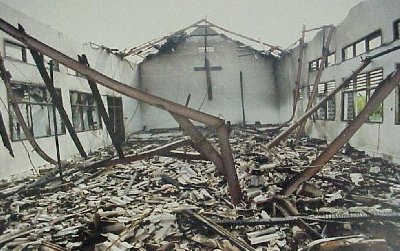
This church in Ambon is one of many that have been demolished in Indonesia in the past few years. Churches are continually being closed down or burned to prevent believers from worshipping. (BP Photo courtesy of International Christian Concern)

“The most intense religious persecution today is not governmental persecution, but rather persecution brought on by religious zealots of other religions or faiths,” he noted. “Orissa in India is one such place where some significant persecution of Christians and Muslims is occurring by extremists in the region. The same has been true fairly recently in East Timor.”

In Eastern Europe, Russia and former Soviet republics, local Orthodox Christian officials have, in recent years, incited mobs against local Protestant or Catholic groups.

While China often is portrayed as one of the world’s worst violators of religious freedom—and the State Department views it that way—Nash noted the situation there is complex.

“Many Americans assume that there is extreme religious persecution in China. In point of fact, China is growing increasingly more open when it comes to religious freedom,” he said. “China recognizes five official religions, including Protestantism, Catholicism, Islam, Buddhism and Taoism. Registered Christians and churches have full religious freedom as long as they are supportive of the nation and work toward building a harmonious society. Bibles are published in China and widely available to the public. Chinese Christian bookstores sell Christian books openly. In many places, Christian meeting places are recognized as churches as soon as they have a building and a trained pastor. Seminaries exist very openly and are working hard to train clergy.”

These homes were burned in 2004 because they were in a Christian village in Indonesia. Islamic extremists attack such villages, destroying homes and churches and kill many of the residents. Survivors are forced to convert to Islam. (BP Photo courtesy of International Christian Concern)

But religious groups by which government leaders feel threatened in China have had a more difficult time. Uighur Muslims in interior parts of China, Christians in unregistered Protestant house churches, practitioners of the Falun Gong religion and Tibetan Buddhists all have suffered severely at the hands of the Chinese regime.

Both the State Department and the Commission on International Reli-gious Freedom issue comprehensive annual reports on the status of religious freedom worldwide. Both organizations maintain lists of what they consider the world’s worst nations for religious-liberty conditions.

All experts consulted for this story agreed the proper responses to global persecution are as complex and varied as the nations and cultural situations in which incidents of persecution arise. But Americans and other Westerners have an outsized opportunity—and responsibility—to act.

“The United States can do more to proactively and forcefully advocate for improvements in countries around the world,” Thames said. “Write members of Congress and urge them to press the State Department to make religious freedom promotion a foreign policy priority. Senators and congressmen also have the ability to talk directly with heads of state, so constituents can urge their member to raise specific situations of concern.”

Nash noted the uniqueness of each situation. “Sometimes advocacy is best accomplished through huge media pressure to effect change. At other times, it is best to wait quietly for local Christians to work it out. It is important to keep up with news media around the world to be fully informed. It is also important to check in with people who know the local situation well.”

He also recommended the Baptist World Alliance and Forum 18, a Norway-based Christian news service that tracks global persecution.

For Van Gorder, Christans bear a special responsibility to speak out.

“While many North Americans are blessed with wealth and privilege beyond what many of our sisters and brothers worldwide can even imagine, the command of Scripture remains true, that ‘to whom much is given, much is expected,’” he wrote.

“Many Christians are not even doing what is expected, which is to pray and to speak for those who have no voice. One day, our sisters and brothers who have lived in contexts of dire persecution will meet their Master face to face and hear those consoling words from his mouth: ‘Well done good and faithful servant, enter into the rest prepared for you.’ Will we hear those same words?”