Grady Nutt a pacesetter for Christian comedy

LOUISVILLE, Ky. (ABP)—Singer-songwriter Don McLean’s 1970s hit record “American Pie” mourned the 1959 plane crash that killed rock-and-roll pioneers Buddy Holly, Ritchie Valens and the Big Bopper as “the day the music died.” For a generation of humor-loving Baptists, Nov. 23, 1982, marked a similar loss.

Grady Nutt

Grady Nutt, a Baptist minister who attained national fame as the “Prime Minister of Humor” in 1979 as a regular cast member of the popular television series “Hee Haw,” was at the pinnacle of his career when he died in a plane crash after a speaking engagement in Alabama at age 48.

Nutt was a pillar of Crescent Hill Baptist Church in Louisville, Ky., then the unofficial mother church of Southern Baptist Theological Seminary, his alma mater and where he worked for a time as director of alumni affairs and assistant to the president. For many alumni who passed through there between his entry into the entertainment field in 1969 and his untimely death, Nutt was the gold standard for Christian comedy.

Speaking to 9,000 youth at a Baptist youth conference at a theme park in Hot Springs, Ark., just weeks before his death, Nutt introduced himself as an authority on young people.

“I’ve tried to be one most of my life,” he quipped.

Nutt described asking once why Methodist kids were allowed to go to dances, while Baptist kids were not. The response, he said, was that once the Methodist kids started going to dances the next step was “the bushes,” a euphemism for necking. The Baptist kids, he explained, just went straight to the bushes.

{youtube}HFxbo_aOIt0{/youtube}

On a more serious note, Nutt advised young people to love others unconditionally. “Jesus never told one person what they had to do the earn God’s love,” he said. “The healthiest thing that ever happens in a church happens when youth in a church become open to other young people.”

Nutt’s homespun storytelling style earned accolades including the Grady Nutt Humor Award presented in his honor by the Gospel Music Association, the Grady Nutt Endowment Fund at the University of Louisville and the Grady Nutt Collection of his works at Southern Seminary.

In his 1979 memoir, Nutt described his life’s journey with the joy of humor as “So, Good, So Far.”

“And I can hardly wait for the next turn in the road,” he concluded.

An unofficial reference page dedicated to Nutt is on the Internet at http://www.the-cartoonist.com/Nutt/Nutt.html.


Laughter is the best medicine … except when it’s a bitter pill to swallow

Something that strikes one person as funny—even something heard at church—may seem inappropriate to another. How can believers strike a balance as they use humor and laughter in ministry?

Individuals need to understand the human experiences that humor tries to relate, Day Lane believes. Lane is completing an integrated doctor of philosophy degree in religious studies and sociology.

When jokes in church make you cringe.

“The difficulty in one person deciding how to weed the proper from the improper is that people experience and interpret humor from different vantage points. Humor that is hilariously funny to Aunt Sally is horribly offensive to Uncle Ben,” Lane said.

That particularly applies to religious humor—hilarious to some and almost blasphemous to others.

While serving as a pastor and director of missions, cartoonist Joe McKeever has seen “Christian” humor hurt others.

“At a state convention, a speaker told an awful joke on his daughter who was ‘dumb, dumb, dumb. She is so dumb that… .’ At the end of a joke that fell flat, he said, ‘I’m just teasing,’” McKeever said.

“I found myself hurting for that pastor. He did a truly foolish thing in making his daughter the butt of his humor, and then to top it off, did a lousy job of telling the joke. Where I was sitting, everyone around me wanted to crawl under the pew, it was so embarrassing.”

How can Christians use humor, even with the possibility of being misunderstood? Follow Jesus’ example, Christian humorists recommend.

“Personally, my basic standard as a comedian is this: I am a Christian first and a comic second,” noted Chonda Pierce, a comedian for about 15 years and current president of the Christian Comedy Association. “When I put my relationship with God in the right priority, then he will convict, convince and convey to me what is improper or not.

“We are carnal creatures, navigating through a fallen world. … If we were perfectly honest, most comics would have to admit that they have used jokes, premises, punch lines and stories that came from a place of sarcasm in an effort to get back at (someone) or to express pain.”

Lane, who has taught sociology of religion courses at Central Baptist Theological Seminary, believes humor should reflect the same concerns Jesus addressed. Christians should ask themselves: Is the humor healing? Is the humor loving? Is the humor performed at the expense of vulnerable people?

“These questions are not easily answered, because in cases where humor is performed as a social critique, the humor might not appear to be loving or considerate of others,” Lane explained. “But this was part of Jesus’ concern, too, not to intentionally hurt people but to, on several occasions, articulate a scathing critique of social structures that harm the masses and benefit a select few.”

Sometimes substituting a group with which the believer associates puts the comedic intent into perspective.

“When I was a young girl … I recited a collection of Polish jokes I had heard during recess at school,” Lane related.

Her father listened politely, laughing at the appropriate places. Then, she recalled, he gently explained: “When we poke fun at people who have a different label than we do, say Polish as opposed to American, we are really poking fun at qualities we all share as humans. So, if we are going to make fun of a whole group of people, how about we make fun of a group we belong to?”

“He paused for a moment, then with a sparkle in his eye, he said, ‘I know! Let’s tell Baptist jokes!’ From that point on, most ethnic and religious jokes told around the dinner table converted easily to Baptist jokes—except for those jokes including a rabbi, a priest and a Baptist preacher.”


Grieving comic says humor, like hope, springs eternal

SHREVEPORT, La. (ABP)—Jinny Henson, a native of Houston, began doing stand-up comedy when she was a student at Baylor University. While working on a master’s degree at Southwestern Baptist Theological Seminary, she began touring nationwide.

Jinny Henson entertains at Gateway Church in South Lake.

Against the advice of friends, she took a six-year hiatus after the birth of her daughter, Maggie Lee, and son, Jack, two years later. In hindsight, she says she is glad she took the time off to be a full-time mom until her children entered kindergarten.

After a local event in November, she’s heading back to the comedy circuit with a major event April 24 in Pearland, and an August date in Monroe, La., for the first time since Maggie Lee’s death at age 12 from injuries received in a tragic church bus accident last summer.

“I am feeling more like myself than I have in a while,” she said. “In the very early stages, when someone would talk about Maggie Lee and then, in the same breath, mention my being a stand-up comic, I would think, ‘Now, isn’t that ironic, a grieving comedian?’ Being humorous was my last priority.

“Interestingly enough, I have found that humor, as well as hope, springs eternal. I have always felt God’s presence and encouragement through humor in my life and I have never needed that more than I have in the past seven-and-one-half months.

“It is refreshing to make people laugh again, even just out to lunch with my friends. It’s a relief to feel any part of my personality is still intact, like my soul is defrosting.”

In the past, her routine included thoughts about how a sense of humor sustained her after losing her mother-in-law and father within a short period of time. Losing a child, she said, confirmed that message at a deeper level.

“For years, I would get notes from someone who saw one of my shows that said, ‘I lost a child two or three years ago, and this is the first time I have laughed since then,’“ she said. “At the time, it was always profoundly moving, but now that I am on the other side, those words are much more meaningful to me.”

She and her husband, John, associate pastor of emerging ministries at First Baptist Church of Shreveport, La., were watching a comic recently, and she recalled their “cathartic belly-laughs.”

{youtube}qR2BQV70Sug{/youtube}

“It hit me then what an amazing gift comedy can be to someone with a broken heart. It’s like this little vacation from the trenches, a lifting of your soul above your circumstances. Being on the audience end of things makes me want to be even better at my craft,” she said.

In addition to her comedy, Jinny does religious retreats including new topics titled “God’s Amazing Grace” and “Devastating Blessing” born of her recent experiences.

“Amazing is an overused word, but I am astounded beyond description that God is carrying my family through this heartache,” she said. “It’s by his grace that we are viewing this as a bad chapter in a good book and not our final chapter. Maggie Lee gave me so much more than just good material.”

“It is true that life at times can be brutally painful, but my pain has been lightened by God’s gift of humor, and I want to encourage others using that gift.”


A Time to Laugh

“For every thing there is a season, and a time for every purpose under heaven … a time to weep and a time to laugh,” according to the Old Testament book of Ecclesiastes.

What is the role of laughter and humor for Christians? When should believers take time to laugh?

Humor takes several forms—from stand-up comics to cartoons to clowns to storytelling. Many Christians who practice some form of humor believe God granted them the opportunity to use it to enhance believers’ lives and to draw other people to Christ.

“God makes his people happy, and happy people love to laugh,” cartoonist Joe McKeever said, pointing to Psalm 4:7. “Laughter is a tension-reliever, an anger neutralizer, the best icebreaker and one of the sweetest sounds on the planet.”

“Humor is a godsend that we as human beings need to give one another,” said Joel Goodman, founder and director of the Humor Project, a Sarasota Springs, N.Y., organization that offers humor resources, training and life coaching.

Laughter and humor cause physical changes that enhance people’s lives, which can help defuse tension.

“Laughter relaxes the whole body, carries more oxygen to cells and tissues and increases cardiac output,” explained Day Lane, a registered nurse in Kansas City, Mo., who is completing a doctor of philosophy degree in religious studies and sociology and has taught at Central Baptist Theological Seminary.

“So, you can imagine with an atmosphere relaxed by a little humor and more blood flowing in everyone’s brain, the possibility for creative solutions to tough problems opens up.”

Motivational speaker Steve Kissell of Norfolk, Va., uses humor as a natural part of all types of speaking engagements, including to government entities, education and industry. Humor can be a “gentle reminder” to make sure his listeners do not forget God as they work, he said.

Sharing the gospel

A comedian for almost 15 years, Chonda Pierce currently serves as president of the Christian Comedy Association. She sees comedy as an effective means of reaching out to people.

“The greatest tool comedy has been for me is the way that it opens an audience up to receive—no matter if the motivation for a particular event is soul-winning, information or just clean entertainment,” she said. “I have seen comedy allow an audience to bond and to sit up and take note of a truth that was on my heart to share.”

Chondra Pierce

Junior the Clown—a.k.a. Tony Jones of Mansfield, Ga.—loves to make people laugh while presenting the gospel. He sees clowning as a way to reach people who might not attend traditional worship services.

“There has been more than one instance that an individual has heard something we have presented that they had not gotten before,” he said. “I believe that there are a lot of ways to preach the gospel and that different people hear different things, depending on how it is presented.”

Meeting life needs

Whether used as a sermon illustration or a remark that just pops out in response to stress, humor and laughter can help individuals deal with problems.

As director of missions in New Orleans when Hurricane Katrina hit, McKeever saw firsthand the balm humor could be. McKeever and up to 100 pastors met weekly as the city and its people dealt with the disaster and began to recover.

“Each person in the room was invited to address the others,” he explained. “When one had a funny story to tell, we welcomed it like the baked summer ground thirsts for water. Nothing was more welcome than a good laugh.”

Lane sees humor surface frequently in hospitals. “Sometimes the humor comes through people, especially children, to lighten some of the difficulties we bear,” she related.

Christian humor“For example, while working in the intensive care unit at a local hospital, my friend, Joan, took care of a middle-aged woman who died despite all the high-tech attempts to save her live. The death was unexpected and the family was in a state of shock.”

As the family tried to deal with details, a 4-year-old granddaughter, who had never been to a hospital, repeatedly asked: “Where’s Grandma? Where’s Grandma?”

Although family members reassured her several times that her grandmother had gone to heaven, the child continued to ask.

“Much to Joan’s dismay, the family … came into the room before Joan had a chance to remove the tangle of tubes, IV bags and machinery. … The little girl was dumbfounded. She looked, wide-eyed, at the room, the oxygen, the ventilator, the EKG machine and countless other items she had never seen before. She peered up at her mom and exclaimed incredulously, ‘This is heaven?’

“It was a profoundly therapeutic moment for both the family and the nurses.”

Humorous stories become teachable moments, as well. McKeever uses them whenever possible.

“Years ago, when brides and grooms sometimes wrote their own vows, a couple said to me, ‘We don’t want to say, ’Til death do we part,’” the former director of missions said.

“When I asked why, they said: ‘So many people say it and don’t mean it and end up getting divorced. We want to be honest.’

“I said, ‘What do you want to say?’ They said, ‘We want to say, So long as love shall last.’ I said, ‘Well, that’ll be about Tuesday.’”

Injecting humor allowed him to minister to that couple and to several couples since then.

“Some of the most creative leaders in church communities are brilliant humorists,” Lane added.

“Humor is effectively used to lessen tensions between parties in church disputes, troubled marriages and, heaven forbid, committee members.”

Use laughter and listen for the humor in others, Lane suggested. Then, watch God use those stories to minister.


Faith Digest

Who is responsible for tackling poverty? A phone survey of 1,002 adults revealed 66 percent of Americans believe the United States has an obligation to assist poverty-stricken children around the world. The survey asked respondents whose responsibility it is to provide aid to children in developing nations. Almost three in 10 (29 percent) said international nonprofit organizations should offer relief, followed by the governments where the children live (25 percent) and developed nations such as the United States (19 percent). Faith-based organizations came in last, with only 16 percent of Americans holding them responsible for tackling childhood poverty. The survey had a margin of error of plus or minus 3.1 percentage points.

Religious freedom violations reported. The State Department has issued its annual human rights report on 194 countries, calling 2009 “a year in which ethnic, racial and religious tensions led to violent conflicts and serious human rights violations.” The State Department said “no genuine freedom of religion” exists in North Korea, and Cuban law permits punishment of any unauthorized assembly of more than three people—including religious services in private homes. In Iraq, despite the government’s public calls for tolerance, attacks on places of worship by extremist and insurgent groups limited their ability to practice their faith. In China, repression of Tibetan Buddhists and Muslim Uighurs increased, the report said. Non-Muslims are prohibited from expressing their religion publicly in Saudi Arabia.

Conservative activist resigns. Donald Wildmon, founder and chairman of the Mississippi-based American Family Association, has resigned after months of failing health. “A bite from a mosquito carrying the St. Louis encephalitis virus caused Wildmon’s illness,” the ministry said. “From August to November of last year, Wildmon spent 121 days in the hospital and rehab.” Wildmon, 72, also was treated for cancer on his left eye. The retired United Methodist minister started the ministry in 1977. It operates 180 radio stations and a monthly magazine, and now employs 175 people with a $20 million budget. The AFA said Wildmon’s son, Tim, 47, is expected to lead the ministry. AFA has been active in boycotting organizations and companies that embrace policies counter to its conservative Christian views.

Grads take dim view of commandments. College graduates are more likely to consider the Ten Commandments irrelevant and reject the Bible as the word of God than people with no college degree, according to a recent study. A distinct shift occurs after college regarding beliefs and opinion, said Richard Brake, director of university studies at the Intercollegiate Studies Institute. The ISI surveyed 2,508 Americans on questions intended to measure the impact of a college degree on people’s beliefs. The study also found that people with college degrees were more likely to support same-sex marriage, as well as abortion available at any stage of pregnancy and for any reason. The study has an overall margin of error of plus or minus 2 percentage points.


Fewer than half of Americans link Easter to Resurrection

WASHINGTON (RNS)—While most Americans describe Easter as a religious holiday, fewer than half of the adults surveyed link it specifically to the Resurrection of Jesus, a Barna Group study shows.

Fewer than half of adults surveyed associate the empty tomb with Easter.

Seven in 10 respondents mentioned religion or spirituality in their response to an open-ended question about how they describe what Easter means to them personally. But just 42 percent tied Easter to the Resurrection.

At 73 percent, baby boomers—ages 45 to 63—were the most likely to describe Easter as a religious holiday, compared to two-thirds of those ages 26 to 44 and Americans 64 and older.

The youngest group of adults—ages 18 to 25—were least likely, at 58 percent, to use that kind of description.

Other than the day Christians believe Jesus rose from the dead, respondents described Easter as “a Christian holiday, a celebration of God or Jesus, a celebration of Passover, a holy day” or a special day to go to church, Barna researchers said.

“The Easter holiday in particular still has a distinctly religious connection for people, but … the specifics of it are really fading in a lot of people’s minds,” said David Kinnaman, president of the Barna Group, based in Ventura, Calif.

The findings are from phone interviews of a random sample of 1,005 U.S. adults conducted Feb. 7-10 and had a margin of error of plus or minus 3.2 percentage points.


Dove Award nominees keep spotlight on Christ

NASHVILLE, Tenn.—The Dove Awards may be the biggest night of the year for the Gospel Music Association, but through testimonies and songs of praise, the spotlight remains shining brightly on Christ.

Musicians and recording industry representatives who gathered for a press conference—and a time of prayer and devotion—before the nominees were announced for the 41st Annual Gospel Music Association’s Dove Awards included (left to right) Ed Leonard, chairman of the board of the Gospel Music Association and president of Daywind Music Group; Wes Bulla, dean of the Mike Curb College of Entertainment and Music Business at Belmont University; Ben Tankard, gospel/jazz artist and multiple Dove Award nominee; Francesca Battistelli, Dove Award nominee; Michael W. Smith, 44-time Dove Award winner; Brandon Heath, 2009 Dove Award-winning male vocalist of the year; Kari Jobe, Dove Award nominee; Jeremy Camp, two-time male vocalist of the year; Lisa Kimmey-Winans, member of the group Out of Eden and Gospel Music Channel host; and Jason Crabb, 10-time Dove Award winner.

Before the nominations were announced for the 41st annual Dove Awards, many Christian musicians and industry leaders gathered together for a time of prayer and devotion led by Pete Wilson, senior pastor of Cross Point Church in Nashville and author of Plan B—What Do You Do When God Doesn’t Show Up The Way You Thought He Would?

“The more God expands your ministry and influence, the more you have to give up control and completely surrender to him,” Wilson said.

“Your primary responsibility in life is to be living for his glory. It may seem like the tasks will always require more than you have to offer, but remember, what Christ begins in you, he will complete. As you’re writing these songs of hope and sharing messages of grace and redemption, you’re being used as a vessel for Christ to accomplish incredible things for his glory.”

Multiple Dove Award winner Michael W. Smith agreed.

“It’s wonderful to hear great songs, but when people’s hearts are really in the right place and focusing on Christ, that’s what will change the world,” he said. “When an artist takes the focus off of himself and shines the spotlight on Christ, that’s what makes me proud to be a part of this industry.

“We’re here to celebrate music and to celebrate Jesus, the one who really is the famous one. It’s not about us. As we recognize these artists who have made a significant impact, it’s really recognizing a heart that loves Jesus and is focused on leading people to him.”

Natalie Grant

Bart Millard

In addition to Smith, other recording artists including Brandon Heath, Kari Jobe, Francesca Battistelli, Jason Crabb and Jeremy Camp attended the devotional time and press conference at Belmont University’s Curb Café in Nashville, Tenn., where this year’s Dove Award nominees were announced.

Jaci Velasquez made a special appearance to assist Camp in announcing the nominees for the Spanish language album of the year.

“I’m always honored and so excited to be a part of anything that the Gospel Music Association does,” Velasquez said. 

“It’s an incredible industry. We get to be a part of music that changes people’s lives. For me, watching all the artists is such a great experience and my hat goes off to each and every one of them. They’re all doing amazing things and creating music that is intended to lead people to a deeper love for God and promoting the kingdom.”

Camp agreed.

“It’s such a joy to be here with all my peers—amazing musicians who love Jesus,” he said. “And that’s the whole purpose why we’re here—to get the gospel out. To be nominated is such an honor, but above all, just to see everyone joined together and saying, ‘I just want to be here to glorify God,’ that’s what brings me the most joy.”

The Dove Awards will be held April 21 at the Grand Ole Opry in Nashville and aired on the Gospel Music Channel. The evening will feature artists from every style of gospel/Christian music coming together for a night of music and celebration.

For a complete list of nominees, visit www.gos-pelmusic.org. 

Natalie Grant, four-time Dove Award winning female vocalist of the year, and Bart Millard, lead singer of the Texas-based band MercyMe, will serve as hosts for the awards show.


Most church websites ineffective, but technology can yield blessings

DIDCOT, England (ABP)—Churches, by and large, still haven’t entered the digital age when it comes to evangelism. But those who have are reaping huge rewards, according to a new survey.

A poll conducted by Christian technology company Endis, which provides the ChurchInsight church web platform and has offices in the United States and the United Kingdom, indicates that when churches deliberately focus their websites on attracting outsiders, they see a corresponding rise in the number of non-Christian visitors.

But many focus on the internal life of the church, and their effectiveness is reduced.


Endis polled 1,600 churches for its DigiMission project, asking questions about church size, the website’s target readership, the number of Christians and non-Christians coming to events, and the influence of the website on their decision to attend.

The 120 churches that responded reported more than 1,300 non-Christian visitors in the last 12 months to church events, services and discipleship courses through the Internet—an average of 11 non-Christian visitors per church. For Christian visitors, the figure is 1,600, an average of 14.

Among the survey’s key findings were that most churches’ websites were not created with the unchurched in mind. Only half offer an outline of the gospel, and only a quarter provide testimonies of people who have come to faith in Christ.

Endis spokesman Geoff Knott said there were clear differences in the effectiveness of different websites.

“When we looked at the successful sites, we found that they had the gospel on their site, and that people were able to book into events,” he said.

“Interactivity is important, but we didn’t find that blogs or forums did much. The other thing that was very successful was stories.”

It was also noticeable that larger churches were less effective than smaller ones at attracting unchurched people.

“Smaller churches of between 100 and 150 are very good at getting guests in. I think they push harder, using Google Adwords for instance. They’re trying to grow. Are we losing our mission edge as we grow bigger?”

He stressed that good content and ease of use were far more important than a sophisticated image or a multiplicity of functions.

Tips for church websites from DigiMission:

• Identify your audience. Most church websites are designed for the reached, not the unreached.

• Try to be more interactive. Letting visitors sign up for events gives them an immediate opportunity to get engaged with you.

• The Internet is just part of your mission effort. Multiple contacts, by different means, increase chances of success. There’s no substitute for personal contact.

• Be serious about the Internet. It’s the new printing press, and hundreds of millions of people use it every day.

• Think about what image you’re communicating. What does your site say about your church?

• Put the gospel on your website. How would you explain the gospel simply to someone who never heard it before?

Mark Woods is editor of The Baptist Times, the weekly newspaper of the Baptist Union of Great Britain.


Secular Jew writes about two years spent undercover in Falwell’s church

LYNCHBURG, Va. (RNS)—Evangelical Christians were a mystery to Gina Welch. All she really knew about conservative evangelicals was that they were trying to change the country in ways she didn’t like.

When she found herself living among them when she moved to Virginia for graduate school in 2002, the more she learned about them, the less she understood.

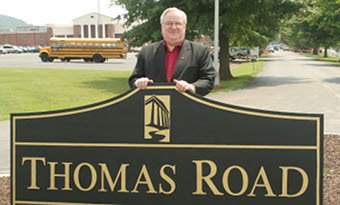
Gina Welch, brought up in a secular Jewish family, went undercover to learn about conservative evangelicals—even to the point of being baptized at Thomas Road Baptist Church in Lynchburg, Va., where Jerry Falwell was pastor. (RNS PHOTO/Courtesy of Thomas Road Baptist Church)

So, she decided to undertake an audacious experiment in the fall of 2005. She would go undercover and pretend to be one of them. And she would do it in—of all places—Jerry Falwell’s church in Lynchburg, Va.

What she found was a world more complex than she anticipated, and deeper friendships than she imagined possible. Eventually, her deception became so troubling to her that she vowed never to lie to anyone again.

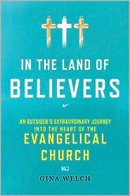
Welch describes her nearly two-year experience at Falwell’s Thomas Road Baptist Church in her new book, In the Land of Believers.

Welch, who was raised in a secular Jewish family in California, didn’t become a Christian, didn’t change her politics and remains troubled by significant aspects of the conservative evangelical community.

Yet she discovered that she likes some of these people, treasures the sense of belonging that church provides, gets a powerful feeling of connectedness from communal singing, and experiences a strong desire to believe in God.

“I think I am fundamentally lacking in whatever chamber of the brain allows for religious belief,” Welch said. “I had a number of experiences when attending church that I had a hard time explaining. I would recognize that it was something new and something emotional and something that was rattling my sense of self.

Gina Welch

“I would try to interpret my feelings and try to see if it had anything to do with religion, with the Bible or with a God watching over everything. But I could never make those concepts align.”

Welch kept her beliefs secret during her time at Thomas Road. Falwell died, in 2007, when she attended. In fact, she even was baptized to cement this deception. While Welch concedes now that her lying was and is impossible to justify ethically, it nonetheless gave her a kind of access to that world that she most likely wouldn’t have had otherwise.

One of the things she found troubling was what she calls “intellectual passivity.” The people she met were generally “uncritical of the institutions they subscribe to,” she said. “They toe the party line. They accept the mythology about gay people, about the environment, about the outside world without testing its truthfulness.”

She was most troubled by the church’s practice of trying to convert children into believers, she said.

“The way I saw evangelicals packaging the gospel message in a way children could understand was that there was a disturbing emphasis on hell. The default position is to frighten them into compliance. … That really bothered me.”

Yet she chose to go on a mission trip to Alaska to save souls—a trip that left her with a disturbing memory of proselytizing a child so she wouldn’t blow her cover.

Welch also was bothered by what she saw as the church’s emphasis on spreading the gospel over serving human needs. “What about poverty? What about discrimination? What about human-rights abuses?” she writes. “Where was the Christian outrage at so much heinousness in the world?”

Still, she tried to understand the motivation of the church members, and eventually did.

“When I thought about it,” she writes. “I wasn’t sure I would act any differently if I believed what they did, that non-Christians are going to suffer eternally in hell.”

When the time came for Welch to leave the church, she wasn’t thrilled about it. It meant no more music, no more “group therapy in the guise of a sermon,” no more community and faces that were happy to see her. “It meant leaving my church friends,” she writes, “probably forever.”

Leaving Thomas Road church also meant Welch had to confront “all of the ethically dubious stuff” she’d done.

“I had proselytized to a little girl, helped lock her into something I didn’t believe in. I had been saved and baptized without believing. I had prayed and been prayed for. … I had cultivated intimate friendships … on a foundation of lies. That was what I felt worst about—deceiving people I couldn’t help but consider true friends.”

She couldn’t eat. She had trouble sleeping. And when she did sleep, she had terrible nightmares. So why wasn’t she more concerned about the ethical issues when she started out on this project?

“I think it was because I was naive about the real possibility of developing relationships with anybody,” she said. “I think I thought church relationships would be like workplace relationships. I didn’t think anybody would feel emotionally connected with me or that I would feel emotionally connected with them.”

But there was another reason, too—that the end would somehow justify the means. “I think my curiosity outran my scruples,” she said.

Given the chance to do it over again, she now says she would not use the same kind of deception.

“I can’t imagine lying to anybody ever again,” she said. “It feels like something that is so toxic that I can’t imagine doing it again. But it’s hard to say I would undo what I did. I feel like what came out of it is something of value. It holds the possibility of a more authentic understanding of evangelicals. It’s something that could potentially humanize a population that people who share my background have thought of as this mob of clones.”

–Margaret DeRitter writes for The Kalamazoo Gazette in Kalamazoo, Mich.


After condemning greed, what should Christians do about the economy?

NEW YORK (RNS)—Ever since the Great Recession began in the fall of 2008, Christians and other faith leaders have criticized the speculative excess and greed that led to the crisis.

A consensus on what to do about it, however, has yet to emerge.

The parameters of the critique were recently staked out at the Trinity Institute’s “Building an Ethical Economy” conference, at Trinity Episcopal Church in the heart of Wall Street. Archbishop of Canterbury Rowan Williams bemoaned the damage that results from “an economic climate in which everything reduces to the search for maximized profit and unlimited material growth.”

Williams focused less on short-term action and more on how communities of faith need to examine language and self-image in order to contribute to building an ethical economy over the long term.

There has been no shortage of suggested solutions. Last July, Pope Benedict XVI proposed a macro solution to the financial crisis, calling for a new world financial order that would reform the United Nations and other international institutions in order to give poorer countries more of a role in international policy.

Others say change has to come about at the level of individuals. Jim Wallis, president and CEO of Sojourners, a Washington-based Christian social justice group, insists the necessary questions in the wake of failed banks and 10-percent unemployment are not “When will this economic crisis end?” but rather “How will it change us?”

In a new book, Rediscovering Values: On Wall Street, Main Street and Your Street, Wallis calls for a “new normal” of biblical values that include broad themes like “Enough is enough” and “We’re in it together.”

“We know that something has gone wrong when Donald Trump (and) the TV reality show The Apprentice is offered as a cultural role model for a new generation of business leaders,” Wallis writes.

Wallis criticizes outrageous executive bonuses and calls for more regulation of the banking industry, but he includes “20 moral exercises” that individuals can take to reset their personal compasses.

More direct, targeted action was the focus of the PICO National Network, a grassroots advocacy groups that represents more than 1,000 congregations. Leaders have met with Bank of America officials in California to demand that the bank slow foreclosures and modify mortgages for struggling homeowners.

PICO didn’t just talk. One pastor said his church had closed its Bank of America accounts in protest, and others were urged to move funds.

Taking action against economic injustice is a concept solidly rooted in the Bible, noted Peter Laarman, executive director of Los Angeles-based Progressive Christians Uniting.

“The teachings of the Hebrew Scripture are clear about usury” lending money at high interest rates, he said. In the New Testament, the story of Jesus chasing the moneylenders out of the temple—a system that preyed on the poor—is told across all four gospels.

In Massachusetts, the Greater Boston Interfaith Organization recently launched a campaign to pressure credit card issuers to lower rates that can soar as high as 30 percent. The group includes 50 faith-based and community organizations.

Laarman believes focusing on personal morality is fine, but that doesn’t get at the root causes of an immoral system.

“People should be invited to sober up and to live within their means, but let’s look more deeply at the system. We need to curb the unbelievably malign influence of concentrated money in our political system,” he said, noting that the Supreme Court recently loosened restrictions on corporate political spending.

A problem that took years to develop will take years to dismantle, Laarman insisted, but he points to an example from three decades ago in which faith groups served as the conscience, and the foot soldiers, of a movement—South African apartheid.

“There’s no question apartheid was brought to its knees, but this won’t be as easy. It’s not immediately apparent to everyone that this concentration of power is a cancer. We need to find the moral center of this.”

The economic meltdown, he said, is “fraught with core issues for people of faith,” but what’s needed now is a unified response.


Social networking and Christian community

A student’s Facebook entry chronicles the painful details of a romantic break-up. Or describes an ill-spent weekend partying with friends. Or scathingly blisters someone who holds differing political views.


Fast-forward a few years. That same student sits in a job interview—or maybe at a conference table with a church staff search committee—and has to answer uncomfortable questions about those entries.

Welcome to the world of social media. Post the gory details of your life on an electronic wall, and it never goes away.

But by the same token, consider a social networking page set up to encourage people to do one act of kindness on a given day, established in memory of a girl who would have turned 13 that day if she hadn’t died in a bus crash on her way to youth camp.

That site—“Maggie Lee … For Good”—drew more than 12,500 members, honoring the memory of Maggie Lee Henson from First Baptist Church in Shreveport, La., and sparking thousands of good deeds.

Recognizing the power of communication

“Too often, people fail to recognize the power of words,” said Bill Tillman, the T.B. Maston Chair of Christian Ethics at Hardin-Simmons University’s Logsdon School of Theology.

Aptly chosen words effectively communicated can build group cohesion and foster cooperation, he noted.

“Social networking sites have tremendous potential for Christians as a place where community-building occurs, where community needs are shared and where meaningful networking happens,” Tillman said.

At the same time, ill-chosen words can rupture relationships and damage character, he noted. And those words can flow too easily from a computer keyboard.


The anonymity online community offers can contribute to a “sub-Christian” incivility and crudeness that develops through social media culture.

“Unless you envision the people to whom you are writing, the temptation is to say whatever comes to mind,” Tillman said.

The anonymity online community offers can contribute to a “sub-Christian” incivility and crudeness that develops through social media culture, he added.

“There are expressions that might never be used in a conversation with somebody, but online, there’s a crassness that seems to creep in,” Tillman said.

Social networking media offer “the illusion of intimacy in a context in which receivers and users of our instantaneous, often hasty, communications may be friend, foe or stranger,” said David Gushee, professor of Christian ethics at Mercer University.

“Communication in which there is such vast diversity concerning exactly who is communicating with whom and on what terms is inherently problematic.”

Gushee suggested Christian leaders “need to bring older, pre-Facebook moral standards into engagement with the brave new world of social media.”

How much information is too much?

While social media can promote authenticity and transparency, they also can feed the hunger for self-promotion, Tillman noted.

“We need to understand that there are no secrets, but there are things that should be kept close in,” he said.

“When it comes to self-disclosure, there’s a battleground. When are we supposed to extend ourselves in terms of who we are, and when does it become nothing more than an exercise in egotism and narcissism, which are sub-Christian values?”

Not everyone needs to know every detail of everyone’s life—particularly when it comes to ministers who intersect lives at some of their most vulnerable points, he noted.

Gushee stressed the importance of protecting confidential communication.

“We need to be a safe harbor for people who need someone to trust, and both we and those we minister to need to know that the words exchanged in pastoral confidence will not become public knowledge,” he said.

Proceed with caution

“Err on the side of prudence,” Tillman suggested—advice echoed by Mark Wingfield, who works with young ministers in the pastoral residency program at Wilshire Baptist Church in Dallas.

“In our work with training young pastors in practical ministry before sending them off to their first senior pastorates, we advise caution in every aspect of the minister’s online presence. What might have seemed innocuous in college or graduate school may appear in a different light to a pastor-search committee. And once something is online, it lasts forever,” said Wingfield, associate pastor at the church.

For instance, he noted one prospective candidate for a ministerial staff position who included the name of his favorite alcoholic beverage on his Facebook profile—a move that “raised some eyebrows” with a sober-mind search committee.

Furthermore, because online social networking does not allow the nuances offered by tone of voice and body language—and because some people simply fail to communicate clearly online—misunderstandings can arise easily.

“I’m aware of several cases in the last year or two where individuals have posted status updates on Facebook that seemed innocent to them but, given the lack of context available to the casual reader, caused others to put two and two together and come up with five,” Wingfield said. “When you are a children’s Sunday school teacher, youth leader, deacon or person of high profile in a church, you are considered a role model—whether you want to be or not.”

Since social media profiles and posts are accessible to readers of all ages, youth ministers and workers with students particularly should exercise discretion, he suggested.

“You may comment on some perfectly acceptable situation for adults and forget that there are younger eyes watching you as well. In the electronic age, we have to be reminded anew of the old adage to avoid even the appearance of impropriety,” Wingfield said. “Unless you are certain that everyone who reads your Facebook post will have the proper context to know what you mean, proceed with caution.”

Consider legal dangers

Social media offer valuable communication tools to churches, but congregations need to recognize legal dangers inherent in social networking, said Frank Sommerville, an attorney from Arlington. He led a Web-based seminar on Internet issues for churches sponsored by the National Association of Church Business Administration.

Participants in social media need to recognize its nature as public—not private—communication, he advised. Every posting on a social networking wall or profile page becomes a public document.

“Even if you restrict it to family and friends, it is still a public document. There are ways to get into those documents even if they are password protected on your machine,” Sommerville said.

Furthermore, he noted, users should realize once a social media document appears, it never really goes away.

“It is imperative that you think about anything that is posted, it is going to potentially live forever, it potentially could be used in an inappropriate way, it potentially could be masqueraded as being you when it is not yours (and) it potentially could be altered, and you’d have no way of knowing it,” Sommerville said.

Develop a social networking policy

Churches need to establish clear policies that stipulate terms and conditions for any employee—or volunteer acting on behalf of the church—who communicates through social media about work-related activities, he emphasized.

Any social-networking user who writes about church-related matters should be required to write under his or her own name and include a disclaimer indicating opinions expressed are those of the user and are not church-endorsed.

Sommerville recommends a social networking policy include several common-sense prohibitions:

No disparaging comments. Church staff should not use social media to attack anyone—particularly other employees, church members or vendors who do business with the church. “You may disagree with the church and its officers, provided your tone is respectful and you do not resort to personal attacks,” he said.

No confidential information. Obviously, sensitive information related to counseling should not be posted, nor should private financial information.

No copyrighted materials. Copyrighted materials may be posted if the person doing the posting owns the copyright. Otherwise, the person posting it should secure express written permission from the copyright owner. Limited use—such as a line or two from a song or a very brief quote from a book—may be permitted under “fair use” legal doctrine, but Sommerville urged caution.

“One of the hottest areas in copyright law is (the question of) when linking to other websites is legal without written permission and when is it not,” he said. Sommerville recommends securing written permission from the owner before linking to any other website.

No defamation. In addition to avoiding anything that would ridicule, defame or libel an individual, church staff also should avoid disparaging comments about other churches, he warned.

No privacy violations. Do not post photos taken in a private setting—including a worship service—without the permission of the individual who is pictured.

“You own your image,” Sommerville said. A person can be photographed in a public setting such as a street, a park or some other open venue, but a church sanctuary does not fit that definition, he asserted.

“Once you are in a private place, you have a right not to be photographed,” he said.

If a church streams its church services live on the Internet or posts any images on social media, he strongly recommends posting signs at church entries indicating people entering are subject to being videotaped or photographed.

Whether on a social networking page, a website or in e-mail attachment, Sommerville advised always securing permission from a parent or guardian before including the image of a child.

“It’s always a good idea not to put last names or addresses on your website” or social media page, he recommended.

Regarding prayer requests, rather than broadcasting specific information about an individual through a social networking page, website, e-mail or Twitter, Sommerville recommended sending out an alert noting a new request has been posted on a secure site. Registered users then can log on to a password-protected site for more specific information.

Monitor with vigilance

Ministers who are “friends” on a social networking site with church members cannot be held responsible for what those individuals post on their own pages. But they should monitor their own online spaces.

“You have no duty to monitor your friends,” Sommerville noted. Youth ministers, for example, “are only responsible for what is posted to their wall,” not others’, he added.

But since Christian leaders are responsible for what is posted on their own sites and may be judged by statements on other sites, Wingfield offers a common-sense housekeeping tip to young ministers at Wilshire—and others who don’t want to be haunted by the ghosts of their online past.

“As someone responsible for personnel management in a church, when we’re looking for staff, I often will do an Internet search on the names of our applicants to see what turns up,” he said. “An easy way for ministers and church leaders to exercise caution is to periodically do a search on their own names and see if there are any messes that need to be cleaned up.”


In Alabama, coach has more Facebook fans than God does

BIRMINGHAM, Ala. (RNS)—University of Alabama football coach Nick Saban may not be bigger than God in Alabama, but he has more fans on Facebook.

Saban edged out the Almighty to claim the top spot in a ranking of Facebook fan page membership in the state. The omnipotent one—God, not Saban—did manage to finish ahead of Starbucks and Chick-fil-A.

The Fan Page Analytics ranking is part of an independent, automated analysis of fan pages on the popular social networking site. Created by a Boulder, Colo., computer programmer, the new system ranks fan page popularity by city, state and country and shows how Facebook users connect with people around the world.

The programmer behind the analysis, Pete Warden, said the concept of “fanning,” or joining what amount to online fan clubs, is more common in sports than in faith, “so I’m not too surprised that coaches beat out God.”

But in his blog, he noted God is “almost always in the top spot” in the South, with some exceptions. Oklahomans picked the Sooners first and God third, for example, and Florida favored Starbucks over the Almighty. University of Florida coach Urban Meyer didn’t even make Florida’s list.

Stephen Jones, senior pastor at Birmingham’s Southside Baptist Church, said he was surprised to learn Saban edged out God for the top spot in Alabama. But not terribly surprised.

“If the Blessed Virgin Mary was going to appear in a field in Alabama, and Nick Saban was going to appear, who do you think would draw the most people?” he said.

The Crimson Tide faithful are certain to revel in the quirky ranking, but shouldn’t get too full of themselves, said Jones, a 1977 graduate of archrival Auburn University. God is certain to be angered by his second-place finish to Saban, and there will be consequences.

“Alabama fans should expect a bad year,” he said.