More hope, less stress for Gen Zers engaged in Scripture

PHILADELPHIA (BP)—Scripture engagement improves hope and lowers stress in Generation Z, a group that otherwise fares worse than any other generation, the American Bible Society said in its latest release from the 2024 State of the Bible.

Gen Zers largely saw their life’s plans interrupted by the COVID pandemic and are stressed and less hopeful—amid an uncertain job market exacerbated by rising living costs and likely college debt—the American Bible Society said in its third chapter of the annual report released June 13.

Range 0-10. (American Bible Society graphic via Baptist Press)

“As a group, these 18 to 27-year-olds are less connected with the church and the Bible than older generations,” said John Farquhar Plake, American Bible Society chief innovation officer and State of the Bible editor-in-chief, upon the release of the findings.

“But what about those in Gen Z who do engage with Scripture?

“Not only do they score higher on the Human Flourishing scale than other young adults who don’t read the Bible,” he said, “but they have the highest score of any generation.”

Additionally, in all generations, those who say they can forgive a person who has wronged them, whether or not that person has apologized, score higher in human flourishing and hopefulness, researchers said.

“Apparently, the ability to forgive is a key component of moving forward with one’s life in a positive way. This is an important insight, and not only for Christians,” researchers wrote.

“People are held back in their own personal progress when they can’t forgive others. They may think they’re getting back at those who hurt them, but they’re only depriving themselves of a forward-moving hope.”

Boomers fare better than other generations in all areas of human flourishing, suffer less stress and are by far more hopeful—findings researchers attributed to the group’s higher levels of Scripture engagement and practicing Christianity, and the group’s ability to thrive.

Since 2020, researchers have used Harvard University’s Human Flourishing Index to track human progress in areas defined by happiness and life satisfaction, mental and physical health, meaning and purpose in life, character and virtue, close social relationships, and financial and material stability.

State of the Bible is based on a nationally representative survey conducted for American Bible Society by NORC (previously the National Opinion Research Center) at the University of Chicago, using the AmeriSpeak panel.

Findings are based on 2,506 online interviews conducted in January 2024 with adults in all 50 states and Washington, D.C.

Additional chapters scheduled for release this year focus on philanthropy, the church in America, finding hope and healing in the Bible, dealing with disappointment, and how the Bible can impact loneliness, among other topics.

Download the third chapter here.


Faith and Gen Z: Cynthia Montalvo

Since the oldest members of Gen Z began entering adulthood in 2014, studies have shown a pessimistic generation, struggling with mental health.

Is faith the antidote? For the recent graduates of Texas Baptist colleges highlighted in this series, it seems to be.

Born between 1997 and 2012, Get Z is nearly 70 million young people strong and more diverse than preceding generations—51 percent white, 25 percent Latino, 15 percent Black, 6 percent Asian or Pacific Islander, 5 percent of 2 or more races, and 2 percent Native Alaskan or American Indian, according to the Annie E. Casey Foundation.

But a 2022 Pew Research Center study of U.S. teens ages 13 to 17 showed one area of clear homogeneity—95 percent had access to smartphones, with almost half (46 percent) reporting they were online almost constantly.

Additionally, Annie E. Casey Foundation’s Kids Count Data Center reported 1 in 4 Gen Z, or Zoomers, having spent at least some of their growing up years in poverty.

Voice of America sites the COVID-19 pandemic and its associated interruptions to typical growth opportunities as an important factor in Gen Z students feeling less confident in their ability to engage in the working world.

And, compounding the stress of stepping into adulthood now, Zoomers will make up more than 17 percent of eligible voters in the 2024 general elections, with 8.3 million having turned 18 between the November 2020 and the 2022 midterm elections.

Additionally, a December 2023 Intelligent.com survey found nearly 4 in 10 employers avoid hiring recent college grads in favor of older workers.

Key reasons cited by the hiring managers polled included unreasonable salary demands (47 percent), showing up to interviews dressed inappropriately (50 percent) and 53 percent were most put-off by the inability of Gen Z candidates to make eye contact during interviews.

With an eye on these statistics, and an ear to Gen Z, a series of articles highlighting the impact of faith in offsetting negative trends among recent graduates of Texas Baptist universities is underway, starting with Cynthia Montalvo, a 2023 graduate of Howard Payne University.

Montalvo is from Bossier City, La. She grew up in a Hispanic Baptist church from the time her father accepted Christ, when she was around eight years old. Her junior year, she moved to a different church, when her father became its pastor. Both her parents are originally from El Salvador.

College experience

Montalvo at graduation from HPU. (Courtesy Photo)

She heard about Howard Payne from a close friend who was attending HPU and invited her to come for a tour.

She had considered a couple of other schools, but after the tour, Montalvo ended up applying only to Howard Payne and its honors program, the Guy D. Newman Honors Academy.

Montalvo double majored in public policy through the academy, and biomedical science, with a pre-med route.

Her long-term plan is to go to medical school and become a surgeon. And, she always has wanted to be a medical missionary, she said.

In high school she was part of a leadership program that introduced students to a variety of careers through field visits. While she’d always been interested in medicine, meeting a doctor and a nurse through this program solidified she wanted medicine to be her future.

One course at Howard Payne for pre-med students required shadowing a doctor, to see if medicine was really the path they wanted to take, Montalvo said. She was chosen to shadow Jason Davis, a Howard Payne alum and orthopedic doctor in north Dallas.

She said Davis was very supportive of what she wanted to do. Coming off COVID-19 restrictions, their initial conversations were by Zoom.

“He kind of told us his story,” she said. “I think a lot of times pre-med students hear: ‘Oh, that person is a doctor. They’ve always been really smart. They’ve always had the best grades.’ And he kind of was not that. That wasn’t really his story,” Montalvo explained.

He was very encouraging, saying “look, if someone like me can do it, if it’s something you really want to do, you definitely can.”

He agreed to be shadowed by Montalvo.

Davis was a great teacher during the week she shadowed him, Montalvo said, taking extra time to explain the difference between what a good x-ray or a bad x-ray looks like, as well as making the environment fun with his laid-back personality.

Change of plans

When she took her MCAT, the entrance exam for medical school, her scores were lower than she was hoping. She chose to take a gap year or two to focus on improving those scores to make her application stronger. And she reached out to Davis to ask if she could shadow him again.

He agreed and suggested his scribe, who was heading to med school, might be willing to talk to her about what it’s like now, since he’d gone to med school so long ago.

Montalvo connected with the scribe, who let her know her job would be coming available when she moved on to med school in July.

Montalvo said she was thrilled at that prospect because any opportunity to stay in Texas versus returning to Louisiana was welcome.

“Also, in all that, just taking the time and asking the Lord if that’s really something he wanted me to do. Because even when I went to Howard Payne, that was kind of not really a possibility. My parents aren’t super rich, and it is quite expensive to go to … a private school, or any college.

“And so, asking the Lord for guidance. Yes, is this something you want me to do? If it is, then maybe opening the doors of possibility and opportunity is something you want me to push through,” Montalvo said.

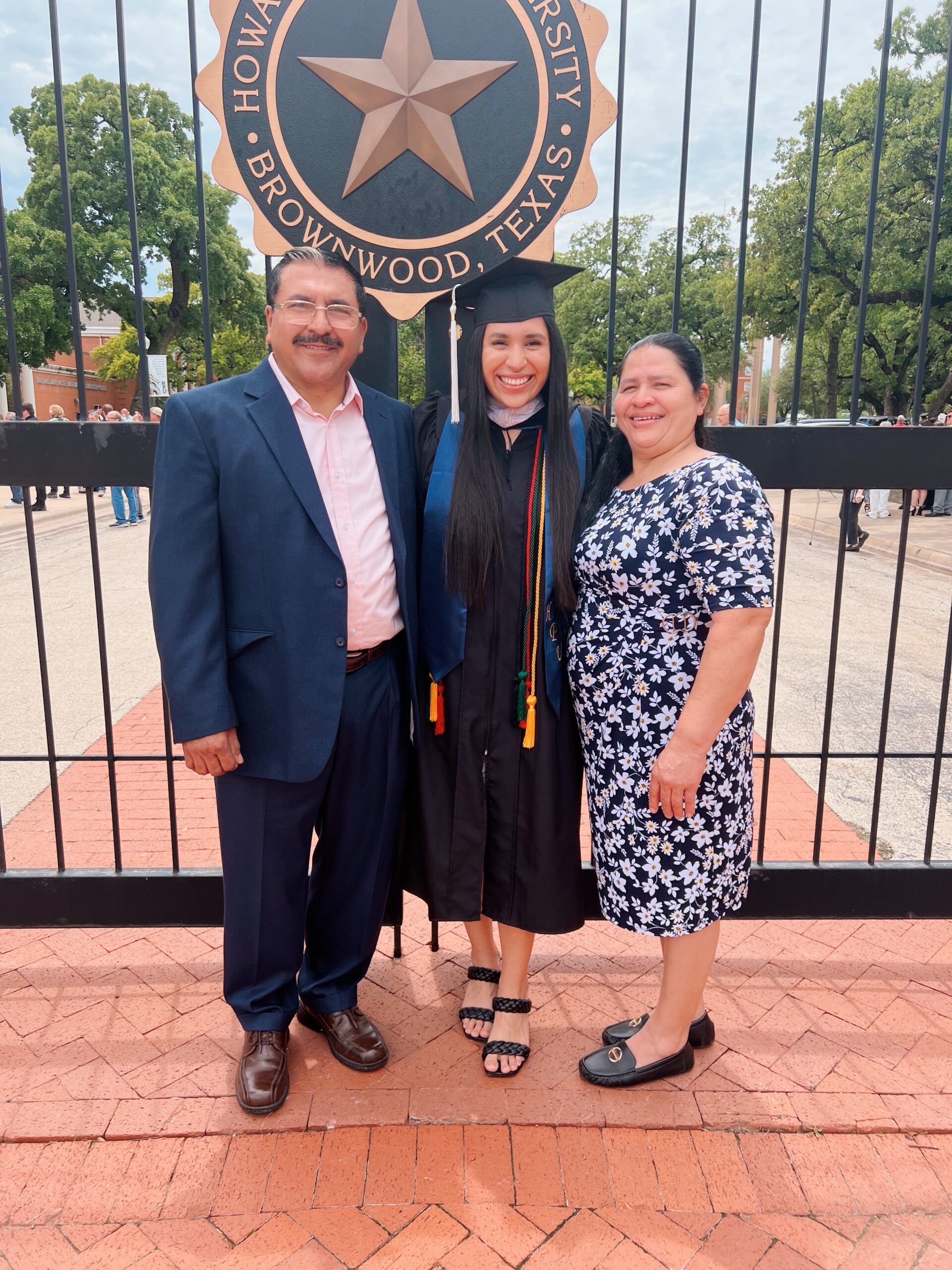
Montalvo with her parents. (Courtesy Photo)

The family friends—a pastor family—who had opened their home to Montalvo when she was shadowing Davis, enthusiastically agreed to let her live with them if she got the job.

Then, before she’d even had a chance to apply for the position, she heard from Davis, saying he’d heard about the scribe essentially offering Montalvo the job and thought it was a great idea. She eventually went through the application, interview and hiring process, and everything came together.

Montalvo explained God had used her time at Howard Payne to work in her spiritual life. Before college, she’d been sheltered so much, her faith had not been tested. In college, she began to struggle.

But, her faith in the Lord and dependence on him was strengthened through the ministry of her college pastor, Billy Cash, at Coggin Avenue Baptist Church. He assured her the faith she was feeling uncertain about was real and reliable. He helped her to know: “I have a personal relationship with God. It’s not just that my dad is a pastor.”

Faith in hard times pays off

She said at times she’d really struggled with difficult circumstances her family had faced and why they were having to go through them, but her dependence on God was strengthened in those struggles.

Cash taught her “sometimes you just need to ask for strength and depend on the Lord to take you through it, and he will. And he will guide you and he will give you strength to endure.

“And then when you come out on the other side, you’ve learned so much, your character has been strengthened. You’re a little bit more patient. You’re a little bit more kind, because you understand what it’s like to go through something like that.”

Montalvo said her faith has continued to grow this year as she’s been responsible for making it on her own. She’s continuing to learn to trust God and be obedient to his leading.

Her dad, initially, was unsupportive of her remaining in Texas. He has since come around, but she struggled when there was tension between them. Knowing that she’d asked the Lord, and he’d led her to take this job relieved a lot of anxiety.

At times, she’s found it difficult to tithe, even though she was raised to know its importance, because money is tight. But she has been obedient in that and several times God has provided for her financially when she’d least expected it, when she’d needed it most, she said.

She’s seen the Lord’s hand this year, noting: “When you walk in obedience there is so much in your favor. And your love for the Lord grows more when you follow him out of love.”

Montalvo said she is committed to pursuing med school in the future. In the meantime, she is active in Elim Church in Dallas and trusting in the Lord for continued guidance.


Historic all-sign-language ‘Jesus’ movie hits theaters

WASHINGTON (RNS)—Joseph Josselyn remembers being fascinated by the 1977 drama Jesus of Nazareth. But as a Deaf child, he had to rely on closed captions to catch the dialogue.

“I had this thought: I wonder what it would be like if this film was completely in sign language,” Josselyn said in a recent interview over Zoom facilitated by an American Sign Language interpreter.

His career since arguably could be described as a journey to finding out. On June 20, a movie telling the story of Jesus entirely in American Sign Language will become the first all-ASL feature film to debut in theaters, according to Josselyn, the film’s producer.

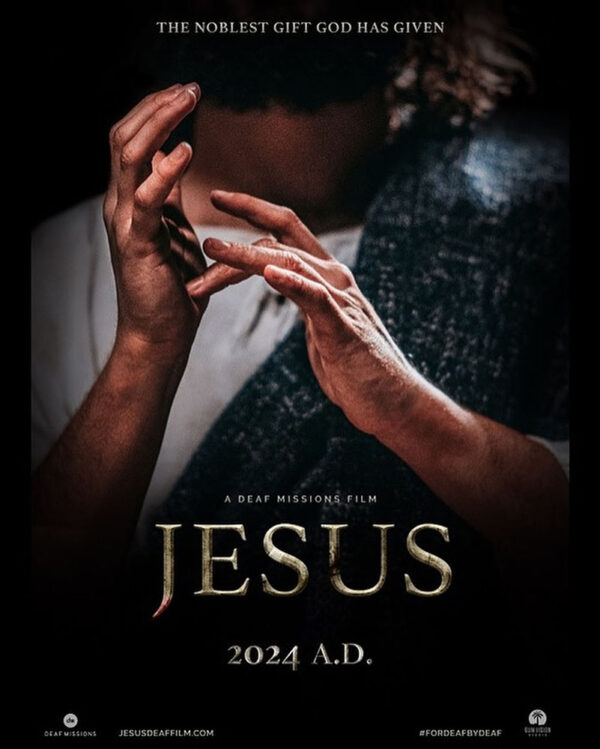
Jesus: A Deaf Missions Film, which carries the tagline “for Deaf, by Deaf,” stars Gideon Firl as the Messiah who, like all of the primary cast, signs his way through the role.

Deaf Missions is an international Christian ministry that serves people in more than 100 countries, with the goal of creating high-quality videos and visual tools in sign language.

Josselyn, who joined in 2006, began with shorter projects before producing the 2018 film The Book of Job, an earlier all-ASL movie with an all-Deaf cast and production team released on video and streaming.

A dream

Joseph Josselyn, left, and Michael Davis. (Photos courtesy of Deaf Missions)

After the Job project, Josselyn returned to his dream of telling the gospel story in an ASL feature. That dream was shared by producer Michael Davis, who joined on in 2022.

Together, the duo pitched the idea to Deaf Missions CEO Chad Entinger, estimating the project would require $4.8 million to fund.

“Our passion was really to see high-quality, Deaf film to be produced. We couldn’t do that with a low budget,” said Josselyn.

The funds secured, Josselyn and Davis had to decide how to frame their adaptation.

Perhaps appropriately for a film about breaking language barriers, they chose to bookend the narrative with Pentecost, a moment described in Acts when the Holy Spirit descends on the disciples so their preaching can be understood by a crowd that speaks many languages.

Peter, whose Pentecost testimony leads to thousands being baptized, serves as the supporting lead in “Jesus,” as he does in the Gospels.

While the plot’s points are familiar to even casual Christians, the film’s use of ASL makes for particularly embodied expression. Every townsperson, priest, Christ follower and zealot is filmed in full view, so their signing remains visible.

“Even hearing people who don’t know sign language will be able to connect, not just through the subtitles, but how expressive it is,” Davis said.

“You listen to a lot with your eyes as well.”

The filming required some adaptations on set. Ryan Schlecht, who portrays Caiaphas in the film, said because he and the other actors couldn’t hear “cut,” Josselyn and the assistant director would throw objects like hats and pillows into the scene to signal when to stop.

The reality

The team also often was communicating primarily through text, rather than via walkie-talkie as on many sets. Though partly filmed in California and Iowa, some of the movie was shot in Bulgaria, and wherever they were they were often in remote locations with poor internet and cell service.

Gideon Firl, center, portrays ‘Jesus in Jesus: A Deaf Missions Film.’ (Photo courtesy of Deaf Missions)

Other scenes in ASL elicited rare questions, such as: How does Jesus sign during his crucifixion?

The cast and crew supernaturally, according to Schlecht, found every solution. “It’s been such a huge blessing to see how God has provided every step of the way, from the cast, from the crew, from the team, from behind the scenes,” he said.

“Trying to get to the finish line was a challenge, but it was a journey of faith that carried us to the end.”

Not all of those working on the film were Christian, though immersion in the drama of the Gospels led at least one cast member to embrace Christianity, Josselyn said. For the Christians on the project, the impact was often profound.

Originally envisioned as a film without sound, the final version of the film includes a soundtrack created by two music producers—one Deaf, the other hearing—as well as background noises and sound effects to create a more immersive experience.

Deaf viewers will be able to hear the music through the vibrations, said Josselyn, and some Deaf audience members can hear some sounds too, Davis added. For nonsigning viewers, there are English subtitles.

Poster for ‘Jesus: A Deaf Missions Film.’ (Courtesy image)

The film’s launch on the big screen was an unexpected development for Davis and Josselyn, who initially expected it to be shown in churches and community centers.

The film will be shown in more than 300 theaters starting next week, making possible an unprecedented cinematic experience.

Despite the barriers encountered during the project, the filmmakers agreed it was worthwhile when they saw audience reactions to the film for the first time in prescreenings this spring.

Audiences were visibly moved—Schlecht added that in 30 years as a Deaf artist working in theater and film production, he’s never seen this level of impact.

“This film is for Deaf, by Deaf. That part is clear. But I just want to encourage the hearing community to come and be a part and watch the film,” said Josselyn.

“We want them to come and share this unique experience, understand our culture just a little better, and celebrate this historical moment in time, of the first ever full feature film about Jesus in sign language.”


Bible societies research Scripture as source of wisdom

(RNS)—One of the biggest research projects into Scripture ever conducted is looking into how people use the Bible and what it means to them—an attempt to understand why, in a time when 90 percent of the world’s population has access to the Christian sacred text, relatively few consider it a foundation of their lives.

The study, with more than 90,000 interviews conducted so far, was commissioned three years ago by an international group of Bible societies, which publish and promote Christian Scripture, in hopes of encouraging people in historically Christian regions of the globe to rediscover it as a source of wisdom and universal truths.

“Bible societies are heavily invested in translating the Bible into many different languages,” said Richard Powney, one of the senior researchers on the project.

“But that is not the final frontier. We want to understand more about how people engage with it in different parts of the world. If there are cultural gaps opening up between people and the Bible, we want to unpick that and work out why.”

Regional meetings

Bible Society leaders from the West met in Geneva last month to discuss the early research findings in Europe, the United States, Australia and New Zealand.

Others from central and eastern Europe, including Russia, met last week in Bucharest, and those from Latin America soon will meet in Mexico.

The first stage of the research divided the world into geographical regions, with the United States, Europe, Canada, Australia and New Zealand in one cluster, based on their social, economic and demographic connections and their common Christian heritage.

Another cluster consists of central and eastern Europe, while there are separate ones for the Middle East, Latin America, Muslim-majority areas of Africa, other parts of Africa and Asia.

The research is being carried out on behalf of an umbrella organization called United Bible Fellowship by the British and Foreign Bible Society, which conducted its own research in 2018 into engagement with the Bible in England and Wales, where 63 percent of residents never have read the Bible at all.

Complex picture in England and Wales

That study drew a complex picture of religion among young people particularly in an increasingly secular country.

Some 70 percent of adults aged 18-24 think it’s important to make a difference in the world, and half of them actually think they can. Among the rest of the population, 56 percent and 39 percent thought these statements were true, respectively.

Young people also are most likely to be searching for a sense of meaning, with 54 percent claiming this as opposed to only 33 percent of the total sample.

But they are also mostly detached from conventional religion. Sixty-seven percent say they are “not religious,” the largest proportion of any age group. They are the age group least likely to say there is definitely or probably a God/gods/higher power—only 29 percent, compared with 38 percent overall.

Nearly three-quarters of young adults rejected the idea that people need religion to know the difference between right and wrong. The same proportion said they have negative views of the Bible, considering it outdated, homophobic and irrelevant to their lives.

The BFBS report concluded: “This is the world of #MeToo and of a deep and increasing awareness of racism, violence and oppression.

“One of the reasons the Bible seems irrelevant to young people is that their Sunday schools or school assemblies don’t make these connections in a way that conveys the visceral power of Bible stories and their power to change lives for good.”

United States Bible engagement in decline

The United States is considered by Bible Society scholars to be today where Britain was 30 years ago in terms of engagement with Christianity.

A recent study by the American Bible Society of Generation Z, born between 1995 and 2010, found this group’s members consider themselves to be suffering from stress, anxiety and other mental health problems, largely linked to their obsession with looking at screens.

Engagement with Scripture in this age group is in steady decline. “Today, just 1 in 10 Gen Z adults regularly engages with the Bible,” said John Farquhar Plake, chief ministry insights officer of the American Bible Society.

“However, this generation still shows significant interest in the Bible and the message of Jesus.”

Some surprising findings

In New Zealand, Bible Society leaders have published results of its engagement survey there, which found 41 percent of New Zealanders 13 years and older identify themselves as Christian, a noticeable increase from 30 percent in 2017.

Among 13- to 18-year-olds, a substantial portion of respondents identified as Christians, followed by a drop among the 19-24 age group.

The survey also found just over half of New Zealanders own a Bible, and 36 percent of those attend weekly discussions about it. Church attendance is low, however. A third of those aged 19-24 never attend church, while a third of those over 65 attend only for special occasions such as Christmas, weddings and funerals.

Younger people in the New Zealand survey reported they use digital platforms to access the Bible, with up to 26 percent of young people using these systems for their accessibility and portability. This is likely to be a key issue worldwide for Bible Society leaders discussing how better to engage younger people with Scripture.

But there are times when Bible experts are surprised by an increase in use of the Bible.

The Bible Society in Ukraine has reported since Russia invaded that country, many residents have shown renewed interest in the Bible, with thousands of displaced Ukrainians, who have lost most of their belongings, asking Bible Society teams for copies of Scripture.

Fieldwork for the global survey is being conducted by Gallup, which expects to complete the project in December, with final results due in February 2025.


Struggling X formalizes policy allowing XXX content

SAN FRANCISCO (BP)—Consensual adult content including nudity and sex is now OK on X, formalizing an unstated practice allowed when the platform was called Twitter.

Pornographic images and acts may be shared whether they depict actual humans, cartoons, anime or hentai—a sexualized form of anime—or are photographic or generated by artificial intelligence, X said in announcing the policy.

“We believe in the autonomy of adults to engage with and create content that reflects their own beliefs, desires, and experiences, including those related to sexuality. We balance this freedom by restricting exposure to Adult Content for children or adult users who choose not to see it,” X said in the policy update.

“We also prohibit content promoting exploitation, nonconsent, objectification, sexualization or harm to minors, and obscene behaviors. We also do not allow sharing Adult Content in highly visible places such as profile photos or banners.”

Southern Baptist ethicist Jason Thacker called the policy “extremely disturbing and dangerous for all involved—especially minors and women,” but said it simply formalizes a longstanding policy at Twitter/X regarding pornography.

“This policy change is no surprise to those working on these issues, especially in light of the false connections drawn between free speech and pornography in contemporary law and society,” said Thacker, senior fellow and director of the research institute at the Ethics & Religious Liberty Commission.

“Regardless of the promised protections or restrictions put in place, this will inevitably expand the accessibility and prevalence of this deeply dehumanizing content that is inherently exploitative of all involved and corrosive to society at large,” said Thacker, also an assistant professor of philosophy and ethics at Boyce College and Southern Baptist Theological Seminary.

The formal change comes as X’s usage has dropped 30 percent since 2023, with 19 percent of the U.S. population using the platform in 2024, a decrease from the 27 percent who used the platform in 2023 and 2022, Edison Research reported in March. The numbers refer to active users, not those who simply hold accounts that are mostly dormant.

Will it trigger an Exodus from X?

The policy change could cause the platform to lose more users—including a Christian author and speaker with a huge following on social media.

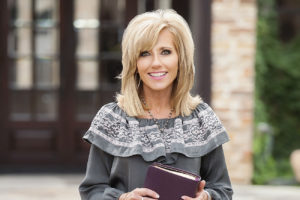
Beth Moore is founder of Living Proof Ministries in Houston. (Courtesy Photo)

“Ok, you guys. This dramatically changes things,” Beth Moore posted on June 4. “I’ve so not wanted to leave this site because of the community we developed. Dialogue. Insight. Hilarity. Silliness. The praying for one another. Celebrating victories and mourning losses. What shall we do?”

In the thread that followed the initial post, Moore explained pornography “is very offensive to me but it doesn’t tempt me.”

“One thing that worries me is that we sure have numerous people in our community who’ve struggled with it. Is it irresponsible of us, then, to stay?” she asked.

At the same time, Moore lamented the loss of online community if she does withdraw from the platform.

“Disrupting the community we found here—new friends we made who are now important to our well-being—will be like leaving our hometown,” she wrote.

Hershael York, dean of the Southern Baptist Theological Seminary School of Theology, tweeted plans June 4 to end his account.

“Does a spring pour forth from the same opening both fresh and salt water?” he wrote, quoting James 3:11. “Friends, I cannot in good conscience remain on X any longer. I’ve tried to use it redemptively, but now this is too much. I’ll remove my account by the end of the day.”

Previously named to the Dirty Dozen

The social media platform established a reputation as a pornography hub before Elon Musk acquired it, with the National Center on Sexual Exploitation naming the site for several years to the center’s Dirty Dozen list of the top mainstream contributors to sexual exploitation.

“Twitter has been an online pornography outlet, strip club and sex shop all rolled into one,” the center blogged in 2017, “and this seedy XXX material is available to children and adults. This social media site hosts a slew of accounts that are essentially ads for pornography performers and studios, as well as prostitution.”

The National Center on Sexual Exploitation last named Twitter to the Dirty Dozen list in 2023.

Adults over age 18 may opt out of viewing adult content, X said, and users may report unmarked content or other violations.

X defines adult content as “any consensually produced and distributed material depicting adult nudity or sexual behavior that is pornographic or intended to cause sexual arousal,” including full or partial nudity with close-ups of targeted body parts, and explicit or implied sexual behavior or simulated acts.

Among its stipulations for posting such content, X said, “We ask that you please adjust your media settings,” to place images and videos behind a content warning that must be acknowledged before viewing the media.” For those who “continue to fail” marking their posts, X will make the adjustments itself, the policy states.

The platform said it will block content from users under age 18 and accounts without the user’s date of birth, and will maintain other rules related to age restrictions

With additional reporting by Managing Editor Ken Camp.


MyChurchFinder identifies Christian nationalist churches

(RNS)—Since taking the pulpit at Legacy Baptist Church in Coolidge, Ariz., Pastor Rob Hudelson has not shied away from hot-button political issues, including disputing the results of the 2020 election.

His taste for politicking has expressed itself in his two campaigns for state representative.

Recently on X, formerly Twitter, Hudelson responded to a post from the conspiracy-minded journalist Lara Logan about recent arrests of Jan. 6 rioters with a post that read: “Marxism will not be something that is debated … only taken by force. It cannot win in the battlefield of ideas.”

That kind of rhetoric has earned Hudelson’s church an “A” rating from MyChurchFinder, a 6-month-old online directory that promises to connect Americans to “biblically sound” congregations across the country.

‘Biblically sound’ ratings

MyChurchFinder sends surveys to pastors nationwide and assigns a letter grade to their church based on their answers. To receive an A rating, pastors must demonstrate that they lead a “biblically sound, culturally aware & non-socialistic legislatively active church.”

Failing to meet any of the above criteria earns a church a “WNR”—Would Not Recommend.

The vast majority of the 270 churches in the directory received an A rating. Twenty-eight churches received B ratings, one church received a C, and three received “WNR.”

MyChurchFinder’s rating system rewards pastors who thumb their noses at the concept of separation of church and state and believe patriotism, politics and Christianity are inextricably, biblically linked.

The site is run by a Texas automobile executive, Roger Elswick, through his organization, the Eleven Six Institute, which describes its mission as “ensuring the Church becomes and remains, not only the conscience of the Government, but also the moral guide to legislation and the moral standard for all Government.”

The directory was co-founded by Neil Mammen, who is also listed as a speaker MyChurchFinder makes available.

Mammen, author of the self-published 2012 book Jesus Is Involved in Politics!: Why Aren’t You? Why Isn’t Your Church, gave an interview earlier this year to American Family News, a publication of the Christian fundamentalist American Family Association. In the interview, he stressed the importance of people being in “good churches” in an election year.

“Bad churches,” he said, are “just propping up the decay of America.”

Neither Elswick nor Mammen responded to requests for comment.

Mammen told American Family News a church’s A rating means “you are not only biblically sound, but you’re also culturally aware; you know and you preach about how abortion is bad and how CRT [critical race theory] is bad, but the most important part of that is then you do something about it.”

Conservative advocacy organization Turning Point USA, whose faith-based arm has endorsed MyChurchFinder, has been on a similar mission of late.

Turning Point’s founder, Charlie Kirk, has teamed up with far-right Christian nationalist pastor Lance Wallnau to turn churches in swing states such as Wisconsin, Arizona and Georgia into “campaign powerhouses,” Rolling Stone magazine reported earlier this year.

Liberty Pastors, another organization that has endorsed MyChurchFinder, is dedicated to “training” pastors “to think Biblically in every area of life—including the realms of civil government, economics, human sexuality, charity, and family.”

And, the organization touts high-profile instructors such as former Arkansas Gov. Mike Huckabee and Act for America founder Brigitte Gabriel.

MyChurchFinder identifies congregations that have become members of Liberty Pastors.

Familiar Christian nationalist names

For those who follow Christian nationalist pastors, a few familiar names pop up in MyChurchFinder’s directory. “Patriot Churches,” a network founded by Ken Peters with locations in Knoxville and Lenoir City, Tenn., and Spokane, Wash., all have A grades.

Peters’ mini empire began with the “Church at Planned Parenthood” in Spokane, which previously used members of the Proud Boys as security.

Another is the Ekklesia church in Pomona, Calif., whose pastor has deep ties to the Proud Boys and other far-right groups in Southern California. On Fire Ministries, in Spokane, run by former Washington state Rep. Matt Shea, is also in the directory.

In 2019, Washington legislative investigators concluded Shea had “participated in an act of domestic terrorism” when he “planned, engaged in, and promoted a total of three armed conflicts of political violence against the United States government” between 2014 and 2016—including armed standoffs in Nevada and Oregon that involved members of the Bundy family and an armed conflict with the U.S. Veterans Affairs Department in Priest River, Idaho.

On Fire Ministries came under scrutiny in 2022 when it turned out two members of white nationalist group Patriot Front were affiliated with the church. A pastor from On Fire Ministries later denounced Patriot Front as “racist.”

While the MyChurchFinder list is by no means comprehensive (notable absences include Sean Feucht’s congregation, Let Us Worship), the 270 churches that are rated offer some insight into geographical hot spots for Christian nationalist congregations.

Alaska, Maine and Vermont do not appear at all on the list, but some other states appear to be overrepresented. An extensive report by the Public Religion Research Institute published earlier this year found sympathy for Christian nationalism was most prevalent in conservative rural states.

But MyChurchFinder lists 40 churches in California, the most of any state, despite PRRI finding just 22 percent of Californians sympathize with or adhere to Christian nationalism.

PRRI also found support for Christian nationalism was “strongly correlated” with voting for Donald Trump in 2020. But of the more than 200 A-rated churches where county-level election data was available, 60 percent were in counties that went red for Trump in the 2020 presidential election.

More than a third were in counties that voted for Biden. And of the at least 133 churches located in pro-Trump counties, a third were adjacent to a blue county.

This story was reported with support from the Stiefel Freethought Foundation.


Have the nones jumped the shark?

(RNS)—Since the mid-2000s, the fastest-growing religious group in America has been the so-called nones.

The percentage of Americans who claim no religious affiliation nearly doubled from 2007 (16 percent) to 2022 (31 percent), becoming a force in American culture and one of the largest segments of the religious landscape, according to Pew Research.

But all things pass. And the skyrocketing growth of the nones may be fading.

“They are not growing as fast as they used to,” said Ryan Burge, associate professor of political science at Southern Illinois University and author of The Nones: Where They Came From, Who They Are, and Where They Are Going.

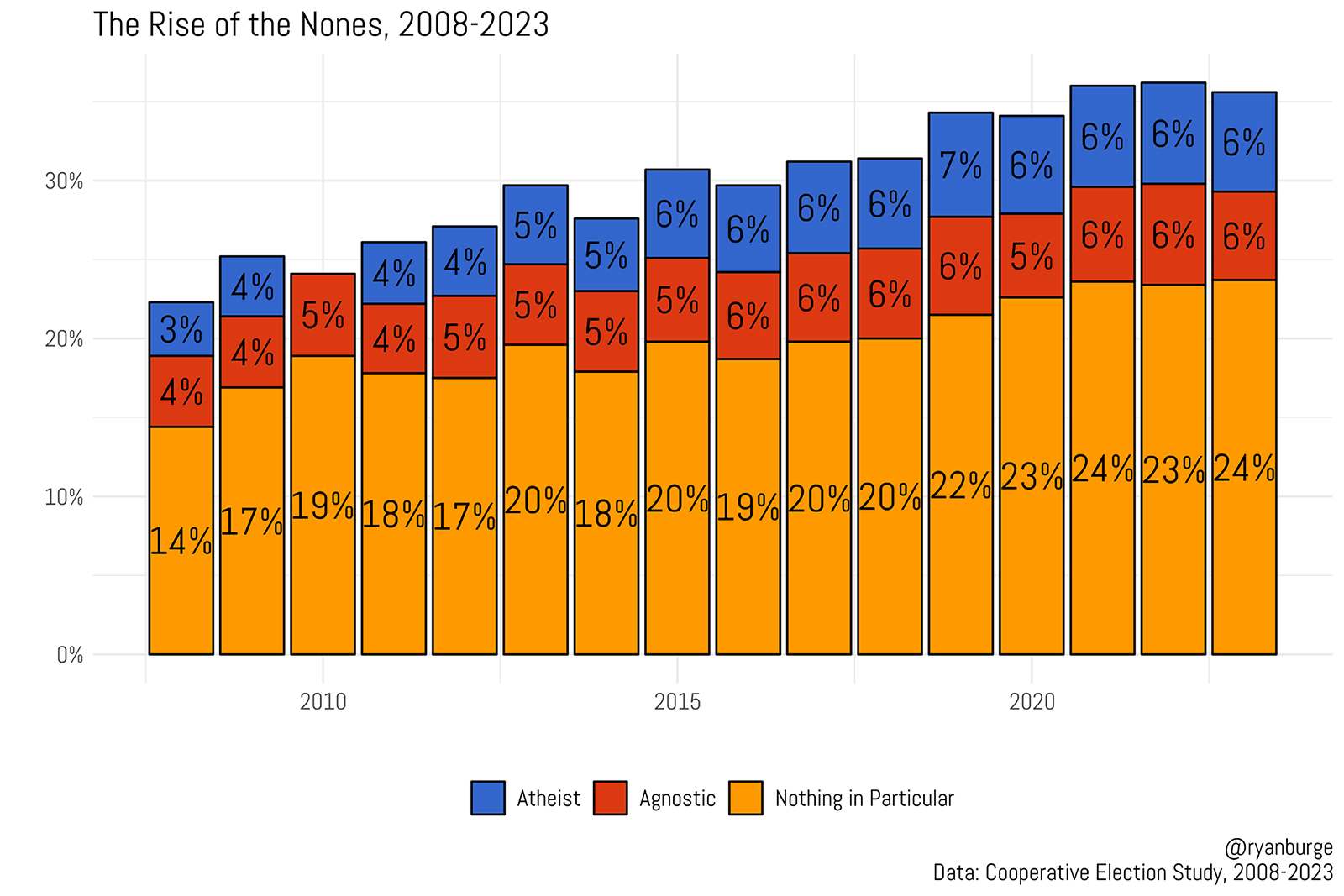
Burge, known for his popular graphs depicting religion trends, told Religion News Service in an interview that the growth of the nones appears to be waning. He pointed to data from Pew, the General Social Survey and the Cooperative Election Study, all of which appear to show a slowdown in the percentage of Americans who claim no religion.

Pew’s most recent published data found that 28 percent of Americans did not identify with a religion in 2023, a slight dip from the previous year.

The CES data, the latest of which was released in May, showed that from 2020 to 2023, the percentage of nones was relatively stable. In 2020, the CES found that 34 percent of those surveyed were nones, while in 2021 and 2023, that percentage was 36 percent. (In 2022, 35 percent of those surveyed were nones.)

(Graphic courtesy Ryan Burge)

“From a pure statistical standpoint, I don’t know if we can say with any certainty whether there’s a larger share of nones in the United States today than there was in 2019,” Burge wrote in a recent edition of his Substack newsletter.

Burge compared the growth of the nones to the growth curve of popular products such as Peloton bikes or tech companies like Apple and Google. Those brands grew rapidly at first but could not keep up that rapid growth forever.

“They became mature businesses,” said Burge. “That’s what the nones are—they’re not going to grow at this unbelievable pace going forward.”

Burge also suspects that most of the Americans who were eager or ready to give up on identifying with a religion have already done so. Any future growth, he said, will likely come from generational replacement—as older, more religious Americans die off and younger, less religious Americans take their place.

Greg Smith, associate director of research at Pew Research Center, said it’s too early to tell what exactly is happening with the nones. There have been some signs in recent years the percentage of nones is stabilizing, he said, but that may be due to the normal fluctuations in survey responses from year to year.

In 2022, he said, the percentage of nones jumped to 31 percent, then dropped back down to 28 percent. He added that in 2016, the growth of the nones appeared to pause and then started to grow again.

“As we looked at the data, the conclusion we’ve come to, even it is kind of wishy-washy, is that it’s way too early to tell if the rise of the religious nones has come to an end,” he said.

Conrad Hackett, a senior demographer and associate director of research at Pew, said there are signs “something interesting” is happening with nones right now, but more data is needed.

Hackett said the conditions that fueled the rise of the nones are still in place. Younger Americans are less religious than older Americans, many Americans still switch their religious faith, and being nonreligious has become “stickier,” Hackett said.

So, people who are born without a religious identity are more likely to stay nonreligious. Nonreligious people in the United States also tend to be younger than religious people.

Hackett is the co-author of a 2022 Pew report that projected what religion in American could look like in the next 50 years. That report looked at birth and mortality rates as well as rates of switching religious identities and projected a long, slow growth in the nones for the foreseeable future. Researchers projected that by 2070, the nones would make up between 41 percent and 52 percent of Americans.

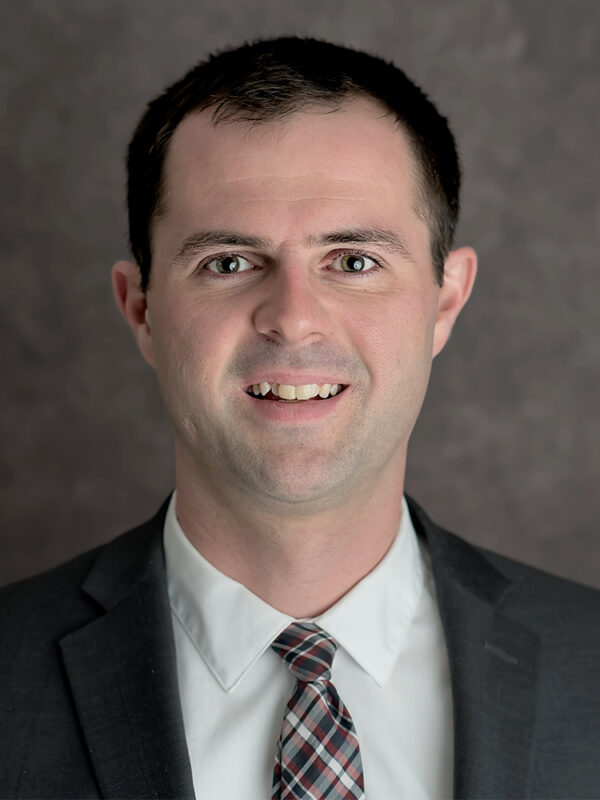
Ryan Burge (Courtesy photo)

Christians, according to Pew’s projections, would make up just under half of Americans, with non-Christian religious people making up about 12 percent of the population.

Complicating matters is that Pew, like other organizations that survey religion in America, has moved to a probability-based online model for surveys—rather than mostly phone interviews.

The GSS, a well-respected and long-running survey, switched from in-person interviews to a hybrid phone and online model during COVID—making it harder to compare its most recent data with past versions.

The CES data has consistently found higher percentages of nones than the GSS and Pew. But Burge said all three sources appear to show that something has changed with the growth of the nones.

The slowing growth of the nones doesn’t mean a religious revival in the United States. Instead, Burge said, theUnited States likely will end up in the future with large numbers of religious people and nonreligious people, with neither group having a sizable majority.

That will pose challenges for democracy, he said, which relies on cooperation and compromise—difficult when many people are feeling unnerved by the changes in the country and where religious and nonreligious people have different ideas on how the country should be run.

And those conflicting ideas lead to polarization and at times, hostility. That hostility, if it continues to grow, “will be bad for democracy,” said Burge.

“We can’t function in a democracy where you have two very large groups who hate each other.”


Book says religion of whiteness permeates US Christianity

WASHINGTON (RNS)—Two sociologists wrote a book in 2000 about the fraught efforts of white evangelicals to diversify their congregations to better address racial discrimination in the church.

Now, one of those authors, Michael Emerson, has teamed up with another sociologist, Glenn Bracey, for an update. And their conclusions are grim.

The Religion of Whiteness: How Racism Distorts Christian Faith suggests as many as two-thirds of white Christians in the U.S. have elevated whiteness to a religion itself, one that rivals Christianity.

It’s a controversial claim but one the authors support through interviews with Christian church leaders, many of them Black, about the state of race in the church, as well as national surveys they conducted over the past few years.

Emerson and Bracey depict a Christianity that effectively worships the white race with a white Jesus at its center and a set of sacred symbols, including the flag (both the U.S. flag and sometimes the Confederate flag), the cross and, increasingly, guns.

Though their churches may be slightly more racially diverse, this religion of whiteness strives to maintain whites at the top of the racial hierarchy as part of God’s ordained order.

Religion News Service spoke to Emerson, a fellow in religion and public policy at Rice University, and Bracey, an assistant professor of sociology at Villanova University, about their bold conclusions. The interview has been edited for length and clarity.

You’re not using the word “religion” metaphorically in this book. You’re actually saying there is a religion of whiteness. Explain how you mean it.

Emerson: This is hard for people to understand, but we’re saying we cannot make progress in our country on race until we understand the depth of what it all means.

It is wrapped literally in a religion that has all the markers of the way we define religion. It’s a unified system of beliefs and practices that worships or sacralizes, not some God in this sense, but whiteness. Whiteness is the god. It declares that everything else that isn’t supporting whiteness is profane; it’s wrong; it needs to be shunned.

Bracey: And when we say whiteness, we’re talking about the dominance that white people enjoy over people of color. So, it’s not as though someone is saying, “I attend the Church of Whiteness.” It’s that they find themselves caught up in the worship of the dominance that white people enjoy.

As you say, this religion doesn’t call itself a Church of Whiteness. Why not?

Emerson: There’s a couple of rhetorical moves that are made so you never have to actually name it. One of them is that Jesus is white, and Jesus by definition is supposed to be for everybody.

So, Jesus is universal. So, as long as Jesus is white and Jesus is universal, then whiteness is universal. And once you do that, you no longer have to name it, because that is truth. Anything else, is an argument against truth.

You also point out that churches across the country are becoming more diverse. You mention that 20 percent of Christian churches are racially diverse, up from 6 percent in 2000. Doesn’t that argue against a religion of whiteness?

Bracey: So, that’s a very good question. It’s important to note that 80 percent of the churches are still homogeneous. The difficulty is, the whiteness of the church can remain, even when the church is not entirely white.

White evangelical churches in particular have race tests to either exclude people of color or make sure that people of color will support whiteness in the way that the church wants it supported.

So, those tests, I call utility-based tests, to tolerate and support these performances of white dominance. Those race tests are working. They’re doing a good job of filtering out people who would disturb the worship of whiteness in those churches.

Describe how these tests work.

Bracey: I went to seven churches across four different states, all majority white and evangelical. In one church, I was asked on my first visit to go up on stage and sing, even though I have no history of singing in churches.

In another church, I was asked if I wanted to adopt a biracial baby, because this child had a biracial family and the father who was white had left, and they were looking for someone to step in and be a father.

Other times, there were exclusionary tests and the exclusionary tests are really obvious and painful. I went to a Bible study, segregated by sex. So, I was in the men’s group, the men’s group was about eight people including six white men and a Latino man and me. It was his first time as well. They introduced themselves by saying what their names were and what their favorite gun was, and how recently they had shot it. So, they established a gun culture, dominance and a sense of threat.

And at one point, the host of the Bible study stands up and says: “I don’t know what the name of my favorite gun is. I just know when I shoot it, it goes chink, chink, chink. So, I call it my China gun.”

So, without saying anything overtly, there was a performance that let you know the space was dangerous for people of color. It was racially stereotypical and hostile. If you were going to stay, you had to be willing to put up with the kinds of behaviors that established this space as a very white dominant space.

You also did some surveys to better define the belief systems of churches that practice the religion of whiteness. How did you get at whiteness in those surveys?

Bracey: We have a set of survey questions that ask people, do you think the Bible should be followed under all circumstances? The people who say “always” are the only people that we then ask follow-up questions.

The Bible says not to speak unwholesome words. And so, it’s wrong to curse. The majority say you should not curse. But then when we ask things that are racially inflected—how to treat immigrants, how to treat racial minorities within the church—then they abandon their Christian commitment to the Bible and show a commitment to something else. And that something else is whiteness.

Some Blacks have embraced this religion of whiteness. How do you understand that?

Bracey: A lot of people get involved with the religion of whiteness, not because they’re attracted to whiteness, but because they’re attracted to the authentic or the real. Because whiteness is considered real, they come to think that real Christianity is what white folks say it is.

People are attached to dominant things. There’s a lot of psychological benefit, in addition to monetary benefit, from being a person of color in the religion of whiteness. People are constantly telling you you’ve done the right thing, you’ve broken from what they would say is the Democratic plantation, you are serious about faith, you put God before race. Frankly, that is enough to sustain a lot of people.

How is there a monetary benefit?

Bracey: I’ll give you an example. (Earlier in my life) a pastor took me to meet one of the Republican members, a Black Republican in our county and recruited me to run for office. And he said plainly, if you want to be a Black Democrat, there’s a million of those. But if you want to be a Black Republican, we’ll give you a lot of money and attention and air time. So, there was a material offer put there.

How did you two scholars find each other?

Emerson: My earlier book, Divided by Faith, focused on white evangelicals. At that time, evangelicals were considered to be making a big change, bringing race into the conversation, advocating racial reconciliation.

In the book, I show there are particular ways of understanding the religion that actually makes matters worse. I argue these churches have three main religious cultural tools that they use: individualism, personal relationships and an antistructuralism that does not allow them to understand issues of race and racial inequality and what the solutions would be.

When we met, Glenn asked me, “Did you ever wonder if maybe it isn’t by chance that white evangelicals have these three cultural tools that just happened to not allow them to see what race really is?” I thought, “OK, I’ve got to work with this man.”

What’s been the response to your findings?

Emerson: I get two extreme reactions. I literally can hear crying in the audience, usually people of color, sometimes clapping, cheering and then some really serious questions: What is my motive? Am I a Christian? What has happened to me? These are coming mostly from white folks really who are very, very angry.

Bracey: If I am attending a church that’s practicing the religion of whiteness, they’ll obfuscate in the way that Michael described. There’s a “not me” syndrome happening. I would just invite people to think a little longer and see where their attachment to white Jesus is. How strong is it? Where would they find themselves in the book?



Increased corporate attention shown to religious diversity

WASHINGTON (RNS)—Once taboo in the corporate world, religion is gaining traction in Fortune 500 diversity efforts, according to a new report from the Religious Freedom and Business Foundation.

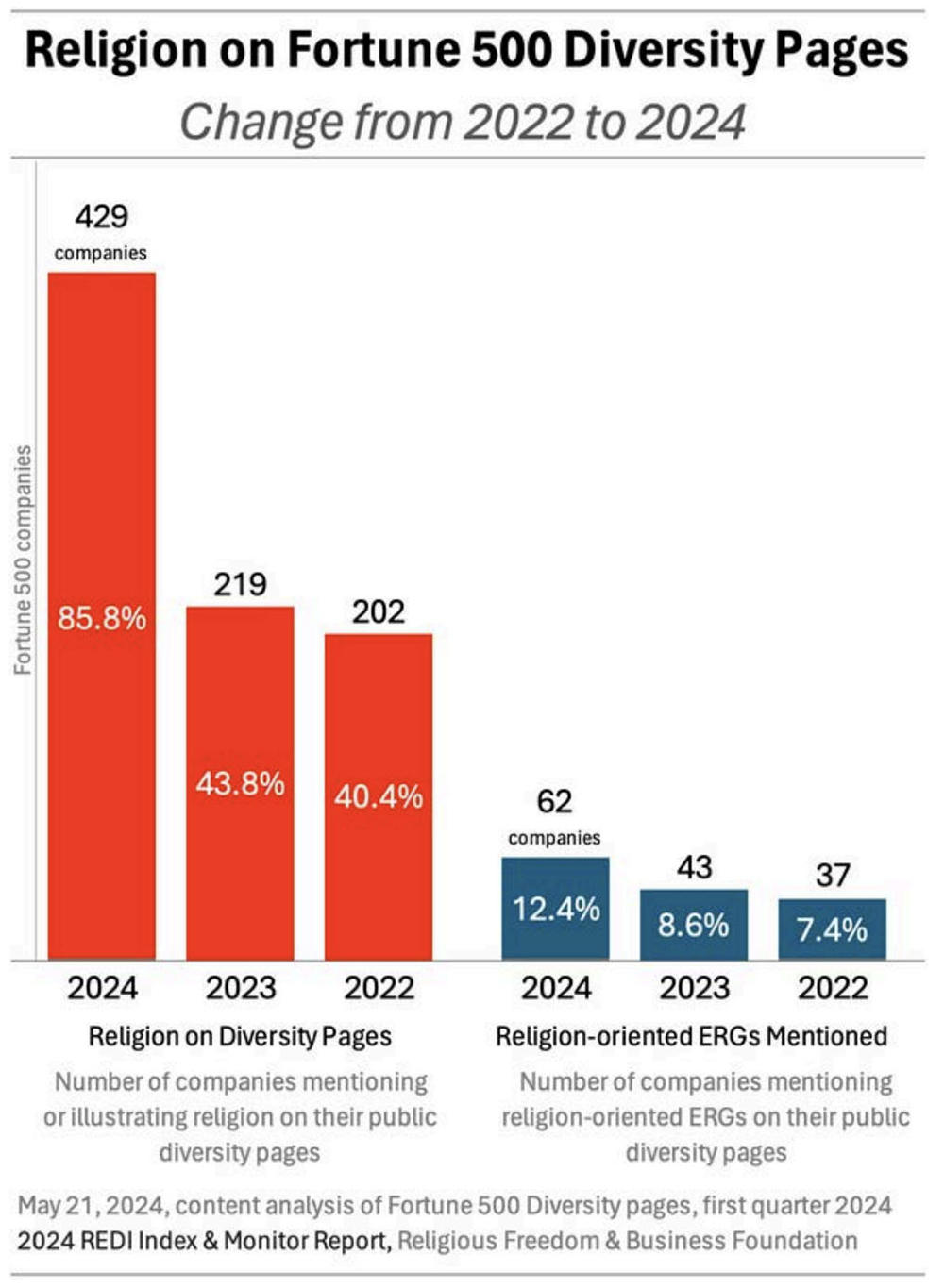
More than 85 percent of Fortune 500 companies (429 companies total) now include religion in their commitment to diversity, more than twice the number that did in 2022, according to the 2024 Corporate Religious Equity, Diversity & Inclusion Index and Monitor.

And 62 Fortune 500 companies (12.4 percent) now showcase faith-based employee business resource groups, up from 7.4 percent in 2022.

These numbers represent a “tipping point,” said Religious Freedom and Business Foundation President Brian Grim, in the number of companies embracing religion as a core component of diversity.

This year, he added, companies especially were attentive to how people of faith responded to global news, including the Israel-Hamas war.

“That has meant paying a little bit more attention than they did in the past to faith identities,” he said. “A number of companies have reached out and relied on their faith employee resource groups to help in the navigation of these types of issues.”

The organization released its 2024 benchmark assessment of corporate America’s religious diversity efforts May 20. This year, Accenture and American Airlines tied as the most faith-friendly Fortune 500 companies, both earning perfect scores on the index, which assessed more than 30 faith-friendly companies via an opt-in survey.

The survey evaluated companies in 11 categories, including their religious accommodations, spiritual care/chaplaincy services and procedures for reporting discrimination. Equinix, Dell Technologies, Intel Corporation, Salesforce and Tyson Foods all followed close behind the top scorers.

Grim said Accenture stood out for proactively creating a corporate culture hospitable to religious identity.

American Airlines, which also topped the REDI Index in 2022, brings great global sensitivity to its religious diversity efforts thanks to its international reach, Grim added.

“At American Airlines, our purpose is to care for people on life’s journey, including our customers and our 130,000 team members,” said Cedric Rockamore, the vice president of global people operations at American Airlines. “Our team members, across all faiths and beliefs, help us better understand and serve our customers around the world.”

Among the 32 top companies assessed via the REDI Index, 100 percent reportedly celebrate their employees’ holy days in an equitable manner, according to the report.

Seventy-two percent match employee donations to religious charities, and 87 percent provide chaplains or other forms of spiritual care for their employees.

Companies that didn’t take the survey were ranked separately on their religious diversity efforts via the REDI Monitor, which was based on publicly available information.

Grim said companies’ approach to religious diversity is often counter-cultural. Businesses that might otherwise be in competition are quick to share best practices for religious inclusion and collaborate on events.

The Christian and Black employee resources groups at Intel and Microsoft, for example, recently teamed up to host a Martin Luther King Jr. Day celebration, he said.

On May 22, Dell Technologies’ interfaith employee resource group is working with Merck, CVS Health and three local faith groups to host a hands-on food packaging event in Washington, D.C.

“I think that’s a very hopeful trend in these polarizing times,” Grim said.

The interest in corporate religious diversity is also spreading globally, Grim added. He noted the Religious Freedom and Business Foundation held an international conference in India in December and released REDI Index and Monitor findings for companies in the United Kingdom in March.

On May 21, the foundation’s annual “Dare to Overcome” conference will bring hundreds of leaders from Fortune 500 companies to Washington, D.C., to discuss topics like workplace chaplaincy, research on faith and faith accommodations in the workplace.


How many churches use background checks?

WASHINGTON (RNS)—About 10 years ago, when Pennsylvania passed a law requiring a background check for anyone who worked with children, Megan Benninger volunteered to help her church comply.

At the time, Benninger and her husband were members of a small Southern Baptist church, where the nursery was run by volunteers and things were a bit disorganized.

“Everything was loosey-goosey,” she said. “I don’t know if we even had a schedule for the nursery.”

Before they got started organizing the background checks, Benninger said a church leader pulled her aside and told her not to include the church’s pastors. None of them worked with kids. Besides, they were pastors and so above reproach.

“They said, ‘Don’t even think about the pastors,’” she said. “So I didn’t.”

Years later Benninger learned that one of the pastors, a former Christian school principal, had been convicted of abusing a minor—a revelation that tore their little church apart.

Benninger left that church and now runs BaptistAccountability.org, a website that posts links to news stories about abusive pastors. She says churches never can be too careful.

“I never trust anyone anymore,” Benninger said. “You just never know.”

Since the Catholic sex abuse scandal of the early 2000s, many congregations have moved to make their churches safer for kids, passing new policies and procedures designed to screen out abusers and to report any abuse to authorities. But few denominations check to see if churches follow those procedures or track those who do.

Difficult to find hard data

A recent report on Southern Baptist churches from Lifeway Research found that about 58 percent of those congregations said they do background checks on staff who work with kids, with small congregations—those with fewer than 50 people—least likely (35 percent) to do those checks. Large churches, those with 250 people or more, are much more likely (94 percent).

The Lifeway data was limited—only 29 of the Southern Baptist Convention’s 41 state conventions collected data on abuse prevention in churches—and churches were not required to answer those questions.

Dealing with abuse has been difficult for the SBC, as all of its congregations are autonomous and there is no hierarchy to require them to follow safety policies for children.

But even denominations with hierarchical structures—like the Episcopal Church or the Evangelical Lutheran Church in America—don’t track what happens on the local level.

Instead, that is left to the local congregation or diocese.

A spokesperson from the ELCA provided a link to suggested policy for congregations but said the denomination does not know what local churches are doing.

A spokesperson from the Episcopal Church also provided a link to a General Convention decision to produce safe church training materials but said “​decisions on implementation are local.”

Evangelical denominations take a similar approach to how churches deal with child safety.

“Assemblies of God has a well-established history in creating resources on this topic and urging urging all churches to adopt best practices to protect the vulnerable,” said a spokesperson for the Assemblies of God.

“Assemblies of God churches are autonomous and the General Council of the Assemblies of God does not have the ability to create policy for local churches.”

Develop a culture that cares about children’s safety

Darrell Morgan, the pastor of CrossWinds Community Church in Stillwater, Minn., part of the Converge denomination, said his congregation background-checks all volunteers who work with kids. A church member who is a former investigator helps coordinate those background checks, he said.

A former therapist with experience in social work, Morgan said those background checks are just a first step. The church also does not let volunteers be alone with children and tries to be selective about who gets to volunteer.

“We want a safe environment that is accountable and protects everyone,” he said.

Emily Garcia, assistant rector at Church of Our Redeemer in Lexington, Mass., has worked with children’s ministries about 15 years, starting before she entered the ministry. She said the local Episcopal diocese requires them to report details of its safe church programs on an annual basis.

Volunteers who work with children must pass a background check, Garcia said, and be an active part of the church for at least six months before starting the screening process.

“Someone came in on their first Sunday and said, ‘I want to work with the children,’” she said. “And we said, ‘OK, talk to us in six months.’ Stick around for a while.”

Garcia said potential volunteers also spend time observing with experienced volunteers—and then the more experienced volunteers give their feedback—just to make sure they feel OK with how the volunteer interacted with kids. Volunteers also are required to do a series of trainings.

She said the church has developed a culture that cares about the spiritual formation and safety of children. Having set policies and doing background checks helps maintain that culture, she said.

“The sense is that no one is above a background check,” she said.

Among Southern Baptists, Lifeway found that churches in the Northeast were most likely to do training on how to report abuse and that churches in the Northeast and the West are most likely to do training on how to care for victims of abuse. Churches in the South were least likely.

Lifeway also found that some Baptist state conventions, like the Baptist General Convention of Texas, the Pennsylvania-South Jersey convention and the Minnesota-Wisconsin convention, had the highest levels of doing background checks and abuse training.

‘Need to remain diligent and vigilant’

Ward Hayes, BGCT treasurer and chief financial officer, reports to Texas Baptists’ Executive Board.  (Photo courtesy of Texas Baptists)

Starting in 2015, leaders in the Baptist General Convention of Texas decided they wanted to tackle the issue of abuse prevention head-on, said Ward Hayes, Texas Baptists’ treasurer and CFO. That led to a greater emphasis on background checks and training.

“We have made progress,” he said. “We still need to remain diligent and vigilant.”

Hayes said more data is needed to know how much progress has been made and how much work still needs to be done. The state convention only knows how churches are doing with abuse prevention if they report those programs.

There are some signs that congregations nationwide are addressing abuse and prevention.

The 2020 Faith Communities Today Survey found that 96 percent of Catholic and Orthodox congregations do background checks, and 94 percent do training for those who work with children.

Seventy-one percent of Mainline congregations and 70 percent of evangelical churches in the study said they did background checks, while 65 percent of Mainline congregations and 68 percent of evangelical churches did training for those who work with children.

Background check only the first step

Stephanie Nelson, pastor of the Covenant Church of Thomaston, Conn., said all volunteers with kids are background-checked.

“On my second day on the job, I filled out a background check,” she said.

But she said that is just a first step. She worries some churches may think a background check is enough to make a ministry safe.

It’s not, she said.

“All they tell you is that someone has not been convicted,” she said.

She said volunteers at Thomaston Covenant have to be part of a church for a year before they work with kids. She also said two adults are required in every church classroom, and the doors to classrooms are always kept open.

Nelson, who worked with children and youth at several churches before becoming a senior pastor, said the church stressed safety is part of caring for the spiritual formation of kids.

“We are here to serve them,” she said. “And our primary goal is to keep them safe.”


Amid campus protests, chaplains find reason for hope

(RNS)—Ask a college chaplain, and you’ll hear a story behind the pro-Palestinian protests on American college campuses that is more complicated—and in some ways less dire—than what you’re seeing on television or in your news app.

Media accounts of the pro-Palestinian protests and counterprotests have focused on unwelcome encampments, fights between rival groups and arrests by police.

But the conflict in Israel and Gaza and the profound issues it raises—some campus spiritual leaders say—have done what colleges and universities are meant to do: prompted them to reflect on what it means to be moral agents and to assess their own diverse faiths.

Whether students participated in encampments, prayer vigils, Shabbat rituals or supporting other students, they were growing spiritually and learning how to claim their own place in history, the chaplains said.

Janet Cooper Nelson, a United Church of Christ minister who has long headed Brown University’s chaplaincy team, said the students at the university—where encampments ended after officials agreed to vote on student demands this fall—represented a wide spectrum of beliefs.

Student events often ‘very moving’

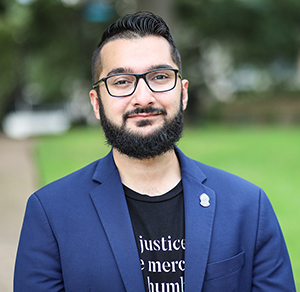
Usama Malik is a chaplain at the Austin community-building organization Muslim Space. (Courtesy Photo via RNS)

At the large public campus of the University of Texas at Austin, Muslim students told Usama Malik, a chaplain with Austin community-building organization Muslim Space, their trust in university administrators and public officials has been damaged by aggressive attempts to clear the encampments—even as solidarity among students of different religions has increased in past weeks, often with support from local pastors, faculty and even parents.

Having seen art-making workshops, a teach-in, a Shabbat service and an interfaith prayer vigil in recent days, Malik said, “You’re really seeing a variety of things that often get missed in the way the news media has been covering the story.” The events, often student-led, are “diverse, eclectic and very moving.”

At Brown, said Cooper Nelson, students have become more involved in campus politics and their own faith issues. Those she has encountered “are prayerful, spiritually formed on the inside,” she said.

“You see the students weighing the ideas and their decisions about engaging those ideas or moving them forward, very much based on how they understand what it is to live a life that’s grounded spiritually.”

Jenn Schaaf, a Dominican sister and assistant chaplain at Yale University’s St. Thomas More Chapel & Center, said the war for many students is by no means an abstraction.

“Like the conflict between Ukraine and Russia, we have students who have relatives in Israel and Palestine. They are worried about people they know,” she wrote in an email.

“I’m grateful that our students are engaged in the religious and political sphere,” she added. “I’m also grateful that they are safe.”

Overall, the chaplains who spoke to RNS seem united in admiration for their students’ capacity to form their own opinions, make moral judgments and embrace the moment, as turbulent as it is.

‘It is my job to listen’

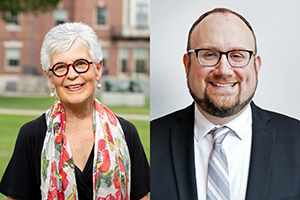
Janet Cooper Nelson is a United Church of Christ minister who heads the chaplaincy team at Brown University. Rabbi Jason Klein is Nelson’s chaplaincy colleague at Brown. (Courtesy Photos via RNS)

Indeed, Cooper Nelson’s colleague at Brown, Reconstructionist Rabbi Jason Klein, said while Jewish students have welcomed the chance to connect the protests to Jewish values, spirituality and practice, they don’t want to be told by outsiders what to believe about the issues at the heart of the protests.

Cooper Nelson doesn’t consider it the chaplain’s role to teach as much as facilitate students’ takeaways.

“It’s not my job to tell them what to do. It is my job to listen carefully and to try and hold up a mirror of what I hear them weighing and measuring, what they are putting out there as the ideas that seem most important to them. I think we’re acting as friends, non-judgmental sounding boards.”

Roger Landry, a chaplain at Columbia’s Thomas Merton Institute for Catholic Life, said he has attempted to focus students on helping one another.

“There’s a temptation to think that a campus demonstration on a New York campus is going to have a major impact on a 76-year-old, seemingly intractable dispute in the Middle East.

“I’ve urged them to be far more practical by doing what we Catholics do, turning to prayer and to personal care,” he wrote in an email, adding this “includes reaching out to Jewish and Palestinian friends to ask how they can support them.”

The majority of Catholics at Columbia are hardworking students who prioritize sanctifying their studies, and despite their many concerns over what has happened in the Middle East before, on and after Oct. 7, aren’t happy that the toxins of that region have been brought onto their campus,” he added.

Personal impact of chaplains at smaller schools

At smaller institutions, the war has also had an outsize effect, and the role of the chaplain has sometimes been more personal than at larger urban schools.

At Eastern Mennonite University in Harrisonburg, Va., students and faculty held a teach-in and a prayer vigil last fall and called for a cease-fire, prompted by students who had gone to Israel and the West Bank over the summer.

After more student-led action this spring, the university administration joined them in urging the U.S. government to work for a cease-fire.

Brian Martin Burkholder, the Mennonite chaplain, said he has tried to be present with the students who were on the trip who “felt compelled to speak out for those who were losing their voice and homes and land due to Israeli attacks and control,” he said.

“I’ve checked in on occasion to see how they are doing and offer a space for reflection on their experiences. I wanted them to know they were seen, supported and valued.”

“Our Anabaptist Mennonite faith tradition informs supporting one another in community as well as giving and receiving counsel,” said Burkholder.

At Indiana’s Earlham College—historically Quaker but now very diverse ethnically, economically and across faith traditions—students have focused on how they can support each other, rather than being combative, said the coordinator of Quaker and religious life, Mimi Holland. As at Yale and many other institutions, there are students who have family members both in Israel and in Gaza she said.

“I think there is something about the culture that is rooted in the Quaker way that promotes more thoughtful responses. The message of justice, bridge building, how we are all interconnected—not just as human beings but as the entire world and environment we live in … that’s very much part of our culture.

“Our students are amazing. I see young people really putting the best part of their faith forward and acting on what their faith causes them to do in kind, loving, peaceful, justice-seeking ways,” said Holland.

“I’m just gobsmacked by how caring and thoughtful they are.”


Most Americans see no moral, spiritual good in AI

PHILADELPHIA (BP)—Most surveyed Americans don’t see a moral or spiritual benefit to artificial intelligence, new research from the American Bible Society revealed.

More than two-thirds (68 percent) don’t believe AI could be used to enhance their spiritual practices and thus promote spiritual health, the American Bible Society stated May 9 in the latest release from its 2024 State of the Biblereport.

About 6 out of 10 (58 percent) don’t believe the technology could aid in their moral reasoning, and 57 percent don’t believe AI can produce a sermon as well-written as a pastor’s original work.

Thirty-seven percent of responders even would view unfavorably a pastor who uses AI to prepare sermons, researchers found.

Scripture-engaged Christians—as categorized by the American Bible Society—expressed even more pessimism over the technology, including the digitally savvy Gen Z.

‘More fearful than hopeful’

More than half of respondents, 51 percent, believe the use of AI will increase unemployment, with Gen Z and Boomer generations expressing the belief in equal measure.

“Americans are more fearful than hopeful about Artificial Intelligence, but our survey also shows a great deal of uncertainty,” John Farquhar Plake, ABS chief program officer and State of the Bible editor-in-chief, said of the findings.

“People just don’t know how AI will change the culture, but they’re mildly uneasy about it. And how do people of faith feel? The same way—uncertain, uneasy—but more so.”

AI’s possible connection to Christian faith should be more thoroughly explored, researchers said, referencing the critique given by Carey Nieuwhof and Kenny Jahng in their December 2023 book, The Ultimate Guide to AI, Pastors, and the Church.

“The question for church leaders becomes not whether the church will embrace AI, but how the church will embrace AI,” Nieuwhof and Jahng write. “History would tell us that ignoring technological revolutions probably isn’t the wisest choice and AI is no exception. Leaders who ignore the future have a hard time doing ministry in the future.

“But embracing AI fully without thinking through the theological, ethical and existential questions of AI poses difficulties too.”

The findings are included in the 2024 State of the Bible’s second chapter, titled “Faith and Technology.”

Examining online worship

In addition to AI, the chapter focuses on how online church worship is embraced and how it impacts Christians.

The chapter references Lifeway Research from 2020, that showed 97 percent of U.S. churches were putting their services online. At that time, 67 percent were livestreaming and others were providing access to videos for later viewing.

Past the pandemic, in-person worship is rebounding, ABS said, with 75 percent of respondents primarily attending worship in person in 2023, 14 percent worshiping primarily online, and 12 percent using both formats equally.

The findings contrast to 2020, when 38 percent primarily worshiped in person, 45 percent primarily online, and 17 percent used both formats equally.

Gen X and Gen Z are more likely to attend in person, with Millennials and the Boomers-plus generations choosing online worship more often.

Still, a majority of all age groups primarily attend worship in person, including 82 percent of Gen X, 78 percent of Gen Z, 71 percent of Millennials and 70 percent of Boomers-plus.

In-person worship is also more popular among those who attend service weekly and among white Americans, researchers found.

Echoing findings from 2023, researchers said online worshipers are more Scripture-engaged than those who attend in person. Most (81 percent) of online worshipers are more likely to read the Bible on their own, researchers said, compared to about two-thirds of those who primarily worship in person.

State of the Bible is based on a nationally representative survey conducted for the American Bible Society by NORC—previously the National Opinion Research Center—at the University of Chicago, using the AmeriSpeak panel. Findings are based on 2,506 online interviews conducted in January 2024 with adults in all 50 states and the District of Columbia.