Commitment to God fuels Armstrong’s Olympics outlook
July 30, 2024
PARIS, France (BP)—Hunter Armstrong’s Instagram account proclaims “GOD FIRST!” The U.S. Olympic swimmer tries to be faithful to that description, whether he’s winning gold medals or not.
“That’s the first thing I want people to see and know about me,” Armstrong told Baptist Press. “As we grow, we have to make sure we have our priorities in line.
“I keep God as a priority. I can’t really live without him. I can live without swimming or being an Olympian or any of that stuff.”
Chris Guliano, Hunter Armstrong, Jack Alexy and Caeleb Dressel celebrate winning the men’s 4×100-meter freestyle relay final during the Paris 2024 Olympic Summer Games at Paris La Défense Arena. (Baptist Press photo by David McIntyre/Genesis Photos)
Armstrong captured one gold medal in the Paris Olympics as part of the men’s 4×100-meter freestyle relay team with Caeleb Dressel, Jack Alexy and Chris Guiliano that held off Australia to win the title on Saturday.
Armstrong’s walk with the Lord has grown considerably over the past several months, he said. While he has professed to be a Christian for a long time, his faith was more peripheral than central to his life.
“I feel like in past years I’ve been sort of on the edge of it,” he said. “When I’m in competition, I’ll pray, and that will last for a little bit. Church camp, same kind of thing. But as soon as I didn’t need him anymore, it would fade.”
That began to change in the aftermath of a breakup with his girlfriend—whom Armstrong had planned to marry—and following the death of his grandfather.
“The biggest catalyst for change in life tends to be pain,” Armstrong said. “Sometimes God will put you in a position where you have no other choice than to turn to him.
“That’s been the biggest change that I’ve made this year. I promised at (world championships) that if he would help me get out of this, then I would embrace it.”
Armstrong’s gold in Paris was the second Olympic gold medal of his career. His first came in Tokyo in 2021 as part of the 4×100-meter medley relay.
Positive influence of teammates
Success in relay races is fitting for Armstrong, as he is quick to point to the influence that some of his fellow swimmers, such as Michael Andrew and Carson Foster, have had on him spiritually.
He remembers an encounter with Andrew at a swimming competition. Though the two had met, they didn’t really know each other well. Armstrong remembers being especially nervous prior to a race, and Andrew noticed Armstrong’s state of mind.
“He got out of the warmup pool, came over and said, ‘Hey, can I pray with you?’” Armstrong said.
Foster also helped sharpen Armstrong by inviting him to participate in group Bible studies for competitive swimmers.
“Truly, my goals for Paris are just to do my best and see what the results are,” Armstrong said prior to the Olympics. “I think everybody here wants a gold medal, but I’ve overcome so much this year that I’m just happy to be here.
“Obviously, I want to have a great performance for myself, my country and my teammates. But if I walk away and I don’t have a single medal or a single best time, I can still walk away knowing that I represented myself well—and God.”
Tim Ellsworth is associate vice president for university communications at Union University in Jackson, Tenn.
William Barber refutes myths about poverty and race
July 30, 2024
(RNS)—When Tim Tyson first invited William Barber II to meet with a group of white residents of Mitchell County, in North Carolina’s Blue Ridge Mountains, Barber half-jokingly replied, “I knew you were going to get me killed.”
Barber, a Black anti-poverty activist, knew in 1923 nearly all the county’s Black residents were driven out of Mitchell County.
Even in 2013, when the invitation was extended, the county had fewer than 100 Black residents out of 15,000 people, or less than 1 percent.
But Tyson, a historian who teaches at the Center for Documentary Studies at Duke University, convinced Barber to trek up the mountain to meet a group of white citizens who were fed up with the state Legislature’s cost cutting, especially in public education.
What Barber found at an Episcopal church in Mitchell County were a group of like-minded working-class whites eager to hear his message.
“There were about 300 people there standing all along the walls, and Rev. Barber just spoke to them from his heart and spoke from his faith,” said Tyson.
“He got three standing ovations. People just wept. They were so touched.”
When it was over, the assembled crowd said they wanted to start a branch of the NAACP—even though they were all white.
A moral leader for all
That’s when Barber first realized he could not be a moral leader and stand up only for Black people. Many white people too are poor and struggling.
In fact, they form the largest single demographic group of the estimated 40 million Americans who are poor according to the U.S. Census, which Barber considers an outdated and significant undercount.
That trip up to Mitchell County convinced Barber he ought to follow in the tradition of the biblical prophet Jeremiah, who was called to be a watchman.
“The ancient prophets remind us that when we cannot see a problem, a watchman must sound the alarm,” he said.
On July 29, on the steps of the U.S. Supreme Court, Barber kicked off a series of Moral Monday Prayers calling for democracy, justice and voting rights ahead of the 2024 presidential election.
As he outlines in his new book, written with Jonathan Wilson-Hartgrove, who is white, it’s time for poor Blacks, whites and other minorities to unite and fight for better living conditions.
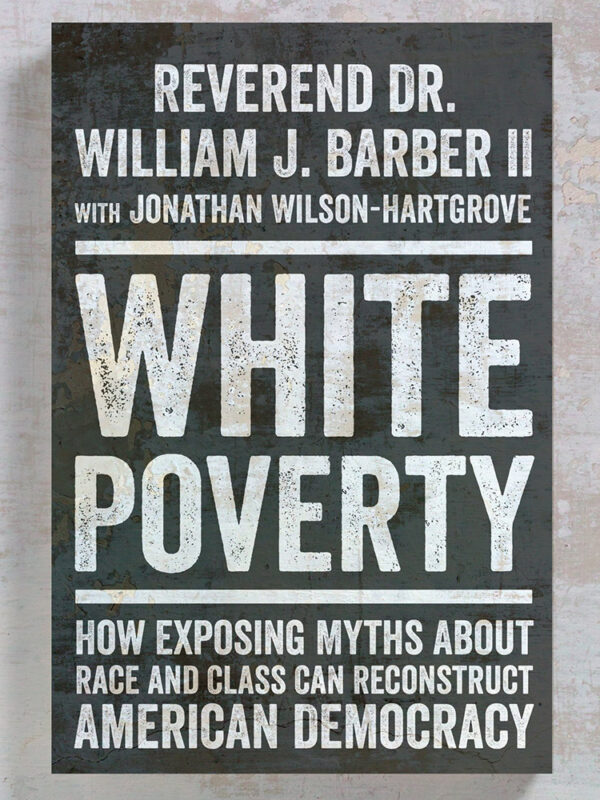
‘White Poverty: How Exposing Myths About Race and Class Can Reconstruct American Democracy’ by William Barber and Jonathan Wilson-Hartgrove. (Courtesy image via RNS)
“The history of America, like the history of the world,” Barber writes, “is filled with stories of powerful people who’ve stolen from the poor and used their power to pit poor people against one another so the masses would not rise up against them.”
As an example, he notes how Republican politicians have portrayed government programs such as welfare benefits as handouts from hard-working white people to poor Blacks, even though more whites benefit from those programs than Blacks.
Attacks on diversity, equity and inclusion programs are another recent example experts point to as conservatives trying to use racial resentment to undermine class solidarity.
“This is the longest power play in the U.S. South, certainly, but across America: to divide people whose interests are shared and whose needs are very painful and urgent, by race,” said Nancy MacLean, a historian at Duke University who has become an ally of Barber’s and whose work is cited in his book.
At last week’s Republican National Convention, JD Vance, the Republican nominee for vice president and an Ohio senator from rural Appalachia, said his party would stand up for working-class communities like the one he was raised in and stand against the “ruling class” that had sold them out.
“We’re done catering to Wall Street. We’ll commit to the working man,” Vance said.
But experts like MacLean said it’s extremely unlikely Vance can transform the free market economic policies of the GOP. Indeed, the signature economic achievement of former President Trump’s term in office was a massive tax cut, skewed largely to benefit corporations and the wealthy.
Barber’s aim is not purely partisan. He can be critical of Democrats too, for not talking enough about poverty and preferring to appeal to middle-class voters.
A ‘Third Reconstruction’
His focus in writing the book ahead of the 2024 presidential election, however, is larger. He wants to build a multiracial coalition that moves beyond the idea poverty is a Black problem.
As he has before, with his Poor People’s Campaign, he is calling for a “Third Reconstruction.”
The first was the work of the Reconstruction era after the Civil War that guaranteed the rights of former slaves with the 13th, 14th and 15th amendments to the Constitution.
The second was the Civil Rights Movement that ended formal segregation, dismantled Jim Crow and removed legal barriers to voting.
For Barber, whites uniting with Blacks to fight poverty is the work of the Third Reconstruction, informed by a deeply moral and Christian mandate.
Before talking to a group of white people up in Mitchell County a decade ago, he had them sing a hymn, “Blessed Be the Tie That Binds.” Reference to that hymn is repeated throughout his new book.
“In communities across the land, I’ve had the opportunity to see and touch the ties that bind poor people,” he writes.
“These are my people, just as much as the multicolored ancestors my daddy taught me to remember. … I am a witness that every shade of America’s poor has a great deal in common.”
Archaeologists discover ancient Jerusalem moat
July 30, 2024
JERUSALEM (RNS)—Archaeologists from Tel Aviv University and the Israel Antiquities Authority have discovered a remnant of a massive ancient moat in Jerusalem that fortified the city during the time of the First Jewish Temple and the Kingdom of Judah.
Yuval Gadot of Tel Aviv University stands next to the northern side of the moat that protected Jerusalem. Alongside him are carved bedrock channels. (Photo by Eric Marmur, City of David)
“This is an extremely important discovery,” said Yosef Garfinkel, a professor at the Institute of Archaeology at the Hebrew University. “It shows that by the ninth century BCE, Jerusalem was an important city.”
Although no one knows exactly when or why the moat was created, the archaeologists say it could have been quarried as far back as 3,800 years ago. At the time, the moat physically separated the southern residential part of the city (the City of David) from the upper city—the Temple Mount area—where the palace and First Temple stood.
Open questions and excavations at the City of David archaeological site have persisted for 150 years. So, any new discovery must be cross-referenced with earlier finds.
In this case, the team reexamined 70-year-old excavation reports written by the renowned British archaeologist Kathleen Kenyon, who worked on a nearby site in the 1960s.
“It became clear to us that Kenyon noticed that the natural rock slopes towards the north, in a place where it should naturally have risen,” said Yuval Gadot, excavation co-director and head of the Institute of Archaeology at Tel Aviv University.
While Kenyon believed it to be a natural valley, she had discovered a different remnant of the moat, carved to the west.
Taken together, the two parts of the moat extend at least 230 feet from west to east. The trench is at least 30 feet deep. The dig site is altogether 3,500 square feet and previously had been used as a parking lot for visitors to the Western Wall.
“Cut into the hill’s natural bedrock, the ditch would have required the quarrying of nearly half a million cubic feet of stone, making it a truly monumental achievement,” an article on the website of the Biblical Archaeology Society notes.
“This barrier appears to have remained in place until the late second century BCE, when it was finally filled in and covered over to allow for new construction.”
New insights into biblical place names
Gadot said the “dramatic discovery” has reenergized the discussion over the meaning of the topological terms used in the Hebrew Bible, such as Ophel, which is believed to be an elevated area, and the Millo, which various scholars have interpreted to mean a stepped stone structure, a tower, a landfill or an embankment.
According to 2 Kings 11:27, Solomon built the Millo and repaired the breaches of the City of David.
The First Jewish Temple was built by King Solomon in 1000 B.C., after his father, King David, conquered Jerusalem. Led by King Nebuchadnezzar, Babylonians breached the Temple’s walls and destroyed it in 586 B.C. The Jews who remained were killed or exiled.
Yiftah Shalev, the excavation’s co-director on behalf of the Israel Antiquities Authority, said the team exposed nearly 10 percent of the moat. He dismissed the notion that the enormous trench was nothing more than a stone quarry.
“We assume it served as some kind of defense,” Shalev said. “You don’t leave a large trench in the heart of the city during the period Jerusalem was the capital of the Judean Kingdom. It would be an obstacle to residents at the time.”
Given the magnitude of the moat, Shalev speculates that it also served as a symbol of the Judean kings’ wealth and prowess.
“It’s as if they are saying, ‘Look, if we can build something so impressive, imagine what else we can do.’”
Garfinkel agreed.
“There has long been a debate about when Jerusalem became a real capital city,” he said. “This discovery, and discoveries in other ancient cities from that time, altogether change the notion of the strength of the Kingdom of Judah.”
Eli Escusido, director of the Israel Antiquities Authority, said the City of David digs “never cease to amaze” not only because they enhance our understanding of the Bible, but because of the engineering skill needed to build the kingdom.
“It is impossible not to be filled with wonder and appreciation for those ancient people who, about 3,800 years ago, literally moved mountains and hills,” Escusido said.
Meaning of Sonya Massey’s near-last words
July 30, 2024
(RNS)—As video footage of the fatal police shooting of Sonya Massey, a 36-year-old Black woman who lived in Springfield, Ill., circulates online, many viewers are memorializing her near-final words: “I rebuke you in the name of Jesus.”
Massey initially called 911 from her home on July 6, citing concerns of an intruder. The body-camera footage, which was released Monday by the Illinois State Police, shows sheriff’s deputy Sean Grayson shooting Massey in the head following a brief exchange over a pot of hot water.
Grayson since has been fired and charged with first-degree murder, aggravated battery and official misconduct, and the U.S. Department of Justice has opened an investigation into Massey’s death.
According to some faith leaders and scholars, Massey’s near-last words, spoken twice in an even voice to the deputies before her death, carry a spiritual and cultural weight specific to Black church communities.
What the rebuke means
“Every person raised in a certain kind of black church knows the power and gravity of those words,” Womanist biblical scholar Wil Gafney wrote on her website on Tuesday.
“Those are the words to be said when facing the evil that has walked in your door and will soon take your life. It is not a prayer to save one’s life or for God to come down and prevent the flagrant act of violence to come. It is something between a benediction and a malediction, laying bare the wickedness of the soul encased in human skin standing before her.”
In an Instagram Live on Wednesday night, author Austin Channing Brown noted her own “churchy” background before providing context for the rebuke, which she said was not in any way a threat.
“Because white people think they have the corner market on what is normal, we are misinterpreted all the time,” she said.
The phrase has begun to take on a life of its own, becoming “memeified” and posted by faith leaders and others, including Essence Magazine, whose post about Massey and her parting phrase has been shared over 12,000 times on Facebook.
“It’s becoming—whether it’s on T-shirts or bumper stickers—that statement is flowing through everywhere,” said the Rev. T. Ray McJunkins, a pastor at Union Baptist Church in Springfield, Ill., who has been serving as an informal liaison between Massey’s family and government officials.
McJunkins agreed the phrase is a cultural one that’s especially common in Black charismatic church contexts. He said it’s typically invoked when something feels out of one’s hands, and certainly when there’s a sense of the demonic.
“We understand and we believe the Bible as it relates to there being power in the name of Jesus,” McJunkins told RNS.
Massey’s Christian faith
Massey, who leaves behind two children, was a member of Second Timothy Baptist Church in Springfield. Cary Beckwith, a pastor at nearby Springfield Grace United Methodist Church, was asked to officiate the July 19 funeral service, which included a sermon on Psalm 46 and a soloist performing Yolanda Adams’ anthem, “The Battle Is the Lord’s.” Several family members who spoke at the service remarked on Massey’s Christian faith.
“The darkness of that day cannot and will not extinguish the light of Sonya Massey,” Beckwith said to the packed funeral home.
Speaking to RNS, Beckwith provided his own explanation of Massey’s near-last words.
“For Sonya to say that I rebuke you in the name of Jesus, she, in that moment, saw something demonic in the eyes of that officer,” he said. “She felt something in her spirit that did not line up with the love of Jesus Christ.”
Some news outlets report Massey had been managing a diagnosis of paranoid schizophrenia with medication. Massey was several feet away from the deputies when she was shot. She was not in a position to harm them, Beckwith said. He added, her mental illness “was not justification for her leaving this earth the way she did.”
Seeking and doing justice
In the days since the funeral, Beckwith told RNS local faith leaders have responded to the tragedy by “taking cues” from local community groups, including the local Black Lives Matter chapter and Intricate Minds, a grassroots harm-reduction organization, which have organized peaceful marches and community events.
At a news conference on Monday, Ben Crump, a nationally recognized lawyer representing Massey’s family, spoke to reporters after the release of the video footage.
“Until we get justice for Sonya Massey, we rebuke this discriminatory criminal justice system in the name of Jesus,” he said. Crump has handled several other notable cases, representing the families of George Floyd, Breonna Taylor, Ahmaud Arbery and Trayvon Martin.
McJunkins, who co-founded the faith-based social justice group Faith Coalition for the Common Good in 2008, has been working behind the scenes in recent weeks, connecting Massey’s family with decision-makers and advocating on their behalf, particularly in conversations with Sangamon County Sheriff Jack Campbell.
McJunkins hosted conversations between Massey’s family and Illinois Gov. J.B. Pritzker and Illinois Lt. Gov. Juliana Stratton at his church on July 22 and is teaming up with the Department of Justice to hold a community listening session at the church July 29.
“My community needs to heal,” said McJunkins, who added Massey’s death has hit close to home for many in Springfield.
“Whether they know it or not, we’re going through the five stages of grief. As a community leader and religious leader, I’m not doing justice if I don’t step up to bring the community together, to walk them through a grief process.”
Amid that process, McJunkins said, Massey’s rebuke will continue to be a focal point and a rallying cry.
Kamala Harris’ pastor known for civil rights, reparations activism
July 30, 2024
(RNS)—The Rev. Amos Brown, a longtime pastor of Third Baptist Church of San Francisco, was specific when he described Vice President Kamala Harris’ connection to his church.
“She’s an old-timer” at the church, he told Religion News Service in an interview on July 22.
In fact, as he told RNS in 2023, she’s also “a dues-paying member, too.” That might help explain why, when Harris met with Christian, Jewish, Muslim and Sikh leaders in Los Angeles the previous year to discuss abortion rights and other issues, Brown was in attendance.
Or why, when she spoke of him that same year, she praised “my pastor” as a man who also long has been her mentor.
“For two decades now, at least, I have turned to you,” Harris said in remarks at the 2022 Annual Session of the National Baptist Convention, USA. “I have turned to him. And I will say that your wisdom has really guided me and grounded me during some of the most difficult times. And—and you have been a source of inspiration to me always. So, thank you, Rev. Brown, for being all that you are.”
And the long-standing connection between the two might be why Harris turned to Brown again this week, reaching out to him over the phone after President Joe Biden abandoned his reelection bid and endorsed the vice president. She asked for prayer, and Brown happily obliged.
Prayers for Harris
Brown and his wife prayed that Harris “would receive the thing that Micah 6:8 records in the Bible, the fulfillment of what the Lord requires: to do justice, love mercy and walk humbly with her God,” Brown told RNS.
He also prayed Harris would move forward in her campaign “in the spirit of our ancestors.” Brown recited lines from “Lift Every Voice and Sing,” a hymn sometimes referred to as the “Black national anthem:”
“God of our weary years, God of our silent years,
Thou who hast brought us thus far on the way;
Thou who hast by Thy might, Led us into the light,
Keep us forever in the path, we pray.”
Screen shot of Kamala Harris being sworn in as vice president of the United States Jan. 20, 2021.
“That’s what this nation needs,” Brown said, later noting he endorses Harris for president in his personal capacity.
“That’s what this vice president and, hopefully, president, will be elevated to be: To bring this nation out of darkness. The darkness of incivility. The darkness of lying. The darkness of injustice. The darkness of irresponsible behavior—and that goes at all levels, from the local community up to the national government.”
Brown, 83, explained he and Harris also have a shared political history. Harris served as Brown’s campaign manager when he ran for reelection to the San Francisco Board of Supervisors in 1999, and Brown joined his wife in praying over Harris and her husband, Doug Emhoff, immediately before the 2021 inauguration ceremony.
“She was very close to our church family,” Brown said.
History of activism
Brown’s history with Harris extends to her family as well. A Jackson, Miss., native and civil rights activist who was taught by the Rev. Martin Luther King Jr. in a class at Morehouse College in the 1960s, Brown mentioned meeting Harris’ mother, Shyamala Gopalan, along with others who participated in civil rights activism.
He formerly was a leader of Baptist churches in West Chester, Pa., and St. Paul, Minn., and has pastored Third Baptist Church in San Francisco since 1976.
His church, which has been affiliated with the National Baptist Convention, U.S.A., and the American Baptist Churches USA, was the site of a 2023 meeting of California’s Task Force to Study and Develop Reparation Proposals for African Americans shortly before it released its final report.
“Harm has been done to Black folks by this nation,” Brown, the vice chair of the task force, told RNS at the time. “And it’s time for us to respond and not react but respond in a responsible, rational, realistic way that will give us results to bring Black folks from the bottom of the well economically, academically, healthwise.”
The Associated Press/Report for America reported in May the California Senate had sent reparations proposals to the state Assembly, including a measure that would help Black families confirm they were eligible for future state restitution.
Speaking to RNS this week, Brown attributed Third Baptist’s longevity—it was founded in 1852—to its long history of social justice advocacy, or, as he put it, “the fact that we’ve always been focused on the liberating gospel of Jesus Christ of Nazareth, and we have not focused on personalities.”
He added: “That’s why Vice President Harris, early on in her academic and political careers, connected with this church.”
Political activism
At the height of the COVID-19 pandemic, Brown was an opponent of churches reopening too soon.
“We are not going to be rushing back to church,” he said in a phone interview with the AP, noting many denominational leaders had died or been sickened. Freedom of religion is “not the freedom to kill folks, not the freedom to put people in harm’s way. That’s insane,” he said.
In 2020, Brown was among a list of 350 faith leaders who endorsed the Biden/Harris campaign.
Early in the Trump administration, Brown supported Black clergy who declared themselves independent of both the “liberal left” and the “religious right.” He advocated for get-out-the-vote efforts ahead of the next elections when he spoke during a 2018 news conference.
“We’ve got to really vote like hell in this midterm election and in 2020 and get rid of this excuse ‘my one vote won’t count,’” Brown said.
“Every vote counts. We’ve got to get that over to our congregations.”
This week, however, Brown appeared to lob thinly veiled criticism at former President Donald Trump, the 2024 Republican nominee.
Referring to how versions of Christianity’s “golden rule” can be found in multiple religions, Brown asked how someone could refer to immigrants as “evil, cruel” or “rapists”—a reference to descriptions Trump has used.
“Why would you do that to other people?” Brown said.
Community involvement
Earlier in his tenure at Third Baptist, the church created a summer school program, a music academy and an after-school enrichment program with a local synagogue.
Beyond his church, Brown has been involved in national and global events, including the 2001 United Nations Conference on Race and Intolerance in Durban, South Africa, where he represented the NAACP’s national board.
Brown told the San Francisco Chronicle he learned from King, “sitting at his feet at Morehouse,” about “personalism:”
“Every person should be viewed as having dignity regardless of how different they may be. We should respect them.”
Interfaith efforts
In what might seem to be unusual pairings, Brown has joined forces with people outside Black Baptist circles for collaborations.
In 2014, Brown and evangelist Franklin Graham wrote a joint anti-violence opinion column in USA Today in the wake of the police killings of Michael Brown in Ferguson, Mo., and Eric Garner in Staten Island, N.Y.
“None of us is always right—and none is always wrong,” they wrote.
“We believe we could all use a good dose of humility—we must avoid arrogance, even in our convictions.”
Brown, the president of the San Francisco branch of the NAACP, appeared at a news conference marking the 2022 rededication of the Washington, D.C., temple of The Church of Jesus Christ of Latter-day Saints. In 2021, the LDS church and NAACP launched initiatives including scholarships for Black college students. Brown is the namesake of a fellowship that has brought young adults to Ghana with leaders of the NAACP and the LDS church to learn the history of slavery.
“I am humbled by this great example of this faith community uniting in order to heal the breaches in our nation, making bonds and setting the bar higher for us to move away from war, strife, prejudice in a world that so desperately needs people of good will and justice,” Brown said at the news conference.
Brown told the Chronicle in a 2021 interview that the LDS church’s family research enabled him to learn his great-great-grandfather, who was born enslaved, eventually owned 150 acres of land and with two other African American men established a church and a school.
“(I)t’s a blessing to me that even in my genealogical chart there was a meeting of self-determination, of enlightened piety, social justice, and high and noble respect for education,” he told the San Francisco newspaper.
In small-town Illinois, a little church says goodbye
July 30, 2024
MOUNT VERNON, Ill. (RNS)—First Baptist Church survived a tornado, church schisms and a pair of worldwide pandemics in its more than a century and a half of ministry in this small Southern Illinois town, about an hour east of St. Louis.
For 156 years, church members gathered to sing hymns, study the Bible and lift each other in prayer. They also ate barbecue, laughed, cried, reached out to their neighbors and cared for one another.
But nothing lasts forever.
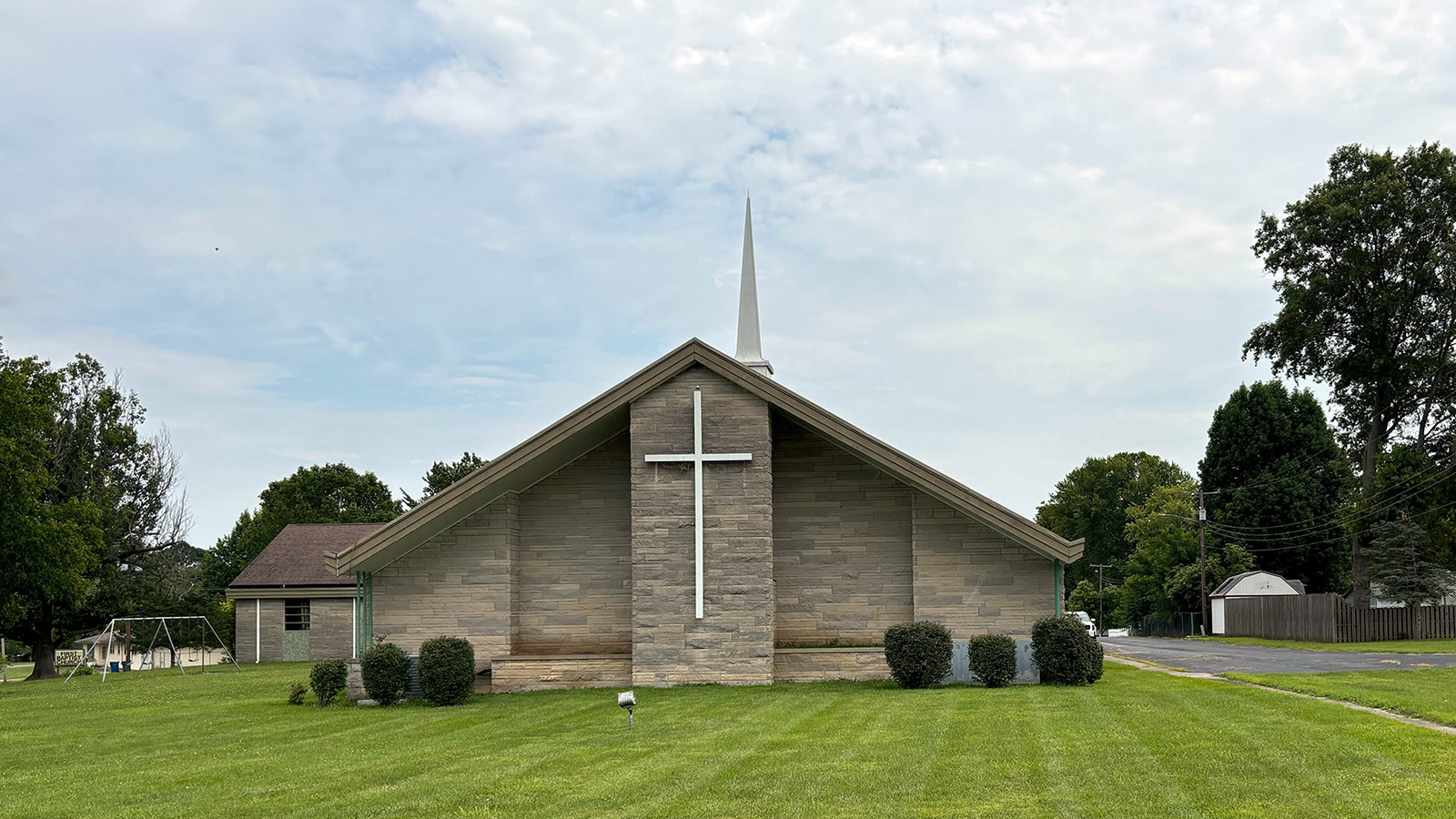
The building of First Baptist Church in Mount Vernon, Ill., is now owned by Corem Deo Classical School. (RNS photo/Bob Smietana)
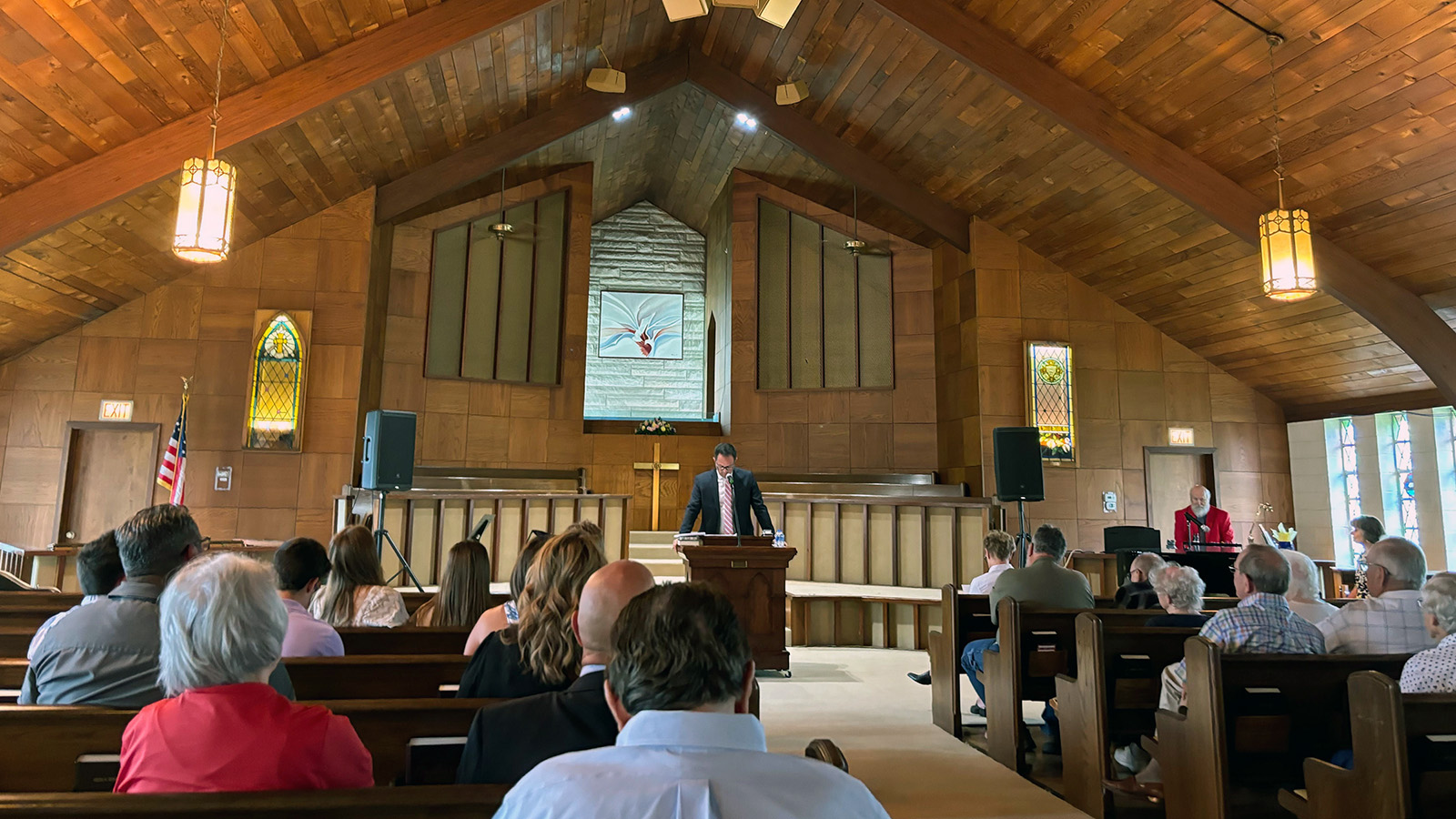
“There is a time for everything,” Ryan Burge, pastor of First Baptist, told his congregation on July 21 as they gathered for the church’s final worship service, reading from the book of Ecclesiastes. “A time for birth and a time for death. A time to build up and a time to tear down.”
For First Baptist, time had run out.
“After being a fixture of Mount Vernon for 156 years, First Baptist Church will no longer exist in the very near future,” Burge told the three-dozen or so worshippers. “And we are all deeply grieved for that moment. It will change our lives, in both big and small ways in the days and weeks to come.”
The church’s closing was made official a few minutes later during a brief congregational meeting after the service, when church members voted to close as of Aug. 1. It was a decision that followed years of slow decline.
Years of slow decline
In the late 1990s, the church had about 170 members, down from more than 600 members in the 1960s but still a going concern. By the mid-aughts, when Burge arrived as a 20-something pastor, the church had about 50 members. At closing, there were fewer than 20.
The decline of First Baptist followed a larger pattern among churches in the United States, where the average congregation’s size has shrunk from 137 in 1999 to less than 60 today, according to the Faith Communities Today study. Meanwhile, most people if they attend services go to a larger congregation.
That pattern has played out in Mount Vernon, where small churches like First Baptist have struggled. First Presbyterian Church, for example, shares space with the local Lutheran congregation, while its former building is now a YMCA.
Meanwhile, about a mile south of First Baptist, Central Christian, a non-denominational multi-site congregation, is thriving.
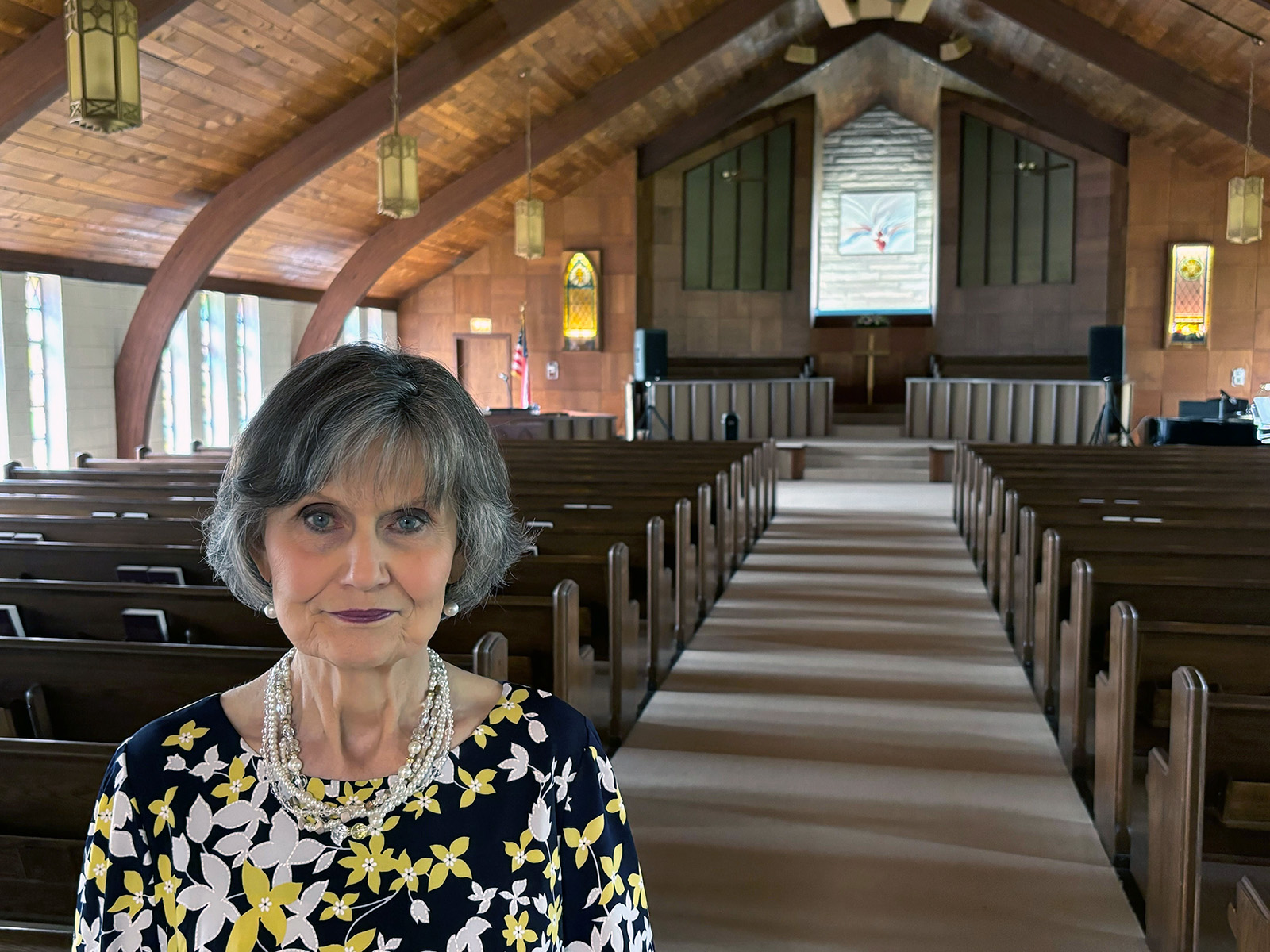
Gail Farnham poses at First Baptist Church, Sunday, July 21, 2024, in Mount Vernon, Ill. (RNS photo/Bob Smietana)
Gail Farnham, who as moderator at First Baptist led the meeting’s vote, said small churches like First Baptist are stuck in a dilemma. They can’t attract people with the same kinds of programs that larger churches offer. As a congregation ages, most of the people they know, if they are interested in going to church, already have a place to worship.
Farnham said she had been preparing for the reality of closing the church for years. In 2017, the church gave its building to a local Christian school, with the caveat that the congregation could still meet in the building for worship. That decision, she said, gave the church a few more years of life. It also ensured the building would still be used for ministry even after First Baptist was closed.
She was pleased to see old friends show up for the church’s last service and the congregation’s last time together.
“I don’t feel sad right now,” said the 80-year-old Farnham, who first came to First Baptist, which is part of the American Baptist Churches USA, with her family when she was about 5 years old. “I just feel like it’s happening the way it should happen.”
Many more churches likely will follow
Tens of thousands of local congregations like First Baptist are likely to close over the next few decades if current trends continue. Their passing will go unnoticed, said Burge, a political science professor at Eastern Illinois University who studies the changing religious landscape.
Burge said that even as the congregation at First Baptist shrank, members were still active in serving their community. From 2008 to 2023, the church provided nearly 55,000 lunches for local schools, with elderly members showing up to volunteer to fill the lunch bags. That dedication renewed his faith, said Burge.
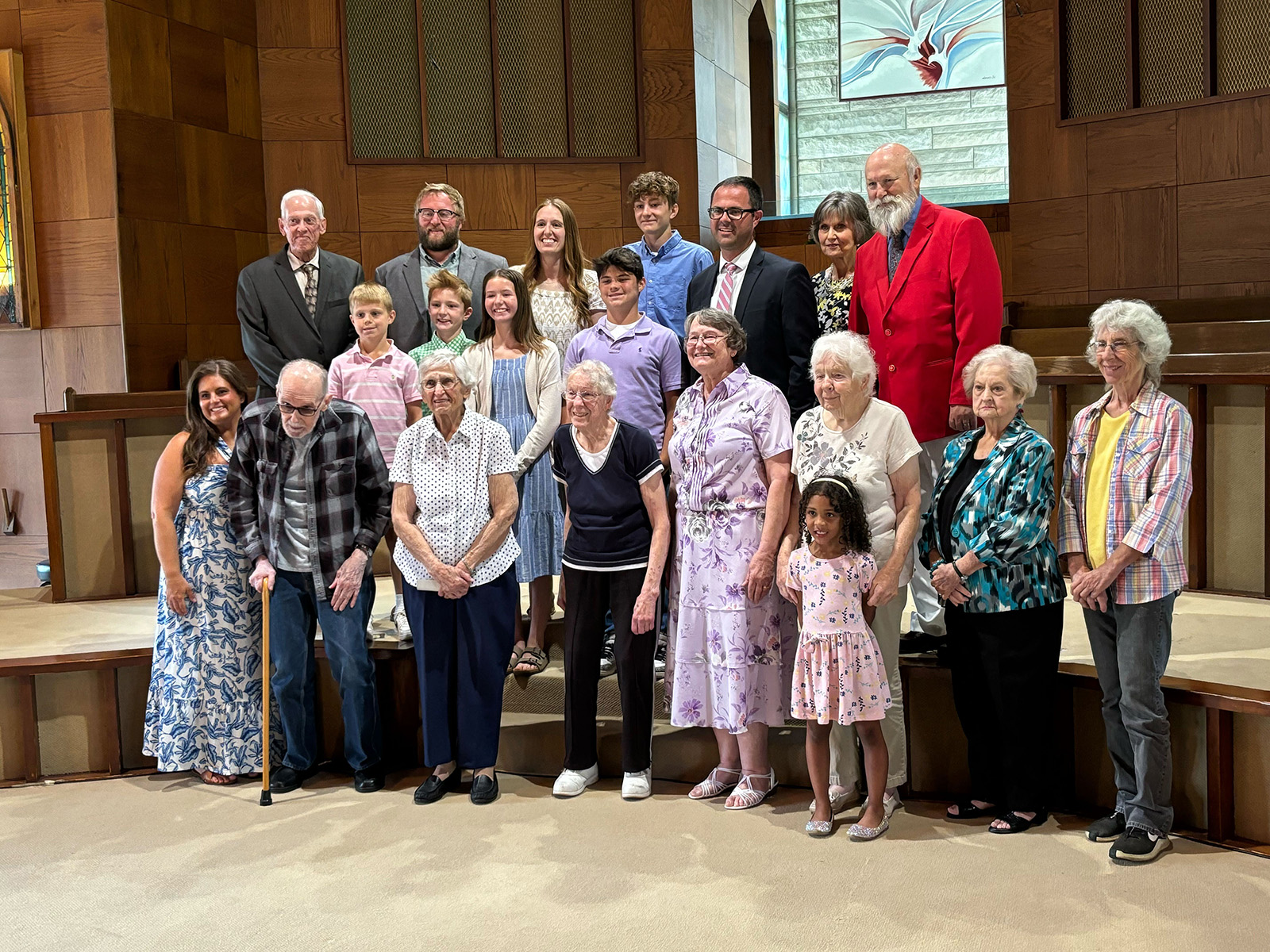
Members of First Baptist Church pose together for a photo after voting to close the church, Sunday, July 21, 2024, in Mount Vernon, Ill. (RNS photo/Bob Smietana)
“When I believed in God the most is when the two dozen people assembled [here] heard about the idea of the Brown Bag Program and did not hesitate to get involved,” he said in his final sermon,“when I saw members who struggled to stand do everything that they could to help pack those bags; when people gave over and above their tithe to make sure that we always had enough items to feed those hungry kids.”
Burge has long championed the importance of organized religion, for both its spiritual and social benefits. Churches, he argues, host food pantries and shelters, volunteer for disaster relief and provide small acts of kindness that make the world less awful. They care for one another when life gets hard.
That’s something he experienced firsthand growing up. His family struggled to make ends meet, and he recalls boxes of groceries showing up on the family’s porch, provided by members of their church who wanted to lend a hand.
Without that care, he wonders if his family would have made it through those hard times.
“That’s what kept me in religion,” he said in an interview the day before the church’s last service. “There are all these small kindnesses I saw for me and my family. I want to do that for other people.”
Pastor Ryan Burge speaks during the final worship service at First Baptist Church, Sunday, July 21, 2024, in Mount Vernon, Ill. (RNS photo/Bob Smietana)
In his last sermon, Burge recounted when a friend told him that First Baptist was lucky to have him as pastor. But his friend was wrong, said Burge, adding that he and his family had received more than they gave in the love and kindness of church members.
He mentioned the church’s kindness, in big and small ways—like the meals that showed up after the birth of his children or the time the church paid his family’s health insurance when he was laid off during budget cuts at the university back in 2016. He was later hired back.
The church didn’t hesitate to help, he said. Burge said that kind of kindness and community can be found at churches around the country—and can’t be easily replaced.
Ministry not wasted
In his sermon, Burge—who came to First Baptist as a 20-something graduate student and has stayed for nearly 18 years—said the church’s ministry was not wasted, and its legacy would live on.
“It was all worth it,” he told the remaining congregants.
Farnham said the church was grateful that Burge had stayed as their pastor. And they are proud of all he has accomplished.
“He is like one of my grandkids,” she said.
Lisa Hayse, who grew up in the church, said the congregation’s legacy will live on in the memories of people who worshipped there and in students at the Corem Deo Classical School, which now owns the building.
“There will still be hymns sung here,” said Hayse, who now teaches kindergarten at Corem Deo. “There will still be singing to praise the Lord in that sanctuary. It won’t stop.”
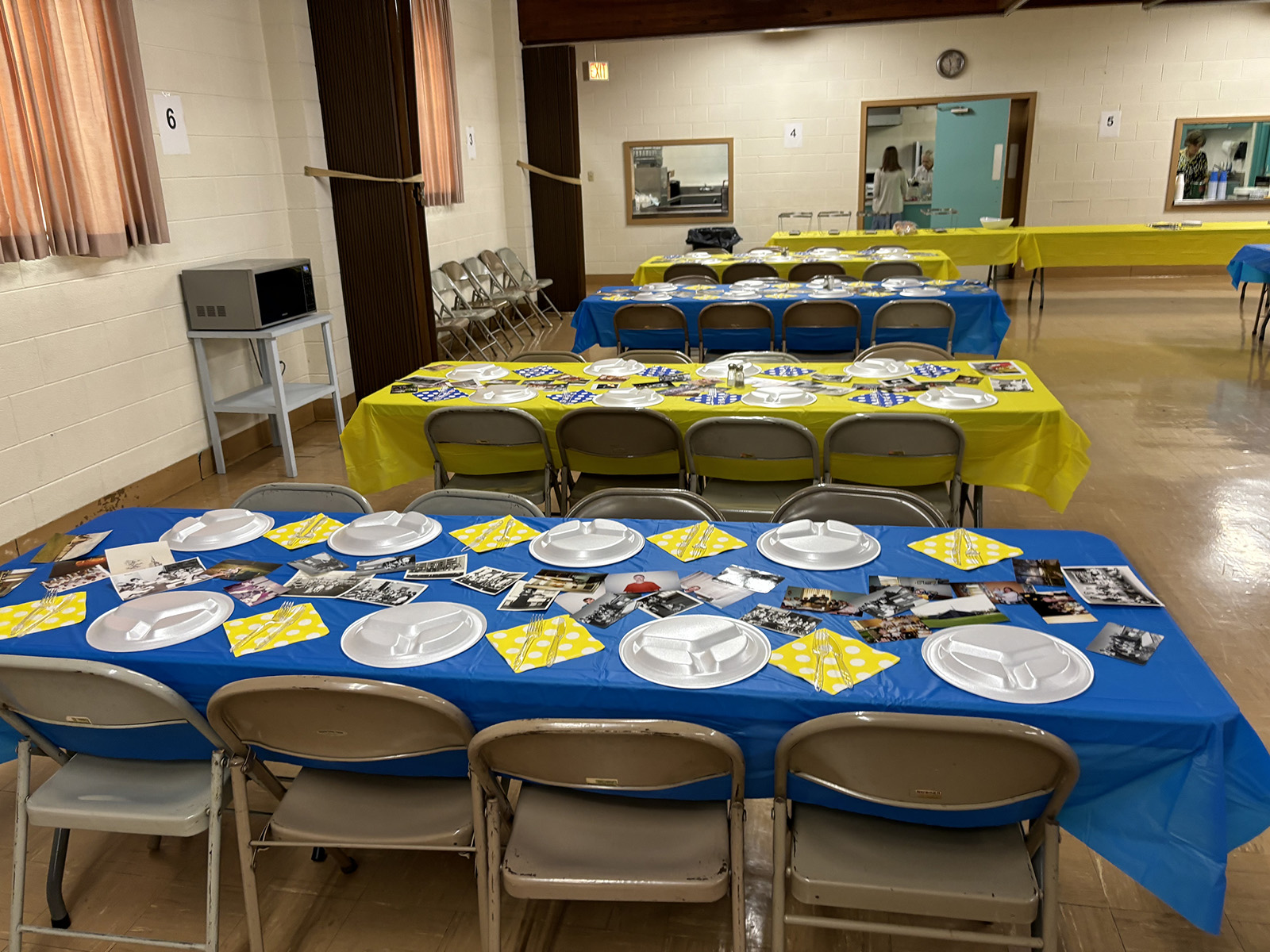
The fellowship hall following the final worship service at First Baptist Church, Sunday, July 21, 2024, in Mount Vernon, Ill. (RNS photo/Bob Smietana)
Standing in the church’s fellowship hall—where church members and friends looked at old photos and memorabilia from the congregation’s history and ate pulled pork, mac and cheese and salad, washed down with lemonade and iced tea—Hayse recalled the days when the church’s pews were packed and Sunday school rooms were filled with the laughter of children.
At Corem Deo, she teaches in the classroom where she learned Bible stories as a preschooler. Hayse said her late father had long hoped the church would once again be filled with children. That hope has been realized, she said.
Though the church is closing, the friendships between church members will remain. Farnham plans to send out updates to church members in the coming months and hopes church members will still find time to meet up.
“We are not done with each other,” she said.
Active Christians value civic responsibility, study shows
July 30, 2024
PHILADELPHIA (BP)—Christians engaged in Scripture place the highest premiums on civic advocacy and engagement, the American Bible Society said in its latest release from the 2024 State of the Bible.
Falling in a presidential election year, the study shows Scripture-engaged Christians place more importance than others on being aware of civic and government issues, advocating for civic and government policies and submitting to government leaders.
Specifically, 66 percent of Scripture-engaged Christians said it is important or very important to maintain awareness of civic and government issues, 48 percent placed the same importance on advocating for civic and government policies, and 42 percent said the same of submitting to government leaders.
“On every point—awareness, advocacy and submission—the Scripture-engaged are far more apt to tout the importance of civic responsibility,” researchers stated, outpacing those described as Bible-disengaged and those in the “movable middle,” a group somewhat engaged in and considered more apt to embrace Scripture.
“We see little difference between the movable middle and the Bible-disengaged on awareness and advocacy, but the Scripture-engaged clearly place a higher value on these aspects of citizenship.”
But the Scripture-engaged, considered the most committed of all Christians, still rank the importance of advocacy and submission below awareness on the study’s seven-point scale of importance, with only awareness ranking above 50 percent.
2024 State of the Bible, American Bible Society
Focus on ‘Love in Action’
In the 2024 report’s fourth chapter, released July 11, researchers focused on “Love in Action,” tabulating the importance of several aspects of the biblical command to love one’s neighbor (Matthew 22:39). Researchers reported on perspectives rather than actual activity.
Researchers invoked the election year in explaining a three-year decline among practicing Christians in the importance of welcoming immigrants, befriending people of other races and caring for the environment.
“The political climate certainly affects the responses here. Our survey presents the issues in a few words, without further definition,” researchers wrote. “Respondents will, of course, add their own context—for instance, whether the immigration is legal or illegal. With that in mind, we find significant movement on these issues in recent years, especially among practicing Christians.”
Among practicing Christians, the importance of welcoming immigrants into communities fell from 4.3 on a six-point scale in 2022, to 3.9 in 2024. While befriending people of other races ranked 4.7 on the scale in 2022, it ranks 4.5 today. Caring for the environment sat at 4.7 in 2022, but ranks 4.6 in 2024.
“All groups are less apt to consider it important to welcome immigrants than they’ve been in previous years, but the decline is greatest among practicing Christians,” researchers stated. “Non-Christians now place more importance on this than practicing Christians do.”
Otherwise, areas of engagement related to loving others have ranked about the same for the past four years, researchers said, including caring for the imprisoned and advocating for those oppressed by society.
An interest in cross-racial engagement that surged after the 2020 death of George Floyd has cooled, researchers found.
“In the next year or two, we saw big companies committing to diversity and communities tearing down statues,” researchers noted. “But our trendline suggests a drop-off of attention in the last two years.”
Still, study participants largely value being good neighbors, despite differing interpretations of who qualifies as a neighbor.
Demographically, loving one’s neighbor is esteemed highest among Boomers, women, the Scripture-engaged, city and suburb dwellers, those in the northeastern U.S., and homeowners.
The University of Chicago’s NORC research center conducted the research Jan. 4-23, compiling findings based on responses from 2,506 online interviews completed among more than 9,900 adults contacted in the nationally representative AmeriSpeak panel.
The American Bible Society will release a chapter of the 2024 study monthly through December. Future releases will focus on the Bible’s intersection with artificial intelligence, well-being, the church, hope, hardship, loneliness and philanthropy.
Faith and Gen Z: Kenzie Eifert
July 30, 2024
It’s tough out there for Gen Z, research shows. Mental and physical health statistics suggest a generation under strain. But some graduates of Texas Baptist universities are bucking these negative trends.
Kenzie Eifert is one Gen Z example of faith’s positive impact.
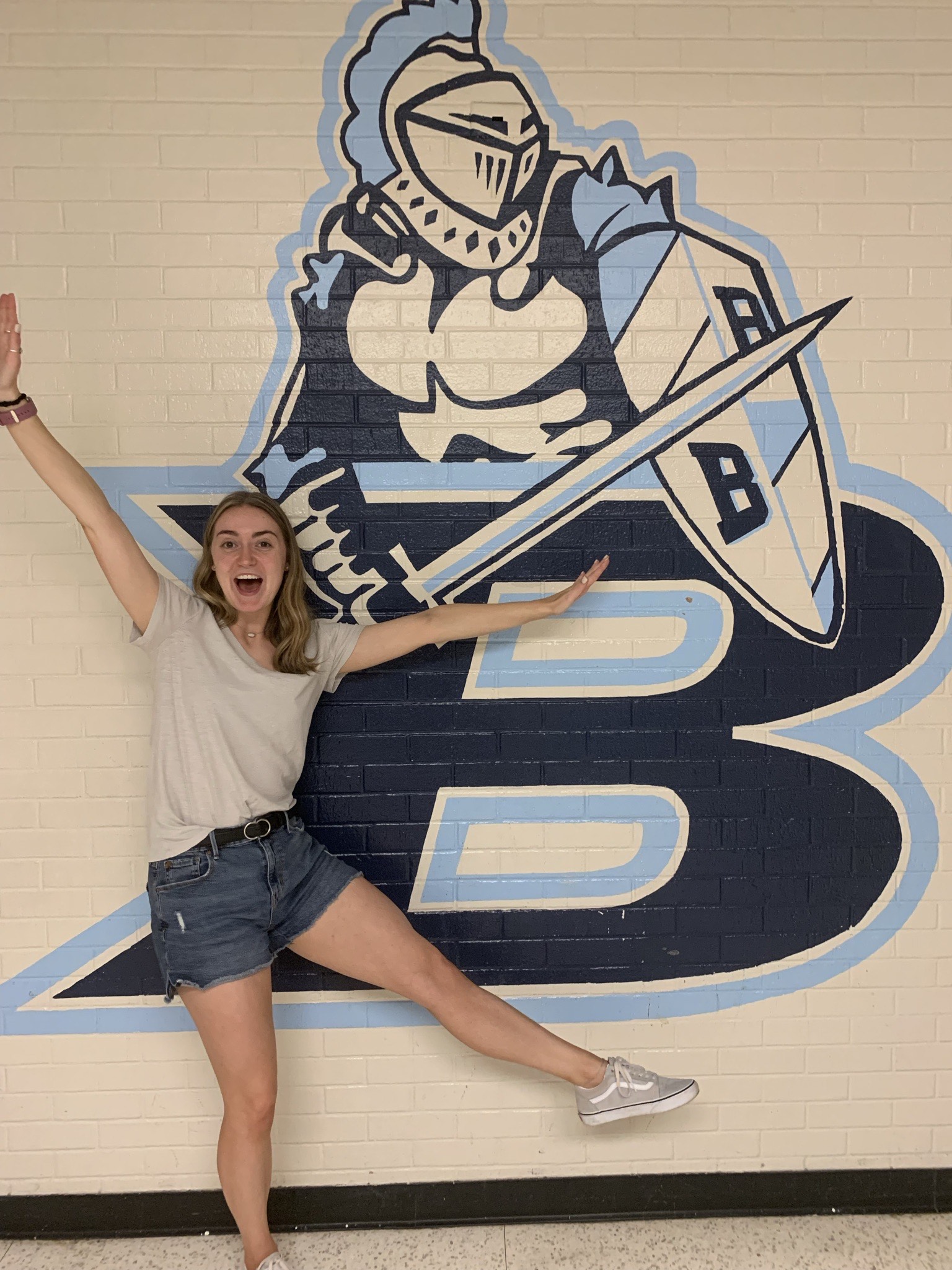
Effect at L.D. Bell High School. (Courtesy photo)
Eifert graduated from Wayland Baptist University in 2021 with a degree in secondary education in English. She currently teaches 10th and 11th grade English at L.D. Bell High School in Hurst.
How she ended up at Wayland “is kind of a funny story,” Eifert explained.
She was a competitive swimmer in high school and planned to continue swimming in college, too. But it was important to her to attend college at a smaller campus that provided a Christ-centered environment.
She got a scholarship to swim at Wayland, but about a month before she was to arrive, Wayland abruptly cancelled the swim program because the coaches were moving to Colorado.
As she’d already been guaranteed a scholarship for swimming, Wayland honored the agreement for all four years. So, Eifert went to Wayland on a swimming scholarship, but didn’t have to swim.
Laughing, she remarked, “God worked all that out for me.”
Although at first it was heartbreaking because “you work so hard to be a college athlete,” she said.
“But looking back at it, I just see how God worked through the whole situation, because I got to really enjoy my college experience and make really great friends, and not have to be so focused on a sport the whole time.”
Blessing in disguise
She wouldn’t have changed it. She ended up meeting her husband, Kyle, and it was a blessing in disguise, Eifert continued.
Eifert arrived at secondary education as her major and career because she comes from a family of teachers and preachers, she said. Almost everyone in her family is either a teacher, preacher or youth pastor.
Growing up, she saw her mom teach elementary school, and she always wanted to be just like her mom. Then in high school, she had an English teacher who was “the most amazing English teacher you could ask for,” Ms. Harvey.
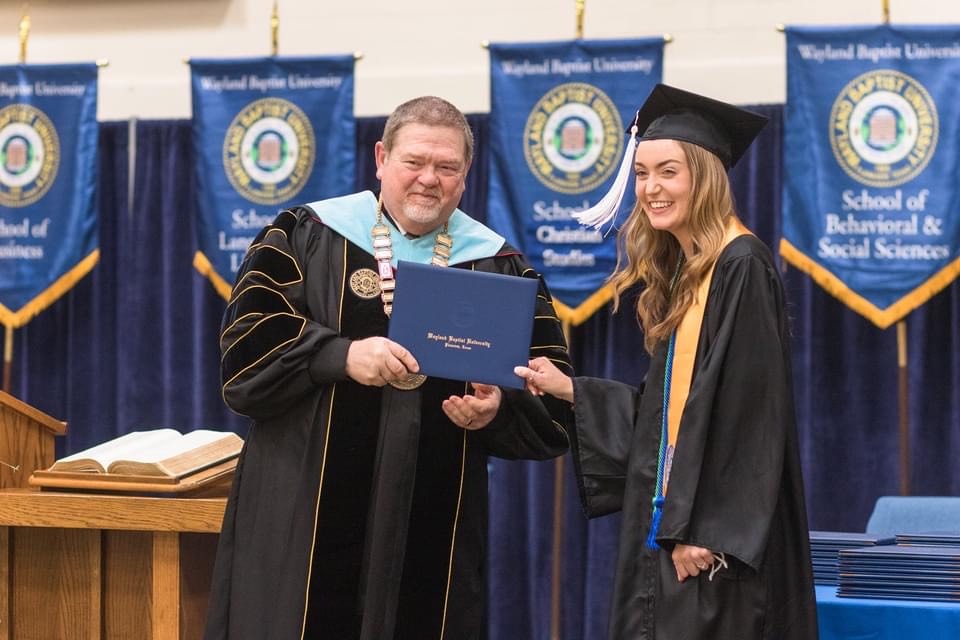
Retired Wayland President Bobby Hall presents Eifert’s degree. (Courtesy photo.)
The rigor of high school English and the in-depth approach of Ms. Harvey drew Eifert’s interest away from elementary toward secondary education. And she decided high school English teacher is what she wanted to be.
COVID-19 interrupted the end of her junior year at Wayland, but the pivot to online classes in the spring of 2020 went remarkably well, she said. Professors were especially helpful during distance learning. And they were easy to contact by Zoom, when needed.
By the fall semester of 2020, students were able to return to campus for in-person classes. Eifert expressed how thankful she was to be back on campus for her senior year.
How she ended up in her current position is “also kind of a funny story,” Eifert said. Her principal, Mr. Belcher, had been principal at the elementary school where her mother taught and Kenzie attended when she was a child.
Eifert remembered her mom talking about how great Mr. Belcher was as a principal, “just because he had high standards, but also in the fact that he was willing to clean up trays in the lunchroom. … He had a servant heart.”
Eifert kept up with Mr. Belcher through the years because of the respect she had for him as a leader. So, when she graduated from college, she reached out to him. He was principal at a junior high at that time, but she was certified to teach middle grades, too.
He showed her around the campus, and they talked about her plans. Her plans were 100 percent to teach in the Hurst-Euless-Bedford school district, she said. She’s a product of the district, her mom and aunt still worked there, and “I loved going through school in H-E-B,” Eifert continued.
Belcher shared with her that he was moving up to high school to L.D. Bell the next year, which “was such a blessing from God. Because, truly, I wanted to teach high school. I didn’t want to teach junior high.”
She would have done it to get her foot in the door and work for Mr. Belcher, Eifert said. But she was thrilled to interview with Belcher at L.D. Bell and get the job. She loves teaching there, even though the other high school in the district is the one she went to.
An added blessing, her mom has now moved up to high school and teaches with her, right across the hall. The staff at L.D. Bell is welcoming, and she loves working with her mother.
“I have thoroughly enjoyed my three years there,” Eifert said.
“Teachers are kind of like police officers in that they have very interesting stories,” Eifert continued.
“It’s always a good profession to be in, because there’s never a dull moment. You’re always on your toes. Your workdays go by fast, and it’s always very rewarding.”
Growing up in a godly home
Eifert grew up in Watauga, at Spring Valley Baptist Church, where she and her husband attend again since moving back to the area. Her grandfather is pastor. Her uncle is youth minister, and her father is associate pastor.
Eifert credits her upbringing in a godly home for shielding her from the hopelessness many in her generation face. While Gen Z may not be known for its optimism, personally, she is a very optimistic person.
Throughout anything, her parents have taught her: “God’s going to take care of you. And you can only control the circumstances and the things that are in your control.
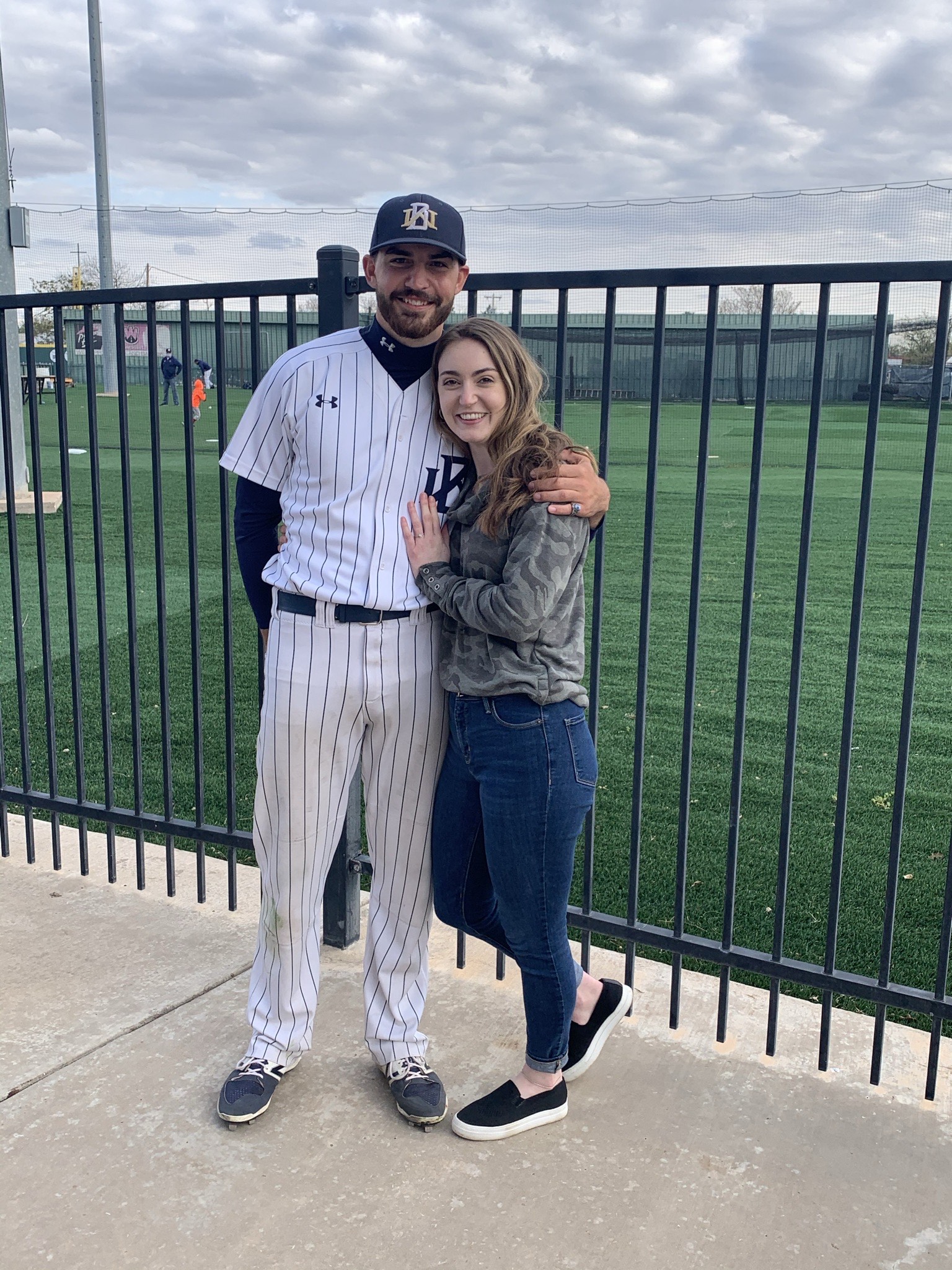
Kenzie and Kyle Eifert. (Courtesy photo)
“And other than that, you just have to put it in God’s hands.”
Throughout her life, she’s seen God work. Not that she’s never had hardships, Eifert said, but things worked out for her in getting into college and having scholarships. Then she was able to go on from college straight into the career she was praying for, which is the exact career she wanted.
Apart from career, she points to God’s hand in her personal life, as well. She met her husband, who she describes as “amazing,” in college at Wayland. They worked through an early change in career for him with grace, and he loves what he’s doing now.
Then six months ago, they had their daughter, Austyn Jane.
“There’s a lot of things in life that are uncertain,” Eifert said, “but the goodness of God is never one of them.”
Throughout her life she’s seen God’s faithfulness, so she’s never worried that he won’t take care of her, no matter what.
Eifert acknowledged it was hard for her in college, though, when swimming for Wayland didn’t work out. It’s one time her faith was challenged, somewhat, because she had prayed so much about swimming in college and had had such a peace about Wayland.
At first, it was disappointing and hard to understand why things turned out the way they did, Eifert noted. But once she got there, she was able to see how God worked in that situation.
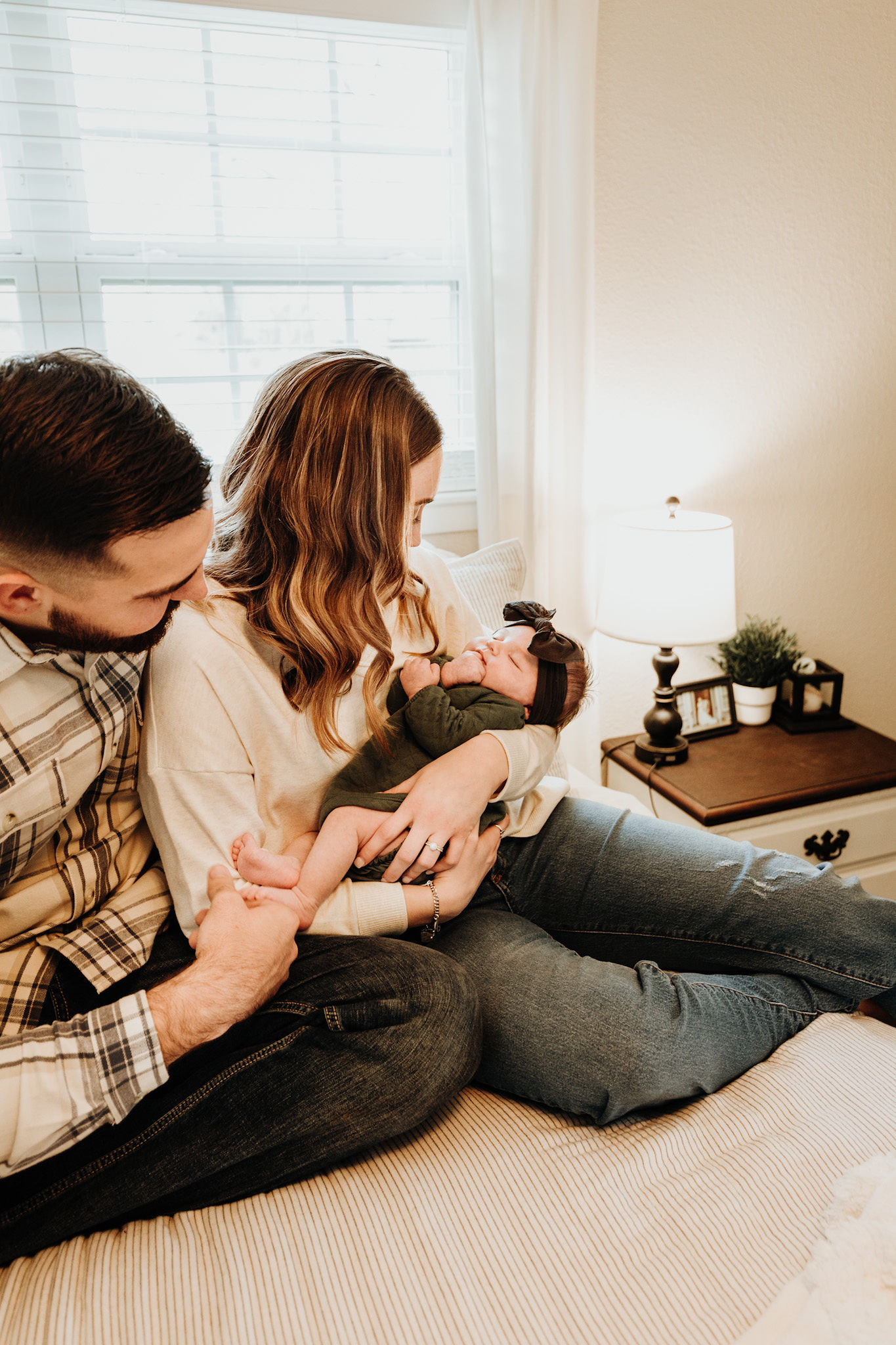
The Eiferts. (Courtesy photo)
She graduated college debt-free, made great friends, and met her husband who she “wouldn’t trade for the world.” She’s glad she trusted God and her belief that he was leading her to Wayland, even with such a big change in plans.
College in Plainview also gave Eifert the opportunity to participate in a faith community not made up of her own family. It was good for her to get to do that, she said, because it helped her take responsibility for growing her own faith.
She was able to serve in her college church, teaching Sunday school just as she had back home. But in having more ownership of her faith, she discovered her relationship with God was only going to be as good as the work she put into it.
She needed to be faithful, Eifert explained. Being at Wayland—where classes included Scripture, professors demonstrated care and prayed for students, and the whole atmosphere was Christ-honoring—supported her independent spiritual growth.
She and her family are happy where they are and would be content to be there for many years, she said.
PARIS (BP)—Disappointed in her performance at the 2021 Olympics in Tokyo, Alison Gibson said goodbye to the sport of diving for good. At least, that was her intention.
Houston-born Alison Gibson will compete at the 2024 Olympic Games in Paris. (Courtesy Photo)
“I felt like I let my country down, let my friends down,” Gibson said. “It was just like a really gut-wrenching feeling.”
She officially retired and began what she considered to be a “normal” life—working, making money, having free time.
But God had other plans for Gibson. And thanks to a phone call from her synchro partner and the counsel of several mentors and friends, Gibson returned to diving.
That decision paid off, as Gibson qualified for the Paris Olympics in the 3-meter springboard competition. This time, she’ll compete in the individual competition.
“I think that’s what the last year of my life has been, really just trusting in God to do the impossible, trusting in God to give me courage to do things I never wanted to ever do again,” she said. “It’s crazy to me that I’m here, and the goodness of God is indescribable and unfathomable.”
‘Leaning into my relationship with God’
Raised in a Christian home, Gibson made a profession of faith and was baptized when she was 7. Though she was a believer, a pivotal moment in her life came during her freshman year of college, when she was struggling with her sport and with her grades. A friend saw the difficulties Gibson was experiencing and helped her think through what she believed and why.
“That’s like my biggest moment of, ‘Hey, this is not just what my parents believed, but this truly, 100 percent is what I believe,’” she said. “It defines the way I act, the way I treat people, the choices that I make. And so, from that moment on until now, I’ve just been really leaning into that, leaning into my relationship with God.”
At her Olympic debut in 2021 in the synchronized 3-meter springboard event in Tokyo, Gibson and her partner Krysta Palmer finished in a disappointing eighth place. Frustration from that performance prompted Gibson’s retirement, until a year ago when Palmer called her.
“I think we can make the Olympic team,” Palmer told her. “You should come back.”
Gibson’s first reaction was negative. Her life was too good, she thought. A return to diving would mean sacrificing money, time and relationships that she didn’t want to sacrifice. In short, Gibson was afraid.
“But her call sparked something in my heart, so I started praying about it,” Gibson said. “And God just kept nudging me, ‘Alison, I have something for you.’”
Things began falling into place for Gibson’s return. Her parents promised to help support her. Her company told her they would let her work part-time. Sponsors emerged to help her financially. She says God gave her the courage to face her fears, and she felt His presence and provision each step of the way.
Using her gifts for God’s glory
Gibson also recognized in her decision-making process that God had gifted her in certain ways, and she wanted to be faithful in using those gifts for his glory.
“God has a purpose in this, and I need to let go of this fear or this shame or these lies that I’m not good enough,” she said.
She has seen and felt the encouragement of family and friends. Her parents are members of Austin Baptist Church in Austin, and Gibson said the church has been incredibly supportive of her Olympic journey.
Jonathan Spencer, the church’s pastor, said Gibson has become part of the church’s extended family. She has shared her testimony in Bible study classes and was a featured speaker this year at a community Independence Day event the church hosted.
“She’s gotten a lot of prayer support from our church, from her parents’ Bible study class really bringing her into that support system,” Spencer said. “She’s had prayer cards that have been written for her and even will be sent to her in Paris.”
In her second Olympic experience, Gibson has two goals. Her first is to compete well and pour her heart and soul into her effort regardless of the outcome. Her second goal is to use her platform to raise awareness about a ministry that means a lot to her—Missions of Hope International, a Christian organization in Kenya that provides physical, emotional and spiritual support to impoverished children and their families.
Gibson sponsors a girl through the ministry, and she said there are 240 children at the Pangani School run by Missions of Hope International who are unsponsored. Her goal is for all 240 of those children to have sponsors.
“I’ve gotten medals in my life. I’ve gotten trophies. I’ve gotten awards,” Gibson said. “All that stuff fades. The medal gets dusty on a shelf, and the band unravels, and people forget about you, and people forget about your accomplishments. But what’s not forgotten is the impact that you have on someone’s life that can also impact future generations.”
The 2024 Olympic Games begin July 26. The women’s 3m springboard preliminary is scheduled for Wednesday, Aug. 7.
Tim Ellsworth is associate vice president for university communications at Union University in Jackson, Tenn.
Archeologist illuminates Scripture with science
July 30, 2024
WAXAHACHIE—Churches have been guilty of teaching half-truths, a real-life Indiana Jones told First Baptist Church in Waxahachie. But archeology can help clarify the intended meaning of some scriptural texts.
Scott Stripling, provost and professor of biblical archaeology and church history at The Bible Seminary in Katy, directs the Associates for Biblical Research’s excavations—the largest archeological dig in Israel—at the ancient region of Shiloh. Shiloh is where the Ark of the Covenant was kept until David brought it to Jerusalem.
Churches don’t mean to teach incomplete understandings of Scripture, Stripling said. However, the Bible was written in primarily Hebrew and Greek, and now American Christians read it in English. So, sometimes some of the meaning gets lost, he noted.
He highlighted biblical texts to consider alongside the context he has gained through archeological research—and a basic understanding of the flora and fauna of the Holy Land—to understand better what might have been meant in the passages.
A tale of two trees
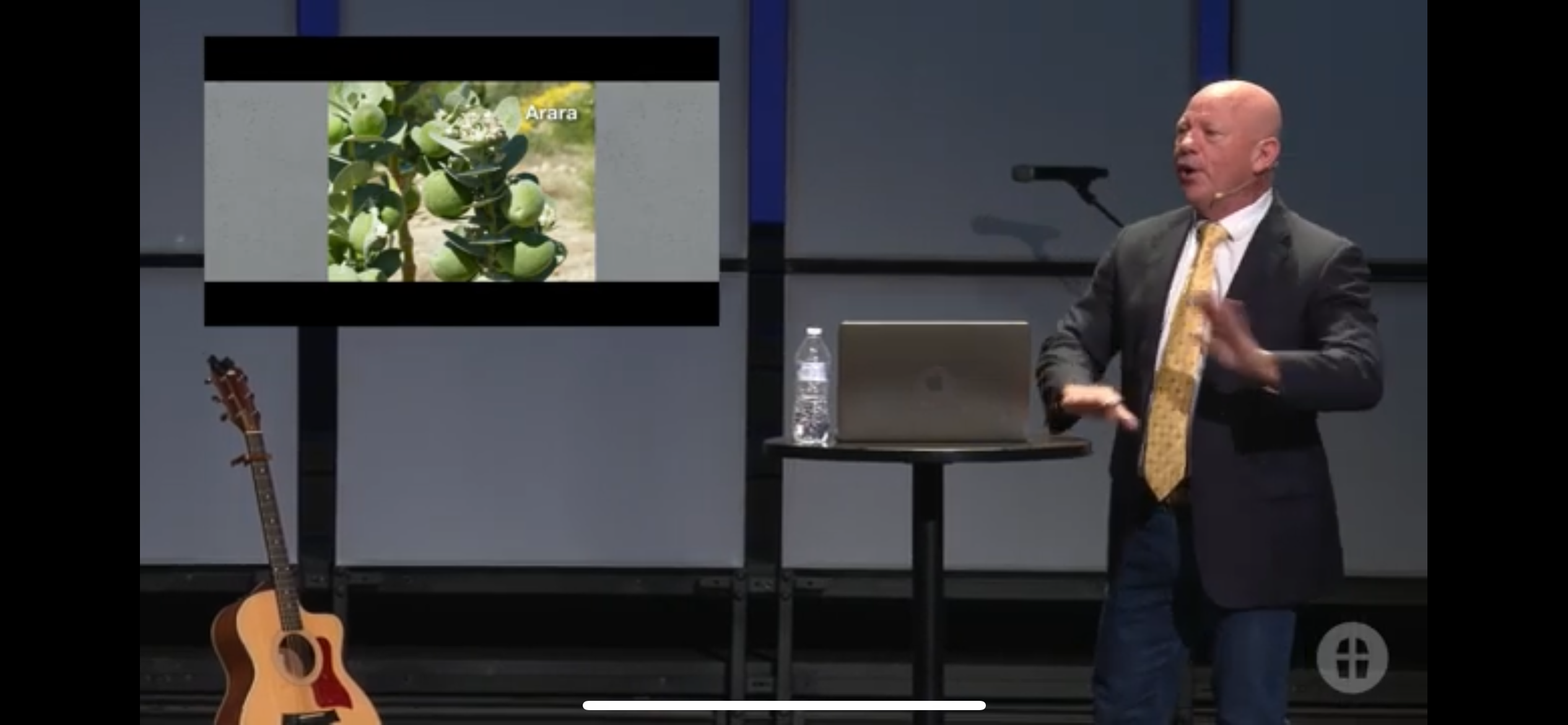
Stripling describes the arara plant in Jeremiah 17:6. (Screen Grab)
Jeremiah 17:6-8 is a tale of two trees, Stripling explained. One, which is not growing with God, is not capable of seeing the good and never will realize it’s thriving even if it is. The other, with God, grows healthy and strong. One is “a tree of death” and the other “a tree of life,” he said.
“And we get to choose from which tree we eat,” he continued.
But English translations of the Bible have a word in verse 6 translated as “bush,” “tree” or “shrub,” when the Hebrew word is “arara.” An arara is not just any bush or shrub, though. It is a specific bush, abundant in the region.
The fruit of the arara looks pretty on the outside, like a cross between a mango and a grapefruit, but when squeezed, it turns to dust and a milky sap of poison, he said. The Bedouin people still use the sap to make their arrows more deadly to hunt hyena, Stripling said.
“Jeremiah wasn’t just saying you’ll be any shrub, or any bush, or any tree, if you turn your heart away from the Lord. You’re going to be this specific shrub, right here, this bush, an arara.”
He explained Jeremiah’s audience would have known what he meant and thought of the arara, which looks delicious, but when squeezed contains nothing but dust and death.
“Your outward appearance has nothing to do with your standing with God,” Stripling continued. Jeremiah makes it clear when “we begin to think it does, we are the ones that have turned our hearts away from the Lord.”
Stripling contrasted the death plant, arara, to the pomegranate, also prolific in the area, which his team has verified played a prominent role through their excavations in the location which they believe to be the Holy of Holies, where the Ark of the Covenant was kept for three centuries.
Scripture speaks of attaching pomegranates to the robes of the priests who entered, and ceramic miniature pomegranate fruits are among the artifacts recovered there.
Only pomegranates, not figs, grapes or dates, were allowed in the Holy of Holies.
Stripling gave some ideas about why that might be, but concluded the pomegranate represented a life-giving tree to Jeremiah’s audience. It represented God’s ability to breathe on a person and “make you a productive member of the kingdom of God. Do we eat from the tree of death or of the tree of life? It all depends on the inclination of our hearts,” Stripling said.
Archeology doesn’t change Scripture in any way. Rather, Stripling stated: “What it does is it illuminates it. It sets it into a context so that we understand it here and now, the way that they understood it then and there.”
Silver coins
First century silver shekel featuring the pagan god Melqor. (Screen Grab)
The archeologist turned to a familiar parable of Jesus, in Luke 15:8-10, about a woman and her 10 silver coins. He pointed out the significance of the coins being silver, a detail often overlooked because the value of the silver coins is not well understood in today’s context.
The 10 silver coins demonstrate she’s a woman of wealth, each coin being worth about two week’s income.
“So, that means she’s got five months of income, on hand, in the bank, so to speak. That’s what financial planners tell you today, you should have at all times in the bank,” in case you run into an unexpected financial challenge.
Bronze coins were ubiquitous. Stripling said 99.5 percent of the coins they find daily in their excavations are bronze. But these silver coins were quite rare, making up, along with gold coins, the other 0.5 percent.
As verse 10 indicates, losing one and finding it again was cause for great celebration.
The point of the parable is this: “You are the coin. You’re the thing of great value that the Son of Man is searching for, because he wants a relationship with you.”
Jesus uses this story—along with the parable of the shepherd leaving 99 sheep to find the one that is lost, before it, and the prodigal son, after it—to demonstrate there is no acceptable amount of “shrinkage” or “lost collateral or inventory” in the business God is running, Stripling said.
Shedding further archeological light on these silver coins, or shekels, Stripling highlighted their high level of purity at 91 percent, when the average purity of silver in the first century was 80 percent.
He explained these coins were the only currency accepted to pay the Temple tax, which is why there were money changers at the Temple.
The problem with these coins being the currency of the Temple, Stripling said, is that on them was the image of the Roman god Melqart. “A pagan, Roman god adorns the only coin accepted in the Jerusalem Temple in the first century in the time of Jesus.”
The religious leaders were willing to overlook the commandment against images because it was 91 percent silver, Stripling said. “No wonder Jesus had a problem with the money changers.”
He cares not if a church “sells tacos in the foyer,” but “if you sacrifice your heartfelt beliefs for economic gain. And that’s what was going on in the first century.”
Stripling also discussed Matthew 19:23 and Luke 7:36-38, challenging common beliefs about the passages with archeological discoveries.
A popular speaker and author, Stripling serves on the board of directors for the Near East Archaeological Society. His books are available on Amazon, and he provided archeological commentary for a forthcoming reprint of the Open Study Bible.
Faith and Gen Z: Sarah Potts
July 30, 2024
Statistics on Gen Z paint a pessimistic picture. Hope is far down the list of emotions this young generation is feeling, as the recent American Opportunity Survey revealed.
But some Gen Z graduates of Texas Baptist colleges tell a more optimistic story. Take Sarah Potts, 2022 graduate of University of Mary Hardin-Baylor, for example.
Sarah Potts (Courtesy Photo)
Potts was all set to attend Texas Tech University, where her parents went, when she graduated high school.
When her mom insisted she needed to tour some other schools to see what else was out there, Potts said she’d never even heard of the University of Mary Hardin-Baylor University.
But a family friend’s daughter went to UMHB and loved it. So, Sarah’s mom wanted her to go check it out.
Reluctance becomes joy
Potts said she had a bad attitude about it on the way on the trip to Belton from Dallas.
“I was saying: ‘I don’t want to go. I don’t want to do this. I’m going to Tech,’” she recalled.
But when she arrived at UMHB, she felt such a peace from the Lord. She and her mom had a great tour of the campus.
When they left, she said she “was giving her mom the silent treatment. …You know how kids never want to admit their parents are right?”
Her mom was concerned and asked her if she was OK. The only response she could give was: “Mom, I loved it. I hate that you told me to do this and then this is where I want to go.”
But they had a good laugh, and Potts said she filled out the application immediately after the visit in the car as they were leaving.
“It was totally the Lord and just my mom listening to the Lord—telling me to go other places and experience other things.”
“It was the literal best three years of my life,” she said, when it hadn’t even been on her radar.
Potts graduated in May of 2022, a year early, with a bachelor’s degree in health sciences with a pre-occupational therapy track.
She came to this career path her senior year in high school when she was able to participate in a health practicum program to explore various health care opportunities. Prior to this program, she thought she was interested in becoming a nurse.
But in shadowing a nurse, she discovered, “Man, this takes a special kind of person, and I do not think that that is for me.”
Her cousin is an occupational therapist, though. In talking with her and researching the field, Potts began to see how “cool” it would be to help people who had lost some type of function be able to regain independence and quality of life.
“I think there’s a lot of ways that I can incorporate my faith into that,” she said, “just pouring into them how loved they are and how much they matter.
“Coming back from diseases is hard. And people sometimes have a hard time coping with the fact that their life might look different, but it doesn’t change the worth of their life.”
Occupational therapy a perfect fit
Potts saw occupational therapy as being perfect for her to be able to love on people—help them realize both who they are in Christ and who they are as a person being able to regain function and independence in life.
She is now at the University of Texas Medical Branch at Galveston, where she is two years into a three-year graduate program to complete a Doctor of Occupational Therapy degree.
Potts leading in a worship service at UMHB ‘Revival.’ (Courtesy Photo)
“The Lord has really been funny these past few years,” Potts said. At UMHB she had so many opportunities to talk about and learn about service. Service is at the heart of what Christians do, Potts believes.
She understood the importance of finding where the Lord is working and joining in that work several years ago. But she didn’t really think it was for her vocationally. The last couple of years, though, God has been impressing upon her a strong desire to serve overseas.
When she completes her degrees, she plans to work stateside for a little bit, but she’s in the process of working with a company with the aim of serving overseas.
If so, Potts said she hopes to use her degree and share medical skills with people who need occupational therapy but might not be able to afford it or have those resources where they live.
God has helped her to see she is at UT Medical Branch for a reason, but he has more for her when she’s done.
Her faith has been so important to her, Potts said, not just now, but also when she was an undergraduate. It was “very, very hard,” she said, when she always had been close to her family to adjust to being away.
“But the Lord was so gracious in allowing me to just feel his presence and the peace of knowing that even when I felt alone, in those first few months at school, I was never really alone,” she continued.
“That’s just been true every step of the way—even moving to Galveston and being five hours away from my family.”
Potts described how God answered her prayer for friends at UMHB in a big way, as she developed great friendships and relationships with peers and faculty there.
Clinging to the Lord
UT Medical Branch is very secular, she explained. There’s not a lot of resources there for getting involved with Christian ministries. In contrast, professors at UMHB were Christian, so Christianity bled into everything students were learning.
It was a bit of a shock when she first started her graduate classes, going from a conservative Baptist school to a not-so-conservative school. Having the ability to know the Lord placed her there, and it’s a great mission field right now has been a help, Potts said.
Potts and fellow UMHB graduates. (Courtesy Photo)
And she’s able to lean on those solid Christian friendships she built at UMHB, counting on those friends to support her in the medical school environment she’s now in.
Potts stated, in the Lord’s kindness, she’d never had to worry about the financial concerns of many others of her generation. Her college was paid for through an inheritance from her grandparents—though some concerns have cropped up in graduate school.
Through mild worries about how she’s going to pay back medical school loans, she trusts the Lord will continue to provide as he always has and “that’s what I cling to,” she said.
She thanks God for people at UMHB like Jason Palmer, dean of spiritual life and university chaplain, and Tiffany Horton, director of global outreach, who made a huge impact on her spiritual growth while she was there.
They and her college minister at Temple Bible Church, Shannon Sword, all helped her wrestle with her faith and ask hard questions while providing her with truth from Scripture.
She’s active in Coastal Community Church on the island, and she’s excited about how God is using her now in graduate school and how he will continue to use her after she graduates.
Churchgoers see public perception of Christians souring
July 30, 2024
BRENTWOOD, Tenn.—Most churchgoers believe Christians have a good reputation with Americans in general, but they worry those feelings are starting to sour.
A Lifeway Research study finds 53 percent of U.S. Protestant churchgoers say most Americans have a positive perception of Christians. Two in 5 (40 percent) disagree, and 8 percent aren’t sure.
More consensus exists on the direction public sentiment is headed. Around 7 in 10 (69 percent) believe people’s perceptions of Christians in the U.S. are getting worse, while 21 percent disagree. Another 10 percent say they aren’t sure.
“The percentage of churchgoers who believe Americans view Christians positively is remarkably close to a recent national poll indicating 53 percent of Americans view Christianity favorably,” said Scott McConnell, executive director of Lifeway Research.
“Though a majority agree, fewer than 1 in 6 churchgoers is strongly convinced most Americans view Christians positively.”
Differences according to demography
With only a slight majority believing Christians are viewed favorably in the United States, many demographic groups have differing outlooks on the current reality.
Men are more likely than women to agree most Americans have a positive perception of Christians (56 percent v. 49 percent). Additionally, African Americans (66 percent) and Hispanics (65 percent) are more likely to agree than whites (48 percent) and people of other ethnicities (44 percent).
Restorationist movement churchgoers (61 percent) and Baptists (57 percent) are more likely than those who attend a nondenominational church (45 percent) to agree most Americans view Christians positively.
Churchgoers who aren’t evangelicals by belief (57 percent) are also more likely than those with evangelical beliefs (49 percent) to agree.
On the other side, churchgoers 65 and older (46 percent) are among the most likely to disagree. Also, those who attend a worship service four times or more a month (43 percent) are more likely than those who attend one to three times (36 percent) to disagree that most Americans have a positive perception of Christians.
While 7 in 10 churchgoers believe the public perception of Christians is worsening in the United States, some groups are more likely than others to see a downward trajectory.
Other ethnicities (84 percent) are the most likely to say people’s perceptions of Christians in the United States are getting worse, while whites (71 percent) are more likely to agree than Hispanics (61 percent) or African Americans (60 percent).
Baptists (73 percent) and nondenominational churchgoers (73 percent) are more likely to agree than Lutherans (61 percent). Also, those who attend a worship service four times a month or more (72 percent) are more likely than those who attend less frequently (65 percent) to believe the public opinion of Christians is declining.
Those with evangelical beliefs (77 percent) are more likely than those without such beliefs (61 percent) to agree.
“Surely the small growth in other religions in the U.S. and large numbers of Americans that once called themselves Christians but no longer do impacted churchgoer perceptions,” McConnell said. “Not all who left the faith have ill feelings toward Christianity, but indifference is definitely a worse perception than once identifying as one.”
Where does the blame rest?
Those who believe the public perception of Christians in the United States is worsening say responsibility for the decline belongs to both Christians and the rest of America.
Out of seven options that may have contributed to the decline, 75 percent of churchgoers point to at least one of the two options holding Americans responsible, and 71 percent choose at least one of the five options placing responsibility on Christians.
Most blame both, as 53 percent point to at least one option that places responsibility on Americans and at least one option that faults Christians.
Two in 3 churchgoers (66 percent) say a reason the public perception of Christians is worsening is because fewer Americans believe faith in God is relevant.
Around 2 in 5 point to Christians not acting any different than those who aren’t Christians (45 percent), more Americans rejecting Christianity because it claims to be the only way (40 percent) and Christians often looking down on those who aren’t Christians (38 percent).
Fewer claim the drop should be credited to Christians often treating each other poorly in person (29 percent), Christians often treating each other poorly on social media (25 percent) and Christians being too political (22 percent). Small percentages say none of these options (4 percent) or they aren’t sure (3 percent).
“Many churchgoers admit Christians are getting in the way of the message of Jesus Christ,” McConnell said. “But if the only reason Christians are not accepted is because people reject the message of Jesus Christ, Christians have already chosen whose approval they desire.”
Frequent church attendees are among the most likely to blame Americans. Those who attend a worship service four times or more a month are more likely than those who attend less often to say Christians’ worsening public perception is due at least in part to fewer Americans believing faith in God is relevant (70 percent) and more Americans rejecting Christianity because it claims to be the only way (44 percent).
Those who attend four times a month or more are less likely than other churchgoers to say the declining perception is due to Christians looking down on those who aren’t Christian (32 percent) and Christians being too political (19 percent).
Churchgoers in the South are among the most likely to point to Christians treating each other poorly on social media (28 percent).
White Americans are among the least likely to place blame on Christians being too political (21 percent).
White Americans (70 percent) and those of other ethnicities (68 percent) are more likely than African Americans (49 percent) to say a reason for the declining reputation is that fewer Americans believe faith in God is relevant.
For their part, African Americans (47 percent) are more likely than whites (34 percent) to point to Christians often looking down on those who are not Christians.
Churchgoers with evangelical beliefs are more likely than other churchgoers to say the decline is because fewer Americans believe faith in God is relevant (71 percent v. 59 percent) or because Christians don’t act any different than those who are not Christians (48 percent v. 40 percent).
But those who hold evangelical beliefs are less likely to point to Christians often looking down on those who are not Christians (32 percent v. 45 percent) and Christians being too political (17 percent v. 29 percent).
The online survey of American Protestant churchgoers was conducted Sept. 19-29, 2023. The completed sample is 1,008 surveys, providing 95 percent confidence the sampling error from the panel does not exceed plus or minus 3.2 percent. Margins of error are higher in sub-groups.



 Specifically, 66 percent of Scripture-engaged Christians said it is important or very important to maintain awareness of civic and government issues, 48 percent placed the same importance on advocating for civic and government policies, and 42 percent said the same of submitting to government leaders.