Music into manna: symphony concert benefits church’s hunger ministry

FORT WORTH (ABP) — A free concert at a North Texas church turned into a blessing for the city's hungry and homeless.

When members of the Fort Worth Symphony Orchestra approached Broadway Baptist Church about staging a concert as a gift to the community, it sounded like a good idea. Then the musicians added that they wanted the event to benefit the church's Agape Meal ministry.

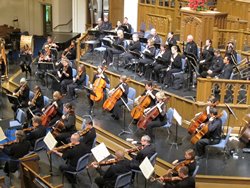
More than 850 persons attended the benefit concert by musicians of the Fort Worth Symphony Orchestra.

An offering during the 90-minute concert in Broadway's sanctuary on Nov. 16 raised $5,600 for the Agape Meal. That's enough to cover the cost of about seven weeks of meals served every Thursday evening in the church's fellowship hall, said Brent Beasley, senior pastor.

Beasley said linking good music and a good cause complemented the church's mission. He quoted French philosopher Albert Camus, who said: "In this world there is beauty, and there are the humiliated. And we must try, hard as it is, not to be unfaithful to one or the other."

"At Broadway, we see our mission as trying to hold together both the love and worship of God through the beauty of the arts and the love and care for the poor and broken who are our neighbors," the pastor said. "This was a great chance to be faithful to beauty and the broken in the same event."

One of several community ministries supported by the church's partnership with Buckner International, the Agape Meal has dished up a hot meal once a week for more than 15 years. Meals are served family style on white cloth-covered tables with real plates, glasses, silverware and linen napkins. Diners are welcomed as guests by volunteers who serve the food, refill drinks and host tables.

Each week the church serves about 175 guests.

An offering during the 90-minute concert in Broadway's sanctuary on Nov. 16 raised $5,600 for the Agape Meal.

"The Agape Meal is about feeding the hungry, but it is more than that," Beasley said. "It is a meal with dignity, and it gives us the opportunity to sit down together around the table with our homeless friends and build relationships. Jesus made a point of breaking down social barriers by sharing a meal with all sorts of people, and we're just trying to follow his example."

Beasley said he hopes members of the symphony will someday play at one or more of the Agape Meals.

Bassist Brian Perry, who worked with Broadway organist Al Travis to organize the concert, won't be surprised if that happens. "The Agape Meal is such a neat concept," he said, adding that colleagues were "thrilled and deeply touched by the whole experience."

"It's heartwarming to know, especially during this season of the year, that the money raised will be enough to get this ministry past Christmas," he said.


David Wilkinson is executive director of Associated Baptist Press. He formerly was on staff at Broadway Baptist Church in Fort Worth.


U.S. is feeling charitable, just not through churches

WASHINGTON (RNS)—Americans are being more generous to religious charities, but why are they skimping on their giving to churches?

A new report from Empty Tomb, an Illinois-based Christian research organization, contains an analysis that found from 2007 to 2008, Protestant churches saw a decrease of $20.02 in per-member annual charitable gifts.

Meanwhile, Empty Tomb’s analysis of federal data found annual average contributions to the category of “church, religious organizations,” which includes charities like World Vision and Salvation Army, increased by $41.59.

John and Sylvia Ronsvalle direct Empty Tomb, a Champaign, Ill.-based research firm that tracks church giving and financial statistics. (RNS PHOTO)

Sylvia Ronsvalle, executive vice president of Empty Tomb, said the good news/bad news difference is stark: Giving to religious charities is up, but giving to churches is down.

One reason? Churches spend more money on congregational finances and less on missions beyond the church walls, which is unappealing to people who want to support specific causes with a tangible, visible benefit.

“People overall give to vision, and this is just what we’ve observed, that you see that kind of outpouring when there is a specific need,” said Ronsvalle, who co-wrote the 20th edition of the State of Church Giving through 2008 with her husband, John.

For example, The Salvation Army’s iconic Red Kettle Campaign, which provides food, toys and clothing to the needy during Christmas, reached a new record in charitable gifts in 2008 that was up 10 percent from the year before.

Israel Gaither, the national commander of The Salvation Army, attributed the increase in charity to Americans’ willingness to serve during a time of great need, aided by increased use of user-friendly technology like cashless kettles, the iPhone and the Online Red Kettle.

According to the Empty Tomb report, U.S. churches devote more than 85 percent of their spending on “congregational finances” such as salaries, utility bills and brick-and-mortar maintenance. Religious charities, meanwhile, can focus on serving people outside their institutions.

The report’s hefty subtitle calls out churches on their lack of charity: “Kudos to Wycliffe Bible Translators and World Vision for Global At-Scale Goals, But Will Denominations Resist Jesus Christ and Not Spend $1 to $26 Per Member to Reach the Unreached When Jesus Says, ‘You Feed Them?’”

Christian Smith, the director of the Center for the Study of Religion and Society at the University of Notre Dame, said the main reasons Christians hold back on their generosity are bad personal financial habits, distrust of where the money is going and a lack of teaching from the pulpit.

Churches trying to serve and survive in difficult economic times should not obsess about finances, Smith said, but he conceded that the financial bottom line is a daily reality for congregations.

“Obviously, churches are more than financial,” he said. “They are more than about just money, but it takes resources to hire people and put programs into action and to serve the community.”

Conrad Braaten, pastor of the Washington’s Lutheran Church of the Reformation, said his Capitol Hill congregation continues to support outreach ministries—a food pantry, a GED and job-training program, and repairing houses of low-income homeowners—despite difficult financial times.

Even though the church has seen a decline in giving, he said it has continued charity work by “tightening the belt” on operating expenses.

“That’s why the church exists,” he said. “When we’re focused in upon ourselves, we’ve lost our reason for being.”

Ronsvalle worries about the long-term implications for philanthropy since churches are where most people learn how to be generous. A U.S. Bureau of Labor Statistics survey found 92 percent of charitable giving from people under the age of 25 went to church or religious charities.

“Religion,” Ronsvalle said, “serves as the seedbed of philanthropic giving in America.”


Young Christians seek community among the poor

GRESHAM, Ore. (RNS)—In the two years since David Knepprath and Josh Guisinger moved into the rough-and-tumble Barberry Village complex, about a dozen young Christian men and women have made Barberry Village their home.

Their goal: Create a sense of community in a chaotic neighborhood overrun with drugs, prostitution and gangs.

Their work mirrors, in some ways, the “new monasticism” movement, in which Christians move into urban or rural areas to work with the poor.

David Knepprath (left) and Tyrone Wing (right) live at the rough-and-tumble Barberry Village in Gresham, Ore., as part what they call “intentional living” among the poor. (RNS Photo)

It’s not an easy way to live. Some neighbors have been suspicious. Safety is an ongoing concern. And some of these urban missionaries have burned out on a project that can be a 24-hour-a-day burden.

Yet they’ve been so successful that other complex owners have asked them to replicate their efforts. Congregations have volunteered their services. A woman from Virginia is moving to the Portland area so she can do similar work in another neighborhood.

Now, at least once a month, churches cook meals for the residents at Barberry Village. In early August, children were invited to a three-day Bible camp.

Guisinger and Knepprath and their friends also helped people move. They’ve thrown birthday parties for neighbors. And they cleaned up one woman’s flooded apartment.

Police officers still are dispatched to Barberry Village on a regular basis, sometimes more than once a day. But many neighbors say the complex is safer, friendlier and better for children. A former manager called the young men and women a “godsend.”

“I hope they continue to do this,” said Eugenia Swartout, who lives at the complex with her family. “It gives us some safety and security knowing there are kind people out here and not just bad guys.”

In the beginning, it was just a group of guys sitting around and talking about their faith. Knepprath and Guisinger were buddies in their early 20s, looking to create a ministry that went beyond church walls.

They didn’t want to dabble, though. They wanted to dive in, 24/7.

With guidance from a nonprofit called Compassion Connect, they moved with friends into an apartment, putting two sets of bunk beds in one room and using the other two bedrooms as an office and a closet.

Still, they remained outsiders who could live in almost any neighborhood they chose. They had to strike a delicate balance; they didn’t want to come on too strong and alienate their neighbors.

David Knepprath, center, sings with other members of the Clear Creek Community Church and residents at the Barberry Village apartments in Gresham. Two years ago, Knepprath and three friends moved into the low-income apartment complex so they could work with their new neighbors. (Benjamin Brink/The Oregonian)

So, while they were open about their Christianity, they didn’t plunge into conversations about their faith. Nor did they move in acting as if they could solve the social ills at Barberry Village.

“Our perspective from the start was that we’re not here with all the solutions, or even thinking we know all the problems,” said Knepprath, who has since moved out but remains active in the ministry.

Guisinger hasn’t been bothered by the crime. He previously worked in street ministry and, when he was a kid, his parents invited in strangers who needed help. Living among the poor, however, was something he’d never experienced.

“I wondered if I would be able to relate,” he said. “I grew up in a wealthy family. I never lacked a meal or insurance or anything like that.”

Knepprath lived at the complex after he got married but moved recently to be closer to his job. Guisinger and his friend Jared Simons now have two new roommates. Even after nearly two years, Guisinger has no plans to move.

Instead of staying holed up in their apartments, neighbors now go outside and get to know one another. They invite each other over for dinner. It’s more like a neighborhood than an anonymous apartment complex.

Jesse Danner, a former heroin and cocaine addict who’s been clean for three years, arrived in April 2009 with his wife and their children.

He was worried about moving into the complex, given its reputation. But he met Knepprath and Guisinger when they invited his family for a community meal. Later, Danner’s wife started going to church and was baptized on a camping trip. Now Danner goes to church, too.

One day last October, Knepprath came over and asked Danner for some help with a computer. They walked across the parking lot to a friend’s place. But Knepprath didn’t really need help.

“They actually threw a birthday party for me,” Danner said. “It’s the only one I’ve ever had.”


Faith Digest: How much is a Bible website worth?

How much is a Bible website worth? A disgruntled investor has sued Bible.com, saying the website’s name alone should make it a “goldmine.” James Solakian filed suit against Bible.com, according to the Reuters news agency. He says the website should be worth as least as much as Dictionary.com, Reference.com and Thesaurus.com, which together sold for $100 million in 2007. R.S. “Bud” Miller, an Arizona pastor, registered the domain name in 1996 for $50, and Solakian acquired 28 percent of the company’s equity in 2001. According to the website, it draws more than 2 million visitors each month and is part of a nonprofit ministry that offers daily devotionals, Bible verses and biblical answers for hot topics.

Study notes fitness benefits of faith for black women. Adding faith to the exercise regimen of African-American women may prompt them to be more fit, a UCLA study shows. Researchers studying black women from three Los Angeles churches who participated in faith-based physical activity found the women increased their walking by about three miles per week. The study results, published in the Journal of the American Geriatrics Society, involved 62 women. All participated in exercises but some also listened to Scripture reading and participated in group prayer. Others, in a control group, listened instead to lectures on topics such as memory loss and identity theft. The women involved in the faith-based program increased their weekly steps by 78 percent, while those in the control group saw a 19 percent increase.

Most think sex offenders should be in pews. Nearly eight in 10 respondents who participated in a Christianity Today International survey said convicted sex offenders should be welcomed in church pews. The vast majority of survey participants agreed—so long as offenders who were released from prison were subject to appropriate limitations and kept under supervision. A significant majority—83 percent—said a demonstration of repentance is a key factor in shaping views about whether or not convicted offenders should be welcomed by a congregation. Two in three respondents said their views would depend on whether one or more of the victims of the offender attend the church. The survey was based on the responses of 2,864 people.

Americans want more forgiveness—theoretically. Most Americans want more forgiveness, but they are picky about choosing who to forgive, a new survey showed. Sixty-two percent of American adults said they need more forgiveness in their personal lives, and 94 percent wanted to see more forgiveness in the country, according to a study by the Michigan-based Fetzer Institute. More than half of Americans said there are situations where people never should be forgiven, including abuse, sexual crimes, murder and other intentionally committed crimes. The survey found a majority of Americans also believe forgiveness is conditional. Findings were based on an online survey taken Aug. 4-15 by 1,000 U.S. adults. It has a margin of error of plus or minus 3.1 percentage points.

Compiled from Religion News Service


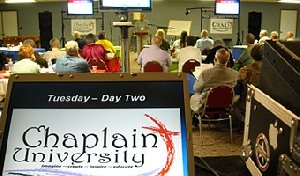
Resort ministry chaplains trained at Chaplain University

Thirty-one students who completed Chaplain University, a training program offered by Christian Resort Ministries International, have been endorsed and qualified for service in RV parks and other recreational settings throughout the United States.

Eddie Bevill (left), a member of the Christian Resort Ministries board of directors, talks with student Eldon Glenn about the ministry opportunities for graduating chaplains. (PHOTO/Robert N. Ruesch)

Christian Resort Ministries requires lay chaplains, who apply for assignment without any formal training at a Bible college or seminary, to complete 30 hours of training within their first 18 months.

All new chaplains receive 40 hours of Hands on Ministry training developed by the Baptist General Convention of Texas, with an additional 12 hours of division-specific chaplaincy training taught by division managers at Chaplain University. 

Chaplains also are required to complete six hours of continuing education annually.

In addition, chaplains are trained in NOVA disaster response, suicide intervention and first-responder intervention, said Dennis Maloney, general director of Christian Resort Ministries International.

Students attend Chaplain University, a training program offered by Christian Resort Ministries International.

“We want our chaplains to be equipped to be the finest they can be and be able to bring the word of the saving grace of Jesus Christ to those who don’t know and who know him. … Jesus clearly states, in Acts 1:8, we need to be his witness in Jerusalem, and all Judea, and Samaria, and to the ends of the earth. Resort ministry in RV parks, campgrounds and resorts spans all the requirements in the Acts passage,” Maloney said.

Christian Resort Ministries has endorsed chaplains who serve in 25 Texas resorts, particularly in the Rio Grande Valley.

Chaplain University is a three- phase teaching process over three years and is offered in the Branson, Mo, area each year in the fall.

For more information about resort chaplaincy, visit www.crmintl.org.


Small dedicated following keeps shape-note singing alive

BIRMINGHAM, Ala. (RNS)—The archaic sounds that fill the historic former church sanctuary echo, hauntingly, like a whispering ghost from the past.

Inside the 1902 building that once housed Second Presbyterian Church, the elaborate archways bounce back the sound of Sacred Harp singing.

Tim Cook leads a class for shape-note singing at the University of Alabama at Birmingham. The ancient music is based on different shaped notes and is sung a cappella. (PHOTO/RNS/Mark Almond/The Birmingham News)

It’s a style of music that once dominated rural evangelical religion, in the days before the Civil War and church organs, when a capella singing was the norm. It’s never entirely died out, in part because of people like Tim Cook.

“It was once common throughout the South,” said Cook, a shape-note singing aficionado who brought his lessons to the former church that’s now part of the University of Alabama at Birmingham campus.

Cook’s group of more than a dozen interested singers sat facing Cook as the song leader, holding wide-page hymnbooks filled with notes in the shapes of open and solid squares, diamonds, triangles and ovals.

Throughout the 1800s, the mournful harmonious sounds of a capella shape-note singing reverberated in churches throughout the South. It’s now experiencing a renaissance of sorts in Sacred Harp songbooks and conventions. But while Sacred Harp singing has surged, the more-complicated seven-shape-note Alabama Christian Harmony singing struggles to stay alive.

“We certainly don’t want it to die out,” said Emily Creel of Burleson, Ala., who carries on her family’s generations-long love affair with the music. “We do it to promote the heritage and tradition of the music.”

The Internet has helped create a revival for shape-note singing, connecting singers and bringing them together for events across the country.

{youtube}YHUfHNEZDPc{/youtube}

Cook says having the notes in different shapes makes it easier to read and sing the music in four-part harmony.

Participants sing the actual note sounds first: “fa” for triangle shape notes, “sol” for oval, “la” for square and “mi” for diamond-shape notes. Then they sing it with the lyrics.

The combination of archaic harmonies and old-style lyrics can be jolting to outsiders. To others, it’s addictive. Many of the shape-note songs were written by English composers such as Isaac Watts and Charles Wesley, set to old English dance tunes and carried from churches in rural England by colonial settlers.

The tradition was carried to the South, where many churches continued the shape-note a capella singing of the hymns with complex harmonies. The songs may have archaic, cryptic names such as “Old Hundred,” better known in many hymnbooks as “The Doxology.” “Amazing Grace” appears in shape-note books as “New Britain.”

When pianos and organs became common in churches, a capella singing began to disappear, along with the complicated harmonies in the old hymnbooks.

Cook took up shape-note singing after moving from Michigan to Atlanta in 1995, and now he teaches it and leads singings.

“I’ve always like to sing a capella, four-part harmony,” Cook said. “When I heard this the first time, I said, ‘That is the voice of heaven.’”


Greg Garrison writes for The Birmingham News in Birmingham, Ala.


‘Love makes a difference’ for children who need homes, musician insists

NASHVILLE, Tenn. —While performing concerts around the country, Dove Award-winning recording artist Mark Schultz often shares his testimony and personal story of adoption in hopes of raising awareness for orphan care and helping young families recognize this desperate need.

“It must have been so hard for my biological mother to give birth to a baby and say with tears in her eyes: ‘There’s so much I want to give you that I can’t. So, I’m going to love you by giving you to someone who can take care of you,’” Schultz said. 

Mark Schultz

“That’s amazing to me, and every day I’m grateful for the parents who adopted me when I was two weeks old and helped me to become the person I am today.”

Schultz hopes that having his songs featured on national television programs such as 48 Hours and Extreme Makeover: Home Edition will provide opportunities to spark conversations with non-Christians and lead them into a relationship with Christ.

His latest album, Come Alive, is a collection of songs that explore life’s greatest joys and toughest challenges while celebrating God’s presence in every moment.

“I would hope that as people listen to these songs and identify with the struggles, that they would know that God is the same through the struggles as he is during the triumphant moments,” Schultz said. ”His love and faithfulness never change.”

Desiring to help make a difference in the lives of orphans, Schultz went on a 3,500-mile bicycle ride across America in 2007, which raised more than $250,000. 

As a strong advocate for adoption, Schultz and his wife, Kate, who is a doctor, are considering adopting children with special needs.

“My wife came home one day from the hospital and brought up the subject,” Schultz explained. ”She asked me what I thought about adopting children with special needs, even children that the doctors believed would only live a short time on this earth. She lovingly said that caring for children in this situation is something we should consider and pray about for our future. 

“She shared: ‘Before they go to heaven, I want them to experience what a great Christmas is like, what a great birthday is like and most importantly, let them know they are loved well on this earth—before they get to heaven and are held in the arms of God.’ The more I thought about it, I realized that as Christians, we are called to love. If that means loving a baby that will be here seven minutes or 70 years, it’s showing love that makes a difference.”


Photographers capture infants’ brief lives on film

MADISON, Ala. (RNS)—For the entire lifetime of his daughter, Joey Karr smiled into her eyes. Then the infant, who couldn’t overcome a fatal form of dwarfism, died in his wife’s arms as their other three children patted their sister.

Photographer Kelly Clark Baugher caught that lifetime of love in photos—images now sacred with the weight of life and loss that the death of a baby brings.

Joey Karr shares a lifetime of love with his daughter, Janie Beth, after she is unhooked from life support. The family was photographed as part of the Now I Lay Me Down to Sleep project. (PHOTO/RNS/Courtesy Kelly Clark Baugher)

Baugher is one of a small but devoted number of professional photographers who volunteer their time at hospitals to take pictures of heartbreakingly short-lived joy.

A Colorado-based group, Now I Lay Me Down to Sleep, sends professional photographers—if the families request them—to record their child’s brief life.

“It’s one of the most wonderful things I’ve ever done,” Baugher said as she looked through photos from more than 60 families she and photographer Mary Ellen Pollard have served.

“It’s almost as though time slows down in that room. I will never forget the feeling. I felt God in that room.”

She refers to the hospital rooms where parents sit with an infant that was stillborn or has been disconnected from life support when death has become the kindest option. The photographers stay at the periphery, quietly working without a flash as they record the fleeting moments.

The idea is macabre only for people who haven’t lived through it, said Ken and Amy Salter, who became the parents of twin boys born last fall, one of whom died after months in neonatal intensive care. They agreed to have their last minutes photographed when nurses suggested they call Baugher.

“The photographs are a lasting comfort,” said Amy Salter, who now volunteers as a parent coordinator for Now I Lay Me Down to Sleep. “Yes, it was difficult, but to have pictures, to remember the little smile he makes, his little fuzzy head—it’s priceless.”

{youtube}MlKhrCORF8w{/youtube}

The photographers make a CD of the photographs after they edit the photos, giving parents finished pictures with the calm sheen of magazine shots. Parents can choose to print them or look at them—or not. Many find themselves returning to them often for a quiet space of remembering and weeping, Salter said.

Nurses who have assisted families going through such a wrenching time have seen how the photos become, later, a source of comfort as people thread the long valley of grief.

“Pictures, as well as clothing, footprints, handprints, stuffed animals and blankets are tangible reminders to these families of the precious little life they have lost,” said Ashley Ray, a nurse in Huntsville, Ala., who works with bereaved parents.

“It is so awesome to be able to offer these families professional photos of their sweet babies.”

For the photographers, it’s a ministry, Mary Ellen Pollard said.

“I had my son two months early, and he is still with us on this side of heaven,” Pollard said. “He spent two months in the NICU. We were told he was not going to survive, but our son went home. Beside us, there was a family whose daughter didn’t. I needed to do something to give back.”

The photographs help to make the lifetime of their daughter real, said Joey and Michelle Karr, who lost their daughter, Janie Beth.

“The one time Janie Beth opened her eyes, Kelly happened to catch that on film. I never even noticed she was taking a picture,” Joey Karr said.

But Baugher noticed the moment when the tiny face peers up at her father from his arms.

“It’s like she looked right into his soul,” Baugher said,


Kay Campbell writes for The Huntsville Times in Huntsville, Ala.


Michael W. Smith reflects on the wonder of worship

NASHVILLE, Tenn. —For almost 30 years, Michael W. Smith has been taking listeners on a musical journey into the heart of worship while delivering powerful messages about grace, love and redemption through his songs.

Michael W. Smith

As one of the most popular contemporary Christian musicians, Smith has amassed an impressive catalog of achievements. His 21 albums have garnered multiple honors, including an American Music Award, three Grammy Awards, 44 Dove Awards from the Gospel Music Association and 33 No. 1 radio hits. In addition, he holds 16 gold, seven platinum and two double-platinum albums for career sales approaching 15 million. In 2009, he was inducted into the Gospel Music Hall of Fame.

He also has scored several film projects and has been featured by a variety of media outlets including FOX and Friends, Hannity and Colmes, USA Today, Newsweek, NBC’s Today Show and Nightly News, Larry King Live, Good Morning America and many others. But Smith has remained committed to shining the spotlight on God. 

In addition to his music, Smith desires to create platforms that would reach out and help those in need. He established Rocketown in his hometown of Nashville, which serves as a safe place for young people to enjoy music and for artists to be discovered. 

He also raises awareness for a variety of mission organizations, including Compassion International and Samaritan’s Purse.  Following the aftermath of the devastating earthquake in Haiti, Smith traveled to Haiti with Samaritan’s Purse. He also co-wrote the song, “Come Together Now,” and gathered a community of artists to record the song to benefit Haiti relief efforts.

His tours consistently rank among the best-attended in the country, and he doesn’t miss a beat sharing the gospel with audiences.

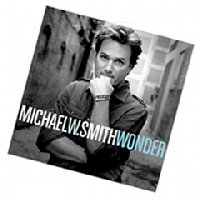
His newest album, Wonder, chronicles songs about life’s most heart-wrenching moments, as well as the unexpected joys.

“I hope that these songs will help people to realize that they can get through whatever situation they are dealing with, if they trust in God,” Smith said.

“Even in the midst of adversities, just anchor down. Don’t cover it up with an addiction, but instead, trust in God’s promises and know that he will never forsake you. The ultimate goal is for these songs to lead people to believe in Jesus and accept God’s promises. If that happens, praise God, because I think it would allow a lot of people to be victorious and be able to finish well in this journey called life.”

This is a busy season in Smith’s life. This fall, he is on the “Make a Difference Tour” with speaker/author Max Lucado and musicians Third Day, TobyMac and Jason Gray. Immediately following this tour, he will join Franklin Graham’s Festival in Latvia and then embark on a tour in Hungary, Austria and Romania. 

In December, he will sing Christmas carols with symphony orchestras around the country. He will appear with the Dallas Symphony at the Meyerson Nov. 30-Dec. 1, and perform at Second Baptist Church in Houston Dec. 10.

While dealing with the demands of a hectic touring schedule, Smith emphasizes the importance of limiting distractions so he can spend time in God’s word. 

“There’s so much going on these days and so many distractions, especially with cell phones, computers and the Internet,” Smith said. 

{youtube}-rPX1z4cbyE{/youtube}

“God continues to teach me the importance of just being still and being in awe of his creation. When I look up at the sky, I can’t help but think, ‘God is so awesome.’ 

“For me, the key to focusing on Christ and dwelling in his presence is removing all those distractions and finding a place where I can be alone and read his word. Sometimes that means turning the cell phone off, going to a park or someplace quiet and just spending some time reflecting on his glory.”

As the years pass by, Smith continues to be amazed and humbled by God leading this musical journey.

“I’m still amazed that I get to be part of building the kingdom through this gift that God has given me,” Smith said. 

“It’s something that I love to do and it’s changing the world a little bit, which blows my mind. Someone recently came up to me out of the blue and said they accepted Christ at one of my concerts 20 years ago. I thought that was incredible. 

“Another time, a man shared about a time when he was going to commit suicide and already had the gun loaded. By God’s divine intervention, just as this man was about the pull the trigger, he happened to hear one of my songs which addressed the issue of suicide and realized he couldn’t go through with taking his life. That man ended up giving his life to the Lord, and now, he’s married with a family. That story right there is worth my whole career.”


Faith Digest

Study says more link Christian faith to being American. As the United States has grown more diverse, more Americans believe being a Christian is a key aspect of being “truly American,” researchers say. Purdue University scholars found that between 1996 and 2004, Americans who saw Christian identity as a “very important” attribute of being American increased from 38 percent to 49 percent. Scholars said the findings, published in the journal Sociology of Religion, couldn’t definitively be tied to a particular event, but they suspect the 9/11 attacks and the wars in Iraq and Afghanistan could have played a role. The findings are based on an analysis of data from the General Social Survey, collected by the National Opinion Research Center, in which more than 1,000 respondents were queried in 1996 and 2004. In a separate survey, Public Religion Research Institute found 42 percent believe “America has always been and is currently a Christian nation.”

Most Protestant pastors nix Obama. Six out of every 10 Protestant pastors say they disapprove of President Obama’s job performance, a LifeWay Research survey found. Researchers said of the 61 percent who disapprove of Obama’s work, 47 percent disapprove strongly. The survey found 30 percent of pastors approve of the president’s performance, including 14 percent who strongly approve. Nine percent were undecided. When the Southern Baptist-affiliated research group surveyed Protestant pastors about their voting intentions just before the 2008 elections, 20 percent indicated they planned to vote for Obama, compared to 55 percent who planned to vote for GOP candidate John McCain. The new research was based on interviews with 1,000 Protestant clergy Oct. 7-14 and had an overall margin of error of plus or minus 3.2 percentage points. Researchers also found 84 percent of Protestant pastors disagreed with the idea of pastors endorsing political candidates from the pulpit.

Stem cell-funding agency apologizes for poem. The California agency that distributes public funds for stem cell research has apologized for honoring a poem that appropriated language from the Last Supper. The California Institute for Regenerative Medicine held a poetry contest to promote Stem Cell Awareness Day and draw attention to the complex and controversial field of medical research. When the two winners were announced, some Christian groups protested that one, “Stem C,” by Tyson Anderson, was blasphemous. The poem begins, “This is my body/which is given for you,” and concludes, “Take this/in remembrance of me,” words of Jesus during the Last Supper as recorded in the Gospels and memorialized at Christian worship services during Communion. The California institute, which helps distribute $3 billion in state funds for stem cell research, said it has removed the poem from its website. While many scientists say embryonic stem cell research holds great medical promise, some Christians call it a wanton destruction of human life because embryos must be destroyed in order to harvest the stem cells.

–Compiled from Religion News Service


Why do people leave churches?

NASHVILLE, Tenn. (ABP)—Many churches and denominations put a lot of effort into attracting new members only to lose many of them through a “back door”—a term used to describe people who regularly attended a church in the past but stopped.

“Churches have gone to great extreme effort to get people in the front door of the church,” Brad Waggoner of LifeWay Christian Resources said in a 2006 podcast. “There’s been some success numerically in that strategy, but very few people are talking about the back door of the church. That is: ‘Where do the people go that slip out of the life of the church?’

“The back door is just as important as the front door in determining the health of a local church.”

LifeWay President Thom Rainer described in an article on ChurchLeaders.com a meeting with more than 200 church leaders where nearly 90 percent indicated their churches had a problem with closing the back door.

“For years, the primary focus in many churches has been on the ‘front door’—people coming into the church,” Rainer said. “While such an emphasis remains the Great Commission priority, our research shows that churches and their leaders must not neglect the issue of the back door, commonly called assimilation.”

George Bullard of The Columbia Partnership, a Columbia, S.C.-based organization that helps churches pursue and sustain vital ministry, said churches face an “assimilation challenge” in the first year after new people begin attending to influence whether they become part of a community or slip through the back door.

“Church growth is a pretty simple concept,” Bullard said. “You get more people who have not been regular attendees and members to become regular attendees and members. You get more regular attendees and members to deepen their involvement in their church and its disciple-making activities. You get less-regular attendees and members to become bored, apathetic or offended and leave the church. If the second thing does not happen, the third thing is likely to happen.”

Mike James, discipleship and assimilation coordinator for the Kentucky Baptist Convention, said in a blog that assimilation is the difference between a church that is like Velcro—where people stick—or Teflon—where people join but stop attending.

Every church should have a strategy for getting first-time visitors to return and a follow-up plan to get them back a second time, James said. It begins by placing value on guests. “Scripture tells us to be warm and friendly to the people we meet,” he said.

James recommends treating every person like he or she is a guest. “Even your own members need a good welcome and a warm greeting,” he said.

The simplest and most effective way to attract guests is to invite them, James said. Polls show that between 75 percent and 90 percent attend church because a friend or relative invited them.

“Churches must be intentional in this process, or we become a revolving door with as many people going out the back door as we have coming through the front door,” James said.

Four things need to happen within the first year for people to assimilate into a new church, Bullard said.

Make attendance a habit.

First, he said, they must have established a pattern of regular attendance. By today’s standards, “in a culture that no longer sits around on Sundays,” Bullard said, regular attendance is between 39 and 42 Sundays a year.

Research indicates the American church went through a period of more than 10 years when churches significantly lowered their expectations of members and attendees, Rainer said. The result was an exodus of people from the church.


“Why would I want to be a part of something that expects nothing of me?” Rainer quoted a former active church member talking to the research team. Many churches now are attempting to remedy the problem with new-member classes, where expectations of service, stewardship and attendance are clearly established.

Common names for such classes are “Connections,” “Membership 101” or “Discovery,” James noted.

“Give it any name you desire, but by all means start one,” he said.

Get connected.

Second, Bullard said, they must have connected with some kind of teaching/learning experience such as a small group or Sunday school class.

“Churches that close the back door seek to get as many of their members as possible into small groups,” Waggoner said. “In some churches, these groups meet in homes. In other churches, the small group is a Sunday school class that meets at the church. The key issue, according to our research, is that the small group is an open group, meaning it has no predetermined termination date, and anyone can enter the group at any point.”

Develop deep relationships.

Third, Bullard said, they need to have developed friends “they call at 3 a.m.,” a reference to Hillary Clinton’s presidential campaign national-security ad featuring a ringing phone in the White House at 3 a.m. and posing a question to voters about who they want answering the phone.

Win Arn, a pioneer in church growth, showed years ago that if somebody can make five friends at a church, they are must less likely to drop out, Waggoner noted. “We need to create opportunities for people to build friendships and to get to know folks,” Waggoner said. “Just sitting in the pew is never God’s intention for any Christian.”

The more new members connect with longer-term members, the greater the opportunity for assimilation, Rainer said. One twist the research found, he said, is that most such relationships develop before the new member ever comes to church. In other words, members first developed relationships with people outside the walls of the church and then invited them after the relationship was established.

Go to work.

Finally, Bullard said, they need to get “some kind of job,” whether elected, appointed or as an ongoing volunteer.

“There’s no doubt about it that when you involve people in the ministries of the church, they are much more likely to give and much more likely to stay,” Waggoner agreed. “If they’re just pew sitters, they are more vulnerable to become disillusioned, and we’ll lose some of the people”

The earlier a new member or attendee can get involved in a church’s ministries, the higher the likelihood of effective assimilation, Waggoner said. “Churches that close the back door have a clear plan to get people involved and doing ministry as quickly as possible.”

“If people don’t do those four things, at the end of their first year, they are going to re-evaluate whether they want to stay in this church,” Bullard said.

While not a primary motivation for assimilating new people, Bullard added, an “unintended consequence” is that people who buy into the church with their time give five times more money than those who do not invest their time and energy.



American Shariah? That’s news to Muslims in U.S.

WASHINGTON (RNS)—Oklahoma state Rep. Rex Duncan expects his “Save Our State” referendum to keep Islamic law out of state courts to pass easily on Nov. 2. He’s less certain a similar measure could pass in Michigan.

The reason? Muslims have have established a foothold in and around Detroit, and they wield enough political power to stop it, he insists.

An estimated 3,500 Muslims gathered Sept. 25, 2009, at the foot of the U.S. Capitol for a first-ever Islam on Capitol Hill prayer rally. (RNS FILE PHOTO)

“I don’t believe anybody who would spend five minutes looking at the landscape and the political dynamics of Dearborn, Mich., would for one minute entertain the idea that they could pass a preemptive strike to keep Shariah law out of the courts,” Duncan said.

Duncan and other conservatives—including Tea Party favorite Sharron Angle in Nevada—ominously warn that Muslims are determined to impose Shariah law on the U.S. legal system.

When opponents of a proposed Islamic center near Ground Zero rallied at the site in September, many carried signs that depicted “SHARIA,” dripping in blood. Former House Speaker Newt Gingrich got a standing ovation at September’s Values Voter Summit when he called for “a federal law that says Shariah law cannot be recognized by any court in the United States.”

The odd thing is that no one in Oklahoma, Michigan or anywhere else is calling for Shariah—including and especially Muslims.

Instead, Muslim American leaders say Duncan’s referendum is a concrete example of fanning hyster-ia about the myth that they want to impose Shariah, which many Americans associate with misogyny, religious intolerance and cruel punishments.

“This is another right-wing fantasy that started on the hate blogs and worked its way into the mainstream media,” said Ibrahim Hooper of the Council of American-Islamic Relations in Washington, D.C. “Where is the evidence of the takeover?”

Perhaps the most frequently cited example comes from New Jersey, where a Moroccan Muslim immigrant who beat and raped his wife was acquitted by a local court that ruled the husband was acting according to his religious beliefs. An appellate court reversed the ruling, and many Muslim Americans say they found the initial New Jersey court ruling as absurd and cruel as non-Muslims.

What they do want, however, is protection for reasonable constitutionally protected acts, like wearing a headscarf or praying at work.

“Accommodating a Muslim employee’s request to wear a religious headscarf at work in no way imposes religious law on the workplace, any more than when employees wear a Latin cross or a Star of David,” said Daniel Mach, director of the ACLU’s Freedom of Religion and Belief program. “Somehow, basic religious exercise by Muslims is viewed as imposition by that group of its own faith on others.”

Frank Gaffney, president of the conservative Center for Security Policy in Washington, D.C., disagreed.

“The principle difference is that Shariah calls for the destruction of our country; Jewish law does not,” said Gaffney, whose institute released a 177-page report recently called “Shariah: The Threat to America.”

Examples of “creeping” Shariah infiltrating American society cited in the report include Muslims building mosques, using Islamic financing to buy homes, and depositing money in Islamic banks, which forbid interest and avoid investments in products like alcohol and tobacco.

“So when you’re talking about saying, ‘Well it’s just another religious court system that is operating kind of like the Jews do,’ it’s completely different; it’s sedition,” Gaffney said.

Muslims say such views reflect either bigotry or ignorance about Shariah, which means “path” in Arabic and is based on the Quran and the recorded teachings of Islam’s Prophet Muhammad.

Abdullahi Ahmed An-Na’im, an Islamic scholar at Emory University, argues in his 2008 book, Islam and the Secular State, that Shariah is meant to be followed as a personal religious code, not imposed as a public legal system covering all citizens in society.

“The moment the state imposes Shariah, it stops being Islamic,” An-Na’im said.

Other Muslims acknowledge some Islamic countries, such as Saudi Arabia and Iran, have legal systems based on strict interpretations of Shariah. That doesn’t mean, however, Muslims elsewhere desire the same thing. In fact, many condemn it.

“Assuming all Muslims follow medieval Islamic rules today is like assuming that all Catholics follow ninth-century canon law,” wrote Sumbul Ali-Karamali, a Muslim woman raised in California and author of The Muslim Next Door: The Quran, the Media and That Veil Thing, in a recent Huffington Post column.

Gaffney, whose report called Shariah the “preeminent totalitarian threat of our time,” dismissed alternative interpretations of Shariah as inauthentic. “There is only one interpretation of Shariah law,” Gaffney said.

Anti-Shariah legislation may never be introduced in Michigan, but Duncan believes other states will follow Oklahoma’s lead and pass similar legislation to ban Shariah.

“There are other states, I believe a dozen or so, maybe more, who are currently in discussions with me,” Duncan said, “and watching what we’re doing.”