Teen website changes lives through laughs

HARRISON, Ark.—With just the click of a mouse, Doug Hutchcraft and Jon Taylor are pointing teenagers and young adults to Jesus.

Desiring to communicate the gospel to a generation that has grown up on the Internet, they have developed a one-of-a-kind website known as the “Doug and Jon Show.” 

Jon Taylor (left) and Doug Hutchcraft brainstorm new ideas for their website, www.thedougandjonshow.com.  Since the site’s founding in 2009, more than 11,000 teenagers from 48 countries have indicated they have committed their lives to Christ as a result of it.

The site’s interactive format provides a safe haven for young people to laugh, share thoughts, open up about their challenges and be introduced to Jesus Christ. 

“Young people under the age of 25 make up the largest mission field right now,”  Hutchcraft said. 

“The majority of this age group has no idea who Jesus Christ is. They feel hopeless and feel completely disconnected from their parents and friends. When we were thinking of ways to effectively reach them, we realized that this age group spends most of their time on the Internet—communicating with friends, checking e-mail and getting all of their information. 

“We realized that if these young people are searching for information on the Internet, then Christians have to be there to point them to the truth, hope, forgiveness and love found in a relationship with Jesus.”

Based out of Harrison, Ark., Hutchcraft and Taylor desire to connect students to Christ through a variety of ways with this platform, including sharing their own testimonies and life experiences. Their site also showcases humorous videos designed to break down barriers, build relationships and allow the truth to enter. 

In a “Life Video Blog” section, they address serious issues young people face—peer pressure, loneliness, bullying and sex. Taylor’s wife, Kara, offers a female perspective in a section called “Café de Kara.” 

“It is amazing at how young an age people can throw their lives away,” Hutchcraft said. “These days, young people face so many heartbreaking problems tied to family, school and peer expectations. Our goal with TheDougAndJonShow.com is to provide a refuge for them—a place where they can be entertained or discuss tough issues … or even choose to hear about the hope that only Jesus can offer.”

{youtube}PwC2qBfQ5ak{/youtube}

Taylor agreed, adding:  “We want to reach the teen who may not feel comfortable stepping through the doors of a church or attending a youth group event but is surfing the Web for answers to life’s difficult questions. We share our life struggles on the site in hopes that it can be an encouragement to teens going through the same thing.”

In addition to making a significant impact on teenagers, Hutchcraft and Taylor have made quite an impression on parents, as well.

“There are things that only parents can do, and we can’t take the place of that,” Hutchcraft said. “But what we can do is try to help teenagers understand where parents are coming from, and say: ‘Hey, give your parents a break. They’re trying to connect with you. They’re trying to understand.’ Hopefully, we can encourage teenagers to build relationships with their parents and communicate with them.”

Taylor added: “We’ve had parents ask us how we’re able to share these messages with teenagers. Parents realize the value of that and appreciate us addressing issues very bluntly, sincerely and authentically—but still in a way that teens will listen to. We hear it over and over again from parents saying, ‘My child needs this.’”

Since the site’s founding in 2009, more than 11,000 teenagers from 48 countries have indicated they have committed their lives to Christ as a result of the resource.

“People talk about viral videos and messages now,” Hutchcraft said. “But the ultimate viral message happened on the day of Pentecost—when thousands came to know Jesus.  That same thing is happening on the Internet today as teenagers are watching these videos, accepting Christ and then passing it on to their friends. That’s the beauty and power of the gospel right there. A young believer might have a hard time knowing how to share their faith, but they don’t have a hard time saying: ‘You should go check out this website or video.’”




Recognize children’s digital proficiency, but be alert to dangers

When it comes to digital communication, children are natives, and their parents are immigrants. And that puts parents at a distinct disadvantage in protecting children from online danger, according to the president of a nonprofit advocacy group devoted to guarding children from Internet pornography and predators.

“Children are native speakers of the digital language of computers, video games and the Internet, and many parents have not been able to develop digital proficiency. Parents are often left feeling overwhelmed, uninformed or ill-equipped to adequately protect their kids online,” said Donna Rice Hughes, president of Enough is Enough.

About 93 percent of adolescents ages 12 to 17 are online, she reported. And too often, their parents lack either the skills or the awareness required to monitor their online activities effectively, she added.

Enough is Enough recently produced a new video, “The Perfect Storm,” as part of its Internet Safety 101 program, created in cooperation with the U.S. Department of Justice. The educational video is posted on YouTube.

“Despite the Internet’s many wonderful benefits, a perfect storm has emerged for the online victimization of children. Kids have free and easy access to pornography, and sexual predators have easy and anonymous access to kids. Law enforcement limitations and challenges abound, and naive kids are engaging in risky online behavior,” Rice says in the video.

Enough is Enough also posts multiple resources for parents at internetsafety101.org, including tips such as:

• Supervise the use of all Internet-enabled devices.

• Know your child’s online activities and friends.

• Monitor the online communities your children use—including social media and gaming sites—to see what information they are posting.

• Supervise the photos and videos your children post and send online.

• Discourage the use of webcams and mobile video devices.

• Teach your children how to protect personal information posted online and follow the same rules regarding the personal information of others.


Churches view social networking as ministry tool

NASHVILLE, Tenn. (ABP)—With the Internet closing in on television as Americans’ main source of national and international news, churches increasingly are viewing social-networking applications like Facebook as ministry tools.

The Oikos social networking site

“Social networking tools have become an integral part of most people’s daily lives and relationships,” said Curtis Simmons, vice president for marketing and community at Fellowship Technologies. “If churches desire to connect with their congregation and community in meaningful ways, then they need to establish a strategy for actively engaging in the social media conversation.”

The rising popularity of social networking is changing the way people communicate. One in five Americans used social networking sites like Facebook or MySpace to connect with a campaign or some other aspect of the 2010 midterm elections. eHarmony, an online dating service that matches singles based on compatibility factors like religion, claims 542 people a day get married because of the service, accounting for nearly 5 percent of all marriages in the United States. The latest uprising in Egypt reportedly began with a call for civil revolt on Facebook and Twitter.

A search for “Baptist” on Facebook found more than 700 pages. That’s in addition to dozens of Christian social-networking sites that have cropped up with names like ChurchSpeak, HolyPal, Oikos, YourChristianSpace and Be Linked As Believers, also known as BLAB.

“While some people are considering editing their lives to have more time for real face-to-face communications, many people are desperately searching for ways to connect with others and develop meaningful relationships amidst the harried state of their current situations,” writer Lauren Hunter said in a 2007 article for Church Solutions Magazine.

While a Web ministry cannot take the place of face-to-face connections, Hunter wrote, “It can enhance and foster growth in relationships that already exist, as well as develop new relationships and provide unique ways to reach out to other nonbelievers.”

A study by LifeWay Research revealed nearly one-half of Protestant ministers now say they use social networking in some aspect of their church’s ministry. Three-fourths use Facebook to interact with their congregation, while 62 percent use social networking to interact with individuals outside the congregation.

“Churches are natural places of interaction,” LifeWay Research Director Scott McConnell said. “Congregations are rapidly adopting social networking, not only to speed their own communication, but also to interact with people outside their church.”

LifeWay Research discovered:

• The most popular use of social networking (73 percent) is interacting with the congregation, followed closely with 70 percent who use it only to distribute outbound news and information.

• Church staff members also are turning to mobile devices like smart phones to access e-mail (53 percent), access calendars (33 percent) and update and respond to Facebook posts (32 percent). Fifteen percent each said they use mobile devices to blog and tweet.

• Three-fourths of churches (78 percent) maintain a website. Most (91 percent) use the website to provide information to potential visitors, while eight in 10 (79 percent) use it to provide information to members of the congregation.

• Fewer than half (43 percent) use their websites to obtain and distribute prayer requests, and 39 percent allowed people to register online for events and activities.

• Four out of 10 churches (42 percent) update their websites once a month or less frequently. Forty percent post new material at least once a week, and 15 percent more often than that.

• One church in four (26 percent) uses blogs in online ministry, but 33 percent said they expect to be blogging this time next year.

• A quarter of churches (26 percent) said they proactively look for new technology. Half (47 percent) are open to new technology but don’t go looking for it. One in four (24 percent) admits to being slow in considering new technology, but 3 percent avoid it altogether.

Steve McCoy, a Chicago-area pastor who blogs as Reformissionary, said in an online discussion on Christians and the Internet that he uses both Twitter and blogging, but mostly to connect with other church leaders outside of his area.

“I need like-minded friends in ministry,” McCoy said. “I can’t fully explain the benefit and blessing of being connecting to hundreds of church leaders through my blog and Twitter. It is truly a kind of community. It doesn’t replace true community. It compliments it and expands it.”

According to the Pew Research Center, Millennials—adults ages 18 to 33—still are significantly more likely to use social networking sites, but the gap for older adults is closing. The fastest growth in Internet usage has come from users ages 74 and older. Social networking site usage for this age cohort has quadrupled since 2008, from 4 percent to 16 percent. Searching for health information, once the primary domain of older adults, is now the third-most-popular online activity for all adult Internet users.

“Human beings are inherently multimedia creatures,” said Quentin Schultze, professor of communication arts and sciences at Calvin College. “So, networking takes many forms across all media, including in-person, print, electronic and digital media.”

Schultze insists the challenge for churches is to find appropriate means of communication in tune with the purposes of the church. Social networking has implications for church governance, as leaders sort through a groundswell of information about innovations and ideas, he added.

Wise preachers use social media to gauge how their sermons and conversations are being applied, Schultze maintains, and social networking is becoming the medium of choice for sharing ideas about topics like worship renewal among others across denominational lines interested in the same issue.

Schultze cautions that the starting point for faith-oriented social networking is recognition that the only “producer” of the sacred is God.

“We begin with a sobering truth, namely, that Christian spirituality is not about what human beings do but about what God does,” Schultze said.

“As I tell my students, we need to keep in mind that Christian spirituality is all about attending to what God has done, is doing, and has promised to do. In other words, God is already at work. Our job—really, our calling—is to attend to the Spirit’s movement here, and there and everywhere, often where we least expect to see God at work. We can’t move ahead faithfully in a Web 2.0 world by pretending to play God.”

McConnell at LifeWay Research agreed that social networking has limits. “Biblical community requires feet and faces, not only retweets and fan pages,” he said. “But clearly social networking is a helpful tool to build and maintain community.”


Is the prodigal generation gone for good, or will they return to faith?

WASHINGTON (RNS)—Drew Dyck didn’t lose the Christian faith of his childhood when he became an adult, but he noticed lots of others did.

Drew Dyck

Dyck, an editor of online publications for Christianity Today, talked to some of those who’ve left the faith for his recent book, Generation Ex-Christian: Why Young Adults Are Leaving the Faith … and How to Bring Them Back. Some answers have been edited for length and clarity.

Q: What prompted you to write about ex-Christians?

A: My friends began leaving the faith. The first was a friend from high school. We had grown up in the church; both of our fathers were pastors. A few years after high school, he informed me that he was no longer a Christian. That got my attention. As I moved through my 20s, I witnessed other friends “de-convert.” I realized that these experiences were not unique.

Q: Are a lot of young people really leaving the faith? Won’t they just come back when they’re older?

A: The answer to the first question is “yes.” In the 2009 American Religious Identification Survey, 18- to 29-year-olds were found to be the least religious age group: 22 percent claimed “no religion.” That was up 11 percent from 1990.

Whether or not they will return is where the scholarly consensus breaks down. Some view the exodus from the church as a hiatus, a matter of young Americans “slapping the snooze” on Sunday mornings. They see the trend as a reversible life-phase phenomenon. I’m not so sure.

Q: What’s the main reason they give for leaving?

A: Most cited intellectual doubts, but there’s often more to the story. One young woman had attended a prominent Christian college, where she’d suffered a mental breakdown after feeling ostracized by the community and betrayed by Christian friends. But it was only in subsequent years that she constructed her elaborate system of doubt. Her intellectual doubts may have prevented her from returning to Christianity, but they were almost certainly not the reason she left in the first place.

My challenge was to watch for those underlying experiences that often push people from the faith. It sounds more credible to say you left on intellectual grounds. But more often, the head follows the heart.

Q: What interesting things did you learn during the interviews?

A: I encountered some surprising signs of spiritual life. In the interviews, I asked the ex-Christians whether they ever still prayed. Most still did pray. They were angry, conflicted prayers but beautiful in their honesty and desperation.

Q: You have some interesting categories of unbelievers in your book: Can you ex-plain what these terms mean?

A: No two “leavers” are exactly the same, but some patterns did emerge.

“Postmodern leavers” reject Christianity because of its exclusive truth claims and moral absolutes. For them, Christian faith is just too narrow.

“Recoilers” leave because they were hurt in the church. They suffered some form of abuse at the hands of someone they saw as a spiritual authority. God was guilty by association.

“Modernists” completely reject supernatural claims. God is a delusion. Any truth beyond science is dismissed as superstition.

“Neo-pagans” refers to those who left for earth-based religions such as Wicca. Not all actually cast spells or participate in pagan rituals, but they deny a transcendent God and see earth as the locus of true spirituality.

“Spiritual rebels” flee the faith to indulge in behavior that conflicted with their faith. They also value autonomy and don’t want anyone—especially a superintending deity—telling them what to do.

“Drifters” do not suffer intellectual crises or consciously leave the faith; they simply drift away. Over time, God becomes less and less important until one day, he’s no longer part of their lives.

Q: Has the church played a role in causing this trend? If so, how can it stem the tide?

A: Over the past couple of decades, business thinking has affected the way many churches minister to youth. The goal has become attracting large numbers of kids and keeping them entertained. … There’s nothing wrong with video games and pizza, but they’re tragic replacements for discipleship and catechism. Many young people have been exposed to a superficial form of Christianity that effectively inoculates them against authentic faith.

Q: What role does contemporary American culture play?

A: A lot of Christians fear the corrupting influence of “the world,” but when it comes to the spiritual plights of young people, what happens inside the church matters most.

Q: You’re a part of the generation you’re writing about. What is different about those such as yourself who didn’t leave?

A: Young people who have meaningful relationships with older Christians are much more likely to retain their faith into adulthood. I had those connections and have no doubt they were instrumental in my life. I also sought out the intellectual resources to understand and defend my faith. …

The difference between me and my friends whom I now describe as “ex-Christians” may be a matter of degree, rather than kind. We all have the tendency to stray. But God, in his mercy, keeps drawing me back.


‘Miracle Detectives’ on the hunt for answers

WASHINGTON (RNS)—Dirt at an ancient holy site in Chimayo, N.M., reputedly cures a woman’s rare bone cancer. In North Carolina, a 14-year-old girl stricken with pneumonia is removed from life support but survives after an angelic image appears on a security monitor outside her hospital room. A Texas man lives despite being cut in half after being run over by a train.

Were these acts of God, or is there a scientific explanation for events that seem to defy reason?

For an hour every Wednesday night, that divisive question is the focus of Miracle Detectives, a prime-time television foray into exploring the miraculous.

Randall Sullivan and Indre Viskontas go on the hunt for the truth behind miracles in the new show Miracle Detectives on the Oprah Winfrey Network. (RNS PHOTO/Courtesy Windfall Management)

The show features two investigators—one a believer, the other a scientist—who seek answers to “mysterious incidents that seem to transcend logic.” It’s one of 17 programs on the new Oprah Winfrey Network that debuted New Year’s Day.

In a society less devout than the United States, and in an era of near daily scientific breakthroughs, such a show might seem a waste of valuable air time. But polls in the United States consistently show 80 percent of Americans believe miracles occur, and slightly more than half believe in guardian angels.

Miracle Detectives may be preaching to the converted: An online survey found more than 92 percent of the program’s viewers said they believe in miracles; nearly 3 percent said they do not; and almost 5 percent said they “need proof.”

Each week, hosts Randall Sullivan, who says he experienced a miracle himself, and Indre Viskontas, a neuroscientist who sings in her church choir but approaches the supernatural with skepticism, visit the sites of reported miracles to hear first-hand accounts.

Interviewing experts and conducting experiments, the duo gathers information and attempts to answer the question: Miracle, or not?

Sullivan, 59, said there is no conflict being an evidence-hungry reporter while also believing in supernatural signs and wonders.

“A journalist’s role is to explore,” he said. “Yes, you’re certainly seeking truth, but you’re also exploring. First thing I want to know is, what happened to people? What did they experience? I want it from the inside out, from them and from me.”

Viskontas, 34, holds a doctorate in cognitive neuroscience, but also calls herself “a very spiritual person,” who was raised a Roman Catholic and is a soloist in her church choir.

“I identify as a scientist,” she said. “A scientist is interested in trying to understand the phenomenon in front of them. They’re trying to get at what is actually happening.”

An expert in how memories are formed and retrieved, Viskontas said she’s in a unique position to discover what someone remembers, what actually happened and how circumstances led them to believe there is a supernatural force at work.

That doesn’t mean she denies the possibility of the miraculous. In fact, she struggles with it.

“One of things I struggle with the most is the idea that an all-loving, all-powerful, all-knowing God would choose to use miracles in which to operate,” Viskontas said.

“There are so many instances in which those miracles don’t happen. It’s very hard for me to believe that God would act in such a direct way, and it seems to me if that were true, then he’s kind of an underachiever.”

Sullivan had a life-altering experience while covering the war in Bosnia in the 1990s for Rolling Stone magazine.

Raised in an irreligious family, he found himself “skeptical and guarded” in the village of Medjugorje, where visions of the Virgin Mary have been reported, drawing pilgrims by the busload.

“I was there to observe, not to be a pilgrim,” he recalled.

While climbing the Mountain of the Cross, the central feature in the village, Sullivan was caught up a violent thunderstorm and feared he might die.

He encountered a group of nuns, singing in French and kneeling in prayer.

“For the very first time in my life, I got down on my knees in the mud and stone and prayed with them and felt an immense sense of release and uplift,” he recalled. “It was like a cork had been pulled out of a bottle.”

A young woman draped a cloth on his shivering shoulders. “I felt instantly warmed and comforted. But when I opened my eyes, the nuns and the woman were gone.”

No one else had seen or heard the nuns, Sullivan said. “The only thing that made me feel I wasn’t completely insane was that I still had the cloth in my hand.”

After struggling with the experience, Sullivan decided to embrace it and concluded it had been a gift from God.

“That core belief inside is so deeply set that I really do believe there are miracles, and I approach most of these cases (on the program) wanting to believe,” he said. “But I’m certainly willing to check it out. If it’s true, there’s nothing to be lost challenging it.”


Faith Digest: No policy changes for military chaplains

No policy changes for military chaplains. The pending repeal of the U.S. military’s ban on openly gay members will not change policies related to chaplains, the Pentagon stated. “There will be no changes regarding service member exercise of religious beliefs, nor are there any changes to policies concerning the chaplain corps of the military departments and their duties,” reads a six-page memo about implementing the repeal of the Don’t Ask/Don’t Tell policy. It notes that chaplains will continue to be required to “care for all,” and their First Amendment freedoms will remain unchanged. “When chaplains are engaged in the performance of religious services, they may not be required to engage in practices contrary to their religious beliefs,” it reads. In November, the military issued a comprehensive review of the planned repeal and concluded “special attention” should be given to the chaplains corps because of sharp differences on the issue. But that report also concluded existing rules protecting chaplains’ First Amendment rights were “adequate” for the ban’s repeal.

More than 6 million U.S. Muslims projected by 2030. The Muslim population in the United States is expected to double over the next 20 years, fueled by immigration and higher-than-average fertility rates, according to a new report from the Pew Forum on Religion and Public Life. The number of Muslims in the United States is projected to rise from 2.6 million, or 0.8 percent of the U.S. population, to 6.2 million, or 1.7 percent in 2030. That rate of growth would make Muslims about as numerous as Jews or Episcopalians in the United States today. Researchers found nearly two-thirds (64.5 percent) of Muslim Americans are immigrants, while 35.5 percent were born in the United States—a figure projected to rise to almost 45 percent by 2030.

Judge upholds law preventing guns in churches. A federal judge has dismissed a lawsuit by gun rights advocates who claimed a Georgia law prohibiting weapons in a house of worship was unconstitutional. GeorgiaCarry.org, an organization that supports gun owners’ rights, and two of its members filed suit against state officials saying the law placed an undue burden on them. However, Judge Ashley Royal of the U.S. District Court in Macon, Ga., said any burden on worship attendance was “tangential” because the law requires that people not carry the weapon in services, leave it in their cars or surrender it temporarily to security officers.

Russian Orthodox leader urges dress code. A Russian Orthodox archbishop has called for an official dress code to encourage propriety after previously suggesting provocatively dressed women provoke immorality and violence. “Vulgar external appearance and vulgar behavior is a straight path to misery,” Archpriest Vsevolod Chaplin said in an open letter. Chaplin, who is in charge of the Moscow Patriarchate’s department on church and society and is known for his provocative statements, was responding to a petition protesting comments he made several weeks earlier when he suggested immodestly dressed women invite rape.

Compiled from Religion News Service


Baptist author produces novel in American Sign Language

Missouri Baptist author George Joslin of Springfield has produced what may be the first American Sign Language-only novel.

ASL novel on DVD

Titled A Deaf Man's Gospel, the novel is only available in American Sign Language (ASL) on DVD, rather than in print format. According to Joslin, his novel may be the first created just for the Deaf in ASL.

"Many stories have been recorded, but not a full-length novel like this," Joslin explained. "Many things have been translated into ASL from English, but this was created in ASL."

The biblical fiction starts with the story of the deaf man Jesus healed in Mark 7:31-35, and adding some incidents from the other gospels.

"The fiction is that the deaf man Jesus healed, named Benjamin, is added to the gospel stories. The book portrays the observations and experiences of this deaf man," he added.

"This is a book created by a deaf man — me, presented in ASL by a deaf man — Tim Bender — for deaf people. We have added voice to the DVD so hearing friends and family can enjoy this book along with the deaf," Joslin said.

The idea formed when Joslin began to ask himself questions as he read the biblical account: Who was this deaf man? Who brought him to Jesus? What was it like to be deaf at the time Jesus was on earth? What happened to this man after he was healed?

The Bible does not provide the man's name, his hometown or the names of those who brought him to Jesus. Because the work is fiction, Joslin chose to name him Benjamin and placed him in Capernaum, near the place where Jesus healed him. Joslin decided Nicodemus and his brother, Abner, Benjamin's father, could have led Benjamin to the Lord.

The author based his assumptions about Benjamin's life on what is common in the Deaf community today and what is known about the way of life in Jesus' time. In the book, Joslin suggests the man met many of the people portrayed in the New Testament, and that he became a follower of Jesus.

Binder serves as pastor of a church for the Deaf in Louisville, Ky. Buddy Burgess, a hearing man and pastor of a Virginia Baptist Deaf church in Richmond, Va., did the voiceover.

Other Baptists also were part of the project. Southern Baptist evangelist Howard Baldwin of Multi-Media Evangelism Inc. handled technical aspects. Let's Sign, owned by Edith Booth of Jackson, Miss., is the distributor.

Joslin is the author of two other novels, A Life After Deafness and A Terp on the Line, and numerous non-fiction books on teaching American Sign Language and interpreting for the Deaf. Individuals interested in the two-DVD A Deaf Man's Gospel may contact Joslin at gjoslin@mchsi.com .


Churches seek to minister to Boomers

Jan. 1 not only marked the beginning of a new year, but also saw the first Baby Boomers turn 65 years old. And congregations face the evolving challenge of finding ways to minister with and to them.

Boomers—born between 1946 and 1964—comprise the largest generation in U.S. history at 78 million strong, and they don’t approach growing older in the same way their parents did.

“Boomers were a generation of change,” noted Mark Seanor, minister to experienced adults at First Baptist Church of Huntsville, Ala. “They don’t want what their parents do in ministry.”

Many Boomers want to keep working past retirement, but in areas of interest and to make a difference. They want to stay young and are searching for productive and meaningful purpose, notes Amy Hanson in Baby Boomers & Beyond: Tapping the Ministry Talents & Passions of Adults Over Fifty.

Boomers often are characterized as people on a personal quest who seek self-actualization and self-discovery throughout life, explained Frank Fain, director of educational services for The Baptist Home system for older adults in Missouri.

Norma Abbott from First Baptist Church in Browning, Mo., shows off a string catfish she caught at Lake Mary.

As older adults, members of this generation are more energetic, healthier and still want to change the world, Fain added. “They want their life to matter. … Older Boomers in particular … don’t want to serve the institution not just for the institution’s sake. They want to serve … to make a difference in the world.”

The differences between Boomers and the generation before them mean churches should rethink the way older adult ministry is done—beginning with the name. Boomers don’t want to be called senior adults, and churches have responded by using terms such as second half, 55-plus, older adult and emerging adult ministry. Some churches are shifting from a SAM—senior adult ministry—focus to BAM—Boomer adult ministry.

But Boomer ministry must be more than simply a name change. Churches must recognize Boomers are distinctively different, Fain said.

Ruth Ann Short, an emeritus missionary to Nigeria, was featured in the Missouri Department of Transportation’s “No MOre Trash” publicity campaign last year. She participates in the Adopt-a-Highway project while she logs an average of 10,000 steps per day. As she picks up trash, she prays for the households and businesses along the roads and for litterbugs.

Boomers still are the “me generation,” Keith Lowry, adult consultant for the Baptist General Convention of Texas, said. “Effective ministry will have to deal with that, but (it) also takes advantage of the tremendous gifts and talents they bring.”

Churches may find they need to divide older adults for some activities and projects. “I realized Boomers are not going to consider themselves as senior adults … and I stopped fighting to merge them,” explained Melissa Fallen, associate pastor for senior adults and pastoral care at Huguenot Road Baptist Church in Richmond, Va.

“I see an opportunity for the church … to help Boomers … make this time meaningful,” she added.

If the church doesn’t, Boomers likely will look elsewhere for meaning. “They want to be involved in specific causes,” noted Ken Kessler of the Baptist General Association of Virginia. “The key word to me is ‘engage.’ Engage them instead of just having them sit back.

“The church has to take the opportunity … to engage them in meaningful ministry … or they are going to flee and find meaningful places to serve.”

As congregations minister to Boomers, they should start by talking with them and with all older adult groups.

Steve Whisler became senior adult minister at Second Baptist Church in Springfield, Mo., last August. He admits he still is formulating how to tackle the Boomer issue without older members feeling abandoned. He believes conversation is the place to start.

Alan Fowler and Dwayne Gibson of Richmond, Va., work on a shed renovated into a clubhouse for ministry partners in Charlotte, N.C.

“Get to know and be known among the senior adult population,” he said. “We did a survey just to see what service people were interested in, and we’re using the survey results as one more listening tool.”

He has talked with nearly every Bible study class teacher and director to understand needs and to hear others’ opinions. “I didn’t know where to begin until I listened and assessed,” he said. “You can’t come in with a plan. How do you know what to do until you listen and assess?”

Education is another key. Educate the church about older adult needs and desires. Help emerging and older adults understand one another.

Allow Boomers to determine their ministry. “It must be grassroots,” Fain explained. “Boomers are saying, ‘This ministry is for us and is going to be done by us.’”

Mark Seanor in Alabama added churches need to develop awareness among members and leaders about the Boomers and their differences. Even though some Boomers have been included in older adult ministry for 10 years—the oldest turned 55 in 2001—“There is still a long way to go,” he said.

The ministry needs to become a priority, Seanor added. “You need to listen to them and work with them and develop ministry from within.”

A conference to address the uniqueness of Boomer ministry will be held at Baylor University next fall.


What makes ministry to older adults more effective?

Ministry to older adults must take many forms, depending upon the make-up of the group a church is trying to reach. As the U.S. population ages, congregations will have even more opportunities to engage older adults.

Richard Martin, newly retired, organizes books as part of a free one-day clinic for the community in Richmond, Va. (PHOTO/Courtesy of Huguenot Road Baptist Church in Richmond, Va.)

While their programs will have different looks and flavors, experts suggest congregations can adopt some common attitudes that help make ministry to older adults vibrant and meaningful:

• Recognize a one-size-fits-all program will not meet the needs and desires of a broad age range. Many congregations have older adults from 55 years old through 100 or beyond. Churches may need to offer two or even three groups to provide a place for everyone.

• Let the ministry develop from the grassroots, but provide a coordinating team or committee and trained leaders.

• Eliminate the word “senior” from ministry and staff titles. Experienced adults, 55-plus ministry, emerging adults, “second half” ministry, encore and other names are gaining popularity.

• Know your people. Talk with them and listen to them. Pray with them. Minister with and for them, rather than to them. Get to know them and let them get to know you.

•Balance the ministry. Some-times ministry to older adults focuses on fellowship. While they need and want fellowship, many—particularly younger members—want service opportunities as well. Take advantage of each individual’s talents, skills and gifts.

•Offer educational opportunities through small groups, special events and short-term seminars. Many older adults, especially younger ones, often focus on health, family, financial and retirement issues.

•Consider ministry by life stages, rather than by chronological age. Many experts and congregations are recognizing several factors determine an older adult’s needs and concerns. Not everyone reaches the same stage at the same time. Perhaps they married later in life. Many are juggling the needs of aging parents and children. Others are facing health issues.

• Remember that graying hair doesn’t mean an individual is a Christian. According to several studies, about half the Boomer generation claims to attend a church or synagogue.

“The Boomers are the most educated generation,” noted Frank Fain, director of educational services for The Baptist Home system for older adults in Missouri. “They want to learn, and that may be the most effective way to outreach.”

James Craver, associate pastor at First Baptist Church in Allen, has a passion for evangelism among 55-plus adults.

He provides an evangelism seminar a couple of times each year and encourages ministry participants to pray for and minister to five non-Christians.


Challenge for churches: How to care for caregivers

As churches minister to the most elderly and infirm among members, some also seek ways to serve their caregivers—often family members—who often labor around the clock.

Members of the "Classic 55-plus" ministry at First Baptist Church in Allen assemble layettes as a service project for a local organization, Real Options for Women. (PHOTO/Courtesy of First Baptist Church in Allen)

Frank Fain, director of educational services for The Baptist Home system for older adults in Missouri, offered these tips.

• Provide a support group—a place for caregivers to express their feelings and to talk about their needs.

• Provide counseling or direct caregivers to available counseling, if needed. Sometimes people need help to deal with the emotional, mental and physical toll caring for loved ones can take.

• Teach families, deacons, caregivers and others who minister with older adults how to communicate effectively with the elderly and to treat them with respect.

• Offer educational events for caregivers. Draw from local experts at your state’s department on aging, hospice, hospital or government agencies.

• Develop a caregiver section in the church media center. Many Baptist state conventions have an adult consultant or specialist or can point the church to resources.

The Baptist General Convention of Texas is developing resources and soon will have a website in place specifically for caregivers.

Care facilities—such as The Baptist Home in Missouri and Buckner Retirement Services in Texas—also can suggest resources. Find out what local resources are available as well.

• Develop a caregiver respite ministry to give individuals a break to shop, run errands or relax. Also consider providing res-pite on Sunday mornings to allow caregivers to worship.

• Partner with local hospice organizations. Perhaps staff members would be willing to be hospice chaplains. Find out what needs other older adults in your group could help meet.

• Take the Lord’s Supper to the homebound and their caregivers.

• Include caregiver ministry as part of care for the homebound. First Baptist Church in Allen provides Keep in Touch ministry to make sure homebound members receive weekly contact from the church. The ministry assists caregivers by helping meet some of the homebound members’ needs.


No single size or shape fits ministry to all older adults

Pretend for a moment a congregation has called you as youth minister and includes all individuals from 3 to 30 years old as your group. What is your reaction?

James and Una Grubbs sort and package Christmas cards for The Baptist Home Auxiliary to sell at homecoming. They reside in the assisted living section of The Baptist Home at Chillicothe, Mo. (PHOTO/Courtesy of The Baptist Home)

Most people wouldn’t expect a youth worker to deal with such a broad range of ages, citing physical, emotional and mental differences. Even so, congregations often expect a minister for older adults to effectively bridge a 30-year, 40-year and even 50-year gap among its members.

What images do the words “senior adult” evoke? An 80-year-old, gray-haired woman who enjoys a monthly potluck lunch and a guest speaker? A crotchety old fellow who complains about the music or the young people or the building project? Or an active and engaged retiree who is seeking meaning in his or her last chapter of life?

Church and denominational leaders are beginning to understand older adults cannot be categorized as a single unit, and a one-size-fits-all ministry will not meet needs.

“As we get older, our differences increase,” declares Amy Hanson in her book Baby Boomers & Beyond: Tapping the Ministry Talents & Passions of Adults Over Fifty. “The bottom line is that we can’t fool ourselves into thinking a potluck luncheon will appeal to everybody who is older—and the reality is, it probably never did.”

The overall U.S. population continues to age, partly because the most populous generation—Baby Boomers—are aging and because of lower birth rates among the generation that followed. Church ministries must change to meet needs across generations

Many congregations include three generations, according to Frank Fain, director of educational services for The Baptist Home, a three-campus system for older Baptists in Missouri.

The civic or hero generation comprises individuals 86 and older. Sometimes referred to as the “slow-go” or “no-go” group, they often receive pastoral care. The adaptor or silent generation, often called the “artist cohort,” includes ages 66-86. About 42 million strong, the “go” group likes to take trips and do activities together. Baby Boomers, also called the “idealist cohort,” is the “too-busy-to-go” group.

“The church has to realize it is dealing with a broad age group with many different needs. They may have someone who is 100 and a 55-year-old who just lost his job,” Fain said. “They must recognize that they must minister to all.”

Hanson points out age can be measured four ways—chronological, functional, psychological and social—and encourages churches to steer away from basing all its ministry to adults along chronological age.

First Baptist Church of Huntsville, Ala., takes a four-pronged approach, said Mark Seanor, minister to experienced adults. Ministry to the first three groups is based on retirement.

Their “builders” group is composed of those who are almost retired and who are either building toward retirement or who may not retire. The “explorers” are those who have just retired and who want their experience to continue to have significance. The “pillars” are retired and are beginning to face more physical changes. The ministry’s fourth group includes the homebound and their caregivers.

Programming and ministry with and to each group center on members’ needs and desires and provides ways for each to use their skills and gifts.

James Craver, associate pastor at First Baptist Church in Allen, concentrates on providing opportunities for members of the 55-plus ministry to use their life experiences, regardless of age.

“About 90 percent of our group is under 80. They’re still active and don’t consider themselves seniors,” he said. “We have a 92-year-old who sees senior adults as those in the nursing home.”

The church provides day and evening activities and events. “We center more on thinking patterns rather than age,” Craver said.

That includes service opportunities. When a member suggests possible ministries or projects, he asks the individual to pray about it. If the member still feels strongly, then he or she is in charge and finds help.

The church’s 55-plus ministry conducts full worship services in area care facilities.

The Worship Together ministry began four years ago when one facility’s administrator noticed residents who wanted to attend church but couldn’t sit for long periods. She asked if the Allen church would provide worship.

The ministry began with four volunteers and one care home. Now nearly 100 church members, including youth, serve in four facilities.

“You cannot do senior adult ministry even like you did it five years ago,” Craver said.


Religious persecution more prevalent, more severe in Muslim countries

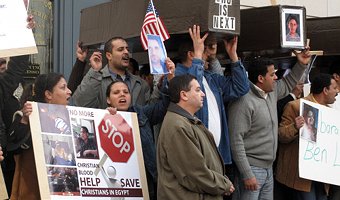
WASHINGTON (RNS)—The New Year’s Day massacre at a Coptic church in Egypt. Christian converts facing the death penalty in Afghanistan. Swastikas painted on a Jewish synagogue in Venezuela.

As the headlines deliver fresh stories of the persecution of the faithful, two recent reports by watchdog groups and a new book take a fresh look at the persistence of religious intolerance worldwide, with Muslim-majority nations facing particular criticism.

More than 1,000 Coptic Christians demonstrated in downtown Nashville against the shooting deaths of six Coptic Christians and other instances in Egypt of violence and persecution against their ancient Christian community. (PHOTO/Baptist Press/Art Toalston)

“Religious persecution is not only more prevalent among Muslim-majority countries, but it also generally occurs at more severe levels,” Roger Finke and Brian J. Grim write in their new book, The Price of Freedom Denied, published by Cambridge University Press.

Finke and Grim drew on annual reports by the U.S. State Department to conclude that religious persecution plagues all regions of the globe.

Studying 143 countries, they found:

• In 86 percent of countries, people were physically abused or removed from their homes based on their religion.

• High levels of government restrictions on religion were found in 78 percent of Muslim-majority nations, compared to 10 percent of Christian-majority nations and 43 percent of other nations.

But nothing inherent in Islam makes Muslim-majority countries poor guardians of religious freedom, Finke said, and Muslims themselves often are victims of religious intolerance.

“As Westerners, we view Muslims as targeting us or other Christians. But when you look within these countries, much of the persecution is Muslim on Muslim,” said Finke, a sociologist of religion at Penn State.

“It’s a battle over what type of Shariah law should be enacted, or who holds the reins of power in government.”

Open Doors, a California-based evangelical group that defends Christian rights globally, also cites Muslim-majority nations as particularly hostile in its recent list of the most dangerous countries in which to practice Christianity.

While North Korea tops the list for the ninth consecutive year in the Open Doors report, eight of the top 10 offenders are Muslim-majority nations. North Korea is followed by Iran, Afghanistan, Saudi Arabia, Somalia, Maldives, Yemen, Iraq, Uzbekistan and Laos.

Open Doors President Carl Moeller said he particularly is concerned about increasing violence against Christians in Iraq and Afghanistan. Iraq broke into the top 10 for the first time, up from No. 17, and showed the most dramatic deterioration for Christians.

“These are countries we sought to bring freedom to, and they don’t enjoy the most basic freedom we have in our country—religious freedom,” said Moeller, whose group devised a 50-question survey to rank countries.

A new report focusing on the most vulnerable religious communities in the world was released by the non-denominational First Freedom Center. In “Minority Religious Communities At Risk,” the Richmond, Va.-based group identifies groups threatened with extinction within a decade.

They are, according to First Freedom, Orthodox Christians in Turkey, Jehovah’s Witnesses in Eritrea, Jews in Arab lands, Jews in Venezuela, Nazarene Chris-tians in Somalia, Masalit Muslims in Sudan and Sabian Mandeans (a Christian sect) in Iraq.

Relying on the State Department’s religious freedom reports and other sources, First Freedom, like Open Doors, calls attention to the growing violence against religious minorities in Iraq and Afghanistan.

The group’s president, former Ambassador Randolph Bell, said the report bolsters his view that protecting religious freedom must be integral to U.S. peacekeeping operations.

“Whenever we try to stabilize situations in countries like Afghanistan, Iraq, Somalia or Nigeria, if we do not take into account the rights of religious minorities, peace will not last,” Bell said.


News Elsewhere:

Copts say Egypt regime change trumps Islamist fears (02/02/11)

An Egyptian Coptic Orthodox church source said the church will advise Copts not take part in the latest protests, but will not stop those who insist on taking to the streets.

Unrest in Egypt: Terry Mattingly wonders why media haven't mentioned the Copts in reference to the latest protests in Egypt.