Bell’s hell draws heat, accusations of heresy from critics

WASHINGTON (RNS)—One of the nation’s rock-star-popular young pastors, Rob Bell, 40, has stuck a pitchfork in how Christians talk about damnation.

Bell is pastor of Mars Hill Bible Church, a megachurch in the Grand Rapids, Mich., area. His controversial book Love Wins: A Book About Heaven, Hell, and the Fate of Every Person Who Ever Lived, arrived in stores March 15.

Rob Bell

Critics pounced before the book even was published, provoking weeks of fierce infighting among pastors, theologians and anyone else who scans the Christian blogo-sphere.

In Love Wins, Bell claims:

• Heaven and hell are choices we make and live with here and now. “God gives us what we want,” including the freedom to live apart from God (hell) or turn God’s way (heaven).

• Death doesn’t cut off the ability to repent. In the Bible, Bell sees no “infinite, eternal torment for things (people) did in their few finite years of life.”

• Jesus makes salvation possible even for people who never know his name. “We have to allow for mystery,” for people who “drink from the rock” of faith “without knowing who or what it was.”

• Churches that don’t allow for this are “misguided and toxic.”

Small wonder that traditionalists call him a false teacher of a Jesus-optional gospel, leading innocents to damnation and a traitor to the evangelical label.

In an interview, Bell joked, “I am not aware that labels are the highest form of goodness and truth.” He rebuffs critics who say he presents a Jesus-optional Christianity: “Jesus spoke of the renewal of all things. He said, ‘I have sheep who are not of this flock.’ Through him, extraordinary things are happening in the world.”

Bell’s view is “that God is love, that he sent Jesus to show us that love, that love demands freedom. So, making definitive judgments about other people’s destiny is not interesting to me. The heart of God is to rescue everyone from everything we need to be rescued from.”

Justin Taylor of the Gospel Coalition, a network of traditionalist scholars and pastors, insists Bell’s views are “dangerous and contrary to the word of God. … If Bell doesn’t believe in eternal punishment, then he doesn’t think sin is an offense against a holy God.”

Taylor’s critique last month, based on reading a few chapters, triggered explosive arguments radiating from Christian sites to CNN. Now that he has read all 200 pages, Taylor is even more convinced of Bell’s errors.

“Whether you like it or not, the Bible presents true teaching and warns against false teachers, even those who look like great people,” says Taylor, digging at Bell’s highly stylized videos circulating online and among churches coast to coast.

But Richard Mouw, president of Fuller Theological Seminary in Pasadena, Calif., calls Love Wins “a great book,” well within the bounds of orthodox Christianity and passionate about Jesus.

The real hellacious fight, said Mouw, is between “generous orthodoxy and stingy orthodoxy. There are stingy people who just want to consign many others to hell and only a few to heaven and take delight in the idea. But Rob Bell allows for a lot of mystery in how Jesus reaches people.”

During an appearance at New York’s Society for Ethical Culture on the eve of his book’s release, Bell responded to questions posed by Newsweek magazine’s Lisa Miller. She directly asked Bell if he considers himself a universalist.

“No, if by universalist we mean there’s a giant cosmic arm that sweeps everybody in at some point whether you want to be there or not,” he said.

Bell went on to explain that the love he espouses involves a God who would never violate free will. God, he said, is one of love, and love involves choice and freedom.

Bell’s caveat is that there will be all sorts of people in heaven, citing passages where Jesus warned that “all the people who are in might be out and all the people who are out might be in.”

Regarding hell, Bell explained that he believes in hell because he sees it around him every day through the human suffering in the world. He further said that he sees no reason that hell will not be extended into eternity.


–With addition reporting by R. Kevin Johnson for Associated Baptist Press.


What would Niebuhr do? Theologian’s legacy debated

PRINCETON, N.J. (RNS)—What happens when the contested legacy of America’s most famous 20th-century theologian meets the harsh political realities of the 21st? You end up with questions like whether Reinhold Niebuhr would support water-boarding.

It’s impossible to know what Niebuhr—arguably the preeminent public intellectual and American theologian from the 1940s to 1960s—would have said about the practice of torture by the United States in post-9/11 Iraq and Afghanistan.

Public officials and pundits from both the left and right lay claim to the legacy of noted 20th century theologian Reinhold Niebuhr and his concepts about Christian realism.

But such questions are hardly a surprise at a time when everyone from President Obama to Secretary of State Hillary Clinton to New York Times conservative columnist David Brooks see themselves as Niebuhr’s acolytes.

Nor are they a surprise when academics come together, as they did recently at Princeton University, and debate the long-term legacy of a figure claimed by both the political left and right, by religious and nonreligious alike.

A man who died in 1971 but has been heralded in recent years as “the man of the hour” deserves his praise, speakers agreed, but also has his limits.

Shaun Casey, who advised Obama on religious outreach during the 2008 campaign, believes the pragmatic Niebuhr who’s become so popular since 9/11 is often viewed as a straightforward disciple of “real-politick” rather than a Christian theologian who wrestled with questions of transcendence.

The richness of Niebuhr’s worldview—one that acknowledges the tragedy and limits of humanity while embracing a call for social justice—has been lost in the contemporary world, said Casey, who is writing a book on those he calls “Niebuhr’s children.”

“Today, you’re either Glenn Beck or Dennis Kucinich,” said Casey, an ethicist at Wesley Theological Seminary who spoke at the Princeton event, titled “The Niebuhrian Moment, Then and Now: Religion, Democracy and Political Realism.”

Gary Dorrien, who teaches at New York’s Union Theological Seminary, where Niebuhr held court more than three decades, said the problem in interpreting Niebuhr is that he “seemed to revel in dispiriting proclamations, such as, ‘The possibilities of evil grow with the possibilities of good.’”

What often is overlooked, Dorrien said, is that Niebuhr was “a passionate type who took his own Christ-following passion for justice for granted. For him, the love ethic was always the point, the motive and the end.”

Niebuhr’s contributions to modern Christian thought include a sense of “irony and paradox,” Dorrien said, as well as a well-honed sense of the “complex ambiguities inherent in all human choices.”

In other words, Niebuhr didn’t see a world that was easy to fit into a ready-made box.

The trouble with Niebuhr’s famed “Christian realism,” however, is that “it dropped the ball on economic justice after World War II. It left progressive Christianity without enough to say or do in its own language, in its own way, and for its own reasons,” Dorrien said.

Given Obama’s own professed embrace of Niebuhr, it was inevitable that the president’s record would be viewed through several “Niebuhrian” lenses.

Although Princeton scholar Jeffrey Stout couldn’t attend the conference, his paper delivered at the event was sharply critical of Obama and the president’s embrace of the politically pragmatic Niebuhr. Stout said Obama “isn’t a principled opponent of anything.”

“The current president came to national attention as a candidate enunciating principles of justice for the conduct of warfare, statecraft, the domestic economy and political change,” Stout said in his paper. “As soon as he described himself to an interviewer as a Niebuhrian, we should have known that the principles were nothing more than mushy sentiments to be thrown overboard at the first sign of rough weather.”

Stout later added that he’s studied Niebuhr and voted for Obama, but it’s more complex than that. “It’s time to start thinking seriously,” he said, “about what they leave out.”

Cornel West, a noted African-American religious philosopher who teaches at Princeton, reveres Niebuhr but acknowledged the many ways Niebuhr’s thought has been used to undergird political and religious conformity.

West, who has been critical of Obama on a number of issues, said Stout was “expressing something that’s being felt more and more. He’s onto something.”

But West said while he has been disappointed in Obama, “I also know what he’s up against. I want to protect him, respect him and correct him.”

There was little consensus on a Niebuhrian approach to modern dilemmas like water-boarding. Niebuhr was at once a moralist, a patriot and a pragmatist. Harvard Historian K. Healan Gaston said there’s little value in trying to speculate on what Niebuhr might say about specific current issues.

“Although Niebuhr’s way of thinking remains intensely relevant to the challenges we face, there are a wide range of discernibly Niebuhrian positions one might take on almost any contemporary issue,” she said.

“As an historian, I tend to regard Niebuhr as a creature of his own historical context who can inspire useful reflections on today’s issues—but should not be ventriloquized in relation to any of them.”


Faith Digest: Airline apologizes

Airline apologizes to Orthodox Jews. Alaska Airlines issued an apology for misinterpreting the devotional behavior of three Orthodox Jewish men on a flight from Mexico City to Los Angeles. The men had strapped on tefillin—black leather bindings and boxes worn on arms and heads during ritual prayer by some Jews—and were praying in Hebrew, ignoring requests from crew to remain seated during turbulence. Two of them visited the restroom while the third seemed to be “standing guard” in the aisle during the flight, which appeared suspicious, according to the airline’s statement. Flight attendants locked down the cockpit and radioed a security alert to the airport, where emergency personnel and law enforcement met the plane. The three men were questioned and released with no charges filed. Alaska Airlines will incorporate Orthodox Jewish practices into its diversity training and work with the Jewish Federation of Greater Seattle to avoid such misunderstandings in the future, officials said.

Adventists see rapid growth. With Saturday worship services and vegetarian lifestyles, Seventh-day Adventism owns a distinctive niche outside the Christian mainstream. But being different is turning out to be more of an asset than a liability for the Seventh-day Adventist Church, the fastest-growing Christian denomination in North America. Newly released data show Seventh-day Adventism growing by 2.5 percent in North America. Adventists are even growing 75 percent faster than Mormons (1.4 percent), who prioritize numeric growth. But despite its roots in North America, the Seventh-day Adventist Church is growing twice as fast overseas. North America is home to just 1.1 million of the world’s 16 million Adventists.

Museum restores Jefferson’s Bible. A Smithsonian museum is restoring the “Jefferson Bible,” a unique volume the third president cut and pasted himself, omitting supernatural elements from portions of the New Testament. Thomas Jefferson assembled the book, The Life and Morals of Jesus of Nazareth, in 1820 when he retired after two terms as president. Conservators at the Smithsonian’s National Museum of American History will repair the fragile book’s torn pages. The project, paid for by private and federal funds, will cost about $225,000. The Smithsonian’s librarian purchased the book from Jefferson’s great-granddaughter for $400 in 1895, said museum spokeswoman Valeska Hilbig.

Religious violence linked to Antichrist. Violence committed in God’s name is a tool of the Antichrist, Pope Benedict XVI writes in a new book on the life and teachings of Jesus. “Violence does not build up the kingdom of God, the kingdom of humanity,” Benedict writes. “On the contrary, it is a favorite instrument of the Antichrist, however idealistic its religious motivation may be. It serves not humanity, but inhumanity.” The passage appears in Jesus of Nazareth—Holy Week: From the Entrance into Jerusalem to the Resurrection, published in eight languages, with an initial printing of 1.2 million copies.


Reciprocity or dependency?

Relationship is the heart of mission involvement, and the form that relationship takes determines whether believers minister “with” or “to” others, missiologists insist. Today, they add, relationship translates as partnership, collaboration and reciprocity.

Access to safe drinking water means healthier families, more time to care for them and the possibility for children to spend their days learning to read instead of walking to fetch water, says Passport Executive Director David Burroughs. Watering Malawi, a ministry of Passport, Inc., provides access to clean water, simple irrigation and sanitation by digging wells like this one in regions of Malawi hardest hit by cyclical drought.

“I definitely see more cooperation, partnership and collaboration,” explained Michael Stroope, associate professor of Christian missions at Baylor University’s Truett Theological Seminary. “A number of people describe it … as a two-way street with benefit going in two directions.”

Sending mentality

Developing a more cooperative spirit requires first letting go of past patterns. “I think that in the past, we had a confessional approach. … Those who agreed with us were welcome to go with us,” said Keith Parks, president of the Southern Baptist Convention’s Foreign Mission Board from 1980 to 1992 and later the coordinator of global missions for the Cooperative Baptist Fellowship.

Credited for leading the mission board to work with unreached people groups in Asia and Africa, Parks acknowledged, “We were … strong on starting Baptist churches, but we didn’t expect those we worked with to always agree with us.”

Then in 2001, Southern Baptists shifted to a creedal approach, Parks said. “That changed the nature of missions. Missionaries would go in, and if nationals didn’t agree, the missionaries would not work with them.”

American Christians’ understanding of their own culture plays into their approach to missions. “Many of us think of ourselves as coming out of the sending mentality … the sending west,” noted Rob Nash, coordinator of CBF global missions. “We think we are enlightened and have moved beyond the sending mentality, but the reality is that we need to see ourselves in the mirror.”

Culturally, Americans see themselves as objective observers, Nash believes. “But we need a confession of who we are, and we need to get in touch with the culture,” he said. “We are future-oriented, pragmatic, linear and action-oriented. We don’t realize how these things affect our relationship with others. If we are not in touch with who we are, we tend to devalue the opposite.”

Paternalism & dependency

The sending concept can lead to a paternalistic approach to missions—doing for people and taking the gospel to them, rather than participating in ministry with them. While more Christians have adopted a reciprocal approach to missions, paternalism hasn’t completely been overcome, Nash believes.

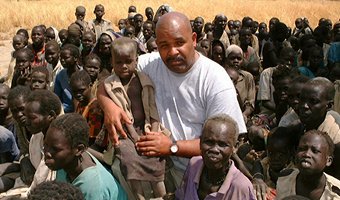
Radio talk show host Joe Madison, seen here in a 2001 visit to Sudan, has helped raise the visibility of the Sudan crisis among black churches in the United States.

“Paternalism is difficult to recognize. Often, we can’t see it when we’re doing it. This is where I think those of us who work with missions have to really become listeners much more than people who fill up the air with words,” he said. “We live in a day when we need to be taught. … There are others at the table doing missions in far better ways than we are right now.”

Churches and missionaries can fall prey to financial paternalism in which the community being helped must rely on the congregation or sending agency for the money to continue ministry. Or groups can be doctrinally paternalistic when they insist on controlling beliefs, Parks said.

How does a congregation know when it’s worked too long with a particular community? That depends on the relationship between them, said Rick McClatchy, CBF coordinator in Texas. “The partnership has to be evaluated to make sure dependency isn’t developing, … but coming in for just a short time doesn’t build the trust and relationship necessary for ministry.

“Dependency is a legitimate thing, but you don’t want to go too far the other way because those long-term relationships … lead to trust and transformation. … You don’t want to drop relationship or not take the time to build relationships.”

Stroope believes as long as the relationship is built on collaboration and reciprocity, dependency becomes less of an issue, especially if each side is honest with the other. “It works when there are good partners on the ground who aren’t afraid to say no and who aren’t afraid to set the terms of participation,” he said.

“Sometimes the relationship is not open enough for limits to be set. Volunteers need to know that what they are doing is part of a strategy and that it is ongoing. That understanding must become part of why they are going and how they go.”

Reciprocal ministry

Chris Thompson, coordinator for Liberty, Mo.-based Together for Hope West, looks at all the entity’s endeavors through the lens of reciprocity and collaboration. Together for Hope West helps coordinate the national CBF Together for Hope Rural Poverty Initiative in areas west of the Mississippi River.

“Rather than using an historic model of bringing in mission teams to do for people, we develop relationships for sustained empowerment for locals,” he explained.

Together for Hope West relies on four “R’s” of community development and cross-cultural ministry—reciprocity, relationship, reconciliation and respect. Staff also make sure ministry is guided by a core-value model—local visioning, leadership, project development, long-term sustainability, local expertise in education and engagement, and an emphasis on the process rather than on the outcome.

The organization builds on relational ministry. “It’s the relationship that’s important—to listen and share the person’s story and to hear the voices silenced by circumstances … even when what we hear is hurtful,” he said. “We must be a part, be a presence in people’s lives. Sometimes that’s a challenge.”


Band wants to help students find direction

NASHVILLE, Tenn.—When Mike Donehey, lead singer for Tenth Avenue North, uses concerts to deliver a message to young people about living for what matters most, he speaks with the authority of one who knows firsthand how a near-death experience helps put things into perspective.

Tenth Avenue North band members Jason Jamison, Ruben Juarez, Mike Donehey and Jeff Owen recently traveled to Honduras to visit children sponsored through Compassion International.

At age 18, Donehey broke his back in two places and needed more than 90 stitches after being thrown out of a car in a near-fatal accident. Convinced God had spared him for a reason, Donehey committed himself to being used for God’s glory. 

During the two months he spent at home recovering from his injuries, he asked his parents for a guitar and began practicing.

“It was the first time in my life that I actually slowed down and spent time reflecting on things,” Donehey said. “Anytime you have a near-death experience, it wakes you up to bigger things. This experience definitely made me take inventory of my life and forced me to evaluate what was important and what was not.”

After he recovered, Donehey attended Palm Beach Atlantic University in West Palm Beach, Fla., and started leading worship for youth and college ministries at local churches. During this time, he met drummer Jason Jamison and guitarist Jeff Owen.

Donehey and his friends began to play at local coffeehouses and other venues. Their group name derives from a major road near their college campus. Bass player Ruben Juarez III recently joined the lineup.

As Tenth Avenue North began touring, band members committed themselves to sharing messages about God’s grace that would challenge young audiences to a deeper walk of faith. 

“As more people are hearing the songs, it provides greater opportunities to let them know about the grace and love offered to them through Jesus Christ,” Donehey said. 

Their concerts benefit mission organizations such as Compassion International, a child-sponsorship organization dedicated to meeting the physical and spiritual needs of children living in poverty around the world. As a result of Tenth Avenue North’s fall 2010 tour, Compassion International secured sponsors for 1,700 children.

Immediately following the tour, band members traveled to Honduras to witness the impact of these sponsorships. They enjoyed spending time getting to know the children, playing with them and hearing stories about their lives. 

Their latest album, The Light Meets the Dark, focuses on how a relationship with Christ can help overcome personal struggles and obstacles. 

“Our hope is that as people encounter truth of the gospel through these songs, they would be moved and changed as they desire to live for Christ,” Donehey said. “Through our music and message, we want to lead people into the presence of the Lord and help people to know Christ as their Savior, Lord and treasure.”


Do Christian athletes strike out on big-dollar contracts?

ST. LOUIS (RNS)—As contract talks broke down between Albert Pujols and the Cardinals, St. Louis baseball fans nervously began asking themselves a host of questions.

He’s a Cardinal for life, right? He wouldn’t go to Wrigley Field, because he likes winning too much, right?

St. Louis Cardinals’ Albert Pujols celebrates as he crosses home plate with a grand slam against the Chicago Cubs. Some Christian fans wonder whether Pujols’ evangelical faith conflicts with his quest for a $200 million-plus contract. (RNS PHOTO/Chris Lee/The St. Louis Post-Dispatch)

But a particular group of Cardinals fans—those who share Pujols’ evangelical faith—asked a different kind of question: What does holding out for the largest contract in the history of baseball say about his Christian testimony?

Pujols and his wife, Deidre, are evangelical Christians. They describe their charity, the Pujols Family Foundation, as “a faith-based nonprofit organization” and participate in Christian events around the city.

So, as Pujols began looking to many like a typical mega-wealthy superstar athlete angling for a record payday, some asked how Pujols’ public, God-fearing image squares with a private quest for wealth.

Team officials declined to describe the details of their offer to Pujols, but it’s widely believed to have been worth about $200 million.

Darrin Patrick, pastor of The Journey, a church in St. Louis that counts a number of professional athletes as members, said Jesus warned against greed.

“Nobody really confesses to that sin,” Patrick said. “Lust, anxiety—sure. But very few people say, ‘I’m greedy,’ and I absolutely think that (Pujols) should be on guard for that.”

A verse from 1 Timothy says, “The love of money is a root of all kinds of evil, and in their eagerness to be rich some have wandered away from the faith and pierced themselves with many pains.”

That’s the fear of many people who love Pujols, both as fans and as Christians. They fear, as Jesus said in Matthew 6:24, that no one can serve two masters. “You cannot serve God and wealth.”

Sean Michael Lucas, a former professor at Covenant Seminary in Creve Coeur and current pastor of a Presbyterian church in Hattiesburg, Miss., describes himself on his Twitter page as, among other things, “Cardinals fan, lover of Jesus.”

At the end of January, Lucas tweeted, “… how is AP’s testimony affected if he holds the Cards hostage for $30m/10yrs? @ what pt does 1 Tim 6:10 apply here?”

In another tweet, Lucas wrote, “Unless there is a big part of this contract that goes to Pujols Foundation ($30-50m) he’s open 2 the question. Legitimately.”

Baptist pastor Scott Lamb, the co-author with Tim Ellsworth of a new Pujols biography called Pujols: More Than the Game that focuses on the first baseman’s faith, said the contract talks have opened up an interesting debate in Christian circles that goes beyond baseball to the uncomfortable intersection of the New Testament and capitalism.

“Consumption mentality is very American, but it’s not very biblical,” Lamb said. “People are asking whether (Pujols) should grab all he can get, and what his moral responsibilities are in terms of what to do with that money.”

What to do with a lot of money is a relatively new problem for Pujols. In 2000, when he was in the minor leagues in Peoria, Ill., and Memphis, Tenn., he was bringing in $125 a week.

By 2005, he and his wife set up their foundation to help children with Down syndrome and children living in poverty in his native Dominican Republic. In 2010, the foundation spent $800,000 on its programs, according to Todd Perry, its executive director.

“Albert and Dee Dee are extremely generous, not just to the Pujols Foundation but to other charities in the community,” Perry said. “Their foundation is their passion.”

Several pastors emphasized the more important point for Pujols is not how many millions he makes, but how he spends it.

“What you do with your money is a factor,” Patrick said. Pujols “has a track record of generosity that is without question. God does use money to help people, and I see God doing that with Pujols.”

Ultimately, Christian Cardinals fans and others who benefit from the Pujolses’ largesse are praying for a big payday for No. 5, and for his generosity to continue, even grow.

“I reject any idea that a person’s Christianity should cause them to step away from what the market would demand for them,” Lamb said. “Albert will go down in history as one of the great ones—someone who grabbed the money and gave it away at the same time.”


Some foreign aid helps, other kinds do more harm than good, experts assert

Even though the Green Bay Packers won this year’s Super Bowl 31-25, up to 100,000 individuals in developing countries are wearing new T-shirts erroneously labeling the losing Pittsburgh Steelers as NFL champions.

For marketing purposes, the NFL preprinted memorabilia for sale at the final gun of the Feb. 6 contest regardless of which team prevailed. Afterward, the league announced a $2 million in-kind gift of the misprinted Steeler apparel to World Vision, a Christian relief organization synonymous with helping children worldwide by addressing the root causes of extreme poverty.

A gesture most Americans likely celebrated as win-win brought quick condemnation from experts labeling it “bad aid,” well-intentioned acts that wind up doing more harm than good.

Bags of food sitting stacked in a warehouse in Ethiopia are reminders that not all aid is “good” aid if the donations are not handled and distributed properly. Wise advocates for the poor insist not only on greater allocations for foreign aid, but also on more efficient and effective administration to make sure it really reduces poverty, some experts insist. (PHOTO/Alan Bjerga/Bloomberg via Getty Images )

Critics said the NFL got a big tax write-off, but since the Steelers weren’t really champs, the retail value of the T-shirts was next to nothing. That prompted an ongoing argument about the narrow equation between whether “gift-in-kind” items like used clothing help the poor or hurt them by competing with local industries and giving away items that could be produced locally for less money than it costs to collect, process and ship them overseas.

World Vision responded that opinions about such gifts—discussed among experts by the acronym GIK—range from absolute opposition to belief that any product sent with good intentions is helpful. World Vision claims a middle-ground it calls a “nuanced conditional strategic use of product in appropriate contexts.”

Laura Seay, an assistant professor at Morehouse College who attended First Baptist Church in Austin while earning her doctorate at the University of Texas, maintains some GIK contributions are good and even necessary for sustainable development. Examples are antiretroviral drugs for treatment of HIV/AIDS and technical items for digging wells. They only work, however, if they are highly targeted and valued by the recipient.

Cheaper items that are readily available and affordable anywhere in the world are at best wasteful and at worst hurt the very people they are intended to help, experts say.

Garth Frazer, an associate professor of economics at the University of Toronto, argued in a widely read article that one major reason many African countries haven’t developed their own major textile industries is the influx of used clothing donations by consumers in industrialized nations.

Success stories over the last 30 years in East Asian countries like Taiwan, Korea, Singapore, Hong Kong and more recently China began with production and exporting of textiles and apparel, Frazer said. As their economies grew, those countries moved to manufacturing higher-ticket items like electronics and automobiles.

By contrast, African economies have stagnated, with many countries unable to step onto even the bottom rung of the manufacturing sophistication ladder by producing and exporting their own textiles and apparel. That is despite Africa’s low unskilled wage levels and abundant supplies of cotton.

Used-clothing donations to charities have increased dramatically over the last 20 years, Frazer said. What many people don’t know, he added, is that thrift shops are able to sell only a portion of what they collect. The rest is sold to exporters who ship it to developing countries at a very low cost.

About 16 percent of containers in ships with U.S. exports bound for Africa in 1995 were filled with used clothing. That flood of imports had a “significant negative impact” on textile and apparel production sectors in sub-Saharan Africa, Frazer said. He calculated a 39 percent annual decline in apparel production and roughly half the annual decline in apparel employment attributed to cast-off clothing.

Eric Raikes, a graduate student at the University of Toronto, wrote a blog arguing why he thinks the NFL/World Vision T-shirt giveaway was a bad idea.

“First, it creates a dependency on aid,” he wrote. “Second, seeing economic production as a possible alternative to aid, it stifles local economic development in favor of cheaply imported goods.”

Beyond that, Raikes argued that shipping 100,000 shirts to developing countries is a bad use of resources. Studies show that on their own, in-kind donations like clothing and food instead of money are reasonably efficient forms of aid, but when you factor in the cost of administration and delivery, they are not cost-effective.

Finally, Raikes said his type of marketing “entrenches ideas of naked Africans who are oh-so-grateful for your shirts” and promotes Western people as “saviors” or “white knights” while encouraging wasteful consumption—people only give away old shirts after they buy new ones.

Seay, who writes regularly about third-world economies in a blog titled Texas in Africa, said the T-shirt giveaway was not only “bad aid” but also “unnecessary aid.”

“There aren’t any places in the world where T-shirts are not available at a market price determined by the local economy and affordable to local consumers,” she wrote.

Both the NFL and World Vision get benefits—the NFL for taxes and World Vision for its bottom line—she said, “and don’t owe anyone an explanation of whether the T-shirts actually do anyone any good.”

Finally, Seay said, there is an “opportunity cost” to shipping clothing items to people who don’t want them but have other serious unmet needs.


Fighting hunger makes economic and political sense, Christian activist says

DALLAS—Despite deep divisions in U.S. society, Christians can lead the way toward bipartisan solutions to the pain of poverty, insisted one of the world’s top hunger fighters.

“Church people—whose congregations often span the political spectrum—have the moral imperative to push for bipartisan efforts to eliminate poverty and hunger,” David Beckmann, president of Bread for the World and 2010 recipient of the World Food Prize, said in an interview.

A Samburu woman in Kenya shares her meal with a child. Meeting the needs of hungry children and poor people makes political and economic sense, according to David Beckmann of Bread for the World. (BP FILE PHOTO/Sydney A. James)

Bread for the World is a multidenominational Christian organization that urges politicians to make decisions that will alleviate hunger in the United States and around the world. Beckmann, an ordained Lutheran minister and former missionary, has led the organization since 1991.

He outlined a two-part strategy for convincing lawmakers to preserve federal programs that protect poor people—illustrate the needs, but also demonstrate how meeting those needs makes economic and political sense.

“Right now, there are huge pressures to cut programs for poor people in the name of deficit reduction,” he acknowledged.

For example, the House of Representatives is proposing a 10 percent reduction in the Women, Infants and Children—WIC—program that provides supplemental food for low-income women and children up to age 5, he said.

But that expense reduction equals bad economics, he added. The federal General Accounting Office has demonstrated WIC saves more than it costs by reducing the amount of Medicaid spent on premature babies whose mothers were undernourished during pregnancy. And long-term, even moderate undernourishment of small children reduces their productivity later in life.

“It just doesn’t make economic sense to cut assistance to pregnant mothers and small children,” he said.

Globally, food prices are higher than they have been in decades, and they’re expected to increase because of rising fuel costs, Beckmann reported, adding he is proud the United States has led the world in investing in poor farmers, yielding improved nutrition.

Nevertheless, the House budget proposes to cut overseas agriculture support by 30 percent, meaning 19 million people worldwide will lose their dietary assistance, he said.

David Beckmann, president of Bread for the World and 2010 recipient of the World Food Prize, insists Christians have a moral imperative to use political influence to eliminate hunger and fight poverty. (PHOTO/Courtesy of Bread for the World)

That doesn’t make economic sense, either, especially for fiscal conservatives, he noted. For every $1 the U.S. government spends on global hunger, other governments and groups contribute $10, leading to a “surge in investment in poor farmers.” But the budget cuts could undercut U.S. leadership in hunger reduction and cause other nations to curtail their support, he warned. And that will lead to worsened conditions for the world’s farmers, resulting in even greater need.

These aren’t simply the concerns of bleeding-heart liberals, but also of clear-eyed conservatives, Beckmann said.

“Both (political) parties can agree on steps that will make aid programs for needy people work better,” he stressed. “Bread for the World is serious about using tax dollars well. … We can get bipartisan agreement to use tax dollars more effectively in foreign aid.”

In fact, Bread has led the charge in demanding accountability from aid programs, he said. During the past three years, the organization has pushed for greater transparency in the programs, demanded tighter measures of effectiveness and insisted the programs “make things work better for people in need.”

The time is right for Christians to promote bipartisan support for antihunger programs, Beckmann noted. “Despite political polarities, Americans are more sensitive to poor people than they were 15 years ago. This especially is true with the economic recession. We’ve all been touched, and just about everyone has a close friend or family member who has lost a job.”

So, Christians should demand their lawmakers find other ways to reduce the federal deficit rather than shave away programs designed to help the poor and hurting, he said. Those programs that respond to people in need—both domestic and international—comprise only 15 percent of the budget.

“There are other ways to reduce the deficit: Grow the economy. Go after the other 85 percent of the budget. And close tax loopholes,” Beckmann suggested.

“Ask yourself: ‘What would Jesus cut?’ He wouldn’t cut WIC. The Bible doesn’t say that specifically. But the Bible says God does support the poor. We do not need to make hungry people hungrier.”

“Bread for the World is grounded in Jesus and deeply connected to the church,” he reported. “We’re grateful for the longstanding support of Texas Baptists, as well as Lutherans, Presbyterians, Catholics, various African-American denominations, such as the African Methodist Episcopal Church, and other groups.”

This spring, Bread is providing Christians with an opportunity to call for support for the world’s poor and hungry through its annual Offering of Letters. For more information about the project, see the editorial on page 5 of this issue.


‘Bad advocacy’ can do more harm than good, Baptist scholar insists

ATLANTA (ABP)—Celebrity-driven campaigns like Save Darfur and Invisible Children are popular, but in some cases, they do more harm than good, according to a Baptist scholar who specializes in African politics, conflict and international affairs.

“Advocacy needs to be intelligent,” said Laura Seay, an assistant professor at Morehouse College. “When you present information that isn’t accurately descriptive of the dynamics of the situation, advocacy groups can sometimes do more harm than good.”


Activists rallied in Chicago at a rally and prayer vigil for Sudan. The Sudan issue has gained traction in American churches. But scholar Laura Seay warns that oversimplifying conflicts is probably the most common mistake American advocacy groups make.

Seay, who attended First Baptist Church in Austin while earning her doctorate at the University of Texas, insists superficial understandings of complex situations can lead to bad advocacy or “badvocacy,” a catch-all phrase to describe advocacy that begins with good intentions but either accomplishes nothing or makes the problem even worse.

Seay, who did field work for her doctorate in the Democratic Republic of Congo, cites that country’s civil war as a prime example. Armed militia in eastern DRC that control minerals used to manufacture cell phones routinely deploy rape as a weapon of war. Advocacy groups like the Enough Project urge Westerners to boycott certain electronic products in order to break the supply chain and thereby discourage atrocities.

The problem, Seay inisted, is no evidence directly links sexual violence and mineral trade.

“The act of buying a cell phone does not cause war in the Congo, and it’s downright misleading to suggest otherwise,” she writes on her blog titled Texas in Africa. “Why? Because it implies that if we could just stop the conflict mineral trade, the situation would markedly improve.”

Bad advocacy leads to bad policy—and to celebrities traipsing around pontificating on issues they don’t understand, Seay said. If advocacy doesn’t help to solve crises and does little or nothing to improve the lives of those who are suffering, Seay contends, it isn’t “better than nothing.”

She cites several reasons why she believes so much Africa-based advocacy in the United States is off-base:

Oversimplification of the issue. Oversimplifying conflicts is probably the most common mistake American advocacy groups make, Seay contends. Americans tend to seek a single external source of evil for all of the world’s problems. Most instinctively try to narrow complex conflicts down to make them understandable to normal people. It’s a lot easier, for example, to call the war in Congo a “resource war” than to explain it as a series of ongoing local conflicts over land, ethnicity, resources and governance with local, national, regional and international dimensions. “That doesn’t really fit on a T-shirt,” she said.

Western-conceived solutions. Most peacekeeping missions, peace-building efforts and conflict resolution plans are conceived in New York, Washington and Brussels, often by people who never or rarely visited the countries they purport to help. Seay said that is why “these so-called solutions rarely work.” She advocates looking to local leaders to find answers whenever possible.

“Civil society leaders are well aware of their communities’ problems, and they usually have ideas as to how to solve those problems, or at the very least to mitigate the effects of violent conflict on civilian populations,” she advised. “They speak the languages, know the cultures and can mediate among the key players in local sociopolitical dynamics.”

That doesn’t mean there is no room for Western assistance, Seay said. “It does mean, however, that advocates on this side of the Atlantic should be asking intelligent victims of war what they think would help rather than insisting that the experts know best.”

Focus on celebrities and trendiness rather than intelligent analysis. Seay says this is Save Darfur’s problem. Everybody opposes genocide, but when people who are trained as actors and musicians start traipsing around war zones without having done any homework independent of the organization supporting their visits, they give a narrative that isn’t exactly representative of the facts.

“So, Darfur in the popular imagination becomes not a civil war over changing land usability and land tenure rights with people doing horrible things on both sides, but rather becomes the nasty Arab government going after innocent black Darfuris,” she says. “The reality, of course, is closer to the former description than the latter, but I don’t expect Mia Farrow to know that.”

Focus on the advocates rather than those they purport to help. Seay confesses to cultural heresy by disagreeing with talk show sensation Oprah Winfrey about Invisible Children, a grassroots movement that started with a documentary film about children kidnapped and turned into child soldiers in Uganda.

“Most of their advocacy isn’t actually focused on Ugandan children, but rather on how their supporters feel about Ugandan children and the problem of the use of child soldiers,” Seay writes. “Good advocacy isn’t about the advocates; it’s about the people who need others to stand up on their behalf.”

Insistence that “we have to do something.” The human impulse to protect others generally is good, Seay said, but that doesn’t always mean that the “something” in question should be done. Westerners too often get involved in conflicts they don’t really understand, and bad things happen.

The white man’s/woman’s burden. “Young people get excited about truly appalling situations and, like generations of missionaries and colonists before them, they decide they’re going to ‘Save Africa,’” Seay said. “This generally leads to discussions of being ‘a voice for the voiceless.’

“Here’s the problem with that: Africans aren’t voiceless. In 11 years of experience on the continent, I’ve never met a citizen of an African state who didn’t have opinions on his or her country and its state of affairs. There’s a big difference between claiming to speak for someone and standing alongside those who want to change their own communities. Africa-focused advocacy could use a lot more of the latter.”


Faith Digest

Views on homosexuality bar foster couple. Two judges in England banned a Christian couple from foster care because they oppose homosexuality—a stance the judges said has no place in the laws of Britain. Owen and Eunice Johns, of Derby, England, already have fostered 15 children, but the High Court in London ruled the Pentecostal couple no longer can continue the practice because their anti-gay views are legally wrong. Lord Justice James Lawrence Munby and Justice Jack Beeston said under 21st-century British law, the rights of homosexuals “should take precedence” over the rights of religious faiths. The two judges decreed Britain had evolved into a “largely secular,” multicultural society whose laws “do not include Christianity.”

FBI sued over mosque surveillance. The American Civil Liberties Union and the Council of American-Islamic Relations filed a lawsuit in Los Angeles, charging the FBI targeted Muslims for surveillance based solely on their religious affiliation and thereby violated their constitutional rights. The lawsuit says the FBI’s Los Angeles office paid Craig Monteilh of Irvine, Calif., to “indiscriminately collect” phone numbers, e-mail addresses and other personal information on Muslims in Southern California. Monteilh worked undercover 14 months between 2006 and 2007, doing most of his surveillance at the Islamic Center of Irvine but also targeting other Southern California mosques, according to the suit. The FBI denied allegations it was guilty of religious profiling. “The FBI investigates allegations of crimes, not constitutionally protected activities, including the exercise of religious freedom,” the agency said in a public statement. “The FBI does not investigate houses of worship or religious groups but individuals who are alleged to be a threat to national security or involved in criminal activity.”

German bishops offer cash to abuse victims. Germany’s Roman Catholic Church is offering cash payments of up to 5,000 euros ($6,925 in American currency) to victims of child sexual abuse in a yet unknown number of cases, some dating back decades. The bishops’ offer includes higher payments for victims of especially serious crimes. Other funds will be made available to pay for psychotherapy and couples counseling for victims. Additionally, a 500,000-euro prevention fund will be created, the bishops said.

Islam topped news coverage. Islam was the most frequent topic of religion news coverage in 2010, as the media doubled the amount of time and space devoted to religion compared to 2009. An analysis by the Pew Forum on Religion & Public Life found more than 40 percent of religion coverage centered on three issues—plans to build an Islamic cultural center near Ground Zero, a Florida pastor’s threat to burn the Quran and commemorations of the anniversary of the 9/11 terrorist attacks. The study, in conjunction with the Pew Research Center’s Project for Excellence in Journalism, marked the first time since 2007 that neither the Catholic Church nor religion and politics ranked as the No. 1 news story.

–Compiled from Religion News Service


‘Soul Prep’ for Easter not just a ‘Catholic thing’

Many Christians view Easter—the celebration of Jesus Christ’s resurrection—as the culmination of their community life, expressing the heart of their faith. But Baptists and other evangelicals often have omitted any intentional period of preparation for their holiest day.

Many Baptists are seeking to re-claim the pre-Easter focus—historically called Lent—that has been an integral part of Christians’ experience since the early years of the church.

“It’s a biblical thing, not a made-up Catholic thing,” said Kyle Henderson, pastor of First Baptist Church in Athens, acknowledging a robust Baptist suspicion of spiritual practices seen as too closely associated with the Roman Catholic Church or its distant cousins, the Anglicans.

Lost treasure

Some Baptists say they sense those suspicions—in part a legacy of the Protestant Reformation—have left them with a diminished spiritual vocabulary.

“There is an uneasy sense that something got lost,” said Phyllis Tickle, whose 2008 book, The Great Emergence, chronicles the blurring of denominational distinctions in late 20th- and early 21st-century American Christianity.

Every 500 years or so, Tickle noted, the church metaphorically holds a great rummage sale, “getting rid of the junk that we believe no longer has value and finding treasures stuck in the attic because we didn’t want them or were too naïve to know their true worth.”

The Reformation was one of those rummage sales, and the current “great convergence” is another, she maintains. For evangelicals, the long-forgotten treasures in the attic include a wide array of spiritual disciplines—including Lent—with roots in the church’s first centuries.

For Sterling Severns, discovering Lent and other seasons of the Christian year was “an eye-opening experience,” which he encountered at the first church he served after graduating from seminary.

“It tapped into something in me that surprised me,” said Severns, pastor of Tabernacle Baptist Church in Richmond, Va. “I remember I almost felt as if I’d been let in on a great secret.”

Lenten practices

Lent—a 40-day period of fasting and self-sacrifice preceding Resurrection Sunday—began as early as the second century, probably as a period of preparation for new Christians who were to be baptized on Easter. Eventually, the entire Christian community, not just baptismal candidates, observed the period of fasting and self-denial.

Among Christians in Western Europe, it universally began on Ash Wednesday and culminated in Holy Week—the days just before Easter that include Maundy Thursday, Good Friday and Holy Saturday.

After more than a millennium as an essential element of spiritual formation, Lent and other spiritual practices were reduced in importance as unbiblical innovations by the Protestant Reformers and eliminated entirely by the Baptists who emerged from their influence. Today, some Baptists who are recovering disciplines like Lent say they’re struck by their spiritual richness.

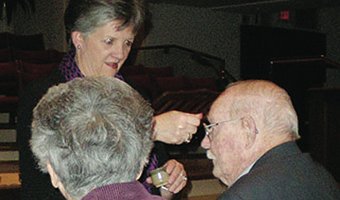
First Baptist Church in Richmond, Va., inaugurates Lent with an Ash Wednesday service—in which the ash of burnt palm branches are smeared on worshippers’ foreheads—and in the last week includes a contemplative service, involving a rhythm of Scripture and devotional readings, silence and meditative songs.

“I’m surprised at how much our folks have embraced” the services, said Lynn Turner, senior associate pastor at First Baptist and staff liaison for the events. “Not just accept—embrace.”

Turner attributes that response in part to the use of prolonged silence.

“It’s simply a time to be quiet,” she said. “Complete silence is a form of prayer we almost never use. We don’t have periods of sustained silence—of even three to five minutes—in our traditional worship services. The rhythm of the contemplative service is different.”

Season of the Cross

While Baptists in East Texas may not warm up to the idea of observing Lent, worshippers at First Baptist Church in Athens wholeheartedly embrace periods of spiritual self-examination, confession and prayer during what they call the “Season of the Cross” in the weeks leading up to Easter, the church’s pastor noted.

“‘Lent’ is not a biblical word, and it can be a disturbing word for some people who didn’t grow up that that tradition,” Henderson said. “I don’t care about our people being committed to Lent. I care a lot about them being committed to Lenten ideas.”

First Baptist in Athens does not rigidly adhere to a liturgical Christian calendar, but Henderson estimates he has led some sort of Ash Wednesday observance annually during his 14 years at the church—normally during a regularly scheduled Wednesday evening prayer service.

Typically, the service involves members writing their sins on slips of paper, collecting and burning the folded pieces of paper, and having their foreheads marked with the sign of the cross using those ashes.

Touching the emotions

Baptists involved in intentional preparation for Easter—whether referred to as Lent or some other name—view it as an effective tool for teaching and spiritual formation.

“I quit doing a Super Bowl Sunday years ago because what does that say about us as a church?” said Chuck Warnock, pastor of Chatham (Va.) Baptist Church. “We Christians have our big Sunday. Our super Sunday is Easter. And we need to get ready for it by doing more than just planning a special hour-long service. We need to prepare our people.”

Lenten practices can help Baptists get in touch with an often-neglected side of worship—the emotional dimension, said Bill Tillman, who holds the T.B. Maston Chair of Christian Ethics and teaches spiritual formation at Hardin-Simmons University’s Logsdon Seminary in Abilene.

“It’s appropriate to grieve over one’s sins and to grieve the death of Jesus. At the same time, Easter should be the ultimate celebration for Christians,” he said. “Spiritual disciplines are things that can help people get into the emotional side of their faith practice, experiencing grief and delight.”

Christ AroseThe Lenten season, as a key part of the Christian calendar, helps Christians move through the salvation story in an orderly way and incorporate the rhythms of the Christian year into daily living, he noted.

“People are looking for reference points,” he said.

Teaching time

Tabernacle Baptist Church in Richmond, Va., uses Ash Wednesday as a teaching day, the congregation’s pastor said.

“Our service is way of teaching people what it means,” Severns said, a key consideration in a church that never had observed Lent before it called him as pastor.

“I was really nervous about the imposition of ashes the first time we did it. But we found way more people came than we expected, and that included the older generation—traditional Baptists—who fell in love with it.”

Severns, an artist whose photography is exhibited in the church, uses photos to remind the congregation of its sense of community. Images of all church members whom he has shot over the past seven years—now including some who have died and children who have grown—are projected on a wall throughout the service.

“We pull out all the stops to enhance our sense of unity as a community,” he said.

For Henderson, Ash Wednesday is a two-fold teaching experience. First, he emphasizes the Old Testament meaning of bearing a mark and using ashes as a sign of repentance. At the same time, he explains the meaning of terms such as ‘Lent’ so members who did not grow up in churches that follow liturgical practices will understand what fellow Christians do during the weeks leading to Easter.

“It’s a way to connect to the broader Christian world,” he said.

Focus on the cross

Easter CrossThe Athens church marks the Season of the Cross by erecting two crosses—a 9-foot cross suspended by ropes in the middle of the sanctuary to help worshippers focus and a 30-foot cross outside on the church grounds to draw the attention of people who pass by.

Worship services during the weeks leading to Easter include a progressively greater emphasis on the cross, Henderson noted. Small-group Bible studies also focus on themes appropriate to the emphasis.

“There’s a change in the tone of the worship services. They are more introspec-tive, with seasons of confession. They tend to be quieter, and our contemporary service features more unplugged acoustic music than usual,” he said.

This year, the church will set up two stations in the sanctuary where people can write down confessions of sin and prayer requests during worship services, then leave them tucked away.

“It’s sort of like a Wailing Wall where people leave their prayer requests,” Henderson explained. “It is a physical, tactile experience. We try to involve all the senses.”

Some years, the church observes the Lord’s Supper on Maundy Thursday—the Thursday prior to Easter, when Jesus instituted the ordinance—and incorporates teaching about the Passover. Typically, a 7 a.m. service on Good Friday involves members moving through the Stations of the Cross, reading Scripture and reflecting at each location.

On the evening before Easter, church members gather at the church to decorate the outdoor cross with flowers so it will be covered when people see it the next morning.

Lent and other elements of the Christian year can be a countercultural response to society’s pressures, Warnock observed.

“The fact is, if we don’t have some kind of spiritual calendar, then we cede our entire lives to the secular calendar or the sports calendar or the shopping calendar,” he said. “No matter what you call it or whether your follow all its intricacies, it’s a calendar that speaks to our spiritual walk and development.”



Austin pastor notes value of Christian calendar for spiritual formation

In this interview, Don Vanderslice, pastor of Mosaic Church in Austin, reflects on how his community of faith observes the Christian calendar:

I’d never been a part of a community that participated really fully in the Christian calendar until I came to Mosaic. We recently did some one-on-one conversations between our pastoral staff and leadership team, and almost every member of our community. They were conversations about spiritual formation, gifts, passion, commitment, other things. What came out over and over again, in asking the question—“How has Mosaic been a part of your spiritual formation?”—was how important the Christian calendar had been in spiritual formation over the past few years.

Don Vanderslice, pastor of Mosaic Church in Austin, speaking at the Transforming Culture Symposium in 2008. (David O. Taylor Photo)

A number of our people were brought up in churches, but we have a lot out of the free church tradition, the Baptist tradition, and then about a third have Catholic, Episcopal, Lutheran, some kind of liturgical background. But they all highly value the Christian calendar and part of that has to do with spiritual formation. It draws us into the priority of journey, reminds us that the spiritual life is indeed a journey, as we celebrate for instance that Lent takes us to Easter, which itself isn’t just a day, but a season during which we dive into the Easter stories—plural—and leads in the Pentecost season, and then ordinary time.

The idea of journey or pilgrimage is that we’re going somewhere, and not just landing on a holiday here and there. I’ve always found it odd that in the Baptist, free church tradition in which I grew up we were so devout in celebrating the secular calendar. Mother’s Day, Father’s Day—if there was a greeting card for it, we dedicated a Sunday to it. But if there was a day in the church year that had been embraced by Christians for about 2,000 years which said something about what it means to be church, we dismissed it.

The Christian calendar is a realization that in the same way God created seasons of the year, there are seasons for the church. We don’t always exist in summertime or in winter. Of course, there’s always a time to think about repentance, but in part of the church year we think seriously about what that means in our lives. When the church says at Advent, now we’re starting a new year in contrast to the culture around us, we’re saying something about our priorities and about our lives, holistically and spiritually. The calendar we follow says a lot about us. The calendar gives us a way of remembering our story.

Mosaic generally has a countercultural feel, and following the Christian calendar has counter cultural aspects to it. Is there an awareness of that at Mosaic?

Absolutely. We have a countercultural commitment, and the Christian calendar is countercultural. Throughout the year, we draw attention to the fact that it distinguishes us from the rest of the culture. I mean, we’re not rah-rah about, but it comes out constantly. At Advent we call attention the fact that it’s the beginning of the year, not the beginning of the shopping season or even of Christmas, which has its own season (after Dec. 25). No, it’s the beginning of Advent. We measure our time differently. When we get to July 4,we still preach out of the lectionary, and that wasn’t created to celebrate American independence in the 21st century. Of course we talk about it being the Fourth, but we acknowledge that we follow a calendar that isn’t tied to our patriotism.

It’s a radical way of marking time and embracing what we have felt in the church is valuable.

How would you introduce spiritual disciplines like the Christian calendar to a congregation unfamiliar with them?

I’ve never been a pastor of a church that resisted those ideas, so I’m not an authority. But I wonder if it started with a small group of people in a church who were interested in exploring the idea, then letting the small group bring the suggestion to the full community instead of the pastor. And there has to be trust between staff leadership and the community.

It’s odd in churches that they celebrate Palm Sunday and Easter with great joy but there’s nothing in between. Holy Week puts that in perspective. It’s a something we are very intentional about as a community. Our Good Friday is very dark. We don’t try to explain Good Friday, give easy answers, we just take part in this last day of Jesus’ life. Then our Holy Saturday is a silent service, where we do ask a lot of questions. They don’t provide easy answers. It’s a way to be, though, because it’s a lived experience. Every human has had a Holy Saturday. We want to articulate that and not cheat our way out of it, just to be present to it. Then Easter really means something. We’re exhausted by the end of Holy Saturday, and Easter is so energizing and enriching when we celebrate the resurrection.