10 practices for ministerial health

The Evangelical Lutheran Church in America lists 10 best practices for ministerial health and wellness:

• Love God with all your heart, soul, mind and strength.

• Love your neighbor as you love yourself — be an example of self-care as well as caring for others.

• Remember the Sabbath and keep it holy — be intentional about time for rest and renewal within your week, church year and life in ministry.

•Honor your body as a gift from God and temple of the Holy Spirit. Feed it healthy foods and build your physical and emotional endurance with regular physical activity.

• Honor your mother, father, siblings, spouse and/or children with your love, respect and time.

• Reflect your faith and use your gifts in your vocation.

• Develop healthy habits to keep your wholeness wheel in balance and to be fit for a ministry of service.

• Equip yourself to use your gifts effectively to proclaim and live out the gospel in the world.

• Practice and seek forgiveness.

• Pray daily.


Leaving Eden drives home gospel message

After challenging listeners to see the world as God sees it with his hit song “Give Me Your Eyes,” singer/songwriter Brandon Heath’s next project found its genesis in Genesis.

Since 2008, Brandon Heath (second from right) has hosted an annual benefit concert, “Love Your Neighbor,” which gathers musicians for a night of music and supports needs within the Nashville community. The 2010 benefit concert, which raised more than $61,000 to help rebuild a church in Nashville that had been damaged by flooding, included performers Mike Donehey of Tenth Avenue North, Jason Ingram, Britt Nicole, TobyMac, Heath and Amy Grant.

A season of soul-searching and reflection inspired the vision behind Heath’s most recent album, Leaving Eden, which focuses on themes of redemption, restoration and relationship with God.

“The title track states the obvious pain in the world by just reading the news headlines but turns towards reconciliation despite the hate and frightening things that happen in life,” Heath explained. “I want to celebrate the goodness in the world, and that’s what the rest of the songs on the project talk about. I feel like I have a choice to protect what little innocence is still left in my life, because I think that’s what attaches me to God.

“Even though we’re leaving Eden, there is another destination—heaven. We have a choice. We can walk towards hope, or we can walk towards hopelessness. For me, I really want to walk towards heaven. I want to go home.”

Heath was inspired to write the song “Your Love” as a testament of God’s unfailing and immense love for his children.

{youtube}LQCdJ-C3Jio{/youtube}

“I want people to know that they are absolutely loved by God and that he really wants us to know his love and grace so we can love other people more,” Heath said. “As I was writing this song, I was thinking about a guy that I met one time who has climbed many mountains and has even peaked Mount Everest, but he doesn’t know God, and I keep wondering what he’s searching for. If he would only realize what he’s missing, he would find true fulfillment by resting in God’s unconditional love.

“I think that the longer I get to know the character of Jesus, the more compassion I personally have for others. It is one thing to have compassion and quite another to act on it. Most times, it starts with the people around you.”

Since 2008, Heath has hosted an annual benefit concert, “Love Your Neighbor,” which gathers musicians for a night of music and supports needs within the Nashville community.

The first event raised $20,000 for tornado victims in Tennessee, and all funds collected went directly to the Macon County disaster relief fund administered by Bledsoe Baptist Association. In 2009, the event supported a local high school student who needed critical eye surgery to prevent blindness. The teenager recently had lost his father and was without health insurance coverage. Enough proceeds were collected to create a standing fund for a future need within his high school.

In 2010, the event raised more than $61,000 to help rebuild a church in Nashville that had been damaged by flooding.

By taking a public platform and merging it with his heart for community, Heath also has been involved in raising awareness for a variety of missions organizations such as Young Life, Blood:Water Mission, International Justice Mission, Food for the Hungry, Restore International and other human rights groups.

“Hopefully, people are not only connecting to the music but also to the message behind it,” Heath said. “I want people to realize that if they will place their faith in Christ, they will be delivered from their old life, given a new lease on life and a fresh start to lead the kind of life that God wants his children to lead—with our lives glorifying him.”


Faith Digest

Reliance on God and treatment linked. Cancer patients who consider the length of their lives to be “in God’s hands” are more willing than others to spend money on treatments that might extend their lives, a new study shows. Michelle Martin, an assistant professor at the University of Alabama, based her research on findings of a National Cancer Institute study of 4,214 patients with colorectal and lung cancer. The study, reported in a recent issue of the journal Cancer, also found African-Americans were more willing to spend all their resources to extend their life than members of other racial and ethnic groups.

Impure holy water? A BBC investigation has claimed holy drinking water from Mecca is contaminated with arsenic and is being sold illegally to Muslims at shops in Britain. The BBC report said its investigation uncovered Zamzam water has been found bottled in large quantities at Islamic bookshops in London and the airport city of Luton, and tests turned up high levels of arsenic and nitrates. Zamzam water comes from a well near the Islamic holy city of Mecca and is considered sacred by Muslim pilgrims. Pilgrims are allowed to bring back small amounts from Saudi Arabia, but the water cannot be exported for commercial use.

Minority of atheist scientists ‘spiritual.’ More than 20 percent of atheist scientists consider themselves to be “spiritual,” according to a Rice University study. The findings, to be published in the June issue of the journal Sociology of Religion, are based on in-depth interviews with 275 natural and social scientists from 21 of the nation’s top research universities. Elaine Howard Ecklund, lead author of the study and an assistant professor of sociology at the Houston university, and her team found that these “spiritual atheists” viewed not believing in God “as an act of strength, which for them makes spirituality more congruent with science than religion.” They viewed spirituality as congruent with science but not with religion because a religious commitment requires acceptance of an absolute “absence of empirical evidence.”

Plans for interfaith school shelved. A seminary affiliated with American Baptist Churches USA and the United Church of Christ has scrapped plans to partner with a Unitarian Universalist school to create a new model of reli-gious higher education. Andover Newton Theological School near Boston and Meadville Lombard Theological School in Chicago canceled plans to create a multifaith institution. Although the schools’ different religious identities were a key aspect of the negotiations, presidents of both schools said other matters—from finances to accreditation issues—prompted a halt to their talks. “We’re tied to the real world of institutions and constituencies and fiduciary responsibility,” said Lee Barker, president of Meadville Lombard. “But in no way in my mind does that undermine the vision of what we were trying to do.” The two schools still plan to offer joint programs for their doctorate of ministry students, including a preaching class in June at Andover Newton.

–Compiled from Religion News Service

Editor's Note:  In the next-to-last sentence of the last item as originally posted, Lee Barker was incorrectly identified as president of Andover Newton. The article has been corrected to note Barker is president of Meadville Lombard.  Nancy Nienhuis, dean of students and vice president for strategic initiatives at Andover Newton Theological Student added: "Andover Newton is moving ahead with its plans to create a multifaith model for seminary education; we just won’t be doing so with Meadville Lombard. Our current work with the Hebrew College Rabbinical School continues to be a part of this vision, as do new initiatives with other schools that will further broaden our multifaith focus."


Scholars chase Bible’s changes, one verse at a time

NEW ORLEANS (RNS)—Working in a cluster of offices above a LifeWay Christian Bookstore, Bible scholars are buried in a 20-year project to codify the thousands of changes, verse by verse, word by word—even letter by letter—that crept into the early New Testament during hundreds of years of laborious hand-copying.

Scholars at New Orleans Baptist Theological Seminary are in the midst of a 20-year project to catalog and post online most of the thousands of text changes that have crept into the New Testament. Bill Warren, head of the New Testament Textual Studies Center, holds a piece of papyrus that contains part of the Gospel of John. (RNS PHOTO/John McCusker/The Times-Picayune)

Their goal: to log them into the world’s first searchable online database for serious Bible students and professional scholars who want to see how the document changed over time.

Their research is of particular interest to evangelical Christians who, because they regard the Bible as the sole authority on matters of faith, want to distinguish the earliest possible texts and carefully evaluate subsequent changes.

The first phase of the researchers’ work is done. They have documented thousands of creeping changes, down to an extraneous Greek letter, across hundreds of early manuscripts from the second through 15th centuries, said Bill Warren, the New Testament scholar who leads the project at New Orleans Baptist Theological Seminary.

After 10 years of work and the interruption of Hurricane Katrina, the seminary’s Center for New Testament Textual Studies has logged those changes, amounting to 17,000 pages of highly technical notes, all in Greek, into a searchable database.

Many of the early changes are well known and have been for hundreds of years. Study Bibles mark scores of changes in italicized footnotes at the bottom of what often seems like every page.

But nowhere have so many changes been collated in a single place and made searchable for scholars and serious students, Warren said.

Nor is there an Internet tool like the one being constructed now in the second phase of the project—the history of substantive textual changes.

This fall, the New Testament center will publish an online catalog of substantive textual changes in Philippians and 1 Peter. Warren estimates there’s 10 more years of work to do on the rest of the New Testament.

Those with more than a passing familiarity with the New Testament know its 27 books and letters, or epistles, were not first published exactly as they appear today.

The earliest works date to about the middle of the first century. They were written by hand, and successors were copied by hand. Mistakes occasionally crept in.

Moreover, with Christianity in its infancy and the earliest Christians still trying to clarify the full meaning of Jesus’ life, his mission and his stories, the texts themselves sometimes changed from generation to generation, said Warren.

As archeologists and historians uncovered more manuscripts, each one hand-copied from some predecessor, they could see occasional additions or subtractions from a phrase, a verse or a story.

Most changes are inconsequential, the result of mere copying errors or the replacement of a less common word for a more common word. But others are more important.

For example, the famous tale in John’s Gospel in which Jesus challenges a mob about to stone a woman accused of adultery: “Let any one of you who is without sin be the first to throw a stone at her,” is a variant that copyists began inserting at least 300 years after that Gospel first appeared.

In the conclusion to the Gospel of Mark, the description of Jesus appearing to various disciples after his Resurrection does not appear in the earliest manuscripts.

And in the Gospel of Luke, the crucified Jesus’ plea that his executioners be forgiven “for they know not what they are doing” also does not appear in the earliest versions of his Gospel.

Even after the fourth-century church definitively settled on the books it accepted as divinely inspired accounts, Warren said, some of the texts within those books still were subject to slight changes.

The story of the adulterous woman in John’s Gospel, for example, seems to be an account of an actual event preserved and treasured by the Christian community, Warren said.

“People know it, and they like it,” he said. “It’s about a forgiveness that many times is needed in the church. Can you be forgiven on major sins?”

John had not included it, but early Christians wanted to shoehorn it in somewhere, Warren said.

In effect, early copiers were taking what modern readers would recognize as study notes and slipping them into the texts, a process that began to tail off around the ninth century, Warren said.

–Bruce Nolan writes for The Times-Picayune in New Orleans.


Kimball clarifies how religion turns lethal

NORMAN, Okla. (ABP) — Power corrupts, and when it accrues to religious leaders, the combination of power and religion can turn lethal, says Middle East scholar Charles Kimball.

Charles Kimball

Kimball, presidential professor and director of religious studies at the University of Oklahoma, says in his latest book When Religion Becomes Lethal: The Explosive Mix of Politics and Religion in Judaism, Christianity, and Islam, that anytime a single religion becomes the default faith of a nation, people who do not hold to that version of faith automatically become second class citizens.

“That’s one of the things that makes me very nervous in this Christian America sentiment that is gaining ground,” Kimball said.

If the great “American experiment” is to continue into its third century, those in control must advocate for the rights of minority views not only to be expressed but to carry weight in public discourse and decision making, said Kimball, who in 1980 was among a few Americans who negotiated with the Ayatollah Khomeini for the release of Americans taken hostage in Iran.

An ordained Baptist minister with Jewish ancestors, Kimball’s career has been immersed in Middle Eastern studies and comparative religions. When Religion Becomes Lethal traces the historical development of the scriptures and peoples of Christianity, Judaism and Islam and shows how political and religious power intertwined in lethal ways in each. Kimball earlier published When Religion Becomes Evil, highlighting five warning signs for when religion is becoming dangerous.

His new book shows how closely related the three major world religions are to each other, all tracing their beginnings to Abraham.

Asked in a telephone interview why such closely related religions should be so antagonistic to each other, Kimball said, “Historically, those who are closest to you but different in some way are those most threatening.”

The most lethal religious situations are found where adherents claim ownership of “the one ultimate truth idea of God,” Kimball said. They justify lethal behavior saying, “I have the truth. You don’t.”

Such behaviors are evident in America’s early history, in current Orthodox religious and political behaviors in Israel and in Islamic states where leaders manipulate religious fervor. Yet the greatest danger may be for adherents within a religious group who suffer at the hands of their own leaders. Osama bin Laden killed thousands of Americans, but his actions have resulted in tens of thousands of Muslim deaths, Kimball said.

He estimated 10 to 20 times as many Iraqis have died in sectarian violence as died from the American invasion and occupation of Iraq.

“Religious zealotry that leads to this extremist violence is at least as dangerous or more dangerous to the internal community that doesn’t get the picture,” Kimball said. “That’s one reason I don’t want to live in Pat Robertson’s version of a Christian America.”

Robertson is a prominent Christian broadcaster, founder of the 700 Club, owner of CBN and was a candidate for U.S. president in 1988.

The more democratic a government is to be, the more it must “accommodate a flexible system that allows for differences,” Kimball said.

“The U.S. has a point of view the world desperately needs if we will live out our own ideals,” he said. The 235-year old American experiment respects minorities, other opinions and different religions. For America to “model what we hope Muslims will model where there are small Christian groups” in their midst, it is important for those in the majority “to be at the forefront in insisting we protect the rights of minorities.”

Kimball said those in the majority “should be the first ones out there in insisting the Muslims have a right to build a mosque.”

Kimball’s newest book, published by Jossey-Bass, traces the development of the three major religions and offers creative actions for individuals to chart a personal, helpful course into the future.

When that happens, Kimball says, the power of fringe elements to incite worldwide rage with just the threat of negative actions will diminish. He noted Florida pastor Terry Jones who threatened to burn a Qur’an and within 24 -36 hours had commanded a personal response from the president and the pope.

Kimball doesn’t deny Jones’ right under American law to do what he did, but he resents “people who are deliberately playing to fear and ignorance.” That includes politicians and religious leaders who work hard “to generate and play off the fear of people in this country” around such issues as homosexuality and abortion. He included the recent Oklahoma vote to forbid Islamic Sharia law being used in court as a way “people’s fears can be whipped into a frenzy over a non-issue.”

Kimball said al Qaeda leader Osama bin Laden was an “important symbol” for a movement that has little credibility among nations. But bin Laden was not a “religious leader” and he affirmed President Obama for stating so.

Bin Laden was “someone who used Islam to incite people and justify murder,” Kimball said. As such he might have been the perfect example for a book on When Religion Turns Lethal.


Minister moms split between pulpit and potty training

WASHINGTON (RNS) — Every now and then, Amy Butler will find herself having to do a little simultaneous parenting and preaching from her pulpit at Calvary Baptist Church in downtown Washington.

Amy Butler of Calvary Baptist Church in Washington, D.C., frequently finds herself balancing her roles as pastor and parent to her children Hayden, right, Hannah, center, and Sam, left. (RNS photo courtesy Amy Butler)

“My daughter, in particular, knows the look,” said Butler, whose teenage children sit — and occasionally chat — with their friends in the balcony. “And if I’m up front leading worship, I can see everything … so if I need to shoot a look, I do.

“And they know exactly what that means.”

Female pastors with one flock at home and another in the pews say being a minister and a mom is a perpetual juggling act, with high expectations, never enough time and challenges that their male colleagues will never face.

At the same time, they say, it can also be a profound blessing.

“Baptist women ministers more than ever before are young, married, and starting families,” said Pam Durso, executive director of the group Baptist Women in Ministry.

Pregnancy, in particular, creates unusual dynamics for clergy and congregations. Rachel Cornwell doesn’t usually talk about herself in her sermons, but one Sunday during Advent, two days before her son was born, she couldn’t help but draw parallels to the baby Jesus.

Now, the pastor of Woodside United Methodist Church in Silver Spring, Md., is preparing for the birth of her third child in August.

“It’s the kind of job where you don’t clock out … but I had to make sure that I was really taking my days off and really honoring my family as well as my congregation and my responsibilities to them,” said Cornwell, the mother of a 6-year-old daughter and 3-year-old son.

Across denominations, clergy moms speak of the gifts of sharing their children with their congregations, and the challenges of meeting everyone’s needs.

Joe Stewart-Sicking, who has studied Episcopal clergy with young children, calls it the “church-home spillover.” He assisted with a recent study of Episcopal clergy, which found that 84 percent of clergywomen said balancing the dual roles was difficult, compared to 61 percent of clergymen.

Clergywomen relayed a number of sticky situations, especially with small children.
Tonya Vickery of Cullowhee Baptist Church in Cullowhee, N.C., splits pastoral and parenting duties with her husband, Jeffrey, as the parents of Elizabeth, 13, and Ally, 11. (RNS photo courtesy Tonya Vickery)

“They talk about their 3-year-old seeing them in their clericals and they would tell them, `Please take that off,”’ said Stewart-Sicking, an assistant professor of pastoral counseling at Loyola University Maryland. “They knew that that meant Mommy was going away.”

Even when children are in the sanctuary, the distance between the pulpit and the pews can be difficult for some ministers’ children.

Najuma Smith-Pollard, pastor of St. James African Methodist Episcopal Church in Los Angeles, recalled one Sunday when her son, Dorian, preferred the company of his mother over his babysitter.

“He still got away … and he ran right up there to the pulpit and he held on to my leg, and I kept on doing what I had to do,” she said of her now-19-month-old. “When it came time for me to preach, one of the ushers, she came and got him.”

Despite the growing acceptance of a woman in the pulpit, congregants often worry about how the church will deal with her absence when her baby is born. When Cornwell took eight weeks of maternity leave, she arranged for others to fill in on Sunday mornings.

“You always have this issue if the young woman you hire … gets pregnant, then who’s going to take care of their church?” said Adair Lummis, a sociologist at Hartford Seminary who has studied women clergy.

Tonya Vickery of Cullowhee Baptist Church in Cullowhee, N.C., said she and her co-pastor husband split parenting and pastoral duties between them, with each of them baptizing one of their two daughters.

“Whoever’s on call as the minister at that moment, the other is on call as the parent at that moment,” she said.

Clergywomen with adult children say the dynamics have changed as more churches have grown comfortable with female pastors.

“Certainly in the early years, we were trying to prove that women could be ministers, could do this work,” said Peg Chemberlin, president of the National Council of Churches, and the mother of a 26-year-old daughter.

“And, on the other hand, there was built into us culturally and perhaps biologically this push to be good mothers, too.”

Now, she says, many denominations have groups for women in ministry that provide clergywomen with informal networks to discuss how to juggle roles.

Leaders of the Young Clergy Women Project, an online community with more than 500 members, say the most popular sections of their online publications are the ones devoted to “Moms and Ministry.”

This Mother’s Day, Cornwell will spend her weekly day off – Friday — at a special Mother’s Day party at her children’s day care programs. On Sunday after she finishes preaching, her husband will treat her to a special lunch.

“I feel very celebrated,” she said. “I feel very blessed.”



Multisite multiplication

The term “multisite” or “multicampus” church might first bring megachurches to mind.

But as it has developed, the church-growth model has taken on many forms to serve a variety of purposes and ministry contexts.

Ministry

Some churches use the multicampus model as a way to meet specific needs.

Broadview Baptist Church in Abilene set up a second site in a trailer park of highly mobile, lower-income families. “We knew it wouldn’t ever be able to be self-supporting,” Pastor David Cason explained.

The church changed its strategy in 2005, when members became convinced God was calling them to reach out to the socio-economically disadvantaged in the city.

The second site has been able to break down barriers of ethnicity and economics much more than members would have been able to do at the main campus, Cason said.

Culture

Some churches choose the multisite option to reach a wide range of cultures or subcultures. Some of those target language and international cultural groups.

Bon Air Baptist Church in Richmond, Va., has four campuses. One grew out of a previous ministry in a mobile home park combined with a group of about 10 to 15 Hispanics meeting in a room at the church’s oldest campus on Buford Road. The combined ministry now meets in a storefront and offers two worship services, one in Spanish and one in English, with two site pastors—one Hispanic and one Anglo.

All Souls Church in Charlottesville, Va., started as a house church in 2009 and now includes what it calls “small communities,” each embedded contextually among the people it serves. The church sees its context as broadly including “all sorts of people” but particularly drawn to a subculture of “cultural creatives”—people who are artistic, progressive, socially conscious and spiritually open. The church has several small communities scattered throughout the city.

Lifestyle

Some people want to stay close to their neighborhood for much of their activity outside of career responsibilities. One Bon Air site targets people within a five-mile radius who use the nearby bypass to get to their offices. Otherwise, most don’t like to drive out of their area.

Pleasant Valley Baptist Church in Liberty, Mo., also targets people not already connected to the church who do not like to drive any distance to worship. The congregation started a second campus near Kansas City International Airport to help church members reach friends and relatives in that area who would not drive out to the main campus.

Sustain growth

One reason multisite churches often are synonymous with megachurches is size. Tom Cheyney of the Southern Baptist Convention’s North American Mission Board and co-author of Sponsoring Starbucks’ Churches in a Folgers World, suggests space considerations should be the primary reason for opening a second or third campus.

“Whether you are an existing church or a new church plant, the real reason behind considering such an approach should be due to lack of space,” he wrote in “The Multisite Church Planting Strategy: Possibly the Most Effective Channel for ‘Doing Church’ in the 21st Century,” an article posted on NAMB’s church planting network website, churchplantingvillage.net.

He sees the multicampus approach as a movement to sustain continued growth of a particular congregation. “When the church moves away from its four-walled expression, it will discover the tremendous power of reproduction,” he wrote.

“Usually, by moving strategically into other sites, it allows the corporate church as a whole to continue to grow while adding other meeting sites. These sites allow for further growth without adding the significant cost of building a new facility.”

Forms

The multicampus model takes on various forms depending upon the needs of the churches that adopt it. Conjoined congregations are multisites that meet simultaneously, sharing the same preacher and worship experience from one live site with a video or Skype link.

Some churches share the senior pastor through video playback, sometimes by taping an early service on the main campus and sending it to other sites or by using the taped version the following week.

Some use a hybrid approach, with the same sermon but different songs or with a different sermon and different songs from the main campus.

Some share the same senior pastor for all ministry needs among all campuses, while others share a senior pastor but have a campus pastor for each site.


Multisite fans view approach as good stewardship

Proponents of the multicampus church option cite flexibility, stewardship and the “spark” that newness can bring to ministry.

“You get the big-church bang … but you also get the pop and sizzle of a new church,” said Rodney Harrison, vice president for institutional effectiveness at Midwestern Baptist Theological Seminary and co-author of Sponsoring Starbucks Churches in a Folgers World.

Stewardship is a key element of the model’s draw. “It allows a church to plant a presence without having to replicate resources,” Harrison said.

A multisite church shares resources—financial, management and personnel. “We are networked for stewardship of resources, not only for money, curriculum and other resources, but also for ideas and best practices,” explained Stephen Boster, campus pastor for a site Pleasant Valley Baptist Church in Liberty, Mo., started near Kansas City International Airport.

The model seems to save money, particularly in urban areas where retail or commercial space is more readily available to rent or lease, noted Glenn Akins, assistant executive director for the Baptist General Association of Virginia and a multicampus expert.

“We advocate a low-cost, low-risk model as much as possible,” he added. “Buying land (and] building buildings, especially in urban areas, is getting to be cost prohibitive and increasingly difficult because of regulations (and) restrictions imposed.”

Sites often share a senior pastor by video link, Skype or CD. Some churches use site pastors for hands-on ministry to site members. Campuses may have their own worship teams or also share music with the main campus. The church and its sites share other personnel for education, counseling or other services.

“A church can have a new work with an on-site pastor, but can use other specialists which are available to all. They don’t have to pay additional staff,” Harrison said.

He added that insurance for a new site can be cheaper as a rider to the main campus’ policy, bylaws and church policies are in place and the sites can share special events.

The multisite model can allow a church to minister to a targeted group in several locations. “Some churches have figured out that they can reach a certain people group well and that they can reach those in other sections,” Akins said. The new site “is a replica but that is contextualized in that area.”

Harrison believes the model allows “so much flexibility” for ministry. He noted a church in Holden, Mo., that met in several sites until it could complete a building to accommodate its growth. “It was an interim strategy,” he said.

A church also can use the model to reach underserved areas. “Many small towns in Missouri don’t have an evangelical presence or a church presence at all,” he said.

Harrison pointed to the church in Jerusalem that met house to house. “That’s the theological mooring that the multisite model is embracing. “We don’t want to go beyond the New Testament church,” he said. “If you understand (multisite) as a church, is it much different than a church with multiple services?”

Congregations interested in using the model need “to do their homework, visit those that are working and learn about those that fail,” he said.

Churches also need to address some issues in advance, Akins said. Leaders must determine the essential core and non-negotiables in the church’s function.

How should the church customize and how will it function as a multiple unit? Leaders must determine how it will measure “success” and how it will handle possible power and control issues.

Paul Atkinson, Baptist General Convention of Texas director of church planting, believes leaders also must be prepared to answer the question: What happens if a site determines it wants to be autonomous?


Wichita Falls takes church to Air Force base

WICHITA FALLS—When Pastor Bob McCartney arrived at First Baptist Church in Wichita Falls, he wanted to lead the congregation to minister better to two distinct populations—students at Midwestern State University and the airmen and their families at Sheppard Air Force Base.

The core group of volunteers from First Baptist Church in Wichita Falls who agreed to help launch The Church at Sheppard gathered for prayer the week before the congregation launched.

The students now meet in a newly constructed building on the church campus each Tuesday night. But to reach military families, the church decided to go to them.

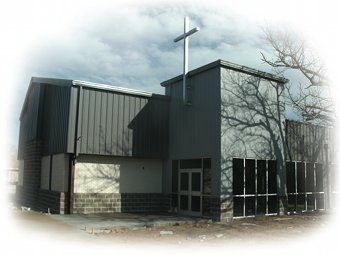
Eden Hills Baptist Church sat near the base gates. It had been a strong church in decades past but dwindled to a handful of members in recent years. A joint vision between First Baptist and the remnant at Eden Hills led to a renovation and rebirth of the fellowship as The Church at Sheppard.

Rather than adopt The Church at Sheppard as a mission congregation, First Baptist chose to make it a satellite church. While the music is live, and Robb Havens serves as campus pastor, McCartney’s sermons are broadcasted through a television signal, and he is the preacher for both campuses.

Multiple families from First Baptist went to the Church at Sheppard to serve as a core leadership group.

Because Sheppard primarily is used for training, its population constantly rotates.

“That’s what ultimately drove us to the satellite concept. What we realize is that The Church at Sheppard will have constant turnover,” McCartney said.

Pastor Bob McCartney shows members of First Baptist Church in Wichita Falls the facilities of The Church at Sheppard during a preview service.

“The only thing The Church at Sheppard maybe should have but doesn’t is a revolving door. We’re going to have people coming in, and we’re going to have people going out. There will be a constant demand on outreach, but that’s why we did it. It’s a place where we can lead people to make a decision to trust Christ, developing them to be like Christ, and then deploying them in service to Christ.”

The Church at Sheppard also will give Havens a chance to grow into his call to ministry, McCartney said.

“His role is a shepherding role. He will be there for the people in the sense of caring for their needs, the visiting ministry and the evangelistic ministry,” he explained. “If they have need for biblical counsel, need for advice, need someone to pray with, he’s the guy on the scene to do that.”

On those Sundays when McCartney is out of the pulpit himself, Havens will preach at The Church at Sheppard “because we want to raise him up and train him,”

The couples who moved from the main campus to The Church at Sheppard were asked for an 18-month commitment.

The Church at Sheppard

“We felt they needed significant buy-in. They had to truly be as committed to the effort as I was and our leadership team was. We felt a revolving door in our core group of volunteers out there would be catastrophic,” McCartney explained.

The leadership team spent a great deal of time researching best practices of churches already engaged in multisite ministry and adopted those that fit the situation in Wichita Falls best.

“We felt we needed to share those best practices” with the core group in training sessions, he said.

McCartney preached on the vision for The Church at Sheppard in two sermons. Couples who were interested in serving in the volunteer corps then were engaged in one-on-one interviews where the level of commitment and the things that would be sacrificed were carefully spelled out for them, McCartney said.

“We had a number of people who looked at us and said: ‘We love this. We’ll support you in this. We’ll do anything we can, but we realize now, this isn’t for us,’” he said.

While the need for The Church at Sheppard appeared obvious, it did not come without sacrifice, McCartney noted.

“We talked about three types of sacrifice that we were going to make it if was going to work. One is the sacrifice of resources. We’ve had people give sacrificially, but we’ve had ministries inside our church that have had to sacrifice bud-get funds. From an economic standpoint, this may not have been the best, most strategic time to plant a satellite congregation. Our ministries have sacrificed to make this work,” he said.

There also has been a relational sacrifice. “That is, ‘I’m going to have leave my life group, I’m going to have to leave this service that I enjoy and these people that I’m associated with. And while I’m going to be around people I like and certainly build a relationship with, I’m going to sacrifice relationally.’

“And we talked about a leadership sacrifice, because we took some of our best—some of our best leaders, some of our best teachers—and we asked them to take this assignment,” McCartney said.

“I don’t know what other pastors would say, but let me tell you from my perspective, this is not easy. This is exceptionally difficult. It’s obviously difficult financially; it’s difficult technologically; it’s difficult relationally. One of the things the staff says around here is, ‘We have complicated matters greatly.’ But we believe it is worth the sacrifice and the complications to reach people for Christ.”

As First Baptist’s leadership team talked to other churches involved in multisite minstry, they were told it would take two years to get it going.

“We took a year and two months, but it took every bit of that. If you’re going to do this well, I think you need ramp up time. You need time to recruit and train. … Our recruiting process was every bit as important as our training.

“It’s the boldest thing I’ve every done in ministry, but the church has to do bold things. We wonder why we’re losing ground in the country and the culture, and while we can see a growth trajectory, the population far outpaces the growth of Christianity in America.

“… I think faith favors the bold. I think God is honored when he’s leading us, but we take a bold step to follow him.”


Church start or church satellite? Decision can be difficult

Perhaps a congregation has discovered a neighborhood or nearby community with no evangelical or other church presence. Or maybe the church has found a demographic that isn’t being reached with the gospel.

Church leaders believe God is leading their congregation to minister to that group. What approach do they take—plant a new church that would one day function as an autonomous body or start an extension of the congregation in that targeted area?

The decision isn’t always easy, according to church planting experts. Many factors—from potential leaders to available resources to culture—determine the choice.

Distance/difference

Virginia Baptist leaders start with proximity measures—to determine how closely related the church and the group it wants to reach are in physical distance and in cultural differences, noted Glenn Akins, assistant executive director for the Baptist General Association of Virginia and an expert in the multicampus model.

The church must decide the geographic distance it is comfortable bridging and that would not be a barrier to providing ministry resources. Would time or fuel costs inhibit sharing staff or facilities? Would distance hinder opportunities for joint activities or worship experiences?

While geographic distance will affect the decision, Akins believes other measures—racial, religious and national—are more influential.

“The greater the differences or distance, the more likely that a plant is the better strategy,” he said. “In other words, if the market area you seek to serve is both far away and very different than your existing ministry approach, this is going to be tough sledding for a multisite approach.”

If a church wants to pursue ministry through another campus site, it must close the distance or difference gap as much as resources will allow. “Technology does this for many, but lots of churches can’t afford the investment required,” Akins added.

When the gap is too wide, planting a new work often is the best approach, he said.

Authentic church

Bo Prosser, Cooperative Baptist Fellowship coordinator of congregational formation, and David King, CBF church starts assistant, focus on making certain the local body is authentic in its setting, whether as a new plant or as an extension of an established ministry.

“It’s a question of how to balance lower costs (and) higher efficiency (of the multicampus model) with a need to make each local church indigenous and contextualized in each setting so as to be authentic,” King said. “I do believe (the multisite approach) has a place, but only as it balances (those) concerns. I think it has been proven to work in large churches that rely on a particular leader or brand.”

King believes the concept would work in smaller settings, but that the host church would have to focus “more on a commitment to living missionally in each setting” and “less on personality or brand.”

Motivation

Motivation for new ministry also is key, noted Rodney Harrison, vice president for institutional effectiveness at Midwestern Baptist Theological Seminary and co-author of Sponsoring Starbucks’ Churches in a Folgers World. “A church must ask itself first what is the motivation,” he said.

Has the church grown to the point that it can no longer accommodate additional growth? Does that church want to be able to draw and reach people from another area? Does the church feel called to reach a different people group? The motive for beginning another ministry will help a church determine the model to use.

Paul Atkinson, Baptist General Convention of Texas director of church planting, agrees a church must examine its intent. Does it want to reach a unique group of people and plan for the group to become autonomous?

Ministry demand

A multicampus model for church growth generally increases administrative demands for the main campus staff. The existing congregation must determine the level of complexity leaders believe they can handle.

“More sites mean more administrative/resourcing demands,” Akins explained. “Many existing churches cannot figure out how to modify their current approach to get to the movement level of reproduction.”

Starting a new church plant generally means building in a timeframe to relinquish all control and withdraw most resources, particularly if partnering with a convention or other body. Generally, most partners, such as the BGCT and CBF, require the new work to become autonomous within three to five years.

Often, resourcing gradually is stepped down over that period, with a lower percentage of funding and other resources trimmed each year.

Leader personality

Sometimes the decision comes down to the personality of the church planter or new site coordinator and how closely that person wants to be tied to the host church.

“If you are starting with a particular planter in mind, then build around them. But if you are starting with a ministry model, then hire accordingly,” he advised.

The host church also may recognize one model works best because of the target personality. First Baptist Church of Farmington, Mo., began New Horizons, intending it to become an autonomous congregation. Church leaders, including the staff member who would become pastor, recognized a growing group of unchurched who did not and likely would not attend the older, established church.


Multisite ministry by any other name …

LEWISVILLE—Before a church launches a multisite ministry, it must select and secure a site, assemble a leadership team, raise funds and work through logistical details. But Northview Baptist Church in Lewisville has discovered the most difficult task sometimes may be education.

“The multisite concept totally confused our people,” said Rob Veal, associate pastor at Northview Baptist Church. “The term ‘multisite’ became a negative. So, we changed the lingo.”

The church—which had 25 members when Pastor Kenneth Wells arrived 30 years ago—has grown in recent years to about 700 in attendance at three worship services on any given Sunday. But its location has limited growth.

“The big issue for us is parking,” Veal explained. “We are on three acres in a neighborhood, surrounded by houses. … As we try to move people in and out of three services, we have cars parked on the grass, parked in bar ditches—it’s just a mess.”

A representative from Denton Baptist Association initially told church leaders Northview Baptist was “a great candidate to go multisite,” Veal recalled. The church put together a team last year to study the matter, looking at existing multisite models and the potential for implementing that approach at Northview.

“It looked like a good fit for us,” he said. The church found a potential site in neighboring Flower Mound, just seven miles from the existing campus and home to about 120 members.

However, members of Northview Baptist had difficulty relating to the high-profile megachurches in the Dallas-Fort Worth area that follow a multisite approach. Some saw the multicampus model as no different than a church split.

“Our people have never seen it before. … There’s not a model in the area that we know of that is like our church,” Veal noted.

So, instead of talking about multisites and satellites, Northview Baptist leaders began using more familiar terms—starting a mission or planting another church, but doing it a different way. The church envisions a congregation that would meet at a school in Flower Mound.

“There will be a campus pastor and a worship team, but it will be the same music and format our people know,” Veal said. “Our pastor will preach there. We reach all generations. We’re not selling a video pastor. But the church will grow as people become more attached to the campus pastor.”

Instead of focusing attention solely on the multisite ministry, the proposal became one part of a three-pronged capital campaign launched May 1 and scheduled to culminate June 5. The campaign involves a master plan expansion and debt reduction, as well as the multisite project.

For now, Northview Baptist leaders are “not pushing it,” Veal said, but simply helping members grow in their understanding of what multisite ministry might look like for a fairly traditional, multigenerational neighborhood church that wants to move beyond the limits of its location.

“We’re not trying to become a megachurch,” Veal said. “We’re just trying to reach people for the Lord.”


Hybrid multisite model uses multiple approaches

HUNTSVILLE—Covenant Fellowship in Huntsville functions as a hybrid multicampus church as a means to give birth to autonomous congregations across the state and the nation.

Ex-offenders make their way to the bus station in Huntsville after release from prison.

While he was pastor of First Baptist Church in Huntsville, David Valentine led the congregation to minister within the prisons located in and around the city and to join other churches to minister to ex-offenders as they were released. Members focused primarily on ministry to correctional staff, but few staff joined the established church.

“Then I realized that the institutional church is not equipped to handle the needs,” he said. “The best way was to start new churches.”

In 2008, Valentine began Covenant Fellowship with the help of the Baptist General Convention of Texas. With the BGCT, First Baptist Church of Deer Park and Union Baptist Association, Covenant Fellowship began starting house churches.

Dub Wallace, a volunteer with Covenant Fellowship in Huntsville, collects information from soon-to-be-released men in correctional facilities.

The state’s prison population stands at roughly 154,000 throughout the year, with about 70,000 brought into the system and an equal number released each year, Valentine said.

“Our work built trust with the state, and then the state asked if we would assist them with prisoners to lower the recidivism rate,” he explained. “Our biggest goal is how to minister to those impacted by the criminal justice system.”

Covenant Fellowship touches every group connected to the system in some way—inmates, staff, ex-offenders and the families of each.

The ministry is built around life transformation groups, meeting at the prison and in several other locations. Covenant Fellowship trains leaders and tracks each group. Church leaders make sure ex-offenders are put in touch with a group in his or her home area once they have been released.

Covenant Fellowship in Huntsville uses a variety of new work to minister to offenders, correctional staff and families.

The fellowship also connects each group to a church or an association in its network of about 70,000 entities. As each life transformation group matures, it becomes a house church. “Our goal is for them to be autonomous churches,” Valentine said. “God didn’t call us to be the administrative center. … We’re just trying to identify the cluster groups and then are developing leaders.”

Currently, Covenant Fellowship has about two dozen life transformation groups through which it ministers. The church offers a celebration service each Sunday. “But our main aim is to move people to the small groups,” he said, adding that many prefer only the small group atmosphere.

Once an ex-offender is released, the entities affiliated with the fellowship’s network in the area help him or her find housing and a job. They also provide support to those who have been trained to be house church leaders and help them begin new groups as needed.

Covenant Fellowship sees God at work through the life transformation groups. About two years ago, a high-ranking gang member came to Christ and now works with other gang members. The church also baptized 100 individuals in the system last year, Valentine said.