CLARKSTON, Ga. (BP)—Christians can use different approaches to help refugees adjust to life in the United States, but they all tend to revolve around the subject of availability.
“We’re needing people willing to do life with refugee families,” said Jason Lee, Mission/Go pastor at Clarkston International Bible Church in Clarkston, Ga.
When resettled refugees enter the United States, various timetables begin, Lee said. They need to be enrolled in an English-as-a-Second-Language program within 10 days. The same goes for enrolling in employment services. Children are supposed to be enrolled in school within the first 30 days.
Lee also directs the Acts 17 Initiative to help those families settle and begin a new life. Launched in 2017, its goal is to educate, equip, engage and network with churches toward developing partnerships and strategies that assist immigrants and refugees.
“We ask churches to make a three-to-six-month commitment and serve as something akin to foster parents for these families,” he said. “In the first three months there are all these timelines that have to happen in the resettlement process. The parents are trying to do things like get a job and learn public transportation.
“Those already acclimated to American life can help them navigate those things.”
Ministering to the sojourner
Clarkston has become known as the South’s Ellis Island. In 2021, the United Nations Refugee Agency reported 339,179 refugees entering the United States. That figure grew to 409,202 in 2023.
Crestview Baptist Church in Griffin, south of Atlanta, partnered with the Acts 17 Initiative five years ago.
“It opens your eyes,” said Thomas Hill, lead pastor. “We’ve helped at different events with things like sports, games, crafts and telling Bible stories to children. It has helped our church connect into those families.
“Scripture calls us to be aware of the sojourner, the people who had to leave their homes. Jason has his pulse on how churches can plug in. It helps open your eyes to what’s right there in your backyard.”
Acts 17 is locally based, but committed to helping churches nationwide build refugee and immigrant ministries suited for their context.
One example at Clarkston International Bible Church is through church members who are also schoolteachers, making the most of that role to assist refugee families. Another example is through a group of women who are involved in a sewing ministry and teach others those skills.
Something as simple as learning how to pay a power bill online can go a long way in helping families rebuild a sense of security and consistency. Learning English, of course, is crucial for reading everything from important documents to road signs.
“We’re helping them learn basic survival tools, like using Google Translate to understand the basic timeline required for new arrivals,” Lee said. “The resettlement agency may not have the bandwidth for a case worker to help get kids enrolled in school, finding an ESL program and other opportunities. If their children are beyond high school age, we help them get their GED and a job.
“The church comes in to help.”
Time together opens doors for gospel conversations, he added.
“We’ve seen Muslims open their homes to Christians. They may have come here kind of hostile in their thinking toward American Christians,” he said. “But I can take you to a number of homes where they would now say, ‘Those American Christians helped us.’”
Nearly half of world’s migrants are Christian
August 21, 2024
(RNS)—The world’s 280 million immigrants have greater shares of Christians, Muslims and Jews than the general population, according to a new Pew Research Center study released Aug. 19.
“You see migrants coming to places like the U.S., Canada, different places through Western Europe, and being more religious—and sometimes more Christian in particular—than the native-born people in those countries,” said Achsah Callahan, the study’s lead researcher.
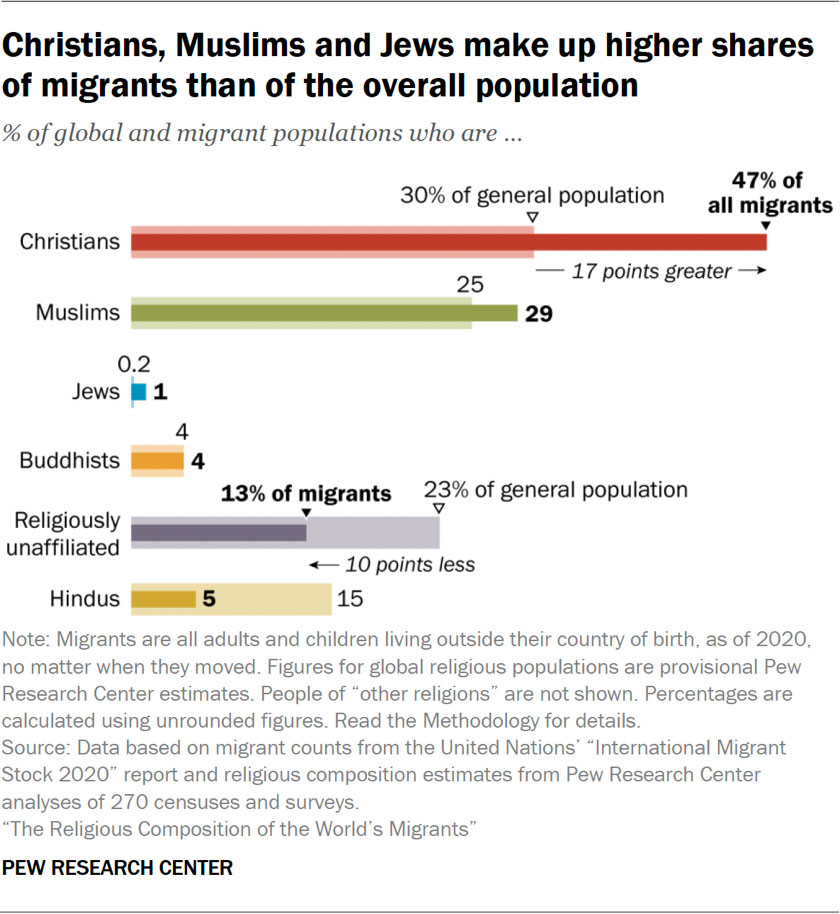
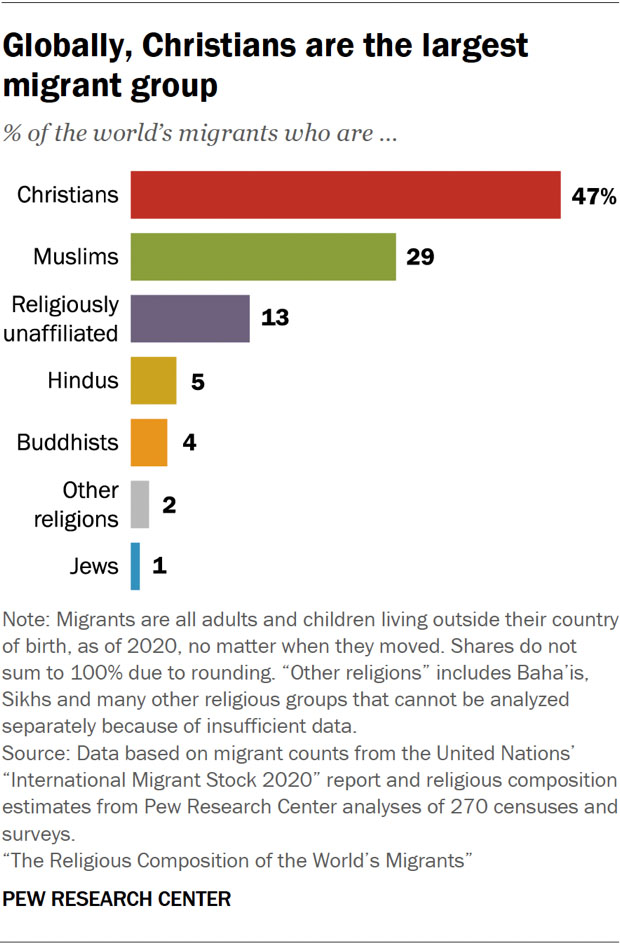
While Christians make up about 30 percent of the world’s population, the world’s migrants are 47 percent Christian, according to the latest data collected in 2020.
The study found Muslims make up 29 percent of the migrant population but 25 percent of the world’s population.
Jews—only 0.2 percent of the world’s population but 1 percent of migrants—are by far the most likely religious group to have migrated, with 20 percent of Jews worldwide living outside their country of birth, compared to just 6 percent of Christians and 4 percent of Muslims.
Four percent of migrants are Buddhist, matching the general population, and 5 percent are Hindu, compared to 15 percent of the world population.
Over the past 30 years, migration has outpaced global population growth by 83 percent, Pew reported.
U.S. migrants more likely to be religious
“Christians, Muslims and Jews make up higher shares of migrants than of the overall population” (Graphic courtesy Pew Research Center via RNS)
Though people immigrate for many reasons, including economic opportunity, to reunite with family and to flee violence or persecution, religion and migration are often closely connected, the report finds.
U.S. migrants are much more likely to have a religious identity than the American-born population in general.
The influx of religious migrants can have a significant impact on the religious composition of their destination countries. In the case of the United States, “immigrants are kind of putting the brakes on secularization,” Callahan said.
While about 30 percent of individuals in the United States overall identify as atheist, agnostic or religiously unaffiliated, only 13 percent of migrants to the United States identify with those categories.
Pew studied data from 270 censuses and surveys, estimating the religious composition of migrants from 95,696 combinations of 232 origin and destination countries and territories.
Their analysis focused on the “stock,” the total number of people residing as international migrants, rather than “flows,” numbers measured over a specific time.
This methodology allowed them to study all adults and children who live outside their countries of birth, regardless of when they immigrated.
“We’re not only interested in the religious composition of people who arrived in a destination country in the last year or in the last five years,” explained Callahan.
According to the report, measuring the total “stock” of migrants reflects slower changes, “patterns that have accumulated over time.”
Migrants move where their religion is prevalent
The study found that migrants frequently move to countries where their religious identity already is represented and prevalent. For example, Israel is the top destination for Jews, with 51 percent of Jewish migrants (1.5 million) residing there.
Saudi Arabia is the top destination for Muslims, with 13 percent (10.8 million) residing in the area.
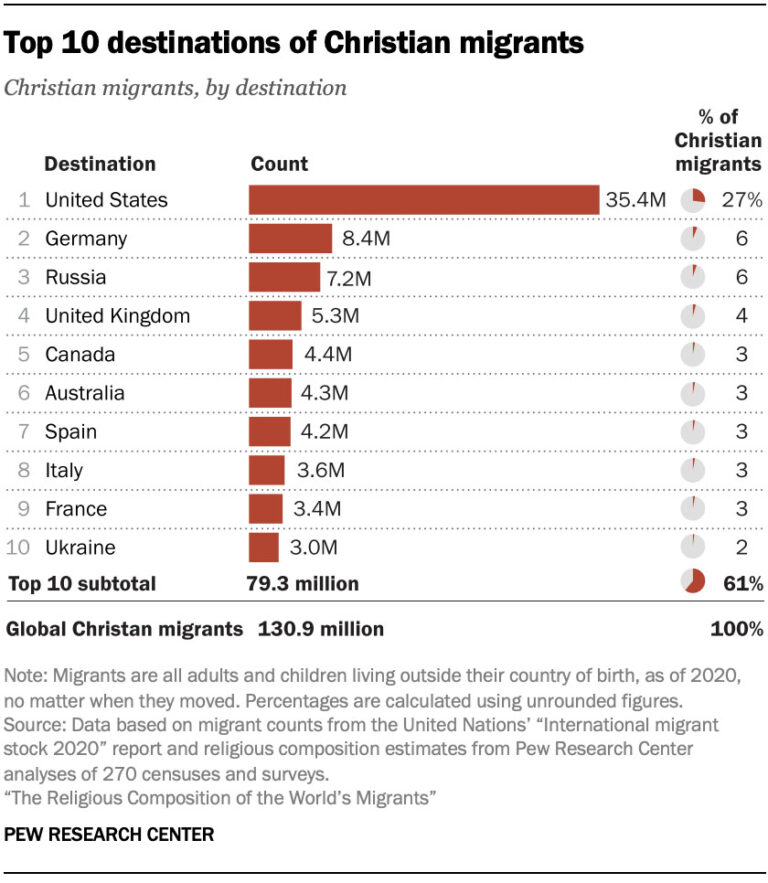
Christian migrants, by destination. (Graphic courtesy Pew Research Center via RNS)
Christians and religiously unaffiliated migrants share the United States, Germany and Russia as their top three destinations.
The majority of the world’s Christian migrants originate from Mexico and settle in the U.S., Pew found. They typically are looking for jobs, improved safety or to reunite with family members.
Meanwhile, 10 percent of the world’s Muslim migrants (8.1 million) were born in Syria, fleeing regional conflict after a war broke out in 2011.
The report attributes high rates of Jewish migration partly to Israel’s Law of Return, which grants Jews the right to receive automatic citizenship and make “aliyah,” a move to Israel.
As of 2020, about 1.5 million Jews born outside of Israel now live within the country’s borders. Jewish migrants to Israel often come from former Soviet republics, such as Ukraine (170,000) and Russia (150,000).
The United States has the second highest population of Jewish migrants (400,000), with a quarter moving from Israel.
Across the board, however, Callahan said immigration levels across religious groups have remained fairly stable over time. Despite consistent numbers, she advocated for doing this study because of the popularity of a 2012 Pew report, Faith on the Move.
The two studies used different methodologies, and Callahan described Faith on the Move as a “snapshot” of religion and immigration in 2010.
“A lot of people have asked for an update to it, and we get a lot of questions related to religion and migration,” she said.
Despite demand for the data, “Faith on the Move was really the last report we put out that focused on this.”
Many of the findings in the new report are similar to the 2012 study, and Callahan found the results relatively unsurprising.
“Even in that older data, you can see that religious minorities were so much more likely to leave their country of origin and migrate to a country where their religious identity was more prevalent,” she said.
“Globally, Christians are the largest migrant group” (Graphic courtesy Pew Research Center via RNS)
Sutherland Springs church demolishes site of mass murder
August 21, 2024
SUTHERLAND SPRINGS (BP)—The site of the deadliest church shooting in the nation no longer stands, as First Baptist Church of Sutherland Springs moved forward Aug. 12 with a 2021 decision to demolish its former sanctuary.
Church members voted 69-35 in August 2021 to demolish the sanctuary after a gunman killed 25 there in November 2017, including a pregnant woman, and injured 20 others before killing himself.
While a lawsuit challenged the decision, it was not filed until May 2024. On July 15, a judge’s ruling removed a restraining order that had prevented the demolition.
Abner Neill, who became lead pastor of the congregation in late 2023, has helped it move forward in ministry to the unincorporated town of fewer than 1,000 people, discussing with church members and leaders how to proceed with demolishing the building.
“We were having internal discussions about what to do and when to do it, and that’s when the lawsuit got filed and a temporary restraining order was issued,” Neill told Baptist Press Aug. 12. “The judge did not renew the restraining order mid-July. So, we said we’re going to wait a little and just let the dust settle.”
Former pastor Frank Pomeroy, who had led the church 20 years and lost a daughter in the massacre, retired in 2022.
The building had served as a temporary memorial, and there had not been an urgency to demolish it, Neill said.
“There was not a sense of urgency in tearing it down until such time as we had a really good idea of what would replace that temporary memorial as a permanent memorial,” Neill said. “It was left up so that we could give an extended period of time for people to reconcile themselves to the fact that it would be going away, and they could say their goodbyes.”
Contractors removed asbestos Aug. 10, bulldozed the sanctuary Aug. 12, and were demolishing the office building Aug. 13, Neill said.
Since 2019, the congregation has worshiped in a new facility funded by the North American Mission Board with gifts made through the Southern Baptist Convention’s Cooperative Program and other donations.
The demolition was delayed as the congregation grappled with the feelings associated with the loss of life and community when Devin Kelley methodically walked through the sanctuary Nov. 5, 2017, killing or injuring dozens before killing himself.
Mixed emotions and disagreement continues
While emotions and views remain mixed among congregants and community members, Neill believes the demolition is best for the community.
“We’ve got some folks who their vote was ‘no’ (in 2021), and if we voted today, their vote would still be ‘no.’ Their hearts are tender right now,” he said.
“Many of our folks, including many who were a part of the church at the time of the tragedy—they may or may not have been in attendance that day—many of them have expressed privately that they are ready to move on.
“For this to finally happen brings them to a place of closure. I had someone tell me just yesterday,” Neill said Aug. 12, “now that we’re doing this, we can get back to just focusing on ministry. That’s kind of the heart that we’re dealing with.”
While opinions vary, Neill said the church is united in ministry.
“I think it will help us move forward,” he said, “in that I have had people in the surrounding community who have said things to the effect of, ‘As long as that’s there, I won’t come.’”
In the lawsuit filed May 17 in the 81st Judicial District Court of Wilson County, plaintiffs Amber Holder and her daughter Aimee Crowder, both of Texas, and Deanna Staton of Alabama sought a preliminary injunction to dismiss the vote to demolish the building and have a new vote but were unsuccessful.
In the lawsuit, the plaintiffs asserted they had been unlawfully removed from the church membership rolls and were thereby unable to vote.
Judge Russell Wilson declined at a July 15 court hearing to extend the restraining order preventing the church’s demolition, effectively making the lawsuit moot as soon as the demolition occurred.
At the hearing, church attorneys argued the court should not interfere with church bylaws, ksat.com reported after the hearing.
First Baptist Sutherland Springs remains active in community ministry, offering a free community breakfast Sundays at 9 a.m., a free community supper Thursdays at 6 p.m., and feeding about 140 families weekly through its food pantry, Neill estimated.
The church averaged 115 in Sunday worship in 2022, according to the 2023 Annual Church Profile, with a total membership of 274.
First Baptist Sutherland Springs is actively searching for a youth pastor and operates a second campus 20 miles north of Sutherland Springs in St. Hedwig.
A memorial prayer garden remains on the grounds alongside the new church, and the congregation is considering a memorial garden on the site of the demolished sanctuary, Neill said.
Latino evangelicals push for immigration reform ahead of election
August 21, 2024
(RNS)—On Good Friday, March 29 this year, Pastor Tony Suarez, founder of the evangelical Christian ministry Revival Makers, drove a stake into the ground in the middle of a tent in McAllen.
“This entire southern border belongs to Jesus,” he declared to a crowd of mostly Latino Texans.
Suarez’s stop in McAllen was one of a series of tent revivals on the southern border that his ministry said have drawn more than 9,000 people.
He doesn’t just preach: As vice president of the National Hispanic Christian Leadership Conference, Suarez advocates with politicians for immigration reform that prioritizes border enforcement, assimilation and a non-amnesty path to legal status.
A member of Donald Trump’s informal evangelical advisory board since 2016, Suarez endorsed the former president in June as one of the campaign’s “Latino Americans for Trump.”
Suarez has, however, at times expressed disappointment in the Republican party’s policies at the border. In this he is representative of Latino evangelical leaders who lack trust in either major political party’s action on the issue, while pushing them for reform.
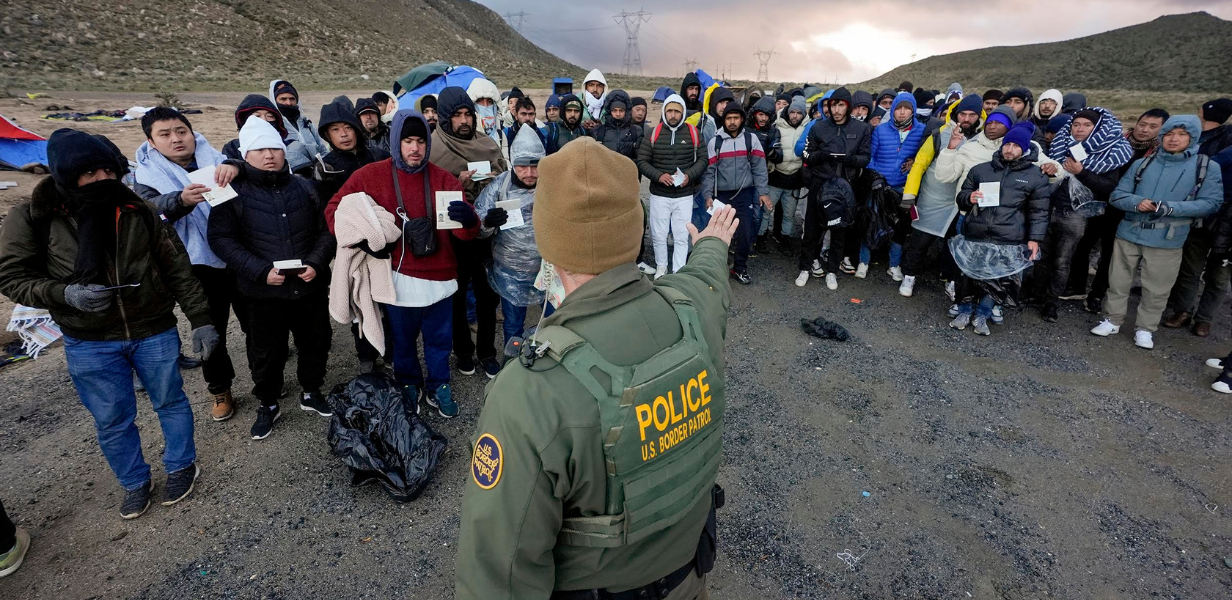
A Border Patrol agent asks asylum-seeking migrants to line up in a makeshift, mountainous campsite after the group crossed the border with Mexico, Friday, Feb. 2, 2024, near Jacumba Hot Springs, Calif. (AP Photo/Gregory Bull)
“We went to the border, and we asked the Lord to intervene, to be in the midst of this, to give wisdom to legislators and to give patience to frustrated citizens,” Suarez told RNS earlier this month.
“In Genesis chapter 2, there was an angelic guard at the Garden of Eden. And so, we prayed and asked the Lord to do something similar at the southern border.”
For Suarez and the National Hispanic Christian Leadership Conference, the “free flow” of migrants crossing the border is an “unprecedented crisis” that led the National Hispanic Christian Leadership Conference to launch its immigration reform campaign, “The Urgency of Now,” in March.
Even as illegal border crossings have dropped following Biden’s recent changes to asylum policy, Suarez said the border remains in crisis, “with no real resolution or end in sight,” calling Biden’s actions “politically motivated but really just empty words.”
“We are a nation of immigrants. We love immigrants and we support immigration reform, but we have to know who’s in the country,” Suarez said.
Latinos not a unified bloc
Since the last presidential election, nearly 4 million more Latinos are eligible to vote, putting the United States’ 36.2 million eligible Latino voters at about 14.7 percent of the electorate.
As the Trump campaign has made reducing immigration a number one campaign issue, Latinos, especially those who call themselves evangelical, are far from a unified bloc.
In 2022, Pew Research Center found 15 percent of Latinos are evangelical Protestants—half of whom are Republican or Republican-leaning—and 44 percent are Democrats or Democratic-leaning. That represents a much higher percentage of Republicans than among Latino Catholics.
Suarez said immigration is just one of the issues the 40,000 member churches in the National Hispanic Christian Leadership Conference are concerned about in this election, saying that Democrats’ “woke ideology” on marriage, life and gender are the “No. 1 issue.”
Gabriel Salguero. (Photo courtesy The Gathering via RNS)
But Gabriel Salguero, president and founder of the National Latino Evangelical Coalition, said poverty and education are the most important issues for Latino evangelicals, putting emphasis on the child tax credit, earned income tax credit and nutrition assistance programs like WIC and SNAP.
“Protecting the poor is an issue for the gospel, because Jesus told us that,” said Salguero, a pastor at The Gathering, an Assemblies of God church in Orlando, Fla. “Latino evangelicals are not one-issue voters, and we’re certainly not a monolith.”
The National Latino Evangelical Coalition has also kept up a “sustained outreach and advocacy effort” on immigration reform, calling for bipartisan legislation to provide more resources for border enforcement and processing asylum cases while prioritizing family unification.
“Latino evangelicals are looking for people who know how to balance justice and mercy, law and humane treatment of people,” Salguero said of the election.
Bishop Jesus Santos Yáñez, a lifelong Republican whose family settled in Texas before it became part of the United States, now leads a region of the Church of God of Prophecy covering Iowa, Colorado, Nebraska and Minnesota.
He tells the pastors in his multiethnic and multiracial Pentecostal Holiness denomination they must prioritize helping people without judgment in addition to following the law.
Recently, he accompanied advocates from Mission Talk, a Florida coalition of Latino evangelicals, on a visit to Tallahassee to speak out against new laws that raise penalties for immigrants lacking permanent legal status who are caught driving without a license.
On the National Day of Prayer in May, Yáñez prayed over Iowa Gov. Kim Reynolds, a Republican, but like other evangelical Latino leaders, he said he cannot support former President Donald Trump because of the former president’s anti-immigrant and racist rhetoric.
Juan García. (Photo courtesy CBF via RNS)
Juan García, pastor of the Hispanic congregation of First Baptist Church in Newport News, Va., said he spends a lot of time countering the right’s narrative that immigrants don’t belong.
“The idea that we’re not loved, we’re not wanted or we’re not valued may be seeded or planted in the minds of people,” said García, who is Puerto Rican.
And García also reminds them of their own worth, saying they spiritually have the “blood of Christ” running through their veins.
Pushing back against problems
García, moderator for the Cooperative Baptist Fellowship, was one of many Latino Protestant leaders who pushed back against Trump’s claims that immigrants are “poisoning the blood of our country.”
The people Trump is targeting, Garcia said, are those who are “making the economy run.”
Elket Rodríguez, an attorney and global migration advocate for the Cooperative Baptist Fellowship, lamented “the lack of seriousness” that lawmakers display when speaking about immigration reform, which he said is about more than U.S. aspirations and responsibilities.
Rodríguez said “a highly intellectual and honest conversation” would address the root causes driving migration and the impact of immigration on questions around the future funding for Social Security, the nation’s aging population and job openings in agriculture and other sectors.
“If you ask me, misinformation is the biggest threat to migrants and those who want to host them,” Rodríguez said.
Some Latino faith leaders say the term “evangelical” has become too politicized to represent them. Yáñez, García and Rodríguez all said while “evangelical” describes their congregations accurately from a theological perspective, they now shy away from identifying that way.
“Evangelical and evangélico are not the same thing,” said Rodríguez, explaining the word in Spanish has a strong theological component.
“The word evangelical in the U.S. has evolved, especially in the past 10 years, into more of a political ethno-national concept.”
But the National Latino Evangelical Coalition’s Salguero said he prefers to make the term bend to what he believes it should represent. “Why should I give up a perfectly good historical definition?” he asked.
“Some of us in the evangelical world have compromised truth for proximity to power, and that’s idolatry. That’s sin,” Salguero said.
“One of the tragic temptations of evangelicalism in America is that we have become captive to partisan talking points and instead of going to our primary source, which is Scripture.”
“Our hope is in the gospel, not in politicians,” Salguero said.
Appeals court rules against Dave Ramsey’s company
August 21, 2024
(RNS)—A federal appeals court has ruled in favor of a former employee who claimed Ramsey Solutions, the company run by Christian personal finance guru Dave Ramsey, discriminated against him during the COVID-19 pandemic.
Brad Amos, a former video editor at the Tennessee-based company, sued Ramsey Solutions in 2021, saying he was fired for not agreeing with Ramsey’s faith-based views about how to respond to the pandemic.
During the pandemic, Dave Ramsey downplayed the risk of COVID-19, referred to those who wear masks as “wusses,” barred employees from working at home and said his company would be guided by faith not fear.
At the Lampo Group—which does business as Ramsey Solutions—wearing a mask or social distancing was seen as “against the will of God,” Amos’ attorneys alleged, and employees were required to agree with Ramsey’s beliefs about the pandemic.
Attorneys for Amos also claimed his faith, including Amos’ belief in the Golden Rule—doing unto others as you would have them do unto you—required him to mask, social distance and comply with other CDC recommendations during the pandemic.
His insistence on doing so, Amos alleged, led to his firing.
Religious discrimination?
“Amos says that his termination was based on his failure to submit to Lampo’s religious practices and his expression of his own religious beliefs with regard to COVID measures.
“These facts form the basis for Amos’s religious-discrimination claims,” according to a ruling from the U.S. Court of Appeals for the Sixth District.
Amos’ attorney also claimed Ramsey Solutions had committed fraud by allegedly lying to him about the “cult-like” atmosphere at the company.
In December, a U.S. District Court had dismissed both the discrimination and fraud claims before they went to trial, saying Amos had failed to show he was discriminated against.
In the lower court ruling, U.S. District Court Judge Eli Richardson wrote that “it is not enough that a plaintiff’s sincerely held religious beliefs do not align with the religious beliefs that underlie the employment policy (requirement) that the plaintiff was terminated for non-complying with.
“Instead, the plaintiff needs to have alleged a religious belief that conflicts with an employment requirement,” Richardson wrote.
Dismissal overruled
On Aug. 8, the Sixth District ruled the district court had erred in dismissing Amos’ discrimination claim. The court ruled federal law protects employees from discrimination based on “religious non-conformity”—also known as reverse discrimination—or requiring an employee to follow a religious belief or practice.
The Sixth District Court also ruled a belief in the Golden Rule qualified as a religious claim and was protected from discrimination.
During the appeal, the Equal Employment Opportunity Commission filed a friend of the court brief, urging the appeals court to reverse the lower court ruling—saying Amos had made a plausible claim for religious discrimination.
The EEOC also argued the term “reverse religious discrimination” was not accurate and said the term “religious non-conformity” was more accurate in cases like the one involving Amos.
“As with all other types of religious-discrimination claims, the employer is accused of discriminating against the employee on the basis of religion,” the EEOC wrote.
“Here, however, it is the employer’s religion that is the focus. But that doesn’t make the discrimination ‘reverse.’”
“We’re happy with the result and look forward to the opportunity to continue fighting for our client,” Jonathan Street, an attorney for Amos, told RNS. The case now will return to the lower district court for trial.
Ramsey Solutions did not respond to a request for comment.
Company disputes discrimination claims
The company’s lawyers, in a brief filed as part of the appeal, said the disagreement between the company and Amos was about how to apply safety protocols. Religion, they argued, had nothing to do with it.
“This lawsuit should never have been filed,” an attorney for Ramsey wrote. “At the heart of it is an aggrieved employee who disagreed with his employer’s approach to the COVID-19 pandemic.”
Ramsey’s attorneys also argued Amos had failed to make his religious discrimination claims in a clear and timely manner and so those claims were invalid.
“Because Plaintiff-Appellant failed to plead reverse religious discrimination, it is not properly before the Court on appeal,” Ramsey’s attorney argued.
Eugene Volokh, a senior fellow at the Hoover Institute at Stanford and a long-time UCLA law professor, was skeptical about the Sixth District ruling. Volokh—who often discusses First Amendment cases at “The Volokh Conspiracy,” his long-running legal blog—said Amos would have to prove that religion was at the heart of his trouble with Ramsey.
An employer, Volokh said, could have secular reasons for disagreeing with vaccine mandates or other COVID-related restrictions. If that is the case, then religious discrimination is not involved. Nor would it matter if an employer’s skepticism was motivated by religion.
He also said most religious discrimination cases are more straightforward—for example, if someone is fired for their religious identity or if an employer fails to offer an accommodation to a religious employee for their religious practice.
Complicated to prove
Determining if a secular firing decision—a disagreement over COVID rules—was motivated by religion is more complicated, he said. He said the court may suspect agreement on COVID was used as a kind of religious test to screen out the wrong kinds of Christians.
“You don’t go along with our views on COVID—well that means to us that you are not our kind of Christians,” said Volokh, speculating on what could constitute religious discrimination in a case like this.
“And therefore, we are really going to fire you because of that.”
That kind of approach would be harder to show but could constitute discrimination.
Ramsey Solutions has faced a series of lawsuits and controversies in recent years—largely from staff who have run afoul of faith-based rules about sex and gossip—including an ongoing lawsuit filed by an unmarried employee who was fired after telling her boss she was pregnant.
In that case, Ramsey argued the employee was fired for breaking a rule that barred all unmarried employees from having sex—rather than for being pregnant.
The company is also dealing with a class-action lawsuit prompted by its ties to a troubled time-share exit company.
Ramsey did get some legal good news this week. The appeals court upheld a lower court’s ruling dismissing Amos’ fraud claims.
Amos had claimed leaders of Ramsey Solutions promised a “drama-free” work environment and had dismissed concerns that Ramsey Solutions had a “cult-like” work culture and was run more like a church than a company. Amos alleged he had moved from California to Tennessee based on those assurances, which he later claimed were untrue.
The district court ruled Amos knew there had been complaints about Ramsey Solutions but did not do enough to vet those complaints. Instead, he had relied solely on assurances from leaders at Ramsey Solutions.
“Amos even avers that he was put on notice that Lampo’s statements about the company were potentially inaccurate,” the appeals court ruled.
“According to his complaint, Amos’s only real attempt to investigate or guard against rumors about Lampo’s workplace culture was to ask Lampo employees about it.”
Belonging tops faith as draw for all but evangelicals
August 21, 2024
PHILADELPHIA, Pa. (BP)—A sense of community and belonging inches out shared spiritual beliefs and faith as a church draw for all groups but evangelicals, the American Bible Society said in its latest release from the 2024 State of the Bible.
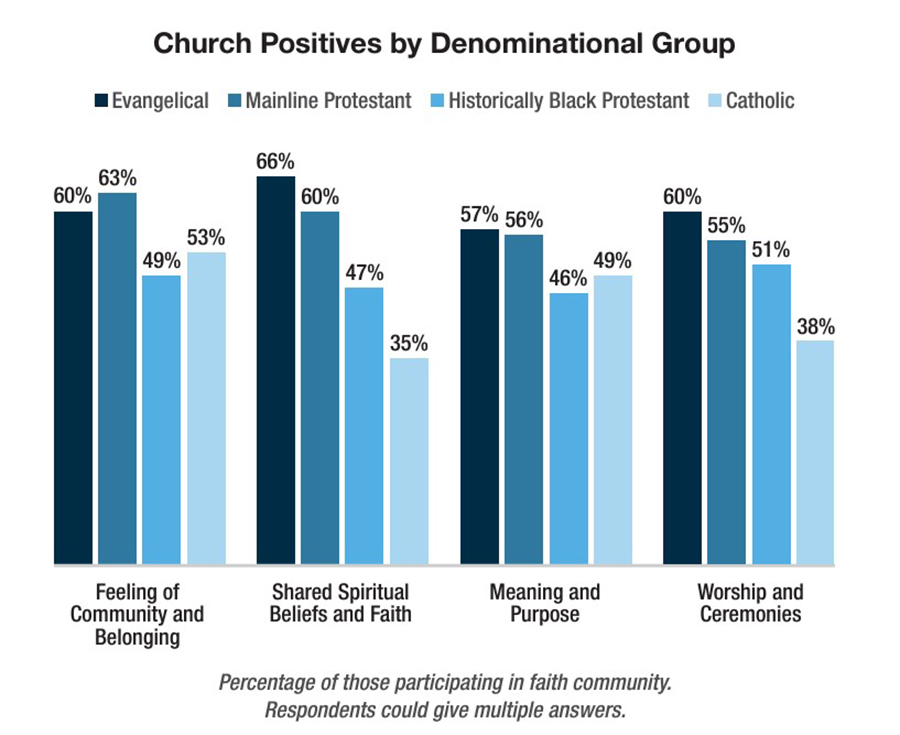
Of the respondents in the study who attend church, 55 percent said they do so because of a feeling of community and belonging, followed by 53 percent who attend because of shared spiritual beliefs and faith, and 51 percent because of meaning and purpose.
But two-thirds of evangelicals—66 percent—are drawn to church by a shared sense of faith, the American Bible Society stated April 8 in releasing the fifth chapter of the 14th annual study.
Participants in mainline Protestant churches are most likely to identify a feeling of community and belonging (63 percent) as a draw, while active Catholics are more likely than other groups to be drawn by cultural or family tradition (43 percent).
Less than half of all respondents combined, 48 percent, said worship and ceremonies draw them to church, the American Bible Society stated.
“The top answers, for both positive and negative responses, are about belonging. When churchgoers feel that they belong, they participate more,” said John Farquhar Plake, American Bible Society chief innovation officer and State of the Bible editor-in-chief.
“And when they feel excluded by cliques, they drift away. So, what can your church do about that? This new chapter offers a few ideas.”
A sense of community and belonging is still a top draw among evangelicals at 60 percent, joined by worship and ceremony at 60 percent, and meaning and purpose at 57 percent.
Falling below 50 percent for evangelicals are religious education and learning, 47 percent; community service and outreach, 36 percent; culture or family tradition, 20 percent; and conversion or religious experience, 17 percent. The aspects are also less than top draws for other denominations cited in the findings.
While the findings come from a nationally representative AmeriSpeak panel of the University of Chicago’s NORC research organization, 42 percent of the 2,506 subjects chose not to answer, saying they did not attend church or participate in a faith community.
Those who did respond selected from nine provided choices of things that attract to church or faith community, the American Bible Society said.
Among other findings:
20 percent, or 50 million people, said a feeling of exclusion or the presence of cliques within faith communities deterred their participation.
19 percent said the church judged or condemned their lifestyle choices, a feeling more common among Gen Z and Millennials (23 percent and 24 percent, respectively).
12 percent are deterred by unresolved conflicts within faith communities.
5 percent said they haven’t felt safe in church or the faith community, most common among Gen Z (8 percent).
Denominations seemed equally impacted by adverse perceptions that drive away attendance, researchers said, with the exception of 15 percent of evangelicals and 14 percent of mainline Protestants who cited conflicts within faith communities that were not resolved satisfactorily, compared to 8 percent of historically Black denominations and 6 percent of Catholics.
Active church volunteers more often expressed a feeling of community and belonging than nonvolunteers, 68 percent to 55 percent, researchers said, and also expressed a deep care for those communities they actively support.
The study was conducted online in January 2024 among adults in all 50 states and the District of Columbia. Additional results from the findings will be released monthly through December, focusing on the Bible’s impact in restoring hope; spiritual nones and nominals; loneliness and the Bible, philanthropy and other topics.
Most pastors have little work experience outside ministry
August 21, 2024
BRENTWOOD, Tenn.—A pastor’s resumé might include multiple churches and ministry roles, but most don’t have much job experience other than ministry listed.
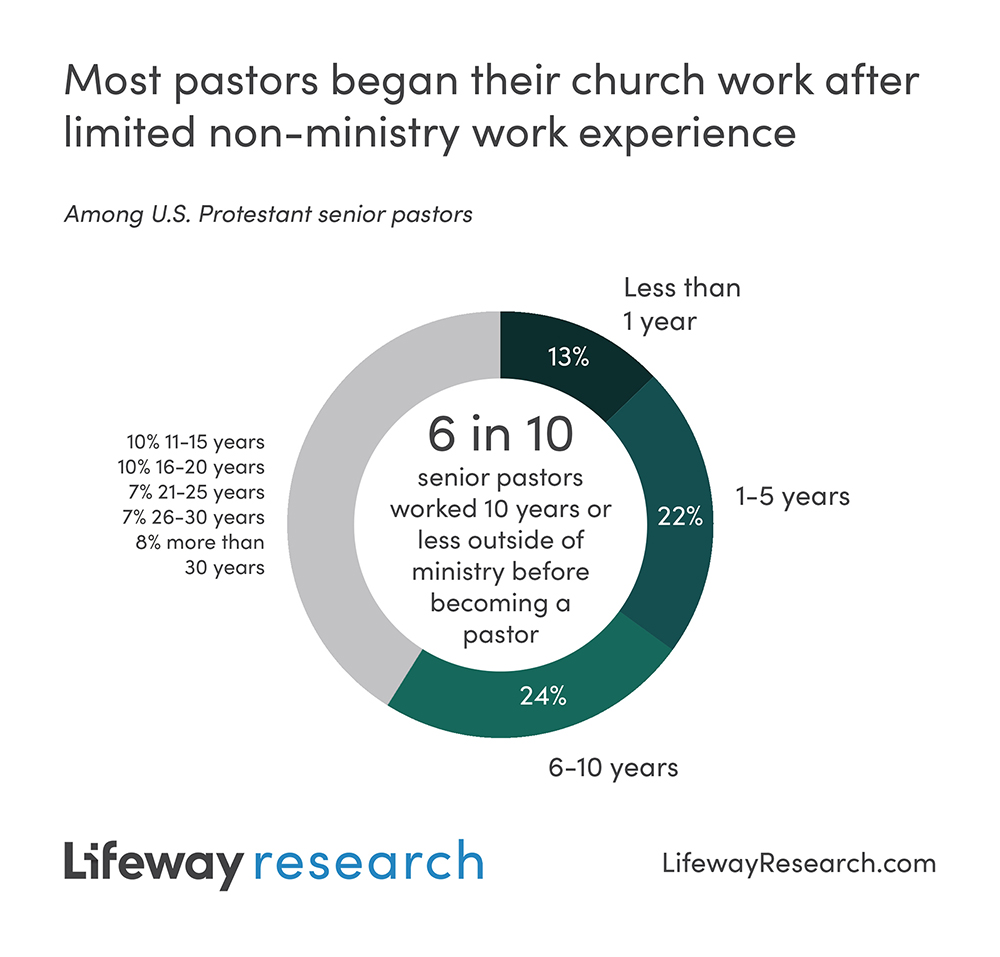
Most current U.S. Protestant senior pastors worked outside of ministry as adults for only a short time, according to a study by Lifeway Research. Only 3 in 10, however, began vocational ministry as the senior pastor.
“A person’s journey to the pastorate can happen at almost any age, but the majority of pastors are in a ministry job by their early 30s,” said Scott McConnell, executive director of Lifeway Research.
“Ministry skills are typically developed in more junior positions at a church, but some senior pastors learn on the job.”
In the period between graduating high school and becoming a senior pastor, a third of pastors (34 percent) say they spent five years or less working in a nonministry job, including 13 percent who have less than a year of secular work experience. Another quarter (24 percent) say they worked outside ministry for six to 10 years.
Fewer have longer nonministry careers before becoming a senior pastor, including 10 percent who worked for 11 to 15 years outside the church, 10 percent 16 to 20 years, 7 percent 21 to 25 years, 7 percent 26 to 30 years and 8 percent who spent more than 30 years in nonministry jobs.
“Years of work experience in nonministry roles can help pastors relate to the experiences of those in their congregations and to develop relationships with people outside their churches,” McConnell said.
As older pastors are the ones who have lived long enough to have decades of post-high school experience, pastors 65 and older (20 percent) are the most likely to say they worked outside of ministry more than 30 years.
Additionally, most younger pastors have worked outside of ministry for a brief time. Pastors aged 18-44 are the most likely to say their secular work experience before coming to the church as a pastor lasted six to 10 years (35 percent) or one to five years (29 percent).
Pastors without much formal education probably also spent time working outside the church. Those with no college degree are the most likely to say before they became a senior pastor, they worked in nonministry employment for 26-30 years (15 percent) and more than 30 years (17 percent).
White pastors (23 percent) are more likely than African American pastors (6 percent) to have a brief 1-year to 5-year nonministry work experience.
One in 5 Lutheran (20 percent) and Restorationist movement pastors (20 percent) say they worked outside the church for less than a year, compared to 11 percent of Baptists and 7 percent of nondenominational pastors.
Ministry experience
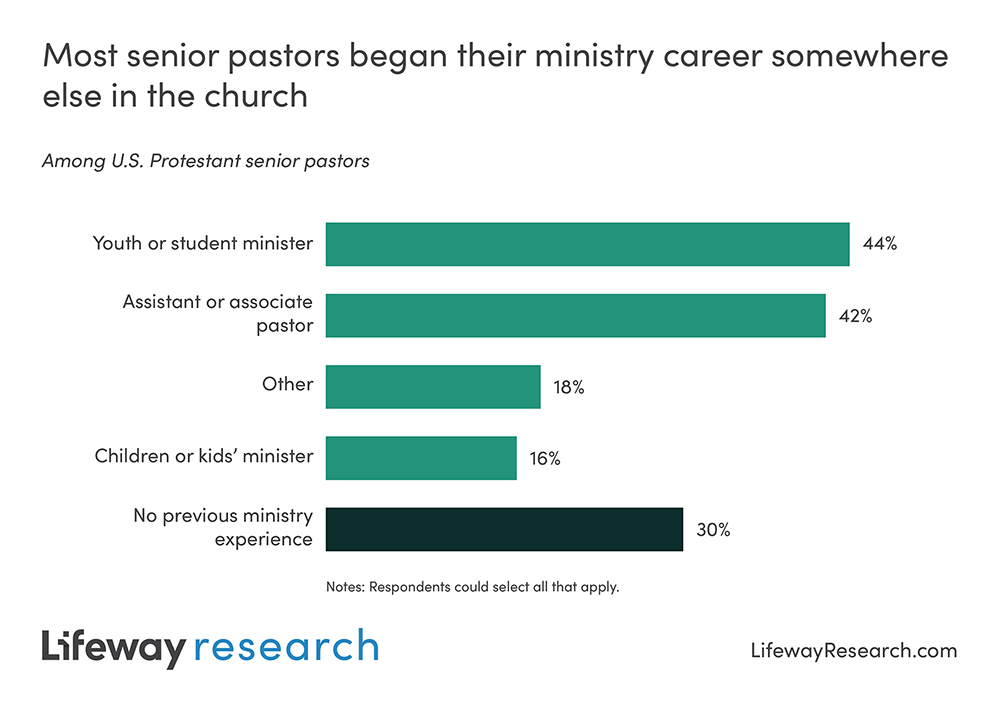
Most senior pastors didn’t step immediately into a lead pastor role as their first ministry position. Seven in 10 started somewhere else in the church. On average senior pastors held 1.7 other ministry roles before their current position as a senior pastor.
More than 2 in 5 say they previously served as a youth or student minister (44 percent) or an assistant or associate pastor (42 percent). Fewer say they worked as a children or kids’ minister (16 percent) or another church ministry position (18 percent). Three in 10 (30 percent) say they had no previous ministry positions before becoming a senior pastor.
“Leading, teaching, equipping, and caring for people are skills all ministers utilize,” McConnell said. “So, regardless of the age or specific ministry within the church there are opportunities to develop skills senior pastors need.”
Pastors 65 and older are the least likely to say they’ve served as an assistant or associate pastor (33 percent) or as a youth or student minister (28 percent). Younger pastors, those 18-44, are the least likely to say they had no previous ministry positions before becoming a senior pastor (20 percent).
Hispanic senior pastors are the most likely to say they previously worked as an assistant or associate pastor (54 percent) and among the most likely to say they were a children or kids’ minister (29 percent).
African American pastors are the least likely to say they served as a youth or student minister (30 percent) and the most likely to say they had no previous ministry experience (44 percent).
Pentecostal (56 percent) and nondenominational pastors (52 percent) are among the most likely to say they worked as an assistant or associate pastor.
Pentecostal (54 percent), nondenominational (54 percent) and Baptist pastors (49 percent) are among the most likely to have spent time as a youth or student minister. Pentecostal senior pastors are also among the most likely to have been a children or kids minister (27 percent).
Lutherans (41 percent) are among the most likely to say they had no ministry experience before becoming a senior pastor.
Pastors of the largest churches, those with 250 or more in worship attendance, (61 percent) are more likely than pastors of small churches, those with less than 50 in attendance, (38 percent) and normative churches, those with 50-99 for worship services, (41 percent) to say they previously served as a youth or student minister.
Pastor search
Around 4 in 5 senior pastors (83 percent) say their church spent less than a year without a pastor before they started. For 2 in 5 (42 percent), the church waited less than a month. A quarter (23 percent) say the time without a pastor was one to six months.
Another 18 percent say it lasted for at least seven months but less than a year. Fewer senior pastors say the church spent 13-18 months (7 percent), 19-24 months (6 percent) or more than two years (5 percent) without a pastor before they arrived.
“Many churches utilize a pastor search process that can sometimes be lengthy,” McConnell said. “Pastors reporting there was little to no time between pastors when they arrived may include situations in which the church had an interim pastor, the pastor leaving stayed until the new pastor was found or leaders in their denomination quickly appointed a pastor.”
Larger churches don’t spend long between pastors. Those at churches with 250 or more are the most likely to say their congregation spent less than a month without a pastor before they started (67 percent).
Different types of churches have different processes for filling vacancies. Some denominations appoint pastors to churches, while other congregations are autonomous and select their own. Methodist pastors (81 percent) are the most likely to say their congregation spent less than a month without a pastor.
Nondenominational (59 percent) and Pentecostal (53 percent) pastors are more likely than Presbyterian/Reformed (30 percent), Baptist (28 percent) and Lutheran pastors (24 percent) to say their church was without a pastor for less than a month before they began serving.
The phone survey of Protestant pastors was conducted Aug. 29, 2023 to Sept. 20, 2023. Responses were weighted by region and church size to reflect the population more accurately. The completed sample is 1,004 surveys, providing 95 percent confidence the sampling error does not exceed plus or minus 3.2 percent. Margins of error are higher in sub-groups.
Commitment to God fuels Armstrong’s Olympics outlook
August 21, 2024
PARIS, France (BP)—Hunter Armstrong’s Instagram account proclaims “GOD FIRST!” The U.S. Olympic swimmer tries to be faithful to that description, whether he’s winning gold medals or not.
“That’s the first thing I want people to see and know about me,” Armstrong told Baptist Press. “As we grow, we have to make sure we have our priorities in line.
“I keep God as a priority. I can’t really live without him. I can live without swimming or being an Olympian or any of that stuff.”
Chris Guliano, Hunter Armstrong, Jack Alexy and Caeleb Dressel celebrate winning the men’s 4×100-meter freestyle relay final during the Paris 2024 Olympic Summer Games at Paris La Défense Arena. (Baptist Press photo by David McIntyre/Genesis Photos)
Armstrong captured one gold medal in the Paris Olympics as part of the men’s 4×100-meter freestyle relay team with Caeleb Dressel, Jack Alexy and Chris Guiliano that held off Australia to win the title on Saturday.
Armstrong’s walk with the Lord has grown considerably over the past several months, he said. While he has professed to be a Christian for a long time, his faith was more peripheral than central to his life.
“I feel like in past years I’ve been sort of on the edge of it,” he said. “When I’m in competition, I’ll pray, and that will last for a little bit. Church camp, same kind of thing. But as soon as I didn’t need him anymore, it would fade.”
That began to change in the aftermath of a breakup with his girlfriend—whom Armstrong had planned to marry—and following the death of his grandfather.
“The biggest catalyst for change in life tends to be pain,” Armstrong said. “Sometimes God will put you in a position where you have no other choice than to turn to him.
“That’s been the biggest change that I’ve made this year. I promised at (world championships) that if he would help me get out of this, then I would embrace it.”
Armstrong’s gold in Paris was the second Olympic gold medal of his career. His first came in Tokyo in 2021 as part of the 4×100-meter medley relay.
Positive influence of teammates
Success in relay races is fitting for Armstrong, as he is quick to point to the influence that some of his fellow swimmers, such as Michael Andrew and Carson Foster, have had on him spiritually.
He remembers an encounter with Andrew at a swimming competition. Though the two had met, they didn’t really know each other well. Armstrong remembers being especially nervous prior to a race, and Andrew noticed Armstrong’s state of mind.
“He got out of the warmup pool, came over and said, ‘Hey, can I pray with you?’” Armstrong said.
Foster also helped sharpen Armstrong by inviting him to participate in group Bible studies for competitive swimmers.
“Truly, my goals for Paris are just to do my best and see what the results are,” Armstrong said prior to the Olympics. “I think everybody here wants a gold medal, but I’ve overcome so much this year that I’m just happy to be here.
“Obviously, I want to have a great performance for myself, my country and my teammates. But if I walk away and I don’t have a single medal or a single best time, I can still walk away knowing that I represented myself well—and God.”
Tim Ellsworth is associate vice president for university communications at Union University in Jackson, Tenn.
William Barber refutes myths about poverty and race
August 21, 2024
(RNS)—When Tim Tyson first invited William Barber II to meet with a group of white residents of Mitchell County, in North Carolina’s Blue Ridge Mountains, Barber half-jokingly replied, “I knew you were going to get me killed.”
Barber, a Black anti-poverty activist, knew in 1923 nearly all the county’s Black residents were driven out of Mitchell County.
Even in 2013, when the invitation was extended, the county had fewer than 100 Black residents out of 15,000 people, or less than 1 percent.
But Tyson, a historian who teaches at the Center for Documentary Studies at Duke University, convinced Barber to trek up the mountain to meet a group of white citizens who were fed up with the state Legislature’s cost cutting, especially in public education.
What Barber found at an Episcopal church in Mitchell County were a group of like-minded working-class whites eager to hear his message.
“There were about 300 people there standing all along the walls, and Rev. Barber just spoke to them from his heart and spoke from his faith,” said Tyson.
“He got three standing ovations. People just wept. They were so touched.”
When it was over, the assembled crowd said they wanted to start a branch of the NAACP—even though they were all white.
A moral leader for all
That’s when Barber first realized he could not be a moral leader and stand up only for Black people. Many white people too are poor and struggling.
In fact, they form the largest single demographic group of the estimated 40 million Americans who are poor according to the U.S. Census, which Barber considers an outdated and significant undercount.
That trip up to Mitchell County convinced Barber he ought to follow in the tradition of the biblical prophet Jeremiah, who was called to be a watchman.
“The ancient prophets remind us that when we cannot see a problem, a watchman must sound the alarm,” he said.
On July 29, on the steps of the U.S. Supreme Court, Barber kicked off a series of Moral Monday Prayers calling for democracy, justice and voting rights ahead of the 2024 presidential election.
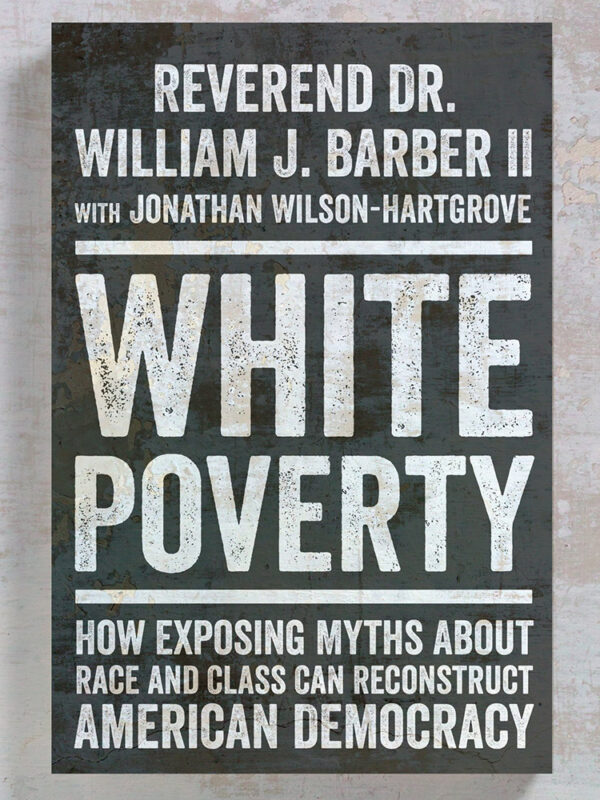
As he outlines in his new book, written with Jonathan Wilson-Hartgrove, who is white, it’s time for poor Blacks, whites and other minorities to unite and fight for better living conditions.
‘White Poverty: How Exposing Myths About Race and Class Can Reconstruct American Democracy’ by William Barber and Jonathan Wilson-Hartgrove. (Courtesy image via RNS)
“The history of America, like the history of the world,” Barber writes, “is filled with stories of powerful people who’ve stolen from the poor and used their power to pit poor people against one another so the masses would not rise up against them.”
As an example, he notes how Republican politicians have portrayed government programs such as welfare benefits as handouts from hard-working white people to poor Blacks, even though more whites benefit from those programs than Blacks.
Attacks on diversity, equity and inclusion programs are another recent example experts point to as conservatives trying to use racial resentment to undermine class solidarity.
“This is the longest power play in the U.S. South, certainly, but across America: to divide people whose interests are shared and whose needs are very painful and urgent, by race,” said Nancy MacLean, a historian at Duke University who has become an ally of Barber’s and whose work is cited in his book.
At last week’s Republican National Convention, JD Vance, the Republican nominee for vice president and an Ohio senator from rural Appalachia, said his party would stand up for working-class communities like the one he was raised in and stand against the “ruling class” that had sold them out.
“We’re done catering to Wall Street. We’ll commit to the working man,” Vance said.
But experts like MacLean said it’s extremely unlikely Vance can transform the free market economic policies of the GOP. Indeed, the signature economic achievement of former President Trump’s term in office was a massive tax cut, skewed largely to benefit corporations and the wealthy.
Barber’s aim is not purely partisan. He can be critical of Democrats too, for not talking enough about poverty and preferring to appeal to middle-class voters.
A ‘Third Reconstruction’
His focus in writing the book ahead of the 2024 presidential election, however, is larger. He wants to build a multiracial coalition that moves beyond the idea poverty is a Black problem.
As he has before, with his Poor People’s Campaign, he is calling for a “Third Reconstruction.”
The first was the work of the Reconstruction era after the Civil War that guaranteed the rights of former slaves with the 13th, 14th and 15th amendments to the Constitution.
The second was the Civil Rights Movement that ended formal segregation, dismantled Jim Crow and removed legal barriers to voting.
For Barber, whites uniting with Blacks to fight poverty is the work of the Third Reconstruction, informed by a deeply moral and Christian mandate.
Before talking to a group of white people up in Mitchell County a decade ago, he had them sing a hymn, “Blessed Be the Tie That Binds.” Reference to that hymn is repeated throughout his new book.
“In communities across the land, I’ve had the opportunity to see and touch the ties that bind poor people,” he writes.
“These are my people, just as much as the multicolored ancestors my daddy taught me to remember. … I am a witness that every shade of America’s poor has a great deal in common.”
Archaeologists discover ancient Jerusalem moat
August 21, 2024
JERUSALEM (RNS)—Archaeologists from Tel Aviv University and the Israel Antiquities Authority have discovered a remnant of a massive ancient moat in Jerusalem that fortified the city during the time of the First Jewish Temple and the Kingdom of Judah.
Yuval Gadot of Tel Aviv University stands next to the northern side of the moat that protected Jerusalem. Alongside him are carved bedrock channels. (Photo by Eric Marmur, City of David)
“This is an extremely important discovery,” said Yosef Garfinkel, a professor at the Institute of Archaeology at the Hebrew University. “It shows that by the ninth century BCE, Jerusalem was an important city.”
Although no one knows exactly when or why the moat was created, the archaeologists say it could have been quarried as far back as 3,800 years ago. At the time, the moat physically separated the southern residential part of the city (the City of David) from the upper city—the Temple Mount area—where the palace and First Temple stood.
Open questions and excavations at the City of David archaeological site have persisted for 150 years. So, any new discovery must be cross-referenced with earlier finds.
In this case, the team reexamined 70-year-old excavation reports written by the renowned British archaeologist Kathleen Kenyon, who worked on a nearby site in the 1960s.
“It became clear to us that Kenyon noticed that the natural rock slopes towards the north, in a place where it should naturally have risen,” said Yuval Gadot, excavation co-director and head of the Institute of Archaeology at Tel Aviv University.
While Kenyon believed it to be a natural valley, she had discovered a different remnant of the moat, carved to the west.
Taken together, the two parts of the moat extend at least 230 feet from west to east. The trench is at least 30 feet deep. The dig site is altogether 3,500 square feet and previously had been used as a parking lot for visitors to the Western Wall.
“Cut into the hill’s natural bedrock, the ditch would have required the quarrying of nearly half a million cubic feet of stone, making it a truly monumental achievement,” an article on the website of the Biblical Archaeology Society notes.
“This barrier appears to have remained in place until the late second century BCE, when it was finally filled in and covered over to allow for new construction.”
New insights into biblical place names
Gadot said the “dramatic discovery” has reenergized the discussion over the meaning of the topological terms used in the Hebrew Bible, such as Ophel, which is believed to be an elevated area, and the Millo, which various scholars have interpreted to mean a stepped stone structure, a tower, a landfill or an embankment.
According to 2 Kings 11:27, Solomon built the Millo and repaired the breaches of the City of David.
The First Jewish Temple was built by King Solomon in 1000 B.C., after his father, King David, conquered Jerusalem. Led by King Nebuchadnezzar, Babylonians breached the Temple’s walls and destroyed it in 586 B.C. The Jews who remained were killed or exiled.
Yiftah Shalev, the excavation’s co-director on behalf of the Israel Antiquities Authority, said the team exposed nearly 10 percent of the moat. He dismissed the notion that the enormous trench was nothing more than a stone quarry.
“We assume it served as some kind of defense,” Shalev said. “You don’t leave a large trench in the heart of the city during the period Jerusalem was the capital of the Judean Kingdom. It would be an obstacle to residents at the time.”
Given the magnitude of the moat, Shalev speculates that it also served as a symbol of the Judean kings’ wealth and prowess.
“It’s as if they are saying, ‘Look, if we can build something so impressive, imagine what else we can do.’”
Garfinkel agreed.
“There has long been a debate about when Jerusalem became a real capital city,” he said. “This discovery, and discoveries in other ancient cities from that time, altogether change the notion of the strength of the Kingdom of Judah.”
Eli Escusido, director of the Israel Antiquities Authority, said the City of David digs “never cease to amaze” not only because they enhance our understanding of the Bible, but because of the engineering skill needed to build the kingdom.
“It is impossible not to be filled with wonder and appreciation for those ancient people who, about 3,800 years ago, literally moved mountains and hills,” Escusido said.
Meaning of Sonya Massey’s near-last words
August 21, 2024
(RNS)—As video footage of the fatal police shooting of Sonya Massey, a 36-year-old Black woman who lived in Springfield, Ill., circulates online, many viewers are memorializing her near-final words: “I rebuke you in the name of Jesus.”
Massey initially called 911 from her home on July 6, citing concerns of an intruder. The body-camera footage, which was released Monday by the Illinois State Police, shows sheriff’s deputy Sean Grayson shooting Massey in the head following a brief exchange over a pot of hot water.
Grayson since has been fired and charged with first-degree murder, aggravated battery and official misconduct, and the U.S. Department of Justice has opened an investigation into Massey’s death.
According to some faith leaders and scholars, Massey’s near-last words, spoken twice in an even voice to the deputies before her death, carry a spiritual and cultural weight specific to Black church communities.
What the rebuke means
“Every person raised in a certain kind of black church knows the power and gravity of those words,” Womanist biblical scholar Wil Gafney wrote on her website on Tuesday.
“Those are the words to be said when facing the evil that has walked in your door and will soon take your life. It is not a prayer to save one’s life or for God to come down and prevent the flagrant act of violence to come. It is something between a benediction and a malediction, laying bare the wickedness of the soul encased in human skin standing before her.”
In an Instagram Live on Wednesday night, author Austin Channing Brown noted her own “churchy” background before providing context for the rebuke, which she said was not in any way a threat.
“Because white people think they have the corner market on what is normal, we are misinterpreted all the time,” she said.
The phrase has begun to take on a life of its own, becoming “memeified” and posted by faith leaders and others, including Essence Magazine, whose post about Massey and her parting phrase has been shared over 12,000 times on Facebook.
“It’s becoming—whether it’s on T-shirts or bumper stickers—that statement is flowing through everywhere,” said the Rev. T. Ray McJunkins, a pastor at Union Baptist Church in Springfield, Ill., who has been serving as an informal liaison between Massey’s family and government officials.
McJunkins agreed the phrase is a cultural one that’s especially common in Black charismatic church contexts. He said it’s typically invoked when something feels out of one’s hands, and certainly when there’s a sense of the demonic.
“We understand and we believe the Bible as it relates to there being power in the name of Jesus,” McJunkins told RNS.
Massey’s Christian faith
Massey, who leaves behind two children, was a member of Second Timothy Baptist Church in Springfield. Cary Beckwith, a pastor at nearby Springfield Grace United Methodist Church, was asked to officiate the July 19 funeral service, which included a sermon on Psalm 46 and a soloist performing Yolanda Adams’ anthem, “The Battle Is the Lord’s.” Several family members who spoke at the service remarked on Massey’s Christian faith.
“The darkness of that day cannot and will not extinguish the light of Sonya Massey,” Beckwith said to the packed funeral home.
Speaking to RNS, Beckwith provided his own explanation of Massey’s near-last words.
“For Sonya to say that I rebuke you in the name of Jesus, she, in that moment, saw something demonic in the eyes of that officer,” he said. “She felt something in her spirit that did not line up with the love of Jesus Christ.”
Some news outlets report Massey had been managing a diagnosis of paranoid schizophrenia with medication. Massey was several feet away from the deputies when she was shot. She was not in a position to harm them, Beckwith said. He added, her mental illness “was not justification for her leaving this earth the way she did.”
Seeking and doing justice
In the days since the funeral, Beckwith told RNS local faith leaders have responded to the tragedy by “taking cues” from local community groups, including the local Black Lives Matter chapter and Intricate Minds, a grassroots harm-reduction organization, which have organized peaceful marches and community events.
At a news conference on Monday, Ben Crump, a nationally recognized lawyer representing Massey’s family, spoke to reporters after the release of the video footage.
“Until we get justice for Sonya Massey, we rebuke this discriminatory criminal justice system in the name of Jesus,” he said. Crump has handled several other notable cases, representing the families of George Floyd, Breonna Taylor, Ahmaud Arbery and Trayvon Martin.
McJunkins, who co-founded the faith-based social justice group Faith Coalition for the Common Good in 2008, has been working behind the scenes in recent weeks, connecting Massey’s family with decision-makers and advocating on their behalf, particularly in conversations with Sangamon County Sheriff Jack Campbell.
McJunkins hosted conversations between Massey’s family and Illinois Gov. J.B. Pritzker and Illinois Lt. Gov. Juliana Stratton at his church on July 22 and is teaming up with the Department of Justice to hold a community listening session at the church July 29.
“My community needs to heal,” said McJunkins, who added Massey’s death has hit close to home for many in Springfield.
“Whether they know it or not, we’re going through the five stages of grief. As a community leader and religious leader, I’m not doing justice if I don’t step up to bring the community together, to walk them through a grief process.”
Amid that process, McJunkins said, Massey’s rebuke will continue to be a focal point and a rallying cry.
Kamala Harris’ pastor known for civil rights, reparations activism
August 21, 2024
(RNS)—The Rev. Amos Brown, a longtime pastor of Third Baptist Church of San Francisco, was specific when he described Vice President Kamala Harris’ connection to his church.
“She’s an old-timer” at the church, he told Religion News Service in an interview on July 22.
In fact, as he told RNS in 2023, she’s also “a dues-paying member, too.” That might help explain why, when Harris met with Christian, Jewish, Muslim and Sikh leaders in Los Angeles the previous year to discuss abortion rights and other issues, Brown was in attendance.
Or why, when she spoke of him that same year, she praised “my pastor” as a man who also long has been her mentor.
“For two decades now, at least, I have turned to you,” Harris said in remarks at the 2022 Annual Session of the National Baptist Convention, USA. “I have turned to him. And I will say that your wisdom has really guided me and grounded me during some of the most difficult times. And—and you have been a source of inspiration to me always. So, thank you, Rev. Brown, for being all that you are.”
And the long-standing connection between the two might be why Harris turned to Brown again this week, reaching out to him over the phone after President Joe Biden abandoned his reelection bid and endorsed the vice president. She asked for prayer, and Brown happily obliged.
Prayers for Harris
Brown and his wife prayed that Harris “would receive the thing that Micah 6:8 records in the Bible, the fulfillment of what the Lord requires: to do justice, love mercy and walk humbly with her God,” Brown told RNS.
He also prayed Harris would move forward in her campaign “in the spirit of our ancestors.” Brown recited lines from “Lift Every Voice and Sing,” a hymn sometimes referred to as the “Black national anthem:”
“God of our weary years, God of our silent years,
Thou who hast brought us thus far on the way;
Thou who hast by Thy might, Led us into the light,
Keep us forever in the path, we pray.”
Screen shot of Kamala Harris being sworn in as vice president of the United States Jan. 20, 2021.
“That’s what this nation needs,” Brown said, later noting he endorses Harris for president in his personal capacity.
“That’s what this vice president and, hopefully, president, will be elevated to be: To bring this nation out of darkness. The darkness of incivility. The darkness of lying. The darkness of injustice. The darkness of irresponsible behavior—and that goes at all levels, from the local community up to the national government.”
Brown, 83, explained he and Harris also have a shared political history. Harris served as Brown’s campaign manager when he ran for reelection to the San Francisco Board of Supervisors in 1999, and Brown joined his wife in praying over Harris and her husband, Doug Emhoff, immediately before the 2021 inauguration ceremony.
“She was very close to our church family,” Brown said.
History of activism
Brown’s history with Harris extends to her family as well. A Jackson, Miss., native and civil rights activist who was taught by the Rev. Martin Luther King Jr. in a class at Morehouse College in the 1960s, Brown mentioned meeting Harris’ mother, Shyamala Gopalan, along with others who participated in civil rights activism.
He formerly was a leader of Baptist churches in West Chester, Pa., and St. Paul, Minn., and has pastored Third Baptist Church in San Francisco since 1976.
His church, which has been affiliated with the National Baptist Convention, U.S.A., and the American Baptist Churches USA, was the site of a 2023 meeting of California’s Task Force to Study and Develop Reparation Proposals for African Americans shortly before it released its final report.
“Harm has been done to Black folks by this nation,” Brown, the vice chair of the task force, told RNS at the time. “And it’s time for us to respond and not react but respond in a responsible, rational, realistic way that will give us results to bring Black folks from the bottom of the well economically, academically, healthwise.”
The Associated Press/Report for America reported in May the California Senate had sent reparations proposals to the state Assembly, including a measure that would help Black families confirm they were eligible for future state restitution.
Speaking to RNS this week, Brown attributed Third Baptist’s longevity—it was founded in 1852—to its long history of social justice advocacy, or, as he put it, “the fact that we’ve always been focused on the liberating gospel of Jesus Christ of Nazareth, and we have not focused on personalities.”
He added: “That’s why Vice President Harris, early on in her academic and political careers, connected with this church.”
Political activism
At the height of the COVID-19 pandemic, Brown was an opponent of churches reopening too soon.
“We are not going to be rushing back to church,” he said in a phone interview with the AP, noting many denominational leaders had died or been sickened. Freedom of religion is “not the freedom to kill folks, not the freedom to put people in harm’s way. That’s insane,” he said.
In 2020, Brown was among a list of 350 faith leaders who endorsed the Biden/Harris campaign.
Early in the Trump administration, Brown supported Black clergy who declared themselves independent of both the “liberal left” and the “religious right.” He advocated for get-out-the-vote efforts ahead of the next elections when he spoke during a 2018 news conference.
“We’ve got to really vote like hell in this midterm election and in 2020 and get rid of this excuse ‘my one vote won’t count,’” Brown said.
“Every vote counts. We’ve got to get that over to our congregations.”
This week, however, Brown appeared to lob thinly veiled criticism at former President Donald Trump, the 2024 Republican nominee.
Referring to how versions of Christianity’s “golden rule” can be found in multiple religions, Brown asked how someone could refer to immigrants as “evil, cruel” or “rapists”—a reference to descriptions Trump has used.
“Why would you do that to other people?” Brown said.
Community involvement
Earlier in his tenure at Third Baptist, the church created a summer school program, a music academy and an after-school enrichment program with a local synagogue.
Beyond his church, Brown has been involved in national and global events, including the 2001 United Nations Conference on Race and Intolerance in Durban, South Africa, where he represented the NAACP’s national board.
Brown told the San Francisco Chronicle he learned from King, “sitting at his feet at Morehouse,” about “personalism:”
“Every person should be viewed as having dignity regardless of how different they may be. We should respect them.”
Interfaith efforts
In what might seem to be unusual pairings, Brown has joined forces with people outside Black Baptist circles for collaborations.
In 2014, Brown and evangelist Franklin Graham wrote a joint anti-violence opinion column in USA Today in the wake of the police killings of Michael Brown in Ferguson, Mo., and Eric Garner in Staten Island, N.Y.
“None of us is always right—and none is always wrong,” they wrote.
“We believe we could all use a good dose of humility—we must avoid arrogance, even in our convictions.”
Brown, the president of the San Francisco branch of the NAACP, appeared at a news conference marking the 2022 rededication of the Washington, D.C., temple of The Church of Jesus Christ of Latter-day Saints. In 2021, the LDS church and NAACP launched initiatives including scholarships for Black college students. Brown is the namesake of a fellowship that has brought young adults to Ghana with leaders of the NAACP and the LDS church to learn the history of slavery.
“I am humbled by this great example of this faith community uniting in order to heal the breaches in our nation, making bonds and setting the bar higher for us to move away from war, strife, prejudice in a world that so desperately needs people of good will and justice,” Brown said at the news conference.
Brown told the Chronicle in a 2021 interview that the LDS church’s family research enabled him to learn his great-great-grandfather, who was born enslaved, eventually owned 150 acres of land and with two other African American men established a church and a school.
“(I)t’s a blessing to me that even in my genealogical chart there was a meeting of self-determination, of enlightened piety, social justice, and high and noble respect for education,” he told the San Francisco newspaper.