Everett: Solving hunger and poverty requires teamwork

Crossing lines to work together is essential in addressing hunger and poverty, advocate Jeremy Everett of Baylor University told participants at the Fellowship Southwest Compassion & Justice Conference, Sept. 21 in Dallas.

Everett, founding director of the Baylor Collaborative on Hunger and Poverty, recounted an event where multiple parties showed up across sectors to meet a need.

The days leading up to COVID-19’s widespread arrival in the United States were fraught with concern of an impending crisis the USDA saw coming among the food-insecure population, Everett said.

Weeks before the pandemic hit in its full intensity, Everett was in Washington, D.C., on an unrelated matter, when he received an unexpected call from the head of the U.S. Department of Agriculture requesting his immediate presence at the Whitten Building.

A call from the USDA secretary is not an everyday occurrence, even for the director of an organization dedicated to cultivating “scalable solutions to end hunger,” Everett stated.

While he assumed he’d done something terribly wrong to be called in, Everett found out it was even worse than that.

Everett recalled being warned the coming pandemic would be much worse than anyone knew, a shutdown of an unknown duration was likely, and people facing food insecurity would be severely impacted.

The lead up

In the summer of 2019, the Baylor Collaborative—then known as the Texas Hunger Initiative—had piloted a 10-week food-distribution program called “Meals to You,” using selected rural counties in Texas as “the test kitchen.” The program was designed to meet the unique food distribution needs of rural communities.

“Meals to You” involved shipping a week’s worth of food directly to the homes of children who participated in meal programs. It had proven to have equal impact on food insecurity, if not greater, than the USDA model of feeding children, which until then had been “the gold standard.”

The USDA secretary and undersecretary wanted to know: “Is there any way that you can scale up the ‘Meals to You’ program nationwide?”

The department estimated 25,000 families would need “Meals to You” provisions, Everett explained. Without discussing the question of scalability with his staff, Everett committed to scaling the program nationwide.

Shortly after he left the Whitten Building the estimate grew to 50,000 families. By the time he was on a plane back to Waco, 150,000 was the number.

The implementation

By the time of kickoff the following week, the Baylor Collaborative and McLane Global had 270,000 children signed up to receive meals “because their parents didn’t know how in the world they were going to provide food for their kids during a shutdown,” Everett recalled.

“Kids were so remote in Alaska, they required seaplanes and boats and barges to be able to get food boxes to children where they were living,” he continued.

Mules were used to deliver food boxes into the Grand Canyon. The United States Postal Service and United Parcel Service drivers dropped off food boxes elsewhere.

 “What was remarkable about this endeavor was the USDA brought their best to bear,” Everett said.

Congress’ bipartisan support made sure they had the resources they needed to provide food for the hungry, he continued. The private sector of the food industry stepped up with Pepsi-Co, Chartwells and other major food companies’ social enterprises arms providing and packaging the food.

UPS Go Brown—without being asked, because they’d recognized the increased shipments into some areas—played a major role in the distribution of boxes, with some delivery drivers relocating “during a pandemic to get food boxes out to the kids, because they knew they needed it.”

Everett asserted “all these groups brought their best to bear.” And it showed collaboration is possible and critical.

“The only way that we can solve for these big social issues is working together,” he said. And this case demonstrated “it is still possible to get bipartisan agreement on critical intervention.”

The Baylor Collaborative team works with the three-prong approach of research, practice and policy. The research continued to demonstrate the efficacy of the program when practiced over several years. In fact, the more rural and remote the child, the more beneficial the “Meals to You” program proved to be.

So, the Baylor Collaborative was able to go back to Congress, show their research, and earn bipartisan legislation to make “Meals to You” a permanent solution available to food insecure children in rural areas.

The work isn’t finished

Everett urged attendees to seek out opportunities to serve the hungry and the poor by proximity to the problem, because Jesus embodied a preference for the poor and identified the poor as members of his family.

“Sometimes we treat the poor like they just need to be better at financial management,” but disability and structural racism, the two biggest predictors of poverty, aren’t issues of poor financial training, he suggested.

Hunger and poverty are on the rise globally after many pre-pandemic years of improvement, but widespread food insecurity is a litmus test for the health and wellbeing of the world, a nation or a community.

When society turns a blind eye to children dying of hunger around the world in areas of conflict and crisis, or here in the states where governors turn down funding to expand child nutrition for their own political gain, “hunger becomes a litmus test for our souls,” Everett asserted.

“What has spiritually gone awry to justify child starvation or to act passively, offering our thoughts and prayers, as if we have no agency to improve these conditions?”


Gen Z’s life in ‘Digital Babylon’ presents opportunities

Barna and Impact 360 concluded a series of Gen Z reports Sept. 12 with Leading Gen Z, a simulcast highlighting their final set of conclusions, based on more than a decade of research.

Presenters David Kinnaman, CEO of Barna, and Jonathan Morrow, director of cultural engagement and student discipleship for the Impact 360 Institute, took turns illuminating their findings, offering insights into discipleship opportunities for this generation.

Describing himself as “a geek, for Christ’s sake,” Kinnaman pointed out Gen Z is the first generation to have grown up with digital tools all around them.

He characterized that atmosphere as “digital Babylon, where access to ideas, alienation from specific ways of thinking about life and tradition, and skepticism of authority sort of define them.”

Kinnaman noted how much of a challenge “digital Babylon” presents in impacting Gen Z for Jesus. It has changed the landscape of what people immerse themselves in and the ways they think about what it means to be human and live a life of meaning, he observed.

Living in digital Babylon

“We’re living in a world, aren’t we, where the Google search bar is sort of like our best friend, our adviser, our educator, our counselor,” he said.

“It really is remarkable how these digital devices, these smartphones, social media—it’s really close to what we could invent if we were trying to invent the Holy Spirit—our ever-present help in time of trouble and lost directions. And maybe you need a good friend, right?”

But looking at what the data shows about this generation immersed in the digital world offers an opportunity to understand what the world looks like to them, Kinnaman said.

Christianity has never faced a time like this, Kinnaman suggested, with these kinds of challenges and complexities.

He also pointed to the nuances, “in terms of the persuasiveness of what it means to be Christian and how do we actually help this generation—how do we help ourselves—learn to be rooted and built-up in Christ in this current digital Babylon.”

Discussing the “inner world” of Gen Z, Kinnaman explained this generation is characterized by anxiety and ambition.

They want to accomplish great things and see the world. If they are Christians, they “want to see the church restore its credibility in the world, and they’re ambitious to do that,” he said.

“But the flip side of this is this level of anxiety and this hum … sort of like static electricity that is always in our heads about all the things we haven’t done yet and haven’t accomplished.”

Knowing Gen Z is experiencing anxiety around their ambition offers leaders who work with them an opportunity. Leaders can help them develop a good “theology of ambition” that recognizes it’s God’s work, and not one’s own, that allows people to accomplish all that God has called them to do, Kinnaman explained.

Struggling to transition to adulthood

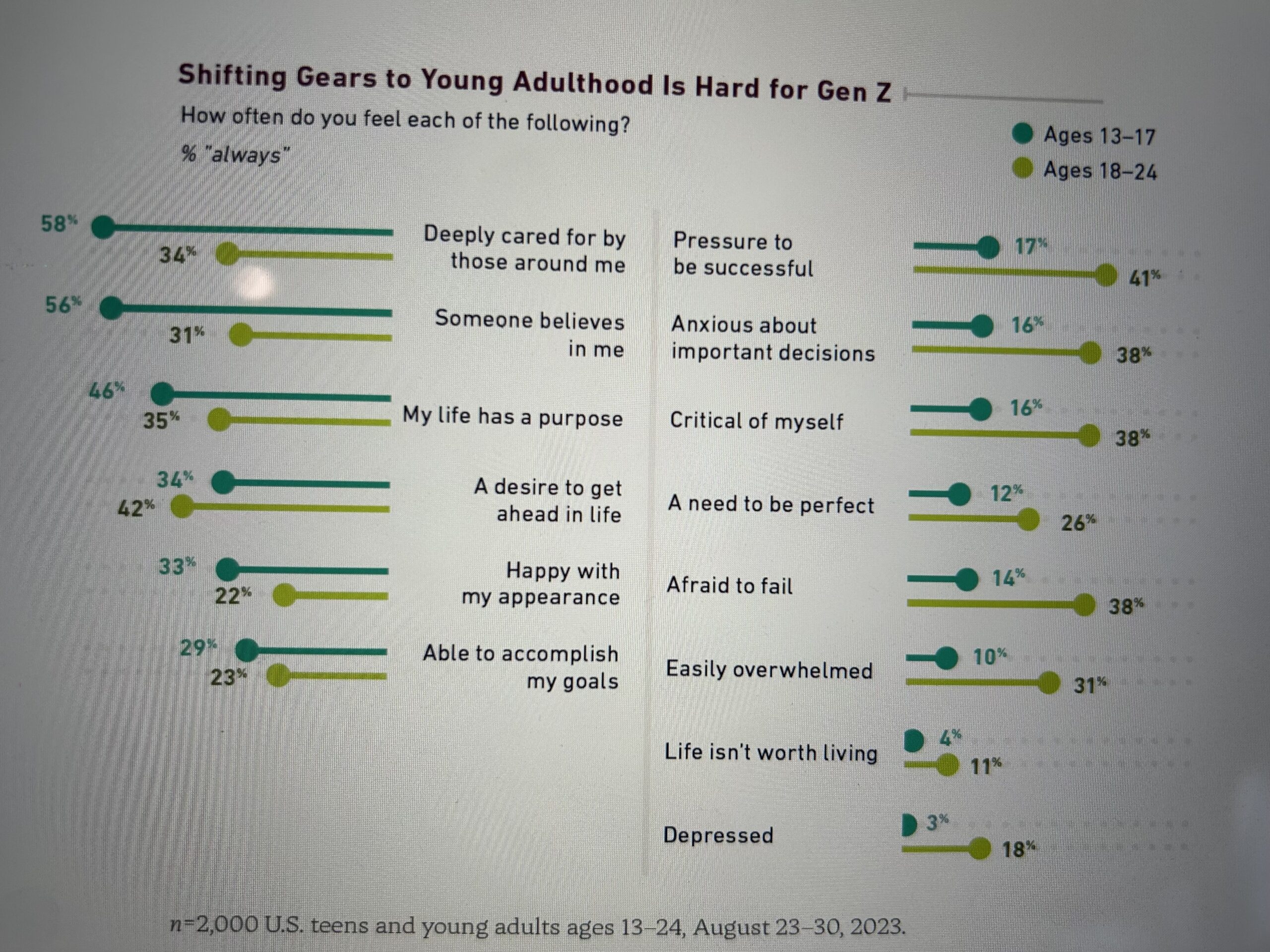
Graph showing shift between adulthood and teen years is hard for Gen Z. (Screenshot)

The data Kinnaman discussed breaks survey participants into two groups, those 13 to 17 years old and those 18 to 24 years old.

Looking at the transition from teen to young adult shows an opportunity for churches to meet a need, Kinnaman noted. There is a significant gap between what teens and young adults in Gen Z reported in terms of how deeply cared for they felt—58 percent of those aged 13 to 17 compared with 34 percent of those aged 18 to 24 reported always feeling deeply cared for by those around them.

Likewise, 56 percent of teens reported always feeling “someone believes in me,” compared with only 31 percent of young adults.

Additionally, young adults were more likely than teens to report negative feelings—reporting always feeling: pressure to be successful (41 percent to 17 percent); anxiety about important decisions (38 percent to 16 percent); self-critical (38 percent to 16 percent); and afraid to fail (38 percent to 14 percent).

In light of the continuing trend to delay marriage and having children—which might help offset some of the reported negative feelings—these gaps offer churches a considerable opportunity to support Gen Z in transitioning to adulthood, Kinnaman suggested.

While the gaps may partly reflect young adults are simply perceiving these “heartbreaking indicators of mental health and challenges” more when they leave childhood, they still need a strong support system, which churches can provide, Kinnaman noted.

Not all bad news

Kinnaman highlighted one positive post-pandemic development. Gen Z has a better understanding of mental health and broader vocabulary and willingness to talk about it. But the data around the mental health issues they face still shows Gen Z is struggling.

Four percent of teens and 11 percent of young adults reported always feeling like life isn’t worth living. Suicide isn’t new, Kinnaman pointed out, but what is new is the access (to Google) and “the alienation from the community of faith and those that can love us.”

What’s new is the increased skepticism toward authority—“the digital Babylon markers,” he continued.

“In digital Babylon, where it’s like: ‘Man, I’m feeling really lonely,’ and you’re going to pull up your phone. And you’re going to go: ‘What do I do?’—search bar—to deal with the loneliness that I’m feeling.”

These are real people dealing with real existential crises reflected in the numbers—young people who would benefit from Christians coming alongside them as they sort through the complex transitions they’re thinking about and experiencing.

That reality presents a “fields-are-white-unto-the-harvest” level of opportunity for Christians who work with Gen Z students and young adults, Kinnaman declared.

Barna and Impact 360’s reports contain many more findings about Gen Z, with suggestions for how the openness of this generation can be a catalyst in reaching them for Jesus. The researchers expressed optimism about the generation, noting quite a few characteristics of Gen Z they considered to be quite positive.


Disability and Church: Building a culture of belonging

WACO—Commit to “one next move” toward building a culture of belonging for individuals impacted by disability, program director of the Baylor Collaborative on Faith and Disability Jason Le Shana challenged attendees of a faith and disability workshop at Baylor University, Sept. 17.

Le Shana pointed out society often neglects people with disabilities and “doesn’t reflect God’s heart” for individuals impacted by disability. But “we believe that the church is called to be the body of Christ in the world,” he said.

Because “when certain parts of the body are neglected, that’s not good for the body in general,” it’s important for church members to think about what gets in the way of movement—in this area of people with disabilities being invited fully into the life of the church.

Churches need to consider what it might look like for disabled people “to be embedded at that DNA, normalized cultural level of church life,” Le Shana suggested.

He defined church culture as an often unspoken or unstated pattern of shared basic assumptions that exist within the group and imperceptibly govern the way members of the group behave. Changing church culture is difficult, Le Shana conceded, but committing to one next move is a good place to start.

Joni & Friends

Daniel Moreno, ministry relations manager for Joni & Friends Texas, discusses five stages of belonging and cultural change. (Photo / Calli Keener)

Daniel Moreno, ministry relations manager for Joni & Friends Texas, explained the organization advocates for the disabled community within the walls of the church because they believe disabled ministry isn’t just an option, but a command, found in Luke 14:21-23.

Joni & Friends has a vision of a world where every person with a disability finds hope, dignity, and their place in the body of Christ. In his role, Moreno works with churches in Texas, empowering them to evangelize, disciple and serve people living with disability—which Moreno suggested comprise “the largest unreached people group in the U.S.”

Moreno said social and physical boundaries exist to including disabled people in church, but these barriers are not new.

For an example of the longstanding nature of disability disenfranchisement, Moreno turned to the story of Bartimaeus in Mark 10:46-52. The followers of Jesus’ rebuke of Bartimaeus, a blind man, highlights an uncomfortable truth—“the people of God often are the biggest barrier to people impacted by disability to enter the doors of the church,” Moreno said.

But, Jesus told his followers to call Bartimaeus to him. When he was healed, Bartimaeus chose to follow Jesus—whose Messiahship he recognized—“with the very people that rebuked him.”

Moreno encouraged churches to think about where the church and its individual ministries fall within five stages of cultural change, when it comes to meeting the needs of the disabled community: unawareness, evaluation, care, friendship and contribution.

The first stage, unawareness of what disabled people and their families experience and need, is addressed by seeking information and becoming knowledgeable about disability ministry considerations.

When a church has become aware of a need to change in order to meet the needs of its disabled members, it’s at the evaluation stage and needs training in how to make the right changes for their church.

From evaluation, the church moves to the care stage, when time together—abled and disabled—is beginning to happen.

Then the church moves into the friendship stage, where individuals with disabilities are beginning to be seen as part of the fabric of the church and are missed when they aren’t there.

Finally, the church reaches the fifth stage of cultural change—contribution—where individuals impacted by disability are given the opportunity to participate in the body, serving as equal, valued members.

When people come to church, they expect to be discipled. Church is about making disciples. Moreno insisted families impacted by disability have the same right to expect church to aid in “fostering a gospel-centered heart” in them and/or their children, regardless of abilities.

People impacted by disability aren’t excluded from the Great Commission, he explained, neither in being recipients of the message, nor in participating in its fulfillment. The gospel and the Great Commission are for everyone.

How is it, then, that the church continues to exclude people with disabilities, Le Shana asked—because: “Change is hard.”

However, “it’s not all bad news,” Le Shana said, there is scholarship on how to do this. He challenged attendees to consider committing to “one next move” they could make in their churches to help build a culture of belonging.

It starts with one

Jason Le Shana, program director of the Baylor Collaborative on Faith and Disability, discusses the power of ‘one next move’ to create change. (Photo / Calli Keener)

Citing the book, It Starts with One, by J. Stewart Black and Hal Gregerson, Le Shana asserted the main reason change is so hard is “as humans, we tend to pursue feelings of competence and success.”

Humans don’t like to feel like failures. Change requires a willingness to live in and with incompetence until the new way of doing things is mastered, according to the book. And people are not naturally going to want to do that, Le Shana said.

Churches tend to measure success in terms of the three “Bs”—budgets, buildings and bodies. If things seem to be going well in those areas, churches can fall into a trap—thinking they’ve figured out how to do the right thing and do it well.

Then they discover there’s something wrong with the right thing.

Le Shana gave examples of a church that’s been known for its loud, spirited worship music learning the worship is painful to families in the church dealing with sensory processing challenges or a church good at quiet, contemplative liturgical-style worship struggling to welcome a visiting person prone to verbalizations and movements.

In each case, the church must decide whether to keep doing the thing well that they’ve been doing—which has become the “wrong” thing because it’s a barrier to participation—or move forward toward a new “right thing,” which at least at first, they can expect to do poorly, Le Shana continued.

To move forward “requires us to face our own collective incompetence,” so change is hard. But, organizational change literature points to a key in fostering change: the power of simple movements. Not grand strategies, but simple movements, or behaviors, is where change starts, Le Shana said.

“Don’t underestimate the power of simple actions undertaken faithfully over time” to effect change in church culture. And, he challenged, consider what movement “God might be calling you to.”


Faith leaders key to providing access to mental health care

(RNS)—When it comes to mental health, “too blessed to be stressed” isn’t an altogether helpful catchphrase, according to the American Psychiatric Association.

“You can be blessed, and you can be stressed. That’s OK,” said Amy Porfiri, managing director of the American Psychiatric Association Foundation. “We want to hopefully avoid that type of messaging, that it’s a moral failing, that mental health is a spiritual failing.”

For over a decade, the American Psychiatric Association has worked to reduce the stigma around mental health in religious contexts. But while awareness around mental wellness is at an “all-time high,” according to Rawle Andrews, executive director of the APA Foundation, “we still have a lag when it comes to actually accessing care, or giving ourselves permission to access care,” he said.

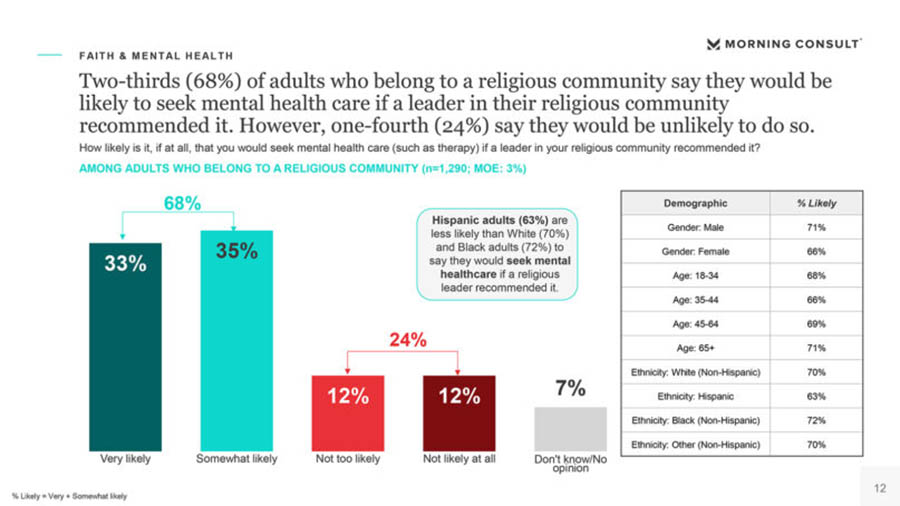
That “lag” is reflected in a new American Psychiatric Association poll released Sept. 16, which suggests there could be a disconnect between faith communities and the people they serve when it comes to mental health.

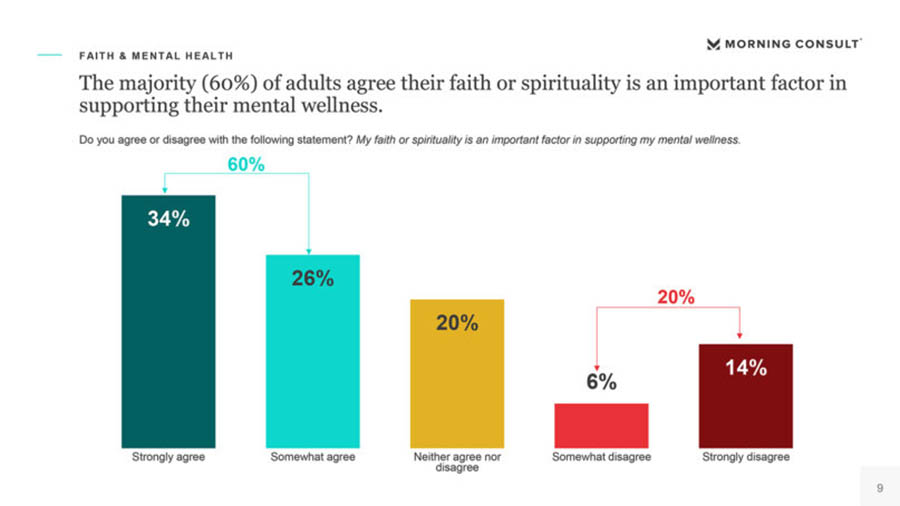
A survey of over 2,000 participants conducted by Morning Consult on behalf of the American Psychiatric Association found while 60 percent of U.S. adults say their faith or spirituality is an important factor in supporting their mental wellness, only 52 percent of those who belong to a religious community agree that their faith community “discusses mental health openly and without stigma.”

When it comes to addressing that gap, findings indicate faith leaders are key. Of survey participants who belong to a religious community, 57 percent said they’d be likely to reach out to a faith leader if they were struggling with their mental health, and 68 percent said they’d be likely to seek mental health care if a religious leader in their community recommended it.

“Our faith leaders have almost become a … first responder when it comes to getting people connected to care,” said Andrews.

Porfiri noted that, anecdotally, parishioners experiencing mental health struggles are often more comfortable turning to a faith leader than making an appointment with a therapist.

How and when to make referrals

But faith leaders don’t always receive training on mental health.

“What we learned is that our faith leaders oftentimes feel very ill-equipped,” she said.

Enter the second edition of the American Psychiatric Association Foundation’s Mental Health: A Guide for Faith Leaders. First published in 2015, the guide includes what Porfiri called a “mental health 101” section and recommendations for how and when faith leaders should make a referral to a mental health professional.

For instance, the guide teaches faith leaders to consider making referrals for congregants experiencing family dysfunction or prolonged grief or whose emotional and behavioral problems don’t meaningfully improve after six to eight sessions.

When making referrals, the guide suggests having a list of qualified professionals on hand and differentiating between clinical care and spiritual support. The guide also lists steps for responding when someone resists clinical treatment.

“I don’t think anything we do with a faith guide is going to make a clinician out of a faith leader, but it certainly will make them turn what we like to say difficult conversations into comfortable or courageous conversations around faith and mental health,” Andrews said.

Compassion fatigue and burnout

In light of more recent concerns about clergy burnout, the updated guide makes clear that faith leaders aren’t solely responsible for congregants’ mental health. A new section includes different models for how faith communities can link congregants with clinical services, from embedded or affiliated mental health clinics to simply having a current set of mental health resources on hand.

The guide also includes suggestions for dealing with clergy compassion fatigue and burnout, including keeping tabs on symptoms, from emotional numbness to increased irritability and chronic fatigue, and taking steps to delegate tasks, schedule sabbaticals and build supportive relationships with people outside of work.

“We have to start seeing our faith leaders as human beings as well,” said Andrews. “They can’t just be 24/7, 365. That has to be part of the message.”


Views about Latino voters’ faith often distorted

WASHINGTON (RNS)—There are more Latino voters in the United States than ever. As reporters and pundits seek to understand this important voting bloc, they’re digging into the faith of Hispanic communities.

But as this election cycle brings yet another flurry of trend pieces about Latino evangelicals, some narratives distort the big picture of Latino faith. Others are just myths.

Consider the facts about Latino voters and their faith:

The share of U.S. Latino adults who are evangelical has been relatively steady in the last decade.

Many trend pieces about Latino voters claim that there has been a significant spike in the Latino evangelical population. However, that narrative doesn’t bear out in the polling.

In 2022, Pew Research Center found 15 percent of U.S. Latino adults were evangelical, the same percentage that was evangelical in 2012. In the years in between, that statistic has dropped to 14 percent or been as high as 19 percent.

The Public Religion Research Institute found in 2013 Hispanic Protestants, a category that also includes nonevangelicals such as mainline Christians, made up 3 percent of Americans. In 2023, those numbers grew to 4 percent.

The small growth PRRI has tracked comes as the overall number of U.S. Latinos is growing, as is the share of the U.S. population they represent. In 2022, Latinos made up nearly 1 in 5 Americans, up from 16 percent in 2010.

This growth does not translate to a significantly expanding Latino evangelical population, yet this misunderstanding persists.

A segment on MSNBC’s “Morning Joe” on Sept. 5 broadcast that narrative, with journalist Paola Ramos saying, “You even have some scholars like Mark Mulder from Calvin University that predict that by 2030, over 50 percent of Latinos will identify as evangelical.”

In an email, Mulder told RNS Ramos had misquoted a prediction he and others made in a 2017 book that included all Latino Protestants, a larger category.

Asked whether he stood by that prediction in 2024, Mulder pointed out the book had been written in 2015, almost a decade ago.

“Right now, no, that does not seem plausible,” he wrote.

A December 2023 poll by PRRI also found Hispanic Protestants’ net gain in membership is relatively small. Only 1.4 percent of the U.S. population has become Hispanic Protestant after growing up with a different childhood religion, but 0.9 percent of those raised Hispanic Protestants have left the faith.

In polling released in August, PRRI found younger Latino adults in both the 18-to-29 and 30-to-49 age cohorts were more likely to be Protestant than older generations, a trend that has held over the last decade.

But while evangelical Protestants have almost always outnumbered nonevangelical Protestants by more than 2-to-1 overall, that gap has been smaller in the 18-to-29 age cohort over the years, with relatively higher representation of nonevangelical Protestants. PRRI pollsters caution that it can be difficult to draw certain conclusions when sample sizes are small.

Eli Valentín, an ordained Pentecostal and founder of the think tank Institute for Latino Politics and Policy, said although Latino evangelical political engagement is currently peaking, this group’s involvement in the religious right began during George W. Bush’s presidency.

While many Latino evangelical traditions began after white evangelical proselytization, the groups had more distance between them in political engagement and worship traditions until recently, said Valentín, a Democratic strategist. Still, Latino evangelical Protestants remain politically diverse.

In 2022, Pew found half of Latino evangelicals identify as Republicans or lean that way, and 44 percent identify as Democrats or lean that way, making the group more conservative than Catholic or religiously unaffiliated Latinos.

A poll from The 19th and SurveyMonkey conducted Aug. 26 to Sept. 4 and released Sept. 10 found 63 percent of Hispanic Protestants would vote for Donald Trump if the election were held today, and 29 percent would vote for Kamala Harris.

More Hispanic Protestants than the national average (36 percent) said inflation and the cost of living was the issue that mattered most to them, with 44 percent identifying that as a priority. And while only 6 percent identified abortion as their top issue, 57 percent of Hispanic Protestants said abortion should be illegal in most or all cases.

Religiously unaffiliated Latinos are seeing the largest growth of any faith category among Latinos.

In 2022, 30 percent of U.S. Latino adults were religiously unaffiliated, up from 10 percent in 2010, according to Pew polling. But the trend pieces haven’t followed. Almost half (49 percent) of U.S. Latinos ages 18 to 29 are religiously unaffiliated, while older generations tend to affiliate with religion.

This group leans significantly Democratic, with 66 percent identifying with the party or leaning that way and 24 percent identifying with Republicans.

In The 19th’s Sept. 10 poll, 59 percent of Hispanics who said their religion was “nothing in particular” indicated they would support Harris if the election were held today, and 28 percent said they would support Trump. Three percent indicated support for a third candidate, and 10 percent were undecided.

Atheist and agnostic Hispanics, who make up only about 5 percent of Hispanics polled, more heavily favored Harris, with 68 percent support. Less than a quarter (22 percent) said they would support Trump, and 4 percent said they would support a third candidate, with 5 percent remaining undecided.

Both groups have high support for abortion rights, even as fewer than 1 in 10 in each group cited it as their top issue. Eighty-seven percent of Hispanics whose religion is “nothing in particular” think abortion should be legal in most or all cases, and 94 percent of Hispanic atheists or agnostics say the same.

Like other groups, a plurality of Hispanics whose religion is “nothing in particular” say inflation and the cost of living is the top issue (39 percent), and 32 percent of Hispanic atheists and agnostics agree.

Catholics are still the largest religious group among Latinos.

Even as Catholicism experiences a strong trend of disaffiliation, 43 percent of U.S. Latino adults are Catholic, according to Pew data from 2022.

More U.S. Latinos leave the Catholic ChurchPRRI found in 2023 that 11.6 percent of the general U.S. population are Hispanic Catholics. In the general U.S. population, 3.7 percent are former Hispanic Catholics and 0.4 percent are Hispanic Catholic converts.

While white Catholics are more likely to be Republican, Latino Catholics are more likely to be Democratic. In 2020, Latino Catholics backed Joe Biden over Trump by a 35-point margin.

In a 2023 Pew poll, 60 percent of Latino Catholics said they were Democrats or leaned Democratic, while 35 percent said they were Republicans or leaned Republican.

In the 19th’s Sept. 10 poll, a third of Hispanic Catholics (33 percent) said they would vote for Trump if the election were held today, while about half (52 percent) indicated they would support Harris. About 1 in 10 (11 percent) are undecided, and another 2 percent plan to vote for a third candidate.

Like other groups, 40 percent of Hispanic Catholics said inflation and the cost of living is the most important issue.

While only 1 in 20 (5 percent) cited abortion as their top issue, 70 percent of Hispanic Catholics said it should be legal in all or most cases, despite U.S. Catholic bishops’ teaching that the “threat of abortion” should be Catholic voters’ “preeminent priority.” About a quarter (28 percent) said it should be illegal in most or all cases.

A birds-eye view of the data shows the Latino evangelical population is not significantly growing. Instead, religious disaffiliation is chipping away at the Catholic base. The impacts of these trends on this year’s election remain to be seen.

“When it comes to Latino voters, the faith component, the religious component is still underexplored,” Valentín said.


Successful leaders accept help, says Joni Eareckson Tada

CHICAGO (RNS)—Good leaders often are told to play to their strengths and hide their weaknesses. That really never has worked for disability activist and nonprofit leader Joni Eareckson Tada.

Paralyzed from the neck down, she can’t disguise what many people perceive as a weakness. And, ultimately, that has been pivotal to her success, said Tada, 74.

She wasn’t tempted to pretend she could do it all herself and she has always been well aware she needs help.

So, when Tada, an author and artist known mostly as just “Joni,” took the stage at this summer’s annual Global Leadership Summit held at Willow Creek, a Chicago-area megachurch, she told the pastors and other leaders gathered that if they want to succeed they are going to have to admit their imperfections.

“The most effective leaders do not rise to power in spite of their weakness,” she said. “They lead with power because of their weakness.”

That lesson is a day-to-day reality for Joni, who was paralyzed at age 17 more than 50 years ago. As a result, she relies on others for the most mundane of tasks.

With that help, she became a best-selling author, a popular speaker, an artist who paints by holding the brush in her mouth, and leader of Joni and Friends, a nonprofit with a nearly $40 million-a-year budget that assists families living with disabilities.

She spoke with RNS in late August about her speech to the Global Leadership Summit, her latest book, and what she has learned in four decades as a nonprofit leader. This interview has been edited for length and clarity.

The speakers at the Global Leadership Summit are often folks who have had unprecedented success and tell stories focused on winning. But that’s not exactly your message, is it?

My speech was mainly about how God delights in recruiting people who don’t naturally shine with their giftedness. He delights in using their weakness to get things done.

The whole point was to talk about how God loves to leverage weakness and minimize power. That’s not the way the kingdoms of this world work, but it is the way of what many call the upside-down kingdom of the Bible. You have to be poor in order to be rich. You have to be weak in order to be strong. You have to be humble in order to be exalted. Those kinds of things.

Those things are not necessarily considered leadership skills or leadership tactics.

Most gifted leaders tend to rely on their own strengths without relying on the strengths of others—and especially the strength of God. I think leadership is a spiritual gift. So, if leadership is a gift from God, then he is the source of the strength, the ingenuity, the passion and the vision that leaders have.

You are a successful writer and speaker and have an ability to connect with people. You lead a thriving nonprofit. And yet, you also have to rely on others for the simplest of things. What have you learned from that?

I have to rely on people just to help me with the most menial tasks—bathing, dressing, getting me up in my wheelchair. There are countless times when I must rely on others, and that teaches you to be grateful and to admit I can’t do this by myself. I’ve got to ask for help. And when help is provided, I’d better be grateful.

A lot of those things have translated into the way I lead. I surround myself with capable leaders, people who are more gifted than I am—people whose ideas I welcome. Just because I’m the CEO does not mean that I hog the spotlight. It’s always a team effort.

That’s why it’s called Joni and Friends.

Joni and Friends has been around for 45 years. Have you seen things change in how churches deal with disabilities during that time? 

I think churches, for the most part, have been woefully behind our society in many respects. I helped draft the original Americans with Disabilities Act, and we have gotten rid of discriminatory policies that prevented qualified people with disabilities from getting jobs, and barriers have been removed. But the church is exempt from a lot of that, and so the church lagged behind for many years.

My campaign for the last 45 years has been to help the church see that God thinks people with disabilities should be treated with special honor, and they should be embraced and welcomed.

The church is stepping up to speed now. We are excited to see so many congregations across the country developing effective outreaches to those with disabilities, putting people with disabilities in places of leadership, and accommodating more people.

I wanted to pivot for a second and ask you about your book about Brother Lawrence, the monk who wrote about finding God’s presence while doing mundane tasks like working in the kitchen. Why revisit that book now?

Well, I read that book back in the ’60s, when it was very popular, and everybody seemed to be reading it. Then when COVID occurred in 2020, and we were all sequestered and reading everything we had on our bookshelves, I pulled it down, reread it, looked at it, and thought, “Oh, my goodness, this is the way I live.”
I practice the presence of Jesus every single day. Except I’m not working among pots and pans in a kitchen. I’m working with wheelchairs and battery chargers and leg bags and bedpans and things like that.

It was an interesting journey looking through it and thinking, “Wow, I can write something a little more current,” but yet, at the same time, introduce a whole new generation to Brother Lawrence, in hopes that they will pick his work off the library shelf as well.

RNS does a lot of reporting on the changing religious landscape and the way that the loss of influence has made religious people very tense and worried. What do you say to people who worry about losing cultural power?

Culture is not changed just because you vote somebody into office. It begins with your own life, the way you relate at the grocery store, the way you relate to your neighborhood. If everybody who is worried about losing influence would just start influencing for good the people in their neighborhood—the elderly person down the street, the mom with a special-needs child—we can make a difference. That’s where culture happens.

When we care for people in our neighborhoods, in the grocery store and in the marketplace, we invite other people to care, and we invite other people to experience what community should be like. Culture changes on a local level, (with) prayer and a good solid witness. In other words: “Here’s my life. What can I do to make your life happy and more meaningful? How can I serve you today? What can I do to assist you?”

I mean, we’re all starved for that kind of person in our lives. Each of us can be that person in our communities, and I think that’s where the influence starts.


Gen Z fearful, but Scripture reduces anxiety, study shows

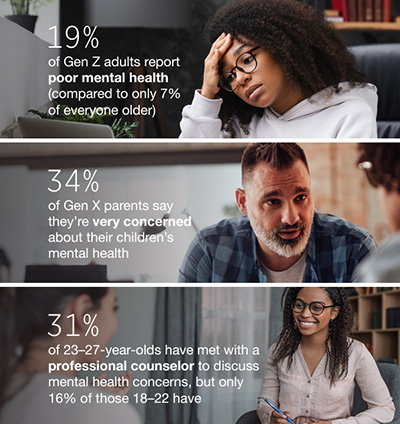
PHILADELPHIA (BP)—Generation Z, the first to grow up with smartphones and tablets, is the most fearful and anxious of any age, the American Bible Society said in its latest release from the 2024 State of the Bible.

But regular Bible engagement, a practice that attracts only 11 percent of Gen Z, reduces anxiety by half and can improve other markers of emotional health, study authors said.

“Our youngest adults (ages 18-27) have more fears, greater anxiety, lower self-esteem and less affirmation from peers than any older generation. This news sounds an alarm for all Christians to do what they can to help,” said John Plake, American Bible Society chief innovation officer and State of the Bible editor in chief.

“The good news is that our data shows the Bible makes a major difference. For instance, Gen Z reports far more clinical anxiety symptoms than any older group. But young adults who engage with the Bible—reading it regularly and applying it to their lives—experience half the anxiety of their peers.”

Impact of Bible engagement

Scripture-engaged Gen Z can score just as well as any other group on several measures of emotional health, but the group ranks lowest in Scripture engagement among all generations. As such, all findings regarding Bible engaged Gen Z members are from a comparatively small cohort, study authors said.

Extreme fears of grief and loss, family stress or trauma, and financial stress or hardship are chief among their concerns, cited among nearly a third of Gen Z respondents, followed by moderate levels of fears of those matters among 45 percent of Gen Z, study authors said.

2024 State of the Bible / American Bible Society

Researchers gauged anxiety on a scale of 0 to 20, based on responses to five questions about clinical symptoms of anxiety. Overall, Gen Z fell at 6.6 on the anxiety scale, followed by Millennials at 6.1, Gen X at 5, and Boomers+ at 3.3.

Differences were found when Gen Z was separated into older and younger groups and by gender, but study authors were careful to draw conclusions, based on the small size of the study subset. Still, older female Gen Z members, ages 23 to 27, scored 7.9 on the anxiety scale, compared to young Gen Z females, who scored 6.6.

“The Bible says, ‘God cares for you, so turn all your worries over to him’ (1 Peter 5:7); ‘Don’t worry about anything, but pray about everything’ (Philippians 4:6); and ‘Don’t worry about tomorrow’ (Matthew 6:34). From these and another dozen references, we see the Bible promoting trust and prayer as powerful responses to anxiety,” study authors wrote.

“So, do people who engage with Scripture report less anxiety? Yes, and the difference is stunning.”

Bible-engaged Gen Z members, on the whole, ranked 3.4 on the anxiety scale, about the same as Bible-engaged Boomers+, 3.1. But Bible-disengaged Gen Z members registered anxiety levels of 7.1.

Gen Z is the least likely to turn to the faith community and medical professionals for help navigating mental health issues, researchers found. Instead, Gen Z is more apt to turn to a trusted family member or social media for help, although only 15 percent of Gen Z would turn to social media platforms for help.

Regarding fears, financial stress or hardship strikes extreme fear in 31 percent of Gen Z, compared to 21 percent of Gen X, 20 percent of Millennials and 12 percent of Boomers.

Grief and loss? Thirty-one percent of Gen Z are extremely fearful, outpacing 21 percent of Millennials, 19 percent of Gen X and 14 percent of Boomers. Extreme fear of family stress or trauma befalls 29 percent of Gen Z, 20 percent of Millennials, 19 percent of Gen X and 10 percent of Boomers.

Other concerns cited, all falling below 20 percent for all generations, were fears of physical and sexual assault, verbal attacks or bullying; racism, bigotry or discrimination; or fear of hostility from people one has offended. People are fearful of war and civil unrest, mass shootings and the effects of global warming.

Among other findings:

  • 52 percent of Americans have personally experienced or witnessed trauma, and a fifth are affected by it most or all of the time.
  • 23 percent of Gen Z say trauma overwhelmingly impacts their lives.
  • Millennials, at 27 percent, are the most likely to have met with a mental health counselor in the past year; followed by Gen Z at 24 percent, Gen X at 23 percent, and Boomers+ at 12 percent.

State of the Bible is based on a nationally representative survey conducted for the American Bible Society by NORC (previously the National Opinion Research Center) at the University of Chicago, using the AmeriSpeak panel. Findings are based on 2,506 online interviews conducted in January 2024 with adults in all 50 states and the District of Columbia.


Gen Z women overtake men in disaffiliation

An April report from the Survey Center on American Life claims young women have overtaken men in disaffiliation from their formative religions.

The report’s authors, Daniel A. Cox and Kelsey Eyre Hammond noted: “Over the last two decades, which witnessed an explosion of religious disaffiliation, it was men more than women who were abandoning their faith commitments.

“In fact, for as long as we’ve conducted polls on religion, men have consistently demonstrated lower levels of religious engagement. But something has changed.”

The study authors explained their recent survey reflected a reversal from this long-standing norm. Details on how the survey was conducted or what questions were asked were not included in the report, only noting the survey of 5,459 U.S. adults was conducted by the Survey Center on American Life in 2023.

Evidence of a flip

The authors said the survey they conducted showed 57 percent of people who disaffiliated among Baby Boomers were men and 43 percent were women—whereas 54 percent of Gen Z adults who left their formative religion are women, while 46 percent are men.

Additionally, research released jointly Sept. 10, by Barna and Gen Z-focused Impact 360, noted nearly half of Gen Z (49 percent) say they personally made a commitment to Jesus Christ that is still important in their life today. Two in five (38 percent) say they have not, and 14 percent are not sure.

However, the report stated when grouped by age (young adult and teen) and sex, “we see that young adult female Gen Z are the least likely to say yes (44 percent), compared with young adult male Gen Z (51 percent), and teens both male (52 percent) and female (50 percent).”

So, Gen Z females—whether young adult or teen—are less likely than Gen Z males to report a personal commitment to Jesus, according to the Barna/Impact 360 report, adding support to growing evidence that young women may be becoming less religious than young men.

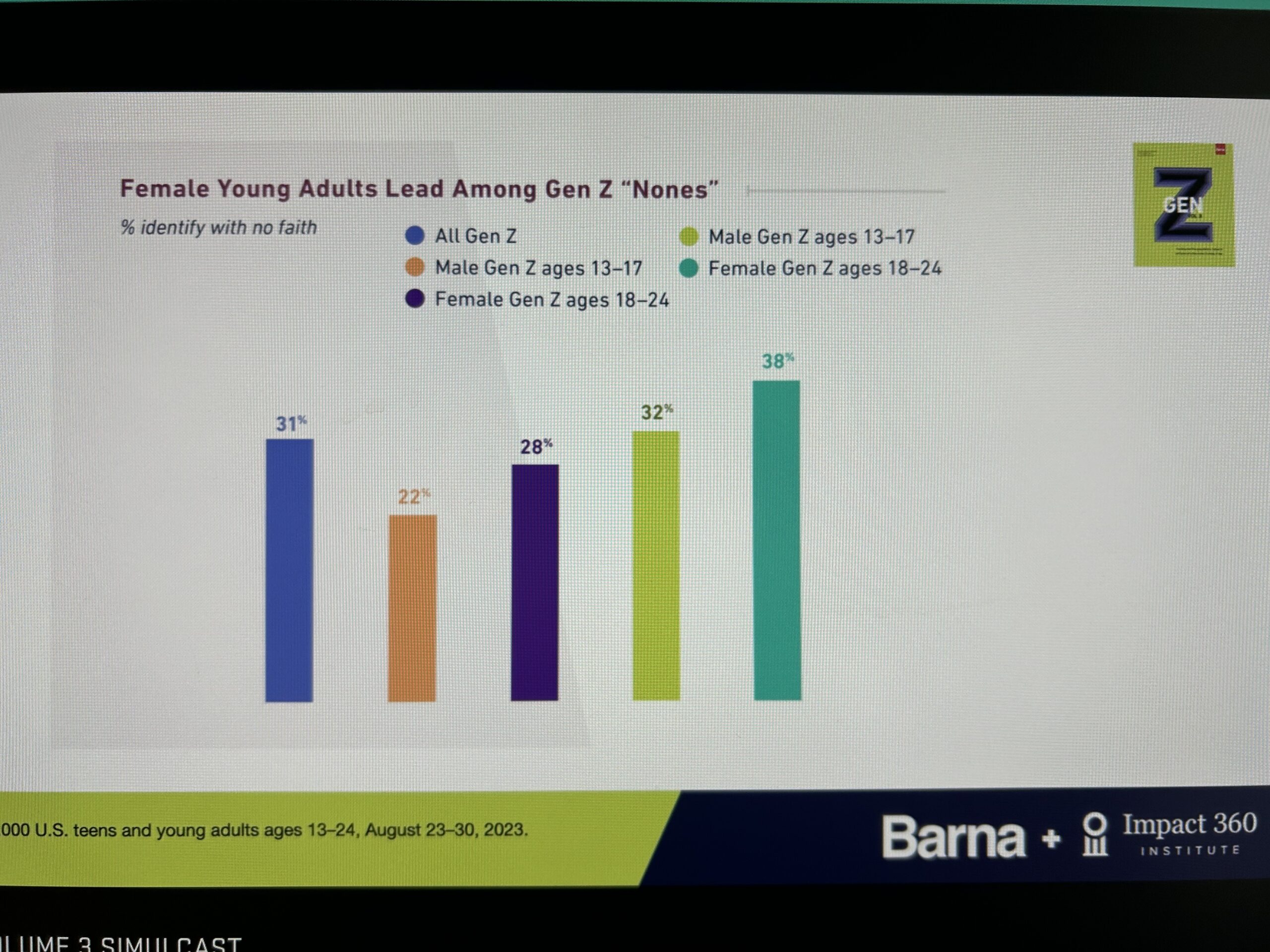
Barna/Impact 360 data shows Gen Z women have surpassed Gen Z men in disaffiliation. (Simulcast Screengrab)

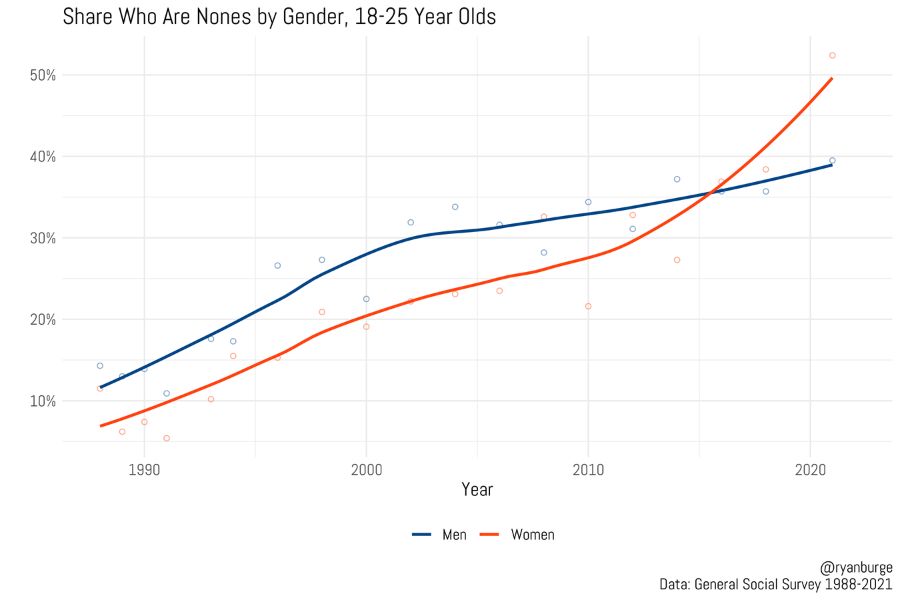
In a simulcast on Sept. 12, Barna CEO David Kinnaman highlighted data from the report confirming the shift explicity. Gen Z women are the most likely to identify as “nones”—38 percent of Gen Z women identify with no faith compared with 32 percent of Gen Z males.

Hammond and Cox stated their concern that while many conservative churches’ memberships have held steady despite the rise of the “nones,” or people who report no affiliation to any religion, those successes may not hold with the current generation of young women.

(Chart courtesy of Ryan Burge, used with permission.)

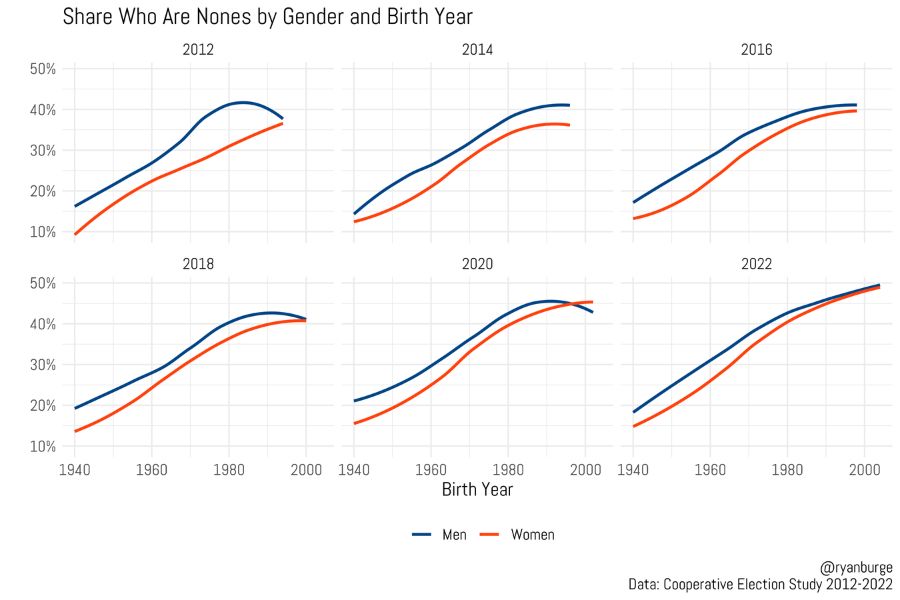
Ryan Burge, an American Baptist and a political scientist regarded as a premier statistician of religious life in the United States, also noted in June of 2023 that something was going on with women. When he analyzed data from the Cooperative Election Study, a pattern emerged suggesting young women were losing their religion in ways not previously seen.

In charting by birth year, for prior generations who reported religious identities of “atheist, agnostic or nothing in particular,” the lines ran parallel, with men slightly more likely than women to identify as nones.

(Chart courtesy of Ryan Burge, used with permission)

But, “among those born around 2000, the gap has essentially disappeared. Women are just as likely to be nones as men. This same general trend is evident in the last three election years of data. It’s hard to believe that it’s just noise when it’s so replicable,” Burge noted.

Contributing factors

Cox and Hammond suggested in their analysis of the Survey Center on American Life findings that “feminism, gender and a cultural mismatchare at the heart of the reversal.

“Sixty-one percent of Gen Z women identify as feminist, far greater than women from previous generations,” the report stated.

“Younger women are more concerned about the unequal treatment of women in American society and are more suspicious of institutions that uphold traditional social arrangements,” Cox and Hammond contended.

“Nearly two-thirds (65 percent) of young women said they do not believe that churches treat men and women equally,” the report continued, pointing to the Southern Baptist Convention’s strong stance against women serving in equal positions to men in the church.

The analysis also noted a “cultural misalignment between more traditional churches and places of worship and young women who have grown increasingly liberal since 2015.” Cox and Hammond cited the 2022 General Social Survey showing 54 percent of young women believe abortion should be available with no restrictions as evidence of this liberal shift.

Additionally, in March Gallup reported young women are more likely than men to hold LGBTQ+ identities.

Almost three in 10 Gen Z women, (28.5 percent) identify as LGBTQ+, compared with 10.6 percent of Gen Z men. Among millennials, 12.4 percent of women and 5.4 percent of men have an LGBTQ+ identification, the Gallup report stated.

A Public Religion Research Institute report in March found 47 percent of young people who left their childhood religion said “negative treatment of gay and lesbian people” was an important factor in their disaffiliation.

Texas considerations

Todd Still (Baylor Photo)

In Texas, Todd Still, dean of Baylor University’s Truett Theological Seminary, said a shift in young women becoming less religious is not something he’s seen verified at the seminary, yet. In fact, he said women already come close (60 percent male to 40 percent female at last count) and next year even may equal men in enrollment.

He acknowledged that “going where you’re wanted” may play a role in the rising number of women at Truett. Some of the women at Truett otherwise might have attended one of the SBC seminaries, but recent SBC stances related to women may have persuaded them to seek theological education at Truett where they know they will be treated more equally.

Despite strong female enrollment, Still said, if additional research does bear out the Survey Center on American Life’s claims that disaffiliation among young women has overtaken that of young men and Gen Z women are disaffiliating with the churches of their childhood, “this does signal, or should signal, concern for churches.

“Because as they [Hammond and Cox] rightly note, frequently, the involvement of women—at least historically—has been greater, the sacrifice has been greater, attendance, obviously, has been higher. If these are early results, it’s disconcerting.”

Jill Hudson (TXBWIM Photo)

Jill Hudson, executive director of Texas Baptist Women in Ministry, an organization that supports women serving in vocational ministry in Texas, also was unaware of reports women may have overtaken men in claiming no specific religious identity.

However, she said in her work with women in Texas, she has seen young women who previously held strong religious convictions reach a place of disaffiliation.

Hudson said when young women graduate from seminary and begin seeking employment in Texas Baptist churches, they often are met with disappointment.

Believing they’ve discerned God’s call to ministry accurately, done what they’ve needed to do to get hired [earn a Master of Divinity degree], and then being unable to find a church who will hire them can lead to a crisis of faith, Hudson explained.

She said it’s extremely discouraging to these women to apply for positions at churches that claim to support women in ministry, only to have it turn out the church, in reality, only meant children’s minister, not whatever the position was to which they applied.

These new graduates learn they have choices—leave Texas, switch denominations or take a ministerial role not in line with what they believe to be what God is calling and has equipped them to do—none of which are choices they want to make, she continued.

These young women are “deeply Baptist,” Hudson said, until the reality of what it’s like to be a woman seeking to serve in vocational ministry in Texas unmoors them. Sometimes, that means losing faith not only in the church and Baptist life, but in themselves and/or in God, because they cannot bridge the mismatch between their internal faith and the cultural reality.

Hudson said she is available to work with churches on matters related to women in ministry and on having difficult conversations that may help stem the outflow of Gen Z women from the faith.

Dedication to women in ministry reaffirmed

Still concluded: “At Truett Seminary, we work intentionally and tirelessly to equip God-called men and women for gospel ministry and to resource and connect our students and graduates, both women and men, with ministry opportunities that align with their callings.

“We are aware of and sympathetic toward any number of the unique challenges women in ministry face, and we strive to facilitate meaningful ministry placements for them in various and sundry ways, not least through our Office of Ministry Connections.

“Simultaneously, our seminary intentionally seeks to serve churches as they search for ministry candidates, including women.

“In fact, in any given year, our Ministry Connections team will consult with more than 400 churches and nonprofits in an effort to assist our students, alumni and friends to find meaningful places of service in and alongside Christ’s church.

“While we do not always succeed, our annual, effective placement rate of both our men and women graduates historically falls between 90 and 95 percent.”

Editors note: Paragraph 9 and the accompanying graph were added after the story initially was posted.


Political journalist insists: ‘It doesn’t have to be this way’

(WACO)—Two months before November elections, Tim Alberta challenged a packed house in the Armstrong Browning Library on the Baylor University campus in Waco to trust in God and stop failing the test.

Alberta is a staff writer for The Atlantic and New York Times bestselling author of American Carnage and The Kingdom, the Power, and the Glory.

“We are here to discuss the crisis in the American church,” Alberta began. But, he pointed out, “There is nothing new under the sun.”

So, the things the white evangelical church in America is dealing with right now really span all the way back to the 4th century with Constantinople and earlier.

Even though it may feel new now, Alberta said, God’s people have been dealing with the pitfalls contributing to the current crisis among evangelicals a long time—so long, it’s a story woven all through the Old and New Testaments.

While Alberta acknowledged it is not only evangelical white American Christians who are struggling, this is the tradition he is part of and knows best. So, when he speaks of the “American church,” white evangelicals are who he means, he explained.

A church in crisis

The American church has become, “in some ways, every bit a secularist’s fever dream—hateful, bullying, hypocritical—more consumed with winning the culture wars than with promoting peace on earth and goodwill toward men.”

“We have acted and spoken in ways that bleed the church of its credibility, while diminishing its capacity to evangelize a world that is unbelieving and desperately in need of Christ,” Alberta said.

“The stench of scandal and the lack of accountability that perpetuates it drags the precious name of Jesus through the mud.”

Alberta lamented the damage that has been done to churches “crumbling under the weight of political strife. The Lamb of God is being appropriated as a mascot for the elephants, and in some cases for the donkeys, too.”

He described pastors who have treated their pulpits as “cable news sets” to “weaponize the word of God to justify their lust for worldly idols, grafting the enduring power of the gospel onto their ephemeral obsession with winning elections,” subjugating their enemies, and imposing a version of Christianity focused on strength and status.

Alberta pointed out this religion they promote includes none of the “self-sacrificial love that turns enemies into friends, friends into brothers and brothers into co-heirs of the kingdom of God,” which is terrible news.

Alberta suggested that to consider this bad news, however, requires a turning to the good news.

The unexpected, “insane” truth that almighty God chose to be “humbled, even humiliated in ways that we cannot fathom,” giving up his majesty and glory to be dishonored on a cross, and that cross would someday become a profound symbol of victory, must be part of the conversation.

The Three ‘Ts’

Then, Alberta got to his main point—“The Three ‘Ts’ that we face inside the church today and has us in crisis—the temptation, the threat and the test.” He said he would “attempt to discuss the nature of following Jesus and why it is so difficult, where we go wrong and how we might do better.”

“All of us, myself included” face these obstacles, even Jesus’ closest followers.

Turning to Luke 4 and Jesus’ temptation, Alberta noted the synoptic Gospels introduce Jesus as an adult in this story, where he is offered the world by Satan.

Jesus responds to the temptation of worldly power with the words: “Get thee behind me, Satan. For it is written, thou shalt worship the Lord thy God and serve him only.”

But Simon, later named Peter, offers a foil to this response by Jesus, Alberta said. Peter was looking for a Messiah who would return the kingdom of Israel to a place of prominence. He hated the oppressive, occupying Roman forces and wanted them defeated.

“Simon … was obsessed with making Israel great again” and restoring worldly power, Alberta said.

Yet Jesus proclaims a new kingdom is here, the kingdom of God. Simon, in following Jesus, comes to understand—and answers Jesus when he is asked in Matthew—that Jesus is the Son of God, no doubt hoping, even expecting, to stand beside Christ and reign, Alberta continued.

But the problem is, Peter does not understand what the kingdom of heaven is all about, Alberta said. Because when Jesus began to explain that he will go to Jerusalem to be killed, “Peter pulls Jesus aside and begins to rebuke him,” and says never, never will this happen.

What does Jesus say in response, Alberta asked, but the same words he’d spoken at his temptation: “Get behind me Satan.”

Jesus addressed Peter in this way because “Peter is flirting with the same temptation”—the temptation to rule the world, to focus on the here and now, Alberta said.

“Peter was pursuing victory in this world, while Jesus was pursuing victory over this world,” Alberta stated.

The American church, Alberta suggested, struggles with this same temptation and perhaps even more so because it believes, as does Alberta, “that we are blessed … and when you believe that we are blessed … be careful, because those blessings, pretty quickly, pretty quietly can become indistinguishable from entitlements.”

The threat was real, Alberta said. The Jewish culture was under attack. All around them there seemed to be a coordinated assault on their faith and the traditional values of Israel. He said he could sympathize with their hope for a Messiah who would come to eliminate the threat.

They wanted a “political strongman” to come do whatever needed to be done to set everything right, Alberta continued. “Desperate times call for desperate measures. The ends justify the means, don’t they?”

The arc of Peter’s life shows his struggle with the temptation to pursue worldly power and eliminate the threat to his people, God’s people, Alberta said.

But with Jesus, the means matter very much, Alberta contended. Only by the spotless Lamb of God could the salvation of the world be attended to.

Jesus promised his followers not worldly success or power, but hardship and pain. The trials Peter faced, he often failed. But in his letters, Peter’s words are “almost unrecognizable.”

In 1 Peter, he tells his audience they are exiles, blessed despite threats. They can withstand the temptations and threats, because through Jesus they are now co-heirs to an otherworldly kingdom.

Good news/bad news

Alberta said Peter is presenting a good news/bad news scenario: “The good news is the kingdom and the power and the glory that belongs to God can be ours also. The bad news is it’s not free, and it’s not easy. It requires suffering. It requires fiery ordeals. We will be tested.”

“We think so much about the ends justifying the means,” Alberta said, but “we are being tested.”

The means matter—the Christian response to testing brings them closer to Jesus and demonstrates to those outside the faith the validity of Christianity. The early Christians’ faithfulness under trials facilitated Christianity’s growth, Alberta explained.

Alberta said the American church today is again being tested, tempted under threat to cling to power, “and we are failing.”

But it doesn’t need to be this way. Christians can fix their eyes on the eternal, seeing themselves as exiles here and citizens of another kingdom.

“Let God handle these big, thorny, scary problems,” he said. Instead, focus on how these challenges or threats actually are opportunities to draw closer to Jesus and share him with others.


Most hit worship songs are a team effort

(RNS)—In January 2023, Chris Brown and a group of fellow songwriters working on a live worship album for Elevation Church, a nondenominational megachurch in Charlotte, N.C., sat down for a writing session.

In the room with Brown were Pat Barrett, Chandler Moore, Brandon Lake and Cody Carnes, authors of such worship staples as “Good, Good Father,” “Build My Life” and “The Blessing,” which can be heard in churches of every size and stripe across the United States.

During the session, Brown pulled out a song that he, Lake and Elevation’s pastor, Steven Furtick, had been batting around for a year with little success. Tinkering with it that day in January, they decided the result, which combines soaring vocals over a galloping beat, was good enough for the album but, said Brown, “We really didn’t see it doing much.”

On stage at Elevation, moments before they debuted it, at a live recording session for the new album, they were still piecing together the song’s opening. But backed by a choir and gaining energy from the live audience, the song took off.

“We left that night going, ‘That was crazy, but we’re still going to put it at the end of the album,’” said Brown.

The song, “Praise,” has since become just the latest example of the power of a tight coterie of songwriters in Christian music, who have increasingly worked together to produce hits.

A live video of “Praise,” recorded that night and posted on YouTube in May 2023, has been viewed 103 million times, and the song, having topped the Billboard Hot Christian Music chart for 25 weeks, has been nominated for a song of the year Dove Award by the Gospel Music Association.

In recent years, songs from the so-called Big Four megachurches—Elevation; Bethel Community Church in Redding, Calif.; Hillsong, a megachurch headquartered in Australia; and Passion City Church in Atlanta—have dominated the Top 25 lists for Christian Copyright Licensing International and PraiseCharts, which track what songs are played in churches.

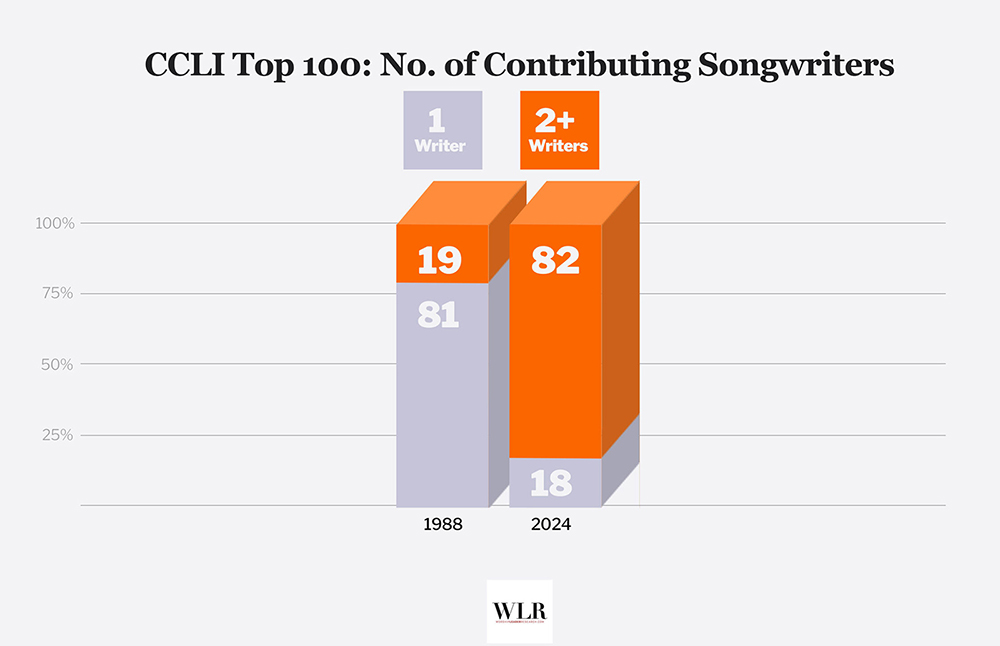
An academic song tracking effort, Worship Leader Research, wrote in a new report that 82 percent of the songs on the CCLI Top 100 in 2024 had at least two writers. When the CCLI Top 100 chart debuted in 1988, only 19 percent had more than one writer—and most of those were written by the legendary gospel music team of Bill and Gloria Gaither.

The “Praise” co-writers Brown, Barrett, Furtick, Carnes, Moore and Lake, like most of the collaborators on recent Top 25 hits, have ties to the Big Four.

“What started as a large pool of individuals contributing their voices to the contemporary worship soundscape eventually became a collection of interconnected enclaves,” according to the Worship Leader Research report.

Many songwriters largely unknown to worshippers

Many of the most successful worship songs have become more associated with the churches that produced them than the songwriters who wrote them.

Jason Ingram, lead singer of the Christian band One Sonic Society, has co-written the hits “Goodness of God” and “Great Are You Lord” to go with more than a dozen of the songs highlighted in the Worship Leader Research study, but he remains relatively unknown in the public eye.

Other successful Christian songwriters such as Ed Cash, co-writer of “Goodness of God” and “How Great Is Our God,” or Jonas Myrin, who co-wrote “Cornerstone” and “10,000 Reasons” and later went on to write for Barbra Streisand, also have relatively low profiles.

Since many churches don’t use hymnals or print music in bulletins—the lyrics tend to be projected on screens around their sanctuaries—congregations don’t always see the names of writers.

“I think the reason why Jason Ingram isn’t considered a household name in general is—especially if you’re a congregant and never even looking at a chord chart—you’ll never see his name, even though he’s around,” said Shannan Baker, a postdoctoral fellow at Baylor University and member of the Worship Leader Research team.

Marc Jolicoeur, a worship pastor from New Brunswick, Canada, and member of the research team, theorizes co-writing is more liable to transform a songwriter’s solo inspiration into something that feels accessible for congregations. He cited a writer’s saying that one should write with the door closed, but rewrite with the door open.

“There’s the idea that many hands won’t just make light work but will make work that might rise to the top,” he said, adding writers often show up to co-writing sessions with works in progress that just need a bit of help to work.

The presence of a well-known co-writer also may help a worship song get more notice, Baker said. She pointed to the ongoing popularity of “Great Are You Lord,” by David Leonard and Leslie Jordan, both of the band All Sons and Daughters, and Ingram.

“I think that song, in and of itself, is a perfect example of the power of a career songwriter, elevating a song,” she said. “All Sons and Daughters had a following, but the minute you add Jason Ingram into that mix, they have a hit.”

Brown, who helps produce Elevation’s worship songs, said he had great respect for past songwriters who wrote on their own, but he appreciates the chance to collaborate with friends and fellow writers. The church, he said, has helped create an environment where that can flourish.

Brown said that’s in large part because the church—and not an outside music label—controls the creative process. If a song or an album is not ready, the church isn’t under pressure to release it.

“We are our own label, so to speak,” he said. “It’s always been that creativity is king.”

Doing the songwriting at the church rather than in a Nashville writing room helps as well, he added. Brown said he doesn’t mean to knock Nashville, which is a hub of songwriting, but said the feel of the church’s writing room is more hospitable and more open to inspiration.

“We worked hard through the years to create an environment where the goal is to go away having enjoyed this day together, feel spent and hopefully inspired,” he said.

In co-writing, Brown said he often learns from others—how they create melodies or find the right cadence to the lyrics or just the right words to make a song better.

“If I partner with someone else creatively or with several other people, there’s a chance it can turn into something even greater—or go in a way that I never saw it going,” he said. “Not to over-spiritualize it, but I think it’s cool to acknowledge that we need each other.”

And in the process, something unexpected may appear.


Ohio State football players lead on-campus baptism service

More than 60 students were baptized during a special on-campus service at Ohio State University on Aug. 26.

A group of Buckeye players were among those who helped lead the event, which reportedly attracted a crowd of more than 800 people.

“Witnessed the ‘Invitation to Jesus’ in person last night led by several players from @OhioStateFB team,” said Jeremy Westbrook, executive director-treasurer of the State Convention of Baptists in Ohio, on the social media platform X.

“Over 60 students stood to profess Christ & follow in baptism!! Had the joy of passing out hundreds of Bibles to those who desired to read who Jesus really is!! Let’s go!!”

The Lantern student newspaper reported, “Four tub-sized buckets of water sat near a stage, on which football players stood to deliver testimonies. Over the next nearly two hours, the crowd grew to over 800 people.”

Ohio State football players who were among those leading the baptism service were TreVeyon Henderson, Emeka Egbuka and J.T. Tuimoloau, according to WSYX ABC 6.

A university spokesman told ABC 6 the service was “not an official football team event” and that Revive Student Organization reserved space for the event.

One parent posted on social media: “The most incredible night I have experienced in a longggg time! God is moving on The Ohio State campus! So many came and were touched by God! So many were baptized! Watching over 2000 students worshipping…an Unbelievable experience! Our boys are changing lives! #ProudMama.”


UTA scholar examines contemporary Black church

ARLINGTON (RNS)—Jason Shelton has made a deep scholarly dive into the world of the Black church.

But not everything in his new book, The Contemporary Black Church: The New Dynamics of African American Religion, was learned at the University of Texas at Arlington, where Shelton is a sociologist.

Shelton drew as well from his experience growing up in Black churches, in his familial home in Ohio and in Los Angeles—at United Methodist, Church of God in Christ, African Methodist Episcopal and nondenominational churches—and searching as an adult for the right spiritual space for his family.

“It was important to me to find a thriving Black Methodist congregation that I could raise my daughters in, and my wife and I had a difficult time,” he said in a recent interview.

“Here we are in (the Dallas-Fort Worth area), and it’s hard to find a young congregation that’s thriving, where I feel like my daughters can develop their own memories and find bonds with other kids, and we can be with other young families. And so that really made me realize there’s a story here to be told about religion in Black America.”

Shelton, 48, and a colleague developed what he calls “Black RelTrad,” a coding scheme that allowed him to delve into the beliefs and practices of a range of Black believers, including Protestants, Catholics and non-Christians.

Shelton, who also is the director of UTA’s Center for African American Studies, talked with RNS about religious differences in Black America, the effects of “disestablishment” on Black churches and whether those who identify as “spiritual but not religious” can be reclaimed by them.

The interview was edited for length and clarity.

You open your book recalling your connections with churches from different expressions of the Black church and leaders such as the Rev. James Lawson and Bishop Charles Blake. How did that experience shape you?

Those early years were definitely formative, in that they left me with impressions about various ways that African Americans express faith. When I got to Ohio, I was able to compare St. James (AME Church in Cleveland) to Holman United Methodist Church, and then compare them to the nondenominational church that my parents were attending in Cleveland, and then compare that to West Angeles (Church of God in Christ).

They all left these distinct impressions about variation and diversity. Decades later, I would look back and say, “O my gosh, modern-day researchers have clearly lumped Black folks together like we’re this monolithic group.” And I just knew in my own walk in life that was not the case.

For years, experts such as Eddie Glaude have asked if the Black church is dead. As you look at the numbers, do you agree or disagree?

I wouldn’t say that it is dead, but certain denominations are in a lot of trouble—that Black Methodist tradition I’ve called home is in a lot of trouble. I’d say the Baptists are also a tradition that has to look and see some trouble down the road.

On the flip side, I would say the Holiness Pentecostal tradition in Black America has always been small, but it’s held its ground over the decades. The Black Catholic tradition, always been small, but held its ground.

So is the Black church dead? It really depends on which traditions we’re talking about.

What do you see as the main difference between the mainline African American Protestants and the evangelical African American Protestants?

These are Black folks who are believers, and on a Sunday, how they think about, practice their faith, oftentimes are still very similar in orientation. That being said, (some) Black Methodists seem to be a lot more open on LGBT issues, whereas we know the AME (African Methodist Episcopal) tradition is very clear, uh-uh, that’s not a line clergy are ready to cross.

The four traditions in today’s world that comprise the heart of the contemporary Black church are the Baptists, the Methodists, the Holiness Pentecostals and the nondenoms. Of the four of those, the nondenoms are more likely to vote for a Republican presidential candidate. That’s a big break from what we’ve seen in the past.

You describe the “Third Disestablishment in Black America.” What does it mean for the Black church?

You’re seeing these young people, particularly millennials, moving away from organized religion in very strong numbers. The baby boomers held on. It started with my generation in the late 1990s, those Gen Xers. But now with the millennials, it’s moving and taking big jumps forward in terms of the number of African Americans who are not affiliating with organized religion.

You mention the changing levels of education of the Black clergyperson and the Black churchgoers. What’s happened there? What’s at stake?

The idea was that the Black preacher was the leader of the community for most of Black history. In light of all that racism and segregation, the pastor was typically the most educated person in the community because that person could stand up and read the Bible and interpret the Bible and speak to the masses in that congregation.

Fast-forward the clock: African Americans in church are oftentimes more educated than the senior pastor in the pulpit. In this modern, technological, mainstream American society, you can sit in church and question what the pastor’s saying in real time.

I argue that a consequence of the success of the Civil Rights Movement is that the church has become voluntary. There was the time that we were expected to be at church. Of course, it’s holding in particular families, don’t get me wrong. But overall, as more and more Black folks have made it to the middle class, and as more and more of us have more options on Sundays, it has undermined organized religion in Black America, and education is the driving force.

You say, though, that there are strong reasons to believe that some of the SBNR—spiritual but not religious—can be reclaimed.

A great number of these SBNRs still believe in God. A great number of these SBNRs still go to church, and some go to church more than once a month. Those are the folks that can be maybe more easily reclaimed, as compared to the person who has completely moved away from organized religion and just says, “Oh no, I don’t believe those beliefs about God,” or “I don’t believe those things about Christ.”

But there’s got to be some kind of reckoning and some kind of reconciliation to bring those folks back in.

You cited hopes of Christians you interviewed for changes that could help draw more young people back to church. Can you give an example? Are you aware of churches that are succeeding?

One of them was to remove status barriers within the church, the classic idea that a pastor wears the robe. Less formality was one of those things. Another one of those things, which a lot of people emphasized, was giving leadership opportunities to 30-somethings.

I can tell you, in my own personal life, part of the reason that we picked the church we did is that a lot of those things are happening. We don’t call our pastor “Reverend,” we call him Derek. There are a lot of young people in leadership. Grandmama is on the usher board too, but there are a lot of younger people that are engaged and a part of it as well. Those are the kinds of things that, particularly, folks have found welcoming.

What worries you most about the state of the contemporary Black church?

Who speaks for the poor? The Black church has spoken for the poor. As the church declines, we’re not only losing the most important institutional anchor we’ve had, we’re also losing an important political and social institution that helped to try to force America to say: “Here’s the counterpoint to everything is fine and great. No. Look over here. There’s more work to be done.”

Regardless of what people’s faith is, and how they affiliate, and what they may say or may not say about a particular faith, for a great number of us, there’s still a sense that there are problems that need to be addressed for us as African Americans. There’s a commonality that connects us as African Americans, at least for our generation.

Who knows what it is in the future? But that is something, I think, to be optimistic about.