Singer focuses on the reason for the season

NASHVILLE, Tenn.—In the midst of the hustle and bustle of the busy weeks leading up to Christmas, singer/songwriter Matt Wertz is helping listeners slow down and take time to reflect on the real reason for this season with his latest album, Snow Globe

In addition to including several Christmas classics, the album features original songs inspired by Wertz's grandfather, who served many years as a Baptist pastor. 

"Growing up, we would always gather at my grandparents' house on Christmas Eve, and my grandfather would read the Christmas story," Wertz said. "Some of my favorite memories involve my grandfather reading Scriptures and praying."

Today, as Wertz maintains a busy schedule performing concerts across the country, he relies on his faith in Christ to keep him grounded in the music industry.

"There are so many opportunities to just be thrown off your foundation, as a musician or any profession," Wertz said.

"A lot of temptations and distractions come with being a musician. But I am constantly being reminded that my identity is found in Christ, and that defines who I am."

{youtube}C4pa4hUt6jE{/youtube}

With songs featured in movies and television shows, Wertz has gained national recognition. However, he remains focused on keeping the spotlight shining on Christ.

"For me, songwriting is like a journal entry put to music," Wertz said.

"Often, I'll write songs to help people reflect and remember who God is and his attributes. Faith and church have been always part of my life since I was a child. As I've gotten older and gone through different seasons, I have learned the importance and value of a relationship with Christ in the midst of busy seasons and making it a priority to stay focused on him."


One-third of shelter residents newly homeless; often victims of violence

WASHINGTON (RNS)—Nearly one in five clients of Christian rescue missions said they were victims of physical violence within the past year, a 6 percent jump from the previous year, according to a new survey.

"It's quite possible that the uptick in physical violence … is due to a friend or family member's feeling of desperation and helplessness accompanying their unemployment and underemployment," said John Ashmen, president of the Association of Gospel Rescue Missions.

A survey of 19,000 people in 114 rescue missions revealed about one-fourth had been homeless three or more times before, but more than one-third said they never before had been homeless. (RNS FILE PHOTO/Ann-Marie VanTassell)

The Snapshot Survey of the homeless is conducted annually by AGRM, North America's oldest and largest network of independent homeless shelters and rehabilitation centers.

Nearly 19,000 individuals took the survey in October at 114 rescue missions; 17 percent of those surveyed were not currently homeless, but all had received services offered at the missions, such as food and medical care.

Although a quarter of those surveyed said they had been homeless three or more times before, an even higher figure—35 percent—said they never before had been homeless.

Bill Roscoe, director of Boise (Idaho) Rescue Mission, said his shelter housed more than 2,000 people in the past year who never had been homeless before.

"We've seen quite a significant increase in numbers with women and children. In two years, the average daily population in our women and children's shelter more than doubled," Roscoe said.

Aside from the increases in reported violence and numbers of women and children, the survey found 80 percent of those using the rescue missions preferred receiving assistance from an agency with a spiritual emphasis.

"Unfortunately, nothing in the report is a huge surprise," Ashmen said. "Some public figures like to give the impression that government programs are curbing homelessness and hunger. We certainly aren't seeing it."


Catholic art finds unlikely home at Bob Jones University

GREENVILLE, S.C. (RNS)— Walking across the tidy campus of Bob Jones University, there's no obvious sign this bastion of Christian fundamentalism is home to one of the nation's largest collections of Renaissance and Baroque religious art from the heart of Catholic Europe. It's all the more surprising since the school's old-time Protestant leaders have for years taught Catholicism is a cult and even called it the "Mother of Harlots."

Erin R. Jones, director of the Museum and Gallery at Bob Jones University and wife of BJU President Stephen Jones, has developed relationships with other museums to share the university's renowned collection of Renaissance religious art. (?RNS PHOTO/David Gibson)

"You go into that gallery, and its big, amazing paintings are really staggering, and you know you can't buy altarpieces like that anymore," said David Steel, curator of European art at the North Carolina Museum of Art and a longtime fan of the BJU collection. "They're just not on the market."

Edgar Peters Bowron, who oversees European art at the Museum of Fine Arts in Houston, agreed.

"It's one of the best collections in the Southeast generally, and certainly in terms of Italian painting from the Renaissance through the Baroque, it is one of premier collections of Italian paintings in America, without contradiction," he said.

Just as surprising as the collection itself, however, is that the man who started it 60 years ago was Bob Jones Jr., the school's second president and the son of the university's namesake.

The younger Jones was not only a promoter of fine paintings, but also of the hoariest anti-Catholic tropes, calling the church of Rome "a satanic counterfeit," for example, and "drunk with the blood of the saints."

Yet the younger Jones, who retired in 1971 and died in 1997, so loved the arts he was able to put these Old Master works in a category that superseded sectarian divisions. Like theologians centuries ago, Jones viewed the artworks as "mute preachers" that could instruct viewers about the Bible, the first and final arbiter of Christian fundamentalist faith.

"He really thought that paintings can reach people and talk to people in ways that that reading books cannot," said Steel, who knew "Dr. Bob," as everyone called him.

Providence, market conditions or both also were kind to Jones. When he took over as president just after World War II, there was a lot of European art on the market, and "sophisticated" collectors viewed Renaissance and Baroque religious pieces as little more than artistic schlock.

"This style was just anathema," Bowron said, and for years the major dealers and famous collectors "didn't touch this stuff."

Jones convinced the university's board to allot him $30,000 a year to buy religious art. He canvassed Europe, establishing ties to sympathetic dealers and leaning on the advice of experts who knew quality and what Jones wanted.

And, Steel recalled, "he was a great bargainer. He loved the deal."

Paintings already going at fire-sale prices often were procured for just a few hundred dollars. By the 1970s, BJU had amassed a collection of some 400 works that covers the 14th to the 19th centuries, with a few stellar Dutch and English pieces among the predominantly Italian Renaissance and Baroque works.

Today, tastes have shifted, and now the pieces are worth hundreds of thousands each; several easily would fetch more than $1 million—not that BJU is looking to sell.

"If you are going to have a strong university, you need a strong collection of art," said Erin R. Jones, director of the BJU Museum and Gallery and wife of the current BJU president, Stephen Jones, a grandson of Bob Jones Jr.

But outside of places like Harvard, Princeton and Yale, no university has a collection like BJU, and high demand and prohibitive prices mean even the wealthiest museum would be unable to assemble such a collection today. More-over, no university uses its collection the way BJU does.

"It is really a teaching collection in the truest sense of the word," Steel said. "It is completely integrated into the life of the university."

But when the university promotes a fundamentalist, decidedly non-Catho-lic version of Christianity, how do crucifixes, altarpieces and coronations of the Virgin Mary fit into the picture?

Erin Jones points to what motivated her husband's grandfather to start the collection in the first place—communicating Bible stories to BJU students while teaching them to appreciate great art.

"As one of God's creations, we are created with a love and a desire to create," she said. "So, these works mirror our God-given gift to create."


Faith Digest

No charges against unbuckled pope. Pope Benedict XVI can cross an outstanding charge of failing to wear a seatbelt from his list of worries. The southern German city of Freiburg threw out charges against the pontiff for riding in his popemobile without a seatbelt during a September visit. Although there is a requirement in Germany to wear seatbelts, even in slow-moving vehicles, city officials ruled the law didn't apply in the pope's case because the street on which he was spotted without a seatbelt had been closed for public traffic the day of his visit. Attorney Christian Sundermann had filed the complaint on behalf of an unnamed German resident of Dortmund. The plaintfiff argued the pope was seen several times during the visit—and captured in a YouTube video clip—riding in the popemobile without a seatbelt. Both the attorney and the plaintiff said this was not an attack on the Catholic Church, but rather an effort to raise awareness of the seatbelt law and increase enforcement.

Mormonism could present primary problem. If Republican presidential candidate Mitt Romney can secure his party's nomination, his Mormon faith shouldn't be an obstacle for voters in the general election, according to a survey from the Pew Research Center—but that may be a big "if." The Pew survey shows white evangelical Protestants—the heart of the GOP primary electorate—are most likely to know Romney is a Mormon and least likely to support him. The survey of 1,576 registered voters, conducted from Nov. 9-14, shows that while 54 percent of Republicans and those who lean Republican believe Mormons are Christian, just 35 percent of white evangelicals agree with that statement. Just 17 percent of white evangelicals say they back Romney in the primaries, as opposed to 23 percent of all GOP voters. Overall, views about Mormonism have remained stable since 2007, with about half of Americans saying they know something about Mormonism and the other half saying they don't know much about it.

Religious advocacy groups show growth. The number of religious advocacy groups in Washington, D.C., has more than tripled since the 1970s, according to a new report. Together, faith-based lobbying and advocacy groups spend $390 million a year to influence lawmakers, mobilize supporters and shape public opinion, according to a report by the Pew Forum on Religion & Public Life. Using financial reports from public tax forms, the biggest spender is the pro-Israel American Israel Public Affairs Committee, which spent $87 million on advocacy in 2008. U.S. Catholic bishops placed second, with $26.6 million spent in 2009, followed by the Family Research Council, with $14 million in 2008. Conservative groups have seen some of the largest budget increases. There now are as many Muslim advocacy groups as mainline Protestant groups, and evangelicals and Roman Catholics constitute a strong 40 percent of religious lobbyists in and around Washington. Allen Hertzke, a political scientist at the University of Oklahoma and the primary author of the report, noted the groups surveyed by Pew have grown from 67 in the 1970s to 212 now, but he conceded that figure probably is an undercount.

–Compiled from Religion News Service


Billy Graham released from hospital

WASHINGTON (RNS)—Evangelist Billy Graham returned to his North Carolina home Dec. 6 after a six-day stay in a nearby hospital where he was treated for pneumonia.

Graham, 93, responded well to antibiotics and grew stronger and more mobile after physical therapy, said Dr. Mark Hellrich, the pulmonologist who treated Graham at Mission Hospital in Asheville.

“I am especially looking forward to seeing my home decorated for Christmas and spending the holidays with members of my family,” Graham said in a hospital statement.

He also expressed thanks for “the many thoughts and prayers expressed by individuals across the country and around the world” during his hospital stay.

Graham, who suffers from significant vision and hearing loss, will continue to receive physical therapy at his mountain home in Montreat to allow him to return to his usual level of activity within the next few weeks, according to his doctors.

Graham continues to write, publishing Nearing Home this fall, a memoir on growing old and grieving for his wife Ruth Graham, who died in 2007, two years after he held his last official crusade in New York.


Congregations reach out to vets with PTSD, traumatic brain injury

NEWTON, Mass. (RNS)—Some wounds of war are all too visible—a missing leg, a shattered arm. The invisible wounds of mind and soul often are more difficult to spot and equally hard to treat.

But those who know where to look can help them heal, and it's a message that is hitting home for American congregations as more than 1.35 million veterans adjust to civilian life after deployments in Iraq and Afghanistan.

Experts suggest veterans suffering from PTSD attend contemplative or more traditional worship services as an alternative to contemporary services, where loud bands and bright lights can trigger anxious reactions.

With symptoms of post-traumatic stress disorder affecting an estimated one-in-six returning service members, congregations are coming face-to-face with the tolls of war. Experts say faith groups have much to offer, even when the wounds include PTSD and traumatic brain injury.

"Churches are kind of in the dark about how to help, unfortunately," said Peter Bauer, an ordained minister and clinical social worker with the Veterans Administration in San Antonio. "But they don't have to stay there. There are some very easy things that churches can do to be proactive and help with this population."

Bauer, a former Navy chaplain, recently convened workshops on PTSD and traumatic brain injury for pastors and seminarians at Andover Newton Theological School in Newton, Mass. His educational outreach builds on other small-scale initiatives that have gained momentum in recent years.

Since forming in 2009, the nonprofit group Care for the Troops has equipped 37 Georgia congregations to convene peer groups, identify local clinicians with military experience and otherwise support soldiers' families. The project is adding congregations in Tennessee, California and other states.

Point Man Ministriesin New York has partnered with about 250 congregations in the United States to host veteran-led peer-support groups for those dealing with PTSD.

Last year, Army Chaplain Jeremy Pickens launched the Massachusetts Military Spiritual Strength Network, where clergy and laypeople receive training in how to make religious programs more military-friendly. The network now includes 60 local churches.

"Sometimes we hear people say, 'We don't have the training to deal with PTSD,'" Pickens said. "But (to minister effectively), I don't need to know what it means to have PTSD. I just need to know how to listen. It's a matter of providing open space where people can talk."

Bauer shared sobering facts about struggles faced by those returning from war. For example, in 2010, the military had more suicides (468) than deaths in combat (462). The roots of trauma often go back to childhood, where 60 percent of veterans experienced physical abuse, and 40 percent experienced sexual abuse. Such psychological wounds can get re-opened in combat, and by the time a soldier comes home, mental and emotional patterns can be habitual and difficult to overcome.

Hidden wounds can be tricky to manage, Bauer said, in part because they're not easy to diagnose. Depression is common in the 3.2 million Americans who've suffered traumatic brain injury, he said. He urged members of faith communities to take note when someone seems overwhelmed by normal levels of light or sound, and make referrals for medical evaluations.

Congregations, however, can do much more than refer. Bauer suggested helping veterans find contemplative or more traditional worship services as an alternative to contemporary services where loud bands and bright lights can trigger anxious reactions.

Churches can show ongoing care in simple ways, Bauer said, such as hosting a monthly support dinner for military family members. They should also appoint a volunteer sponsor to check in monthly with a deployed serviceman or woman, and a second sponsor for his or her loved ones at home, during deployments.

"It's unforgiveable in 2011 that someone (who belongs to a church) would be deployed to Afghanistan, and no one from that church would be willing to step up to the plate, be a sponsor and make sure they're OK," Bauer said. "That is a crime."

Veterans say churches are finding their way in a new ministry landscape, but not always successfully. James Knudsen, a Vietnam War veteran and PTSD sufferer in Marion, Iowa, said churches in his area have resisted requests to host support groups for veterans.

"I have not heard of any churches in my area that are helping veterans," Knudsen said. "They have other interests."

But in western Massachusetts, 29-year-old Robert Henry Hyde, an Air Force veteran who served from 2000 to 2004 and deployed to Iraq, helped raise awareness in local churches before he left the area to attend seminary.

"Ministers, though they might not have served in the military and might not understand it, have the tools to help people handle PTSD or brain trauma, or at least refer people to the right professionals to get help," Hyde said. "So, in that sense, churches need to be a part of this" healing effort.

Even churches with a history of ministry to veterans see new opportunities now to branch out. Jeremi Colvin, assistant rector for mission in homeless ministry at the Church of the Holy Spirit in Fall River, Mass., hopes her church soon will begin hosting peer support groups for veterans.

"We have a ministry of outreach to veterans and military families," she said. "But we need to spread out, talk to people, talk to hospitals and make it more known that we're there."


Black seminaries embrace hip-hop to reach out to young people

WASHINGTON (RNS)—It's hard enough to get young people out of bed and into the pews on a Sunday morning, but two leading black seminaries think they have found a way to grab the next generation—hip-hop.

"If we're going to take young people seriously, we have no choice," said Alton B. Pollard III, dean of the Howard University School of Divinity.

Christian hip-hop artist Sean Simmonds performs at a convocation at Howard University School of Divinity. (RNS PHOTOS/Courtesy Sandy Waters/Howard University School of Divinity )

"When we talk about what's happening in the lives of young people, that's a subterranean culture that some of us just don't know how to get with."

Howard's recent annual convocation featured the rocking beat of Christian hip-hop artists Da' T.R.U.T.H. and Sean Simmonds, and professors are using spoken word—rap poetry performed as social commentary—to examine the New Testament.

At Vanderbilt University Divinity School in Tennessee, several professors analyze hip-hop music in their classes as they study protest music. At Northern Seminary in Illinois, the 2005 book The Hip-Hop Church is used in courses on youth ministry.

"In order to be relevant, in order to do youth ministry, you can't do ministry without engaging hip-hop," said Maisha Handy, who has taught a course on hip-hop and Christian education for two years at Atlanta's Interdenominational Theological Center.

Howard's Pollard concedes seminaries "have come a little late to the dance," but says its better to embrace hip-hop rather than be intimidated by it.

And though some might cringe at the genre's misogynistic, violent and drug-related undertones, it's not all that different from the church's initial reaction to jazz or the blues.

"Some artists do definitely exhibit egregious behavior, and that behavior should never be condoned," said Joshua Wright, a sociologist at the University of Maryland Eastern Shore, speaking at a hip-hop panel at Howard. "But this does not make all hip-hop artists devil worshippers."

Wright pointed to Christian hip-hop artists—self-described "misfits" who are caught between two worlds—as an example of how hip-hop can be harnessed for good.

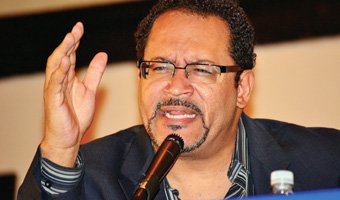
Michael Eric Dyson, a Georgetown University scholar who teaches a class on hip-hop superstar Jay-Z, said religious critics of hip-hop need to look at their own leaders.

"As much as you want to dog a rapper and steamroll his or her lyrics, steamroll some sermons, too, of the bishops and the imams and the rabbis," said Dyson, who was headed to a concert featuring Jay-Z and Kanye West.

Georgetown University professor Michael Eric Dyson speaks at a panel on hip-hop and black churches at Howard University School of Divinity. (RNS Photo)

Dyson spoke in an open collar, and advocates say dressing down is just one way some churches can indicate an openness to hip-hop culture.

"Maybe we need some fitted caps on Sunday," said Willie J. Thompson Jr., an assistant pastor of a Presbyterian congregation in Springdale, Md., who helped coordinate Howard's Christian hip-hop concert. "Maybe we need to dress down. Maybe we need to change some of the things that we've become accustomed to."

Hip-hop artists say part of the problem is that churches are too traditional, too rigid.

"I am young, gifted, eccentric and artistic, but I am not religious," said Oraia, a white female spoken-word artist who appeared onstage at Howard between black male artists. "I don't worship tradition."

Kayeen Thomas, a first-year student at Washington's Wesley Theological Seminary and a hip-hop performer, said the church has much to learn from hip-hop's Christian and not-so-Christian aspects. One tends to focus on the suffering of Jesus; the other on the suffering of the streets.

"The last time I performed, I did a Christian rap song, and I did a song about Troy Davis," he said, referring to the recently executed Georgia inmate who became a rallying cry for alleged racial disparities in capital punishment.

Thomas, who comes from the Christian Methodist Episcopal Church, eventually hopes to lead conferences on hip-hop as a tool for evangelism.

"It does have the ability to be used not only to bring souls to Christ but to also change lives, to also inspire people to do better," he said. "For you to ignore a medium that has a potential to be so powerful is a huge, huge mistake on the part of the church."


Baptist pastor writes Bible study for Harry Potter movies

HUSTONVILLE, Ky. (ABP)—With the recent DVD and Blu-ray release of Harry Potter and the Deathly Hallows: Part 2, the eighth and final film in the long-running series based on books by J.K. Rowling, a Southern Baptist pastor has written a Bible study to help young people discern between the series' mixed messages about good and evil.

"Depending on who you talk with in the evangelical community, you'll receive a variety of opinions concerning Harry Potter: 'Christians shouldn't watch it,' 'Christians can enjoy God through it' and even, 'It's of the devil!'" author Jared Moore writes in The Harry Potter Bible Study.

Moore, pastor of New Salem Baptist Church in Hustonville, Ky., and a Baptist blogger who contributes to SBC Voices, admits the stories contain "some evil elements," but he believes they are "still an avenue through which Christians can enjoy God."

Moore, a graduate of Liberty University and Southern Baptist Theological Seminary, contends that instead of trying to shield their children from all worldly influences, parents should teach them to discern between truth and lies. "One way to help our children cultivate discernment in this wicked world is to engage in the media wars with them as a guide," he writes.

In the study, Moore confronts some parts of the Harry Potter series that some evangelicals find objectionable—the element of witchcraft and wizardry, occasional inappropriate language and the central role of revenge. 

He then draws out other positive messages for discussion, such as "Are we willing to lay down our lives for our enemies?" "Should Christians stand up for truth?" and "Are all humans equally valuable?"

He even finds fodder for current issues, including "Should Christians use performance-enhancing drugs as they participate in sports?" and situation ethics in "Is telling untruth ever permitted by God?"

"In God's world, all truth is God's truth and all lies are Satan's lies," says a description on the book's dust jacket.

"The Harry Potter series, like all forms of media, presents truth and lies interwoven into a complicated web. The purpose of this Bible study is to help Christians take every thought captive to obey Christ as they untangle this web."

Moore writes in an appendix that some Christians avoid watching scary movies because they fear it will cause them to doubt that God is in control.

"First, if you doubt God, scary movies are not the reason; rather, scary movies merely bring to the surface the doubt that is already there in your heart," he asserts.

"The answer to your sin problem is not attempting to minimize your outside influences," he writes. "You should be able to face scary situations, whether voluntary or involuntary, without doubting God. Rather, your answer should be to pray, memorize Scripture and face voluntary fears while believing what God has said in his perfect word."


Chaplain in Afghanistan reflects Christ’s peace

KANDAHAR, Afghanistan (BP)—Capt. Kevin Humphrey's last quarterly report to the North American Mission Board's chaplaincy group reads like the script of a Hollywood blockbuster.

Capt. Kevin Humphrey, an Air Force chaplain stationed in Afghanistan, sits at the controls of a HH-60 helicopter, used to rescue wounded troops and transport them back to the base hospital.

But the combat incidents are real—true wartime stories of battlefield death, horrific injury, bloodshed, bravery and close calls. If it were a movie, it could be titled A day in the life of a Baptist chaplain in Afghanistan. "It has been a very challenging time here in Kandahar," said the 38-year-old chaplain, who serves in the 451st Air Expeditionary Wing of the U.S. Air Force.

"The dangers are very real, and it weighs on the people's minds here. Back in the summer, there were rocket attacks almost every two days or so and sometimes twice a day," Humphrey said, adding the attacks have slowed this fall.

Combat deaths in the region come so often, American flags never go more than four days without dropping to half-staff in honor of the fallen, Humphrey said.

Humphrey—one of about 190 military chaplains in the Afghanistan theater of operations—said Taliban forces in the area constantly are adapting their methods to inflict the most damage and death to U.S. and coalition forces.

One of Humphrey's most recent "scares" came at the nearby base hospital where he was volunteering as chaplain so the Navy chaplain usually on duty could take a well-deserved day off. While Humphrey couldn't reveal details because of security concerns, the incident came close to claiming his life and the lives of hospital personnel—most of whom never had been so close to dying before.

"It's brutal at the hospital, and the ministry is tough. They've had many single, double or triple amputees come through in the last two months. The things you are exposed to there are things that no human being should have to see. But it is a powerful ministry to the staff and patients."

Many dangers in Afghanistan come without warning, Humphrey said.

"During a recent rocket attack, a Department of Defense compound was hit," Humphrey recounted. "Their chaplain was unavailable, so I went and ministered to 250 shaken DOD army civilians.

"The building's generator just happened to go out about 30 minutes prior to the rocket attack, so only six people were in the building at the time it was hit. Had the generator not gone out, several people would have been killed. Thanks to God, only six had minor shrapnel injuries.

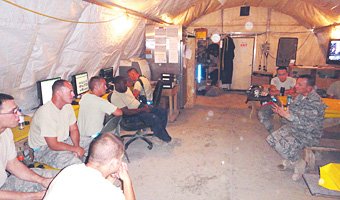
Air Force Chaplain Kevin Humphrey (second from right) conducts a 10-minute "Combat Service" for eight of his A-10 plane maintainers. This may be the only church service they are able to attend because of their busy mission schedules.

"I spoke with one man who couldn't understand why he was not in the building at the time and didn't die. I shared that God says in Hebrews we are appointed once to die and that our day of death has been fixed by God, and that God has a plan and purpose for our lives. While he is not yet a Christian, he is now seeking God for the first time in his life."

Humphrey conducts seven combat services each week for his units.

Services are at-tended not only by American troops but also by soldiers from the coalition nations—Brits, Canadians, Pak-istani Christians and others. "It makes me think that this is what heaven will be like, with every tribe and nation."

Eight people accepted Christ in the first service Humphrey preached recently, followed by 15 in the second service and three in the third.

Although Humphrey's job as a chaplain is difficult because of the hostile and chaotic environment in Afghanistan—"there is real tension here, and some take it much better than others"—his ministry also is rich.

"The very real presence of Christ has been here in the midst of difficulty," Humphrey said. "Psalm 91 has become very real for me. I have not feared for my life since I have been here—not because I think I'm brave but because Christ has been so present."

Humphrey and wife Jennifer—who's back "home" at Kadena Air Force Base in Okinawa, Japan—are the parents of five children ranging in ages from 3 to 11. He graduated from Southwestern Baptist Theological Seminary with a master of divinity degree in 2003 and was a pastor three years prior to entering active duty as an Air Force chaplain. Humphrey is slated to serve in Afghanistan until January 2012, when he will be reassigned to Okinawa.

The National Bible Association, based in New York City, recently announced Humphrey—out of 500 Air Force chaplains—is one of three 2011 recipients of the association's Wither-spoon Award, given annually to military chaplains representing the Army, Air Force and Navy. The award is given in cooperation with each U.S. military branch's chief of chaplains and is named for the famous World War I and II chaplain, Maurice Witherspoon.

The award recognizes chaplains who "promote Bible reading in a very creative, unique and effective way and whose actions and day-to-day activities encourage others to read, study and apply the Bible's principles to their lives."


Faith Digest

NCC staff leader to step down. The National Council of Churches announced General Secretary Michael Kinnamon is resigning due to health reasons. Kinnamon, 63, told the ecumenical group's governing board he must "immediately and significantly" reduce his activity, especially the frequent travel required by the job, under the advice of his cardiologist. A minister in the Christian Church (Disciples of Christ), Kinnamon was elected to lead the New York-based NCC in 2007, amid staff layoffs and budget cuts. Under Kinnamon, the NCC cut spending on programs and administration from about $6.2 million in 2008 to about $5.4 million last year, according to annual reports. The NCC's income also declined, from about $5.4 million in 2008 to $5.1 million last year.

Evangelical group calls for nuclear cuts. The National Association of Evangelicals has called for greater precautions with nuclear weapons and a renewed effort toward disarmament. The resolution calls for taking a second look at the Cold War doctrine of deterrence in light of shifting global politics, and it challenges the United States to pursue new negotiations with Russia and other nuclear countries. It does not, however, call for unilateral disarmament. The resolution also challenges the Senate to ratify the Comprehensive Nuclear Test-Ban Treaty. The board of directors of NAE, which represents more than 45,000 churches, approved the resolution at its semiannual meeting.

Religious services make some women happier. A new study in the Journal of Religion and Health suggests—at least for some women of a certain age—a link between optimism and attendance at religious services. Researchers examined the religious practices of nearly 100,000 women. Those who attended services frequently were 56 percent more likely to have an optimistic outlook than those who did not and were 27 percent less likely to be depressed, according to the study. The research, focused on post-menopausal women, is far from the first to associate church attendance and happiness, but it cements previous work that seems to show those who engage in communal religious services are better able to cope in life.

Charges filed against Catholic University. A George Washington University law professor has filed charges against the Catholic University of America for not providing Muslim students with prayer rooms free of Catholic iconography. John F. Banzhaf III, who earlier filed charges over the university's switch to same-sex dorms this summer, filed the new 60-page complaint with the Washington, D.C., Office of Human Rights. Banzhaf complained the university does not sponsor a Muslim student association, even though it sponsors a Jewish one. He also claimed the single-sex dorm policy discriminates against female students. The university, whose Arab student population swelled from 56 in 2007 to 122 this year, sponsors an Arab American Association, founded this fall by Muslim student Wiaam Al Salmi. The Office of Human Rights has begun an investigation of the university, which could take as long as six months.


Independent, nondenominational churches on the rise, book asserts

DURHAM, N.C. (ABP)—About one in five American Protestant churches is independent of any de-nomination, and about one in five Protestants attends those independent churches, Duke sociologist Mark Chaves reports in his new book, American Religion: Contemporary Trends.  

Chaves, professor of sociology, religion, and divinity at Duke University in Durham, N.C., and director of the National Congregations Study, said the number of Protestants attending independent churches increased from 14 percent in 1989 to 19 percent in 2006.

Mark Chaves

"If the unaffiliated congregations were all in one denomination, they would constitute the second-largest in number of participants (behind only the Roman Catholic Church) and the largest number of congregations," Chaves writes.

"Although most Protestant churches are denominational, a noticeable and growing minority are not formally affiliated with any denomination."

Chaves says an increase of 5 percentage points in the number of people attending independent churches may not seem like much, but he noted growth occurred over a period of just eight years. Those numbers probably understate the cultural significance of the trend, because denominational affiliations seem to be decreasingly important to congregations and their members even when they do exist, he added.

Nearly two-thirds of Protestant megachurches formally belong to a denomination, Chaves said, but many downplay those connections. Even though the annual income of denominationally affiliated congregations increased faster than inflation between 1998 and 2006 in real dollars, the amount of money those congregations passed on to their denominational offices declined from about 5 percent of their income in 1998 to 4 percent in 2006.

While some congregations re-duced contributions to a denomination to protest its policies or priorities, Chaves said, decline in denominational giving is "a longer-term trend driven mainly by the rising costs of running a local congregation."

Chaves devotes one chapter in the book to the so-called "mainline decline." He notes the percentage of Americans affiliated with theologically more liberal mainline denominations has declined steadily since 1972, while the percentage of people in more conservative evangelical congregations increased slightly until the 1990s and has remained stable since then. By 2008, twice as many people claimed affiliation with conservative de-nominations as with theologically more liberal ones—28 percent compared to 14 percent.

While "one of the best-known religious trends of the last several decades," Chaves contends the decline of liberal Protestantism "often is misunderstood."

"It is commonly believed that this trend is the result of people fleeing liberal de-nominations for more conservative churches, but this is not what happened," Chaves writes. "Indeed the flow of people from more liberal to more conservative denominations started to slow exactly when conservative churches made their greatest gains relative to liberal denominations."

Among people born before 1950 and raised in a mainline denomination, 16 percent shifted to a more conservative denomination as adults. But beginning with those born in the 1960s, more raised in a mainline church became religiously unaffiliated than became evangelical.

"The most important trend is not an increased flow from liberal to conservative churches," he writes. "Rather the most important change is decreased flow of people in the other direction. In the not-too-distant past, conservative denominations lost many more people to liberal denominations than they do now."

Upward social mobility was a big reason people formerly flocked to the mainline churches, Chaves said. Among upwardly mobile people who were raised as conservative Protestants, 28 percent of those born before 1931 switched to a more liberal denomination as an adult.

Chaves noted women in conservative evangelical churches tend on average to bear one more child than their liberal Protestant counterparts. While that may not seem significant, over the course of several generations, the impact multiplies.

As denominations lose members or resources, Chaves said, cuts to national and regional staffs often follow, resulting in a weakened denominational infrastructure. Many people don't seem bothered by that, perhaps because they think of waste and inefficiency in denominational agencies, they disapprove with some of the initiatives pursued by denominational agencies or they think congregations can find materials and services that denominational agencies traditionally provided somewhere else.

Given that, it may be surprising how often congregations turn to their denomination for help and resources. One congregation in four received some sort of direct help, expertise or service from a denomination in the last year, Chaves noted.

More than 90 percent of the outside help congregations received on personnel or staff issues came from denominational sources, Chaves reported. Only on building and facilities issues did a majority of the consulting help used by congregations come from other than a denominational source.


Baptist cooperation developed slowly but took root deeply

Mention "cooperation" and many Baptists think of the Cooperative Program, the Southern Baptist Convention's unified giving plan.

But Baptists may have forgotten that instead of money, cooperation historically grew around accomplishing kingdom work together—primarily missions—when churches realized they could do more working together than they could on their own.

The idea that believers voluntarily could cooperate set Baptists apart, but it took decades for the concept to develop and to be used extensively among churches and other Baptist entities. That process took time because of Baptists' distinctive beliefs and history, said Bill Pinson, Baptist General Convention of Texas executive director emeritus, in a series of Baptist distinctives articles.

Objections to cooperation

Some objected to cooperative effort because the Bible, they said, makes no provision for any organization except the local church. But other Baptists cited passages such as Acts 15:2, 2 Corinthians 8-9, Galatians 1:2 and 2:1-10 and Revelation 1-3 as the basis for voluntary cooperation.

The strongly held belief in the autonomy of the local church caused others to resist the cooperative movement. Many feared organizations outside the local body would attempt to exercise control over the churches. Those who pushed cooperation overcame this objection by stressing its voluntary nature.

The Pennsylvania Association, formed in 1707, became the first formal outgrowth of the voluntary cooperative effort in America. Organized after the English model, it existed for fellowship and discussion of church issues.

Cooperation in diversity

Diversity and competition were additional problems the concept faced. Much of the diversity among Baptists—at least 50 groups and subgroups exist in the United States today—grew out of two distinctly Baptist principles—religious freedom, with its emphasis on soul competency and the congregational form of governance closely tied to it.

Diversity and competition "still keep some churches from cooperating with each other. However, many churches are willing to cooperate voluntarily, as long as basic convictions are not compromised, for the advancement of evangelism, missions, education and benevolence," Pinson wrote.

But diversity often did—and still does—stand in the way. Albert W. Wardin Jr., a retired history professor at Belmont University, noted theological and cultural differences often have disrupted cooperative attempts.

Theological differences around issues of Calvinism, Arminianism (free will) and fundamentalism (moderate and militant) have disrupted cooperation.

"Moderate fundamentalists will cooperate with evangelicals of like faith, but militant fundamentalists refuse cooperation with evangelicals who, in turn, may cooperate with theological liberals," Wardin wrote in Doing Diversity Baptist Style: Documents for Faith and Witness.

Cultural and ethnicity issues surfaced when Southern Baptists split with Northern Baptists, now known as American Baptist Churches-USA. Wardin asserts the initial split between the two was cultural, not theological. Northern Baptists objected to slavery, while Southern Baptists "defended" the South's "way of life." The Southern Baptist Convention declared the approach to missions caused the split.

A collaborative approach

Several factors challenge Baptists' traditional cooperative efforts, Pinson believes. Denominations are seen as relics and Baptist distinctives as irrelevant, with some Baptists preferring to cooperate through affinity groups. The rise of megachurches that can fund their own efforts and don't need the help associations or conventions can provide also disrupts cooperation.

Denominational conflict and pressure to conform to demonstrate "cooperation" also are factors.

But Bill Leonard, a professor of church history at Wake Forest University School of Divinity, believes Baptists can form new organizational relationships based on collaboration. "Twenty-first century 'concerns' suggest, perhaps demand, that multiple Baptist groups extend their collaborative ministries while pursuing more formal institutional connections," he wrote in an opinion article for Associated Baptist Press.

"Denominational realities compel consideration of a more integrative associationalism between such Baptist communions as the ABC/USA, the Progressive National Baptist Convention, the Cooperative Baptist Fellowship, the Lott Carey Missionary Convention and the Alliance of Baptists."

He pointed out the New Baptist Covenant effort has helped foster that type of cooperation. "But without more substantive denominational affiliations, that may be too little too late."