Documentary claims age-graded Sunday school harms families

A controversial new documentary movie contends age-graded Sunday school and youth ministry are doing more harm than good.

In Divided, young filmmaker Philip Leclerc sets out to discover why so many people of his generation are leaving the church. The answer, he says, is the "hipster Christianity" approach to youth ministry, centering on fun and games with Bible study tacked on, and the notion that youth pastors are more qualified to train children than their parents.

{youtube}ZaUR2aEknGM{/youtube}

Leclerc acknowledges grouping kids and age and developmental stages makes sense on the surface. In the Bible, however, parents are given the responsibility for religious instruction of their children.

The modern idea of age-graded Sunday school, youth ministry and children's church came from somewhere else. When it started in the 1800s, Sunday school was intended for poor children without Christian parents. In most American churches today, Leclerc insists, Christian fathers relinquish their leadership to programs based on secular educational theories instead of the teaching of Scripture.

"The issue is to start with we have to get man to respond to God," Voddie Baucham, a Southern Baptist pastor, author and conference speaker, says in the film. "That's our goal. Therefore whatever makes man respond is appropriate. That's the wrong starting point. …

"When it comes to being innovative and trying to reach the culture and doing things that are not found in the Scripture, trying to worship God in ways that God has not told us to worship him, then our innovation becomes dangerous."

Baucham advocates the "family-integrated" church, a model popular with families who home school. Instead of church programs that pull families apart with parents and kids arriving at church together then going their separate ways, the family-integrated church does not offer a separate Sunday school or children's church.

Families sit together in worship and fathers are exhorted and equipped to lead their families in daily worship and to train their children in the way of the Lord.

Baucham asserts there is a clear pattern in both the Old and New Testaments of young people being in corporate worship with their parents, and parents—especially fathers—have the responsibility of instructing their own children. Age-segregated programming used in most churches, he insists, goes against Scripture and does not work.

Divided doesn't claim the family-integrated model is for everyone, but it questions if statistics showing that 85 percent of students in a typical youth group fall away within three years of graduation might fulfill prophecy by early Sunday school opponents 200 years ago that the movement eventually would destroy the family.

"Parents are the only ones who have the proper tools," Baucham says in the movie. "For example, children need nurture, but they also need correction. That kind of biblical correction falls within the purview and responsibility of the parent. The church does not wield the rod in the child's life. Only the parent does. And the Bible says that that is a primary tool in the correction and shaping of children."

The film, produced in association with The National Center for Family-Integrated Churches, comes on the heels of a book by the center's director, Scott Brown, which describes modern youth ministry as a "50-year-old failed experiment" that is "destroying the younger generation, fragmenting the family and dividing the church."

Endorsements for A Weed in the Church include Paige Patterson, president of Southwestern Baptist Theological Seminary in Fort Worth.

"As I have watched what has happened in most of our churches, I have become convinced that Scott Brown is far more right than wrong on this matter," Patterson wrote.

"I, for one, am extraordinarily grateful that he has gone to the trouble to write this book and articulate the position. May God grant that many will listen to it before our families are totally lost and with them the churches also. Our families simply must have some time when they worship and study together."


Sunday school an evolving institution

Sunday school plays such an important role in Baptist life a typical churchgoer might be tempted to think it always has been around. In fact, it is a relatively modern and evolving invention.

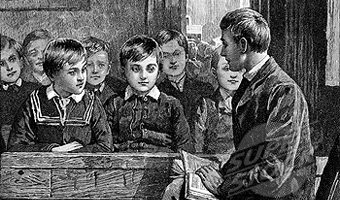
While some debate its origins, most credit a British printer named Robert Raikes as founder of the modern Sunday school movement. An Anglican layman, Raikes was concerned about children in slums he saw drifting into a life of crime. Since many children were forced to work in factories six days a week, he and a local pastor decided to open a school for them on Sunday in July 1780.

While Raikes' aim was to teach reading, writing and arithmetic, he used the Bible as a textbook, introducing a spiritual component to the curriculum. When Raikes died in 1811, an estimated 400,000 people attended Sunday schools in Great Britain. The schools served as a model for Britain's public school system. John Wesley described Raikes' Sunday schools as "one of the noblest specimens of charity … in England since William the Conqueror."

The idea spread to other nations. In 1785, a Sunday school was begun by William Elliott, a Methodist layman, in Accomac County, Va. In 1797, Second Baptist Church in Baltimore—now called Second and Fourth Baptist Church—began a Sunday school reported to be one of the first in the United States to use the Bible as its only textbook and all-volunteer teachers.

Like any innovation, the Sunday school movement had its detractors. In Virginia, organizers were criticized because they offered instruction to black slaves. In 1830, a Baptist association in Illinois passed a resolution declaring its lack of fellowship with Sunday schools, as well as foreign and domestic mission and Bible societies.

Opposition to missionary societies and Sunday schools prompted some Calvinist Baptists in the early 1800s to separate into their own Primitive Baptist tradition. Other denominations divided as well. But in time, most denominations came to embrace Sunday school.

Luther Rice, a primary force behind the founding of the General Missionary Convention of the Baptist Denomination in the United States for Foreign Missions—called the Triennial Convention because it met every three years—joined with others to form the Baptist General Tract Society in 1824. Today, the ministry is known as Judson Press, publishing arm of the 1.5 million-member American Baptist Churches USA.

After Baptists in the South separated from the Triennial Convention's missionary-sending program in 1845, many continued to use study materials from the northern American Baptist Publication Society. The Southern Baptist Convention formed its own Sunday School Board, now known as LifeWay Christian Resources, in 1891, completing the Northern/Southern Baptist schism.

In 1920, Arthur Flake was named head of the Sunday School Board's department of Sunday school administration. In 1923, he wrote the book Building a Standard Sunday School containing five points that came to be known as Flake's Formula. Flake's plan—"(1) know possibilities; (2) enlarge organization; (3) provide place; (4) train workers; and (5) go after them"—succeeded in growing Sunday school enrollment from around 1 million in 1920 to nearly 6 million when Flake died in 1952.

Sunday school's golden age lasted until the 1960s, when many denominations began to see enrollments decline. Today, LifeWay Christian Resources reports more than 2 million Sunday school classes in the United States.


Matthew West shares life stories through songs

NASHVILLE, Tenn.—For his album, The Story of Your Life, singer/songwriter Matthew West took an unusual approach to find inspiration. He posted a note on his website asking people to share their life stories and said a select few would be turned into songs.

For his album, The Story of Your Life, singer/songwriter Matthew West drew inspiration from the personal stories from more than 10,000 people around the world who shared their greatest joys and most heart-wrenching moments.

West never expected to receive more than 10,000 responses from people in 20 countries who provided detailed accounts of their greatest joys and most heart-wrenching moments.

"I've always been sort of a storyteller at heart," West said. "Up until now, I've written songs telling the story of my life and talking about what I've been through—my experiences, faith and family.

"As I was getting ready to work on a new album, I thought it might be interesting to see what would happen if I turned the microphone around and created songs based on other people's experiences. That was the initial plot behind it, but what wound up happening from that one little idea was an experience much bigger than I originally anticipated."

West was deeply affected by the responses and took the time to read each one. 

"The mountaintop experiences and the joys that we have, those are all defining moments in our lives," West said. "But the stories that were most often shared were the weakest moments. People shared the greatest trials they've ever faced—the illness that they suffered, the loved one that they lost, the desire to have a child, and many people shared about abuse or addictions they were dealing with.

"This project has changed me and challenged me to look at the world in a different way. These people were trusting me to be their messenger. I was up late into the night for several months just reading about people's lives, and I felt like I had been given a window into their world.

"These songs will now go on to hopefully encourage other people who might be going through similar struggles. My desire is that people will realize that their life is telling a story, and by allowing God to work and mend the broken pieces, it can be a beautiful story that impacts the world around them."

In addition to serving as the inspiration for the songs on the album, West also was able to create a devotional book, The Story of Your Life: Inspiring Stories of God at Work in People Just Like You

This month, West is releasing another book and companion DVD, What's Your Story?  This book and interactive guide further illustrate the impact of God's hope and redemption working throughout each life story.

"I want to encourage people to realize that God hasn't stopped working in their lives," West said. "I think a lot of times, we get so defeated in our lives—thinking we've made too many mistakes or that our lives are too bruised and broken that we can't have any impact in the world.

"The truth is that no matter how many mistakes you've made or trials you've faced, it's the brokenness of our lives that God uses to give us something to say to the world. I hope it's an empowering message that people can cling to during difficult times, when they realize that God has something to say to us and through us."


Some see Crystal Cathedral’s purchase by Catholic diocese as calculated risk

WASHINGTON (RNS)—Even by the depressed metrics of Southern California's real estate market, most observers believe the Roman Catholic Diocese of Orange negotiated a pretty sweet deal when it purchased the iconic Crystal Cathedral, the longtime pulpit of the Robert Schuller and backdrop to his popular Hour of Power television broadcasts.

Not only did Catholics get a national landmark designed by the renowned architect Philip Johnson, but Bishop Tod D. Brown wasn't even the highest bidder. Schuller and the board of the Protestant megachurch opted to take Brown's $57.5 million offer over a $59 million pitch from Chapman Univer-sity because the bishop would keep the campus as a place of worship.

The Roman Catholic Diocese of Orange, Calif., has purchased the iconic Crystal Cathedral for $57.5 million, but it faces a major challenge in retrofitting the building for use as a Catholic cathedral. (?RNS PHOTO/Arnold C. Buchanan-Hermit via Wikimedia Commons)

The diocese's top lawyer, Tim Busch, called the deal "a true miracle." But divine intervention—or at least "an exceptionally gifted architect," as one anxious churchman put it—now will be needed to transform this temple of suburban evangelicalism into a Catholic sanctuary that will make the cathedral a real bargain and not a liturgical white elephant.

That won't be an easy task, given the disparity between traditional Catholic worship requirements and modern Protestant sensibilities.

The challenge of redesigning the Crystal Cathedral's interior was central to the cost-benefit analysis driving the Orange diocese's calculations throughout the process, according to church officials familiar with the deal.

In fact, Brown initially was cool to the idea of buying the Crystal Cathedral, which was $50 million in debt when it filed for bankruptcy last year. Brown, who wanted to leave a new cathedral as part of his legacy, gradually was won over by aides and business advisers.

Some of the bishop's hesitation stemmed from the fact that while the 2,800-seat Crystal Cathedral was a relative bargain, the diocese does not have much cash on hand. The diocese will need to launch a major fund-raising effort that could total $100 million and would entail the sale of other property in order to cover the $57.5 million price tag, as well as several million more that will be needed for renovations and hefty maintenance costs.

But the opportunity was too good to ignore. For one thing, the Crystal Cathedral's price tag was a lot less than it would have cost to build a new cathedral from the ground up.

The Diocese of Orange—the 10th largest in the nation, with 1.2 million Catholics—was facing construction costs approaching $200 million on a lot half the size of the Crystal Cathedral's 31-acre campus.

And for those who may wince at the assertive modernism of the Crystal Cathedral's glass design, the reality is that any new cathedral likely would have followed a similar style. Just look up the coast to Oakland's glass-and-steel Cathedral of Christ the Light, which was dedicated in 2008.

Similarly, lingering concerns over the cost and size of the Cathedral of Our Lady of the Angels in Los Angeles—nicknamed the "Taj Mahony" after its visionary, retired Los Angeles Cardinal Roger Mahony—also played into the decision to make the Crystal Cathedral deal work.

"This was a no-brainer from a business perspective," said a churchman familiar with the purchase, who declined to be named as negotiations continued.

But even after the deal was sealed, there was another hurdle looming. The Vatican had to sign off on the deal, and it was far from a foregone conclusion.

Just as the deal was coming together, it was revealed Pope Benedict XVI was setting up a new Vatican office to vet the construction or purchase of major new churches around the world.

That posed a special challenge because the goal of the commission is to ensure that new cathedrals, unlike some recent designs, are not "buildings composed of cement cubes, glass boxes, crazy shapes and confused spaces (that) remind people of anything but the mystery and sacredness of a church," as Vatican watcher Andrea Tornielli put it in his story on the new body.

To some, the Crystal Cathedral, which was completed in 1980, would fit that unflattering description.

But after a series of exchanges with the Orange diocese, Rome finally gave its approval—two weeks after Brown had won the bidding war.

Now comes the hard part—transforming the Crystal Cathedral from a theater-like atrium complete with Jumbotron screens into a Catholic cathedral where priests will celebrate Mass with incense and reverence.

Brown already said he has "no intention to change the exterior" of the famous building, but he also conceded it would require "critical design upgrades" inside to make it "suitable for a Catholic place of worship."

In a blog post at U.S. Catholic magazine, journalist Megan Sweas questioned whether any renovation could sufficiently sever the cathedral's ties to Schuller's feel-good, made-for-television approach to ministry.

"The space could benefit from a sprucing up, but I hope the diocese goes further than that," Sweas wrote, adding: "How can the Catholic Church make the space its own while respecting what came before?"


Faith Digest

Religious freedom panel gets reprieve. With a last-minute vote, Congress saved an independent religious freedom watchdog commission that was about to shut down. The bill reauthorizing the U.S. Commission on International Religious Freedom for three years was held up in the Senate almost three months before passing with an amendment that will limit the appointment of commissioners to a maximum of two, two-year terms. The House approved it Dec. 16, the same day the commission was set to close. USCIRF is a bipartisan commission that issues an annual report of "countries of particular concern" on religious rights abuses and provides foreign policy recommendations to the president, Congress and the State Department. It has nine commissioners, a staff of 17 and a $4 million annual budget.

U.S. tops charity index. Are Americans the most generous people in the world? Yes, according to a new study of global giving to charity. The "World Giving Index," based on 150,000 interviews with citizens of 153 nations, ranks the U.S. highest on a scale that weighed monetary donations, volunteer work and willingness to help a stranger. The survey's authors noted charitable behavior is not correlated with wealth. Of the 20 countries the World Bank ranks richest by gross domestic product, only five made it into the top 20 of the index.

Atheists distrusted by society. A new study finds atheists among society's most distrusted group. Psychologists at the University of British Columbia and the University of Oregon say their study, published in the current issue of Journal of Personality and Social Psychology, demonstrates anti-atheist sentiment stems from moral distrust, not dislike, of nonbelievers. The study, conducted among 350 American adults and 420 Canadian college students, asked participants to decide if a fictional driver damaged a parked car and left the scene, then found a wallet and took the money, was the driver more likely to be a teacher, an atheist teacher or a rapist teacher? The participants, who were from religious and nonreligious backgrounds, most often chose the atheist teacher.

Believers can be swayed on nukes, environment. Most Americans believers do not see preventing climate change or the spread of nuclear weapons as "spiritual obligations," according to a new poll. The University of Maryland's Center for International and Security Studies conducted the poll to examine how individuals think their faith intersects with global policy challenges. Just 39 percent of all believers, and 31 percent of evangelicals, agreed most scientists think the problem of climate change is urgent and enough is known to take action. Only 15 percent of all believers initially agreed it is a spiritual obligation to prevent climate change. But after being presented with pro and con statements about a spiritual obligation to be good stewards of the environment, 76 percent embraced this notion. Similarly, after being presented with pro and con arguments for eliminating all nuclear weapons in the world, 69 percent favored this goal, up from an initial 55 percent.


‘The world didn’t end in 2011’ and other year-end observations

WASHINGTON (RNS)—It was supposed to be the year the world ended. Twice.

But after evangelist Harold Camping's predictions about a 2011 doomsday failed to materialize, all eyes now are on 2012 when, according to an ancient Mayan calendar, we need to once again prepare for the end of the world as we know it.

Bob James of Morristown, N.J., organized a grass roots campaign to fund billboards in his area warning about a pending judgment day on May 21. (RNS PHOTO/Noah K. Murray/The Star Ledger)

Jesus was pretty clear—wars and rumors of wars, earthquakes and uprisings, are just the beginning of the end. Indeed, 2011 had enough tumult, anxiety and unrest to make people think maybe the end is nigh after all.

For the Arab world, the Arab Spring upended longstanding regimes in Egypt, Libya and Tunisia and could do the same in Syria and Yemen. A magnitude 9.0 earthquake left more than 21,000 dead or injured in Japan and literally tipped the earth off its axis, while a smaller Aug. 23 quake along the East Coast sent finials and angels tumbling from atop Washington National Cathedral.

Frustrated demonstrators occupied Wall Street, and a sexual abuse scandal ricocheted through the Roman Catholic Church and Penn State's football program. To top it all off, the Crystal Cathedral went belly-up.

And that's not even counting the 2012 presidential campaign.

Here's a quick tour through the topsy-turvy world of religion in 2011:

Taking it to the streets

From Tahrir Square to the Wisconsin Statehouse to Zuccotti Park, 2011 was the year of taking it to the streets as popular anger—against despots, union-busting politicians and Wall Street tycoons—coalesced into (mostly) peaceful protests. Religious leaders voiced concern for religious minorities swept up in the turbulence of the Middle East, as well as support for the Occupiers' goals of fairness and equity in the global financial system.

Ray Maldonado of Paterson, N.J., marks the death of al-Qaida leader Osama bin Laden at Ground Zero in New York. (RNS PHOTO/John Munson/The Star-Ledger)

'Do not rejoice when your enemies fall…'

The street celebrations that followed the death of al-Qaida leader Osama bin Laden, meanwhile, left a bad taste in the mouth of many Americans. "In obedience to Scripture, there can be no rejoicing when our enemies fall," said David Gushee, a Christian ethicist at Mercer University. Americans, however, had fewer qualms about bin Laden's eternal fate: a poll after bin Laden's death found that two-thirds of Americans think he's paying for his sins in hell.

Cults and personality

With the GOP campaign in full swing, crucial blocs of evangelicals fell in and out of love with Michele Bachmann, Rick Perry and Herman Cain, but never really fell for Mitt Romney. One poll found 53 percent of evangelicals don't think Mormons are Christians; Dallas pastor (and Perry supporter) Robert Jeffress called Mormonism a "cult." By year's end, evangelicals were swooning for Newt Gingrich, a thrice-married Roman Catholic convert who carries some heavy ethical baggage. Said Ron Godwin, the provost of Jerry Falwell's Liberty University: "My conclusion is the devil I know is preferable to the one I don't really know." But in a sign that Mormons have arrived, The Book of Mormon, a heartfelt (if obscene) ode to Mormon piety from the creators of South Park, swept the Tony awards, including Best Musical.

Ghosts of scandals past

Nearly 10 years after the Catholic Church's sex abuse scandal erupted in Boston, the bishop of Kansas City, Mo., was indicted for failing to report a priest suspected of possessing child pornography to police, and a grand jury slammed the Archdiocese of Philadelphia for allowing 37 known abusers to remain in ministry. The U.S. Conference of Catholic Bishops' report on the "causes and contexts" of the scandal faulted—among other factors—the turbulent culture of the 1960s, and victims launched a long-shot bid to make Pope Benedict XVI face charges at the International Criminal Court in The Hague. U.S. bishops offered to share what they've learned with Penn State, where an eerily similar abuse cover-up led to the sacking of coaching legend Joe Paterno.

Rob Bell

Who's in hell? Who knows?

Michigan megachurch pastor Rob Bell can't say for sure whether bin Laden—or anyone else—is in hell, at least not in the way Christians have traditionally thought of it. Bell's book, Love Wins, rocketed to the top of The New York Times best-seller list by questioning traditional beliefs on hell and sparked a heated public discussion of hell and damnation. Southern Baptists were quick to disagree, passing a resolution affirming the reality of hell as "eternal, conscious punishment" for those who do not accept Jesus Christ.

Do Ask, Do Tell

After 18 years as one of the touchiest issues in the culture wars, Congress retired the Don't Ask/Don't Tell policy that barred gays and lesbians from serving openly in the military. For the first time, a majority of Americans (53 percent) voiced support for legalizing same-sex marriage, and the Presbyterian Church (USA) officially welcomed non-celibate gay clergy. New York became the sixth state to allow gay marriage, and Catholics in Illinois pulled out of state contracts for adoption and foster care rather than comply with the state's new civil unions law.

Church & State

In a widely expected but little-loved ruling, the U.S. Supreme Court upheld Kansas pastor Fred Phelps' right to hold "Thank God for Dead Soldiers" protests outside military funerals. The justices also denied a challenge to an Arizona program that gives tax credits for donations to private school scholarship programs, and will rule next year on tough state immigration laws that have angered religious groups. In Oregon, jurors convicted two sets of parents from a faith-healing church of criminal neglect after one child died and one was nearly blinded from lack of medical care.

A matter of conscience

The nation's Catholic bishops, concerned about growing threats to "religious freedom" emanating from the White House, launched a policy offensive over gay marriage and mandated insurance coverage for birth control. At the same time, the bishops said sharply that they, not doctors or administrators, have the final say over what constitutes ethically problematic procedures in Catholic hospitals.

Enemies, foreign and domestic

After last year's heated battles over Muslims' rights to build an Islamic cultural center near Ground Zero, the spotlight shifted to Capitol Hill, where House Republicans convened hearings on the "extent of radicalization in the American Muslim Community." Barely two weeks later, Florida provocateur Pastor Terry Jones presided over a mock trial of the Quran, sentencing the Muslim holy book to death by fire; subsequent riots swept Afghanistan. By year's end, major companies pulled sponsorship of a new TLC reality series, All-American Muslim, after conservative activists complained of creeping acceptance of Islam.

End of an Era

The Crystal Cathedral, the iconic embodiment of suburban Protestant positivity, was sold for $57.5 million to the Roman Catholic Diocese of Orange County — a sample shift within the American religious landscape, as aging mainline Protestants are literally lose ground to growing numbers of Hispanic Catholics.

Do-it-yourself faith

Pay, pray and obey? Not so much. A June survey by the Public Religion Research Institute found that more than two-thirds of Americans say they can make up their own minds on abortion or homosexuality and still be faithful members of their churches. Meanwhile, 60 percent of Catholics say you can be a good Catholic without aiding the poor, and three in four said the same about not giving money or time to the church, according to a survey conducted by researchers for the National Catholic Reporter.

Passages

Pioneering Jewish folksinger Debbie Friedman died at age 59; Harvard theologian Peter Gomes died at 68; evangelical gang activist David Wilkerson died at 79 and the "evangelical pope" John Stott died at 90; National Catholic Reporter publisher Joe Feuerherd died at 48; Episcopal liberal lion Bishop Walter Righter died at 87 and fiery civil rights icon Fred Shuttlesworth died at 89.


Bin Laden’s death rated 2011 top story by religion newswriters

WASHINGTON (RNS)—The death of Osama bin Laden and the reactions it produced among people of faith was rated the No. 1 religion news story of 2011 by the nation's leading religion journalists.

Osama bin Laden

The Religion Newswriters Association polls its members annually to compile a list of the top 10 religion stories of the year. About 90 religion beat specialists took the poll this year.

The al-Qaeda leader's death topped the ranks because of the national discussion it sparked among people of faith on issues of forgiveness, peace, justice and retribution.

The No. 2 story was a series of controversial congressional hearings focused on American Muslims. Hearings were held in the House on the alleged radicalization of U.S. Muslims, and in the Senate on hate crimes reported against U.S. Muslims.

RNA also usually names a Religion Newsmaker of the Year, but did not do so this year because of a virtual three-way tie between failed doomsday evangelist Harold Camping, Pope Benedict XVI and Texas Gov. Rick Perry.

Rounding out the 10 religion news stories in 2011 were as follows:

3. Catholic Bishop Robert Finn of Kansas City, Mo., is charged with failure to report the suspected abuse of a child, becoming the first active bishop in the country to face criminal prosecution in such a case.

4. The Catholic Church introduces a new translation of the Roman Missal throughout the English-speaking world, making the first significant change to a liturgy since 1973.

5. The Presbyterian Church (USA) allows local option on ordination of partnered gay people.

6. Pope John Paul II is beatified in May.

7. California evangelist Harold Camping attracts attention with his predictions that the world would end in May and again in October.

8. A book by Michigan megachurch pastor Rob Bell, Love Wins, presenting a much less harsh picture of hell the traditional view, stirs discussion in evangelical circles.

9. The Personhood Initiative, designed to outlaw abortion by declaring a fetus a person, fails on Election Day in Mississippi, but advocates plan to try in other states.

10. Bible translations make news, with celebrations of the 400th anniversary of the King James Version; criticism about gender usage in the newest New International Version; and completion of the Common English Bible.


Charitable giving up slightly but still ailing

WASHINGTON (RNS)—Charitable giving is trickling back up as the economy heals, but it could take years to return to pre-recession levels, nonprofit leaders say.

Giving totaled $291 billion in 2010, according to the 2011 annual report by the Center on Philanthropy at Indiana University. That's up 3.8 percent from 2009 and follows two consecutive years of declines.

The Center on Philanthropy reports Americans contribute 2 percent of their disposable income to charitable causes, a figure that has remained constant for decades. (RNS FILE PHOTO/ Julie Peters/The Birmingham News)

This year shows little change. Charity Navigator, a Glen Rock, N.J., organization that evaluates nonprofits, anticipates donations will be flat during the holiday season.

About 35 percent of nonprofit contributions come from state, federal and local government grants and contracts, and those gifts are declining, CEO Ken Berger said. Only 15 percent is from individuals.

"Staying the same is generally not a great place to be when you've got increases in demand and operational costs because of inflation and so on," said Patrick Rooney, executive director of the Center on Philanthropy.

If the recuperation continues at its current rate, it will take U.S. charities six years to return to where they were financially in 2007, Rooney warns. "We are not out of the recession, and we are not recovered from the recession," he said.

Some leaders in the nonprofit world see the glass as half-full. An American Red Cross survey of 1,020 adults this fall found that although 80 percent of respondents said their finances were the same or worse than the same time last year, 57 percent plan to give to a charity during the holidays. Almost seven in 10 say that because of the economy, it is important to give to charity.

"Despite the difficult economy, Americans want to give to help others in need," said Gail McGovern, Red Cross president and CEO.

The Center on Philanthropy report said Americans contribute 2 percent of their disposable income, a figure that has remained constant for decades.

Nonprofit leaders agree charitable organizations must think innovatively to keep the cash coming in.

Berger of Charity Navigator said organizations should avoid duplicating services. Nonprofits should adjust to meeting the public's need for openness about finances and organization, he said.


Advent a make-or-break chance for churches, visitors

WASHINGTON (RNS)—Deck the halls and cue the pageant! The weeks before Christmas mark a time in American churches when the lapsed and the curious who seldom darken the door just might drop by for a taste of the season's spirit.

But if visitors briskly come and go without considering a commitment to join or get involved, then churches will have missed a golden opportunity with huge implications for the future.

Attendance tends to increase at worship services for the four weeks of Advent, but new attendees often don't see or feel what makes others stay involved year-round.

Part of what's at stake, researchers say, is the survival of congregations. Unless they start engaging the types of people who visit only at the holidays, aging mainline churches will have virtually no one in them in 30 years, according to Scott Thumma, a sociologist of religion at Hartford Seminary. Evangelical congregations, too, are in many cases poised to face a similar fate.

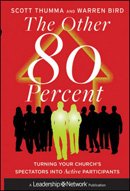
"If you just have the Advent season without also calling people to a more significant, disciplined sense of what the Christian life is, then you run the risk of letting people come in once a year and feel that they've done their Christian duty," said Thumma, author of The Other 80 Percent: Turning Your Church's Spectators into Active Participants.

The Christmas season is when Americans are most open to considering matters of faith, according to data from LifeWay Research, a Southern Baptist research firm. In a 2008 survey, 47 percent said they've been more open during the holidays. That's more than after a national crisis such as 9/11 (38 percent), after a natural disaster (34 percent) or the birth of a child (28 percent).

Attendance tends to increase at worship services for the four weeks of Advent, according to Thumma. But new attendees often don't see or feel what makes others stay involved year-round.

Scott Thumma

"When we get caught up in all the celebration and don't take time to think about communication, we miss a big point of the Christmas season," said LifeWay Research President Ed Stetzer. "I would grade churches a C or a D on this. A lot of churches just go through the motions and assume people will come."

This year, new initiatives are courting those who've wandered from the flock. Some call them the "Chreasters" — people who rarely show up beyond Christmas and Easter.

The Catholics Come Home project is for the first time running a $3.5 million TV campaign nationwide. CCH is also launching new local campaigns in St. Louis, Tampa and Fort Wayne, Ind. The Episcopal Church is running an online Advent greeting in which a young adult woman waxes nostalgic about holidays spent in church and invites everyone to services.

The challenge for congregations, however, involves breaking old habits and learning new ones during what is already a busy, demanding time of year.

"Special efforts (to engage inactive members and seekers) are not likely to occur during the Christmas season," said Alan Newton, executive minister for the American Baptist Churches in and around Rochester, N.Y. "It is a busy season with lots of charitable work, extra visiting of shut-ins and the like, (plus) extra services. A lot of the regulars travel on holidays, making extra efforts challenging."

Despite the difficulties, churches are finding ways to turn holiday activities into forums where people with tenuous or nominal ties to a faith community can explore deeper ones. Approaches vary widely, but all tend to give visitors a taste (or a reminder) of what's meaningful about church commitments.

Sometimes the focus is on a few individuals. At Our Saviour's Atonement Lutheran Church in New York, ministry associate Jacob Simpson said he struggles to get consistent participation from the six teenagers in his confirmation group.

But at Advent, he could ask a new question: how would you like to help your neediest neighbors? Their answer: with a winter clothing drive and volunteering at a soup kitchen. Based on their excitement for projects of their own design, he expects close to full participation.

"Kids don't understand why they should be coming to church, and churches often don't give kids enough to do," Simpson said. "We can be honest with them that this world is not perfect, and we're called to do something about it."

At worship services and special events, churchgoers need to remember the welcoming and non-judgmental father from the parable of the prodigal son, Thumma said. His tip: remind greeters to avoid comments like, "Where have you been? We haven't seen you in ages!" Stick instead with, "It's great to see you! How are things going? Come see what's happening here … "

Another tip: create environments where newcomers and inactive members can see and hear what makes church life meaningful. This might be a rolling video or a brief presentation during a reception. It could be a hallway lined with photos from mission trips, boys and men shoveling out elders after snowstorms, and other highlights of the year.

"It seems like a perfect occasion for the pastor or some religious leader to say, 'It wasn't just the shepherds or the wise men back then'" who were giving, Thumma said. '"We have people who're giving all year round in this community.'"


Christmas ornaments change lives in Thailand

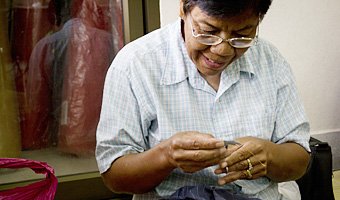
BANGKLA, Thailand (BP)—Ponpit Sayom uses a silver pen to sketch miniature figures of the wise men from the Christmas story and then cuts out the velvet ornaments that will hang on trees in countless American homes during the holidays.

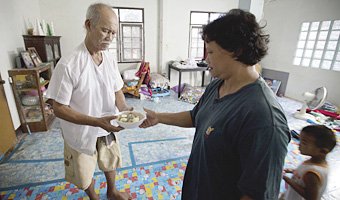
After making Christmas ornaments from 8 a.m. to 5 p.m. at Thai Country Trim, Ponpit Sayom comes home and cooks for her family, feeds and bathes her grandchildren and tends to her aging father who has Alzheimer's.

However, Christmas isn't celebrated in her home in Thailand. To her unbelieving family, Jesus is just another man. On Christmas Day, Sayom simply goes alone to church to celebrate her Savior's birth.

Food must still be earned, and her grandchildren need tending to. Sayom is the main breadwinner for her family of eight, especially since her husband's work has suffered setbacks from heavy rain and flooding. She prays one day her family will listen to the story represented in the ornaments she makes.

Sayom earns her wages by making hand-stitched Christmas ornaments for Thai Country Trim, a 25-year-old ministry that provides livelihood for rural Thai women.

Thai Country Trim employs 22 full-time workers at the ministry center — all Christians who lead Bible studies and small groups. The ministry also employs dozens of women who work from home, which allows them to make an income as they care for their children.

Thai Country Trim was the first artisan group in the Woman's Missionary Union WorldCrafts program that began in 1996 and now has national artisans in 33 countries.

Thai Country Trim employs dozens of rural Thai women who work from their home to make Christmas ornaments, enabling them to make an income as they care for their children.

WMU's support and promotion allows Thai Country Trim to employ more workers, director Cheryl Derbyshire said.

Derbyshire finds great joy in watching lives change as the 22 full-time workers share the gospel with the women who work from home who aren't Christians. Sayom, who has worked for Thai Country Trim for 20 years, is one of the full-time workers.

Sayom seems like the type of woman who'd spend her time in a rocking chair, sipping tea while rocking a grandchild to sleep.

But Sayom rarely has an idle moment. She spends her days and nights meticulously checking the stitching on Christmas ornaments. If a stitch is out of place, the entire ornament must be scrapped.

She rises at 5 a.m. to get her grandchildren ready for school. Then she heads to the Thai Country Trim center and draws and cuts out the figures of Christmas characters.

After working from 8 a.m. to 5 p.m., she returns home to cook for her family, feed and bathe her grandchildren and tend to her aging father who has Alzheimer's.

After others are in bed, she sits cross-legged on her linoleum floor and sews angel ornaments by the light of a fluorescent bulb until midnight to earn extra income.

To pass the time as she sews and decorates ornaments, Sayom sings praise songs and whispers prayers for her family. She's caring for three generations, her father, her children and her grandchildren.

A friend introduced Sayom to Thai Country Trim and helped her get a position making ornaments. She never had love before, she explains as tears form behind her silver glasses — tears of hurt, heartache and healing. Her father was always mean to her, she said, and her mom died when she was 7. Sayom said she grew up lonely and longing for love.

"When he's old, I don't want to take care of him," Sayom once told her brother.

But things changed when Sayom started working at Thai Country Trim. She learned she had value. She received praise for her handiwork and began taking pride in her work.

Like most Thais, Yupha Hanuman was a Buddhist. When her daughter caught dengue fever, Hanuman's Christian coworkers at Thai Country Trim covered her in prayer. God healed her daughter and, at a Christmas party, Hanuman chose to believe the message behind the ornaments she makes. Thai Country Trim allows Hanuman to provide for her aging mother.

In weekly Bible studies that are a part of the workday at the ministry center, Sayom heard God is like a father and loves her unconditionally. She saw his love in her coworkers' lives.

"My Christian friends loved me," Sayom says. The love the Christian workers showed her stirred her to believe in Christ.

Because of Christ's love, she says she's able to love her father. After a major surgery, her father needed to live with one of his children. He asked if he could live with her.

"I didn't want to," she admits. "But thanks to God, because when I came to know God, God changed my mind to love my dad."

God is changing her father's heart too. Although still not a Christian, he treats Sayom with more respect now.

Derbyshire has watched Sayom's transformation. As her self-esteem rose, she began to reach out to others. Sayom started working at home and has now moved to a full-time position working at the center. She helps lead weekly Bible studies with women who haven't believed yet.

Because of Thai Country Trim, Sayom is able to support herself and her family. She has a Christian community who supports her and nurtures her.

Life is still hard for Sayom. Her family has yet to believe. As mother to both her children and to her four grandchildren, she must continue to provide for them financially.

But, "God's greater," Sayom said, smiling.


Parents, pastors wrestle with place of Santa at Christmas

WASHINGTON (RNS)—When John McCausland crafted his Christmas Eve sermon at his Episcopal church in Weare, N.H., he always followed a basic formula. There had to be a brother and a sister in the story. Jesus and the holy family played a prominent role. And there was always an appearance from Santa Claus.

The DVD "Why Do We Call it Christmas?" spends 45 minutes detailing the origins of Christmas traditions, including Santa Claus.

"If we never mention Santa Claus, then you create a parallel universe," said McCausland, who retired in June. "What I try to do in this story is to tie the two together, but not make Santa Claus primary."

McCausland kept the Jesus-and-Santa story tradition for 14 years at Holy Cross Episcopal Church. Children would carry the figures to the creche display and sit for McCausland's story, in which Santa often joins in the adoration of the Christ child.

Just where to place the jolly elf in the original Christmas story can be a perennial dilemma for both parents and pastors. This year, two new products draw on educating kids about the origins of Santa, or inspiring them to become Santas themselves.

Phil Vischer, creator of the popular VeggieTales characters, has launched a DVD that answers the question, "Why Do We Call it Christmas?" The video, hosted by Vischer and featuring puppets and animation, spends 45 minutes detailing the origins of Christmas traditions, including Santa Claus.

One puppet on the DVD credits American TV shows and movies that "mushed up Christmas" by melding stories of St. Nicholas and the Nativity. "How did this guy become such a big part of Jesus' birthday party?" Vischer asks as the video opens.

In an interview, he said he hopes to diffuse tensions between Christian parents who want nothing to do with Santa and those who think there's room for both Jesus and Santa.

"We have the ability to get kind of paranoid," Vischer said. "I think it's easy for some Christians to say there's got to be some plot, there's some evil organization, that is foisting Santa upon us to steal Jesus."

Vischer's video trip back through history details the celebrations of Christ's Mass (which became Christmas) to mark Jesus' birth, and the Feast of St. Nicholas that recalls the giving saint who helped poor children.

"I think it would be awesome if Christian parents could bring back a more overt celebration of St. Nicholas because, effectively, you can have your Santa and Jesus, too," Vischer said.

Kelly Moss, author of the new book The Santa Club, is doing just that by encouraging children to join "millions of Santa Clauses" around the world in being generous givers modeled after St. Nicholas, who she considers the first Santa as well as a follower of Jesus.

Her book was inspired by the answer her mother-in-law gave to her older son, Jonathan, when she and her husband were flummoxed about how to handle his inquiry about Santa. He stayed up that night with his grandmother and helped place gifts for his younger brother, Jameson, under the Christmas tree.

"The following year, when Jameson asked (about Santa), Jonathan said, 'I'll handle this, Mom,' and he welcomed him into The Santa Club," Moss recalled of her sons, now 22 and 20.

Others make only one choice, focusing on Jesus rather than Santa.

Michael Chanley, the former parenting minister at Southeast Christian Church in Louisville, Ky., said he stuck to the Bible and never intentionally taught about Santa.

"When children have asked, as they always do, I simply ask them what they believe. Regardless of what they say, my response is, basically, the same," said Chanley, now the executive director of the International Network of Children's Ministry.

"I tell them Christmas is a celebration of the birth of Christ. Then, I share with them the story of the real Santa Claus, St. Nicholas, and how his generosity inspired many of our traditions."

Gerry Bowler, author of the 2005 book, Santa Claus: A Biography, said discomfort with Santa has been around for centuries, even as some opposition has waned, with an image of Santa kneeling at the creche that's become popular in recent years.

"The warming really took place about 150 years ago and there've been frequent outbursts of resistance and then a gradual accommodation," he said.

Still, there are a range of holdouts, from Jehovah's Witnesses who don't celebrate any birthdays, to the Westboro Baptist Church in Topeka, Kan., which changed the lyrics of Santa Claus is Coming to Town to "Santa Claus Will Take You to Hell."

"You'll find a rationalist streak that says I must not tell my kid a lie: If this is a lie then when I tell them about Jesus, well, that's just like Santa," adds Bowler, who teaches a course on the social history of Christmas at the University of Manitoba in Canada.

But McCausland, the newly retired New Hampshire vicar, doesn't buy it. The father of two grown daughters and grandfather of two can't recall a child who concluded Jesus didn't exist if Santa does not.

"I think literal grown-ups worry about that," he said.


Christmas symbols are in the eye of the beholder

WASHINGTON (RNS)—When is a candy cane not just a candy cane?  For some people, its red and white stripes might signify the sacrifice and purity of Jesus, or maybe just a 19th-century candy-maker's twist intended to dazzle his grandchildren. Both stories are alive and well on the Internet.
    
Is Santa Claus the imagined incarnation of the fourth-century St. Nicholas of Myra, the vision of a 19th-century poet or the carefully rendered creation of a 20th-century ad man?
    
Candy CanesAnd there's the tree. Is it a powerful, pre-Christian sign of enduring life? Or what remains of Martin Luther's Reformation teaching moment? Perhaps a natural reminder of renewal and hope, or a spiritual testament to resurrection?
  
Christmas has become a hybrid holiday, a mix of sacred and secular, depending on who is celebrating it. For some, the holiday is a religious occasion recalling the birth of Jesus. For others, Christmas signals the end of winter's darkness and the promise of returning light. Christmas may be a day devoted to family and memories of a shared past, or an opportunity to exchange gifts, even an opportunity to boost the struggling U.S. economy.
    
If Christmas has come to mean different things to different people, then it's not surprising that some familiar Christmas symbols bear the weight of more than one interpretation.
    
"Everything is open to interpretation," said Sharon Sherman, a professor of folklore at the University of Oregon. When folklorists study holidays, they look at the origins of symbols, how their interpretations have changed over the years and what purpose they serve in a given culture.
    
But Christmas poses a special challenge, she added. "The great majority of Christmas tradition has nothing to do with the birth of Jesus," she said.
    
The Confraternity of Penitents, a private Roman Catholic group centered in Middletown, R.I., might disagree. Their website offers "the Christian meaning" behind 44 common Christmas symbols. Gingerbread men, according to the site, are like human beings; they do not create themselves but are created.
    
"Spices, reminiscent of those mentioned in the Old Testament, make the gingerbread man the color of earth (Adam was created from the dust of the earth)," the site continues. "Like us, gingerbread people are not immortal. They are destined to be eaten and thus to unite with their creators."
    
The Internet is home to many theological theories and secular interpretations of holiday symbols, many of which can't be proven one way or another, according to Sherman.
    
"There's how something functions for you and how it functions for someone else," she said, arguing that it's less a matter of who is right and who is wrong.
    
Folklorists recognize symbols function in different ways. Simon J. Bronner, a professor of American studies and folklore at Penn State Harrisburg and author of Explaining Traditions: Folk Behavior in Modern Culture , said symbols offer a way to deal with nostalgia, express inner anxieties or conflicts and encourage more intimate connections between human beings.
    
Christmas symbols function all three ways — as links to a shared past (either real or imagined), expressions of deeply held values (sacred or secular) and as signs that others agree with one's own beliefs.
    
Arguments about the meaning of Christmas symbols are as old as the celebration itself. But practically speaking, does it matter if a candy cane is a religious symbol or simply a sweet and sometimes sticky treat? Or whether Santa Claus is selfless as a saint or "a right jolly old elf," as Clement Moore described him in "A Visit from St. Nicholas"?
    
For some people, it does matter. They find the answers they seek and circulate them to those who share their views. But for many others, it doesn't matter, Sherman said.
    
"What's important in most people's minds is how a given symbol or tradition is explained within his or her own family," whether it's their biological family or a more intentional grouping. It's family that pulls us all "home" for Christmas, she added, across the miles or in our hearts. And Christmas, whether one assigns it religious significance or not, is, after all, all about traditions, she said.
    
"Whether we're spiritual or not," she said, "traditions hold us together."