Beyond Facebook: Scanning the social media landscape

Facebook has become the social network of choice for the vast majority of people—it's hard to argue with 850 million users around the globe—and it's not likely to disappear any time soon.

But some specialists see a growing market for "niche" networks.

"Some are predicting that we'll stop seeing movement toward one platform and more toward niche groups," said social media consultant Natalie Aho. "None of these platforms will be as large a market as the ones that preceded them," but exploring them can enhance churches' community-building efforts.

Linkedin. A professional networking site, Linkedin's no-nonsense approach—there are no distracting games, for instance—leaves it virtually free of spammers. Linkedin Groups allow churches to network with others around similar interests and start discussions without requiring email addresses, eliminating the need for frequent database updates.

Pinterest. The virtual pinboard allows members to organize and share visual images reflecting their interests. Churches looking to engage the arts can identify "the beautiful things of the world" that represent its values, like social justice, or liturgical seasons, said Aho.

Google+. The newest kid on the social media block, Google+ (or Google Plus or G+) integrates a variety of social networking functions, backed by the mighty Google empire.

Apps allow users to create documents, edit photos and listen to music without having to install complicated software, and are especially useful for browsing church web sites on smart phones or tablet computers. Randolph Memorial Baptist Church in Madison Heights, Va., is typical of churches that have created an app on iTunes at a modest cost. "It offers church news, information about us, directions to the church, sermons and items off our web site," says Pastor Derik Hamby. "It's an easy weekly connection for our members, and they love it." The church is developing an app for the Droid as well.

Foursquare. A location-based social network, Foursquare allows users to "check in" at locations around the globe and lets followers know where they are. "I have a client who encourages church members to use Foursquare because it signals to their followers how important church life is to them," said Aho. "It offers opportunities for conversations about spiritual matters."

QR codes. Not a social network, QR (Quick Re-sponse) codes are barcodes from which a website URL can be read by smart phones loaded with the appropriate software. Churches have placed QR codes near their entrances. They allow worshippers to access online giving sites to make financial contributions or to download the service's order of worship on phone or tablet.

Instagram allows users to snap photos on an iPhone and send to Facebook, Twitter or Flickr—another photo sharing site—without first loading them on a computer.


So your church is on Facebook. What now?

While about half of Protestant churches have Facebook pages, many essentially use it as a bulletin board, missing out on the potential to nurture relationships with congregants and its community.

"It's OK for a church to use Facebook like a web site," says social media consultant Natalie Aho. "That may be all a church feels it needs. But understand that if you're not using it as it was intended, you might not get the results you want. If you want to tap into its power, you need to use it socially. It's all about building community."

Social media specialists suggest several ways a congregation can get the most out of Facebook:

Examine other pages. See what other churches are doing and experiment. Don't reinvent the wheel.

Keep it current. Post updates regularly—at least several times a week —so fans have a reason to return often. A stagnant site quickly loses its appeal.

Open it up. Set the page's parameters to allow as many people as possible to post. Moderate comments frequently, if you have concerns about unrestricted content. But Facebook isn't about controlled release of official information. It's about encouraging engagement with your church's mission.

Be a first responder. The Economist recently reported that almost 90 percent of posts on businesses' Facebook pages went unanswered. Acknowledge comments, answer questions, clarify confusion and express thanks for compliments.

Focus on the congregation. "I don't see Facebook at a place to connect initially with visitors and nonmembers," said Aho. "That's the role of the web page. They'll go to your Facebook page, but they'll evaluate you on the basis of the shared community that they find there."

Share the wealth. Encourage members to post photos and comments that reflect God's impact on their lives. Some congregations are better at this than others. "If they're not good at sharing in person, they're probably not going to be good at it on Facebook," Aho said.

Delegate responsibility. Staff ministers may not be the best administrators of a Facebook page. "In fact, I'd encourage them not to be," said Aho. Find a church member who's proficient at posting and understands the community-building aspect. For some members, the role may satisfy an unfulfilled desire to increase their church involvement.

Start a discussion. It might be last week's sermon or a story in today's newspaper. Facebook conversations aren't limited by time or geography, and everyone can participate.


Text message donors represent new category of giver, study shows

One in 10 Americans have made a charitable donation using the text messaging feature on their mobile phones, according to a newly-released study produced by the Pew Research Center's Internet & American Life Project and Harvard's Berkman Center for the Internet & Society.

According to the study, released in January, two thirds of American adults now use text messaging, and 9 percent have texted a charitable donation.

Those donors represent a new kind of charitable giver, suggests the study, which analyzed the "Text to Haiti" campaign after the 2010 earthquake. Individuals gave an estimated $43 million for reconstruction efforts on the Caribbean island using text messaging in the weeks following the disaster.

Often the contributions were spur-of-the-moment decisions in response to images seen on television that spread virally through friend networks. Almost three quarters of donors contributed using their phones on the same day they heard about the campaign, and 76 percent said they typically make text message donations without conducting much in-depth research beforehand. And most have not paid close attention to continuing reconstruction efforts in Haiti—43 percent have been following these efforts "not too closely" and 15 percent have been following them "not at all."

By contrast, online donations—typically on a web site—tend to involve more deliberation, as half of these donors say they generally do a good bit of research before donating money.

Yet while texters' initial contribution often involved little deliberation, 43 percent of these donors encouraged their friends or family members to give to the campaign as well. In addition, 56 percent of those surveyed have continued to give to more recent disaster relief efforts—such as the March 2011 earthquake and tsunami in Japan—using their mobile phones.

Among other findings of the study:

• For three-quarters of Haiti text donors, their contribution to Haiti earthquake relief was the first time they had used the text messaging function on their phone to make a charitable contribution.

• Although technology helped facilitate texters' initial donation, the donors were more likely to spread the word about their contribution through face-to-face conversations than through online means. Of those who encouraged a friend or family member to contribute, 75 percent did so by talking with others in person, and 38 percent did so via voice call. By comparison, 34 percent encouraged others to contribute by sending a text message, 21 percent did so by posting on a social networking site and 10 percent did so via email.

• Mobile givers are divided when it comes to their preferred tool for making charitable contributions. Overall, text messaging (favored by 25 percent of these Haiti text donors) and online web forms (favored by 24 percent) are most preferred, followed closely by mail (favored by 22 percent) and in-person donations (favored by 19 percent). Voice calling stands out as the least preferred option, favored by just 6 percent.

• Donors in the survey are similar to Americans as a whole when it comes to participation in social or civic groups and engagement with news, but differ when it comes to technology ownership. While they are no more or less involved with charitable or nonprofit groups than other Americans, they are much more likely to own an e-reader, laptop computer or tablet computer; use Twitter or other social networking sites; or use their phones for activities such as accessing the Internet, taking pictures, recording video or using email.

Mobile givers also are younger and more racially and ethnically diverse when compared with those who contribute through more traditional means.

A Pew Foundation analysis of the survey indicated mobile giving offers opportunities to charitable groups for reaching new donors under new circumstances, but warned it also poses challenges, including the uncertainty about whether the donors will remain engaged once they make their donation.

The Pew survey is based on telephone surveys with 863 individuals who contributed money to the Haiti earthquake efforts using the text messaging feature on their cell phones, and who consented to further communications at the telephone number they used to make their donation. The margin of sampling error is plus or minus 3 percentage points.


Bible library on a chip for persecuted Christians

WASHINGTON (RNS)—Persecuted Christians now can hold an entire seminary library on a fingertip.

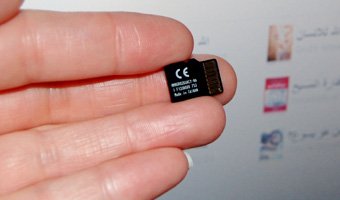
Bible League International is working with the Digital Bible Society to carry the thumbnail-sized chips to Christians in countries such as China or Saudi Arabia, where possessing unapproved religious materials can result in prosecution or even death.

Bible League International is distributing thumbnail-sized microchips that contain entire theological libraries to Christians around the world who are persecuted for their faith. (RNS PHOTO/Courtesy Bible League International)

"It's like a miniature Christian bookstore," said Robert Frank, global CEO of Bible League International, an Illinois-based nonprofit evangelical ministry dedicated to training church leaders using the Bible.

The digital ministry continues the historic work of the Bible League, which went international after World War II when Gen. Douglas Mac Arthur asked U.S. Christian groups to send Bibles to Japan.

The Bible League's 2011 merger with the Texas-based World Bible Translation Center expanded its abilities to get materials to Christians around the world in their own languages.

The Digital Bible compresses data for maximum storage, then copies the material to cell phone cards, thumb drives, CDs and DVDs, depending upon the country where they will be used. The advantage of the format is that a person can use them, but leave no trace on a computer of their use, unlike the trails left by accessing websites.

Publishers who made their work available for the chip also have agreed to allow copying the cards without a fee, Frank said. The works have been translated into Arabic, Farsi, Mandarin and other languages of areas where Christians are persecuted.

"And the content has been donated," said Synetta Armstrong, senior director of global communications for the Bible League, who demonstrated the chip at last fall's Religion Newswriters Association conference. "We want to spread the word of God."

In addition to several versions of the Bible, each of the Digital Bible libraries include worship music, movies, Bible commentaries, a study library, a copy of Rick Warren's The Purpose Driven Life and other landmark books about discipleship, ministry and history, as well as more than 1,200 images that can be used for a pastor's study and for teaching others.


U.S. mosques multiply, take ‘moderate’ approach

WASHINGTON (RNS) —The number of mosques in America has jumped 74 percent since 2000, and the majority of them—56 percent—espouse a less-than-literal approach to interpreting Islam's holy texts, according to a new survey of American mosques produced by a coalition of Islamic civic groups and Muslim and non-Muslim religion scholars.

"Islam is one of the few growth spots in America's religious mosaic," said David Roozen of the Hartford Institute for Religion Research, part of a Protestant seminary.

The number of mosques in America has jumped 74 percent since 2000. (RNS photo by Aristide Economopoulos/The Star-Ledger)

Leaders of the institutions that sponsored the survey offered it as a counterargument to the currents of "Islamophobia" they say have tainted much political and personal discourse during the past 10 years.

The report, they said, shows a strong willingness on the part of mosque leaders to encourage worshippers to engage in American society, including its politics.

"Post-9/11, I was really afraid of the new negative attitude Muslims were receiving," said Safaa Zar-zour, secretary general of the Islamic Society of North America. "It made me feel that Muslim communities would feel marginalized from American society, and that, to me, is where things can become dangerous."

But that did not happen, he continued.

"We see outreach and engagement among mosques—mosques with food pantries, medical clinics. You have people who can look at mosques in their neighborhood and see Muslims as people who can help, not people to be feared."

The survey, "The American Mosque 2011," counted 2,106 mosques in the nation, and a spike in the number of people who attend Eid prayers, the Muslim holy days that tend to attract more people than any other. In 2011, the survey found 2.6 million people had gone to Eid prayers, up from 2 million in 2000.

That last figure challenges many previous estimates of the U.S. Muslim population, which generally fall well below 3 million. Given the number of Muslims who do not pray the Eid prayers, the total number of Muslims in the United States likely exceeds 3 million, perhaps by more than a million, the study's authors conclude.

Within those mosques, a more flexible attitude toward the interpretation of Islam is more typical, with 56 percent of mosque leaders describing their own approach as one that sees the Quran and other Muslim holy writings as a guide relevant to modern life.

Of the remaining mosque leaders surveyed, 31 percent take a more conservative approach and base their interpretations on centuries of Islamic scholarship. Another 11 percent follow a single, traditional religious school of thought.

Just 1 percent followed a strict interpretation the study's authors likened to Wahhabism, the brand of Islam that predominates in Saudi Arabia.

For most of American history, American Muslims have not drawn much attention. That changed on 9/11, but much of the new focus on Muslims has been negative and depicted American mosques as a breeding ground for radicalism. The House Homeland Security Commit-tee has held a series of widely publicized hearings on the subject.

But the 524 mosque leaders interviewed for the report tell a different story, according to the survey. Asked whether they agree that American Muslims should be involved in American institutions, 98 percent agree or strongly agree; none strongly disagree.

And 91 percent of mosque leaders either agree or strongly agree Muslims should participate in the American political process.

The study also reveals the diversity of American mosques. Among regular mosque participants, 33 percent are South Asian, 27 percent are Arab, and 24 percent are African-American.

Other findings of the report include:

• A steady conversion rate. In 2011, the average number of converts per mosque was 15.3 compared to 16.3 in 2000.

• A decrease in the number of mosques in urban areas and an increase in suburban mosques. In 2000, 16 percent of mosques were located in the suburbs, compared to 28 percent in 2011.

• A shift in geographic distribution of mosques, which in 2000 were mostly concentrated in the Northeast. In 2011, the South had the greatest number of mosques, 34 percent, compared to 26 percent in 2000.

• About 7 percent of the mosques surveyed identified as Shiite, with the greatest proportion located in the West (37 percent).

The survey is part of a larger, continuing study of American congregations called Faith Communities Today, a multifaith effort.

The mosque survey in particular was sponsored by the Hartford Institute for Religion Research at Hartford Seminary; the Association of Statisticians of American Religious Bodies; the Council on American-Islamic Relations, the Islamic Society of North America, the Islamic Circle of North American and the International Institute of Islamic Thought.


Faith Digest

No Mormon baptism for Holocaust victims. Mormons who want to practice proxy baptism for the dead have been told to keep it in the family. The governing First Presidency of the Church of Jesus Christ of Latter-day Saints recently issued a mandate to members: Do not submit names of Jewish Holocaust victims or celebrities for proxy baptism. Doing so could cost Mormons access to their church's genealogical data or even their good standing in the faith. The letter reminded members their "pre-eminent obligation" is to their own ancestors, and any name submitted for proxy rituals "should be related to the submitter." The Mormon practice known as "baptism for the dead" involves living people being baptized on behalf of the deceased. Mormons believe it is their moral obligation to do the temple rituals, while those in the hereafter can either accept or reject the ordinance.

Billy Graham Evangelistic Association makes cuts. Fifty people on the 500-member staff of the Billy Graham Evangelistic Association will lose their jobs between mid-March and this summer, said Brent Rinehart, a BGEA spokesman. About 20 of the affected staffers work at the association headquarters in Charlotte, N.C. Others have worked as field staff across the globe or at The Cove, the BGEA's training center in Asheville, N.C. Rinehart insisted the layoffs are "not a reflection of the financial health of the organization." Rather, they are part of an effort to redeploy resources to focus on those areas of great impact, such as SearchforJesus.net, a website the association launched last April that includes a real-time count of decisions people make to become Christians. Famed evangelist Billy Graham remains the chairman of the association he founded in 1950. His son, Franklin, runs the day-to-day operations as the CEO and president. The BGEA's revenue dropped from $126 million in 2005 to $85.7 million in 2009, Rinehart said. In 2010, it totaled $91.6 million.

Slow progress at quake-damaged National Cathedral. It took 83 years to build the iconic Washington National Cathedral, but a rare East Coast earthquake last summer took only seconds to send carved stone finials tumbling from the heavens to the ground below. Six months after the 5.8-magnitude quake, the cathedral is facing repair costs of at least $20 million, and a reconstruction timeline that could stretch out a decade or more. The bill to fix the iconic church now is at least $5 million more than original estimates, said church officials, who still are working to stabilize the building, repair its intricate stonework and raise money to continue the restoration. So far, donations for repairs have reached $2 million, or 10 percent of the predicted cost.

Anglicans seek to stop copper thefts. The Church of England is spearheading a campaign to install high-tech movement sensors on scores of churches in a bid to stop a rash of lead and copper thieves who have targeted the roofs of religious buildings. The stolen metals are fetching increasingly higher prices on international markets. The insurance firm Ecclesiastical reported receiving a record 2,600 claims last year.

Compiled from Religion News Service


Faith & Politics

While the U.S. Constitution specifically mandates no religious litmus test should be used to determine who holds office, Christians still grapple with how—and if—their faith should inform their choice in candidates. And they often use the Bible to back their decisions.

Recently, Relevant magazine published a series of opinion pieces in which selected writers shared their reasons for choosing to participate with a particular political party or none at all. All of them pointed to Scripture to support their conclusions.

Caryn Rivadeneira chose the Libertarian Party partly because Jesus called the church to help people who need assistance, but she believes the church has abdicated that responsibility.

Republican Matthew Anderson pointed to 1 Timothy 2:1-2 and Revelation 13:1-10. God has given the government the power of coercion. Republicans recognize the power but choose not to force taxpayers to meet society's needs. They recognize needs but choose to allow people to meet needs voluntarily.

On the other hand, Democrat David Masciotra used Romans 12, Matthew and James to bolster arguments for government participation in social justice and service.

C. Christopher Smith even pointed to Jesus' ministry as justification for his "discipline of not voting."

The constitutional prohibition on a religious test for public office means any qualified person, regardless of his or her faith tradition—or lack thereof—can run.

But should Christians apply their own "test"?

No, according to the Baptist Joint Committee for Religious Liberty. "People often focus on religion, but they shouldn't make a decision (about a candidate) based on religion alone," Executive Director Brent Walker said.

"Article 6 (of the Constitution) keeps government from setting a religious test. … We should not just abide by the letter of the law, … but voters also ought to exercise that same restraint," he added. "Religion is part of the mix but … shouldn't be the primary factor."

The way in which a politician practices his or her faith, rather than the religion itself, plays into that mix. For example, if a candidate holds to a faith tradition that is based upon and highly values peace, how will that affect foreign policy decisions or his or her reaction to the threat of war?

Citizens shouldn't vote on the basis of "theology for theology's sake," Walker added, "but on whether it makes a difference in the performing of the office."

Religious liberty

Ethicist Bill Tillman, the Baptist General Convention of Texas' director of theological education, pointed out that historically, Baptists have championed religious liberty.

In Great Britain, "Thomas Helwys … asked for no religious test to be mandated from the English throne as to who could have religious services. Helwys' conviction was that one's conscience, part of the image of God implanted in us, was of such worth that no king, government or anyone had any business mandating how it should work," Tillman said.

Many Baptists have lost that perspective today, especially in parts of the country where they represent the religious majority, he said.

"In losing a minority perspective, … ironically, some Christians who have never felt a religious persuasion to be mandated lean on getting elected officials to do their commissioned work," Tillman said.

"The United States government was set up as a secular state, a grand vision, that peoples' individuality and sensitivities to the larger social well-being would be what is important."

While some Baptist leaders agree public servants have a right to practice or not practice faith, they also believe Christians should consider the biblical perspective when dealing with political issues. Many Southern Baptist state conventions have a Christian life commission or have a volunteer or staffer to articulate moral and ethical stands to their legislators.

Louisiana Baptist Convention trustees recently named Kelly Boggs as their state convention's public affairs officer. He also serves as editor of the Baptist Message, the convention's news journal.

"I'm interested in issues that have become politicized," he said in a recent interview. "I've always felt strongly about speaking out" on those issues.

Noting that his father had fought in World War II, he added, "It is my opinion that because of what they (servicemen) did … the least I can do … is take a stand publicly for what they fought for."

Christians are called to be "salt and light." The United States is a "participatory democracy, and citizens have the right to participate," Boggs said. "America has been shaped in debate … respectful debate for the most part … I have just wanted to present ideas from a Christian worldview."

Political choice

Although religion—particularly Mitt Romney's Mormon faith—continues to generate controversy in the 2012 election cycle, candidates may not be able to count on faith to garner as many votes as it may have done in the past.

According to a September 2011 LifeWay Research online survey, only one in six Americans is more likely to vote for a candidate who publicly expresses his or her faith than for candidates who do not. That's especially true among voters under 29.

Even though religion may not play as prominent a role, there are still "too many candidates trying to posture themselves as religious champions," according to Rudy Pulido, longtime president of the St. Louis chapter of Americans United for Separation of Church and State, who just recently stepped down.

He believes Americans are no longer "challenged" to fight for religious liberty because the law allows each person to worship as they wish, and have many outlets to express their beliefs.


Rick Warren finds new purpose in weight loss

LAKE FOREST, Calif. (RNS)—Megachurch Pastor Rick Warren has become an outsized evangelical superstar as best-selling author of The Purpose Driven Life series, pastoral mentor and even political referee. Now, Warren is finding a new purpose—tackling his outsized waistline.

Mehmet Oz measures megachurch Pastor Rick Warren's waistline at a Daniel Plan forum at Saddleback Church in Lake Forest, Calif. (RNS PHOTO/Courtesy Toby Crabtree/Saddleback Church)

Warren, 58, noted the revelation came about a year ago, during a marathon baptism session of about 800 people at Saddleback Church. As he struggled to immerse members of his flock in the baptismal pool one by one, he realized his parishioners were heavy and that he, too, was fat, setting a terrible example.

Warren's gradual weight gain—about two to three pounds a year—has added up over his 30 years as a pastor. To lose the extra pounds and inspire others to do the same, the former football player en-listed the help of three doctors.

Warren recruited a family physician, Mark Hyman; Meh-met Oz, New York Times best-selling author and host of NBC's The Dr. Oz Show; and Daniel Amen, a professor of psychiatry at the University of California, Irvine School of Medicine, and the lone Christian in the mix.

Together, they launched "The Daniel Plan: God's Prescription for Your Health," named after a passage in the biblical Book of Daniel where the prophet and fellow Israelites refuse to accept "royal" food and wine from the Babylonian king, opting for water and simple vegetables instead.

The Daniel Plan encourages parishioners to link into Saddleback's vast network of small Bible study groups as support systems to get fit. Congregants exercise together at weekly classes such as "Walk & Worship" and "Pump & Praise." The three doctors offer tips on healthy eating, and participants can create a health profile online.

Since the launch of the plan a year ago, more than 15,000 people have signed up, and participants have shed a combined total of at least 250,000 pounds, according to the church. The 6-foot-3 Warren, who started the program at 295 pounds, shed 60 pounds in the first year.

Amen, a Saddleback member, said: "Churches are by and large a place of illness. … I'm tired of fat football coaches and fat pastors."

Rick Warren is finding a new purpose—tackling his outsized waistline.

The advantage of losing weight in a church, he said, is the support of the built-in community.

"When you're surrounded by other people who have the same values, and they have the same health habits, you're going to do so much better," he said.

Tammie Allen, 41, a mother of two and a Saddleback Church member, joined the Daniel Plan with other members of her Monday night Bible study group.

"You can't do it alone, and you can't do it without God's power," said Allen, who started exercising with other Saddleback parishioners and chose more fruits and vegetables. So far, she's dropped 97 pounds.

"My daughter tells me all the time she loves being able to put her arms around me."

Jim and Melanie Black, who just celebrated their 11-year anniversary, joined the program together and have dropped their taste for fast food. "We're doing it so we can serve God at a higher level," he said.

Chiquita Seals, 45, a single mother of two, is so far the church's biggest loser.

"In the beginning, I thought, 'This is just another diet program,'" she said. Seals added she assumed she was "going to be eating rabbit food."

After all, Seals said, she had tried other diet programs like Jenny Craig and Weight Watchers, but this is the only one that stuck. When she began the Daniel Plan, she weighed 267 pounds. She now weighs 135.

"All my life I thought that I could never be used by God," Seals confessed in a video posted on the church's website. But after losing the pounds, "I know I can be used by God."

To be sure, the program has attracted scrutiny. The church posted an online response to those who questioned the use of non-Christian doctors to help lead the program, saying that members "will never compromise our belief that Jesus is the only way to heaven or that the Bible is the 100 percent completely in-fallible and perfect word of God."

"These doctors are helping us as friends," the statement concludes, "but are in no way advising our church on spiritual matters."

For his part, Warren still hopes to drop another 30 pounds. And, in typical Warren fashion, he's spreading his message to other churches. The bottom line, Amen said, is those looking to lose weight are in luck.

"If for whatever reason your family won't do it with you," he said, "well, you now have the family of Saddleback."


Politics & Media: Learn to recognize bias, determine reliability

Voters want and need reliable and truthful information about candidates at all levels of government and from all political perspectives. But in an information age that overwhelms the electorate with sheer volume at breakneck speed, what factors should people of faith keep in mind as they glean information from mainstream and religious media?

"People come to media already with certain biases," noted Debra Mason, executive director of the Religion Newswriters Association, an organization for religion writers in the mainstream media. "Sometimes they can't separate out those attitudes."

Voters need to be aware of their own biases, including those in their own faith tradition. Then they also must look for the bias that the media they use also likely will reflect.

"World (magazine) may appear to be using the same standards and approach as the New York Times, but, in fact, it is using a Christian frame to everything it reports," Mason said. "That's not necessarily bad, … readers just need to recognize that."

Readers looking for information also should be aware that a look of professionalism, particularly online, doesn't necessarily mean the information is reliable.

"It's very easy to have a site that looks professional and sounds professional as if it has been done by professional journalists but that still is propagandistic," she said. "That is harder to discern."

But Mason encourages all voters to be as informed as possible and to use a variety of media as they research candidates and issues. She offered some tips for discovering legitimate and credible sources of information:

• "Look at the issues that are raised to high prominence," she said. Prominently featuring certain, especially highly emotional, issues, even when those issues are not major concerns in the campaign, could indicate a bias. Ask, "Are those editors using those issues because they are highly salient to a particular group?"

• Look for diverse comments on the site. "If the journalists are annoying both sides, sometimes that's a clue that the site is offering a little of both sides of issues," Mason said.

• Is the medium's ownership clear? "If you can't find out who owns it … or is producing it, you have to wonder why that information is so elusive."

• Don't assume a secular medium holds higher journalistic standards than does a religious one, with the additional assumption that one medium treats information more fairly or accurately. "The selection of news may be more narrow (in a religious medium), but the treatment of news may be just as fair, and the censorship may be light," she explained.

• Diversity can provide more angles to veracity. "Any story with diverse sources and with a lot of different points of view is going to get closer to the truth," she said. "Bloggers are basically offering their opinions."

Media consumers need to be aware of the difference between blogs—personal journals on the Internet—and news stories online. People "sometimes don't notice or discern the difference between news and commentary," she said. Realizing the distinctions will help voters determine possible bias.

• Voters must be cautious with political polls and numbers, Mason noted. "Numbers can be used in deceptive ways. It's important to look at where they (writers) are getting the numbers and how the poll is being done. Do they tell you how the numbers are being used? You can use numbers to support assertions or to deceive."

• Who has been interviewed for the article? While a story might quote sources, does it adequately identify the individuals' connection to the candidate? "The closer someone is to the person written about, the more accurate you hope the information will be," Mason explained. "But you also have to consider the level of the investment of that (source) in the candidate. But at least that person is on the record."

• Voters also must remember that today's media have "a huge opportunity for rumor and conjecture" because they must offer news 24 hours a day, seven days a week. "That's what's so hard today—the 24/7 news cycle," Mason said. Media "risk publishing or distributing errors more frequently and more easily than with longer and more predictable publishing cycles."


Bearing false witness still a sin, even in campaign season

When a politically volatile email arrives warning Christians about some elected official's action or some candidate's position that sounds so horrible it's hard to believe—don't believe it, some pastors suggest.

And for heaven's sake, don't forward it.

"When an email is forwarded to me, I am skeptical from the start," said David Morgan, pastor of Trinity Baptist Church in Harker Heights. "Assume it isn't true until you check it out. Personally verify it. Be hesitant to forward anything."

Christians have a responsibility not only to avoid bearing false witness, but also to stand up for truth, said Van Christian, pastor of First Baptist Church in Comanche.

"We are horrendously guilty of the urban-legend syndrome. If it sounds good to us and seems plausible, we want to warn everybody about it," Christian said. "To tell something you do not know to be true is a terrible Christian witness."

Failure to check out the veracity of a rumor not only violates the commandment about truth-telling but also demonstrates sloth, he added.

"We need to make a commitment to not be lazy. We need to be good stewards of the truth. We should take the time and make the effort to find out what the truth is and stand for that," Christian said.

Civility should characterize a Christian's conversation, whether that involves political debate during a campaign or commentary on an official after an election, Morgan said.

"After the election, respect is not a bad thing for Christians to have. Practice truth-telling and respect, whether or not your candidate wins," he said.

"There is not a demon on the ballot—usually. If my candidate didn't win, I would not be happy, but I need to realize the other guy who won is not the bad guy.

"We should take steps not to be polarizing. Find those things we have in common. … The candidates are all seeking what's best for America. I'm still naïve enough to believe that. They have different visions, but they want what's best for the country."

Christians who like to quote Scripture to back up their already-determined political views should listen to the whole counsel of the Bible, Christian suggested.

"We are pretty selective about which Scriptures we listen to. When we look at the commands of Scripture, we find we are not to bear false witness. We are to control ourselves and tame the tongue. We are to bear one another's burdens. These things receive more emphasis than what we generally tend to quote."

In regard to both truthfulness or civility, Christian offered a question believers should ask: "If we were discussing politics with Jesus, would we do it the same way we do with others?"


Faith & politics: Making choices in a fallen world

Passion and conviction often direct a Christian in choosing public servants. Economic concerns, social-justice issues, foreign policy or a host of other issues can be of primary concern.

Suppose Candidate A's approach on one issue matches, but his stand on another does not. Candidate B indicates her stand is just the opposite on the two. How does a person of faith choose when his or her values clash?

"No candidate is going to agree with you 100 percent of the time," noted Brent Walker, executive director of the Baptist Joint Committee for Religious Liberty. "You must balance out which candidate reflects your understanding … on issues that matter."

Furthermore, Christians should be realistic in their expectations, in terms of finding a candidate whose values mirror their own.

"The first thing Christians need to recognize is that they are voting for an elected official, not for their pastor. The expectations need to be differentiated," said Van Christian, pastor of First Baptist Church in Comanche.

Followers of Christ have to decide which political values are most important and establish priorities—or rather, acknowledge priorities they already hold, Christian noted. "We have to be honest with ourselves about whether they are in the same order biblically," he said.

"Christians should work from what is clearly defined in Scripture out to the more general principles. Those issues that are clearly defined should be at the forefront, and those that are based on general principles should be more toward the back. … There are issues that trump others."

The gospel can keep believers focused, noted Bill Tillman, director of theological education for the Baptist General Convention of Texas. Christians are citizens of both heaven and of a particular geographical location.

"All issues (and) positions, all other ideals—for the Christian—must be filtered through the gospel. When a candidate's particular conviction begins to abridge gospel values, it is time for a Christian to begin to question that particular conviction," he said.

The Bible should be a Christian's guide, said Kelly Boggs, the Louisiana Baptist Convention's public policy officer and editor of the Baptist Message. Formation of values "starts way before talking about politics," he said. "Hopefully, people have formed their values on the Bible, … and hopefully, they are informed."

After looking at the individual candidates, party platforms and the issues, "then you've got to choose—what is right for me," Boggs added.

Matt Paxson, an associate pastor at Fairview Baptist Church in Fredericksburg, Va., and a candidate for mayor in that city, believes voters must remember that each candidate reflects his or her "larger" party.

"Although there are times when candidates of one party might appeal to me, it is important that I remember that they represent a larger party that has identified platforms," he said.

Concern for the greater good, as opposed to self-interests, directs some believers' choices.

"Community is important. What will benefit the community as a whole?" noted David Morgan, pastor of Trinity Baptist Church in Harker Heights. "We should look out for the good of the majority and protect the rights of the minority when we vote."

Lee Wilkins, who teaches journalism ethics at the University of Missouri, considers community. "I'm leery of making a decision based on a single issue. There is a huge range of choices—everything from war and peace to tax issues. … I think all politics is about community," she explained.

"We must ask: What is best for me? What is best for my community? And I assume people in my community are not going to be like me, so I also must ask: What is best for people unlike me? They may be poorer, richer, of different faiths. … We're too focused on 'me.' It's I-I-I-I-I. But it's not about 'I' but about 'we' … the people plural."

Wilkins emphasized that when an issue "seems to strike at core values, I must ask which ones. … Then I ought to ask: How does … the range of policy proposals fit into my value structure?

"We should not be afraid to ask candidates questions. We should go beyond the first minute of sound bite and then ask the deeper questions," she said.

Wilkins added most people hold to values deeply and usually concurrently, rather than as separate beliefs, and systems of thought teach respect.

"I know of no religious or philosophical system that holds to demonizing people for what they believe, and I am exceptionally wary of people who ask me to do that," she said.

When struggling with decisions, people of faith must remember they "live in a fallen, quite mortal world," Tillman said.

"As we begin to support a particular candidate … we must figure out where they come out mostly, not just on one issue. Confusing? Dilemma-producing? Yes, but if we really do invest some time into the political sphere, we will find ourselves making these matters a point of prayer, ever more seeking the will of God for ourselves and beyond ourselves. The results of such seeking can't be bad at all."

–With additional reporting by Managing Editor Ken Camp


Young singer finds strength and stability in Christ

ATLANTA, Ga.—Jamie-Grace Harper's Grammy Award-nominated contemporary Christian song, "Hold Me," grows from her own experience of God's sustaining grace as she has struggled with Tourette syndrome.

Jamie-Grace Harper’s Grammy Award-nominated contemporary Christian song, “Hold Me,â€Â grows from her own experience of God’s sustaining grace as she has struggled with Tourette syndrome.

At age 11, Harper was diagnosed with the neurological disorder characterized by uncontrollable sounds or movements.

"Symptoms started showing up when I was 9, and it was two years later that I received the official diagnosis," Harper said. "It was really frustrating and stressful, because I started making these weird movements and sounds that I couldn't control, and I dealt with a lot of bullying and torment from kids at school. When I got the diagnosis, in one way it was a relief to know what was going on. But it also left me with more questions and heartbreak, because there wasn't a cure or a medicine to fix it.

"Before being diagnosed with Tourette's, I was this outgoing kid who was passionate about her faith. After receiving the diagnosis, I spent almost two years in a slump. I never doubted that God was there, but I thought he didn't love me as much. I thought that my parents and sister must have loved the Lord more than I did, and in return, God must have loved them more than he loved me because they didn't have this problem. I had a lot of doubts and insecurities with my relationship with Christ and also with my self image." 

However, an unexpected gift from her grandfather sparked a renewed joy and also helped relieve some of her symptoms.

"When I was 13 or 14, my grandfather gave my sister and me a drum set and guitar," Harper said. "Looking back, I think he was trying to bring us some hope and joy during this time.  I don't think he had any idea that he was stirring up this passion in me to play music.  I had been singing my whole life, but when I started playing these instruments, it took music to another level for me and also started helping my symptoms. During that same time, I was really impacted by Psalm 30:5, 'Weeping may remain for a night, but rejoicing comes in the morning.'

"Between that verse and being involved with music, I was able to start coming out of my slump and began to understand that God still had a plan and purpose for my life. I realized that he wasn't going to let go of me—even though I was confused, stressed out and depressed. When I realized that he was still there and was still taking care of me, my outlook on life completely changed." 

At age 19, Harper performs concerts across the country on the Revolve Tour, where she shares a message with teenage girls about finding strength and identity in Christ. In addition, she has established a nonprofit organization for teenagers with Tourette syndrome. As she describes her personal struggles, she desires to provide comfort and hope for others who are suffering from similar issues or illnesses. Harper has also created the Grace Talk conference, designed for local churches and focusing on topics relevant to teenage girls such as purity, relationships, parents and school. 

{youtube}ISgr8SgCYbY{/youtube}

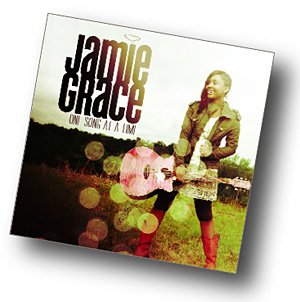
A few months ago, she released her debut album, One Song at a Time. While maintaining a busy speaking and performance schedule, Harper is majoring in child and youth development at Point University, formerly Atlanta Christian College. 

Whether she is singing, speaking or working with young families, Harper desires to make an impact on lives with messages of hope and encouragement while sharing the gospel.

"I want to do everything I can to help other teenagers and to tell everyone I can about the joy of the Lord," Harper said. "I want to do whatever I can to share the love of God and to share that we all go through difficult things, but we are never alone. God is right there with us, and is never going to leave his children."