





An April report from the Survey Center on American Life claims young women have overtaken men in disaffiliation from their formative religions.
The report’s authors, Daniel A. Cox and Kelsey Eyre Hammond noted: “Over the last two decades, which witnessed an explosion of religious disaffiliation, it was men more than women who were abandoning their faith commitments.
“In fact, for as long as we’ve conducted polls on religion, men have consistently demonstrated lower levels of religious engagement. But something has changed.”
The study authors explained their recent survey reflected a reversal from this long-standing norm. Details on how the survey was conducted or what questions were asked were not included in the report, only noting the survey of 5,459 U.S. adults was conducted by the Survey Center on American Life in 2023.
Evidence of a flip
The authors said the survey they conducted showed 57 percent of people who disaffiliated among Baby Boomers were men and 43 percent were women—whereas 54 percent of Gen Z adults who left their formative religion are women, while 46 percent are men.
Additionally, research released jointly Sept. 10, by Barna and Gen Z-focused Impact 360, noted nearly half of Gen Z (49 percent) say they personally made a commitment to Jesus Christ that is still important in their life today. Two in five (38 percent) say they have not, and 14 percent are not sure.
However, the report stated when grouped by age (young adult and teen) and sex, “we see that young adult female Gen Z are the least likely to say yes (44 percent), compared with young adult male Gen Z (51 percent), and teens both male (52 percent) and female (50 percent).”
So, Gen Z females—whether young adult or teen—are less likely than Gen Z males to report a personal commitment to Jesus, according to the Barna/Impact 360 report, adding support to growing evidence that young women may be becoming less religious than young men.
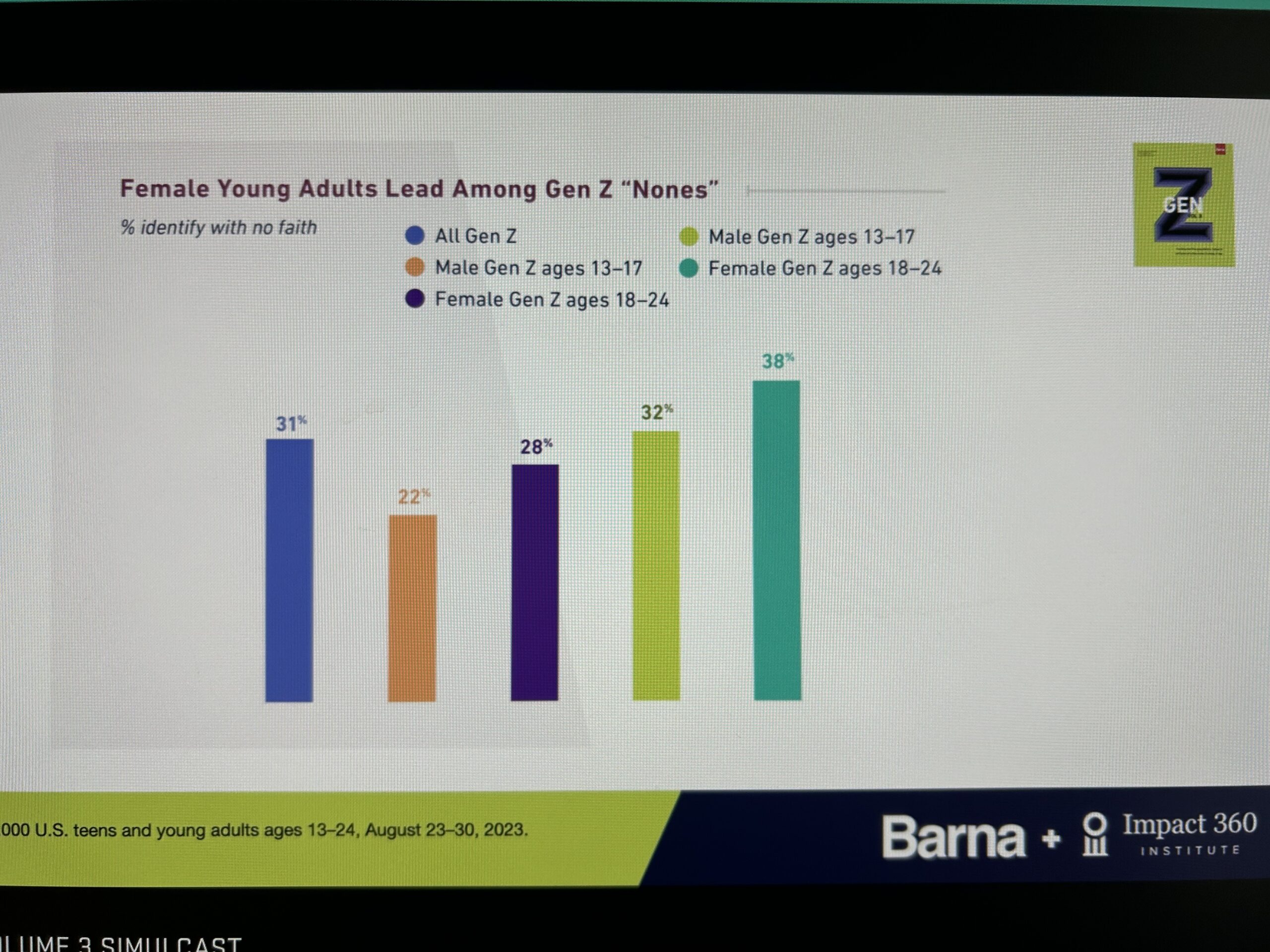
In a simulcast on Sept. 12, Barna CEO David Kinnaman highlighted data from the report confirming the shift explicity. Gen Z women are the most likely to identify as “nones”—38 percent of Gen Z women identify with no faith compared with 32 percent of Gen Z males.
Sign up for our weekly edition and get all our headlines in your inbox on Thursdays
Hammond and Cox stated their concern that while many conservative churches’ memberships have held steady despite the rise of the “nones,” or people who report no affiliation to any religion, those successes may not hold with the current generation of young women.
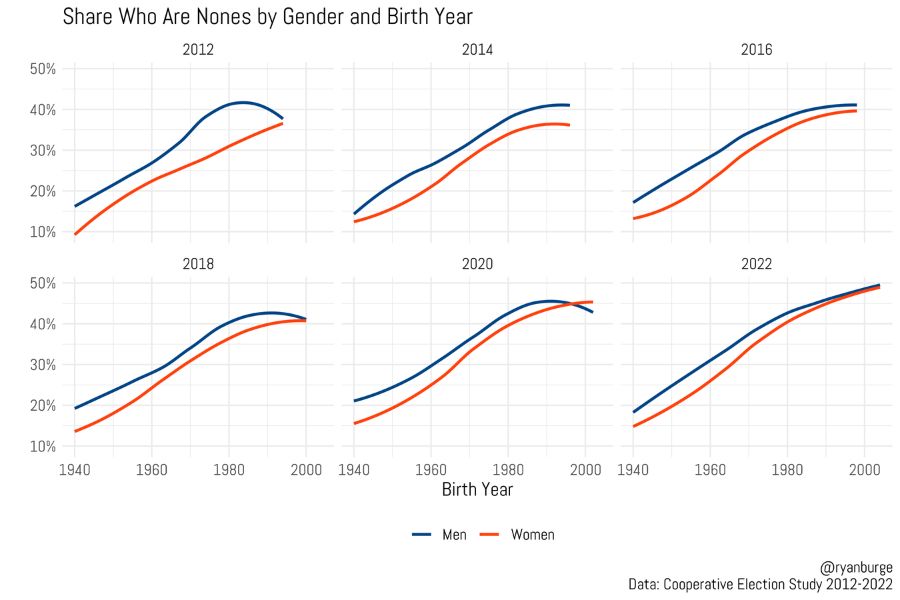
Ryan Burge, an American Baptist and a political scientist regarded as a premier statistician of religious life in the United States, also noted in June of 2023 that something was going on with women. When he analyzed data from the Cooperative Election Study, a pattern emerged suggesting young women were losing their religion in ways not previously seen.
In charting by birth year, for prior generations who reported religious identities of “atheist, agnostic or nothing in particular,” the lines ran parallel, with men slightly more likely than women to identify as nones.
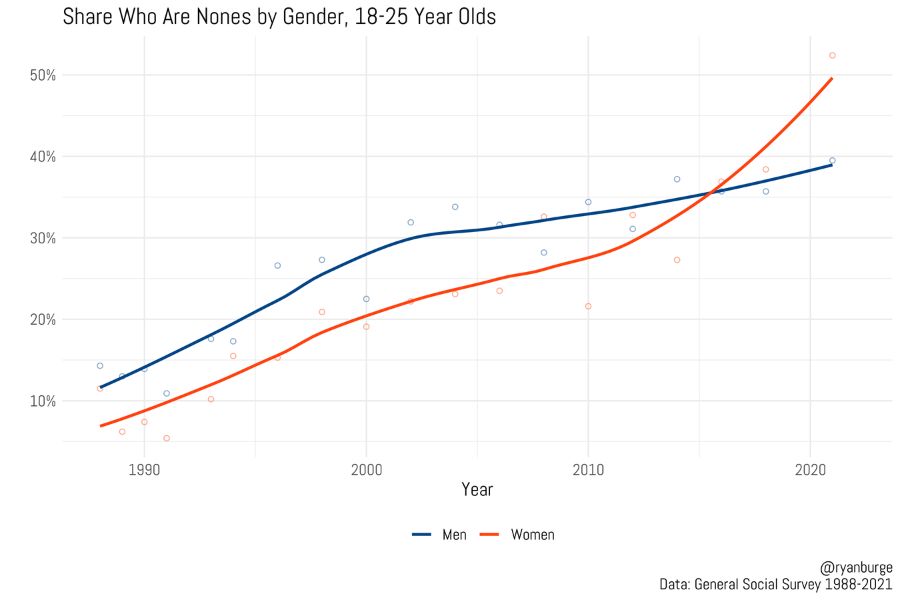
But, “among those born around 2000, the gap has essentially disappeared. Women are just as likely to be nones as men. This same general trend is evident in the last three election years of data. It’s hard to believe that it’s just noise when it’s so replicable,” Burge noted.
Contributing factors
Cox and Hammond suggested in their analysis of the Survey Center on American Life findings that “feminism, gender and a cultural mismatch” are at the heart of the reversal.
“Sixty-one percent of Gen Z women identify as feminist, far greater than women from previous generations,” the report stated.
“Younger women are more concerned about the unequal treatment of women in American society and are more suspicious of institutions that uphold traditional social arrangements,” Cox and Hammond contended.
“Nearly two-thirds (65 percent) of young women said they do not believe that churches treat men and women equally,” the report continued, pointing to the Southern Baptist Convention’s strong stance against women serving in equal positions to men in the church.
The analysis also noted a “cultural misalignment between more traditional churches and places of worship and young women who have grown increasingly liberal since 2015.” Cox and Hammond cited the 2022 General Social Survey showing 54 percent of young women believe abortion should be available with no restrictions as evidence of this liberal shift.
Additionally, in March Gallup reported young women are more likely than men to hold LGBTQ+ identities.
Almost three in 10 Gen Z women, (28.5 percent) identify as LGBTQ+, compared with 10.6 percent of Gen Z men. Among millennials, 12.4 percent of women and 5.4 percent of men have an LGBTQ+ identification, the Gallup report stated.
A Public Religion Research Institute report in March found 47 percent of young people who left their childhood religion said “negative treatment of gay and lesbian people” was an important factor in their disaffiliation.
Texas considerations

In Texas, Todd Still, dean of Baylor University’s Truett Theological Seminary, said a shift in young women becoming less religious is not something he’s seen verified at the seminary, yet. In fact, he said women already come close (60 percent male to 40 percent female at last count) and next year even may equal men in enrollment.
He acknowledged that “going where you’re wanted” may play a role in the rising number of women at Truett. Some of the women at Truett otherwise might have attended one of the SBC seminaries, but recent SBC stances related to women may have persuaded them to seek theological education at Truett where they know they will be treated more equally.
Despite strong female enrollment, Still said, if additional research does bear out the Survey Center on American Life’s claims that disaffiliation among young women has overtaken that of young men and Gen Z women are disaffiliating with the churches of their childhood, “this does signal, or should signal, concern for churches.
“Because as they [Hammond and Cox] rightly note, frequently, the involvement of women—at least historically—has been greater, the sacrifice has been greater, attendance, obviously, has been higher. If these are early results, it’s disconcerting.”

Jill Hudson, executive director of Texas Baptist Women in Ministry, an organization that supports women serving in vocational ministry in Texas, also was unaware of reports women may have overtaken men in claiming no specific religious identity.
However, she said in her work with women in Texas, she has seen young women who previously held strong religious convictions reach a place of disaffiliation.
Hudson said when young women graduate from seminary and begin seeking employment in Texas Baptist churches, they often are met with disappointment.
Believing they’ve discerned God’s call to ministry accurately, done what they’ve needed to do to get hired [earn a Master of Divinity degree], and then being unable to find a church who will hire them can lead to a crisis of faith, Hudson explained.
She said it’s extremely discouraging to these women to apply for positions at churches that claim to support women in ministry, only to have it turn out the church, in reality, only meant children’s minister, not whatever the position was to which they applied.
These new graduates learn they have choices—leave Texas, switch denominations or take a ministerial role not in line with what they believe to be what God is calling and has equipped them to do—none of which are choices they want to make, she continued.
These young women are “deeply Baptist,” Hudson said, until the reality of what it’s like to be a woman seeking to serve in vocational ministry in Texas unmoors them. Sometimes, that means losing faith not only in the church and Baptist life, but in themselves and/or in God, because they cannot bridge the mismatch between their internal faith and the cultural reality.
Hudson said she is available to work with churches on matters related to women in ministry and on having difficult conversations that may help stem the outflow of Gen Z women from the faith.
Dedication to women in ministry reaffirmed
Still concluded: “At Truett Seminary, we work intentionally and tirelessly to equip God-called men and women for gospel ministry and to resource and connect our students and graduates, both women and men, with ministry opportunities that align with their callings.
“We are aware of and sympathetic toward any number of the unique challenges women in ministry face, and we strive to facilitate meaningful ministry placements for them in various and sundry ways, not least through our Office of Ministry Connections.
“Simultaneously, our seminary intentionally seeks to serve churches as they search for ministry candidates, including women.
“In fact, in any given year, our Ministry Connections team will consult with more than 400 churches and nonprofits in an effort to assist our students, alumni and friends to find meaningful places of service in and alongside Christ’s church.
“While we do not always succeed, our annual, effective placement rate of both our men and women graduates historically falls between 90 and 95 percent.”
Editors note: Paragraph 9 and the accompanying graph were added after the story initially was posted.








We seek to connect God’s story and God’s people around the world. To learn more about God’s story, click here.
Send comments and feedback to Eric Black, our editor. For comments to be published, please specify “letter to the editor.” Maximum length for publication is 300 words.