





BRENTWOOD, Tenn.—More pastors are encouraging members to adopt and provide foster care at a time when adoptions have declined in the United States.
A Lifeway Research study found more than 2 in 5 U.S. Protestant churchgoers (44 percent) say their congregation and its leaders are involved proactively with adoption and foster care in at least one of seven ways.
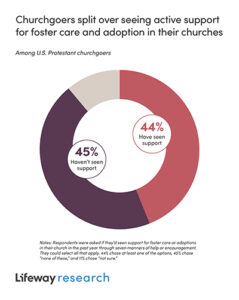 A similar percentage (45 percent) say they haven’t seen other churchgoers or leaders provide any of the specific types of care or support, while 11 percent aren’t sure.
“Caring for the fatherless is repeatedly prioritized throughout Scripture,” said Scott McConnell, executive director Lifeway Research. “But the Bible does not pretend caring for another like your own child is convenient or easy.”
More than 1 in 10 churchgoers say someone in their congregation has provided foster care (16 percent), adopted a child from the United States (13 percent) or adopted a child from another country (11 percent) within the last year.
Compared to five years ago, fewer churchgoers say they’ve seen members of their church actively participate in adoption and foster care. In a 2017 Lifeway Research study, 25 percent of U.S. Protestant churchgoers said a church member provided foster care, 17 percent said someone adopted domestically and 15 percent said a member adopted internationally in the past year. 
Adoptions and the prevalence of foster care have fallen among all Americans in recent years. The number of U.S. children in foster care dropped from 436,556 with 124,004 waiting to be adopted in 2017 to 391,098 with 113,589 waiting to be adopted in 2021, according to a report from the Adoption and Foster Care Analysis and Reporting System. Adoptions, both domestically and internationally, have declined as well.
Need is great and may grow greater
Some experts have speculated, however, that the overturning of Roe v. Wade will result in increased strain on the foster care system and additional children in need of adoption.
In a Lifeway Research study conducted just prior to the Supreme Court’s decision on abortion rights, around 3 in 4 Americans (74 percent) said churches and religious organizations in states that restrict access to abortion have a responsibility to increase support and provide options for women who have unwanted pregnancies.
Sign up for our weekly edition and get all our headlines in your inbox on Thursdays
“It is likely the pandemic limited some families in considering foster care or adoption,” McConnell said. “But the need is still great in the U.S. and could grow larger in states with abortion restrictions.”
Churchgoers in the parenting age range often are more likely to say they’ve seen someone in their church step up in these areas in the past year. Those ages 18 to 34 (19 percent) and 35 to 49 (22 percent) are more likely than those 65 and older (10 percent) to say someone in their congregation has provided foster care.
Churchgoers 35 to 49 (16 percent) are twice as likely as those 50 to 64 (8 percent) and 65 and older (9 percent) to say someone at their church adopted internationally. Those 18 to 34 (19 percent) and 35 to 49 (20 percent) are twice as likely as those 50 to 64 (10 percent) and 65 and older (8 percent) to have seen a domestic adoption in their church within the last year.
Nondenominational churchgoers (22 percent) are among the most likely to have seen foster care in their churches. Methodists are among the most likely to say a fellow church member has adopted either internationally (18 percent) or domestically (31 percent).
Despite the decrease in churchgoers seeing members actively participate, many say within the last year they’ve heard leaders broach the subject and seek to support the issue in other ways.
Around 1 in 6 say their church leaders have raised funds for families who were adopting (18 percent), encouraged families to provide foster care (17 percent) or encouraged families to consider adoption (16 percent).
Additionally, 10 percent say their church leaders have provided training for foster parents in the last year. 
Churchgoers are more likely now to say they’ve seen leaders help in these ways compared to 2017. Five years ago, 12 percent of churchgoers said leaders encouraged members to provide foster care, 8 percent saw leaders raise funds for families who were adopting, and 6 percent said leaders provided training for foster parents.
“While some forms of encouragement have become more common in churches in the last five years, 8 in 10 churchgoers have not seen or heard each of these forms of help or encouragement,” McConnell said.
Again, proximity to parenting age increases the likelihood of someone having seen leaders encourage members in these ways. Churchgoers under 50 are more likely than those 50 and older to say they’ve seen leaders raise funds, encourage providing foster care and encourage adoption. Those 65 and older (4 percent) are least likely to say they’ve seen leaders at their church provide foster care training.
Methodists are among the most active in providing assistance and encouragement. They’re among the most likely to say they’ve seen leaders raise funds for adoption in the past year (42 percent) and the most likely to say their leaders have encouraged churchgoers to consider adoption (48 percent) and provide foster care (41 percent).
Comparable to 2017, 45 percent of U.S. Protestant churchgoers say their church hasn’t helped in any of these ways in the past year.
“Not every exhortation from pastors and church leaders is heard or understood by laity, but only a minority of churchgoers recognized encouragement for families to adopt or provide foster care this last year,” McConnell said.
Churchgoers 65 and older (59 percent) are most likely to say they haven’t seen their church provide any of the assistance or support asked about in the study. Females (49 percent) are more likely than males (39 percent) to select “none of these.”
Denominationally, Presbyterian/Reformed (60 percent), Lutheran (55 percent) and Baptist (50 percent) churchgoers are more likely than Restorationist movement (26 percent) and Methodist churchgoers (20 percent) to say their churches haven’t helped in these ways.
Lifeway Research conducted the online survey of American Protestant churchgoers Sept. 19-29, 2022, using a national pre-recruited panel. Quotas and slight weights were used to balance gender, age, region, ethnicity, education and religion to reflect the population more accurately. The completed sample is 1,002 surveys, providing 95 percent confidence the sampling error does not exceed plus or minus 3.3 percent. Margins of error are higher in sub-groups.






We seek to connect God’s story and God’s people around the world. To learn more about God’s story, click here.
Send comments and feedback to Eric Black, our editor. For comments to be published, please specify “letter to the editor.” Maximum length for publication is 300 words.