Bob Dylanâs religionâ still tangled up in mystery
WASHINGTON (RNS)—In the 1960s, Bob Dylan was hailed as a prophet, first of folk music, then of rock ’n’ roll—at least by those who forgave him the heresy of having “gone electric.” But in the late 1970s, when rock’s best-known Jew famously declared Jesus to be the answer, many fans turned on him.
|
Author Michael J. Gilmour says it’s “hard to answer where (Dylan) is now” religiously. “He’s always going on first dates but never actually settles into a long-term relationship.”
|
For five decades, Robert Allen Zimmerman, who turned 70 May 24, has shocked, mystified, baffled and intrigued fans with songs rife with biblical references and no shortage of religious imagery.
For Michael J. Gilmour, an associate professor of New Testament and English literature at Providence College in Manitoba, Canada, and author of the book Gods and Guitars, Dylan proves an irresistible subject for theological analysis.
Some fans gladly embrace the idea of Dylan as a secular prophet, a term vague enough to permit “a semblance of religiosity that does not actually connect the singer to a faith tradition in any way,” Gilmour writes in his recent book, The Gospel According to Bob Dylan.
And while some might bristle at linking the word “gospel” to Dylan, Gilmour calls the famous songster a “serious religious thinker,” even a “musical theologian.”
Dylan often mentions God in his songs, “and though he rarely attempts to define what the term means, he still points us toward that vague Other,” Gilmour writes.
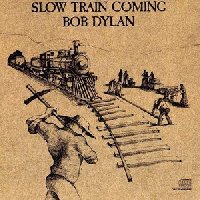
The author, 44, said he experienced something of a religious awak-ening at age 13 while attending a church camp, where he heard Dylan’s “Slow Train Coming,” a song born of the singer’s embrace of evangelical Christianity in 1979.
“It was the first time I listened to anything with sustained reflection on spiritual themes,” Gilmour said in an interview. “And the idea that a well-known celebrity actually took religion seriously struck me as rath-er important.”
|
Raised Jewish, Dylan had a bar mitzvah and, after a visit to Israel in 1971, even pronounced the late far-right Rabbi Meir Kahane “a really sincere guy.” Convalescing from a motorcycle accident and leading up to the 1967 album John Wesley Harding, he reportedly read the Bible extensively.
While former Beatle George Harrison embraced Hinduism without fuss and singer Cat Stevens became a pious Muslim, Dylan’s public and unexpected turn to Christianity was met with wide derision.
“What distinguished Dylan’s experience from Stevens’ and Harrison’s was the disdain generated by his turn to religion,” Gilmour writes.
Some conservative Christians latched onto Dylan’s fame as a way of raising their own profiles and further-ing their agendas, but his evangelicalism “turned a lot of people off.”
The singer reportedly has seemed to return to the Jewish fold. He has supported the ultra-Orthodox Chabad Lubavitch movement, even studying at one of its yeshivas, and had his sons, Samuel Isaac Abraham and Jakob Luke, bar mitzvahed.
However, Gilmour believes it’s “hard to answer where (Dylan) is now” religiously. “He’s always going on first dates but never actually settles into a long-term relationship.”
In any event, Dylan has recovered from that earlier disdain, Gilmour said.
“The impression I get from his concerts is that people cheer just as loudly for those (Christian gospel) songs as they do for the others,” he said.

From the time he broke onto the folk music scene in the early 1960s, some critics hailed Bob Dylan as a poet and prophet. But the biblical imagery that has infused so many of his lyrics has left some secular critics uneasy. (RNS PHOTO/Courtesy of Simon & Schuster)
|
Dylan treated Pope John Paul II to a stirring rendition of “Blowin’ in the Wind” and other standards at the 1997 World Eucharist Congress.
For Gilmour, Dylan’s papal show and his apparent return to Judaism show the musician “respects religion.”
Dylan has been truly mystified about the fuss over his spiritual messages, Gilmour writes, though he was “not above nurturing this mystique and indulging it occasionally (but) no doubt with a sense of irony (and) exaggerated self-description.”
In the end, the presence or absence of religious meaning in Dylan’s music is something that rests largely with the listener, Gilmour concedes.
“Some find Dylan merely using religious terms and imagery artistically but with no particular theological intent, whereas others find in his songs meaningful engagements with ultimate questions.
“The gospel according to Bob Dylan means something quite different from fan to fan.”
Gilmour confesses his answer always is the same when someone asks him about Dylan’s personal spiritual beliefs: “I do not know. Ultimately, it’s none of my business. All I can say with any confidence is that religious language is everywhere in his songs.”