


SALT LAKE CITY (RNS)—Twenty years ago, who would have predicted the 2012 U.S. presidential race would pit a black incumbent against a white Mormon?
"I've been black my whole life and a Mormon for 30 years and never thought either of these (candidacies) would happen in my lifetime," Utah attorney Keith Hamilton said.
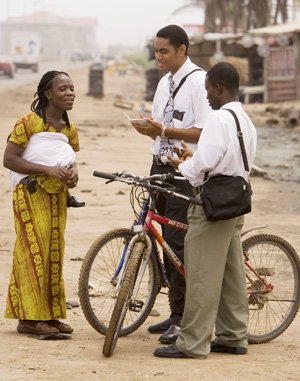
Mormon missionaries, now including African-Americans in their ranks, can be seen on the streets of hundreds of major cities in the world, as well as in thousands of smaller communities. (RNS PHOTO/Courtesy the Church of Jesus Christ of Latter-day Saints)
|
"This is a day that all Americans should take some solace in—that things are changing. Regardless of who wins, this sends a message to our children."
Darius Gray, former head of Genesis, a long-standing support group for black Mormons, sees this historic choice between two members of traditionally outsider groups as evidence of a "marked change for this nation, a maturing too long in coming. You can take joy that both groups are now players on the scene."
Unlike white Mormons, the vast majority of whom side with Republicans, African-Americans overwhelmingly vote Democratic. So black Mormons look at Obama, the Democrat, and Romney, the Republican, and find themselves caught between political perspectives. Many still lean liberal, others have switched parties after joining the church, and some find themselves going back and forth.
Not so long ago, there were very few black Mormons even to consider.
Until 1978, the Church of Jesus Christ of Latter-day Saints barred blacks from its all-male priesthood. After that landmark shift 34 years ago, missionaries found some success winning black converts, but African-Americans still represent only about 3 percent of the Mormons' 6 million U.S. members.
Of course, few people cast their votes primarily on the basis of race or religion. But many weigh whether a candidate's personal story, politics and perspective match their own.
Sign up for our weekly edition and get all our headlines in your inbox on Thursdays
"Having President Obama in the White House has done so much for race relations, which anyone who knows me is aware that this is one of my greatest passions," said Marvin Perkins, the Mormon co-author of the Blacks in the Scriptures DVD series. "In the last election, I voted for Obama, not because he was African-American but because he was clearly the better candidate."
Today, Perkins is not so sure that remains true, particularly in light of Obama's recent support of same-sex marriage, which his LDS church opposes. Now that there's a Mormon candidate, Perkins likely will go the other way—not because of Romney's Mormonism, he wrote in an email from Los Angeles, but because they share the same values.
Not every black Mormon connects with Romney—or Obama, for that matter. And Hamilton, who explored reasons for the LDS church's pre-1978 ban in his memoir, Last Laborer, said he cannot relate to either man's biography.
"Like Obama, I am an African-American and an attorney, but he lived a life very different than mine," Hamilton said. "As a Mormon, I don't have anything in common with Mitt Romney, except we both try to live our beliefs."
Romney is a multimillionaire with several homes, he said. "I don't know how Mormons like that live. I don't know what they do for service projects."
Hamilton voted for Obama before and likely will again—despite the president's position on same-sex marriage.
"I agree with the LDS church's position that marriage is ordained between a man and a woman, but it is not my business who gets married under man's law," he said.







We seek to connect God’s story and God’s people around the world. To learn more about God’s story, click here.
Send comments and feedback to Eric Black, our editor. For comments to be published, please specify “letter to the editor.” Maximum length for publication is 300 words.