




WACO—A team that includes Baylor University students discovered mosaics depicting Noah’s ark and the parting of the Red Sea while excavating a synagogue in Israel that dates to the fifth century.
 Nathan Elkins, Baylor University assistant professor of art, studies a coin at the synagogue excavation in Huqoq, Israel. (Photo / Jim Haberman)They also uncovered coins spanning 2,300 years, said Nathan Elkins, a Baylor assistant professor of art history who specializes in the study of coins and a technical specialist at the site in a former village called Huqoq.
“The ancient coins … are critical for our knowledge of the monumental synagogue and the associated village,” said Elkins, a member of a team of staff and students from Baylor, the University of North Carolina at Chapel Hill, Brigham Young University and the University of Toronto.
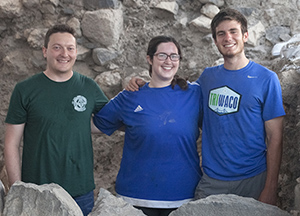 Nathan Elkins, Baylor University assistant professor of art, poses with Baylor students Sara Beth Burch, a sophomore majoring in art history, and Nathaniel Eberlein, a senior University Scholar, at the synagogue excavation in Huqoq, Israel. (Photo / Jim Haberman)Baylor University students Sara Beth Burch, a sophomore majoring in art history, and Nathaniel Eberlein, a senior University Scholar, helped with the excavations.
The mosaics decorate the floor of a synagogue that dates to the time when the area was ruled by the Roman Empire and when Christianity had become the empire’s official religion. The mosaics show an ark and pairs of animals including elephants, leopards, donkeys, snakes, bears, lions, ostriches, camels, sheep and goats.
The images also portray Pharaoh’s soldiers being swallowed by large fish, surrounded by overturned chariots with horses and chariot drivers.
 The most recent excavations in Huqoq, Israel, have uncovered two floor mosaics depicting the Biblical stories of Noah’s ark and the parting of the Red Sea. (Photo / Jim Haberman)“This is by far the most extensive series of biblical stories ever found decorating the mosaic floor of an ancient synagogue,” said archaeologist Jodi Magness, who holds a senior endowed chair in religious studies at the University of North Carolina at Chapel Hill.
Excavations have continued in the synagogue every summer since the first mosaics were found in 2012. Since then, teams have uncovered mosaics depicting Samson and his foxes (related in the Bible’s Judges 15:4), Samson carrying the gate of Gaza on his shoulders (Judges 16:3) and a Hebrew inscription surrounded by human figures, animals and cherubim.
They also found the first nonbiblical mosaic in an ancient synagogue at Huqoq, showing the legendary meeting between Alexander the Great and the Jewish high priest.
Sign up for our weekly edition and get all our headlines in your inbox on Thursdays
“It is a great pleasure to be a staff member at Huqoq, a site that garners worldwide attention on account of the significance of the monumental synagogue and its unprecedented mosaic find,” Elkins said.
“It is also wonderful that I have been able to involve Baylor students in this excavation each year. Next summer, we expect Baylor participation in this excavation to become more formalized via a Baylor study-abroad program called ‘Baylor in the Galilee,’ which I hope will increase Baylor student involvement.”
The mosaics have been removed from the site for conservation, and the excavated areas have been backfilled. The National Geographic Society and the Memorial Foundation for Jewish Culture provided financial support for the 2016 excavations.
Excavations are scheduled to continue in the summer of 2017.







We seek to connect God’s story and God’s people around the world. To learn more about God’s story, click here.
Send comments and feedback to Eric Black, our editor. For comments to be published, please specify “letter to the editor.” Maximum length for publication is 300 words.