





TEL ZAFIT, Israel (RNS)—The Gath archaeological site in southern Israel is littered with distinctive 2,800-year-old pottery shards poking out of the ground. Archaeologists and biblical scholars say that strongly indicates the Philistines—the mighty warriors and arch enemies of the Israelites—once lived here.
The excavation, now in its 21st year, is one of a handful of digs in southern Israel producing everything from vessels to bones belonging to the people best known for their famous warrior Goliath, who fought the young David in the book of 1 Samuel. The Philistines lived in what is now southern Israel from around 1,200 B.C. until 604 B.C., when they were destroyed by King Nebuchadnezzar of Babylon.
Last year, the team at Gath/Tel Zafit—also known as Tell es-Safi—discovered a massive city gate reminiscent of the one where David took shelter when he fled from King Saul. Over the years, a temple, fortification walls, an iron-making facility, an altar and inscriptions with a name similar to “Goliath” have been discovered at the site.
 Team members photograph and document a 10th-9th century B.C. burial in the excavation of the Philistine cemetery by the Leon Levy Expedition to Ashkelon. (Photo courtesy of ©Tsafrir Abayov/Leon Levy Expedition)
Philistine cemetery discovered
On July 10, a team excavating in nearby Ashkelon announced they had found the first Philistine cemetery ever discovered.
While archaeologists at both sites said such discoveries do not “prove” that biblical accounts are historical fact, “we have finally come face to face with the people themselves,” Daniel M. Master, professor of archaeology at Wheaton College in Illinois and co-director of the Ashkelon dig, said of the 3,000-year-old cemetery.
“With this discovery we are close to unlocking the secrets” of the Philistines’ origins, he added.
Understanding the Philistines
Sign up for our weekly edition and get all our headlines in your inbox on Thursdays
The Philistines were an Aegean people—more closely related to the Greeks and with no connection ethnically, linguistically or historically to modern-day Palestinians.
Ashkelon is one of the five Philistine cities mentioned in the Hebrew Bible and other ancient texts.
Scholars long have pondered the origin of the Philistines. Master said the artifacts, including jewelry, ceramics and weapons, show which objects the Philistines held most dear, and he hopes they will help researchers connect the population to related groups across the Mediterranean.
Bone samples from the site are undergoing three types of testing—DNA, radiocarbon and biological distance studies to help ascertain the Philistines’ origin.
Until now, Master said, “individual remains, believed to be Philistine, have been discovered, but never a cemetery. This one has well over 100 graves of men, women and children, some containing groups of people, some individual. Some were cremated, some were pit internments, others were buried in multi-chambered tombs.”
Now archaeologists can compare the Philistine’s burial practices to those of others across the region, and—they hope—discover similarities.
Volunteers at work digging
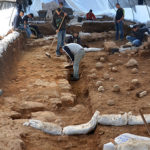
On a stiflingly hot July day at Gath/Tel Zafit, the hometown of the biblical Goliath, dozens of mostly young volunteers erected a tent over what appears to be an ancient olive press. A hundred yards away, another team prepared to dig up a ceramic vessel whose round top was visible through the soil.
The vessel might have held beer, a drink enjoyed by the Philistines, according to earlier findings.
Picking through a pile of newly excavated pottery shards, Aren Maeir, director of the Ackerman Family Bar-Ilan University Expedition to Gath, said it is possible to find Philistine ruins within an inch or two of the surface because no one has ever built atop some of the Philistine city’s ruins.
The volunteers, including many Americans, excavating the site aren’t here to prove or disprove the Bible, Maeir said.
“But we do use what we find to enhance our understanding of the past,” Maeir said. “The fact that we found a gate doesn’t prove David came to this gate, but it adds color and context to the story and teaches us how people lived at that time.”
Major differences between Philistines and Israelites
From the artifacts discovered here and elsewhere, Maeir said, it appears the ancient Israelites and Philistines were in contact.
“Although they sometimes fought each other, they also traded with each other and—in some cases—intermarried.”
Even so, Maeir said, the dig has revealed major differences between the Philistines and Israelites. Philistines ate pork, which Israelites did not. They cooked their food in hearths, while Israelites cooked in ovens, and they worshipped a female goddess.
Faith strengthened
David Kotter, dean of theology at Colorado Christian University, said having his students dig up artifacts at a site mentioned in the Bible has strengthened their faith.
“There are things you can’t learn in the classroom. Being here makes the ancient texts come alive and gives students confidence in the historicity of the texts,” he said.
Diona Southcott, a student at the University of Kansas, agreed.
Southcott spoke of the excitement of standing in the same riverbed where, according to the Bible, David picked up the stones he hurled at Goliath.
“We all know that the Twin Towers went down in New York, but when you go there and see the place, it’s more impactful. You feel it really happened,” Southcott said. “The same can be said of the Bible.”
Michele Chabin is Jerusalem correspondent for RNS.








We seek to connect God’s story and God’s people around the world. To learn more about God’s story, click here.
Send comments and feedback to Eric Black, our editor. For comments to be published, please specify “letter to the editor.” Maximum length for publication is 300 words.