San Marcos Baptist Academy family on Family Feud  

Brian Guenther and his family were featured on a “Family Feud” episode that aired Tuesday, Feb. 17. Guenther is president of San Marcos Baptist Academy, a private Christian, coeducational, college preparatory school in San Marcos. 

Guenther’s family was invited to the show after his daughter Grace, a University of Mary Hardin-Baylor student, applied online. “Two weeks later, they contacted us for a tryout,” he said. 

“Two weeks after the tryout, we got a call saying they’re ready to schedule us for the show,” he continued. “We were scheduled to film in April of last year. It’s taken almost a year for the show to actually make it to air.” 

Brian, his wife Christy, their identical twin daughters Grace and Faith, and their adopted son Wilson participated in the episode.

Wilson’s social media presence may have helped the Guenthers’ application, Christy said. Wilson has over 460,000 followers on his Facebook page and over 34,000 followers on YouTube.

The filming experience

During filming, the Guenthers met seven other families who were backstage together. “We encouraged each other. We all shared the same makeup and hair people and had the same producers working with us,” he said. 

“The filming experience was another level, because we got to interact with [the host] Steve Harvey,” Brian continued. 

Filming takes two hours, but each televised episode is only 22 minutes, meaning much of the comedic bits are cut out, he explained. “[Steve] would go into a comedy episode of something, and those are things only the live audience gets to see.” 

“[Steve’s] personality is so lively and vibrant,” Christy said. “He’s so funny. I felt like he was really down to earth and very personable. He kept coming over to our family and saying: ‘Come on. Come through family. You can do this.’ He seemed like a really good guy.”

Window to share faith

The “Family Feud” filming gave the Guenthers unique opportunities to share their faith with others. “It was really nice getting to meet other families from … all over. It was fun hearing different family stories and sharing our faith with other families. It was a great experience,” Brian said.

The Cornelius family, who participated in a separate episode, shared faith in common with the Guenthers. 

“He and his wife pastor a church. … It was neat being able to relate. We talked for a long time. What we had in common was our faith, and that made [the experience] so great,” Brian said.

Experience on secular television 

Brian described how nervous he felt being on a game show and not knowing what questions may be asked: “We were nervous in the beginning. … We [prayed] the Lord would protect us from something that would embarrass our school or family.” 

During the episode, a question about a stripper was raised. “When that question got asked, I was like, ‘Oh, no. This is what I prayed against,’” Christy said. “I was so thankful the question came to me and not one of my girls.” 

When asked how the family balances public visibility with humility and leadership, Brian emphasized the importance of maintaining your life in a respectful manner: “With Wilson’s social media following, we get recognized in a lot of places.”

“[When] we went to the Baptist World Alliance Congress in Australia last summer, we were on the streets of Australia and got recognized by someone who asked for a photo,” he said.

“We carry it with a lot of humility, because there’s no way that’s us. We are not rich because of it. We don’t make money [from fame.] That’s one way the Lord has protected our family from fame going to our heads. We don’t make a big deal of it around other people,” Brian continued.

“In fact, at the school, we didn’t talk much about the show. We had a watch party, but we didn’t do it through school communications,” Brian added. 

“We try to [carry] our life in a humble and respectful way to the location we’re in. We’re here to serve and work at the school. … This is where God has called us to be.” 

The importance of family and faith 

When asked if he would ever make a return to television, Brian highlighted doing things together as a family as “one of our family values. We’ve always involved our kids in ministry. … So, when it came time for this show, it was a no-brainer for us to be able to do that together.” 

“We absolutely would do something like that again, … and we did. Shortly after Family Feud, we were invited to film a reality TV show in London. That did come through Wilson’s social media. … One of his videos got 44 million views or something like that,” Brian continued.

“For that show, we had to write into the contract that it’s all of us, or none of us. [The show] wanted me, Christy, and Wilson,” Brian added.

He explained how arrangements were made to have all members of the family present for filming. Another stipulation was the family had to share their faith without compromising. 

“We are not going to hide our faith. If you’re going to [film] a reality TV show about us, we will talk about our faith,” Christy said. The show involved swapping lives with another family, potentially allowing for differences in belief to be promoted. 

“We [said] we don’t want to practice a different religion. They honored that, and they highlighted our faith really well. They honored our school, and they honored our faith.”



Fewer Latin Americans claim religion but still pray and believe

The number of Latin Americans who say they are not affiliated with a religion has long been steadily increasing.

And over the past decade, according to a 2024 Pew Research Center survey, the percentage of those known as “nones” roughly doubled in Argentina (to 24 percent in 2024), Brazil (15 percent) and Chile (33 percent); tripled in Mexico (20 percent) and Peru (12 percent); and almost quadrupled in Colombia (23 percent).

But for many, that label doesn’t mean a rejection of faith. Across Brazil, Colombia, and beyond, people continue to pray, meditate, and participate in rituals drawing from Christian, Indigenous, African, and Eastern traditions in deeply personal ways, so-called nones told RNS. 

Their beliefs and practices may reveal a blind spot of such surveys in how they rely on Christian and Western frameworks to define what counts as religion. 

Mixed religious practice

For Camile Coutinho, a 28-year-old dietitian who lives near Rio de Janeiro, a typical week involves attending a Sunday service at a Baptist church, taking part in ritual baths and cowrie-shell divination with an Umbanda priestess, and going to Deeksha meditation gatherings. 

She recites the Hail Mary and Our Father Catholic prayers and uses Japamala prayer beads. She keeps incense and crystals in her home to attempt to cleanse negative energy. However, she identifies as religiously unaffiliated.

“I believe in the Bible, in Christianity,” she said, “but today I also believe in spiritism and in Umbanda. I’ve been studying these traditions a lot.”

Coutinho grew up in a typical Catholic Latin American religious environment. Her parents were Catholic—“though not very practicing,” she said. But when she fell ill, her mother would often take her to see a traditional folk healer who prayed over people, known in Brazil as a rezadeira.

In her teenage years, Coutinho converted to evangelical Christianity, and her family followed. In more recent years, however, she began to distance herself from her church as political polarization intensified in the country. 

The church’s support for right-wing politics—especially its alignment with former President Jair Bolsonaro—along with witnessing increasingly homophobic discourse there, pushed her away, even as her parents chose to stay, she said. 

Coutinho fits into a category of nones encompassing far more than only atheists or agnostics, and which is especially prevalent in Latin America. 

Her experiences also echo a broader pattern in many traditional cultures, including Latin American Indigenous ones, where spiritual beliefs are inseparable from everyday life, social organization, and community practices, said Gustavo Morello, a sociologist of religion at Boston College in Massachusetts.

Less institutional spirituality

After Catholicism was introduced to Latin America by European colonizers, many regions did not have enough priests to sustain it on an institutional level. While colonial-era cities such as Rio de Janeiro, Mexico City, and Lima had a regular clerical presence, vast rural areas did not, and religious life was maintained by the communities, Morello said. 

This opened space for practices that diverged from official Catholic orthodoxy and incorporated Afro-descendant and Indigenous spiritualities. As a result, many people came to describe their faith in personal terms, often combining multiple spiritual traditions while still identifying as Catholic.

“For the last 100 years, 9 in 10 Latin Americans believe in something,” Morello said. “The idea that you are only one religion is very North Atlantic.” 

In surveys, this complexity is rarely visible. And until well into the 20th century, Morello said, one was typically either Catholic or outside the cultural mainstream altogether.

In Brazil and Colombia, more religiously unaffiliated people say they believe in God, pray daily, and consider religion very important in their lives than do those who identify as Christians in European countries such as Spain, the United Kingdom, and France, according to Pew.

“Europe represents a practice grounded in doctrine, in belief and formal religious practice, whereas here [in Latin America] we have an effervescence of religious experiences that goes far beyond a purely rational adherence to religious content,” said Flavio Senra, a religious studies professor at Pontifical Catholic University of Minas Gerais in Brazil. 

That could be because the region’s culture emphasizes believing in something beyond the material world, Morello said. “People in Latin America do believe in this enchanted reality—that there is a dimension in life we cannot explain with what we see only,” he continued.  

Both scholars said rather than thinking of the trend toward religious disaffiliation as secularization, in which religious beliefs diminish within the culture, the shift is better viewed as a change in how people approach belief.

“The idea of enchanted modernity explains better what we see in Latin America,” Morello said, “because we are looking at a vibrant spiritual and religious society that does things to engage with this other world.”

Freedom from commitment

At the same time, the number of atheists and agnostics is not growing in the region and remains a small percentage of the population, both scholars explained. That also suggests the growth of the nones category instead reflects weaker ties to religious institutions and greater freedom today to shop across the religious market.

“A context of greater religious, political, and cultural plurality creates an environment of greater freedom for people to express their beliefs without being judged as harshly as they were in the past,” Senra said.

Juan Guevara, a 35-year-old high school philosophy teacher from Bogotá, was raised in an observant Catholic household. However, as a teenager, he began encountering other belief systems, particularly Buddhism, and started questioning his family’s religion, he told RNS. 

The discovery planted a lasting doubt: If there were many ways of understanding the world, why should one claim exclusive truth?

Class differences and injustice also weighed on his decision. “It started to bother me a great deal to see that the people who were particularly devout—those who professed their beliefs with special fervor—did not strike me as good people,” he said.

Guevara’s academic training in philosophy pushed him toward broader intellectual and spiritual exploration, but Buddhism remained a recurring reference point. He participated in Soto Zen and Vipassana meditation retreats and was drawn in by what he described as their internal coherence and lack of institutional demands. 

“There was a lot of consistency there,” he said. “No one was asking me for a sacrament or a promise I would stay forever.”

He also took part in ceremonies involving ayahuasca, often organized by or in dialogue with Indigenous groups in Colombia. These experiences carried religious elements and were also deeply ethical, cultural, and communal, he said. But the freedom to engage without lifelong commitment was, for him, essential. 

An imperfect mix

Coutinho’s experience is similar in that way. She consults with a mãe de santo priestess in the Umbanda tradition and attends rituals but deliberately avoids formal initiation. “I don’t want to go through the initiation process,” she said. 

“I know that being part of Umbanda, for example, demands a much greater devotion than I’m willing to give. Even so, I feel close to the practices.”

But she described moments of confusion, too. “Sometimes I get confused trying to understand where the stories fit,” she said. “Where is Jesus in the stories of the Orixás (divine spirits)?”

Still, she continues to engage with various traditions: “I find a lot of beauty and strength in these stories, so I keep believing and studying.”

In experiencing different faith practices, this growing group of believers often gathers traces and memories, taking what they believe is good from each faith and leaving aside what does not resonate. 

“The religion may not be the religiosity that Catholic leaders expect, nor the one Pentecostal pastors want,” Morello said. “But it is what the people do. It’s mixed, it’s not pure, it’s imperfect, it’s not orthodox—but it is what people are practicing.” 


Why pastors are leaving the pulpit

A 2025 Lifeway Research article indicated while only 1 percent of protestant pastors on average decide to step down from ministry each year, the reasons for them stepping down are dynamic, with pastors facing many unique challenges and uncertainties. 

The research highlighted a change in calling as the primary reason pastors step down from the pulpit, with 40 percent of pastors across four denominations citing this in connection with leaving the ministry. 

Among other leading causes are burnout (16 percent), family issues (10 percent), and finances (10 percent). A separate study based on 2022 post-pandemic Barna research recognized burnout and overwhelming stress as a major factor driving pastors to quit ministry. 

Burnout, stress, and isolation

Fifty-six percent of study respondents cited burnout and stress as their primary reason for stepping down. The study also linked increased burnout in 2022 to shifting church structures resulting from the pandemic, such as navigating the growing use of social media and complex organizational dynamics. 

Beyond an increasingly digital, on-demand cultural context, pastors are routinely subject to stress resulting from the nature of their positions. In an interview with Baptist Standard, David Bowman, executive director of Tarrant Baptist Association in Fort Worth, described this issue. 

“[Pastors] are overwhelmed with all the work they have to do. It never ends. You take care of details all day at the office, … you come home and you’re having dinner with your family [when] the phone rings and somebody is either seriously ill or there’s been a death,” Bowman said. 

Bowman described the pastor’s role as a leader and the toll it takes: “There are [many] leadership demands on a pastor. If a church is in a building program or relocation or something, … that requires extra time and energy you never get back.” 

Pastors, who are expected to balance the demands of spiritual leadership within their communities, suffer as a result of isolation and loneliness associated with bearing the weight of a congregation’s needs. A 2024 Barna study claimed nearly 1 in 5 U.S. pastors contemplated self-harm or suicide within the past year. 

“One of our adversary’s favorite schemes is to isolate us,” Bowman said. “Pastors often feel like they’re the only one carrying that load. … They’re not really good at sharing [it.] They don’t trust that other people can help them. … So, they get isolated.”

Physical, emotional, and mental health among pastors was recorded as lower than the general population, with researchers observing a strong link between a pastor’s reduced conviction in their vocational calling and a drop in their overall well-being. 

The significance of sabbatical rest

The National Association of Evangelicals conducted a survey on pastor sabbaticals, concluding 63 percent of evangelical pastors have a church sabbatical policy, but many churches do not prioritize sabbaticals. Church policies surrounding sabbaticals vary significantly.

Larry Floyd, executive director of missions for El Paso Baptist Association, explained many pastors do not use sabbatical leave for necessary rest, resulting in burnout: “As directors of missions, we are to promote the health of the pastor. Otherwise, we won’t [have] a pastor.”

“Sabbaticals should be more often and for rest,” Floyd said. “Six weeks off every five years, not including vacation. Too many times, it isn’t really a sabbatical since many pastors [continue] to work on their Ph.D. or still entertain phone calls.” 

A 2022 Lifeway Research article connected an increase in pastor burnout to a lack of proper sabbatical rest. Sabbaticals were highlighted as a valuable time of reset for pastors, providing them with renewed energy and vision during a season of ministry burnout.

Age is an additional factor

A 2022 Barna research survey noted finding younger pastors is becoming a challenge. As of 2022, only 16 percent of Protestant senior pastors are 40 years old or younger, and the average age of pastors is 52. 

Younger pastors also suffer from higher rates of burnout than their older colleagues, compounding the age issue, the research found. 

Floyd emphasized age as a major factor influencing pastor’s decisions to step down: “Too many older pastors stay way too long in their retirement years out of necessity or obligation. This creates a dying church and a church who doesn’t have a succession plan.”

Research suggests the age issue could result in a succession crisis, with many churches unprepared for the transition. Four in five pastors (79 percent) agree churches are not taking initiative to raise up the next generation of pastors. 

Polarization in the modern church era 

In the 2025 Lifeway research study, 18 percent of Protestant pastors linked church conflict to their decision to leave ministry. Roughly 27 percent of this conflict revolved around national or local politics or doctrinal differences. 

Amid growing fears of ICE, many churches are locking their doors or holding online services to avoid potential detainment of congregants with or without legal status. 

Following the disrupted church service at Cities Church in St. Paul, Minn., by anti-immigration protesters, faith leaders called for the urgent protection of worshipers and compassion for migrants, with some churches posting notices on their doors saying no ICE or U.S. Border Patrol agents are allowed inside

When asked about polarization in recent ministry, Bowman discussed the growing significance of immigration-related issues and the division it has caused within churches.

“I write a daily devotional for a small mailing list. Anytime I talk about immigrant issues and how God loves immigrants as much as he loves me, I lose readers,” he said. 

Growing tensions in evangelical churches have left many churches divided on immigration reform, resulting in political and cultural polarization among congregations. 

“If a pastor stands up and says, ‘Jesus loves everybody, and so should we,’ including [people] you want to deport, … he’s going to have some conflict [come] from that,” Bowman said. 

“If a pastor is trying to preach the truth in love, … [trying] to talk about hot button issues from a place that’s not aligned with either political party, but aligned with what God tells us, that pastor [will] stay in trouble,” Bowman continued. 

“People just have strong opinions about certain issues, and they’re going to let their pastor know about it.” 

Help the church help the pastor

When asked how churches can serve pastors in need, Bowman prioritized the power of prayer: “One of the best things we ever did in the last church I served was called Pastor’s Prayer Partners. We had a hundred people every day who were praying for the church.

“They were praying for the staff. They were praying for our ministries, those kinds of things. That is huge. And, you know, people need to befriend their pastors and their families,” Bowman continued. 

Bowman expressed how hope for the future of ministry is vested in God’s love for the world: “God really does love this world. He’s given us the church to bring people to salvation, to continuing growth and development in their relationship with our Father.”

“There are seasons where the church seems like it’s the adversary of everything, … but the church is God’s plan for the world to know him, experience him, and enter into the deep and abiding walk he wants for [every believer.] God will continue raising up those leaders necessary to do the work and to help folks learn how to do their own work,” Bowman continued. 

“He is going to renew [people] serving in the churches right now, who are feeling the pressures of our age, the pains and problems we have, and when he renews them, that will contribute to the renewal of the church.” 


2026 ‘He Gets Us’ ad more personal, less political

Back in 2021, a group of evangelical families, including the founders of Hobby Lobby, began funding a new ad campaign, hoping to help skeptical Americans give Jesus a second look and to convince people to be a little kinder to one another.

The website for the campaign describes the mission this way: “Our hope was that more people could encounter love. More joy. More peace. A greater sense of purpose.”

Jesus’ humanity a key focus 

Known as He Gets Us, the campaign, which launched in 2022, focused on the human side of the Christian Messiah, with billboards and black-and-white video ads showing people with loneliness, anxiety, and other struggles, and ending with the claim Jesus understood those struggles. 

Other ads showed Jesus as an immigrant or a rebel against the status quo, who loved those he disagreed with.

An ad for the 2023 Super Bowl, titled “Love Your Enemies,” featured images of Americans at each other’s throats and in each other’s faces, as English singer Rag’n’Bone Man’s hit song “Human” played.

“Jesus loved the people we hate,” the ad claimed.

For the 2024 Super Bowl, “He Gets Us” offered an ad with a series of foot-washing tableaus, each featuring an unexpected pairing: an older woman washing the feet of a young girl, a cowboy the feet of an Indian, and a white Catholic priest the feet of a queer Black person.

Last year’s Super Bowl ad continued the “let’s all get along” theme, showing Americans from different walks of life helping each other, including a man in a John 3:16 hat embracing another man at a Pride march, with the tagline “Jesus showed us what greatness was.” The ad also featured Johnny Cash’s cover of “Personal Jesus.”

Americans still polarized

Yet four years—and more than $700 million—after the launch of the ad campaign, Americans remain just as polarized. Few seem convinced Jesus can bring the country together or feel a need to love their political enemies. 

And while the decline in religion in America has paused for now, that decline will likely be short-lived, according to long-term polling data.

That reality, along with pushback from evangelicals claiming the ad campaigns were too “woke,” has led the “He Gets Us” campaign, now run by a nonprofit called Come Near, to shift course.

In the last few months, and leading up to the 2026 Super Bowl, a new set of ads, known as “Loaded Words,” focuses less on social conflicts and more on the pressures and noise of modern life. One online ad, called “Don’t,” which has been viewed more than 68 million times, starts with a close-up on a newborn, with a mother’s voice saying, “Don’t be afraid.”

That’s followed by a host of other voices, giving warnings like “don’t mess up,” “don’t make a scene,” and “don’t you dare let us down.”

“What if the only expectation was love?” the ad asks. “Jesus doesn’t expect us to earn it.”

Another ad, called “Do,” looks at the pressure to do it all—to be popular, to be beautiful, to be a team player, to be the best. 

Ads use a ‘neighbor-led’ approach

Simon Armour, creative director for Come Near, told RNS in an interview the ads were developed using what he called a “neighbor-led” approach, built on research that asked Americans about their spiritual needs and life experience.

That research, said Armour, revealed Americans felt pressured to be busier, to acquire more stuff, to gain more recognition, so life would then be meaningful.

“What we kept hearing was that was failing them. Their life is not turning out how they wanted,” he said. “They’re in this place where the noise is constant, with digital media, social media, and our phones.”

Adweek, an industry publication, summed up the new take on “He Gets Us” this way: “In its fourth Super Bowl appearance, He Gets Us is getting personal.”

Campaign generates billions of views 

In the four years since “He Gets Us” launched its first campaign, the videos have been viewed nearly 10 billion times, while 56 million visitors have clicked on the HeGetsUs.com website, which has averaged about 700,000 visits a week since the “Loaded Words” campaign launched in December.

This year’s Super Bowl Ad, titled More,” takes on the noise of modern life, with images of online influencers taking selfies and of a race car driving in circles and getting nowhere.

“The spot is really showing the thing we all feel, which is the absurdity of where things are at,” Armour said. “We’re chasing our tails, we’re going fast, but going nowhere.”

Armour hopes the new ads will connect with the spiritual needs of viewers.

“It doesn’t matter who you are, where you’re from, where you’re at in a spiritual journey,” he said. “Jesus has something relevant for you. He gets you. He sees you. He knows you.”

For the campaign’s fourth Super Bowl, Armour said, the “He Gets Us” ads were due for a new direction. He said brands often evolve. Otherwise, the message gets stale.

“After a period of time, people can see it coming,” he said. “It’s less surprising. It doesn’t cut through as much.”

The “He Gets Us” ad isn’t the only faith-based message that will air at the Super Bowl. The Blue Square Alliance Against Hate, a campaign to combat antisemitism and other forms of religious-based hatred, will also air an ad, called “Sticky Note,” during the NFL championship. 

  The campaign was founded by Robert Kraft, owner of the New England Patriots. The Patriots will play the Seattle Seahawks for the Super Bowl title on Sunday, Feb. 8. 

Project sparks controversy

The “He Gets Us” ads have been controversial from the start, in part because the project was funded through The Signatry Foundation, a Christian donor-advised fund which has also donated to anti-abortion and anti-LGBT groups and had ties to conservative donors. 

Conservative critics, including the late Charlie Kirk, claimed the ads presented a distorted version of a Jesus who didn’t care about politics or who tolerated sinners, or the ads were too weak and woke.

“The marketing group behind ‘He Gets Us’ has done one of the worst services to Christianity in the modern era,” Kirk said in 2023, after the foot-washing Super Bowl ad aired that year. “The Green family are decent wonderful people who have been taken for a ride by these woke tricksters. So sad!”

Millions invested into the ad campaign

The ads have been costly.

According to disclosures filed with the IRS, the Signatry Foundation spent $429.8 million on “He Gets Us” from 2021 to 2024. Come Near, the nonprofit that took over the project in 2024, is organized as a church and does not disclose its finances. 

However, the nonprofit projected it would spend $345 million on the campaign between July 2024 and June 2026, when it applied for tax-exempt status. A spokesperson for Come Near said those figures “represented a reasonable and good faith projection of future finances.”  

Organizers told RNS in the past the goal was to spend a billion dollars on the campaign. 

Ads intended to speak to outsiders 

Nicole Martin, a member of the Come Near board of directors, said “people have a lot of opinions” about the “He Gets Us” ads. She said the ads aren’t aimed at people who already believe in Jesus and go to church. Instead, she said, they are meant to speak to outsiders.

“This is for people who just need to believe in something, and Jesus is the way to reach them,” she told RNS in an interview. “That’s why I am involved.”

Martin, who was recently named president and CEO of Christianity Today, a prominent evangelical publication, said the ad campaign has made Jesus part of the public conversation around the Super Bowl. 

That’s especially important in a time when religion in America has been on the decline, and many young people don’t know as much about Christianity.

“I think the goal is to try and shift that trend by a few degrees, so there would be a generation who wouldn’t grow up without knowing Jesus. That’s what I think they’re trying to do,” Martin said.

She hopes the new ad will remind people there’s more to life than the noise of social media and online debates. And to take a break from the hectic pace of life.

“I’m hoping this commercial will give us a chance to breathe,” she said.


Christian nationalism isn’t limited to US, scholars say

Scholars from around the world are gathering in Chicago this week to focus on Christian nationalism, which they say is growing in influence globally.

“Christian nationalism is not a single ideology, nor is it confined to one nation,” said Abimbola Adelakun, associate professor of global Christianity at the University of Chicago Divinity School and organizer of the conference. 

“Across the world, Christianity is being invoked to legitimize political authority and exclusionary visions of belonging. This conference brings global perspectives together to better understand how these movements operate and why they matter.”

The first of what organizers say will be an annual event, the conference is designed to look at issues affecting Christians around the world, Adelakun said. “This year, we’re looking at Christian nationalism, because it’s the most topical issue,” she said.

“We are trying to understand this phenomenon of Christian nationalism. What does it mean for Christianity?” she said. “What does it portend, and where do we go from here?”

She said the scholars invited to the conference have defined Christian nationalism as an attempt to make Christianity the “defining or governing moral order of the nation,” a complicated undertaking in a democratic society. 

“From an ethical view,” she said, “Christianity is a great religion that can define the moral order. But then again, it is now being weaponized against different categories of people.”

Christian nationalism and democracy

The idea only Christians should wield political power can lead to a rejection of democratic ideals, Adelakun commented, including religious freedom. 

She offered the example of Zambia, which was officially declared a Christian nation in 1991. While Zambia bans discrimination against other faiths, there have been attacks on non-Christians, according to the U.S. State Department.

A Zambian scholar will be one of the speakers at the conference, which has registered some 60 scholars and members of the public in all. Others presenting case studies are coming from Ghana, Zambia, Cameroon, Norway, South Korea, Pakistan, Romania, and Russia, as well as the United States and several Latin American countries. 

The event began Wednesday, Jan. 28, and runs through Friday, Jan. 30, at the University of Chicago on Chicago’s South Side. Lectures will be streamed online

The conference will kick off with a keynote lecture from Nimi Wariboko, a professor of social ethics at Boston University. Valentina Napolitana, an anthropologist from the University of Toronto, will also give a keynote address. 

Adelakun said some Christians around the world have reshaped American Christian nationalism for their own context, while in other countries, the Christian nationalism is homegrown and often developed as a way to oppose colonialism. 

“It was a way to say we are not going to reject Christianity because of the defect it has, but we’re going to create an African Christianity,” she said.

She said Christianity can be a powerful force for organizing and allows people from different backgrounds and cultures to unite around a common faith. But it can also be used as a weapon against people who don’t share those beliefs.

James T. Robinson, dean of the divinity school, said the conference helps further the public understanding of religion. 

“Understanding the political uses of religion requires careful historical and comparative scholarship,” Robinson said in announcing the conference. “This conference reflects the divinity school’s commitment to examining religion’s public life with global reach and intellectual precision.”


Cities Church considering legal options after anti-ICE protest

Leaders of Cities Church, the Minneapolis congregation whose worship service was disrupted by anti-ICE protesters, are considering legal action against the activists, saying the group that invaded the church on Sunday, Jan. 18, “jarringly disrupted our worship gathering.”

In a statement issued Tuesday, the church leaders said the protesters “accosted members of our congregation, frightened children, and created a scene marked by intimidation and threat. 

“Such conduct is shameful, unlawful, and will not be tolerated. Invading a church service to disrupt the worship of Jesus—or any other act of worship—is protected by neither the Christian Scriptures nor the laws of this nation,” the statement reads.

The church also called on federal officials to protect all houses of worship from similar protests.

Protests targeted ICE affiliated pastor

Nekima Levy Armstrong, a minister, lawyer, and activist, told The Washington Post activists were protesting against David Easterwood, a lay pastor and elder at the Southern Baptist church who also works for U.S. Immigration and Customs Enforcement. Armstrong said she was angered at seeing a video of Easterwood defending his work with ICE.

“I don’t understand how as a pastor he thinks that that’s acceptable,” Levy Armstrong told the Post.

Easterwood is one of several ICE officials, including Homeland Security Secretary Kristi Noem, named in a federal lawsuit filed by protesters in Minnesota who have accused federal officials of trying to suppress their free speech. 

“They have pepper-sprayed, violently subdued, and aimed assault rifles at protesters and observers, and even followed observers home to scare them in a tactic lifted straight from the mafia,” the lawsuit alleges. 

Easterwood, the acting field director of an ICE office in St. Paul, has denied the allegations.

Videos circulating online

Videos of the protest were shared widely on social media over the weekend, leading to outrage from Southern Baptist and other evangelical Christian leaders. SBC President Clint Pressley, in an interview with Religion News Service, said the scene was “just unbelievable.”

Pressley said he was thankful the protest ended peacefully, given how recent shootings and acts of violence at houses of worship have put congregations on edge. “It scared me to death to think about what might happen in a church if you had intruders like that,” he said.

No matter what people think about ICE, he said, disrupting a church service is wrong.

In a message on the Cities Church website, pastor Jonathan Parnell wrote: “Rejoice in the trial. See God’s blessing. Keep doing good.”

Cities Church was planted by Parnell in 2015 and worships in a former Episcopal church known as St. Paul’s on the Hill. An article on the church’s website notes the church is “neither a gym nor a theater,” unlike many modern evangelical churches. 

Through the SBC’s North American Mission Board, church leaders declined a request for an interview.

The congregation has a more formal liturgy than many SBC churches, including a weekly confession of sin and “assurance of pardon,” as well as Communion at every service. 

The church also has ties to Bethlehem College and Seminary, a school started by John Piper, a bestselling author and pastor, and Joe Rigney, an author and professor known for his belief that empathy is sinful and his critique of “woke” Christians.

On X on Monday, Rigney called himself a founding pastor of Cities Church. He is now a pastor at Christ Church DC, where Secretary of Defense Pete Hegseth attends, a congregation “which faces weekly protests by vile leftwing activists.”

Department of Justice conducts investigation

The U.S. Department of Justice is investigating Sunday’s protest for possible civil liberty violations or violations of the 1994 Freedom of Access to Clinic Entrances Act, which protects access to both abortion clinics and houses of worship. 

The FACE Act also bans protesters from intentionally “injuring, intimidating, or interfering with, or attempting to injure, intimidate, or interfere, any person by force, threat of force, or physical obstruction.”

John Greil, a law professor at the University of Texas who co-teaches a religion and law clinic, said the protesters had claimed they wanted to disrupt a worship service and that videos of the incident seem to show at least some activists appear to have intimidated worshippers.

“There’s a pretty touching image of a child who’s being consoled by her parents, and at least some of those individuals who went into the church were going into people’s faces, shouting,” he said. “I think that that satisfies intimidation or interferes with worship.”

Greil also said one protester appeared to threaten a worshipper who asked him to leave.

Though protesters could invoke a First Amendment right to protest at the church, Greil said, that would hold true only if the protest had taken place on the sidewalk or in another public forum.

In a 2011 ruling, the U.S. Supreme Court reversed a $5 million award for damages against members of Westboro Baptist Church who had been sued for protesting at a veteran’s funeral, ruling the church members had protested from the sidewalk outside the funeral, not on private property.

A protest on private property is different from a public setting, Greil said.

“I think we could very easily imagine the real harms that would happen if Black churches were interrupted by white supremacists just to chant public slogans, if Jewish services were interrupted, if Muslim prayer services were interrupted,” he said. “I think it’d be a pretty scary world to imagine.”

Greil said the church could sue protesters for trespassing on its property.

Police department further investigating

The St. Paul Police Department is also investigating the incident, in which 30 to 40 protesters entered the church, though most of them had left the building and were walking away when the officers arrived about 10:40 a.m. local time.

“This incident is an active & ongoing disorderly conduct investigation,” public information officer Alyssa Arcand told RNS in an email. “Because this is an open investigation, no additional public information is available at this time.”

The Baptist Joint Committee, a pro-religious freedom group, declined to comment specifically on the protest but issued a statement on Tuesday criticizing the Trump administration for undermining religious liberty in its immigration policies. 

“In Minneapolis and across the country, the threats to the religious freedom of all people are not the people standing up for and participating in civic life but the people who wield state power in a manner that undermines it,” the statement read. 

The statement also called on officials to “respect places of worship as spaces of conscience and community.”

Immigration issues cause fear

Trey Turner, executive director of the Minnesota-Wisconsin Baptist Convention, said Baptist churches in both states have been struggling to respond to ICE enforcement and the issue of immigration. Many of the churches in the convention, he said, including about a third of those in the Twin Cities, serve immigrant congregations.

“There are Hispanic churches that are not meeting right now because they are afraid of what’s happening in our part of the world, in part, because of the interaction between the federal government and the state government,” said Turner.

Even church members who have legal status fear ICE could raid churches, he said, causing a great deal of concern in the immigrant community. He said churches in the convention don’t all agree on how best to deal with the issue of immigrants.

This week, Turner hopes to meet with Baptist leaders from the Southeast Asian Hmong community to talk about ways SBC churches in Minnesota can work together to support one another.

Turner cautioned not all Southern Baptists hold the same view on immigration, but many other pastors in the area had reached out to offer their support. Turner said his first thought after hearing about the protest was, “How can I serve this congregation going through this trauma?”

“Because they’re going to try to get together this coming Sunday, and what will be the response?” he said.

He said Sunday’s protest felt like something sacred had been violated. People go to church to seek sanctuary from the outside world, he said. They don’t expect the kind of chaos and disruption that occurred on Sunday.

“It’s shocking to us,” he said.


Leaders seek to block interstate Rx abortion pills

WASHINGTON––U.S. Sen. James Lankford (R-Okla.) and Family Research Council President Tony Perkins, both Southern Baptists, joined others at a press conference Jan. 14 urging federal authorities to block interstate abortion pill prescriptions.

Also on hand was Louisiana Attorney General Liz Murrill, who announced Jan. 13 her indictment of California physician Remy Coeytaux on the charge of “criminal abortion by means of abortion-inducing drugs,” alleging he prescribed the abortion cocktail of mifepristone and misoprostol for a Louisiana woman. 

Louisiana law punishes the crime by financial penalties and one-to-50 years of hard labor, Murrill reported.

Joining the three were U.S. Sen. Lindsay Graham (R-S.C.), Ohio Attorney General Dave Yost and several pro-life congressional and state leaders in their appeal to the U.S. Food and Drug Administration and the U.S. Department of Justice to outlaw the interstate shipment of abortion-inducing drugs.

The Southern Baptist Ethics & Religious Liberty Commission applauded efforts to end interstate prescriptions for abortion-inducing drugs, especially commending Murrill for issuing an indictment.

“The state of Louisiana is to be commended for its aggressive legal efforts to protect preborn children and their moms from predatory purveyors of medical abortion,” Miles Mullin, ERLC executive vice president and chief of staff, told Baptist Press.

“Many pro-life states have passed similar laws since [Dobbs v. Jackson Women’s Health Organization], so we can expect to see more of these efforts by their attorneys general in the months and years ahead,” Mullin said.

Still, federal action is the best route to saving unborn lives, Mullin said.

“In reality, there is no way that California, or other pro-choice states, will honor any sort of extradition order for those supplying abortion drugs. Neither will abortion doctors in those states stop mailing abortion drugs across state lines to pro-life states, unless the federal government takes action,” Mullin said.

“Once again, this leads to the conclusion that there is still much work to be done at the federal level to save preborn lives, starting with enforcement of the Comstock Act. Please join us in praying that our leaders in Washington, D.C., would have the fortitude to take that important step. Now is the time for action,” Mullin continued.

Lankford, a Southern Baptist, represents Oklahoma, one of 14 states banning medical abortions as recently as June 2024, according to USAFacts.

“What’s happening right now on the national level is abortion pills are being mailed into my state to go around state law to facilitate the death of children in my state,” Lankford said at the press conference.

“There is always a death that’s involved in this drug, but it is also incredibly dangerous for the mom as well. So, we’re speaking out on this, challenging the FDA and [Health and Human Services] to live up to our values,” Lankford continued.

Louisiana indictment

Murrill charged Coeytaux with violating Louisiana’s prohibition on abortion “by means of an abortion-inducing drug,” and a state law prohibiting aiding and abetting in the procurement or distribution of such drugs, according to Murrill’s press release.

“This is not health care; it’s drug dealing,” Murrill said, accusing doctors of “flagrantly and intentionally placing women in danger. We’ve seen the proof of that, with women showing up in emergency rooms after taking these pills and being coerced into abortions.”

In October 2023, Coeytaux, who resides in Healdsburg, Calif., sent a pregnant woman in Louisiana the abortion pills for a fee of $150, Murrill said in a bill of information. The pregnant woman ingested the medication and ended her pregnancy.

Louisiana sent an order to California for Coeytaux to be extradited to Louisiana for trial, but California Gov. Gavin Newsom has refused to comply, Politico reported.

It is Louisiana’s second indictment of an out-of-state doctor on such charges, following the January 2025 indictment of New York physician Margaret Carpenter, her company Nightingale Medical PC, and a third individual. New York also refused to extradite Carpenter for trial.

In her battle against medication abortions, Murrill also testified Jan. 14 before the U.S. Senate Health, Education, Labor and Pensions Committee about the dangers and interstate proliferation of the medication.

“Abortions have tragically increased in Louisiana since, despite its pro-life laws,” Murrill testified. “The pro-abortion Society of Family Planning reports that, from April to June 2024 alone, mail-order abortion drugs—sent illegally into Louisiana from doctors and activists in other states—accounted for an average of 617 abortions in Louisiana per month.”

The number exceeded 800 such abortions in December 2024, she said, “and continues to trend upward, eclipsing 900 abortions per month in Louisiana in 2025.”

Murrill is a co-plaintiff in a lawsuit to block interstate abortion pill prescriptions, citing the dangers inherent in the pills being prescribed without in-person exams by physicians. 

Press conference

At the Washington press conference, Perkins and others lamented and criticized actions under the Biden administration intended to protect abortion access through the availability of medication abortions. The effort has bicameral Republican support in concert with that of state leaders, Perkins said.

Speakers said the abortion pills are at least 20 times more dangerous than Tylenol.

“The reason we’re holding this press conference,” Perkins said, “is really to drive home the issue of the states. This is coming from conservative states, states that should be aligned with this administration. And if there are those that don’t care about the life issue, they should care about the politics of this.

“This is going to be a political problem for those who have sold out the pro-life movement,” Perkins said.


Lifeway Research finds church closures eclipse openings

BRENTWOOD, Tenn.—The changing religious landscape in the United States includes a decline in the total number of Protestant and Southern Baptist churches.

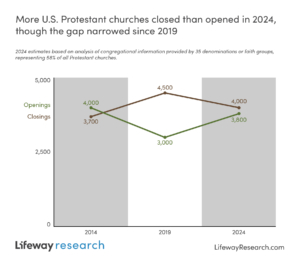
In 2024, Lifeway Research estimates 3,800 new Protestant churches were started in the U.S., while 4,000 churches were closed. This is based on analysis of congregational information provided by 35 denominations or faith groups, representing 58% of all Protestant churches.

(Lifeway Research)

“Some individual denominations release annual numbers related to church plants and church closures, but we are grateful many more were willing to contribute unpublished numbers to help us understand the bigger picture of Protestant churches today,” said Scott McConnell, executive director of Lifeway Research.

“Given recent declines in Americans identifying as Christians, churches show a remarkable ability to remain open, even with fewer attendees on average.”

The 200-church gap between those closed and those opened represents a significant improvement over the 2019 numbers.

In the most recent previous analysis, 1,500 more churches closed than opened. Five years ago, there were 4,500 closures compared to 3,000 openings. Ten years ago, however, Lifeway Research found more Protestant churches were planted (4,000) than closed (3,700) in 2014.

Using the U.S. Religion Census 2020 estimate of approximately 293,000 Protestant congregations in the U.S., the 4,000 closures in 2024 represent almost 1.4% of all U.S. Protestant churches.

Lifeway Research’s analysis of the Southern Baptist Convention found 1.4% of active Southern Baptist congregations disbanded or closed and 0.4% left or were disaffiliated between 2023 and 2024.

In 2024, 906 of the 49,380 active Southern Baptist congregations from the previous year were no longer part of the convention, including 715 that disbanded or closed, and 188 that left or were disaffiliated. 

However, many new churches were planted, and some existing churches became affiliated with the SBC. So, the SBC had 183 fewer congregations in 2024 compared to 2023, according to the SBC’s most recent Annual Church Profile.


(Lifeway Research)

The number of Southern Baptist congregations peaked in 2017 and has declined each year since. However, the 715 that disbanded or closed in 2024 represent the smallest annual loss during the decline.

“The immediate impact of COVID appears to have passed. Denominations have discovered those that closed during quarantine and never reopened,” McConnell said.

“However, the typical church in America has fewer attendees than it did 20 years ago. These assemblies are often weaker than prior generations. But at the same time, new churches are flourishing and a subset of churches are growing,” McConnell added.

Existence expectations

Most pastors aren’t planning on their churches shutting down any time soon, but a few have concerns.

The vast majority of U.S. Protestant pastors don’t expect their church to be among those closing. A Lifeway Research study found 94% of pastors believe their churches will still exist in 10 years, 4% disagree, and 2% aren’t sure.

Even among those who believe their churches have an extended future, some are concerned. Fewer than 4 in 5 (78%) strongly agree they expect their church to have at least another decade.

Smaller church pastors are most likely to be worried. Those leading churches with fewer than 50 in attendance are the least likely to agree their church will still exist in 10 years (88%) and most likely to disagree (8%).

“The typical American church has always been small. But the aging of church attendees and higher cost of living mean even a church with the same number of attendees may have fewer resources than a generation ago,” McConnell said. “However, those churches would say their power is not found in numbers or the strength of the attendees, but in the God they serve.”

Church planting priorities

A recent Lifeway Research study found more than a third of U.S. Protestant churches have participated in helping to start new churches. But while 36% say they were involved in planting new churches, the levels of participation vary.

Around 2 in 5 of these churches have helped with training (42%) and coaching (38%) for church planters. Three in 10 (30%) have been involved with church planting assessments. Just 2% of all churches have accepted direct financial responsibility as the primary sponsor of a new church in the last three years.

Not only do new churches help offset the losses of churches that close, but newer congregations are statistically more likely to be growing than others.

Specifically within the SBC, the only group of churches that demonstrated overall membership growth in the past five years is those founded in the last 25 years, according to Lifeway Research analysis.

Those churches that began in 2000 grew by 12%. Membership among congregations founded between 1950 and 1999 (-11%), 1900 and 1949 (-13%) and before 1900 (-11%) all declined.

“While the American church landscape changes slowly, it is not standing still,” said McConnell.

“The future of Protestant churches in America lies in reaching new people with the offer of salvation through Jesus Christ. Most growth in the U.S. happens in new communities. Church planting is vital to share the gospel in these new communities as well as communities in which the population is changing or previous churches have closed,” McConnell added.

Methodology

Estimates of the number of 2024 Protestant church starts and closures are based on unofficial reports Lifeway Research gathered from 35 denominational groups that represent 58% of U.S. Protestant churches. The pattern in this large sample was applied to the non-reporting and non-denominational groups to provide the overall estimate.

The SBC analysis utilized the final Annual Church Profile congregation file for 2024 compared to 2023. Lifeway Research conducted a postmortem analysis to determine what happened to each congregation in the 2023 dataset not found in the 2024 dataset. This analysis was possible thanks to information shared by data administrators and clerks in each state convention.


Philip Yancey, beloved evangelical author, retires after admitting affair

(RNS)—Philip Yancey, a beloved evangelical author and speaker, will retire from public ministry after admitting to a long-term affair.

“My conduct defied everything that I believe about marriage,” Yancey, 76, wrote in a letter to Christianity Today. “It was also totally inconsistent with my faith and my writings and caused deep pain for her husband and both of our families.”

Christianity Today, where Yancey had been a columnist and contributor for decades, reported the news of his retirement.

Known for his thoughtful and poignant books on faith, with titles such as What’s So Amazing About Grace, Disappointment With God, and Where Is God When It Hurts, Yancey connected with millions of evangelical readers, helping them wrestle with doubts about their faith and the hardships of life.

His books sold a reported 15 million copies, and Yancey was a popular speaker at churches and Christian events, continuing to accept speaking engagements even after being diagnosed with Parkinson’s in 2023.

He had been scheduled on Wednesday, Jan. 7, to speak at Lake Avenue Church in Pasadena, Calif., at a service commemorating the wildfires that struck that community, before news of his retirement broke.

In his letter to Christianity Today, Yancey, who has been married for 55 years, said he has withdrawn from all writing, speaking, and social media, and entered a counseling program to deal with the damage caused from what he called an eight-year affair with a married woman.

“Instead, I need to spend my remaining years living up to the words I have already written. I pray for God’s grace and forgiveness—as well as yours—and for healing in the lives of those I’ve wounded,” he wrote in his letter to Christianity Today.

In a statement, Yancey’s wife, Janet, asked for prayer, saying she knows God has forgiven her husband. She also said she was dealing with the trauma of betrayal.

“God grant me the grace to forgive also, despite my unfathomable trauma. Please pray for us.”

Former Christianity Today editor David Neff, a longtime colleague of Yancey, said news of Yancey’s misconduct left him speechless.

“Fortunately, Philip makes no attempt to gloss over his deeds, blame the victim, or turn this into a launching pad for further ministry,” he said in a post on Facebook. “His statement shows a solid biblical understanding of the nature of sin and grace. Pray for Philip and Janet at this difficult time.”


Studies reveal disappearing religious gender gap 

A study by Pew Research Center shows shifting religious demographics among young men and women. Young women, previously considered “more religious” than young men, are now considered roughly as religious as men in the same age group.

According to the 2023-2024 Religious Landscape Study, there is little difference between religious identification of young men and women. Fifty-seven percent of women ages 18 to 24 identify as religious, a statistical trend nearly mirroring that of men in the same age group (58 percent). 

While seemingly insignificant, the closing religious gender gap between young men and women reflects changing historical trends. A two-year study by the Center for the Study of Global Christianity revealed women’s historical attitude toward religion, with women reporting higher rates of church attendance, prayer, and identification. 

Changing attitudes toward religion are a big factor

The change in this historical tendency seems to be due in part to growing “unaffiliated” religious identification among women. Research conducted by the Public Religion Research Institute expressed changing trends in 2024, where 40 percent of women ages 18 to 29 identified as religiously unaffiliated, representing an 11 percent increase from 2013. The percentage of men in the same age group remained stable (35 percent in 2013 vs. 36 percent in 2024). 

These statistics seem to further reflect fluctuating attitudes of women toward churches, particularly those with more conservative views regarding women in church leadership positions. 

Growing rates of feminism in the U.S. have contributed to changing cultural attitudes as female congregants focus more on the unequal treatment of women. A recent survey highlighted higher rates of female disaffiliation in churches, with 65 percent of women claiming men and women are not treated equally. 

This seeming gender disparity is tied predominantly to Protestant denominations, particularly those that require women to submit to male leadership. 

As modern culture continues to push increasing female independence and empowerment, more traditional religious ideas have become difficult for women to reconcile within a transforming cultural background, the study indicates. 

In an interview, Faith Brack, a former Southern Baptist, argued: “A lot of women are driven away by patriarchal beliefs. Women see that the church is dominated by men and are told [to] submit to their husband and not worry about helping in the church [in more meaningful ways].” 

Shifting sociopolitical beliefs contribute to this change

A Survey Center on American Life study suggests women are not driven from churches purely due to gender roles. A lot of women have grown increasingly progressive, focusing more on church equality, individual rights, and social justice. 

Rates of women identifying as members of the LGBTQ community have also increased, resulting in many American women leaving churches that are not LGBTQ-affirming. 

Most American women leaving their faith do not attribute it to a single reason, but rather an accumulation of negative experiences and teachings that do not reflect the beliefs of a growing diverse culture. 

Some of these women also cite the inability of many more conservative Protestant churches to adapt to more commonly seen lifestyles and identities as having driven these women out or leaving religion altogether and identifying as atheists. 

Women contribute to church community-building

Further research indicates religious American women tend to participate more actively in churches, contributing more time to community building and volunteer efforts. 

Women also provide the bulk of church childcare, with mothers playing significant roles in the faith formation of their children, both within and outside of church.

Americans raised in religious households often cite their mothers as having greater influence in leading their religious upbringing than fathers. This trend is especially prominent in interfaith families, in which nearly half (46 percent) of those raised by interfaith parents cite the mother as having a more prominent role in religious upbringing. 


Study shows rising interest in magic as religion declines

(RNS)—As more people move away from regular attendance in religious institutions, they are moving toward individual spiritual exploration and “secular supernaturalism,” the latest findings from the Baylor Religion Survey reveal.

That brand of supernatural belief doesn’t involve God or gods, but it could involve anything from internet rituals to palm reading—activities researchers are categorizing as “magic.”

 “In general, we conceptualize secularity and religiosity as separate spheres. Now, in reality, of course, that’s not true,” said Baylor sociology professor Paul Froese.

Froese gave a presentation on “Who Believes in Magic? The Relationship between Magical Beliefs, Traditional Religion, and Science” at the annual meeting of the Society for the Scientific Study of Religion and the Religious Research Association in Minneapolis.

Who believes in what?

The Baylor findings from the survey of 1,812 American adults in early 2025 show significant differences between the religiously interested and the religiously indifferent, especially around more traditional beliefs.

For example, 80 percent of respondents who were interested in religion believe in angels and in heaven, compared with 55 percent and 53 percent of those not interested in religion.

Almost 7 in 10 (69 percent) of those interested in religion believe in hell, compared with 43 percent of the religiously uninterested.

But similar percentages of both groups believe in ghosts (53 percent of religion-interested and 50 percent of religiously indifferent) and the possibility of talking to the dead (48 percent of religion-interested and 46 percent of religiously indifferent).

Jen Buzzelli, 57, a former Catholic who describes herself as “nonreligious and agnostic,” said in an interview that the Baylor findings resonate with her.

“There must be a section of overlap where we share beliefs in our different camps,” she said, adding that she has “a little bit of an open heart” to the inexplicable.

Buzzelli believes in evil and divine healing, and the ability to communicate with the dead, but not in heaven, angels, demons, Satan or hell—all part of the inquiry in the Baylor study, whose survey was written by the university’s scholars and administered by Gallup.

Interest sparked by loss of loved one

The film and television executive in Brooklyn, N.Y., describes herself as being fascinated by the 1988 bestseller Many Lives, Many Masters, a book by a psychiatrist about past-life therapy, which she read as she grieved her father’s sudden death almost two decades ago.

“It gave me hope to think that his spirit was still alive out there somewhere, and that maybe we will meet again,” said Buzzelli, who also recalled lights flickering or exploding shortly after the time of his death.

“Even though that book wasn’t about heaven or hell or the afterlife, it just showed there’s a whole ’nother realm out there that we don’t know about.”

Lila Wilson, also 57, was baptized Catholic but grew up in an agnostic household and attends an Episcopal church service when she visits her mother. Never a Bible reader, Wilson said she gained her understanding of Christianity by reading The Chronicles of Narnia as a child.

“My understanding of anything beyond the Earth is sort of amorphous,” said the data analyst from Texas. “So, to think we’re putting these structures on that—that seems a little bit off to me.”

Like Buzzelli, Wilson said she began a journey after the loss of a close relative—in her case, her mother-in-law.

“I just was like, where did she go? And I was looking for any way to figure it out,” said Wilson, who met with psychic mediums and has read about and watched documentaries on near-death experiences.

‘Energy that we don’t understand yet’

Now, she wonders if learning about ghosts and near-death experiences may be a different avenue to achieve what one might through attending church.

“I believe in energy that we don’t understand yet,” Wilson said, noting other people may label that as belief in the paranormal. “That’s my belief system.”

About two-thirds of surveyed Americans (64 percent) would be disinclined to buy a house where there had been a murder. That discomfort held whether respondents were interested in religion (64 percent) or not (62 percent), the Baylor Religion Survey demonstrated.

Both Buzzelli and Wilson said they’d have some discomfort buying a house where someone had been murdered.

Increase in magical thinking

In a November interview, Froese, director of the Baylor Religion Survey, said popular characters from the past, such as the 1960s depiction of Mr. Spock on the original “Star Trek” series, may have given the impression secularity is purely rational and has nothing to do with the supernatural.

“Most people have some sense of some supernatural stuff going on. Superstitions are very routine,” he said. “It’s a continuum. You’re either kind of closer to this secular ideal, or you’re closer … to a religious ideal.”

Froese said the findings may reflect a greater interest in the pursuit of secular, seemingly magical thinking as some move away from traditional religious beliefs around the supernatural. What once may have been labeled “paranormal” by some could become normalized.

“As we see a decline in church membership, we see a decline in trust of church organizations; then we’re seeing a rise of magic,” he said.

“And I think part of that has to do with the internet and just, essentially, it’s a much more individualistic, transactional kind of thing. And so, I think that the future is maybe we’re going to have more magic belief and less traditional religious belief.”


Early religious experiences shape why people stay or leave

(RNS)—Americans who had a positive religious experience as kids are most likely to keep the same faith as adults. Those who had negative experiences are most likely to change faiths or give up on religion.

And while a majority (56 percent) of Americans still identify with their childhood faith, a third (35 percent) have switched—including 20 percent who now say they have no religion.

Those are among the findings of a new report from Pew Research Center, based on data from Pew’s 2023-24 U.S. Religious Landscape Study and a survey of 8,937 American adults conducted between May 5 and May 11.

Researchers asked Americans what religion they’d been raised in as well as their current religion, then asked those who switched or left their childhood faith about why things changed. They also asked Americans who are religious why they remain part of that faith.

Nine percent indicated they weren’t raised in a religion and don’t have one today either.

For this study, released Dec. 15, changing from one brand of Protestantism to another did not count as switching faiths.

Childhood experiences matter

The study found 86 percent of Americans were raised in a religion, but those who stayed tended to have a different experience from those who left.

“Our data shows that the nature of their religious experiences as children—that is, whether they were mostly positive or negative—plays a significant role in whether they stay in their childhood religion as adults,” the study’s authors wrote.

Eighty-four percent of those who had a positive experience as children stayed in the same faith when they became adults, while 69 percent of those who had a negative experience now have no religion, according to the report.

Americans who grew up in what Pew called “highly religious” homes were more likely to keep their childhood faith (82 percent) than those raised in homes with “low levels of religiosity” (47 percent).

Those most likely to keep their childhood faith were Hindus (82 percent), followed by Muslims (77 percent), Jews (76 percent), those with no religion (73 percent), Protestants (70 percent), Catholics (57 percent), Latter-day Saints (54 percent) and Buddhists (45 percent).

Most who change religion do it early

Most switching between faiths comes before people turn 30 years old, according to the report. Of those who switched religion, 85 percent did so before age 30, including 46 percent who switched as teenagers or children.

About half of Americans (53 percent) who no longer claim a religion, known as nones, after growing up religious did so by age 18. Of those who switched religions, about 3 in 10 did so as teenagers.

Americans who stick with their childhood faith do so because it works for them, according to the report.

Many cited their faith’s beliefs (64 percent) as the top reason they retained their faith, along with having their spiritual needs met (61 percent) or finding meaning in life (51 percent) through faith.

Only about a third (32 percent) said the faith’s social or political teachings are important reasons to keep their faith.

Those who find spiritual fulfillment tend to stay

Protestants (70 percent) and Catholics (53 percent) were more likely to indicate their faith’s teachings were an important reason to stay, compared to Jews (45 percent).

Protestants (65 percent) and Catholics (54 percent) were also most likely to say their faith fulfills their spiritual needs.

Jews were more likely to cite a sense of community (57 percent) or their faith’s traditions (60 percent) as why they stay with their religion.

Few Americans say they stay in their childhood faith out of a sense of religious obligation, including 33 percent of Jews, 30 percent of Catholics and 24 percent of Protestants.

What prompts the nones to leave?

Many of those who left their childhood faith and now have no religion say they don’t need religion and don’t believe, the survey suggests.

Among the most important factors were they stopped believing their faith’s teachings (51 percent), religion was no longer important to them (44 percent), and they gradually drifted away (42 percent).

Scandals involving religious leaders (34 percent), unhappiness about social and political teachings (38 percent) or the way the religion treats women (29 percent) were also factors.

Researchers also asked those who have no religion about why they are not affiliated with a faith.

Among the most important reasons were they feel they can be moral without a religion (78 percent), they question religious teaching (64 percent), and they don’t need religion to be spiritual (54 percent). About half said they don’t trust religious organizations (50 percent) or religious leaders (49 percent).

About 30 percent of Americans say they have no religion—a figure that has remained constant since 2020.

The report found about 3 percent of Americans who were raised without any religion now identify with a faith—largely for the same reasons as religious Americans. They embrace their new faith’s beliefs (61 percent), say the faith meets their spiritual needs (60 percent) and say the faith gives their life meaning (55 percent).

Parents polled about practices

As part of the study, researchers also looked at the religious practices of children in the United States from the viewpoint of their parents. Just under half of parents with kids under 18 said their children say prayers at night (46 percent), say grace at meals (43 percent), read religious stories (43 percent), or attend services at least monthly (43 percent).

Protestant parents (61 percent) were most likely to say their children attend services monthly. They are also most likely (35 percent) to say their children are being raised in a highly religious household.

Nones are least likely to say their children attend services monthly (7 percent) or are being raised in a highly religious household (1 percent).

Mothers (39 percent) are about twice as likely as fathers (17 percent) to say they play the primary role in teaching their kids about religion, according to the study.