Church staff salaries increase; insurance coverage declines

NASHVILLE (BP)—Compensation for full-time Southern Baptist church staff members exceeded the cost-of-living increase over the past two years. However, health insurance coverage continues to decline, according to the 2016 Southern Baptist Convention Church Compensation Study.

The biannual study is a joint project of state Baptist conventions, GuideStone Financial Resources and LifeWay Christian Resources. Compensation and congregational data are collected anonymously about ministers and office/custodial personnel of Southern Baptist churches and church-type missions.

Compensation increased

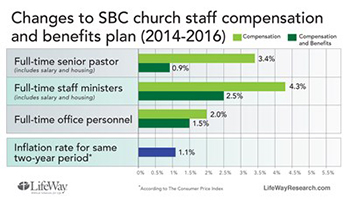
Compensation—salary, plus housing—increased 3.4 percent for full-time senior Southern Baptist pastors over the last two years, 4.3 percent for full-time staff ministers and 2 percent for full-time office personnel. The U.S. Department of Labor’s Consumer Price Index for the same two-year period increased only 1.1 percent.
compensation 350Factors correlating with compensation for senior pastors include education level, weekly church attendance and tenure at their current church, as well as total years of experience. Those with a bachelor’s degree earn an average of $4,040 more than otherwise equivalently qualified pastors without a college degree. Master’s and doctorate degrees correspond with incremental compensation increases of $2,171 and $11,151, respectively. Seminary graduates have an additional increase in average compensation of $4,706.

Scott McConnell, executive director of LifeWay Research, pointed out that despite increases in compensation, fair wages take into account wages at comparable churches, increased experience and education, and cost of living.

“While inflation has been lower this last year, it is still true that the dollars churches paid last year don’t buy as much,” McConnell said. “Without a raise, you are actually paying less.”

Overall, the value of the entire pay package—salary, retirement, housing and other benefits including insurance—for senior pastors (0.9 percent) has not kept pace with inflation, even though the pay package for full-time staff ministers (2.5 percent) and office personnel (1.5 percent) exceeded inflation.

Only half provide health insurance

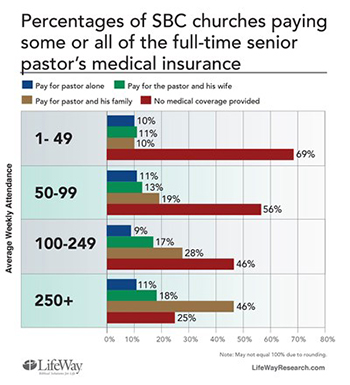
Only half of churches participating in the survey provide health insurance coverage for senior pastors, down from 60 percent two years ago and 64 percent in 2012.
medical insurance 350“While recognizing these trends, and the impact of Obamacare, GuideStone continues to advocate for churches to support all staff members with this important benefit,” said Scott Charbonneau, GuideStone’s managing director of insurance plans.

“Further, GuideStone has reduced the access point for its insurance plans down to a minimum group size of only two employees with multiple plans available, including a low-cost value plan.”

One-fourth of churches pay for medical insurance for the senior pastor and his family, 15 percent provide for the pastor and his wife, and 10 percent provide only for the pastor.

Multiple factor influence level of benefits

Although a larger weekly attendance correlates with churches providing senior pastors with health insurance, one-fourth of churches with 250 or more average attendees do not provide health insurance. Conversely, nearly one-third of churches (31 percent) with less than 50 in weekly attendance do provide their pastor with medical coverage.

pastoral benefits 300Some churches also provide additional insurance benefits to senior pastors, including life and/or accidental insurance (29 percent), disability (26 percent), dental (24 percent) and vision (10 percent), although each is a few percentage points less than reported in 2014.

Multiple factors also impact the amount of vacation senior pastors receive. Larger churches tend to give pastors more vacation, with otherwise equivalently qualified pastors averaging one additional day for every 448 attendees. Pastors with a bachelor’s, master’s or doctorate degree add an average of one, two or four vacation days, respectively, over those with some college or an associate degree. Seminary graduates, on average, also receive one additional vacation day.

The survey also obtained compensation data for bivocational pastors and part-time custodial and office personnel. This data is standardized by the median number of hours worked to allow churches to compare their part-time employees with these averages.

Southern Baptist state conventions invited each church’s staff to respond to the survey; 14,076 completed surveys are available, including 8,164 full-time staff analyzed for this article.

For the purpose of this article, senior-pastor responses were weighted to account for lower response rate among smaller churches and to match the distribution of the size of Southern Baptist churches.


BWA names Virginia Baptist as divisional coordinator

WASHINGTON—Trisha Miller Manarin, executive coordinator for the Mid-Atlantic Cooperative Baptist Fellowship based in Virginia, assumed duties Sept. 1 as part-time coordinator of the Baptist World Alliance division of mission, evangelism and justice.

She succeeds Fausto Vasconcelos, who retired Aug. 31. The division she leads combines two previous areas of BWA work—the division of mission, evangelism and theological reflection and the division of freedom and justice.

Manarin, the director of supervised ministry and an adjunct professor at the John Leland Center for Theological Studies, is a member of the BWA Commission on Mission. She was elected a vice president of the North America Baptist Fellowship in July, after serving as the regional fellowship’s recording secretary.

“Over the last nine years, I have gotten to know Trisha and her interest in, and commitment to, BWA and its mission,” BWA General Secretary Neville Callam said. “Her intellectual gifts and her communications and organizational skills will prove helpful to the organization as we inaugurate the new division on mission, evangelism and justice.”

Manarin holds a degree in music education and vocal performance from Samford University in Alabama, a master’s degree from Eastern Baptist Theological Seminary (now Palmer Seminary) in Pennsylvania and a doctoral degree from Wesley Theological Seminary in Washington, D.C.

She and her husband, Tim, a member of the BWA Commission on Human Rights Advocacy, have three children.

Based on reporting by Eron Henry of the Baptist World Alliance.


Don’t equate cultural Christianity with the gospel, Chandler insists

NASHVILLE (BP)—Christians need to learn not only how to engage the culture in a gospel-focused manner, but also avoid becoming a captive of cultural Christianity, speakers and panelists said at the Southern Baptist Ethics & Religious Liberty Commission’s national conference.

North Texas Pastor Matt Chandler said the Bible Belt has “churches that are filled with unregenerate (people) in a culture where any type of conservatism is just lumped in to being a Christian.”

In the Bible Belt, pastors often need to help “really moral church folk understand that they’re non-Christians” and “deconstruct the idea that Jesus is about good people,” said Chandler, pastor of The Village Church in Flower Mound.

Transformation, not trying harder

Speaking on the parable of the lost sheep, coin and son in Luke 15, Chandler said: “The mission of God is to seek and save the lost—not moral betterment. That’s what happens when we are saved, right? We are going to be transformed from the inside out.”

“Well, the Bible Belt is so twisted around this idea,” he said, adding he has been overwhelmed that “the basic gospel message has been completely lost on a full generation.”

The reality for a Christian that “all of life is repentance” needs to be understood in the church, Chandler said.

Otherwise, “every little struggle they have will be hidden in the darkness because they will believe that they did that when they got saved,” he said. “I just can’t tell you the sheer volume of people I know who are enslaved to sin and feel like they can’t tell anyone about it, because they got saved 15 years ago.”

Quest for control

Andy Crouch, executive editor of Christianity Today, challenged conference audience to consider whether they—and the American church—are “on a quest for control,” particularly of culture.

Andy Crouch 350Andy Crouch, executive editor of Christianity Today, talks about culture and leadership at the Ethics & Religious Liberty Commission national conference. (Photo by Rocket Republic)Human beings are given authority—the capacity for meaningful action—and vulnerability—exposure to meaningful risk, he said. But control itself is a testament to true motivations, he added.

“You know someone is addicted to control (if) when their control begins to slip, they become violent,” Crouch said. “What our culture has perceived of us Christians is they see us losing control of culture, and they see the rage with which we react to that loss of control.”

Crouch proposed an alternative approach—true leadership and leaders who “just show up and are honest about their limits, honest about our limits and call us to live a life of risk.”

Follow Jesus, invest in others

Robby Gallaty, senior pastor of Long Hollow Baptist Church in Hendersonville, Tenn., pointed conference participants to a two-fold strategy Jesus gave the church to engage the culture—an invitation to follow him and invest in others.

“We’re going to change the culture the same way Jesus changed the culture, and that’s with an invitation to follow him,” Gallaty said. “We will never affect the culture publicly until we have been transformed by the gospel privately.

“Intimacy with God always precedes ministry. Who we are in Christ trumps what we will ever do for Christ.”

Recover the work ethic

Greg Thornbury, president of The King’s College in New York City, said he is worried as someone who leads an institution preparing young adults for the world.

“I am concerned that the rightful teaching of grace in our churches may be producing a slacker generation that will damage our witness in culture in coming generations,” he said.

“We need to recover the work ethic that made the people of God who they were in every cultural situation.”

Connect to the Great Commission

During a panel discussion, Trevin Wax, a publisher for LifeWay Christian Resources, said cultural engagement should be connected to the Great Commission.

If cultural engagement is simply a way for Christians to seek “to show that we’re culturally savvy … then that is the way to disaster,” he said. Christians should possess a “Great Commission understanding of people around us so we can effectively present the gospel,” he added.

On the same panel, Jackie Hill Perry, a poet and artist with Humble Beast Records, encouraged young Christians to demonstrate “an intentionality” about their lives and to use their “online presence for the gospel, for the glory of God.”

Hill Perry also urged young Christian couples: “Don’t be afraid to have children. If we are not raising disciples now, who will be the ones to carry the torch later?”


Aponte named vice president of mobilization at IMB

RICHMOND, Va. (BP)—Trustees of the Southern Baptist Convention’s International Mission Board approved Edgar Aponte, seminary administrator and educator, as vice president of mobilization.

Aponte is director of Hispanic leadership development and instructor of theology at Southeastern Baptist Theological Seminary in Wake Forest, N.C. He and his wife, Sara, are members of Christ Covenant Church in Raleigh, N.C.

“Over the course of prayerful conversations with Edgar, we believe that he is the right person to serve IMB as vice president of mobilization,” IMB President David Platt told trustees, noting Aponte’s desire to mobilize the church in the United States to spread the gospel to the nations.

Edgar Aponte 250Edgar Aponte In his new role, Aponte will seek to mobilize churches in sending missionary teams evangelize and start churches among unreached people and places. 

“Edgar Aponte is an incredibly gifted man of God,” said Danny Akin, president of Southeastern Seminary. “The Lord has blessed him with a wide range of abilities and talents. He excels at whatever he does. This is a sad day for Southeastern and me personally. However, it is a great day for the IMB and the advancement of the kingdom of King Jesus among the nations. He goes to our very close sister entity with my blessing and prayers. This is a great thing for Southern Baptists.”

Prior to his work at Southeastern Seminary, Aponte served at the ministry of foreign affairs in Washington, D.C., on behalf of his home nation, the Dominican Republic. As minister counselor in the political section, he coordinated political relations between the embassy and the State Department, Department of Labor, U.S. Congress and Department of Defense; advised the ambassador and authorities on a broad range of policy issues from a bilateral agenda; and engaged in meetings with other embassies and interest groups about specific regional issues, such as human trafficking and drug trafficking. Previously, he worked five years in banking.

Aponte holds a bachelor’s degree in business administration, a graduate degree in corporate finance and a master’s degree in business administration and management. He also earned a master’s degree in Christian ministry from Southern Baptist Theological Seminary in Louisville, Ky., and expects to complete a doctorate in theological studies with a concentration in systematic theology from Southeastern Seminary this fall.

Based on reporting by Julie McGowan.


CBF board affirms executive coordinator in process of divorce

ATLANTA—Cooperative Baptist Fellowship leaders issued statements affirming Executive Coordinator Suzii Paynter in light of her pending divorce from her husband of 44 years, Roger Paynter, former pastor of First Baptist Church in Austin.

“While divorce is regrettable, unexpected and painful, the Bible does identify circumstances under which such a step is permissible,” a statement from the CBF governing board said.

When the organization’s officers learned about the divorce proceedings, they talked to her in detail and determined “she has met the highest standard of biblical conduct in response to it,” according to the board statement.

They concluded “she has done nothing that would adversely affect her ability to fulfill her responsibilities as executive coordinator, among which is to ‘provide spiritual leadership in keeping CBF focused to its purpose’ and expressing ‘exemplary Christian character,’” the statement continued.

The officers recommended to the governing board she be affirmed, and the board “joined with them in unanimously pledging their full endorsement of Suzii and her handling of this painful personal matter, and unequivocally supports her in her continued role as leader of the daily operations and mission of CBF,” the board statement said.

The board also asked for “prayer for Suzii and her family.” It asked “those affiliated with the Fellowship to support and encourage Suzii in her work on the Fellowship’s behalf.”

Doug Dortch, CBF moderator and senior minister of Mountain Brook Baptist Church in Birmingham, Ala., also pledged his personal support for her.

“While I hurt for Suzii and her family in this most difficult season in their lives, I am absolutely confident in her ability to lead our organization into the good future God has for us all,” Dortch said. “In fact, seeing how she has already had to balance the hard and painful aspects of this matter with the pressing demands of her position only has strengthened my appreciation for her leadership.”

The leaders of 18 state and regional CBF organizations also released a statement affirming Paynter and expressing confidence in her leadership.

Paynter assumed the CBF executive coordinator’s post in 2013. Previously, she was director of the Texas Baptist Christian Life Commission.

Based on reporting by Jeff Huett, associate communications coordinator for CBF.


Customers praise GuideStone as ‘trustworthy’

NEWPORT BEACH, Calif.—Vision, integrity and purpose characterize people and organizations of influence, O.S. Hawkins, president of GuideStone Financial Resources, told the agency’s board of trustees.

He called 2016 “the Year of Influence” for GuideStone, referencing 2 Corinthians 10:13, which says, “But we will not boast beyond limits, but will boast only with regard to the area of influence God assigned to us, to reach even to you.”

People who responded to a recent customer satisfaction survey overwhelmingly identified GuideStone as “trustworthy,” Hawkins reported.

“It takes integrity to maintain trust,” he said. “We are thankful for the trust our participants place in GuideStone, and we continue to work diligently to maintain that trust.”

Retirement and investment contributions up 20 percent

GuideStone’s board of trustees met in regular session in Newport Beach, Calif., to visit to the world headquarters of PIMCO, a long-time subadviser in GuideStone’s investment work and one of the world’s largest bond investment companies.

Chief Operating Officer John R. Jones told the board GuideStone Funds are available now on 20 intermediary platforms, including Fidelity and Schwab, as a result of reaching out to Christian financial advisers. Financial planners use intermediary platforms to access the investments they offer to their clients. As the number of platforms offering GuideStone Funds grows, the number of potential investors grows with it.

Year-to-date, retirement and investment contributions are up 20 percent compared to the same period in 2015.

Expect rate increases in medical insurance

Chief Financial Officer Kim Walthall reported GuideStone continues to work diligently to keep medical rates down; however, medical inflation has been higher than projected. Published reports have indicated some state and federal healthcare exchange insurers have requested rate increases ranging from 50 percent to 65 percent for 2017.

While rates for GuideStone’s medical plans will increase for some participants in 2017, they will not be anywhere near the rate-increase requests seen by exchange-based insurers, agency officials reported. GuideStone’s rates will be communicated in September, and churches should prepare for rate increases, regardless of their provider for next year, the board learned.

GuideStone’s group medical participation continues to be strong in 2016, thanks to competitive insurance plans, rates, customer service and broad provider networks along with the diligence of the sales and support teams, staff leaders told trustees.

Property and casualty beneficial

GuideStone’s alliance with Brotherhood Mutual Insurance Company continues to prove beneficial for both organizations as well as the churches and ministry organizations served, trustees learned. Premiums, year-to-date, for the property and casualty agency, which serves Texas and Alabama, total $18.6 million, up from $17.3 million at the end of 2015.

While enjoying a 99 percent renewal rate, GuideStone continues to grow the property-and-casualty part of its business, adding more agents to serve churches and ministries in Texas, as well as looking for opportunities in 2017 and beyond.

Mission:Dignity assists retirees in need

Mission:Dignity, GuideStone’s ministry that provides financial assistance to retired Southern Baptist ministers, workers and, in many cases, their widows, continues to add new contributors to its donor base. During Mission:Dignity Sunday, celebrated across the Southern Baptist Convention June 26, an all-time high of 8,274 congregations participated.

To refer a retired Southern Baptist pastor or widow in need, visit MissionDignity.org, and select the “Refer Someone in Need” link on the right side of the page. Eligibility guidelines and links for more information are available there.

New executive officers named

Trustees approved three new executive officers.

The board named Harry Nelson chief strategic investment officer. In that role, he will provide leadership to GuideStone’s investments division. Nelson joined GuideStone in 2013 as executive director of investments sales.

Trustees named Mark Borchgardt chief services and operations officer, and he will oversee day-to-day service, operations and quality initiatives. He joined GuideStone in the finance and accounting area in 1996 and has held a variety of positions, including financial reporting, retirement and investment product development, strategic planning and retirement services.

The board approved Harold R. Loftin as chief legal officer and general counsel. Loftin will provide leadership and counsel on regulatory and legal needs. He joined GuideStone in 2013 as associate legal counsel.


Texas Baptist named national WMU ministry consultant for boys

BIRMINGHAM—Zachariah Seanor, a graduate of Baylor University’s Truett Theological Seminary and former Texas Baptist minister to students, joined the national Woman’s Missionary Union staff as ministry consultant for Royal Ambassadors and Challengers.

Zachariah SeanorSeanor’s responsibilities include growth and development of missions education through the RA program for boys in first through sixth grades and the Challengers program for young men in grades seven through 12.

“We are delighted to welcome Zachariah to our staff,” said Carol Causey, director for WMU’s Missions Resource Center. “His personal knowledge from being raised in RAs, along with his training in education and missions, make him uniquely equipped for this position. We look forward with great anticipation to his contributions.”

Most recently, Seanor was chaplain and interim dean of student life at Live Oak Classical School in Waco.

Previously, he was associate director of student recruitment for Truett Seminary and minister of students at Taylor’s Valley Baptist Church in Temple.

He earned his undergraduate degree from Samford University in Birmingham and his master of divinity degree from Truett Seminary, with a focus on missions and world Christianity.


Tim LaHaye, Religious Right leader and ‘Left Behind’ author, dead at 90

WASHINGTON (RNS)—Tim LaHaye, the evangelical minister known for both his conservative politics and the best-selling Left Behind series of novels, died July 25 at age 90, after recently suffering a stroke.

“Thrilled as I am that he is where he has always wanted to be, his departure leaves a void in my soul I don’t expect to fill until I see him again,” said Jerry B. Jenkins in a statement on the death of his co-author of the apocalyptic Left Behind series.

Half of evangelical power couple

LaHaye and Beverly, his wife of 69 years, were an evangelical power couple, with him serving as a pastor, religious broadcaster and the founder of Christian high schools and her founding Concerned Women for America, a prominent conservative organization.

“Between his theology and his co-writer Jerry Jenkins’ writing ability, the two of them really managed to capture the popular imagination,” said Marcia Z. Nelson, contributing editor and former religion book reviews editor at Publishers Weekly.

End-times novels captured imagination

The Left Behind series, a modern-day morality tale, told how an airline captain tried to find his family—and struggled with his own failings—after believers were suddenly “raptured” into heaven and nonbelievers were left to face tribulations on earth.

The series was first published in 1995, in the run-up to the new millennium, which prompted anxiety among end-times believers as well as others. LaHaye’s contributions to those books made his apocalyptic theology more engaging and approachable to a more general readership.

In 1999, Apollyon was the first Christian fiction title to cross over from Christian best-seller lists to general ones, spending multiple weeks on both The New York Times and USA Today best-seller lists.

LaHaye had long been a proponent of relying on the Bible for prophetic messages.

“Everyone wants to know about the future, and there’s a lot of discussion, but only the Bible gives concrete answers,” LaHaye said in a 2005 story published by Religion News Service. “What people don’t realize is that 28 percent of the Bible was prophetic at the time it was written. There are over 1,000 prophecies in the Bible, half of which have already been fulfilled.”

Early architect of Religious Right

One of his key roles in U.S. politics was to encourage the late Jerry Falwell Sr. to start the Moral Majority, urging previously reticent conservative Christians to speak out about their values and views. LaHaye had gathered Southern California pastors to counter progressives but thought a national organization should be formed.

More recently, he helped garner evangelical support for former President George W. Bush and was known as a spiritual adviser to former GOP presidential candidate Mike Huckabee.

Beyond the 16-book Left Behind series, LaHaye wrote dozens of other books on topics such as family life, Bible prophecy and critiques of secular humanism that sold millions of copies.

‘Politics of fear’

In 2001, the Institute for the Study of American Evangelicals named him “the most influential American evangelical of the last 25 years.” It cited the string of 1970s and 1980s books he had written about “battles” for evangelicals—The Battle for the Mind, The Battle for the Family and The Battle for the Public Schools.

Christian author Tom Sine—a critic of LaHaye’s role with the Religious Right—agreed with the finding of the institute, saying LaHaye was influential in fostering the “politics of fear.”

“Tim LaHaye has become such a dominant influence in American Christian culture because he has defined the terms of America’s culture war,” wrote Sine, author of Cease Fire: Searching for Sanity in America’s Culture War, in a 2001 article in Sojourners.

Megachurch pastor

The son of a Detroit autoworker, LaHaye was an Air Force veteran and a graduate of Bob Jones University. He was pastor of churches in South Carolina and Minnesota before moving to California.

He led the Scott Memorial Baptist Church in San Diego County for 25 years, expanding it to three locations, including Shadow Mountain Community Church, an evangelical megachurch in the San Diego suburb of El Cajon.

“Tim was one of the most godly men I have ever known,” said David Jeremiah, the current senior pastor of the El Cajon church. “Almost every conversation I had with him ended with his praying with me and for me.”

Samuel Rodriguez, president of the National Hispanic Christian Leadership Conference, praised LaHaye for the range of his contributions.

“Dr. LaHaye has blessed the church in America with a legacy that will far outlast his time on this earth,” he said. “The principled stand he took on countless issues has impacted the social, cultural and political landscape for generations. He was a once-in-a-millennium type of leader who paved the way for future generations.”

The last tweets before the announcement of his death on LaHaye’s Twitter account were two quoting the Gospel of Matthew about focusing on heaven rather than earth.

“Don’t store up treasures here on earth where they can erode away or may be stolen,” they read. “Store them in heaven where they will never lose their value and are safe from thieves. If your profits are in heaven, your heart will be there too.”


Baptist Joint Committee joins Nevada brief opposing school vouchers

WASHINGTON—Funneling taxpayer funds to religious schools through a voucher program compromises religious liberty, according to a legal brief filed at the Nevada Supreme Court and joined by the Baptist Joint Committee for Religious Liberty.

The Hindu American Foundation also joined the brief in the case of Duncan v. Nevada. The Nevada Supreme Court will hear oral arguments July 29, the same day it hears another case challenging the voucher program, Schwartz v. Lopez

Nevada’s school voucher program allows public dollars to flow to private schools, including religious schools, by diverting money from the state’s designated public education fund.

When an eligible student applies for a voucher, money is transferred from the Distributive School Account into the Education Savings Account program, which can be used for certain education expenses, including tuition at private religious schools and religious instructional material for those schools. There are no restrictions on how the private schools may use the public funds after they receive them. 

“Funding religious schools with taxpayer money can violate the consciences of citizens who disagree with their teachings,” said Jennifer Hawks, associate general counsel of the Baptist Joint Committee. “Parents have the right to choose a religious education for their children but not the right to insist that taxpayers pay for it through any type of voucher program.”

The brief asserts religious liberty is threatened when the government gets involved with religion, noting the principle of separation between church and state “recognizes that governmental support for and funding of religion corrodes true belief, makes religious denominations and houses of worship beholden to the state, and places subtle—or not so subtle—coercive pressure on individuals and groups to conform.”

For centuries, Baptists have preached that genuine religious belief means people come to faith of their own free will, following the dictates of their consciences without coercion, BJC officials added.

The Nevada Constitution has a clause specifically prohibiting any public funds from being used “for sectarian purpose.” According to the brief, that No-Aid Clause is “an expression of both the philosophical and political traditions of freedom of conscience.”

That clause protects religious freedom and supports religious pluralism, the brief asserts, noting the success of religion in the United States is in part thanks to adherence to the idea that “individual congregations and worshippers are free to define for themselves the terms of belief and religious practice” without dependence on or interference from the government.


Houston pastor named to committee to guide CBF Illumination Project 


DECATUR, Ga.—Cooperative Baptist Fellowship Moderator Doug Dortch appointed a Houston pastor to a five-member ad hoc committee that will oversee implementation of the Illumination Project.

steve wells 200Steve Wells, pastor of South Main Baptist Church in HoustonSteve Wells, pastor of South Main Baptist Church in Houston, will serve on the committee, designed to create a cooperative and collaborative way to address potentially divisive matters, such as LGBTQ issues.

The CBF governing board adopted the project at the general assembly in Greensboro, N.C., to build and strengthen unity through cooperation across the Fellowship.

The Illumination Project is a process of discernment and accompaniment involving CBF congregational leaders to shed light on the qualities that have built unity in CBF and identify intentional efforts by which the Fellowship can maintain and grow unity through cooperation. 

‘More light and less heat’

Designed to create models of dialogue and decision-making for a cooperative body, the Illumination Project aims to provide “more light and less heat” in situations where the Fellowship finds itself in conflict or has varying convictions, CBF officials said.

In consultation with CBF Executive Coordinator Suzii Paynter, Dortch selected Charlie Fuller, minister for congregational life at Second Baptist Church in Little Rock, Ark., to serve as the committee’s chair.

“As a former dean of the School of Fine Arts at Ouachita Baptist University, Charlie knows how to manage diverse viewpoints and personalities,” Dortch said. “As a church staff member, he understands how conversations on potentially controversial topics have a bearing on local congregations. As a valued governing board member, he has made many valuable contributions to our work together. He is, without question, the right person for this responsibility.”

Serving with Fuller and Wells on the committee are Paul Baxley, senior pastor of First Baptist Church in Athens, Ga.; Kasey Jones, past CBF moderator and senior pastor at National Baptist Memorial Church in Washington, D.C.; and Rebecca Wiggs, an attorney in Jackson, Miss.

‘Build and strengthen CBF unity through cooperation’

The committee’s charge is to implement the Illumination Project “as a means by which to build and strengthen CBF unity through cooperation in light of our current cultural context,” Dortch said.

“I have asked that the committee proceed with this charge through a process that is broad-based and transparent; deliberate and intentional; and without any predetermined outcome, other than the desire to encourage CBF unity through cooperation. Knowing the caliber of people we have on this committee, I have no doubt that they will be able to fulfill this charge most effectively.”

The ad hoc committee is “committed to implementing a process that models what we claim to be—Cooperative Baptists,” Fuller said.

“Our objective is to listen and truly hear the voices from CBF stakeholders across the rich and diverse breadth of our Fellowship,” he said. “A process that seeks to discern the voice of God can’t have a predetermined outcome or a predetermined timeline. We must wait until we’ve heard God speak through the Fellowship itself. 

“We will work together to determine what issues of human sexuality mean for us as a cooperating network of Baptists. We will work diligently and be as transparent as possible throughout the length of our work. Most importantly, we covet your prayers for us as we discern the voice of God, who speaks to all of us in our ‘big tent’ Fellowship.” 

Prayer and input requested

The ad hoc committee held its first conference call July 13, will hold a two-day retreat Sept. 19-20 in Decatur, Ga., and will convene again Sept. 29-30 during the fall meeting of the governing board.

“I encourage everyone in the Fellowship to be in prayer for this committee and the important work they will undertake,” Dortch said. “Be ready also to join your voice to the conversation, and let us be hopeful that we will come to a place where we have the necessary clarity to forge forward as a unified Fellowship in addressing issues that come before us.”

Contact Fuller with questions or comments at governingboard@cbf.net.

Read more and comment online here


Walker still sees need to boost religious freedom


Brent Walker can see the U.S. Capitol and the U.S. Supreme Court building when he arrives at work. That’s appropriate, since the religious liberty advocate often finds himself heading over to those two buildings, as well as the White House and other government buildings in Washington.

Read it at Baptist News Global.


BWA adds three new member groups

VANCOUVER, B.C.—The Baptist World Alliance welcomed three new member organizations during its general council meeting in Vancouver.

The council added Baptist groups in Grenada, India and South Sudan to the BWA roster. The international organization now has 235 member organizations in 122 countries and territories.

Founded in 1984, the Grenada Baptist Association has six churches and 400 members. Grenada is the newest country in the Caribbean to join the BWA international fellowship.

The Arunachal Baptist Church Council in northeast India, established in 2008, includes 95,000 members in more than 1,000 churches. It grew out of a merger of two Baptist groups, one in the north and the other in the south, and it becomes the 21st BWA member from India.

The Faith Evangelical Baptist Church in South Sudan—established in 2007—has 7,000 members in 74 churches in both South Sudan and Kenya.

In other business, the general council approved a recommendation from its executive committee to combine the BWA division of mission, evangelism and theological reflection with its freedom and justice division.

Fausto Vasconcelos, who directs the missions, evangelism and theological reflection division, retires at the end of August after more than 10 years.

The freedom and justice division director’s position has been vacant since 2014 after Raimundo Barreto resigned to take up a professorship at Princeton Theological Seminary in New Jersey.

Both the BWA budget and finance committee and the human resources committee agreed funds were not available to enable BWA to hire a successor to Barreto, BWA General Secretary Neville Callam told the general council.

Based on reporting by Eron Henry.