Lawyers say Justice Department probe of SBC closed
March 13, 2025
NASHVILLE (RNS)—Lawyers for the Southern Baptist Convention said March 12 the U.S. Department of Justice has ended an investigation into the denomination’s response to allegations of sexual abuse committed by Southern Baptist pastors and institutional leaders.
That investigation was launched in 2022 after the release of the Guidepost report that demonstrated SBC executives had mistreated abuse survivors and sought to downplay the effects of abuse in the convention.
“Earlier today, the U.S. Attorney’s Office for the Southern District of New York informed us that the investigation into the Southern Baptist Convention and Executive Committee has officially concluded,” SBC attorneys Gene Besen and Scarlett Nokes told Baptist Press, an official SBC outlet.
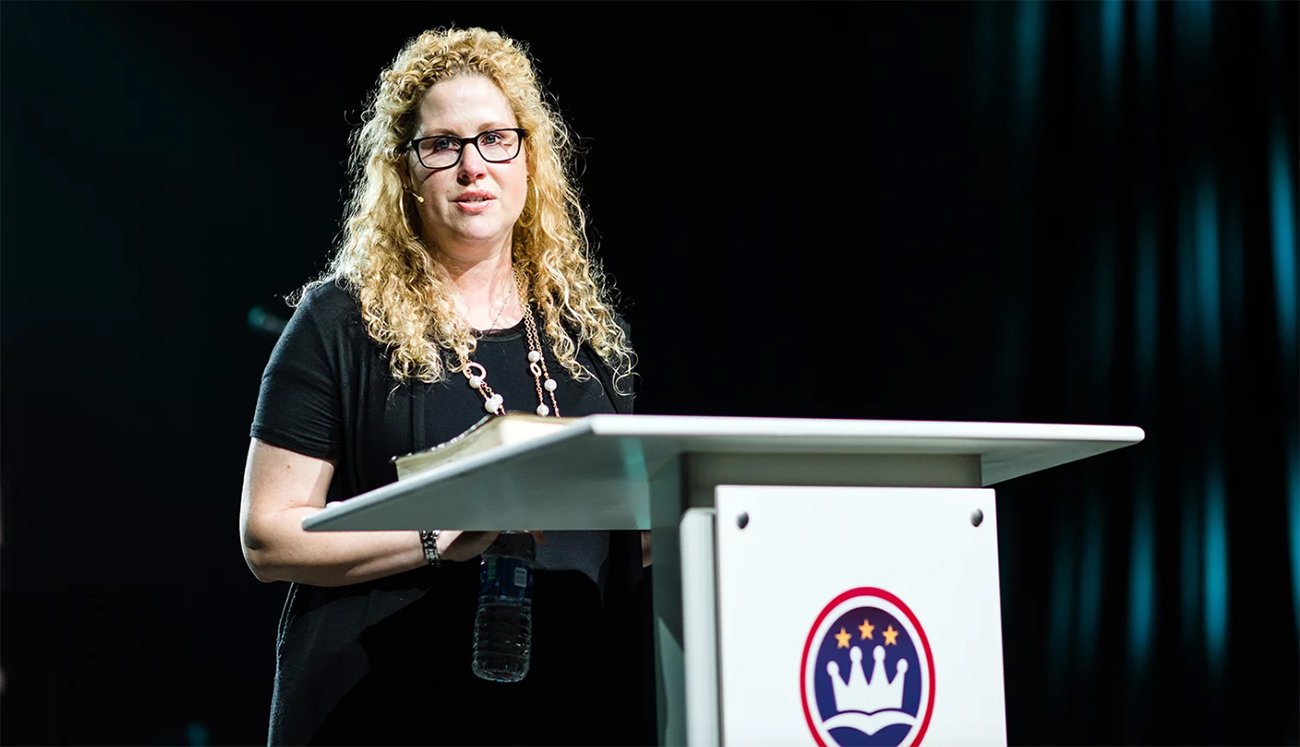
Megan Lively speaks at the Caring Well conference in Grapevine on Oct. 3, 2019. (Photo / Karen Race Photography / Courtesy of SBC Ethics and Religious Liberty Commission)
Megan Lively, an abuse survivor and activist, said she was disappointed to hear from an FBI agent the investigation was over. She had hoped, she said, the investigation would move the SBC to take abuse reforms seriously.
“It’s just a mess,” she added.
A spokesman for the U.S. Attorney’s Office for the Southern District of New York declined to comment.
No abuse charges have been filed as a result of the Guidepost report. Matt Queen, a former Southwestern Baptist Theological Seminary professor and provost, pleaded guilty last fall to lying to the FBI, and recently was sentenced to six months of house arrest, a year of supervised release and a $2,000 fine.
But aside from Queen’s case, few details of the investigation have been made public. Given that national SBC leaders have no direct control over pastors or churches, it always was unclear what crimes SBC leaders might be charged with.
Leaders from Southwestern Baptist Theological Seminary, where Queen was once a professor as well as provost, stated: “For more than two years, Southwestern fully cooperated with the DOJ throughout the investigation and is pleased that there were no findings of wrongdoing against the institution or current employees. We remain committed to ensuring the safety of all members of the seminary community.”
This is the second time the SBC’s attorneys have announced an end to the Department of Justice investigation. Last March, those attorneys said the investigation into the Executive Committee, which oversees the denomination’s day-to-day operations, was over, but later clarified the investigation into the denomination as a whole continued.
‘Grateful we can close this chapter’
Southern Baptist leaders have spent more than $2 million on legal fees related to the investigation. Those fees, along with more than $3 million spent defending lawsuits filed by a pair of former SBC leaders named in the Guidepost report, and the cost of the Guidepost investigation itself, have drained the Executive Committee’s reserves and left it unable to pay its legal bills.
SBC Executive Committee President and CEO Jeff Iorg gives an address to Executive Committee members, Feb. 17. (BP Photo / Brandon Porter)
Jeff Iorg, president and CEO of the Executive Committee, gave thanks for the investigation’s end, saying, “We’re grateful that we can close this chapter in our legal proceedings and move forward.”
The SBC’s attempts to manage accusations of sexual abuse have occupied the leadership for more than a decade, and the convention’s governing body, the annual meeting of messengers from local churches, has demanded reform, forcing the Executive Committee to commission the Guidepost investigation in a floor vote in 2021.
But critics of the reform efforts point to the cost of the Guidepost investigation to claim it was a mistake. Abuse advocates worry those critics now will use the end of the Justice Department investigation to derail reforms.
The Guidepost report led Southern Baptists to pass a series of reforms intended to address abuse in churches, including more training and publishing a database of abusive pastors. Those reforms largely have stalled.
While the SBC has distributed training materials and hired a national staffer to help oversee reforms, the database has been tabled for now, with SBC leaders saying last month it is no longer a priority.
Abuse survivors now worry the end of the investigation and the tabling of the database signal abuse reforms have run out of steam.
“Everything seems to be falling apart,” Lively said.
Northeast only region for SBC growth, analysis shows
March 13, 2025
NASHVILLE (RNS)—Southern Baptists long have been known as a large branch of evangelical Christianity and a dominant force in the Southern states.
But an analysis of recent statistics supplied by congregations across the country revealed New England is the sole region where Southern Baptists gained congregants overall from 2018 to 2023.
Churches in Connecticut, Maine, Massachusetts, New Hampshire, Rhode Island and Vermont grew by 10 percent, a Lifeway Research analysis released March 11 said, based on data from the Southern Baptist Convention’s 2023 Annual Church Profile.
“Every other region saw declines in overall church membership,” the report stated.
Just 2 percent of Southern Baptist churches are in the Northeast region, compared with 78 percent located in the South.
The SBC annual report often is used to indicate the statistical state of the national denomination, which decreased to 12.9 million members according to the most recent profile in May 2024. That marked the lowest numbers since the late 1970s for a denomination that reached its peak at 16.3 million in 2006.
Analysis over five years offers wide view
But analyzing SBC’s results over time can give a wider view of where the growth and decline of Southern Baptists is occurring within the United States, as the Lifeway analysis over five years demonstrates.
“The growth in New England is driven by numerous years of church planting in the region and faithful reporting of continued growth in many of those churches,” Scott McConnell, executive director of Lifeway Research, told RNS via email.
Two Southern regions—one comprising Alabama, Kentucky, Mississippi and Tennessee, and the other including Arkansas, Louisiana, Oklahoma and Texas—saw the smallest drop in church membership in the five-year period at 8 percent.
“The rapid population growth in Texas is definitely driving the growth in the West South Central region of the U.S.,” McConnell said.
The five-year regional comparisons included only churches that reported non-zero data in both 2018 and 2023 for total membership, an executive summary noted. While 69 percent of Southern Baptist churches nationwide contributed to the 2023 Annual Church Profile, McConnell said 99 percent of SBC churches in New England contributed to that statistical census.
“The membership growth (in the Northeast) is not enough to cover losses in southern states, but it is still noteworthy,” McConnell added.
Older churches in the South have lost members
Outside of the South and New England, 11 percent of Southern Baptist churches are in the Midwest and 9 percent are in the West.
“Southern Baptists have the most churches in the South, and those older churches have lost many members over the last two decades,” McConnell said.
“Newer churches tend to reach more new people through baptism, though older churches still may have many baptisms as they reach the next generation of their existing families.”
The region with the largest drop in church membership was the Pacific region, with a decline of 18 percent.
Lifeway Research provided the caveat that Delaware, Minnesota, New Hampshire, Rhode Island, North Dakota, Wisconsin, Maine, Utah, Nebraska and South Dakota each had fewer than 30 churches to consider in calculations and, as such, their analysis needs “to be considered with caution.”
Iorg says abuser database delayed by legal hurdles
March 13, 2025
A Ministry Check database of Southern Baptist ministers convicted or credibly accused of sexual abuse is “not so much on the back burner” as it is derailed by legal hurdles, said Jeff Iorg, president of the Southern Baptist Convention Executive Committee.
Instead, the SBC will focus on educating churches about best practices and resources that already exist to prevent sexual abuse in churches, Iorg said in a 15-minute Zoom interview with the Baptist Standard on March 10.
At a news conference held during the most recent SBC Executive Board meeting, Iorg said about the Ministry Check database, “At this point, it’s not a focus for us.”
When asked what factors prompted Executive Committee leaders to place the Ministry Check database on the back burner, he said the question seemed to make assumptions he didn’t share.
“I would say, it’s not so much on the back burner as it is we want to teach churches how to access databases that already exist [and] how to do thorough background checks of people that they’re considering employing or using in volunteer positions with minors,” he said.
Additionally, he said SBC leaders will “continue to consider are there other ways that we can make information available to them that would help them to make the kinds of evaluations they need to make.”
“For us, it’s not a matter of not acknowledging databases or wanting to work with them. It’s a matter of how do we do this most effectively that gets the right information to the right churches in the right places at the right time. And that’s what we’re working on,” Iorg said.
“So, it’s not that we’re ignoring the issue. It’s that we’re trying to think how do we solve this issue the best way, and that’s what we’re working on now.”
Iorg explained the concerns about an SBC-generated database were related to “its legality and our capacity to insure it and to insure our convention in light of doing it. And those are hurdles we haven’t found a way over yet.”
So, going forward, the SBC Executive Committee’s plan is to magnify and emphasize databases already available and accessible, he said.
“Rather than one thing we’re not sure we can do, why not focus on the many things we know we can do?” he asked.
Control of the SBC Abuseprevention.com website, created by the Abuse Reform Implementation Task Force, has been in the process of being transferred to the Executive Committee for ongoing oversight.
Now that the transfer is complete, the Executive Committee has updates to the site underway and hopes to roll out the new resource, with state-by-state information on existing (criminal) databases, at the annual meeting in Dallas this June, Iorg said.
“We need it published, and we know that. We’ve got to get it out there,” he said.
Iorg clarified that while he might see differently what was mandated regarding an abuse database, “It’s a big issue. … We’re trying to figure out a way to do it the best way we can.”
Additional background on databases
In a follow-up interview with Jeff Dalrymple, director of abuse prevention and response within the SBC Executive Committee, he said the background screening industry is fairly complex and nuanced, and is “based on our judicial system, which is really at the county level.”
But all of those criminal databases are available to churches now and will be emphasized on the new online resource.
However, Dalrymple noted, it matters which resources are utilized. Some background checking services are more reliable than others, but even the best criminal reporting will have holes. So, relying on a “one-and-done” background check is not adequate to prevent abuse.
Research indicates many churches still are underinformed about sex abuse prevention and so are underutilizing proven methods of preventing child sexual abuse, he explained.
Dalrymple said he wants to encourage ministries to do so much more “in screening, training and operations, and if we put so much emphasis on a database, there’s just so many holes and weaknesses with that as a solution.”
Having the right ratios of youth to workers, “to have a response plan, to understand mandatory reporter laws, and so forth,” all are proven methods of minimizing abuse risk, he emphasized.
Dalrymple said he thought when Southern Baptists decided to call for a database of “credibly accused” ministers, they didn’t understand the legal ramifications of what they were calling for.
Keeping a database of names that haven’t been adjudicated opens the denomination up to “massive financial liability” and more of the defamation lawsuits they’ve been dealing with the last few years, without a guarantee that having the nonadjudicated database actually would help keep kids safe, he said.
On the Law Amendment’s return
The Standard also asked Iorg about reports indicating Texas pastor Juan Sanchez intends to reintroduce the Law Amendment—which goes beyond the Baptist Faith & Message 2000 to exclude churches that accept women as pastors—at the annual meeting this summer in Dallas.
Last year, Iorg provided commentary supporting his position that the amendment should be rejected.
Iorg clarified the position paper published last year was his personal position on the Law Amendment, for which he took full responsibility, not a position the Executive Committee voted on or directed him to take.
“My main concern is that we take action that will bring more clarity to how to respond on this issue and not more confusion. And, I am still concerned that the wording that is currently proposed still doesn’t answer all of the questions that need to be clarified for the credentials committee to know how to respond,” he said.
“So, I hope to work over these next few months to try to help make sure that whatever is considered is the clearest possible solution to this issue. As I wrote in my position paper, I agree that the office of pastor is limited to men as qualified by Scripture.
“I’ve never wavered on that, nor have I ever taught differently or led differently, but where it begins to be complicated is how that is actually applied, when you have so many different churches with so many different models of ministry, of leadership structure in the congregations. And that’s where it begins to be challenging.
“And I would hope that we could adopt something that would give guidance but also recognize this difficulty of applying it in all of these different situations.”
On the Cooperative Program’s future
As the Cooperative Program marks its centennial anniversary and celebrates its past, Iorg said the main thing that gives him hope is his belief in “a rising generation of leaders who want to work together.”
He believes they’ll “facilitate the Cooperative Program being strong for another generation or two because they really will see it as the best way to work together to get so much done.”
Additionally, he noted, “anyone who takes an honest look at what the Cooperative Program has accomplished has to just stand back and awe at what God has done through it.
“And when you see that,” he said, “instead of focusing on some aspect of the negative that is a part of it, but instead focusing on as I said in my speech about ‘Southern Baptists are a force for good,’” individuals will be motivated to continue giving to the Cooperative Program, he believes.
However, Iorg noted “a rising tide of independence and sectarianism in American culture, not just in denominational life.” He is concerned “we’re letting the culture impact us more than we’re impacting the culture on this issue of how to work together.”
But, he believes Christians, finding strong motivation for working together in Scripture, “can look at the practicality of the Cooperative Program, [and see] how well it interfaces with our polity as Baptists and is a useful tool for us.”
Iorg also said Southern Baptists can look at what the Cooperative Program has accomplished and say: “Well, there’s not anything that’s done anything in American Christianity even close to this in the last hundred years. Why would we want to move away from this strategy?’”
Iorg has insisted on several occasions Southern Baptists are “a force for good.”
When asked how the SBC could become an even greater force for good in the world, he responded, “We can minimize some of the problems that we’re currently having by resolving them and then increasing the focus we have on our core mission, which is getting the gospel to the world.”
Iorg acknowledged: “There’s no question that we’re in a season here where we have to work on some legal and financial and strategic issues. But I believe those need to be worked through in the next two or three years, and then we move on, not ‘this is going to be our perpetual new reality.’ That’s at least my goal that I’m committed to.”
Alaska exec resigns after apologizing for earlier statement
March 13, 2025
ANCHORAGE, Alaska (BP)—Randy Covington has resigned as executive director and treasurer of the Alaska Baptist Resource Network after issuing a public apology Feb. 25.
He apologized for a statement he made when the church where he is a member was deemed not to be in friendly cooperation with the Southern Baptist Convention.
Alaska Baptist Resource Network Director of Missions and Church Planting Jae McKee told Baptist Press Covington submitted his resignation Feb. 27. An interim has not been named, McKee said.
Covington exited the post seven months ahead of his planned retirement, announced at the network’s 2024 annual meeting with an intended effective date in September.
At issue are comments Covington made Feb. 19 following the SBC Executive Committee’s decision regarding Rabbit Creek Church, where Covington is a member.
“I want to take this opportunity to sincerely apologize for a statement I made to Baptist Press. I deeply regret the impact it may have had on our community,” Covington wrote in the emailed apology addressed to “brothers and sisters in Christ.”
“I sincerely regret the statement, ‘They do not have egalitarian views,’ which was a personal opinion and should not have been made on behalf of the Alaska Baptist Resource Network. I allowed my frustration and emotional bias toward my church, Rabbit Creek Church, to cloud my better judgment.”
Covington was referencing the following statement made to BP the day after the Executive Committee’s decision to deem Rabbit Creek Church not in friendly cooperation with the SBC:
“I’m disappointed by this decision. My knowledge of this church and its pastors is extensive. They do not have egalitarian views. Their positive impact on the community of Anchorage cannot be overlooked,” Covington told Baptist Press in the Feb. 19 comment.
“Cooperation and unity are among the priority values of Rabbit Creek Church. Sadly, many within the SBC seek to divide us when we urgently need to come together to reach lost people with the Gospel.”
Covington did not respond to Baptist Press’ March 6 request for comment about his announced resignation. Covington and his wife Robin have been members of Rabbit Creek for eight years, he has told Baptist Press.
Additional context
The church was deemed not in friendly cooperation after its Senior Pastor Mark Goodman, his wife and four Rabbit Creek ministry leaders signed an Open Letter to Baptist Women, published by Baptist Women in Ministry defending women in church leadership and asserting, “Jesus did not place any limits on women’s roles.”
“Jesus did not make a mistake by calling the women present at the resurrection to preach the gospel, and he has not made a mistake in calling women to pastor, minister, and lead today,” the letter says.
“When anyone treats you as if you are not worthy to do God’s work, they are challenging Jesus’ own actions.”
In his apology, Covington said he does not agree with the Baptist Women in Ministry statement.
“It is important to clarify that I do not support the Baptist Women in Ministry platform or its vision, values, materials, or events. I am sure I can also speak for the ABRN in this regard,” Covington wrote in his apology.
“Please know my love for Alaska Baptist churches and their pastors is genuine and deep. As your Executive Director, I am a faithful steward of your trust and the resources under my responsibility,” he said in advance of his resignation.
“My desire is to promote cooperation and unity among our churches. I promise to be your greatest advocate and supporter of your local ministry. I will be loyal to Alaska Baptist churches and always have your back, because I deeply value and appreciate the work you do in your local communities.”
Rabbit Creek Church does not plan to appeal the decision at this year’s SBC annual meeting in Dallas, Goodman told Baptist Press Feb. 27.
Covington’s resignation ends more than 30 years of Southern Baptist work and leadership. He had served since 2016 as the Alaska network’s executive director and 22 years previously with the International Mission Board.
“It has been a great honor for me to serve in this leadership role with the Alaska Baptist Resource Network,” Covington said in October 2024 when he announced his planned retirement.
“I have come to know some great leaders within the fellowship of state executive directors, and I have learned so much from them.
“The combined experience of these godly men has pushed me to heights of service that I never thought possible. All the glory belongs to our Lord and Savior, Jesus Christ.”
SBC leaders address lack of funds for legal bills
March 13, 2025
NASHVILLE (RNS)—In mid-February, Southern Baptist Convention leaders received grim news. The denomination’s Executive Committee essentially was broke.
Over the past four years, the committee has spent more than $13 million on legal fees and other costs related to a historic sexual abuse investigation by Guidepost Solutions, draining its reserves and leaving it unable to pay its bills for the following year.
Among those bills were $3 million in additional legal fees for the upcoming year, with more likely to come.
SBC Executive Committee President and CEO Jeff Iorg gives an address to Executive Committee members, Feb. 17. (BP Photo / Brandon Porter)
“Those bills are due,” Jeff Iorg, president of the SBC Executive Committee, said in his speech to SBC leaders meeting at a Nashville, Tenn., airport hotel in February. “And they must be paid.”
To deal with the financial crisis, the Executive Committee has put its Nashville headquarters up for sale, cut staff and applied for a $3 million loan. The committee also is seeking a $3 million “priority allocation” for legal fees from the denomination’s $190 million Cooperative Program budget, which is usually used for missions and ministries.
Iorg said the committee had avoided tapping those funds for years. Now, there are no other options.
“This is a controversial and difficult recommendation to make,” Iorg said. “No mission-centered Southern Baptist wants to take this action. I don’t, you don’t. No one does. But we have exhausted other definitive options.”
The SBC budget, including the legal allocation, must be approved during the denomination’s annual meeting in June. It’s unclear what will happen if the request fails.
What happened?
How did the nation’s largest Protestant denomination get in such financial trouble?
One reason is Johnny Hunt.
Johnny Hunt, a longtime megachurch pastor in Georgia, was named in the Guidepost Solutions report on sexual abuse in the SBC, which alleged Hunt had sexually assaulted another pastor’s wife in 2010. Guidepost, a third-party investigation firm, found the claims credible. (BP File Photo)
Hunt, a former Southern Baptist Convention president and megachurch pastor, sued the denomination in 2023, after allegations he had sexually assaulted another pastor’s wife were published in the Guidepost report. Hunt denied the allegations at first, then said the sexual conduct was consensual.
His lawyers have argued Hunt’s sins were nobody’s business but God’s and have sought tens of millions of dollars in damages.
As of fall 2024, the Executive Committee had spent more than $3.1 million on legal fees related to the Hunt lawsuit and a second suit filed by David Sills, a former seminary professor named in the report. Most of the costs were due to the Hunt lawsuit, which goes to trial in June.
The costs from Hunt’s lawsuit have also essentially doubled because the Executive Committee agreed to pay Guidepost’s legal fees in any lawsuit based on its investigation, a process known as indemnification.
Hunt also played a key role in the Great Commission Resurgence, a 2010 initiative that cut the Executive Committee’s funding to give more money to missions.
Hunt’s attorneys did not immediately respond to a request for comment.
Executive Committee leaders also spent $2 million on the Guidepost investigation and another $2 million on an ongoing investigation by the U.S. Department of Justice.
Inherent fragility
The longer answer to the fiscal woes is that the SBC is an inherently fragile organization. Though it boasts about 13 million members and more than 46,000 churches—which collect about $10 billion a year, most of which stays within those churches—the overarching SBC organization is held together by a volunteer committee, a tiny staff and a relatively minuscule budget.
In essence, SBC is a billion-dollar organization that spends almost no money on administration or oversight on a national level. Only about 3 percent of SBC funding goes to the Executive Committee, which runs the SBC in between its annual meetings, collects donations and handles the denomination’s legal affairs.
A combination of inflation, legal fees and the rising cost of putting on the growing annual meeting has strained the Executive Committee’s budget. In 2014, the meeting drew about 5,200 messengers, and last year’s drew nearly 11,000.
Most of the money donated to the SBC’s Cooperative Program goes to the SBC’s six seminaries and two major mission boards. Those entities hold hundreds of millions of dollars in reserves.
When Southern Baptists approved the Guidepost investigation, they also approved the idea of using Cooperative Program funds for dealing with abuse.
However, the messengers did not approve an official budget for the investigation, and attempts to tap those funds stalled in 2021.
‘They have to pay these expenses’
Iorg said there’s no way of knowing what future legal costs might be. However, he told SBC leaders he hopes the $3 million allocation and the eventual sale of the Executive Committee building will alleviate most of the current budget woes.
Marshall Blalock, pastor of First Baptist Church in Charleston, S.C., said the Executive Committee is in an “unenviable situation.” SBC leaders followed the will of the messengers, he said, and that came with a cost.
He backed the idea of a priority allocation to fund legal bills.
“They have to pay these expenses,” said Blalock, who served on the committee that oversaw the Guidepost investigation. “When the money runs out, it has to come from somewhere.”
Blalock said he’s heard critics blame the task force or past Executive Committees for the current budget shortfall. That’s misguided, he said.
“They are blaming the wrong people,” he said.
The budget shortfall, he said, was caused mainly by lawsuits from those named in the Guidepost report, and that’s where the blame should lie.
“The ideal solution would be for people to stop suing us,” he said, while not naming specific names.
Lawsuits slowed down abuse reforms
Blalock also said he worries the lawsuits have slowed abuse reforms in the SBC, such as a proposed database that would name abusive pastors.
Defending against lawsuits has dried up funds that could have been used for reforms—and made Baptist leaders wary of reforms, such as a database.
The Guidepost investigation was delayed in 2021 for weeks due to a heated debate over waiving attorney-client privilege—essentially giving investigators access to correspondence between SBC leaders and their lawyers. After a number of resignations, the committee waived privilege.
Some critics of waiving privilege claimed at the time that waiving privilege would lead to financial ruin for the SBC. Supporters of those critics now claim they were right. A spokesman for the Executive Committee said it was difficult to determine what one factor caused the rise in legal fees.
“The waiving of privilege was one of many critical decisions that have impacted the finances of the SBC Executive Committee,” Brandon Porter, the Executive Committee’s vice president for communications, said in an email.
“While not individually quantifiable, those combined decisions have led to substantial and continued costs.”
Tapping Cooperative Program funds could come with some unintended consequences. During the Executive Committee’s meeting in February, Dani Bryson, a committee member from Tennessee, said doing so could jeopardize funds the SBC has long sought to protect in the event it ever loses a lawsuit.
“If we’re going to be standing before a court trying to tell them that we don’t have access to all the Cooperative Program funds, this designation sure doesn’t make that look true,” she said during the meeting.
In an interview, Bryson said that if the proposal to tap Cooperative Program funds fails this summer, the committee will have to come up with a different approach.
Bruce Frank, the North Carolina megachurch pastor who chaired the abuse task force that oversaw the Guidepost investigation, said he’d back the plan to tap Cooperative Program funds and that paying the SBC’s legal bills is part of the cost of running a major denomination.
“We can’t talk about how large of an organization we are and how we’re the largest Protestant denomination, and then say we can’t afford the basic cost of running this,” he said.
Queen given 1-year supervised release, fined
March 13, 2025
NEW YORK (BP)—Former Southwestern Baptist Theological Seminary interim provost Matt Queen received a judgment of time served with one year of supervised release, six months of home confinement and a $2,000 fine related to a federal investigation of the Southern Baptist Convention regarding sexual abuse.
Queen, 50, must also immediately pay a $100 special assessment. The term of supervised release must include Queen’s participation in outpatient mental health treatment and continued usage of prescribed medications. New lines of credit may not be opened without the approval of a probation officer.
During home confinement, he must wear an electronic monitor and can only leave to obtain medical care for himself or his wife, and that only with written permission from a probation officer.
Queen’s attorney, Sam Schmidt, told BP his client faced a maximum of five years in prison.
The charges stemmed from a Department of Justice investigation into allegations of mishandled claims of sexual abuse in the SBC and falsified notes that Queen made in early 2023 over a reported case of sexual abuse at Southwestern.
Queen “is thankful that he will not serve time in prison and will seek to use his time under home confinement to help others,” Schmidt said.
Last month, Schmidt filed a document on Queen’s behalf containing letters from family and friends extolling the former pastor’s character and detailing the impact the investigation had taken on his physical, mental and emotional health.
Queen’s former employer released a statement upon news of the judge’s decision.
“Since November 2022, Southwestern Seminary has fully cooperated with the Department of Justice’s investigation into the Southern Baptist Convention’s response to sexual abuse,” it read.
“With the criminal justice process now complete regarding the charges against Matt Queen, we are hopeful that the investigation will soon reach its conclusion, allowing all parties to move forward. Our prayers for Matt Queen and his family as well as all others involved in this process continue.
“Southwestern Seminary remains steadfast in its commitment to ensuring the safety and well-being of all members of our community, taking every possible measure to prevent sexual abuse and harassment.”
SBC may revisit amendment about female pastors
March 13, 2025
DALLAS (BP)—Austin pastor Juan Sanchez is urging Southern Baptists to re-visit an amendment at their annual meeting this June that addresses the definition of pastor/elder/overseer in the Southern Baptist Convention constitution.
Virginia pastor Mike Law originally presented an amendment to Article III of the constitution—which came to be known as the Law Amendment—at the 2022 annual meeting in Anaheim.
It asked for the addition of a sixth item that noted a cooperating church would “not affirm, appoint or employ a woman as a pastor of any kind.”
The next year in New Orleans, Sanchez, pastor of High Pointe Baptist Church in Austin, offered what Law accepted as a friendly amendment for churches that affirm, appoint or employ “only men as any kind of pastor or elder as qualified by Scripture.”
The amendment received the first of two required successive 2/3 vote of approval by messengers, but failed to reach that mark last year in Indianapolis.
Support for the Law Amendment received momentum recently over the shared exchange of correspondence from the credentials committee regarding the submission of NewSpring Church in Anderson, S.C., and its employment of a woman as teaching pastor.
The committee informed the submitter no action would be taken, and NewSpring remained in friendly cooperation with the SBC.
The decision “makes it clear that the committee needs stronger and clearer guidance in making decisions about which churches closely identify with the SBC and our confession of faith, particularly regarding churches with women serving with the title and office of ‘pastor,’” Sanchez wrote on X, formerly Twitter.
An “Open Letter to Our Southern Baptist Family” asks messengers in Dallas to give the majority vote needed to suspend the convention’s sixth standing rule.
The rule states all motions to amend the SBC’s governing documents or the Baptist Faith & Message not presented to messengers by the Executive Committee automatically will be referred to the Executive Committee for review and reporting to the next annual meeting.
The letter’s supporters say that time gap won’t do.
“Because we have already debated this language at the last two conventions, we do not believe that we need to spend another year waiting for the Executive Committee to decide whether to put the amendment before the convention for a vote,” said the letter.
In addition to Sanchez, those undersigning are:
Nate Akin, executive director, Pillar Network
HB Charles, pastor-teacher of Shiloh Metropolitan Church in Jacksonville, Fla.
Jed Coppenger, lead pastor of First Baptist Church in Cumming, Ga.
Aaron Harvie, senior pastor of Highview Baptist Church in Louisville, Ky.
Brian Payne, pastor of Lakeview Baptist Church in Auburn, Ala.
Clay Smith, senior pastor of Johnson Ferry Baptist Church in Marietta, Ga.
Why is the SBC still arguing about women pastors?
March 13, 2025
(RNS)—The Southern Baptist Convention’s credentials committee had a problem.
It had been asked to determine whether to expel one of the denomination’s largest churches for violating the SBC’s ban on women serving as pastors.
But the committee could not agree on what the word “pastor” meant in a rule that said only men can be pastors. Did it refer to the church’s senior pastor? Or did it mean any role with the title of pastor—such as a music pastor, youth pastor or children’s pastor?
The committee asked the messengers to the denomination’s 2022 annual meeting for help. What the committee got was an earful instead.
“If we eventually have to form a study committee over every word in our confession of faith, then we’re doomed, and we’re no longer a confessional people,” Al Mohler, president of Southern Baptist Theological Seminary, told the meeting, adding Southern Baptists know exactly what a pastor is.
Nearly three years—and a failed constitutional amendment—later, confusion remains about how the ban on women pastors should be applied.
Continued confusion
In mid-February, the SBC’s Executive Committee voted to expel a church in Alaska after its pastor signed a letter saying Jesus did not put limits on the roles women could play in ministry.
But the credentials committee, which makes recommendations to the Executive Committee on such issues, deemed a South Carolina megachurch, which has a woman teaching pastor who preaches regularly, remained in “friendly cooperation” with the SBC.
That did not please Clint Pressley, the SBC’s current president.
“My understanding is that our credentials committee deemed a church in friendly cooperation that has a female teaching pastor,” Pressley, a North Carolina pastor, wrote on X, formerly known as Twitter.
“The committee needs to take another look at this one. Our statement of faith is clear about qualifications for a pastor.”
Things changed after church leaders signed a letter
Pastor Mark Goodman. (Courtesy photo via RNS)
Mark Goodman, pastor of Rabbit Creek Church in Anchorage, Alaska, said he was saddened to no longer be part of the SBC, after spending his whole life in the denomination.
“I jokingly say I’ve been a Baptist longer than I’ve been a Christian, because my parents took me to a Baptist church while I was still in the womb,” Goodman said in a recent interview.
Goodman said the church had first heard from the credentials committee last year, after someone complained about Lori Pepiton, the congregation’s longtime pastor to children and families.
After exchanging emails, the committee closed its inquiry, having found no conflicts with the SBC’s beliefs.
“Again, thank you for your cooperation and for the information you provided,” the committee wrote in an email dated Oct. 24.
“We value the partnership of Rabbit Creek Church with the Southern Baptist Convention and pray for your continued ministry.”
Things changed when Goodman and other leaders at the church signed a letter in March which argued for no limits on the roles women can hold.
Signing that letter went too far, the credentials committee decided, as it gave public support to beliefs that contradicted SBC teaching.
Goodman said that in signing that letter, he was speaking for himself, not the congregation. Not everyone in the church holds the same beliefs, and the church has not taken an official stand on the issue.
The SBC holds complementarian beliefs—the idea that women and men have different roles to play in marriages and in churches. Churches that allow women pastors are often referred to as egalitarian.
Among the members at Rabbit Creek is Randy Covington, the leader of Alaska Baptist Resource Network, the state convention for SBC churches in Alaska.
He told Baptist Press there was no conflict between Rabbit Creek’s beliefs and the SBC.
‘Feels like kind of a witch hunt’
Rabbit Creek Church in Anchorage, Alaska. (Image courtesy Google Maps via RNS)
“They do not have egalitarian views,” Covington said. “Their positive impact on the community of Anchorage cannot be overlooked.”
Meredith Stone, executive director of Waco-based Baptist Women in Ministry, said the removal of Rabbit Creek Church was disappointing. She found it odd the church essentially was being punished because its pastor signed a letter.
“It feels like kind of a witch hunt,” she said.
Stone also wonders whether SBC pastors—and not just churches—are being put on notice any disagreement with the SBC statement of faith on the issue of women in ministry will not be tolerated.
That’s not how the SBC handles other issues, such as baptism or who can take Communion. The SBC statement of faith says only those who have been baptized by immersion can take part in Communion.
“But they’re not kicking churches out because someone who was sprinkled for their baptism took Communion,” she said.
Inconsistent application alleged
NewSpring Church, a megachurch in South Carolina where Meredith Knox serves as a teaching pastor and preaches regularly, remains in friendly cooperation with the SBC. That decision has led to public criticism of the credentials committee.
Suzanne Swift, the risk and legal services director for NewSpring, said in an email only men can be lead pastor or elders at the church, but women are allowed to be leaders and to preach.
“We recognize a biblical distinction between the office of elder/overseer—reserved for qualified men—and the shepherding and leadership responsibilities that both men and women may carry,” Swift said.
“The term ‘pastor’ at NewSpring refers to shepherding care rather than the formal office of elder. While women are not ordained as elders, they play an essential role in pastoral care, leadership, and teaching, all under the biblical framework of male eldership.”
A media representative for the SBC’s Executive Committee referred RNS to the credentials committee for comment, which did not immediately respond to that request.
At the SBC annual meeting in 2024, messengers failed to confirm a proposed change, known as the Law Amendment, that only would have allowed churches that have “only men as any kind of pastor or elder as qualified by Scripture” to be part of the SBC.
The amendment to the SBC constitution passed by a two-thirds majority in 2023 but fell short of that mark in 2024 during a required second vote—meaning it failed.
‘Inconsistency is pretty glaring to me’
The credentials committee decision on NewSpring baffled Jared Cornutt, pastor of North Shelby Baptist Church in Birmingham, Ala.
In an interview, Cornutt said a past credentials committee had recommended the Executive Committee expel Saddleback Church for having a woman teaching pastor. So why not NewSpring?
“This is exactly like Saddleback,” he said. “The inconsistency is pretty glaring to me.”
Cornutt, who backed a successful 2023 change to the SBC’s statement of faith meant to clarify the definition of pastor, said some churches are using the word in a way that’s not “biblically permissible.”
“There is no difference between a senior pastor, associate pastor or children’s pastor,” he said. “If you have the title pastor, then you have the office of pastor.”
The easiest solution, said Cornutt, is for churches to change the titles they use. Rather than calling someone a children’s pastor, call them a children’s ministry director, he said. The title of pastor should be limited to men who preach or have authority in the church.
He said one reason the Law Amendment failed is a system already was in place to deal with churches that have women pastors. Now that system has failed.
He predicts the Law Amendment—named for Virginia pastor Mike Law, who proposed it—or something like it will be reintroduced this year.
“I can’t see how it won’t pass,” he said.
The belief that only men can be pastors was added to the SBC’s statement of faith in 2000.
Impact of social media
But no churches were removed on a national level for violating that until 2023, when the Executive Committee voted out Saddleback.
That’s for a number of reasons, said Griffin Gulledge, pastor of Fayetteville First Baptist Church, about 45 minutes south of Atlanta.
A Saddleback Church Facebook post about ordaining three women in May 2021. (Screen grab via Saddleback and RNS)
Until the advent of social media, he said, most Southern Baptists had no idea who was serving on the staff of other churches. So even if a church like Saddleback ordained a woman as pastor, few people would know.
“How many Southern Baptists 10 years ago could name a single staff member at Saddleback apart from Rick Warren?” said Gulledge, referring to Saddleback’s legendary pastor, who retired from the church in 2022.
By contrast, Saddleback announced the ordination of three women staffers as pastors on the church Facebook page in 2021—setting off a denomination-wide debate.
The debate intensified after the church named Stacie Wood, wife of Andy Wood, who succeeded Warren, as a teaching pastor.
He also said that for pragmatic reasons, churches have for years used the term “pastor” incorrectly applying it to a wide variety of roles.
He said Southern Baptists agree on what a pastor is. But they have not always been consistent in how they use the word.
Changing that will be complicated, Gulledge said. Some would prefer churches just change titles for staffers, while others want a more top-down approach along the lines of a Law Amendment.
He does not see much widescale support for women pastors.
“There is zero chance that what the future holds for the Southern Baptist Convention is a consensus that allows for women pastors,” he said.
Goodman worries that the more the SBC draws hard lines, the more it will shrink.
“They keep narrowing the understanding of what it means to be a Southern Baptist church,” the Alaska pastor said.
Proposed plan emphasizes broader trustee accountability
March 13, 2025
NASHVILLE (BP)—A rewritten business and financial plan to be presented at the June Southern Baptist Convention annual meeting is designed to strengthen transparency and oversight for trustees who are approved to those positions by messengers, SBC Executive Committee President Jeff Iorg said.
“One of our trustees said a strength of the new document is how remarkably consistent it is with upholding trustee governance of the entities,” Iorg said on Feb. 20.
“One of the goals was to clarify that the business and financial plan must reflect the constitution and bylaw standards and that the boards are ultimately accountable for the entities. I agree that this is a strength of the document as well.”
Iorg gave five convictions that guided the creation of the document in his address to Executive Committee members on Feb. 17. The first is that Southern Baptists govern entities by electing trustees, who are expected to fulfill the business and financial plan.
The other guiding convictions are:
The plan must emerge from the SBC constitution and bylaws.
The plan must focus on general principles rather than specific methodologies.
It must call for transparency by entities in business and financial decisions.
It must use plain language, with technical or legal jargon appearing only where necessary for clarity.
At 1,956 words, the proposed business and financial plan is substantially shorter than the current version that weighs in at over 3,300 words. That wasn’t necessarily the focus, but a byproduct of a desire to simplify the plan and use more basic language, Iorg noted.
“The goal was to write a document that eliminated duplications and removed archaic issues, and when it turned out to be shorter, that was a benefit,” he said.
A section about new enterprises that included hospital propositions was removed, for instance, as was another about publications. Almost all publications are hosted on websites now, Iorg explained.
“Those kinds of things were removed because they aren’t applicable anymore to the way we do business,” he said.
Accountability strengthened
Iorg cited to Executive Committee members various areas of the plan where trustee accountability was strengthened and reiterated those in a phone call with Baptist Press.
Those steps expand trustee accountability and oversight in areas such as audit practices, use of restricted funds, compensation and executive expenses, fundraising practices and internal controls.
The proposed plan states that any member in good standing at a Southern Baptist church in friendly cooperation with the SBC can receive descriptions of compensation processes, personnel practices and salary structures from entities upon written request to the respective entity’s chief financial officer.
Currently, the business and financial plan states church members may have access to such information, but no clear path is given for obtaining it.
The revised plan came about largely due to referrals of motions adopted by messengers at SBC annual meetings in recent years that related to business and financial components of the SBC and its entities. An overall response to those concerns through a new business and financial plan was the best course, Iorg told trustees Feb. 17.
Recommending the new plan doesn’t set anything in stone, he said.
“If we discover deficiencies, the Business and Financial Plan can be amended until we feel it is adequate for its purpose,” Iorg said.
“My hope is we will adopt the revised plan, live with it for the next two years, and then adjust any deficiencies or shortcomings as we find them.”
Matt Queen attorney asks for probation and fine
March 13, 2025
NEW YORK (BP)—A document submitted by the attorney of Matt Queen contains excerpts from 59 letters of support for the former Southwestern Baptist Theological Seminary professor alongside pleas for leniency from Queen himself as his sentencing date approaches for lying to federal investigators.
Queen, 50, pleaded guilty in U.S. District Court in Southern New York on Oct. 16 to making a false statement related to a Department of Justice investigation into the Southern Baptist Convention and some of its entities. He resigned his pastorate at Friendly Avenue Baptist Church in Greensboro, N.C., three weeks later.
Sentencing for Queen is set for March 5.
His attorney, Sam Schmidt, wrote in a Presentence Report that his client does not deny he falsified the date on notes provided to federal investigators, though the contents were accurate.
“Dr. Queen acknowledged [it] … shortly after he lied about it,” Schmidt wrote. “He admitted it to counsel. He admitted it in his motion to dismiss. He admitted it when he pled guilty.”
“Severe consequences” and financial loss for his actions have already been felt, including losing his pastorate as well as speaking engagements and publication opportunities. Queen has been “repeatedly denigrated in the secular and Christian press,” Schmidt added, and “a number of ‘friends’ have distanced themselves from him.”
‘Downward spiral in his mental health’
Those are in addition to the emotional and psychological punishment.
Queen explained through his attorney how a “tumultuous five-year period (2018-2023)” that ended with his time as interim provost and vice president for academic administration at Southwestern led to being “anxious and overwhelmed” as the DOJ investigation unfolded.
Isolation exacerbated the “self-doubt, fear, confusion and uncertainty … within me, and I felt lost. I lost about forty pounds and was eating and sleeping very little,” he said.
A letter from Queen’s wife, Hope, told of the “downward spiral in his mental health which was fueled by the dysfunctional atmosphere at the seminary.”
Fears of dismissal and orders to not speak to anyone also prompted her husband not to seek help from a counselor or attorney.
“Matt’s anxiety grew. On a regular basis, I walked into our bedroom and found him on our bed with his chest heaving and limbs shaking. I watched with concern but felt trapped without a way for him to get help due to the instruction not to tell anyone about the investigation,” she said.
The stress led Queen to contemplate suicide, according to his wife, who persuaded him to seek help at a hospital.
“The government was also concerned about Dr. Queen’s mental health as a result of its indictment,” Schmidt said. “It insisted that one of the conditions of his release on bail was for him to obtain the services of a therapist. He did and continues to see his therapist.”
Schmidt posited, “There is no identifiable purpose for imposing a period of incarceration” on Queen, urging Judge Lewis A. Kaplan to accept a United States Department of Probation recommendation that Queen be sentenced to one year of probation and a $2,000 fine.
‘I have learned from my mistake’
Statements from Queen accompany the document.
“While I have repented of my sin before God, made it right with the government by correcting my false statement to them, and have pled guilty before this Court, I will forever live with the knowledge that I lied, an action contrary to my faith, my character and my morals,” he said.
“I am daily reminded that my lie has disappointed my God, my wife, my daughters, my parents, my brothers, my church, my friends, and my students.
“… I commit to you, your Honor, to apply the lessons I have learned from my mistake for the remainder of my life and ministry. I sincerely request your mercy, your Honor, as you decide my sentence.”
The letters of support testify to Queen’s character, Schmidt said, and “recognize that this man is not characterized solely by his error.”
Nickie Buckner, a friend of Queen’s since the sixth grade who considered himself a nonbeliever, recognized Queen’s “unshakeable belief in God” and said, “[Queen] genuinely wants to help people regardless of who they are or what they believe.”
Former Southwestern professor John Massey explained Queen gave not only his time, but also his money to students in need and “has been among the most popular professors in denominational life because of his love for students and accessibility to them at any time.”
Former student and friend Matt Henslee said he leaned on Queen during his own tough emotional and psychological times.
“Dr. Queen was a phone call away to pray for me, encourage me and offer me wisdom or practical steps to deal with what was going on,” he said.
Ryan Stokes, a former SWBTS professor, said Queen “holds himself to the highest conceivable moral standards, has an unusually sensitive conscience and exhibits an overriding concern that he deal with others fairly, compassionately and honestly. … If it is possible to be pathologically good, that is what Matt is.”
Abuse database not a present focus for SBC leaders
March 13, 2025
NASHVILLE (RNS)—A proposed online database that would list the names of abusive Southern Baptist pastors is now on hold, with no names likely to be added to the website by the denomination’s annual meeting this summer.
Instead, Southern Baptist leaders working to address abuse in the nation’s largest Protestant denomination say they will focus on helping churches access other databases of abusers and training churches to do better background checks.
However, the so-called Ministry Check database, which was a centerpiece of reforms approved by Southern Baptist messengers is now on the back burner.
“At this point, it’s not a focus for us,” Jeff Iorg, head of the Southern Baptist Convention Executive Committee, told reporters at a Feb. 18 news conference during the committee’s meeting in Nashville.
The proposed database has been derailed by denominational apathy, legal worries and a desire to protect donations to the Southern Baptist Convention’s mission programs, RNS previously reported.
Sexual abuse survivors have been advocating for a database of abusers since at least 2007, when ABC News’ “20/20” published a report on abuse among Southern Baptist pastors.
The Executive Committee rejected the idea in 2008, but it resurfaced in 2021 after a Guidepost Solutions investigation found Southern Baptists long had downplayed the issue of abuse in the denomination and mistreated abuse survivors who tried to raise the alarm about the issue.
That led to initiating reforms, which were to include building education for churches and creating the Ministry Check database. For years, an SBC task force charged with implementing reforms said the database would soon go live, once concerns about finances and legal issues were overcome.
A website for SBC abuse reform, which SBC leaders called “historic” when it was launched in 2023, included a link to the Ministry Check website. However, no names appear on that site.
“Coming soon, Ministry Check will provide leaders with the ability to search for information about individuals who have been convicted, found liable or confessed to abuse,” the website reads.
Advocates decry failure to develop database
The delay in adding names to the database, among other delays, led some advocates to wash their hands of the SBC’s abuse reform efforts.
“Accountability is illusion and institutional reform is a hall of mirrors,” wrote Christa Brown, a longtime advocate of SBC reforms, and other abuse survivors in a recent editorial.
Iorg did not rule out future work on the database but said it would not happen soon. Jeff Dalrymple, who was recently named to head up the SBC’s response to sexual abuse, also said he would not rule out future work on a database.
A now-disbanded task force charged with implementing the SBC reforms, including the database, started a nonprofit last year called the Abuse Reform Commission. However, its proposal for funding was rejected by the heads of the mission boards.
Earlier in the meeting, Iorg outlined a set of priorities for responding to and preventing abuse, including providing more training for churches and working more closely with the denomination’s state conventions of churches. He also gave thanks for Dalrymple’s new role, which he said would help move the reforms and response to abuse forward.
Taking steps to prevent abuse
Iorg said more data was needed about the scope of abuse in the denomination and steps churches are taking to prevent it and respond when it happens.
A 2024 report from Lifeway Research, which is owned by the SBC’s publishing house, found only 58 percent of churches did background checks on those who work with children. Those checks are considered one of the essential steps in abuse prevention.
Dalrymple, who previously was executive director of the Evangelical Council for Abuse Prevention, a nonprofit that addresses abuse, said helping churches deal with abuse was part of his calling in life.
The news the database has stalled was both disappointing and expected for abuse survivors Jules Woodson and Tiffany Thigpen, who have long advocated for reforms. Both said because the SBC does not oversee its pastors and because abusers only make it onto criminal databases after convicted, a list of abusive pastors is necessary.
After years of delay, Thigpen said at least survivors have an answer about the future of the database.
“I’m just glad it was said out loud,” she said. “So now we are off the hook for hope.”
Thigpen said the Feb. 18 meeting felt like the end of an era for survivors who have pushed for reform and that SBC leaders have moved on. But she said even though the database seemed doomed, Southern Baptists no longer can say abuse is not a problem.
Woodson said the move away from a database showed the will of church messengers doesn’t matter in the end. Southern Baptist leaders, she said, will do what they think is best, no matter what anyone else says.
She compared the SBC abuse issues to a house on fire—and instead of calling the fire department, Southern Baptists asked a board of directors to put the fire out. That left them standing around with buckets while things burn.
“They should have called the fire department,” she said.
Abuse crisis sparks financial difficulty
The cost of dealing with abuse was also on the minds of Iorg and other Baptist leaders meeting in Nashville. Legal costs from the Guidepost investigation and the abuse crisis generally have totaled $13 million and drained the Executive Committee’s reserves.
Executive Committee members recommended a 2025 budget for the denomination’s Cooperative Program that includes a $3 million “priority allocation” for legal costs.
That allocation will have to be approved by SBC messengers this summer at the denomination’s meetings in Dallas and likely will be controversial. Cooperative Program funds from churches are used to pay for missionaries, seminary education, church planting and other national ministries—and previous attempts to tap SBC’s Cooperative Program funds to address the issue of abuse stalled.
So far, SBC abuse reforms have been funded by an initial $4 million from Send Relief, a joint venture of the SBC’s International Mission Board and North American Mission Board. No permanent funding plan is in place.
Iorg said the “priority allocation” has been the subject of vigorous debate and called it “the most palatable of a lot of bad options.”
He also said the messengers to past SBC meetings authorized the investigation into abuse, and the legal cost is part of the consequences of that decision. He noted the Executive Committee is trying to sell its building, which could help with legal costs.
When asked if he regretted past decisions that led to the costs, Iorg said addressing abuse was the right thing to do, though he wished Southern Baptists had found a way to do it that was not as costly or disruptive.
During the meeting, Southern Baptist leaders also removed two churches from the denomination—one in California over the issue of abuse, and a second in Alaska due to having “egalitarian” views about the roles of men and women in leadership.
The SBC’s statement of faith has restricted the role of pastor to men, and in recent years, the denomination has become more aggressive in removing churches with women pastors.
SBC leaders undaunted as legal bills mount
March 13, 2025
NASHVILLE (RNS)—Leaders of the Southern Baptist Convention’s Executive Committee struck a hopeful and defiant tone Feb. 17, acknowledging the fiscal woes facing the convention, yet insisting the nation’s largest Protestant denomination remains a force for good in the world.
“Some critics persistently claim we are corrupt, and the entire Southern Baptist enterprise needs to be dismantled,” Executive Committee President Jeff Iorg told committee members in an impassioned speech. “They are wrong.”
The denomination would not fail on his watch, Iorg added, saying he hopes the SBC’s thousands of pastors feel the same way.
Iorg, a former seminary president, had been on his way to retirement last year before accepting the role of president of the Executive Committee.
Convention leaders hope his tenure will bring an end to several years of instability and conflict for the Nashville-based committee, which manages the denomination’s business in between the SBC’s annual June gatherings.
When he was elected president, Iorg became the first permanent leader since 2021 and its third since 2018.
His predecessor, Ronnie Floyd, resigned in October 2021 after a two-year tenure marked by the SBC’s sexual abuse crisis.
Floyd’s predecessor, Frank Page, stepped down in 2018 for misconduct.
An interim leader that followed Floyd also resigned after admitting he falsified his resume.
Taking steps to address sexual abuse
The Executive Committee’s staff had begun to make progress in addressing abuse by hiring Jeff Dalrymple as a national director to oversee several proposed reforms, Iorg reported.
Iorg also outlined five steps the committee planned to take to implement the abuse reforms, including strengthening training materials and working more closely with the denomination’s state conventions to address abuse.
The abuse reforms, including a database to track abusive pastors, have largely stalled over the past three years, in part because there was no permanent funding and because implementing reforms had been left in the hands of a volunteer task force.
Last year, the SBC’s annual meeting charged the Executive Committee with getting the reforms back on track.
Iorg said the committee’s plans for responding to abuse were shaped in part by the response to a hotline set up by the SBC in 2022 for reporting abuse claims. The hotline has received 1,008 contacts since then, said Iorg.
Two-thirds of those contacts—674 in all—had to do with abuse. Of those, 41 percent dealt with alleged abuse of adults, while 59 percent were reports of alleged abuse of minors.
Iorg said those reports suggest sexual abuse is a serious issue for the SBC to deal with—but asserted it is not widespread.
“Abuse is not frequently being reported in Southern Baptist churches,” Iorg said. “We have widely publicized this issue for the past five years and encouraged people to come forward with information and allegations. We now have verified, third-party data.”
Iorg added the hotline call data was not a comprehensive look at the scope of abuse in the SBC and more data was needed.
SBC faces financial challenges
He also laid out the committee’s financial challenges—caused mainly by ongoing legal costs related to a 2021 investigation into abuse.
A report from the investigation found SBC leaders had downplayed the prevalence of abuse in the denomination and had mistreated abuse survivors who tried to raise the alarm.
The Southern Baptist Convention Executive Committee building in Nashville, Tenn. (Baptist Press Photo)
Two of the leaders named in that report for alleged abusive conduct are now suing the denomination.
Legal costs from the investigation have totaled more than $13 million, Iorg told the committee, draining the committee’s reserves.
To defray those costs, the committee is marketing its Nashville office with a $35 million price tag, hoping to bring in an influx of cash.
Leaders are also proposing to set aside $3 million in the SBC’s annual budget for legal fees, to be taken out of the SBC’s Cooperative Program, which raises funds for missionaries, seminaries, new church starts and other national ministries.
The proposal was approved by the committee Tuesday morning and now will be presented to messengers at the SBC’s annual meeting, set for this June in Dallas. Leaders would prefer to use Cooperative Program funds for missions and ministry, Iorg said.
But the denomination’s legal bills have come due—and more likely will accrue in the future. The denomination’s churches approved the investigation, said Iorg, and the legal fees are part of the cost that came along with that decision.
“Here’s our present reality,” he said. “Decisions were made by the messengers in 2021. Those decisions have consequences. Those consequences have costs, and those bills are due, and they must be paid.”
Iorg said he believed the SBC’s churches would step up to pay those bills and would rally together to set up the denomination to focus on its mission in the future.
His comments, which were greeted with a standing ovation, came on the heels of a rousing speech by SBC President and North Carolina pastor Clint Pressley, who was elected last year. Pressley urged his fellow leaders to celebrate the good things the denomination does—and to work together to address the denomination’s challenges.
In particular, he pointed to the denomination’s Cooperative Program, which turns 100 this year. That program—which raises hundreds of millions of dollars every year from local churches—was beset by troubles in its early years, which coincided with the Great Depression and were marked by two major embezzling scandals in the late 1920s.
Rather than giving up, Pressley said, Baptists faced their problems head-on and made things better. He called on the committee members and other SBC leaders, including heads of the SBC’s mission boards, seminaries and other entities, to do the same.
“Leaders don’t panic,” he said. “But they do act.”