IMB pledges to be a leader in abuse prevention

RICHMOND, Va. (BP)—Trustees of the Southern Baptist Convention’s International Mission Board heard recommendations from the firm conducting an external examination of the board’s handling of past allegations of abuse and sexual harassment, along with its current policies and practices.

IMB President Paul Chitwood responded immediately with an apology to victims and a pledge for the future.

‘Opportunity to be a leader’

Kathryn Nash, leader of the examination task force from Gray Plant Mooty, presented findings from the firm’s external examination during a trustee plenary session May 22. In her statement, Nash reviewed the scope and process of the firm’s examination and various recommendations resulting from the work.

The IMB “has an opportunity to be a leader within the Southern Baptist Convention in prevention and response efforts,” Nash said.

The firm’s recommendations will enable the mission board “to improve its efforts to protect its personnel and their families and those who interact with its personnel and their families and to effectively and appropriately respond when there is an allegation of child abuse or sexual harassment (including sexual assault),” she said.

Chitwood offers apology

International Mission Board President Paul Chitwood responds to an external examination of IMB’s handling of past allegations of abuse and sexual harassment with an apology to victims and a pledge for the future. (IMB Photo / Chris Carter)

Chitwood responded to the presentation from Gray Plant Mooty with an acknowledgement that “churches and mission agencies are not exempt from evil and sin,” and the imperative that the IMB, the SBC and Christian believers altogether must demand the highest standards in abuse prevention and response.

“On behalf of the International Mission Board, to any person who has been affected by these actions of anyone associated with IMB, I offer a heartfelt, sincere apology that these injustices have occurred in your lives,” Chitwood said.

“I recognize that some people were harmed by the way IMB has responded to these situations throughout our 174-year history and for that, on behalf of the IMB, I apologize,” he said. “I commit to you today that we will do better in the future.”

Working to implement recommendations

Chitwood noted the board’s trustees and senior leaders already are at work to implement the recommendations presented by the examination.

The IMB is “committed to making the changes necessary to better prevent instances of child abuse and sexual harassment (including sexual assault), and to better care for victims while holding perpetrators accountable,” he said.

He called on members of churches in partnership with the SBC to partner “in diligently demanding the highest standards” to respond to incidents of child abuse and sexual harassment (including sexual assault), including seeking trauma-informed care for victims.

Beyond the SBC, he called on every believer in Jesus Christ to join in the commitment to “absolute excellence in these areas as we represent the global church.”

Make wise decisions, report misconduct

In his response, Chitwood reiterated that the IMB strongly encourages any church, entity or other employer who is considering working or partnering with a former IMB personnel to contact IMB at references@imb.org to obtain a reference on that individual “so that we can do our part to help you make wise and informed hiring decisions.”

In July 2018, then-IMB President David Platt called for an external examination of the mission board’s handling of past allegations regarding child abuse and sexual harassment—including sexual assault—as well as a review of IMB policies and practices.

IMB trustee officers interviewed numerous potential outside investigators for the task and selected Gray Plant Mooty, headquartered in Minneapolis, Minn., to conduct the examination.

After Chitwood’s election last November, he affirmed his commitment to the examination. “On behalf of the trustees, I’m grateful that we walked through this process,” said Lisa Lovell, a trustee officer who represented the IMB on the task force. “One instance of abuse is one too many. We’ve learned so much, and implementing the recommendations will help us improve our prevention and response efforts.”

The IMB encourages anyone who has been a victim of abuse by its personnel to report it to authorities. In addition, victims can contact IMB on a confidential hotline at (866) 292-0181 or email advocate@imb.org so that the mission board can provide care to that victim and take appropriate steps to ensure the safety of others.


SBC churchgoers split on existence of more clergy sex abuse

NASHVILLE, Tenn.—About one-third of Southern Baptist churchgoers believe more revelations of sexual abuse and misconduct by Protestant ministers remain to be exposed. But few know of specific individuals in their church whose misconduct still is hidden, according to a new LifeWay Research study.

The 2019 Sexual Misconduct and Churchgoers Study by LifeWay Research explored the perceptions and experiences of Southern Baptist and Protestant churchgoers.

“Protecting people from abuse of any kind should be of utmost importance to churches and our convention,” said Brad Waggoner, acting CEO of LifeWay Christian Resources. “LifeWay decided to sponsor this research because it’s imperative we make our churches safe places for people to hear the gospel and grow in their walk with Jesus Christ.”

Undiscovered abuse?
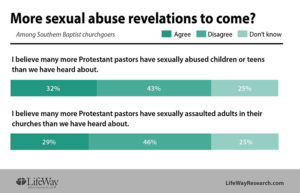
The study found one in three Southern Baptist churchgoers (32 percent) believe many more Protestant pastors have sexually abused children or teens than have been exposed to date. More (43 percent) disagree, while 25 percent say they don’t know.

Fewer (29 percent) Southern Baptist churchgoers say there are many more undiscovered instances of Protestant pastors who have sexually assaulted adults, while 46 percent disagree and 25 percent don’t know.

Relatively few say they know someone attending their church who has sexually assaulted someone (3 percent) or sexually abused a child (3 percent), but it has not yet come to light.

“Perceptions are reality,” said Scott McConnell, executive director of LifeWay Research. “When almost a third of churchgoers sense there is an avalanche of abuse and assault cases coming, churches must address this head on even if few say they actually know someone whose abuse is still hidden.”

Prevalence of sexual misconduct

More than a third of Southern Baptist churchgoers (37 percent) say they have been victims of the following types of sexual misconduct—unwanted sexual joking, unsolicited sexual messages, unwanted compliments and inappropriate glances.

Researchers asked those victims where the misconduct took place. Seven percent say the misconduct occurred at church.

Six percent of those Southern Baptists who say unwanted sexual joking was directed at them say it happened at church. The same is true for 7 percent of those who received unwanted compliments that implied the person viewed them sexually, 3 percent of those who received unwanted pictures or sexual advances via text or direct message, and 6 percent of females who experienced prolonged glances or staring at their chest.

When asked if they received compliments that implied the person viewed them sexually, 6 percent of SBC churchgoers say they heard such remarks as a child and 15 percent did as a teenager. When asked from where they knew the person giving the sexually-insinuating comments, 36 percent say school, 34 percent say their home or family and 10 percent say church.

Similar issues continued in adulthood. Southern Baptist churchgoers are more likely to say inappropriate behavior occurred in settings other than the church, but some still reported occurrences in church.

Unwelcome physical greetings?

Some churchgoers expressed wariness over the greetings they receive from others at church. Around one in six (18 percent) say some attendees express physical greetings in ways that seem to go beyond a simple gesture.

A 2018 LifeWay Research study found one in eight Protestant pastors said a church staff member had sexually harassed a member of the congregation at some point in the church’s history. One in six pastors said a staff member had been harassed in a church setting.

Overall, in the 2019 study, most SBC churchgoers (86 percent) say the church is a better environment when it comes to encountering sexually inappropriate comments compared to other places where they socialize with people. That’s slightly better than the 75 percent of all Protestant churchgoers who say the same.

Few Southern Baptist churchgoers (1 percent) believe the church is a worse environment, while 6 percent say it is the same as other places and 7 percent aren’t sure.

“The findings of this study are similar to previous research through the years,” McConnell said. “Churchgoers and the church setting have statistically fewer cases of immoral behavior, but those issues still have a very real presence.”

Prepared to respond?
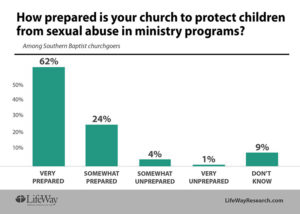
Most Southern Baptist churchgoers believe their church is prepared to handle issues of sexual abuse and trust their congregation to respond appropriately if confronted with instances of misconduct.

A majority of SBC churchgoers say their church would respond to someone who had experienced sexual abuse, sexual assault or rape with respect (73 percent), sympathy (70 percent), privacy (62 percent) and protection (56 percent).

Few believe their church would ignore the person who shared their experience (2 percent), see them as an attention-seeker (2 percent) or view them as partly to blame (2 percent).

About three-fourths of Southern Baptist churchgoers (76 percent) consider their congregation at least somewhat prepared to help someone who has experienced sexual assault, with 38 percent saying their church is very prepared. Fewer than one in 10 (7 percent) believe their church is unprepared. Eighteen percent aren’t sure.

Is the church a safe place?

The vast majority of SBC churchgoers (95 percent) agree their church is a safe place where adults are actively protected from sexual assault in the church; 3 percent aren’t sure and 1 percent disagree.

More than eight in 10 (86 percent) believe their church is at least somewhat prepared to protect children from sexual abuse in ministry programs, with 62 percent saying their church is very prepared. One in 20 (5 percent) say their church is unprepared and 9 percent are unsure.

Virtually all Southern Baptist churchgoers (96 percent) say their church is a safe place where children and teenagers are protected from sexual abuse. Few aren’t sure (3 percent) or disagree (1 percent).

Southern Baptist churchgoers believe safety measures have improved in the last decade. Around three in four (74 percent) believe their church is more prepared to protect children from sexual abuse than 10 years ago. Few say their church has had no additional preparation (6 percent) or was doing well then and now (7 percent). Thirteen percent say they don’t know.

“Those in the pews are noticing progress in the prevention efforts at their own church,” McConnell said. “Additional steps need to be taken and clearly communicated, however, so that more can say their congregation is very prepared to protect those who attend from sexual assault and child sexual abuse.”

Is the church a place of healing?

If someone did experience sexual abuse, Southern Baptist churchgoers feel confident their church would be a safe place for victims.

More than nine in 10 (92 percent) say someone who experienced sexual abuse as a child or teenager would find healing at their church; 4 percent disagree. Similarly, 94 percent say their church would be a place of healing for adult victims of sexual assault; 2 percent disagree.

Eight in 10 Southern Baptist churchgoers (80 percent) say an adult attending their church could share that they have experienced sexual assault by a fellow attendee and be believed. Fourteen percent aren’t sure and 6 percent disagree.

“When a church communicates it is a safe place for those who are hurting to find healing, it teaches truths about the identity and worth of every individual,” McConnell said. “More importantly, it answers the fundamental question of whether God cares.”

If sexually inappropriate things happened within the church, 5 percent believe church leaders would try to cover it up. Nine in 10 (90 percent) say their church is likely to report suspicions of abuse or neglect to the appropriate authorities.

Will leaders do the right thing?

Churchgoers also have faith in their leaders to correctly address sexual misconduct that may occur in the church even if it is costly or hurts the congregation’s image. Around eight in 10 (83 percent) agree their church would respond appropriately, regardless of the cost.

If sexual misconduct allegations were made against a pastor, most Southern Baptist churchgoers say they would want a careful investigation of the facts (79 percent), the truth to be made known (66 percent) and the alleged victim protected (54 percent). Four in 10 (40 percent) would want the police involved. Fewer say they would want the pastor protected (17 percent), doubt the validity of the accusation (11 percent) or want the situation dealt with quietly (9 percent).

Most Southern Baptist churchgoers feel safe attending their church. Few current churchgoers say they have ever attended less frequently because of advances from other attendees (2 percent). A similar number of churchgoers say they have ever stopped attending a church because they felt sexual misconduct was not taken seriously (3 percent) or because they didn’t feel safe from sexual misconduct (2 percent).

“Among people who are currently attending church, few said they stopped attending because of issues related to sexual misconduct,” McConnell said. “This does not measure, however, any who left due to these problems and have not returned to any church since.”

The research indicates churches are suffering from negative perceptions with many churchgoers bracing for more pastor-related sexual abuse stories to emerge, McConnell said. That hasn’t worsened churchgoers’ opinions of their own church or caused them to attend less frequently, but they still see areas church leaders should prioritize.

“From the perspective of the pew, there is room for churches to improve their process to prevent sexual abuse and assault, their communication of what is being done, and their handling of investigating accusations,” McConnell said.

The online survey of 1,815 Americans was conducted Feb. 27 to April 8, 2019. Respondents were screened to only include adults whose religious preference is Protestant and who attend church services once a month or more. Southern Baptists were oversampled to provide reliable estimates for this subgroup. Analysts used maximum quotas and slight weights for gender, region, age, ethnicity, education and Southern Baptist affiliation to reflect Protestant churchgoers more accurately, using statistics published by Pew Research.

The completed sample is 1,815 surveys, providing 95 percent confidence that the sampling error does not exceed plus or minus 2.9 percent. Margins of error are higher in sub-groups.



Turmoil leaves stained glass artists picking up the pieces

FORT WORTH (RNS)—Stained glass is fragile. So, too, are the fortunes of a stained glass artist.

Don and Debora Young were reminded of that lesson last month with the abrupt cancellation of a lucrative, once-in-a-lifetime commission to produce a series of stained glass windows for the MacGorman Chapel and Performing Arts Center on the Southwestern Baptist Theological Seminary campus.

The project, launched in 2013, was to take a dozen years or more and could have brought the Youngs, who run a small studio out of their Fort Worth home, as much as $2 million in income. A job of that size and scope “just doesn’t happen” to somebody “in our line of work,” Young said in an interview.

“It was like a dream. And then, just like that, we went from a dream job with a regular paycheck to nothing,” he said.

The windows, more than 60 in all, were to honor titans of the self-described “conservative resurgence” in the Southern Baptist Convention. That movement began in the late 1970s with the stated goal of reversing what its proponents perceived as a liberal drift away from an unbending, unambiguous adherence to biblical inerrancy.

In early April, the seminary’s board of trustees announced that it was removing the 32 windows that the Youngs had already completed, “in the best interest of the institution.”

Southwestern Baptist offered no further explanation for the decision. A seminary spokesman, after initially saying he would respond to a written request from RNS for comment, did not do so.

Allegations of impropriety

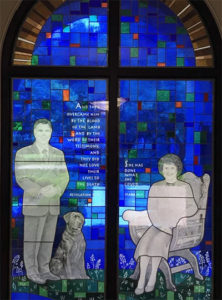
A stained glass window of Paige and Dorothy Patterson from Southwestern Baptist Theological Seminary. (RNS Photo courtesy of Don Young Glass Studio)

One of the windows paid homage to Paige Patterson, former president of Southwestern Baptist who was fired last year.

A June 1, 2018, written statement from Kevin Ueckert, chairman of Southwestern’s board of trustees, said the board unanimously concluded that Patterson ignored or mishandled female students’ complaints of sexual assault, both at the Fort Worth seminary and at Southeastern Baptist Theological Seminary in Wake Forest, N.C., where Patterson had previously served as president.

Patterson steadfastly has declined to comment on his firing or on the allegations that the trustees said compelled it.

Another of the Youngs’ windows depicted Paul Pressler, a Southern Baptist leader from Houston who became the subject of a 2017 lawsuit alleging decades of sexual abuse. Pressler denied the allegations of abuse in court filings. Those abuse claims against Pressler, a former Texas legislator and state appellate judge, were dismissed last November.

Frank Page, a former SBC leader depicted in a window, resigned last year after admitting to improper conduct.

Southwestern Baptist said it would “safely store” the windows until it figured out what to do with them.

Falwell decries ‘new regime’ in the SBC

On May 10, Jerry Falwell Jr., president of Liberty University in Lynchburg, Va., announced he’d brought two of the windows—one depicting his father, Liberty’s founder, and the other depicting Jerry Vines, who delivered the school’s baccalaureate address— to the university, where they’ll be displayed in the Jerry Falwell Museum.

Paul Pressler (right) is depicted in a stained glass window that has been removed from Southwestern Baptist Theological Seminary. (RNS Photo courtesy of Don Young Glass Studio)

Falwell rebuked what he called “a new regime” within the Southern Baptist Convention that’s turning away from “the high view of Scripture” advanced by his father and others.

“We will continue to honor the conservative leaders who reformed the Southern Baptist Convention,” Falwell told graduating students at Liberty. “And we place our hope in your generation to be the ones to step up and provide better leadership for the future.”

The stained glass project was conceived and organized six years ago by Dorothy Patterson, the wife of Paige Patterson. She led efforts to raise money to pay for the windows.

“My dream was to portray the 20-year history of the conservative resurgence of the Southern Baptist church,” she told the Fort Worth Star-Telegram in December 2013.

‘Dorothy’s pet’ project

But her dream was not shared by the seminary’s trustees, Debora Young said.

“It was Dorothy’s pet,” she said. “The trustees were never really in favor of it. But Dorothy wanted it done, so everyone just sort of went along with it.”

Paige and Dorothy Patterson—along with their black Labrador—were the subjects of one of the windows installed by the Youngs.

Other Baptist luminaries immortalized in etched and colored glass included Rick Warren, O.S. Hawkins, W.A. Criswell, Jimmy Draper and Richard Land.

Patterson, a former president of the Southern Baptist Convention and the Fort Worth seminary’s president for 15 years, was a leading architect of what critics called the “fundamentalist takeover” of the Southern Baptist Convention.

At a Southwestern chapel service in 2015, he said he recalled a time in the late 1970s when he asserted just 16 professors in Southern Baptist seminaries believed in biblical inerrancy.

“Now, just a few years later, you can go to any one of our six theological seminaries, and you will not find one single professor who does not believe in the inerrancy and the infallibility of God’s Word. That is a phenomenal act of God,” he said.

‘That was going to be our retirement’

Debora and Don Young (RNS photo / Bruce Tomaso)

Don Young, a Texas native, said he was raised as a Baptist but described himself and his wife as “spiritual” but “bohemian.”

The Youngs had planned to complete “about three dozen” windows before the project was cancelled. Don Young said no one from Southwestern told him or his wife that the windows were coming down. They learned about it after the fact from an online news story.

“We were taken totally by surprise. No one from there has contacted us about the removal—including Mrs. Patterson,” he said.

“When people ask me if I’m sorry about what happened, I tell them, ‘Honestly, I’m sorry about the money.’ We have no complaints. We did really well for these past few years. We made enough to pay off our house 10 years early.

“But we were counting on working on this for several years more. That was going to be our retirement.”


Baptist church ordination study shows room for improvement

PIKEVILLE, Ky. (BP)—The ordination process of Southern Baptist churches is a weak spot when it comes to protecting congregations from sexual predators, according to a report released May 9.

The report, “Above Reproach: A Study of the Ordination Practices of SBC Churches,” was conducted by Jason A. Lowe, an associational mission strategist in Kentucky, in response to a Feb. 10 Houston Chronicle report on sexual abuse among Southern Baptist churches.

Lowe began polling pastors and other Baptist leaders across the Southern Baptist Convention on Feb. 20, two days after SBC President J.D. Greear presented 10 calls to action from the Sexual Abuse Presidential Advisory Study, one of which was to enhance the ordination screening process.

A ‘sacred responsibility’

Southern Baptist Convention President J.D. Greear reported recommendations from a sexual abuse advisory committee to the SBC Executive Committee. (BP Photo / Morris Abernathy)

The screening process is a “sacred responsibility” that needs to be taken seriously, Greear said, the Illinois Baptist reported. He explained that ordination candidates should have no hint of sexual abuse or cover up in their past and asked why background checks are often more rigorous for children’s ministry volunteers than people being ordained to lead.

Ordination, a process that sets a person aside for ministerial service, is left up to each individual Southern Baptist congregation in keeping with the SBC’s policy of local church autonomy.

Churches may review a person’s salvation experience, pastoral call, qualifications and potentially his experience or seminary training to determine if he’s an appropriate candidate, according to the SBC’s website.

But Lowe wrote in his article that up until now, no one had a good snapshot of what was happening across the SBC when it came to ordination practices. “Very little study” has been done on this topic, he said.

“No one knows how thoroughly candidates for ordination are being examined,” wrote Lowe, associational mission strategist for the Pike Association of Southern Baptists in southeastern Kentucky as well as executive pastor for First Baptist Church of Pikeville.

“No one knows how many ordination councils require candidates to complete a background check,” he wrote. “No one knows how many ordination councils examine a candidate’s sexual purity.”

So in late February and early March, Lowe gathered 555 survey responses from pastors (60 percent), associational and denominational leaders (17 percent), deacons (9 percent), retired or former pastors (5 percent) and others (9 percent) across 34 states to find out how their own ordination processes were conducted.

He released his findings in a 42-page report and noted five significant points of interest:

  • SBC ordination practices have significant room for improvement.

In addition to Greear, other SBC leaders had spoken out about weaknesses in the ordination process ahead of Lowe’s report.

Al Mohler, president of Southern Baptist Theological Seminary, wrote on his blog in February that “lackadaisical ordination will produce doctrinally dubious and morally corrupt pastors.”

That kind of trend “must end and churches must take responsibility for those men they ordain for ministry,” he wrote.

Thom Rainer

Thom Rainer, former president of Lifeway Christian Resources, also wrote that because of the weak process, “we ‘bless’ new pastoral candidates who may not be ready for ministry at the least, and who are sexual predators at worst.”

Lowe said his report confirmed their observations.

“While there are some encouraging trends, (Southern Baptist) churches need to improve our current ordination practices in a number of ways,” he said.

For example, only 30.2 percent of ordained ministers were required to have a background check and only 29.4 percent were asked about their sexual purity. Also in roughly 60 percent of cases, the ordination service was publicized before screening took place, and the screening council happened on the same day as the service.

  • Discussions regarding a candidate’s sexual purity are sparse, but on the rise.

Even though sexual purity is not discussed most of the time, the report found that there has been a “significant uptick (40.5 percent) since 2010.”

  • SBC ordination practices are changing in both positive and negative ways.

Lowe’s survey garnered ordinations spanning every decade since the 1960s, and across the years, a number of trends emerged.

Some were positive—for instance, more churches are requiring theological training, and more are conducting background checks and asking candidates about sexual purity.

On the other hand, the role of the ordination council seems to be decreasing in importance. Screening periods have gotten shorter as a whole, and councils involve fewer ordained pastors.

  • Ordaining churches in more populated areas set higher standards for their ordination candidates.

The report data showed urban and suburban churches handling the process differently than churches in less-populated areas. The former checks in more often with candidates both before and after ordination and requires training more often. The latter is more likely to publicize the ordination service before a candidate is approved, then conduct the screening on the same day as the service.

  • Larger churches are more thorough in their examination of ordination candidates.

Churches with a larger membership are more likely to cover more topics during the screening process, require a background check and require training.

Lowe didn’t make any specific recommendations for improvements, but he wrote that he shared the findings “with the hope of generating productive conversations among Southern Baptists as we seek ways to improve our ordination practices in the days ahead.”


Judge dismisses former state executive’s suit against NAMB

ABERDEEN, Miss. (BP)—A federal court judge cited First Amendment legal precedent in dismissing a lawsuit against the North American Mission Board by a former executive of the Baptist Convention of Maryland/Delaware.

Senior Judge Glen Davidson of the U.S. District Court Northern District of Mississippi ruled April 22 that a lawsuit by Will McRaney would require the court to determine religious elements in the case—something “the court cannot do,” he wrote in a seven-page opinion.

Davidson, of the district court’s division in Aberdeen, Miss., addressed the three claims McRaney made in his April 2017 lawsuit seeking unspecified punitive damages that NAMB had: defamed him and harmed his career with the Maryland/Delaware convention as executive director, leading to his termination in 2015; harmed his ministry by causing cancelation of a 2016 speaking engagement in Mississippi; and caused emotional distress by posting a photo of him at NAMB’s welcome desk describing him as an enemy of the mission board.

Citing “ecclesiastical abstention doctrine, rooted in the First Amendment’s free exercise clause,” Davidson wrote, “The court dismisses this case for lack of subject matter jurisdiction.”

The doctrine is “built out of numerous Supreme Court cases affirming that churches have the ‘power to decide for themselves, free from state interference, matters of such government as those of faith and doctrine,’” Davidson wrote, citing 1952 precedent from Kedroff v. St. Nicholas Cathedral of Russian Orthodox Church in North America.

Regarding McRaney’s claim that NAMB had defamed him and interfered with his employment, Davidson wrote: “Review of these claims will require the court to determine why the BCMD fired McRaney—whether it was for a secular or religious purpose. It will require the court to determine whether the NAMB’s actions were done ‘without right or justifiable cause’—in other words, whether the NAMB had a valid religious reason for its actions. That the court cannot do.”

Davidson noted the same issue with the canceled speaking engagement, stating, “That matter the court cannot decide.”

Regarding McRaney’s claim of emotional distress from the photo and description as an enemy of NAMB, Davidson wrote: “Once again, to resolve these issues, the court will need to make determinations about why the NAMB held these opinions of McRaney, and because the NAMB is a religious institution, the question will touch on matters of religious belief. The court, therefore, finds that under the First Amendment it lacks subject matter jurisdiction to adjudicate McRaney’s disputes.”

The state court where McRaney initially filed suit likewise would not be able to deliberate in such First Amendment matters, Davidson wrote. The case had been transferred to federal court under federal law permitting NAMB to make the request because the plaintiff and defendant were residents of different states.


Former Acteens celebrate 50 years of missions discipleship

BIRMINGHAM—Woman’s Missionary Union will celebrate the 50th anniversary of Acteens—the missions education group for girls in grades 7–12—with a reunion of former Acteens in Birmingham, Ala., June 7.

The Acteens for Life event—scheduled prior to the WMU Missions Celebration June 9-10 and the Southern Baptist Convention annual meeting June 11-12—will be held at the WMU national office at 100 Missionary Ridge in Birmingham.

The reunion is for all women whose lives have been impacted through Acteens in their teenage years, as well as current and former Acteens leaders.

Participants will gather for a 6 p.m. meal to reminisce about Acteens’ transformational influence on their lives. Following dinner, a panel will discuss the future of missions discipleship for teenage girls and how women can become involved.

“This event will be a great time for women who have experienced Acteens to celebrate what they learned as teenagers,” said Heather Keller, missions consultant for Acteens. “But even more importantly, we will challenge those in attendance to consider how they can help teen girls learn about and participate in missions discipleship today. It’s an exciting time to learn about the Great Commission and share God with his world.”

On June 8, former Acteens are encouraged to join the Crossover Birmingham evangelistic outreach event to participate in hands-on missions throughout the area.

Tickets for the Acteens for Life event are $30, which includes the Friday evening meal, a T-shirt and a gift from WorldCrafts, the fair-trade division of WMU.

For more information, email wmu.com/acteensforlife. To register, click here.


Former BWA General Secretary Denton Lotz dies

Denton Lotz, who served nearly two decades as general secretary of the Baptist World Alliance, died April 23 in Forestdale, Mass. He was 80.

Lotz was born Jan. 18, 1939, in Flushing, N.Y. After graduating from the University of North Carolina at Chapel Hill, he enlisted in the U.S. Marine Corps, ultimately earning the rank of second lieutenant.

Lotz went on to graduate from Harvard Divinity School and earn a doctorate in theology from the University of Hamburg, Germany.

He was ordained to the gospel ministry at Binkley Memorial Baptist Church in Chapel Hill, N.C.

In 1970, he married Janice Robinson of Ellisville, Miss. They served 10 years as missionaries with the International Ministries Division of American Baptist Churches.

During that time, he was professor of missions and homiletics at the Baptist Theological Seminary in Rüschlikon, Switzerland. At the seminary, he founded the Summer Institute of Theological Education to offer Eastern European pastors short-term intensive theological training.

Denton Lotz

Lotz joined the BWA staff in 1980 as associate secretary. He later also assumed responsibility as director of the BWA youth department.

After BWA General Secretary Gerhard Claas was killed in an automobile accident in 1988, Lotz was named interim general secretary. The BWA Executive Committee soon voted to appoint him general secretary, and the BWA General Council affirmed the appointment.

During his time as general secretary, Lotz helped launch the Baptist International Conference on Theological Education and the Living Water Initiative to enlist and equip Baptists around the world for evangelism and servant leadership. He served alongside five BWA presidents.

“He leaves a massive footprint in the history of BWA,” said David Coffee, BWA president from 2005 to 2010. “He was a missionary theologian, an inspiring preacher and evangelist, a champion for religious liberty, a Baptist ambassador, a Christian statesman and a brother unrivaled in his prodigious remembering of the names of hundreds of people and places.”

When Lotz retired from his leadership post at BWA in 2007, former President Jimmy Carter said: “As I think of all the BWA has accomplished for Baptists around the world in the past 20 years, I know that your gifted leadership has helped to make it all possible. You have served a great organization with conviction and honor.”

Based on information from the Baptist World Alliance.


New Mexico Baptists aid asylum seekers

ALBUQUERQUE, N.M. (BP)—The Baptist Convention of New Mexico and other faith-based organizations in Albuquerque are helping to house and feed more than 400 asylum-seeking migrants from South and Central America at the request of municipal and federal agencies.

“This is a different kind of response for us,” said Ira Shelton, director of New Mexico Baptist disaster relief.

However, Shelton noted the teachings of Jesus recorded in Matthew 25:31-46 and his call for his followers to care for “the least of these” means that “we need to be helping these people.”

“They’re hungry, and they’re confused,” Shelton said. “If we can bring hope, help and healing, then that’s what we need to do.”

Over the past several weeks, hundreds of asylum-seeking migrants have entered the United States along the El Paso sector of the country’s border with Mexico. In addition to El Paso, the sector includes New Mexico’s entire southern border.

As of March 27, U.S. Customs and Border Protection had more than 12,000 migrants in custody.

El Paso facility reached capacity

Because of the large number of people crossing the border in El Paso, Annunciation House, a Catholic ministry that serves migrant and homeless communities in the border city, quickly reached capacity. As a result, many migrants have been transported by Immigration and Customs Enforcement to Albuquerque, where city leaders are working with several nonprofit organizations to meet migrants’ day-to-day needs.

As of early April, Albuquerque was hosting 430 asylum-seeking migrants who entered the United States through the El Paso sector, said Roger Ebner, director of Albuquerque’s Emergency Management Office.

Medical personnel, city leaders and nonprofit organizations in Albuquerque agreed to work together to provide the migrants with medical care, temporary housing, food, clothing and transportation, said Ed Greene, associate director for New Mexico Baptist disaster relief.

Baptists provide meals for migrants

From March 14-19, 12 Baptist volunteers, including Greene and Shelton, prepared hot meals and nonperishable lunches for several of the migrants who are staying in Albuquerque-area motels as they await further processing.

New Mexico Baptist volunteers also prepared nonperishable sack lunches for distribution to migrants who were traveling from Albuquerque to other parts of the United States where they have immigration sponsors, said Cricket Pairett, ministry assistant for the New Mexico Baptist Missions Mobilization Team. Food in the sack lunches, she said, had to be able to withstand several days of travel and varied temperatures.

As of March 26, the Baptist convention team had prepared approximately 320 meals in all and logged 193 volunteer hours.

Sandia Baptist Church in Albuquerque, which has a commercial grade kitchen, allowed New Mexico Baptist disaster relief to use its space to prepare meals. Garland Peek, Sandia’s minister to adults, helped coordinate the operation on behalf of the church.

Three additional New Mexico Baptist churches expressed interest in providing meals and other resources. Joseph Bunce, executive director of the Baptist Convention of New Mexico, said churches can supply volunteers to help as cooks and servers, provided they adhere to strict food preparation guidelines.

At least one disaster relief volunteer declined to participate in the ministry to asylum-seeking migrants, citing political differences, Shelton said.

It is unclear how long the migrants will be in Albuquerque or whether more will arrive in the coming weeks. Ebner, of the city’s Emergency Management Office, said, “There may be an ebb and flow to this, so I think this will continue into the future. But I believe there will be a decrease at some point. … We need to be as ready as possible and then be as flexible as possible.”

Ebner commended faith-based groups and volunteer medical personnel for meeting migrants’ needs.

“The Baptists have done a tremendous work here. Every organization appreciates the work they have done,” he said.


Southwestern Seminary to ‘recalibrate,’ president tells trustees

FORT WORTH (BP)—Southwestern Baptist Theological Seminary is looking to “recalibrate and to reposition” itself in “every way to strengthen the core of what we do,” President Adam Greenway told trustees during their spring meeting, April 8-10.

Business included approving the budget for the 2019-2020 academic year, approving a change to Scarborough College’s degree offerings, electing a new vice president, and approving a change in the administration of the seminary’s endowment.

Strengthen residential theological education

Addressing Southwestern Seminary’s full board for his first-ever president’s report, Greenway stressed the importance of recalibrating the seminary in order to return the institution to its core priorities—particularly residential theological education.

Adam Greenway (Southwestern Seminary Photo)

“At the end of the day, our core of strength is what we do right here on Seminary Hill. It is the experience that happens here in the classroom and on this campus,” he said. “Theological education in the context of a vibrant, worshiping, learning, living together community—that is of first importance.”

Greenway pledged “to do everything I can to make sure that we have the resources and are making the investments to strengthen our residential theological education and to reprioritize our core degree programs of strength,” which he identified as the master of divinity, the master of arts in Christian education and master of music.

While affirming the seminary’s other degree programs—including doctoral degrees, other master’s programs and other specialized training—Greenway said all of these things must be done “out of a clear core of strength.”

Budget represents ‘tough choices’

Greenway characterized the budget for the upcoming fiscal year as a reset to get back to the seminary’s core strengths.

“In a time where we must be extraordinarily judicious in conserving the resources entrusted to us by our Southern Baptist Convention of churches, by the donors and friends who believe in our work and are willing to invest in us, (and) by the tuition dollars we receive from our students, we must make sure that we steward and shepherd every dime in a way that is going to enable our seminary to flourish and thrive in an increasingly challenging environment and world,” he said.

The budget involves “some tough choices,” Greenway continued, and “it does involve some transitions. But I believe it will transition us to move forward to do what we must do to ensure that the work of Southwestern Seminary can continue in strength.”

The $32.6 million budget was presented by the business administration committee and approved without objection by the full board.

Trustees also approved a recommendation to eliminate the Bachelor of Arts in humanities and biblical studies degree in Scarborough College and replace it with two degrees: the Bachelor of Arts in Christian studies and the Bachelor of Arts in humanities.

In addition, trustees elected Colby T. Adams vice president for strategic initiatives. This position oversees the Office of Communications, Campus Technology, and other administrative priorities. Adams has held this position in an interim capacity since February. Adams also serves as chief of staff.

The board approved the recommendation that funds managed by the Southwestern Seminary Foundation be moved to GuideStone Financial Resources for management as soon as feasibly possible, and that once said action is completed, the Southwestern Seminary Foundation be dissolved.

The board elected new officers—Philip Levant, pastor of Iglesia Bautista La Vid in Hurst, as chairman; Danny Roberts, executive pastor of North Richland Hills Baptist Church in North Richland Hills, as vice chairman; and Jamie Green, retired speech-language pathologist in Katy, as secretary.

In other business:

  • Randy Stinson, provost and vice president for academic administration, was elected professor of theology and ministry in the School of Theology, effective immediately.
  • Patricia Ennis was given the title distinguished professor emeritus of family and consumer sciences, effective immediately.
  • The board approved a committee recommendation to amend the seminary’s bylaws, including updated nomenclature and administrative titles and job descriptions.
  • The Jack D. Terry Jr. School of Church and Family Ministries was renamed The Jack D. Terry Jr. School of Educational Ministries, and The School of Church Music was renamed The School of Church Music and Worship.


Founding Nevada Baptist executive director Ernie Myers dies

PLANO (BP)—Ernie Myers, founding executive director of the Nevada Baptist Convention, died April 2, in Plano. He was 93.

Myers was elected as executive director when the Nevada convention was constituted in 1978 in Las Vegas during an Oct. 16-17 meeting at Red Rock Baptist Church. He led Nevada Baptists until his retirement in June 1992.

He also served as the Southern Baptist Convention’s second vice president, elected at the SBC’s 1989 annual meeting in Las Vegas.

“Dr. Myers provided stability as this new convention was learning to be a convention,” said Kevin White, the convention’s current executive director. “He ever sought to keep the vision and purpose before the churches—of a convention of churches working together for the kingdom.”

The convention grew from 65 churches and missions to 135 during the 13-plus years of Myers’ leadership, with 17,341 baptisms.

‘Trailblazer in the West’

Michael Rochelle, retired pastor of Shadow Hills Baptist Church in Las Vegas and a former convention president, said, “Nevada has been blessed by the visionary leadership of this trailblazer in the West.”

“Leaving the security and comfort of a solid ministry for the risk of giving birth to a new state convention evidences the walk of faith in this man’s life,” Rochelle said. “Patience and persistence characterized his life. His willingness to invest himself in the lives of churches and church leadership was undeniable.”

Mike McCullough, associate executive director for the California Southern Baptist Convention who formerly worked on the Nevada convention’s staff, said Myers, a Mississippi native, “loved serving in the West and advocated for the needs of Nevada and other new work conventions.”

“In the early 1980s, representation on SBC entities and boards required 25,000 church members, something few of the western states could claim,” McCullough said. “Ernie was instrumental in leading the SBC to change membership guidelines, giving the small new work conventions representation on the Executive Committee and major boards. That one action helped Nevada to believe it was really part of SBC life.”

Long record of denominational service

Myers, at the time of his election to lead the Nevada convention, had served as the Arizona Southern Baptist Convention’s director of assemblies development and architectural consultant since 1975.

He also worked for the Arizona convention from 1956-1961 as training union (discipleship) secretary and, later, Sunday School secretary, recording Sunday School growth from 29,000 to 45,000 in his five years on staff. He also served concurrently as an architectural consultant, assisting more than 150 Arizona churches in their building plans.

From 1961-1975, Myers worked at the former Baptist Sunday School Board (now LifeWay Christian Resources) as a consultant in the church architecture department, serving more than 4,300 churches in states west of the Mississippi River, including Alaska and Hawaii.

He helped develop the widely used “Together We Build” fundraising program for church construction; wrote several resources, including Essentials of a Church Building Program; and lectured on church buildings and finances at several SBC seminaries each year.

Myers was a graduate of New Orleans Baptist Theological Seminary and Mississippi College.

During World War II, he served three years in the U.S. Navy in the Pacific Theatre, receiving a Purple Heart.

Myers is survived by his wife June, married since December 1950, his son Ernest of Plano, and a daughter, Kay, an actress in Franklin, Tenn.


Baptist statesman James Wood dies at age 96

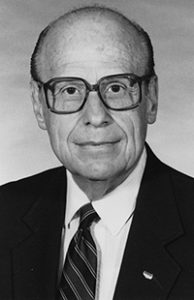
James E. Wood Jr., former executive director of the Baptist Joint Committee for Religious Liberty and longtime director of Baylor University’s J.M. Dawson Center for Church-State Studies, died March 24 at age 96.

Wood was born on July 29, 1922, in Portsmouth, Va., and served as a Baptist missionary in Japan before joining the Baylor faculty in 1955 as an associate professor of religious history.

James E. Wood Jr.

After publishing the landmark book Church and State in Scripture, History and Constitutional Law in 1958 with Baylor colleagues E. Bruce Thompson and Robert T. Miller, Wood became director of the Dawson Institute.

He led the Dawson Institute to develop several undergraduate and graduate programs, launched the Journal of Church and State and opened the J.M. Dawson Church-State Research Center in Carroll Library on the Baylor campus.

“Dr. James Wood certainly put the academic study of church-state relations on the map at Baylor and beyond,” said Doug Weaver, current director of the Dawson Institute and professor of Baptist studies at Baylor.

“As a Baptist, Wood understood the importance of the separation of church and state and how that separation was good for both. As he noted that spread of authoritarian governments in his day, he strongly advocated for the religious liberty ‘as an axiomatic principle basic to all human rights.’”

Wood left Baylor in 1972 to lead what then was called the Baptist Joint Committee on Public Affairs in Washington, D.C., for eight years.

In his inaugural address as head of Baptist Joint Committee, Wood said the concern of the church for religious liberty “must necessarily include the concern of the church for all civil liberties as inalienable rights of all men.”

Wood viewed the issue of religious liberty through the lens of God’s care for every human.

“To be true to its mission, therefore, the church must be involved in public affairs because it seeks to minister to the whole man in the world, and no aspect of life can be regarded as outside of God’s concern, dominion, and power,” he said.

James E. Wood Jr. addressed a 1980 meeting of the Baptist Joint Committee board. (BJC Photo)

During his tenure at the Baptist Joint Committee, he led the agency to expand its mission to include issues such as international human rights and seeking an end to the nuclear arms race.

“It is safe to say that James Wood’s views were known inside the White House and the Department of State and that they helped the Carter Administration lay a sound foundation in formulating an international policy based in large measure on the bedrock commitment of Baptists and others to freedom of conscience,” said Stan Hastey, who worked with Wood at the Baptist Joint Committee.

For example, Hastey remembered Wood’s impassioned pleas on behalf of the imprisoned Soviet Baptist dissenter Georgi Vins were instrumental in securing Vins’ release from the USSR.

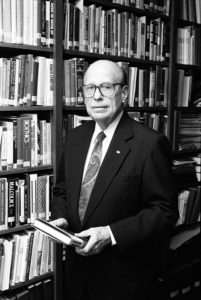
James E. Wood Jr. was director of the J.M. Dawson Institute for Church-State Studies at Baylor University. (Photo courtesy of the Texas Collection at Baylor)

“James Wood was indefatigable, working tirelessly on a wide range of public policy issues he considered the rightful agenda of the Baptist Joint Committee,” he said.

Wood returned to Baylor in 1980, serving both as director of the Dawson Institute and as the Simon and Ethel Bun Professor of Church-State Studies. He retired from Baylor in 1999.

Wood served on various religious liberties committees, such as the World Council of Churches Committee on Religious Liberty, the First World Congress on Religious Liberty and the International Academy for Freedom of Religion and Belief, of which he was president.

He served as a consultant to many Eastern European countries following the collapse of the Soviet Union, advising them on the creation of new religious freedom laws. He received many awards, including the Religious Liberty Award by the Alliance for the Preservation of Religious Liberty and the Abner V. McCall Religious Liberty Award from the Baylor Alumni Association.

Wood was preceded in death by his wife of 58 years, Alma McKenzie Wood. He is survived by their son, James E. Wood III.

Compiled from reports by the Baptist Joint Committee and Baylor University.


Ronnie Floyd elected SBC Executive Committee president

The Southern Baptist Convention’s Executive Committee chose Ronnie Floyd, former SBC president and Arkansas megachurch pastor, as its new president.

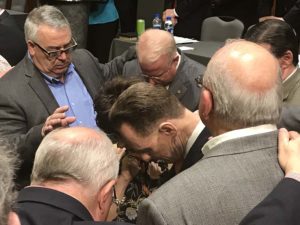
Members of the Southern Baptist Convention Executive Committee gather around Ronnie Floyd and his wife, Jeana, after his election as the agency’s president and chief executive officer. (Photo / Ken Camp)

During a called meeting at a hotel at Dallas-Fort Worth International Airport, the SBC Executive Committee voted 68-1 to elect Floyd, 63, as its seventh chief executive.

Floyd has been senior pastor of Cross Church in northwest Arkansas for 33 years. During his time at the multi-campus church, which grew out of First Baptist Church in Springdale, Ark., it reported baptizing more than 22,000 people and starting 148 other churches.

Evangelical adviser to Trump

He has served on President Trump’s informal council of evangelical advisers and was appointed president of the National Day of Prayer Task Force in 2017.

Asked at a news conference following his election whether he plans to continue to serve with the Trump evangelical advisory group, Floyd explained he never endorsed Trump for office. Rather, he agreed to serve on an advisory council during the presidential campaign to advise Trump about issues of concern to evangelical Christians, noting specifically sanctity of life, dignity of life and religious liberty, he said.

After Trump was elected, Floyd said, he has been part of “a few experiences—not very many” consulting with the president by phone along with other evangelical leaders. Floyd noted he was involved in one Oval Office visit, where he was one of two people invited to pray for Trump.

“That was the only time in my life I’ve been in the Oval Office. … I want to make this really clear, if that had been Hillary Clinton elected, if she would have asked me to the Oval Office, I would have been glad to have gone,” he said.

In his new role at the Executive Committee, Floyd emphasized he would be “glad to meet with any president” to pray, offer counsel and call attention to issues of concern to evangelical Christians.

‘Ready to lead on Day One’

At his news conference, Floyd also stressed he will “continue to think like a pastor” as he leads the SBC Executive Committee.

“I will champion pastors,” he said. “I will champion local churches.”


Ronnie Floyd, newly elected president of the Southern Baptist Convention’s Executive Committee, is shown in this 2016 file photo holding a news conference as SBC president. (BP file photo)

Mike Stone, chair of the SBC Executive Committee, praised Floyd as “a trusted voice of experienced leadership” who “will be ready to lead on Day One” as the agency’s chief executive.

Floyd was chair of the SBC Executive Committee in 1995-97 when the convention adopted the Covenant for a New Century strategic plan that reduced the number of SBC entities from 19 to 12.

Later, he also chaired the SBC Great Commission Resurgence Task Force, which revised the ministry assignments of the International Mission Board and the North American Mission Board.

Floyd succeeds Frank Page, who stepped down in March 2018 after acknowledging a “morally inappropriate relationship.”  D. August “Augie” Boto has served as interim president since April 2018, and Boto named Jimmy Draper as “Executive Committee ambassador”—essentially his liaison to churches.

Racial reconciliation

Steve Swofford, pastor of First Baptist Church in Rockwall and chair of the SBC Executive Committee’s presidential search committee, announced Floyd’s nomination in a letter emailed to Executive Committee members, calling him “no stranger to any of us.”

Ronnie Floyd, newly elected president of the Southern Baptist Convention’s Executive Committee, and his wife Jeana of 42 years have two sons and seven grandchildren. (BP file photo)

“He has been a leader in racial reconciliation and has a stellar record of bringing together brothers and sisters from all generations, all races and all walks of life to work in harmony for kingdom purposes,” Swofford wrote.

“We firmly believe he is the man God has uniquely prepared and gifted to lead our Executive Committee at this challenging time in our nation’s and our denomination’s history.”

Floyd was born in Gonzales, earned his undergraduate degree from Howard Payne University and received his Master of Divinity and Doctor of Ministry degrees from Southwestern Baptist Theological Seminary. His Texas pastorates include First Baptist churches in Cherokee, Milford, Palacios and Nederland.

When he was SBC president, Floyd and Jerry Young, president of the historically black National Baptist Convention U.S.A., Inc., coordinated a November 2015 meeting of 10 Southern Baptist pastors and 10 National Baptist pastors to discuss ways to promote racial reconciliation.

Floyd also presided over the 2016 SBC annual meeting when messengers adopted a resolution renouncing the display of the Confederate battle flag.