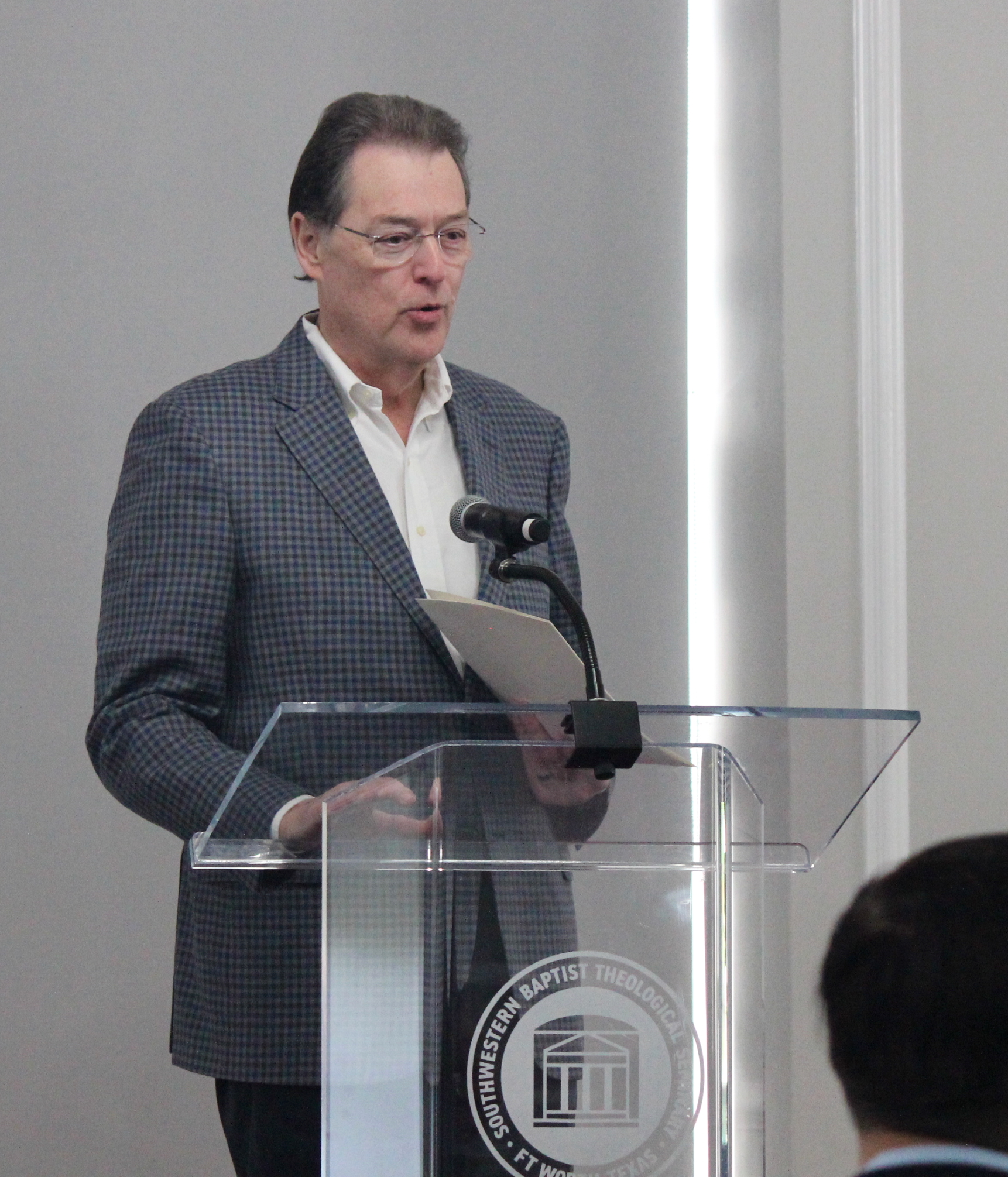
Live in the authority of Jesus, Baptist lecturer challenges
ABILENE—“Will you live as if all authority belongs to Jesus?” asked Elijah Brown, general secretary of the Baptist World Alliance, addressing participants of the Pinson Lectures on Baptist distinctives at Hardin-Simmons University, April 23.
Brown began his challenge to faculty, students, alumni and area pastors noting two key distinctives of Baptists.
First, he emphasized Baptists’ “commitment to read, study and follow the teachings of the Bible.”
Second, he noted Baptists’ particular passion for the final words of Jesus, the Great Commission, found in Matthew 28:18-20:
“Then Jesus came to them and said, ‘all authority in heaven and on earth has been given to me. Therefore, go and make disciples of all nations, baptizing them in the name of the Father and of the Son and of the Holy Spirit, teaching them to obey everything I have commanded you. And surely, I am with you always, to the very end of the age.”
Brown said, for months, “all authority in heaven and on earth is in Jesus” had been resonating with him.
“Power and influence are seductive” in this world, but they don’t last. Because all authority belongs to Jesus, neither churches nor individual believers need to worry about building power and authority here, Brown asserted.
Pandemics, disease, demons, sin, governments and the like exercise some authority, but these are “time-limited” authorities, he said.
“Let us not give in to the power of time-limited authorities. They are a smoke, a mask of emptiness,” he continued,noting no power, authority or doubt can overcome Jesus.
“There is no political party, no politician, no principality. There is no appeal to false protection, prestige or pleasure. There is no lie that can overcome the authority of Jesus Christ.”
Jesus alone must be the source of Christians’ authority, identity and being, he contended.
Besides, Brown asserted, the church has learned in 2,000 years the time will come, no matter how terrible a situation is in the moment, when “wars will end and politics will change.”
The church also has learned the time comes when every “political, cultural and social trajectory, even those that seem to benefit the church, will change.”
“The call to relationships of gospel witness and just peace supersedes political boundaries. Even when it is difficult, most especially when it is difficult, we must work to build relationships and give gospel witness,” because the seeds planted by that witness, through the Holy Spirit, will yield fruit in the proper time, he proclaimed.
Christ followers are not time-limited, but eternally bound, so “let us live by the time and authority of eternity.”
“All authority in heaven and earth has been given to Jesus,” he repeated.
The kingdoms of this world will crumble—including their economic exploitation, rampant militarism and ongoing oppressions, he said.
But, Brown admonished, let the church live, in the words of Scott McKnight, as “dissident disciples” whose politics are “a politics for others,” joy-filled, bearing “witness to the reality that all authority on heaven and earth is in Jesus,” Brown said.
“Therefore, go and make disciples.”
Looking toward “the nations,” and making disciples, Brown illuminated emerging frontlines.
Changing demographics
The Baptist family is shifting to outside of Europe and North America.
Baptists have declined by 1 percent in Europe and the Middle East and 5 percent in North American in the past 10 years, while seeing growth of 32 percent in the Asian Pacific, 13 percent in Latin America and 112 percent in Africa.
“Are we building toward a Baptist identity as a worldwide movement with worldwide concerns with our largest demographic base in Africa?” Brown asked.
Africa and India are where the greatest population increases also will be seen in the next 30 years, with growth of more than 1 billion people expected.
Increased urbanization
A first in history, 55 percent of the world lives in urban areas. By 2050, 68 percent of the world’s population will live in cities, including megacities with more than 10 million inhabitants, such as Lagos, Nigeria; Beijing, China; Mexico City, Mexico; and Los Angeles.
In 10 years, the number of megacities will grow from 33 to 39. Asia will be home to 20 of the 39 megacities. Twenty megacities will be in a country where fewer than 10 percent of the population claims any form of Christianity, and 16 of the megacities will be in countries with fewer than 25,000 Baptists in the entire country.
“The future is urbanization, and it will be disruptive,” because megacities will have an outsize influence on culture, economics and the extent to which the world lives in peace, Brown noted.
Vulnerable people and democracies
More people are on the move today than at any time in history, with more than 100 million forcibly displaced and 281 million international migrants.
One in every four Baptists faces persecution, war, violence and hunger—living and ministering in the most vulnerable contexts. Even with recent improvements, great gaps in resources remain.
The average GDP among Baptists per region in U.S. dollars is:
- Africa—$1,482
- Asia Pacific—$18,425
- Caribbean—$9,267
- Europe and the Middle East—$21,811
- Latin America—$7,279
- North America—$49,683
“The world is becoming increasingly vulnerable,” Brown noted. “And as a result, it will become increasingly violent. Dangerous undercurrents are at work, and some people of faith are allowing themselves to be either too complacent or too associated with one political party or the other.”
Brown offered three ways to respond to these emerging frontlines in the second half of his lecture.