Sex abuse response, entity transitions top 2019 SBC stories

NASHVILLE (BP)—Southern Baptists marked a year of transitions at several national entities in 2019, and they launched an initiative to help churches care for individuals affected by sexual abuse and harassment.

These 10 news stories, selected by both the editors of Baptist Press and a poll of Southern Baptist state publication editors, represent their picks as the most important stories of 2019.

  1. Southern Baptists take action to curb sexual abuse in the convention.

Bible teacher and sexual abuse survivor Beth Moore (left) participates in a panel discussion hosted by the Southern Baptist Convention Ethics & Religious Commission called “Sexual Abuse and the Southern Baptist Convention” at the Birmingham-Jefferson Convention Complex, the night before the start of the 2019 SBC annual meeting. (BP Photo / Van Payne)

In February, Southern Baptist leaders expressed brokenness over the findings of a series of Houston Chronicle articles detailing the plight of victims of sex abuse in Southern Baptist Convention churches. The newspaper released a database of 220 individuals who had been convicted or pled guilty to sexual abuse.

SBC President J.D. Greear called the abuse “pure evil” and resolved to mobilize the SBC in “stopping predators in our midst.”

After 10 months of work, the Sexual Abuse Advisory Study initiated by Greear issued a 52-page report it hoped would “spark a movement of healing and reform” within the convention. The report called for the education of SBC churches to understand abuse and its impact, the equipping of SBC churches to care for abuse survivors, and the preparing of SBC churches to prevent abuse.

Southern Baptists overwhelmingly approved bylaw and constitutional changes at the 2020 SBC annual meeting to specifically deal with systemic issues the report addressed.

In May, the International Mission Board released the findings of an independent investigation into past allegations of sexual abuse and harassment and began implementing recommended reforms. In June, the mission board announced the hiring of a full-time senior staff member to oversee sex abuse prevention response efforts. The IMB also said it would involve outside legal counsel when reports of child abuse and sexual harassment were received.

In June, the Ethics & Religious Liberty Commission, LifeWay Christian Resources and the Sexual Abuse Advisory Study released an eight-step guide to equip congregations to prevent predatory behavior and to care for survivors. A free training resource and a Caring Well conference with 1,650 registrants were a part of the eight-step plan.

  1. Four new presidents elected to lead SBC entities.

Adam Greenway is the first alumnus in a quarter-century to serve as president of Southwestern Baptist Theological Seminary. (Photo / Eric Black)

In February, the trustees of Southwestern Baptist Theological Seminary elected Adam W. Greenway as the seminary’s ninth president. Previously, Greenway was dean of the Billy Graham School of Missions at Southern Baptist Theological Seminary. At his introductory press conference shortly after the election, he declared his commitment to the seminary’s legacy as the “big-tent seminary of the SBC,” where students who may differ on secondary theological issues can unite behind “rigorous scholarship, missions and evangelism.”

Less than two months later, the SBC Executive Committee elected former SBC President Ronnie Floyd to be its new president and CEO. Floyd was in his 33rd year as the pastor of Cross Church, a multi-site church in northwest Arkansas. At his September inauguration, Floyd urged Southern Baptists forward in prayer, unity and a “hyper-focus on missions” in order to finish their Great Commission task.

In early June, New Orleans Baptist Theological Seminary trustees tapped Jamie Dew as the school’s ninth president. Previously, he had served as vice president for undergraduate studies and distance learning at Southeastern Baptist Theological Seminary.

At a press conference shortly after his election, Dew outlined a four-part vision for his first year at the seminary, calling Leavell College his “priority No. 1.” He also included enrollment, marketing and communications and building denominational relationships among his top four priorities.

LifeWay Christian Resources trustees chose Denver church planter Ben Mandrell as the entity’s 10th president at a June 28 meeting in Atlanta. Trustees chose the 42-year-old Mandrell to lead LifeWay during a time of historic change. When he was installed as president in late August, Mandrell stressed the need for unity and teamwork as the entity pushed forward with large-scale changes to how it distributes products.

In November 2018, IMB trustees selected Paul Chitwood to be the board’s 13th president, which meant five new SBC entity heads took over in less than eight months’ time. IMB officially installed Chitwood as president on Feb. 6, 2019.

  1. LifeWay closes brick-and-mortar stores and shifts to online strategy.

LifeWay Christian Resources announced the closure of its remaining 170 brick-and-mortar stores in 2019 as part of a shift to a broader digital retail strategy. As part of this announcement, the entity said it would continue to offer a “broad selection of resources” through its website and the LifeWay Customer Service Center.

LifeWay also announced new strategies to engage customers in 2019. To compensate for a lack of physical storefronts, LifeWay implemented an Authorized Dealership program, allowing local, independent Christian bookstores to sell LifeWay-branded Bible studies. LifeWay’s partnerships also go beyond independent bookstores, extending to established chain stores such as Walmart, Books-a-Million and Mardel Stores.

  1. Great Commission Giving surges throughout the convention.

Southern Baptist churches gave generously to fund Great Commission efforts throughout the convention in 2019.

In October, the North American Mission Board announced a record $61.4 million Annie Armstrong Easter Offering. It marked the third consecutive year the offering hit a record high.

Southern Baptists also gave their third-highest total in history to the Lottie Moon Christmas Offering. One hundred percent of the $157.3 million given through the offering goes directly to missionaries on the international mission field. The offering exceeded the IMB’s goal for the 2018-19 offering by $2.9 million.

As the SBC Executive Committee’s 2018-19 budget came to a close at the end of September, the committee reported that Cooperative Program giving had exceeded budget for the fifth year in a row. Southern Baptists gave $196,731,703.44 to Great Commission causes through the Cooperative Program.

Last month, the Executive Committee reported the strongest first two months of Cooperative Program giving since 2009. Contributions to the Cooperative Program exceeded $32.5 million, surpassing last year’s budgeted contributions through two months by more than $1 million.

Some state Baptist conventions reported higher than expected—even record—missions giving. Several passed budgets to increase the percentage of their giving going to national Cooperative Program efforts.

  1. SBC votes overwhelmingly to approve significant bylaw and constitutional changes.

At June’s SBC annual meeting in Birmingham, Ala., messengers approved two amendments to the SBC constitution, which stated sexual abuse and discrimination based on ethnicity were grounds to declare churches “not in friendly cooperation” with the convention. The two constitutional amendments will require a second two-thirds vote of messengers at the 2020 meeting in Orlando.

Messengers at the 2019 annual meeting also approved an amendment to the SBC’s bylaws to repurpose the SBC Credentials Committee into a standing committee. This new standing committee will make inquiries and recommendations for actions regarding sexual abuse, racism and other issues that could call into question a church’s relationship with the SBC. The bylaw change required a vote at only one annual meeting.

In December, the new standing Credentials Committee announced the establishment of a portal for reports of a church’s alleged departure from Southern Baptist polity, doctrine or practice. Submissions to the portal can be made both online and in print.

  1. A flurry of abortion-related laws come before state legislatures nationwide after Supreme Court shifts.

As state governments reacted to a perceived ideological change on the U.S. Supreme Court, some state governments made moves to protect unborn life while others made abortion laws more permissive. The moves come as a new report once again documented a decline in the number of abortions throughout the United States.

In an effort to defend abortion rights amid the Supreme Court’s suspected rightward shift, New York Gov. Andrew Cuomo signed into law the Reproductive Health Act, making the state likely the most permissive on abortion in the nation. The controversial law legalized abortion until birth for the mother’s health.

The recent New York pro-abortion law and controversial comments on abortion by the Virginia governor sparked the passage of a number of pro-life pieces of legislation in state legislatures, including several “heartbeat” bills that passed in the spring. These heartbeat bills restrict abortion after a fetal heartbeat has been detected.

A bill to protect “abortion survivors” failed in the U.S. Senate just days after Virginia Gov. Ralph Northam made controversial comments regarding infants born after a failed attempt at abortion.

In May, the Alabama Senate passed a bill banning abortion in the state, two weeks after the House of Representatives voted overwhelmingly in favor of the proposal. Republican Gov. Kay Ivey signed the law the following day. The law is one of the toughest in the nation and makes a doctor performing an abortion guilty of a Class A felony with the possibility of life imprisonment.

In October, California became the first state to require all of its public universities to offer abortion-inducing pills to on-campus students. With passage of the law, state taxpayers and students will likely underwrite the costs of the abortions.

  1. Mohler announced as 2020 SBC presidential nominee.
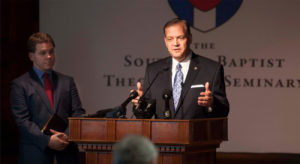
Al Mohler, president of Southern Baptist Theological Seminary in Louisville, Ky., speaks with the press. (Photo / Emil Handke, courtesy of Southern Baptist Theological Seminary / Via RNS)

In November, Florida pastor H.B. Charles announced he will nominate Southern Baptist Theological Seminary President Al Mohler to be SBC president at the 2020 annual meeting in Orlando, Fla. Shortly thereafter, Mohler said he would accept the nomination, becoming the first confirmed 2020 presidential candidate.

Mohler’s nomination comes a year after he celebrated his 25th year as president of the seminary. If elected, Mohler would become the first entity head to simultaneously serve as SBC president since Paige Patterson did so in 1999-2000.

  1. NAMB launches ‘Who’s Your One?’ emphasis.

The North American Mission Board officially launched the “Who’s Your One?” evangelism initiative in February. The emphasis asks Southern Baptists to pray for and focus on one person in the hope he or she will come to faith in Christ. NAMB made a free kit available to all churches with resources designed to help them with the initiative.

In August, NAMB launched a “Who’s Your One?” nationwide tour to catalyze evangelism within the SBC. The tour began Aug. 11-12 in Fayetteville, N.C., with a Sunday evening rally and an evangelism workshop the next morning. NAMB continued the pattern at later stops of the tour. The rallies include preaching from Johnny Hunt, former SBC president and current NAMB evangelism vice president. Each rally also includes worship led by different groups. The evangelism workshops the following day are designed for pastors, church staff and lay leaders.

The tour traveled to eight states in 2019. NAMB has planned 21 such events for 2020.

  1. SBC president J.D. Greear appoints the most diverse committees in SBC history.

In February, SBC President J.D. Greear named a diverse selection of Southern Baptists to serve on the convention’s Committee on Committees. In total, 34 percent of the influential 68-member committee are female.

The ethnic breakdown of the committee included 50 percent white, 24 percent African American, 15 percent Hispanic, 7 percent Asian and 4 percent other/multi-ethnic. More than half of the appointments came from churches of 250 members or less, and 24 percent from churches of 100 or less.

At the SBC annual meeting in June, messengers approved 150-plus new or renominated trustees and committee members. Of these new and renominated appointments, nearly a third were female or non-Anglo.

  1. Southwestern Seminary removes stained-glass windows commemorating the ‘Conservative Resurgence.’

In April, Southwestern Baptist Theological Seminary sent a letter to donors explaining their decision to remove 40 stained-glass windows commemorating leaders of the self-identifed Conservative Resurgence from the J.W. MacGorman Chapel.

While the seminary gave no official reason for removing the windows, Jimmy Draper, chairman of the Southwestern Advisory Council, said the decision was under consideration for a year prior to the removal. The J.W. MacGorman Chapel and Performing Arts Center has become a centerpiece of the campus, and Draper believed it was no longer a good place to spotlight a small segment of the school’s 111-year history. Draper and his wife Ann were two of the 40 individuals depicted on the windows.


Baptist Friendship House a beacon of hope for 75 years

NEW ORLEANS—For the vulnerable and the hurting, Baptist Friendship House has stood as a beacon of hope in the heart of New Orleans for 75 years. For the past 20-plus years, Kay Bennett has played a key role in sharing that hope with area residents in need.

“What keeps me motivated is the fulfillment of watching God work miracles in people’s lives,” explained Bennett, who has served as Friendship House’s executive director since 1997.

The ministry center, which first opened its doors in 1944, has operated from its current location a few blocks from New Orleans’ famed French Quarter since 1947.

“Over the years, the different ministries have kind of changed at Friendship House to meet the needs that are the greatest in our city,” Bennett said. “That’s kept it alive and vibrant as it has changed.”

As Baptist Friendship House marked its 75th anniversary this year, current ministries include aiding the homeless with such basic necessities as food, showers and clothing; transitional housing for women, including mothers with their children; and day programs such as literacy, English-as-a-Second-Language classes, job readiness training and a community Bible study.

Staff members also offer practical assistance to human trafficking survivors, ranging from providing temporary housing or connecting survivors with a safe house to arranging for involvement in long-term treatment programs or transportation back home.

Friendship House also partners with national Woman’s Missionary Union to provide Christian Women’s Job Corps and WorldCrafts ministries and with the Southern Baptist North American Mission Board in providing thousands of backpacks filled with a variety of items for schoolchildren, the homeless and those escaping human trafficking.

A lighthouse in the city

Kay Bennett, executive director of Baptist Friendship House in New Orleans since 1997, describes the ministry center as “a lighthouse in the city for people in need.” (WMU photo by Pam Henderson)

Bennett reflected on the center’s day-to-day ministry impact.

“You can see someone that is at the bottom that may be addicted and homeless and on the street, and you realize when they come through the door that you can’t change that person, but you do know that Jesus can work in their lives,” she said. “He can melt their hearts and bring healing and you can see them just totally turn their lives around and change. It is so fulfilling to watch how he works and changes them.

“It’s just really cool to me to be able to be in a setting that has been here for so long because it’s like a lighthouse in the city,” she emphasized. “New Orleans is known as the city that care forgot, but here at Friendship House, we try to put a little bit of concern and care and help and hope back in our people.”

With a well-earned reputation for making a difference in people’s lives, Baptist Friendship House recently was among organizations honored by FBI Director Christopher Wray who presented the ministry center with its distinguished Director’s Community Leadership Award for its work in fighting human trafficking.

“For many years, the FBI New Orleans field office and the Baptist Friendship House have worked together to combat human trafficking in the city of New Orleans,” said Eric Rommal, FBI New Orleans special agent in charge. “Their staff continues to serve the shelter with compassion, dedication and professionalism.”

Bennett accepted the award on behalf of Baptist Friendship House at FBI headquarters in Washington, D.C.

“Human trafficking is the fastest-growing criminal industry in the world, and it is all around us here in the United States,” she pointed out. “I think it’s very important that we, as Southern Baptists, look around us, assess needs, see what’s going on and reach out to help people.”

Life-changing relationships

Kendall Wolz, assistant director of Baptist Friendship House, helps serve a meal in conjunction with the ministry center’s weekly community Bible study. (WMU photo by Pam Henderson)

Bennett quoted 1 John 3:17-18 as one of the Bible passages that drives the center’s ministries: “If you have all that you need and see someone else in need and do not reach out to them, how can the love of God be in you? Let us not love merely through words and tongue but in action and in truth.”

“Our mission statement simply states, ‘Meeting needs through love, action and truth.’ We do that by basically walking alongside others and doing life with them,” she noted. “It is in meeting people’s basic physical and emotional needs that it opens the door for us to minister to the greatest need of all which is the spiritual need so that a life-changing relationship can begin with Jesus Christ.”

Peggy Day, who leads Friendship House’s weekly community Bible study, said that perspective is typical of Bennett’s ministry commitment.

Peggy Day, one of Baptist Friendship House’s ministry volunteers, leads a weekly community Bible study for area residents. “The ladies are so receptive,” she said. “They just are so hungry for the Word.” (WMU photo by Pam Henderson)

“She is such a blessing. She just never gives up. She’s always hopeful and always positive and always encouraging and accepting,” Day said. “That’s one of the big things here is that everybody is treated alike—they’re accepted.”

As the ministry center focuses on clients’ physical, emotional and spiritual needs, “we love having volunteers come to Friendship House and help us with our ministries,” Bennett said.

Inviting individuals, churches and mission groups to join the effort, she said volunteer opportunities range from helping pack hygiene kits and snack packs or preparing meals for Bible studies to donating food and clothing or helping staff such annual events as Friendship Fest, Back to School Bash and Fall Festival.

Citing Baptist Friendship House’s ongoing influence and impact, Bennett concluded: “I’m just thankful that here at Friendship House, we don’t judge people. It doesn’t matter where you’ve been, what you’ve done. We’re to be Jesus to others and treat them with respect and treat them like Jesus treats all of us. He loves us no matter what.”


Arkansas Baptist buys out shoe store and inspires town

ALMA, Ark. (BP)—Carrie Jernigan took her kids shoe shopping when her daughter, Harper, brought a pair of shoes to her.

Harper had noticed a friend from school had shoes that were too tight and had holes, and she asked her mom if they could buy the shoes for him.

“I said, ‘Yes,’ but I looked down and I could tell they were small,” said Jernigan, an attorney in Fayetteville, Ark., and member of Kibler Baptist Church in nearby Alma. “I just jokingly said to the clerk, ‘Looks like I may have to buy out all the shoes.’”

The employee at the discount shoe store, which was going out of business, laughed and then asked, “Would you really consider doing that?”

A few days later, Jernigan had 1,500 pairs of shoes.

A viral social media post and a massive outreach effort

Carrie Jernigan and her daughters, Harper (middle) and Campbell (left), with a few of the thousands of shoes they bought at a shoe store’s going-out-of-business sale. (Submitted photo)

Jernigan told her pastor, Lee Denton, she had bought all the shoes, but she was going to give them away anonymously. She spent most of the summer trying to give the shoes away. However, the new school year was approaching, and she still had plenty of shoes left.

“When I found out Carrie had purchased the shoes back in the early summer, I had mentioned to her that we could make it a big event,” Denton said. “After she shared her initial Facebook post, it went viral within 24 hours, and we were scrambling to decide what, when, how and where.”

Jernigan’s social media post was asking for a location where she could set up all the shoes and give them away to the community. It later was updated with details of the River Valley Kickstart that would be held at the Alma Middle School gym—17 days after the Facebook post went live.

The viral post also got the attention of major national news outlets.

“That first national news story let me talk about God and kept it in the article,” Jernigan said. “That’s when I knew that if MSN on their lead story is me and these shoes and they did not cut out me talking about God, God was going to do something big.”

Jernigan also was featured on the national talk show Strahan and Sara, where the hosts gifted her $30,000 worth of school supplies.

Loaves, fish and shoes

With national attention, Jernigan was able to raise more money for the back-to-school event and purchase more shoes and more school supplies. Local businesses and churches also chipped in, donating money to help kids get ready for school.

“The event could not have gone better,” Jernigan said. “Someone said that God was in every nook and cranny in that school, and that was so true. Where everything could have gone wrong, or a few bad things could have gone wrong, nothing did.”

Before the doors were even opened, 1,500 people were already waiting outside with the heat index at 114 degrees.

During the River Valley Kickstart, 150 volunteers from Kibler Baptist Church and 50 volunteers from the community gave away 1,200 backpacks, 2,300 pairs of shoes, 6,500 bottles of water, school supplies and thousands of dollars’ worth of gift cards to local fast-food restaurants. The event also featured free dental screenings, health screenings, physicals and haircuts.

City officials estimated about 5,000 people attended the event; the population of Alma is 5,748.

“There were so many people, I thought we were going to run out of shoes. I thought we wouldn’t have enough backpacks,” Jernigan said. “Everybody kept talking about Jesus with the (bread and) fish, and that’s exactly how it felt.”

God supplied the platform

According to Denton, this was the largest “missionary event” in the history of Alma.

“We normally give away 400 backpacks a year, but this year was altogether different,” he said. “God supplied the platform and absolutely showed out in the River Valley.”

Next year, Denton hopes to host the event again— but “with a little more than 17 days to plan” it.

“I think so many times in our community that our businesses are not working with our churches and our people. Everything is so individualized. We had almost every big church in town help, almost every business, the mayor, our police forces, almost all these elected officials,” Jernigan said.

“There is just one kingdom, and that’s what I think communities like ours have to get better at doing. I think the event is exactly what God wanted that day—that there was a showing of all these different types of organizations that can work together for him.”


Church gets creative with Lattes for Lottie

KNOXVILLE, Tenn. (BP)—Anyone heading to Mount Harmony Baptist Church in Knoxville, Tenn., doesn’t need to stop at a fancy coffee shop on the way to church. Multi-flavored coffees and lattes will be ready when worshippers arrive, served by smiling baristas.

Donations at the coffee counter not only raise money for the Lottie Moon Christmas Offering for International Missions, but also raise awareness about the offering’s namesake.

“I didn’t just want it to be a table with people coming up to give money and get a latte,” said Emily Sheddan, who started Lattes for Lottie in her church in 2017. “It was on my heart to get them involved and really know who Lottie was.”

‘Not just a name on an offering’

Sheddan, the daughter of Southern Baptist missionaries, grew up in Southeast Asia and remembers learning about Lottie Moon. As an adult, she noticed many people in local churches didn’t know about the feisty missionary. Those who did not participate in missions education programs, like Girls in Action and Royal Ambassadors, may never have learned about Lottie Moon.

“It wasn’t just a name of an offering, but was indeed a sweet soul who went forth,” Sheddan said. “I feel like it has to be pushed out there that she’s an actual person in history that we speak of, not just the name of the Christmas mission offering.”

Each year, Sheddan refines the process and introduces new ways to teach church members about Lottie Moon and about current missions efforts. In past years, she has distributed quizzes about Lottie Moon’s life and used displays that taught more about the missionary to China.

This month, she is displaying an International Mission Board map that features unreached people groups. Each time someone buys a latte, Sheddan adds a “Send and Go” pin to an unreached area of the world.

Young baristas serve treats

Emily Sheddan (center) and youth baristas team up each December to serve specialty coffees at Mount Harmony Baptist Church, Knoxville. All proceeds go to the Lottie Moon Christmas Offering. (Photo / Kris Wysong)

As for the lattes, Sheddan prepares batches in crockpots and offers flavored syrups, espresso and whipped cream at the counter. Church members stop by before Sunday school or before the worship service and add their donations to a collection box.

Sheddan enlists youth from the church to don the barista aprons, and together they serve up the hot treats. The team even adds the special touch of shaking the beverages in mason jars before serving, to add the frothy effect common in coffee shop lattes.

Elijah Morton, 15, is taking his place as a volunteer barista for a third straight year.

“My friends and I enjoy it, and we always make it a blast, whether we are making coffee, having competitions of who can make the best whipped cream swirl, or just chatting while we have downtime,” he said.

Morton credits Lattes for Lottie for helping grow his own understanding of missions.

“It has helped me understand why we do this, why we need to reach other states, countries, nations. It’s all for the glory of God, and I realize that now, by seeing people with loving hearts give to see more people get to know the Lord,” he said.

This year, Sheddan hopes that latte donations will raise $800 toward their church’s missions offering goal. With her own missions experience and with her parents still serving on the field, she has personal connections and the knowledge of how those contributions make a difference in the lives of missionaries.

This month, she is sharing her love of missions through a latte for Lottie, with or without a whipped cream swirl on top.


Too few churches for New Mexico’s Hispanic mission field

ALBUQUERQUE, N.M. (BP)—Nearly half of New Mexico’s population is Hispanic—the highest share in the United States. Yet only 57 Hispanic Baptist churches minister to fewer than 3,000 Hispanics on any given Sunday across the state. One Southern Baptist is set on changing that.

“New Mexico is a mission field,” said Ricardo Rivera, Hispanic strategist for the Baptist Convention of New Mexico. “Our biggest challenge is finding church planters to reach this people group.”

The Hispanic population of New Mexico is as diverse as it is large. In the northern part of the state, most Hispanics are of Spanish descent, have been in the area many generations and speak English primarily.

In the southern part of the state, most of the Hispanic population is made up of immigrants from Mexico, Central and South America who speak mostly Spanish.

To the east, many Hispanics work in the dairy farms that line that part of the state. First Baptist Church in Portales is the only church in New Mexico working to reach the dairy farm workers.

“The ministry to the dairy farm workers started through a deacon (at First Baptist in Portales) … who owns one of the farms and wanted to reach the Hispanics working there. Forty people have been saved as a result of that ministry,” Rivera noted.

Another strategy churches are using to reach Hispanics is evangelistic events, which Rivera says are essentially revival-style services. The Hispanic churches are encouraged to host one of these events annually. The events include block parties and door-to-door evangelism.

Thirty churches welcomed about 900 unchurched people to their Easter revivals, Rivera said. More than 100 made professions of faith in Christ, and 12 have been baptized. Next year, churches will work on hosting two revivals—one in the spring and another in the fall.

Much of the outreach so far has focused on first-generation Hispanics.

“We have many second- and third-generation Latinos who communicate in English but are culturally Hispanic,” Rivera said. “We are not currently serving that group effectively.”

“We need young, bilingual church planters who are culturally Hispanic to come and work with this people group in New Mexico.”

While ministry to a group with a strong Roman Catholic background can be challenging, “people are open to hearing the gospel,” he added.


Former professor and seminary at odds over cause of dismissal

FORT WORTH—Southwestern Baptist Theological Seminary denied charges by a former humanities professor—who identifies as a previously gay abuse survivor—that he was fired because he refused to stop talking about homosexuality and sex abuse.

Instead, Provost Randy Stinson said the decision was based on “changing program needs” of Scarborough College, the seminary’s undergraduate program.

Lopez claimed seminary wanted to silence him

Robert Oscar Lopez, formerly a humanities professor in Scarborough College, issued a public statement Dec. 3 asserting his position was eliminated due to pressure from the Southern Baptist Convention’s Ethics & Religious Liberty Commission and opposition from seminary administration.

According to the statement, Lopez claimed he was dismissed “for his position on same-sex relationships and his advocacy for victims of same-sex abuse.” He has spoken and written about his personal experience, growing up in the home of his lesbian mother and her same-sex partner. Consequently, he became involved in what he has called “a homosexual lifestyle” before he became a Christian.

Lopez insisted he was told in September “not to continue to discuss homosexuality or sex abuse in any capacity while employed at the seminary.”

Allegations demand ‘public, unambiguous response’

Southwestern Seminary issued its own statement the following day. While noting the school normally does not comment on personnel matters, the seminary provost said the “public allegations” by Lopez demanded “a public, unambiguous response.”

“Let me be absolutely clear: no faculty member, including Dr. Lopez, has been told, or would be told, they cannot discuss homosexuality,” Stinson said in the Dec. 4 statement.

The seminary “joyfully affirms” the 2000 Baptist Faith & Message, “including each and every assertion about biblical sexuality,” he stated.

“As such, the administration faithfully requires all faculty members to teach in accordance with and not contrary to these truth claims. Our faculty—including our president—regularly teach on God’s design for the family and marriage and the biblical sexual ethic, which homosexuality is in rebellion against,” Stinson said.

Significant staff reductions

In a Nov. 16 article published on the conservative website American Greatness, Lopez stated: “By September 19, I was asked to resign by the provost. In early November, the spring 2020 schedule was published, indicating that I had no classes at all.”

Lopez wrote that Adam Greenway, who was elected president of Southwestern Seminary in February, “fired 26 professors in 24 hours, sending a clear signal to all of us that we were eminently replaceable.”

In April, the seminary’s board of trustees approved a reduced budget and voted to revamp undergraduate degrees offered by Scarborough College, reflecting what Greenway called a move to “recalibrate and to reposition” itself in “every way to strengthen the core of what we do.”

In an Oct. 10 interview with the Baptist Standard, Greenway noted the drastic reduction in Southwestern Seminary’s enrollment over the course of the last few decades. He stressed his desire to emphasize residential theological education and give greater attention to the master’s level degree programs that equip students for ministry in churches.

Baptist Press, information service of the SBC Executive Committee, quoted a seminary official as saying: “Currently, we have two full-time professors of humanities—one senior professor of humanities and one professor of philosophy and humanities. From last year to this year, the required humanities courses have been cut from eight to four. Michael Wilkinson, dean of the college, in consultation with Provost Stinson determined that we did not need a third full-time professor of humanities.”

Lopez said he was pressured to keep quiet

In his Dec. 3 statement, Lopez stated he received written notification Nov. 29 his position was eliminated from Southwestern’s undergraduate program. He asserted that followed three meetings with Stinson and four with Wilkinson, saying he was “pressured to cease from discussing sexuality and sex abuse.”

“I was preaching publicly that with the help of Jesus Christ people could overcome homosexuality, and I was discussing same-sex sex abuse,” Lopez stated, noting he had submitted resolutions on those subjects at Southern Baptist Convention annual meetings in 2018 and 2019, but neither resolution made it out of committee.

Lopez alleged he was ordered in September to stop discussing homosexuality or sex abuse while he was employed at the seminary.

“I stated that the demands from the seminary violated my conscience and would force me to disobey God. I was told that if that was the case, I had to resign. I refused to resign,” Lopez stated.

Claims seminary ‘in retreat’ on biblical sexuality

Furthermore, the public statement from Lopez alleged Southwestern Seminary joined unnamed churches, denominations, parachurch organizations and schools as being “in retreat” regarding “biblical truths about sexuality.”

“Any true believer in Jesus Christ expects pushback from unbelievers. What we don’t expect is pushback from people who claim to uphold and teach the very principles clearly presented in the Bible,” he said.

Lopez also was interviewed on American Family Radio’s “Focal Point” program in a segment titled “Southern Baptists getting ready to flip on homosexuality.”

‘Committed to a biblical view of marriage and sexual ethics’

In his Dec. 4 statement, Stinson insisted the seminary holds to its traditional understanding regarding biblical sexuality and the ability of individuals to be changed by Christ.

“Our faculty—including our president—regularly teach on God’s design for the family and marriage and the biblical sexual ethic, which homosexuality is in rebellion against. Our faculty also teach that all sinners can be changed by the power of the gospel of Jesus Christ,” Stinson said.

“Indeed, any contrary teaching at the seminary would not be tolerated. As Southern Baptists should expect of their seminaries, we are committed to a biblical view of marriage and sexual ethics. Any claim that Southwestern Seminary has wavered on these longstanding commitments is either misinformed or intentionally deceptive.”

‘Refuse to compromise’ on biblical principles

Stinson took personal exception to assertions he made any statements contrary to the traditional understanding of biblical teachings regarding sexuality.

“I have given my entire academic and ministry career of more than two decades to addressing these matters from a biblical worldview. In light of the growing cultural confusion on sexuality and growing pressure to force Christians to conform to prevailing opinions, my resolve on these matters is stronger today than ever,” he said.

“The biblical sexual ethic is God’s plan for human flourishing and the gospel of Jesus Christ is God’s plan for redeeming all sinners. On these matters, I and Southwestern Seminary refuse to compromise.”

‘Failure to comply with basic administrative policies’

Stinson emphasized Lopez’s position at Scarborough College was eliminated due to “changing program needs.” But he also noted the decision “was undergirded by his own actions, which included his failure to comply with basic administrative policies, his being the subject of regular complaints from students and faculty colleagues, and, in the end, his refusal even to attend meetings with his supervisors.”

“While it is unfortunate when any institutional position must be eliminated, I am confident this decision is in the best interests of the students we are educating for gospel ministry and this institution,” Stinson said.


Her honesty brought allegations against Patterson to light

GREENSBORO, N.C. (RNS) —Megan Lively glanced down furtively to the copious notes she had jotted in a thick spiral-bound notebook resting in her lap. She was about to speak to a room full of Southern Baptist pastors about the sexual abuse she experienced, and she was nervous.

Her message to more than 50 male pastors sitting in a conference room during the annual meeting of the Baptist State Convention of North Carolina was both tremulous and full of conviction: When a woman comes forward alleging abuse, listen to her. Don’t try to fix it. Be more like Jesus.

For Lively, speaking publicly about her sexual assault 16 years ago on the campus of Southeastern Baptist Theological Seminary still is stressful.

It’s been a year and a half since she revealed she was the woman who was encouraged by Paige Patterson, then president of the seminary, not to report her rape by a fellow student to the police.

Southwestern Baptist Theological Seminary trustee chairman Kevin Ueckert (left) addresses trustees at a special called meeting at the Fort Worth campus May 22. The board met to discuss the controversy surrounding Paige Patterson (right), then president of the seminary. (Photo by Adam Covington/SWBTS via BP)

That allegation, cited by leaders of a Southern Baptist seminary, helped get Patterson fired as president of Southwestern Baptist Theological Seminary in Fort Worth last year. It also helped move the Southern Baptist Convention toward a reckoning with sex abuse.

Lively, who is now married with two children and runs a social media consulting business for small and midsize churches, does not revel in the spotlight.

In September, she spoke at the Caring Well conference in Grapevine, where the denomination invited abuse survivors to tell their stories. In the new year, she plans to speak at half a dozen other SBC-affiliated venues.

Willing but not eager

But public speaking is not a role she relishes. She has just emerged from a harrowing year in which she faced a trauma she had buried deep inside for more than a decade. She’d much rather be known for her social media company Relevant Reach. She also understands there’s no turning back.

“I’m willing to share what happened to me if it helps somebody else,” Lively said.

The multifaceted sexual abuse scandal in the Southern Baptist Convention has made household names of several Southern Baptist women who have come forward in recent years with stories of clergy misconduct and of church officials failing to respond.  Lively, now 40, doesn’t want that kind of recognition.

Megan and Vincent Lively at the Koury Convention Center in Greensboro, North Carolina, after Megan’s talk on a panel at the annual meeting of the Baptist State Convention of North Carolina. (RNS Photo / Yonat Shimron)

“Contrary to what some may believe, I’m not a fan of the principles of the #MeToo movement,” she told pastors assembled at the abuse crisis panel in Greensboro last week. “I wasn’t empowered or motivated by the #MeToo movement or by a hashtag. I don’t find power in women standing up and saying ‘I was sexually assaulted.’ I grieve when that happens.”

Lively is trying to walk a middle path. She does not want to come off as an angry feminist trying to pull down powerful men. She was raised to respect her elders and look up to authority. She and her husband, Vincent Lively, are faithful churchgoers at Peace Church in her hometown of Wilson, N.C. Some of the people she most respects are Southern Baptist men.

But after the dozens of reports of sexual abuse in the church, she also wants to help her denomination do the right thing. In this, she has become a reluctant speaker.

A love of church

Megan Lively felt a call to Christian ministry when she was 16.

The daughter of a realtor and a psychologist, Lively grew up in Wilson, an old tobacco town about 40 miles east of Raleigh, the state capital. Her family attended Grace Baptist, and like them, she loved church.

At Campbell University, she majored in religion and joined a group called Monday Night Bible Study started by two Campbell graduates, J.D. Greear and Bruce Ashford. Greear is now president of the SBC, and Ashford is now provost and dean of the faculty at Southeastern.

After graduating from college, Lively wanted to continue studying Christianity and in 2002, she enrolled at Southeastern to pursue a Master of Divinity degree in women’s studies, a program started by Dorothy Patterson, Paige Patterson’s wife.

By then, Paige Patterson already had cemented his role as the architect of the Southern Baptist Convention’s self-described “conservative resurgence” with its embrace of biblical inerrancy, the belief that the Bible is without error. In 1992, Patterson was named president of Southeastern in Wake Forest, N.C.

But he wasn’t quite done. In 2000, Patterson and his wife led the SBC to revise its doctoral statement to codify traditional gender roles. The revised statement now includes a sentence declaring that “a wife is to submit herself graciously to the servant leadership of her husband,” and another that declares the office of pastor is limited to men.

Around that time, Dorothy Patterson started the master’s program intended to educate women about their biblical role as wives and mothers.

Lively, like many in the denomination, admired the Pattersons. As a woman, she knew she couldn’t be a pastor, but her calling was not to preach from the pulpit anyway.

Assaulted and then shamed

Once on campus, she found the master’s program was not as rigorously academic as she had hoped. And she was also one of only a handful of single women on campus.

Still, she went to classes and studied. The following year she began dating a student.

Lively won’t go into details about that fateful evening. It’s still too raw. But the man she had been dating for a few weeks sexually assaulted her, she said.

The following morning, she reported a nonconsensual sex act to a campus student office. She was immediately called and questioned by Paige Patterson. She recalls him asking for the precise details and then suggesting she was at fault for inviting a male student to her room. She was asked to forgive her assailant and advised not to report it to the police.

“I remember feeling very ashamed,” she said.

Southeastern placed Lively on probation; she can’t remember why. It may have been for allowing the male student to her room. The school, she said, also expelled her alleged attacker.

With that, the matter appeared closed.

And so, it seemed, was her call to ministry.

Suffering in silence

During the 15 years that followed, Lively told no one what happened.

She withdrew from Southeastern to care for her ailing grandfather and took jobs in banking and marketing. She married Vincent, an insurance agent, and became a mother. The couple became members of Peace Church, a large congregation in Wilson dually aligned with the SBC and the National Association of Free Will Baptists.

Then, in the spring of 2018, while scrolling through her social media feed, Lively began to read about mounting criticisms of Paige Patterson. A recording surfaced of Patterson saying he counseled abused women to remain with their husbands. In a video, he was seen objectifying a teenage girl and criticizing the physical appearance of female seminary students.

The stories sparked flashbacks and mounting feelings of anger. One evening after Lively’s son and daughter were asleep, she had an argument with her husband. He asked her what was wrong. She told him about the assault at Southeastern.

“Megan, you were raped,” he said.

“‘No. I wasn’t,” she blurted out, still struggling with the denial.

“I was still that little girl under the control of the Pattersons,” she said later.

Trauma continued

But the flashbacks, insomnia and anger she was experiencing were signs that what she had long repressed was coming back into focus.

“In a religious system, survivors often lack the vocabulary to name (sexual abuse) as a crime,” said Susan Codone, a professor in the School of Engineering at Mercer University who experienced sexual abuse as a teen. “You don’t have the words to say: ‘This was rape. This was sexual abuse.’ Without the words, you tend to put your own words on it: ‘It was my fault. It was a sin I committed.’”

After that exchange, the couple decided to meet with their pastor, who urged Megan to get immediate medical help for her insomnia and to see a mental health professional.

She contacted Ashford, now the Southeastern provost, to tell him what happened to her in 2003. He told her the seminary would support her if she wanted to press charges against her alleged assailant. Lively decided it was too late for that, though she supports other women who do.

Going public

Soon after, a Washington Post reporter called and wrote about her experience without identifying her. Hours after the story broke, Southwestern seminary trustees meeting behind closed doors voted to demote Patterson, then days later, to fire him.

Since word was getting about about her story, Lively decided she didn’t want to remain anonymous anymore.
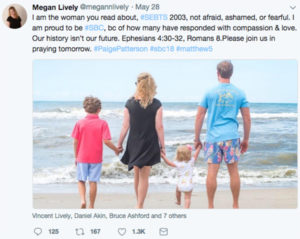
“I am the woman you read about, #SEBTS 2003, not afraid, ashamed, or fearful,” she tweeted on May 28, 2018.

Days later, the wife of Patterson’s chief of staff published a blog post contesting Lively’s account and quoting from a private letter Lively wrote to Patterson after the incident,

Lively had begun her journey, and though she may not have realized it then, her ministry.

Redeem and refashion

Hers, she decided, would be a coaching role. Yes, she would talk about her experience, but mostly she wanted to be a resource behind the scenes. Surely this would be a way to redeem the painful episode and refashion her ministry.

At the annual denominational meeting, for example, a group of women protested outside the Birmingham, Ala., convention center. Lively counseled the male pastors inside: Don’t offer to pray with these women, she told them.

“They were abused in a church setting. That could have happened while a pastor was praying for them or leading them through the Bible.” It could re-traumatize them, she suggested.

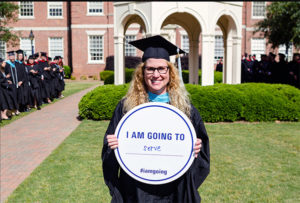
Megan Lively graduated from Southeastern Baptist Theological Seminary in Wake Forest, N.C., with a Master of Arts in Christian studies degree on May 14. (Photo courtesy of Megan Lively)

Lively has resumed her friendship with Daniel Akin, the president of Southeastern whom she first met in church revival as a teen and later during college. The two talk or text every few weeks. When she told him she would like to complete her degree, Akin said the school would assume the cost of tuition.

“That was the least we could do,” Akin said. “She was abused and taken advantage of and harmed in all of this.”

This past spring—one year to the day after she first contacted the seminary—Lively graduated with a Master of Arts in Christian studies. Akin personally handed her the diploma and gave her a hug.

But the fallout from coming forward as a survivor of sexual assault has been bruising in many ways. Many of her immediate family members don’t understand her. One warned her she could be sued. Another wonders why she’s not pressing charges.

Healing continues

The work of healing continues. Lively completed a type of therapy called “eye movement desensitization and reprocessing” to help her deal with the trauma. She’s now working with a therapist on the hurt she’s feeling toward family members who have fallen out.

Every time she gets up to speak she’s aware of the distance that has been created between them.

She understands that some people believe women who come forward with allegations of abuse are doing so for fame, or fortune, or to get back at someone. She feels bound to demonstrate that’s not why she’s doing it.

But many days, she wishes she didn’t have to.

“I don’t know of any little girl that dreams of growing up to be on this stage, discussing this topic,” she said. “But I believe God can use my broken story of redemption.”

And, she adds, maybe the church can, too.

Editor’s Note: After the story originally was posted, two paragraphs under the subheading “Going public” were edited to clarify the sequence of events.


Beth Moore doesn’t ‘have an axe to grind’

EDITOR’S NOTE: A video of Beth Moore’s sermon can be viewed in our Baptists Preaching column.

“I got no personal agenda here. I got no axe to grind. I got Acts to teach,” Beth Moore declared during her sermon at the inaugural National Preaching Conference hosted by Baylor University’s Truett Theological Seminary.

Those words appeared soon afterward across social media. Others at the conference described Moore’s sermon as “historic” and a “watershed.”

During her sermon, Moore addressed the controversy surrounding John MacArthur’s assertion that she “go home” when he was asked to respond to the phrase “Beth Moore.”

Moore’s lifelong love for the Bible

After being welcomed “home” by Baylor President Linda Livingstone, Moore recounted her upbringing, stating that if she had an earned doctorate, “it would be in being First Baptist.”

She also spoke of being raised in a troubled and unstable home in which she fell victim to abuse and endured the confusion of seeing her abuser serve in prominent positions in her church.

Moore preached on Acts 1:1-11, continuing into Acts 2. The title of her sermon was “Knowing This from That.”

Speaking of her love for the Bible, Moore said she is “62 and a half years in to being mesmerized by the inspiration of the God-breathed word.”

“To me, one of the marvelous things about the word of God” is that after so many years teaching the Bible, “no matter how many times you’ve seen a passage, something jumps out at you,” she said, referring to her recent reading of the Gospel of Luke and deciding to continue straight into the book of Acts. Both books of the Bible were written by Luke, Acts being a continuation of the Gospel.

Moore noticed a recurring phrase Luke used in Acts—“this Jesus.” Luke accentuates “this Jesus” “because there is ‘this Jesus’ and ‘that Jesus,’” she said. The challenge is to figure out which one we know, Moore said.

Differentiating ‘this Jesus’ from ‘that Jesus’

She described several ways in which Christians have accommodated Jesus, including monetizing and politicizing him. Since Christians no longer recognize Jesus, he is no longer recognizable in them, she said.

Describing “that Jesus,” Moore said people see eye-to-eye with “that Jesus,” and “‘that Jesus’ evolves.”

By contrast, “this Jesus” calls people to follow him and become fishers of people. Instead, Christians tell “‘that Jesus,’ ‘You follow me, and I will make you fishy to people,’” Moore said.

After describing “that Jesus” as an idol, Moore declared, “You can tell somebody’s Jesus by looking at someone’s life.”

“‘This Jesus’ is most conspicuous in the Gospels” that tell of his ways, Moore said. “Make me to know your ways, O Lord,” she said, quoting Psalm 25:4.

Citing Acts 4:5-12, Moore said, “Only ‘this Jesus’ can save.” Preachers and teachers must know the difference so they don’t preach another Jesus.

Citing Acts 17:2-4 and 1 Corinthians 15:3-4, she pointed out that “this Jesus” is anticipated by the Scripture, fulfills the Scripture and illuminates the Scripture.

Moore addressed women in ministry

Stating she is a representative of her gender, Moore declared “this Jesus,” who called and cloaked and gifted women, still calls and cloaks and gifts them. “I don’t know about ‘that Jesus,’” she said, stating also that she is not confused about “this Jesus’” take on women, noting he went out of his way to include women. Moore then quoted Acts 2:17-18, which records the Apostle Peter’s recitation of Joel 2:28-32:

“In the last days, God says,
I will pour out my Spirit on all people.
Your sons and daughters will prophesy,
your young men will see visions,
your old men will dream dreams.
Even on my servants, both men and women,
I will pour out my Spirit in those days,
and they will prophesy.”

“I got no agenda here. I got no axe to grind. I got Acts to teach,” Moore stated.

She went on to say that Acts doesn’t “show women displacing men” but being placed in positions of ministry along with men. “‘This Jesus’ didn’t dream of wasting half the gospel witness,” Moore said.

In response to those who say Acts describes a temporary situation necessary briefly following Pentecost, Moore pointed out biblical accounts of women leading in ministry decades after Pentecost.

Addressing the power of “this Jesus,” Moore said he is the one who poured out his Holy Spirit on the people at Pentecost, enabling them to do miraculous things.

“The biggest miracle we’ve been able to perform is to turn wine back into water,” Moore said. “Surely, there are bigger wonders than that.”

Another difference between ‘this’ and ‘that Jesus’

Citing the story of Stephen in Acts 6–7, Moore acknowledged “‘this Jesus’ can get you into trouble” while “that Jesus” is much safer.

“That Jesus” would never put us in an awkward position, put our lives at risk or call us to give anything up, Moore said. “‘That Jesus’ calls us to take up our car and follow him to church.”

She also described “that Jesus” as a house cat and “this Jesus” as a lion.

“‘This Jesus’ makes us no longer that same person,” Moore asserted.

A personal and powerful closing

Turning personal, Moore closed the sermon with a story about her young granddaughter, who was present during the sermon.

When asked who she would most like to meet, Moore has responded, “There’s this face I can’t wait to see that I’ve never seen.” Likewise, she has a favorite place she hasn’t been but where she will go someday.

She described being at her home recently when a vehicle drove into the driveway, and the car door opened. Her granddaughter jumped out, ran to her and gave her a big hug. Moore asked her granddaughter if, when she was a young woman at college, she would still run like that to her grandmother.

Moore said she started running to Jesus when she was a child and continued running to him as a college student, a young woman, a married woman and a mom. Imagining Jesus asking her, “When you die, will you run to me,” Moore said, “Oh yes, and no one better get in my way” because then I’ll be “going home.”


Patterson fearful after first black SBC president elected

WASHINGTON (RNS)—A newly discovered letter from one former prominent leader of the Southern Baptist Convention to another reveals a depth of mistrust and suspicion toward the denomination’s first black president.

Shortly after the convention’s 2012 meeting, Paige Patterson, then a seminary president and the architect of the denomination’s ultra-conservative turn, sent a letter to another denominational leader expressing doubt about the newly elected SBC president, Fred Luter, who is African American.

Specifically, Patterson feared Luter would fail to nominate future leaders of denominational boards and agencies who would continue the “conservative resurgence” in the SBC.

“The difficulty is that among many of the ethnic groups there are not so many of them who understand the issues involved and the seriousness of them,” wrote Patterson to Jimmy Draper, a former SBC president. Southwestern Baptist Theological Seminary trustees fired Patterson as president last year for mishandling student reports of sexual abuse.

Patterson letter to Draper

In his letter to Draper, Patterson said he wrote Luter after his historic election to tell him his appointees must uphold biblical inerrancy—the belief that the Bible is without error—and must also be committed to the appointment of others with like beliefs.

Although Patterson said he was “glad we elected a black president and specifically Fred,” he sounded a warning: “Under Fred’s leadership it would be possible for us to slide a long way back toward where we once were, and that would be devastating.” This, he said, left him “quaking about it a bit.”

The letter is among a trove of papers given to Southwestern by Draper upon his retirement. It was discovered by SBC blogger Benjamin Cole, who is writing a book about evangelicals and public life. He posted it to Twitter Nov. 13.

“I believe the existence of this letter substantiates the concerns of many pastors and churches that qualified godly leaders from nonwhite ethnic backgrounds have never quite received a fair chance to rise to positions of leadership,” Cole told RNS.

Luter and Patterson did not immediately respond to requests for comment.

Al Mohler, president of Southern Baptist Theological Seminary in Louisville, Ky., and a candidate for the denomination’s presidency, said the letter was regrettable but not shocking.

“Fred Luter made very good appointments and served nobly as president of the Southern Baptist Convention,” Mohler said. “And the fact is that Fred Luter has been supportive in every way of the conservative resurgence in the SBC and so the concerns reflected in this letter were not realized in his appointments.”

Left feeling like ‘the other’

Pastor Dwight McKissic of Arlington is shown in a 2014 file photo. (BP Photo / Van Payne)

Dwight McKissic, an African American leader within the predominantly white 14.8-million member group, tweeted that Patterson’s letter was racist and  said in an interview that it validates McKissic’s feeling like “the other” within the denomination.

“With the kind of mentality that Paige Patterson expressed in that letter and with the SBC over and over rejecting ethnic minorities for leadership—entity head positions—it leaves you feeling like the other,” said McKissic, an Arlington minister whose proposed resolution about white supremacy eventually was adopted after much struggle at the Southern Baptists’ 2017 annual meeting.

“When you have to fight so hard to get an alt-right resolution passed, it just gives you that feeling you’re on somebody else’s territory although you belong to this group.”

The discovery of the letter comes at a time when the denomination, formed in 1845 as a haven for Southern slaveholders, has been working to reckon with its past—not always successfully. Southern Seminary last year issued a 71-page report acknowledging decades of bigotry, directed first at African slaves and later at African Americans.

But the denomination has also stumbled.

The same year that the resolution denouncing “alt-right white supremacy” passed after a fierce backlash from social media, a group of white professors from Southwestern posed for a photo as rappers, a stunt many saw as degrading and offensive to blacks.

More recently, a black pastor who was a finalist for a post at a prominent Florida congregation failed to get enough votes after a racially tinged whisper campaign by church members.

More than ‘one man’s close-minded opinion’

Jemar Tisby is president of The Witness: A Black Christian Collective and co-host of the “Pass the Mic” podcast. (Photo / Ken Camp)

Jemar Tisby, author of The Color of Compromise: The Truth about the American Church’s Complicity in Racism, said Patterson’s letter can’t be dismissed as “one man’s close-minded opinion.” Instead, he said, it represents sentiments held broadly in white evangelicalism in general and among some Southern Baptists in particular.

“The assumption of many white evangelicals is that black people and other people of color do not have the theological acumen of white Christians,” Tisby said. “The core of the matter is that people such as Paige Patterson and those who share his views functionally believe that only white Christians can be trusted to interpret the Bible and lead the church.”

Mohler acknowledged that adherence to the Bible is not limited to one group of people.

“I am firmly convinced that biblical orthodoxy and theological fidelity has no race or color,” he said in an interview Nov. 13. “Some of the great giants of the faith past and present and future have been those who certainly did not have white skin. And that was true from the very first century of Christianity to the present.”

Mohler said that while concern grew about biblical inerrancy among evangelicals as more liberal Protestants voiced different views in the 20th century, “at the same time you have had powerful affirmations of the truthfulness of God’s word thundering from African American pulpits and from others.”

The conservative resurgence was “primarily a theological correction within an overwhelmingly white denomination” that now is “committed to being less white and more representative of the kingdom of Christ.”

‘New to Southern Baptist life’

Draper, to whom Patterson’s letter was addressed, said the ruckus over it was misplaced and “we’ve got some great ethnic leaders who are in key positions now and have done a great job.”

But he agreed with Patterson’s contention that some minority leaders might not be acquainted with aspects of the conservative-moderate fight that captivated Southern Baptists starting in 1979.

“Most of the ethnics were relatively new to Southern Baptist life,” he said in an interview Wednesday, “and would not necessarily be familiar with other individuals who could help us continue in the effort to be sure we were steered in a conservative theological way. So the letter didn’t pose any kind of criticism of Fred. It just said this may be one of his challenges, knowing people that he could nominate and you might be able to help.”

Draper also called the idea that the letter demonstrated the notion that only white Christians can be trusted as biblical interpreters and church leaders “ridiculous because there’s no evidence to that at all.”

Rather, he said, Patterson recognized that the SBC president—then and now—is responsible for dozens of appointments and might want advice.

Draper said he doesn’t recollect Luter ever seeking his counsel on appointments: “I don’t recall him asking me anything.”

According to the 2013 Southern Baptist Convention Annual, this was the racial/ethnic breakdown of 123 committee appointees made by Luter during his first one-year term as president: 13 African American, two Hispanic American, three Asian American, one Native American; the other 104 appointees were Anglo American.


Southwestern Seminary enters partnership with OBU

FORT WORTH (BP)—Southwestern Baptist Theological Seminary and Oklahoma Baptist University have established a pathway for OBU bachelor’s degree students to enter Southwestern Seminary’s master’s degree programs with advanced standing, expediting their theological education.

“I’m delighted with this new partnership with OBU, further strengthening the strong relationship between Seminary Hill and Bison Hill,” said Adam Greenway, president of Southwestern Seminary. “It’s a win-win-win—for Southwestern Seminary, for OBU, and—most of all—for students.”

Accelerated pathway toward master’s degree

The relationship between the two institutions provides an accelerated pathway from a bachelor’s degree at OBU to a master’s degree at Southwestern Seminary. OBU students will be able to receive master’s credit at Southwestern Seminary for work done at OBU.

Through this collaboration, bachelor’s degree graduates from OBU who already have taken courses in Old Testament, New Testament, biblical languages and church history may demonstrate their proficiency in these subjects through advanced standing tests at Southwestern Seminary. If graduates pass these tests, then they will receive credit for these courses at the master’s level, and they will not be required to repeat them during their studies at the seminary.

“In short, this partnership provides a more efficient way for students to train for their calling,” said Mark Leeds, registrar at Southwestern Seminary.

Randy Stinson, provost and vice president for academic administration at Southwestern Seminary, said the relationship is beneficial for both institutions and serves as an example of cooperation between like-minded institutions.

“We are excited about the partnership, which will provide a pathway for OBU students to enter master’s programs at Southwestern ahead of the game,” Stinson said. “We look forward to a healthy and prosperous relationship between OBU and Southwestern for many years into the future.”

Save time and money

Heath A. Thomas, newly elected president of OBU, added: “For over 100 years, Oklahoma Baptist University has transformed lives through a distinctively Christian liberal arts education. We are discerning in our partnerships—we partner with like-minded institutions in our Baptist family that are committed to biblical, orthodox and practical ministry training. Southwestern Seminary has been committed to this vision for decades.

“OBU has worked with Southwestern Seminary for a B.A. to M.Div. pathway through extension centers in the past, but we believe this new pathway will serve our students strategically for the future, saving them time and money as they move from a world-class undergraduate education to a world-class graduate education.”

Thomas added that, as both an OBU and Southwestern Seminary alum, he is delighted to see this fellowship emerge between the two institutions.

“It is true that we can do more together than we can do alone,” he said.


Marine veteran plants churches near military bases

JACKSONVILLE, N.C. (BP)—As a 10-year, active duty service member in the Marine Corps, Brian O’Day regularly moved with his family. He traveled to 15 different countries including deployments to Iraq and Afghanistan.

About eight years into his military service, O’Day discerned God’s calling him to ministry—to establish a church in a military community with a consistent gospel witness.

“I felt like God was calling me not to move around and jump from church to church but instead serve in one of those churches, that sat still in a military community and ministered to and pastored and shepherded military service members and their families,” O’Day said.

That call came while O’Day was stationed at the Marine Corps base in Quantico, Va., and attending Pillar Church in Dumfries, Va. Now he serves on the leadership team at Pillar Church Jacksonville, N.C., a church O’Day started in his family’s home on Jan. 6, 2013.

O’Day became executive director of the Praetorian Project in May of 2019, which exists to establish a network of gospel-centered churches near military installations around the world.

Planting new churches in military communities is one of the focus areas of the North American Mission Board’s Send Network, NAMB’s church-planting arm. As the endorsing entity for Southern Baptist chaplains, NAMB encourages both established churches and new churches to involve chaplains in their ministry strategy.

“Southern Baptist military chaplains have the primary responsibility of providing religious services and activities for their service members, veterans and the surrounding military community,” said Doug Carver, NAMB’s executive director of chaplaincy.

“Churches can work intentionally to prayerfully support SBC-endorsed military chaplains and military church plants, regularly including them in local church events and other denominational activities.”

Unique churches with unique challenges

Serving in a church that has a major focus on military service members involves a number of unique challenges. Military families move often, and the soldiers deploy for months at a time. Those hurdles should not discourage any church’s outreach to military members, O’Day insisted.

“Everyone, every believer, needs a healthy local church,” O’Day said. “Even if they move a lot, even if they deploy a lot, they need a healthy local church. We want to plant churches near these service members and their families.”

Aside from meeting the need for Christians to have a local church, O’Day also emphasized the need for churches to provide access to the gospel to everyone, “even highly transient service members.”

The transitory nature of military life, however, provides opportunities alongside those challenges. Moving every few years can make it difficult to connect with a local church, but the travel opens up doors for ministry as well.

“We want these service members to take the gospel with them to all of the different places they go,” O’Day said. “I was in 15 different countries in 10 years of active duty, and I took the gospel with me. We want others to do likewise.”

Building relationships

Reaching out to members of the military requires intentionality, O’Day said. There are opportunities for churches to connect by providing counseling before, during and after deployment.

“The relationship between the local church and the military community involves a continuous relationship building and education process between military chaplains, church plants near military communities and local Southern Baptist churches,” Carver said.

Military chaplains will have insight into the most pressing needs affecting a local military community, and they can share those opportunities with churches, he added.

“Local churches can greatly support the military community by offering value-added ministry activities such as biblical counseling, parenting classes, marital counseling, financial planning seminars, and grief and trauma counseling,” Carver said.

Churches may be intimidated or concerned about asking military members about discipleship, but O’Day reminded churches that they are used to and understand training.

“They need to be discipled as they continue to grow, in their faith, in their maturity, as they grow in their influence, we want to see them grow in spiritual maturity as well,” O’Day said.


Analysis: What Mohler’s nomination for SBC president means

WASHINGTON (RNS)—There are seven more months before the next annual meeting of the Southern Baptist Convention. But the race for SBC president may already be over, following news that Al Mohler likely will be nominated to run as the denomination’s next president.

H.B. Charles, pastor of Shiloh Metropolitan Baptist Church in Jacksonville, Florida, a predominantly African American congregation, announced he planned to nominate Mohler.

“We need the zeal to mobilize our resources to spread the gospel,” Charles said in making his announcement on Twitter. “We must do so together. I believe @albertmohler is the man to lead us forward in that unity.”

Preemptive move?

Mohler, president of Southern Baptist Theological Seminary in Louisville, Ky., is widely regarded as one of the denomination’s most prominent public intellectuals. He writes widely, has a podcast and appears regularly on TV.

In a statement about his willingness to serve as SBC president, Mohler said he hopes to “unite Southern Baptists,” a group that has long had political and theological divisions within its fold even as it has seen a declining membership as the nation’s largest Protestant denomination.

“We are facing a new era in the world and in the United States, and cultural challenges that will test our conviction,” he said. “We must make clear that we stand without reservation for biblical Christianity and Baptist conviction, and we must stand together.”

But his nomination to succeed the younger J.D. Greear, a megachurch pastor from Durham, N.C., now serving a second and final one-year term as president, has puzzled some.

Southern Baptists do not generally begin the campaign for the presidency so far in advance of the annual meeting, which will take place in Orlando, Fla., June 9-10, 2020.

“I think it’s to keep others out,” said Wade Burleson, a prominent Enid, Oklahoma, pastor. “Because Al Mohler has come out so far in advance and announced, that might preclude others from running.”

Burleson’s views were corroborated by several other Southern Baptist watchers. Speaking off the record, they said nominating Mohler was a preemptive move intended to block candidates from the denomination’s more zealous “God and country” faction. That group is expected to nominate someone eventually.

But Mohler’s candidacy means they likely won’t choose someone quite so prominent.

All about another president?

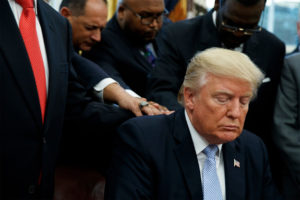
Faith leaders pray with President Trump after he signed a proclamation for a national day of prayer to occur on Sept. 3, 2017, in the Oval Office of the White House on Sept. 1, 2017, in Washington. (AP Photo/Evan Vucci via RNS)

Campaigns for the presidency of the nation’s largest Protestant denomination with about 14.8 million members are usually tightly scripted, polite affairs in which populist megachurch pastors are typically chosen. But because 2020 is a U.S. presidential election year, there was a desire among leaders of some of the denomination’s agencies and seminaries to avoid an ugly and potentially divisive battle over President Donald Trump.

Although most Southern Baptists are evangelicals and therefore make up the backbone of the Republican Party, Trump’s presidency had divided some of its leaders who believe it’s unwise to align so publicly with the nation’s president.

Among those who support Trump is Robert Jeffress, pastor of First Baptist Church in Dallas, who has become a fixture on Fox News defending Trump publicly for protecting America as a Christian nation. Other Southern Baptist leaders, such as Russell Moore of the SBC’s Ethics and Religious Liberty Commission, are in the Never Trump camp.

“There’s a tension in the SBC,” said Barry Hankins, professor of history at Baylor University. “The rank and file are going to vote for Trump one way or the other. The leadership will argue on it.”

Mohler, who is 60, has taken a middle path.

Though not a Never Trumper, Mohler expressed skepticism about Trump’s moral character as early as 2016. Appearing on CNN shortly after the “Access Hollywood” tape came to light in which Trump is heard bragging about grabbing women’s genitals, Mohler took a sharply critical view.

“When it comes to Donald Trump, evangelicals are going to have to ask a huge question: Is it worth destroying our moral credibility to support someone who is beneath the baseline level of human decency for anyone who should deserve our vote?” Mohler said.

Racial diversity? Not so much

Ironically, Mohler has been close to Jeffress in the past. The Dallas pastor announced plans to nominate Mohler for SBC president in 2008, calling him a “visionary leader.” Mohler later dropped out of the presidential race, citing health concerns.

Pastor Dwight McKissic of Arlington is shown in a 2014 file photo. (BP Photo / Van Payne)

Mohler has been far more muted on Trump since his election. He is best known in Southern Baptist circles as a leading spokesman for the Reformed or Calvinist wing of the SBC.

He has also recently been more vocal on racial issues. Last year, he oversaw a 71-page report that found that Southern Seminary owned more than 50 slaves and its faculty promulgated the view that slavery was morally correct.

Although Mohler resisted calls for reparations, many African American Southern Baptists took note, including Texas minister Dwight McKissic, who said he appreciated the seminary’s “very transparent document.”

But McKissic, who was instrumental in getting Southern Baptists to repudiate the Confederate flag in a 2016 resolution, said the planned nomination of Mohler could be a step back for the denomination.

McKissic said it could become again, despite its new diversity of racial and ethnic groups, one that has been “represented by the good ol’ boy club and where women were in their place, where blacks sat at the kids’ table and if they sat at the grown folk table they had to check all the boxes: Republicanism, Calvinism, that sort of thing, sort of a clone of Al Mohler and that ilk.”

Addressing sexual abuse

Baptist historian Bill Leonard agreed that Mohler’s “uncompromising orthodoxy” on political, social and theological issues would undergird a candidacy that “would be a reassertion of that orthodoxy.”

Mohler has certainly been a champion of the Southern Baptist position on complementarianism, the view that men and women are created equally but for different roles. But he has also acknowledged that complementarian theology “can and has” led to the abuse of women in the church.

In this sense, he is seen as someone who would continue the work begun by Greear to address sexual abuse within the denomination.

“He’s not rallying around Paige Patterson,” said Hankins, referring to the former seminary president fired for mishandling accusations of sexual assault on women. “He’s saying it’s sin. It needs to be repented. He’s been pretty outspoken.”

Former SBC President Jack Graham, who has been a vocal Trump supporter, said he does not view Mohler as a compromise candidate nor as a leader who will take the SBC back to an earlier time.

“Al Mohler his whole life has been training young people, both men and women, in ministry,” said Graham, pastor of Prestonwood Baptist Church in Plano. “It would be inaccurate to say that because of Al Mohler’s veteran leadership and status in the SBC that this would be a move back. It’s a move forward.”