SBC leaders call for prayer after George Floyd’s death

MINNEAPOLIS (BP)—Southern Baptist leaders lamented the death of George Floyd, an African American who died in Minneapolis after a white police officer used a knee to pin his neck to the pavement for several minutes.

Marshal Ausberry, first vice president of the Southern Baptist Convention

“I am disturbed, brokenhearted and deeply grieved when I see and read that another black man’s sacred life has been unjustly snuffed out,” said Marshal Ausberry, SBC first vice president and president of the National African American Fellowship of the Southern Baptist Convention. “The life of George Floyd was ended by those charged to protect and serve. They became judge, jury and executioner.”

In a video taken by a bystander May 25, an officer later identified as Derek Chauvin pressed his knee into the back of Floyd’s neck as Floyd lay face down on the pavement. “I cannot breathe,” Floyd is heard saying several times as the pressure continues. After seven minutes in the hold, Floyd is limp and unresponsive. He is placed on a stretcher and put into an ambulance.

Ronnie Floyd, president of the SBC Executive Committee, tweeted that he was “astounded by what happened in Minneapolis relating to the death of George Floyd. … This is ungodly and inhumane.”

The video begins with Floyd pinned by the officer. The Minneapolis Police Department said officers were responding to a report of forgery and that Floyd “physically resisted officers.” Four police officers involved in the arrest were fired after the incident. Chauvin was arrested and charged with third-degree murder and manslaughter.

As Floyd’s death has sparked national outrage, it inflamed tensions locally. Thousands of protestors marched May 26 from the scene of the incident to a Minneapolis police precinct station. Some chanted “I can’t breathe.”

According to the Minneapolis Star Tribune, the march was peaceful, but tension grew when the protestors arrived at the precinct station, where windows and a police car were damaged. Police wearing riot gear fired tear gas and rubber bullets. Protestors threw rocks and water bottles.

‘A striking racial problem in America’

Chris Reinertson, director of missions for the Twin Cities Baptist Association in Bloomington, Minn., said local pastors are leading their congregations in prayer and discussing ways to respond. Reinertson pastors Southtown Baptist Church.

“It’s so fresh, and of course, we want to help people connect with Christ, and that deals with all of the situation at hand,” Reinertson said. “Don’t ever think I’m saying this is a fresh racial issue. I’m saying this African American man, George Floyd, being arrested and then the white police officer putting his knee right on his neck — that specific incident. I’m not talking, ‘Oh, this is the first incidence of racism.’“

Ausberry, who is pastor of Antioch Baptist Church in Fairfax, Va., pointed out the sanctity of human life.

“Ultimately, the lack of respect for the dignity and sacredness of all human life is sin,” he said. “If we hold that all human life is sacred, then why is it that black and brown lives are ended way before their time? The facts speak for themselves. There is a striking racial problem in America.”

SBC President J.D. Greear noted several black Americans who have died tragically in 2020, including Ahmaud Arbery, who was pursued and killed by two armed civilians as he jogged on a neighborhood street, and Breonna Taylor, who was killed in her own bed by police who had entered her home in the middle of the night while searching for someone else.

“#ahmaudarbery, #breonnataylor, #georgefloyd – Hashtags that represent people made in God’s image — souls tragically lost,” Greear tweeted. “These tragedies move us to lament ongoing racial tension and the severe and lasting damage racism has caused in our country.”

In a subsequent tweet, Greear added: “If we want to join in the gospel movement against racism and toward equality, our struggle must continue well after these hashtags fade. Lord, help us search our own hearts and commit to bear one another’s burden.”

Greear went on to co-author a public statement with Jamie Dew, president of New Orleans Baptist Theological Seminary, that was signed by all SBC officers, entity heads and state convention executive directors.

“We grieve to see examples of the misuse of force and call for these issues to be addressed with speed and justice,” the statement read. “While we thank God for our law enforcement officers that bravely risk their lives for the sake of others and uphold justice with dignity and integrity, we also lament when some law enforcement officers misuse their authority and bring unnecessary harm on the people they are called to protect. We further grieve with our minority brothers and sisters in the wake of George Floyd’s death, pray for his family and friends and greatly desire to see the misuse of force and any inequitable distributions of justice come to an end.”

Read the entire statement here.

EDITOR’S NOTE: On June 4, three former police officers were charged with aiding and abetting murder in the death of George Floyd, and the charge against Derek Chauvin, who pinned his knee to Floyd’s neck,  was upgraded to second-degree murder.


Black and Hispanic churches deal with COVID-19 disparities

NEW ORLEANS (BP)—The usher typically allows five people in the sanctuary at a time. One person approaches the casket. The others wait, at a safe distance, for their turn to view the body of a loved one who died of COVID-19.

In New Orleans—a pandemic hotspot—Pastor Fred Luter of Franklin Avenue Baptist Church has instituted socially distanced wakes in advance of funerals, having lost seven church members to the coronavirus.

“It’s just so crucial at funerals, just that human touch to embrace someone and say, ‘Here’s a shoulder you can lean on,’” Luter said. “But you can’t do any of that, because everybody’s so afraid of catching this virus.”

While COVID-19 has affected all sectors of the U.S. population, studies show African American and Hispanic communities have suffered disproportionate tolls in death, illness and loss of income. Researchers link the disparities to long-term racial inequities in health care and employment.

In planning to resume onsite worship services, churches serving African Americans and Hispanics must cope with disparities while protecting their congregations’ health and maintaining revenue.

Delaying a return to in-person worship

For Pastor Kevin James at New Creation Bible Fellowship in Tracy, Calif., a congregation of about 100 worshipers, that means returning to gather together no sooner than August or September.

“My number one goal is to keep our members and families safe,” James said. “I don’t want to put them in a position that anyone can contract the virus. … We’re in the wait and see, because although they’re trying to reopen things and loosen the requirements—and I understand why—but I think lives are important. And I think as a leader, my Number One responsibility is for their safety and the safety of this community.”

None of his members has died of the illness, but some employed in the retail industry have lost jobs. James has seen an increase in giving, with data showing 21 new givers.

James is western and northern regional director for the National African American Fellowship of the Southern Baptist Convention, which serves about 4,000 churches and mission congregations. His congregation helps support four church plants, and he encourages pastors to request help when they’re in need.

Higher mortality rate, higher unemployment

Data released May 12 by APM Research Labs shows “the latest available COVID-19 mortality rate for black Americans is 2.2 times higher than the rate for Latinos, 2.3 times higher than the rate for Asians and 2.6 times higher than the rate for whites.” The numbers are based on data from 80 percent of deaths and racially specific numbers released from 39 states.

“To put it plainly, if all Americans had died of COVID-19 at the same rate as white Americans, at least 10,500 black Americans, 1,400 Latino Americans and 300 Asian Americans would still be alive,” researchers said.

According to Pew Research, 61 percent of Hispanics and 44 percent of blacks said they or someone in their household had experienced a job or wage loss due to the pandemic, compared with 38 percent of whites.

Such disparities could make it more difficult for African American and Hispanic Southern Baptist congregations to recover from the pandemic, said Marshal Ausberry, president of the National African American Fellowship.

“Both communities have experienced higher unemployment along with higher mortalities when compared to the national rate for other populations. These two factors will lead to increased poverty and homelessness among African Americans and Hispanics,” said Ausberry, pastor of Antioch Baptist Church in Fairfax Station, Va., and SBC first vice president.

“Some congregations may be on the verge of closing and not reopening its doors. This may be an opportunity to connect with an African American and/or Hispanic congregation to develop relationships with the pastors and congregations. Relationships where each congregation prays for one another. I believe it all begins with prayer.”

Florida Baptists offer interest-free loan

Pastor David Perez at Casa de Bendición Church in St. Cloud, Fla., has been able to keep his church afloat through prayer and an interest-free loan from the Florida Baptist Convention, due in 10 years. He chose not to apply for federal assistance.

His church resumed onsite worship May 3. Attendance is limited to about 20 members—about one-fifth of pre-pandemic numbers. Families sit together, socially distancing. Hand sanitizer is prevalent. Senior citizens, comprising about 70 percent of the church membership, mostly stay home.

“We have our pros and cons in our Latino and Hispanic churches,” he said. “Most of our Hispanic churches are small; they’re not megachurches. The finances, those that can receive a small financial help, that will make a big difference and we can overcome this.”

Perez described his membership as faithful. Although some have lost their jobs during the pandemic, the church has been able to continue his salary as a full-time pastor, and has been able to continue ministering to the community through assistance from the state convention. He said some members have contracted the virus but have recovered.

Lost loved ones, lost income

East End Baptist Church in Suffolk, Va., which runs about 400, lost two members to the coronavirus, according to Pastor Wayne Faison. He estimated about 15 percent of the congregation has lost a family member or loved one to the illness. Some members have lost income or are in harm’s way by working in the service, retail and health care sectors.

“We’re hearing stories of either people being furloughed or laid off,” Faison said. “But as restaurants or things like that open back up, they are not coming back to their old jobs, but they’re coming back to jobs that might pay them less. So, they have to really begin to make some critical decisions in terms of the risk factor in terms of their particular health and the economic factor in terms of trying to put food on the table. Some of the stimulus funds are only going to last for so long.”

But his members have been faithful to give, he said, and the last two Sundays have been two of the highest in terms of giving in the past two years.

“Some of that is due to people catching up, the stimulus package, there are some pieces to it,” Faison said. “But we’re going to just thank our Lord for that support.”

Faison’s, Luter’s and James’ churches all applied for and received Paycheck Protection Plan loans through the Coronavirus Aid Relief and Economic Security Act.

Faison said he hopes to resume onsite worship in July. The services would be limited because of safety protocols to about 90 attendees in a sanctuary with a capacity of 656.

New Orleans church rethinks reopening

Luter said he had hoped to resume services May 31 in Phase 1 of New Orleans’ reopening plan. But with governmental safety guidelines limiting attendance to 100, he’s rethinking his reopening date. Sunday worship attendance averages about 3,200.

“When the mayor came and told us you only can have 100 people, for a church our size, how do you choose 100 people? It’s impossible,” Luter said. “And so, we have decided that we just will continue to livestream, because there’s no way we could have chosen 100 people without getting the others upset.”

Members of Franklin Avenue Baptist Church have suffered job and income losses, although many are able to work from home. Luter estimates giving at about 90 percent of pre-COVID-19 levels. He has encouraged members to apply for unemployment and has encouraged small business owners to apply for loans.

In addition to seven deaths, many members have been hospitalized or quarantined with the coronavirus. Mindful of health disparities, Luter has encouraged all members to monitor their health.

“The statistics are there,” Luter said. “A lot of low-income people do not have health insurance, and that’s because they just can’t afford it. And so, there’s got to be some kind of way that the country’s aware of that, and that we try to make health care available for everybody.

“A lot of these people that got sick, it’s not because they didn’t take care. They just didn’t have access to proper health care.”


Race relations trailblazer Willie McPherson dies at age 80

WICHITA, Kan. (BP)—Willie Thomas McPherson, recognized as a trailblazer in Southern Baptist race relations and diversity, died May 12 in Wichita, Kan., at age 80.

McPherson was pastor of a predominantly white church in the 1970s in California and later was the first black divisional leader within the California Southern Baptist Convention.

“He was a wise counselor, a wise leader, that I think was unique, because you really needed somebody like that who had the ability to work within both cultures and bring both cultures together,” said Jay Wells, a retired LifeWay Christian Resources executive.

McPherson, a Mississippi native, enjoyed a decades-long career in Southern Baptist denominational work. In 1980, he became the first African American director of the California Southern Baptist Convention’s Black Church Extension Division.

He was one of the first African Americans to lead a national Southern Baptist denominational division, directing the newly named Black Church Extension Division of what is now the North American Mission Board from 1992 to 1997.

Dennis Mitchell, executive director of the National African American Fellowship of the SBC, said McPherson “paved the way for many African Americans to enter denominational service.”

“Bro. Willie, a man of uncompromising convictions and moral integrity, will long be remembered for his unshakable faith in God, commitment to racial reconciliation, the work of Southern Baptists, knowledge of black history and his penchant for sharing stories from the past with both passion and humor,” Mitchell said. “Dr. McPherson was a true generational denominational leader.”

McPherson received many awards and recognitions for his work, including the NAMB Lifetime Achievement Award for Church Planting, and the Black Southern Baptist Denominational Servants Network 2009 Hall of Servanthood Award.

McPherson was a graduate of Golden Gate Theological Seminary (now Gateway Seminary), California Baptist College and Miracosta Junior College.

Survivors include his wife of 58 years, Frankie Owens McPherson.


Nursing home chaplains find ways to minister during pandemic

OKLAHOMA CITY (BP)—One of the most difficult things for Cathy Tisher, a chaplain to three nursing homes in the Oklahoma City area, is seeing the face of a particular nursing home resident as she conducts regular video calls.

Tisher knows something the resident does not. Roughly three weeks after visitors were prohibited from entering the facility due to the coronavirus pandemic, this resident’s wife died.

“The situation is breaking my heart,” Tisher said. “In March, his wife was no longer able to go in, and she had been one of the most faithful to come and see him. She would come every day.”

The family wrestled with the decision of whether or not to tell him. They want to share with him in person, but in order to do so, they would have to go in, relay the news and afterward leave almost immediately.

“They haven’t told him because they don’t want him to have to be alone after receiving that news,” Tisher said. They worry it will be too much for him to bear.

Challenges ministering to at-risk population

Across North America, chaplains are walking through heart-wrenching ministry situations like this with nursing home residents, their families and the staff. The susceptibility of the elderly to COVID-19 has affected those who seek to serve the nursing home population.

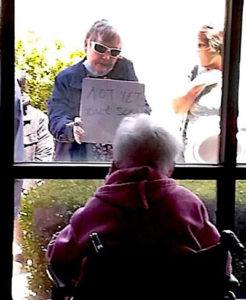
Residents of a nursing home where Baptist Chaplain Cather Tisher serves have only been able to see their friends and family through closed glass doors and windows. This visitor holds up a dry erase board with the message, “not yet, but soon.”

USA TODAY reported at least 2,300 long-term care facilities in 37 states have reported positive cases of COVID-19, and at least 3,000 residents have died.

“In Oklahoma, they have told us that 40 percent of the COVID-19 deaths that we have are in nursing homes,” said Tisher, a member of Southern Hills Baptist Church in Oklahoma City.

Nationwide, according to numbers compiled by The Associated Press, residents and staff of nursing homes or other long-term care facilities accounted for about one-third of the total death toll of approximately 80,000.

While Tisher currently isn’t allowed inside the facilities she serves, she has been conducting Bible studies each week via Skype. Staff members set up laptops either in activity rooms or in individual rooms. She is able to teach through a video chat, though she cannot interact as she would like.

“It has been really tough. It’s been hard to be at a distance like this,” Tisher said. “I’m being told it will be at least July and maybe even August before they open back up to the public.”

Accessibility limited

The facilities have allowed “drive-bys,” where family can stop by to see residents briefly and interact from the outside of the building through closed windows. Residents also participated in a “parade,” where they made their way through the parking lot as friends and family cheered them on from a distance.

Accessibility to nursing facilities varies by region. In Missouri, Mike Crowell, a chaplain and chaplain ambassador with the North American Mission Board, has been able to enter The Gardens Assisted Living and Memory Care in Kansas City, where he continues to conduct weekly worship services and Bible studies.

Mike Crowell, a Southern Baptist chaplain, regularly visited residents of The Gardens Assisted Living and Memory Care in Kansas City before the COVID-19 pandemic broke out. Crowell has still been able to visit the facility, following precautions such as having his temperature taken before entering, wearing a mask and actively social distancing. (Photo from Facebook)

“Each time I come in, they do a temperature check and ask me how I’m doing,” said Crowell, a member of Pleasant Valley Baptist Church in Liberty, Mo. “I also wear a mask when I come in and lead services. It is different. It gives you an appreciation for those who do that all the time.”

He maintains proper social distancing and does not interact physically with residents. In one instance, his temperature was slightly above normal. Out of respect for the staff and residents, Crowell did not go in that day.

While family members cannot, in most instances, do anything besides walk up to the windows from the outside of the building, one exception provided a moment of encouragement to Crowell.

The daughter of one of the memory care patients at his facility was able to be with her father as he died. Earlier, she had shared with Crowell that her father had been struggling with certainty over his spiritual condition.

Crowell shared a covenant statement with her about committing to follow Christ, and her father, who was 98 or 99 years of age, initialed the statements of commitment, and he displayed them in a place where he could look and remember them any time he wavered.

“He died the day after Resurrection Sunday,” Crowell said. “His daughter was given special permission to come in and visit while her dad was dying.”

Ministry difficult but not impossible

As these examples illustrate, the COVID-19 pandemic has made ministry difficult but not impossible. Chaplains encourage Christians and churches to find ways to minister to the elderly during this time.

“It has always been my prayer that churches would adopt a facility in their neighborhood even under normal circumstances,” Tisher said.

Philip Peavey, a chaplain at University Medical Center in New Orleans, served nursing home residents and staff 30 years as both a pastor and a chaplain before becoming a chaplain at the medical center.

“The key was going to the activities director in the nursing homes, and that was my point of entry for getting into nursing homes,” said Peavey, now a member at First Baptist Church in New Orleans. “When I did that ministry, I would check on the staff and do visitation with the patients.”

Social distancing requires that most communication take place via text messages, phone calls and email, but communicating with the facilities in the community may reveal specific needs that residents or staff may have.

“Begin by talking to the director and saying, ‘We are interested.’” Crowell said. “Ask, ‘How may we serve you?’ and ‘How may we serve the residents?’ Then be ready to have some suggestions in case the director doesn’t have any ideas or asks what you can offer.”

Provide resources, meals, thank you cards or gift cards to the staff to let them know they are appreciated. Ask members of your congregation who have family in assisted living homes if they have ideas they can share.

“Any way a church can reach out, I would say do it,” Tisher said.


LifeWay to discontinue World Changers program

NASHVILLE (BP)—LifeWay Christian Resources is canceling World Changers mission projects for summer 2020 and closing all future operations due to declining numbers and the inability to host projects this summer because of COVID-19.

“We are sad about the closing of World Changers, but we know now is the time to make this decision based on more than 10 years of decline in participants and the current financial impact related to the coronavirus pandemic,” said Ben Trueblood, director of student ministry at LifeWay.

Part of cost-cutting at LifeWay

The decision came in conjunction with budget cuts designed to save $25 million to $30 million annually—about 10 percent of LifeWay’s budget—in an attempt to counter a steep revenue decline amid the global pandemic. Cuts also included staff layoffs and hiring and discretionary spending freezes.

LifeWay reported April 29 that revenue was down 24 percent over a five-week period as compared to the year before, and that the trend was expected to continue. A week earlier, LifeWay announced it was exploring options for the sale of Ridgecrest Conference Center and Summer Camps in North Carolina.

Since 1990, World Changers has provided students and adults opportunities to meet the physical and spiritual needs of others by making repairs for low-income homeowners at no charge. Volunteers donated a week of their time in the summer, often sleeping on classroom and gymnasium floors at local schools, while tackling projects like building wheelchair ramps, applying fresh coats of paint and replacing windows and siding.

“While World Changers as an organization is going away, the impact upon thousands of lives over 30 years of ministry is undeniable,” Trueblood said. “The love of Christ was shown to homeowners and communities across North America. People came to know the Lord, and students were trained in sharing the gospel and being the hands and feet of Jesus.”

Students repaired substandard housing, shared the gospel

World Changers launched its first project in the small coal-mining town of Briceville, Tenn., in 1990. Repairing substandard housing was the key avenue for sharing the gospel at that first World Changers project.

worldchangers ladder400
Volunteers donated a week of their time in the summer, often sleeping on classroom and gymnasium floors at local schools, while tackling projects like building wheelchair ramps, applying fresh coats of paint and replacing windows and siding. (File Photo from 2013)

It marked the first time any organization used students in construction-type ministry projects. That summer, 137 youth and adults painted, roofed and performed other light construction jobs on nine homes in the area.

Partnering with local churches, Southern Baptist associations and city governments, World Changers became one of the first student volunteer organizations to help alleviate substandard housing in the United States. It also was one of the first pre-packaged mission trips for Southern Baptist churches.

“For 30 years, World Changers has provided meaningful missions experiences for more than 400,000 students and adults throughout North America,” Trueblood said. “It’s important we celebrate this incredible ministry and the work the Lord has done through it for three decades.”

World Changers originally began under the umbrella of the former Southern Baptist Convention Brotherhood Commission and was moved to the North American Mission Board in 1997.

In 2011, LifeWay partnered with NAMB to bring World Changers to the LifeWay student ministry family and assume day-to-day operations of the ministry. Summer 2012 was the first summer World Changers was operated by LifeWay.

“I am deeply proud of our World Changers team and the work they’ve done for the last eight years serving churches, communities, and providing life impacting missions experiences for teenagers.” Trueblood said. “They’ve poured their lives into this ministry, and I’m grateful for the work the Lord has done through them. They’ve had an undeniable impact on thousands of lives.”


LifeWay announces budget cuts and staff reductions

NASHVILLE, Tenn.—LifeWay Christian Resources is implementing budgetary freezes, cutbacks and staff reductions in an effort to cut $25 million to $30 million of recurring expenses from its operating budget.

LifeWay CEO Ben Mandrell cited a steep and steady decline of sales since mid-March, as well as uncertainty in the ability to host camps and events this summer due to the COVID-19 pandemic as reasons for the actions LifeWay is taking.

“LifeWay stands to lose tens of millions of dollars of revenue that the organization would normally generate over the summer months from camps, events, VBS and ongoing curriculum sales,” Mandrell said.

“LifeWay is mitigating these losses as much as possible through various expense reduction plans, including staff reductions and cuts in non-employee expenses. Additionally, LifeWay will likely have to use money from its reserves to cover a portion of the lost revenue.”

Staff cut, salary increases suspended

The organization will reduce staff, freeze all hiring and discretionary spending, and suspend salary increases and matching retirement plan contributions for all employees. In addition to these measures, the members of the executive leadership team will give up one month’s salary beginning in May. These temporary expense reductions go into effect May 1.

LifeWay announced recently it is exploring options for the sale of Ridgecrest Conference Center due to changes in organizational strategy, rising costs and uncertainty surrounding COVID-19.

“We know these decisions will cause pain and affect every LifeWay employee in some way,” Mandrell said. “But we are committed to helping our employees transition well.”

LifeWay will provide a comprehensive package of benefits to those impacted by the staff reductions, including severance pay where applicable.

“We hope these proactive steps will allow LifeWay to continue ministering to churches throughout the crisis, however long it lasts, and long into the future,” Mandrell said. “We know the COVID-19 crisis has created a unique challenge for churches as they find new ways to gather, and many are also facing severe financial strains.

“We want to make sure LifeWay is in a position to continue serving churches and church leaders to help them fuel their ministries. These are challenging times, but I am confident the Lord will use this for His glory and will push LifeWay into the future in a fresh way.”

COVID-19 hit hard

Mandrell said the COVID-19 crisis hit while LifeWay was still rebounding from the closing of its brick-and-mortar stores. In March 2019, LifeWay announced the closing of its retail chain due to nearly $50 million of losses from 2014-19. While LifeWay closed its last store in November 2019, the company still is working to settle more than 30 leases.

At the February LifeWay board meeting, Mandrell reported LifeWay had experienced a successful transition in closing its retail chain and had seen significant growth in its direct sales channels.

Through February 2020, sales through LifeWay’s direct channels were 12 percent above the same period the previous year, according to Mandrell. “We were pleased with the progress we had made in a fairly short period of time.”

LifeWay exceeded its first quarter revenue budget of $56 million by $600,000 or 1 percent. By the end of March, LifeWay was 3 percent ahead of budget.

However, much of the progress LifeWay was experiencing in the early spring slowed dramatically as shelter-at-home orders spread across the nation and churches were no longer meeting in person.

“It seemed like overnight we went from serving the church gathered to serving the church scattered,” Mandrell said. “I’m so proud of how quickly the teams at LifeWay came together to provide free digital resources to churches, families and individuals so discipleship could continue.”

Multiple scenarios considered

With an imminent economic decline in sight, LifeWay leaders began to plan for various scenarios that would allow the denominational publisher to continue resourcing churches.

LifeWay saw five consecutive weeks of steep revenue decline across all sales channels; the trend is expected to continue. Revenue across key channels is down 24 percent compared to the year prior. While book and Bible sales continue to see strong growth through LifeWay channels, the decline in revenue is largely due to a sharp drop in bulk orders from churches for resources like ongoing Sunday School curriculum, Bible study materials and VBS.

“Churches and church leaders are enduring a season of heartbreak and pain,” Mandrell said. “Since our mission is tied so closely to local churches, we expect the impact of COVID-19 to continue to be felt here at LifeWay as churches slowly and cautiously begin to reopen their facilities and gather in person.”

Mandrell said, “the good news is the local church will rebound and recover, but it will take time and will introduce new ways of thinking about ministry.

“We have to be ready to adjust to the needs of churches if we want to be relevant in a post-COVID world,” he said. “Church operations and ministries are going to look different for an indefinite period of time.”

Seeking better financial footing

Mandrell said LifeWay leaders have been working for months, even prior to the pandemic, to replenish reserves and free up capital to invest in strategic areas of focus.

In August 2019, LifeWay sold its distribution center in Lebanon, Tenn., for $20.1 million and is leasing back the warehouse and distribution space. LifeWay also will begin a feasibility study of its corporate office building in downtown Nashville. This could result in leasing several floors to external occupants, selling the building and leasing back office space, or moving to another location, Mandrell told employees in an April 13 email.

Employees moved into the 277,000-square-foot, debt-free building in November 2017. LifeWay sold its former campus and property for $125 million and spent approximately $100 million for land, construction, furnishings and relocating to the new campus.

No decisions have been made about the corporate headquarters. It could take several months or longer before a recommendation is made to the board of trustees, according to Mandrell.

Mandrell said he and the executive leadership team had begun redefining LifeWay’s mission and asking what churches really needed from LifeWay before the COVID-19 crisis hit.

“This situation has only helped to clarify the purpose of LifeWay moving forward as we seek to come alongside church leaders,” Mandrell said. “The time has come for LifeWay to make bold moves to prepare for future ministry. This temporary trial does not change our mission; it merely sharpens our focus.”

Carol Pipes is director of Corporate Communications for LifeWay Christian Resources. 


LifeWay explores sale of Ridgecrest Conference Center

NASHVILLE (BP)—LifeWay Christian Resources trustees authorized exploring the sale of Ridgecrest Conference Center and Summer Camps, despite the conference center and camps operating at a profit in recent years.

The trustee board’s executive committee presented the recommendation to the full board during a special called meeting held virtually and in executive session April 23. The board unanimously supported LifeWay scheduling exploratory site visits with potential buyers.

“This was a painful decision,” LifeWay CEO Ben Mandrell said. “LifeWay’s leaders have prayed over this decision and looked at multiple options to keep Ridgecrest. The more than 100-year-old conference center has a rich heritage and spiritual legacy for Southern Baptists. However, the decision is a necessary one.”

If sold, Ridgecrest would join Glorieta Conference Center as a former LifeWay property. Glorieta was sold in 2013 for $1 to a Texas-based nonprofit that incorporated as Glorieta 2.0 for the purchase. Glorieta 2.0 continues to operate the facility east of Santa Fe, N.M., which recently served as the filming location for NBC’s “The Biggest Loser.”

Ridgecrest Conference Center and Summer Camps hosts 70,000 guests annually for various events involving churches, Christian associations, other ministries, families, and individuals. Among these are several offered by LifeWay, including Centrifuge, CentriKid and Student Life Camps, Black Church Leadership and Family Conference and others. In addition, Camp Ridgecrest for Boys and Camp Crestridge for Girls operate at near capacity during the summer months.

Focus on ‘overall sustainability’

According to an FAQ on the company’s website, LifeWay has been considering “whether or not owning and maintaining a conference center is the wisest way forward in terms of stewardship.”

Mandrell, who became president of the 129-year old organization last summer, cited changes in organizational strategy, rising costs and uncertainty due to COVID-19 as reasons for the potential sale of the property.

“LifeWay must control costs and manage resources in order to continue serving local churches in the most effective way,” he said. “Owning a conference center and the adjoining girls’ and boys’ camps requires significant operational and increasing financial investment.”

Mandrell also stated in order for Ridgecrest to thrive in the future, “it will require a significant increase in financial investment over the next 10 years. We believe our focus must be on the overall sustainability and extension of LifeWay’s core ministry. Owning a conference center will require more financial investment than we can bear.”

As with Glorieta, LifeWay’s preference would be to find a buyer that would continue to offer a Christian conference center environment and the operations of the boys and girls camps.

“Due to significant LifeWay investments over the past six years, Ridgecrest is well-positioned for future success under new ownership,” Mandrell said. “Finding a buyer who can make the ongoing investments necessary to maintain Ridgecrest’s current high standards of hospitality and service is the right thing to do for the future of Ridgecrest and LifeWay.”

Due to the global pandemic, Ridgecrest temporarily has ceased hosting groups until local authorities lift restrictions on groups physically gathering. On April 7, LifeWay announced the cancellation of all camps for the month of June. A decision has not been announced related to Camp Crestridge and Camp Ridgecrest.

All July and August camps still are scheduled, but North Carolina Gov. Roy Cooper announced April 23 the extension of stay-at-home orders in the Tarheel State through May 8. The three-phase reopening plan for the state means July and August camps might now also be in jeopardy.

While LifeWay is tasked by the SBC with assisting churches through the operation of camps and conference centers, it will be “recommending to the SBC Executive Committee a refresh of (its) ministry assignments that more closely align with (its) current mission, vision and strategic initiatives.”

“We’ve been asking whether or not owning and maintaining a conference center is the wisest way forward in terms of stewardship,” Mandrell said. “While LifeWay will continue to host camps and events, we realize we don’t need to own a hospitality facility to provide those experiences.”


Bivocational pastors losing income during COVID-19

EL PASO, Texas (BP)—Bivocational missionary Jesus Galarza financially supplements his ministry in El Paso and northern Mexico by coaching volleyball, but he can neither minister nor coach during the COVID-19 pandemic that has stymied livelihoods across the United States.

The Baptist General Convention of Texas will continue to pay Galarza as a contract employee through the end of the year and will include him in an economic relief program for bivocational ministers.

To further compensate for his loss of income as a volleyball coach, Galarza will rely on savings and the economic supplement the U.S. government is sending taxpayers through the Coronavirus Aid, Relief and Economic Security (CARES) Act.

“I hope to be rehired (as a coach) in October,” Galarza said. “I trust completely in the Lord by that date everything is coming to a normality.”

Pastors lose second stream of income

Galarza is among many Baptist bivocational ministers and pastors facing challenges in making financial ends meet during the COVID-19 pandemic. He is not pastor of a church, but statistics gathered from state conventions indicate that between 22,000 and 35,000 Southern Baptist churches are led by bivocational ministers, according to the Bivocational & Small Church Leadership Network.

“We’ve discovered many of our pastors have been laid off from that second position,” said Joe Wright, the network’s executive director. “The churches have by and large stayed strong and have continued to employ their pastors. But many of those pastors have lost their second stream of income.

“And so those churches need to be aware that that places a bivocational pastor in a precarious position, if the church is not able to step into that void and continue to operate, then that pastor truly will be totally unemployed.”

Jerad File, pastor of Redeemer Baptist Church in Panama, Ill., hasn’t worked in his job as a substitute teacher since March 13, but he expects a couple of checks to trickle in for substitute work completed before schools were shut down to prevent spread of the coronavirus.

In Wilkesboro, N.C., Booneville Baptist Church children’s and youth pastor Dana Blankley is being paid his full salary as a middle school English and social studies teacher, teaching his students from home on Zoom during the pandemic. His church salary also is continuing, with increased financial gifts to the church generating a 20 percent budget surplus the first two weeks of April, according to Blankley, through online and mailed giving.

Dusty Marshall, pastor of New Life Baptist Fellowship in Alamogordo, N.M., has lost much of his income as CEO of Smiling Foamworks, a small business selling foam swords, shields and other equipment used in live-action role-playing community games across the United States and Canada. While sales are largely online, the events that generated a large portion of his sales have been canceled through July, and potential customers are no longer able to play the games in which his equipment is used.

Donald McKinnon, lead pastor of Legacy Church in Sutton, Mass., can neither work as a substitute school teacher nor collect unemployment for the lost income, he said, because his work as a substitute “is considered a gig job. I am not eligible for unemployment so it has been very, very stressful for me and my wife.”

Mission:Dignity program expanded

Wright said many state conventions are working to provide supplemental income for bivocational pastors during the pandemic. Pastors at least 65 years old can apply for Mission:Dignity funds through GuideStone Financial Resources. The program, originally established to help retired pastors and their widows, has been expanded during COVID-19 to help those still in active ministry.

At least 51 percent of the more than 47,000 Southern Baptist churches have Sunday School attendance of fewer than 50, based on Annual Church Profile numbers, Wright said. A full 83 percent of churches average 125 or fewer.

“In most areas when a church gets over 100, they’re pretty self-sufficient. And they tend to have their own ability to meet their needs,” Wright said. “Once you reach 100 … the need for bivocationalism goes way down. But for those churches that are 75 and below, the need for a strategy of bivocationalism is very, very high, and so we see the percentages go way up, the smaller the church gets. That’s just economics.”

McKinnon receives $150 a week as a pastor, he said, and has received financial gifts from the Baptist Convention of New England and a local church.

“My wife is disabled and gets Supplemental Security Income, which is our current main income, but still not a lot,” McKinnon said. “I know everything is in God’s hands, and that 100 years ago the world was in a similar place, but it does weigh on us as we miss gatherings and doing life as normal.”

BGCT makes short-term grants available

Ira Antoine

The Baptist General Convention of Texas has issued short-term financial grants to more than 275 pastors across “a very diverse ethnic and cultural network,” said Ira Antoine, Texas Baptists’ director of bivocational ministry. About 50 percent of BGCT-affiliated churches have a bivocational pastor, Antoine said.

“The purpose of the Texas Baptist Pastor Grant is to meet the needs of Texas Baptist churches by providing short-term financial support to bivocational and small-church pastors who have experienced economic difficulties through the loss of employment or church salary as a result of COVID-19,” Antoine said. “We want to help our bivocational pastors and small church pastors who lost their secular jobs or income get over a two-month hurdle.”

Galarza has qualified for one of the Texas grants, capped at $1,000 for up to two months.

“I’m still OK, because I saved a little bit of money,” Galarza said. “The hardest part for me is I live by myself.” Galarza said his faith has sustained him during this time of isolation.

In Illinois, File is receiving help from family and awaiting a CARES Act stimulus check.

“If what I’ve heard in media reports is correct about the stimulus checks provided by the CARES Act, then it should come at just the moment of our need,” File said. “Because of our family size, the stimulus check we receive should be more than two months’ worth of what I have made substitute teaching. I’m hopeful that we can get back to work before that runs out.”

Marshall, a small business owner, is not allocating himself a paycheck for at least two months because of a decline in sales.

“It hurts us financially at home,” Marshall said. “As a bivocational pastor, this business is what helps sustain us as we pay for any bills we have, buy groceries, put gas in vehicles, etc. Currently to make up for shortfalls, we are relying on family and friends as they have helped out in any way they can. My wife still has her job but it is part-time and online based. She teaches ESL online, but her bookings for classes have significantly dropped since the outbreak of COVID-19 as well.”

Blankley, who continues to receive pay as a teacher in North Carolina, sees blessings in the midst of the stress caused by the pandemic.

“This is a historic and worrisome time in our world, but this is also a blessing to our world as well. What I mean by that is the gospel is being spread quicker, faster and farther than at any other time in history,” Blankley said.

“Churches and pastors who might not have a strong online presence are now reaching much more of their communities via the internet, people are able to see multiple church and multiple speakers at any time, and by reposting and sharing messages we are spreading the good news of Jesus Christ to people who may not would attend church or listen normally. I praise God for this opportunity to serve him.”


COVID-19 hampers seminary education in prisons

ROSHARON (BP)—The 165 students earning bachelor’s degrees in biblical studies at Darrington Prison Unit in South Texas no longer can attend classes, with the prison on lockdown since the presence of COVID-19 was confirmed in the facility.

But the interruption is itself a learning experience for the men, who are being trained to minister while serving time at prisons across Texas.

“It is part of God’s equipping and his sovereignty for what these men need in their hearts,” said Brenna Norwood, director of programs for the Heart of Texas Foundation, which runs the prison education program in partnership with Scarborough College of Southwestern Baptist Theological Seminary and the Texas Department of Criminal Justice. “This is an interruption that (God) knew was coming, and he’s strengthening them. He’s growing them through this, preparing them for ministry in the midst of this.”

Two cases of COVID-19 have been confirmed at Darrington, a maximum-security facility with a population of about 2,000 men; 150 were being monitored after possible exposure to the coronavirus, the Texas Department of Criminal Justice reported April 14 on its website.

Prison seminary programs affected by pandemic

The Scarborough College Darrington Prison Extension program is among similar prison education programs offered by Southern Baptist seminaries in six states. All of the programs have been altered in some way by the pandemic.

Along with the program at Darrington, programs offered in North Carolina by Southeastern Baptist Theological Seminary and Louisiana by New Orleans Baptist Theological Seminary continue. Programs offered by New Orleans Seminary in prisons in Florida, Georgia and Mississippi have been suspended during the pandemic.

At Nash Correctional Institution in Nashville, N.C., the 66 men enrolled in Southeastern Seminary’s program have been able to continue their full academic load. Each class is divided among three separate rooms with no more than eight students per room. Desks are situated at least six feet apart, and instruction is conducted online through Zoom utilizing a large television screen, according to Seth Bible, director of prison programs for Southeastern Seminary.

“It allows me to log in from my house and project to all three classrooms simultaneously, so I only have to do one lecture,” Bible said.

Instructional opportunities in prison vary by state.

Limited opportunities in Louisiana

New Orleans Seminary is allowed to continue only a limited number of classes at Louisiana State Penitentiary at Angola, La., and the Louisiana Correctional Institute for Women in St. Gabriel, La.

Baptist Briefs: Prison church joins Baptist association
Inmates at Louisiana State Penitentiary at Angola were the first to have the opportunity to pursue seminary training through a New Orleans Baptist Theological Seminary extension at the nation’s largest maximum security prison. Inmate Paul Will, pastor of Grace Baptist Church of the Main Camp, is a 2007 graduate of seminary’s extension program at Angola. (Baptist Press file image from “A New Hope,” a documentary about the ministry)

Kevin Brown, director of the seminary’s Prison Extension Center education, said chaplains with New Orleans Seminary doctorate degrees who are considered essential prison personnel are teaching some classes, and some students are completing assignments independently.

All other prison seminary classes have been suspended, including programs at Hardee Correctional Institution for men in Bowling Green, Fla.; the Mississippi State Penitentiary at Parchman, and the Whitworth Women’s Facility in Hartwell, Ga.

“We’re doing what we can do to keep moving, to keep the students advancing,” Brown said. “But this COVID thing, it’s more serious in prison than it is for you and I, because once it gets in the prison it’s not getting out. I mean, the prisoners can’t go anywhere.”

At least one Louisiana Department of Public Safety and Corrections employee at Angola has died of COVID-19, the agency announced April 10. Prisoners who tested positive for COVID-19 but were asymptomatic were being isolated in Camp J of the prison compound. Normally, many prisoners at the facility live in open dormitories.

A Mississippi inmate with another illness was found to have also had COVID-19 after his death at Parchman, the Associated Press reported April 14.

Internet access is not allowed in the prisons served by New Orleans Seminary, which prevents instruction via Zoom and other online platforms.

“We have the capabilities,” Brown said. “We haven’t figured out how to create sufficient firewalls to be able to teach into the prison.”

Brown said New Orleans Seminary has ordered the necessary equipment as authorities at Angola have considered allowing an exception, but approval hasn’t been given.

“The scary thing for them is, that if prisoners have access to the internet, they’ve got access to all the negative stuff on the internet as well,” Brown said.

New Orleans Seminary has nearly 150 students enrolled in the five states, according to Brown, who added that graduation will be delayed for some because of the pandemic, but the setback is temporary. New Orleans Seminary was the first Southern Baptist seminary to offer education in prison, beginning the program in 1995. The program has expanded to include two master’s degree opportunities, including the Master of Divinity with classes in biblical Hebrew and Greek.

“At Angola, it’s the gold standard,” Brown said. “Our guys have proven themselves to be amazing mentors and leaders, and have a degree of trust with administration that they don’t have in our other prisons.”

Texas classes suspended

At the Heart of Texas Foundation program, classes are suspended but students had completed enough course work before the pandemic to graduate this spring, Norwood said. For the first time in the program’s 10-year history, though, a chapel service will not be held for graduation.

Grove Norwood, Brenna’s husband and the Heart of Texas Foundation founder and CEO, said the students have been diligent in completing coursework despite the obstacles presented by the pandemic.

“They do work very, very hard in seminary,” Grove Norwood said. “This is no piece of cake. … The field ministers themselves are still the light in the darkest of places. Whether they’re talking across the hall to the cell next door, or to the bunk next door, their light is still shining.”

Men accepted into the Scarborough bachelor’s degree program are all transferred to Darrington Prison, a maximum-security unit near Rosharon, for more than four years of coursework, and then trained in the foundation’s field ministry program. Upon completion, they are transferred to their previous prison units to serve as ministers to fellow prisoners.

Southeastern Seminary plans to graduate its first class of seminary students in North Carolina prisons in 2021, with 26 students currently on course to graduate, and then to minister to others as they complete their prison terms.

Bible said seminary education is important to the rehabilitation of those who are incarcerated, and called it an important investment in the lives of those serving lengthy or lifetime sentences.

“We’ve seen the impact that it’s had at Angola in Louisiana, and also the impact that a similar program has had on the state of Texas through Southwestern Seminary,” Bible said.

“We believe that some of the most influential people inside of the prisons are actually those long-term folks, and so we see a real value in investing in them so that they can make a positive impact from the inside.”


Wingfield named Baptist News Global executive director

Baptist News Global announced April 15 its board of directors named Mark Wingfield, associate pastor of Wilshire Baptist Church and a former managing editor of the Baptist Standard, as executive director and publisher of the news service.

Wingfield, 58, will assume his new role July 1. David Wilkinson will retire June 30 as executive director and publisher after about 12 years as executive director and publisher of Baptist News Global and its predecessor, Associated Baptist Press.

Wingfield has served more than 16 years at Wilshire, where he oversees a dozen ministers and about 100 full-time and part-time staff.

Before joining the church staff, he worked about 21 years in religious journalism.

He was managing editor of the Baptist Standard from 1998 to 2003. Before coming to the Standard, he was editor of the Western Recorder in Kentucky, where he earlier served as news director.

Previously, he had been associate director of news and information for the Southern Baptist Convention’s Home Mission Board, director of news and information at Southwestern Baptist Theological Seminary and assistant editor of the Baptist New Mexican.

He is the author of Why Churches Need to Talk about Sexuality and Staying Alive: Why the Conventional Wisdom about Traditional Churches is Wrong.

Wingfield has been a frequent writer of opinion articles for Baptist News Global, where he began serving on the board of directors in 2012. He also has served on the Cooperative Baptist Fellowship Missions Council.


Disaster relief crews deal with tornadoes during COVID-19

COLLINS, Miss. (BP)—Already heavy-laden with the turmoil of a global COVID-19 pandemic, residents in several Southern states suffered the added burden of a string of tornadoes Easter Sunday.

The National Weather Service received more than 40 reports of tornadoes that hit areas from East Texas to North Carolina. Tornadoes killed at least 27 people, destroyed hundreds of homes and left more than a million in the dark.

‘Still in shock’

“Most everybody’s still in shock,” said Tommy Broom, director of missions for the Covington-Jefferson Davis Baptist Association in Collins, Miss., which includes about 30 churches spread across several communities damaged by strong tornadoes. “It’s kind of unreal.”

Several Southern Baptist churches were among damaged buildings in Mississippi, Tennessee and Alabama, and many homes of Baptists were destroyed.

Southern Baptist disaster relief crews sought to respond to the damage while observing social distancing to prevent spread of the coronavirus.

“We’re trying to keep our distance and doing the best we can, during the times we live in,” Broom said. “We need cleanup crews, and many people in our area will need financial support to purchase clothing and basic necessities. There’s lots of houses just totally destroyed. We’ve cleaned roads off where people can get into their homes, and we’ve been cutting trees in the yards.”

Deaths and damage reported

Mississippi bore the brunt of the storm deaths with at least 11 people killed, according to the National Weather Service. Seven deaths were reported in Georgia; five were reported in South Carolina. Tennessee had two reported deaths, while North Carolina and Arkansas each reported one death.

Mississippi Baptists set up a base of operations at First Baptist Church in Soso, a small town 70 miles southeast of Jackson.

In Chattanooga, Tenn., the Hamilton County Baptist Association still was receiving reports of damaged homes and churches, according to director of missions Dennis Culbreth.

“We’ve got churches that are volunteering to help. People have contacted me from other parts of the state, and we’re seeking to do our best to assist these people during this time,” Culbreth said. “And on top of this, you’ve got the coronavirus. … We’ve never dealt with this.”

Bill Mason, co-pastor of Morris Hill Baptist Church in Chattanooga, was removing items from his damaged home after a tornado tore away the roof.

“The subdivision we live in, Holly Hills, it is devastated,” Mason said. “There are houses that are totally destroyed. Some have very little damage. Our house, we lost our roof; a big tree fell on our deck. It’s not livable.”

Mason said four other families from his church also live in the subdivision.

“COVID-19 has taken a backseat right now,” Mason said. “That’s the last thing on my mind. You deal with what’s most important. … We’re trying to find a hotel for the night.”

Volunteers offer disaster relief

Doyle Pittman, Hamilton County Baptist disaster relief director, planned to establish an incident command at Concord Baptist Church in Chattanooga and deploy chainsaw teams after damage is assessed.

“We are hoping to get some software set up where people can turn in their requests (for help) online, rather than having everybody come to an incident command,” Pittman said.

To handle in-person requests, he added, “We’re going to have a table set up outside incident command to interface with people.”

Pittman said various areas of the church will be utilized to maintain social distancing as much as possible.

The pandemic “adds a whole new aspect” to disaster relief, Pittman said. Crews will use protective gear, including masks, gloves and Tyvek suits, which are normally used during disaster relief work, and will likely use a disinfectant on tools.

According to the Tennessee Baptist Mission Board, disaster relief is an essential service that is allowed even as the state is under a stay-at-home order, he noted.

“What we’re encouraging people to do down here, at this point, is to help your neighbor and stay out of the way,” Pittman said. “Everybody’s pretty much willing to help, volunteer anywhere they can. We’re just trying to exercise precautions.”

In Seneca, S.C., Southern Baptist disaster relief crews have been clearing trees and pushing debris to curbsides. While the area did not have the highest number of fatalities in the state, the damage spread widest there, said Randy Creamer, South Carolina Baptists’ disaster relief director.

Taking precautions, relying on local volunteers

To comply with guidelines to combat the COVID-19 pandemic, before serving each day, volunteers must have their temperature taken by a first responder. They then must wear a wrist band in order to move in and out of affected areas, Creamer explained.

South Carolina Baptist volunteers have been answering calls across the state, receiving requests for help “from 13 different areas in the state, from the eastern side of the state up to the North Carolina border all the way to Oconee county, which borders Georgia,” Creamer said.

Just on the other side of the state line in Toccoa, Ga., Stuart Lang, Georgia Baptists’ disaster relief director, expects most responses in the state to be in Stephens County, although several teams are deployed across the state, including the northwest corner and the area around Savannah.

“I’m very prayerful and optimistic that we will be able to help a lot of people in the midst of the pandemic,” Lang said.

Sam Porter, the national director for Southern Baptist disaster relief at the North American Mission Board and Send Relief, has encouraged Baptist state and local leaders to utilize local churches, since the pandemic has restricted travel.

State Baptist disaster relief directors have avoided overnight housing in this response, instead opting to make sure teams are close enough to return to their own homes after a day of chainsaw and debris cleanup.

“Thankfully, we’ve got great volunteers who react quickly when a disaster hits their backyard,” Porter said. “Our churches need to be aware and prepared to respond if a disaster hits in their area.”

With additional reporting by Brandon Elrod from the North American Mission Board. 


Southwestern Seminary cuts programs and spending

FORT WORTH (BP)—Meeting via video conference April 7, the Southwestern Baptist Theological Seminary board of trustees approved structural changes including the elimination of the School of Preaching, which is being folded into the School of Theology.

Trustees also postponed adoption of the fiscal year 2021 budget until mid-July, if necessary, and the school acknowledged it has instituted budget cuts of about 25 percent, including faculty and staff layoffs.

The trustees also authorized the administration to make distributions from the seminary’s unrestricted endowment. The decisions were part of the seminary’s response to the severe economic downturn related to the COVID-19 pandemic.

“We’re going to come through this,” Adam W. Greenway said during the seminary president’s report to the trustees. “We’re going to come through this stronger than ever before. We’re going to come through this in a way that I believe is only going to glorify God.”

Like many educational institutions, Southwestern Seminary has been forced by the COVID-19 pandemic to make rapid adjustments, including the closure of campus and moving all classes online for the spring and summer terms, as well as significant long-term changes.

School of Preaching folded back into School of Theology

(Southwestern Baptist Theological Seminary Photo)

Trustees voted to rescind, effective immediately, a motion adopted by the board in 2015 to establish the School of Preaching as a separate school of the seminary. All areas of responsibility assigned to the School of Preaching—including faculty, curricula, degrees, centers and programs—have been reassigned to the School of Theology.

David L. Allen, who has served as dean of the School of Preaching, will continue in his faculty role as distinguished professor of preaching and as director of the Southwestern Center for Text-Driven Preaching, overseeing the seminary’s Preaching Source online resources, as well as conferencing and events related to preaching and preachers, Greenway said.

Other cuts were not detailed during the trustees’ meeting. But in an April 6 statement, the seminary announced it was discontinuing its archaeology program “as part of campus-wide budgetary reductions.” The seminary stated it no longer will offer degrees in archaeology “because they are incongruent with our mission to maximize resources in the training of pastors and other ministers.”

Postpone vote on 2021 budget

John Rayburn, chair of the trustees’ business administration committee, recommended adoption of the fiscal year 2021 budget be postponed until “on or before July 15.” The budget normally is adopted during the trustees’ spring meeting. Rayburn said postponement was necessary because “the coming months are hard to predict” amid the pandemic.

“We’ve decided we need a little more time to watch what happens with this and all that’s going on in our world today before we can really come up with a realistic, informed budget,” he said.

Southwestern Seminary’s fiscal year 2020 budget is $34,815,439. In an April 8 statement released to Baptist Press, the seminary said it would achieve “budgetary reductions of approximately 25 percent campus-wide through a combination of faculty and staff position deletions, furloughs, and discontinuation of certain academic programs. These actions realign expenditures with reduced revenue projections while undergirding mission-critical academic programs and continuing the institution’s renewal begun last year.”

Trustees also authorized the seminary’s administration to “execute special endowment distributions as needed on or before Dec. 31, 2021, up to the total amount of the unrestricted portion of the seminary’s endowment,” which was last reported as $13,310,454.

“This is to give our administration the flexibility to deal with whatever comes up that they need to deal with,” Rayburn said.

Changes in faculty and degrees

The board elected three faculty members who had been serving under presidential appointment—Jonathan W. Arnold as associate professor of church history and historical theology, Chris S. Osborne as professor of preaching and pastoral ministry and Carl J. Bradford as assistant professor of evangelism.

Trustees approved four undergraduate degrees in Scarborough College, four graduate degrees in the Jack D. Terry School of Educational Ministries and one master’s degree in the School of Church Music and Worship. They also voted to revise four master’s degrees.

The trustees also approved a recommendation to amend the seminary’s bylaws. They adopted the Nashville Statement on biblical sexuality for the first time and reaffirmed the Chicago Statement on Biblical Inerrancy and the Danvers Statement on Biblical Manhood and Womanhood “as official guiding documents” expressing the seminary’s “convictional standards, expectations, and beliefs,” and functioning as “proper interpretations” of the Baptist Faith and Message 2000, which serves as the seminary’s confession of faith and is signed by faculty.

Philip Levant, pastor of Iglesia Bautista La Vid in Hurst, was reelected as chairman of the board of trustees; Danny Roberts, executive pastor of North Richland Hills Baptist Church in North Richland Hills, was reelected as vice chairman; and Jamie Green, retired speech-language pathologist in Katy, was reelected as secretary.

In his report to the trustees, President Adam Greenway assured the board that “when challenges come to Southwestern Seminary, Southwestern Seminary always stands ready to meet the challenge.”

“It does mean a call to difficult decisions. It does mean a call to fiscal prudence. It does mean a call toward making cuts today that will enable us to not merely survive but to thrive moving forward,” Greenway said.