Leatherwood resigns as president of the ERLC

Brent Leatherwood, who spent nearly four years dealing with critics from the most conservative wing of the Southern Baptist Convention, resigned as head of the SBC’s Ethics and Religious Liberty Commission.

The commission’s board announced Leatherwood’s resignation July 31. Miles Mullin, vice president and chief of staff, will serve as acting president.

Leatherwood—a former executive director of the Tennessee Republican Party—played a key role in advocating for the federal defunding of Planned Parenthood.

The ERLC under his direction also placed 40 ultrasound machines in pregnancy resource centers around the country through its Psalm 139 Project.

However, Leatherwood resisted the efforts of some abortion abolitionists to seek criminal penalties for women who pursue abortions. That position proved unpopular with a vocal segment of Southern Baptists.

Other Southern Baptists criticized the ERLC under Leatherwood’s direction for participating in the Evangelical Immigration Roundtable.

Agency survived vote at SBC in Dallas

At the SBC annual meeting in Dallas in June, Southern Baptists voted to reject a motion to do away with the ERLC.

However, the motion to abolish the agency received support from about 43 percent of the voting messengers at the annual meeting. It marked the fourth attempt in recent years to disband or defund the ERLC.

Seven weeks after the ERLC survived the floor vote at the SBC, its board issued a statement from Leatherwood announcing his departure from the moral concerns and public policy agency.

“After nearly four years leading this institution, it is time to close this chapter of my life,” he stated. “It has been an honor to guide this Baptist organization in a way that has honored the Lord, served the churches of our convention, and made this fallen world a little better.”

He applauded the ERLC and its staff, saying the commission “never wavered in serving as a light on Capitol Hill, before the courts, and in the culture.”

‘A balance between conviction and kindness’

“In all of our advocacy work, we have sought to strike a balance of conviction and kindness, one that is rooted in Scripture and reflective of our Baptist beliefs,” Leatherwood stated. “That has meant standing for truth, without equivocation, yet never failing to honor the God-given dignity of each person we engage.”

The ERLC “has helped the world clearly understand that Jesus Christ reveals a better way to live rather than the angry, self-absorbed, and cruel model that is so often served up by our modern culture, and, more importantly, he freely offers the gift of eternal salvation—selflessly purchased with his own blood,” Leatherwood continued.

“That hope has powered our work these last several years, and has shaped my own conscience. It will continue to do so as I move forward to render service where the Lord is calling me next.”

Led in the face of ‘polarizing culture’

Scott Foshie, chair of the ERLC board of trustees, expressed gratitude to Leatherwood for his leadership and service.

“Brent has led the commission well and demonstrated loving courage in the face of a divisive and increasingly polarizing culture in America,” Foshie said. “While biblical values have been under attack, Brent has been a consistent and faithful missionary to the public square. We are thankful for his commitment to the Lord and to this commission.”

That “polarizing culture in America” plagued Leatherwood for much of his tenure since the time he was elected president in 2022, after serving one year as acting president. Previously, he served the ERLC as chief of staff and director of strategic partnerships.

Leatherwood, the father of three children who survived the shooting at Covenant School in Nashville, angered some in the SBC when he supported a proposal by Tennessee Gov. Bill Lee to allow authorities temporarily to keep guns out of the hands of people at risk of hurting themselves or others.

He also alienated some supporters of President Donald Trump when he praised President Joe Biden’s decision to withdraw from the 2024 presidential race, calling it a “selfless act.”

Kevin Smith, who was chair of the ERLC board at that time, initially announced Leatherwood was fired as ERLC president. Less than 12 hours later, the ERLC executive committee issued a statement saying Leatherwood was not fired, Smith acted without board approval, and Leatherwood had the board’s support “moving forward.”


BWA leaders note ‘What women these Christians have!’

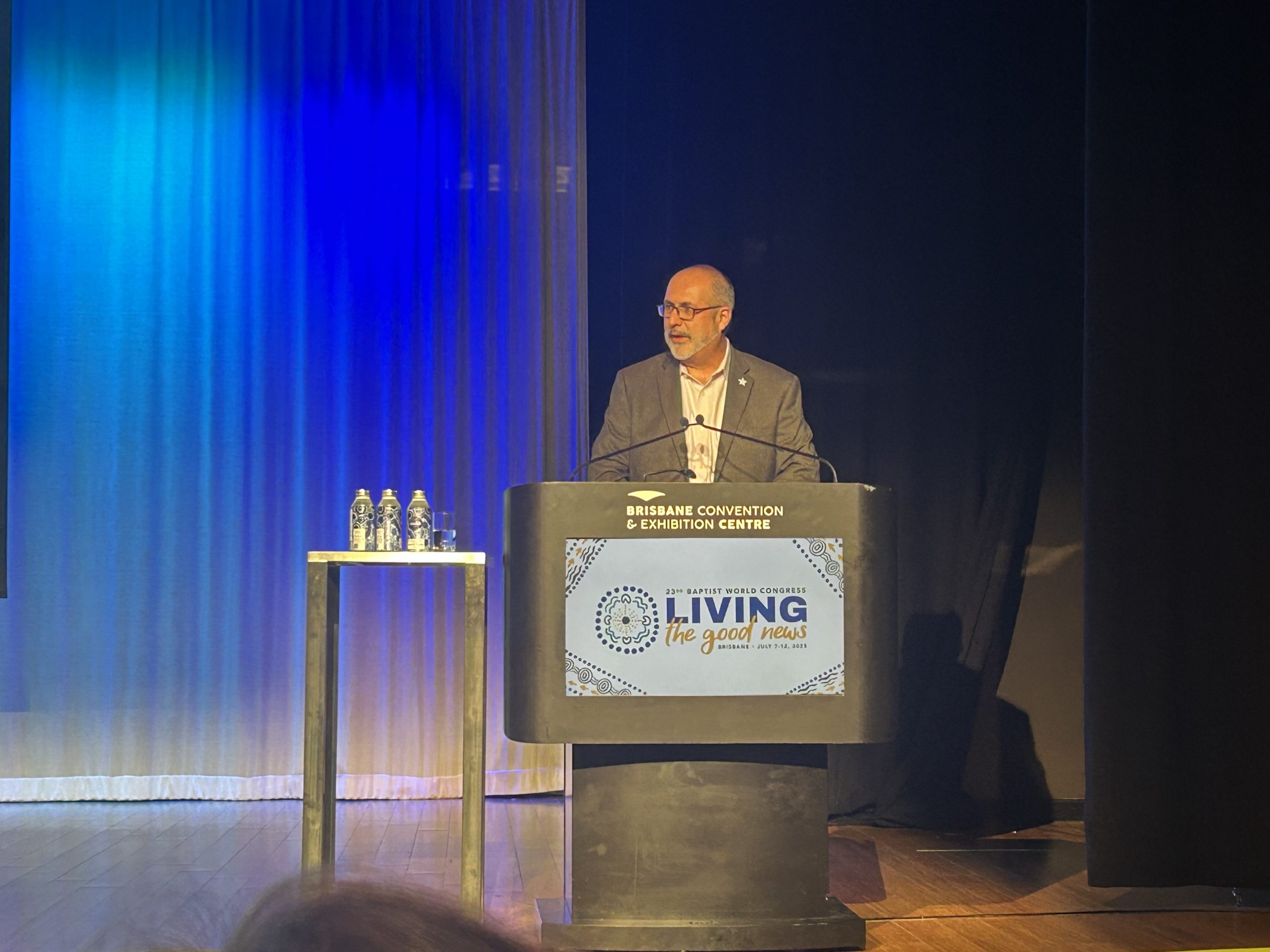
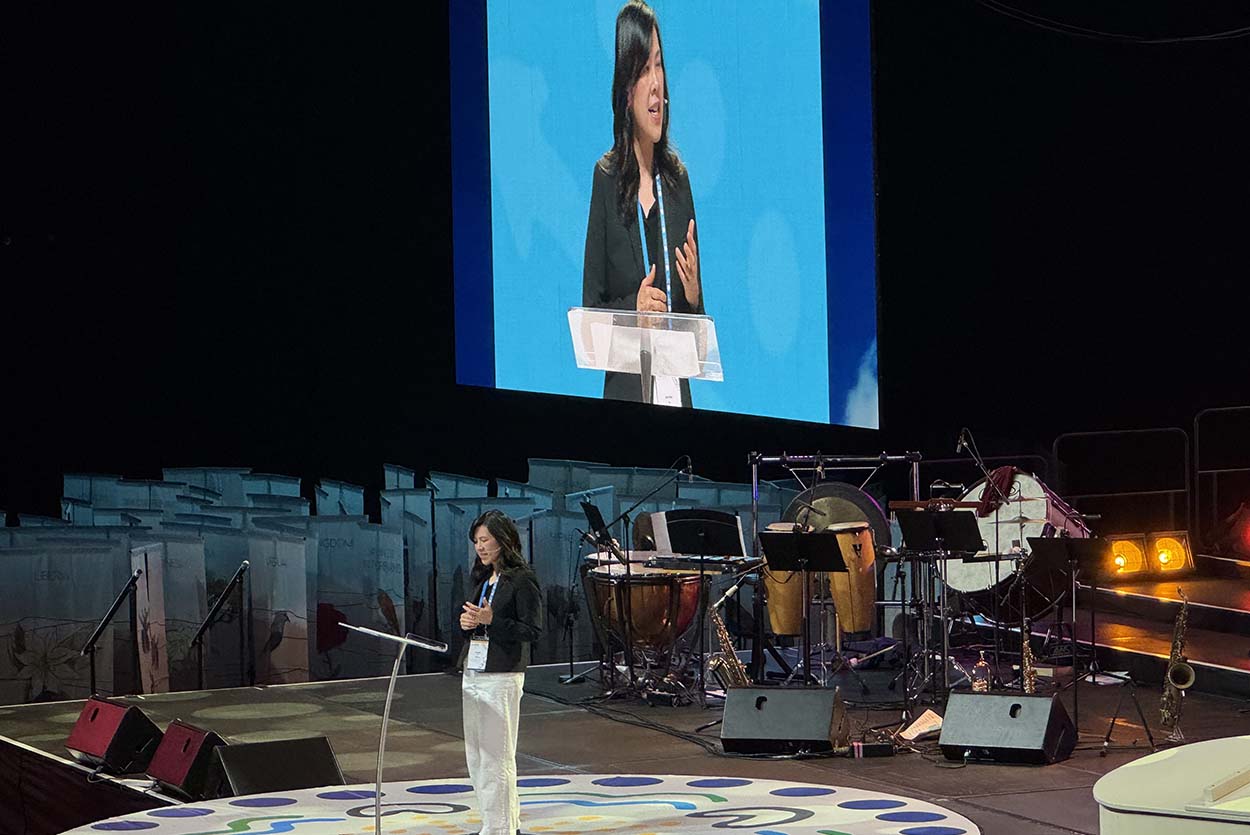
BRISBANE—J. Merritt Johnston, executive director of Baptist World Alliance Women, urged women to live Jesus-shaped lives so the world will note, as a 4th century pagan intellectual did, “What women these Christians have!”

Delivering the final keynote address of the BWA Women’s Summit in Brisbane, Johnston explained Libanius made the comment after hearing a story of John Chrysostom’s mother, Anthusa, who was renowned for her dedication to Christ.

After summarizing who makes up the BWA sisterhood, Johnston noted as she has traveled around the world to meet with BWA Women in their home countries, “It’s overwhelming to me, the good that I see you doing.”

While people often feel overwhelmed by all the challenges happening in the world, she asserted, “There is good happening. And as I travel it is often, very often, the women that are leading that charge.”

Johnston said if the world could see what she sees and hears about the work of BWA Women, the world would be saying, “What women these Christians have!”

The evidence

As evidence, Johnston spoke of the work BWA Women have done with the United Nations promoting equality for women worldwide, a goal experts have suggested is at least 300 years away from being achieved.

Johnston said it’s not only equality the BWA Women U.N. participants are fighting for.

“We’re fighting not for equality, but eternity,” she said, noting she sees BWA Women standing strong in the worst situations.

Before the full-scale Russian invasion of Ukraine, for example, BWA assembled a group of Baptist women in Ukraine to pray. Johnston sent a message to check on the women to find out if they were OK when the situation worsened.

“Yes,” came the reply. “We’re in the basement of the church, and we can feel the walls shaking.”

Yet with bombs as the background accompaniment, the Ukrainian women sang “Count Your Blessings,” Johnston recalled, saying, “What women these Christian have.”

She spoke of “sisters in Manipur” who were stripped naked and paraded through the streets and whose churches and homes were under attack.

One “sister just had her home burned down,” but she wouldn’t be homeless because her Baptist sisters would stand with her, Johnston said.

She pointed to Scripture for the answer to the question: “How am I supposed to live the good news where I am?”

The world sees limitations—a 300-year timeline to equality. Yet, Johnston said, “time and time again women” like Jesus’ mother Mary, Mary Magdeline and the other Mary bore witness—to the birth, death and resurrection of Jesus.

The world may “see through the lens of limitation, but the Lord sees through the lens of love,” Johnston observed.

“Jesus loves you,” she said. “Jesus loves me,” but sometimes “we forget what it is to feel loved.”

Because Jesus loves “you, we have the best news,” that needs to be shared with those who do not know Jesus yet.

She urged women to live into the charge in Luke 4:18-19, to proclaim the good news, so that the world would note, not only “What women these Christians have,” but even more, “What a God these women have!”

General secretary’s address

Elijah Brown offers the opening address of the BWA Women’s Summit in Brisbane. (Photo / Calli Keener)

BWA Women is a fully integrated ministry arm of the Baptist World Alliance. In BWA General Secretary and CEO Elijah Brown’s opening address to the BWA Women’s Summit, he affirmed women’s equality and disavowed limitations upon how God uses them.

“BWA Women,” Brown began. “You are at the heart of the Baptist World Alliance, just as you are at the heart of the biblical narrative.”

Providing a list from Scripture, he backed up his claim, noting, Shiprah and Puah were the midwives fighting for justice and stood against government oppression to bring forth life.

Rahab provided refuge to strangers. Ruth “embraced isolation and risk … to provide for her family,” and Hannah’s “prayer and sacrifice sets in motion the search for a king … and gives rise to a deepened worship and understanding of God,” Brown said.

“It was Huldah, who was trusted to provide theological reflection and insight into the ways of the Lord.”

And he noted, Esther bravely prevented a genocide. Elizabeth sensed the Spirit in ways her husband, a priest, did not, and she bore and reared “the voice of one calling in the wilderness.”

Mary the mother of Jesus changed history. Mary Magdelene and the other Mary were “commissioned as the first evangelists with a transformative declaration that ‘Jesus is risen,’” Brown said.

He said Mary the mother of Mark likely owned the home where the Last Supper was hosted and where Jesus gathered with his disciples after the resurrection, the home where the disciples reflected on the Holy Spirit’s outpouring at Pentecost and perhaps where the first church in the world was organized.

Lydia was the first Christian in what is today, Europe. Priscilla, with her husband planted a church. Junia was well known to the apostles and imprisoned for her faith, Brown reminded the women.

“We could go on,” Brown said, because the Scriptures are clear: “women are equal custodians of faith leadership.”

Brown noted, “the BWA continues to affirm the calling God places on the lives of women to serve him fully and completely.”

Yet, Brown observed, women continue to face “disproportionate levels of gender discrimination,” forced marriages and higher levels of violence—including “sinful domestic abuse.”

Women “often face religious persecution in ways less visible than men,” including “house arrest, abduction and loss of custody.”

Brown noted, women “even within the church, are too often discounted and dismissed.”

“I am sorry,” he said. “And BWA affirms every woman, equally alongside men,” to be created in God’s image and filled with the same Holy Spirit as the resurrected Jesus when they accept him.

“You are equally called to join Jesus in his redeeming mission in the world today,” Brown said, whether as ordained pastors or in other equally important ways.

Brown pointed to the first sermon given in the church by Peter: “In the last days, God says, I will pour out my Spirit on all people. Your sons and daughters will prophesy. Your young men will see visions. Your old men will dream dreams and even on my servants, both men and women, I will pour out my Spirit in those last days.”

Brown noted his prayer is for everyone in the world to have an opportunity to know Jesus and affirmed the important role BWA Women play in helping to accomplish that mission.

He prayed for God to “do it again”—send a global revival and pour out his Spirit as he had at Pentecost—“and Lord, let it begin right now, and right here, with BWA Women.”


Lifeway’s Ben Mandrell called as Bellevue pastor

CORDOVA, Tenn. (BP)—Bellevue Baptist Church in Cordova, Tenn., called Ben Mandrell as senior pastor. Mandrell has served as president and CEO of Lifeway Christian Resources since 2019.

“I cannot tell you how thankful we are for this moment,” Mandrell, 48, said in a statement from the church. “This big hurricane of Bellevue love has just swallowed us up.”

The July 13 vote came as the entire church met in an overflow worship service followed by a special-called business session. His first Sunday as pastor is scheduled for Aug. 10, according to church staff.

Bellevue has played a key role in the Memphis area and across the Southern Baptist Convention over the last century with pastoral leadership from R.G. Lee, Adrian Rogers and Steve Gaines, all former SBC presidents.

Gaines, 67, announced last September his desire for a pastoral transition process to begin at the church. He has served as Bellevue’s senior pastor since 2005.

The pastor search committee began its work in November 2024, according to the release.

“In our first meeting, we spent most of our time in prayer,” said Chad Hall, chairman of the pastor search committee, in the statement. “From that very first night, we began praying for our pastor. We prayed for his wife, his kids—his whole family. We didn’t know who he was, and we didn’t know where he was, but we knew God did.”

According to 2024 Annual Church Profile data, Bellevue reported 7,382 people for in-person and online worship attendance, 329 total baptisms and $26,276,186 in total undesignated receipts.

Earlier this week, Mandrell met with Lifeway staff to inform them of the potential call.

“Our entire family is deeply grateful for these years in Nashville with Lifeway,” he said. “This ministry is filled with salt-of-the-earth people, and it’s truly heartbreaking to think we won’t see their faces as often in the years to come. Even so, the Lord has made it crystal clear that it’s time for us to return to the pastorate and to join the Bellevue family.”

Lifeway trustees met July 15 and selected Joe Walker, Lifeway’s executive vice president and chief operating officer to serve as interim president and CEO until a new president is named, in accordance with Lifeway’s bylaws.

Mandrell has roots in West Tennessee, having served as pastor of Englewood Baptist Church in Jackson, Tenn., from 2006-2013. He also served as the church’s college pastor and as director of discipleship ministries at Union University in Jackson.

The Mandrells left Jackson in 2014 to help launch Storyline Fellowship in Denver, Colo. The church, planted through a partnership with the North American Mission Board and First Baptist Church in Orlando, Fla., grew to nearly 1,000 in weekly worship attendance prior to Mandrell’s departure for Lifeway in 2019.

A native of Tampico, Ill., Mandrell is a 1998 graduate of Anderson (Ind.) University. He also holds a master of divinity degree from Southern Baptist Theological Seminary and a doctor of ministry degree from Union University.

Mandrell and his wife Lynley have four children.


Bible study leaders challenge Baptist World Congress

BRISBANE—Ralph West, founding pastor of The Church Without Walls in Houston, challenged global Baptists to embrace a “theology of reconciliation.”

He was among more than 50 speakers representing about 30 countries who presented Bible studies in 10 languages—with each presenter teaching the same passage each day—during the Baptist World Congress, July 10-12.

In a study of 2 Corinthians 5:18-21, West encouraged Baptists to recognize they worship a God who is reconciling his creation to himself.

“God’s ultimate act of reconciliation was to send his only Son,” he said. “All reconciliation comes through Christ.”

Through the incarnation, God reconciled himself to humanity by taking on humanity, he noted.

“People need a Jesus who they can identify with and a Jesus who can identify with them,” West said.

Baptists and other Christians need to answer the call to be “ambassadors for Christ,” he said, recognizing an ambassador’s role is not to make policy but to represent faithfully the policy of the one who is sovereign.

“We are not given authority to change the message,” West said.

Rather, Christians are to proclaim “a message of peace and a message of freedom” as presented in Scripture and to “set the message loose in the world,” he said.

Disruptive good news

Julio Guarneri teaches on 2 Corinthians 5:17-6:2 at the Baptist World Congress in Brisbane. (Photo / Calli Keener)

Julio Guarneri, executive director of Texas Baptists also taught on 2 Corinthians 5:17-6:2. He focused on the disruptive nature of the good news.

Recalling a series of disruptive events from his own history—beginning with his parents’ coming to Texas from Mexico as missionaries to Spanish-speaking people in his teen years—Guarneri asserted surrender to God’s direction moved him to a deeper plane, no matter how imperfect his surrender may have been.

In the passage, Jesus sets his kingdom agenda of reconciliation—an agenda that is clear: “through his perfect work on the cross, he proclaims good news to the poor, freedom for the captive,” sight to the blind, healing for the sick and the beginning a new era of the Lord’s favor.

“Our agenda ought to reflect Jesus’… the metric for success ought to be the same as that of Jesus,” Guarneri noted.

Jesus’ agenda is comprehensive, including proclamation, healing and liberation. “It is physical, it is spiritual, and it’s emotional,” he said.

“The nature of the gospel requires us to be holistic in our approach,” Guarneri noted, continuing, “Our ministry is about words and about works … It is about loving, and it’s about living the good news.”

Paul reminded the Corinthian Christians they are partners with God, he said.

God’s coworkers cannot be mere recipients of God’s redemption, but also must be reconcilers, Guarneri asserted.

God’s heart has always been for the nations, but the Holy Spirit’s power took an ethnocentric understanding of God and “reframed it to be inclusive of all people.”

When God sends the disciples, it starts a global movement that extends to the ends of the earth.

Guarneri noted 60 percent of the world’s Christians today can be found in the Global South where Christianity is growing rapidly.

So, “the church, the academy and the mission” are at a pivotal moment.

“To be disruptible disciples in the rest of the world is to change our paradigm from simply thinking that we send from the West to the rest of the world, to coming alongside the Global South to send from everywhere to everywhere.”

Godly fasting

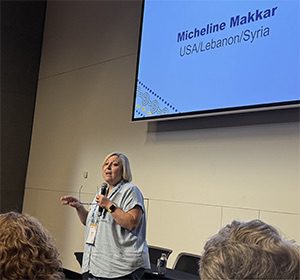
Micheline Makkar from the Baptist Church of Damascus, Syria, leads a Bible study at the Baptist World Congress. (Photo / Ken Camp)

God wants his people to fast—not to deprive themselves of needed nourishment but to meet the needs of others, said Micheline Makkar from Damascus, Syria.

“True fasting is doing good and loving justice,” Makkar said, focusing on Isaiah 58:6-12. “A godly fast is not about afflicting oneself but about liberating others.”

When a devastating 7.8 magnitude earthquake rocked Aleppo in 2023, no international humanitarian aid was able to reach the affected people because of sanctions imposed on Syria, she recalled.

Many members of the Baptist Church of Damascus struggled to feed their own families and had experienced deprivation themselves due to war.

However, leaders of the congregation encouraged church members to share what little food and other resources they had with the people of Aleppo.

“Our church gave 1,000 bags of blessing to Aleppo—from the poor to the poor,” Makkar said. “Our church learned fasting.”

God honors acts of “costly compassion” as expressions of worship, she said.

“God answers those who answer the needs of others,” Makkar said. “God responds to human mercy with divine favor.”

Acts of kindness and pursuit of justice are never in vain, even if their results are not immediately apparent, because they plant “the seeds for generational renewal,” she said.

Makkar urged global Baptists to ask: “What legacy of justice am I leaving?”


With additional reporting by Calli Keener.


Persecution and violence addressed at BWA Congress

BRISBANE—Bruce Webb, pastor of The Woodlands First Baptist Church, recounted the history of Baptist advocacy for freedom of religion during a breakout session at the Baptist World Congress focused on the persecution of Christians.

Webb started with Thomas Helwys and John Smyth becoming the first Baptists in direct response to the lack of complete religious freedom in England.

He traced Baptist championing of religious freedom through the American colonies, noting persecution of dissenting Christians by the official state churches—during that period.

“Using political power to achieve spiritual gains … is always short-sighted,” Webb said, alluding to Christian nationalism.

“If we give Congress or any political leader the power to give Christianity an advantage, then we also give them the power to remove it and grant that advantage to another ideology we oppose.”

“Baptist Christians have historically believed, if put on equal footing, Christianity will win because it is true,” Webb continued.

“We have never asked for an advantage, have never supported coercion, but have passionately advocated for the freedom to worship, serve God and share the good news of Jesus Christ with everyone everywhere.”

Samson Aderinto Adedokun, pastor of New Dawn Baptist Church in Lagos, Nigeria, described the situation for Christians in his country. He and his family have experienced religious persecution firsthand by what he called “Islamic fundamentalists.”

Adedokun described the positive results of persecution. Persecution scatters the church, but for a purpose.

“When you cannot escape the fire, carry the flame where you land,” he said.

Persecutors also need God’s love, Adedokun said. So, persecuted Christians need to act in love. This love can be demonstrated in kindness toward persecutors. “Your kindness may be someone’s miracle,” he said.

“Persecution is temporary. Kingdom joy is permanent,” Adedokun concluded. “Joy flows from obedience [to God], not comfort.”

Lessons for churches from areas of conflict

Igor Bandura participated in a breakout session focused on lessons learned from churches facing war, violence and terror. (Photo / Eric Black)

Igor Bandura, vice president for international affairs with the Union of Ukrainian Baptists, participated in a breakout session focused on lessons learned from churches facing war, violence and terror.

Bandura began by  pointing to Psalm 46:1—“God is our refuge and strength, an ever-present help in trouble.”

“This promise anchors us,” he said.

Bandura shared four lessons—“practical wisdom for any church facing trials”—Ukrainian Baptists have learned in the current war.

  • “Plan for the worst. Act in faith.”

Even though their prayers expecting God to stop the war were not answered, “not one pastor said God failed us,” Bandura said. “War became our call to serve.”

  • “Pace yourselves for the long haul.”

Likening war to a marathon, Bandura said: “The finish line is unknown. … Be sure you’re not alone. … Never face trials alone.”

  • “Adapt your theology to war’s challenges.”

Bandura made clear he was not speaking of core theology, but theology of concepts like peace and evil.

“Peace-time theology often crumbles in war. … Theology written in a soft chair does not work because life is bloody,” he said.

“Evil is very intentional,” Bandura added. “Propaganda deceives even good Christians. … War demands sober realism. … A deceived church cannot stand.”

  • “Community preserves mental and spiritual health.”

Knowing their No. 1 plan would be to serve their community when Russia launched its full-scale invasion of Ukraine, Ukrainian Baptists provided  water, generated electricity and offered church basements as bomb shelters.

To maintain their mental and spiritual health and build resilience, “we laugh a lot,” cry together and pray together, Bandura said.


Global Baptists challenged to live the gospel

BRISBANE—Featured speakers at the Baptist World Congress challenged global Baptists to live out the gospel by caring for neighbors, making disciples, pursuing justice, advocating for freedom, and bearing witness to the transforming power of Christ.

With “Living the Gospel” as their theme, more than 3,000 Baptists from about 130 nations gathered in Brisbane, Australia, for the 23rd Baptist World Congress.

Throughout the international event, speakers focused on different aspects of what it means to join in the “Acts 2 movement” as presented by Elijah Brown, general secretary of the Baptist World Alliance.

Brown urged Baptists around the world to mark the 2,000th anniversary of Jesus’ resurrection and the coming of the Holy Spirit at Pentecost by committing to follow principles demonstrated in Acts 2.

Disruptiveness of the gospel

John Kim, executive director of South Korea-based Good Steward, urged Baptists to embrace radical discipleship that transforms lives and disrupts the status quo.

“Jesus came to disrupt things,” Kim said, noting a life spent following Jesus is “not for the faint-hearted.”

Being a follower of Jesus and making other disciples requires making an investment in the lives of others, he noted.

“We invest in people because people matter to God,” Kim said.

Discipleship demands self-denial and challenges followers of Jesus to examine their lifestyles, he said.

“We are comfort-driven creatures,” Kim said. “We don’t want to let go of our stuff.”

Australian Baptist pastor Dale Stephenson rejected the notion that making disciples is a spiritual gift limited to only a few Christians.

“Disciple-making is everybody’s responsibility,” said Stephenson, pastor of Crossway Baptist Church in Melbourne.

“There is not a gift of disciple making. There is the command of disciple making.”

Christ gave his Great Commission—to “make disciples” of all nations—to “ordinary people” equipped and empowered by the Holy Spirit, he noted.

“Listen for the prompting of the Holy Spirit,” Stephenson said. “Do what God is prompting you to do.”

Pursuing freedom in a broken world

Christians should count the cost of pursuing freedom in a broken world, said Jennifer Lau, executive director of Canadian Baptist Ministries.

“The gift of freedom does not have a price, but it does have a cost,” Lau said.

While some view freedom in terms of individualistic, self-centered autonomy, true freedom in Christ is “meant to be experienced in community and in relationships,” she said.

And that connectedness carries an emotional cost, she acknowledged.

In a world “rife with injustice,” Christians cannot be emotionally detached “bystanders” to oppression, she continued. Instead, Christians are called to be people who “move toward the suffering.”

In a world “rife with injustice,” Christians cannot be emotionally detached “bystanders” to oppression, Jennifer Lau, executive director of Canadian Baptist Ministries, told the Baptist World Congress. Instead, Christians are called to be people who “move toward the suffering.” (Photo / Ken Camp)

“We don’t get to stand at a comfortable distance,” Lau said.

Rather, Christians should “emulate the character of Christ” and be willing to love deeply and without restraint,” she said.

“The freedom we have in Christ compels us to be neighbors to those on the margins,” Lau said.

Kay Warren, cofounder of Saddleback Church in Southern California, called on Baptists to offer care and support to individuals who wrestle with mental health issues and to their families.

She and her husband Rick discovered the challenges families face when a loved one experiences mental illness. Their son Matthew battled mental health issues 20 years before eventually taking his life 12 years ago.

Families whose lives are touched by mental health struggles need the love of a caring community, she stressed, and churches can meet that need.

“Every church—no matter its size, location or financial status—can make an intentional, deliberate decision to become a caring and compassionate sanctuary for individuals living with mental illness and their families,” Warren said.

She urged churches to minister to families affected by mental illness by helping meet practical needs, training volunteers and putting them to work, removing the stigma attached to mental illness, collaborating with the community and offering hope.

Courageous truth-telling

“Perilous times” compel Baptists to be courageous truth-tellers, said Marsha Scipio, director of Baptist World Aid.

“Truth-telling can get you into trouble,” Scipio said. “It can have painful consequences. But truth-telling can lead to transformation.”

Sometimes, Christians must assume a prophetic posture and offer “frank speech” that challenges the status quo, she stressed.

“Prophetic speech names what is wrong that needs to be made right,” Scipio said.

While “frank speech” may produce sadness, it can become godly sorrow leading to repentance that produces transformation, she said.

“Be about the business of prophetic agitation,” she urged. “Take up the mantle of truth-telling.”

Kethoser Kevichusa of Nagaland, director of intercultural learning and collaboration with BMS World Mission, described the state of the world and Christ’s impact on it.

“We all know our world is in a mess,” he said.

The coming of Jesus did not bring an immediate end to violence, poverty, hunger and injustice, he acknowledged. However, it brought something far greater.

“Jesus brought God in the flesh,” he said. “We now have God with us.”

God has “staked his claim” on all of creation, and he has given his Holy Spirit to his people to guide, equip and empower them to proclaim the gospel, Kevichusa said.

The New Testament book of Acts emphasizes the role of the Holy Spirit in the growth of the church and the spread of the gospel, he noted.

“If the early church needed the Holy Spirit so much, how much more do we?” he asked.

Chicago pastor Charlie Dates challenged global Baptists to be bold proclaimers of the gospel. (Photo / Ken Camp)

Charlie Dates, pastor of both Progressive Baptist Church in Chicago and Salem Baptist Church in Chicago, called on global Baptists to be “anointed proclaimers” who are “not ashamed of the gospel.”

“The gospel is the only message that cures what it diagnoses. The gospel has unlimited capacity. The gospel is the power of God,” Dates said.

Unfortunately, some churches go to the wrong source for power, he noted. In the United States, some Christians hope to gain power from political candidates and elected officials.

“We have moved from megachurches to MAGA churches,” Dates said.

Christians need to recognize the church does not need worldly power, because it already has been entrusted with a powerful gospel that has “incomparable rearranging power,” he observed.

The gospel has the power to transform lives, and that transforming power is available personally to all who will receive it, he emphasized.

“The gospel is for everybody,” Dates said. “It reveals the righteousness of God.”


Following Jesus means caring for the poor

BRISBANE—Good news for the poor exists, and his name is Jesus, Tim Costello, executive director of Micah Australia, told a July 9 symposium on aid, immediately prior to the Baptist World Congress.

“Yes, we worship Jesus, but Jesus didn’t say, ‘Worship me.’ He said, ‘Follow me.’ … You cannot follow Jesus without being profoundly concerned for the poor,” Costello told the symposium sponsored by the Baptist Forum on Aid and Development.

In his “signature sermon” in Nazareth at the beginning of his public ministry, Jesus proclaimed “good news for the poor,” Costello said.

When Jesus told his disciples “the poor you will have with you always,” he was not telling them there was no point in trying to alleviate poverty, he stressed. Rather, he asserted, Jesus was emphasizing his disciples’ continuing responsibility to the poor.

“There is no escaping the claims of the poor,” Costello said. “This isn’t an option. … This is fundamental to following Jesus.”

Need to ‘prioritize the poor’

A world that “is retribalizing fast” needs Christians who are not focused on the greatness of any single nation but upon the greatness of the mission of following Jesus by embodying good news for the poor, he insisted.

“It’s not about seizing power. It’s about being a witness,” Costello said.

Jesus has called his followers to “prioritize the poor” in a world that seeks to disregard them, he asserted.

“In a retribalizing, populist, post-truth, polarizing world, is there good news?  Yes, there is. The answer is Jesus. He is the good news,” Costello said.

‘This is a humanitarian disaster’

Costello described what he witnessed one week earlier, spending eight days on the Thai-Burma border among the Chin, Kachin, Karen and other persecuted ethnic minority groups.

“Please, in their moment of Gethsemane, do not forget the Baptists of Burma,” Costello urged.

Talking with Chin leaders, he heard about 60 churches that had been bombed.

“Sadly, with the cessation of USAID, the TB, malaria, HIV treatments and emergency health care is no longer getting into the ethnic areas,” he said.

A Baptist doctor with whom he spoke wondered how the hospital where she serves could continue running without USAID funds.

 “The nine refugee camps on the Thai-Burmese border—mainly with Karen refugees, mainly Baptist—will all close at the end of this month. Why? Because the $1 million to feed them from USAID has ceased,” Costello said.

Other governments also have cut their aid budgets, leaving the camps without resources.

“This is a humanitarian disaster. … The churches in the ethnic areas of Burma are literally the only humanitarian centers left. There is really no aid getting in,” he reported.

“It’s the churches alone, even with churches being bombed and under attack, who are trying to feed some 1.6 million Karen internally displaced people in their state.”

Direct action, advocacy and generosity

Costello described the Australian “Safer World for All” campaign to mobilize Christians to direct action, advocacy and generous giving to help the poor.

Christians who have a passion for the world’s poor not only are contrary to society at large that sees empathy as a “fundamental weakness,” but also are at odds with some evangelicals who talk about “the sin of empathy,” he noted.

“I want to say that because it has been so profoundly influenced by the story of the Good Samaritan, the fundamental strength of western civilization is empathy,” Costello said. “It’s good news for the poor.”

In a panel discussion, Irene Gallegos with Texas Baptists’ Christian Life Commission emphasized the importance of working not only at the “macro level” through large-scale organizations and international efforts, but also at the “micro level” through personal ministry to neighbors.

A vision of shalom

Johnathan Hemmings with the Jamaica Baptist Union focused on the need to serve the poor, stand with the poor and walk alongside the poor.

Missional engagement must be informed by a vision of shalom—biblical peace and wholeness, he asserted.

Hemmings described how the “haves” and the “have nots” perceive peace differently. Those who have abundance may be willing to practice charity but not be open to transformational initiatives because they benefit from the status quo, he observed.

“Charity never transforms systems and structures. It requires justice, mercy and humility,” he said.

Wissam Nasrallah, chief operations officer for Thimar, a Christian nonoprofit based in Lebanon, decried any form of the gospel that is focused exclusively on improving one’s own life, rather than doing good for everyone.

“What the gospel does, first and foremost, is that it destroys self-centeredness,” he said. “This is the source of our ills. We are too self-centered.”

Move beyond charity

Amanda Khozi Mukwashi, United Nations resident coordinator in Lesotho, not only participated in the panel discussion, but also as keynote speaker at a luncheon sponsored by Baptist World Aid.

Amanda Khozi Mukwashi, United Nations resident coordinator in Lesotho, challenged the Baptist World Congress to reject and resist unjust systems and structures. (Photo / Ken Camp)

“I think we have become too comfortable,” Mukwashi said, challenging churches to move beyond charity and instead pursue freedom and justice for the poor by seeking to dismantle unjust systems and structures.

“We live in a turbulent and volatile world. … It is a world where poverty, war and injustice persist,” she said. “But it is a world where the church is called to respond not just with charity, but with prophetic clarity and moral courage and fortitude,” she said.

She drew a sharp contrast between allegiance to the empires of this world and the kingdom of God.

The church too often mirrors the unjust systems and structures of empire, but it is called to disrupt and dismantle them, she stressed.

“It involves breaking free from both external domination and internalized oppression, from inherited injustice and distorted images of God, self and others,” Mukwashi said. “It means calling out the gospel of Caesar masquerading as the gospel of Christ.”

Deliverance from the grip of empire

The Exodus story not only was the central event of God’s people in the Old Covenant, but also informs how the church should view liberation today, she emphasized.

Exodus focused on “God delivering his people from the grip of empire not only physically but spiritually,” she said.

“Pharaoh and empire did not see the Israelites as people or as neighbors. It saw them as threats, laborers and problems to manage and to solve. Their identity was stripped. Their worth was reduced to simply economy. I hope that sounds familiar,” Mukwashi said.

“Many of our churches and institutions have inherited theologies shaped by empire—prioritizing hierarchy over service, order over justice, control over compassion, and charity over restoration—and God help us if we mention the word ‘reparations.’”

‘Are we preaching a gospel of freedom?’

Even humanitarian aid to the poor can become an instrument of manipulation and oppression, she noted.

“When humanitarian efforts treat people as problems instead of partners, they unintentionally mirror Pharaoh’s mindset. Aid is offered, but voice is silenced. Needs are met, yet dependency is perpetuated,” she said.

“The church must ask itself, ‘Are we empowering communities, or are we replicating Egypt draped in religious language?’”

The people of God are called to a reimagined world and to create community “where dignity is restored and the image of God is recognized in every one of us,” she said.

“Are we preaching a gospel that liberates or one that domesticates? … Are we preaching a gospel of freedom?” she asked.

“Are our churches places of refuge or replicas of Pharaoh’s palace? Have we accepted theologies and structures that mimic empire more than the kingdom of God?”

Christians are called to challenge empire—including empire within the church, she said.


BWA Women’s Summit celebrates global work

BRISBANE—The Baptist World Alliance Women’s Summit celebrated the work of Baptist women around the globe and connected them to support one another with renewed sense of purpose in living the good news.

Along with BWA Women Executive Director J. Merritt Johnston and outgoing President Karen Wilson and Secretary/Treasurer Sherrie Cherdak, the women who comprise BWA Women Executive Board lead continental unions of Baptist women.

These serve voluntarily as BWA Women vice presidents and as presidents of their continental conferences.

The African delegation introducing their countries and ministries. (Photo / Calli Keener)

Each regional leader reported on special projects their organizations have undertaken, as well the ongoing work of Baptist women in her continent or region.

Union leaders reported work related to ministering to victims of domestic violence and sexual abuse, religious persecution, literacy education for children and adults, disaster relief, ministry in areas of conflict and to internally displaced people and otherwise meeting basic human needs.

All the while, women proclaimed the good news of Jesus and sought to disciple and intentionally seek to engage young Baptist women to become Jesus-shaped leaders.

The unions and their leaders include: Verónica León Caro, Unión Femenil Bautista de América Latina; Siham Daoud, European Baptist Women United; Karlene Edwards-Warrick, Caribbean Baptist Women’s Union; Patty Lane, Baptist Women of North America; Elissa Mcpherson, Baptist Women of the Pacific; Jane Mwangi, Baptist Women’s Union of Africa; and Vernette Myint Myint San, Asia Baptist Women’s Union.

Live counter-cultural lives

Tamiko Jones, executive director of Woman’s Missionary Union of Texas, challenged BWA Women to live counter-cultural lives, formed by the Holy Spirit, and do good even if it means suffering like Jesus.

Jones noted four teachings found in Romans 12 showing how to live lives on the basis of Christ.

First, Christians are to demonstrate love—not a transactional love, but a genuine love that seeks to outdo one another in showing honor.

Christians are not to wait until someone is “worthy” to show love, but rather to love one another as Christ, who died for us while we were still sinners, loved us, Jones said.

Also, Christians are to serve enthusiastically, “not as unto man, but unto the Lord Jesus,” who though he was worthy to be served, chose instead to serve.

Following Christ means that we are servants first, “as we serve in a global community, as we serve right where he has placed us,” Jones said.

Romans 12 also compels Christians to keep on praying even through the most difficult circumstances and to practice hospitality, holding each other accountable in community and giving testimony to the ways our lives never have been the same since meeting Jesus.

“Our sisters” around the globe need hope, Jones asserted, noting “we have more in common than our differences.”

“For such a time as this, we must be unified and demonstrate the love of Jesus Christ to the world,” she said.

Baylor University President Linda Livingstone participated in a panel featuring global Baptist women leaders, which included Penetina Kogoya, who has served for 20 years as representative for Paupua Indigenous peoples in the Papuan Parliament and Melissa Lipsett, CEO of Baptist World Aid. (Photo / Calli Keener)

Two panels discussed the global issue of gender-based violence and sexual abuse and global Baptist women leaders.

Gender-based violence panel

French Baptist theologian Valérie Duval-Poujol began the Red Chair Project to raise awareness of domestic abuse and sexual abuse. She shared startling statistics to answer the question of “why” there is a need for global advocacy on this matter to begin panel discussion.

Duval-Poujol noted:

  • Globally, 12 million girls are forced into marriage each year “which often means a sentence to domestic violence for life” she asserted.
  • 6,000 girls are subject to female genital mutilation each day.
  • Excluding marital rape, which were those numbers included the statistics would be even higher she pointed out, in the United States every 1.5 minutes a woman is raped.
  • Worldwide, 1 in 3 teenage girls aged 16 to 19 in settled relationships has been the victim of emotional, physical and/or sexual violence at the hands of her husband or partner.
  • Globally a woman or girl dies at the hand of an intimate partner or family member every 11 minutes.
  • Globally, 1 in 4 women has experienced sexual violence from her intimate partner in the last 12 months.
  • And in every denomination, 1 in 4 Christian women has experienced domestic violence in her current relationship.

Other panelists included Ruta Aloalii, community conversations facilitator and leader of Village Connect in Australia, and Zandile Tshabalala, general secretary of the Baptist Convention of South Africa National Women’s Department and manager of Ndawo Yahko, a women’s shelter for abused women and their children in South Africa.

Aloalii and Tshabalala discussed with Duval-Poujol and moderator Pastora Nohemy Acosta, of Honduras, their efforts to combat domestic and sexual violence in their countries.

Baylor University President Linda Livingstone participated in the second panel featuring global Baptist women leaders, which included Penetina Kogoya, who has served for 20 years as representative for Paupua Indigenous peoples in the Papuan Parliament and Melissa Lipsett, CEO of Baptist World Aid.

Introduction of new leaders

Outgoing BWA Women President Karen Wilson of Australia introduces the incoming president and first vice president and their families. (Photo / Calli Keener)

Outgoing BWA Women President Karen Wilson of Australia explained the term for the new officers beginning their terms will be shorted from 5 years to 2.5 years. Caribbean Baptist Women’s Union President Karlene Edwards-Warrick was announced as incoming president, the first Caribbean woman to hold the position.

Wilson noted the second officer now will serve under a new title as first vice president. That officer’s term also is reduced to 2.5 years but with the hope that the first vice president then would step into the role of president. Rula Abassi form Jordan was announced as the new first vice president.

BWA President Tomás Mackey of Argentina prayed a blessing over the women as they assume their new leadership roles.


Texas Baptist entities feature in BWA business

The Baptist World Alliance General Council on July 9 approved 17 new BWA member bodies and partners—including five affiliated with the Baptist General Convention of Texas or are closely connected with Texas Baptists.

BWA General Secretary Elijah Brown (left) with representatives of new BWA member partners (left to right): Bob Garrett, representing HighGround Advisors; Jacob West, dean of Hardin-Simmons University’s Logsdon School of Theology; Texans on Mission CEO Mickey Lenamon; and Rolando Aguirre, representing Convención Bautista Hispana de Texas. (Photo: Eric Black)

Convención Bautista Hispana de Texas, with 42,520 members in 1,063 churches, was among the new conventions and unions approved as BWA member bodies.

Hardin-Simmons University in Abilene, with 1,665 students, and No More Violence/No Más Violencia in Arlington, which had 765 students in 2023, were among the educational institutions approved as new BWA member partners.

One aid organization, Texans on Missions, and one financial institution, HighGround Advisors—both affiliated with the BGCT—were approved as new BWA member partners.

The BWA Executive Council elected Jerry Carlisle, president of the Texas Baptist Missions Foundation, to serve as the first chair of the Trustee Committee.

Jerry Carlisle, Texas Baptist Missions Foundation and newly elected BWA Trustees chair, with his wife Dedi (center) during a commissioning prayer of new BWA leaders. Chris Liebrum of Howard Payne University, a BWA member partner, stands behind them. (Photo: Eric Black)

BWA created the Trustee Committee when the BWA General Council adopted a restructured constitution and bylaws during its 2024 annual meeting in Lagos, Nigeria.

BWA General Secretary Elijah Brown, in his remarks, announced a memorandum of understanding between Baylor University and BWA will be signed at the 23rd Baptist World Congress “to establish for the first time ever a BWA program and center of study focused on the Baptist World Alliance.”

Other new BWA members

Four other Baptist conventions and unions were approved as new BWA members:

The Baptist World Alliance General Council on July 9 approved 17 new BWA member bodies and partners—including five affiliated with the Baptist General Convention of Texas or are closely connected with Texas Baptists. (BWA courtesy photo.)

  • Baptist Evangelical Union in Angola, with 214,250 members in 260 churches.
  • Baptist Union of Tamil Nadu in India, with 2,000 members in 50 churches.
  • Kachin Baptist Churches USA, with 2,700 members in 21 churches.
  • Seira Community Church in Rwanda, with 5,200 members in 11 churches.

Four new members are the first BWA partner members in their respective countries:

  • Association of Baptist Churches in Senegal, with 760 members in eight churches.
  • Baptist Union of Samoa and International Ministries, with 300 members in five churches.
  • Mongolian Baptist Convention, with 500 members in 14 churches.
  • Union of the Baptist Christians in the Republic of North Macedonia, with 200 members in four churches.

Two other educational institutions were approved for BWA membership:

  • Campbellsville University in Campbellsville, Ky., with more than 20,000 students, whose former provost Donna Hedgepath is the current president of Wayland Baptist University.
  • The International Baptist Theological Study Centre, founded in 1949 in Ruschlikon, Switzerland, and now headquartered in The Netherlands, with 51 current students.

One news organization, The Alabama Baptist, Inc., became “the first BWA member partner focused primarily on media.”

Baptist Mission Australia also was approved as a new BWA member partner.

New leaders elected

Outgoing BWA President Tomás Mackey with incoming BWA Chair Karl Johnson addressing the BWA General Council during its business session preceding the opening of the 23rd Baptist World Congress in Brisbane, Australia. (Photo: Eric Black)

Tomás Mackey of Argentina concludes his five years as BWA president at the 23rd Baptist World Congress.

Karl Johnson of Jamaica, current BWA vice president, was elected to succeed Mackey as chair. The title of president was changed to chair in the new BWA constitution and bylaws to reflect the pastoral nature of the role.

Lynn Green of the United Kingdom was elected vice chair, succeeding Johnson as vice president.

The new BWA constitution also created a Leadership Council that includes 12 at-large members. Igor Bandura of Ukraine, Bela Szilagyi of Hungary and David Washburn of the United States were elected as at-large council members.

BWA growth reported

Brown reported more than 3,400 registrants from 130 countries for the 23rd Baptist World Congress.

BWA has grown 32 percent worldwide over the last 10 years, Brown said, “and now includes 53 million baptized believers in 134 countries.”

BWA General Secretary addressing the BWA General Council during its business session preceding the opening of the 23rd Baptist World Congress in Brisbane, Australia. (Photo: Eric Black)

Brown reported growth in the BWA Global Mission Network with the addition of the Asia Pacific Baptist Mission; New Zealand Baptist Missionary Society; Fiji Baptist Convention Mission; the Africa Baptist Mission Board; and Baptist Evangelism, Church Planting and Missions Network of the Baptist Union of South Africa, bringing the global network to more than 7,000 missionaries.

Additionally, a first-ever collaborative mission initiative will launch during the 23rd Baptist World Congress thanks to a $1 million donation.

Noting the 30th anniversary of the Rwandan genocide, Brown expressed gratitude to Bashaka Faustin, present in the room, for his efforts to keep many people alive during the massacre.

“President Bashaka, we want to publicly say ‘thank you,’ because your courageous protection kept more than a hundred people alive,” Brown said.

“He sheltered more than a hundred people in his Baptist church in downtown Kigali and kept them alive, selling what he had to keep those who were doing the harm out.”


Accrediting body extends sanctions for Southwestern

FORT WORTH (BP)—Southwestern Seminary President David S. Dockery announced June 27 the Southern Association of Colleges and Schools Commission on Colleges extended sanctions against Southwestern Baptist Theological Seminary first implemented in 2023.

Dockery noted the regional accrediting body acknowledged “significant recent accomplishments in addressing noncompliance” and that institutional evidence “makes it reasonable for the Board to assume it will remedy all deficiencies within a 12-month period.”

In an eight-page letter to the Southwestern community, Dockery noted the institution’s “long-term pattern of challenges, financial and otherwise” and pledged to continue to work with the agency to address its concerns.

He also pledged to Southwestern’s “constituents and publics” that the institution “will work faithfully and responsibly concerning expectations from accreditors.”

Dockery commended the work of the board of trustees, faculty, staff, students and others “who have worked so hard, sacrificed, served, prayed, given, supported, counseled and encouraged” the administration for the past 33 months.

“The decision from SACSCOC, which cannot be appealed, does not in any way take away from the remarkable strides that have been made by the entire Southwestern community since the fall of 2022,” he said, adding it is “vital to recognize” all academic programs “remain fully accredited.”

Dockery said the association’s “decision must not be seen as a setback but only as further motivation to continue the institutional resolve and good progress that has been made to this point.”

Continued optimism

In a separate statement, Bob Brown, chairman of the seminary’s board of trustees, said while he is disappointed in the decision, he is “extremely optimistic about Southwestern’s future.”

“With our enrollment continuing to rise and our financial position measurably stronger, there are sound reasons to be positive about the future of SWBTS,” said Brown, executive director of Lakeway Christian Schools in White Pine, Tenn.

“However, my optimism is primarily driven by the work of the Holy Spirit on Seminary Hill with hope and unity sweeping the campus in tangibly observable ways every day.”

Expressing appreciation for Dockery and the rest of the seminary leadership, Brown also pledged the “full cooperation” of the board of trustees with the regional accrediting agency “to take the actions necessary to bring the seminary in full compliance with its accreditation standards and policies.”

In its disclosure statement posted on the organization’s website on June 27, the Southern Association of Colleges and Schools Commission on Colleges reported the seminary’s accreditation has been continued for “Good Cause” and placed on “Probation” for 12 months following its review, citing Core Requirement 13.1 (Financial resources) and Standard 13.3 (Financial responsibility).

These two standards have been at the core of the concerns from the agency since the conclusion of the 2021-22 fiscal year when the institution completed the year with an operational deficit of $8,911,823 and a decrease in net assets of $15,317,497.

“These standards expect the institution to have sound financial resources and a demonstrated, stable financial base to support the mission of the institution and to manage its financial resources and operate in a fiscally responsible manner,” the notice said.

The Southern Association of Colleges and Schools Commission on Colleges noted after two years of monitoring: “Instead of removing the institution’s accreditation, the SACSCOC Board of Trustees can act to extend the accreditation for Good Cause if (1) the institution has demonstrated significant recent accomplishments in addressing non-compliance, and (2) the institution has provided evidence which makes it reasonable for the Board to assume it will remedy all deficiencies within a 12-month period, and (3) the institution has provided assurance to the Board that it is not aware of any other reasons, other than those identified by the Board, why the institution cannot be continued for Good Cause.

“Probation for Good Cause is the most serious public sanction imposed by the SACSCOC Board of Trustees short of loss of accreditation.”

Dockery expressed gratitude for the commendations offered by Southern Association of Colleges and Schools.

While acknowledging Southwestern is not in compliance with the agency’s standards, Dockery noted the seminary’s financial position in the spring of 2025 “was measurably stronger” than it was in the spring of 2021 when its accreditation was reaffirmed.

Committed to continued improvements

“Southwestern has reached a place of financial stability, but we need to establish what SACSCOC refers to as ‘a pattern of financial stability.’ Our efforts are now focused on ongoing sustainability as well as additional improvement,” he said.

“We respect the SACSCOC process and promise to work with them regarding next steps,” Dockery said. He invited the seminary community “to join with me in asking the Lord for his ongoing help as we recommit ourselves to the good work that has been started.”

Dockery also said he welcomed the seminary’s regional accreditor for its April 2026 site visit to evaluate the institution’s progress. The seminary remains in good standing with its national accreditor, Association of Theological Schools.

Dockery’s letter cited many enrollment and financial metrics that demonstrate dramatic improvements in the financial picture of the seminary since the initial warning status was put in place by SACSCOC in 2023 and before.

Among the metrics cited by Dockery are:

  • increases in enrollment headcount, annual credit hours taught, and fulltime equivalent enrollment;
  • “positive” budget trends in the current budget year, which ends July 31, compared to the prior budget year, and a “positive change” of $8 million in the operational budget in the past two years;
  • significant increases in tuition and operating revenues, decreases in operating expenses, and reduction in number of full-time employees;
  • reduction in long-term debt and the complete elimination of short-term debt;
  • decreased liabilities and increased assets; and
  • change in cash position from a loss of nearly $5 million in 2022 to a gain of more than $9 million in 2024, and an increase in cash and cash equivalents from $1.7 million to more than $12 million.

“Overall, these numbers have resulted in a significant change in Southwestern’s overall financial picture,” he said, noting the seminary’s bankers “have applauded the commendable progress” of the institution since the fall of 2022.

“We pledge to the Southwestern constituents and publics that Southwestern will work faithfully and responsibly concerning expectations from accreditors,” Dockery said.

“I invite Southwesterners to join me with a new resolve for the sake of Southwesterners who have gone before us, for our shared love for our current students, and for our shared hopefulness regarding future students.

“Together, we will work to seek first God’s kingdom and his righteousness in all things, trusting in our providential God and acknowledging our full and complete dependence on him for his provision and protection for Southwestern in the days to come.”

Dockery’s letter to the Southwestern community is available here, as well as a Frequently Asked Questions document here.


Friends mourn Jennifer Lyell, SBC whistleblower

NASHVILLE (RNS)—Mourners gathered June 26 in a small chapel at Immanuel Nashville church to say goodbye to Jennifer Lyell.

People attend a private memorial service for Jennifer Lyell, Thursday, June 26, 2025, at Immanuel Nashville church in Nashville. (RNS photo/Bob Smietana)

In the pews for the invite-only memorial service were former co-workers, activists and church leaders, all there to pay their respects to Lyell, a former Christian publishing executive whose career was derailed when she accused her former Southern Baptist mentor and seminary professor of sexual abuse. She died June 7 after a series of massive strokes at age 47.

“This is a friend’s service, a service put on by friends to celebrate a friend and to celebrate friendship,” said Keith Whitfield, pastor of Temple Church in North Carolina, who officiated.

The service also marks the end an era—one in which leaders of Southern Baptist Convention admitted they had mistreated survivors of abuse in the church in the past and pledged to make amends.

The SBC passed reforms meant to prevent abuse and to keep track of pastors guilty of abuse as a result. Those reforms now largely have stalled, undone by lawsuits, denominational politics and lack of funding. However, Lyell’s story played a role in sparking those reforms.

Reported alleged sexual abuse

In 2017, she told her fellow executives at Lifeway Christian Resources, the SBC’s publishing arm, that her mentor, a missionary and seminary professor named David Sills, had sexually abused her.

Sills was fired from his job at Southern Baptist Theological Seminary for what the seminary’s president, Al Mohler, has referred to as abuse. Sills also lost his job as the leader of a missionary organization.

But few details of Sills’ misconduct were made public until a year later, after Lyell learned her former mentor, who once had been a father figure to her, had returned to the ministry.

She then told Baptist Press about the abuse. But her story was changed in editing to claim she had admitted to a “morally inappropriate relationship.”

The story led to a firestorm online, with Lyell being accused of being an adulteress and sinner who had led a good man astray.

At the time, Lyell was the highest-ranking woman at any of the SBC’s major entities—a publishing editor and publisher who’d worked on a dozen bestsellers and a faithful church member who had dreamt of being a missionary and taught the Bible to young children.

Felt abandoned by the SBC

However, Lyell lost her reputation, left her job and struggled to find a way forward. Though Baptist Press eventually apologized, and SBC leaders reached a settlement with Lyell, the damage was done. Lyell felt abandoned by the church she loved and the leaders she trusted, said her friend, Rachael Denhollander.

Rachael Denhollander speaks during a private memorial service for Jennifer Lyell, Thursday, June 26, 2025, in Nashville. (RNS photo/Bob Smietana)

That especially was true after Sills, who has admitted misconduct but denied abuse, sued Lyell and SBC leaders after he was named in the denomination’s 2022 Guidepost report about how its leaders had responded to abuse.

Denhollander said, in the end, Lyell was seen as disposable.

“She was literally the poster child for the SBC,” Denhollander said. “It was not enough to make her valuable enough to truly fight for.”

During the memorial service, friends remembered both Lyell’s struggles and her remarkable life. Known for her brilliant mind and her knack for finding books that would speak to mass audiences, her supporters said she was also a kind and devoted friend who cared about teaching children to love books, especially the Bible.

Denhollander recalled Lyell had sent her daughters T-shirts that said “I read after bedtime.” When Denhollander texted Lyell a photo of her daughters up late reading, Lyell was more than pleased.

“Tell them keep going—Miss Jen says it’s great,” Lyell texted back.

Former rising star in Christian publishing

Former colleague Devin Maddox, now a vice president at Lifeway, recounted Lyell’s rise from little-known editor at Moody Publishers in Chicago to holding a vice president role at Lifeway.

“Quickly, word spread in the Christian book world about a young, clever, tenacious, new acquisitions editor that was changing the perception at Moody through aggressive acquisitions, insightful editorial and disciplined execution,” Maddox said.

When Lyell arrived at Lifeway, she exceeded all expectations, Maddox added. Despite her successes, she retained a missionary’s heart, he said, especially hoping to teach children about God’s love.

“Jennifer’s greatest ambition was for her children’s Sunday school class to believe that they could hang their lives on believing that if nothing else, the Bible can be trusted,” Maddox said.

Jennifer Lyell with her dog, Benson. (Courtesy photo)

Other friends at the service spoke of Lyell’s love for her dog, Benson, the music of Christian singer Rich Mullins and the television show “The West Wing”—her favorite episode was called “Two Cathedrals.”

They also described her sense of humor, her generosity and her ability to see the good in others, despite the heartaches she experienced.

“She had every reason not to trust people, and yet she extended grace over and over and over again that believed the best of those that she encountered,” said Amy Whitfield, her friend and former co-worker. “I am a better person because she shared her whole self.”

At rest, but leaving behind brokenhearted friends

During a sermon, Russell Moore, editor of Christianity Today, read a New Testament passage from Luke’s Gospel about a woman who was healed by touching the hem of Jesus’ robe as he walked through a crowd—a passage he had read to Lyell as she lay dying in a hospital bed. Lyell had been found unconscious in her home after missing a doctor’s appointment and never recovered.

In that passage, the woman, who had been ill for years, sought to hide from Jesus.

That was not quite like Lyell, Moore said, who was not one to hide in a crowd and likely would have approached Jesus “and tried to sign him for a contract.”

Yet, she, too, knew what it was like to suffer for a long time and feel forgotten. But Jesus saw her, like he saw the woman in the parable. And Jesus has not forgotten Lyell, even in death, Moore said.

“So, we commit Jennifer to sleep for a little while, and we do so with hope,” he said. “Jesus knows where to find her.”

In giving her tribute, Amy Whitfield, who is married to Pastor Keith Whitfield, summed up the feelings of many of the mourners as she quoted from a Mullins song called “Elijah.”

The song about a biblical prophet who was taken up to heaven in a whirlwind was one of Lyell’s favorites. In the song, Mullins, who died in 1997 at 41, sang about wanting to go out the same way.

“It’ll be like a candlelight in Central Park,” he sang. “And it won’t break my heart to say goodbye.”

Whitfield, who was also at Lyell’s deathbed, said she believes her friend felt the same.

“I know that her whole self is at rest, and it did not break her heart to say goodbye,” she said. “But it sure has broken mine.”


Tennessee Supreme Court will hear SBC appeal in lawsuit

NASHVILLE (BP)—The Tennessee Supreme Court will hear the appeal of the Southern Baptist Convention in a case connected to an inquiry by the SBC Credentials Committee.

Preston Garner, a longtime worship pastor and school music teacher, and his wife Kellie filed suit in 2023 against the SBC, Guidepost Solutions and others.

The Garners are alleging defamation/libel and slander, defamation by implication, invasion of privacy and loss of consortium.

The Garners claim the SBC defamed them in an inquiry made by the SBC Credentials Committee to a church in friendly cooperation with the SBC in the course of following up on a confidential report made to the SBC’s abuse hotline.

The SBC argued in court it was protected by the church autonomy doctrine, a First Amendment right that keeps courts from interfering in disputes with religious bodies that involve religious faith, doctrine or governance.

Two lower courts rejected the SBC’s argument. The SBC asked the Tennessee Supreme Court to step in, which it now has agreed to do.

“Churches have a sacred calling to protect their flocks. When a church leader in a position of trust is accused of serious misconduct, religious bodies must be free to take action without being dragged through intrusive, costly, and unnecessary litigation,” Daniel Blomberg, senior counsel for Becket, told Baptist Press in written comments.

“We’re confident the Tennessee Supreme Court will safeguard that freedom for Southern Baptists and all religious groups across Tennessee.”

The attorney representing Preston and Kellie Garner declined to comment to Baptist Press on June 23.

SBC hotline received report

The SBC’s abuse hotline, maintained by Guidepost Solutions, received a report in 2022 from a woman claiming Garner had sexually abused her 12 years prior when he was serving as interim pastor of Englewood Baptist Church in Rocky Mount, N.C. Guidepost relayed the information to the SBC Credentials Committee.

On Jan. 7, 2023, an SBC employee, on behalf of the Credentials Committee, sent a letter to Everett Hills Baptist Church in Maryville, Tenn., where Garner had been employed as worship pastor.

The letter informed the church the committee had “a concern regarding the relationship between Everett Hills Baptist Church in Maryville, Tennessee, and the Southern Baptist Convention. Specifically, the concern is that the church may employ an individual with an alleged history of abuse.”

The letter inquired about Everett Hills’ hiring practices and about Garner’s current employment status there and asked the church to respond within 30 days.

At the time the letter was sent, Garner also was employed as a music teacher at The King’s Academy, a Christian school. He was set to take another position at First Baptist Church of Concord, Tenn.

He asserts the letter and subsequent fallout caused First Baptist to withdraw its offer of employment and caused The King’s Academy to suspend him and ultimately terminate his employment.

The Tennessee Supreme Court’s order gave permission to The Jewish Coalition for Religious Liberty, the Tennessee Catholic Conference, Assembly of Canonical Orthodox Bishops of the United States of America, Lutheran Church-Missouri Synod, Anglican Church in North America, and General Conference of Seventh-Day Adventists to file amicus briefs.

The order said the case will be placed “on the docket for oral argument upon the completion of briefing.”