La Red Nacional Bautista Hispana define sus valores esenciales
June 29, 2023
NEW ORLEANS (BP) – Los directivos de la Red Nacional Bautista Hispana (NHBN) se reunieron en la histórica Primera Iglesia Bautista Hispano Americana en el Lower Garden District para almorzar y hacer negocios.
Los directivos definieron los valores clave de la organización que guiarán su trabajo a lo largo del año mientras buscan conectarse en misión, contribuir y compartir recursos, celebrar lo que Dios está haciendo entre los bautistas hispanos y facilitar la comunicación y colaboración entre los pastores hispanos, las entidades de la Convención Bautista del Sur (SBC), su presidente y el Comité Ejecutivo de la SBC.
“Dios está construyendo algo grande para hacer avanzar su Reino en los Estados Unidos”, dijo Emanuel Roque, director de la red de líderes estatales y catalizador de ministerios hispanos de la Convención Bautista de Florida.
Roque dirigió un taller en el que todos los funcionarios trabajaron juntos para definir siete valores que respaldaran su misión.
Transferir la vida conectándose en misión
Compartir y aportar intencionadamente los recursos pertinentes
Comunidad clara
Cero egoísmo y amor sin límites
Colaboración con el trabajo del Reino
Celebraciones centradas en Cristo
Liderazgo que sirve.
Desde su última reunión en Anaheim, la red ha formado una Junta Directiva compuesta por pastores y una mujer que representan a cuatro estados. Los miembros de la junta son Alberto Ocaña, Iglesia Bautista Northside en Florida; Rubén Torres, First Baptist Church Jonesboro, Georgia; Ramón Medina, Champion Forest Baptist Church en Español, Texas; Víctor Pulido, Satélite Iglesia Cristiana Nueva Jersey, y Zoila López de Texas.
A medida que la NHBN avance, trabajará en el desarrollo de un presupuesto y de correos electrónicos organizativos para una comunicación más clara.
Los directivos de la NHBN son el Dr.Bruno Molina, director ejecutivo; Eloy Rodríguez, presidente; David Pérez, director de oración; Emanuel Roque, director de representantes estatales; Clara Molina, directora de mujeres; Josué Del Risco, director de evangelismo; William Ortega, director de plantación de iglesias; Daniel Sánchez, director de educación; Tony Muñoz, director de comunicaciones, y Ricardo Aguilar, director de finanzas. El sitio web de la NHBN es rednacionalbautista.org.
FORT WORTH—The accreditation status of Southwestern Baptist Theological Seminary has been moved to “warning” level by the Southern Association of Colleges and Schools Commission on Colleges.
The warning status decision was made June 15 and applies to all components of the institution—all programs, branch campuses, off-campus sites and distance learning programs— the SACS Commission on Colleges reported June 23.
According to a disclosure statement found on the accrediting body’s website, the commission’s board of trustees determined Southwestern Seminary “had failed to demonstrate compliance with Core Requirement 4.1 (governing board characteristics), Core Requirement 13.1 (financial resources) and Standard 13.3 (financial responsibility) of the [Principles of Accreditation: Foundations for Quality Enhancement].”
“Southwestern Seminary, which has been accredited by the Southern Association of Colleges and Schools Commission on Colleges since 1969, values the insights and guidance received by SACSCOC and is fully committed to take all necessary steps to address concerns related to the July 31, 2022, financial audit and financial decisions that led to it,” President David S. Dockery said.
David S. Dockery
“The current administration and board of trustees, with support from the faculty and staff, will continue to work diligently to aggressively reduce institutional spending in the current budget year as well as in the forthcoming 2023–24 budget year, which includes significant reduction in personnel costs, while prioritizing the educational mission of the seminary,” Dockery continued.
“We will continue to focus on budgetary and organizational restructuring in the coming academic year, prioritizing institutional stewardship to demonstrate the financial soundness of the seminary. We look forward to working with SACSCOC in the coming months to demonstrate our commitment to fulfilling all its accreditation standards.”
Expectations for an accredited school
The expectations are for an educational institution to: “Have a governing board of at least five members that: is the legal body with specific authority over the institution; exercises fiduciary oversight of the institution; ensures that both the presiding officer of the board and a majority of other voting members of the board are free of any contractual, employment, personal or familial financial interest in the institution; is not controlled by a minority of board members or by organizations or institutions separate from it; is not presided over by the chief executive officer of the institution.”
An accredited institution also is required to “have sound financial resources and a demonstrated, stable financial base to support the mission of the institution and the scope of its programs and services” and to “manage its financial resources in a responsible manner.”
Southwestern Seminary officials have one year to provide a monitoring report addressing the areas cited as noncompliance by the SACS Commission on Colleges board. The board will review the report in June 2024 and determine next steps, which could clear the warning status if compliance is met. Other action would be taken if not.
An educational institution can remain in warning mode for up to two years. More serious statuses include probation and removal.
To gain or maintain accreditation with SACS Commission on Colleges, an institution must comply with the policies and procedures of the accrediting agency and the standards contained in its principles of accreditation.
“SACSCOC applies the requirements of its principles to all applicant, candidate and member institutions, regardless of type of institution (public, private for-profit or private not-for-profit),” according to sacscoc.org.
Using a peer review and self-regulation process, the accrediting body’s mission is “to assure the educational quality and improve the effectiveness” of its member institutions, which are degree-granting higher education institutions in the Southern states.
Alabama, Florida, Georgia, Kentucky, Louisiana, Mississippi, North Carolina, South Carolina, Tennessee, Texas and Virginia make up the primary membership, according to sacscoc.org.
SACS Commission on Colleges also accepts applications for membership from institutions in the other 39 states and has members in Latin America and other international sites.
What does the Bible say a pastor is? It’s complicated
June 29, 2023
WASHINGTON (RNS)—During their annual meeting in New Orleans, Southern Baptists drew a clear line in the sand: Give a woman the title of “pastor” and your church no longer fits in the nation’s largest Protestant denomination.
But as nearly 13,000 local church messengers departed the Big Easy in mid-June, a crucial question was left unanswered.
What exactly is a pastor?
Answering that question is complicated.
That’s in part because, when Southern Baptists talk about the word “pastor,” they are discussing three things at the same time: job description, gender and church governance. And there’s a difference between how Southern Baptist doctrine defines the word and how churches use the term.
That disconnect has caused enough confusion that last year, a prominent Southern Baptist Convention committee wanted to form a study group to sort out how the word “pastor” is used in local churches. That request was soundly rejected, with one influential leader insisting Southern Baptists know exactly what a pastor is.
And in New Orleans this year, the Southern Baptist Convention made it clear if a woman is a senior leader of a congregation or preaches regularly, that church is out.
But what happens at the estimated 2,000 SBC churches where women have a number of support roles, such as associate pastor, worship pastor and children’s pastor? Are they also in danger of being kicked out of the SBC?
And is using the term “minister”—often seen as a synonym for pastor—for women staffers also a violation of Southern Baptist doctrine?
What does the Bible say?
Bigstock Image
Answering that question is not simple, in part because the Bible uses a series of titles for church leaders, including elder, overseer (often translated as bishop), pastor and deacon.
“The New Testament does not define the word ‘pastor’ in any way near the way we define it today,” said Scot McKnight, author and professor of New Testament at Northern Seminary, a private Baptist seminary in Lisle, Ill.
Three of the most common words used for leaders in the New Testament are the Greek words “presbyteros,” which is often translated as elder; the word “episkopos,” translated as overseer or bishop; and the term “poimen,” which is translated as pastor.
Because the Christian church was in start-up mode during the time the New Testament was written, none of the structures that developed later were yet in place. And Christian groups have come to interpret those words differently.
For example, the term “overseer” or “bishop,” in the Catholic Church and among Protestants such as Lutherans and Methodists, is someone who oversees a geographic area, whereas a pastor leads a local congregation.
Presbyterians, Baptists and some other Protestants, by contrast, don’t have a hierarchy of bishops, and most congregations are overseen by local leaders, such as a pastor or board of elders.
“There’s a long debate about the relationship between an elder and overseer,” McKnight said. “And there is a long debate because the New Testament is not at all clear.”
Ray Van Neste, dean of the school of theology and missions at Union University, a Baptist college in Jackson, Tenn., disagrees. He said there’s long been a consensus among Southern Baptists that the three main words for pastor—elder, overseer and pastor—refer to the same distinct role in the church. That role is set apart from other church members, who may also be involved in church leadership and ministry.
How do Southern Baptists use the term?
But while the New Testament’s teaching about pastors is clear, Van Neste said, Southern Baptists have not always been careful in how they use language, especially when it comes to job titles and job descriptions within the church.
“We love Jesus and try to get people saved,” he said. “Those things are crucial, but failure to pay attention to definitions has led to sloppy language, which leads to confusion.”
Van Neste said a woman who leads the children’s ministry or music ministry of the church could be called a minister without violating biblical teaching. But he’d prefer they use the job title of director instead, as people sometimes confuse the terms “pastor” and “minister.”
Bart Barber, recently elected for a second term as SBC president, offered a solution to the confusion about job titles.
Bart Barber is pastor of First Baptist Church in Farmersville and president of the Southern Baptist Convention. (RNS Photo / Riley Farrell)
At First Baptist Church in Farmersville, where Barber serves as pastor, both men and women have leadership roles in ministry. But anyone with the title of pastor must be eligible for the senior role at the church, while those with different titles needn’t be.
Barber said churches that use the word “pastor” differently could simply change job titles and be in line with SBC doctrine. He also noted the overwhelming support during the annual meeting for the belief that only men can serve as pastors.
Gender an underlying issue
Still, the gender restrictions on the role of pastor are also debated. While many Christian groups, including Southern Baptists and Catholics, restrict that role to men, the New Testament shows women taking prominent leadership roles.
Amy Peeler, author of Women and the Gender of God and an associate professor of New Testament at Wheaton College, said the restriction of women pastors played a role in her leaving the SBC, where she had been raised.
“I really love teaching, and I love teaching the Bible,” Peeler said. “I realized there wasn’t a place for me in the SBC.”
She now is an associate rector at St. Mark’s Episcopal Church in Geneva, Ill., adding she was also drawn to a more liturgical style of worship.
Peeler said there are valid interpretations of the Bible that see all the terms used for the pastor as referring to one role—and that the role is limited to men. But there are also valid interpretations, she said, that define the terms differently and see the role of pastor as open to both men and women.
“Let’s show respect to someone that reads the Bible differently,” said Peeler, who has always found the Bible empowering to women because it shows women acting as leaders and pastors, no matter what their title.
What did women do in early churches?
McKnight also believes there are several ways of interpreting a prominent passage found in 1 Timothy, where the Apostle Paul says he does not allow women to teach or have authority over men.
Southern Baptists point to that verse to support limiting the role of pastors to men. McKnight believes that statement dealt with a specific situation in a specific church, rather than applying universally. The New Testament also shows women teaching and leading, he said, at times in partnership with Paul.
“You can’t prohibit women from doing what they were doing in the early church and be consistent,” he said.
During their meeting in New Orleans, Southern Baptists approved a change to their statement of faith to clearly state the terms “elder,” “pastor” and “overseer” refer to the same office. That change must be ratified next year.
How are churches governed?
The change may also have unintended consequences for church governance.
Many local Southern Baptist congregations use what’s known as an “elder-led” model, where the pastor is one of a group of men who serve as a governing board for the church. That model has become increasingly popular in churches as a way of making sure that one person—often the pastor—doesn’t hold all the power.
While many scholars agree having multiple elders at a church is good, not all church governance boards are led by elders in the SBC. And not every pastor on a church staff is always included on the church elder boards.
Also, in many cases, the church’s deacons—another role mentioned in the New Testament but not always defined—serve as the board, while the pastor is not called an elder.
Van Neste said that structure doesn’t match the biblically defined role for deacons. Instead, he said, it shows the way Southern Baptists have not been precise in their language. He said Southern Baptists understand what they believe about pastors and elders. Now it is time to practice what they preach when it comes to church leadership.
“We need to sit down with the understanding, which is pretty clear, and ask hard questions about whether or not we’re being true to that understanding,” he said.
Juan García nominated for CBF moderator-elect
June 29, 2023
The Cooperative Baptist Fellowship nominating committee selected Pastor Juan L. García of Primera Iglesia Bautista de Newport News, Va., to serve as moderator-elect in 2023-24.
The multicultural congregation includes people from Mexico, Central America, South America and the Caribbean.
A native of Puerto Rico, García has a bachelor’s degree in business administration from the University of Puerto Rico in San Juan and a Master of Divinity degree from the John Leland Center for Theological Studies in Arlington, Va.
In 2006, García planted Primera Iglesia Bautista de Newport News with 15 people, and the congregation now has more than 100 active members. Prior to his tenure as pastor, García worked for the U.S. Department of Treasury in Washington, D.C. as a financial program specialist.
García has a history of extensive community involvement in Newport News, including serving as a member of the Hispanic Advisory Committee to the City Manager and on the board of directors of Southeastern Virginia Health System. He has partnered with the city of Newport News and local organizations to host free health and resources fairs for the Hispanic community.
He is a member of the CBF governing board and has also served on the CBF Toward Bold Faithfulness collaborative response team, the CBF theological education commission, the executive coordinator search committee, and the steering committee of Familia, CBF’s Latino network.
García also helped facilitate numerous CBF Dawnings congregational visioning retreats for pastors and lay leaders in Texas, California, North Carolina and the Dominican Republic.
García and his wife Monica have two children, Natalia and Daniel.
CBF Executive Coordinator Paul Baxley expressed his support to the nominating committee for selecting García.
“Juan has been deeply involved in CBF life and over the last several years has offered critical leadership in some of our most transformative work,” Baxley said. “I have come to highly respect Juan. He is a deeply committed Baptist Christian and a gifted pastor. He is willing to ask important and hard questions when doing so is necessary to make the best decisions.
“Juan is incredibly committed to the renewal of congregations, the discovery of more faithful ways of preparing ministers, the growth of our Fellowship and a truly holistic global mission. I look forward to leading with him.”
García expressed his excitement to serve Cooperative Baptists as moderator-elect.
“It is a great honor and responsibility to be considered for the position of Moderator-Elect, especially as the first Latino to hold such a position in our CBF family,” García said.
“Since the moment I participated in my first general assembly, I felt myself at home being welcomed and included. I am very grateful for the openness with which I have been received, as well as for the many opportunities given to me to serve, to have my voice heard and to be part of the present and the future of our Cooperative Baptist Fellowship.
“I am excited for what God is doing and will continue to do in the years to come. I look forward to the work ahead as we continue to position CBF for what God has in store for us.”
The CBF Nominating Committee will present García for approval from the general assembly, June 29-30, along with additional nominees to serve on the Fellowship’s governing board, missions council and ministries council.
Additionally, the CBF governing board will present recommendations to serve on the nominating committee, council on endorsement and board of the CBF Foundation.
Texans nominated to serve are:
Brad Jernberg, minister for administration at South Main Baptist Church in Houston, and Israel Loachamin, associate pastor of Spanish ministry at First Baptist Church in Waco, on the governing board.
Eric Howell, senior pastor of DaySpring Baptist Church in Waco, on the missions council.
Christopher Adams, resident chaplain at Covenant Baptist Church in Garden Ridge, on the ministries council.
Deborah Reeves, pastor to children and their families at First Baptist Church of Austin, on the CBF council on endorsement.
Zach Graves, auditor and a member of South Main Baptist Church in Houston, on the CBF Foundation.
SBC annual meeting draws 12,737 messengers
June 29, 2023
NEW ORLEANS, La. (BP) – Registration and survey data following the 2023 SBC annual meeting indicates more than 4,400 churches were represented among the nearly 19,000 attendees in New Orleans.
In total, 4,423 churches sent 12,737 messengers, who formed the bulk of the 18,901 total attendees to the meeting. This marks participation by 9.4 percent of all churches in the convention. In 2019, only 3,428 churches were represented in Birmingham.
Data was compiled from registration info and a survey sent to registrants that saw more than 2,000 responses. Other data includes a demographic breakdown of attendees.
Of those in attendance, 69.8 percent were male, and 30.2 percent were female.
The largest age group was those over the age of 60, with 31.7 percent. Attendees 50-59 were 22.4 percent, while those 40-49 were 21.7 percent, those 30-39 were 16.2 percent and those under 30 were 7.9 percent.
After three consecutive annual meetings with messengers from all 50 states plus Washington, D.C., and Puerto Rico, there were no messengers from North Dakota or Rhode Island this year.
More than half of attendees work on staff at a church (54 percent), while 21 percent are employed in a secular vocation and 12 percent are homemakers. Of those who work on a church staff, 63 percent serve as the senior pastor.
Only 2.6 percent of messengers to the annual meeting were employees of national SBC entities.
For just over 30 percent of attendees (30.2), this year’s gathering was their first SBC annual meeting, while 8.6 percent had attended more than 20.
The location of the host city proved to be a factor for travel as 66.8 percent of attendees drove to New Orleans, while just 32.7 percent flew into the Crescent City.
More than 81 percent of attendees made use of the SBC annual meeting app, and 85 percent of attendees indicated they plan to attend the 2024 SBC annual meeting in Indianapolis.
CBF general assembly to consider $17.3 million budget
June 29, 2023
The Cooperative Baptist Fellowship general assembly will consider a $17.3 million budget proposal that reflects both words in the “Holy Ambition” theme for the gathering, the CBF governing board’s finance committee chair asserted.
“It’s holy in the sense that we understand God to be present in it, especially in the wisdom, discernment and good judgment given to our leaders, as the budget was being prepared,” Juan García said. “It’s also holy in the sense that it pursues initiatives, ministries and collaborations that will make possible for the continuation of the proclamation of the gospel of the kingdom of God, both domestically and abroad.
“It’s ambitious in its anticipation of a $750,000 increase in unrestricted income to support CBF ministries and mission and an increase of $315,000 in global missions to sustain the presence of our field personnel, to commission two new ones, and to make possible the anticipated policy changes impacting the compensation structure and housing benefits for field personnel.
“And it’s ambitious in the sense that it shows us to be in the forefront to support our ministers and congregations with the tools needed to prepare themselves for thriving ministry amid the challenging times in which we live.”
Participants at the 2023 CBF General Assembly will vote on the budget proposal at the June 28-30 meeting in Atlanta, Ga.
The projected increase for CBF ministries and mission reflects continued modest growth in contributions from congregations, as well as cautious estimates for success in fundraising strategies focused on individual donors.
The revenue total for the Offering for Global Missions reflects the actual cost of sustaining the presence of CBF’s field personnel around the world. That number has increased this year because of the commissioning of new field personnel and anticipated policy changes impacting the compensation structure and housing benefit for field personnel.
Nearly all increases in expenditures in this year’s budget are in areas funded by restricted revenue. The only increases in spending associated with unrestricted revenue are increases budgeted for health insurance, funds for compensation bonuses and fixed costs.
To access the CBF 2024 fiscal year budget proposal, click here. A budget summary document is available, as well as a detailed narrative that explains both revenue and expenditure projections.
“I am grateful to our staff, the finance committee of our governing board and our entire board for their diligent work in preparing this budget,” CBF Executive Coordinator Paul Baxley said.
“Through this budget, our Fellowship continues to invest in the strengthening of global missions, expanding ways we join states, regions and partner organizations to respond to the needs of congregations and their leaders all the while continuing to prioritize the growth of our Fellowship. We welcome opportunities both before and during general assembly to respond to questions regarding this proposal.”
SBC amends Baptist Faith & Message, OKs task force
June 29, 2023
In a highly unusual move, messengers to the Southern Baptist Convention annual meeting amended the 2000 Baptist Faith & Message statement on pastors in response to a motion offered from the convention floor.
During a meeting dominated by debate about female pastors and which churches can be considered Southern Baptist, messengers also voted to approve a task force to study how the convention should regard churches as “in friendly cooperation.”
Jared Cornutt, pastor of North Shelby Baptist Church in Birmingham, Ala., introduced the motion to amend the 2000 Baptist Faith & Message to change language in an article on the church from “pastor” to “pastor/elder/overseer.”
“We should never take lightly the prospect of amending our statement of faith,” Cornutt said.
However, he asserted, “I believe we have unintentionally found ourselves with a lack of clarity that can be remedied by a small and nonsubstantive change.”
The amended article regarding the church states: “Its two scriptural offices are that of pastor/elder/overseer and deacon. While both men and women are gifted for service in the church, the office of pastor/elder/overseer is limited to men as qualified by Scripture.”
The revised language is consistent with a resolution the convention adopted that stated “the only officers of the local church that the New Testament recognizes are that of deacon and of bishop/elder/pastor.”
Left unresolved is the modern practice—followed both by some megachurches and by Baptists who strictly adhere to the Reformed tradition—of having what some refer to as a “plurality of elders.” Some of those churches distinguish between “teaching elders” and “ruling elders” or “governing elders.”
Study ‘friendly cooperation’ determination
Debate at the annual meeting centered on whether churches with female pastors can be considered “in friendly cooperation” with the SBC. Messengers voted to affirm the ouster of Saddleback Church, a California megachurch with a male senior pastor, because it has women on staff who carry the title “pastor.”
James Merritt, a former SBC president and pastor of Cross Pointe Church in Duluth, Ga., made a motion to authorize the convention’s president to appoint a “broadly representative” task force to study how the convention should determine if churches are “in friendly cooperation on questions of faith and practice.”
Merritt’s motion called on the task force to bring its recommendations to the 2024 SBC annual meeting regarding how the convention “can move forward together in biblical fidelity, missional clarity, and cooperative unity.”
Four other past presidents of the SBC—Ed Litton, J.D. Greear, Steve Gaines and Bryant Wright—stood with Merritt as he made the motion.
Messengers rejected an amendment that would have dictated the composition of the task force, including stipulating that Al Mohler, president of Southern Baptist Theological Seminary, chair the group.
The convention also approved the appointment of a task force to study the impact of the Great Commission Resurgence recommendations adopted by the 2009 annual meeting.
Randy Chestnutt of Woodland Hills Baptist Church in Dayton, Ohio, made the motion to empower the convention president to appoint the task force. The group is to what influence recommendations from the Great Commission Resurgence report had on the effectiveness of SBC efforts to evangelize North America and on relationships between SBC ministry partners.
Some matters of accountability referred
Several motions on financial accountability were referred to the Executive Committee:
Rhett Burns from First Baptist Church in Travelers Rest, S.C., made a motion to require SBC entities to submit information found in IRS Form 990 to the convention.
David Norman from University Baptist Church in San Antonio made a motion to amend the SBC Business and Financial Plan for printing reports in the Book of Reports and include information required by IRS Form 990.
Thomas Beckwith from New Beginnings Church in Boone, N.C., requested the Executive Committee study its financial practices.
Ben Bowden from First Baptist Church in Enterprise, Ala., asked the Executive Committee to study whether any executive staff member should serve as SBC treasurer.
Based in part on information provided in a report by Erin Roach of Baptist Press.
SBC adopts resolution on AI and emerging technologies
June 29, 2023
Southern Baptists adopted a resolution calling for “the utmost care and discernment” in the development and use of Artificial Intelligence.
“God alone has the power to create life,” but emerging technologies offer “unprecedented opportunities for advancement,” the resolution stated.
The resolution, adopted by messengers to the Southern Baptist Convention annual meeting in New Orleans, is believed to be the first statement on the ethics of AI from a major denominational body.
“AI raises deep, crucial questions that challenge society’s false assumptions about what it means to be human, which are often rooted merely in human capabilities rather than in divinely granted ontological status,” the resolution stated.
The resolution noted “emerging technologies afford us unprecedented opportunities for advancement across industries and throughout our societies.”
However, the statement warned technological breakthroughs “may also have dangerous and dehumanizing outcomes if not utilized with godly wisdom and discernment.”
The resolution acknowledged “the powerful nature of AI and other emerging technologies, desiring to engage them from a place of eschatological hope rather than uncritical embrace or fearful rejection.”
The resolution stated belief in human beings’ “intrinsic worth as image bearers [of God]—not rooted in what we do or contribute to society—and that human dignity must be central to any ethical principles, guidelines, or regulations for any and all uses of these powerful emerging technologies.”
The SBC statement calls on “all who employ these tools to do so in honest, transparent, and Christlike ways that focus on loving God and loving our neighbors as ourselves, never seeking to willfully deceive others or take advantage of them for unjust gain or the accumulation of power.”
Resolutions on women and pastors
During an annual meeting dominated by debate over the role of women in ministry and whether churches can call female pastors and still be considered Southern Baptist, messengers adopted two related resolutions.
One focused on “the legacy and responsibility of women fulfilling the Great Commission.” The resolution states men and women “share equal value, dignity, and worth, and are commissioned by God.”
It pointed to women in Scripture and in Baptist history who were “crucial and indispensable” to God’s mission, and it called on Southern Baptists to cultivate an environment “where women are fully respected, valued, and mobilized as co-laborers for the fulfillment of Christ’s Great Commission and the glory of the Triune God.”
At the same time, it quoted the 2000 Baptist Faith & Message: “While both men and women are gifted for service in the church, the office of pastor is limited to men qualified by Scripture.”
The other resolution related to debate at the annual meeting focused on “the office of bishop/elder/pastor.”
It examined the 19th century New Hampshire Confession of Faith and the Baptist Faith & Message as adopted by the SBC in 1925 and revised in 1963 and 2000, tracing the interchangeable use of the terms “bishops,” “pastors” and “elders.”
The resolution affirms “the only officers of the local church that the New Testament recognizes are that of deacon and of bishop/elder/pastor.”
It reaffirms the Baptist “confessional heritage, grounded in Scripture, and recognizes that these are the only two offices appointed by Christ to serve along with members of a New Testament church, and we encourage our churches to uphold all the biblical qualifications that the New Testament requires for all those who would hold either the office of bishop/elder/pastor or deacon.”
The resolution was amended from the floor of the convention to remove one key phrase—“while autonomous churches may differ in their uses and categories regarding titles for staff members.”
Saddleback Church in Southern California, which has a male senior pastor, was considered not in “friendly cooperation” with the SBC because it has female staff who are designated as pastors.
Immigration and gender transition addressed
The convention also approved resolutions on immigration, gender transitions and affirming the “unshared lordship of Jesus Christ over every human conscience.”
The statement on immigration stated “governments should promote peace and order, including strong borders and clear immigration policies as well as care for migrants—not sacrificing one for the other or capitulating to the ever-shifting cultural and political values of the day.”
The resolution affirmed “the inherent dignity and value of immigrants and refugees, regardless of their race, religion, ethnicity, culture, national origin, or legal status.”
It also called on government leaders “to maintain robust avenues for valid asylum claimants seeking refuge and to create legal pathways for permanent status for immigrants who are in our communities by no fault of their own, prioritizing the unity of families.”
The resolution on gender transitions stated messengers to the SBC annual meeting “condemn and oppose ‘gender-affirming care’ and all forms of ‘gender transition.’”
The SBC resolution declared “God created humans in His own image as distinctly male and female.”
The convention statement said the “differences between men and women are complementary, determined at conception, immutable, rooted in God’s design, and most clearly revealed in bodily differences, not in self-defined and ultimately false notions of ‘gender identity.’”
The resolution asserted puberty blockers, high doses of hormones and surgery are “not only spiritually destructive but also render otherwise healthy children sterile for life, impairing or destroying their fertility, reproductive organs, capacity for sexual pleasure, and at time causing lifelong medical dependency as well as unknown long-term consequences.”
“Vulnerable children and teens are targets for psychosocial messaging and claims from the medical community that induce and even coerce their participation in escalating, increasingly harmful ‘transition’ interventions,” the resolution stated.
The resolution on Christ’s lordship over the human conscience decried “any effort which seeks to supplant the sole lordship of Christ over consciences through confusing the separate covenants and responsibilities of the church and the state.”
Other resolutions adopted by messengers:
Emphasized the importance of church revitalization and replanting.
Urged care and support for pastors and ministry leaders.
Expressed appreciation to the host city for the annual meeting.
SBC reaffirms commitment to abuse reforms
June 29, 2023
NEW ORLEANS (RNS)—For more than a decade, Southern Baptists called for their leaders to set up a database to track abusive pastors, hoping to stop abusers from preying on one church after another.
In the past, their leaders said creating such a list was impossible.
Ministry Check website unveiled
That has changed this week, as leaders of the Southern Baptist Convention’s Abuse Reform Implementation Task Force unveiled a “Ministry Check” website June 14 as part of their report at the convention’s annual meeting.
The website was part of a series of abuse reforms passed last year by Southern Baptists in the wake of an investigation that found SBC leaders had mistreated abuse survivors for years and sought to block any attempts to address the issue of abuse on a national level.
Getting that website off the ground was a historic moment, said Heather Evans, a social worker and a member of the task force charged with implementing those reforms. Evans said she’d had the privilege of watching with a group of abuse survivors as the site, sbcabuseprevention.com, went live.
“They had been told for years and years this could never be done,” she said during a press conference on Wednesday.
A work in progress
The website is still a work in progress, said task force leaders. While the site works, all the names to be added to the site are still being vetted, said Marshall Blalock, the Charleston, S.C., pastor who chaired the task force.
Those names will include leaders from three categories: those convicted of abuse, those who have confessed to abuse and those who have had a legal judgment against them for abuse.
Last year, messengers approved a fourth category—those credibly accused of abuse.
According to the abuse implementation task force, “an independent third party hired by any church or other Baptist body, may determine, by preponderance of the evidence following an inquiry, that a pastor, denominational worker, or ministry employee or volunteer is credibly accused.”
However, the task force decided to hold off on the fourth category—in response to pushback from critics of the process who worry that pastors will be falsely accused of abuse. That pushback led to a motion from the floor to permanently remove that category. The motion was rejected.
Blalock told the gathered crowd of more than 12,000 local church messengers the fourth category was essential. Most abuse goes unreported, he said, and few abusers end up convicted or facing legal consequences for their actions.
“That means most abusers will never be identified,” Blalock said. “And they’ll go from church to church unless there’s a category four.”
Ministry toolbox available
The website also features a ministry toolbox with resources to help churches prevent abuse and to care for survivors of abuse. The resources are organized into a five-step process: train, screen, protect, report and care.
Those are only the first steps in their work, said task force members. The group also needs to find permanent funding for the abuse reforms along with a permanent home for the work of preventing and responding to abuse.
Because their work is not yet complete, the task force—which had only been authorized for a year—asked messengers to give them additional time. That request was granted by an overwhelming number of messengers.
Already making an impact
During his presentation to the messengers, Blalock pointed to a recent case of abuse in Louisiana, where a prominent Baptist leader was arrested and charged with abuse. According to local news reports, Daryl Stagg, a leader for several Louisiana Baptist associations, faces multiple charges of sexual abuse that officials said could stretch across several states.
Oklahoma pastor Mike Keahbone said implementing abuse reforms has been difficult, given the complicated issues involved, including getting the SBC’s 40,000 churches to work together. He said he has been discouraged at times but has also seen real change as a result of those reforms.
Last month, he learned a pastor friend, whom he knew from speaking at youth camps, had allegedly confessed to years of abuse. According to the Houston Chronicle, Michael Anthony Romero, a former youth pastor at First Baptist Church in Magnolia, walked into a police station and confessed to abusing boys at the church.
“Romero’s alleged confession was driven by the fear of finally being outed by investigations started by church elders in the wake of damning revelations of decades of sexual abuse cover-ups in Baptist churches, according to police,” the Chronicle reported.
Romero’s case had been cited during a session of the annual meeting on Tuesday as a sign that the SBC was going in the right direction. Keahbone said he had mentioned to Romero he had been working on the abuse task force over the past year but had no idea about the alleged abuse.
“I was floored,” he said. “I was hurt. I was angry. But it also hit me at the right time.”
Keahbone said that before hearing that report he had been discouraged, but it confirmed the reforms were working.
Still work to be done
During their presentation and a follow-up press conference, task force members thanked a group of abuse survivors for the years of work to get the SBC to address abuse. Their courage and perseverance made the reforms possible.
Tiffany Thigpen, an abuse survivor and longtime activist, said she was thankful for the leadership Blalock and other task force members showed. She also was thankful the task force’s work will continue.
Still, she said, there’s so much work to be done. And the work often goes too slow, said survivor Jules Woodson.
“Why is it like pulling teeth to get something passed to protect people?” she asked.
Meighan McCammon of Georgia, who said she’d been abused by a family member who was a former SBC pastor, said reauthorizing the task force was a good step. But more needs to be done.
“This is the first time in years when I have seen a glimmer of hope,” she said. “But at the same time, I don’t trust words.”
‘Not grow weary in doing good’
Woodson, Thigpen and Megan Lively, a former seminary student whose story of abuse led to the downfall of a prominent SBC seminary president, said they had kept quiet for years. But then they became activists for the sake of their daughters and other young women.
“That’s when the mama bear came out,” said Woodson. “We’re all teaching our children to have to be kind, to be generous, to be forgiving. But at the same time, we have to bring out that warrior to protect them.”
Lively said she and other survivors plan to continue their activism for years so churches will become safer and the children and young people in those churches are spared the abuse survivors endured.
“We will not grow weary in doing good,” she said.
Newly reelected SBC President Bart Barber praised the task force, which he appointed last year, for their diligent work. He said the task force could have rushed things—but instead, they listened to the concerns of churches. That will pay off in the long term, he said.
“If a church doesn’t like what they are doing and they leave, then the children in that church are no more safe than they were before,” he said. “Every church that participates in making our churches safer is going to have to do so because they want to.”
SBC approves amendment limiting pastorate to men
June 29, 2023
The day after messengers to the Southern Baptist Convention annual meeting affirmed the expulsion of two churches because they have female pastors, messengers also initially approved a constitutional amendment to limit the office of pastor to men.
Screen Capture Image
SBC messengers voted to approve a change to Article 3, Paragraph 1 of the SBC Constitution. The amended item stipulates a cooperating SBC church “affirms, appoints, or employs only men as any kind of pastor or elder as qualified by Scripture.”
Constitutional amendments require two-thirds approval at two consecutive annual meetings. So, it will face a second vote at the 2024 SBC annual meeting.
Originally, Michael Law, senior pastor of Arlington Baptist Church in Arlington, Va., submitted a proposed amendment saying a cooperating Southern Baptist church “Does not affirm, appoint, or employ a woman as a pastor of any kind.”
Juan Sanchez, senior pastor of High Pointe Baptist Church in Austin, proposed the alternative language, restating the definition in terms of what a church does rather than what it does not do.
The SBC affirmed a decision of its Executive Committee to consider Saddleback Church in Southern California and Fern Creek Baptist Church in Kentucky outside the bounds of “friendly cooperation” with the convention on the basis of the SBC confessional statement, the 2000 Baptist Faith & Message.
The Baptist Faith and Message says, “While both men and women are gifted for service in the church, the office of pastor is limited to men as qualified by Scripture.”
Rather than leave the matter up to the SBC Credentials Committee and SBC Executive Committee, Law said he felt it would bring “clarity” to include a statement about a male-only pastorate in the SBC governing document.
‘Slow on the take … quick on the draw’
The same morning SBC messengers voted to approve the limiting language in their constitution, they also approved a motion to grant a one-year extension to its abuse reform implementation task force.
The task force asked for more time to complete their work, including development of an online database to track known sexual abusers.
During debate on the constitutional amendment, Bob Bender, pastor of First Baptist Church Black Forest in Colorado Springs, Colo, asked, “What does it say when we are slow on the take on sexual abuse of women but quick on the draw to disqualify them from non-lead pastor roles?”
Meredith Stone
Meredith Stone, executive director of Baptist Women in Ministry, said Southern Baptists’ votes to expel two churches with female pastors and to approve the constitutional amendment “devalue the worth and the callings of women to participate in God’s work through the local church.”
The SBC already made its position on women serving as pastors clear when it approved the revised Baptist Faith & Message in 2000, Stone said.
“However, this amendment further denigrates women,” she said. “It creates division, draws lines and communicates that the bodies, lives, leadership and ministry of women are a battleground to determine who is ‘in’ and who is ‘out.’
“The emotional, spiritual and physical safety of women is further threatened when they are not only devalued, but used in a political denominational battle.”
SBC affirms ouster of churches with female pastors
June 29, 2023
Messengers to the Southern Baptist Convention annual meeting voted overwhelmingly to affirm the expulsion of three churches—two congregations that allow women to serve as pastors and one church that allegedly tolerated sexual abuse by a minister.
By a wide margin, messengers to the SBC annual meeting in New Orleans affirmed an Executive Committee decision to find Fern Creek Baptist Church in Louisville, Ky., Saddleback Church in Southern California and Freedom Church in Vero Beach, Fla., outside the bounds of “friendly cooperation” with the SBC.
Screen capture image
Messengers from Southern Baptist churches voted on Tuesday afternoon, June 13, and results were announced Wednesday morning, June 14.
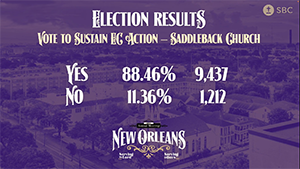
They voted 9,700 to 806 (91.85 percent) to affirm the ouster of Fern Creek Baptist Church; 9,437 to 1,212 (88.46 percent) to support the decision to expel Saddleback Church; and 9,984 to 343 (96.46 percent) to ratify the expulsion of Freedom Church.
Churches appealed Executive Committee decision
The three congregations appealed the Executive Committee action. In each case, a church representative had three minutes to make a case for reinstatement prior to a vote by messengers.
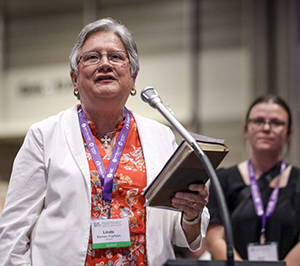
Linda Popham has been pastor of Fern Creek Baptist Church in Louisville, Ky., more than 30 years. (Photo by Sonya Singh)
Linda Popham has served Fern Creek Baptist Church 40 years, including the last three decades as senior pastor. She described herself as “more conservative than most Southern Baptist pastors.”
“We believe that the Bible allows women to serve in ways in which all of you do not agree,” Popham told messengers during the business session prior to the vote. “But we should still be able to partner together.”
Rick Warren, retired founding pastor of Saddleback Church, urged messengers to “act like Southern Baptists and agree to disagree” on the single issue of whether a woman can serve in the office of pastor.
Historically, Warren said, Southern Baptists have agreed to disagree on some doctrinal issues for the sake of a shared mission.
Churches should be disfellowshipped by the SBC for “sins that harm the testimony of our convention,” Warren said, but churches that call women to serve as pastors “have not sinned.”
He noted the SBC Constitution says cooperating churches “closely identify” with the Baptist Faith & Message, not “completely agree.” Saddleback Church disagrees with “one word” in the statement of faith, he said.
“Isn’t that close enough?” he asked.
Mohler defended decision to exclude churches
Al Mohler said the Southern Baptist Convention is within its rights to remove Fern Creek and Saddleback because it “has the sole responsibility to establish its own membership and to define what it means to be a cooperative Southern Baptist church.” (Photo by Sonya Singh)
In both cases, the Executive Committee called on Al Mohler, president of Southern Baptist Theological Seminary, to speak in support of the decision to exclude the two congregations with women in pastoral roles.
“The congregations of the Southern Baptist Convention are autonomous, and we do not seek to invade the autonomy of any local church,” Mohler said. “At the same time, this convention has the sole responsibility to establish its own membership and to define what it means to be a cooperative Southern Baptist church.”
The issue, Mohler said, is maintaining doctrine and order. He insisted the issue of women in the pastorate is grounded in the doctrine of biblical authority. Furthermore, he said, a shared commitment to a male-only pastorate has resulted in a unified convention.
“The issue of a woman serving in the pastorate is an issue of fundamental biblical authority that does violate both the doctrine and the order of the Southern Baptist Convention,” Mohler asserted.
Warren ‘wasn’t expecting to win’
“I wasn’t expecting to win,” Warren told reporters in a news conference soon after the vote results were announced. “I wanted to push a conversation that had stagnated.”
Rick Warren responds to reporters’ questions after messengers to the Southern Baptist Convention affirmed a decision to expel Saddleback Church, which he founded. (Screen capture image)
In the first century, all followers of Jesus—male and female—were involved in proclaiming the gospel and making disciples, he said.
“The church at its best was the church at its birth,” Warren said.
The priesthood of all believers means all followers of Christ are empowered for ministry, he said.
“In the New Testament, everybody gets to play,” Warren said.
Warren expressed surprise that more than 1,200 voted against affirming the Executive Committee decision to exclude Saddleback, given the composition of the SBC annual meeting.
He characterized those who attend the convention primarily as denominational workers, retirees who want a reunion with old friends, local Baptists from the area where a meeting is held and “activists” from small churches who are looking for a platform.
“The face of Southern Baptists does not look at all like the annual meeting,” he said.
A majority of messengers to the 2023 annual meeting chose “conformity and uniformity rather than unity,” Warren said.
Warren emphasized his belief in “historic Baptist principles,” noting, “Baptists are famous for dissent.”
“You have to do what’s right, even if you shake the boat,” he said.
“We made the effort knowing we weren’t going to win,” Warren said.
However, he voiced belief Saddleback’s view on women in ministry eventually will prevail.
“Truth inevitably wins out over tradition. … Change will happen,” he said.
Church excluded over handling of abuse allegations
Messengers to the SBC annual meeting also heard discussion regarding the decision to deem Freedom Church not to be in “friendly cooperation” with the SBC, because the church failed to cooperate to resolve concerns regarding an abuse allegation.
Donald Stewart, a representative from the congregation said the pastor who was the subject of the allegations resigned May 22, and an independent party—the Anglican Church of North America—investigated and resolved the concerns.
Executive Committee member and Florida pastor Dean Inserra noted Freedom Church was disfellowshipped both by Treasure Coast Baptist Association and the Florida Baptist Convention.
He also said the congregation “took zero action” and failed to respond to the SBC Credentials Committee or the Executive Committee until after the decision to oust the church was reached.
IMB honors medical missionary Rebekah Naylor
June 29, 2023
NEW ORLEANS (BP)—Missionary surgeon and longtime healthcare missions advocate Dr. Rebekah Naylor was honored at the annual International Mission Board dinner June 12 during the 2023 SBC annual meeting in New Orleans.
IMB President Paul Chitwood announced a ministry fund being named in honor of Naylor.
“In honor of Dr. Rebekah Naylor’s commitment to getting the gospel to the nations through healthcare, we are creating the Dr. Rebekah Naylor Fund for Global Healthcare Strategies,” Chitwood announced.
“Every time someone gives to this fund, they will not only honor Dr. Naylor’s legacy of service, but they will also create opportunities for hurting people to receive physical help and eternal hope.”
Naylor was appointed to India in 1973 and has more than 50 years of service with the IMB. During her years of service in India, she helped supervise the growth of the former Chicken Coop Clinic into Bangalore Baptist Hospital as surgeon, chief of the medical staff, administrator and medical superintendent. She also served in pivotal roles on church-planting teams.
In 2009, Naylor retired from her work on the field and became IMB’s global healthcare strategies consultant. Today, IMB has more healthcare missionaries than ever in its history, largely due to her efforts. She has announced her upcoming retirement in September of this year.
In presenting a plaque accompanying the announcement, Chitwood shared that the inaugural $10,000 gift to the fund will come from the IMB.
Chitwood also recognized IMB President Emeritus Jerry Rankin, who was president for 17 years and served a total of 40 years with the IMB.
Consider grim reality of global lostness
Jeff Ginn, the IMB’s global engagement leader for the Americas and incoming vice president of mobilization, shared some of the stark realities of global lostness.
He personalized it, recounting a story from his time in Colombia. His wife, Nell, realized their son was missing. Stopping everything to search for him, she and a national friend discovered that a woman was trying to kidnap him. The friend rescued the boy and returned him to his mother.
“I still get weak in the knees when I think about how our lives would have been forever changed had she not had a concern for the lost,” Ginn recounted.
Ginn went on to tell how he had witnessed the power of the gospel among the lost, before moving to the stark reality of lostness—the world’s greatest problem.
More than half (59 percent) of the world’s population is unreached, Ginn explained. This means there are less than 2 percent evangelical Christians within their people group or nearby. In addition, 3,072 people groups (287 million people) are considered unengaged and unreached. These people groups have no missionary presence and likely no access to the gospel.
“This cannot be ignored, this cannot be tolerated, this cannot stand,” Ginn said, as he encouraged the crowd to pray faithfully for missionaries and unreached peoples.
Project 3000 and Great Pursuit
Another emphasis at the dinner was Project 3000. Through this pioneering initiative, Project 3000 will create 100 new jobs each year over three years. Each of these new missionaries will be exploring 10 people groups over a two-year period.
This announcement continues IMB’s theme of a Great Pursuit for those who remain without gospel access. IMB leaders have repeated this message, driving home why the IMB and the Southern Baptist Convention exist.
Chitwood commissioned attendees to take action as they left the dinner.
“As your missionaries continue the work of addressing the world’s greatest problem—spiritual lostness—with God’s solution—which is the gospel, they need your prayers, your continued generosity and more reinforcements,” he said.
“The number of missionaries who have applied and are walking through the process to go to the field has grown to 1,200,” he said.
“But we need more missionaries to go. Will you consider how God is calling you and how God is calling those in your churches?” he posed to attendees.
“From the Great Commission in Matthew 28 to the great multitude that we see in Revelation 7:9, we have been called to unite in this Great Pursuit: To reach every nation—no matter the cost,” Chitwood said.