Baptists celebrate past with an eye to the future

In 400 years, the Baptist movement has grown to 200,000 churches with more than 50 million members in countries around the world.

But even though Baptists globally continue to show statistical growth, the largest Baptist group in the United States—the Southern Baptist Convention—has reported declining membership, following a trend other U.S. denominations began reporting two decades earlier.

“Some have said this is the first membership decline ever. That is not true,” said Southern Baptist statistician Ed Stetzer of LifeWay Research. “However, I believe this time is different. I believe that, unless we have a significant intervention, we have peaked, at least in regards to membership.”

Citing percentages of growth since 1950, Stetzer observed: “Our year-to-year growth has been in a constant trended decline, not for one year, but for decades. This is … a 50-year trend.”

Philip Jenkins predicts the center of the Christian population will shift from North America and Europe to the Southern Hemisphere.

Researchers cite several cultural and religious factors that play into the decline. Philip Jenkins asserted in The Next Christendom: The Coming of Global Christianity that the Immigration Reform Act of 1965 was a major event overlooked by most researchers.

“As recently as 1970, Asian and Hispanic Americans accounted for only 8 percent of total births in the United States, but today, that figure has increased to more than 25 percent,” Jenkins wrote.

“One reason for this transformation is that Latinos are generally much younger than longer-established populations. The national census of 2000 showed that the median age for Hispanics was about 26, younger than that of any other ethnic group, and far lower than the median age for Anglo-whites, which stood at a venerable 38.5. By mid-century, 100 million Americans will claim Mexican origin.”

Slow to respond 

Rather than seize the demographic change as a missions opportunity, as a whole, Anglo Baptists have been slow to respond, some observers say.

To add further to the decline, while Baptists were not reaching the growth groups in the United States, their own birthrates were falling.

Baptist researcher Curt Watke, executive director of the Intercultural Institute for Contextual Ministry, points to the aging of the Baptist population and the related decline in Anglo birthrate as cultural factors affecting growth in white Baptist churches.

Another factor, discussed widely among bloggers, suggests Baptists under 40 are disengaging themselves from denominational life and finding other affiliations more fulfilling.

Last year, former SBC President Frank Page received much notice and some criticism for saying, “If we don’t start paying attention to the realities … by the year 2030, we will be proud to have 20,000 rather than 44,000 Southern Baptist churches.”

Current evidence suggests decline will be long-term without spiritual intervention. Programmatic approaches have failed. According to a recent report in USA Today, the Southern Baptist North American Mission Board spent $343,700 on a strategy called ‘What Now’ before pulling the plug.

“Another campaign, called ‘Who Cares,’ also fizzled,” the newspaper reported. NAMB leaders hope their new evangelism effort, God’s Plan for Sharing, or GPS, fares better.

A bright global future 

But while future growth among Baptists in the United States is questionable, globally the future looks bright.

According to Baptist World Alliance figures, with Southern Baptist Convention statistics added for the United States, Baptists around the world have grown in number by 49 percent from 1990 to 2008. Baptists in Africa led all others in growth, increasing by 327 percent in that period.

Jenkins predicts the center of the Christian population will shift from North America and Europe to the Southern Hemisphere.

His assertions are being validated by Baptist growth in developing nations, particularly in Africa.

According to Jenkins, the Christianity of the future will incorporate some of the customs and practices of the regional population but will be biblically conservative, taking literally much that Westerners ignore.

“The denominations that are triumphing all across the global South are stalwartly traditional or even reactionary by the standards of the economically advanced nations. The churches that have made most dramatic progress in the global South have either been Roman Catholic, of a traditional and fideistic kind, or radical Protestant sects, evangelical or Pentecostal,” Jenkins said.

“These newer churches preach deep personal faith and communal orthodoxy, mysticism and Puritanism, all founded on clear scriptural authority. They preach messages that, to a Westerner, appear simplistically charismatic, visionary and apocalyptic.

“In this thought-world, prophecy is an everyday reality, while faith-healing, exorcism and dream-visions are all basic components of religious sensibility. For better or worse, the dominant churches of the future could have much in common with those of medieval or early modern European times. On present evidence, a Southernized Christian future should be distinctly conservative.”

Looking to the future 

As Baptists plan their 400th anniversary celebrations, Bob Dale, author and recently retired associate executive director of the Baptist General Association of Virginia, suggests they think ahead to the kind of celebration they want to have a generation from now.

Casting an eye to the future, Dale asks:

•Will Baptists learn to become true partners of indigenous leaders—globally and in the United States?  Will they develop humility enough to learn from Third World churches?

•Can Baptists change their win-lose Western mindset to a more Eastern challenge-response cooperative mindset?

 •Will Baptists in the West move beyond culture prejudices and see Baptist cousins in developing nations as equals?

•Will Baptists learn to read the Bible from its original Eastern roots rather than through the prisms of Western assumptions?

•Will Baptists learn to relate to world religions in a global world?

•Will state conventions and associations become less absorbed with regional issues and more focused on world-change, looking for the global dimensions of local concerns?

•How soon will Baptists in the United States consider it shortsighted and foolish to speak only one language and be familiar with only one culture?

•Can Baptist find ways to minister from the bigger cultural middle and let go of those on the narrower fringes who persist in fighting?

•What if Baptists in the United States continue to focus on their needs and persist in the attitude: “As for me and my house, we will serve me and my house?”



Who founded the Baptist movement– John Smyth or John the Baptist?

Baptists who celebrate the 400th birthday of their denomination in 2009 miss the mark by about 1600 years, some Baptists insist.

Since Jesus founded his church during his earthly ministry and promised “the gates of hell shall not prevail against it,” Landmark Baptists believe that means an unbroken line of church succession dating back to Christ’s lifetime. And since John the Baptist immersed Jesus, the church Christ formed was a Baptist church, some add.

“Landmarkers believe that Jesus meant literally that his church would continue in an unbroken lineage until he returned,” said John Penn, church history instructor at Missionary Baptist Seminary in Little Rock, Ark.

Landmark Baptists hold to their belief in church succession out of commitment to the veracity of Scripture and the claims of Christ, said Philip Bryan, president emeritus of Baptist Missionary Association Seminary in Jacksonville.

Books by J.R. Graves, J.M. Pendleton and Joe T. Odle kept the Landmark view of Baptist history in circulation.

“The traditional Landmark Baptist position on the origin and continuation of the Lord’s church is essentially one of doctrine and theology rather than history,” Bryan said.

Baptists in perpetuity 

Landmarkers believe in the perpetuity of the church Christ instituted—“that there has never been a day since Christ founded his church when there was no scriptural church on earth, and that the church shall continue in existence until he comes again,” he explained.

J.R. Graves spread Landmark Baptist teaching throughout the South and Southwest in the 1850s as editor of the Tennessee Baptist.

J.M. Pendleton perpetuated it for many generations through his Church Manual, a book still in print and sold by LifeWay Christian Stores.

In the mid-20th century, Joe T. Odle of Mississippi taught the same principles in his Church Members Handbook, a popular booklet published by Broadman Press and used in Baptist Training Union classes throughout the South.

“No man this side of Christ can be named as the founder of Baptists. Nor can any date this side of his personal ministry, nor any place outside of Palestine, be set for their beginning,” Odle wrote.

graves

J. R. Graves

Many Landmark Baptists hold to the “Trail of Blood” teaching popularized by J.M. Carroll—the belief that persecution was the mark of the true church throughout Christian history. W.H. Whitsitt was forced to resign from Southern Baptist Theological Seminary in 1899 for daring to contradict unbroken succession.

In addition to an unbroken line of succession back to New Testament times, Landmark Baptists also believe in the primacy of the local church as the only biblical missionary-sending body and in closed communion—limiting the Lord’s Supper just to Baptists or even to members of a specific Baptist congregation.

Landmarkers believe the true church that has existed since the time of Christ has not always borne the “Baptist” label, but it has exhibited certain distinguishing marks testifying to its validity. And for much of church history, one of those marks has been persecution.

The distinctive of persecution 

“After the union of church and state, it is contrary to the teaching of Christ that any so-called church that enforced his teaching by persecution—that is, by physical punishment, jailings and beatings—could be considered his true church,” Penn said.

“Landmarkers prefer to trace true succession through those groups who were persecuted than by those who inflicted physical suffering and death. … These groups were not called Baptists, but they bore the burden of preaching the truth.”

Some of the dissenting Christians who were persecuted by the state church held “some strange or even heretical views,” Penn acknowledged.

“However, it is also to be observed that they had their books burned, their houses pillaged, their Bibles confiscated and their children taken from them. Yet, in spite of this, they maintained a true witness,” he said. “These dissenters kept the faith and passed it on to us.”

Some Landmark Baptist historians note that while modern Baptists certainly do not hold identical views to Novatians, Waldenses and other ancient Christian groups who rejected infant baptism, they also differ significantly from early English Baptists, who did not practice baptism by immersion until about 1641.

“Assuming the validity of the Baptist belief that baptism by immersion is an absolute necessity for scriptural baptism, the accounts of the baptisms of John Smyth, the earliest Particular Baptists prior to the 1640s and even of Roger Williams disqualify such people from originating or continuing Baptist churches,” Bryan said.

Gaps in the historical records require believers in any theory of Baptist origins to make a leap of faith, he insisted.

“We cannot show conclusively how modern Baptists sprang from the people who are usually believed to be the founders of the Baptist movement,” he said.

“Those people were about 1,600 years late.”


Scholars disagree on Anabaptist, Baptist connection

DURHAM, N.C. (ABP)—While much writing about Baptist history in the 20th century focused on what distinguishes Baptists from other Christians, a group of contemporary scholars believes the Baptist movement now needs to reconnect to its ecumenical roots.

Most modern Baptist historians mark the birth of the Baptist movement at 1609. A minority and often controversial counterview argues the church established by Christ and the apostles has existed in one form or another in unbroken succession since the New Testament apart from a corrupted Roman Catholic Church.

A small number of scholars put forth a third view. While not insisting on direct links between the Anabaptists and Baptist traditions as the Successionists do, they believe a kinship existed between early Baptists and Anabaptist communities that has been neglected and caused Baptists to marginalize themselves from the larger free-church family.

John Smyth

In a 1997 article, Curtis Freeman, now research professor and director of the Baptist House of Studies at Duke Divinity School, said the Baptist movement grew out of a conviction that the true church is a believer’s church, free to worship by the gospel of Jesus Christ and not conferred by power of the state.

Over time, he argued, those ideals were influenced by philosophers like John Locke and American notions of populism and revivalism, to produce a corrupted and individualist Baptist identity where “every tub must sit on its own bottom.”

“Anabaptist” was a term applied to various movements that emerged in Europe in the 16th century period called the Radical Reformation. From the Greek prefix “ana,” which means “again,” and the word “baptize,” it means “re-baptizers.” Viewed as heretics, the term was applied originally to the Anabaptists as a term of contempt, an epithet today comparable to “sect” or “cult.”

Descendants of those who survived persecution today populate groups including the Amish, Mennonites, Church of the Brethren and some German Baptists.

There is no question the earliest Baptists interacted with Anabaptists in Holland— when John Smyth’s group left England for Amsterdam, they met in a bake house owned by a member of a Waterlander Mennonite congregation—but historians disagree over the extent of cross-pollination between the groups.

Smyth’s self-baptism—viewed at the time as scandalous—suggested he was not convinced the Anabaptists represented a true church. He later began to question the validity of his own rebaptism, however, and was waiting to join the Mennonites when he died in 1612. Repenting of their baptism, Smyth and 31 church members asked to merge with the Mennonite congregation.

Ten members, including Thomas Helwys, a layman who helped finance the group’s move from England, believed their believer’s baptism was valid. They split from Smyth’s church and later returned to England, where facing an oppressive environment they became stalwart advocates for religious liberty and the separation of church and state.

William Estep, a longtime professor at Southwestern Baptist Theological Seminary who died in 2000, said it is impossible to understand Baptist origins without studying Anabaptists. Estep claimed the earliest Baptists “were dependent on the Mennonites for the determinative features of what was to become known as Baptist faith and practice.”

Glen Stassen, the Lewis B. Smedes Professor of Christian Ethics at Fuller Theological Seminary, contends a book by Menno Simons so shaped early Baptist confessions of faith that Baptists today ought to accept the Mennonite founder as a significant “parent.”

Freeman said recent books have questioned whether the Helwys congregation survived and if it did how much it influenced the mainstream of Baptist life. Most scholars today accept a “polygenetic” view of both Anabaptist and Baptist traditions, meaning they probably grew from multiple streams instead of a single source, he said.

In collecting essays for a 1999 book titled Baptist Roots, Freeman and two co-authors included chapters from the 15th and 16th centuries by Anabaptist founders to provide a sense of the “connectedness with the larger free-church tradition.”

They distinguished “Baptist” from “baptist” with the small “b” denoting “spiritual and theological kindred” with an extended denominational family.


Robert Handy, Baptist historian, seminary professor, dies

NEW YORK (ABP) — Robert Handy, who studied under legendary Christian scholars like Paul Tillich before becoming a prominent Baptist historian in his own right, died at a retirement community in West Caldwell, N.J., Jan. 8. He was 90.

Handy was a professor of church history at Union Theological Seminary — the ecumenical Protestant graduate school in New York — from 1950 until 1986. During that time he taught generations of pastors, missionaries, chaplains and other ministers and published works on church history and American religion that scholars still consider standards in the field.

In a tribute to Handy’s scholarship published after he retired, Altered Landscapes: Christianity in America 1935-1985, former students, colleagues and friends lauded the historian’s career.

"Every one of them… knows his or her indebtedness to the lifelong scholarly career of Robert Handy," the book’s editors wrote, praising "his strict adherence to the technical canons of historical inquiry, his sensitivity to the practical needs of Christian people, his signal labors on behalf of a sophisticated understanding of American church history, and his appreciation for the conceptual ties of history with many other disciplines."

He was particularly known for his work on church-state relations in the United States, and attempts by some U.S. Christians in the 19th century to impose their vision of a “Christian” America.

Handy was born Jan. 30, 1918, in Rockville, Conn. He graduated from Brown University in 1940 with a bachelor’s degree in European history and earned a divinity degree from Colgate-Rochester Divinity School in 1943. He was ordained a Baptist minister that year.

While serving as pastor of an Illinois congregation, he began taking history classes at the University of Chicago Divinity School as a way of combining his interests in local-church ministry and history. After a stint as an Army chaplain, he returned to Chicago, where he earned his doctorate in 1949.

Union Seminary appointed him to a three-year contract the next year. He taught classes while assisting Tillich and another renowned Christian scholar, John McNeill, in research for their foundational works on church history.

"Little did I know that the three years would stretch into twelve times that number to the time of retirement," he later wrote.

Handy also authored the official history of Union Seminary in 1987 as part of the school’s sesquicentennial celebration.

"We know that as a historian he loves the truth of history," the editors of the tribute to Handy’s career wrote. "He loves as well the people who make history. Indeed, among those scholars whom we know, we know of none who better joins the love of truth to the truth of love."


Baptist Briefs: Former Attorney General Bell dies

Former Attorney General Bell dies. Griffin Bell, U.S. attorney general during President Carter’s administration and a longtime benefactor of Mercer University, died Jan. 5 after lengthy battles with pancreatic cancer and kidney disease. He was 90. Bell, who grew up in Americus, Ga., earned his law degree from Mercer in 1948. He worked more than 40 years at King & Spalding, an Atlanta law firm, and sat for 15 years on the 5th U.S. Circuit Court of Appeals. He left his law practice to become the 72nd attorney general of the United States in 1977, where he served two years before returning to the Atlanta firm. Bell helped raise more than half a billion dollars in gifts to Mercer University. He served six terms on Mercer’s board of trustees and was chair of the board from 1991 to 1995. He was elected a life trustee in 2007. Bell was a member of Second-Ponce de Leon Baptist Church in Atlanta. His first wife, Mary, preceded him in death in 2000. He later married a longtime friend, Nancy Kinnebrew, who survives him. Other survivors include his son, Griffin Jr., two grandchildren and five great-grandchildren.


Todd Deaton

Kentucky paper gets new editor. Kentucky Baptists have tapped veteran denominational journalist Todd Deaton to become editor of the Western Recorder. Deaton, 45, has been managing editor of the Baptist Courier, newspaper of the South Carolina Baptist Convention, since 1996. Before that, he was associate editor for the Biblical Recorder in North Carolina. Deaton worked three years as an intern for the Western Recorder while he attended Southern Baptist Theological Seminary in Louisville, Ky., in the 1980s. A graduate of Furman University in Greenville, S.C., Deaton holds a master of divinity degree from Southern Seminary and expects to complete a doctor of education degree from Southeastern Baptist Theological Seminary in Wake Forest, N.C., in May. Deaton replaces Trennis Henderson, who resigned last March after eight years as editor to become vice president of communications at Ouachita Baptist University in Arkadelphia, Ark.

Billy Graham joins Spartanburg church. The best-known nonresident member of First Baptist Church in Dallas has moved his membership. Evangelist Billy Graham has joined First Baptist Church in Spartanburg, S.C. Graham, a long-time member of First Baptist Church in Dallas, told Pastor Don Wilton on Christmas Eve he wanted to join the Spartanburg church, the Spartanburg Herald-Journal reported. Wilton and his son were visiting Graham at the 90-year-old evangelist’s home in Montreat, N.C., about 90 miles from Spartanburg. The congregation learned about Graham’s decision when Wilton announced it in worship services Dec. 28. Graham is good friends with Wilton and watches the church’s services on television. Graham wrote the foreword to Wilton’s 2005 book, Totally Secure: Finding Peace and Protection in the Arms of God.


Baptist World Alliance responds to Muslim letter

FALLS CHURCH, Va. (ABP) — The Baptist World Alliance has issued its formal response to a 2007 letter, written to Christians by 138 Muslim leaders, describing love for God and love for neighbor as common ground between the two faiths.

BWA leaders agreed that the double love for God and neighbor "lies at the heart of the message of Jesus Christ as recorded in the Gospels" but clarified that Baptists do not understand those commands as "the sum total of our two faiths."

The letter cited one example, the Trinity, as "troubling" for Muslims but "absolutely essential for us in confessing the oneness of God."

"We are well aware that Muslims believe the Christian idea of the Trinity contradicts the affirmation that God has no other being in association with him," the Baptist leaders said, but Christians do not understand "the distinct reality" of God in three persons to mean that any other being is beside God.

"Rather, the church is attempting to express the truth that there are mysterious, unknowable depths to the personal nature of God," the letter said. "It is also aiming to be faithful to the truth of God which has been disclosed in the event of Jesus Christ in history."

Not an attempt to convince 

The Baptist leaders said the letter is not the place for "a fuller exposition of the Christian doctrine of the Trinity" or an attempt to try to convince Muslims of its truth.

"We write in order to make clear that we ourselves cannot think of God as love except in terms of an eternal communion or fellowship whose unity is dynamic and relational," the letter said. "While we rejoice to confess with you that there is one God, it is not possible for us to speak of the one God without also speaking of Trinity."

In November 2007 a number of Christian leaders published a statement in the New York Times responding to A Common Word Between Us and You by Muslim scholars and clerics.

Signed by evangelicals including Leith Anderson and Richard Cizik of the National Association of Evangelicals, Timothy George of Samford University's Beeson Divinity School, David Gushee of Mercer University, Bill Hybels of Willow Creek Church, Richard Mouw of Fuller Theological Seminary and Rick Warren of Saddleback Church, the Loving God and Neighbor Together response  expressed strong agreement with the Muslim letter.

After conservative evangelicals including John Piper, Al Mohler and Focus on the Family's CitizenLink newsletter criticized the Christian letter for not explicitly affirming the deity of Christ, some of the original signers had their names removed.

During a discussion of a Baptist response to the Islamic letter last summer, according to a report on the website EthicsDaily.com, some Baptists expressed concern about theological language in the original letter from Islamic leaders. Meanwhile, some Baptists from areas of the world where Christians and Muslims clash questioned the need for dialogue.

After that meeting, BWA leaders drafted a formal response signed by BWA president David Coffey, General Secretary Neville Callam, Paul Fiddes of the Commission on Doctrine and Inter-Church Cooperation and Regina Claas of the Commission on Freedom and Justice.

Thanks for "generous initiative" 

The BWA letter thanked the Muslim leaders for their "generous initiative" and "irenic and constructive spirit" in the 2007 letter. The leaders proposed that future discussions take place not in a central commission of the BWA but rather in regional unions and conventions engaged in joint conversations and projects for aid and development.

They also called for education of both religious teachers and members of local congregations and mosques to "change attitudes and prejudices" that undermine values of respect and honor of others despite differing religious beliefs.

"Just one way this may happen is for religious teachers in both faiths to be careful about the rhetoric they use, which may have unintended effects on followers who are less aware of theological nuances, and which may even lead to violence," the leaders said. "To be concrete, we have one suggestion for Baptist Christians, that they avoid words to describe evangelism (or telling the gospel story) which appear threatening to others, such as 'evangelistic crusades.' Nor is it necessary to be critical of another faith in order to commend what we believe to be true in ours; the story of Jesus has power to persuade in its own right."

"It is easy to slip into a violent rhetoric which arouses unpleasant memories of conflicts in the past," the letter said. "We do not venture to suggest examples of unhelpful rhetoric to you, our Muslim friends, but hope that you might be able to identify some for yourselves. Let our rhetoric be that of love, as you have already shown."


–Bob Allen is senior writer for Associated Baptist Press.


Billy Graham joins South Carolina church

SPARTANBURG, S.C. (BP)—The best-known nonresident member of First Baptist Church in Dallas has moved his membership.

Evangelist Billy Graham has joined First Baptist Church in Spartanburg, S.C.

Graham, who has been a member of First Baptist Church in Dallas more than 50 years, told Pastor Don Wilton on Christmas Eve that he wanted to join the Spartanburg church, the Spartanburg Herald-Journal reported.

Wilton and his son were visiting Graham at the 90-year-old evangelist's home in Montreat, N.C., about 90 miles from Spartanburg.

The congregation learned about Graham’s decision when Wilton announced it in worship services Dec. 28.

Graham is good friends with Wilton and watches the church's services on television. Graham wrote the foreword to Wilton's 2005 book, Totally Secure: Finding Peace and Protection in the Arms of God.

"Our church is deeply humbled and deeply grateful to accept him as one of our own," Wilton told WSPA-TV in Spartanburg. "And it certainly gives us great joy to do that."


Tebow’s football awards anchored by faith

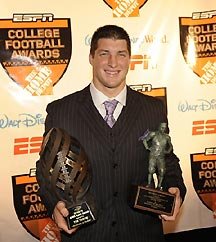
GAINESVILLE, Fla. (BP)–University of Florida quarterback Tim Tebow has added to an already impressive collection of national football awards, garnering the 2008 Wuerffel Trophy, the Maxwell Award and the Disney Spirit Award.

[Tebo garnered one more honor Jan. 8 when he led his team to victory over the Oklahoma Sooners, 24-14, in the BCS National Championship game]

Tebow is a member of First Baptist Church in Jacksonville, where his parents, Bob and Pam Tebow, are longtime members and, as missionaries to the Philippines, head up the Bob Tebow Evangelistic Association.

A college junior, Tebow, who last year was the first sophomore to win the Heisman, college football's most prestigious honor, finished last among this year’s three finalists but had the most first-place votes.

University of Florida quarterback Tim Tebow. (Photo courtesy of WDWnews)

The 1996 Heisman winner, Danny Wuerffel, notified Tebow Dec. 11 that he had won the trophy named for him (Wuerffel), which is awarded to the college football player who best combines exemplary community service with athletic and academic achievement.

"Without question, you completely deserve this award and I am so excited to announce that you're this year's winner," Wuerffel, himself a decorated former University of Florida football player, said to Tebow the morning he was informed of the award, as recounted in a news release.

"It was just amazing to see the success that Tim has had in all three aspects of this award: academically, athletically and in the community and service to other people," Wuerffel continued. "He's just an amazing young man, an amazing football player. I'm just so incredibly proud to have him [as the winner]. It's funny how things go back and forth. Maybe one day my son will win the Tebow Trophy."

Tebow told Wuerffel he was humbled by the award.

"To win the SEC championship is a dream come true and then to get this award — Danny's award — is just great; it's very humbling," he said, according to the news release. "I want to take this platform that I have by being a quarterback and being at the University of Florida and use that to help people and use that to share my message about helping people and about helping people's lives. That's the reason I think I've been blessed to have the success that I've had."

Tebow also won the Maxwell Award for the second year — edging Texas' Colt McCoy and Texas Tech's Graham Harrell –- as the nation's best all-around player. Recognizing him for "humanitarian efforts [that] have captivated college football fans nationwide" during the Home Depot ESPNU College Football Awards at Disney's BoardWalk Resort in Orlando, Tebow also was presented the 2008 Disney Spirit Award as college football's most inspirational figure.

Tebow was recognized for spending his 2008 spring break as a missionary in the Philippines with his dad's ministry. In April 2008, he organized a flag football tournament to raise awareness for orphans in Gainesville and around the world. He has spoken at a business conference in Croatia and was invited by the Southern Baptist Convention's International Mission Board to speak to missionaries in southern Asia. He also has spoken at several prisons across the state of Florida.

Mac Brunson, pastor of First Baptist Church in Jacksonville, said he and the church are "incredibly proud" of Tim and "how much his leadership has come to the top."

"We talk about Timmy the runner, we talk about Timmy the passer, we talk about Timmy the football player, but I think what everybody has seen this year is the leadership quality," Brunson told the Florida Baptist Witness. "Everything rises and falls on leadership, and after the Mississippi game [Florida's lone loss], he just kind of rose to leadership."

Brunson said he attributes Tebow's "God-given gift of leadership" to his relationship with Jesus Christ and he knows through keeping in touch with Tebow's father Bob that the young man is staying the course.

Commenting about Tebow's mission work, Brunson said, "I think that's his heart … that's his life. That's what he grew up doing.

"I think the neater story there is the impact that he's had on people around him," Brunson said.

Joni B. Hannigan is managing editor of the Florida Baptist Witness.


Teen campaigns for fresh water in Sudan

JACKSON, Tenn. (BP)—Joshua Guthrie has a message for teenagers: they can do something to make the world a better place. And he is leading by example.

Guthrie, a 16-year-old high school sophomore dually enrolled at Union University in Jackson, Tenn., has launched an initiative to raise money for a freshwater well in Sudan.

Called “Dollar for a Drink,” the campaign also is intended to help provide clean drinking water for the Sudanese people as a demonstration of God’s love for them.

Joshua Guthrie

“The concept is extremely simple,” said Guthrie, whose father is a Bible professor at Union University. “Give up one drink, and instead give that $1 to help build a well in Sudan. Our objective is for one well, which is $8,000, by Christmas 2008.”

More than 12 million people in Sudan lack adequate access to clean water, he noted. Digging wells is also expensive, because the dry climate requires deep digging to get to the water.

In addition, Guthrie stressed, the lack of water leads to tribal conflicts.

“So, in a way, putting in more wells not only eliminates the thirst, but also wars as well,” he said.

Guthrie is working on the project with Baptist Global Response, an international relief and development organization, which has set aside a specific well for which Guthrie is raising money. Once the money is collected, Baptist Global Response will send in a team to dig the well, and the workers will use their time in Sudan as an opportunity to talk with people about the love of God.

The project launched in September. Although larger donations are welcomed, Guthrie is asking people to donate $1—about what it would cost to purchase a soft drink—to the effort. Some may think their small donation doesn’t matter, but Guthrie disagrees.

“I like to think of every dollar as a droplet of water,” he said. “By itself, that droplet can’t do a whole lot of good. But if you combine them all, you really have this large power source that really can make a large dent in the situation in Sudan.”

He has collected about $3,855 so far.

“This is a way all of us can be doers of the word,” Guthrie said. “Right now, in the next few minutes, we can act on Jesus words’ where he said, ‘When I was thirsty, you gave me a drink.’ Our Sudanese brothers and sisters are the least of these, so we hope that people will not delay giving, but act now if the Spirit is prompting them.”

He especially hopes teenagers will get involved in the effort, perhaps adopting it as a project for their church youth groups. Guthrie is a member of Northbrook Church, a Baptist congregation in Humboldt, Tenn.

“I really hope to be a motivation to other teenagers that it really doesn’t matter what your age is, you can make a difference in the world and overcome the low expectations of the culture,” he said.


Southwestern Seminary cuts budget

FORT WORTH—Southwestern Baptist Theological Seminary has announced plans to cut its budget by about 10 percent—a reduction between $3.5 million and $4 million—to “protect the institution from future financial crisis.”

Casualties of the budget cuts include the seminary’s childcare center, its study program in England and most overseas travel. More cutbacks are anticipated.

A Dec. 16 news release quoted seminary President Paige Patterson as saying, “The administration is doing the best it can to find ways to cut spending that do not involve the release of existing faculty or the students employed by the school.”

Southwestern is suspending for at least 18 months the work of its Naylor Children’s Center, a laboratory school under the direction of the school of educational ministries that provides care and instruction for preschool age children from six weeks to age 5. The center posts a deficit annually, according to the seminary's new release.

Parents reportedly received about two weeks notice that the childcare center would be closing.

The seminary has also suspended its Oxford study program and all traveling scholar overseas on-site study trips, except for travel directly related to a missionary training program in the Roy Fish School of Evangelism and Missions.

“We anticipate that other cutbacks in the budget will be necessary to ensure that Southwestern maintains its debt-free operational position and to be certain that revenues cover expenditures,” Patterson said.

“This is a most regrettable circumstance and not of our own making, but as stewards before God, we are all responsible for handling matters with as much compassion and justice as we possibly can. The goal in the end is to have a strong seminary when the present financial crisis eases.”

The news release noted that the cutbacks were being made in accord with recommendations by the seminary’s board of trustees.

The seminary’s operating budget draws on four streams of income—endowment, tuition and fees, charitable gifts and funds from the Cooperative Program unified budget.


Southern Seminary facing budget shortfall

LOUISVILLE, Ky. (ABP) — The head of Southern Baptist Theological Seminary is predicting layoffs and tuition increases to manage a $3 million budget shortfall.

President Al Mohler said in a Dec. 15 letter to the seminary community that cost-saving measures — including a hiring freeze on non-essential positions and reduced travel — have already trimmed the Southern Baptist Convention school's budget by $1.7 million.

That leaves a projected $800,000 to $1.5 million in further reductions projected over the next several months. Mohler said that would likely mean a reduction in the seminary's workforce and increasing tuition to boost revenue.

Mohler pledged "to do our very best to limit tuition increases" as a way to keep theological education affordable to as many ministers as possible.

Endowment, giving down 

Mohler attributed the shortfall to significant losses in the value of the seminary's endowed funds. He also said the school projects annual gift levels this year to be lower than usual and has been advised by denominational leaders to expect economic forces to eventually show up in reduced giving through the SBC.

Prior to the shortfall, Southern Seminary's 2008-2009 budget was $36,947,000. Just less than 40 percent of the school's income comes from tuition and fees. Nine percent is drawn from endowment revenue and 27 percent from the SBC's unified budget, called the Cooperative Program.

Mohler said work will continue on a 14,000 square-foot Welcome Pavilion under construction at the front entrance to the seminary's campus; it is designed to house admissions and the campus-security office. He also said other capital projects that are already funded and under contract will go forward, but all future building projects are on hold.

He said the current nation's economic challenge will likely be measured not in months but instead over the next two to five years.


–Bob Allen is senior writer for Associated Baptist Press.


Kentucky Baptist paper names editor

LOUISVILLE, Ky. (ABP) — Kentucky Baptists have tapped veteran denominational journalist Todd Deaton to become next editor of their historic newspaper, the Western Recorder.

Newly appointed Western Recorder Editor Todd Deaton interacted with mission board members prior to his affirmation Dec. 9. (Photo courtesy of Kentucky Baptist Convention)

Deaton, 45, has been managing editor of the Baptist Courier, newspaper of the South Carolina Baptist Convention, since 1996. Before that he was associate editor for the Biblical Recorder in North Carolina.

"Todd Deaton meets and exceeds all of our requirements that we set," Skip Alexander, chairman of an editor search committee told the Kentucky Baptist Mission Board. "We believe he is right for Kentucky Baptists."

Alexander, pastor of Campbellsville, Ky., Baptist Church, introduced Deaton as "a bridge-builder and an encourager." 

Deaton pledged to "support wholeheartedly" ministries of the state convention carried out through the Cooperative Program, a unified budget that supports both the Southern Baptists Convention and affiliated state bodies.

He said he "would reflect traditional, conservative Southern Baptist" views on social issues like same-sex marriage, gambling and embryonic stem-cell research. He said he looks forward to showcasing Baptist work across the state.

"I would like to make Kentucky Baptists the main story," he said. "My personal belief is that the state Baptist paper is your paper."

His election marks Deaton's return to the news journal affiliated with the Kentucky Baptist Convention. He worked three years as an intern for the newspaper while attending Southern Baptist Theological Seminary in Louisville, Ky., in the 1980s.

Founded in 1826, the Western Recorder is the second-oldest Baptist newspaper in the nation. Only Georgia's Christian Index, which is four years older, predates it. The Western portion of the journal's name owes to the fact that, when the paper was founded, Kentucky was part of America's western frontier.

Today the Kentucky Baptist Convention claims 2,400 affiliated churches and a variety of ministry institutions.

Deaton replaces Trennis Henderson, who resigned last March after eight years as editor to become vice president of communications at Ouachita Baptist University in Arkadelphia, Ark.

A graduate of Furman University in Greenville, S.C., Deaton holds a master of divinity degree from Southern Seminary and expects to complete a doctor of education degree from Southeastern Baptist Theological Seminary in Wake Forest, N.C., in May.

He expects to assume his new role in mid-January.