Seminary president labels Southern Baptist mission strategy ‘heresy’

LYNCHBURG, Va. (ABP) — The president of Liberty Theological Seminary has labeled a method used by Southern Baptist missionaries to spread the gospel in Muslim lands deceptive and heretical.

The Camel Method seeks to engage Muslims into talking about Jesus using verses from the Quran as a bridge.

In a podcast interview on the SBC Today blog, Ergun Caner blasted the "Camel Method," developed by longtime International Mission Board strategist Kevin Greeson to engage Muslims into talking about Jesus using a familiar legend from Islam. The story goes that every good Muslim knows 99 names for Allah, but there is a 100th name that was revealed only to the camel. 

According to the Camel Method, the 100th name is Jesus, or "Isa," as the name is spelled in Arabic. Using selected verses from the Quran, the method establishes three points: that Isa — honored in Islam as a prophet but not as divine — is holy, has power over death and knows the way to heaven. From there it goes on to present the plan of salvation by relating it to Eid al-Adha, the Islamic feast of sacrifice.

Through reportedly very effective in working with Muslims, the method has detractors who say it crosses a line between "contextualization" — embracing Christianity in ways that are culturally relevant in a given society — and "syncretism" — a fusion of two different belief systems that cannot be reconciled with biblical Christianity.

For Caner — a former Muslim who has written books labeling Islam a false religion — that line is clear. "The IMB is teaching heresy," he said matter-of-factly.

Caner said Allah as described in the Quran and the God revealed in the Bible have nothing in common. To suggest otherwise, he said, is "absolute, fundamental deception."

Kevin Greeson, a Southern Baptist missionary, developed the Camel Method from experience working with Muslims in Asia.

"You can't start an evangelistic enterprise based on deception," Caner said. "I just can't imagine that type of lying, and that's exactly what I call it.

"So you're saying [IMB President] Jerry Rankin lies?" he continued. "That's exactly what I'm saying."

Greeson, who has served with the International Mission Board since 1993, says he had little success during his first two years of working with Muslims in South Asia. They didn't believe Jesus was the Son of God or in his resurrection. They did not acknowledge the authority of the Bible, so quoting Scripture was useless.

After discovering a Christian movement in a village where many people were converting from Islam, Greeson asked about the catalyst. From there he developed the Camel Method as a way to treat Muslims with respect while challenging them to confront their own sacred writings as a bridge to the gospel.

The method is not intended primarily for one-on-one witnessing, but for planting of reproducing indigenous churches called "Jesus Groups." Greeson says there are thousands of such congregations in what he calls the largest turning of Muslims to Christ in history.
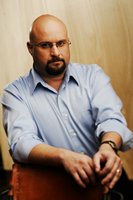
Ergun Caner is a former Muslim who has written books labeling Islam a false religion.

Caner said the issue is not whether the method works, but rather if it represents biblical Christianity.

"There's a huge difference between building a church and building a crowd," he said. "There's a huge difference between having a movement with results and having a movement with eternal results."

Caner said he has no problem using the name "Allah" for God when speaking in Arabic — that is the name Arab Christians have used for the deity since before Islam began — but telling a Muslim that Allah in the Quran refers to the Christian God is dishonest.

Proponents of the Camel Method say it isn't intended to be a full presentation of the gospel message but a point of connection with a goal of leading Muslims to accept Christ as revealed in the Bible while retaining their ethnic identity in an Islamic culture.

John Travis, a pseudonym for a Christian who has worked with Muslims in Asia for many years, says that for the majority of the world's 1 billion Muslims, changing religions is something that is never seriously contemplated.

Yet, Travis says he personally knows many Muslims who have put their faith in Jesus. Some formally convert to Christianity and worship at local churches identified with Western denominations or in small home fellowships with other Muslim-background believers. Fearing persecution, others worship underground. Still others, sometimes called "Messianic Muslims," reject teachings of Islam that directly contradict the Bible — like Jesus did not die on the cross — but do not view or describe themselves as Christians.

International Mission Board trustees adopted guidelines in 2007 regarding "contextualization" of church-planting methods among unreached people groups.

The IMB supports, for instance, using "Allah" when describing the God of the Bible but not the theological construct represented by the name as used in the Quran. While condoning the use of a culture's sacred text for "bridge building," the guidelines caution missionaries to take care not to imply wholesale acceptance of those teachings. The policy affirms the need to be "ethically sound" in church-planting efforts.

"Integrity requires, for example, that we not imply that a false prophet or a body of religious writings other than the Bible are inspired," the policy says in a footnote. "There is a level of contextualization that crosses the line of integrity. Our board has dismissed personnel who have refused counsel and deliberately positioned themselves beyond that line."

Caner said he does not believe IMB personnel who use the Camel Method are "heretics," just "Christians who are teaching heresy."


–Bob Allen is senior writer for Associated Baptist Press.
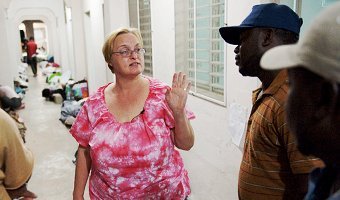


Idaho church hopeful that members in Haiti will be released

MERIDIAN, Ohio (ABP) — Leaders of a Southern Baptist church in Idaho said Feb. 11 they were encouraged by reports that a judge in Haiti has recommended release of 10 mission volunteers being held on child-kidnapping charges but were still awaiting official word.

Media reports indicate that Bernard Saint-Vil, the Haitian judge overseeing the case of the church members who have come to be known as the "Idaho 10," determined that the group should be released from jail while the investigation continues. The judge reportedly gave the prosecutor an opportunity to object, however, and it is unclear that if released they would be allowed to leave the country.

All Headline News reported Feb. 12 that Saint-Vil would not decide on a final ruling before Monday.

"Media reports continue to suggest that release of our loved ones is imminent," Clint Henry, pastor of Central Valley Baptist Church in Meridian, Idaho, said in a prepared statement to media. "At this present time, we still have not heard any official word about this. As soon as we have received reliable confirmation of release, we will let you know. Until such time the family continues to pray and wait for that all important phone call."

Five of the Americans arrested Jan. 29 while attempting to rescue 33 children from earthquake-stricken Haiti and move them into a temporary orphanage in the neighboring Dominican Republic are members of Central Valley Baptist Church. Three belong to Eastside Baptist Church in Twin Falls, Idaho. The remaining two, relatives of other team members, are from Topeka, Kan., and Amarillo, Texas.

The volunteer missionaries were officially charged with child kidnapping and criminal association Feb. 4 for attempting to transport the children across the Haiti/Dominican Republic border without proper documentation.

The Baptists insist they were only trying to help Haitian orphans. Haitian authorities suspect the group intended to put some of the children — many of whom have living parents — up for adoption.

The Central Valley Baptist Church statement voiced confidence in the attorneys representing the church members. "We understand that judicial proceedings take time," the statement said. "And even though we wanted them home yesterday, we will be just as glad to have them home tomorrow."

"Now we wait and pray believing that in the coming hours we will receive the news we have waited for," the statement concluded. "Let's get our people home and let's do it soon."


–Bob Allen is senior writer for Associated Baptist Press.
Previous stories:

Pastor stays out of division reported among jailed Americans in Haiti

Southern Baptist leaders ask Obama to intervene on behalf of missionaries

Church seeks forgiveness for mission team detained in Haiti

SBC official says he believes detained missionaries acted in good faith

Baptist prof fears Haiti arrests will set back adoption movement

Baptist group arrested in Haiti denies trafficking charge


Baptist prof fears Haiti arrests will set back adoption movement

LOUISVILLE, Ky. (ABP) — A Southern Baptist seminary professor says the arrests of a group of U.S. Baptists accused of trying to remove children from earthquake-stricken Haiti without proper documentation could give a black eye to a budding movement of evangelicals who view adoption as a means of spreading the gospel.

Russell Moore, senior vice president for academic administration and dean of the School of Theology at Southern Baptist Theological Seminary, recounted his reaction to hearing the news that 10 Americans accused of human trafficking were members of Baptist churches Feb. 1 on the "Albert Mohler Radio Program."

"I thought, 'Oh no, this is going to cause all kinds of derision to the orphan-care movement and to what the Holy Spirit is doing in churches all across America and all over the world in having a heart for orphans,'" Moore said, sitting in as guest host for seminary president Al Mohler.

Last year Moore published a book titled Adopted for Life calling on Christians to adopt children as a "Great Commission priority." On Feb. 26-27, the seminary in Louisville, Ky., is sponsoring an "Adopting for Life" conference aimed at creating "a culture of adoption" in families and churches.

"The Bible tells us that human families are reflective of an eternal fatherhood (Eph. 3:14-15)," says a website promoting the event. "We know, then, what human fatherhood ought to look like on the basis of how Father God behaves toward us. But the reverse is also true. We see something of the way our God is fatherly toward us through our relationships with our own human fathers. And so Jesus tells us that in our human father's provision and discipline we get a glimpse of God's active love for us (Matt. 7:9-11; cf. Heb. 12:5-7). The same is at work in adoption."

Moore, the father of two children adopted from a Russian orphanage, said while all the facts are not in about the motives and methods of the mission team comprised mostly of members of two Southern Baptist churches in Idaho, he has heard from many individuals stirred by images of suffering asking what they can do to help Haitian orphans.

Particularly following tragedy, Moore said couples seeking international adoption can feel frustrated by the seemingly endless process of filing and processing papers. But he said a certain amount of red tape is necessary to ensure that children have no surviving relatives able to care for them before they are removed from a home and that they receive proper care from their new parents.

"I'm worried that this news is going to give a black eye to the orphan-care movement in the same way that some of the really rambunctious, lawbreaking aspects of the right-to-life protestor movement did to the pro-life movement," Moore said on Monday's program. "You had people who were saying for instance, 'Unless we have a constitutional amendment right now, outlawing all abortions in every situation, then we can't do anything.' Well that hurt, I think the pro-life movement in many ways."

Moore said backlash to what is being reported as well-intended but poorly executed action by the church group "is going to cause people to have increased skepticism toward what I think is a genuine movement of the Spirit of God among God's people."

During the segment Moore interviewed Jedd Medefind, president of the Christian Alliance for Orphans, and, along with Moore and David Platt, senior pastor of The Church at Brook Hills in Birmingham, Ala., one of three keynote speakers at the upcoming conference.

"I think those of us who care passionately for the cause of orphans and I think a lot of Christian groups that are out there on the ground really are just deeply embarrassed by this, and I think frankly it will have the potential to do some really pretty significant long -term harm to the cause of both Christian care in country as well as the cause of adoption," Medefind said. "I think some folks who really oppose our approach to caring for children will kind of point to this very mistakenly as Exhibit A of reasons why a focus on adoption is not healthy and why you should leave caring for orphans just to governments and not allow ordinary people in the church to be involved."

Medefind, a former aide to President George W. Bush who led the Office of Faith-Based and Community Initiatives, now heads an alliance of orphan-serving organizations and churches promoting Christian orphan and foster care and adoption and adoption ministry.

The group's mission statement says it exists to "motivate and unify the body of Christ to live out God's mandate to care for the orphan." The Alliance's vision statement is "every orphan experiencing God's unfailing love and knowing Jesus as Savior."

Moore said there are some people, only a few, who comprise "kind of an anti-adoption movement out there that would say every adoption is abduction, is man-stealing."

Reacting to the news out of Haiti, Moore said, "I can just see those people saying, 'See, this is what we're talking about."

In his book, Moore said when he and his wife were adopting their boys they were encouraged by social workers and family friends to "teach the children about their cultural heritage."

"We have done just that," he wrote.

"Now, what most people probably meant by this counsel is for us to teach our boys Russian folk tales and Russian songs, observing Russian holidays, and so forth," Moore explained. "But as we see it, that's not their heritage anymore, and we hardly want to signal to them that they are strangers and aliens, even welcome ones, in our home. We teach them about their heritage, yes, but their heritage as Mississippians."


–Bob Allen is senior writer for Associated Baptist Press. .


Former Southwest Baptist University student pleads guilty to assault

SPRINGFIELD, Mo. (ABP) — A former football player at Southwest Baptist University pleaded guilty Jan. 25 to second-degree assault in a 2006 beating that left a Bolivar, Mo., man permanently disabled.

Rony Saintil, 27, of Del Ray Beach, Fla., accepted a plea bargain that reduced his charge from first-degree assault, a class A felony punishable by up to 30 years in prison. Under terms of his plea he could still get seven years, but the Bolivar, Mo., Herald-Free Press reported that Saintil's lawyer intended to ask for shock detention. That allows a defendant to receive probation after a short time in a correctional facility, or for a suspended sentence.

Police originally arrested four students attending the school affiliated with the Missouri Baptist Convention in connection with an incident outside a Springfield, Mo., nightclub. Police said a group of men were seen Oct. 13, 2006, kicking and punching 22-year-old Joshua Mincks of Bolivar, where SBU is located, in the head while he was pinned underneath a car. The incident took place in the parking lot outside of Cowboys 2000, a popular night spot for young people. 

Mincks suffered injuries, including a broken jaw. He was in a coma for three days and hospitalized for weeks. The Bolivar newspaper said he has since been classified as permanently disabled.

Because witnesses had fled the scene by the time police arrived, they did not have enough evidence to file charges. The university conducted its own internal investigation and dismissed an undisclosed number of students, citing federal law that says disciplinary action taken against a student is not public information.

Saintil was identified publicly when indictments handed down to him and another man, Henry Warren Patten, by a grand jury impaneled mainly to investigate crimes by gangs, were unsealed with their first court appearance in October of 2007.

Penny Speake, a Greene County, Mo., assistant prosecutor, said Patten's case is still pending with a pre-trial conference coming up soon. She said a third man charged in the incident, Alvin Pope, was recently extradited and his next court date is Feb. 2.

The crime rocked the county-seat town of Bolivar, with a population of about 11,000. Some questioned if the assault was racially motivated — the attackers were black and the victim white. It raised questions on the Southwest Baptist campus both about safety and recruiting standards for the SBU Bearcats football program. 

According to a Google search, Saintil, a 6-foot-5-inch, 215-pound wide receiver, attended Spanish River High School in Boca Raton, Fla. He joined the team at Bethune-Cookman College in Daytona Beach, Fla., in 2001  before transferring to a junior college in Reedley, Calif.  He committed to Temple University in 2004 and was mentioned in a 2005 season preview. After his dismissal from SBU, Santil moved to the University of North Alabama, but he was academically ineligible to play. 
 
Southwest Baptist University football coach Jack Peavey resigned abruptly after just two years in 2007. The university declined to comment on the reasons he was leaving, but Peavey, a former NFL player who now is an assistant at Texas A&M University-Commerce, said in a letter to a Springfield newspaper it was because administrators would not permit him to do what was needed to make SBU competitive. The university is the only private school in the Mid-America Intercollegiate Athletic Association.

Sentencing for Saintil is scheduled for April 23 in Greene County Circuit Court. A jury trial scheduled for him the week of Jan. 25 was canceled.

According to the Bolivar Herald-Free Press, Saintil acknowledged that he took part in the fight but his lawyer said the injuries to Mincks were caused by the actions of several individuals and that nobody knew for sure who caused them.

-30-

Bob Allen is senior writer for Associated Baptist Press.


Missionaries offer comfort to injured quake victims from Haiti

JIMANI, Dominican Republic (BP)—Delores York sits in the hallway of Good Samaritan Clinic just east of the Haiti border in the Dominican Republic. Her feet hurt, and she is exhausted. It’s been a long day for her and other clinic volunteers as earthquake victims fill every room, waiting for treatment.

IMB missionary Dawn Goodwin serves as an interpreter at a clinic in Jimani, Dominican Republic. She is one of the few there who speaks Haitian Creole and can translate for medical staff and patients, scattered on mattresses throughout the clinic. (IMB PHOTO)

Suddenly York, an International Mission Board missionary from Abilene who has ministered among Haitians 12 years, is back on her feet. She’s in the lobby holding hands with Claire, a woman about to go into surgery to repair her broken hip. Claire lost her home, looters stole everything she had and she—like so many others—lost loved ones in the 7.0 magnitude earthquake that rocked Haiti.

But the two women can’t stop smiling.

“She’s my sister,” York says proudly. “She’s happy about Jesus saving her life.”

“I have hope in God,” Claire responds. “God will get me through this.”

York and Claire just met at the clinic, but they’ve become fast friends since York speaks Claire’s Creole language. As hundreds of injured Haitians pour into the clinic, York and other IMB missionaries helping there provide a valuable skill as interpreters.

“Hardly anyone here speaks Creole,” said Dawn Goodwin, an IMB missionary from Jefferson City, Tenn. “We’re able to help the doctors understand what exactly is wrong with the patient, so they can give the treatment the patient needs.”

Language barriers only complicate the situation in what looks like a war zone, with patients scattered on mattresses throughout the clinic.

Patients include amputees, those with head wounds, infections and broken bones. They line the hallway as ambulances pull up to unload new patients.

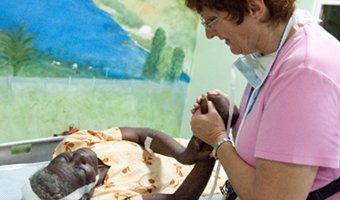
Missionary Delores York of Abilene interprets, consoles and prays with patients at a clinic in Jimani, Dominican Republic, near the Haiti border. In addition to being injured, most patients have lost their homes as well as family and friends. (BP PHOTO)

The only available space for some is a patch of grass and dirt just outside the clinic. Rooms overflow with patients, exhausted doctors and other medical volunteers, some just trying to catch an hour or two of rest.

“It’s been a week since the earthquake—and they’re still coming,” Goodwin said.

Sleep isn’t something Goodwin, York or York’s husband, Sam, from Midwest City, Okla., have seen much of in recent days.

“I just did a 24-hour shift,” Goodwin said. “I haven’t been able to get much sleep, but there aren’t enough translators.”

Interpreting is just part of what the Baptist missionaries are doing. A day at the clinic can include everything from helping lift patients on and off beds to cleaning bathrooms.

The focus, however, remains the patients—most of whom have lost their homes as well as family and friends.

“Everything is gone,” said Junior, who was visiting his wife, a patient at the clinic. They lost their two children in the earthquake. “This is all we have,” he said as he pulled on his shirt.

“We have nowhere to go.”

After being released, many patients are transported to Bethel Baptist Church in Jimani, Dominican Republic, for temporary shelter. But their future remains uncertain.

For now, volunteers do what they can to comfort the hurting and wounded.

Although doctors continue to rotate in, the number of patients is overwhelming. Workers at the clinic estimate they have treated more than 1,000 patients.

Another challenge is the equipment at the clinic. One evening, the X-ray machine was down, forcing doctors to cut open an arm or leg to feel for cracks or breaks in the bone.

While so many stories coming out of Haiti are sad, there also are miracles to report.

A woman and her 22-day-old baby were transported to the clinic after being rescued from the rubble of a building where they had been trapped for three days.

It’s easy to feel helpless and overwhelmed in the midst of crisis, York acknowledged. But she wouldn’t want to be anywhere else.

“For us, the hardest part would be not being here,” she says.


Baptist World Aid workers say situation in Haiti still desperate

FALLS CHURCH, Va. (ABP) — A Baptist rescue team in Haiti described the situation there as desperate more than two weeks after a massive earthquake the devastated the island nation Jan. 12.

Bela Szilagyi, director of Hungarian Baptist Aid and a leader of a Baptist World Aid Rescue24 team since three days after the quake, told Baptist World Alliance officials Jan. 26 that thousands of people are fleeing Port-au-Prince, a capital city plagued by food and water shortages and long lines at gas stations where fuel has quadrupled in price.

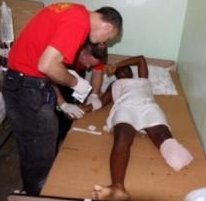
A BWAid Rescue 24 team member treats a woman injured in the Jan. 12 Haiti earthquake. (BWA photo)

Szilagyi said the Rescue24 team, consisting of two Hungarians, five from North Carolina Baptist Men and three Haitians, provided medical treatments for several hundred persons at a community clinic in Pétionville, a suburb of Port-au-Prince.

"Hundreds of people have been waiting for medical care in the hall and even in the parking lot at the clinic," Szilagyi said. Many, he said, had broken limbs and pelvises, fractured skulls and badly injured ankles and feet. "Most of the injuries were already infected because of not having medical care for such a long time," Szilagyi reported.

The Baptist World Alliance continues to make appeals to Baptists around the world to donate funds for Haitian relief, which will be done largely through Baptist groups in the country. Already, more than $150,000 have been pledged or received from Baptists in South Korea, Taiwan, Malaysia, India, Germany, the United Kingdom, Croatia, the Czech Republic, Belgium, South Africa and the United States.

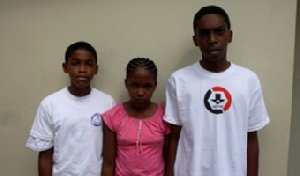
Bethill L'Amerique, right, 16, and sister Bioutelle, 11, center, managed to rescue their mother from concrete rubble. Their father, Baptist pastor Bienne L'Amerique, was killed. Brother Berlau George, 13, was not at home but at his grandmother's house. (BWA photo)

Earlier Szilagyi spoke with family members of Bienne L'Amerique, pastor of Shiloh Baptist Church in Port-au-Prince, one of 150,000 confirmed deaths so far. Government officials said the death toll could reach 300,000.

L'Amerique's 11-year-old daughter, Bioutelle, told Szilagyi she was reading on the first floor when a chasm opened and their two-story home fell into it. Her brother, Bethill, 16, said he was watching television upstairs. He said he was unhurt and helped pull his sister from the rubble. They heard their mother screaming, he said, and managed to pull her free from the concrete rubble.

Bioutelle said her father was in the living room with his mother and a section of the ceiling fell on him when he stood to leave the house. He was buried too deep for the family to reach him and did not speak or move. "My mother is saying that it is possible that he died immediately when the ceiling fell on his head," Bethill reportedly said.


–Bob Allen is senior writer for Associated Baptist Press.


Haitians seek shelter near church in Port-au-Prince

PORT-AU-PRINCE, Haiti (BP)—A blue tarp tied to what is left of Shiloh Baptist Church in Port-au-Prince, Haiti, serves as a safe haven for some members who survived the Jan. 12 earthquake.

Members of Shiloh Baptist Church in Port-au-Prince, Haiti, which lost four key leaders in the Jan. 12 earthquake, gather outside what’s left of their church building. As church members recount stories of that horrific day, they ask for prayer that God will raise up new leaders to guide their church. (IMB PHOTO/Baptist Press)

A few dozen families who lost their homes are living outside the church under the tarp. The earthquake damaged the building, collapsed the church’s school and took the lives of Pastor Bienne Lamerique and three other church leaders.

One member said that, of the 2,000-member congregation, only 100 have been accounted for since the 7.0 magnitude quake that is believed to have killed hundreds of thousands of people in Haiti.

International Mission Board missionaries Dawn Goodwin and Carlos Llambes, Baptists from the Dominican Republic and a missionary from another organization visited Shiloh Baptist and other churches in the area to review damage and encourage members.

Many pews at Shiloh Baptist remain overturned and support beams appear to be damaged. Metal rods in the beams were bent from the shifting weight of the roof during the earthquake. The church building was under construction, so the congregation had been meeting in an open-air auditorium.

Twenty-five-year-old Pierre Anderson and several other church members were in the auditorium when the earthquake hit. A few members were injured, but none seriously, Anderson said. He and the others later learned their pastor and three other church leaders had died in the disaster; Lamerique died of injuries sustained when his house collapsed.

Anderson and a handful of other church members shared their stories with IMB missionary Mark Rutledge Jan. 18. Rutledge, currently on stateside assignment, is in Haiti to help translate for a media team as they report on the damage.

Although some of the walls remain standing, a collapsed roof has made Shiloh Baptist Church in Port-au-Prince, Haiti, too unsafe to use. Instead, church members gather for daily worship services in a small open lot on the side of the property. (IMB PHOTO/Baptist Press)

“We don’t know where our future leaders will come from,” Anderson told the missionary.

Rutledge paused while translating for Anderson, who speaks French Creole, the heart language of Haitians. He turned and cried for a moment while members of the congregation watched.

“One of their remaining leaders told them that they just need to hold on a little longer,” said Rutledge, who served in Haiti for 26 years.

When Rutledge and his wife, Peggy, began serving as career missionaries in 1987, the couple attended Lamerique’s first church start, which met in a small house in a Port-au-Prince slum. The Rutledges became close friends and prayer partners with Lamerique and his wife.

Anderson also told Rutledge he lost his two sisters in the earthquake. One of the bodies has yet to be pulled from a collapsed building.

His faith is what is getting him through the crisis, Anderson said.

“It’s been the church’s encouragement that has helped give me strength,” Anderson said. The church has been holding services every day outside the building since the quake.

“No matter what happens in life, the only thing that matters is Jesus Christ,” Anderson continued. “If you have faith, he will sustain you.”

{youtube}oZtqWOrKL3E{/youtube}
Message from IMB Haiti missionary Mark Rutledge.

“The same God that allowed this to happen can rebuild it,” added Roseman Louis, who lost a cousin and a sister.

For now, the church continues to move forward, but Anderson admits they are struggling for direction and to meet physical needs since water, food and other supplies are limited.

Thousands of displaced people—like members of Shiloh Baptist Church—are living on the streets, in parks and just about anywhere there is open space. Bodies still can be seen lying on the street or partially exposed in the remains of collapsed buildings.

Amid the dire situation, “a revival could happen…,” Rutledge said. “… If the focus is on Jesus, that kind of change can happen … a change that is more than skin deep.

“I think there is huge potential for revival,” Rutledge added. “I believe there is hope.”


Church historian: No easy predictions for Baptists’ next 400 years

WACO—Nobody can predict with certainty what the next 400 years hold for Baptists—or for any religious denomination, church historian Martin Marty told a gathering at Baylor University.

But Marty, professor emeritus at the University of Chicago, offered general observations based on history and trends as he spoke on “The Future of a Denomination: Baptists in the Next 400 Years.” The event was scheduled as part of Baylor’s recognition of the 400th anniversary of the Baptist movement.

Marty characterized denominations—as distinct from a single state church—as a “four century-old Anglo-American invention” and noted Baptists were “present at the creation.”

Martin Marty (left), professor emeritus at the University of Chicago, visits with Baylor University Interim President David Garland (center) and Barry Hankins, professor of history and church-state studies at Baylor. Marty spoke at Baylor on “The Future of a Denomination: Baptists in the Next 400 Years.” (PHOTO/Robert Rogers/Baylor University)

While some observers ask if denominations in their present form are dead or dying, Marty asserted that “structurally, functionally, something would likely fill its role.”

What’s true for denominations in general undoubtedly would prove true for the Baptist movement, he suggested, but he cautioned against making confident predictions.

He cited as a guiding text a line from a speech by Abraham Lincoln: “If we could first know where we are, and whither we are tending, we could better judge what to do and how to do it.”

“This means cautious projection and the describing of alternative scenarios for life in the future,” he said. “The latter must relate to the Baptist visions and embrace of Christian faith, hope and love. Praxis follows.”

Marty offered a series of “where and whither questions” followed by “what and how” application on a variety of subjects:

Identity. Regarding the essence of the distinctive Baptist tradition, Marty confessed, “I have not found the essence of baptisthood.”

However, he suggested, a clue to the historically central feature of the Baptist movement lies in its name.

“Believers’ baptism by immersion was the most visible mark of being a Baptist,” he said, pointing to its “branding” nature. But the commitment to following religious convictions and living those convictions out with integrity preceded the mode and method of baptism. Separatists and others “backed into” their understanding of believers’ baptism, he asserted.

“It was so exceptional, unsettled and branding that it became central to the story and provided the name,” he said.

Marty observed less attention today given to the meaning of believers’ baptism among Baptists—particularly as it relates to daily living and ethics—than in some places and times, as well as a decline in baptisms, even in congregations where attendance has increased.

• Community and autonomy. Baptists long ago “took the risk” in terms of emphasizing individual decision-making in matters of religion, Marty noted. However, he added, historic Baptist convictions about soul liberty and soul competency have been balanced by “the integral tie to community in voluntary association.”

The challenge for the future lies in the “pick and choose” nature of individualized spirituality that does not find direction from a religious community, he asserted.

• Church polity. Observers of church life recognize that regardless of a denomination’s official polity—hierarchical, episcopal, presbyterian, congregational or whatever—“the local wins out,” Marty observed, and “Baptists should be theologically most ready to profit from the trend.”

At the same time, individual Christians, churches and denominations have unprecedented capacity to be involved with other Christians globally through communication technology, he added. Through the Internet, “distance has disappeared,” he noted.

• Church and state. In some circles “long-held Baptist views on separation of church and state have appeared to be compromised or obscured—or even abandoned,” Marty said.

“The moral crisis, the security crisis, the pluralism crisis—all have led some to conclude we are so far gone that even Baptists have been willing to call on the state to help us do our work,” he said.

How Baptists—“and Baptist-like traditions”—respond to church-state issues in the future has fateful consequences for their witness in society, he observed.

• Peoplehood. Baptists, like other Christians, tend to congregate and allow their lives to be shaped to a large degree along lines of social class and race, Marty noted.

“Some largely white Baptist groups do better than others at reaching beyond historical bounds, but all confess that they have a long way to go,” he said.

The role of women in the church—particularly in ministry—remains a crucial issue with which Baptists likely will grapple in the future, he noted.

• Witness and pluralism. Few Baptists waver in devotion to the uniqueness of Jesus Christ, Marty said, but they struggle with how that faith relates to other world religions.

“We can’t settle for a casual universalism that says we’re all in different boats headed toward the same shore,” he observed.

At the same time, some Baptists want to avoid holding to the kind of exclusiveness that would cause non-Christians to write them off as narrow bigots more focused on “denouncing each other than hearing each other,” he said.

• Sex. Baptists’ response to issues such as abortion, contraception and homosexuality do not relate specifically to Baptist history and impulses—except the Baptist tendency to fight, Marty observed.

• Conflict. “Baptists as creative dissenters were born in conflict and produce conflict,” he said.  But Baptists also possess the capacity to provide “a rich and warm home,” he added. “And there are plenty of biblical texts to find direction for that.”

An African-American, Hispanic and British Baptist each offered responses to Marty’s presentation.

David Goatley, executive secretary-treasurer of the Lott Carey Baptist Foreign Mission Convention and president of the North American Baptist Fellowship, offered cautious words about a tendency toward disunion in Baptist life, but also described the calling toward communion.

“The centering role of denominations is no longer needed in the same way it once was,” Goatley noted.

Churches can access information by Internet that denominational publishing houses once provided, and they may connect with missions opportunities globally without the intermediary of a denominational mission board, he said.  

Rather than make a utilitarian argument for denominational entities—“We can do more together than we can do working alone”—Goatley suggested looking to the need for communion and fellowship.

“There is a calling for communion, a call to be family,” he said. “Denominations create the table around which we gather.”

Nora Lozano, associate professor of theological studies at Baptist University of the Americas , described the way her early understanding of Baptist identity was shaped in reaction to Catholics, and later charismatics and Pentecostals.

“We defined ourselves in a negative way,” she said. “What they did, we didn’t do.”

Later, she gained an understanding of Baptist identity formed by what church historian Walter Shurden has called “four fragile freedoms”—Bible freedom, soul freedom, church freedom and religious freedom.

Lozano voiced hope that Baptists will find the freedom to become more inclusive—particularly of racial minorities and women—and more trusting of fellow Christians who may differ on emphases or worship styles.

Nigel Wright, principal of Spurgeon’s College in London , challenged Baptists to look not just at the future that can be calculated based on trends, but also at “the imaginable future” as projected by the biblical prophets and by the heavenly vision in Revelation 7.

That vision of a great multitude from every nation, tribe, people and language gathered to worship the exalted Christ means “everything about Baptist life is provisional,” Wright said.

“Baptists are not the last word, but just a step on the journey—a journey we share with God and with people of many communions,” he said. “There is no one way of being the church.”

Wright called for a “corrective ecumenism” that recognizes the true church does not yet exist, but the many Christian communions have insights they can offer to other members of the Christian family.

While Baptists can learn from Catholic, Orthodox and Anglican Christians something about the historical continuity of faith, other parts of the Christian family can learn important principles about freedom from the Baptist movement, he noted.

“We need to care about other parts of the church,” Wright said, “because our future is bound up in their future.”


U.S. Baptists issue urgent fundraising appeals for Haiti

ATLANTA (ABP) — Baptist groups in the United States have launched urgent funding appeals for earthquake relief in Haiti.

The Cooperative Baptist Fellowship has directed more than $15,000 in funds designated for "Haiti Earthquake Response" raised through a website appeal, Chris Boltin, short-term assignments and partnerships manager for the Atlanta-based CBF reported Jan. 16.

Steve James, a missionary jointly appointed by CBF and American Baptist Churches USA, ministered to earthquake victims Jan. 18 at a mission clinic located about two miles outside the epicenter near the capital city of Port-au-Prince.

James' wife, Nancy, said missionaries were treating wounded people on tables outdoors until they could find a building safe enough to bring them inside. She said her husband counted nine aftershocks during the course of the day, one strong enough to shake medicines off of the pharmacy shelves.

The Jameses were in the U.S. when the 7.0 magnitude quake struck Jan. 12. They made it back to Haiti Jan. 14, where they decided that he would head into the damage zone with an initial fact-finding team while she went to their home in Haut Limbe, outside the damage zone, so she could answer e-mails and keep in touch with him by phone.

She said her husband and other volunteers with him appreciate prayers and thoughts for them and for the people of Haiti. "It is a time of stress but also they are so glad that they are there able to be of help," she wrote. "Please pray for food, fuel and medicines to arrive soon as their supplies are low. Pray for so many still suffering." 

Julius Scruggs, president of the National Baptist Convention USA, Inc, called on the convention's auxiliaries, boards, commissions, ministries, churches, state conventions and district associations to "work together under the leadership of the Parent Body" for disaster relief.

"By working together, our impact will be multiplied," Scruggs wrote in an open e-mail. 

Scruggs, pastor of First Missionary Baptist Church in Huntsville, Ala., said National Baptists were following the recommendations of the USAID Development Experience Clearinghouse, of which the convention is part, to wait until infrastructure is established before sending in untrained volunteers.

"As the situation in Haiti becomes clearer and more stable over the next several days and weeks, the convention will develop and execute a disaster-relief plan with measureable goals and objectives," Scruggs said. "In the meantime, we must focus our efforts on raising funds which ultimately will determine how much assistance we will be able to provide."

Scruggs said more plans for disaster response would be announced to those attending the convention's Mid-Winter Board Meeting scheduled for Jan. 18-22 in Nashville, Tenn. The convention has also established a Haiti Disaster Relief fund for online donations.

The Progressive National Baptist Convention, Inc., issued an urgent appeal to member churches for financial contributions to support earthquake victims. The PNBC has been involved in mission work in Haiti since the 1960s. PNBC president DeWitt Smith and PNBC General Secretary Tyrone Pitts said contributions to the Haitian Relief Fund "will be sent directly to our partners in Haiti and those who are suffering from this horrible tragedy."

John Raphael, director of the Foreign Mission Board of the National Baptist Convention of America, Inc., prepared to travel to Haiti for a first-hand look at the devastation. "We believe our mission sites have been destroyed," convention president Stephen Thurston said in an appeal for donations to the NBCA Relief Fund.

"I am appealing for an immediate response on behalf of your church, associations and state conventions to give dollars for the Haitian disaster," Thurston said.

Thurston said supplies would be transported to Haiti and distributed as part of a joint effort with the Lott Carey Foreign Mission Convention, another historically African-American group. Scruggs said he and the heads of the other major black Baptist conventions would be visiting Haiti as a group in the near future.

Over the years organizational and philosophical differences divided America's black Baptist community into four main organizations. In recent years those groups have held joint meetings, not in view of a merger, but to build relationships for cooperation on common concerns.

Two years ago they were part of a broader movement called the New Baptist Covenant, which seeks to unite all Baptist groups — black, white and brown — in North America around consensus concerns.

The Lott Carey Foreign Mission Convention is receiving funds to support families affected by the tragedy in partnership with the Strategic Union of Baptist Churches in Haiti, a network of 22 churches and one of Lott Carey's global partners.


–Bob Allen is senior writer for Associated Baptist Press.


Baptist World Alliance rescue team arrives in Haiti

FALLS CHURCH, Va. — A Baptist World Aid Rescue24 team has arrived in Port-au-Prince, Haiti, and has begun work in a local clinic, according to a news release from the Baptist World Alliance.

The BWAid team, consisting of members from Hungary and North Carolina, has come up against horrific scenes.

"The situation is terrible, I have never seen anything like this," said Bela Szilagyi, head of Hungarian Baptist Aid, who has been working in major disaster zones for more than 10 years. Szilagyi is one of the leaders of the BWAid Rescue24 team in Port-au-Prince.
 
They came across "immense chaos, confusion, and the terrible smell of dead bodies."
 
Members of the team flew to a location close to the Haiti-Dominican Republic border, and were escorted into Port-au-Prince by "blue helmets," United Nations peacekeeping soldiers. They will remain in Haiti for one week providing emergency medical services.


Baptist pastor among dead in Haiti

ALLENTOWN, Pa. (ABP) — Baptists in Haiti mourned the death of a beloved pastor killed in the Jan. 12 earthquake.

Gedeon Eugene, a vice president of the Baptist Convention of Haiti, told the Baptist World Alliance that Bienne L'Amerique, 46, pastor of Shiloh Baptiste Church in Port-au-Prince, was one of thousands of victims buried in rubble of collapsed buildings in the capital city.

L'Amerique, described as a beloved pastor and leader among Haiti's Baptists, was a host to mission groups from the United States and was due to visit the U.S. next month.

''Everybody in our office is crying,'' Jack Groblewski, senior pastor of New Covenant Christian Community in Bethlehem, Pa., told the Morning Call newspaper in Allentown.

With most of Haiti's power grid destroyed, information from Haiti was slow in coming during the first three days after the disaster. Eugene told BWA officials there had been no word on the fate of about 15,000 members of six Baptist congregations located in Port-au-Prince.

Groblewski said about half of L'Amerique's church building collapsed, and it was constructed better than some others. The American pastor said streets in the neighborhood where Shiloh Baptiste was located are said to be lined with corpses, which are covered with sheets or blankets because there are no body bags.

Baptists in America responded quickly to the humanitarian crisis, but aid was slow in arriving due to difficulty in getting into the country. A medical team from North Carolina Baptist Men left for Haiti Jan. 14, but was still trying to get across the border a day later.

Texas Baptist Men were waiting for clearance Jan. 15 to send 5,000 water-purification systems that cost $30 each. The group asked for donations to help cover costs of the $150,000 commitment.

Buckner International was preparing four containers of shoes and emergency food items for Haiti, which will cost $5,000 per container to ship. Buckner asked the public to supply new items such as new socks, tents, toiletries and new and unopened first-aid kits.

Relief agencies said the best way to help in the short term is to give money. Aid cannot be distributed until staging areas are established, and most volunteer work will not be needed until after the initial search-and-rescue phase. Groups including Baptist World Aid, the Cooperative Baptist Fellowship and American Baptist Churches USA are all raising money for earthquake relief.

Several churches are also making large commitments to disaster relief. Seventh & James Baptist Church in Waco, Texas, set aside $10,000 for earthquake aid. Mitch Randall, pastor of NorthHaven Church in Norman, Okla., asked his church members to give money to Baptist World Aid. Randall visited Haiti last year to distribute mosquito nets with His Nets, a ministry that fights malaria in developing countries started by T Thomas, coordinator of the Cooperating Baptist Fellowship of Oklahoma.

Baptist leaders also sought prayer for Haiti. www.d365.org, a devotional website sponsored by the Cooperative Baptist Fellowship, The Presbyterian Church U.S.A., and the Episcopal Church, is editing content to guide readers in devotion and prayer about Haiti.

Colleen Burroughs of Passport, Inc., the organization that produces d365.org, said the site was created in response to 9/11, when it became apparent that Advent literature written months earlier for students was not relevant at the time. The site offers daily devotions, along with Advent and Lenten series, but it is also designed to respond immediately to events like the tsunami in Asia or Hurricane Katrina.

"The immediate response helps make it a relevant ministry to students," Burroughs said. Last year d365.org had 450,000 visitors from all around the world, and the site is currently being translated for Christians in Mongolia at their request.


–Bob Allen is senior writer for Associated Baptist Press.


Baptist Briefs

Church employees invited to participate in compensation survey. Texas Baptist church employees are invited to participate in the 2010 Southern Baptist Convention Church Compensation Survey, provided through the joint efforts of Baptist state conventions, LifeWay Christian Resources and GuideStone Financial Resources. The survey, which can be accessed at www.LifeWay.com/compensationsurvey, studies the pay and benefits of ministers and employees of Southern Baptist churches. Through the survey, church administrators, personnel and finance committees and minister-search teams have access to an accurate baseline by which they can compare their own church’s salary and benefits with similar churches across the country. Answers to the online survey are kept confidential and are not reported individually. The survey takes, on average, less than 10 minutes to complete. In addition to salary and benefit information, participants in the survey will need to have their church’s average weekly worship or Bible study attendance, resident membership and annual budget. The survey is available through April 30, and results will be released in June.

FamilyNet sold again. FamilyNet, a television and radio network formerly owned by the Southern Baptist North American Mission Board, has been sold once again. Charles Stanley’s In Touch Ministries, which purchased FamilyNet from NAMB in October 2007, has sold the network to ComStar Media Fund, a private firm affiliated with Robert A. Schuller, son of TV preacher Robert Schuller. No purchase price for FamilyNet was disclosed. NAMB received a half-hour of TV and radio programming each week under the sale of Family Net to In Touch Ministries. NAMB will lose that airtime under the new sale.

SBC president undergoes cancer surgery. Southern Baptist Convention President Johnny Hunt underwent successful cancer surgery Jan. 7 at Northside Hospital in Atlanta. An update on the First Baptist Church of Woodstock, Ga., website said Hunt rested well after the operation and was due to be released from the hospital the next day. He was scheduled to visit the doctor for a check-up Jan. 15. Hunt, 57, announced in November he had been diagnosed with prostate cancer. He was elected SBC president in 2008 and re-elected to a customary second term last year.

Truett-McConnell requires faculty to sign SBC statement. Truett-McConnell College’s trustees adopted the 2000 Baptist Faith & Message as the confessional statement for the Georgia Baptist institution and asked President Emir Caner to develop a plan for faculty and administrators to embrace the doctrinal statement. Trustee Bailey Smith, an evangelist and former Southern Baptist Convention president, made the recommendation. “We will be the first Southern Baptist college to require a signature to affirm the Baptist Faith & Message in a public forum,” Caner said. Faculty will have 18 months to sign the document, he announced.