Vietnamese churches join Baptist World Alliance

HONOLULU — Some of the globe’s most persecuted Christians found an international home when the Baptist World Alliance admitted the Baptist Churches in Vietnam into the global organization.

The BWA’s General Council voted full membership July 28 to the Vietnamese organization, as well as to Baptists from Zambia and the District of Columbia in the United States, as delegates gathered in Honolulu for the 20th Baptist World Congress.

“This is a historic moment and a fruitful moment,” BWA President David Coffey said as General Council members prepared to vote on the Vietnamese Baptists. He reflected on the persecution and struggles faced by Christians in Vietnam during the latter part of the 20th century.

He pointed to a 2006 human rights visit — conducted by representatives of the BWA and Texas Baptists — as a pivotal event in securing government recognition for Vietnamese Baptists.

They trace their heritage to the work of Southern Baptist missionaries in their country, reported Alistair Brown, chairman of the BWA’s membership committee.

“Their formal founding was in 1988,” said Brown, a British Baptist who now is president of Northern Baptist Theological Seminary in Lombard, Ill., a Chicago suburb. “Those were very difficult years, when open witnessing was illegal in Vietnam.”

The Baptist Churches in Vietnam received government recognition in 2008. The organization includes 509 churches with about 30,000 members.

“This day represents a new chapter of Baptist work in Vietnam,” noted Bonny Resu, general secretary of the Asia Pacific Baptist Federation, one of the BWA’s six regional fellowships.

Admission into the BWA marks a historic and emotional milestone for Vietnamese Baptists, stressed Giam Nguyen, general secretary of the Baptist Churches in Vietnam, in an interview.

The General Council also affirmed admission of the Baptist Fellowship of Zambia and the District of Columbia Baptist Convention.

The Zambian fellowship was founded in 1995 and affiliates with about 1,500 congregations, making it the largest Baptist group in the African nation, Brown said. The Baptist Convention of Zambia, an older but smaller organization, endorsed the Fellowship’s BWA membership – an important component in the process of affiliating with the BWA, which aims to avoid rivalry among Baptist groups in each country.

The District of Columbia convention dates to 1877 and covers the entire district, the United States’ capital, plus parts of neighboring Maryland and Virginia.

The D.C. convention includes 112 churches and 34 mission congregations and numbers 66,000 members. It affiliates with multiple other Baptist groups, including the Alliance of Baptists, American Baptist Churches in the USA, Cooperative Baptist Fellowship, Progressive National Baptist Convention and Southern Baptist Convention.

Coffey, whose term as BWA president ends with the Baptist World Congress in Honolulu, presided over his last General Council session.

He recounted visiting the naval memorial at Pearl Harbor, where thousands of U.S. naval personnel lost their lives in a surprise attack by the Japanese air force that launched World War II.

A map at the memorial “put Honolulu at the center of the universe,” Coffey reported, noting, “This was appropriate for a monument at Pearl Harbor, but I was not used to seeing the world that way.”

He compared this surprising perspective to participation in the BWA. “We see the world from a different perspective,” he said of the experience brought about by attending the Congress with fellow Baptists from all over the planet.

Through the lens of the BWA, he has seen remarkable changes, Coffey said. He noted particularly the contrast between a 1986 trip to the U.S.S.R to plead on behalf of persecuted Baptists in Siberia, when Soviet officials were dismissive, and a return trip this year, when government leaders praised Baptists for their work on behalf of their fellow Russians.

“What a difference 24 years make,” he marveled. “We’ve seen enormous changes in our world and among Baptists, but our God is the same yesterday, today and tomorrow.”

Coffey’s successor, President-elect John Upton, also presided at a General Council session.

He compared the BWA to the origin of the Harlequin clowns of Europe. The original Harlequin was a poor boy who could not attend a ball because he could not afford a costume. His friends all realized they could donate pieces of their costumes, which they took to him, even though they were embarrassed by the hodgepodge of scraps.

The friends arrived at the ball in their finery but lamented the absence of Harlequin. Late in the evening, he showed up wearing the most beautiful and colorful costume, which his mother sewed from the fragments of his friends’ costumes.

“His friends ran to Harlequin and told him how glad they were Harlequin came to the ball,” Upton reported. “But he said, ‘I’m the gladdest of all, because I’m clothed in the love of my friends.’ ”

The story is a metaphor for BWA, Upton said. “We’re all different, with different colors, shapes and languages. Maybe God wants to use each of us to make that unusual thing called BWA. Bring your own distinctive colors, talent, style and heritage.

“A miracle is going to happen, and it will look like dancing. You know who will be the one dancing? It will be Jesus, clothed in the love of his children.”

Among other business, General Council members:

• Learned the BWA had received a clean audit for 2009, according to Richard Smith of Virginia, chairman of the budget committee.

• Received a 2011 budget, previously approved by the BWA Executive Committee, of $2,342,000. That amount is flat compared to the 2010 budget, Smith reported.

“This is a difficult time,” Smith said, referencing the downturns of the global economy and its impact upon Baptists. “We appreciate the staff for working to maintain expenditures within receipts.”

• Re-elected the BWA ministry directors — Raimundo Barreto of Brazil, freedom and justice; Emmett Dunn of Liberia, youth department and conferences; Paul Montacute of the United Kingdom, Baptist World Aid; and Fausto Vasconcelos of Brazil, mission, evangelism and theological reflection.

• Elected regional secretaries — George Bullard, North American Baptist Fellowship; Everton Jackson, Caribbean Baptist Fellowship; Harrison Olan’g, All Africa Baptist Fellowship; Tony Peck, European Baptist Federation; Alberto Prokopchuk, Union of Baptists in Latin America; and Bonny Resu, Asia Pacific Baptist Federation. Jackson is new in his assignment; the others have been serving.

• Filled vacancies on multiple committees and commissions.

• Learned the BWA theme for the next five years will be “In Step With the Spirit.”

• Heard the BWA Executive Committee selected Durban, South Africa, to host the 21st Baptist World Congress in July 2015, and the 2011 BWA Annual Gathering will be in Kuala Lumpur, Malaysia.

–Marv Knox is editor of Texas’ Baptist Standard.


Listen to the Spirit, receive the anointing, Coffey urges Baptists

HONOLULU — Human effort and creative strategies lead to futility apart from an anointing by God’s Holy Spirit, British Baptist leader David Coffey told the opening session of the Baptist World Congress, July 28 in Honolulu.

Coffey, who completes his five-year term as president of the Baptist World Alliance at the international gathering in Hawaii, challenged Baptists from around the world to hear and heed the Holy Spirit.

Outgoing BWA president David Coffey preaches in the opening session of the Baptist World Congress. (Photo by Rand Jenkins)

“We can be a purpose-driven church. We can be a seeker-sensitive church. We can be an emergent and creative church. We can be a justice-and-peace church. We can be a conservative Calvinist church. But if we fail to hear the Holy Spirit of the living God, then all our serving will be futile and fruitless,” he said.

Baptists run the risk of having “the appointing without the anointing,” he warned.

From his virgin birth to his empowered ministry of teaching, preaching, healing and perfect obedience to God’s plan, the Holy Spirit rested upon Jesus Christ, Coffey observed.

“The Holy Spirit is integral to the birth, the identity and the mission ministry of Jesus,” he said. “So, why is it we so often to choose to go it alone?”

When Baptists choose to follow their own methods and timing rather than God’s, they fail to follow in the footsteps of their forebears, Coffey noted. He cited the example of early English Baptists John Smyth and Thomas Helwys, missionary Lottie Moon and civil rights leader Martin Luther King Jr.

God wants the Spirit-filled ministry of Jesus Christ to continue through his people, Coffey said.

“The essence of the Holy Spirit’s ministry is to bring the presence of Christ to his people. His purpose is that Jesus is known, loved, honored and praised,” he said.

The Spirit of God brings attention to the Son of God, exalting Christ and making him known, he said.

To be the people God has called them to be, Baptists should be able to testify the Holy Spirit lives within them and rests upon them, Coffey said.

“If you can’t say the Holy Spirit is in me, then you cannot be truly part of God’s family. If you can’t say the Holy Spirit is on me, you cannot be truly effective in ministry,” he said.

When the Holy Spirit rests upon God’s people, obedience and service mark their lives, he said.

“When the Holy Spirit is truly upon people, Jesus is leading his people and it shows,” Coffey said. “It produces healthy churches and fruitful mission.

“The Holy Spirit inspires praise and worship. He creates fellowship between diverse people. … The greatest sign of the Holy Spirit on us is that God makes us part of his action plan for winning a lost world. … He has called and equipped us to be the actors in his great drama.”

When God’s people are anointed by God’s Spirit, they have no call to them of themselves as “nobodies,” Coffey insisted.

“Friends, the people of God are never a little people. The world may despise and hate us. The world may persecute us and seek to destroy us. The world may exercise might without morality and power without compassion,” he said.

“But the truth is when the world has left the battlefield, the last people standing will be those who can exclaim, ‘The Spirit of the Lord is on me, because he has anointed me.’”

At a news conference prior to the opening session of the Baptist World Congress, Coffey characterized the global Baptist fellowship as a people of “praying hands and dirty hands” — people who seek the Holy Spirit for vision but who face the world as it is and seek to make it better.

Coffey reflected briefly on his five years as BWA president and a few words of counsel for President-elect John Upton.

“We don’t have to make the gospel relevant, but we do have to demonstrate its relevance,” he said.

Baptists also need to respond to the challenge to “demonstrate the ongoing vitality of being a Baptist,” Coffey concluded. “The next generation may not want to inherit our institutional structures, but they want our vision.”

Coffey, a former Baptist pastor, was general secretary of the Baptist Union of Great Britain for 15 years before retiring.

—Ken Camp is managing editor of the Texas Baptist Standard.


U.S. denies visas to about 1,000 hoping to attend BWA Congress

HONOLULU — As many as 1,000 people who had registered for the Baptist World Alliance’s Congress this year were unable to attend because they were denied visas by the U.S. government, leaders of the global Baptist organization said July 28.

Security-conscious Americans are increasingly prohibiting entry to foreign nationals attending religious conferences and that is making it difficult for global Baptist meetings to be held in the United States, said the leaders at a press conference at the beginning of the 20th Baptist World Congress.

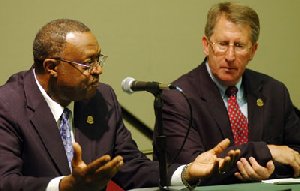
BWA general secretary Neville Callam (left) and outgoing BWA president David Coffey speak to reporters on the first day of the Baptist World Congress. (Photo by Rand Jenkins)

“People want to come to the United States. It’s a wonderful place,” said Neville Callam, general secretary of the Falls Church, Va.-based BWA. “But it’s difficult when general secretaries and presidents [of national Baptist conventions and unions] have saved to come to a conference and they are denied a visa. And there’s nothing anyone can do.

“Of course, states have to protect themselves,” Callam added. “We must take that into account. But it would be very unfortunate if the U.S. had to be eliminated from the list of places to hold meetings.”

Countries in Africa and Asia were the hardest hit by the visa denials, said Emmett Dunn, the BWA’s meetings and conferences director. All 87 delegates from Angola were denied visas, Dunn said, as was 40 percent of Nigeria’s 246-member delegation. Only two of Sierra Leone’s 27 registered delegates were granted visas and only 24 percent of the more than 100 registrants from Bangladesh received permission to enter the U.S. Other hard hit countries were Ghana, Liberia and India.

“We live in post 9-11 world,” said Dunn, acknowledging heightened security concerns.

Registration at this year’s Congress is expected to be about 4,000 – a steep drop from the approximately 10,000 who attended the last Congress five years ago in Birmingham, England. While a fragile economy and Hawaii’s distance from centers of Baptist population both contributed to a smaller attendance, visa denials unquestionably played a role and left many potential travelers frustrated – as many expressed in emails sent to BWA headquarters in Falls Church.

BWA conference director Emmett Dunn discusses the U.S.\'s denial of visas to about 1,000 conference registrants. (Photo by Rand Jenkins)

“We paid our registration fees, we paid also our travel ticket, we have done our reservations … really we lost more money, we’re very sorry,” wrote one of the Angolans whose visa was denied.

“After showing all the required documents … several of us were rejected today for no specific reason,” wrote a delegate from Sierra Leone.

Callam said other global Christian bodies – including the worldwide organizations of Seventh-day Adventists and the Reformed churches – have been impacted by American visa denials, sparking wide-ranging debate about the issue.

In other comments at the press conference, outgoing BWA President David Coffey said his five-year term in office increased his appreciation for Baptists’ diversity and of the challenges to sharing the gospel.

“We don’t need to make the gospel relevant,” said Coffey, a British Baptist pastor and denominational leader. “We do have to demonstrate its relevance. The challenge for us who are international pastors is to demonstrate what is already a relevant gospel to people around the world.”

The BWA also must “demonstrate the ongoing vitality of being Baptist,” which may result in new ways of ministry, said Coffey.

“The next generation may not want to inherit our structures, but they will want to inherit our visions.”

–Robert Dilday is managing editor of Virginia Baptists’ Religious Herald.


South Africa to host continent’s first Baptist World Congress in 2015

HONOLULU (ABP) — For the first time, the Baptist World Congress will be held in Africa in 2015, according to a July 27 announcement from Baptist World Alliance General Secretary Neville Callam.

Speaking on the eve of the 20th Baptist World Congress in Honolulu July 28-Aug. 1, Callam said the South African port city of Durban would host the 21st quinquennial gathering of global Baptists. The meeting is scheduled for July 2015.

"It will be an honor to the Baptists of South Africa and to Africa to host the Baptist World Congress," responded Paul Msiza, president of the All Africa Baptist Fellowship and general secretary of the Baptist Convention of South Africa. Callam’s announcement and Msiza’s remarks came during the BWA Executive Committee meeting, one of several BWA events prior to the Honolulu Congress.

Msiza said South Africa’s recent experience hosting the FIFA World Cup soccer tournament — the globe’s most widely viewed sporting event — provided the nation’s Baptists with good practice at hosting foreigners.

"You will enjoy South African hospitality," Msiza said.

Durban — a city of 3.5 million on South Africa’s east coast — was one of several cities around the nation that served as venues for games in the tournament.

The event marks the first time the 105-year-old umbrella group for the world’s Baptists has held its biggest meeting in Africa. African Baptists — like other Christian groups on the continent — are growing rapidly. However, the high cost of international travel — particularly to far-away Western destinations like North America and Western Europe — has made attending past congresses prohibitive for many African Baptist leaders.

A crowd of approximately 4,000 was expected at the Honolulu meeting, compared to about 13,000 who attended the 2005 congress celebrating BWA’s centennial in Birmingham, England.

The first meeting was held in London, and has mostly stuck to the Western and Northern Hemispheres in years since, with the majority of congresses meeting in English-speaking countries.

Only three other Baptist World Congress gatherings — in Rio de Janiero in 1960, Buenos Aires in 1995 and Melbourne in 2000 — have taken place in the Southern Hemisphere. The gatherings have taken place in Asia twice — Tokyo in 1970 and Seoul in 1990.


–Robert Marus is managing editor and Washington bureau chief for Associated Baptist Press.


Southern Baptists’ large military presence colors gay debate

WASHINGTON (RNS)—In many religious circles, the repeal of a military ban on openly gay members is considered practically a done deal. But Southern Baptists, who have many more active-duty military chaplains than any other denomination, are not giving up without a fight.

The Southern Baptist Convention is battling the expected repeal of Don’t Ask/Don’t Tell on a number of fronts. Its agencies are contacting Congress and the Pentagon, retired chaplains are sending letters to President Obama, and a resolution adopted at the denomination’s annual meeting in Orlando, Fla., condemns allowing gays and lesbians to serve openly in the military.

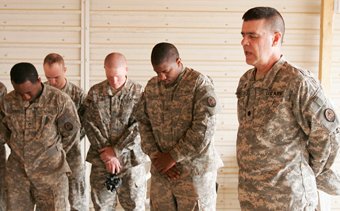
U.S. Army Chaplain Jeff Houston (right) prays with American soldiers prior to a mission in Iraq. (BP PHOTO/Carol Pipes)

“If a policy makes it more difficult—in fact, discourages—one of the groups that provides one of the largest numbers of chaplains to the military from continuing to engage in chaplaincy ministry, that should raise significant concerns for them about the … spiritual well-being of our men and women in uniform,” said Barrett Duke, vice president of the SBC Ethics & Religious Liberty Commission.

With about 16 million members, the Southern Baptist Convention is the country’s largest Protestant denomination but falls well short of the Catholic Church’s 68 million members. But whereas the Catholic Church has 252 active-duty chaplains, the Southern Baptist Convention has 448—the most in the military. There are about 3,000 active-duty chaplains overall.

The number of active-duty personnel who identify themselves as Southern Baptist is far smaller than the number of Roman Catholics, but there is no quota system for chaplains. Chaplains serve members of all faiths, rather than solely troops of their denomination.

More liberal denominations with much smaller numbers of military chaplains worry Southern Baptists might be more influential in the gay debate.

“We have some concerns about that, sure,” said John Gundlach, a retired Navy chaplain who serves as minister for government chaplaincy for the United Church of Christ, which had 17 military chaplains as of March, according to the Defense Department.

Gundlach’s denomination joined other groups like the Episcopal Church, the Unitarian Universalists and the progressive Alliance of Baptists, in writing to Congress earlier this spring saying “this policy of government-sanctioned discrimination is morally wrong.”

Southern Baptist leaders have warned their chaplains may have to leave the military if Don’t Ask/Don’t Tell is repealed. Even their allies aren’t willing to go that far.

Archbishop Timothy Broglio, leader of the Archdiocese for the Military Services USA, has urged Congress not to repeal the current policy. But John Schlageter, general counsel for the archdiocese, said there are no plans to remove Catholic chaplains if the repeal occurs.

“We don’t think that the free exercise would be that restricted that we have to pull out,” he said, referring to the constitutional principle of freely exercising religious freedom.

The House of Representatives voted in late May for the repeal, and the Senate could consider it within a few weeks. If both houses of Congress pass the repeal, it would not go into effect until a Defense Department review is completed by Dec. 1 and President Obama and top military officials determine it won’t harm military readiness or retention.

Defense Department spokeswoman Cynthia Smith said the review panel’s mission “is not to engage in a debate about whether to repeal the law” but rather to learn how it might affect service members and their families.

Asked if a large group like the Southern Baptists might have more influence than others, Smith said: “Our review is going to be thorough and very objective.”

Southern Baptists, who say their presence in the military chaplaincy totals 1,300 chaplains when Reserve and National Guard units are included, have told Congress and the Pentagon that chaplains could lose their freedom to preach and counsel against homosexuality if openly gay members are accepted by the military.

“For instance, a chaplain could be told there are certain passages of the Scripture that you shouldn’t preach from,” said David Mullis, the Southern Baptists’ military chaplaincy coordinator.

“If there was a prohibition about certain kinds of literature that did not espouse homosexuality, I can see the Bible being banned in the military.”

Neither military officials nor Baptists could pinpoint why the Southern Baptist Convention has far more chaplains than other denominations.

But retired Army Chaplain Herman Keizer, who once served as the European Command chaplain, said the number of Southern Baptist chaplains has increased with the shortage of Roman Catholic priests in the military and reduced participation by mainline Protestants after the Vietnam War.

Also, he said, some seminaries have attracted second-career students who are too old for the chaplaincy, whereas Southern Baptist and other evangelical seminaries continue to draw younger clergy candidates.

Keizer, who has endorsed chaplains for the Christian Reformed Church, said he doesn’t think Bibles will be removed from military chapels, and he doubts most Southern Baptists would leave if the repeal is put in place.

“They’re dedicated enough to the whole notion of evangelism that they’re not going to abandon a mission field,” he said.


The faiths of military chaplains

Southern Baptists far outnumber other faith groups in the U.S. military chaplaincy corps, with 448 serving as active-duty chaplains out of a total of 2,992.

Joined with other evangelicals, they bring the number of evangelical chaplains to more than 1,000. Chaplains affiliated with mainline Protestant denominations number less than half of their evangelical counterparts, with more than 400 in the ranks. Roman Catholics total more than 250.

Here are totals for some faith groups, based on statistics as of March 31 from the Department of Defense:

• Southern Baptist Convention — 448

• Roman Catholic Church — 252

• Assemblies of God — 119

• United Methodist Church — 110

• Seventh-day Adventists — 43

• Church of Jesus Christ of Latter-day Saints — 37

• Orthodox — 25

• Islam — 10

• Judaism — 21

• Buddhist — 1

Sources: Department of Defense, membership lists of National Association of Evangelicals and National Council of Churches.


Catholics in Nagaland claim persecution by Baptists

NAGALAND, India (ABP) — Baptists in Nagaland defended themselves against charges of anti-Catholic bigotry after villagers tore down a Catholic church because the town allows churches only of the Baptist denomination. The controversy has generated widespread media attention pitting Catholics against the Nagaland Baptist Church Council.

Iringtie Kauring, acting general secretary while his boss Anjo Keikung traveled to attend this week's Baptist World Congress in Hawaii, released a statement saying the crisis in the village of Anatangre had been "blown out of proportion by people without studying the ground realities and listening to both parties in conflict."

Nagaland Map"The conflict is not between Catholics and Baptists, but between Catholics and Anatangre Village Council," Kauring said. "The Village Council has considerable authority in solving any problem within its jurisdiction for the welfare of the people. Therefore, NBCC appeals all concerned to address the crisis in the right perspective for the sake of peace and harmony in our land."

Catholic and media critics said the statement was too slow in coming and could have been more conciliatory. The controversy occurs at a time when Baptist leaders are taking a leadership role in opposing an effort to lift Nagaland's prohibition of liquor established in 1990.

Catholic priest Abraham Lotha penned a column in The Morung Express comparing the Baptist leaders' statement to "refusing to see the elephant in the room." While Baptists and Catholics coexist peacefully in many villages, Lotha lamented, "The truth is that anti-Catholicism is still the staple food for many people in Nagaland."

Nearly 150 years after arrival of the first American Baptist missionaries arrived, 65 percent of Nagaland's 1.9 million citizens are Christians. Among but native Nagas, whose ancestors were headhunters, the figure is 90 percent.

The vast majority of Nagaland's Christians are Baptists, creating an irony that in India — a country often known for persecution of Christians by Hindus — Baptists are being portrayed as oppressors.

Catholic schools across the state shut down to protest what the Catholic Association of Nagaland called a denial of "basic human rights."

The deputy commissioner in Kiphire district ruled July 23 that a Village Council resolution passed in 1991 prohibiting the establishment of churches of denominations other than Baptist had no legal standing. That resolution, passed in an attempt to prevent Baptists from converting to Catholicism, was behind a vote in March imposing fines and seizure of property against persons bringing other religions into the community.

Villagers constructing a Catholic Church in Anatangre were stopped July 9. The building was dismantled and construction materials were confiscated.

Ken Sehested, co-pastor of Circle of Mercy Congregation in Asheville, N.C., said there is no doubt that tension exists between Catholic and Baptist communities in some locales in Nagaland. "The anti-Hindu prejudice is even worse," Sehested said in an e-mail July 27. 

Sehested, former director of the Baptist Peace Fellowship of North America, has traveled overseas with Daniel Buttry, an American Baptist missionary, to work on conflict resolution between various Naga factions.

Buttry, global consultant for peace and justice with International Ministries of American Baptist Churches USA, circulated an e-mail denouncing the actions taken against the Catholics in Anatongre.

"This is not in keeping with basic Baptist principles about freedom of religion and freedom of conscience," Buttry said. "Our Baptist forebears suffered under this kind of religious exclusion, and it is both ironic and shameful when Baptists treat others like they themselves don't want to be treated."

"Catholics are not our enemies but are part of the Body of Christ even if we disagree with some of their teachings and practices," Buttry said.

Settled in northeast India for centuries, the Naga people wanted their independence after the end of the British Empire. Instead they were established as an Indian state

An article in India's constitution grants Naga villages jurisdiction to pass resolutions to protect "traditional culture and practices," but Catholics say that doesn't mean they can deny fundamental rights like freedom of religion.

Kauring defended the Nagaland Baptist Church Council's response and said July 27 it appeared that the village council in Anatangre was taking steps to resolve the situation.


–Bob Allen is senior writer for Associated Baptist Press.


Group demands apology for religious teaching that denigrates women

ORLANDO, Fla. (ABP) — A group of women and men calling themselves the Freedom for Christian Women Coalition has demanded an apology for religious teaching they say is harmful to women. Shirley Taylor, founder of Baptist Women for Equality, presented the Demand for an Apology from the Council on Biblical Manhood and Womanhood at a July 24 meeting in Orlando, Fla.

"At a time in our church history that the main focus should be on winning lost souls and spreading the gospel to a hurting world, we fear for the future because the Council on Biblical Manhood and Womanhood has placed a greater priority on women's submissive role rather than on the gospel of Jesus Christ," the statement read in part.

{youtube}XmdyPif9aq0{/youtube}

The Council on Biblical Manhood and Womanhood is an organization with offices on the campus of Southern Baptist Theological Seminary in Louisville, Ky. It was formed in 1987 to oppose "the growing movement of feminist egalitarianism" in churches. The council countered with a "complementarian" interpretation the Bible that affirms that men and women are equally in the image of God but assigns them "complementary differences" in role and function.

The view became enshrined as the official position of the Southern Baptist Convention in 1998, when an article on the family was added to the Baptist Faith and Message. The statement assigns husbands the responsibility "provide for, to protect and to lead the family," while the "wife is to submit herself graciously to the servant leadership of her husband even as the church willingly submits to the headship of Christ."

The Freedom for Christian Women Coalition claimed that wifely submission "is more about power and control than about love or obeying the Word of God." It called on the Council of Biblical Manhood and Womanhood to denounce the "Danvers Statement"– the group's statement of core beliefs — acknowledge the harm it has done to churches and to "confess it as sin."

The coalition said the theology behind the Danvers Statement assigns a "god-like" status to males, while relegating women to a lower class that opens the door to abuse.

"We are concerned about wife abuse, girlfriend abuse and abuse to female children that takes place in many homes where evangelical men are taught that they have earthly and spiritual authority over women," the statement said.

Complementarians deny their views on gender roles promote abuse, but Cindy Kunsman, a blogger who writes about spiritual abuse and one of the speakers at Saturday's conference, said that is naïve.

"Many women suffer as a result of the 'evil woman theology' perpetuated by CBMW because their sub-Christian view of the nature of women scapegoats women as the root cause of all problems within both marriage and the family," Kunsman said. "Therefore, daughters raised within such systems suffer as well, because they are seen as merely objects of use to men of all ages."

Shirley Taylor

"I believe that young men who have been raised to believe that women are objects — beings who are lesser then men — and who are also taught to blame women as the ultimate cause of sinfulness have been given tacit permission to resort to mistreatment of women," Kunsman added.

Another speaker, Jocelyn Andersen, said no one is claiming that all complementarian men are physically abusive, but studies abound connecting rigid gender roles with abuse and physical violence. Andersen described her own experience as a former battered wife in a 2007 book titled Woman Submit! Christians and Domestic Violence.

Randy Stinson, the president of the Council on Biblical Manhood and Womanhood, did not immediately respond to a request for comment.

The coalition's statement also condemned "mistranslation of the scriptures by complementarian translation committees."

Andersen said she dedicates an entire chapter in her new book, Woman this is WAR! Gender, Slavery and the Evangelical Caste System, to what she called "mistakes" in the English Standard Version Bible translation due to "androcentricity" when she wrote the book. She said she now believes there was "deliberate mistranslation" in the ESV Study Bible released in 2008, hailed by the Council on Biblical Manhood and Womanhood as "unapologetically complementarian."

Andersen said one example of "misogynistic influence" in the ESV is Genesis 5:2, which reads, "Male and female he created them, and he blessed them and named them Man when they were created."

Wayne Grudem, a member of the translation committee, used the verse in a book to make the point that "God named the human race 'man'" and not some gender-neutral term, suggesting a leadership role belonged to man before the Fall.

Andersen, however, said God did not name the couple ish, the Hebrew word for man — ishshah is Hebrew for woman — but rather Adam, the name given to the first man but also applied to the whole human race.

Along with calling on the Council for Biblical Manhood and Womanhood to denounce the Danvers Statement, the Freedom for Christian Women Coalition demanded that "denominational leaders and all churches and seminaries" that have endorsed the statement to do the same.

Trustees at Southwestern Baptist Theological Seminary in Fort Worth, Texas, voted last fall to add the Danvers Statement to the seminary's policy manual under "Guiding Documents and Statements."

The Freedom for Christian Women Coalition promoted the Orlando meeting as Seneca Falls 2. The name is borrowed from the Seneca Falls Convention of 1848, the first women's rights meeting in American history. Organizers of Seneca Falls 2 pointed out that four of the five organizers of the original Seneca Falls Conference were Christians and it was held at a Methodist Church.

That is significant, coalition leaders said, because people who promote an "egalitarian" view that males and females are equally gifted for all roles in the church and home are often accused of being influenced by secular feminism.


–Bob Allen is senior writer for Associated Baptist Press.


Jimmy Carter credits Baptist preacher for his election as president

JASPER, Ga. (ABP) — Jimmy Carter said July 23 he doubts he would have been elected 39th president of the United States without the aid of Jimmy Allen, a Texas Baptist preacher who endorsed him at a time when his 1976 presidential campaign was floundering.

Jimmy Carter remarks in a July "roast" of Jimmy Allen at Big Canoe, Ga.

Carter told about 260 guests at an event introducing a new biography by McAfee School of Theology professor Larry McSwain titled Loving beyond Your Theology: The Life and Ministry of Jimmy Raymond Allen, the thought occurred to him years later as he listened to his long-time minister friend respond in a meeting with African-American Baptist leaders to the question, "When did you first meet Jimmy Carter?"

"I began to realize that when I first came to Texas — I had won in Iowa and New Hampshire and Florida — that I was a forlorn, woeful, forgotten, hopeless candidate for president," Carter said. "Until I met Jimmy Allen — he was pastor of the First Baptist Church in San Antonio — and he took me under his arm."

"He was reluctant to get involved in politics," Carter said, "but he remembered that I said I was a born-again Christian."

"He pointed out that he wasn't really supporting me," Carter said. "He was supporting the right of somebody to say they are a born-again Christian. So he endorsed me."

Although Allen wasn't an official spokesman for Texas Baptists, Carter said, "because of the introduction and endorsement I got in San Antonio, Texas turned around."

Carter, 85, wrote the foreword to the new book published by Mercer University Press. McSwain, a lifelong admirer of Allen who during the last few years has become a personal friend, said interviewing Carter was a highlight of the project. It revealed "the long and enduring friendship of a president and a Baptist preacher," he said. "That's pretty unusual in our world these days."

Jimmy Allen responds at an event introducing a new book about his life and career.

McSwain, associate dean of the doctor of ministry program and professor of leadership at the Atlanta theology school associated with Mercer University, described the book as an "oral history" of Allen's life and career based on extensive interviews. Some were done by Jim Newton, a veteran Baptist journalist who originally planned to write as co-author but became sidelined due to illness.

It details in 255 pages the story of a preacher's son raised in poverty, influenced by preaching of the legendary Baptist preacher George W. Truett and taught to meld a conservative reading of the Bible with a progressive social agenda under tutelage of longtime Southwestern Baptist Theological Seminary ethicist T.B. Maston.

Allen's career included working as an ethicist, pastor and SBC agency head. He was the last moderate president of the Southern Baptist Convention and a visionary as head of the SBC Radio and Television Commission that launched the ACTS television network, a broadcasting venture that for a time was the fastest-growing religious network on cable but eventually folded due to lack of funds.

Allen was also an early leader of the Cooperative Baptist Fellowship, a group of disenfranchised moderates who withdrew from efforts to defend the Southern Baptist Convention from domination by organized conservatives in 1990.

In April 2006 Carter invited leaders of 30 Baptist organizations to the Carter Center to discuss and explore opportunities for cooperation. Out of that came a three-day gathering early in 2008 celebrating a "New Baptist Covenant" that reaffirmed commitment to traditional values such as sharing the gospel, peacemaking, care for the poor and respect for religious diversity.

Carter said Allen had approached him with the idea of "rejuvenating" the original Baptist convention in the United States. Organized in the early 1800s, it was nicknamed the Triennial Convention because it met every three years.

"It was racially integrated, and Jimmy Allen got the idea we should have another resurrection of Baptists of all races and beliefs working together," Carter said. "So we began to work on that as partners."

Carter said that in planning the meeting he worked closely with Baptists of various race and ethnicities he hadn't met before, but all knew Allen. The result was 15,000 Baptists of various traditions meeting together Jan. 30-Feb. 1, 2008, in Atlanta under the theme "Unity in Christ."


"Loving Beyond Your Theology" is published by Mercer University Press.

"I think that is something that we need to repeat," Carter said, "and Jimmy is already pressing me to help him have another event that would be three years after the last one."

McSwain said he got the book's title from a line in Allen's 1995 book Burden of a Secret, where Allen tried to reconcile his belief in a loving God with his personal tragedy of losing a daughter-in-law and two grandsons to HIV/AIDS.

"He writes in that book, 'The God who calls us all to behaviors of redemption must live with one fact, and that is to love past our theology, to help meet the needs of dying people,'" McSwain said.

"It's where the book can make an impact in each of  our lives, I think, as we, too, learn to live  and love beyond the confines of the conceptions of God that have shaped our lives in too limited a way," McSwain explained.

Allen, 82, said he was "overwhelmed and deeply moved" by friendships represented at the event organized by his wife, Linda, to introduce the book.

"God created us in his image, and he created all of humanity to walk hand in hand," Allen said. "We are now in a fractured world that desperately needs unity and harmony and mutual respect."


–Bob Allen is senior writer for Associated Baptist Press.


ABP celebrates 20th birthday marked by growing pains

NASHVILLE, Tenn. (ABP) — July 17 marked the 20th birthday of Associated Baptist Press, an independent news service created by and for Baptists interested in a free press during a tumultuous time within the Southern Baptist Convention.

W.C. Fields (right) and Patricia Ayres, both longtime friends of ABP, mingle with ABP Executive Director David Wilkinson.

On July 17, 1990, the SBC Executive Committee voted in executive session to fire the two top editors of Baptist Press. The committee chairman said it was because members believed coverage was biased against conservatives that over the course of a decade had gained majorities on most of the convention's boards of trustees.

Upon learning he had lost his job as news editor, Dan Martin, 51, told a crowd of about 200 supporters at the Executive Committee headquarters in Nashville, Tenn., that leaders of the denomination wanted to replace the journalists at the convention's official news service with "their own minister of information."

"They want someone who will be a 'spin doctor,' who's going to put the spin on stories the way they want them," Martin predicted.

R.G. Puckett, editor of Biblical Recorder, news journal of the Baptist State Convention of North Carolina, called it "a day to live in Baptist infamy." He wrote about it on its anniversary every year until his retirement in 1998.

"Never in my many years in Baptist life have I witnessed something so unchristian and non-Baptistic," Puckett recalled.

Jeff Mobley, a Nashville attorney and member of the city's First Baptist Church, followed the firings with announcement of a new autonomous news service "guided by the highest tenet of professional journalism and the standard of Christian ethics."

Mobley, who at the time had been practicing law for fewer than 10 years, said he was asked out of the blue to help a new Baptist entity that needed to be incorporated in Tennessee. He met with a small group of Baptist state paper editors and others who had set into motion weeks earlier the idea for an alternative Baptist press.

David Wilkinson blows out candles on a birthday cake celebrating the news services 20th anniversary at a reception during the recent CBF General Assembly in Charlotte.

"I can't tell you why, but they decided that I would read the Declaration of Independence on behalf of the organization there in the auditorium of the Executive Committee building," said Mobley, who joined the founding board of directors as legal counsel and was elected as chair in 1994.

Editors defend 'free religious press'

The Southern Baptist Press Association, an organization of Baptists newspapers in state conventions affiliated with the SBC that 44 years earlier had been instrumental in establishing Baptist Press, immediately endorsed the concept.

A month before, at the Southern Baptist Convention annual meeting in New Orleans, Martin and his boss, Baptist Press director Al Shackleford, were told their services would no longer be required. The men were advised to resign quietly — with severance benefits — or be fired. They chose to announce the threat June 26, 1990, in an article in Baptist Press.

The Executive Committee announced a special called meeting — the first in a quarter-century — to "consider the termination" of the editors. The state paper editors convened an emergency meeting July 6-7 in Dallas, where they adopted a resolution decrying the attempt "to suppress a free religious press."

Later a smaller group met informally to discuss the need for an alternative to Baptist Press. Bob Terry, at the time editor of Missouri's Word and Way and now at the Alabama Baptist, secured Floyd Craig, who owned a communications and marketing business with his wife, Anne, to begin producing Associated Baptist Press issues beginning that fall.

Craig said he was interested because of his longtime friendship with and admiration of W.C. Fields, the longtime director of Baptist Press who built a reputation among the secular journalists establishing the Southern Baptist news service as the nation's best in modeling openness, integrity and professional journalism.

"It really was a no-brainer for us to deal with ABP," Craig recalled. "It was a moment that the integrity of BP was destroyed after years."

A news service is born

The inaugural issue, dated Sept. 26, 1990, announced that the first issue of ABP was being sent to about 50 outlets mostly by fax. Craig, a veteran communicator who had worked for the SBC Christian Life Commission from 1967 to 1979 and for the governor of North Carolina before moving back to Nashville to start his own business, selected Martin as interim news director.

"For 10 years I have had the best journalism job in the Southern Baptist Convention," Martin said after being fired July 17 by Baptist Press. "Even if I had known the outcome, I would have come, because it has been a wonderful ride."

The emotional high was short-lived. By December Craig wrote directors reporting that the results of his fund-raising efforts fell short of the amount he had billed them for hourly fees. That set off a discussion that eventually ended ABP's relationship with Craig and Associates.

"Several of the board members felt the bills we submitted were excessive," said Anne Craig, who worked alongside her husband as ABP's copy editor.

"Nobody believes you when you say it took 'X hours' to do so-and-so," Floyd Craig added.

Directors began looking for a full-time executive editor. They removed "interim" from Martin's news director title, leading him to believe he was being considered for the job.

Even though he had violated their gag order, the Executive Committee gave Martin six months of severance pay, anyway. It was about to run out, so Martin needed a job. After being told he was told he had been too political and vocal in the SBC controversy to be editor, Martin wrote a letter to directors describing the experience as more painful than his firing the previous summer from Baptist Press.

The Warner years

The board turned to Greg Warner, electing the 36-year-old associate editor of the Florida Baptist Witness and award-winning writer as ABP's first full-time employee effective May 1, 1991.

"I am excited about the future of ABP with a journalist such as Greg Warner on board, Charles Overby, the news organization's founding board chair, said at the time. "I am impressed by his ability and attitude."

Under Warner, ABP achieved financial stability, expanded staff and earned a good reputation among secular journalists following the SBC controversy, one of the top religion stories of the 1990s.

Warner left the job in 2008, when chronic back problems forced him into disability retirement at age 53. Last fall the organization honored Warner by naming him first recipient of a lifetime achievement award established in his name.

Changing times, changing audience

"ABP's board of directors has tried over the past 10 years to find the appropriate outlet for its objective news coverage of Baptists," said Dan Lattimore, the current chair of the ABP board. "The state Baptist papers had been the initial users of our content. However, most state Baptist papers have become controlled by fundamentalists of their conventions. It has become a much less viable outlet for ABP."

Desiring to expand a reader base beyond its original audience of Baptist and secular newspapers, ABP launched FaithWorks, a lifestyle magazine aimed at young Christians in 1998.

While "a good quality product," Lattimore said ABP lacked resources to market and distribute the magazine widely enough to make it financially feasible. Directors suspended publication in 2004.

Present and future

In 2007 Associated Baptist Press entered into a strategic partnership three historic Baptist state newspapers in an initiative called New Voice Media. Currently the partners — ABP, the Baptist Standard of Texas, Religious Herald in Virginia and Word and Way in Missouri — collaborate on news coverage and design.

Long-term goals include a state-of-the-art multi-media platform including web, print and other media — an "online gathering place for historic and progressive Baptists and other global Christians to share ideas."

"With the increasing use of electronic media by our constituents, we feel this will provide the best outlet for the future," Lattimore said.

In 2008 ABP hired David Wilkinson, a veteran Baptist communicator of 30 years, as executive director, separating the administration and day-to-day news operation that had been combined in Warner's job.

Looking back

Floyd Craig said his original vision for ABP was that it would be a much larger and more influential organization than it has become, on par with Baptist Press during the W.C. Fields era as the news service of record for the secular press. With so many secular newspapers downsizing or eliminating their own religion reporting, however, Craig said a reputable Baptist news service is needed as much today as ever.

"I guess the story is sort of the day the world came tumbling down and they fired [the Baptist Press editors], there were people who rose up and did the right thing and carried on," said Anne Craig. "That was the intent."


–Bob Allen is senior writer for Associated Baptist Press.


Baptist Briefs: Crumpler honored

Crumpler receives award. Carolyn Weatherford Crumpler, former executive director of Woman’s Missionary Union and a past moderator of the Cooperative Baptist Fellowship, received the annual Courage Award from the William H. Whitsitt Baptist Heritage Society during the CBF general assembly in Charlotte, N.C. Crumpler is the third woman to receive the award, first presented in 1993, honoring the legacy of a president of Southern Baptist Theological Seminary forced to resign in 1899 for reasons of academic integrity.

BUA president named to CBF task force. René Maciel, president of Baptist University of the Américas in San Antonio, was named to a 14-member task force to study the Cooperative Baptist Fellowship’s structure and funding. CBF Moderator Hal Bass named Jean Willingham of St. Petersburg, Fla., and David Hull of Huntsville, Ala., as co-chairs of the task force. Other members are Alan Culpepper of Stone Mountain, Ga.; Ray Higgins of Little Rock, Ark.; Larry Hovis of Pfafftown, N.C.; Tony Hopkins of Greenwood, S.C.; Stephen Cook of Danville, Va.; Ruth Perkins Lee of Auburn, Ala.; Hollyn Holman and Kasey Jones of Washington, D.C.; Susan Deal of Orlando, Fla.; Laura Hoffman of St. Louis, Mo.; and Connie McNeill of Atlanta, Ga.

Kentucky seminary relocates. The Baptist Seminary of Kentucky is moving to the campus of Georgetown College. Launched in 2002 in the education building of Calvary Baptist Church in Lexington, Ky., Baptist Seminary of Kentucky since 2005 has rented space on the campus of Lexington Theological Seminary, which is affiliated with the Christian Church (Disciples of Christ). The move to Georgetown College comes on the heels of another milestone. Member institutions of the Association of Theological Schools voted to grant associate-member status to the seminary. Associate membership status in the ATS, the first of three categories leading to candidate and finally accredited membership, signifies a seminary has been around long enough to have graduated its first class of master-of-divinity degrees, has an adequate number of qualified professors working full time in post-baccalaureate theological education and a student body of sufficient size to provide appropriate peer-learning opportunities. Accreditation allows students to transfer credits to other accredited schools and to qualify for federally funded student loans.

Canadian Baptists appoint leader. Leaders of Canada’s largest Baptist body have, for the first time, appointed a non-Anglo to their top executive post. Canadian Baptist Ministries—an association of four regional and language-based Canadian Baptist conventions—named Sam Chaise as the group’s next general secretary. He previously was director of the William Carey Institute at Carey Theological College, a Baptist school in Vancouver, British Columbia. Chaise—who was born in England, raised in Ontario, educated in Saskatchewan and British Columbia and has served in western Canada his entire ministry—is of Indian descent. Chaise will take over Oct. 1 for Gary Nelson, who became president of Tyndale University College and Seminary, a nondenominational Christian school in Toronto, July 1.


CBF workshop explores church’s response to homosexuality

CHARLOTTE, N.C. (ABP) – Fifteen years after the Cooperative Baptist Fellowship adopted an organizational value prohibiting the funding of organizations that affirm practicing homosexuals, a large crowd packed a workshop June 25 on what it means to be the “presence of Christ” among persons of same-sex orientation.

George Mason

Convener David Odom, executive vice president of leadership at Duke University, said CBF evaluation forms for several years have asked the CBF General Assembly to address a topic on the minds of many religious organizations.

“To be a disciple of Jesus Christ in these days means having a way of answering a question of how to be a witness to a lot of people,” Odom said. “This happens to be the most difficult of the conversations we address, because it is so scary. Some believe that they have all the answers and others believe they have none of the answers. Most of us are terribly confused and leave the people in the pews in worse shape.”

Joy Yee, pastor of Nineteenth Avenue Baptist Church in San Francisco, said homosexuality is not what she would call “God’s Plan A.”

“But not much of the human journey in history or even in the Bible has followed Plan A,” she observed. “I have seen a lot of redemption in all of God’s Plan B or C or D.”

“There are people in my life who are very dear to me and active in the homosexual lifestyle who have been and are the presence of Christ in profound ways,” Yee said. “Sexual orientation is not a litmus test for salvation. We are saved when we confess our need for God and accept his love for us.”

George Mason, senior pastor of Wilshire Baptist Church in Dallas, said his views on the subject are still evolving but have changed.

“When you read the passages of Scripture that deal with this subject, over time I’ve changed my mind,” he said. “It seemed to me that the weight of the evidence is clear that there was no room to engage this question at all. It does seem to me now that none of the passages that speak directly to the matter speak about orientation. They speak to things like rape and pederasty and prostitution. They are more narrowly construed, and they are used sometimes for larger purposes rather than specifically that issue.”

Mason said the conversation about sexual orientation in the church comes at a cost.

“As a pastor, I have known the pain of people who have left the church that I pastor because I was too conservative about this matter, and I have known the pain of people who have left the church because I was too liberal on this matter,” he said. “It does not seem to matter which position you take. You are going to have that kind of pain about this.”

David Odom

Mason said he sees parallels in changes in attitude during his time in ministry toward divorce. While the Bible strongly condemns divorce, he said, many churches that formerly treated divorcees with scorn found new ways of interpreting Scripture to allow them in good conscience to include and extend grace toward those who have experienced divorce.

“My suspicion is we are trying harder than we ever have been now to be faithful to the gospel, to read the Scripture, to try to understand this matter in a way to create space for people who are gay among us to have life with us and fellowship with us,” Mason said. “For some that goes to the full extent of ordination and full embrace to be welcoming and affirming congregations. Some of those folk are going to model for others what it’s like for that to be the case, and some of us will be watching, because we are concerned about the consequences of all these decisions and our life together and how we will restructure our life together. Others are more reticent. I would hope that we would be patient with them, because they are trying to be faithful to the gospel, too.”

In a question-and-answer session, Yee said she has addressed the issue of sexual orientation only a couple of times with her church, and never from the pulpit.

“I prefer not to do it from the pulpit,” she said. “This is a conversation and dialogue that needs to happen among people of God. I prefer to have it happen in the Sunday school classroom or some format where people can talk. Preaching is a very one-directional kind of thing. Preaching format is a little bit limiting. I would rather have that conversation like this.”

Mason said there is a role for prophetic preaching, but he added: “I think maybe we should have a moratorium on declaring ahead of time that we are being prophetic about this.  There are a lot of things it seems to me that over time we’ll be the judge as a church about whether something was prophetic or not.”

Yee said not everyone in her congregation agrees with her about homosexuality. “For me to be the presence of Christ means walking compassionately with each other, regardless of our sexual orientation,” she said. “It does not mean that we have to agree completely about everything with each other on every single thing. I don’t know about you, but I don’t know any human being on this planet with whom I agree completely on everything.”

Some questions, written on slips of paper in a controlled format that a CBF leader said was designed to allow audience participation without creating a forum for “making speeches,” asked what the CBF was going to do about the issue.

“The question of what CBF is going to do is going to be answered by CBF, the CBF community,” Yee, a former CBF moderator, responded. “It is not going to be dictated.”


–Bob Allen is senior writer for Associated Baptist Press.


CBF to evaluate structure, funding in two-year study

CHARLOTTE, N.C. (ABP) – Facing a chronic budget shortfall, Cooperative Baptist Fellowship moderator Hal Bass has appointed a 14-member task force to study the organization’s missional and organizational future.

The task force, emerging from consensus during a recent gathering of leaders of state and regional CBF and partner organizations, will take up to two years to develop a model of funding for the umbrella Fellowship movement that fosters “collaboration rather than competition” for resources.

Daniel Vestal delivers a report to the CBF General Assembly. (Photo by J.V. McKinney)

 “When we created CBF 20 years ago, we organized an institution with the best thinking we had,” CBF Executive Coordinator Daniel Vestal said during a business session of the group’s annual General Assembly June 25. “In the coming months we will attend to our institutional well-being, and we will nurture the movement of God’s Spirit within our community, because that is who we are.”

Participants adopted a 2010-2011 budget of $14.5 million, down from $16.1 million last year, in an attempt to get a handle on economic realities. Early in the current fiscal year the CBF Coordinating Council implemented a contingency spending plan anticipating income at 80 percent of the projection in the adopted budget.

Eight months into the year, receipts were coming in at 73 percent, prompting leaders to ponder even deeper cuts and/or finding ways to increase revenues between now and Oct. 1.

“The fluctuation in the economies have made the last few years financially difficult,” Colleen Burroughs, chair of the Coordinating Council’s finance committee, said June 24.

The budget includes a goal of $5.5 million raised though the CBF’s Offering for Global Missions , reduced from $6.1 million this year but more in line with actual receipts in recent years. Shortfalls in the offering, which provides a majority of the income for the $8.6 million budgeted for global missions and ministries initiatives, limit the Fellowship’s ability to appoint new fully funded missionaries. At a June 23 service the group commissioned 16 new field personnel who will serve alongside CBF missionaries but raise their own support.

“Many of us don’t realize that the courageous and called 16 field personnel that we commissioned last night as affiliates have to raise their own support, but they are going because God is still moving and working in the world,” Burroughs said. “You and your churches are vital to sustaining the CBF and the ministries that we have committed to do together.”

Julie Pennington-Russell, pastor of First Baptist Church in Decatur, Ga., challenged CBF churches and individuals to step up contributions to the CBF’s missions program.

“The CBF Offering for Global Missions is not above and beyond the budget to do special extra kinds of ministries,” she said. “It is the way our field personnel are supported on the field. Specific ministries don’t happen if the offering is not received.. The goal is a real number.  It comes straight from the CBF budget for global missions personnel.”

While emphasizing the urgency to keep CBF missionaries on the field, leaders insisted the overall Fellowship movement is strong.

“We wish we were over a hundred percent of budget and over a hundred percent of Offering for Global Missions, but I want to assure you of something,” pastor moderator Jack Glasgow said in a breakout session to discuss the budget. “The Cooperative Baptist Fellowship movement is doing more right now than we’ve ever done before — global missions, congregational resources — we’re doing more, not less. It’s just that people are giving in different streams and in different ways. They’re giving to robust state organizations like North Carolina. That’s not something that we’re concerned about. We celebrate that. There is money being given directly to partners. There are churches who are partnering with us in specific ways so that money is not flowing through the Offering for Global Missions. It’s not flowing through the budget, but it’s going to the mission field.”

Glasgow said helping churches sort out the Fellowship’s and partner’s various funding streams will be a major focus of the “2012 Task Force” chaired by David Hull, pastor of First Baptist Church in Huntsville, Ala., that will report at next year’s General Assembly in Tampa, Fla., and the 2012 meeting in Fort Worth, Texas.

“We recognize that having a collaborative funding approach, where partners – whether it’s state, regions or identity partners like Baptist Joint Committee, Baptist Center for Ethics, press organizations, whether it’s theological schools – we need to be able to come together and say for the next 20 years what is our strategy going to be for getting the dollars to where they need to be that they can be used best and so we send a message to individual Christians and congregations that is a consistent message of how we can best fund God’s enterprises,” Glasgow said.

Along with funding, the task force will examine ways to streamline organizational structures to help churches and other ministries respond more effectively to global needs and help churches and individuals to embrace their identity as part of the CBF.

Succeeding Bass, a professor at Ouachita Baptist University in Arkansas, is Christy McMillan Goodwin, associate pastor at Oakland Baptist Church in Rock Hill, S.C. Goodwin, 38, attended the initial gathering that led to formation of the CBF as an 18-year-old student at Furman University. A graduate of Baptist Theological Seminary at Richmond, Va., she will be the first leader of the organization whose entire adult life has been post the Southern Baptist Convention controversy that birthed the movement and in a CBF church.


–Bob Allen is senior writer for Associated Baptist Press.