SBC Executive Committee merging functions, including Baptist Press

NASHVILLE, Tenn. (ABP) — The Southern Baptist Convention's Executive Committee will eliminate two vice presidents and merge its news and public-relations functions, Baptist Press reported Nov. 30.

Executive Committee President and CEO Frank Page announced consolidations and staff reductions in memos dated Nov. 17 and Nov. 29, the news service reported.

The restructuring streamlines the staff of the Executive Committee — an elected board charged with major duties like planning an annual meeting, proposing a budget, disbursing funds throughout the year and acting on behalf of the convention in decisions made between annual meetings — from five divisions to three.

It includes merging Baptist Press and the office of convention relations into a new office called the office of convention communications and relations. Roger (Sing) Oldham, current vice president of convention relations since 2007, assumes leadership of the office.

The Baptist Press release announcing the restructuring cited "unprecedented economic challenges" facing the Executive Committee. This year the Executive Committee is preparing an SBC operating budget $500,000 smaller than the current spending plan.

That is before the committee takes action to respond to a motion referred by this summer's convention proposing reduction of the committee's share of the Cooperative Program by 1 percent as way to get more dollars to international missions.

For many years the convention's communications and news functions were handled in a single office. Wilmer C. Fields served as vice president for public relations and director of Baptist Press from 1959 until his retirement in 1987. His successor, Al Shackleford, was fired in 1990, along with news director Dan Martin, over a clash with Executive Committee officers over story selection. That action prompted formation of Associated Baptist Press.

The Executive Committee then separated news and convention relations into two offices and in 1991 hired Herb Hollinger, a Baptist state newspaper editor from California, as director of Baptist Press. After Hollinger retired, Morris Chapman, executive committee president from 1992 until his retirement this year, tapped Will Hall, a military veteran with no previous professional journalism experience, to the VP post now being eliminated, in 2000. His last day on the job is Dec. 3.

Art Toalston, a veteran Baptist journalist who came to work for Hollinger at Baptist Press in 1992, will oversee daily production as editor of Baptist Press.

Bob Simpson, immediate past president of the Association of State Baptist papers, said Dec. 1 he understands the rationale expressed for the downsizing but that he was "shocked" to hear that Hall no longer fits into the Executive Committee's plans.

Simpson, editor of the Baptist Convention of Maryland/Delaware news journal Baptist Life, termed Hall "a man of integrity" and "a gifted leader who has done an excellent job for Southern Baptists during his tenure."

Simpson said Hall "has communicated fairly and skillfully to both Southern Baptists and non-Southern Baptists" and "will be sorely missed."

Hall's leadership became an issue for some Baptist state paper editors this year, when an editorial accused Baptist Press of biased coverage of a Great Commission Task Force that proposed a major reshuffling of the convention's priorities.

At this summer's SBC annual meeting, Marty King, editor of the Illinois Baptist, made a motion that Baptist Press be separated from the Executive Committee altogether and function as an SBC entity with trustees elected by the convention in order to increase both its editorial freedom and accountability to Southern Baptists.

Citing previous studies on similar proposals in years past, the Executive Committee voted in September to decline to recommend the change, expressing desire that Baptist Press "continue to operate as an integral part of the ministry assignment of the Executive Committee of the Southern Baptist Convention rather than a separate entity."

The other Executive Committee position being eliminated is a vice president responsible for promoting the Cooperative Program, the convention's unified budget. Created in 1997, the position has been held since 2005 by Bob Rodgers, a layman. After Rodgers' last day Dec. 10, Page, who took over as head of the Executive Committee Oct. 1, will oversee that responsibility directly.

Page commended both Hall and Rogers for their service and said it is never easy to lay people off from their jobs. "This has been an agonizing set of decisions for me to make," he said in the release. He added the cuts "will not be the only ones we will need to make in the days ahead."

In addition to the restructuring, Page also announced hiring of Bill Townes as interim vice president of convention finance. Currently director of development at the North American Mission Board, Townes will be recommended for permanent election to the post when the Executive Committee meets in February.

The finance VP president position has been vacant since July 1, 2009, when Clark Logan was asked to resign after less than two years on the job for unspecified reasons.


–Bob Allen is senior writer for Associated Baptist Press.


Baptist Briefs

SBC agency heads join call for prayer. A Nov. 12 open letter calling Southern Baptists to observe a day of prayer in January declared Americans “live in desperate times” and need “a heal-the-land kind of blessing” from God. The call to “solemn assembly” issued by the Southern Baptist Convention’s Great Commission Council—composed of heads of the convention’s entity organizations—echoed an invitation by SBC President Bryant Wright for churches to observe a day in January to seek God in prayer and repentance. The challenge to hold a nationwide solemn assembly was an element of the Great Commission Resurgence task force report adopted at the June 2010 Southern Baptist Convention annual meeting in Orlando. In preparation, the North American Mission Board has launched a website with resources. The website www.namb.net/sbcdayofprayer provides an eight-step guide on how to incorporate a prayer emphasis one Sunday in January.

BWA accepts nominations. The Baptist World Alliance is receiving nominations for the 2011 Denton and Janice Lotz Human Rights Award. Nominations will be accepted until Feb. 1, 2011.  The BWA presents the award annually for significant and effective activities to secure, protect, restore or preserve human rights. Details on the nomination process are available at http://www.bwanet.org.                

Central Seminary to receive $1.7 million. Central Baptist Theological Seminary in Shawnee, Kan., is slated to receive two foundation gifts totaling $1.7 million. The Eula Mae and John Baugh Foundation pledged $1.1 million for general expenses, while an unnamed Kansas City foundation awarded $600,000 for a new master-of-divinity program aimed at attracting younger students. In 2009, the Baugh Foundation pledged $2 million toward an $8 million Central Seminary capital campaign. That gift earned naming rights for a new chapel on a campus to which the seminary relocated in a series of cost-cutting measures in 2006. Founded in 1901, Central Seminary is aligned with both American Baptist Churches USA and the Cooperative Baptist Fellowship.

Early registration open for young women’s event. National Woman’s Missionary Union offers discounted early registration for Blume, a four-day focus on missions for teenaged and collegiate young women, July 13-16 in Orlando, Fla. Participants will have the opportunity to take part in hands-on ministry projects, interact with missionaries, participate in worship and Bible study, and experience a unique and interactive cultural activity in EPCOT customized for Blume through Disney’s Youth Education Series program. Chandra Peele, author of Radiant: Discovering Beauty from the Inside Out and Priceless: Discovering True Love, Beauty and Confidence, will be the keynote speaker. Early-bird registration through April 30, 2011, is $299 per person if staying within the Blume block of reserved rooms, or $399 per person if reservations are made outside the Blume block of rooms. Registration fees May 1, 2011, and after are $349 per person inside the reserved Blume block of rooms, or $449 outside the Blume block. For more information on Blume, visit www.blumeforgirls.com.


Council on Biblical Manhood and Womanhood unimpressed by new NIV

LOUISVILLE, Ky. (ABP) — A group that criticized the New International Version Bible translation for introducing a gender-inclusive edition in 2005 says it isn't satisfied by revisions in the latest edition recently available online.

The Council for Biblical Manhood and Womanhood was among critics who said Zondervan's Today's New International Version pandered to a feminist agenda and promoted the "egalitarian" view that men and women are equipped for identical roles in the church and home.

New NIV

The new NIV version is due out in 2011.

The controversy prompted the International Bible Society to scale back attempts to substitute gender-neutral language for masculine pronouns in what had become the most popular modern translation among evangelicals after its initial release in 1978.

Last year Biblica, the new name for a company created by the IBS' merger with Send the Light publishers in 2007, announced it would undertake the first complete update of the NIV since 1984. The print edition is due out next year, but a preview is available at BibleGateway.com.

Wheaton College Bible scholar Doug Moo, head of the Committee on Bible Translation, told a reporter for The Tennessean the group tried to create an accurate English Bible while avoiding what were viewed as missteps in the TNIV.

Jay Phelan, senior professor of theological studies at North Park Theological Seminary in Chicago, said he worries that the translators buckled under pressure from conservatives.

"The whole idea that we want to make this constituency or that constituency unhappy is wrong," he told The Tennessean "You don't do a translation that way. You don't say 'this will make the liberals unhappy' or 'this will make conservatives unhappy.' Your job is to produce the most accurate translation possible."

The Council for Biblical Manhood and Womanhood said in a blog Nov. 19 that it reviewed the new edition three weeks before rendering a verdict. While noting "significant improvements" over the TNIV, the group said it would still recommend other translations like the Holman Christian Standard Bible, New American Standard, New King James or the English Standard Version instead of the NIV.

"Though we are deeply appreciative of the very different process by which our friends at the CBT and Zondervan pursued and unveiled this new version, we still cannot commend the new NIV(2011) for most of the same reasons we could not commend the TNIV," the council said. "Our initial analysis shows that the new NIV(2011) retains many of the problems that were present in the TNIV, on which it is based, especially with regard to the over 3,600 gender-related problems we previously identified. In spite of the many good changes made, our initial analysis reveals that a large percentage of our initial concerns still remain."

One "significant problematic" decision observed in the new translation, the council said, was rendering First Timothy 2:12 as not permitting a woman to "assume authority" over a man. The council, which teaches that men and women are assigned to different roles in the church and home, says a more accurate reading of the Greek text is "have authority."

The translation committee said it sought to leave interpretation open to either "egalitarian" or "complementarian" interpretation, but the council said the change instead "intentionally introduces a crucial ambiguity that is not found in the original NIV."

The council said it would continue to review the translation in greater detail, but initial impressions raised continued concerns "about the frequent omission of the words, 'man,' 'brother,' 'father,' 'son' and 'he.'"


–Bob Allen is senior writer for Associated Baptist Press.

Previous ABP story:

New NIV translation due out in 2011 (9/1/2009)


Georgia Baptists oust second church with woman pastor

ALBANY, Ga. (ABP) – For the second year in a row, the Georgia Baptist Convention has withdrawn fellowship from one of its most historic member churches for calling a woman as pastor.

Geogia Baptists have declared a second church led by a woman not a "cooperating" church.

Meeting Nov. 15-16 at Sherwood Baptist Church in Albany, Ga., more than 1,000 GBC messengers endorsed a March vote by the convention’s executive committee declaring that Druid Hills Baptist Church in Atlanta is not a “cooperating church” under the denomination’s articles of faith.

The convention overwhelmingly accepted a recommendation by its executive committee stating “that Druid Hills Baptist Church in Atlanta is not a cooperating church as defined in Article 2, Section 1 of the constitution, because a woman is serving as co-pastor and that Druid Hills Baptist Church of Atlanta be excluded from the convention and all rights and privileges thereof.”

That article defines cooperation in terms of fidelity to the 2000 version of the Southern Baptist Convention's Baptist Faith and Message statement, which says in part, “While men and women are gifted for service within the church, the office of pastor is limited to men as qualified by Scripture.”

Mimi Walker, co-pastor of Druid Hills with her husband, Graham, who teaches at McAfee School of Theology, has been listed as a pastor in the state convention's annual record book since 2003. Last year convention leaders viewed that as “a matter of concern,” said executive committee member Tom Rush, prompting a meeting between leaders of the convention and congregation. After the meeting, the executive committee approved a recommendation by its administrative committee to withdraw fellowship from Druid Hills.

'Selective creedal application'

Carey Charles, a deacon and fourth-generation member at Druid Hills, described the church’s goal to messengers as “first and foremost missional.”

“When Baptist churches are closing their doors inside the I-285 perimeter [the freeway that surrounds the central part of the Atlanta area] today at a historically rapid pace, and that [what was] once 166 Baptist churches are now down to a mere 39, we at Druid Hills Baptist have deliberately chosen to stay and bear a testimony as stated in our core values — to love God, to share Christ, to serve others and grow in faith,” Charles said.

Georgia Baptists visit exhibits at annual meeting.

“In staying, we recognize that we must ask tough questions, missional questions; not something that unifies only our church, but also that unifies our church in our neighborhood, city and world immediately surrounding us,” he said. “Therefore we chose the Walkers, both of whom have been recognized as partners in mission by the International Mission Board of the Southern Baptist Convention for 12 years of service in the Philippines, who deeply share our passion for what is now a growing mission field inside Atlanta.”

Michael Ruffin, pastor of First Baptist Church in Fitzgerald, Ga., urged messengers to consider “selective creedal application” of the confession of faith.

“So far as I can tell, we are applying no other provision of or line in the Baptist Faith and Message statement in the way as the line about the office of pastor being reserved for men,” Ruffin said. “If an autonomous Georgia Baptist Church calls a woman as a pastor, they will now automatically be deemed a non-cooperating church.”

“There are many, many, many more provisions in the Baptist Faith and Message,” Ruffin warned. “I don’t want the GBC to become even more creedal in its application of the Baptist Faith and Message than it has on this one score. We really should consider the arbitrariness of such an application. I think we also ought to consider the possibility that if we get serious about holding every Georgia Baptist Convention church accountable to every line in the Baptist Faith and Message as we are this one, we’ll soon have no churches left.”

Executive committee chairman Fred Evers, pastor of Northside Baptist Church in Tifton, Ga., defended the recommendation.

“We are acting on what we believe are biblically held convictions,” he said. “We certainly affirm the right of any church to call whom they will as pastor. We certainly want to affirm the great contribution of faithful women who serve across our state in our churches in proper, biblical roles. We certainly affirm the great contribution that Druid Hills Baptist Church has made in the history of our Georgia Baptist Convention. However, we have, as a convention, clearly defined what constitutes a fully cooperating church in the Georgia Baptist Convention.”

Historic congregation

Following the vote, the convention will no longer receive funds from the church and will not allow messengers from the congregation to the annual meeting. That ends a historic relationship dating back to the congregation's founding in 1914. Louis Newton, who served as Druid Hills' pastor for four decades — including a stint as president of the Southern Baptist Convention — is one of the most recognizable names in Georgia Baptist history. He wrote daily columns for two of the state's largest newspapers and was often called "Mr. Baptist."

Last year Georgia Baptists took similar action against First Baptist Church in Decatur, Ga., a long-time leading church in the convention until it called Julie Pennington-Russell as pastor in 2007.

“The Georgia Baptist Convention has never been opposed to women serving in ministry positions other than pastor,” Robert White, the convention’s executive director, said in a statement. “Women are serving as gifted leaders in churches all across our state.


Bob Allen is senior writer for Associated Baptist Press.
Related ABP content:

Opinion: Church-autonomy inquiries from a naïve Baptist (3/18/2010)

Georgia Baptists target second church with woman pastor (3/18/2010)

Opinion: Georgia Baptists, the Bible and women pastors (11/24/2009)

Opinion: Does the SBC respect local-church autonomy or not? (11/20/2009)

Georgia Baptists cut ties with church led by woman pastor (11/16/2009)

In historic move, First Baptist Decatur calls woman as senior pastor (6/18/2007)


N.C. Baptist newspaper editor resigns amid defunding threat

CHARLOTTE, N.C. (ABP) – The editor of North Carolina Baptists' newspaper has agreed to resign his post to prevent a threatened motion to defund the publication from being made at the upcoming Baptist State Convention of North Carolina annual meeting.

Norman Jameson

Norman Jameson offered to resign his post at the Biblical Recorder prior to a regularly scheduled board meeting in Charlotte Oct. 21. Board members expected their meeting to include discussion about an announced challenge to the newspaper’s funding through the state convention when the organization holds its annual meeting Nov. 8-10.

Jameson, editor of the Recorder for just over three years, called his resignation “not required, but necessary.”

“Nobody asked me to resign,” Jameson said in a telephone interview Oct. 22. “Nobody threatened to fire me.”

Sandy Beck, director of missions in the Hendersonville-based Carolina Baptist Association, recently wrote convention leaders warning that if Jameson were not removed as editor, there would be a motion from the floor of the convention to amend the Cooperative Program unified budget to defund the Recorder.

“It seems that Mr. Jameson does not know the mindset of this predominantly biblically conservative state,” Beck wrote. “Enough is enough. If his board of directors cannot influence his lack of sensitivity, perhaps the conservative pastors and laity of this state can.”

Cooperative Program funding accounts for about 45 percent of the Biblical Recorder’s $726,500 budget in 2010.

Jameson, a Baptist journalist since 1977, said he was confident until just hours before his board meeting that the Recorder would survive such a challenge if it were to materialize. But with no such confidence expressed by the board, he offered to resign.

“It was necessary because I came to the conclusion eventually that the threat to the Recorder was real, and in the grand scheme of things I’m a pretty small fish,” he said.

Jameson, 56, has been criticized recently for continuing to cover North Carolina Woman’s Missionary Union, which is no longer recognized by the state convention but still is active in most of the convention’s churches. The paper has also continued to include stories about the Cooperative Baptist Fellowship, a moderate breakaway group that was included in one of the state convention’s multiple budget options before they were eliminated in favor of a single plan that excluded CBF, but kept giving to the Southern Baptist Convention.

Bill Flowe, chairman of the Recorder’s board of directors, affirmed Jameson’s “many positive personal qualities and his excellent work for and dedication to the Biblical Recorder and to North Carolina Baptists.”

“The editor’s job is not only to report but also to challenge readers to think in ways they otherwise might not think,” said Flowe, a lawyer and member of First Baptist Church in Liberty, N.C.  “This duty makes the job precarious. The perception that Mr. Jameson is not a good fit as editor with the current direction of the convention resulted in the painful decision to make a change.”

News of Jameson’s resignation spread as directors and friends of Associated Baptist Press celebrated the 20th anniversary of the independent news service’s founding in reaction to censorship concerns related to the Southern Baptist Convention’s official news service, Baptist Press.

Meeting Oct. 22 in Nashville, Tenn., ABP directors unanimously went on record noting sadness about Jameson’s resignation and affirming his professionalism as a journalist.

“We believe the health and vitality of the Baptist movement and the integrity of the Baptist witness are best served by a free and unfettered flow of information,” the statement said in part. “As champions of truth and freedom, Baptists must be ever diligent to guard the role of a free and unfettered press as an essential corollary to our historic Baptist principles of religious liberty, freedom of conscience and priesthood of the believer.”

ABP directors said Jameson’s ministry “has been marked by the utmost integrity and the highest standards of journalistic excellence” and pledged admiration and support for him and his family as he seeks new employment.

Jameson said the paper’s directors asked him to work through the end of the December and “were kind” in their severance offer.

“There is no animosity in my heart and no anger toward any person,” he said. “The meeting ended on a very positive note. The board members seemed genuinely appreciative of my work and of me as a person. It just felt that I was not part of the tribe.”

Jameson worked as executive leader for public relations for the Baptist State Convention of North Carolina before moving to the editorship of the Biblical Recorder in August 2007. He succeeded Tony Cartledge, 55, who resigned to become a professor at Campbell University Divinity School in Buies Creek, N.C. 

Cartledge cited discord in the state convention and threats to the paper’s independence as factors in his departure. In 2006 North Carolina Baptists defeated a bylaw change that would have given convention-related institutions such as the Biblical Recorder more influence over the appointment of trustees and directors.

Raised in a small Wisconsin farming community, Jameson graduated from Oklahoma Baptist University and worked for the Colorado Springs Gazette Telegraph before being named feature editor of Baptist Press in 1977.

He entered Southwestern Baptist Theological Seminary in 1982, where he finished his degree while working as associate editor of the Oklahoma Baptist Messenger. He then became communications director for Baptist Children's Homes of North Carolina in 1987, a position he held for 12 years.

Jameson and his wife, Sue Ellen, have three adult children and are members of Hayes Barton Baptist Church in Raleigh, N.C.


–Bob Allen is senior writer for Associated Baptist Press. 

Full text of statement from Associated Baptist Press follows.

The Board of Directors of Associated Baptist Press, at its semi-annual meeting in Nashville, Tenn., Oct. 22, adopted the following statement:

We are dismayed to learn of the resignation of Norman Jameson as editor of the Biblical Recorder of North Carolina, one of Baptists’ historic and most respected newspapers. 

Ironically, this news came to us on the same day that the Board of Directors gathered with other friends of ABP to honor those Baptist state paper editors and founding board members who stepped forward 20 years ago to establish and lead ABP as a free and autonomous news service for Baptists and other Christians worldwide.

We believe the health and vitality of the Baptist movement and the integrity of the Baptist witness are best served by a free and unfettered flow of information.  As champions of truth and freedom, Baptists must be ever diligent to guard the role of a free and unfettered press as an essential corollary to our historic Baptist principles of religious liberty, freedom of conscience and priesthood of the believer. 

Norman Jameson’s ministry among Baptists has been marked by the utmost integrity and the highest standards of journalistic excellence.  We are grateful for Norman’s principled leadership of the Biblical Recorder, his commitment to providing accurate and reliable information to North Carolina Baptists, and his fair-minded and insightful editorials on matters of faith and current issues.

For Norman, serving as editor of the Biblical Recorder was the fulfillment of a dream and a glad response to the calling of God.  Now, at this unfortunate and unanticipated juncture in their lives, we wish to assure Norman and his wife Sue Ellen of our prayers, our admiration and our continued support as they prayerfully contemplate a new direction in life and ministry.


CBF 2012 task force begins with listening sessions

DECATUR, Ga. (ABP) — A blue-ribbon task force assigned to study and recommend changes to the Cooperative Baptist Fellowship's structure has begun its work with a series of listening sessions for various stakeholders as the organization formed out of pangs of controversy 20 years ago seeks to move beyond the past and look toward the future.

"There is no way to understand the beginning of this movement or this organization without acknowledging that we were all about guarding something," David Hull, chairman of a "2012 Task Force" appointed this summer said in a listening session during the CBF Coordinating Council's regularly scheduled meeting Oct. 14-15 at First Baptist Church in Decatur, Ga.

David Hull

"Guarding is something that is important," Hull, a member of the interim steering committee behind formation of the Atlanta-based CBF in the context of controversy in the Southern Baptist Convention in 1991. "We need to protect those principles and the things that we hold dear in our heritage, but that looks to the past."

"As we approach this 20th anniversary it's a great time to celebrate and look back, but it's also a wonderful time to look forward," said Hull, pastor of First Baptist Church of Huntsville, Ala.

CBF Executive Coordinator Daniel Vestal initiated the 14-member task force after an invitation-only retreat of leaders of more than 20 Fellowship-affiliated organizations in April. The Coordinating Council endorsed the process in June, amid questions from some members about the composition of the task force and the scope of its authority.

In his initial report to the council, Hull said the group understood its task to be "to listen to the Fellowship community and to recommend ways to align our organizational structure with the vision, mission and values of the Cooperative Baptist Fellowship."

"We don't come with any preconceived notions of what needs to happen, what needs to change, what needs to stay the same," Hull said. "We're all involved and have been involved in CBF life, but we're coming to listen to many different groups, many different kind of folks who are involved in the CBF community, to hear from you what's working, what's not working, what needs to change, what doesn't."

The other task, Hull noted, is to "recommend."

"We have no power to implement anything," he said. "We are not anybody's governing body. We're just a group of folks who will commit time and energy and our best thoughts and resources to listen and then to try to shape some recommendations."

Between now and next year's General Assembly in Tampa, Fla., Hull said the task force would be in a "listening mode," meeting with groups such as state coordinating councils and gatherings of state coordinators.

"We want to be listening where CBF folks are already gathering; for example, state meetings, where they are already coming together," he said. "Let's go to places like that and listen."

The first listening session took place at a recent Alabama CBF gathering. National Coordinating Council members broke into groups Oct. 15 to discuss questions on a provided worksheet. One task force member moderated each group, while another took notes.

Hull said no single listening session would be able to cover every issue, but he asked the Coordinating Council to give special attention to one question regarding suggested changes to the structure of the Coordinating Council, since that is something most directly related to their function.

Hull said the task force has a long list of CBF constituency groups to ask for input. He mentioned young ministers just getting started in CBF churches, current students in CBF-related seminaries and divinity schools and partner groups that work under the Fellowship movement's umbrella but function independently of the organization.

Hull said in an interview that the task force doesn't have a particular number of listening sessions in mind, but they want to do as many as possible between now and the June 22-25 General Assembly.

After the Tampa assembly, Hull said, the task force plans to work about six months turning information from the listening sessions into concrete recommendations. In response to a question from one Coordinating Council member about how that group would handle inevitable differences of opinion, Hull used an analogy of a funnel, where the large volume of information at the top naturally narrows into common themes.

Hull said the task force expects to bring recommendations to the Coordinating Council in February. After that, the Coordinating Council will determine what recommendations to bring to the General Assembly.

"It is a huge assignment," Hull said. "One reason we have a separate working on this is so that a smaller group can devote time and energy. We don't have other CBF assignments like you do as a Coordinating Council or like other groups do or staff does. This is going to be our main assignment."

Individuals who do not get answers to their questions can submit them directly through a form on the CBF website.

Hull said this wouldn't be the only time that the Coordinating Council would have access to the task force. "We will come alongside you, work with you on this, and we want to hear from you: today and in the days to come," Hull said.


–Bob Allen is senior writer for Associated Baptist Press.


Rise of Hispanic evangelicals said influencing immigration debate

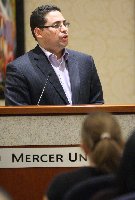
ATLANTA (ABP) — The immigration debate has drawn Latinos into the public square more fully than ever before — and Hispanic Protestants in particular — Gabriel Salguero, a noted Latino evangelical author and thinker, recently told an audience at Mercer University.

Salguero is director of the Hispanic Leadership Program at Princeton Theological Seminary and he and his wife, Jeanette, are senior pastors of The Lamb’s Church, a multicultural Nazarene congregation in New York. He gave four addresses at Mercer’s Macon, Ga., and Atlanta campuses on Oct. 11 and 12 as the first speaker hosted by the new Mercer Center for Theology and Public Life.

Hispanic evangelical leader Gabriel Salguero said followers of Christ from Hispanic and other backgrounds understand  they are integrated into the global church rather than assimilated. (Mercer photo)

He challenged the thesis of Who Are We?, written by the late Harvard University political scientist Samuel Huntington. It claimed that America is defined by an Anglo-Protestant ethic that includes individualism, the English language, hard work and a belief that the country is not a “nation of immigrants,” but rather a “nation of settlers” who came to develop a new country based on the rule of law. Huntington argued that previous waves of immigrants had assimilated into this settlers’ ethic, but a variety of factors led Hispanics to resist this.

Salguero pointed out that followers of Christ from Hispanic and other backgrounds understand that they are integrated into the global church rather than assimilated.

“It is possible to integrate the rule of law with respect for human dignity,” Salguero said. “The Scripture has done it all the time. Jesus puts it this way: ‘Humanity was not made for the law, but the law was made to serve humanity,’ So what we say as people of faith is that if the law is breaking people, then the law is broken.”

Latino evangelicals have come to the fore in the public-policy coalitions dealing with social issues as a result of the immigration conversation, Salguero contended.

“The immigration debate has been a watershed moment for Hispanic evangelicals. Before that, they were not really asked into the conversation; they were not part of these national coalitions,” he said. “But the immigration debate, for better or for worse, catapulted Hispanic evangelicals into the national scene.”

While Hispanic immigrants come from many different regions, religions and worldviews, Salguero said, upon their arrival in America they often develop an identity that is “pan-Hispanic or pan-Latino” in response to political and social pressures. Of the estimated 46 million Hispanics in the United States, as many of 9 million of those may be Protestants, and of those, Salguero said, they are mostly evangelical and charismatic/Pentecostal.

Hispanic evangelical leader Gabriel Salguero addresses students at Mercer University. (Mercer photo)

While Hispanic evangelicals have long had a history of grass-roots action and community development, the immigration debates have led various political groups to seek them out as partners in changing the debate. It has also served as an impetus for Hispanic evangelicals to organize and expand their own public-policy groups, even though they hold to a wide variety of theologies and political philosophies.

Fueled by their growing numbers and the rise of a new generation that is communications-savvy in English and are American citizens, Hispanic evangelicals have now begun to assert themselves and bring their sensibilities to the argument.

“This tells us that Latino evangelicals are coming of age in engaging the public sphere,” Salguero said. “Why? Because we have second-generation Latinos and Latinas who … are fully hybrid. They pray in Spanish, but they speak English.”

Hispanics have a deep understanding of being the outsider, and their varied roots and “mestizo” or mixed ethnic backgrounds help them to understand there is a hybrid nature to culture.  

Even their understanding of God is shaped by a difference in translation. The Gospel of John begins, in English, “In the beginning, there was the word” — but in Spanish, “word” is translated as verbo, or action word. By exerting their right to migrate — legally or illegally — and by their suffering through this experience and the pains of integration or assimilation, Hispanics have developed a different perspective that adds to the debate, Salguero said.

“Hispanic evangelicals have been arguing for common-sense immigration reform from a variety of perspectives. Number one, from a moral perspective … it is in keeping with the best Christian understandings of how we treat the stranger. The second is that it is in keeping with the best of U.S. ideals. The third is that it makes sense economically,” he said.

“What Hispanic evangelicals are trying to do, with varying degrees of success and failure, is to stake out their place for an indigenous given-ness, an indigenous particular contribution to the public-policy debate. So when they talk about poverty, they are arguing that there is something particular, there is something indigenous, an experience that they bring.”

–Mark Vanderhoek is director of media relations at Mercer University.

Related ABP story:

Gushee to head new Mercer Center for Theology and Public Life (5/7/2010)


Heaven’s Rain tells true story of sin, pain and forgiveness

OKLAHOMA CITY (ABP)—A son of Southern Baptist missionaries who survived the home-invasion murder of his parents in 1979 and later went on to advocate for victims’ rights as Oklahoma’s youngest-ever state senator brings his story to the big screen in a newly released independent film titled Heaven’s Rain.

The movie tells the true story of Brooks Douglass, who produced, co-wrote and appears as an actor in his first film.

Brooks Douglass (top right) portrays his father, Richard, as a missionary in Brazil in Heaven’s Rain. Kelly Curran (left) plays Brooks’ mother, Marilyn. Nicholas Braico (lower left) plays Brooks as a child, while Taylor Pigeon (lower right) plays his sister, Leslie.

Heaven’s Rain deals with one of Oklahoma’s most heinous crimes. On the evening of Oct. 15, 1979, two drifters burst into the home of Richard Douglass, then pastor of the 3,000-member Putnam City Baptist Church in Oklahoma City. They bound the pastor and his wife, Marilyn, along with 16-year-old Brooks, and forced the family to listen helplessly while they took turns raping the couple’s 12-year-old daughter, Leslie.

Finally, 24-year-old Glenn Burton Ake told his accomplice, Steven Keith Hatch, 26, to go start the car. Ake then shot all four of the family members, leaving them for dead as the duo made off with a little more than $40. Richard and Marilyn Douglass died at the scene, but Brooks and Leslie managed to untie each other and drive the family car for medical help.

After his election to the Oklahoma State Senate in 1990, Brooks Douglass—a Baylor University graduate—got landmark legislation passed allowing family members of a murder victim to witness the execution of the killer. He and his sister became the first crime victims to exercise the right when they watched Hatch’s execution by lethal injection on Aug. 9, 1996.

Except for the murder of his parents, however, Douglass says the most dramatic moment of his life was his 1994 meeting with Ake at the Oklahoma State Penitentiary, where he forgave the triggerman who forever altered his life.

“I have to admit that on some level I thought of myself as a happy person,” Douglass said in an interview. “I didn’t realize until I was sitting in that room how angry I was and how much I was carrying around.”

Douglass said he and director/co-writer Paul Brown didn’t set out to make a “message” film. “We kind of let it tell itself, based on what events did I feel like were pivotal in getting me where I am today,” Douglass said.

On the other hand, “I certainly felt like the message of forgiveness was one that couldn’t help but come through,” he added.

Christians talk about forgiveness, Douglass said, but he doesn’t think most people really understand what it means.

“You hear it in church a lot, but when you really get down to the nitty-gritty, I don’t think we see that much of it in practice,” he said. “Although we talk about it, I think forgiveness seems hard, painful. It’s something that we don’t want to do. I think it’s contrary to most of our nature. I think it’s certainly contrary to mine.”

The title Heaven’s Rain alludes to Matthew 5:45, where Jesus says God causes rain to fall on both the just and the unjust.

Douglass said people ap-proached him in the past about making his story into a book or movie, but he turned them down because they wanted to tell it as a crime story. He said he never dreamed he would do it himself, but after 12 years in politics, he decided he wanted to become a screenwriter.

Douglass said “99 percent” of the dialogue was written from conversations he actually had.

{youtube}_fUVQv-z4Is{/youtube}
Trailer for Heaven's Rain film.

As the writing began to wrap up, Douglass balked at the idea of shopping the script around to studios and production companies, because if they bought it, they would have the right to rewrite it.

“I wasn’t particularly fond of the idea of having gone through all this, writing all this, and having somebody come in and take their own approach and own values and rewrite it the way they want it,” he said.

The only other option was for Douglass to produce it himself. That meant hiring people and raising a budget. Douglass started spending his own money and raised some funds.

Thanks to local support in Oklahoma, the crew was able to use the State Capitol, governor’s mansion and the state prison free of charge. Panavision donated the use of four expensive movie cameras, and Fuji gave them a price break on film. Most of the actors worked for the minimum scale. Several of the scenes are filmed inside First Baptist Church of Oklahoma City.

“People have been extraordinarily giving and supportive, and that is how we were able to get it done,” Douglass said.

The movie stars Mike Vogel, who currently stars in the CBS primetime show Miami Medical, playing the young Brooks Douglass. Taryn Manning, who co-starred in the 2005 movie Hustle and Flow, plays Leslie Douglass.

A small budget also ruled out a huge marketing campaign. Instead Douglass is renting theaters a week at a time—beginning in Oklahoma and Texas and with a goal of getting into every major market by the end of the year. “We want as many people to see it as we can,” he said.

While not an intentionally “Christian” movie, the settings of a mission field in Brazil and a pastor’s home and church mean faith messages play a central role. Douglass said some churches might want to sponsor a showing, and he is willing to do that depending on how close it is to other screenings scheduled around the same time.

Douglass said everyone was “astonished” when the film received an R rating—mainly because some of the dialogue includes a character describing memories of being raped as a 12-year-old girl—but he doesn’t believe that will hinder Christians from seeing it.


LifeWay background-check service finds hundreds of felonies

NASHVILLE, Tenn. (ABP) — Discounted criminal-background checks offered by LifeWay Christian Resources found more than 600 felony offenses in checks for the 900-plus churches and organizations that have purchased the service in its first two years.

Since contracting with backgroundchecks.com in 2008, the Southern Baptist Convention's publishing arm has sold 11,277 background checks that start at $10 for base-level check of a national criminal and sex-offender search.

About 40 percent returned a "hit" for criminal activity, but most of those were for minor traffic and non-traffic infractions such as jaywalking. One in five, however, returned records of a misdemeanor or felony (2,320 searches) and one-fourth of those were felonies.

"Churches need to exercise due diligence by running background checks," said Jennie Taylor, marketing coordinator in LifeWay's direct-marketing department.

While necessary in today's world, Taylor said, background checks have limits.

"Background checks do not predict the future or expose harmful behaviors from individuals who have never been caught," Taylor said. "But checks can help organizations learn of volunteers or employees who have documented criminal pasts."

A document on preventing child sexual abuse from the Centers for Disease Control calls criminal background checks "an important tool in screening and selection" of employees and volunteers, but says they are only one component in creating a safe environment for organizations working with youth.

The CDC suggests written applications, personal interviews and reference checks for adults seeking access to young people. They also recommend letting applicants know up-front that the organization is serious about protecting youth in order to deter individuals at risk of abusing youth from applying for staff or volunteer positions.

Other CDC safeguards include establishing guidelines to distinguish appropriate from inappropriate behaviors and maintaining proper ratios of employees and volunteers to youth to minimize one-on-one interaction, such as having at least two adults present at all times.

Policies should address not only interactions between adults and youth, but also situations where unsupervised youth can physically or sexually abuse one another. They should include supervision and monitoring of activity and account for safe environments by using spaces that are open and visible to people and controlling access to know who is present at all times. Monitoring devices can include cameras, but there must be staff infrastructure to monitor them.

While the ultimate goal is to prevent abuse from occurring, the CDC said organizations should also communicate clearly what it and its employees/volunteers should do if policies are violated or if child sexual abuse occurs. The government also recommends training about sexual-abuse prevention to give people information and skills to help them prevent and respond to reports of abuse.

Taylor told the Associated Press LifeWay's partnership with backgroundchecks.com grew partly out of a call three years ago for more protections against child sex abuse in the Southern Baptist Convention.

Wade Burleson, pastor of Emmanuel Baptist Church in Enid, Okla., brought a motion at the convention's annual meeting in 2007 asking the SBC Executive Committee to study the establishment of a national registry of "clergy and staff who have been credibly accused of, personally confessed to, or legally been convicted of sexual harassment or abuse."

After studying the matter, the Executive Committee recommended against establishing a database, saying the convention lacked the authority to require churches to report incidents of abuse.

The Executive Committee delivered a report saying that "churches are strongly encouraged to recognize the threat of harm as real, to avail themselves of such information and to aggressively undertake adequate steps at the local level to prevent harm and protect victims."

Officials also added links to the Executive Committee website directed to resources for prevention of sexual abuse, including a link to a national database of sex offenders maintained by the U.S. Justice Department.

LifeWay said in an editor's note that the statistics reported in the press release are not derived from a representative sample, but reflect more than 900 clients who purchased background checks without regard to organizational type, denomination, region, demographic make-up or other determining factors.

That means all the customers are not SBC churches. But if they were, that number would account for about 2 percent of the most recent count of 45,010 Southern Baptist churches with a combined membership totaling 16.1 million.


Bob Allen is senior writer for Associated Baptist Press.


Reduction in force planned at NAMB

ALPHARETTA, Ga. (BP)—Telling North American Mission Board staff “considerable change” is coming, President Kevin Ezell shared a retirement incentive with employees that will be the beginning of an overall reduction in force in the months ahead.

“There are a lot of changes and some things coming down the road. I don’t know what all of those are,” Ezell told the NAMB staff at the mission board’s offices in Alpharetta, Ga., Sept. 30.

“Knowing that there are changes coming and not knowing who exactly that would involve, we wanted to offer an incentive to those who might already be thinking about retirement.”

Ezell said it was important to announce the incentive at this time in order to coincide with a significant change GuideStone Financial Resources has announced in its annuity funding rate beginning Jan. 1, 2011. GuideStone is reducing the floor funding for its lifetime annuity payments from the current 6 percent to prevailing industry rates.

Ezell described the incentive as “the first phase” in what will be a series of staff changes coming to NAMB.

“Is this it? No,” he said. “We don’t know the extent as to what will happen, but we do know that this will be the first phase. That’s why we want you to at least look and see.”

Under the plan, staff who are age 55 and older will be credited additional years of service in order to qualify for health insurance benefits.

Additionally, a retirement incentive bonus will be paid, based on years of service.

No number was mentioned for how many of the 258 staff in Alpharetta are 55 years of age or older and eligible for this plan. However, information was offered that there are 34 direct-paid missionaries who serve throughout North America who are eligible for the incentive.

Employees taking advantage of the plan will need to retire by Dec. 31, 2010.

“To be sure, we are being very clear—this is the very best incentive we could come up with,” Ezell said. “It’s the best option that will be available.”

Ezell compared the changes coming to NAMB to a company that had been making washing machines and now will be making cars.

“There is going to be considerable change,” Ezell said. “A lot of the changes will not be directed to competency of people because we are going to be doing some things so drastically different. What does that look like specifically, I don’t know yet. But we are working on that as fast as we can.”


Church administrators to focus on risk management

DALLAS (ABP) – A jury in Florida ordered a prominent Southern Baptist church to pay $4.75 million to a man injured seven years ago on a ski trip for youth.

Damian Mallard, an attorney representing the then-14 year old identified in the case only by initials, said his client had never skied before, but his mother relied on chaperones from Idlewild Baptist Church near Tampa to see that her son received instructions on skiing safety.

Instead the boy wandered onto an advanced slope on Beech Mountain, N.C., in December 2003 and collided with another skier at an estimated 55 miles per hour. The youth suffered spinal fractures that left him with a limp and permanent nerve damage.

“We are very pleased that our clients have received justice for the negligent planning, organization and supervision of this snow skiing trip which catastrophically injured this young man,” Mallard said in a press release. “We hope this verdict will help other kids be protected in the future.”

Brian McDougall, executive associate pastor of the 11,000-member Idlewild Baptist, told the Tampa Tribune that church officials are consulting with attorneys about what to do next.

"We do not agree with the verdict and know that important evidence was not heard by the jury," McDougall said. "Idlewild has always maintained the highest safety standards in all our church activities.”

William Rice, senior pastor at Calvary Baptist Church in Clearwater, Fla., worried that the judgment could have "a chilling effect on everybody that is trying to work with young people.”

Phill Martin, deputy CEO of the National Association of Church Business Administration, an interdenominational professional organization for church administrators, recognized a critical need for churches to safeguard members and take steps to ensure that donor contributions are used for ministry instead of litigation.

Martin said the second annual National Church Administration Day, scheduled Oct. 21, will focus on helping ministry leaders to foresee potential for liability, injury, abuse and theft that places congregations at risk.

“Part of the cost of doing ministry in a dangerous world is preventing, minimizing and preparing for these threats — that is, risk management,” said Martin, a Baptist minister.

Local NACBA chapters around the country are planning instructional events for clergy and laity Oct. 21 around a theme of “Risk Management: The Cost of Ministry.” Leaders will offer professional advice on the four critical areas of risk management:

–Property risks, like eliminating health hazards, enforcing building codes and providing liability insurance.

–Personnel risks, ensuring that personnel policies are appropriate and applied and understanding the laws that apply to church hiring.

–Congregational risks, including properly screening and training volunteers and providing security for church gatherings.

–Financial risks, such as proper handling of offerings and developing a financial operations manual.

In addition to National Church Administration Day, the NACBA has recently begun offering a new resource titled Weeds in the Garden: The Growing Danger of Fraud Taking Root in the Church.

Written by Verne Hargrave, a certified public accountant, the book offers proactive ways for church’s to prevent church fraud.

National Church Administration Day locations are published on the association’s website.


–Bob Allen is senior writer for Associated Baptist Press. 


SBC ethics czar supports Murfreesboro mosque

NASHVILLE, Tenn. (ABP) — After opposing the building of a mosque near Ground Zero in New York City, the Southern Baptist Convention's chief spokesman on public policy has come out in support of Muslims seeking to build a new Islamic center in Murfreesboro, Tenn.

Richard Land, president of the Southern Baptist Ethics and Religious Liberty Commission, recently signed on as a charter member of the Interfaith Coalition on Mosques, an initiative sponsored by the Jewish Anti-Defamation League.

Land

The coalition of religious leaders from Jewish, Christian and Muslim faith traditions filed a friend-of-the-court brief opposing a lawsuit filed by citizens seeking to halt construction of a new Islamic Center of Middle Tennessee. The brief argues that the lawsuit alleging that local officials acted improperly in granting building permits to an existing Muslim congregation that has outgrown its facilities amounts to "unlawful viewpoint discrimination" against a "disfavored" religion.

Land, who has said publicly that he believes a proposed Park51 Islamic cultural center and mosque near the former World Trade Center should be moved to another location out of respect for survivors of those who lost lives in the terrorist attacks of Sept. 11, 2001, said in general that Muslims have the same right as Christians and everyone else to worship as they please.

"To help preserve the First Amendment for all Americans, we have the right to the free exercise of our faith without the interference of the government," Land said in a recorded audio interview at WorldNetDaily.com.

"We agree with that as Baptists," Land said. "We believe that people have the freedom to worship and to express their faith and to have houses of worship in the places where they live."

Land decried acts of vandalism and arson that have been reported at the proposed future site of the Murfreesboro mosque. "People have resorted to violence to try and keep them from having a place of worship where they live, and we believe that is un-American."

Opponents to the mosque argue that the issue isn't religion but rather that they view radical Islam as a political philosophy with a goal of world domination. Land, however, said the jihadist movement that spawned the 9/11 attacks represents of "a very small minority" of Muslims and is in fact a "death cult" that didn't emerge within Islam until the 18th century.

"I would argue that we should never ever make any religion illegal or should in any was discriminate against a religion," Land said. "I would say the Muslim community in Murfreesboro is definitely being victimized."

The Anti-Defamation League, which also is on record opposing the so-called Ground Zero Mosque, spearheaded the Interfaith Coalition on Mosques to combat what a press release called "a disturbing rise in discrimination against Muslims trying to legally build or expand their houses of worship, or mosques, across the United States."

"We believe the best way to uphold America's democratic values is to ensure that Muslims can exercise the same religious freedom enjoyed by everyone in America," according to the group's statement of purpose. "They deserve nothing less than to have a place of worship like everyone else."

The statement accused mosque opponents of "misrepresenting the Koran and taking passages out of context and seeking to use the statements of a few extremists to claim that all American Muslims secretly want to impose Islamic Shariah law in the United States."

Another charter member of the coalition is Welton Gaddy of the Interfaith Alliance, an ordained Baptist minister and pastor for preaching and worship at Northminster [Baptist] Church in Monroe, La.


–Bob Allen is senior writer for Associated Baptist Press.