Southern Baptists in NC participate in week of service
August 12, 2024
RALEIGH, N.C. (RNS)—About 100 mostly homeless men lined up outside Oak City Cares, a multi-service nonprofit on the downtown’s edge, by 9 a.m. on Aug. 9. Anne Bazemore was there by the door to offer them a hot cup of coffee.
Bazemore, 25, was one of a handful of volunteers from Imago Dei Church who spent the week of Aug. 3-10 volunteering with various civic organizations as part of ServeNC, a statewide project launched this year by the Baptist State Convention of North Carolina.
A total of 1,169 mostly Southern Baptist churches in 92 of North Carolina’s 100 counties participated in the effort, fielding volunteers for a week of service helping vulnerable populations, including homeless people, orphans, prisoners, refugees and the elderly.
By Friday, Bazemore knew the names of some of the regulars and how they liked their coffee—black, with cream and sugar, or extra sugar. On a counter just beside the door were two insulated 5-gallon coffee urns. Bazemore poured out coffee until there was no more.
She had spent two hours each morning this past week at Oak City Cares, an organization that offers the unhoused a place to shower, do laundry and get medical and case management services.
“Just as I was once far off and have been saved and given a family and given hope by the grace of God, I love getting to love and serve the marginalized in my city,” Bazemore said. “And I count it a great gift that I get to do it.”
Nearly half of SBC churches in NC participated
Summers are often a time when congregations send out people to far-off mission work. This year, Southern Baptists in North Carolina envisioned something closer to home.
“In my almost 20 years of being a Christian, I can’t remember a time that a group of churches this large was doing something like this together,” said Todd Unzicker, executive director-treasurer of the Baptist State Convention.
There are approximately 2,800 congregations that partner with the state convention. Nearly 45 percent participated.
Despite a tropical storm that scuttled some outdoor projects, the churches managed a range of aid initiatives.
In Winston-Salem, Calvary Baptist Church packed 750 school backpacks. First Baptist Church of Raeford built a wheelchair ramp for a couple in the community. Friendship Southern Baptist Church in Concord put on a “Senior Prom Night” at a local nursing home. Salem Baptist Church in Dobson stocked shelves and bagged groceries at a local food pantry.
The Southern Baptist Convention has faced a series of challenges in recent years: declining membership, a sexual abuse crisis, a crackdown on women pastors, a condemnation of in vitro fertilization, an embrace of Trump and MAGA politics.
ServeNC was a local effort to get out from under those challenges and serve the communities.
As Baptists who have taken strong anti-abortion stands, many congregations enlisted their members to volunteer at unlicensed anti-abortion centers that counsel women against terminating their pregnancies. The North Carolina legislature has spent about $49 million since 2013 to support anti-abortion centers.
Projects focused on communities in need
But mainly, the ServeNC projects were intended to help communities in need.
Wesley Knapp and his wife, Conner Waldrop, volunteered at a weeklong Vacation Bible School in a Raleigh apartment complex that houses refugee families from several different countries.
The young couple—he is 25, she is 24—are members of Imago Dei Church and said the experience of playing with the children, many of whom were just learning English, was fun and eye-opening. On Saturday, they planned to take the children to a trampoline park.
“I think we both left this experience with more of a pull toward fostering and adopting down the road,” Knapp said. “It was just so cool to interact with those kids and again, just the humility that that brought into our lives during that week was super impactful.”
For Zac Lyons, the pastor for missions and evangelism at Imago Dei, the weeklong service project was a way to cultivate a deeper commitment to helping others.
“The real focus is to have people regularly serving in the community,” Lyons said. “It’s a catalytic tool to see they can do this on a regular basis.”
Scholarships help CWJC graduates take next steps
August 12, 2024
Marie Beam said she’s always liked working on cars. She found out early on that she didn’t like being stranded. She’d rather be able to do something about it when her car had problems.
“I started learning how to do it myself,” she said.
Then she started helping the women in her apartment complex, who frequently had car trouble.
“It’s something I love to do,” Beam said. “So, I started thinking maybe I could do it as a career too.”
Through Christian Women’s Job Corps of Tyler, she’s had the support to enroll in college and start making that happen.
“I’ve got six classes left,” she said.
And thanks to the Faye Dove Scholarship, a gift provided by the WMU Foundation to help a CWJC graduate further her education, Beam now has money to buy the tools to finish her associate’s degree in automotive mechanics at Northeast Texas Community College.
The scholarship also will help her continue to provide support for her four children, who range in age from 2 to 12.
“Everything I learn, I get out there and show my kids what I learn,” she said. “Hopefully, it’s the gift that keeps on giving.”
Beam was one of two recipients of the Faye Dove Scholarship this year—Evelyn Ribeiro, a graduate of Begin Anew Nashville, Tenn., also received funds to put toward tuition at Middle Tennessee State University.
Ribeiro got connected with Begin Anew after coming to the United States from Brazil just as the COVID-19 pandemic hit. Through the program there, she earned her GED and began pursuing a career in nursing.
“Every opportunity that comes my way, I can see that God is behind it,” Ribeiro said.
Additional recipients
Two other CWJC graduates—Laurien Assis of Begin Anew Nashville, Tenn., and Jacklyn Powell of Heart & Hands of East Texas in Lindale—also received a CWJC Academic Scholarship.
Assis will use the funds to continue to pursue her degree in business administration and management at Williamson College in Franklin, Tenn.
Studying there “aligns with my desire to fulfill God’s mission for my life, and I am confident that the college’s educators and resources, combined with the support from Begin Anew, will continue to guide me toward realizing this purpose,” she said.
Powell’s scholarship will help her pay for tuition and books at Tyler Junior College. After losing her husband, she walked through some dark times, including a night in jail and a journey to sobriety. At Heart & Hands of East Texas, she gained skills and confidence and surrendered her life to Jesus.
Currently, Powell lives with her parents while raising her two children, one of whom has special needs. Her goal is to become a counselor who can help others experience the love and hope of Jesus no matter what they’re walking through.
“My journey is not done yet, and I still have some things to do, but God is showing up and showing out daily,” Powell said. “I am blessed and have been born again through Christ.”
Peggy Darby, president of the WMU Foundation, said the gifts that fund the scholarships for Powell and the three other recipients make a difference.
“Your gifts to the Sybil Bentley Dove endowment help to support Christian Women’s Job Corps by providing scholarships to participants, program development grants for sites and a grant for Dove award recipients,” she said. “Whether you make a one-time gift or become a monthly donor, your support will help to change lives forever.”
Christian Women’s and Men’s Job Corps are compassion ministries of Woman’s Missionary Union. Through more than 100 sites across the country, CWJC/CMJC seeks to equip women and men for life and employment in a Christian context.
Forty-three of those sites are in Texas, where lives are impacted through high school equivalency diploma preparation classes, English as a second language classes, computer training, Bible study, mentoring and job readiness skills. These ministries are supported through gifts to the Mary Hill Davis Offering.
With additional reporting by Calli Keener, news writer for Baptist Standard.
Medical team serving migrants, refugees in Mexico
August 12, 2024
A medical team member asked a patient about his diet. The patient responded, “I eat when I can, when somebody can give me some food. I ate today because they gave me breakfast.”
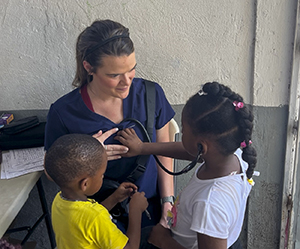
A nurse helps children not to be scared by letting them listen to her heartbeat. (IMB Photo)
This wasn’t a typical doctor’s appointment. This happened last year on the southern border of Mexico, near Guatemala and the Pacific Ocean. A medical mission team of eight went to offer care to migrants, refugees and displaced peoples.
Another team member treated a young man who injured his knee. The young man said he was running from a gunman who killed his mother in front of him. He fell into a hole which caused his injury. After his treatment, the young man made a profession of faith in Christ.
International Mission Board missionaries Charlie and Robin Janney, who focus on human needs in Mexico, coordinated this team, knowing how great the medical needs are in this area.
“God gave them medical abilities and the intelligence to help others,” Robin Janney said of the team made up of doctors, nurses, physician assistants and physical therapists. “There are people in serious need and have no one else. They are desperate.”
She explained how grateful people were for this medical team to offer them care, considering how difficult it can be to afford treatment. She said it was a “huge honor” for them to receive medical attention and not be charged.
Over five days, the team met with more than 300 patients. For many of the medical professionals, this was the start of their involvement in mission work.
Robin Janney said one of the team members is heading for training to be a Journeyman, a two-year missions program for young adults.
“Another feels called to Africa,” she said. “So, we put her in contact with a missionary there who also uses medical personnel.”
A doctor on the team is close to retiring. He and his wife may consider taking advantage of IMB’s Master’s program, a missions pathway for singles and couples 55 years of age and older who want to give the first two-to-three years of their retirement to the nations.
Visiting medical team makes an impact
The Janneys met most of the members of the medical team last year at MedAdvance, a medical missions conference that allows hundreds of medical professionals, students and church leaders to connect with IMB missionaries and leaders. This year’s MedAdvance will meet September 12-14 at Houston’s First Baptist Church.
Attendees discover how God is at work through medical missionaries and how they can pair their healthcare training with a love for international missions.
“We went in not sure what to expect, and God decided to show us a lot of things at MedAdvance,” Charlie Janney said. “It exceeded our expectations.”
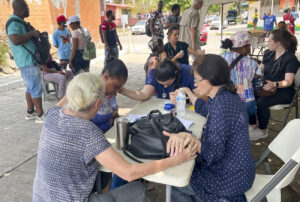
Missionary Robin Janney (in foreground) and members of the medical team pray with a woman who made a profession of faith in Christ. The medical team examined 80 patients this day at a shelter. (IMB Photo)
The Janneys participated in MedAdvance’s Affinity Marathon, as part of the Americas affinity group. This activity allows attendees to connect with missionaries on the field and hear about different IMB health strategies around the globe.
“We had many seek us out,” Robin Janney said. She explained that six of the eight medical professionals on last year’s trip had been at MedAdvance.
“The team did not know each other beforehand, but they worked as if they had worked together for years. It was one of the best teams that we have had.”
Not only did the medical team impact patients, but they had great fellowship with the host church.
Robin Janney said a woman from the church came up to her.
“She told me, ‘Our ladies of the church want to take them out for coffee.’ [The medical team] connected with the host church. They went out for coffee at least three times,” she said.
She also shared a story of a retired IMB missionary who served in the Middle East as a medical doctor and now serves in Mexico. The doctor was a great encouragement to the medical team, and she and a team member led another woman to Christ.
Team members helped both the church and patients learn about different health topics. One led a session on dehydration.
“A nurse talked to a group of Haitian refugees about dehydration, what were the symptoms and how to prevent it,” Robin Janney said. “We now have a recipe of how to rehydrate someone quicker.”
A physical therapist on the team taught patients different stretching exercises that gave them some relief and helped them sleep better.
The Janneys experienced how God used MedAdvance to strengthen their field ministry. They plan to return this year.
“There are so many medical needs all over the world,” Charlie Janney said. “MedAdvance helps connect those in the medical field with those on the mission field.
“They can make an impact in so many ways. It may not be medically. It might be through encouragement. They might inspire a church.”
After controversies, SBC turns to a low-key leader
August 12, 2024
CHARLOTTE, N.C. (RNS)—As he stepped up into the old-fashioned wooden pulpit on a recent Sunday, Pastor Clint Pressley wasted no time.
After quickly thanking the student discipleship minister who had brought many of the church’s Camp Paradise teens to the 11 a.m. service at his church, Hickory Grove Baptist, Pressley turned to the task at hand.
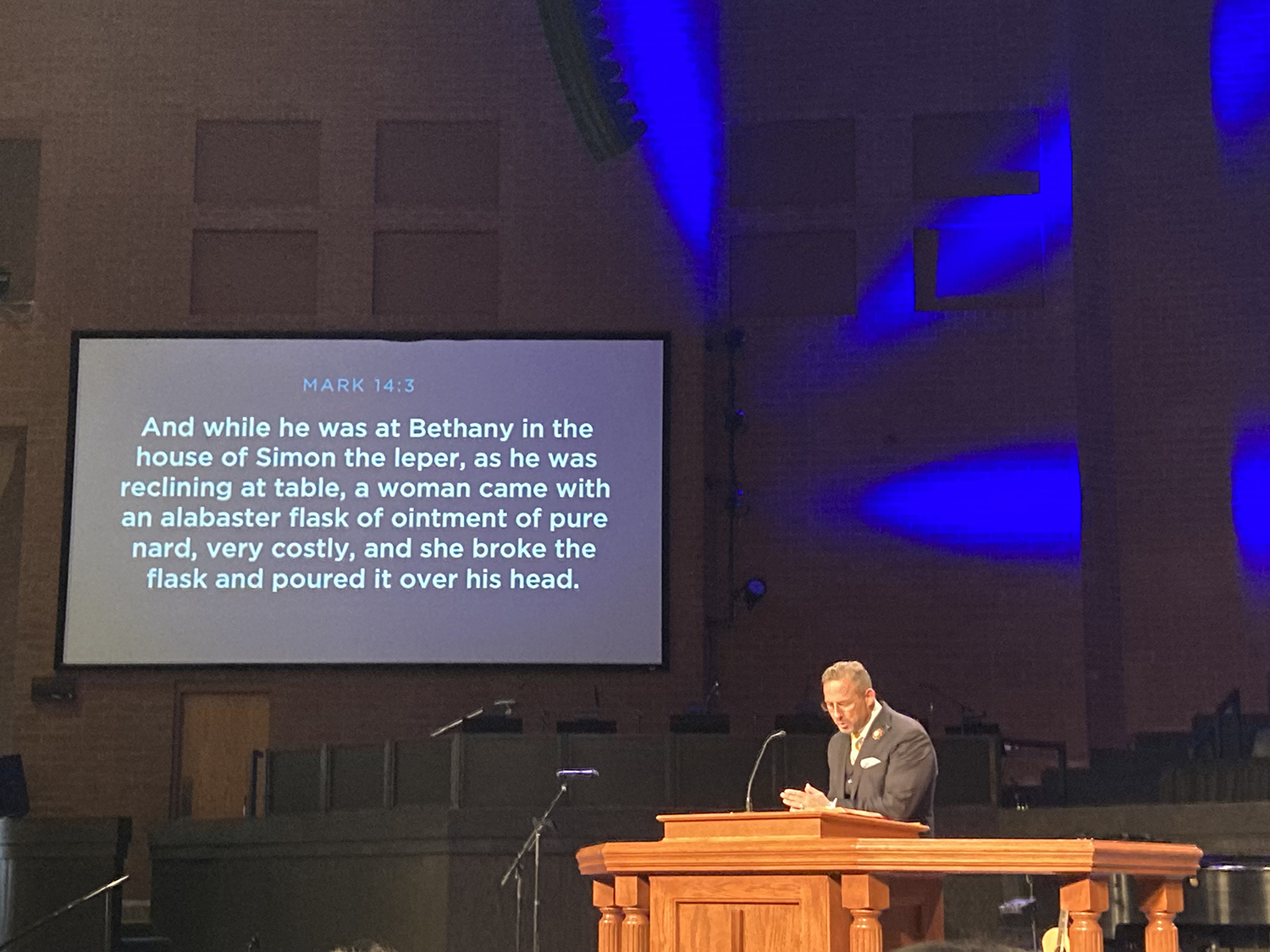
“Mark chapter 14,” he intoned in his Southern drawl. “If you’re a guest with us, we read the Bible, and then we just talk about the Bible. You’re going to find it feels a lot like a Bible study. Mark 14 starting in verse one …”
After relating the first 10 verses that tell the story of the woman who anoints Jesus with a bottle of expensive perfume, he drives home the passage’s lesson with a series of questions.
“You have one life to live,” he said. “Pour it out. Have you done what you could? What’s holding you back? I want your life to be all-out devotion to God.”
This was Pressley’s third sermon of the day. He preached the 8 a.m. service, drove 13 miles to the church’s second campus to preach the 10 a.m. service, and then drove back to the main campus for the 11 a.m. service.
When he concluded 40 minutes later, he shed his jacket and stood outside the doors of the cavernous chocolate-brick sanctuary, greeting worshippers on their way out—among them, his parents.
Pressley, 55, the newly elected president of the Southern Baptist Convention, is a hard-working pastor of North Carolina’s fifth-largest Baptist church—whose main campus lies on a busy commercial corner of a modest suburban neighborhood of 1950s ranch homes. A K-12 private Christian school is part of the main 56-acre campus.
Pastoring a church is what he’s wanted to do since he was a kid growing up in the state’s Queen City. He’s been devoted to the task ever since, building a multiracial, multigenerational megachurch that draws some 3,000 people each Sunday.
Pastor Clint Pressley likes to preach from a Colonial-style pulpit at Hickory Grove Baptist Church in Charlotte, N.C., on July 21. (RNS photos/Yonat Shimron)
Yet at its last meeting in June, its members elected a traditional preacher who wears three-piece suits, a tie and monogrammed cuffs—and mostly stays out of the limelight.
“In a time where we have so much cultural chaos, Clint’s steadiness and his reputation for integrity really impress a majority of Southern Baptists,” said Nathan Finn, a professor of faith and culture at North Greenville University in South Carolina and the recording secretary for the SBC.
Pressley does not have a national following or a big social media presence. Though he is a trustee of Southern Baptist Theological Seminary and has served in various other denominational roles, he is not trying to use the presidency—which he may serve for a maximum of two consecutive one-year terms—as a platform for influence.
“Really, my hope is to clear some of the fog of negativity and get us back on those two things we have: our confession and our mission,” he said of his mostly symbolic new role.
Pressley is the second North Carolina pastor to lead the SBC in less than a decade.
J.D. Greear, who served as SBC president from 2018-2021, has a national following and leads the largest SBC congregation in North Carolina, the Summit Church—with an average attendance of more than 12,000 people spread out across 13 campuses.
Bart Barber, Pressley’s immediate predecessor—who led a small, rural Texas church but was known for his expertise on denominational governance—had a large social media following and an opinion about everything.
Pressley, by comparison, is low-key. His church does not hold voter drives, and he will only refer to current events if it relates directly to the Bible passages he is preaching on.
“He has said publicly, his goal is not to embarrass the convention,” said Chris Justice, pastor of Lee Park Church in Monroe, N.C., who nominated Pressley in June.
“His answer to things will be short, biblical and delivered in such a way so as not to generate a fight. He’s looking to guide carefully and steward the convention with humility.”
Pressley wants to tone down the acrimony.
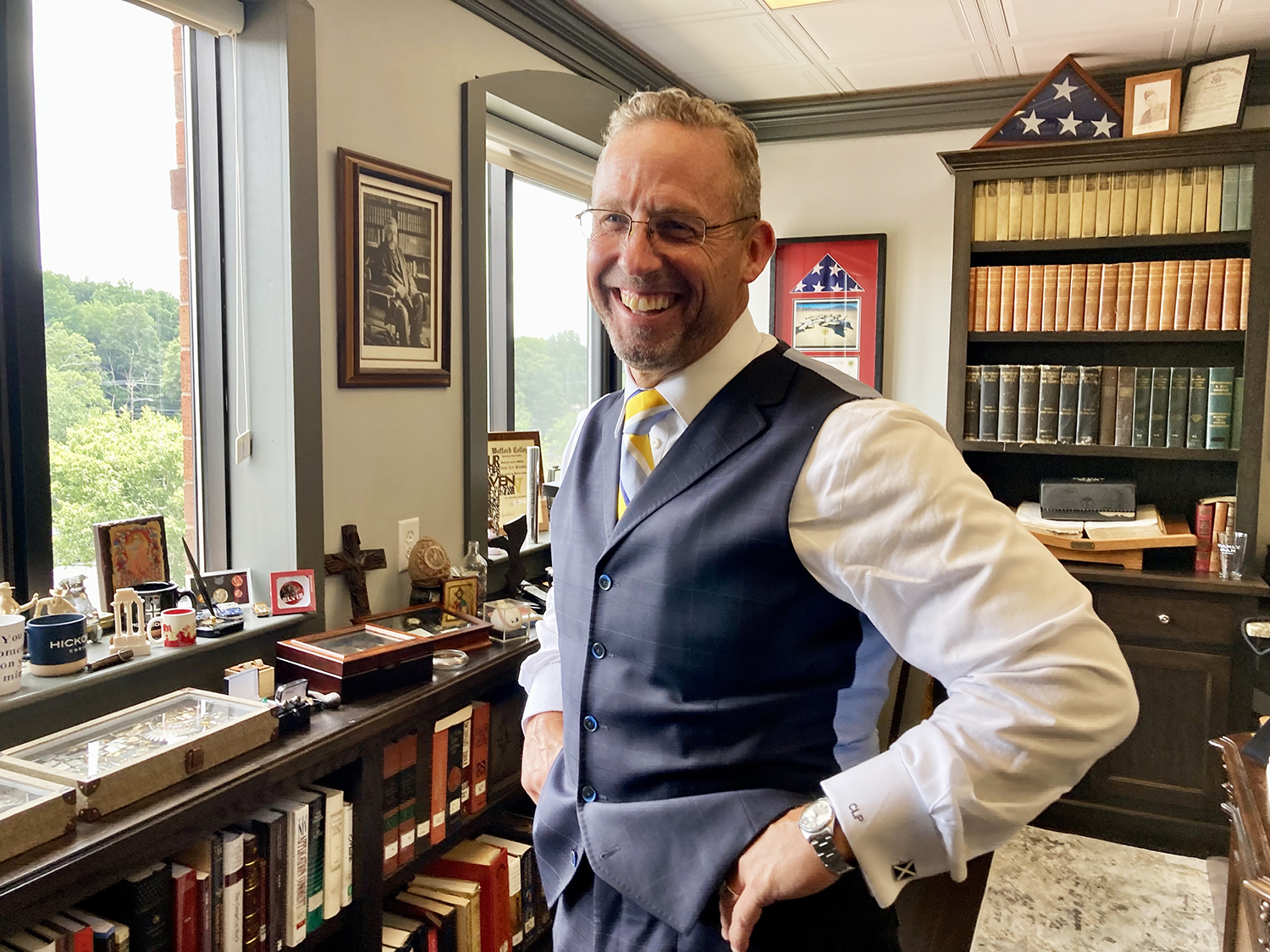
Pastor Clint Pressley stands for a portrait in his office at Hickory Grove Baptist Church in Charlotte, N.C., on July 21. (RNS photos/Yonat Shimron)
Family and religious background
The new Southern Baptist president became a Christian in the liberal Presbyterian Church (U.S.A.), where his parents belonged, when he was 11.
But on a vacation to Roanoke, Va., a few years later, a friend the Pressley family met at the beach invited them to their Baptist church. The preacher spoke with conviction. He was authoritative and passionate.
“I’d never heard anything like that, and I thought, ‘That’s what I wanted to do,’” Pressley said.
When the family returned home to Charlotte, he encouraged his parents to seek out a Baptist church. They tried Hickory Grove and, after attending for two weeks, became members.
Pressley kept his ties to Hickory Grove while he was at Wofford College in Spartanburg, S.C., where he also played football. After graduating, Pressley’s Hickory Grove pastor suggested he go to Southwestern Baptist Theological Seminary in Fort Worth.
There he met Connie, the daughter of a Mississippi Baptist pastor, who was in her last year studying for a Master of Divinity degree with the hope of becoming a missionary. After a nine-month courtship, they were married.
“I told the Lord I was not going to marry a pastor,” Connie Pressley said. “But I was well prepared. My mom was a great pastor’s wife and was a good example for me.”
Even before they married, Connie told Clint she probably couldn’t have children. She suffered from endometriosis, a condition in which tissue similar to the uterine lining grows outside the uterus, making it difficult to conceive.
The couple considered in vitro fertilization but felt like adoption was a more biblical choice. The New Testament uses adoption as a metaphor for becoming rooted in the family of God.
Pressley completed his Master of Divinity degree at New Orleans Baptist Theological Seminary, which was closer to Mississippi where he was pastoring two small churches and where he and Connie adopted two boys, brothers ages 2 and 6 months, Mack and Nate.
In 1999, he came back to Hickory Grove in Charlotte as associate pastor. Five years later he became senior pastor of a midsize church in Mobile, Ala., before returning to Hickory Grove as senior pastor in 2011.
Once he became its top leader, Pressley streamlined many of the church’s offerings and cut out some of the trendier, seeker-friendly outreach programs—such as cookouts and guest appearances from professional athletes.
He also sorted through the church’s long list of members to winnow out hundreds of members who were no longer active.
“We kind of pared back on trying to get more people in and really tried to get the people that were there more rooted in the word” of God, said Mark Foster, a deacon and Sunday school teacher.
Pastor Clint Pressley has worked with a handful of different churches throughout the South but returned for the second time to Hickory Grove Baptist Church in 2011. (RNS photos/Yonat Shimron)
He bucks trends
Services at Hickory Grove, like most contemporary Baptist services, feature a modern band that performs praise songs with drums and a synthesizer.
But unlike those pastors who stand in front of the stage, beside a stool or a chair, Pressley has kept the traditional Colonial-style wooden pulpit.
He also has bucked the recent trend of pastors dressed in khakis or jeans and a T-shirt.
He may prefer the buttoned-up look, but Pressley is warm and outgoing—a people person.
“He’s an incredibly encouraging person and incredibly authentic,” said Al Mohler, the president of Southern Seminary and a prominent conservative voice in the SBC.
“The public Clint Pressley and the private Clint Pressley are exactly the same man.”
Last August, Pressley’s 24-year-old son, Nate, who had been estranged from the family and living in the Washington, D.C., area, died of an apparent drug overdose. Church members said the Pressleys grieved with dignity and grace.
This year, a volunteer was arrested after church leaders learned he had been accused of sexual abuse by a student at the church’s Christian school.
The church reported the disclosure to Child Protective Services and the city’s police. Pressley notified the entire congregation by letter.
“We do not tolerate abusive behavior of any kind,” said Pressley in his letter.
Pressley is a creature of habit, and he sticks to a routine. He said he rises at 5 a.m. most days, reads the Bible, prays and then works out—lifting weights with a group of men, mostly from the church, in his backyard shed.
He doesn’t watch much TV and prefers reading books about history. He and his wife vacation—typically at a beach—with other pastor friends.
That commitment to routine serves him well and keeps him focused, said Eric Little, a member of his church with whom he also lifts weights.
“I think the reason I am drawn to pastor Clint is just his model of consistency—of what it means to be a leader, not just in the church, but in the home, in the community,” said Little.
Pressley keeps his eye trained on the long view. His favorite Bible passage is from the prophet Isaiah.
He has it engraved on the pulpit as well as painted on the wall of his office: “The grass withers, the flower fades, but the word of our God stands forever.”
Spiritual encounters occur in Olympics hospitality spaces
August 12, 2024
PARIS (BP)—At first, Adam Moore was a little skeptical about one of the Olympics outreach strategies in which his mission team was participating.
Eighteen members of Peninsula Baptist Church in Mooresville, N.C., spent the week in Paris, engaging people in gospel conversations. (BP Submitted photo)
Moore, the teaching and sending pastor at Peninsula Baptist Church in Mooresville, N.C., led a team of 18 members of his church to minister in Paris for a week.
One of the places they served was called “The Living Room,” an open-seating area hosted by a local church with coffee, water, air conditioning and livestreaming of the Olympics.
“Is anybody going to stop into that?” Moore wondered.
He was quickly proven wrong, as the venue welcomed several visitors during Moore’s time in Paris.
“That has led to probably at least 10 long, lengthy gospel conversations through individuals just showing up,” Moore said.
“The Living Room” is an example of how Baptists in Paris, in partnership with the Southern Baptist Convention’s International Mission Board, are creating attractive spaces to show hospitality to residents and tourists, and then engaging those visitors with conversations about Jesus Christ.
Using art and culture to share the gospel
Another project in Paris is the work of French artist Estienne Rylle, who has launched a contemporary gallery called “Hymnal: Humanity Gathered” at La Baptisse in the first Baptist church in Paris, Rylle said.
“It’s what we want to propose to visitors, ‘Come and enjoy the place of solace we created with art,’” Rylle said.
The exhibit also offers a coffee shop and place of refreshment for visitors, inspired by Jesus’ request of the Samaritan woman, “Give me a drink.”
“There is something very powerful for me in this sentence,” Rylle said.
Rylle pitched the project, with contributions from several French artists, as a “monastery of the third millennium,” a place of prayer and contemplation—a cultural experience.
He hopes visitors will be prompted to consider spiritual matters as they contemplate the art, and Christians then can provide answers that may spark further reflection.
Distributing Scripture, issuing invitations
A team from North Carolina distributed hundreds of Bibles on the streets of Paris during the 2024 Olympics.
While some of Moore’s team staffed “The Living Room” each day, others went out into the city handing out flyers and inviting people to the location. They also distributed hundreds of Bibles with an Olympic-themed cover.
Moore said two of the high school students on his team encountered an “ardent atheist,” but one who admitted he had a lot of questions about Christianity’s truth claims. The man acknowledged being bothered by concepts like eternity and judgment, wondering what that meant if such matters were true.
“They were able to spend a long time talking with him, sharing the entirety of the gospel with him, answering questions, pointing him to Christ,” Moore said.
He said his team also saw a number of visitors from China profess faith in Christ during their stay.
The Paris trip for Peninsula Baptist Church was part of an ongoing partnership the congregation has with IMB staff in the city. The Olympics, Moore said, brought a lot of different people to Paris and made it more normal for Americans and other international visitors to be present and engaging with people.
He said his team was pleased with how receptive many people were to having spiritual conversations.
“As they talk through life and other things, it’s been good to be able to move that toward the gospel,” Moore said. “We’ve seen that be pretty fruitful so far.”
Tim Ellsworth is associate vice president for university communications at Union University in Jackson, Tenn.
Short-term trips meet long-term strategies at Olympics
August 12, 2024
The Southern Baptist Convention’s International Mission Board mobilized more than 300 short-term volunteers who are hitting the streets of Paris, sharing the gospel during the 2024 Summer Olympic Games.
“We can’t control the results, but we can measure our faithfulness,” said Jason Harris, team leader for the IMB Paris team, explaining their strategy for gospel outreach during the Games.
Part of that strategy includes facilitating and mobilizing more than 300 short-term volunteers. The team Harris leads in Paris is young and growing. No team members have been there longer than a few years. They are united around a common vision to make Christ known among Europeans and a long-term goal to plant five churches in Paris over the next five years.
‘A launching point for church planting’
Harris explained that short-term volunteers are vital to sharing the gospel broadly and making connections that will catalyze their local church-planting strategy and lead to longevity.
Each week of Olympics outreach, volunteers are focused on sharing the gospel within specific geographical and cultural segments of Paris. They are using a number of creative strategies as entry points for evangelism and have invited local French churches to work alongside them.
“My prayer has been that the outreach for the Olympics would be a launching point for church planting in the city,” Harris said.
Ultimately, the harvest is in God’s hands, the team recognizes. They already have witnessed God drawing people to himself through volunteer efforts this summer.
Zach Beasley, campus minister at Alabama State University and Tuskegee University—two historically black colleges in Alabama—led a team of six students to join a week of pre-Olympic outreach to Paris in May.
One thing the students didn’t expect was the spiritual darkness they felt almost immediately on arrival in the “City of Light.” Beasley said more than anything, this trip has motivated them to pray for missionaries and their long-term presence on the mission field.
“We realized to really make a lasting impact, you have to be there for years,” Beasley said. “It takes years for boundaries to be broken down and relationships built.”
The team from Alabama spent eight days passing out water bottles, prayer walking, distributing flyers, and doing spiritual surveys.
“The work we did with the local church was very familiar to our students. It’s the same thing we do on campus, going out and sharing the gospel,” Beasley said. “We collaborate and build the local church, and I loved seeing that reiterated here for our students.”
At the end of the week, Beasley and his team were excited to see many people they had given flyers to show up for an outreach event at a local church.
“We were praying they would come, and they actually did,” Beasley said.
Divine appointments to share the gospel
IMB missionary Diane In came to Paris from a nearby country where she lives to help with the Olympic outreach. She joined a group of 90 volunteers partnering with local Chinese-French churches.
On their first day, they handed out more than 1,000 portions of Scripture in French, had 300 gospel conversations, and saw several professions of faith in Christ.
The missionary shared how she has seen God provide divine appointments for the gospel. At the end of one day, In and one volunteer—a Chinese pastor from the United States—sat next to some members of the Chinese press on their way back to the hotel. The pastor gave one of the men a custom-designed trading pin and shared the gospel with him.
On their way out of the station, they ran into two more members of the Chinese press—a man and a woman—who were lost and asked for directions. As the pastor gave directions to the woman, In pulled out another pin and shared the gospel with the man.
Brant Bauman, a digital engagement strategist for the IMB, gave an exciting update on the first round of virtual volunteers and their strategy to extend on-the-ground evangelism.
Bauman said digital responders around the world are getting exactly the kind of interaction they have been hoping and praying for. Volunteers are serving on a week-long virtual mission trip where they’ll be on call to answer chat requests.
“It’s a strange thing to say, but the volume on my computer is turned up and there is a little chime that goes off roughly every 30 seconds,” Bauman said.
“Normally that would drive anyone mad, but not tonight, because that is the sound of new people responding to our online ads and reaching out to us. Better yet, it’s the sound of doors being opened and the gospel being proclaimed by so many digital responders scattered all over the world.”
Bauman added that despite challenging discussions, team members are excited and bold in their interactions.
“We have already seen countless prayers responded to, quite a few spiritual conversations and gospel shares, and some that have expressed a desire to meet up face-to-face and find a church.”
Harris asked for prayer as their team begins to follow up with new contacts in Paris.
“The number of connections made could be really challenging to follow up with effectively,” he said. “Pray that, ultimately, people become disciples of Jesus and don’t just hear the gospel once.”
ERLC executive committee issues update on entity
August 12, 2024
NASHVILLE (BP)—An Aug. 2 statement from the executive committee of the Ethics & Religious Liberty Commission affirms the group’s support for Brent Leatherwood as president and leader of the Southern Baptist Convention entity, saying its work is more important now than ever.
“In light of ongoing questions surrounding the recent events at the ERLC, the executive board of the trustees wishes to affirm our support for Brent Leatherwood as president and his leadership of the organization. Our goal is to do everything within our power to set up the ERLC and its staff for success,” the statement said.
The committee members are interim Chairman Tony Beam, Amy Pettway, Nathan Lugbill and Anthony Cox.
Former Chairman Kevin Smith resigned following a confusing series of events announcing Leatherwood’s removal July 22 before a statement from the other committee members announced Smith acted outside of governing documents and Leatherwood had not been removed was released in the early morning hours of July 23.
“There was no meeting of the executive committee with a vote taken or any permission given for the actions taken by then-chair Kevin Smith. None of us, as executive committee members, were aware that Kevin was planning to drive to Nashville to meet with Brent on July 22,” said the statement.
Conversations followed SBC annual meeting
In a statement to Baptist Press Aug. 2, Smith confirmed there were conversations—both group and individual ones—that had taken place since the SBC annual meeting in Indianapolis.
“I believed I had the consensus of the executive committee based on conversations since Indy, as a group and one-on-ones,” Smith said.
A motion from Texas messenger Michael Borghese requesting Brent Leatherwood’s resignation was ruled out of order, as was a motion from Tennessee messenger Kenny Cody to reallocate the ERLC’s Cooperative Program allocation to the International Mission Board. A motion made by Florida messenger Tom Ascol to abolish the ERLC failed after a floor vote.
Smith takes responsibility for not having official records of the conversations. “That’s on me,” he said. “The consensus I believed I had had no official form,” he said.
Smith said, “The EC are fine trustees, and I was happy to serve with them.”
The existing committee members say they did not have “interactions or discussions with the ERLC staff about the press release sent on July 22. We did not know about it until it was published.”
The group says they are “taking seriously the good faith questions raised by those outside the organization.”
The statement says the leadership group is focusing on two tasks:
“First, we are committed to operating transparently knowing that all we do is visible to our God, before whom we ultimately must give an account.”
“Second, we want to make sure that every vital decision concerning the present and future success of the ERLC should be made by the full board of trustees.
In addition to the committee’s quote, an ERLC spokesperson said in written comments, “The staff at the ERLC serves Southern Baptist churches under our president Brent Leatherwood and fulfills our ministry assignment as our board directs us.”
The full ERLC trustee board is set to meet Sept. 10-11. The release says they will “provide more information at that time.”
Recap of discontent over SBC’s ERLC
August 12, 2024
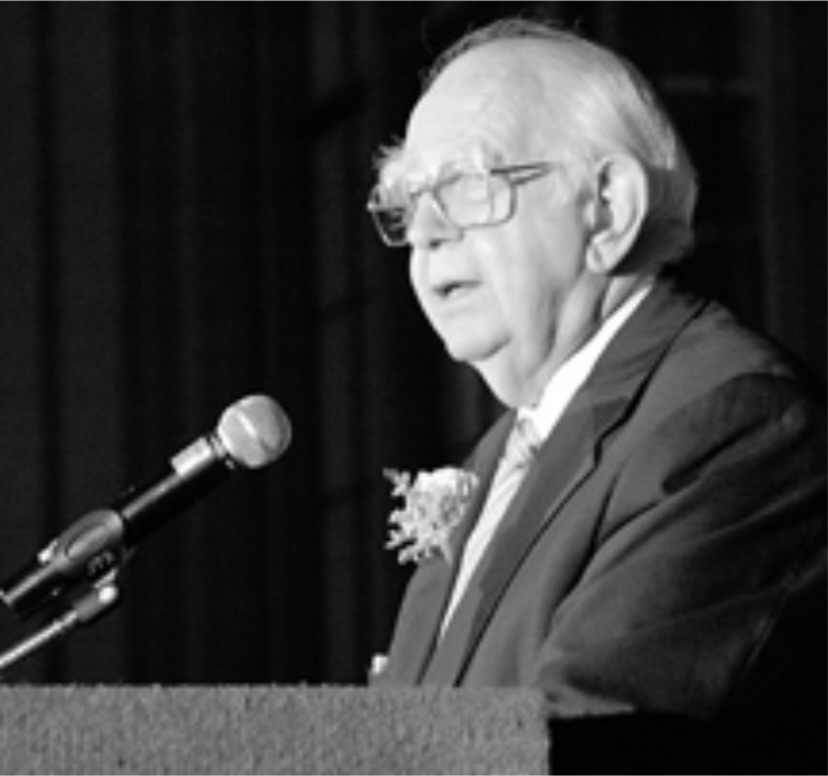
(RNS)—Richard Land, who led the Southern Baptist Convention’s Ethics and Religious Liberty Commission for a quarter-century, said he often would remind his staff if they did their job right, they’d eventually end up in hot water.
“Sooner or later, we’re going to make everyone in the convention mad,” Land, in a recent phone interview, recalled advising his employees. “When you are the conscience of the convention, you are going to irritate people.”
Richard Land at the White House Easter Prayer Breakfast on April 5, 2013. (RNS photo / Adelle M. Banks)
Land’s adage has applied to many who have led the public policy and ethics arm of the SBC, a job some describe as providing a “prophetic” voice in showing Southern Baptists how to apply their faith to the social problems of the day. Though Land lasted more than two decades, heading the ERLC from 1988 to 2013, eventually it applied to him.
Brent Leatherwood, the current president of the ERLC, lasted only a year and 10 months before getting in hot water. On Monday night (July 22), an email from the executive committee of the ERLC’s board announced he had been fired. The following morning, the entity retracted that announcement, stating Leatherwood was still on the job.
The ERLC’s former chairman, Florida pastor Kevin Smith, was blamed for the “confusion” and resigned.
The episode left Land and other Southern Baptists shaking their heads, but it also has increased questions from some corners of the SBC about the value of the ERLC. At a time when trust in religious institutions is in decline, can the SBC afford the tumult the agency seems to invite?
A history of turmoil
Foy Valentine (Baptist Standard archive photo)
Had his firing held up, Leatherwood would have been the fifth ERLC leader in a row to leave office amid controversy. From 1960 to 1987, Foy Valentine led what was then known as the Christian Life Commission before being forced out by conservatives who took over the SBC in the 1980s.
Valentine’s successor, Larry Baker, lasted 16 months on the job. Land retired in 2013 after being accused of plagiarism and making controversial remarks about Trayvon Martin, the young Black man killed by a Florida man in a “stand-your-ground” case.
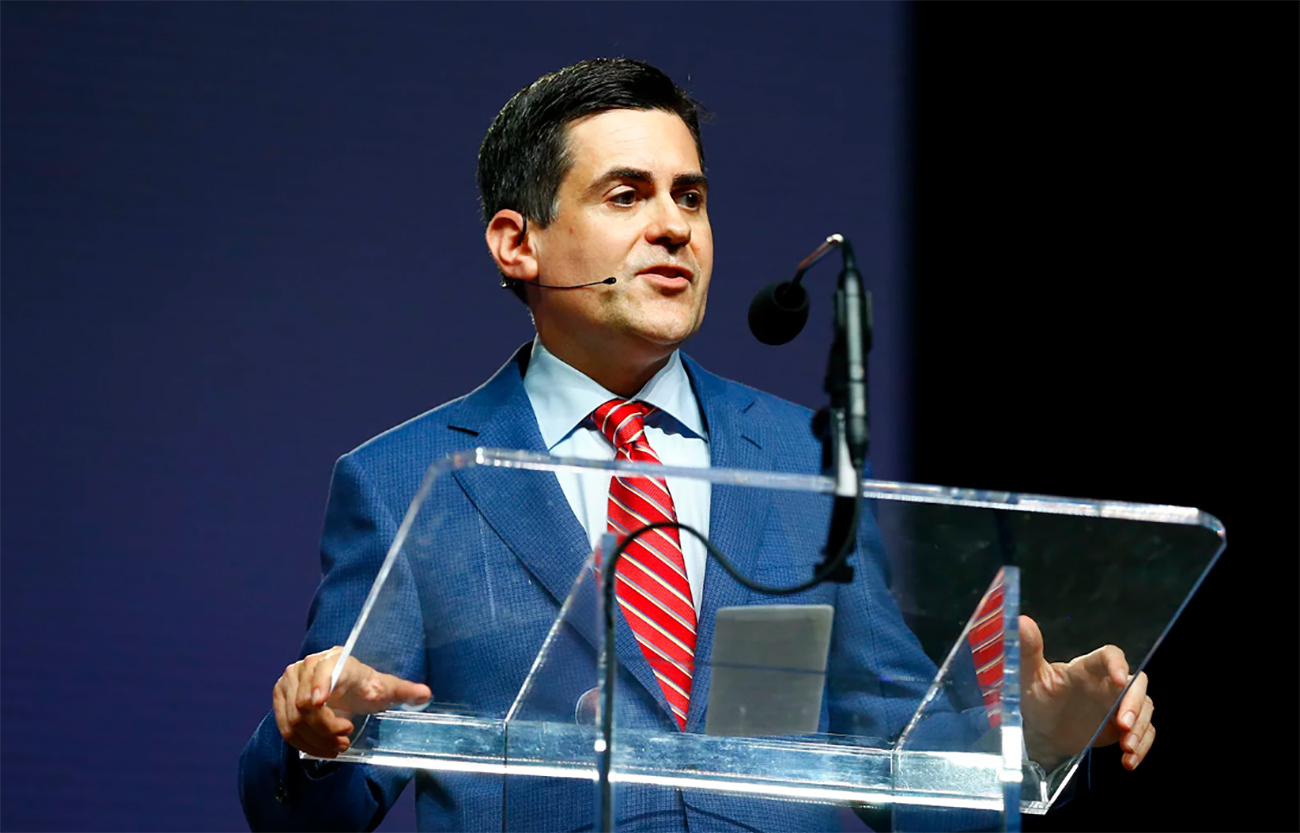
Russell Moore, then president of the Southern Baptist Convention’s Ethics and Religious Liberty Commission, speaks during an annual meeting of the Southern Baptist Convention. (RNS Photo / Butch Dill)
Russell Moore then led the ERLC from 2013 to 2021, before stepping down to join Christianity Today magazine. Moore’s last few years in office were filled with controversy, primarily due to his criticism of Donald Trump and his advocacy for survivors of sexual abuse.
Leatherwood was named ERLC president in 2022, after initially serving as interim. Even before this week’s events, he had drawn criticism for his opposition to legislation that would have jailed women who have abortions and for praising President Joe Biden’s decision to drop his reelection bid.
Like the broader American culture, Southern Baptists have been divided over politics, race and Trump in recent years. That’s made the job of the ERLC leader even more complicated than it was in the past.
Baylor University history professor Barry Hankins, who long has studied Southern Baptists, said Leatherwood, though he has seemed to survive for now, likely faces an uncertain future.
As ERLC president, Leatherwood’s mandate is to focus on Christian values, rather than politics. “That won’t fly with the hardline culture warriors” in the SBC, said Hankins. “They want an ERLC that’s going to fall in line with the Trumpian right wing.”
For and against the ERLC
At the SBC’s annual meeting in June, Florida pastor Tom Ascol, a vocal ERLC critic, made a motion to disband the ERLC entirely, saying the entity “has become increasingly distant from the values and concerns of the churches that finance it.”
The motion failed but did get a surprising amount of support, with as many as a third of messengers voting for it.
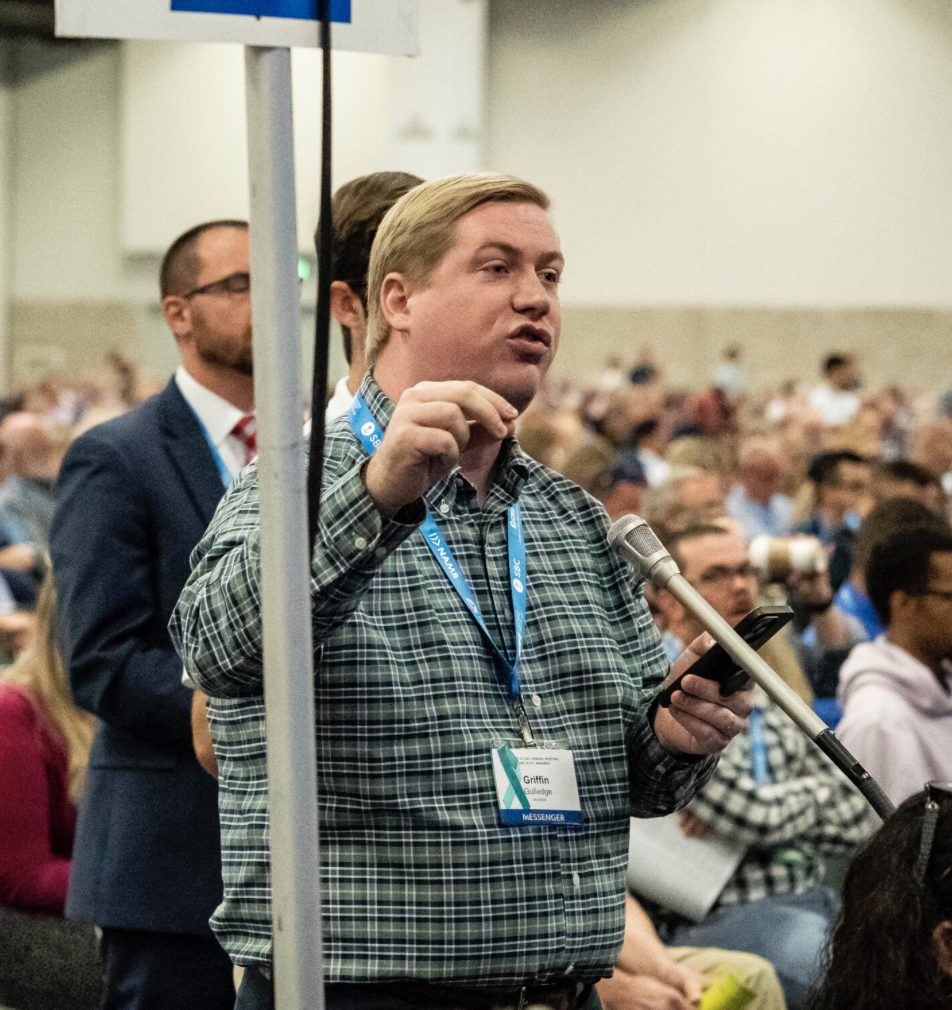
Pastor Griffin Gulledge speaks at the Southern Baptist Convention annual meeting on June 15, 2022, in Anaheim, California. (Photo by Justin L. Stewart / RNS)
That vote should be a wake-up call, said Griffin Gulledge, pastor of Madison Baptist Church in Madison, Ga., and an avid supporter of the ERLC. In recent years, Southern Baptists have had vocal disagreements over religious liberty and the best strategy for opposing abortion, he said. Those disagreements are showing up as conflict over the ERLC.
“There is real division here,” he said. “Not just about any individual’s performance or accomplishments, but about the very convictions that drive the organization.”
Gulledge, who received an award from the ERLC in 2021 for his advocacy in drawing attention to the persecution of Uyghur Muslims in China, said the ERLC also has been charged with dealing with some of the most contentious issues in American culture, from immigration reform to presidential politics. “Every issue they deal with is complicated,” he said.
Gulledge said the ERLC needs to focus on connecting with local churches and pastors, to make them more aware of the work it does on their behalf. “The future success of the ERLC is completely dependent on the extent to which it builds relationships with, works alongside and empowers local church leaders in the Southern Baptist Convention.”
Focus and transparency
Jon Whitehead, a Missouri attorney and member of the ERLC’s board of trustees, said ERLC can’t shy away from controversial issues, but he believes the agency should focus on positions Baptists agree on, rather than take sides in debates on abortion and other divisive issues.
“Increasingly, we’re committed to being on the side of life, from natural conception through natural death,” he said. “There are obviously some disagreements about how that is implemented, and I’m not sure the convention intends the ERLC to be the referee for that fight.”
Most immediately, Whitehead said, the ERLC needs “complete transparency” about the circumstances around Leatherwood’s employment status. He worries Smith, the former ERLC chair, will take all the blame when the situation is more complicated.
“Kevin Smith did not go postal,” Whitehead told RNS, repeating a sentiment he had shared on the social media site X.
Rebuilding trust
In a press release earlier this week, the ERLC’s executive committee said rebuilding trust will be a key task when the ERLC trustees meet in September in Nashville.
“We know that the task of rebuilding trust will be great,” the committee wrote. “We know that it will require listening to Southern Baptists about their concerns. And we know that we are accountable to Southern Baptists, and ultimately God, for how we carry out our work. To that end, we seek your prayers as we faithfully discern the next best steps for us as a board and for this organization.”
Land, meanwhile, said he believes Leatherwood may be in a stronger position after this week’s events, but warns his accustomed warning is more true today, thanks to social media and email, which make it easier for criticism to turn into a firestorm.
“It used to be that if someone wanted to complain—they had to write a letter or get me on the phone,” said Land.
With additional reporting by Baptist Standard Editor Eric Black.
Queen’s attorney petitions for release of materials
August 12, 2024
NEW YORK (BP)—The government press release charging Matt Queen with falsifying records “contained factual allegations that are inaccurate, misrepresented some facts, and cast Mr. Queen in a more negative light,” the pastor and former seminary leader’s attorney said in a letter filed July 22 with the U.S. Southern District Court.
The May 21 press release announcing the charge “went beyond the allegations in the information,” said Sam Schmidt, attorney for Queen, the former Southwestern Baptist Theological Seminary evangelism professor and interim provost.
Material received from the government during discovery since then falls under “Brady material,” or evidence a prosecutor has that is favorable to the accused. A prosecutor is required to disclose such material.
“Counsel should be permitted to correct the inaccurate and misleading public statements made by the government supported by documents,” the letter said.
“As a result of the information and press release, Mr. Queen has been suspended from his position as the Lead Pastor of Friendly Avenue Baptist Church, which he has held since March 1, 2024. His reputation has been damaged, he was required to withdraw at least one contribution to a forthcoming publication, and he has had previously arranged speaking engagements canceled, affecting potential honoraria.”
His counsel said it only seeks “to provide a limited number of documents” to Friendly Avenue’s committee investigating the allegations to determine if Queen can be reinstated as pastor prior to trial. The documented information also would be made available to the press, albeit not to “endanger any person or witness, nor [to impede] any possible investigation.”
Explanation of the meeting
At issue are Queen’s recollections of a meeting about a reported case of abuse involving a seminary student. On Jan. 24, 2023, Southwestern became aware of the police investigation and released a statement.
Schmidt’s letter goes into greater detail on a meeting two days later following chapel services that included Queen, “Employee 1” and “Employee 2” after Employee 1 was contacted by the alleged victim.
“With Employee 2, Mr. Queen met with Employee 1 near the front of the chapel, immediately after the completion of chapel, with people walking by them during the conversation,” the letter said.
“As instructed by the president, Mr. Queen told Employee 1 that if the matter the alleged victim wanted to talk about concerned the alleged sexual abuse, she should tell victim to speak to the Burleson Police Department. If it related to some other unrelated matter concerning the seminary, then Employee 1 should speak to her. If it was about a personal matter, then it was at Employee 1’s discretion whether to speak to her or not.
“After Mr. Queen provided the advice, Employee 1 and Employee 2 discussed the document that Employee 1 had left for Employee 2 the day before. Mr. Queen was present, though his attention was directed to emails in his mobile telephone because the conversation did not involve him.
“In subsequent conversations with many others, including in his interviews with the government, Mr. Queen repeatedly explained that he never heard Employee 2 tell Employee 1 to destroy the document.”
Document in question
The document in question outlined the allegation of abuse. The two employees cited were later identified as Terri Stovall, current dean of women (Employee 1), and Heath Woolman (Employee 2), who served as chief of staff before accepting the lead pastor position at Fruit Cove Baptist Church in St. Johns, Fla.
In interviews with federal investigators, Queen said he did not interpret the conversation as having directed the destruction of the document. His attorney’s letter goes on, however, to say when Stovall—still identified as “Employee 1” in the recently-filed letter—told Queen she had kept contemporaneous notes, Queen falsely responded he had as well.
Later, Queen learned he would have to produce the nonexistent notes to investigators for his upcoming interview. The government’s statement claims, three days after the interview, Queen said he found a notebook in his office of notes from the January meeting and provided that to investigators. Queen would admit in a follow-up meeting he had not written the notes in January but following his initial interview with investigators.
Queen’s frame of mind
His attorney’s letter opens a window into Queen’s frame of mind at that time.
“Having been upset when questioned harshly by the government on May 23, being fearful, being told by one of the seminary’s attorneys to pray and meditate to remember, and believing that the government was correct—as a very religious person he did pray and meditate the night of May 24,” it read.
“Mr. Queen woke up from a dream believing that he remembered more of the conversation, as previously suggested by the government, including Employee 2’s use of the term ‘this needs to go away.’
“On May 25, 2023, Mr. Queen told of his new recollections to the attorney retained by the seminary to represent potential witnesses employed by the seminary, and he was told that this would be reported to the government.
“After being told that the government would want to talk to him again, Mr. Queen shortly thereafter wrote the notes, which accurately reflect his recollections prior to the night of May 24, in his notebook and provided it to both the attorney and Employee 3. On June 1, 2023, the attorney informed the government about Mr. Queen’s new recollections, and we believe he provided them with the notes as well.”
Schmidt’s letter claims some of the information so far withheld includes Brady material, supports Queen’s defense and/or demonstrates the indictment contained “incorrect or misleading statements.”
Chair resigns ERLC board, issues apology
August 12, 2024
WEST PALM BEACH, Fla. (BP)—Southern Baptist pastor Kevin Smith announced Tuesday morning, July 23, he has resigned as chairman and from the board of the Ethics & Religious Liberty Commission. Smith’s resignation comes on the heels of a turbulent 24 hours for the Southern Baptist public policy entity.
The ERLC announced Monday evening, July 22, the board’s executive committee had removed President Brent Leatherwood “in accordance with our bylaws.” However, that decision was rescinded early this morning.
In a statement provided to Baptist Press, Smith said: “After multiple conversations with Executive Committee members of the ERLC, I was convinced in my mind that we had a consensus to remove Brent Leatherwood as the president of the ERLC. It is a delicate matter and, in an effort to deal with it expeditiously, I acted in good faith but without a formal vote of the Executive Committee. This was an error on my part, and I accept full responsibility.”
Smith went on to note: “At this time, the Executive Committee does not wish to move forward with my course of action.”
He confirmed his resignation from the board saying: “I have been a proud participant in Southern Baptist Convention life for 35 years. I love the SBC. I love the ERLC. And I trust the Executive Committee to take the best course of action moving forward. I will look forward to focusing on ministry in my neighborhood church.”
Smith is a pastor at Family Church in West Palm Beach, Fla. He previously served as executive director of the Baptist Convention of Maryland/Delaware and has been on the ERLC board since 2018.
The ERLC trustees are scheduled to meet Sept. 10-11 in Nashville.
Full statement
Smith’s full statement follows:
“It has been my honor to serve as a trustee at the Ethics & Religious Liberty Commission (ERLC) of the Southern Baptist Convention. As to recent events: After multiple conversations with Executive Committee members of the ERLC, I was convinced in my mind that we had a consensus to remove Brent Leatherwood as the president of the ERLC. It is a delicate matter and, in an effort to deal with it expeditiously, I acted in good faith but without a formal vote of the Executive Committee. This was an error on my part, and I accept full responsibility. At this time, the Executive Committee does not wish to move forward with my course of action. Therefore, I am resigning as the Chairman of the ERLC Board of Trustees and as a Trustee. I have been a proud participant in Southern Baptist Convention life for 35 years. I love the SBC. I love the ERLC. And I trust the Executive Committee to take the best course of action moving forward. I will look forward to focusing on ministry in my neighborhood church.”
ERLC reverses course, Brent Leatherwood not fired
August 12, 2024
(RNS)—In a head-scratching turn of events, the executive board of the Southern Baptist Convention’s public policy arm now says its leader has not been fired.
On Monday evening, July 22, the SBC Ethics and Religious Liberty Commission announced Brent Leatherwood, the group’s president, had been fired—a day after he praised President Joe Biden for ending his reelection bid.
Less than 12 hours later, the ERLC’s executive committee issued a new statement on Tuesday, saying Leatherwood would remain in leadership.
“Brent Leatherwood remains the President of the ERLC and has our support moving forward,” the statement read.
The committee also said ERLC board chair Kevin Smith had acted on his own in announcing that Leatherwood was fired. Smith, a former seminary professor and denominational administrator who currently pastors a church in Florida, has resigned as ERLC chair, according to the statement.
“There was not an authorized meeting, vote, or action taken by the Executive Committee,” the executive committee’s statement said.
Smith, who has served on the ERLC board since 2018, was elected chair last fall.
Smith’s error
Smith, pastor of Family Church in West Palm Beach, Fla., did not immediately reply to a request for comment. He told Baptist Press, an official SBC publication, he had spoken with other members of the ERLC executive committee about removing Leatherwood and thought they agreed. He now said he was wrong.
“After multiple conversations with Executive Committee members of the ERLC, I was convinced in my mind that we had a consensus to remove Brent Leatherwood as the president of the ERLC. It is a delicate matter and, in an effort to deal with it expeditiously, I acted in good faith but without a formal vote of the Executive Committee,” he told Baptist Press. “This was an error on my part, and I accept full responsibility.”
The ERLC’s bylaws do allow the executive committee to fire the entity’s leader. The bylaws require 10 days’ notice for special meetings of the board of trustees but do not detail notice requirements for executive committee meetings.
Smith is a former professor at Southern Baptist Theological Seminary in Louisville, Ky., and a former executive director of the Baptist Convention of Maryland/Delaware. Smith told Baptist Press he resigned both as chair and as an ERLC trustee.
ERLC board response
A statement issued by the ERLC board of trustees the evening of July 23, acknowledged the board’s failure “to fulfill [it’s obligation to oversee the ERLC’s ministry assignment] in ways that ensure the stability of this organization.”
The board affirmed its “support for the ERLC staff and their faithfulness in fulfilling their assignment to our churches. This board stands behind the staff and will do everything in its power to ensure that the work of the organization—protecting a culture of life, championing God’s good design for marriage and sexuality, and defending a free church in a free state–continues uninterrupted.”
Referencing “the events of the last 24 hours,” the board stated Smith’s “decision to act” was unilateral and “outside of his authority as board chair.” Furthermore, “the members of the executive board were unaware of the chair’s actions until they received the email” sent by staff.
“While the executive committee recognizes a wide range of opinions on the work of the ERLC, most visible in a recent attempt to abolish the organization at the 2024 SBC annual meeting, the executive committee does not believe that this discontent rises to the level of a dismissible offense,” the statement continued.
The board also defended Leatherwood against accusations of “moral failing,” saying he is found “to be a man of utmost moral and ethical integrity.”
Trustees also wanted to make clear their retraction was “not about responding to pressure from outside organizations. As people who must give an account to God and Southern Baptists for how we have stewarded this commission, we have worked to ensure that every action taken follows the appropriate procedures affirmed by Southern Baptists.”
“Vice chair Tony Beam has assumed the responsibilities of chair of the board. The other members of the executive committee are: Amy Pettway, Anthony Cox, and Nathan Lugbill.
“As a board, our responsibility is to ensure that this commission can execute the task given to it by the messengers of the Southern Baptist Convention. We commit ourselves to that task” and to rebuilding trust in “the executive committee, the trustee board” and the ERLC.
Praise for Leatherwood
Eric Costanzo, pastor of South Tulsa Baptist Church and an ERLC trustee board member, praised Leatherwood after it was announced the ERLC president was not fired.
“Brent deserves countless apologies for this error and all the assumptions that came with it,” Costanzo wrote on X. “He has proven to be a faithful leader and man of integrity time and again.”
The confusion over Leatherwood’s status is the latest crisis for the ERLC—which has been embroiled in seemingly endless controversy since the election of Donald Trump as U.S. president in 2016.
Criticism of ERLC
Several prominent megachurches withheld funding for the group after Leatherwood’s predecessor Russell Moore was critical of Trump, leading to calls for Moore to be fired.
That led to a meeting between Moore and Frank Page, who was then head of the SBC’s Nashville, Tenn.-based Executive Committee, where the two pledged to work together to unite Southern Baptists. Page later resigned in a scandal.
The SBC’s Executive Committee went on to investigate the ERLC in 2020 for allegedly being divisive and causing a shortfall in denominational donations. A 2021 report from the investigation, which was led by Georgia pastor Mike Stone, a fierce critic of Moore, called the ERLC “a significant distraction.”
Moore resigned as ERLC president in May 2021, leaving the commission for a role at evangelical magazine Christianity Today, where he is now editor-in-chief.
Critics such as Florida pastor Tom Ascol, head of a Calvinist group called Founders Ministries, have repeatedly called for the ERLC to be shut down. This summer, Ascol made a motion to that effect at the SBC’s annual meeting. The motion failed.
Criticism of Leatherwood
Leatherwood has been criticized for opposing legislation backed by Ascol and other members of the so-called abortion abolition movement that would have jailed women who have abortions. More recently, Leatherwood criticized the GOP for dropping anti-abortion language from its 2024 platform.
Leatherwood also called for gun law reforms after a shooting in March 2023 at a Nashville Christian school where his children were students.
He did not respond to requests for comment. Leatherwood did post his thanks on social media.
“I deeply appreciate everyone who has reached out, especially our trustees who were absolutely bewildered at what took place yesterday and jumped in to set the record straight,” Leatherwood wrote Tuesday morning on X.
With additional reporting by Baptist Standard Editor Eric Black.
This is a breaking story and will be updated.
Baptists respond to Trump assassination attempt
August 12, 2024
Baptists and other Christians offered prayers and pleas for peace in the aftermath of the attempted assassination of former President Donald Trump at a July 13 campaign rally in Pennsylvania.
Trump sustained an injury to his right ear, but a statement from his campaign said he is “fine after being checked out at a local hospital.” A rally attendee, former fire chief Corey Comperatore, was killed, as was the shooter. Two other people also were wounded.
Texas Baptists’ Christian Life Commission issued a statement expressing grief for the loss of life and prayers for the “speedy and full recovery” for the former president and “for our entire nation.”
“The murder of at least one rally attendee and attempted murder of the former president is an assault on the image of God, and gun violence is in direct opposition to the pro-life values of Texas Baptists,” the CLC statement reads.
“The CLC unequivocally condemns all acts of political violence as an affront to democracy and our nation.”
The CLC called on Christians to “lead the way in loving our neighbors as ourselves.”
“This moment is a reminder of the sacredness of all human life and that we have more in common than what divides us. We invite Texas Baptists to pray for healing in our nation.”
‘May your people be peacemakers’
Julio Guarneri, executive director of the Baptist General Convention of Texas. (Texas Baptists Photo)
On Sunday morning, July 14, Baptist General Convention of Texas Executive Director Julio Guarneri tweeted a prayer on X, the platform formerly known as Twitter: “As we prepare to gather in our houses of worship, we grieve. Our country, and the world, has been shaken by the tragedy that occurred yesterday.
“The violent attack on former President Trump and the senseless loss of lives reminds us of our divisions and our brokenness. Regardless of political persuasion, your people hold human life sacred because you do. Any attack on those made in your image is a transgression against you.
“Today may your gathered people pray in humility. May we grieve before you for the state of our world. May we repent of bitterness, hatred, malicious talk and pettiness. May we seek your forgiveness, experience your grace, and desire to be like you.”
Guarneri continued: “May we learn to pray for and talk to those who disagree with us. May your people be peacemakers so that we can truly be called the children of God.”
Appeal to ‘the better angels of our nature’
Bart Barber, immediate past president of the Southern Baptist Convention, posted a message on his blog for members of his congregation, First Baptist Church in Farmersville, asking them to “pray for our nation.”
“Let us make it clear that this kind of behavior is unacceptable. Unlike people in many other places around the world, we get to speak by way of our votes,” Barber wrote.
“We live in a nation where our votes are not coerced, we are not threatened or intimidated in our voting, our votes are fairly counted every time, and our country transfers power every time in accord with the expressed wishes of the people.”
He urged prayer for Trump “no matter how you plan to vote in November.”
“Let us all speak with one voice saying that this kind of behavior is WRONG. Let us not contribute to making things worse, but let us be the ones summoning what Lincoln called ‘the better angels of our nature’ in all of those around us,” Barber wrote.
“Let us do all of those things around our family tables, in our Sunday School classrooms, and in our presence online.”
‘No place whatsoever in America’
Brent Leatherwood, president of the SBC Ethics and Religious Liberty Commission, stated: “In a democracy like ours, we voice our opinions, we passionately press our case, we bravely dissent, and we loudly campaign for our cause. But we must never cross the line to harm those we disagree with.
“Political violence has hurt too many individuals and taken too many lives in our history. Now is the moment for all of us to unite and bring a swift and universal condemnation to this vile act that has no place whatsoever in America.
“While it will be easy to use this moment as an opportunity to dig in our heels, I urge Americans to pause, lament this violence, and realize how far we have strayed from our nation’s ideals. Let’s commit to praying for our leaders, those who are willing to serve in public office, and appeal to our Lord that his reconciling work would be poured out on this nation to overcome the hatred that is so prevalent in our culture.”
Leatherwood’s predecessor at the ERLC, Trump critic Russell Moore, editor in chief of Christianity Today, tweeted:“Political violence is evil to the core and is an attack on everything this country represents. Attempted murder is an attack on the image of God. This is awful.”
Bible teacher Beth Moore tweeted a prayer: “Jesus have mercy on us in these horrors and sorrows. We on this bloodied soil are desperate for your peace. Bind this heinous violence and cause sound minds to prevail and vicious plans to fail. Oh Jesus, Jesus, hasten to save.”