Interfaith relations focus on friendship, pastors say

JACKSONVILLE, Fla. (ABP)—Interfaith dialogue is on the rise—not just in formal conversations led by religious leaders, but also in local communities where friendships form as ministers of various faiths work together for common goals amid increasing religious diversity in the Bible belt.

Imam Joe Bradford (left) and Pastor Kyle Reese share a light moment at Hendricks Avenue Baptist Church in Jacksonville, Fla. Reese counts Bradford–along with a local rabbi and Greek Orthodox priest–among his best friends. (ABP PHOTO/Jeff Brumley)

Kyle Reese, pastor at Hendricks Avenue Baptist Church in Jacksonville, Fla., has been front-and-center in community interfaith efforts, especially in his dialogue with Muslim and Jewish spiritual leaders. He refers to Imam Joe Bradford as "best friend"—as he does a rabbi and an Orthodox Christian priest.

Steve Jones, who worked with Jews and Muslims to tackle social injustice in Birmingham, Ala., said the same about Rabbi Jonathan Miller. "I am closer to these guys than I am with many other Baptist ministers," said Jones, pastor of Southside Baptist Church.

The emergence of a more grassroots, relational interfaith movement can be attributed to 9/11 and its aftermath, said Antonios Kireopoulos, who oversees interfaith issues for the New York-based National Council of Churches.

The attacks generated both suspicion and curiosity about Islam that raised interest in dialogue "10, 20 and 100 fold," he said. He noted a growing "Baptist-Muslim dialogue" in the form of pulpit swaps and practical alliances on local issues.

Mitch Randall, pastor of NorthHaven Church, a Baptist General Convention of Texas-affiliated congregation in Norman, Okla., is among the participants. Randall noted he once had little use for the historic interfaith model and its focus mostly on annual prayer breakfasts or worship services. All that changed shortly after 9/11, when a motorist gave him a rude gesture.

"I'm a quarter Native American and fairly dark-skinned, and he probably mistook me for a Middle Eastern individual," Randall reported. "I thought, 'What must that feel like for people who truly are Muslims?'"

The result was "a quest to befriend people who are Muslim … to break down those barriers and stereotypes." He since has developed friendships with Muslim religious leaders in Oklahoma.

"We began doing things together," Randall said, "like feeding the poor or working on immigration issues."

But the interfaith movement isn't out of the woods yet.

"That word still scares a lot of people," said Paul Chaffee, founder and editor of TheInterfaithObserver.org, based in California. Many Christian conservatives see interreligious communication as an effort to blend all faiths into one.

However, Chaffee said, even some conservative evangelicals have seen the value of working with conservatives of other denominations and faiths on social issues like same-sex marriage and abortion opposition.

Meanwhile, the progress being made in interfaith work slowly is spilling over into ecumenical outreach, which experts say is a more difficult field.

"The closer you get in the family, the more the temperature goes up in the room," said Chaffee, who also serves on the board of the North American Interfaith Network.

Steven Harmon, adjunct professor of Christian theology at Gardner-Webb University, said he's seen that phenomenon first-hand. Ecumenical dialogue "does not have the kind of excitement or urgency there was a few decades ago," he said.

Harmon, who served on a Baptist World Alliance team that held exploratory talks with leaders of the Orthodox Church, said dialogue must focus on more than symbolic and theological meanings.

"Whether it's ecumenical or interfaith, ultimately there needs to be more emphasis on what happens on the grassroots level," he said.

As Chaffee put it: "As soon as you start making friends, it changes everything."

In Jacksonville, Reese said his relationships with Bradford, Rabbi Joshua Lief and Greek Orthodox Priest Nicholas Louh have provided him spiritual and emotional solace.

The four hang out together, gather with their wives for dinner and speak to each others' congregations.

Their friendship became so well known, they were invited to speak on local public radio monthly as "the God Squad."

"We just have such a strong rapport and we can kind of rib each other," Bradford said of the foursome's behavior on and off the air.

Reese often jokes with Bradford about growing up in a Baptist home until he became a Muslim as a teenager.

Reese noted getting to know Bradford and his community has deepened his appreciation for the persecuted, minority origins of the Baptist tradition.

"I would argue that I am a better Christian because I know Joe," said Reese, former pastor of First Baptist Church in San Angelo.

In Birmingham, Jones received complaints about his relationship with the Jewish community and its rabbi. "We were really criticized because we weren't preaching the gospel to them or trying to win them to Christ," he recalled.

For him, however, participation is simply a way of being a good Christian.

"As a Baptist, my idea of evangelism isn't 'winning anyone to Jesus' but being a good neighbor and showing respect," Jones said. "And you can't do that if you don't get together."


Seminary archaeology team makes key find

KARME YOSEF, Israel (BP)—A recent archaeological discovery by a New Orleans Baptist Theological Seminary team never will be displayed in a museum, but it is as significant as many from the Holy Land that fill the finest antiquity halls around the world. And it is much, much larger.

Jim Parker (left) and Dan Warner of New Orleans Baptist Theological Seminary talk to Tsvika Tsuk (right), chief archaeologist at the Israel Nature and Parks Authority, discussing features of the natural cavern at the end of the Gezer Water System in Israel. (BP PHOTO/Gary D. Myers)

The team, under the direction of the seminary's Center for Archaeological Research, located a large open section in a cave at the eastern end of the ancient water system at Tel Gezer in Israel.

The discovery marks a major milestone in the seminary's three-year exploration at Gezer and sets the stage for future research, helping scholars understand the cultural context in which the Bible was written.

The team still plans to locate the water source for the system and explore the entire cave, seeking a possible rear exit and pottery evidence to help date its construction in future digs.

The dig leaders believe the rock-hewn water tunnel was cut by the Canaanite occupants of Gezer between 2000 and 1800 B.C.—around the time of Abraham. Other scholars date the system to the time of the Divided Kingdom after Solomon.

The site is mentioned numerous times in the Bible, including in 1 Kings 9, when the city was given to Solomon by the Egyptian pharaoh. Solomon rebuilt and fortified the city with a massive wall and unique gate system.

The latest discovery could help archeologists date the Tel Gezer water system and understand how it works, which would offer valuable information to students of the Bible.


SBC pastors concerned about Calvinism, embrace some of its tenets

NASHVILLE, Tenn. — Nearly equal numbers of pastors in the Southern Baptist Convention consider their churches as Calvinist/Reformed as do Arminian/Wesleyan, although more than 60 percent are concerned about the affect of Calvinism on the denomination, according to a new survey from LifeWay Research.

Calvinism chartLifeWay Research presented a slate of statements about Calvinism to a randomly selected sample of senior pastors in the SBC to gauge their theological inclination and whether they are concerned about the impact of Calvinism in the convention.

Sixty-six percent of pastors do not consider their church a Reformed theology congregation, while 30 percent agree (somewhat or strongly) with the statement “My church is theologically Reformed or Calvinist.” Four percent did not know. This compares to 29 percent who agreed to this statement in an earlier survey of 1,000 Protestant pastors in 2011.

By the same token, 64 percent of SBC pastors also disagree (15 percent somewhat; 49 percent strongly) that “My church is theologically Arminian or Wesleyan.” Thirty percent of respondents classify their church as Arminian or Wesleyan, with 6 percent selecting “Don’t know.” This compares to 37 percent of Protestant pastors who agreed on the 2011 survey.

“It is fascinating how much debate is occurring right now on this topic when most pastors indicate that neither end of the spectrum correctly identifies their church,” said Ed Stetzer, president of LifeWay Research.

“However, historically, many Baptists have considered themselves neither Calvinist nor Arminian, but holding a unique theological approach not framed well by either category.”

Stetzer also explained, “We used the terms ‘Reformed or Calvinist,’ as that is generally self-explanatory.  However, the terms ‘Arminian or Wesleyan’ are less common as Wesleyans are often seen as another denomination, and many are uncomfortable with the term ‘Arminian.’

“However, to compare it to Protestant pastors, we wanted to use consistent terms—and, I imagine, many will be surprised that language did not keep respondents away—with an equal number claiming Reformed or Calvinist as claimed Arminian or Wesleyan.”

The survey revealed more than 60 percent of SBC pastors agree (35 percent strongly; 26 percent somewhat) they are “concerned about the impact of Calvinism in our convention.” Thirty percent disagree (16 percent strongly, 14 percent somewhat) with the statement. Nine percent chose “Don’t know.”

The survey showed pastors of Midwestern churches are more likely than pastors in the South (20 percent vs. 13 percent) to somewhat disagree and less likely to strongly agree (27 percent vs. 37 percent) they are concerned about the impact of Calvinism in the SBC.

Pastors age 18-44 are most likely to strongly disagree (26 percent) that they are concerned (4 percent selected “Don’t know”) and are more likely (20 percent) to somewhat disagree than pastors age 55-64 (10 percent) and 65 and older (9 percent).

Seventy-eight percent of pastors responded they personally are not five-point Calvinists, while 16 percent agreed (8 percent somewhat and 8 percent strongly) with the statement, “I am a five-point Calvinist.” This compares to 32 percent of pastors who agreed with the statement in last year’s survey of Protestant pastors.

The majority is reflected in every age bracket, although SBC pastors age 55-64 (77 percent) and 65 and older (77 percent) are more likely to “strongly disagree” with the statement than pastors age 18-44 (60 percent) and 45-54 (66 percent). Pastors age 18-44 (18 percent) and 45-54 (10 percent) are more likely to strongly agree with the statement than pastors age 55-64 (3 percent) and 65 and over (1 percent).

The survey also showed SBC pastors of churches with less than 50 in attendance are most likely to select “Don’t know” (14 percent) and the least likely to strongly disagree (62 percent) with the statement, “I am a five-point Calvinist.”

LifeWay Research asked a similar question in a 2006 SBC survey, which revealed 85 percent did not consider themselves five-point Calvinists and 10 percent affirmed that they were five-point Calvinists.

“Rather than ask a single question of yes or no, the new survey was intended to capture some of the complexity of the debate by covering several specific theological points and bringing clarity to how strongly pastors hold each position,” Stetzer explained.

Ten percent of respondents strongly agree with the statement, “Christ died only for the elect, not for everyone in the world,” and another 6 percent somewhat agree. More than 80 percent somewhat disagree (6 percent) and strongly disagree (77 percent) with the statement. This compares to 91 percent of Protestant pastors who disagreed in the earlier survey.

Half of SBC pastors agree with a statement related to irresistible grace—31 percent strongly agree and 19 percent somewhat agree with the statement “God is the true evangelist, and when he calls someone to himself, his grace is irresistible.” Forty-eight percent (29 percent strongly, 19 percent somewhat) disagree with the statement. This matches the agreement Protestant pastors showed (50 percent) in the 2011 survey.

Two-thirds of SBC pastors strongly disagree with a statement on double predestination: “Before the foundation of the world, God predestined some people to salvation and some to damnation.” Eleven percent strongly agree with the statement, while 10 percent somewhat agree and 9 percent somewhat disagree. A similar question was asked of Protestant pastors and 13 percent agreed.

More than 90 percent strongly disagree that “it diminishes God’s sovereignty to invite all persons to repent and believe.” An additional 5 percent somewhat disagree, leaving 4 percent who strongly or somewhat agree. This compares to 87 percent of Protestant pastors who disagreed.

Ninety-four percent of respondents believe in the security of the believer, that “a person can, after becoming a Christian, reject Christ and lose their salvation.” Five percent agree a person can lose their salvation.

“There appears to be a lot of concern among Southern Baptist pastors on the impact of Calvinism, but the beliefs in these doctrines, at least measured by these questions, show quite a mix of beliefs,” Stetzer said.

Stetzer summarized: “Most Baptists are not Calvinists, though many are, and most Baptists are not Arminians, though many are comfortable with that distinction.  However, there is a sizeable minority that see themselves as Calvinist and holds to such doctrines, and a sizeable majority that is concerned about their presence.  That points to challenging days to come.”


Southern Baptists elect Luter first African-American president

NEW ORLEANS (ABP)—One hundred sixty-seven years after forming over the right to appoint slaveholders as missionaries and 17 years after apologizing for the denomination's racist past, the Southern Baptist Convention elected its first African-American president.

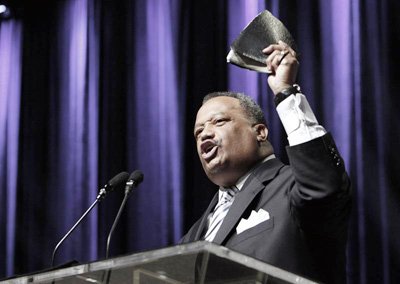
Fred Luter Jr., pastor of Franklin Avenue Baptist Church in New Orleans, preaches at the Southern Baptist Convention Pastors' Conference. When messengers to the SBC annual meeting elected Luter as convention president, he became the first African-American to hold the office. (BP PHOTO/Bill Bangham)

Messengers to the SBC annual meeting elected New Orleans pastor Fred Luter by acclamation to lead the nation's second-largest faith group behind Roman Catholics. Luter, pastor of Franklin Avenue Baptist Church in New Orleans, was nominated to the office by David Crosby, pastor of First Baptist Church in New Orleans.

"He is qualified in every way to hold this office," Crosby said. "We have an opportunity to make history, to show the watching world the truth about our Savior and ourselves and to affirm again the mission that undergirds everything we do."

Wiping away tears, Luter came to the platform to thank messengers for his election. "To God be the glory for the things that he has done," Luter said. "God bless you. I love you."

Luter's election comes at a time when Southern Baptists are seeking to turn around a numerical decline and to elect leadership more representative of the ethnic diversity that exists in the convention's 40,000 churches.

Ed Stetzer of LifeWay Research says the percent of non-Anglo churches has moved from one in 20 to one in five just during the last two decades.

It also adds credibility to efforts by the denomination to shed its past image as defenders of Jim Crow in the South during the Civil Rights Movement championed by black Baptists like Martin Luther King Jr.

Emmanuel McCall, longtime director of black church relations for the Southern Baptist Home Mission Board, dates real progress toward racial reconciliation in the SBC to 1957, when the HMB—since reorganized into the North American Mission Board—hired Victor Glass as liaison with the National Baptist Convention.

McCall, an adjunct faculty member at Southern Baptist Theological Seminary from 1970 until 1996 and past moderator of the Cooperative Baptist Fellowship, said in his 2007 memoir of race and Baptists, When All God's Children Come Together, that the founders of the Southern Baptist Convention found theological justification for white supremacy in the Curse of Ham theory, which came into use in defense against abolitionists between 1800 and 1865.

The myth that black people were made dark by a curse that God put upon one of the sons of Noah was largely regarded as the "inspired" word of God until scholarship of the 1960s refuted it, McCall said. Questions around the theme were raised regularly at race relations conferences until the 1970s, and that the notion still exists on the fringes, he noted.

Denominational leaders' views on race evolved with the rest of white America, McCall observed. After President Truman desegregated the armed forces, Southern Baptists in 1947 passed a resolution opposing racial prejudice and pledging to "cooperate with Negro Baptists in building up of their churches, the education of their ministers, and the promotion of their missions and evangelistic programs."

In 1954, the Christian Life Commission supported Brown v. Board of Education by encouraging the SBC to affirm civil authority. As SBC president in 1958-1959 and as a member of the CLC's board of trustees, Arkansas Congressman Brooks Hays pushed progressive racial views in the denomination that wound up costing him his political career.

In 1960, Foy Valentine, a protégé of Southwestern Baptist Theological Seminary professor T.B. Maston, took over as director of the Christian Life Commission—lobbying for ethical issues including race. After a seminar in Washington where President Johnson invited participants to the White House and solicited their help in passing the Civil Rights Act of 1964, a member of the SBC Executive Committee suggested the agency be abolished.

In 1968, the commission worked with SBC President Franklin Paschall for adoption of A Statement Concerning the Crisis in Our Nation that confessed Southern Baptists' shortcomings in advocating racial justice. About one-fourth of voting messengers opposed the statement, described by newspaper editors as the denomination's strongest statement ever on race.

Another catalyst for racial reconciliation was the Home Mission Board under leadership of Arthur B. Rutledge from 1965 until 1976. Rutledge gave Home Mission Magazine editor Walker Knight and staff freedom to write about churches and missionaries on the cutting edge of community action and change.

Rutledge also expanded work with National Baptists to department status, in 1968 hiring McCall as the first African-American to serve on the national staff of an SBC agency. Headlines read, "Southern Baptists elect a Negro executive."

Sailing wasn't always smooth for progressives in the SBC. In 1971 the Sunday School Board recalled 140,000 copies of a publication that featured a front-cover photo of a black male student talking to two white female students on a college campus. McCall says public backlash to the incident was a major embarrassment that nudged the denomination toward a healthier attitude about race.

In the early 1990s, a number of Baptist state conventions passed resolutions apologizing for past racism to clear the air in anticipation of the SBC's 150th anniversary in 1995. One in the Georgia Baptist Convention was sponsored by current SBC president Bryant Wright, who had encountered animosity from black religious leaders while trying to coordinate an area-wide evangelistic crusade in preparation for the 1996 Summer Olympics in Atlanta.

For the first time, historians began discussing frankly the role slavery played in the SBC's founding. In 1995, the Christian Life Commission, under direction of Richard Land, held a Racial Reconciliation Consultation of 16 Baptist leaders, equally divided between black and white, who drafted what became the SBC resolution apologizing for the denomination's historic support for slavery and acceptance of past racial injustice including segregation.

The statement went on to "genuinely repent of racism of which we have been guilty, whether consciously or unconsciously" and "ask forgiveness from our African-American brothers and sisters, acknowledging that our own healing is at stake."

Land's work for racial reconciliation was tarnished recently when his trustees reprimanded him for comments about racial profiling—related to the Trayvon Martin shooting—that the board deemed harmful to black-white relations.


WMU celebrates Jesus’ story in New Orleans

NEW ORLEANS (BP)—Woman's Missionary Union's theme for this year, "The Story Lives On," came to life through the words of a New Orleans pastor, a missionary and others during the WMU annual meeting in New Orleans.

National Acteen Panelist, Mary Virginia Harper of Montgomery, Ala., addresses the Woman's Missionary Union missions celebration and annual meeting in New Orleans. (BP PHOTO/Matt Miller)

WMU President Debbie Akerman noted "The Story Lives On" focuses on the gospel's ability to transcend generations and transform individuals, churches, communities and nations.

David Crosby, pastor of First Baptist Church in New Orleans, described the lasting impact of Jesus' story on New Orleans following Hurricane Katrina.

"It turned our city into a lake," Crosby said. "Eighty percent of the footprint of the city of New Orleans was covered with water. Our church was an island in a flood for three weeks. And when I came in by helicopter 11 days after the storm, I wondered, 'God, will it ever come back together again?'

"And then, there was a rush of wonderful love. A flood of people, thousands and hundreds of thousands, who came to help in this city that care forgot."

But love for one's neighbor doesn't come easy, Crosby said. Referencing the story of the Pharisee who tested Jesus in Matthew 22 by asking Christ which commandment was greatest, Crosby said it wasn't the first commandment the religious leader struggled with but the second.

"Love the Lord your God with all you heart, soul, strength and mind. He felt he had that down. He was a devoted Jew," Crosby said. "He went to synagogue, he said his prayers and gave his tithe. … What troubled his conscience, why he wanted to justify himself, was the second: Love your neighbor as yourself. You might be a little like him. I think I am."

David Crosby, pastor of First Baptist Church in New Orleans, was a featured speaker during the Woman's Missionary Union missions celebration and annual meeting in New Orleans. (BP PHOTO/Matt Miller)

That's why Jesus gave believers the story of the Good Samaritan in Luke 10, Crosby explained, "to help you and me understand what it means to love your neighbor." And love, he said, walks into a trial.

"Love is so complicated and so difficult, it's such a mess. It's just easier to walk by the other side of the road. I mean, you got church work to do, meetings to attend—we're busy people.

"Talk about washing feet? A beautiful rendition of that story—it's going into a stranger's house and cleaning up after the flood, and helping that poor soul deal with the fact that he brought a truck to take what he wanted to save, and (instead) he can fit it all in a 13-gallon trashcan."

Participants at the WMU annual meeting also heard about the power of Jesus' story from Annette Hall, an International Mission Board worker who spoke about the impact of chronological Bible storying. Hall has worked nearly 40 years with North African and Middle Eastern peoples, and ranks among IMB's top oral evangelism experts.

"Two-thirds of the world's people are oral communicators," Hall said. "That means that they learn through stories or music, drama or poetry. … If you hand them a book to read, they either can't read it or they won't read it."

The process behind chronological Bible storying is simple, Hall said, often using a set of 20 individual stories that move listeners through the Bible from Genesis to the second coming of Christ.

"We tell them the story, and then we have them learn the story, and then we process the story by asking some very simple questions," Hall said. "Because they've learned the story, and because we use the same simple questions every time, they can reproduce this and go out to tell other people.

"We don't teach. We want people to get the point of the story from the story. They need to discover it for themselves. If I tell them the answer, it goes into their heads, but it doesn't go into their hearts."

Hall related a recent success story from a Bible storying training event she led in southern Asia last year. One of Hall's colleagues, who helped with the training, met a young woman whose family had been radically changed.

"The woman said: 'There were some people from my village who went to a training and they learned how to tell Bible stories. And they came and they told the story for me and my family. Now I am a believer and so is my family. All of us believe in Jesus,'" Hall recounted. More than 20 people in that village have been baptized as a result of chronological Bible storying, she added.

"Chronological Bible storying is a powerful tool," she said. "God gave it to us. He gave us a book full of stories. And all we have to do is learn to use them."

Participants at the WMU meeting also were introduced to this year's National Acteen Panelists, young women in grades 7 through 12 chosen from across the United States based on their commitment to missions and participation and leadership in their Acteens group, church, school and community.

Mary Harper, from First Baptist Church Prattville, Ala., told WMU she learned boldness in sharing her faith through interactions with a Korean student she met in a high school chemistry class. Harper described him as a confirmed atheist who often worked "page after page of physics problems that he claimed proved God did not exist."

"He was so much smarter than me, but I knew that my God, the God who gave Daniel the courage to face the lion's den, and the God who gave David the strength to overcome Goliath, would give me the words to say to persevere," Harper said.

She continued to share her faith with her friend over the past two years, and although he has not yet made a commitment to Christ, Harper said he's begun reading his Bible daily and attending church.

"I know that God will continue to work in his life, Harper said. "Through this experience I have learned that God calls all Christians to be missionaries, even if this simply means being willing to share his love with the people we meet in our everyday lives."

Each of the six Acteen panelists will receive $1,000 from the Jessica Powell Loftis Scholarship for Acteens from the WMU Foundation.


More than 870 respond at SBC Crossover 2012 events

NEW ORLEANS (BP)—More than 1,500 Southern Baptist volunteers from 59 New Orleans area churches and many others from across the nation shared the gospel as part of Crossover, the evangelistic emphasis preceding the Southern Baptist Convention annual meeting .

A member of a high school band and choir from Hunter Street Baptist Church in Birmingham, Ala., performs during a Crossover event June 16 at Richard Lee Playground in New Orleans. (BP PHOTO/Hannah Covington)

Their efforts stretched from the Lower Ninth Ward outward to Metairie and Kenner. Counting 38 block parties June 16, as well as special events and door-to-door community evangelism efforts throughout the week, at least 870 people made decisions for Christ during Crossover 2012.

Annual Crossover events are a partnership between local Southern Baptist churches, associations and the North American Mission Board . NAMB provides funding, strategy and coordination assistance.

"We put a lot of work and preparation into it, and the churches and church planters executed the plan superbly," said Jack Hunter, director of missions for the New Orleans Baptist Association . "God did a great work at this year's Crossover."

One of the 38 area churches hosting a block party was Franklin Avenue Baptist Church, pastored by Fred Luter, who was elected as the SBC's first African-American president during the SBC annual meeting.

"Our block party is a great event for the community, the city and the SBC," Luter said. "My prayer is that—using the games and the music—we'll be able to share Christ with folks who don't have a relationship with God so their lives can be changed.

"New Orleans is not the same place as in 2005. It's a whole new city. That's why I'm excited the SBC is here. Baptists came in and helped rebuild our city (after Hurricane Katrina). It's great to see Baptists come back and see the fruits of their labor."

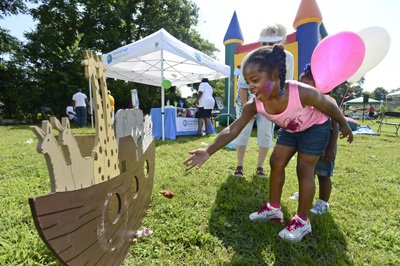
Damayah Clark, 5, tosses a beanbag into a Noah's Ark game during a block party hosted by Celebration Church in New Orleans. The event was part of Crossover, a series of evangelistic events, held prior to the Southern Baptist Convention annual meeting. (BP PHOTO/Jeremy Scott)

Whether it was large churches like Franklin Avenue Baptist or small congregations like Evangelistic Baptist Church on Elysian Fields Avenue, New Orleans-area churches offered neighborhood children bounce houses, water slides, hamburgers and hot dogs, snow cones, cotton candy and live entertainment by Christian rap artists, praise groups and strength teams on church campuses or in parks throughout metro New Orleans.

Evangelistic Baptist Church lost 65 percent of its members after Katrina, and now it's down to about 25 members. But those surviving members, along with youth and adults from Baptist churches in Peachtree City, Ga., and DeRidder, La., sponsored a block party drawing about 200 people, Pastor Anthony Pierce said.

"We didn't know whether we'd ever even have church here again after Katrina," Pierce said. Floodwaters destroyed the sanctuary of the old church, which had to be rebuilt on the inside.

Local churches benefited from the outpouring of volunteer labor from across the convention.

Thomas Strong, pastor of Metairie Baptist Church in Metairie, La., believes their block party represents another opportunity for the church to let the surrounding community learn more about the church. Crossover volunteers played a critical role in the block party, he said.

"We're all working together at this block party," Strong said. "It's reminding our church that it's not just us. It's not just the churches in our city. It's all of us as Southern Baptists coming together to accomplish God's purpose for us in reaching out."

Dustin Swanger, a member of First Baptist Church in Peachtree City, Ga., had the opportunity to lead a 17-year-old to faith in Jesus Christ at the block party hosted by Metairie Baptist. The boy told Swanger he hadn't read the Bible and never prayed to receive Christ. Swanger then led the young man to faith in Christ.

"That hits me deep within when I think about it, to know that someone who once wasn't saved is now saved, and I was there to witness it," Swanger said.

For Emmanuel Spanish Baptist Church in Metairie, a weeklong Vacation Bible School culminated in a block party with close to 30 decisions for Christ. First Spanish Baptist Church in Atlanta helped Emmanuel with VBS and the block party. Parents of children who attended VBS and others in the community were invited to the party to see the children perform some of what they learned during the week.

Jonathan Sharp, the cross-cultural evangelism strategist at the New Orleans Baptist Association, said Emmanuel had been apprehensive about holding a block party since it would be new for them. But volunteers from the Atlanta church helped teach them how to put the block party together.

"They've helped us do many things this week to help us better reach our community," Eric Gonzalez, Emmanuel's pastor, said. "It also helped to encourage and motivate our people to serve more."

Downtown, volunteers fanned out to prayerwalk the French Quarter. Starting at the Baptist Friendship House, teams learned about the surrounding community from executive director Kay Bennett.

Supplied with water bottles and tracts, a Texas Baptist team from San Jacinto College in Pasadena walked down Frenchman Street stopping to talk and pray with locals.

"The people who live here are looking for something to believe in," said Scott Flenniken, director of Baptist Student Ministry at San Jacinto. "They want to find a friend, acceptance."

Flenniken and his wife Nicole have been to New Orleans many times, but it was the first mission trip for the students with them.

"Scott and I just feel a connection to this city," Nicole said. "To see what God is doing in this city is addicting. That's why we keep coming back. You can tell God has a heart for this city."

An "Awaken the City" rally drew about 500 high school students from the greater New Orleans area to East Jefferson High School in Metairie. Church of the King, a church plant of 400 people that meets at the high school, New Orleans Baptist Association and Abandon Productions sponsored the rally that featured Christian rap artist Trip Lee and Andy Gavin of the Strength Team. Gavin included his testimony and the gospel as he demonstrated feats of strength such as breaking a baseball bat over his thigh, tearing a thick phonebook and deck of cards in half, and bending rods of steel, horseshoes and frying pans.

"We just want kids to give their hearts to Jesus," said Dean Ross, executive director of Abandon Productions and pastor of Lakeside Church in Metairie. "The theme, Awaken the City, is literally what we want to do in New Orleans. Events like this are great, but movements are better. We want to change the fabric of this city forever."

With additional reporting by Tobin Perry and Carol Pipes of NAMB


2012 SBC, CBF national meetings offer streaming access

The 2012 national meetings of two Baptist groups offer access via web streaming.

SBC - CBFThe Southern Baptist Convention, meeting June 19-20 in New Orleans can be viewed here. The Cooperative Baptist Fellowship's General Assembly meets June 20-23 in Ft. Worth and can be viewed here.

Both meetings have general information and access to meeting updates online:

Cooperative Baptist Fellowship General Assembly  – "Infinitely More"

Southern Baptist Convention Annual Meeting – "Jesus to the Neighborhoods and the Nations" 


Dad’s best present: sons who are godly leaders

JINOTEGA, Nicaragua (BP)—Rex Jones knows a thing or two about raising sons. He has three of them, and he's trained them to make an impact on the world for Christ.

The Jones boys—Barrett, 22; Harrison, 20; and Walker, 18—all are talented football players.

Barrett, a graduate student in accounting, is an NCAA unanimous all-American lineman for the University of Alabama who, in the past year, has won both the Wuerffel Award for combining exemplary community service with athletic and academic achievement and the Outland Trophy for being the best college football interior lineman.

Father-and-son duo, Rex (black shirt) and Barrett Jones, visit with a group of school children in Jinotega, Nicaragua. Throughout the trip, Rex helped his three sons as they ministered to those around them — both the people of Jinotega and members of their team. (BP PHOTO)

Harrison is an upcoming junior at Alabama and plays as a tight end for the Crimson Tide.

Walker, a rising senior at Evangelical Christian School in Cordova, Tenn., is on his high school football team and plans to play college football like his brothers.

Early in their marriage, Rex Jones, director of advancement at Evangelical Christian School, and his wife, Leslie, decided to be "intentional" in their style of parenting and raise their sons with a clear focus on Christ. They wanted "to teach and train these kids to be a resource to the world," he said.

"The world needs Christian men leaders," he continued. "I don't know that they'll be pastors or missionaries, but … the world needs good Christian lawyers and doctors and dentists and people who are in professions that can influence people."

The Jones boys have accepted their father's challenge. Barrett has led three mission trips during his spring breaks from college; two of them included his entire family. The Joneses returned from a weeklong mission trip to Nicaragua in March.

During that trip, Rex Jones encouraged Barrett to take the leadership role for the team of about 30. He urged all three of his sons to disciple their friends on the trip.

Barrett understands the value of participating in missions and the importance of encouraging others to get involved.

"Missions is something that's extremely important to the Christian community because God is so much bigger than just America. He's a global God," he said.

"We can only (reach) so many people," Rex Jones said. "But if we train other people to (reach) people, then it becomes exponential."

Jones also sees the family's mission trips as a time to expand the vision for missions. He challenges participants "not only to experience serving on these mission trips, but to have a goal in their lifetime … to be able to do the same thing with their families."

His hope is that each of the 30 people on the trip will go on a future mission trip and take 30 of their friends.

"That would be 900 people around the world that God could use to make a difference, and that's our goal," he said.

Barrett, Harrison and Walker each use football to share Christ's love with their teammates and the spectators.

"Obviously sports are for fun—that's why I do them—but also you can have a great influence on others," Walker said. "As we've seen with Barrett, really it's given him a pedestal to be able to share the gospel and share his faith, and that allows people to watch him more closely. I believe that if you take that opportunity and you make the most of it, then that can really change people for Christ."

Jones says despite Barrett's fame, his family keeps him grounded.

"He has two brothers and a mom and a dad who work really hard to keep him humble, and we have fun doing that," his father said with a smile. "It's a great love that we have for each other. I challenge him to maximize his time to be able to use it wisely to do what God is wanting him to do."

The Jones brothers are appreciative of their father's leadership, character and influence as a Christian role model in their lives.

"He's a picture of Christ for me," Harrison said. "He's taught me everything that I think I want to teach my kids one day."


NAMB a finalist for free campus

NORTHFIELD, Mass.—After four months of hosting tours, soliciting proposals and fending off controversy, the billionaire Oklahoma family that owns the Hobby Lobby craft store chain announced two finalists in the competition to receive—free of charge—a picturesque campus in western Massachusetts.

The 217-acre Northfield, Mass., campus founded by 19th-century evangelist D.L. Moody.

Finalists to receive the 217-acre Northfield, Mass., campus founded by 19th-century evangelist D.L. Moody are the Southern Baptist Convention's North American Mission Board and Grand Canyon University Foundation of Phoenix.

Naming finalists marks the latest stage in a two-year process by the Steve Green family to give away the Northfield campus formerly owned by Northfield Mount Hermon School.

Their initial plans were dashed in December when the C.S. Lewis Foundation missed a key fundraising deadline to launch a C.S. Lewis College. Since then, dozens of institutions have made proposals that show both a Christian vision and the financial means to pull it off.

Grand Canyon University, a for-profit Christian school in Phoenix, proposes to establish a second campus in Northfield. As many as 4,800 undergraduates would live on-site. After three or four years, it likely would become a stand-alone university with both traditional and online students, according to Grand Canyon University CEO Brian Mueller.

The North American Mission Board would use the 43-building campus for training missionaries and church planters, as well as hosting retreats for pastors. The Southern Baptist Convention has been targeting the Northeast for church planting in recent years, but the denomination has lacked supportive infrastructure in the region, according to Aaron Coe, vice president for mobilization at NAMB.

A final decision about who gets the campus is expected within the next month.


Baptist Briefs

Wayne Ward

Longtime seminary professor Ward dies. Wayne Ward, 90, retired theology professor at Southern Baptist Theological Seminary, died May 23 at Baptist Hospital East in Louisville, Ky., after suffering a stroke. Ward, who taught at the seminary more than four decades, served as interim pastor at many churches. In later years, much of Ward's attention turned to giving care to his wife of 64 years, Mary Ann, who slipped into years of declining health and increasing dementia until her death in 2007.

BWA names reps for dialogue. David Goatley, executive secretary-treasurer of the Lott Carey Foreign Mission Convention, will represent the United States in an international Baptist/Pentecostal dialogue that begins in August in Quito, Ecuador. Baptist World Alliance General Secretary Neville Callam also named to the panel Henry Mugabe from Zimbabwe, visiting professor of theology at the Baptist Theological Seminary at Richmond and former president of the Baptist Theological Seminary of Harare; Miyon Chung from South Korea, professor at the Torch Trinity Graduate School of Theology; Burchell Taylor from Jamaica, pastor of the Bethel Baptist Church in St. Andrew; Nigel Wright from the United Kingdom, principal of Spurgeon's College; Richard Serrano, president of the Baptist Theological Seminary in Venezuela; and William Brackney from Canada, director of the Acadia Center for Baptist and Anabaptist Studies at Acadia Divinity College.

Baptist women protest rapes in Burma. Leaders of American Baptist Women's Ministries wrote U.S. Secretary of State Hillary Clinton voicing concern about human-rights violations in Burma, particularly the use of rape as a weapon of war. The letter from American Baptist Women's Ministries Executive Director Virginia Holmstrom, President Barbara Anderson and Associate Executive Director Sandra DeMott Hasenauer applauded steps toward democracy in the country also known as Myanmar. But the letter urged Clinton to make sure countries that continue to abuse human rights do not benefit from increased economic engagement with the United States. The American Baptist women mentioned specifically the kidnapping by soldiers of a 28-year-old mother of a 14-month-old daughter last October, who has not been seen by her family since, and a 48-year-old woman reportedly beaten and gang-raped in April. The State Department's latest report on human rights praised Burma for progress toward political reform but noted lingering concerns, including "the legacy of decades of violence against ethnic minorities" and reports "that the military continued to use rape as a tactic of war."

Clarification: Mimi Haddad, president of Christians for Biblical Equality, believes some of the statements quoted in the article, "Scriptures used to support varied understandings of women's role," published in the May 28 issue of the Baptist Standard, could erroneously be understood to support the position that egalitarians rely unduly on experience rather than the language of Scripture in biblical interpretation. The full text of her clarification is posted online at http://baptiststandard.com/index. php?option=com_content&task=view&id= 13837&Itemid=53.


Survey: Pastors favor idea of black SBC denominational leader

WASHINGTON (RNS)—A majority of Southern Baptist pastors surveyed said they think it would be good for their denomination to have an African-American leader.

Six in 10 pastors responding to a LifeWay Research survey said they agree with the statement, "Without regard to any individual, I think it would be a good thing to have an African-American as president of the Southern Baptist Convention."

Fred Luter Jr. of New Orleans is the highest ranking African-American in the Southern Baptist Convention and is widely seen as the denomination's next president. (RNS file photo by Ric Francis/The Times-Picayune)

Ten percent disagreed, and 29 percent said they did not have an opinion. Of those who had an opinion, 86 percent agreed with the statement.

Messengers to the Southern Baptist Convention annual meeting June 19-20 are poised to elect Fred Luter, a New Orleans pastor, as their first African-American president.

Ed Stetzer, president of SBC-affiliated LifeWay Research, said the question was asked to learn pastors' views on the expected vote, but the poll did not mention Luter.

"We are still a predominantly Anglo denomination, so it is particularly encouraging to see the openness and enthusiasm for an African-American SBC president," Stetzer said.

He thinks the almost 30 percent who did not state an opinion—and some of those in disagreement—may reflect pastors who think race should not play a role in SBC leadership selection.

Nearly 1,000 pastors responded to a mailed survey between April 1 and May 11 that had an overall margin of error of plus or minus 3 percentage points.


Trustees cancel Richard Land’s radio show

(ABP)–The Southern Baptist Convention's Ethics and Religious Liberty Commission is pulling the plug on agency head Richard Land's radio show over recent controversial remarks about the Trayvon Martin killing.

The ERLC's trustee executive committee announced June 1 through Baptist Press the decision to cancel Richard Land Live! following an investigation into plagiarism charges. They also reprimanded the 24-year president for "hurtful, irresponsible and racially charged words" during a broadcast about the Feb. 26 shooting of a black Florida teenager widely viewed as a case of racial profiling.

Richard Land

The trustee leaders formally reprimanded Land for not giving proper attribution for comments he read on the air, including statements describing black leaders Jesse Jackson, Al Sharpton and Louis Farrakhan as "race hustlers" who have "made their careers and lucrative fortunes by fomenting racial grievance and demonizing the 'white power structure.'"

Those were just some of the words Land quoted verbatim from a Washington Times column without saying so on the air, although the article was posted on the ERLC website as a program note. Trustee leaders assessed that as "unwisely accepting practices that occur in the radio industry," but said they found no instances of plagiarism in any of Land's written work.

The executive committee launched a plagiarism investigation after a Baptist blogger who read about Land's March 31 comments in Associated Baptist Press listened to an Internet archive of the broadcast and discovered that many of Land's comments were quoted from other sources without on-air attribution.

Aaron Weaver, a Baylor doctoral student who blogs at The Big Daddy Weave, said trustees appeared to give Land "a pass" by describing "clear efforts to make someone else's words his own" as carelessness.

While admitting he isn't a big fan of talk radio, Weaver said he has "serious doubts that what Land did is a common practice in the radio industry among hosts with his level of name-recognition," but that either way, "It's a dishonest practice and blatantly unethical."

The executive committee also determined the content and purpose of Richard Land Live! "are not congruent" with the mission of the SBC agency assigned to address social, moral and ethical concerns, and that controversy over the March 31 broadcast "requires the termination" of the program as soon as possible within the bounds of contracts with the Salem Radio Network.

Land, 65, said in a statement passed on through Baptist Press that he believes in "trustee oversight and governance" and looks forward to working with ERLC trustees.