Fort Worth professor elected Richmond seminary dean

RICHMOND—Timothy D. Gilbert, longtime professor at Tarrant County College in Fort Worth, has been elected dean at Baptist Theological Seminary at Richmond , a post he will assume July 1.

For nearly 30 years, Gilbert has been a professor of philosophy at Tarrant County College, where he also has served as divisional dean and associate vice chancellor for academic affairs.

Timothy Gilbert

Tarrant County College is a nearly 50-year-old two-year institution enrolling more than 50,000 students on five campuses

“Tim brings a wealth of experience to his new responsibilities,” BTSR President Ron Crawford said. “He is a gifted administrator and teacher. He is a splendid churchman.”

Gilbert was elected during a board of trustees conference call Nov. 20. He succeeds Israel Galindo, who completed a five-year term as dean and has chosen to return to the classroom, Crawford said.

Gilbert is a graduate of Oklahoma Baptist University and holds master of divinity and doctor of philosophy degrees from Southwestern Baptist Theological Seminary in Fort Worth, Texas.

He co-authored Christian Ethics—A Primer and contributed a chapter on Christian ethics to Has Our Theology Changed? Southern Baptist Thought Since 1845.

Gilbert is married to Karen Grubb Gilbert, who works contractually for the Cooperative Baptist Fellowship. The Gilberts have two daughters: Katie Lacey is director of college and young adults at First Methodist Church in Birmingham, Ala., and Mary Beth Foust is a BTSR student.


Baptist Briefs: Nigerian Baptists respond to floods

Flooding in Nigeria prompted the BWA to send relief funds.

Nigerian Baptists respond to floods. The Baptist World Alliance dispatched $10,000 for flood relief in Nigeria, where heavy rains have killed 363 people since July. More than 2 million Nigerians have been forced from their homes by this year’s floods, the worst in a half-century. Nigerian Baptists have responded with trucks carrying food items to three Baptist state conferences in hard-hit areas. Olasupo Ayokunle, president and chief executive officer of the Nigerian Baptist Convention, estimated costs for food, clothing and other supplies in the affected areas to be at least $25,000 in the initial stages of immediate assistance. In addition to the initial $10,000 grant, the BWA is accepting donations for other disaster relief.

SUV driver indicted in church van crash. A grand jury indicted the driver of an SUV that crashed into a church van in east Tennessee killing two people and injuring 11. Tyler Schaeffer, 21, was indicted on two counts of vehicular homicide, 20 counts of reckless aggravated assault, nine counts of vehicular assault, one count of DUI, one count of possession of a controlled substance and one count of possession of a synthetic derivative. Police believe Schaeffer was under the influence of methylone, a synthetic derivative used in bath salts that mimics the effects of ecstasy, when his vehicle crashed head-on into a vanload of youth from Cedar Grove Baptist Church in Maryville, Tenn., returning home from a weekend retreat. The fiery collision killed van driver Jeff Trussell, 45, a lay leader in the congregation, and Courteney Kaliszewski, 16, a high-school junior active in volunteer missions. Eleven other passengers were injured, some seriously, but they managed to get out of the van before it became engulfed in flames. Cedar Grove Pastor Bob Lynch noted the injured church members all are out of the hospital, but some face long-term rehabilitation or additional surgeries.

Baptist BriefsBJC sponsors student essay contest. High school juniors and seniors can win up to $2,000 for college in an essay scholarship contest sponsored by the Religious Liberty Council of the Baptist Joint Committee. Essays must examine religious diversity in America and evaluate the claim that the United States was founded as a “Christian nation.” Grand prize is $2,000 and airfare and lodging for two to Washington, D.C. Second prize is $1,000, and third prize is $250. Essays must be between 800 and 1,200 words, and they must be mailed—along with registration forms—and postmarked by March 1, 2013, to be eligible. Visit www.BJConline.org/contest for complete contest rules. For more information, contact Cherilyn Crowe at (202) 544-4226 or by e-mail at ccrowe@BJConline.org.

Oklahoma Baptists affirm failed ‘personhood’ amendent. Messengers to the Baptist General Convention of Oklahoma annual meeting applauded an attempt to amend the state constitution to declare an embryo a human being from the moment of conception. Although the attempt failed, messengers commended the efforts of lawmakers who proposed the amendment.

–Compiled from wire services


Students share their faith during Engage24

The day started out like any other day for a busy college student, rushing from class to class. Then a Christian classmate invited her to go for a cup of coffee.

"I was kind of happy she asked, because there was something I desperately needed her perspective on," the student wrote in an email, asking that her name be withheld.

Students enjoy coffee, donuts and meaningful conversation during an Engage24 outreach event at the University of Texas at Arlington. (PHOTOS/Christi Brazile Matthews)

About a year ago, she had an abortion, in spite of her mother's disapproval. She carried an immense amount of pain, guilt and disappointment. She shared her story with her classmate, expecting also to receive judgment. But that didn't happen.

"She surprised me," the young woman wrote. "She smiled, grabbed my hands and told me all about how and why everyone is messed up—most importantly, how and why everyone still has a hope. She told me it was the gospel, and that it meant that regardless of who and where I was, I was loved."

The conversation marked "the first piece of life I've seen in a while," she continued. "I've even begun to see new strength, and it is helping me begin to do things like rebuild my relationship with my mother."

 The conversation between classmates was one of thousands that took place recently through Engage24. In one 24-hour period, college students connected to Baptist Collegiate Ministries around the nation and Canada made an effort intentionally to engage their campus with the gospel. The goal was for every Christ-following student to share the gospel with one person that day.

Leaders with the Baptist Collegiate Network, an organization of Southern Baptist collegiate ministries in the United States and Canada, began one year ago to pray about ways to involve more college students in evangelism efforts. They felt led by God to promote a one-day effort for sharing their faith.

"Our heart was to somehow move evangelism forward on a national level and communicate to all the college students in the U.S. and Canada that we want them to be out sharing their faith," said Christi Brazile Matthews, associate director of the BSM at University of Texas at Arlington, who serves on the Baptist Collegiate Network evangelism committee.

Through the effort, more than 2,700 students across the nation and Canada reported they shared the gospel more than 9,300 times and saw 96 students choose to begin a relationship with Christ.

"We just have been absolutely been blown away with what God has done," Matthews said.

Texas is home to more than 1.5 million students on 158 college and university campuses. Within Texas Baptist Student Ministries, 37 campuses committed to take part in the Engage24 efforts.

Each campus was encouraged to create its own plan for evangelism training and reaching out to the campus. At Houston Baptist University, students with the BSM staffed a table with solarium cards—a popular evangelistic tool—that help start conversations with students.

 "At least one girl came to Christ through our solarium card tables," said Danny Miller, BSM director at the university. "We definitely involved more people than we would have if we had just our leaders participating." 

Richard Parsons, a business management major at Angelo State University in San Angelo, found Engage24 not only gave him an opportunity to share the hope of Christ with non-Christians, but also to encourage Christians who have been struggling in their walk. He particularly recalled one young man he met.

"We exchanged contact info and had a deep talk. He was really depressed," Parsons said. "We were going try to meet up last night, but he was tired, and we ended up texting. It seems he's getting back on the right track again. It's great to see how we were trying to connect and make an impact with non-believers, and yet we were making an impact for the struggling believers, as well."

At the University of Texas at Arlington BSM, Matthews and other leaders held evangelism training each hour of the day on the designated Engage 24 day, equipping students to share their faith.

The group also gave away free coffee and more than 600 donuts that day, giving students an opportunity to connect with others on campus and begin gospel conversations. Through the effort, Matthews noted she was able to explain the gospel to four students that day.

"There are students in the BSM who have grown up in church but had never shared their faith until Engage24," Matthews said. "I think because it was a national day, they felt encouraged to be bold and take part in sharing their faith."

Beyond spreading the gospel, Engage24 also is intended to inspire Christian students to make evangelism a daily part of their lives, Matthews said.

"I hope that this helps them to have a lifestyle of evangelism, that they will look at their everyday personal lives they are living as a chance to share Christ—that they won't see this as a one-day event but a lifestyle of sharing Christ with friends and family," Matthews said.


Children’s sermons here to stay–but not without critics

ORANGE PARK, Fla. (ABP)—Judging from the absence of squirming and giggling, Holly Smith's children's sermon at Island View Baptist Church in Orange Park, Fla., was a hit.

Five little girls gathered on the steps leading to the pulpit and choir loft and listened intently to a brief message about the differences between fictional literature and Scripture.

Holly Smith, ministry director for children at Island View Baptist Church in Orange Park, Fla., delivers a children's sermon. (ABP PHOTO/Jeff Brumley)

They stayed focused during the reading of Hebrews 4:12 and perked up when Smith, the congregation's children's ministry director, held up a copy of Green Eggs and Ham followed by a Bible.

After she finished, the girls marched off to children's church, and the rest of the congregation got down to the business of worship. For Smith, it was another challenging but meaningful sermon delivered.

"I think the kids really relate to it," she said. "They need to have an understanding of the biblical perspective that they don't get in a lot of places."

The children's sermon has its share of critics in sanctuaries and seminaries across the country, with some calling for an end to a tradition they consider to be ineffective and inappropriate in the 21st century church. Critics insist the sermons do little more than placate adults and relegate kids to secondary status within congregations.

Others say the sermons can be effective, but it would be better if churches addressed children's spiritual growth in the context of regular worship.

"If I had my perfect world, if I had my way, there would not be a children's sermon," said Janice Haywood, childhood ministry specialist and adjunct professor of Christian education at Campbell University Divinity School. Instead, the regular Sunday sermon "would be inclusive of the children in the congregation."

Even so, Haywood continues to teach the practice to her divinity students because so many churches use it. "The children's sermon is here to stay. Even the bad ones the adults love," she said.

The tradition is widespread and spans denominations.

"It's prevalent," Haywood said. "Theological position doesn't seem to figure into it."

Critics say children's sermons are often preached at the children's expense in order to provide humorous moments for adults. At other times they are awkward exchanges resulting in confusion among the children and discomfort for adults.

Haywood noted she's heard of others using the children's sermon as a way of preaching to parents, with the message going way over the youngsters' heads.
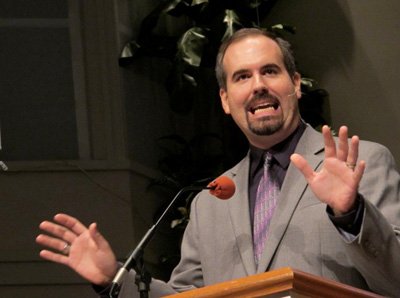
Kevin Collison, pastor of Island View Baptist Church in Orange Park, Fla., said the church is intentional in keeping its children's sermons. (ABPnews photo by Jeff Brumley)

"I have all kinds of anecdotal stories about the things that went haywire—and they go bad more than they go good," she said. "It's really painful."

As a result, some seek an end to the children's sermon. Methodist bishop Will Willimon has argued children's sermons are inappropriate because they reduce the gospel to moralistic mush and subdivide worship generationally.

"We wouldn't interrupt the congregation's worship with, 'And now I would like all those of you who are over 65 to come down front while I say something sentimental and sappy to all of you old folks,'" Willimon wrote on his "A Peculiar Prophet" blog.

Ultimately, he added, his problem with children's sermons boils down to two points: "They are not for children and are usually not sermons."

But they can be if taken seriously by the preacher, said Leslie Rosencrans, minister of congregational life at Seventh and James Baptist Church in Waco.

Rosencrans acknowledges the shortcomings identified by critics of the practice but said many of those faults result from incorrect assumptions that they are easy to deliver because they are short and for children. The truth is those factors make the sermons difficult to properly prepare and deliver, she said.

"The hard thing about children's sermons is you have a shorter time to get your message across, and your audience is a lot more wiggly than your congregation might usually be."

Rosencrans spends three to five hours on a children's sermon that might last three to five minutes. The goal is to distill Scripture and theology into a short message that keeps children's attention and edifies them.

The preacher also must be aware of children's developmental stages at different ages, and always avoid metaphors and allegories.

"Otherwise there's a real danger of it becoming entertainment or not being taken seriously," Rosencrans said.

Despite the challenges, Rosencrans said she's an advocate for children's sermons, because they are often the only way children are actively included in worship.

"It's important to teach them what's important in our faith," Rosencrans said. "With the children's sermon we are able to do that in the context of our service."

That's why children's sermons are an intentional part of worship at Island View, Pastor Kevin Collison said.

On some mornings, the children's sermon or the children's church—or both—are canceled to give youngsters a chance to experience important moments in worship.

"What we try to do is strike a balance between including children in worship and having a focused time for the younger children."

Otherwise, the sermon function's to give children that touch point in worship, he said.

"Holly and I agree the children's sermon should be a sermon, not just a cute story," he said. "They're not good when they veer off into moralisms and generalities."

And a children's sermon done correctly can often move adults, too, Smith said.

"Adults will come up to me and say it opened an avenue for them to understand things better," she said. 


Survey: Obedience and self-denial mark discipleship, but they don’t happen easily

NASHVILLE, Tenn.—Personal, sacrificial decisions made in obedience to Christ demonstrate spiritual growth, according to a survey of American churchgoers by LifeWay Research. But less than one-third of churchgoers strongly agree they follow through in specific aspects of obedience.

"Obeying God and denying self" is one of eight attributes of discipleship identified in the Transforma-tional Discipleship study conducted by LifeWay Research. Each of the eight attributes consistently shows up in the lives of believers progressing in spiritual maturity. The study produced the Transformational Discipleship Assessment, which measures an individual's spiritual growth in each of the eight areas of development.

"The 'obeying God and denying self' attribute does not measure a specific list of sins to avoid. Rather, it gauges whether an individual has an obedient posture," said Scott McConnell, director of LifeWay Research.

"When it comes to obedience, a spiritually mature disciple of Christ has a loving motivation to obey God, the self-awareness to know they must be proactive to avoid bad decisions and the humility to confess sins they commit," he said.

The survey reveals 64 percent of churchgoers agree with the statement: "A Christian must learn to deny himself/herself in order to serve Christ." Nineteen percent disagree with the statement.

"Obeying God is only easy when a person's own desires match God's," McConnell said. "Until believers have the same mind as Christ, denying their own natural desires will be hard."

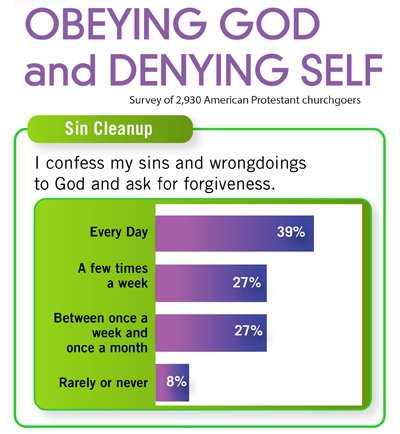
The survey measures confession of sins and asking God for forgiveness as one component of obeying God and denying self. When asked how often, if at all, they personally confess sins and wrongdoings to God and ask for forgiveness, 39 percent indicate every day and 27 percent say at least a few times a week. Eight percent of respondents say they rarely or never confess sins and wrongdoings to God and ask forgiveness.

Sin was addressed not only after the fact—the survey also asked individual churchgoers how proactive they are in avoiding sin with the statement: "I try to avoid situations in which I might be tempted to think or do immoral things." Three-fourths agree with the statement, but only 32 percent strongly agree. Ten percent disagree, and 16 percent responded indifferently.

The survey also examines an individual's inclination to adjust their attitude through the statement: "When I realize my attitude does not please God, I take steps to try to fix it." More than 80 percent agree with the statement, but only 32 percent strongly agree. Fifteen percent neither agree nor disagree, and 4 percent disagree.

The survey also reveals other actions that can positively impact the scores of individuals on the obeying God and denying self attribute:

• Attend a worship service.

• Make a decision to obey or follow God with awareness that choosing his way may be costly.

• Be discipled or mentored one-on-one by a more spiritually mature Christian.

• Read the Bible or a book about what is in the Bible.

• Pray for the spiritual status of unbelieving acquaintances

• Set aside time for prayer of any kind.

McConnell noted obeying God and denying self is the only one of the eight attributes of discipleship that was predicted by more frequent worship attendance.

"Many people think of obeying God as something they must do on their own," McConnell noted. "However, it's clear through the research findings that the teaching, encouragement and accountability of corporate worship have a direct impact on obedience."

These findings on obeying God and denying self are part of the largest discipleship study of its kind. Results from each of the eight attributes of spiritual maturity will continue to be released over the coming months.

To help pastors, churches and individuals measure spiritual development, LifeWay Re-search used the study's data to develop a questionnaire for Christians, called the Transfor-mational Discipleship Assessment. The online evaluation delivers both individual and group reports on spiritual maturity using the eight factors of biblical discipleship. The assessment also provides suggestions on appropriate next steps for spiritual development.

The survey of 2,930 American adults who attend a Protestant church once a month or more was conducted Oct. 14-22, 2011. A demographically balanced online panel was used for the interviewing. Respondents could respond in English, Spanish or French. The sample provides 95 percent confidence the sampling error does not exceed plus or minus 1.8 percent. Margins of error are higher in subgroups.


Bucket project relaunched to provide help for the dying

RICHMOND, Va. (BP)—Taken to a village to die because there was no hope, a woman suffering with stomach cancer finds some relief in her last days. A mother on her deathbed from AIDS regains enough strength to help provide food for her three young children. Caregivers are encouraged by having adequate supplies to make terminally ill patients more comfortable.

A leader from the Baptist church in Maralal, Kenya, unpacks a hospice kit for a terminally ill patient and her caregiver, explaining the purpose of each item in the kit and telling the family about the love of Jesus that prompted a congregation in North America to send them. (BGR PHOTO)

Tears fill retired missionary Paula Kilpatrick's eyes as she recounts story after story of the many grateful faces of terminally ill Africans who received hospice kits from Baptist Global Response the past four years.

She and her husband, Franklin, who served in Zambia 40 years with the Southern Baptist Convention's International Mission Board, have seen firsthand how each kit—a five-gallon bucket filled with medical and hygiene supplies to help Africans with terminal illnesses like advanced HIV/AIDS—makes an impact not only on the dying, but also on families and caregivers.

"It just overwhelms them that … somebody in America is giving them something to help them over there," she said.

"But what really makes the biggest impression is that somebody in America has prayed for them."

Baptist Global Response re-launched "The Bucket Project: Hospice Kits," formerly called "In-Home Care Kits," with a focus on Texas.

The organization's goal is to collect 10,000 hospice kits for distribution by the end of 2013.

Since its beginning in 2008, the bucket project has sent nearly 5,000 of the "buckets of love" to HIV/AIDS-stricken countries across Africa like Zambia, Swaziland, Mozambique, Lesotho and South Africa.

The project's official relaunch began with the recent "Be the Hands and Feet of Jesus" training at Travis Avenue Baptist Church in Fort Worth.

Although every state is encouraged to participate in the Hospice Kits project, Texas will serve as the model in packing buckets, donating to the project, raising awareness and praying.

Several Texas Baptist associations have committed to participate in the project, said Lori Funder-burk, Baptist Global Response prayer strategist and hospice kit project coordinator, and are forming collection points for the buckets. These collection points will handle getting the buckets either to Houston or to Richmond, Va., where they will be shipped to Africa.

The Kilpatricks are serving as the Texas coordinators for the project and will work to help raise awareness, facilitate church participation, collect buckets and donations, and prepare the buckets for shipment. Their home church, First Baptist of Jacinto City, is one of Baptist Global Response's "champion" churches for the bucket project, and the final destination for all buckets collected in Texas.

Churches, organizations and individuals can get involved in the bucket project by becoming a prayer partner, packing a bucket, donating funds, and collecting and transporting buckets.

Packing one Hospice Kit costs approximately $100. The most important element is to remember to pray for the recipients of the bucket, Funderburk stressed.

For more information, visit www.baptistglobalresponse.com/projects and click on "The Bucket Project: Hospice Kits," email bgrbuckets@gobgr.org or call (615) 367-3678.


Disaster relief workers respond to Hurricane Sandy

Baptist disaster relief workers throughout the United States mobilized in response to Hurricane Sandy, the killer superstorm that flooded much of the nation's most populous area.

The storm claimed at least 145 lives, including 76 in the northeastern United States, and initially left 8 million people without electricity.

Evacuees claimed their cots in the Red Cross shelter at Pleasantville High School in Pleasantville, N.J. Many came from neighborhoods near the ocean on barrier islands south of Atlantic City. (PHOTO: Les Stone/American Red Cross)

Coy Webb, director of disaster relief for Kentucky Baptist Men, asked Texas Baptist Men to stand by to provide volunteers to work with Kentucky disaster relief food-service units in Orange County, N.Y. If deployed to New York, TBM workers will serve up to two weeks in the affected area.

Victim Relief Ministrieschaplains and emergency responders also were placed on alert for possible deployment to the Northeast. Victim Relief Ministries is an interdenominational organization that grew out of TBM and continues to serve as an independent but affiliated TBM ministry.

Hurricane Sandy forced the District of Columbia Baptist Convention to postpone its annual meeting. The convention placed its disaster relief volunteers on standby, including its chainsaw, debris removal and flood response units.

Gaylon Moss, disaster relief director for the Baptist State Convention of North Carolina, coordinated assistance to hard-hit New Jersey, relying on Baptist volunteers from North Carolina and Tennessee.

The North American Baptist Fellowship—a regional fellowship of the Baptist World Alliance—activated its disaster response network to gather information and resources to help the most-affected areas.

Baptists also responded to hurricane-related needs beyond the United States. Baptist World Aid, the relief and development arm of the Baptist World Alliance, made an initial $20,000 grant to the Caribbean. Hurricane Sandy killed at least 52 people in Haiti and displaced about 200,000. Jamaica, Cuba, the Bahamas and the Cayman Islands also sustained serious damage.

At the request of Southern Baptist International Mission Board field personnel, TBM provided water purification units to Cuba. TBM has an ongoing relationship with the Western Baptist Convention of Cuba.

Includes information from reports by Associated Baptist Press and Baptist Press


Baptist Briefs

Vote on CBF head set for February. The Cooperative Baptist Fellowship Coordinating Council will vote in February on a successor to Executive Coordinator Daniel Vestal, who retired in June, according to an announcement at the council's October meeting in Decatur, Ga. CBF Moderator Keith Herron said the candidate's name will be announced Jan. 18, when the recommendation comes to the CBF advisory council, and the Coordinating Council will vote on the recommendation at its Feb. 21-22 meeting.

Midwestern Seminary elects president. Jason Allen, 35, vice president of institutional advancement at Southern Baptist Theological Seminary, has been elected the fifth president of Midwestern Baptist Theological Seminary in Kansas City, Mo. He succeeds former president Phil Roberts, who resigned in February amid questions about his leadership from members of the seminary's board of trustees. He holds Ph.D. and master of divinity degrees from Southern Seminary and an undergraduate degree from Spring Hill College in Mobile, Ala. Allen and his wife, Karen, have five children.

Foundation names VP & general counsel. The Baptist Foundation of Texas board of directors unanimously named Joe Hancock vice president and general counsel of the Baptist Foundation of Texas, effective Jan. 1.  Hancock, currently senior trust counsel, has been with the foundation 13 years.  Hancock holds a bachelor's degree from Baylor University and master of business administration and law degrees from the University of Arkansas. He succeeds Jeff Smith, who has been named president and chief executive officer, effective Jan. 1.

Heys named interim CBF communications director. Patricia Heys, communications manager for the Cooperative Baptist Fellowship, has been named the organization's interim director of communications and marketing. She succeeds Lance Wallace, who left CBF for a similar role with Georgia Tech Research Institute. Heys holds a journalism degree from the University of Georgia and earned a master of divinity degree and doctor of ministry degree from Mercer University's McAfee School of Theology.

CBF kick-starts 2012 task force plan. Leaders of the Cooperative Baptist Fellowship chose a fast track for implementation of re-visioning the 21-year-old movement adopted last summer, approving a timeline at the October CBF Coordinating Council meeting to propose a new constitution and bylaws, nominees for a new governance model and transition plan, all in time for next year's general assembly in Greensboro, N.C. The first order of business is choosing a nominating committee to select individuals to replace the current 60-member Coordinating Council with a leaner 16-member governing board and transitional leaders for two new councils focused on missions and ministries and less involved in day-to-day oversight of the entire organization. Also, a legal committee will draft a new constitution and bylaws for Coordinating Council consideration.


Theology study derails Glorieta sale

NASHVILLE, Tenn. (ABP)—LifeWay Christian Resources decided not to sell its cash-strapped Glorieta Conference Center in New Mexico to a Christian college in California following an independent review of the potential buyer’s doctrinal views.

The Tennessean
in Nashville, Tenn., reported late Oct. 16 that the Southern Baptist Convention’s publishing house has received the report of a study by the National Association of Evangelicals and that a potential deal with Olivet University International is off.

Glorieta

The sale of Glorieta Conference Center was halted.

“LifeWay Christian Resources has reviewed the report from the National Association of Evangelicals, and decided not to go forward with the sale of Glorieta Conference Center to Olivet University,” LifeWay said in statement. “We are appreciative of our relationship with Olivet's leadership and indebted to NAE for their thorough work. We will now renew our pursuit of viable options for the sale of the property.”

A LifeWay spokesman declined to discuss details of the NAE investigation, but Olivet has long been hounded by controversy over a movement in Asia led by the school’s founder, David Jang, who has faced repeated accusations of holding heretical views about the Second Coming of Christ.

Olivet’s current president, former Southern Baptist missionary and seminary professor Bill Wagner, insists that the school’s teaching is orthodox. He released a statement saying Olivet intends to discuss the report with LifeWay leaders in hopes of reviving the deal.

Olivet, currently located in San Francisco, has already failed in bids to purchase Bethany University, a closed Assemblies of God school in Scotts Valley, Calif., and a 217-acre campus in Northfield, Mass., founded by famed evangelist D.L. Moody that was recently donated to formerly Baptist-affiliated Grand Canyon University by the billionaire owners of Hobby Lobby.

LifeWay has also had problems selling its 2,100-acre encampment near Santa Fe, N.M., that has lost money 24 of the last 25 years. In July, the Baptist Convention of New Mexico turned down an offer to purchase Glorieta for $1, after a study committee failed to come up with a viable business plan to operate the conference center as a ministry.

The New Mexico task force estimated deferred maintenance of the conference center opened in 1952 would cost $10 million to $20 million and that any prudent business plan would include an environmental study. New Mexico Baptists asked LifeWay to indemnify the Baptist Convention of New Mexico for any environmental liability and litigation liability. LifeWay declined and the deal was off.

Olivet University leadership has leased unused space at Glorieta during discussions about possible purchases of the property. Olivet President Bill Wagner, a native of Albuquerque who served as an International Mission Board missionary for 31 years and as professor of missions and evangelism at Golden Gate Baptist Theological Seminary for 10 years, was invited to speak to Glorieta volunteers in August.


Coalition faces ‘post-Christian’ challenges

A diverse coalition of pastors and theological educators has launched an initiative offering a platform for evangelicals to develop theology and practice for mission and ministry in "post-Christian" North America."

The Missio Alliance will "provide a place for theological dialogue, training and the creation of resources to navigate present and future missional challenges," said Chris Backert, a key organizer of the effort.

An inaugural conference in April 2013 in suburban Washington will feature an array of presenters, including evangelical heavyweights Alan Hirsch, Scot McKnight and Dallas Willard.

The initiative is a response to the increasingly post-Christian cultural context churches encounter in the United States and Canada, said Backert, who also directs two networks of missional churches — Ecclesia and Fresh Expressions — and works closely with the Virginia Baptist Mission Board in church planting.

"There's a need to consider afresh what God is doing and calling us to in his mission," he said. "In recent history we have witnessed increasing fragmentation within evangelical Protestantism and sharp denominational decline. Yet even amidst these challenges, we believe there is a unique opportunity to work toward the renewal of the church for mission in North America."

Other early organizers of the Missio Alliance include Jim Baucom, pastor of Columbia Baptist Church in Falls Church, Va.; Alistair Brown, president of Northern Baptist Theological Seminary in Lombard, Ill.; Travis Collins, pastor of Bon Air Baptist Church in Richmond, Va.; Gary Nelson, president of Tyndale University College and Seminary in Toronto; and Roger Olson, professor of theology at Baylor University's Truett Theological Seminary in Waco, Texas.

Its leaders said the Missio Alliance will offer an alternative to the Gospel Coalition, another evangelical renewal movement but one with a strong Reformed, or Calvinist, theological stance. Among its leaders are prominent Calvinists Albert Mohler, president of Southern Baptist Theological Seminary in Louisville, Ky.; John Piper, pastor for preaching and vision at Bethlehem Baptist Church in Minneapolis, Minn.; and Mark Dever, senior pastor of Capitol Hill Baptist Church in Washington.

"In our opinion, there is a real need for a more positive, theologically orthodox yet sociologically hopeful, evangelical voice in North America," said Baucom, whose church is just outside of Washington. "Of late, the loudest voices have been hyper-Reformed, offering what sounds to us like a deterministic and discouraging vision of God, creation and God's relationship to creation. We find this vision inconsistent with the teaching of Jesus and the whole counsel of Scripture.

Olson agreed the Missio Alliance will offer "an alternative for moderate evangelicals."

"I don't mean anything against the Gospel Coalition," he said. "It's just that it can't be a hospitable network for support, cooperation and common mission for moderates. There really isn't one like that, as far as I know. The Missio Alliance is the best hope we have."

Backert said that, while the Missio Alliance isn't a specific response to the Gospel Coalition, the new group "is saying there are other ways of being scripturally faithful, that as evangelicals we are grappling with the realities of post-Christianity on our continent and want to bring some substantive theological reflection and formation to that."

"We consider the tribes [faith groups] in the Gospel Coalition our brothers and we appreciate and respect what they are doing," said Backert. "We are just working in a different field. In our new day of challenge for mission we all have to remember that those who share a foundation of Christian orthodoxy all work for the same boss."

Added Baucom, "The way I like to describe our vision is as rooted in a core, biblically-informed conviction that God doesn't just tolerate the humans he created; he actually likes them and desires that none of them be lost."

Though Baptists have been prominent in the Missio Alliance's formation, a wide range of denominational traditions are involved, including Wesleyans, Anglicans, Assemblies of God and the Christian and Missionary Alliance. That gives strong momentum to the initiative, said Backert, who added the Alliance will ground itself in the Capetown Commitments, a confession of faith developed in 2010 by the international Lausanne Movement.

"The historic tribes of Christianity — and I mostly mean Protestant Christianity — were created in a world with different issues and they set themselves apart based on those issues," he said. In a post-Christian context, "new kinds of alliances and connections are forming that didn't exist 50 years ago."

"The diversity of our voice is a tremendous strength, and by diversity I mean socioeconomic and ethnic as well as denominational," Baucom said. "In some ways, our diversity demonstrates more clearly a vision of restoration and regeneration in Christ than any words we can write or preach could possibly convey."

The April 11-13 inaugural conference will be held in two locations in Alexandria, Va. — Alfred Street Baptist Church and Downtown Baptist Church — and will feature more than two dozen presenters and a variety of workshops.

Among the conference sponsors are the Virginia Baptist Mission Board, the John Leland Center for Theological Studies, George Fox Evangelical Seminary, Fuller Theological Seminary and Northern Baptist Theological Seminary.

Ecclesia and Fresh Expressions also are sponsors, as are the Spence Network, a leadership group; V3, a church planting network; Forge America, a missionary training network; and InterVarsity Press, the evangelical publishing house.


Baptist Briefs

International Baptist Theological Seminary's campus in Prague.

European leaders endorse seminary move. Leaders of the European Baptist Federation voted overwhelmingly to move the International Baptist Theological Seminary from Prague to Amsterdam as an international Baptist studies and research center with close ties to the Union of Baptist Churches in the Netherlands. The European Baptist Federation Council approved three recommendations from seminary trustees at their annual meeting in Elstal, Germany, near Berlin—to sell the Prague campus for the best possible price; to convert an Amsterdam church into a "Baptist House" with studies to begin in fall 2014; and to focus mainly on doctoral work in Baptist and Anabaptist studies and practical theology. The proposals respond to changing needs for theological education, costs of maintaining an aging campus in the Czech Republic and loss of donor support in a poor global economy.

Baptist BriefsM&M Benefit Board head to retire. Sumner Grant, executive director of the Ministers and Missionaries Benefit Board since 1998, has announced plans to retire after his successor is named. Grant led the church-benefits organization started for American Baptists to open its membership to other Baptist denominations and has been a key leader in the restructuring of American Baptist Churches USA. Before Grant joined the retirement benefit board in 1993, he served as executive director and treasurer of American Baptist Churches of New York State and previously as senior pastor of churches in New Hampshire and Maine more than 15 years. Formed in 1911, the board primarily serves churches and ministers affiliated with American Baptist Churches USA. Its ministry partners also include the Baptist General Convention of Missouri, the Alliance of Baptists and the four largest African-American Baptist denominations.

Beeson dean represents BWA in Rome. Timothy George, dean and professor of divinity, history and doctrine at Beeson Divinity School, is representing the Baptist World Alliance in Rome as a fraternal delegate to the 13th Ordinary General Assembly of the Catholic Church's Synod of Bishops. The Vatican meetings began Oct. 7 and end Oct. 18. Discussion topics include a rediscovery of the heart of evangelization; discerning changes that affect how the faith is lived and influence Christian communities; the transmission of the Christian faith; and pastoral activity. George serves as chair of the BWA Commission on Doctrine and Christian Unity and a member of the BWA Division of Mission, Evangelism and Theological Reflection.

LifeWay won't sell 'womanhood' book. A new book by an author who for one year kept her vow to follow literally every instruction for women found in the Bible won't be sold at LifeWay Christian Stores. Rachel Held Evans, whose book A Year of Biblical Womanhood is due out Oct. 30, reported on her blog she learned her book wouldn't be available at 165 bookstores owned by the Southern Baptist Convention's publishing arm. LifeWay responded with a statement saying the company does not comment on reasons why it chooses specific products out of thousands that it reviews, but factors include "alignment with evangelical beliefs, past sales by an author and how they fit within LifeWay's values and vision."

Georgetown College president to retire. Bill Crouch, who steered Georgetown College through financial woes, established bonds with African-Americans and loosened ties with the Kentucky Baptist Convention, has announced plans to retire next summer. Crouch was 39 years old and working as vice president for development at Carson-Newman College in Jefferson City, Tenn., when he was named 23rd president of Georgetown College in 1991. A graduate of Southeastern Baptist Theological Seminary, he also was pastor of two churches in North Carolina.


Pastor compensation slightly ahead of inflation, SBC survey says

NASHVILLE, Tenn. (BP)—Compensation for full-time Southern Baptist pastors increased at a rate slightly faster than inflation nationally over the past two years, but many churches continue to struggle in providing their pastors with adequate medical insurance.

These findings are part of the SBC Church Compensation Study, an in-depth survey of 12,168 staff members in Southern Baptist churches. Baptist state conventions along with LifeWay Research and GuideStone Financial Resources conduct this survey every two years.

Image

Adjusting for church size, the average full-time Southern Baptist senior pastor's compensation—including salary and housing—rose 5.5 percent between 2010 and 2012. That rate of change was only slightly higher than the 5.1 percent inflation rate for the same two-year period, according to figures supplied by the U.S. Department of Labor's Consumer Price Index.

According to Scott McConnell, director of LifeWay Research, "Other surveys by our team (among pastors) have shown that a majority of churches have not experienced growth in giving that would keep pace with these same inflation measures. In these churches, providing cost-of-living pay increases and covering the rising cost of benefits has required cuts in other budget areas."

Overall, the value of the entire pay package—salary, housing and other benefits such as insurance—for the average full-time senior pastor rose by 6.4 percent.

For other full-time staff ministers, basic salary and housing compensation decreased 0.7 percent between 2010 and 2012, while salary compensation for full-time office personnel increased 2.8 percent.

When it came to determining pastors' compensation rates, education level, tenure at current church and higher weekly attendance resulted in more compensation.

In fact, each additional educational degree level adds, on average, $2,878 in compensation. Seminary graduates receive, on average, $7,012 more in total compensation than non-seminary graduates and receive more vacation time.

The survey also revealed slightly more full-time senior pastors receive medical insurance from their churches today than in 2010, matching results from the 2008 study. Sixty-four percent of churches partially or fully pay medical insurance for their full-time senior pastors, compared to 61 percent in 2010. The U.S. Department of Labor indicates the cost of medical care rose 7 percent between June 2010 and 2012.

Twelve percent of SBC churches provide at least partial medical insurance funding for the full-time pastor alone while 19 percent fund coverage for the pastor and his wife and 34 percent supply coverage for the pastor and his family.

For full-time senior pastors, churches fully or partially pay for the following benefits:

• Life and/or accident insurance—37 percent

• Disability insurance—30 percent

• Dental insurance—28 percent

• Vision insurance—12 percent

More than half of churches with weekly attendances above 250 people provide insurance for the pastor and his family. Nearly half—47 percent—of churches that average 50 to 99 people in weekly attendance do not provide any medical coverage.

The survey also obtained compensation data for bivocational pastors and part-time custodial and office personnel. In 2012 for the first time, this data is standardized by the median number of hours worked to allow churches to more easily compare their part-time employees with these averages.