Former seminary professor pleads guilty to lying to FBI

(RNS)—A former professor at Southwestern Baptist Theological Seminary pleaded guilty Oct. 16 to lying to the FBI during an investigation into sexual abuse.

Matt Queen, the pastor of Friendly Avenue Baptist Church in Greensboro, N.C., had pleaded not guilty earlier this year when charged with obstruction of justice for actions taken when he was a professor and interim provost at Southwestern Seminary in Fort Worth

Southwestern Baptist Theological Seminary in Fort Worth (BP File Photo)

As part of an investigation into the Southern Baptist Convention and its entities, federal officials have been looking into alleged sexual abuse that occurred in 2022 at the seminary. School officials were required to turn over any documents related to abuse to the Department of Justice.

However, an unnamed seminary official, known as “Employee-2,” allegedly ordered that a report on the 2022 abuse case—which detailed that the seminary had known about the alleged abuse but failed to act on it—be destroyed.

According to federal officials, Queen heard Employee-2 order “Employee-1,” the staffer who wrote the report, to destroy it and then allegedly lied to federal officials about it. Queen was also accused of creating fake notes about the conversation surrounding the report.

Queen’s story changed under oath.

“On or about June 21, 2023, MATTHEW QUEEN, the defendant, testified under oath that on January 26, 2023, he had in fact heard Employee-2 instruct Employee-1 to make the Document ‘go away,’” according to a court filing.

Matt Queen in a video for Southwestern Baptist Theological Seminary in November 2022. (Video screen grab via RNS)

On Oct. 16, the U.S. attorney for the Southern District of New York filed court documents charging Queen with falsification of records and providing false information to law enforcement. As part of an arrangement with federal officials, Queen pleaded guilty to the second charge.

“I understand that if my plea is accepted, my sentencing will take place before the United States District Judge who is assigned, or who is to be assigned,” Queen said in a court filing.

A trial on the earlier charges had been scheduled for November.

Queen’s attorney said that the guideline for this offense is zero to six months and hopes Queen will not be incarcerated. Sentencing currently is set for February.

Sam Schmidt said prosecutors approached Queen about a plea deal and said his client admitted to making a false statement.

“And for the past year and a half, he has regretted, repented and tried to make himself a better person for making that mistake,” he said.

Since 2022, the Department of Justice has been investigating the SBC and its entities, in response to the Guidepost report that year, which found SBC had long mistreated abuse survivors and downplayed the issue of abuse in the nation’s largest Protestant denomination.

But aside from the charges filed against Queen, few details about the investigation have been made public.

The SBC admitted the investigation—along with other lawsuits filed in the wake of the Guidepost report—has led to a fiscal crisis for the SBC’s Nashville-based Executive Committee. That committee recently announced plans to put its office building on the market in part because of its strained finances.

The identity of the seminary official who ordered the report destroyed has not been made public. However, Terri Stovall, the seminary’s dean of women, has come forward as the person who wrote the initial report on the 2022 abuse case. Stovall, according to school officials, refused to destroy the report.

“I am grateful for the diligence of the Office of the U.S. Attorney for the Southern District of New York for holding Queen accountable for his criminal actions while serving as interim provost at Southwestern,” Stovall said in a statement.

“My hope is that the full truth and extent of his actions—and the actions of others who are no longer employed at Southwestern—will one day come to light.”

Southwestern officials said they will continue to cooperate with the DOJ investigation.

“We pray for victims of sexual abuse. Southwestern Seminary remains committed to doing everything possible to protect all members of the seminary community from sexual abuse and harassment,” the seminary said in a statement.

“Our prayers continue for Matt Queen and his family, as well as for others who have been involved in this process.”

After he was charged this past spring, Queen was placed on leave by Friendly Avenue Baptist Church. Church leaders currently are working on a response to his guilty plea, according to a statement on the congregation’s Facebook page.

“We stand firmly against any behavior that undermines trust and integrity,” the church said in its statement, which noted that Queen, who has been on leave since May, had admitted to a “serious crime.”

“Our church leadership is reviewing these recent developments as it works to complete its investigation and submit a recommendation to the church membership concerning Dr. Queen’s status and relationship with Friendly Avenue Baptist Church, all in accordance with the church’s governing documents.”
Texas disaster relief teams provide ‘breath of fresh air’

ELIZABETHTON, Tenn.—More than two weeks after Hurricane Helene hit northeastern Tennessee, life slowed to a crawl. The floodwaters are gone, but destruction remains.

At least that was the case until Texans on Mission volunteer flood recovery teams began cleaning out homes affected by the storm.

Local residents viewed them as an injection of energy, help and hope across the region.

“I haven’t been happy since the flood—until today,” one homeowner told a Texans on Mission team as they worked on her home.

More than 25 Texans on Mission teams—supplemented by local volunteers and out-of-state church mission teams—have focused on meeting needs in parts of Florida, Tennessee and North Carolina after Hurricane Helene and Hurricane Milton.

These include chainsaw teams, flood recovery teams, mass feeding teams, heavy machinery, shower/laundry units, chaplains and more.

In all, Texans on Mission volunteers have served more than 9,000 hours. They have provided more than 30,000 meals. And they continue ministering today in Christ’s name.

Ray Gann, who is leading the feeding team in Port Charlotte, Fla., said volunteers are working together like a family. They help each other out. They focus on meeting needs and helping others.

It’s encouraging to see the body of Christ working together, he said.

“I’ve met many of my friends that I’ve worked with before,” he said. “I’ve met new friends. It’s the camaraderie that’s great. We minister together.”

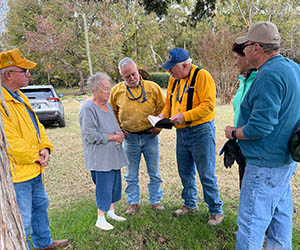
Team leader Gene Walker and a Texans on Mission chainsaw crew present a Bible to a homeowner in North Carolina. (Texans on Mission Photo)

The presence of Texans on Mission chainsaw teams is being felt across Rutherford County, N.C. One homeowner described the teams as being “like a breath of fresh air” after the oppressive storms.

“I prayed with three homeowners today,” David Wells, Texans on Mission disaster relief director said. “They’re so grateful we’re there. People are waving at us everywhere we go. They’re excited we’re here.”

Local volunteers and mission teams from churches have been a vital part in Texans on Mission ministry after the hurricanes. Local congregations are feeding the Texans and people from all over have jumped in to be part of the volunteer teams. New faces and new energy abound in this relief effort.

“It’s cool to see that spirit,” Wells said.


Black Church Collective seeks to reach African diaspora

LITHIA SPRINGS, Ga. (BP)—Charles Owusu, a Ghanaian pastor and seminary adjunct professor, appreciates the diversity among the many churches stemming from the African diaspora, including not only African American, but Haitian/Caribbean, Liberian, Nigerian, Ethiopian, Egyptian and others.

Owusu is among a core group of four pastors tasked with organizing the Black Church Collective. The collective is seeking to create a collaborative evangelistic and missions table for the larger National African American Fellowship of 4,000 churches and the smaller fellowships and numerous other contingencies from the African diaspora outside NAAF members.

“Otherwise, people might think that it’s only NAAF that is involved in [Southern Baptist Convention] outreach in the Black community, said Owusu, senior pastor of Word of Life Baptist Church, a Ghanaian congregation in Lithia Springs, Ga.

“But the collective is to sensitize all the other groups, the various groups, to know that SBC has a very strong outreach program to all the Black community. And so, we should all get involved, and that’s what we’re working on.”

Charles Grant, SBC Executive Committee associate vice president for convention partnerships, is launching the group to strengthen efforts to advance the gospel among African diaspora people groups.

He hosted a preliminary organizational meeting in September, aided by Mark Croston, national director of Black church partnerships for Lifeway Christian Resources of the SBC.

Among Grant’s goals is for the group to become a self-governing work of African diaspora pastors, whom he has charged with solidifying four gatherings per year, forging three accomplishments, and communicating the essence and work of the collective.

Gathering place for fellowships within African diaspora

The group is especially a gathering place for established fellowships within the African diaspora, with the goal of coalescing others to join the 25-plus fellowships of various ethnicities that account for 11,000 Southern Baptist churches, 22.7 percent of the total.

“The Black Church Collective’s value will create greater cohesion, collective representation and collective celebration of African diaspora ministry and mission work in and through the SBC,” Grant told Baptist Press.

“While these Black church fellowships have different cultures, I am grateful to the fellowship presidents that desired to come together for kingdom advancement. I am grateful to the Lord to witness the joy of their efforts to work together while simultaneously giving attention to their individual fellowships.”

NAAF President Greg Perkins, also a member of the core organizing group, looks forward to the collective’s impact in coordinating the work of African diaspora Southern Baptists.

“This coordination will ensure that we are properly positioned to have the maximum kingdom impact,” said Perkins, lead pastor of The View Church in Menifee, Calif.

“I hope it will facilitate oneness of mission that will support and undergird the work of the Black church within the SBC through coordinated and connected opportunities for joint missions, church planting/revitalization and evangelistic pursuits.”

The first organization meeting is set for this month, said Daryl Jones, a North American Mission Board church planter and Miami pastor tasked with leading the core leadership team the first year. The pastor of The Rock Fellowship Church in Miami is a member of NAAF and is active as a Black Church Emerging Leader.

“I want to be able to bring all these different expressions together when it comes to the African diaspora,” Jones said, “for us to able to gather together to cooperate, to coordinate and then also to be able to share resources and experiences and expertise so that we continue to grow when it comes to the mission.”

Amid the diversity, Jones said, is the shared mission.

“I think we’re all in the SBC going forward on one mission, this mission Jesus has given us to make disciples,” Jones said. “And I think this collaboration gives us a unique opportunity to let nothing fall through the cracks.”

Each ethnic group represented, Jones said, brings unique gifts that can be utilized in reaching particular people groups, gifts that might be overlooked were it not for cooperation.

Rounding out the core group is Keny Felix, president of the Southern Baptist Convention National Haitian Fellowship and senior pastor of Bethel Evangelical Baptist Church in Miami.


Texans on Mission volunteers respond to two hurricanes

Texans on Mission sent key disaster relief equipment to Florida this week in advance of Hurricane Milton’s landfall. The Dallas-based ministry now is seeking more volunteers to respond to what has become a two-hurricane disaster.

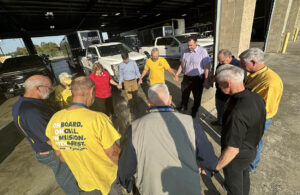
Texans on Mission volunteers gather to pray before sending a mobile mass feeding kitchen, large generator, shower/laundry unit and flood recovery unit to Florida in advance of Hurricane Milton’s landfall. (Texans on Mission Photo / Russ Dilday)

Texans on Mission sent a mobile mass feeding kitchen, large generator, shower/laundry unit and flood recovery unit to Florida Wednesday, while many Texas volunteers are still in North Carolina and Tennessee responding to Hurricane Helene devastation.

“We timed the deployment from Texas to ensure teams were on the ground quickly” after Hurricane Milton, said Mickey Lenamon, CEO of Texans on Mission. “With a storm of this magnitude, we anticipate people will be reeling, and we want to begin meeting needs quickly.

“Back-to-back hurricanes of this size are stretching the volunteer corps of ministries across the country. Texans on Mission volunteers are stepping up in incredible ways to minister in multiple locations.”

Texans on Mission has created a special website to facilitate recruitment of more volunteers—TexansOnMission.org/serve.

New volunteers can select dates and locations to plan for serving, Lenamon said.

“You can even hop a weekly shuttle we’re running from Dallas to Tennessee,” he added. “As always, we’ll take care of your lodging, meals and shower/laundry. All you need to do is minister in the name of Christ.”

Teams continue work in N.C. and Tennessee

In North Carolina and Tennessee, “disaster relief teams continue ramping up ministry as the reality of the situation sets in across the region,” Lenamon said. “Electricity is slow to come back. Entire towns have been washed away. People have lost their belongings and, in some cases, their livelihood. Hopelessness is widespread.

“In the midst of it all, Texans on Mission volunteers are delivering help, hope and healing in the name of Christ. Teams are cleaning out flooded homes, moving fallen trees and providing roughly 3,500 meals a day and counting.”

Lenamon thanked those who are praying for the people impacted by the hurricanes and for volunteers meeting needs.

“Your prayers and support make a profound impact,” he said. “You are bringing help, hope and healing to people experiencing some of their most difficult days.”

Texans on Mission’s work is built on three pillars—volunteers, prayer and financial giving, he continued. And all three are “critical in our responses to these two hurricanes, not to mention Hurricane Francine’s devastation in Louisiana last month.”

To donate to Texans on Mission’s hurricane response, click on TexansOnMission.org/hurricanes.


Storm survivors found what they needed on pastor’s deck

FAIRVIEW, N.C. (BP)—Cane Creek starts as a trickle up in the mountains from Stacy Harris’ home. Garren Creek and Flat Creek are there too.

Typically, they create the small, crystal-clear pools trout love and cascading waterfalls that are favorites of Smoky Mountain tourists.

Their appearance began to change when heavy rain saturated the area. Then Hurricane Helene arrived on Friday, Oct. 4. People in Fairview Township, where Harris is pastor at Trinity of Fairview Baptist Church, hunkered down. Their homes lost power at 3:23 a.m. that night.

‘We couldn’t go anywhere’

“It was around noon on Saturday before we could venture outside,” said Harris. “There was even some blue sky because Helene was gone. But we couldn’t go anywhere.”

The mailing address for his church is in Fletcher, a bedroom community about 20 minutes south of Asheville. Fairview is further into the mountains. Those who ever attended a conference at Ridgecrest and took a side trip to Bat Cave or Chimney Rock drove through Fairview on Highway 74.

Helene had turned small valleys into funnels for the branches feeding those creeks. The water built into the kind of torrent that swept away lives and homes in areas throughout western North Carolina, contributing to a death toll of more than 230 across several states.

Like others working through loss, however, Harris and his community are finding ways to look for positives.

The creek running in front of his home wasn’t big enough for a name, but Helene turned it into something capable of ripping through his driveway. Others were in the same predicament.

Neighbors feast and fellowship on deck

When the waters receded, they had left a sizeable amount of gravel washed down from the mountain. Someone with a skid steer shaped it into a crossing good enough for a four-wheel-drive. That, and the need to be around others, would soon lead others to join Harris in his backyard.

“I have a little back deck and was fortunate enough to have a generator strong enough to pump water from my dad’s well,” he said. “We kept everybody in the valley with water and still are. We don’t expect to have water for another week.”

His generator runs from 4 p.m. to 7 p.m. People get as much as they need to take home.

Fellowship and feasting became common due to eating food that would otherwise spoil. There have been hamburgers, but also the 40-or-so pork chops from a pig someone had just slaughtered. Harris smoked an 8-lb. ham that provided days of sandwiches.

“Our neighbors had never spent time like that together,” he said. “This brought people out of their houses and into their yards. Even in the middle of such disaster, it’s beautiful to see that human connection.

“We just feed, sit around and talk, telling stories and encouraging each other while the kids play,” Harris said. “It’s become our gathering time.”

The swollen creek had trapped Harris, his wife Tammy, and Harris’ parents—who live nearby—for a couple of days. Time with them and neighbors was precious, but he still had many other people on his mind.

“As a pastor, the hardest thing was a lack of communication,” he said. “I didn’t even know through the storm if my parents or other people were OK.”

Trinity of Fairview is a mix of white- and blue-collar folks. Harris knows them and the area well.

Invested a lifetime in congregation

He may be the only pastor who joined his church at 5 years old. Harris, 56, became associate pastor 30 years ago with ministry responsibilities over children, students and worship. The church called him as lead pastor 14 years ago.

“I think I’ve done everything there is to do there,” he said. “The Lord has been so good to me, to be here with these people.”

Trinity has joined other churches in becoming a distribution hub for materials. But there is also its presence as a light in an otherwise dark time.

A generator powers its family life center in those efforts. Recently, everyone there was treated to sloppy joes and burritos that had been in the freezer of Juicy Lucy’s—a local joint known for cooking the cheese inside its burgers.

That event accompanied Trinity of Fairview’s first post-Helene worship gathering on Oct. 6, held in its parking lot.

“Yesterday was a banner day, to have everyone here for praise and worship,” Harris said. “We shared a little bit of the word [of God] and the gospel with people.

“It was tremendous. It was good for my spirit and good for my soul.”


Layman Owen Cooper made significant impact on SBC

YAZOO CITY, Miss.—Owen Cooper wasn’t a Baptist when he left for college, intending to be a Presbyterian as was his mother. But Bible-reading led the young Mississippian into a faith journey that helped shape Southern Baptists during the latter half of the 20th century.

He did so as a layman who founded a large-scale fertilizer plant.

Fifty years ago, Cooper ended two terms as president of the Southern Baptist Convention—among only a few laymen ever elected to the office. His legacy includes casting a vision for the SBC-wide Bold Mission Thrust initiative that aimed to share the gospel with every person in the world by the year 2000.

Emphasized importance of laity

Owen Cooper regularly underscored the importance of laymen as he visited every state in the union during his SBC presidency, along with an array of mission fields.

In his presidential address to the 1974 annual meeting in Dallas, he asserted, “The greatest apostasy” of the past century was “the perpetuation of the nonbiblical concept that the burden for evangelism and missions lies only with the full-time Christian worker and that the ‘layman’ has little responsibility.”

“Lay people are expected to occupy the church pew, to fill the offering plate, to teach a Sunday School class, to attend Church Training [the former Sunday evening discipleship hour] but otherwise are seldom challenged by the church program,” Cooper said.

In his 1974 book The Future Is Before Us, published by the convention’s Broadman Press, he insisted, “You will never know the abundant life, you will never find fulfillment in your church membership, and you will never know the peace that passeth understanding until you minister even as you are ministered unto.”

Cooper brought a layman’s demeanor to his presidency, as noted by the SBC Executive Committee’s lead administrative assistant, the late Martha Gaddis.

“The other presidents and their wives I called ‘Dr. and Mrs. So and So.’ From the very beginning the Coopers said: ‘We’re Owen and Beth. Don’t call us anything else,’” she recounted in a 1992 book about Cooper, The Thought Occurred to Me by the late Don McGregor, editor emeritus of the Baptist Record in Mississippi.

Humble beginnings

Cooper grew up as a farm-boy near Vicksburg, Miss., chopping cotton and milking cows. While a student at Mississippi State University, preparing to teach high school vocational agriculture and paying his way by beekeeping and delivering newspapers, he was elected as president of the statewide Baptist Student Union.

As a vo-ag teacher in his early 20s in the Mississippi Delta town of Leland, Cooper became the Sunday school superintendent at First Baptist Church and served on its pastor search committee.

After earning a master’s degree in economics and political science at the University of Mississippi, he pursued a law degree from the Jackson School of Law (now part of Mississippi College, a Baptist school). As a member of Jackson’s First Baptist Church, he became the Baptist Student Union director at two colleges in the state capital, Belhaven, affiliated with the Presbyterians, and Millsaps, affiliated with the Methodists.

Cooper moved to Yazoo City, 50 miles northwest of Jackson, while working to establish the nation’s first farmer-owned nitrogen fertilizer plant, Mississippi Chemical Corporation, which opened in 1951, in a cooperative venture involving the Farm Bureau, farmers and their banks throughout the South and federal loan officials.

He joined First Baptist Church in Yazoo City, taking on the role of Sunday school superintendent and knocking on doors in weekly home visitation and revival campaigns. He was moderator of the Yazoo Baptist Association before becoming president of the Mississippi Baptist Convention. As a longtime member of the SBC Executive Committee, he was elected as president of the Southern Baptist Convention in 1972.

Call to engage in evangelism

Cooper’s advocacy for Baptist laymen typically was voiced alongside an insistent call for evangelistic fervor throughout the SBC.

In his 1973 presidential address on the “Share the Word” theme at the SBC annual meeting in Portland, Ore., Cooper said Baptists must witness “in our kitchen, in our dining room, in our den and in our living room … in our front yard and across the fence in our backyard.”

“It means we should witness to our neighbors next door and to our neighbors who live around the world,” he said. “It means we should witness where we work, where we shop, where we bank, where we play and where we make our social contacts … when we travel, when we are on vacation, when we are on a business trip, attending a conference, at the civic club, at the country club, at the hunting club, at the social club and at the garden club.”

He continued: “We should also witness to the uttermost parts of the earth …to the rural settlement, to the village, to the town, in the city, and in the metropolis. We should witness in the townhouses, and in the ghetto, in the single-family residence, and in the high-rise, in the row house and in the tenant house.”

As SBC president, Cooper initiated a 21-member Missions Challenge Committee in 1974 that brought a report to the 1976 annual meeting in Norfolk, Va., calling Southern Baptists into a 25-year Bold Mission Thrust effort encompassing numerous international and home missions initiatives.

The late Albert McClellan, the Executive Committee’s associate executive secretary, wrote to Cooper in 1977: “I remember quite vividly that the whole concept of the Missions Challenge was your idea. You stirred it up in the [former] Committee of Fifteen and fixed it so that it would become clear to Southern Baptists that we needed to go forward in missions.”

Passion for missions

Reflecting his passion for missions and his entrepreneurial spirit, Cooper took an interest in India, leading several U.S. fertilizer companies and the U.S. Agency for International Development to pioneer large-scale fertilizer plants in the populous Asian nation.

He then launched an organization to support Indian evangelists, naming it Universal Concern.

He also raised funds to rehabilitate the cemetery where missions pioneer William Carey is buried.

Creating an Agricultural Missions Foundation, Cooper worked with farmers to nurture their missions involvement by shipping beef and dairy cattle, hogs, rabbits, seed, tools and a tractor to Southern Baptist agricultural stations in Ecuador, Liberia, Rhodesia (now Zimbabwe), the Philippines and other locations.

Promoted race relations

In civic affairs, as executive director of the Mississippi Farm Bureau Federation in the 1940s, he led an effort in the state legislature to create the Mississippi Commission on Hospital Care, which he then chaired, approving the construction of more than 100 rural hospitals.

During the 1960s, Cooper bridged racial lines, accepting the chairmanship of an organization to lift the state’s Head Start program from bankruptcy. Called the Mississippi Action Project, the board consisted of an equal number of whites and blacks, including the NAACP state chairman.

Cooper acknowledged to friends that his Head Start involvement would derail his long-held goal to someday run for governor of Mississippi.

Within the SBC, Cooper often voiced concern about race relations, drafting a 1972 resolution, for example, expressing “gratitude to God for the progress being made in an increasing number of our churches where persons of other races are welcomed into all areas of church life and fellowship.”

Cooper never was shy about tying an evangelistic exhortation to his Mississippi roots as well as his business interests, noting in The Future Is Before Us: “We need to be challenged by the fact that as Christians it is our responsibility, not our privilege, it is our obligation, not our wish, it is our duty, not our desire to see that the gospel is preached throughout the world.”

Cooper died in 1986 at age 78.


Texans on Mission teams deploy after Hurricane Helene

Texans on Mission deployed mass feeding, chainsaw and flood recovery teams—among others—Sept. 30 to meet needs after the second deadliest hurricane in U.S. history.

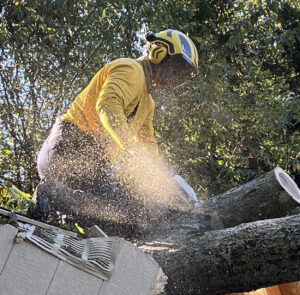
A Texans on Mission chainsaw volunteer works at a home outside of Ruth, N.C. (Texans on Mission Photo / John Hall)

Category 4 Hurricane Helene raged through Florida, Georgia, Tennessee, South Carolina, Virginia and North Carolina, killing more than 100 people and leaving millions without electricity.

Days after the storm, many remain powerless and the water supply in some areas has been severely disrupted.

The Texans on Mission disaster relief teams are serving in Johnson City, Tenn., and Spindale, N.C., communities impacted in different but significant ways.

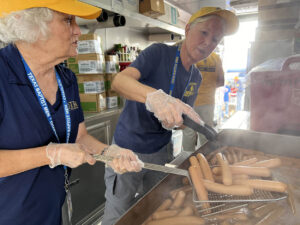
Texans on Mission volunteers Kathy Abney (left) and Terry Crabtree cook meals in Johnson City, Tenn., after Hurricane Helene. The Texas state feeding unit has been tasked with providing more than 2,000 meals a day. (Texans on Mission Photo / Ferrell Foster)

The Texans on Mission state feeding unit has been tasked with providing more than 2,000 meals a day in Tennessee, while flood recovery volunteers clean out water-soaked homes from the floods.

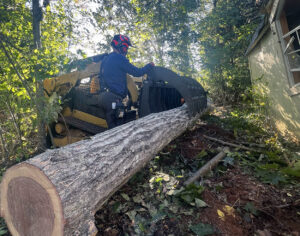
In North Carolina, Texans on Mission chainsaw teams are cutting and removing fallen limbs and trees in an area hit hard by the storm’s high winds.

“Helene left a trail of almost unbelievable destruction,” Texans on Mission Disaster Relief Director David Wells said. “It’s like each state is suffering from a Hurricane Katrina-like event.

“People are going to be without electricity in some places for weeks. They’re downtrodden and hopeless. We aim to help pick them back up, help them down the path toward recovery, and serve as reminders of God’s love.”

The storm’s damage is stretching the country’s crucial volunteer disaster relief structure as volunteers try to step up once again in a disaster-heavy 2024. Nearly every Southern Baptist disaster relief group is responding in some way, setting up a multitude of relief sites across the region.

Moving felled trees from homes is one of the major tasks facing Texans on Mission volunteers serving in North Carolina. (Texans on Mission Photo / John Hall)

An emerging nationwide network of Christians called the On Mission Network is resourcing and coordinating relief efforts in multiple areas, as well.

 “The Bible tells us we can do all things through Christ who gives us strength,” Wells said, noting this is Texans on Mission’s 15th major disaster relief deployment of the year.

“We’re seeing that in this response as God’s people respond to his call to minister. Texans on Mission volunteers are serving as the hands and feet of Christ to people in some of their most difficult days.”

‘Everyone has a role’

Texans on Mission volunteers operate heavy equipment to remove fallen trees from buildings in North Carolina. (Texans on Mission Photo / John Hall)

Texans on Mission expects to rotate volunteers in Tennessee and North Carolina for many weeks. Wells asked people to pray for those impacted by the storm and for those who are meeting needs. He also encouraged people to step out in faith and join the relief effort by volunteering.

“Everyone has a role in God’s kingdom,” Wells said. “Many people are being called to go serve right now. Some people are being called to give financially. We are all being called to pray for what’s happening from Florida to North Carolina and everywhere in between.”

For more information about how to support Texans on Mission Disaster Relief efforts following Hurricane Helene financially and how to volunteer, click here.


East Texas volunteers respond to Louisiana flooding

MORGAN CITY, La.—“Stop,” urged Chaplain Leslie Burch of the Texans on Mission Deep East Texas flood recovery team. “Can everybody stop and pray with me?”

She asked her fellow team members to halt their work as they tore out flooring in the home of Troy and Angel in Morgan City, La.

Texans on Mission’s Deep East Texas flood recovery team tear out water-damaged flooring from a home in Morgan City, La. (Texans on Mission Photo / Russ Dilday)

The couple’s home had been flooded during heavy rains that hit the Mississippi Delta town the week before as Hurricane Francine landed in southern Louisiana.

“Troy and Angel are talking about accepting Christ, and we need to pray for God’s Spirit,” Burch explained.

It was all she needed to say. The group left their scrapers, shovels and wheelbarrows, gathered in the living room, now an empty space with bare concrete floors, held hands and prayed for the young homeowners and their children.

Members of the Texans on Mission Deep East Texas disaster relief team pray with a couple in Morgan City, La., whose home was damaged by floodwaters caused by Hurricane Francine. (Texans on Mission Photo / Russ Dilday)

The Texans on Mission team was one of two that responded to Francine’s aftermath, joining partner groups from several other states to provide flood recovery and tree and debris removal after the violent storm.

Like many Texans on Mission teams, the Francine volunteers represented a mix of churches and backgrounds from throughout southeastern Texas.

Burch, a member of First Baptist Church of Orange, said the team came to “serve the needs” of the flood victims.

Team leader Mike Petigo of First Baptist Church in Nederland explained the team had been assigned to do flood recovery.

“We’re taking out sheetrock and disinfecting their homes so that survivors can get ready to put new sheetrock back in,” Petigo said.

For Steve Hammer of Covenant Church in Willis, the recovery efforts were about “getting it all cleaned out so these people can get on with their lives.

“We’re here today, about a week after the hurricane came through, and it’s important,” Hammer added. “We’re cleaning out houses now, because it gets nastier and nastier and nastier as time goes on.”

Pastor on the receiving end of ministry

Homeowners Tracey and Marci Smith were grateful for the team, who removed the lower two feet of their home’s sheetrock to ready it for replacement after flood waters seeped in and posed a mold danger.

It was especially meaningful for Tracey Smith, pastor of First Baptist Church of Morgan City, where the combined relief teams camped in Bible study rooms and ate in the fellowship hall.

Texans on Mission volunteers removed flood-damaged drywall from the home of Pastor Tracey Smith of First Baptist Church in Morgan City, La., and his wife Marci. (Texans on Mission Photo / Russ Dilday)

Smith has been involved in Louisiana Baptist disaster relief in previous hurricane recoveries, but after Francine flooded his home, he found himself on the receiving end of disaster response.

Taking a break from helping the Texas team tear out lower walls and treat for mold, he offered his perspective on the recent storm.

“Well, we’ve been through this before. We’ve been through Hurricanes Laura and Delta back in 2020. But we didn’t have flooding like this,” Smith said.

Smith rode out the flooding in his truck outside his home. Marci Smith said that as the water rose and came closer to their house, Tracey “sat in the truck with the two dogs” near his fishing boat in case he needed to “help our neighbors escape.” It was not needed, but he was ready to help.

Texans on Mission volunteers from Deep East Texas pray with Tracey and Marci Smith in Morgan City, La. (Texans on Mission Photo / Russ Dilday)

The Smiths’ own home became surrounded by an unbroken sea of water.

“It’s just kind of a hopeless feeling not being able to stop or prevent that from happening,” Tracey said.

The day after the storm, he said, the couple noticed the water “was migrating more and more throughout the house.

“So, we didn’t know to what degree we were going to have to remove the flooring or walls or anything like that,” he said. “It pretty much changes your routine and most definitely changes your way of life. You know that it’s not going to be back to what you would consider normal anytime soon.”

Tracey Smith has responded to other disasters, including Hurricane Ian in 2022 when he worked with Texas volunteers. So, he knew what to expect from the volunteers when they arrived.

“We knew the quality job” they would do, Tracey said. “We knew that they were going to be more than willing to do whatever we needed. And we were just glad to have them. … This is a good bunch.”


Settlement talks between SBC and Johnny Hunt fail

NASHVILLE (RNS)—Court-ordered mediation between a former Southern Baptist Convention president and lawyers for the nation’s largest Protestant denomination failed last week, meaning the dispute between the two parties likely is headed to a trial in November.

Johnny Hunt, a former Georgia megachurch pastor and denominational official who served as SBC president from 2008 to 2010, sued the denomination in 2023, alleging defamation.

Hunt was named in the Guidepost report on abuse in the SBC for allegedly sexually assaulting another pastor’s wife. He initially denied the incident and has since said it was consensual.

Lawyers for Hunt have claimed the former SBC president’s misconduct was a private matter and the SBC ruined his reputation by making it public.

On Sept. 19, the two sides met for a court-ordered mediation, which ended in an impasse, according to a report filed Sept. 24 with the U.S. District Court of the Middle District of Tennessee.

The lawsuit has cost the SBC’s Executive Committee about $3 million in legal fees so far. Those legal fees, along with about $9 million in fees related to the Guidepost report, led the Executive Committee to put its Nashville, Tenn., office building on the market.

Last week, current SBC President Clint Pressley tweeted that no settlement had been reached. The possibility of a settlement was raised during a recent Executive Committee meeting.

“Despite what you may be hearing, there is no settlement with Dr. Johnny Hunt,” Pressley tweeted on Thursday, the same day as the mediation.

The trial for the lawsuit is set to begin Nov. 12 in Nashville. Hunt’s lawyer recently petitioned the court to block the SBC from calling several witnesses, including Kevin Ezell, the president of the denomination’s North American Mission Board, at the trial.

After stepping down as pastor of First Baptist Church in Woodstock, Ga., Hunt served as a vice president at NAMB before resigning following the release of the Guidepost report in 2022.

No details of the settlement discussions were made public. However, earlier this year, lawyers for Hunt claimed more than $75 million worth of damages.

Those damages, according to court documents filed in the case, include a loss of $610,000 in annual income and benefits, a loss of $360,000 a year in book sales, a loss of $350,000 in speaking fees and an additional $80,000 in other lost income, for a total of $1.4 million a year. The lawyers also claim that Hunt intended to work for 11 years—or until he was 80—when the Guidepost report was published—for a total alleged loss of $15.4 million.  No supporting documents were included to substantiate those claimed losses.

The court filing also claims at least $30 million in reputational harm and at least $30 million in emotional distress

EDITOR’S NOTE: After the article originally was posted on Sept. 25, Religion News Service updated it to include the last three paragraphs with details of the settlement claim filed by Hunt’s lawyers.  This article was edited early morning on Sept. 26 to include those paragraphs. 


SBC may tighten faith statement amendment process

NASHVILLE (BP)—The Baptist Faith and Message soon could be more difficult to amend. That’s a good thing, said the Southern Baptist Convention messenger whose motion this summer in Indianapolis helped initiate the change.

“We have enough division in our denomination without the instability of our foundational confessional document,” said Chelsea McReynolds, the pastor’s wife and women’s ministry leader at Chandler (Okla.) Southern Baptist Church.

“If it is too easy to amend, our core doctrines could shift based on temporary trends or majority whims. Such fluidity could cause confusion among church members and undermine the theological foundations built by our forefathers.”

SBC messengers in Dallas next June will receive a recommendation from the convention’s Executive Committee to give the first of two required approvals to stiffen requirements for amending the Baptist Faith and Message, Southern Baptists’ confession of faith.

The Executive Committee voted Sept. 17 to recommend that messengers amend the SBC Constitution to require two-thirds votes at two consecutive SBC annual meetings to amend the Baptist Faith and Message—the same requirement that exists for amending the SBC constitution.

Triggered by two actions at 2024 SBC

Two actions at the 2024 SBC annual meeting in Indianapolis spurred the Executive Committee to consider Baptist Faith and Message amendments.

One was McReynolds’ motion that the convention require a two-thirds majority for all Baptist Faith and Message alterations. The other was a recommendation from the convention’s ad hoc Cooperation Group that “edits or amendments to The Baptist Faith & Message follow the same process as amendments to the Constitution (two-thirds vote, two consecutive years).”

Southern Baptists began discussing the process for Baptist Faith and Message amendments following a 2023 edit to the confession of faith that some viewed as hasty.

Last year, messenger Jared Cornutt, pastor of North Shelby Baptist Church in Birmingham, Ala., moved that the terms “elder” and “overseer” be listed as synonyms for pastor in Article 6.

The Committee on Order of Business believed the motion’s wording required that they schedule it for debate during that meeting. They did, and messengers voted to amend the Baptist Faith and Message as Cornutt suggested during the meeting’s final session on Wednesday afternoon.

Quick action could create complications

The quick amendment to a foundational document led many, including Cornutt, to raise questions.

“Amending our confession from the floor on a Wednesday afternoon, when our messengers are experiencing ‘delegate fatigue syndrome’ (credit to parliamentarian Al Gage), is like doing surgery on the dining room table with a pocketknife and a flashlight,” Cornutt wrote in a BP column.

“You might get the bullet out (or in this case, the benign tumor), but you’re taking a lot of risks along the way. And why take those risks when you have a team of experienced surgeons and a sterile operating room next door?”

Al Mohler, president of the Southern Baptist Theological Seminary, said the amendment helped clarify what Southern Baptists believe about the office of pastor, but he thought sudden changes to the Baptist Faith and Message could have a negative impact on SBC entities.

The entities include Baptist Faith and Message language in some employees’ contracts, he said, and need time to change legal and business documents.

A quick change could have “charter implications” as “SBC entities are fully accountable to the Baptist Faith and Message,” Mohler said.

Yet tightening the requirements for Baptist Faith and Message amendments is not just a matter of denominational polity, McReynolds said. It also affects local churches.

“Local church constitutions also utilize the BF&M to communicate their beliefs and as part of their governing documents,” she said. “Every change to the BF&M essentially requires each of our churches to personally accept or deny the change.

“There is already an issue in which edition of the BF&M one most closely aligns with. It is not unifying to further complicate the document over a foundationally insignificant change.”

The proposal for Baptist Faith and Message amendments will come before messengers during the Executive Committee report at the SBC annual meeting in Dallas, June 10-11, 2025.


SBC to create sexual abuse response department

NASHVILLE (BP)—Southern Baptist Convention Executive Committee trustees on Sept. 17 approved a recommendation to create a department within the Executive Committee to assist churches in the area of sexual abuse prevention and response.

Messengers voted at the 2024 SBC annual meeting in June for the Executive Committee to find a permanent home for sexual abuse prevention and response efforts in the SBC.

Executive Committee President and CEO Jeff Iorg began conversations with leaders in the Abuse Reform Implementation Task Force shortly after being nominated to his position. By the time of his election in May, those talks had been taking place for weeks.

“We have had two task forces that have done difficult and hard work,” he told the Executive Committee. “But it’s time to stop talking about what we’re going to do and take an initial, strategic step of action that puts into place an administrative response to this issue.”

As Iorg began his role, he said, the implementation task force decided to recommend to the SBC that the Executive Committee take the lead in identifying the best place within the Southern Baptist structure to address ongoing sexual abuse prevention and response. The real work for that goal began after messengers approved the recommendation.

Leaders considered placing the responsibility with an existing SBC entity or creating a new entity, Iorg said. The decision to create a new department in the Executive Committee was determined to be the best option “to get us proactively started on implementing sexual abuse prevention and response across our denomination work,” Iorg said.

Send Relief gift to provide initial funds

Initial funding for the new department will be drawn from the remaining funds given by Send Relief in 2022 to go toward implementing sexual abuse reforms in the SBC. SBC Executive Committee CFO Mike Bianchi said about $1.8 million remains of the initial $3 million.

Iorg said an immediate step would be hiring a national director of sexual abuse prevention, who would recommend additional staff for the ministry.

Trustee Brian Cloys asked during open discussion why the role wasn’t given to the Ethics & Religious Liberty Commission, saying the entity seemed to be better suited for the role within its ministry assignment.

Iorg responded that prior to his becoming president, the Abuse Reform Implementation Task Force had held discussions with the ERLC. Both determined, Iorg said, “that it was not the most workable solution at the time.”

After becoming Executive Committee president, Iorg continued conversations with the ERLC on the matter.

“They are very open to helping us with this process and want to be a team member with us,” he told trustees. Currently, though, the Executive Committee is better suited for the role, he said.

Iorg went on to say, however, that different conditions in the future wouldn’t necessarily prevent the ERLC from taking on a more active role.

Cloys also asked about any connection between the announcement regarding the new department and the Abuse Response Commission, a new organization announced at February’s Executive Committee meeting.

“That organization was not authorized by the Southern Baptist Convention, doesn’t belong to the Southern Baptist Convention and therefore we cannot give any responsibility to it as the Executive Committee,” Iorg said. “It can only take its own responsibility in making its own decisions.

“That’s not to criticize them, but to draw a distinction. [The Abuse Response Committee] does not belong to us, so we have no comment or directive that can be given by the Executive Committee of ARC.”

Some flexibility will be necessary, he said.

“This is not the final step by any means, but it is the first step,” Iorg said. “If we conclude as the months and years go by that this needs to be moved to another entity, it can be done. If we conclude it needs a separate entity, that can also be done.

“Things can still evolve out of this initial decision. But this decision starts us on a path—a concrete, specific action and is a workable solution, or at least the beginning point of one.”


SBC legal expenses surpass $12M in three years

NASHVILLE (BP)—The Southern Baptist Convention Executive Committee reported it has spent more than $12.1 million on the 2021-2022 Guidepost Solutions investigation into its handling of sexual abuse claims and subsequent legal expenses dating back to 2021.

To cover expenses and operating costs moving forward, the Executive Committee voted in executive session at its September meeting to authorize President Jeff Iorg to execute a loan secured by the SBC Executive Committee building and place the Nashville building on the market.

The release of the detailed financial information was the result of a motion adopted by messengers at this summer’s SBC annual meeting.

Executive Committee Finance Committee Chair Adam Wyatt told Baptist Press the funds to cover legal expenses have been taken from the Executive Committee’s reserve funds to “protect Cooperative Program dollars” even though the original motion adopted by messengers at the 2021 SBC annual meeting approved the use of Cooperative Program dollars for the review.

The numbers show the Executive Committee has “done everything in our power to take the burden on ourselves to protect the Cooperative Program and the work of the convention and its entities,” Wyatt said. “And it is our effort of trying to just be as transparent and clear about where we really are.”

The expense breakdown given to the Executive Committee shows:

  • The total cost of the Guidepost Investigation was $3.1million.
  • $2 million was paid directly to Guidepost to conduct the investigation.
  • Legal and task force expenses totaled $1.1 million.
  • The Executive Committee has paid $3.1 million to indemnify Guidepost.
  • The cost of the abuse tipline hosted by Guidepost has been $861,000. This expense has been reimbursed by Send Relief.

Other legal expenses include:

  • Litigation and case management: $2.4 million
  • U.S. Department of Justice investigation: $2 million
  • General counsel: $571,000
  • Post investigation legal support: $131,000

Messengers to the 2021 SBC annual meeting in Nashville approved a motion calling for an independent, third-party investigation into alleged mishandling of sexual abuse claims by the Executive Committee over a period of 20 years.

The motion also called for the creation of a Sexual Abuse Task Force to oversee the third-party investigation and bring recommendations to the 2022 SBC annual meeting.

That task force retained Guidepost to conduct the investigation, and the contract signed included a clause indemnifying Guidepost of any legal expenses resulting from its investigation.

The report from the investigation was released in May 2022. An investigation of the SBC by the Department of Justice was announced in July 2022.

Two men named in the Guidepost report later sued both Guidepost and the SBC for defamation—former Georgia pastor and SBC president Johnny Hunt and former Southern Baptist Theological Seminary professor David Sills.

The Hunt suit in particular has made up the lion’s share of litigation expenditures thus far, Wyatt told Executive Committee members Tuesday.

One of the recommendations of the Sexual Abuse Task Force at the 2022 SBC annual meeting was the formation of the Abuse Response Implementation Task Force. The implementation task force functioned from September 2022 until the 2024 SBC annual meeting in Indianapolis.

In its final report to messengers this past June, the Abuse Response Implementation Task Force recommended the Executive Committee find a permanent home for sexual abuse response and prevention in the SBC.

The Executive Committee took first steps toward that end Sept. 17 by adopting a recommendation from its officers to form a new department within the Executive Committee.

Seeking to be ‘fully transparent’

SBC Executive Committee CFO Mike Bianchi told Baptist Press the Executive Committee is striving to be “fully transparent of how we got here, and we want to be equally transparent of where we’re going.”

“We want to bring all the partners, all the entirety of the SBC into that discussion of where we’re going,” Bianchi said.

Chairman Philip Robertson reported Executive Committee members acted during an executive session to help cover the entity’s expenses and operating costs.

The Southern Baptist Convention Executive Committee building in Nashville, Tenn. (Baptist Press Photo)

“To meet the EC’s operational and legal expenses, the Executive Committee has authorized the president to execute a loan secured by the building and place the SBC building on the market,” Robertson said.

The Executive Committee discussed the potential sale of the SBC building in Nashville during its September 2023 meeting.

At the 2017 SBC annual meeting, messengers authorized the Executive Committee to “continue studying the advisability of a sale of the SBC Building, and to sell the property upon such terms and conditions, and at such a time, if any, as the Executive Committee may hereafter approve.”

The building is home to the Executive Committee, the Ethics & Religious Liberty Commission, SBC Seminary Extension, the Southern Baptist Historical Library and Archives and the Southern Baptist Foundation.

Proceeds would be divided among them:

  • The Executive Committee holds a 56 percent interest.
  • The Ethics & Religious Liberty Commission holds a 14 percent interest.
  • The Council of Seminary Presidents holds a 26 percent interest. This is composed of a 10 percent interest for Seminary Extension Education and 16 percent for the Southern Baptist Historical Library and Archives.
  • The Southern Baptist Foundation holds a 4 percent interest.

The Executive Committee’s next scheduled meeting is Feb. 19-20, 2025, in Nashville.